
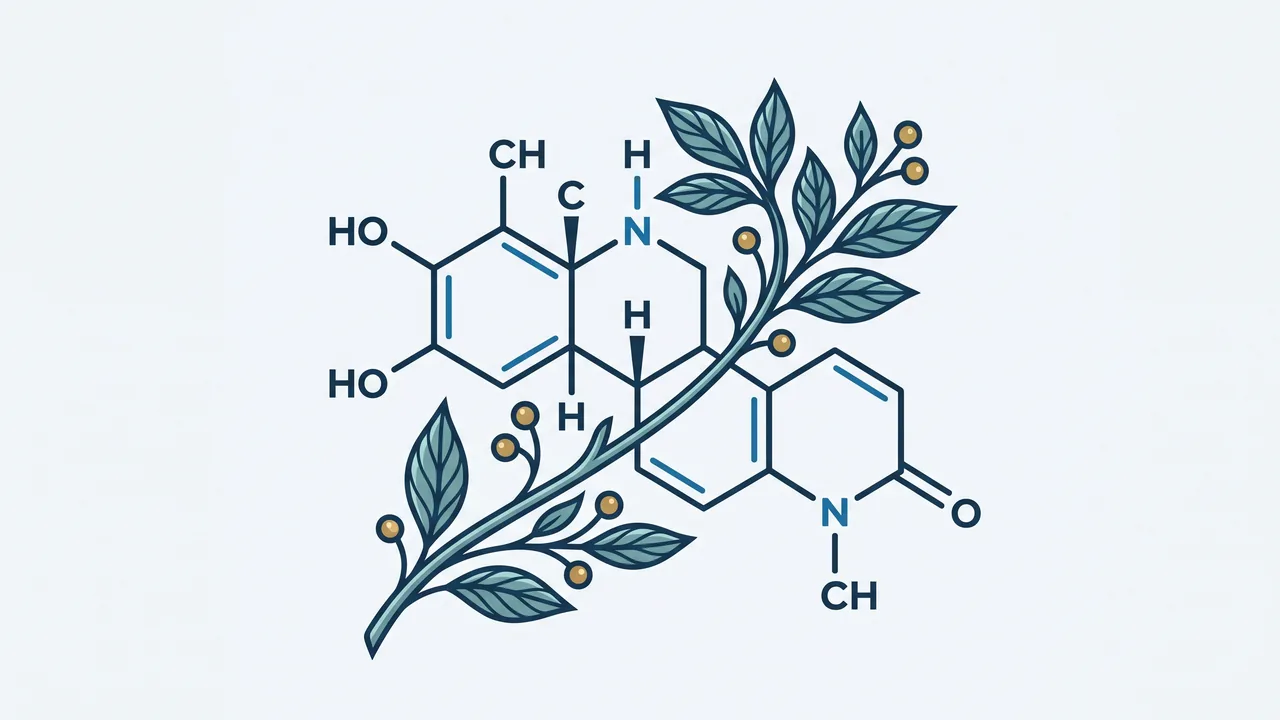
Berberine
Botanical extracts and whole herbs. A research review published by South Beach Longevity.
Berberine
Metabolic pharmacology, human evidence and safety: where the metformin analogy holds, and where it failsBerberine is a protoberberine alkaloid sold as a glucose- and lipid-lowering nutrient and often branded nature's metformin. The chemistry is old and the human metabolic literature is large, geographically concentrated, and mostly short. Oral bioavailability is poor. Gut conversion, AMPK hypotheses, and surrogate metabolic shifts are not metformin-equivalence. This article keeps those layers apart. It is a research review. It is not medical advice.
Compiled by South Beach Longevity · 20 August 2026 Copyright 2026 Series SBL-41 / SP-BERBERINE · Register A scientific article Sources peer-reviewed cell, animal, and human studies; LiverTox; trial-registry records; labelled reviews · verified NCBI records Constraint This document describes published research. It is not medical advice. No human use, dose, route or schedule is recommended anywhere in this document.
How to read this document Every finding is labelled, in the sentence that reports it, by the kind of study that produced it. A Coptis root is not a capsule. A rat first-pass extraction is not a human pharmacokinetic curve. An AMPK blot is not an HbA1c. A three-month Chinese RCT is not UKPDS. A dihydroberberine pilot in five men is not a formulation proof. Amounts appear only as reported experimental or registry parameters, always with the population attached. Nothing here is a recommendation. Findings are graded in place as established, strongly supported, emerging, plausible, or speculative. Two further labels mark careful absences rather than verdicts: not established, where the evidence is too thin to place a claim on the ladder at all — untested or insufficient, an absence of proof rather than disproof; and not supported, where the weight of evidence leans against a claim but stops short of a formal refutation. Cellular data, animal data, human biomarkers, and clinical outcomes are kept in separate sentences.
01 What this document is, and five things it is not
This is a South Beach Longevity scientific article on berberine as a metabolic object. It is a research review. It is not a Radix peptide title, not a Project 05 record, and not a product article.
Five refusals travel with every later section. They are reading rules, not a table of contents. A later section that forgets one of them has left the argument.
It is not a botanical encyclopaedia. Several plants contain the same cation. The cation is the object unless a named extract is the trial material.
It is not a metformin label. Shared mitochondrial targets do not transfer regulatory status, oral bioavailability, pregnancy data, or cardiovascular outcome trials.
It is not a dose schedule. Product labels and trial regimens are reported as published parameters. They are not instructions.
It is not a collapse of dihydroberberine, phytosomes, nanoparticles, or berberine–silymarin combinations into “berberine.” Each formulation is a separate object (Part Four).
It is not a claim that short-term surrogate movement is absent. The human glycaemic and lipid record is real, geographically concentrated, and methodologically thin. That combination is the problem this article is written to keep visible.
02 Botanical sources
Berberine is a plant alkaloid, not a synthetic first-in-class. LiverTox names high concentrations in Hydrastis canadensis (goldenseal), Coptis chinensis (coptis or goldenthread), Berberis aquifolium (Oregon grape), Berberis vulgaris (barberry), and Berberis aristata (tree turmeric). Those taxa are established as botanical sources. They are not interchangeable products. Goldenseal is a North American Ranunculaceae root. Huanglian is a Chinese Coptis rhizome. Barberry is a Berberidaceae berry and bark. A trial that used “berberine chloride” used a salt. A trial that used a Coptis decoction used a mixture.
Reviews repeat the same genera (Berberis, Coptis, Hydrastis) and add Phellodendron as a traditional source of the alkaloid used in Chinese adjuvant practice (Lan, Zhao, Dong, Yan, Zheng, Fan, and Sun, 2015; Habtemariam, 2020). Source identity matters because contamination, substitution, and undeclared alkaloids travel with the plant, not with the PubChem record.
03 Alkaloid chemistry
Berberine is a quaternary protoberberine isoquinoline cation. PubChem lists it as CID 2353, molecular formula C20H18NO4+, molecular weight 336.4, InChIKey YBHILYKTIRIUTE-UHFFFAOYSA-N, CAS 2086-83-1. The charge is established. It is the first pharmacokinetic fact, not a decoration. A permanent cation does not passively cross epithelium the way a neutral drug does.
The common oral salt is berberine chloride. PubChem distinguishes the cation from the chloride. Commercial labels that print “berberine HCl 500 mg” are naming a salt mass, not a free-base equivalent, and not a plasma exposure. Dihydroberberine is a reduced, more lipophilic congener (Part Four). It is not the same compound.
Older names include umbellatine. They do not change the structure. They do change retrieval. This article uses berberine for the cation and names the salt or the reduced form when a paper does.
04 Oral bioavailability
Poor oral bioavailability is strongly supported in animals and is the load-bearing constraint on every later human claim.
Liu, Hao, Xie, Lai, Wang, Liu, and Wang (2010) used four dosing routes in rats. After intragastric dosing, approximately half the dose ran intact through the gastrointestinal tract and another half was disposed of by the small intestine. Absolute oral bioavailability was 0.36%. Hepatic tissue exposure exceeded plasma by about seventy-fold on area-under-the-curve. That paper is rat pharmacokinetics. It is not a human bioavailability study. It is the clearest published account of why plasma levels stay low while tissue and metabolite stories grow.
Chen, Miao, Fan, Yang, Lin, Meng, and Tang (2011) reported an absolute bioavailability of 0.68% in rats at 100 mg kg−1 oral versus 1.0 mg kg−1 intravenous, and showed that D-α-tocopheryl polyethylene glycol 1000 succinate (TPGS) raised Cmax 2.9-fold and AUC0–36 1.9-fold, consistent with P-glycoprotein interference. Again, rats.
Khoshandam, Imenshahidi, and Hosseinzadeh (2022), reviewing Berberis vulgaris pharmacokinetics, restated oral bioavailability as less than 1%, with demethylenation, reduction, and dioxymethylene cleavage in phase I and glucuronidation, sulfation, and methylation in phase II. Fecal excretion (11–23%) exceeded urinary and biliary routes. A review is a map. The primary rat numbers are the evidence.
Human plasma concentrations after ordinary oral doses sit in the low nanogram-per-millilitre range when they are measured at all. Feng, Zhao, Ma, Guo, Wang, and Jiang (2018) reported a Cmax of 36.88 ± 23.45 ng/mL in beagle dogs after 50 mg/kg oral berberine. Moon, Ratliff, Hagele, Stecker, Mumford, and Kerksick (2021) measured human Cmax of 0.4 ± 0.17 ng/mL after 500 mg berberine in five men. Those two sentences are different species and different doses. Together they support one claim: oral berberine does not produce a metformin-like plasma curve.
05 Gut conversion to dihydroberberine
The gut is not a footnote. Feng, Shou, Zhao, He, Ma, Huang, Fu, Tan, Li, Wen, Chen, and Yang (2015) showed, in animals, that intestinal bacteria reduce berberine to dihydroberberine via nitroreductases; dihydroberberine had an intestinal absorption rate five-fold that of berberine; and the reduced form re-oxidized to berberine in intestinal tissue by a heat-stable, non-enzymatic process. Antibiotic diminution of the flora decreased the conversion and reduced lipid- and glucose-lowering efficacy in KK-Ay mice. That paper is strongly supported as a pharmacokinetic mechanism in animals. It is not a human outcome trial.
Feng, Zhao, Ma, Guo, Wang, and Jiang (2018) then described gut-microbiota-regulated pharmacokinetics in beagle dogs. Dihydroberberine was not detected in plasma; small amounts appeared in faeces; butyrate rose after seven days; nitroreductase- and butyrate-producing taxa increased; eleven phase I/II metabolites were catalogued. Dogs are not patients. The paper is the cleanest non-rodent confirmation that the absorbable reduced form is a microbial product and that circulating berberine remains low.
Habtemariam (2020) reviewed the same hidden-organ argument: structural and numerical microbiota changes under pathology are reversed by berberine in several disease models, which is a way to explain systemic effects despite poor plasma levels. That is a review inference. Microbiome change can be a mechanism, a confounder, or both. PREMOTE later tested a piece of it in people (section 10).
06 P-glycoprotein and first-pass metabolism
Pan, Wang, Liu, Fawcett, and Xie (2002) showed, in rat perfusion, everted-sac, Ussing-chamber, and Caco-2 systems, that P-glycoprotein inhibitors improved berberine absorption about six-fold and that serosal-to-mucosal transport exceeded the reverse direction. P-gp contribution to poor intestinal absorption is strongly supported in those models.
Qiu, Jiang, Liu, Ju, and Jin (2009) pretreated rats with berberine and then dosed carbamazepine (CYP3A substrate), digoxin (P-gp substrate), and cyclosporine A (dual). Carbamazepine kinetics did not change. Intravenous digoxin did not change. Oral digoxin AUC rose in a dose-dependent manner (133% and 170% of control after single 30 and 100 mg/kg berberine). Oral cyclosporine AUC and Cmax rose 62% and 43% (30 mg/kg) and 96% and 60% (100 mg/kg) after two weeks. The authors concluded that berberine increased oral digoxin and cyclosporine bioavailability by inhibiting intestinal P-gp, without a detectable CYP3A change in that design. That is a rat interaction study. It is the reason later safety sections refuse to treat berberine as a metabolically silent botanical.
Murakami, Bodor, and Bodor (2023) re-analysed published rat bioavailability and concluded that oral exposure is limited by CYP-mediated intestinal first-pass, low solubility plus P-gp efflux, and hepatic first-pass, with active metabolites generated in the gut. Their paper is a physicochemical review. It does not replace Liu 2010 or Chen 2011. It names the same bottleneck.
07 Complex I and AMPK
Turner, Li, Gosby, To, Cheng, Miyoshi, Taketo, Cooney, Kraegen, James, Hu, and Li (2008) is the mechanistic paper the metformin analogy actually rests on. In L6 myotubes and isolated muscle mitochondria, berberine dose-dependently inhibited respiration at complex I, similar to metformin and rosiglitazone. AMPK phosphorylation did not require LKB1 or CAMKKβ. Dihydroberberine showed improved in-vivo efficacy against adiposity, tissue triglyceride, and insulin resistance in high-fat-fed rodents, attributed to better oral bioavailability. That is strongly supported as cell and rodent pharmacology. It is not a human AMPK biopsy study. It is not a demonstration that circulating berberine reaches myocyte mitochondria at the concentrations used in dishes.
Yin, Gao, Liu, Liu, and Ye (2008) reported that berberine increased insulin sensitivity in dietary obese rats (fasting insulin −46%, HOMA-IR −48%) and induced glycolysis in cell lines, with AMPK activation secondary to mitochondrial inhibition. Xu, Xiao, Yin, Hou, Yu, Shen, Liu, Wei, and Jia (2014) then showed that berberine still increased glucose consumption and lactate release when AMPK was blocked by Compound C, siRNA, or dominant-negative AMPKα, while complex I activity was almost fully blocked. Metformin behaved similarly. The glucose-consumption effect is therefore strongly supported as AMPK-independent glycolysis downstream of complex I inhibition in those cells. AMPK activation remains real. It is not necessary for the dish phenotype.
Those cell systems are not human vastus lateralis. They are the systems in which the AMPK story can be turned on and off.
Xiao, Xu, Alimujiang, Bao, Wei, and Yin (2018) reported bidirectional AMPK regulation: high-to-moderate glucose activated AMPK and berberine or metformin abolished that activation; normal-to-moderate glucose suppressed AMPK and the same agents restored it. Both agents still increased glucose consumption and lactate under all preincubation conditions. AMPK is therefore a context-sensitive reporter, not a master switch that licenses every metabolic claim.
08 Glucose metabolism without assuming AMPK necessity
Yin, Hu, Chen, Tang, Li, Yang, and Chen (2002) compared berberine with metformin and troglitazone for glucose consumption in HepG2 cells. At 11.1 mmol/L glucose, berberine 5 × 10⁻⁶ to 1 × 10⁻⁴ mol/L increased consumption 32% to 60%, comparable to 1 × 10⁻³ mol/L metformin. That is cell culture. The concentrations are not plasma concentrations.
The human glucose literature is Part Three. The mechanistic permission for it is complex I inhibition plus intestinal and hepatic first-pass, not a proven myocyte AMPK activation in patients.
09 Lipids and the LDL-receptor mRNA
Kong, Wei, Abidi, Lin, Inaba, Li, Wang, Wang, Si, Pan, Wang, and Wu (2004) is the lipid paper that launched the modern metabolic story. Oral berberine in 32 hypercholesterolemic patients for three months reduced serum cholesterol 29%, triglycerides 35%, and LDL-cholesterol 25%. In hamsters, cholesterol fell 40% and LDL-C 42%, with hepatic LDL-receptor mRNA up 3.5-fold and protein 2.6-fold. In hepatoma cells, upregulation was SREBP-independent, ERK-dependent, and post-transcriptional via mRNA stabilization through the 3′ UTR. The mechanism is strongly supported as distinct from HMG-CoA-reductase inhibition. The human arm is an open 32-person series, not a blinded RCT. It is emerging as a human lipid signal and not a statin-equivalent outcome trial.
Zhu, Bian, Wang, Sun, Xu, Yan, Xia, Chang, Lu, Li, Xia, and Li (2019) attributed murine NAFLD improvement to AMPK–SREBP-1c–SCD1 suppression of triglyceride synthesis. That is a mouse liver paper. It does not convert Kong’s 3′ UTR result into a fibrosis endpoint.
10 Microbiome as a pharmacokinetic organ
Zhang, Gu, Ren, Wang, Zhong, Zhao, Ma, Gu, Xue, Huang, Yang, and Chen (2020) — PREMOTE, NCT02861261 — is the largest modern human trial that treats the gut as a mechanism rather than a side-effect site. Four hundred nine newly diagnosed type 2 diabetes patients at twenty Chinese centres were randomized 1:1:1:1 to berberine alone, probiotics plus berberine, probiotics alone, or placebo for twelve weeks after a one-week gentamicin run-in. HbA1c change (least-squares mean) was −1.04% (probiotics+BBR) and −0.99% (BBR alone) versus −0.59% (placebo) and −0.53% (probiotics alone), P < 0.001 for the berberine-containing arms versus the others. Metagenomics implicated inhibition of deoxycholic-acid biotransformation by Ruminococcus bromii. Gastrointestinal side effects were more common with berberine. That trial is strongly supported as a short, multicenter, placebo-controlled glycaemic study in newly diagnosed Chinese adults. It is not a cardiovascular outcome trial. The gentamicin run-in is a design choice that complicates a clean microbiome baseline. Probiotics alone did not beat placebo.
11 Hepatic effects
Two hepatic stories must not be merged.
The first is pharmacology: high hepatic extraction (Liu 2010), LDL-receptor mRNA stabilization (Kong 2004), and rodent steatosis models (Zhu 2019; Guo, Shen, Wang, Luo, Zhang, Zhang, Gao, Han, and Jiang, 2023). Guo 2023 reported that in high-fat-diet hamsters and/or ApoE−/− mice, berberine and metformin had nearly identical effects on fatty liver, inflammation, and atherosclerosis, with berberine appearing stronger on lipids and obesity and metformin stronger on glucose, via distinct microbiota and bile-acid patterns. That is animal comparative pharmacology. It is the cleanest modern paper that both invites and limits the metformin analogy.
The second is injury. LiverTox (updated 6 October 2020; NBK547852) assigns likelihood score E — unlikely cause of clinically apparent liver injury — and reports no published cases attributed to berberine in UNOS transplant series, Spanish DILI, US ALF, DILIN, or Teschke compilations. Asbaghi, Ghanbari, Shekari, Reiner, Amirani, Hallajzadeh, Mirsafaei, and Asemi (2020) found no significant ALT or AST change in a twelve-trial anthropometric meta-analysis. Absence of attributed cases is strongly supported as a LiverTox reading. It is not a demonstration that every commercial product is liver-safe, because products are not the alkaloid. A goldenseal capsule, a Coptis decoction, and a labelled berberine chloride tablet do not share an impurity profile. The E score attaches to the named alkaloid in the reviewed literature, not to the aisle.
12 “Nature’s metformin”: where the analogy holds
The phrase is marketing. The analogy has a real core and a hard edge.
It succeeds at four scientific points. Both compounds inhibit mitochondrial complex I in muscle preparations (Turner 2008; Xu 2014). Both can activate AMPK as a consequence of energetic stress, and both can still move glucose consumption when AMPK is blocked (Xu 2014). Both have been compared, in small human cells, as oral glucose-lowering agents (Yin, Xing, and Ye, 2008). Both perturb gut microbiota in ways that may contribute to the measured effect (PREMOTE; Guo 2023).
It fails at six points that decide what a clinician or a regulator actually has. Metformin’s oral bioavailability is not sub-1%. Metformin has decades of Western multicenter evidence, including UKPDS, a defined renal contraindication, a characterized lactic-acidosis risk, and a pregnancy evidence base that is imperfect but large. Berberine has P-gp and CYP interaction potential (Qiu 2009; Khoshandam 2022), a neonatal bilirubin-displacement file (Chan, 1993), product heterogeneity, and no cardiovascular outcome trial. Yin, Xing, and Ye (2008) randomized 36 newly diagnosed adults for three months; that is not a metformin-equivalence study. Dong, Wang, Zhao, and Lu (2012) and Lan and colleagues (2015) already warned that the diabetes metas rest on low methodological quality. Liang, Xu, Yin, Zhang, Huang, Chen, and Ni (2019) found the pooled glycaemic effect became unremarkable beyond 90 days, above 2 g/day, and after age 60. A drug whose pooled signal fades on those cuts is not metformin. The phrase survives because it is short. The evidence does not get shorter to match it.
Guo 2023’s title — “a potential alternative for metformin with good regulatory effect on lipids” — is an animal-and-mechanism sentence. This article does not promote it to a human substitution claim.
13 Type 2 diabetes
Two 2008 papers still carry the commercial claim.
Yin, Xing, and Ye (2008) ran a pilot. Study A randomized 36 newly diagnosed adults to berberine or metformin, 0.5 g three times daily, for three months. In the berberine arm, HbA1c fell from 9.5% ± 0.5% to 7.5% ± 0.4%, fasting glucose from 10.6 ± 0.9 to 6.9 ± 0.5 mmol/L, postprandial glucose from 19.8 ± 1.7 to 11.1 ± 0.9 mmol/L, and triglycerides from 1.13 ± 0.13 to 0.89 ± 0.03 mmol/L. The authors called the hypoglycaemic effect similar to metformin. Study B added berberine for three months in 48 poorly controlled patients; HbA1c fell from 8.1% ± 0.2% to 7.3% ± 0.3%; fasting insulin and HOMA-IR fell 28.1% and 44.7%. Twenty of 58 exposed patients (34.5%) had transient gastrointestinal effects. No functional liver or kidney injury was observed. This is emerging as a short, small, single-centre comparison. It is not a metformin-equivalence trial. Baseline HbA1c near 9.5% magnifies absolute change.
Zhang, Li, Zou, Liu, Yang, Zhu, Huo, Wang, Hong, Wu, Ren, and Ning (2008) randomized 116 patients with type 2 diabetes and dyslipidemia to berberine 1.0 g daily or placebo for three months. Fasting glucose fell from 7.0 ± 0.8 to 5.6 ± 0.9 mmol/L, post-load glucose from 12.0 ± 2.7 to 8.9 ± 2.8 mmol/L, HbA1c from 7.5% ± 1.0% to 6.6% ± 0.7%, triglycerides from 2.51 ± 2.04 to 1.61 ± 1.10 mmol/L, total cholesterol from 5.31 ± 0.98 to 4.35 ± 0.96 mmol/L, and LDL-C from 3.23 ± 0.81 to 2.55 ± 0.77 mmol/L, all differing from placebo. Glucose disposal rate rose within the berberine arm (P = 0.037) but not versus placebo (P = 0.063). Five participants had mild-to-moderate constipation. This is the strongest early placebo-controlled metabolic RCT in the reviewed record. It remains a three-month Chinese trial of a poorly characterized oral alkaloid.
Later metas enlarge the n and do not enlarge the quality. Dong, Wang, Zhao, and Lu (2012): 14 randomized trials, 1,068 participants; methodological quality generally low; berberine plus lifestyle beat lifestyle; berberine versus oral hypoglycaemics did not show significantly better glycaemic control; combinations looked better; no serious adverse effects reported. Lan and colleagues (2015): 27 RCTs, 2,569 patients, Chinese and English databases; berberine with lifestyle tended to lower FPG, PPG, and HbA1c versus lifestyle or placebo; combination with oral hypoglycaemics beat the same hypoglycaemic; berberine versus oral hypoglycaemics was not statistically different. Liang and colleagues (2019): 28 studies, 2,313 patients; FPG WMD −0.54 mmol/L (95% CI −0.77 to −0.30), PPG −0.94 (−1.27 to −0.61), HbA1c −0.54 (−0.93 to −0.15); the effect became unremarkable after 90 days, above 2 g/day, and after age 60. Those three metas are strongly supported as descriptions of a short-term surrogate literature with low trial quality. They are not confirmatory phase-3 programmes.
PREMOTE (Zhang 2020) is the quality step-change: multicenter, placebo-controlled, 409 newly diagnosed patients, twelve weeks, HbA1c about −1.0% on berberine-containing arms versus −0.5% to −0.6% on placebo or probiotics. Still China. Still twelve weeks. Still no microvascular or macrovascular primary.
14 Prediabetes and insulin resistance
Insulin-resistance indices move in several of the diabetes and PCOS papers (Yin 2008 study B; Zhang 2008 clamp; Wei 2012; An 2014). A dedicated, adequately powered prediabetes outcome literature — progression to diabetes, as in the Diabetes Prevention Program for metformin — is not in this review as a completed, independently replicated programme. Li, Ma, Zhang, Kuang, Ng, Hou, and Wu (2013) published a protocol (NCT01138930) for a multicenter, randomized, placebo-controlled, double-blind clamp study of insulin action in PCOS; that is a protocol, not a result. HOMA-IR changes in small open or single-centre cells are emerging as metabolic signals and speculative as prevention claims.
15 Dyslipidemia
Kong 2004 remains the mechanistic opening. Dong, Zhao, Zhao, and Lu (2013): 11 RCTs, 874 adults; quality generally low; TC −0.61 mmol/L (95% CI −0.83 to −0.39), TG −0.50 (−0.69 to −0.31), LDL-C −0.65 (−0.76 to −0.54), HDL-C +0.05 (0.02 to 0.09). Ju, Li, Lin, and Xu (2018): 16 trials, 2,147 participants; high clinical heterogeneity; majority low quality on sequence generation, concealment, blinding, and incomplete data; TC −0.47 mmol/L, LDL-C −0.38, TG −0.28; HDL-C rose when berberine was used alone (+0.08). Zhao, Yang, Du, Yang, and Wu (2020) reached a similar lipid direction in 25 Chinese/English trials (3,042 cases) and found no significant difference in adverse-event incidence versus controls.
The lipid signal is strongly supported as a short-term, heterogeneous, low-quality RCT literature with a consistent LDL-C and triglyceride direction. It is not a statin-outcome literature. It is not independent of the same geographic concentration that weights the diabetes metas.
Fogacci, Grassi, Rizzo, and Cicero (2019) meta-analysed five double-blind placebo RCTs of berberine plus silymarin (497 subjects): TC −25.3 mg/dL, TG −28, LDL-C −29.1, HDL-C +6, FPG −7.5 mg/dL. That is a combination product. It is not berberine. It is filed under formulation (section 23).
16 Body weight
Asbaghi and colleagues (2020): 12 RCTs; body weight −2.07 kg (95% CI −3.09 to −1.05), BMI −0.47 kg/m2, waist circumference −1.08 cm, CRP −0.42 mg/L; ALT and AST unchanged. Those are modest surrogate changes in mixed metabolic populations. They are not obesity-outcome trials. They are not GLP-1-comparator trials. Ilyas, Perna, Al-Thawadi, Alalwan, Riva, Petrangolini, Gasparri, Infantino, Peroni, and Rondanelli (2020) reviewed weight-loss claims and mixed preclinical doses with human 300–1,000 mg/day reports; a narrative review is not a weight-loss registration programme.
PREMOTE did not publish weight as its primary. Wei 2012 reported waist and WHR advantages versus metformin in PCOS. An 2014 reported BMI reduction versus metformin before IVF. Weight is a frequent secondary. It is not an established anti-obesity indication.
17 PCOS
PCOS is the one reproductive file large enough to discipline the metformin analogy.
Wei, Zhao, Wang, Sui, Liang, Deng, Ma, Zhang, Zhang, and Guan (2012) randomized 89 Chinese women with PCOS and insulin resistance to berberine+CPA, metformin+CPA, or placebo+CPA for three months. Versus metformin, berberine showed greater reductions in waist, WHR, TC, TG, and LDL-C, and greater increases in HDL-C and SHBG. Versus placebo, metabolic and androgen-related indices moved. This is a short, three-arm, CPA-background trial. It is emerging.
An, Sun, Zhang, Liu, Guan, and Lu (2014) randomized 150 infertile PCOS women to berberine, metformin, or placebo for three months before IVF. Both active arms reduced androgens, glucose, insulin, and HOMA-IR and increased SHBG versus placebo, raised pregnancy rate, and reduced severe OHSS. The authors reported more live births and fewer gastrointestinal events with berberine than metformin, plus BMI and lipid advantages. That live-birth claim is a secondary in a 150-person, single-centre IVF programme. It is emerging and has not been the field’s last word.
Wu, Wang, Liu, Liang, Xue, Ma, Shao, Ng, and the Reproductive and Developmental Network in Chinese Medicine (2016) is the paper that stops the aisle. Six hundred forty-four infertile women with Rotterdam PCOS were randomized 1:1:1 to letrozole, berberine 1.5 g daily, or both, double-blind, for up to six months. Cumulative live births were 36% (letrozole), 34% (combination), and 22% (berberine). Berberine did not add fecundity to letrozole. That result is strongly supported. It is the largest reproductive RCT in this review. It is the opposite of a substitution claim.
Li, Zhou, and Li (2018) meta-analysed nine RCTs of PCOS-IR and found no significant difference between berberine and metformin on insulin resistance or glycolipid or reproductive endocrine indices, with insufficient data for firm conclusions. Xie and colleagues (2019): 12 RCTs; live birth similar to placebo or metformin and lower versus letrozole (RR 0.61, 95% CI 0.44 to 0.82); testosterone and LH/FSH fell versus placebo or no treatment; waist and WHR favoured berberine versus metformin without a BMI difference. Ha and Song (2024) pooled 10 RCTs (713 patients) of berberine as adjuvant to Western medicine and reported higher ovulation and clinical pregnancy rates — an adjuvant literature, not a monotherapy proof, and heavily Chinese.
Rondanelli and colleagues (2023) tested a berberine phytosome in a controlled, randomized, multicentric, open-label PCOS trial. Open-label phytosome is a formulation study. It does not rescue Wu 2016.
18 MASLD / NAFLD
Human NAFLD/MASLD evidence is thinner than the rodent AMPK–SREBP file. A 2024 systematic review and meta-analysis (PMID 38429794) evaluated efficacy and safety in NAFLD and is cited as a review of generally small trials, not as a fibrosis-regression programme. Zhu 2019 and Li, Chen, Gong, Liu, Zhang, Wang, Zhang, and Han (2025) are mouse or cell combination papers (the latter reports metformin–berberine synergy on AMPK–SREBP1–FASN). They are not MASLD outcome trials. Guo 2023’s hamster fatty-liver result is animal. This article grades human histologic or elastographic NAFLD benefit as emerging at most, and as not established.
19 Cardiovascular markers
Beba, Djafarian, and Shab-Bidar (2019): five RCTs; CRP −0.64 mg/L (95% CI −0.67 to −0.61), I2 = 0%. Asbaghi 2020 found a smaller CRP reduction (−0.42 mg/L). Suadoni and Atherton (2021) reviewed berberine for hypertension and did not convert that literature into an outcome claim. A 2021 “mechanistic randomized controlled trial” on cardiovascular risk factors (PMID 34444711) sits in the reviewed record as a risk-factor study, not an events trial.
There is no UKPDS, no EMPA-REG, no FOURIER for berberine. Surrogate lipids, CRP, and blood pressure are emerging. Major adverse cardiovascular events are not established because they have not been the primary of an adequate trial.
20 Metabolic RCT matrix
The matrix is the argument in tabular form. Study quality, geography, duration, and endpoint class are the columns that marketing omits.
| Study | Design / n | Geography | Duration | Primary-class endpoint | Grade |
|---|---|---|---|---|---|
| Yin 2008 A | RCT vs metformin; 36 new T2DM | China | 3 mo | HbA1c / glucose (surrogate) | Emerging; not equivalence |
| Zhang 2008 | RCT vs placebo; 116 T2DM + lipids | China | 3 mo | Glucose and lipids | Strongest early placebo RCT |
| PREMOTE 2020 | RCT 4-arm; 409 new T2DM; 20 centres | China | 12 wk | HbA1c; microbiome mediation | Strongly supported short signal |
| Dong 2012 meta | 14 RCTs; 1,068 | Mostly China | Mixed, short | Glucose / lipids | Low trial quality (authors) |
| Liang 2019 meta | 28 studies; 2,313 T2DM | Mixed, China-heavy | Mixed | FPG / PPG / HbA1c | Effect fades >90 d, >2 g, age >60 |
| Kong 2004 | Open; 32 hypercholesterolemia | China | 3 mo | TC / TG / LDL-C | Emerging human; strong mechanism |
| Dong 2013 lipid meta | 11 RCTs; 874 | Mixed | Mixed | Lipid panel | Low quality; consistent direction |
| Ju 2018 lipid meta | 16 RCTs; 2,147 | Mixed | Mixed | Lipid panel | High heterogeneity; low quality |
| Wu 2016 | RCT 3-arm; 644 PCOS infertility | China | ≤6 mo | Cumulative live birth | Berberine < letrozole; no add-on |
| Wei 2012 | RCT 3-arm; 89 PCOS-IR | China | 3 mo | Metabolic / hormonal | Emerging |
| An 2014 | RCT 3-arm; 150 IVF PCOS | China | 3 mo pre-IVF | IVF / live birth (secondary) | Emerging; not replicated as primary |
| Moon 2021 | Crossover PK; 5 men | USA | Hours | Plasma BBR Cmax | Formulation pilot only |
21 Standard chloride
The reference object is oral berberine chloride (or a named salt) in the 2008–2020 diabetes and lipid trials. Those papers rarely publish dissolution, impurity, or independent assay data. “1.0 g daily” in Zhang 2008 and “0.5 g three times daily” in Yin 2008 are regimen parameters. They are not a USP article. Poorly characterized preparations are a adversarial finding, not a footnote (section 28).
22 Dihydroberberine
Dihydroberberine is the reduced, more lipophilic form. Turner 2008 and Cheng, Chen, Wu, Sheng, Zhang, Gu, Li, Zhang, Hu, Li, and Li (2010) showed better rodent efficacy than berberine, with 8,8-dimethyldihydroberberine added as a stability analogue. Those are animal papers.
Moon 2021 is the human PK pilot the aisle cites. Five men, randomized, double-blind, crossover: placebo, 500 mg berberine, 100 mg dihydroberberine, 200 mg dihydroberberine, four doses around a glucose-and-bread meal. Baseline levels already differed. Cmax for 100 mg dihydroberberine was 3.76 ± 1.4 ng/mL versus 0.4 ± 0.17 ng/mL for 500 mg berberine (P = 0.005 versus both placebo and B500). D200 Cmax 12.0 ± 10.1 ng/mL tended to exceed B500 (P = 0.06). This is emerging as a plasma-exposure difference in five men over two hours. It is not a diabetes trial. It is not a safety database. Wang and Tang (2026) reviewed dihydroberberine and stated that human clinical trials assessing direct disease outcomes remained highly limited, while noting hERG-inhibition as a toxicology flag requiring evaluation. That review is the correct grade for the commercial “better berberine” claim: pharmacokinetic promise, outcome evidence not established.
Buchanan, Meng, Poulin, Zuccolo, Azike, Gabriele, and Baranowski (2018) compared transdermal berberine and dihydroberberine with oral berberine in rats (AUC ranking DHB TD > BBR TD ≫ BBR PO) and saw no change in a single-dose simvastatin bioavailability or CYP3A4 expression after 14 days. Rats, transdermal, simvastatin — not a human interaction package.
A 2024 pilot (PMID 38891813) compared metabolite profiles of dihydroberberine and micellar berberine in Caco-2 cells and humans. A pilot metabolomic contrast is not an outcome trial.
23 Enhanced-bioavailability products
TPGS (Chen 2011), mixed micelles with Pluronic P85 and Tween 80 (Kwon, Lim, Lee, Jeon, Choi, and Song, 2020), selenium-coated nanostructured lipid carriers (Yin, Hou, Yin, and Song, 2017), and phytosomes (Rondanelli 2023) all raise exposure or claim to, in rats or in open-label humans. Fogacci 2019’s berberine–silymarin meta is a combination nutraceutical, not an enhanced-berberine salt. Each product is a new object: new excipients, new interaction potential, new assay problem.
This article does not rank commercial brands. It records that enhanced-bioavailability claims are plausible on P-gp and first-pass grounds and not established as superior hard-outcome drugs.
24 Formulation matrix
| Object | What is established | What is not |
|---|---|---|
| Berberine chloride (trial salt) | Low oral BA in rats; short human glucose/lipid RCTs | Characterized USP-level product; CV outcomes |
| Dihydroberberine | Microbial intermediate (Feng 2015); higher Cmax in 5 men (Moon 2021); better rodent efficacy (Turner 2008) | Human disease-outcome RCTs; long-term safety; hERG residual risk |
| 8,8-Dimethyldihydroberberine | Rodent PK/efficacy (Cheng 2010) | Human trials |
| TPGS / micelles / NLCs | Rat exposure increases | Human outcome superiority |
| Berberine + silymarin | 5-RCT lipid/glucose meta (Fogacci 2019) | Attribution to berberine alone |
| Phytosome | Open-label PCOS signal (Rondanelli 2023) | Blinded replication |
25 Gastrointestinal effects
Gastrointestinal events are the consistent human adverse class: diarrhea, constipation, nausea, bloating. Yin 2008: 34.5% transient GI effects. Zhang 2008: constipation in five. PREMOTE: more GI events on berberine. LiverTox: mild, transient GI symptoms as the main listed effects; in most controlled studies adverse events no more frequent than placebo, serious events rare. Dong 2012 and Lan 2015 reported no serious adverse effects in their included trials. GI intolerance is established as the common, usually transient, trial-limiting effect. It is also the practical ceiling on the doses used to chase a sub-1% bioavailability.
26 CYP and P-glycoprotein interactions
Qiu 2009 is the rat interaction paper: oral digoxin and cyclosporine exposures rose; carbamazepine did not. Khoshandam 2022 lists concomitant metformin, cyclosporine A, and digoxin as clinically important interaction candidates. A 2025 human paper (PMID 39488825) reported sex-dependent CYP2D6 effects on berberine pharmacokinetics. Rad, Rameshrad, and Hosseinzadeh (2017) cautioned about CYP inhibition and about co-administration with CYP-metabolized drugs.
P-gp and CYP interaction potential is strongly supported in animals and emerging in humans. It is already enough to refuse the “inert botanical” frame. Cyclosporine and digoxin are narrow-therapeutic-index drugs. This article does not write a management algorithm. It records that the interaction file exists and that product-level inhibition will vary with the uncharacterized extract.
27 Pregnancy and neonatal bilirubin
Chan (1993) is the paper the safety section is not allowed to bury. Huanglian (Coptis chinensis) had been reported to pose kernicterus risk among jaundiced Chinese neonates. In vitro, berberine displaced bilirubin from albumin about ten-fold more potently than phenylbutazone and about a hundred-fold more than papaverine. Chronic intraperitoneal berberine in adult rats decreased bilirubin-protein binding and raised unbound and total bilirubin, possibly also by inhibiting metabolism. Chan concluded that herbs with a high berberine content are best avoided in jaundiced neonates and pregnant women. That is a protein-binding and animal paper plus a public-health inference. It is not a randomized pregnancy trial. It is strongly supported as a biochemical risk mechanism and the correct uncertainty for pregnancy: the absence of a modern teratology programme is not reassurance.
Rad 2017 likewise advises caution in pregnancy, the neonatal period, and G6PD deficiency. LiverTox has no pregnancy section. Wu 2016 enrolled infertile women seeking pregnancy; that is not a fetal-safety trial. Ionescu and colleagues (2023) reviewed berberine in infertile or pregnant women with PCOS as a narrative; a narrative is not a registry.
28 Contamination and poorly characterized preparations
Dietary-supplement berberine is not a single pharmaceutical. Goldenseal and multi-herb products carry substitution, heavy-metal, and undeclared-alkaloid risks that are general to the herbal-and-dietary-supplement class; LiverTox notes those class problems without attributing DILI to berberine. This review did not return a dedicated goldenseal-heavy-metal trial under the berberine queries. The gap is named: product assay is not in the RCT methods. Meta-analyses that pool “berberine” pool salts, extracts, combinations, and unstated impurities. That is a quality defect in the evidence, not a consumer-grade footnote.
29 Long-term safety gaps
The human RCT file is measured in weeks to a few months. Liang 2019’s fade after 90 days is an efficacy problem and a duration problem. There is no decade-long safety cohort comparable to metformin. Hypersensitivity frequency is unknown (LiverTox). hERG flags appear in the dihydroberberine toxicology review (Wang and Tang, 2026). Phototoxicity, immunotoxicity, and dose-dependent cytotoxicity on normal as well as cancer cell lines appear in Rad 2017’s toxicology review — mostly non-clinical. Long-term safety is not established. That sentence is the grade, not a hint.
30 Adversarial resolutions
adversarial review was not used to price these claims. The five owner challenges are resolved against the verified record.
Study quality. Dong 2012, Dong 2013, Lan 2015, and Ju 2018 all state that included trials were of generally low methodological quality. That is the authors of the metas, not this article’s invention. Grade: accepted.
Geographic concentration. The load-bearing RCTs (Yin 2008, Zhang 2008, Wei 2012, An 2014, Wu 2016, PREMOTE) are Chinese. ClinicalTrials.gov returned 112 unique berberine-related records in this review; that registry breadth does not relocate the published metabolic file. Grade: accepted. Generalizability to non-East-Asian diets, BMI distributions, and background therapy is not established.
Publication bias. Chinese-database metas (Lan 2015; Zhao 2020; PCOS metas drawing CNKI/Wanfang/VIP) enlarge n by adding literature that is hard to audit from MEDLINE alone. Funnel-plot silence is not proof of completeness. Grade: plausible and unrefuted.
Metformin-equivalence claims. Fail. Yin 2008 is n=36. Wu 2016 shows berberine inferior to letrozole for live birth and non-additive. Liang 2019’s effect fades on duration, dose, and age. No CV outcome trial. Shared complex I is not shared medicine.
Poorly characterized preparations. Accepted. RCT methods do not generally report independent assay, dissolution, or impurity profiles. Combination products are pooled as berberine.
Surrogate outcomes. Accepted. HbA1c, LDL-C, HOMA-IR, CRP, and waist are the measured objects. Live birth in Wu 2016 is the rare hard reproductive endpoint, and it did not favour berberine over letrozole.
Small, short trials. Accepted as the default, with PREMOTE (n=409, 12 weeks) and Wu 2016 (n=644, ≤6 months) as the exceptions that still do not supply years or events.
31 Standing constraint
Standing constraint This document describes published research. It is not medical advice. No human use, dose, route, or schedule is recommended. Berberine is not licensed as metformin. Dihydroberberine is not a completed human metabolic drug. Nothing in this article authorizes substitution, stacking, or discontinuation of a prescribed medicine.
Evidence handling
Claims are graded in place. Cell and animal results are not rewritten as human outcomes. Combination products are not collapsed into berberine. Reviews are labelled as reviews. Meta-analyses are used for direction and for their own quality statements, not as primary instruments. Project 06 was read only; the ingestion pipeline was not run. Project 07 was discovery-only. LiverTox (NBK547852) was read from the local NLM Bookshelf package. PubChem identity is CID 2353. ClinicalTrials.gov v2 returned 112 unique NCT records for berberine-related queries; dihydroberberine returned six.The five matrices compiled for this title — metabolic RCT, lipid, PCOS, formulation, and safety — have their load-bearing rows in §§20 and 24 and in the safety sections; they are not reprinted here as a second evidence base.
The 70-item bibliography was selected from a larger set of screened PubMed records; records not cited were screened out rather than silently averaged into the grades.
| Object | Grade in this document |
|---|---|
| Chemistry and botanical occurrence | Established |
| Sub-1% oral bioavailability (rat) | Strongly supported |
| Gut BBR → dhBBR conversion (animal) | Strongly supported |
| Complex I / AMPK-optional glycolysis (cell, rodent) | Strongly supported |
| Short-term HbA1c and lipid surrogates | Strongly supported as a low-quality, China-heavy literature |
| Metformin-equivalence | Not supported |
| PCOS live birth vs letrozole | Berberine inferior; no add-on (Wu 2016) |
| Dihydroberberine as a human metabolic drug | Not established (n=5 PK) |
| Clinically apparent DILI from the alkaloid | Unlikely (LiverTox E) |
| Neonatal bilirubin displacement | Strongly supported as mechanism (Chan 1993) |
| Cardiovascular events | Not established |
Those grades are the document. A later sentence that upgrades any row without a new primary study is an amendment, not a reading.
References
Continue reading