
Motor Learning
Exercise and training interventions. A research review published by South Beach Longevity.
Motor Learning
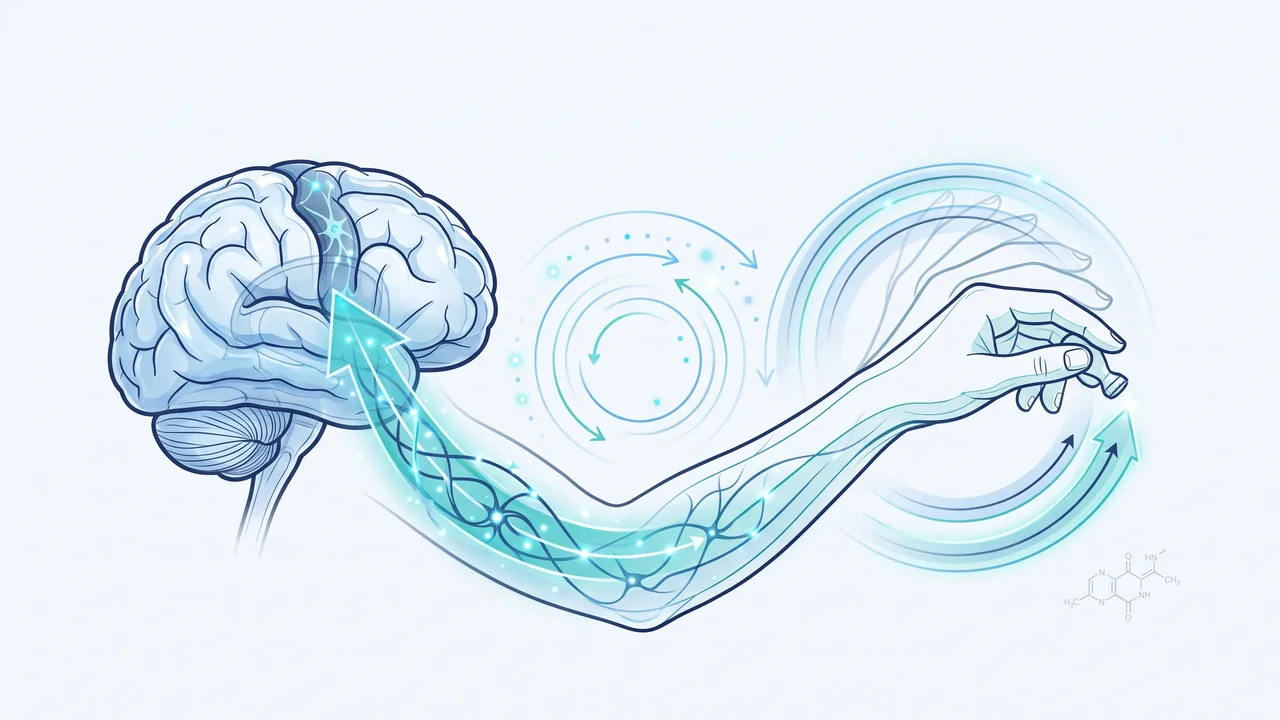
How the nervous system acquires, retains, and transfers skilled movementMotor learning is not one process wearing several names. It is a family of adaptations — implicit recalibration of an internal model, explicit strategy, sequence chunking, and habit formation — supported by interacting cortical, cerebellar, and basal-ganglia systems. Session improvement is not learning. Classic stage models and coaching slogans (10,000 hours, always-external focus, always-random practice, “neuroplasticity” as a synonym for getting better) over-unify that family. What survives is the learning–performance distinction, dose and challenge as modulators, and the obligation to measure retention and transfer.
Compiled by South Beach Longevity · 20 August 2026 Copyright 2026 Series SBL-41 / SP-MOTOR-LEARNING · Register A scientific article Sources peer-reviewed human experiments, meta-analyses, computational reviews, labelled animal work, and rehabilitation trials · verified NCBI records Constraint This document describes published research. It is not medical advice. No human use, dose, route, schedule, or coaching prescription is recommended anywhere in this document.
How to read this document Every finding is labelled, in the sentence that reports it, by the kind of study that produced it. A visuomotor rotation in a laboratory is not a tennis serve. A squirrel-monkey lesion map is not a human scan. A session score is not a delayed retention test. A coaching memoir is not an experiment. Where two results conflict, both are given. Classic theories are treated as historical objects and then asked whether modern evidence still supports them. Findings are graded in place as established, strongly supported, emerging, plausible, or speculative. Two further labels mark careful absences rather than verdicts: not established, where the evidence is too thin to place a claim on the ladder at all — untested or insufficient, an absence of proof rather than disproof; and not supported, where the weight of evidence leans against a claim but stops short of a formal refutation. Nothing here is a recommendation.
01 What motor learning is, and four things it is not
Motor control is the generation of posture and movement from the current state of the body and the world. Motor learning is a lasting change in that generation as a function of practice or experience. Krakauer, Hadjiosif, Xu, Wong, and Haith, writing the field’s current long review, treat the distinction as load-bearing: control can be excellent in a session that leaves no durable trace, and a clumsy session can still deposit a memory that appears later (Krakauer et al., 2019). Kantak and Winstein named the same gap the learning–performance distinction and argued that acquisition curves are the wrong dependent variable for a learning claim (Kantak and Winstein, 2012). Soderstrom and Bjork, reviewing the broader memory literature, showed that conditions that inflate performance often depress later retention, and the reverse (Soderstrom and Bjork, 2015). That distinction is established. It is the first filter of this document.
Wolpert, Diedrichsen, and Flanagan framed sensorimotor learning as the updating of predictions and controllers: the system learns the consequences of its own commands and the commands that produce a desired consequence (Wolpert, Diedrichsen, and Flanagan, 2011). Flanagan, Vetter, Johansson, and Wolpert showed, in a human object-manipulation experiment, that predictive grip-force adjustment preceded successful control (Flanagan et al., 2003). Prediction is not a metaphor. It is a measurable lead.
Four things follow and will be enforced.
First, motor learning is not motor control with a longer time axis. Control can be explained without invoking a memory. Learning cannot. A beautiful swing that vanishes overnight was a performance. A clumsy swing that survives a week was a memory.
Second, it is not one computation. Haith and Krakauer separated model-based and model-free contributions to human motor learning (Haith and Krakauer, 2013). Mazzoni and Krakauer showed that an implicit adaptive plan can override an explicit aiming strategy during visuomotor rotation (Mazzoni and Krakauer, 2006). McDougle, Bond, and Taylor mapped explicit and implicit processes onto the fast and slow timescales of sensorimotor learning (McDougle, Bond, and Taylor, 2015). Tsay and colleagues, in a 2024 synthesis, named three fundamental processes — reasoning, refinement, and retrieval — rather than a single “skill module” (Tsay et al., 2024). Collapsing those into one word is a teaching convenience. It is not a mechanism.
Third, it is not a coaching slogan. “Reps make champions,” “keep your eyes on the ball,” and “10,000 hours” are claims about volume, attention, and expertise. Each has a literature. None of them is the definition of learning.
Fourth, it is not medical advice and it is not a training prescription. This document describes published research. It recommends no drill, dose, device, or rehabilitation schedule for any person.
Sibling articles in this series take sports nutrition and noninvasive neuromodulation as neighbouring problems. This title is the skill-acquisition cut of the same nervous system. A protein meta-analysis is not a motor-learning paper. A TMS protocol is not a practice schedule.
02 Cortical and subcortical systems
Dayan and Cohen reviewed the human imaging, stimulation, and lesion record and treated motor-skill learning as a cascade: fast, attention-demanding gains that recruit prefrontal, premotor, and parietal cortex, then slower, more automatic performance that shifts toward sensorimotor cortex, striatum, and cerebellum (Dayan and Cohen, 2011). Hardwick, Rottschy, Miall, and Eickhoff, in a quantitative activation-likelihood meta-analysis of human motor-learning imaging, reported consistent recruitment of premotor cortex, primary motor cortex, supplementary motor area, cerebellum, and basal ganglia across tasks, with the exact map depending on whether the experiment was a sequence, an adaptation, or an execution contrast (Hardwick et al., 2013). Hardwick, Caspers, Eickhoff, and Swinnen later compared meta-analyses of imagery, observation, and execution and showed overlap that is real and incomplete: the three are not interchangeable maps of the same circuit (Hardwick et al., 2018). These are imaging syntheses, not causal proofs. They are strongly supported as a description of where the human literature lights up. They are not a licence to point at a coloured blob and say “this is where the skill lives.”
Karni, Meyer, Jezzard, Adams, Turner, and Ungerleider showed, with functional MRI in adults practising a finger-sequence task, that primary motor cortex representation changed with skill learning (Karni et al., 1995). That paper is established as evidence that adult motor cortex is not a fixed lookup table. It is not evidence that every coaching cue “rewires the motor cortex,” a sentence that has been asked to do more work than a finger-sequence scan can support.
Muellbacher and colleagues used transcranial magnetic stimulation in humans to interfere with primary motor cortex shortly after a ballistic-pinch practice bout and reported disruption of early consolidation (Muellbacher et al., 2002). The design is a disruption experiment, not a coaching study. It is strongly supported as evidence that M1 is necessary for an early form of skill stabilization in that task. It is not a protocol for a gym.
Nudo, Milliken, Jenkins, and Merzenich mapped use-dependent reorganization of movement representations in primary motor cortex of adult squirrel monkeys after skilled reach training and after focal infarct (Nudo et al., 1996). That is an animal electrophysiology-and-lesion record. It is established in that species and preparation. It is not a human trial, and it is not cited here as one.
Shadmehr and Krakauer proposed a computational neuroanatomy in which cerebellum, parietal cortex, and motor cortex implement complementary estimators and controllers (Shadmehr and Krakauer, 2008). The paper is a theory fitted to lesion and imaging patterns, not a new experiment. It is emerging as a unifying sketch and strongly supported as a reason not to treat “the motor system” as a single box.
03 Cerebellum
The cerebellum is the structure the field keeps rediscovering. Manto, Bower, Conforto, Delgado-García, da Guarda, Gerwig, Habas, Hagura, Ivry, Mariën, Molinari, Naito, Nowak, Oulad Ben Taib, Pelisson, Tesche, Tilikete, and Timmann, writing a consensus paper, recorded the diversity of ideas about cerebellar involvement in movement rather than pretending a single job description had won (Manto et al., 2012). Koziol and colleagues later restated a broader consensus that the cerebellum contributes to movement and to cognition, and that the contribution is not a simple “timing module” (Koziol et al., 2014). Consensus papers are syntheses. They are strongly supported as maps of expert disagreement. They are not new data.
Celnik reviewed human cerebellar stimulation and motor learning and treated the cerebellum as a modulator of adaptation rate and error sensitivity, not as the sole seat of skill (Celnik, 2015). Spampinato, Block, and Celnik reported somatotopically specific changes in cerebellar–M1 connectivity associated with motor learning in humans (Spampinato, Block, and Celnik, 2017). These are human physiology papers. They are strongly supported for adaptation and connectivity change. They are not evidence that a “cerebellar workout” exists.
Tseng, Diedrichsen, Krakauer, Shadmehr, and Bastian showed that cerebellar damage in humans impairs adaptation to visuomotor and force-field perturbations while leaving some strategic compensation intact — a dissociation that the later explicit/implicit literature would need (the 2007 Bastian-group record is the experimental ancestor of Mazzoni and Krakauer, 2006, and of Taylor and Ivry, 2011). Taylor and Ivry showed that humans deploy flexible cognitive strategies during motor learning and that those strategies can be dissociated from implicit adaptation (Taylor and Ivry, 2011). The cerebellum is necessary for a particular kind of error-driven updating. It is not the whole of skill.
04 Basal ganglia
Hikosaka, Nakahara, Rand, Sakai, Lu, Nakamura, Miyachi, and Doya proposed parallel neural networks for learning sequential procedures, with a gradual shift from associative to sensorimotor loops as a sequence becomes automatic (Hikosaka et al., 1999). Doyon, Bellec, Amsel, Penhune, Monchi, Carrier, Lehéricy, and Benali reviewed human imaging and argued that the basal ganglia and related structures contribute differently to motor-sequence learning and to motor adaptation (Doyon et al., 2009). Yin and Knowlton, reviewing rodent and human evidence, treated the basal ganglia as central to habit formation: action–outcome control giving way to stimulus–response control with overtraining (Yin and Knowlton, 2006). Graybiel described habits, rituals, and the evaluative brain as products of recurrent cortico-basal-ganglia loops, not of a single “habit centre” (Graybiel, 2008).
These papers do not agree on every boundary. They agree on a negative: the basal ganglia are not a volume knob for “trying harder.” Sequence automaticity, habit, and reward-based action selection are related and are not identical. A golf pre-shot routine can be a habit in Graybiel’s sense and still be a sequence in Hikosaka’s. Calling both “muscle memory” erases the distinction the experiments were built to make. The loop-shift account is strongly supported as a framework. Direct causal mapping from a named drill to a named striatal territory in a healthy athlete remains speculative.
05 Sensory feedback and proprioception
Proske and Gandevia reviewed the proprioceptive senses — signals of body shape, position, movement, and muscle force — and treated them as a family of receptors and central interpretations, not as a single “balance sense” (Proske and Gandevia, 2012). That review is established as the physiological map this article uses. A coaching cue that says “feel the movement” is pointing at that family. It is not specifying which receptor or which inference.
Wolpert, Ghahramani, and Flanagan treated motor learning as a problem of using noisy sensory feedback to update internal models (Wolpert, Ghahramani, and Flanagan, 2001). Sigrist, Rauter, Riener, and Wolf reviewed augmented visual, auditory, haptic, and multimodal feedback in motor learning and warned that more channels are not automatically more learning: the useful signal is the one that is interpretable as an error the learner can act on (Sigrist et al., 2013). Subramanian, Massie, Malcolm, and Levin, in a systematic review of extrinsic feedback after stroke, found that feedback can help upper-limb motor learning but that the human rehabilitation record is methodologically uneven (Subramanian et al., 2010). van Vliet and Wulf asked the same question for stroke and recorded that the evidence for any particular feedback schedule was thinner than the textbooks implied (van Vliet and Wulf, 2006).
Established: proprioceptive and visual feedback are used to update predictions and controllers (Wolpert, Diedrichsen, and Flanagan, 2011; Proske and Gandevia, 2012). Strongly supported: augmented feedback is a tool whose value depends on content, timing, and the learner’s capacity to use it (Sigrist et al., 2013; Salmoni, Schmidt, and Walter, 1984). Emerging: which modality wins in which sport or which paresis. A vibrating sleeve is not a theory of learning.
06 Neuroplasticity: what was measured, and what is said
“Neuroplasticity” is the most abused word in this literature. Kleim and Jones stated principles of experience-dependent neural plasticity for rehabilitation after brain damage: use it or lose it, use it and improve it, specificity, repetition, intensity, time, salience, age, transference, interference (Kleim and Jones, 2008). Those principles are a translation of a mostly animal and human-rehabilitation record into clinical language. They are strongly supported as a checklist of variables that have moved maps or behaviour in defined preparations. They are not a proof that a healthy adult’s yoga class “is neuroplasticity.”
Karni et al. (1995) and Nudo et al. (1996) are the two papers most often laundered into that slogan. One is a human finger-sequence MRI study. The other is a squirrel-monkey cortical-map study. Both are real. Neither licenses the inference that every performance gain is a cortical-map change, or that every cortical-map change is a performance gain. Dayan and Cohen (2011) and Hardwick et al. (2013) are the correct next citations: systems change with learning, and the change is distributed. Shadmehr and Holcomb showed, with PET in humans, that the neural correlates of a motor memory shift after a period of consolidation (Shadmehr and Holcomb, 1997). A shift of activation is not a certificate of skill.
Maier, Ballester, and Verschure restated neurorehabilitation principles from motor-learning and plasticity mechanisms and were careful to keep the two vocabularies from collapsing (Maier, Ballester, and Verschure, 2019). This article follows that care. When a later section says a practice schedule changed retention, that is a behavioural claim. When it says a scan changed, that is an imaging claim. The word “neuroplasticity” will not be used as a bridge between them unless the cited paper measured both.
| System / process | What was actually measured | Strongest human evidence in the reviewed literature | What the finding is not |
|---|---|---|---|
| Primary motor cortex | Sequence-practice fMRI; TMS disruption of early consolidation | Karni et al., 1995; Muellbacher et al., 2002 | A licence to call any cue “rewiring M1” |
| Premotor / parietal / prefrontal | Imaging meta-analysis of learning contrasts | Hardwick et al., 2013; Dayan and Cohen, 2011 | A single “attention centre” |
| Cerebellum | Consensus syntheses; cerebellar–M1 connectivity; stimulation reviews | Manto et al., 2012; Celnik, 2015; Spampinato, Block, and Celnik, 2017 | A cerebellar exercise prescription |
| Basal ganglia | Sequence-learning reviews; habit reviews | Doyon et al., 2009; Hikosaka et al., 1999; Yin and Knowlton, 2006; Graybiel, 2008 | Proof that a drill “builds a habit circuit” |
| Proprioception | Receptor and central-inference review | Proske and Gandevia, 2012 | A single “feel” sense |
| Experience-dependent plasticity | Principles translated from animal and rehab records | Kleim and Jones, 2008; Nudo et al., 1996 (squirrel monkey) | Evidence that improvement equals a map change |
| Computational anatomy | Theory fitted to lesion and imaging patterns | Shadmehr and Krakauer, 2008; Krakauer et al., 2019 | A scanned confirmation of every box |
07 Classic stage models — useful cartoons, weak mechanisms
The most famous stage cartoon in this field is Fitts and Posner’s three-stage account (cognitive, associative, autonomous), published as a book in 1967 and therefore not an NCBI-indexed experiment. Gentile’s taxonomy of motor skills and her two-stage account of getting the idea of the movement, then refining it, is the other classroom fixture. Both are historical objects. They are plausible as pedagogical sketches. They are not established as a neural sequence.
The modern record does not abolish stages so much as multiply them. Dayan and Cohen’s fast-then-slow cascade (Dayan and Cohen, 2011) looks like Fitts and Posner from a distance. McDougle, Bond, and Taylor’s explicit-and-implicit timescales (McDougle, Bond, and Taylor, 2015) do not. A learner can be “autonomous” on a sequence and still be in a highly cognitive, strategy-dominated state on a new visuomotor rotation. Tsay et al. (2024) replace stages with processes that can be co-active. That is the better description.
Adolph and Hoch reviewed infant motor development as embodied, embedded, enculturated, and enabling, and treated milestones as culturally and environmentally contingent rather than as a universal internal timetable (Adolph and Hoch, 2019). Thelen had already argued that motor development is a new synthesis of dynamic systems, not a maturational tape (Thelen, 1995). If childhood skill does not obey a three-stage script, adult sport skill is unlikely to.
Adversarial (psychology): stage models survive because they are easy to teach, not because they survive process-dissociation experiments. Adversarial (neuroscience): a cascade of activation is not a stage theory unless the same person, on the same task, shows the same order. Adversarial (coaching): “you are still in the cognitive stage” is often a polite way of saying the athlete is thinking, which Beilock and Carr showed can be exactly the wrong diagnosis under pressure (Beilock and Carr, 2001).
08 Closed-loop theory, schema theory, and the motor program
Adams published a closed-loop theory of motor learning in which a perceptual trace is built from feedback and a memory trace selects the movement (Adams, 1971). The paper is established as the first modern information-processing theory of motor learning. It is not established as a complete account. It struggled with rapid, open-loop actions and with the production of novel variants.
Schmidt’s schema theory (1975) was the reply: a generalized motor program plus recall and recognition schemata that are strengthened by variability of practice. The original paper is a Psychological Review essay and was not recovered as a MEDLINE record in the reviewed literature. The experimental children of that essay are in the reviewed record. Shea and Kohl tested specificity and variability of practice and reported that variability can help transfer when the test asks for a novel parameter of a practised class (Shea and Kohl, 1990). Ranganathan and Newell, in a series of human experiments and a later review, showed that “variability” is not one manipulation: variability at the task-goal level and variability at the execution-redundancy level do different jobs (Ranganathan and Newell, 2010a; Ranganathan and Newell, 2010b; Ranganathan and Newell, 2013). Schema theory predicted a benefit of variability. It did not predict which kind.
The motor-program idea — Keele’s 1968 formulation is the usual ancestor — survives in a weakened form. Todorov and Jordan replaced a pre-computed trajectory with optimal feedback control: a control policy that uses feedback to achieve a goal while allowing variability in task-irrelevant dimensions (Todorov and Jordan, 2002). That paper is a computational theory with supporting human and simulation observations. It is strongly supported as a reason to stop talking as if a skill were a stored tape. It does not abolish internal models. It changes what an internal model is for.
Adams (1971) remains the right historical starting point. Schema theory remains the right historical reason coaches were told to vary practice. Optimal feedback control is the right modern reason that “repeat the ideal form” is an incomplete instruction. None of the three is a closed science.
09 Ecological dynamics and the constraints-led account
Newell treated motor learning as a change in the dimensional structure of coordination, not only as a reduction of error on a prescribed form (Newell and Vaillancourt, 2001; Newell and Liu, 2012). Chow, Davids, Button, Shuttleworth, Renshaw, and Araújo named nonlinear pedagogy as a constraints-led framework for the emergence of game play and movement skills (Chow et al., 2006). Later empirical papers from that group reported that a nonlinear-pedagogy intervention can accommodate individual differences in learning a sports skill (Lee, Chow, Komar, Tan, and Button, 2014) and can change the acquisition of game skills in a territorial game (Chow, Meerhoff, Choo, Button, and Tan, 2023). Lindsay, Komar, Chow, Larkin, and Spittle asked whether prescription of a specific movement form is necessary for optimal skill development and argued, from a nonlinear-pedagogy stance, that it is not always (Lindsay et al., 2023). Ribeiro, Davids, Silva, Coutinho, Barreira, and Garganta argued that talent development requires enrichment rather than early narrow specialization (Ribeiro et al., 2021).
These are a mix of theoretical frameworks, small pedagogical experiments, and narrative reviews. They are emerging as an alternative design language for practice. They are not a demonstration that information-processing accounts have been falsified. A constraints-led session still produces errors that a cerebellum can use. The correct relationship is coexistence at different grains: ecological accounts are strong on representative design and degeneracy; computational accounts are strong on what is updated when an error arrives.
Williams and Hodges, writing on soccer, already challenged tradition in practice and instruction without abandoning the experimental motor-learning toolkit (Williams and Hodges, 2005). That is the posture this article takes. Tradition is not evidence. Neither is a framework.
10 Computational internal models and the modern process inventory
The computational core is now a short list.
Internal models. Wolpert, Diedrichsen, and Flanagan (2011) remain the review of record. Prediction precedes control (Flanagan et al., 2003). Smith, Ghazizadeh, and Shadmehr showed that short-term motor learning is carried by interacting adaptive processes with different timescales (Smith, Ghazizadeh, and Shadmehr, 2006).
Optimal feedback control. Todorov and Jordan (2002) remain the theory of record for coordination as a policy, not a trajectory.
Explicit versus implicit. Mazzoni and Krakauer (2006); Taylor and Ivry (2011); McDougle, Bond, and Taylor (2015); Kim, Parvin, and Ivry (2019). An aiming strategy can look like learning in a session and leave a different memory than implicit recalibration.
Model-based versus model-free. Haith and Krakauer (2013). Huberdeau, Krakauer, and Haith later showed that practice can induce a qualitative change in the memory representation for visuomotor learning (Huberdeau, Krakauer, and Haith, 2019).
Reasoning, refinement, retrieval. Tsay et al. (2024). The newest synthesis in the reviewed literature, and the one that best resists slogan collapse.
Krakauer et al. (2019) is the document-level map. Where a later section cites a coaching effect, it will say which of these processes the experiment could have measured. Where it cannot say, the grade drops.
| Theory | Historical claim | What modern evidence still supports | What it overreaches |
|---|---|---|---|
| Fitts–Posner / Gentile stages | Skill proceeds through cognitive, associative, autonomous phases | A coarse fast-to-slow cascade in some sequence tasks (Dayan and Cohen, 2011) | Co-active explicit and implicit processes; infant development is not a universal tape (Adolph and Hoch, 2019; McDougle, Bond, and Taylor, 2015) |
| Adams closed-loop (1971) | Perceptual and memory traces built from feedback | Feedback updates predictions; KR/KP matter (Salmoni, Schmidt, and Walter, 1984; Wolpert, Diedrichsen, and Flanagan, 2011) | Rapid open-loop actions; novel variants |
| Schmidt schema (1975) | Variability strengthens schemata and transfer | Some variability helps some transfer (Shea and Kohl, 1990; Ranganathan and Newell, 2013) | All variability is equal; a single GMP for every skill |
| Ecological / nonlinear pedagogy | Skill emerges from constraints, not prescribed form | Representative design and individual solutions can be trained (Chow et al., 2006; Lee et al., 2014) | Replacement of error-based updating; thin RCT record in elite sport |
| Internal models | The system learns forward and inverse mappings | Human prediction and adaptation records (Flanagan et al., 2003; Krakauer et al., 2019) | A single model for sequence, habit, and strategy |
| Optimal feedback control | Coordination is a policy that allows irrelevant variability | Human and computational support (Todorov and Jordan, 2002) | A complete account of explicit reasoning |
| Dual-process / RRR | Explicit and implicit (and reasoning/refinement/retrieval) are dissociable | Process-dissociation experiments (Mazzoni and Krakauer, 2006; Tsay et al., 2024) | Easy translation into a single coaching cue |
11 Deliberate practice and the 10,000-hour claim
Ericsson, Krampe, and Tesch-Römer’s 1993 deliberate-practice article is the origin of the modern expertise argument. It is a book-length Psychological Review paper and was not recovered as a MEDLINE record in the reviewed literature. The claim that entered public speech — 10,000 hours, via a later popular book — is not that paper’s claim, and it is not a scientific result.
What this review does contain is the corrective. Macnamara, Hambrick, and Oswald meta-analysed deliberate practice and performance in music, games, sports, education, and professions and reported that deliberate practice explained a minority of variance, with the sports estimate smaller than the music estimate (Macnamara, Hambrick, and Oswald, 2014). Macnamara, Moreau, and Hambrick then restricted the analysis to sports and again found a reliable but far-from-exhaustive contribution (Macnamara, Moreau, and Hambrick, 2016). Tucker and Collins reviewed genes and training as joint contributors to sporting success and treated the “training is everything” slogan as a category error (Tucker and Collins, 2012). Güllich, studying developmental paths to Olympic gold in men’s field hockey, reported many roads, not one (Güllich, 2014). Ribeiro et al. (2021) made the same point from a nonlinear-pedagogy and athletic-skills stance: enrichment, not early narrow hours.
Established: accumulated, effortful, feedback-rich practice is associated with higher performance in several domains (Macnamara, Hambrick, and Oswald, 2014). Established, negatively: the association is not large enough to make 10,000 hours a scientific threshold, and it is not large enough to erase starting age, sport, genes, opportunity, or developmental breadth (Macnamara, Moreau, and Hambrick, 2016; Tucker and Collins, 2012; Güllich, 2014). The popular number is a literary device. Citing it as if it were a dose is a category error this document will not repeat.
Ericsson’s later replies exist and argue that the metas mixed practice qualities. That argument is real. It does not restore a magic hour-count. A coach who says “the research says 10,000 hours” is citing a bookstore, not a trial.
12 Practice volume, massed and distributed practice
Lee and Genovese showed, in human motor-skill experiments, that the distribution of practice has different effects for discrete and continuous tasks (Lee and Genovese, 1989a; Lee and Genovese, 1989b). Massing trials can inflate a session curve and still lose on a retention test — the learning–performance distinction again (Kantak and Winstein, 2012; Soderstrom and Bjork, 2015). Cepeda, Pashler, Vul, Wixted, and Rohrer meta-analysed distributed practice in verbal recall and found a robust spacing benefit whose optimal gap depends on the retention interval (Cepeda et al., 2006). Cepeda, Coburn, Rohrer, Wixted, Mozer, and Pashler then offered a quantitative treatment of how to place those gaps (Cepeda et al., 2009). Those metas are verbal-memory metas. They are strongly supported for word lists. They are emerging as a prior for motor skill, not a transplant.
Guadagnoli and Lee’s challenge-point framework is the right motor-specific moderator: the same absolute difficulty is a different information load for a novice and an expert, and learning is expected to be greatest when functional task difficulty matches the learner (Guadagnoli and Lee, 2004). Volume without challenge-point is a pile of repetitions. Volume with an unmanageable challenge is noise. Neither is a dose in the pharmacological sense.
Roig, Skriver, Lundbye-Jensen, Kiens, and Nielsen reported that a single bout of intense cycling after motor practice improved motor memory in a human experiment (Roig et al., 2012). That is an acute-exercise consolidation paper, not a periodization manual. It is emerging. It is not a reason to exhaust a learner and call the exhaustion “volume.”
13 Variability and contextual interference
Shea and Morgan’s 1979 blocked-versus-random experiment is the laboratory origin of the contextual-interference (CI) effect: random practice often looks worse in acquisition and better on retention or transfer. The original Journal of Experimental Psychology paper was not recovered in the reviewed literature. Brady’s meta-analysis is the quantitative stand-in: a CI benefit exists, it is larger in laboratory tasks than in applied sport tasks, and the applied effect is smaller and less consistent (Brady, 2004). Porter and Magill showed that systematically increasing contextual interference can benefit learning of sport skills in a human experiment (Porter and Magill, 2010). Ramezanzade, Saemi, Broadbent, and Porter examined CI alongside an errorless-learning model and treated the two as interacting, not interchangeable, designs (Ramezanzade et al., 2022).
Ranganathan and Newell (2013) remain the right warning about the word “variability.” Randomizing task order (CI) is not the same as varying a parameter inside a schema, and neither is the same as allowing redundant joint configurations. A coach who “adds variability” without saying which of the three is adding a slogan.
Strongly supported: laboratory CI is real (Brady, 2004). Emerging: applied-sport CI, with a smaller and less stable effect (Brady, 2004; Porter and Magill, 2010). Not established: “always random, never blocked.” Guadagnoli and Lee (2004) predict that random practice can be the wrong challenge point for a true novice. That prediction is why this article will not print a universal schedule.
14 Feedback: knowledge of results, knowledge of performance, and the guidance hypothesis
Salmoni, Schmidt, and Walter reviewed knowledge of results and stated the guidance hypothesis: frequent KR can prop up performance during practice and leave a weaker memory when the crutch is removed (Salmoni, Schmidt, and Walter, 1984). That review is established as the field’s feedback constitution. It is a review of a mostly laboratory KR literature, not a physiotherapy manual.
Chiviacowsky and Wulf showed that self-controlled feedback can enhance learning, and that the benefit depends on the learner receiving feedback when they request it for a reason, not merely on a sense of choice (Chiviacowsky and Wulf, 2002; Chiviacowsky and Wulf, 2005). In 10-year-old children, higher self-controlled frequencies enhanced learning (Chiviacowsky et al., 2008). Related experiments reported benefits in adults with Down syndrome and in persons with Parkinson’s disease (Chiviacowsky et al., 2012a; Chiviacowsky et al., 2012b). These are small human experiments. They are strongly supported as evidence that autonomy over feedback can help in defined tasks. They are not a clinic protocol.
Knowledge of results says whether the goal was met. Knowledge of performance says how the movement looked or felt. Sigrist et al. (2013) is the modern multimodal review. Subramanian et al. (2010) and van Vliet and Wulf (2006) are the stroke-feedback reviews. More information is not more learning if it induces dependence or points at a variable the learner cannot control.
Wulf, Chiviacowsky, and colleagues later folded autonomy support and enhanced expectancies into the OPTIMAL theory of motor learning (Wulf and Lewthwaite, 2016; Wulf, Chiviacowsky, and Cardozo, 2014; Wulf, Chiviacowsky, and Drews, 2015; Wulf, Lewthwaite, Cardozo, and Chiviacowsky, 2018). OPTIMAL is a motivational-attentional theory, not a cerebellar theory. It is emerging as a package. Its parts — autonomy, expectancy, external focus — are unequally evidenced, and the additive “triple play” experiments are small. Treating OPTIMAL as a settled physiology is a category error.
15 Internal versus external attentional focus
Wulf and Su reported that an external focus of attention enhanced golf-shot accuracy in beginners and experts in a human experiment (Wulf and Su, 2007). McNevin, Shea, and Wulf reported that increasing the distance of an external focus enhanced learning, which they interpreted through a constrained-action account: an internal focus induces conscious control that interferes with automatic control processes (McNevin, Shea, and Wulf, 2003). Chiviacowsky, Wulf, and Avila reported an external-focus benefit in children with intellectual disabilities (Chiviacowsky, Wulf, and Avila, 2013).
The laboratory and applied record is large and is not uniformly signed. Wulf and Lewthwaite (2016) treat external focus as a pillar of OPTIMAL. The reviewed record did not include a single comprehensive 2013 Wulf review as a MEDLINE record; the primary experiments above are the verified base. Strongly supported: an external focus often helps in aiming and balancing tasks of the kind Wulf’s group studies. Not established: external focus is universally superior for every skill, every learner, every phase. A surgeon’s implicit-learning papers (Masters, Lo, Maxwell, and Patil, 2008; Zhu, Poolton, Wilson, Hu, Maxwell, and Masters, 2011) and Beilock and Carr’s choking work (Beilock and Carr, 2001) agree that inward attention can hurt an already-automated skill. They do not agree that a novice should never be told what a joint is doing. Guadagnoli and Lee (2004) again: the useful cue is the one that matches the current challenge point.
Adversarial (coaching): “always external” is easier to remember than “it depends,” which is why it spreads. Adversarial (psychology): many external-focus experiments are short, use novices, and measure acquisition more cleanly than delayed transfer. Adversarial (neuroscience): constrained action is a behavioural hypothesis, not a demonstrated M1 mechanism.
16 Implicit versus explicit learning
Maxwell, Masters, and Eves followed novices toward “no know-how” in a longitudinal implicit-motor-learning study (Maxwell, Masters, and Eves, 2000) and later treated working memory as a constraint on motor learning and performance (Maxwell, Masters, and Eves, 2003). Maxwell, Masters, and Poolton analysed performance breakdown in sport as a function of reinvestment and verbal knowledge (Maxwell, Masters, and Poolton, 2006). Wong, Masters, Maxwell, and Abernethy linked reinvestment to walking and falling in community-dwelling older adults (Wong, Masters, Maxwell, and Abernethy, 2008; Wong et al., 2009). Masters, Poolton, Maxwell, and Raab studied implicit motor learning and complex decision making under time constraint (Masters, Poolton, Maxwell, and Raab, 2008). Zhu, Poolton, Wilson, Maxwell, and Masters treated neural co-activation as a yardstick of implicit learning and the propensity for conscious control (Zhu et al., 2011a).
The explicit/implicit split in adaptation (Mazzoni and Krakauer, 2006; McDougle, Bond, and Taylor, 2015) is not the same split as Masters’ implicit-golf and reinvestment work, but they rhyme. Both say that a verbal rule can prop up a session and become a liability when attention is scarce. Beilock and Carr showed that pressure can induce a novice-like, step-by-step control of an expert skill — choking as misplaced explicitness (Beilock and Carr, 2001).
Strongly supported: extra verbal knowledge can be a risk for an automated skill under pressure or dual task. Emerging: how to train implicitly without starving a learner of the explicit strategy that visuomotor work shows is real and useful (Taylor and Ivry, 2011). Errorless learning and analogy learning are design bets, not settled protocols. This document does not prescribe them.
17 Observational learning and mental imagery
Williams and Hodges (2005) challenged traditional instruction in soccer and treated observation and well-designed practice as experimental questions, not guild secrets. Hardwick et al. (2018) showed that observation, imagery, and execution share neural correlates and do not share them completely. A video is not a repetition. An image is not a scan of the movement.
Schuster, Hilfiker, Amft, Scheidhauer, Andrews, Butler, Kischka, and Ettlin systematically reviewed motor-imagery training elements across five disciplines and offered a “best practice” synthesis of what those literatures had actually done (Schuster et al., 2011). Arora, Aggarwal, Sirimanna, Moran, Grantcharov, Kneebone, Sevdalis, and Darzi randomised surgical trainees to mental practice and reported enhanced technical skills (Arora et al., 2011). Anuar, Williams, and Cumming tested whether PETTLEP physical and environment elements predict sport imagery ability (Anuar, Williams, and Cumming, 2017). PETTLEP itself is a 2001 framework paper; the reviewed record recovered later tests, not the original Holmes and Collins essay.
Strongly supported: motor imagery and observation can change performance and, in some randomised settings, skill (Arora et al., 2011; Schuster et al., 2011; Hardwick et al., 2018). Not established: imagery as a substitute for physical practice, or as a uniform protocol. Dose, individual imagery ability, and the gap between a surgical box-trainer and a match are all still live.
18 Error augmentation, error reduction, and robotic guidance
Reinkensmeyer, Emken, and Cramer reviewed robotics, motor learning, and neurologic recovery and treated robots as experimental instruments before treating them as therapies (Reinkensmeyer, Emken, and Cramer, 2004). Huang and Krakauer restated robotic neurorehabilitation from a computational motor-learning perspective: a robot that reduces error may guide performance and starve learning; a robot that augments error may speed adaptation in some learners and overwhelm others (Huang and Krakauer, 2009). Emken and Reinkensmeyer showed that transient dynamic amplification can accelerate internal-model formation during locomotion in a human-robot experiment (Emken and Reinkensmeyer, 2005).
Abdollahi, Case Lazarro, Listenberger, Kenyon, Kovic, Bogey, Hedeker, Jovanovic, and Patton reported that error augmentation enhanced arm recovery in individuals with chronic stroke in a randomised crossover design (Abdollahi et al., 2014). An earlier conference report from the same group made the same directional claim (Abdollahi et al., 2011). Sharp, Huang, and Patton reported that visual error augmentation enhanced learning in three dimensions in a human experiment (Sharp, Huang, and Patton, 2010). Celian and colleagues later asked whether visual error augmentation offered advantages during bimanual therapy after stroke and did not treat the answer as obvious (Celian et al., 2025). Marchal-Crespo, McHughen, Cramer, and Reinkensmeyer showed that haptic guidance, aging, and initial skill level interact in a steering-learning task (Marchal-Crespo et al., 2010).
Emerging: error augmentation can help some adaptation and some chronic-stroke reaching. Not established: a general rule that errors should be enlarged, or reduced, for all learners. Guadagnoli and Lee (2004) again. Schweighofer, Wang, Mottet, Laffont, Bakhti, Reinkensmeyer, and Rémy-Néris dissociated motor learning from recovery in exoskeleton training after stroke — a warning that a robot curve is not a recovery curve (Schweighofer et al., 2018).
| Manipulation | Typical acquisition look | Typical retention / transfer look | Best-supported boundary |
|---|---|---|---|
| High-frequency KR | Better session scores | Weaker once KR is removed (Salmoni, Schmidt, and Walter, 1984) | Guidance hypothesis; laboratory KR |
| Self-controlled feedback | Variable | Often better learning in small human experiments (Chiviacowsky and Wulf, 2002; 2005) | Not a clinic dose |
| External focus | Often better aiming/balance | Often better learning in Wulf-group tasks (Wulf and Su, 2007; McNevin, Shea, and Wulf, 2003) | Not shown to be universal |
| Internal focus / reinvestment | Can look careful | Risk under pressure or dual task (Beilock and Carr, 2001; Maxwell, Masters, and Poolton, 2006) | Expert automated skills |
| Random / high CI | Worse acquisition | Better laboratory retention/transfer; weaker applied effect (Brady, 2004; Porter and Magill, 2010) | Challenge-point limited |
| Blocked practice | Better acquisition | Often poorer transfer | Useful at low skill / high complexity |
| Distributed practice | Slower session gains | Better retention in discrete tasks and in verbal metas (Lee and Genovese, 1989a; Cepeda et al., 2006) | Verbal metas are not motor proofs |
| Error augmentation | Can look worse | Can speed adaptation or help some stroke reaching (Abdollahi et al., 2014; Huang and Krakauer, 2009) | Overload risk; not general |
| Imagery / observation | Little or no physical score | Small-to-moderate adjunct effects (Schuster et al., 2011; Arora et al., 2011) | Not a substitute for practice |
| Deliberate-practice hours | Monotonic folklore | Minority of variance (Macnamara, Hambrick, and Oswald, 2014; Macnamara, Moreau, and Hambrick, 2016) | Not a 10,000-hour threshold |
19 Retention and transfer
Kantak and Winstein (2012) and Soderstrom and Bjork (2015) are the constitution of this part. A practice condition is a learning condition only if a delayed test, preferably of a variant the learner did not rehearse, still shows the gain. Krakauer, Mazzoni, Ghazizadeh, Ravindran, and Shadmehr showed that generalization of motor learning depends on the history of prior action (Krakauer et al., 2006). That is a human generalization experiment, not a coaching anecdote. It is strongly supported as evidence that transfer is structured, not automatic.
Kitago and Krakauer reviewed motor-learning principles for neurorehabilitation and treated transfer to the clinic and to the home as the unsolved problem, not as a footnote (Kitago and Krakauer, 2013). A treadmill that improves a treadmill is a device demonstration. Levin, Kleim, and Wolf distinguished motor recovery from compensation after stroke and insisted that the two not share a name (Levin, Kleim, and Wolf, 2009). Cirstea and Levin showed that compensatory strategies for reaching after stroke can achieve a hand-to-target goal while leaving the original impairment intact (Cirstea and Levin, 2000). A transfer test that rewards the goal and ignores the effector will call compensation “learning.”
20 Sleep and consolidation
Walker, Brakefield, Seidman, Morgan, Hobson, and Stickgold described the time course of motor-skill learning across wake and sleep in humans (Walker et al., 2003). Walker, Stickgold, Alsop, Gaab, and Schlaug reported sleep-dependent motor-memory plasticity in the human brain (Walker et al., 2005). Robertson, Pascual-Leone, and Press showed that awareness modifies the skill-learning benefits of sleep: an explicit sequence may need sleep; an implicit one may consolidate over wake (Robertson, Pascual-Leone, and Press, 2004). Robertson later offered a broader framework from creation to consolidation (Robertson, 2009). Korman, Doyon, Doljansky, Carrier, Dagan, and Karni reported that daytime sleep condenses the time course of motor-memory consolidation (Korman et al., 2007). Diekelmann and Born reviewed the memory function of sleep across systems (Diekelmann and Born, 2010). King, Saucier, Albouy, Fogel, Rumpf, Klann, Buccino, Binkofski, Classen, Karni, and Doyon reported that cerebral activation during initial motor learning forecast subsequent sleep-facilitated consolidation in older adults (King et al., 2017). Brawn, Fenn, Nusbaum, and Margoliash reported consolidation of sensorimotor learning during sleep in a human experiment (Brawn et al., 2008).
The contrary paper in the reviewed literature is Pan and Rickard’s review: after accounting for time-of-testing, reactive inhibition, and publication practices, the unique contribution of sleep to motor learning is smaller and less clean than the first wave of papers implied (Pan and Rickard, 2015). That review is strongly supported as a methodological objection. It does not erase Walker, Robertson, or Korman. It changes the grade of any sentence that says “sleep consolidates motor skill” without naming the task, the awareness condition, and the control for passing time.
Established: time passing after practice is not empty; off-line change occurs (Walker et al., 2003; Robertson, 2009). Strongly supported: sleep can favour some explicit-sequence memories (Robertson, Pascual-Leone, and Press, 2004; Diekelmann and Born, 2010). Emerging / contested: a general sleep-consolidation law for all motor tasks (Pan and Rickard, 2015). A coach who says “the skill consolidates while you sleep” is pointing at a real literature and at a live argument. Both should be in the sentence.
21 Fatigue
Fatigue is a performance variable that is constantly mistaken for a learning variable. A session that ends in exhaustion can look like high volume and still be a poor encoding condition, or it can be the Roig et al. (2012) acute-exercise booster, or it can be neither. The reviewed record does not contain a single definitive human experiment that separates peripheral fatigue, central fatigue, and encoding quality across sport skills. What it does contain is the obligation, from Kantak and Winstein (2012), to stop reading the last block of a fatigued session as a learning score. Beilock and Carr (2001) add a second fatigue: pressure. A tired expert who starts to reinvest is not “grinding.” They may be moving the skill back into working memory.
This section is short on purpose. The honest grade for “train to failure to learn better” is speculative. The honest grade for “fatigue can mask or mimic learning” is strongly supported by the learning–performance distinction.
22 Aging
Seidler, Bernard, Burutolu, Fling, Gordon, Gwin, Kwak, and Lipps reviewed motor control and aging as a story of brain structure, function, and biochemistry, not of a single slowing factor (Seidler et al., 2010). Seidler reported that aging affects motor learning but not savings at transfer of learning in a visuomotor experiment (Seidler, 2007). Anguera, Reuter-Lorenz, Willingham, and Seidler showed that failure to engage spatial working memory contributes to age-related declines in visuomotor learning (Anguera et al., 2011). Trewartha, Garcia, Wolpert, and Flanagan reported that adaptive motor-learning processes associated with aging and cognitive decline can be fast but fleeting (Trewartha et al., 2014). Noohi, Boyden, Kwak, Humfleet, Müller, Bohnen, and Seidler reported interactive effects of age and multi-gene profile on motor learning and sensorimotor adaptation (Noohi et al., 2016). King et al. (2017) tied older adults’ initial activation to later sleep-facilitated consolidation. Marchal-Crespo et al. (2010) showed that haptic guidance interacts with age and initial skill.
Strongly supported: older adults can learn motor tasks; they often need more time, more working-memory support, and more careful tests of what was saved (Seidler, 2007; Seidler et al., 2010; Anguera et al., 2011). Not established: that aging abolishes implicit adaptation, or that a “senior motor-learning protocol” exists. Wong et al. (2008, 2009) add that reinvestment is a fall-risk story, not only a sport story.
23 Children
Adolph and Hoch (2019) and Thelen (1995) are the developmental constitution: skill is assembled in a body, a culture, and an environment, not read off a milestone chart. Diamond reviewed executive functions and the programs that do and do not improve them, and was hostile to hype (Diamond, 2013; Diamond and Ling, 2016). Motor learning in children is not adult learning with a smaller shoe. Chiviacowsky et al. (2008) found that children used self-controlled feedback differently from the adult pattern. Chiviacowsky, Wulf, and Avila (2013) and Bahmani, Wulf, Ghadiri, Karimi, and Lewthwaite (2017) reported that motivational and attentional manipulations can change children’s motor learning in small experiments. Those experiments are emerging. They are not a youth-sport curriculum.
| Outcome | What a positive result means | What a positive result does not mean | Anchor papers |
|---|---|---|---|
| Acquisition (session) | Performance under the practice conditions | Learning; transfer; sport success | Kantak and Winstein, 2012; Soderstrom and Bjork, 2015 |
| Delayed retention | A memory survived time and often a break from KR | The skill will appear in a match or a kitchen | Walker et al., 2003; Salmoni, Schmidt, and Walter, 1984 |
| Transfer / generalization | A related task or workspace moved | Far transfer; “they can do anything now” | Krakauer et al., 2006; Kitago and Krakauer, 2013 |
| Savings | Faster relearning of a previously adapted task | Permanent immunity to the perturbation | Seidler, 2007; Smith, Ghazizadeh, and Shadmehr, 2006 |
| Compensation | A goal was met by a new effector pattern | Recovery of the impaired pattern | Levin, Kleim, and Wolf, 2009; Cirstea and Levin, 2000 |
| Off-line gain | Performance rose without further practice | Sleep is the unique cause | Robertson, Pascual-Leone, and Press, 2004; Pan and Rickard, 2015 |
24 Rehabilitation after injury — learning is not recovery, and recovery is not a session
Krakauer reviewed motor learning’s relevance to stroke recovery and neurorehabilitation and warned against treating a laboratory adaptation effect as a therapy (Krakauer, 2006). Kitago and Krakauer (2013) and Levin, Kleim, and Wolf (2009) are the vocabulary. Maier, Ballester, and Verschure (2019) are the principle list that keeps plasticity language honest.
The large human trials in the reviewed literature do not flatter simple stories. Wolf, Winstein, Miller, Taub, Uswatte, Morris, Giuliani, Light, Nichols-Larsen, and the EXCITE investigators randomised constraint-induced movement therapy three to nine months after stroke and reported improved upper-extremity function (Wolf et al., 2006). Taub, Uswatte, and Pidikiti had already named CIMT as a family of techniques (Taub, Uswatte, and Pidikiti, 1999). EXCITE is strongly supported as evidence that a high-dose, constraint-and-shaping package can move function in a defined chronic window. It is not evidence that constraint is the active ingredient, or that the package is the right package for every paresis.
Winstein, Wolf, Dromerick, Lane, Nelsen, Lewthwaite, Cen, Azen, and the ICARE team randomised a task-oriented rehabilitation program after motor stroke and did not find it superior to dose-equivalent usual care on the primary upper-extremity outcome (Winstein et al., 2016). That null is as important as EXCITE’s positive. More theory-laden therapy, at a matched dose, did not win. Duncan, Sullivan, Behrman, Azen, Wu, Nadeau, Dobkin, Rose, Tilson, Cen, Hayden, and the LEAPS team found that body-weight-supported treadmill rehabilitation after stroke was not superior to progressive home exercise at one year (Duncan et al., 2011). French, Thomas, Coupe, McMahon, Connell, Harrison, Sutton, Tishkovskaya, and Watkins updated the Cochrane review of repetitive task training and reported modest benefits for functional ability after stroke (French et al., 2016). Pollock, Farmer, Brady, Langhorne, Mead, Mehrholz, and van Wijck, in a Cochrane overview of upper-limb interventions, recorded a field of many small trials and few decisive ones (Pollock et al., 2014). Lohse, Lang, and Boyd asked “is more better?” of stroke-rehabilitation dose and found a dose–response signal in metadata, with the usual caveats of non-randomised dose (Lohse, Lang, and Boyd, 2014). Lang, Lohse, and Birkenmeier treated dose and timing as a prescription problem that the trials had not yet solved (Lang, Lohse, and Birkenmeier, 2015).
Established: humans after stroke can change upper-limb function with structured practice (Wolf et al., 2006; French et al., 2016). Established, negatively: the cleverest motor-learning packaging does not automatically beat dose-matched care (Winstein et al., 2016; Duncan et al., 2011). Strongly supported: recovery and compensation must be measured separately (Levin, Kleim, and Wolf, 2009; Cirstea and Levin, 2000). Robots and error-augmentation devices remain experimental adjuncts (Huang and Krakauer, 2009; Abdollahi et al., 2014; Schweighofer et al., 2018). This section describes those trials. It does not prescribe a therapy.
25 Sport — where anecdotes go to be mistaken for designs
Williams and Hodges (2005) is the right opening: tradition in instruction is a hypothesis. Porter and Magill (2010) and Brady (2004) are the CI sport record — real, smaller, and not a licence for permanent chaos. Chow et al. (2006, 2023) and Lee et al. (2014) are the nonlinear-pedagogy sport record — promising, still thin. Wulf and Su (2007) is a golf experiment, not a tour-player memoir. Beilock and Carr (2001) and Maxwell, Masters, and Poolton (2006) are the pressure record. Macnamara, Moreau, and Hambrick (2016), Tucker and Collins (2012), and Güllich (2014) are the expertise record.
Elite-athlete anecdotes fail as evidence for a simple reason: they are selected on the dependent variable. Every champion practised. So did most of the people who did not become champions. Güllich’s many roads are what a developmental record looks like when it is not written by the medal. A memoir that says “I visualised every night” is a PETTLEP-adjacent story. Schuster et al. (2011) and Arora et al. (2011) are the experiments. Keep them on different shelves.
Biomechanics enters here as measurement, not as a rival science. A kinematics paper that never runs a retention test is a control paper. A coach who changes a kinematic target and sees a better session score has a performance story until the delayed test arrives.
| Coaching move | What the literature actually says | Common overreach | Grade |
|---|---|---|---|
| Accumulate huge hours | Deliberate practice explains a minority of sport variance | “10,000 hours is the science” | Macnamara, Moreau, and Hambrick, 2016 — established negatively |
| Randomise drill order | Laboratory CI is robust; applied CI is smaller | “Never block” | Brady, 2004; Porter and Magill, 2010 |
| Give constant KR | Frequent KR guides; can weaken retention | “Always tell them the number” | Salmoni, Schmidt, and Walter, 1984 |
| Cue the effect in the world | External focus often helps aiming tasks | “Never mention a joint” | Wulf and Su, 2007; McNevin, Shea, and Wulf, 2003 |
| Train implicitly / by analogy | Can reduce reinvestment under pressure | “Never explain” | Maxwell, Masters, and Poolton, 2006; Taylor and Ivry, 2011 |
| Use imagery and video | Adjunct effects in some RCTs and reviews | “Mental reps equal physical reps” | Schuster et al., 2011; Hardwick et al., 2018 |
| Let the athlete choose feedback | Small experiments show benefits | A universal autonomy protocol | Chiviacowsky and Wulf, 2002 |
| Constraints-led / representative games | Framework plus small pedagogical studies | Replacement of all instruction | Chow et al., 2006; Williams and Hodges, 2005 |
| Sleep as a training tool | Off-line change is real; unique sleep benefit is contested | “Sleep consolidates every skill” | Walker et al., 2003; Pan and Rickard, 2015 |
| Cite a champion’s routine | A selected story | Experimental evidence | Güllich, 2014; Macnamara, Hambrick, and Oswald, 2014 |
26 Six adversarial questions
Are classic stage models oversimplified? Yes, as mechanisms. Fitts–Posner and Gentile remain useful cartoons for a first lecture. They cannot hold co-active explicit and implicit processes (McDougle, Bond, and Taylor, 2015; Tsay et al., 2024), infant development that is not a universal tape (Adolph and Hoch, 2019; Thelen, 1995), or a learner who is autonomous in one task and cognitive in another. Grade: established as pedagogy; not established as theory.
Is contextual interference robust outside laboratory tasks? Partly. Brady’s meta-analysis is the honest summary: the laboratory effect is reliable; the applied-sport effect is smaller and less consistent (Brady, 2004). Porter and Magill (2010) show that a designed CI schedule can help sport skills in an experiment. That is not the same as “random practice always wins on Saturday.” Guadagnoli and Lee (2004) predict failures in novices. Those failures are not anomalies. They are the theory.
Is external focus universally superior? No. It is often superior in the tasks Wulf’s group studies (Wulf and Su, 2007; McNevin, Shea, and Wulf, 2003) and it is a pillar of OPTIMAL (Wulf and Lewthwaite, 2016). Universality would require a bias-corrected meta-analysis across skill classes, expertise levels, and delayed transfer. This review did not recover that paper as a MEDLINE record. Constrained-action remains a behavioural hypothesis. A novice being taught a dangerous implement may need an internal constraint. The word “always” is the defect.
Is “10,000 hours” scientifically defensible? No, as a threshold. Yes, as a mangled memory of a real correlation. Macnamara, Hambrick, and Oswald (2014) and Macnamara, Moreau, and Hambrick (2016) are the quantitative case against the number. Tucker and Collins (2012) and Güllich (2014) are the biological and developmental case against training-only stories. The original Ericsson argument was about the quality of practice in a selected group of violinists, not about a stopwatch for everyone.
Are elite-athlete anecdotes being mistaken for experimental evidence? Yes, routinely. The expertise metas exist because anecdote had already filled the space. A champion’s diary is a hypothesis generator. EXCITE, ICARE, LEAPS, Brady, Macnamara, and Walker-versus-Pan are the tests. This article keeps them on different shelves.
Is neuroplasticity used rhetorically without direct evidence? Yes. Kleim and Jones (2008), Karni et al. (1995), Nudo et al. (1996), and Dayan and Cohen (2011) are real. The rhetorical use is the jump from “maps can change” to “this drill rewired you.” Unless the cited paper measured a neural change and a behavioural change in the same design, the word is a compliment, not a result. Maier, Ballester, and Verschure (2019) are the rehabilitation authors who refused that jump. This document follows them.
The three adversarial benches do not cancel each other. Psychology is strongest on process dissociation, choking, and meta-analytic humility. Neuroscience is strongest on systems and on the refusal to treat a blob as a skill. Coaching science is strongest on representative design and on the reminder that a laboratory button-press is not a match. Each bench is weakest when it talks as if it had already absorbed the other two.
This document describes published research on motor control, motor learning, practice, feedback, sleep, aging, development, sport, and rehabilitation. It does not recommend a drill, device, dose, route, schedule, or therapy for any person. Reported experimental parameters are reported experimental parameters. They are not prescriptions.
27 Evidence handling
Study type is labelled in the reporting sentence. Human randomised trials, human laboratory experiments, meta-analyses, narrative reviews, computational theories, animal lesion maps, and coaching frameworks are not interchangeable. Conflicting results are presented as conflict. A newer null (ICARE, LEAPS, Pan and Rickard) is not assumed to erase an older positive (EXCITE, Walker, Brady laboratory CI); the design difference is stated. General reference and news databases were consulted only to locate literature, never as citation authority; the authority throughout is the peer-reviewed record verified against NCBI.
28 Limitations
Classic book-length statements — Fitts and Posner (1967), Bernstein (1967), Gentile (1972), Schmidt (1975), Ericsson, Krampe, and Tesch-Römer (1993), Newell’s 1986 constraints chapter, Holmes and Collins (2001) — are treated as historical objects. Where MEDLINE did not return the original, this article cites the verified experimental children and the metas, and says so. Several applied-sport and youth-sport questions remain under-powered. The neurophysiology map is an original table rather than a scanned figure; no commissioned or third-party plate is used.
29 Glossary
Acquisition. Performance during practice.
Compensation. Achievement of a goal by a new effector pattern (Levin, Kleim, and Wolf, 2009).
Contextual interference. The learning effect of interleaving tasks or variants, typically random versus blocked practice (Brady, 2004).
Deliberate practice. Effortful, feedback-rich, specially designed practice; not a synonym for time-on-task, and not a 10,000-hour threshold (Macnamara, Hambrick, and Oswald, 2014).
External focus. Attention directed to the intended effect of a movement in the environment (Wulf and Su, 2007).
Internal model. A learned mapping used to predict sensory consequences or to select actions (Wolpert, Diedrichsen, and Flanagan, 2011).
Knowledge of performance (KP). Information about the movement pattern.
Knowledge of results (KR). Information about the outcome relative to a goal (Salmoni, Schmidt, and Walter, 1984).
Learning–performance distinction. Session scores are not delayed memory (Kantak and Winstein, 2012).
Recovery. Restoration of a previously used pattern, as distinct from compensation (Levin, Kleim, and Wolf, 2009).
Retention. Delayed test of the practised task.
Savings. Faster relearning of a previously experienced adaptation (Seidler, 2007).
Transfer. Test of a task or workspace that was not identical to practice (Krakauer et al., 2006).
References
Generated from verified NCBI records in the apparatus list.
Continue reading