
Pyrroloquinoline Quinone
Metabolic cofactors and energy intermediates. A research review published by South Beach Longevity.
Pyrroloquinoline Quinone
Pyrroloquinoline quinone is sold as a mitochondrial nutrient. Bacteria use it as a redox cofactor. Mammals encounter it in food at microgram amounts. The commercial claim is mitochondrial biogenesis; the human record is small, often combination-product, and mostly surrogate. This article keeps those layers apart. It is a research review. It is not medical advice.
Compiled by South Beach Longevity · 20 August 2026 Copyright 2026 Series SBL-41 / SP-PQQ · Register A scientific article Sources peer-reviewed cell, animal, and human studies; a novel-food safety opinion; trial-registry records; labelled reviews · verified NCBI records Constraint This document describes published research. It is not medical advice. No human use, dose, route or schedule is recommended anywhere in this document.
How to read this document Every finding is labelled, in the sentence that reports it, by the kind of study that produced it. A methanol-dehydrogenase crystal is not a vitamin. A mouse on a chemically defined diet is not a patient. A fall in C-reactive protein, a rise in PGC-1α protein, or a Stroop-test shift is not an energy, sleep, or dementia outcome. A combination capsule is not PQQ. Amounts appear only as reported experimental or registry parameters, always with the population attached. Nothing here is a recommendation. Findings are graded in place as established, strongly supported, emerging, plausible, or speculative. Two further labels mark careful absences rather than verdicts: not established, where the evidence is too thin to place a claim on the ladder at all — untested or insufficient, an absence of proof rather than disproof; and not supported, where the weight of evidence leans against a claim but stops short of a formal refutation. Cellular data, animal data, human biomarkers, and clinical outcomes are kept in separate sentences.
01 Chemistry, not branding
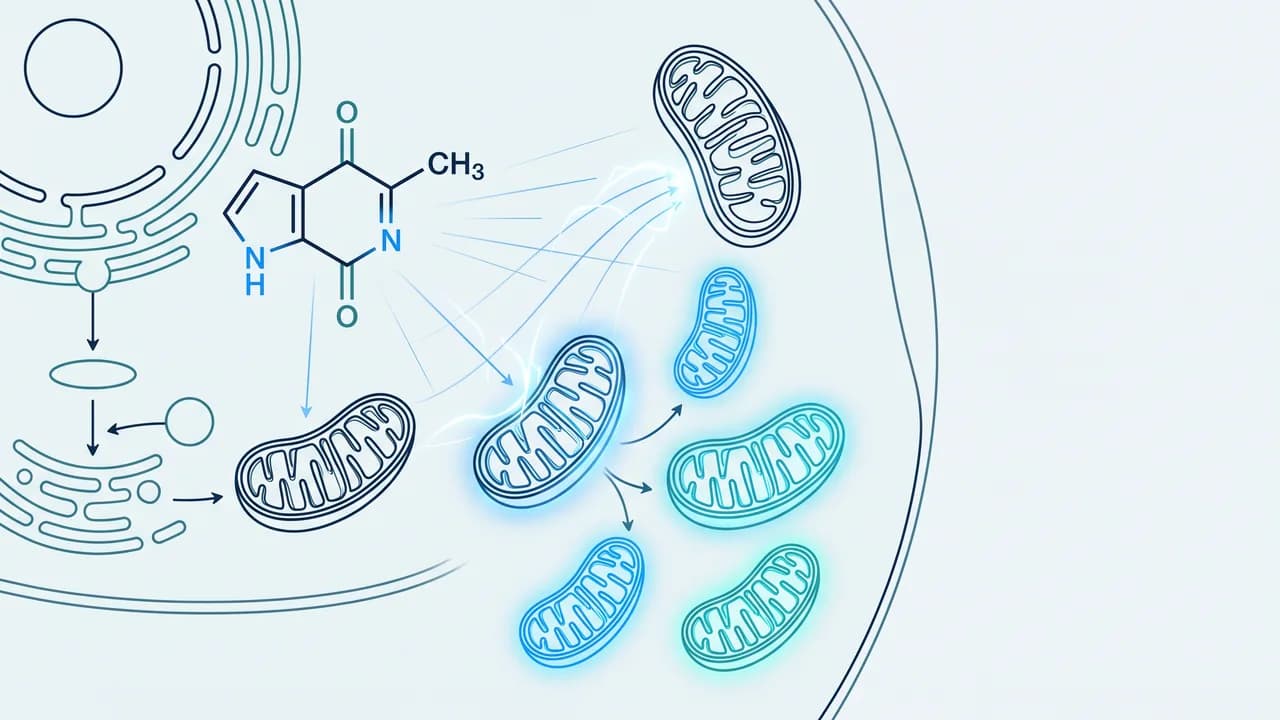
Pyrroloquinoline quinone is an o-quinone tricarboxylic acid. PubChem lists it as CID 1024, molecular formula C14H6N2O8, molecular weight 330.21, InChIKey MMXZSJMASHPLLR-UHFFFAOYSA-N, IUPAC name 4,5-dioxo-1H-pyrrolo[2,3-f]quinoline-2,7,9-tricarboxylic acid. That identity is established as a chemical record. It is not a physiological role.
The older name is methoxatin. Forrest, Salisbury, and Kilty described a mechanism for enzymic methanol oxidation involving that coenzyme (Forrest, Salisbury, and Kilty, 1980). Duine, Frank, and Verwiel reported the structure and activity of the prosthetic group of methanol dehydrogenase (Duine, Frank, and Verwiel, 1980). Those papers are bacterial enzymology. They are established as the chemical opening of the field. They are not human nutrition.
Commercial disodium salts (BioPQQ, mnemoPQQ, and related designations) are formulation names. A brand is not a mechanism. Where a trial used a named salt, this article keeps the name so the product is not silently generalized.
02 Bacterial redox-cofactor biology
PQQ is the cofactor of quinoproteins. Duine and Jongejan reviewed that enzyme class: dehydrogenases that use PQQ rather than NAD or flavin as the organic prosthetic group, notably bacterial methanol dehydrogenase (Duine and Jongejan, 1989). That bacterial biochemistry is established.
Two later mistakes must be named before any mammalian claim is allowed to borrow this prestige.
Quinoproteins are not a single enzyme. Methanol dehydrogenase is the textbook case; soluble glucose dehydrogenase and other bacterial dehydrogenases also use PQQ (Duine and Jongejan, 1989). Calcium is part of the catalytic site in several of those proteins, which is why reconstitution recipes mention both PQQ and a divalent cation. That is still bacterial enzymology. It does not create a human RDA.
The commercial move is to treat “cofactor” as a nutrient class. In bacteria, cofactor means the protein does not turn over without PQQ. In a capsule description, cofactor often means only that the molecule can accept and donate electrons. Redox activity is real. Enzyme dependence is a stricter claim. This article uses the stricter sense unless a reconstituted protein is named.
First, van der Meer, Groen, and Duine reported covalently bound PQQ as the organic prosthetic group of human placental lysyl oxidase (van der Meer, Groen, and Duine, 1986). That paper is a mammalian-enzyme claim. It did not hold. van der Meer, Groen, Jongejan, and Duine later showed that the redox-cycling assay is not suited for detecting PQQ in biological samples (van der Meer, Groen, Jongejan, and Duine, 1990). The correction is established. A colorimetric cycling assay that lights up in tissue extracts is not a reconstituted quinoprotein.
Second, the word cofactor in a supplement advertisement is not the bacterial fact. Bacterial MDH without PQQ does not turn over methanol. That is an enzyme requirement. It is not a licence to call milligram capsules an essential nutrient.
03 Occurrence in foods, and the downward revision
Kumazawa, Sato, Seno, Ishii, and Suzuki measured PQQ in various foods by gas chromatography-mass spectrometry (Kumazawa, Sato, Seno, Ishii, and Suzuki, 1995). Trace detection in human and rat samples had already been reported (Kumazawa, Seno, Urakami, Matsumoto, and Suzuki, 1992). Those analytical papers are strongly supported as evidence that PQQ exists in some foods and in some mammalian samples at low levels. They are not intake requirements.
The same laboratory failed to verify earlier high levels in eggs and skim milk (Kumazawa, Seno, and Suzuki, 1993). That correction is load-bearing. Food tables that still quote the high early numbers are quoting a result the method did not sustain. Dietary exposure is real and small. It is not a milligram-capsule diet.
Fermented soy, parsley, kiwi, green tea, and human milk appear in secondary food lists. This article does not reprint an unverified food table. The primary analytical papers above are the evidence class. Secondary marketing lists are not.
04 Mammalian exposure and pharmacokinetics
Smidt, Steinberg, and Rucker reviewed the physiologic importance of PQQ as a then-open nutritional question (Smidt, Steinberg, and Rucker, 1991). That is a review. It is a map of a hypothesis, not a human PK study.
The human pharmacokinetic and short-term biomarker paper in this review is Harris, Chowanadisai, Mishchuk, Satre, Slupsky, and Rucker (Harris et al., 2013). Ten healthy adults (five women, five men) completed a crossover. Study 1 used a single ingestion of 0.2 mg PQQ/kg in a fruit-flavoured drink, with plasma and urine PQQ and antioxidant-potential assays over 48 hours. Study 2 used 0.3 mg PQQ/kg daily; after 76 hours the endpoints were plasma C-reactive protein, interleukin-6, standard clinical chemistry, and urinary metabolites by 1H-NMR. Plasma and urine PQQ rose. Standard clinical indices, including cholesterol, glucose, HDL, LDL, and triglycerides, were normal and not altered. CRP and IL-6 decreased. Urinary methylated amines including TMAO decreased, and the authors interpreted other urinary metabolites as consistent with mitochondria-related functions.
That paper is a human biomarker and PK study, n=10, hours not months. It is emerging as evidence that ingested PQQ is absorbed and that selected inflammatory markers can move. It is not a clinical-outcome trial. It does not show mitochondrial biogenesis in human tissue. The authors’ last sentence, linking animal systemic effects to corresponding effects in humans, is an inference. The measured human objects were plasma, urine, and CRP/IL-6.
05 Kasahara and Kato, 2003
Kasahara and Kato announced a new redox-cofactor vitamin for mammals (Kasahara and Kato, 2003). The claim, as later summarized by the critics who answered it, was that a mouse enzyme predicted to participate in lysine metabolism is a PQQ-dependent dehydrogenase, and that PQQ is therefore a vitamin. The MEDLINE record for the Nature brief carries no abstract. The paper is a claim, not a completed reconstitution.
If that claim had held, PQQ would join the small set of organic cofactors that mammals cannot make and must obtain. It did not hold. The next section is the reason this article refuses essential-nutrient language.
06 The 2005 replies
Felton and Anthony asked whether PQQ is a mammalian enzyme cofactor (Felton and Anthony, 2005). Their brief is a sequence and motif critique: the Kasahara–Kato assignment depended on databases that inappropriately label β-propeller sequences as PQQ-binding motifs. What the evidence actually suggested, they wrote, is a novel seven-bladed β-propeller protein, with nothing to indicate a PQQ-dependent dehydrogenase. That is a primary critique of the vitamin paper, not a marketing review.
Rucker, Storms, Sheets, Tchaparian, and Fascetti asked, in the same Nature exchange, whether PQQ is a vitamin (Rucker, Storms, Sheets, Tchaparian, and Fascetti, 2005). The Rucker group had the rodent nutrition file. They did not rescue a reconstituted mammalian quinoprotein dehydrogenase. Nutritional interest and cofactor proof are different objects.
The vitamin claim is therefore not established. It is a 2003 announcement that did not survive 2005 sequence and function scrutiny. Later reviews that restore “vitamin-like accessory factor” language (Jonscher, Chowanadisai, and Rucker, 2021) are reviews by the laboratory that generated most of the rodent nutrition data. They are labelled as such. A review is not a new enzyme.
07 Mouse nutrition is real, and it is not an RDA
Killgore and colleagues fed mice a chemically defined diet devoid of PQQ (Killgore et al., 1989). The animals grew poorly, failed to reproduce, and became osteolathyritic, with friable skin, extractable collagen, and decreased lysyl oxidase. The authors suggested a fundamental role as a growth factor or vitamin. That is a mouse diet experiment. It is strongly supported as a phenotype of that diet. It is not a demonstration that PQQ is lysyl oxidase’s cofactor (see section 02), and it is not a human requirement.
Steinberg, Gershwin, and Rucker showed that reproductive outcome in BALB/c mice was compromised on PQQ-poor chemically defined diets, with fewer pups per litter and poorer neonatal survival, and that splenic mitogen responses appeared related to PQQ intake (Steinberg, Gershwin, and Rucker, 1994). Steinberg, Stites, Anderson, Storms, Chan, Eghbali, and Rucker later reported improved growth and reproductive performance when PQQ was restored (Steinberg et al., 2003). Those papers are strongly supported as rodent nutrition. Chemically defined diets strip many things. A rescue by added PQQ is evidence that PQQ, or a contaminant that travels with it, mattered in that system. It is not an essential-nutrient classification for people eating food.
Stites and colleagues reported that PQQ modulates mitochondrial quantity and function in mice (Stites et al., 2006). Bauerly, Storms, Harris, and colleagues reported altered lysine metabolism and mitochondrial DNA content with PQQ nutritional status (Bauerly et al., 2006). Bauerly, Harris, Chowanadisai, and colleagues later reported modulation of mitochondrial, lipid, and energy metabolism in rats (Bauerly et al., 2011). Tchaparian and colleagues mapped transcriptional networks responding to dietary PQQ (Tchaparian et al., 2010). Rucker, Chowanadisai, and Nakano reviewed potential physiologic importance (Rucker, Chowanadisai, and Nakano, 2009). All of that is animal or review. It is the strongest preclinical nutrition file this review contains. It still is not a human essentiality proof.
08 What a mammalian PQQ enzyme would have to be
A bacterial-style claim needs a protein, a reconstituted activity, and a PQQ dependence that survives motif hygiene. Akagawa, Minematsu, Shibata, Kondo, Ishii, and Uchida identified lactate dehydrogenase as a mammalian PQQ-binding protein (Akagawa et al., 2016). That is protein chemistry. It is emerging as a binding result. Binding is not catalytic dependence of the MDH type. It does not reopen Kasahara and Kato.
Jonscher, Chowanadisai, and Rucker later argued that PQQ modulation of lactate dehydrogenase and NAD+-dependent sirtuins could mediate mitochondrial functions, and that PQQ has “strong potential as a potent therapeutic nutraceutical” (Jonscher, Chowanadisai, and Rucker, 2021). That sentence is a review inference. This article does not adopt the nutraceutical clause. Accessory-factor language is a retreat from vitamin language. It is still stronger than the human outcome file.
09 Cellular data: CREB, PGC-1α, and micromolar dishes
Chowanadisai, Bauerly, Tchaparian, Wong, Cortopassi, and Rucker exposed mouse Hepa1-6 hepatocytes to 10–30 µM PQQ for 24–48 hours (Chowanadisai et al., 2010). Citrate synthase and cytochrome c oxidase activity, Mitotracker staining, mitochondrial DNA content, and cellular oxygen respiration increased. CREB was phosphorylated at serine 133. The PGC-1α promoter was activated. PGC-1α mRNA and protein rose. NRF-1, NRF-2, Tfam, TFB1M, and TFB2M mRNA rose. siRNA knockdown of PGC-1α or CREB blocked the biogenesis programme. Cells were protected from rotenone, 3-nitropropionic acid, antimycin A, and sodium azide.
That cell-culture result is strongly supported as a description of what 10–30 µM PQQ does to those hepatocytes. It is the load-bearing molecular paper behind almost all subsequent “mitochondrial biogenesis” copy. It is not a human trial. Micromolar culture medium is not a food microgram. The last sentence of the abstract, suggesting benefit in diseases associated with mitochondrial dysfunction, is a hypothesis. This article keeps it as a hypothesis.
Saihara, Kamikubo, Ikemoto, Uchida, and Akagawa reported that PQQ, as a redox-active o-quinone, stimulates mitochondrial biogenesis by activating SIRT1/PGC-1α signalling (Saihara et al., 2017). That is a cell paper. It is emerging as a second route to the same programme. It is not human biogenesis.
10 Animal data, including a 2026 null on energy
The rodent nutrition papers in section 07 already report mitochondrial quantity and metabolic transcripts. Jonscher and colleagues reported that early PQQ supplementation had persistent long-term protective effects on developmental programming of hepatic lipotoxicity and inflammation in mice (Jonscher et al., 2017). Ohwada and colleagues reported that PQQ prevented a cognitive deficit caused by oxidative stress in rats (Ohwada et al., 2008). Those are animal findings. They are not human NAFLD or memory trials.
Zhang, Xu, Zhao, and colleagues supplemented male mice on normal chow or high-fat diet with PQQ in drinking water for three months (Zhang et al., 2026). Mitochondrial biogenesis and antioxidant capacity in liver increased. Autonomous activity increased on normal chow. Body weight, energy metabolic rate, food and water intake, and adipose mass did not change on either diet. Hepatic genes of lipid and glucose metabolism shifted. The authors concluded that PQQ-induced changes in hepatic gene expression and mitochondrial biogenesis are unable to alter systemic energy metabolism and adipose accumulation in male mice.
That paper is strongly supported as a dissociation: organelle-content markers can move while the whole-animal energy phenotype does not. It is the preclinical counterweight to energy-marketing language. It does not erase Chowanadisai. It limits what Chowanadisai is allowed to imply.
11 Human biomarkers that are not clinical outcomes
Harris et al., 2013, already discussed, moved CRP and IL-6 in ten people over 76 hours and interpreted urinary metabolites as mitochondrial. That is human biomarker evidence. Clinical lipids did not move.
Hwang, Machek, Cardaci, Wilburn, Kim, Suezaki, and Willoughby randomized 23 untrained men to 20 mg/day PQQ or placebo during a supervised six-week endurance-training programme (Hwang et al., 2020). Peak oxygen consumption and total exercise-test duration improved with training in both groups. There were no significant group differences in aerobic performance. The PQQ group had a significant increase in PGC-1α protein versus placebo. Body composition by DEXA did not show an ergogenic PQQ effect.
That RCT is the most important human mitochondrial paper in this review. It is PQQ-alone. It is academic, not a BioPQQ cognition chapter. It shows a biogenesis-related protein moving and performance not moving. If commercial copy says PQQ improves endurance via mitochondrial biogenesis, this trial is the contradictory human test, not a supporting citation.
12 The mitochondrial claim ledger
The sold claim is that PQQ causes mitochondrial biogenesis, and that this is why people will have more energy. The measured objects are different in each stratum.
| Sold phrase | Measured object | Stratum | Moves? | Human outcome? |
|---|---|---|---|---|
| New mitochondria | CS, COX, mtDNA, respiration, CREB, PGC-1α | Mouse hepatocytes, µM | Yes | No |
| SIRT1 biogenesis | SIRT1/PGC-1α programme | Cells | Yes | No |
| Diet sets mitochondrial quantity | Organelle content, transcripts | Mouse/rat | Yes | No |
| Energy expenditure | Weight, metabolic rate, fat mass | Mouse, 3 months | No, despite marker movement | No |
| Human biogenesis | PGC-1α protein | Men, 6 weeks + training | Yes vs placebo | Aerobic performance no |
| Human mitochondria | Urinary NMR, CRP, IL-6 | n=10, 76 h | Surrogates | Lipids no |
Ledger verdict. Mitochondrial-biogenesis language is strongly supported as cell and rodent biology. In humans it is, in this review, a protein and a set of urinary and inflammatory surrogates. It is not a demonstrated improvement in human mitochondrial disease, VO2peak beyond training, body composition, or energy expenditure. Using the phrase as a synonym for vitality is marketing compression.
13 Complete inventory of PQQ-alone human studies in this review
High-quality independent human evidence is scarce. The PQQ-alone set that meets a trial or intensive biomarker design in MEDLINE, as retrieved 20 August 2026, is short enough to list without a funnel plot.
| Study | n | Duration | Product | Domain | Outcome class | Independence |
|---|---|---|---|---|---|---|
| Harris et al., 2013 | 10 | 48 h / 76 h | PQQ in drink | PK, CRP, IL-6, lipids, urine NMR | Biomarker | Academic |
| Itoh et al., 2016 | 41 | 12 wk | BioPQQ 20 mg | Stroop, Touch M | Neuropsychological surrogate | Manufacturer-linked |
| Nakano et al., 2016 | 20 | 12 wk | BioPQQ 20 mg | tNIRS CBF/SO2 | Physiologic surrogate | Manufacturer-linked |
| Nakano et al., 2015 | women, 8 wk | 8 wk | PQQ 20 mg | TEWL, questionnaire | Dermatologic / subjective | Manufacturer-linked |
| Hwang et al., 2020 | 23 | 6 wk | PQQ 20 mg | VO2peak, PGC-1α | Performance null; protein positive | Academic |
| Shiojima et al., 2022 | 58/64 | 12 wk | mnemoPQQ 21.5 mg | Cognitrax, DECO, MMSE-J | Neuropsychological | Branded salt |
| Tamakoshi et al., 2023 | adults 20–65 | 12 wk | PQQ 20 mg | Memory; age-stratified speed | Neuropsychological | Ikemoto coauthor |
That is the PQQ-alone human core. Combination products are section 18. Registry protocols without published results are named as registry, not as outcomes.
How much high-quality independent human evidence exists? Very little. Hwang 2020 is the clearest independent PQQ-alone RCT with a hard performance endpoint, and it is null on that endpoint. Harris 2013 is independent and tiny. The cognition file is larger and more manufacturer-adjacent.
14 Energy, fatigue, and sleep
No PQQ-alone MEDLINE RCT in this review has a pre-specified, validated clinical fatigue or sleep-architecture primary endpoint with a registered protocol and an independent sponsor.
Ikemoto, Mohamad Ishak, and Akagawa, in a 2024 review, state that an open-label trial showed improvement in sleep and mood, and that co-administration of PQQ and coenzyme Q10 further enhanced cognitive effects (Ikemoto, Mohamad Ishak, and Akagawa, 2024). That is a review. Open-label sleep is not a blinded RCT. Co-administration is a combination. This article does not promote an unrecovered primary sleep paper into a PQQ-alone clinical outcome. If a later agent recovers the Functional Foods in Health and Disease open-label reports as MEDLINE RCTs, they should be graded as open-label or manufacturer-linked, not as independent sleep medicine.
Harris et al., 2013, did not measure sleep. Hwang et al., 2020, did not show an endurance advantage. Zhang et al., 2026, did not show an energy-expenditure advantage in mice. Energy-marketing language is not supported as a human clinical result in this review.
15 Cognition
Itoh, Hine, Miura, Uetake, Nakano, Takemura, and Sakatani randomized 41 elderly healthy subjects to BioPQQ 20 mg/day or placebo for 12 weeks (Itoh et al., 2016). Stroop interference ratios improved versus placebo. On the Touch M visuospatial test, only the lower-baseline stratum of the PQQ group improved. The authors suggested PQQ can prevent reduction of brain function in aged persons, especially attention and working memory. Nakano is a coauthor. The paper is a book-series RCT, not a large journal trial. Grade: emerging, manufacturer-linked, neuropsychological surrogate.
Nakano, Murayama, Hu, Ikemoto, Uetake, and Sakatani then measured prefrontal haemoglobin and tissue oxygen saturation by time-resolved NIRS in 20 healthy 50-to-70-year-olds after the same 20 mg/12-week BioPQQ regimen (Nakano et al., 2016). Baseline haemoglobin and total haemoglobin in the right prefrontal cortex increased; SO2 decreases were more pronounced than placebo. The authors inferred increased right-PFC activity. That is a physiologic surrogate in a small sample. It is not a cognitive-outcome replication. It is not cerebral blood-flow by gold-standard imaging.
Shiojima, Takahashi, Takahashi, Moriyama, Bagchi, Bagchi, and Akanuma randomized 64 healthy Japanese adults aged 40 to under 80 years to mnemoPQQ 21.5 mg/day or placebo for 12 weeks; 58 completed (Shiojima et al., 2022). Mean ages were about 71 and 72 years. Cognitrax domain scores (composite memory, verbal memory, reaction time, complex attention, cognitive flexibility, executive function, motor speed) and DECO and MMSE-J improved versus placebo. No adverse events were reported in the abstract. Grade: emerging. The product is a branded salt; the co-author list includes names familiar from industry-adjacent nutrition trials. It is still a PQQ-alone parallel RCT, and it is larger than Itoh 2016. It is not a dementia-prevention trial.
Tamakoshi, Suzuki, Nishihara, Nakamura, and Ikemoto reported a double-blind, placebo-controlled study of PQQ 20 mg/day for 12 weeks in adults aged 20–65 (Tamakoshi, Suzuki, Nishihara, Nakamura, and Ikemoto, 2023). Composite and verbal memory improved. Age-stratified analysis found faster gains in cognitive flexibility, processing speed, and execution speed at 8 weeks in the 20–40 group, and memory gains at 12 weeks in the 41–65 group. Ikemoto is a coauthor of BioPQQ literature. Grade: emerging, same-lab cluster as the 2024 review.
Ohwada et al., 2008, remains rat oxidative-stress cognition. It must not be restated as human memory.
Small studies and surrogate markers are easy to overinterpret here. Stroop, Cognitrax, MMSE-J, and NIRS are not incident dementia, not workplace function, and not a registered cognitive-impairment indication. Multiple positive manufacturer-linked trials in similar designs are a cluster, not an independent replication network.
16 Inflammation, lipids, and metabolic outcomes
Harris et al., 2013: CRP and IL-6 down; cholesterol, HDL, LDL, triglycerides, glucose unchanged at 76 hours in ten people. That is the human metabolic-chemistry core. It is not a lipid-outcome trial.
No PQQ-alone MEDLINE RCT in this review is a powered trial of HbA1c, NASH histology, LDL-C, or body weight. Mouse lipid and lysine papers (Bauerly et al., 2006; Bauerly et al., 2011; Jonscher et al., 2017) stay in the animal column. Zhang et al., 2026, found no adipose-mass change.
Inflammation as a sold benefit currently rests on a 76-hour n=10 CRP/IL-6 shift. That is emerging as a biomarker observation. It is speculative as a claim about human inflammatory disease.
17 Exercise
Hwang et al., 2020, is the PQQ-alone exercise RCT. Untrained men, 20 mg/day, six weeks, both arms endurance-trained. Training worked. PQQ did not add VO2peak or test duration. PGC-1α protein was higher with PQQ. The authors concluded that supplementation does not appear to elicit ergogenic effects on aerobic performance or body composition.
Hwang and Willoughby had earlier written a narrative review on possible synergistic effects of PQQ and CoQ10 on skeletal-muscle mitochondrial biogenesis (Hwang and Willoughby, 2018). That review is mechanism speculation. It is not a combination RCT, and it is not a reason to ignore the 2020 null performance result.
ClinicalTrials.gov records a completed PQQ supplementation study in non-endurance-trained athletes (NCT07148726) and a hydrogen-plus-PQQ mitochondrial-biomarker study (NCT05910047). Registry rows are not results. This article does not invent their numbers.
18 Combination products are not PQQ
This is the attribution trap.
| Product | Other actives | Human design | If sold as PQQ proof |
|---|---|---|---|
| PQQ + CoQ10 (commercial) | Ubiquinone or ubiquinol | Mechanism review (Hwang and Willoughby, 2018); enhancement asserted in Ikemoto et al., 2024 | Wrong attribution |
| Dihydrogen + PQQ | H2 | RCT of the pair (Baltic et al., 2024 / PMID 38908296) | Wrong attribution |
| NPQ Plus | NMN, CoQ10, oligonol, minerals | Single-arm NCT07703215 | Extreme misattribution |
| Citicoline + homotaurine + B3 + PQQ | Three neuro-actives | Single-blind crossover, glaucoma PERG (Rossi et al., 2025) | Extreme |
| Silymarin + PQQ + myricetin | Two polyphenols | Pilot n=20 (Bosco et al., 2024) | Extreme |
Ikemoto et al., 2024, explicitly say co-administration of PQQ and CoQ10 further enhanced cognitive effects. That sentence, in a review, is the commercial hinge. This article treats it as a review claim about a combination, not as PQQ-alone evidence.
Are combination trials wrongly attributed to PQQ alone? Yes, routinely, in the marketplace. In the peer-reviewed set, the recent human papers are increasingly combination or branded-salt cognition studies. The scientific duty is to keep the column.
19 Safety evidence is not efficacy
Nakano, Suzuki, Imamura, Lau, and Lynch reported a genotoxicity package for PQQ disodium salt (BioPQQ) (Nakano, Suzuki, Imamura, Lau, and Lynch, 2013). Nakano, Takahashi, Koura, Chung, Tafazoli, and Roberts reported acute and subchronic toxicity studies of the same salt in rats (Nakano et al., 2014). Shiojima, Deshmukh, Moriyama, and colleagues reported a safety assessment of mnemoPQQ (Shiojima et al., 2022). Those are toxicology. They are relevant to novel-food files. They are not benefit.
The EFSA Panel on Dietetic Products, Nutrition and Allergies issued a safety opinion on pyrroloquinoline quinone disodium salt as a novel food pursuant to Regulation (EC) No 258/97 (EFSA NDA Panel, 2017). That is a regulatory safety opinion. It is not an efficacy article. Ikemoto et al., 2024, note FDA new-food-ingredient status in 2008 and later food approvals in Japan and the EU. Those are status sentences in a review. This document does not convert GRAS or novel-food clearance into a mitochondrial-biogenesis claim.
Human RCTs in this review did not report serious adverse events in their abstracts. They are not powered for rare harm. Dry-skin TEWL (Nakano et al., 2015) is a dermatologic observation in women reporting dry skin, mixed in one paper with a mouse mast-cell and T-cell histology experiment. Mixed papers require split labelling: the mouse half is animal; the TEWL half is a small human dermatologic arm.
20 Red-team: does commercial enthusiasm substantially exceed the evidence?
Yes.
The five aggressive questions, answered from this review:
How much high-quality independent human evidence exists? A handful of PQQ-alone papers. One academic performance RCT is null on performance. One academic n=10 biomarker study is short. Cognition positives cluster around BioPQQ/mnemoPQQ and overlapping authors. That is not a large independent Phase 3 file.
Is “mitochondrial biogenesis” primarily preclinical marketing language? As a cell and mouse finding, no: Chowanadisai et al., 2010, and the rodent diet papers are real. As a human vitality slogan, yes: Hwang et al., 2020, and Zhang et al., 2026, are the dissociation. Marker without outcome is the marketing move.
Are combination trials wrongly attributed to PQQ alone? Yes, in commerce. In the literature, Ikemoto et al., 2024, invite the move by discussing CoQ10 co-administration inside a PQQ review. Recent registry and papers add hydrogen, NMN, citicoline, and polyphenols.
Are small studies and surrogate markers overinterpreted? Yes. n=10 to n=64, 6–12 weeks, Stroop, NIRS, CRP, PGC-1α protein, TEWL, Cognitrax. None of those is a hard clinical outcome in a general longevity sense.
Is essential-nutrient language justified? No. Kasahara and Kato, 2003, did not survive Felton and Anthony, 2005. Mouse chemically defined diets (Killgore et al., 1989; Steinberg et al., 1994; 2003) remain mouse diets. Jonscher et al., 2021, restore vitamin-like wording in a review. That is advocacy from a laboratory with a long PQQ file, not a new cofactor.
The enthusiasm gap is therefore not that PQQ is chemically uninteresting. It is that a bacterial cofactor plus a cell biogenesis pathway plus mouse diet phenotypes plus small human surrogates have been compressed into a mitochondrial vitamin. Compression is the defect.
21 Unresolved science
What would change the grades:
- A reconstituted mammalian PQQ-dependent dehydrogenase, with activity that survives motif hygiene.
- An independent, pre-registered, PQQ-alone RCT powered for a validated fatigue, sleep, cognitive, or metabolic clinical endpoint, with a sponsor at arm’s length from the salt manufacturer.
- Human tissue or imaging evidence of mitochondrial biogenesis that is not a circulating protein or a urinary NMR interpretation, tied to a function people care about.
- Publication of completed registry trials (athletes; schizophrenia add-on) as papers that survive the combination-product filter.
- A CoQ10 factorial RCT: PQQ, CoQ10, both, neither. Until that exists, synergy is a review sentence.
Until then, the honest inventory is short, and the catalogue is loud.
Standing constraint This document describes published research. It is not medical advice. It does not recommend human use of any compound, food, or method and specifies no dose, route, or schedule for any person. Supplemental salts named here are discussed as scientific objects. They are not sourced, titrated, or combined for any reader.
Evidence handling
Study type is labelled in the reporting sentence. Cellular, animal, human-biomarker, and clinical-outcome findings are kept in separate sentences. Conflicting evidence is presented as conflict: Chowanadisai 2010 and Zhang 2026 are both kept; Hwang 2020’s PGC-1α rise and performance null are both kept; Kasahara 2003 and Felton 2005 are both kept. Reviews are maps. Registry records are snapshots dated 20 August 2026. Combination products are never restated as PQQ-alone effects.
The abbreviation PQQ is a homograph. Unrelated uses were excluded at the search stage by requiring pyrroloquinoline, methoxatin, BioPQQ, or a quinone-plus-nutrient context. Project 06 was queried read-only; title-level PQQ hits were sparse and were used for discovery, not as citation authority. Project 07 news was discovery only and is not cited as evidence. the NCBI record is the citation authority for published papers. PubChem CID 1024 is the chemical-identity source. Local Firecrawl retrieved open pages; paywalled Nature briefs are cited from MEDLINE. ClinicalTrials.gov API v2 supplied registry rows; a completed registry row without a paper is not a result.
Literature through August 2026. Claims that a later trial overturns a grade should be re-adjudicated against the primary paper and the registry, not against this paragraph.
References
Continue reading