
Noninvasive Neuromodulation Technologies
A structured review of transcranial magnetic and electrical stimulation — mechanisms, dosing, and the evidence landscape.
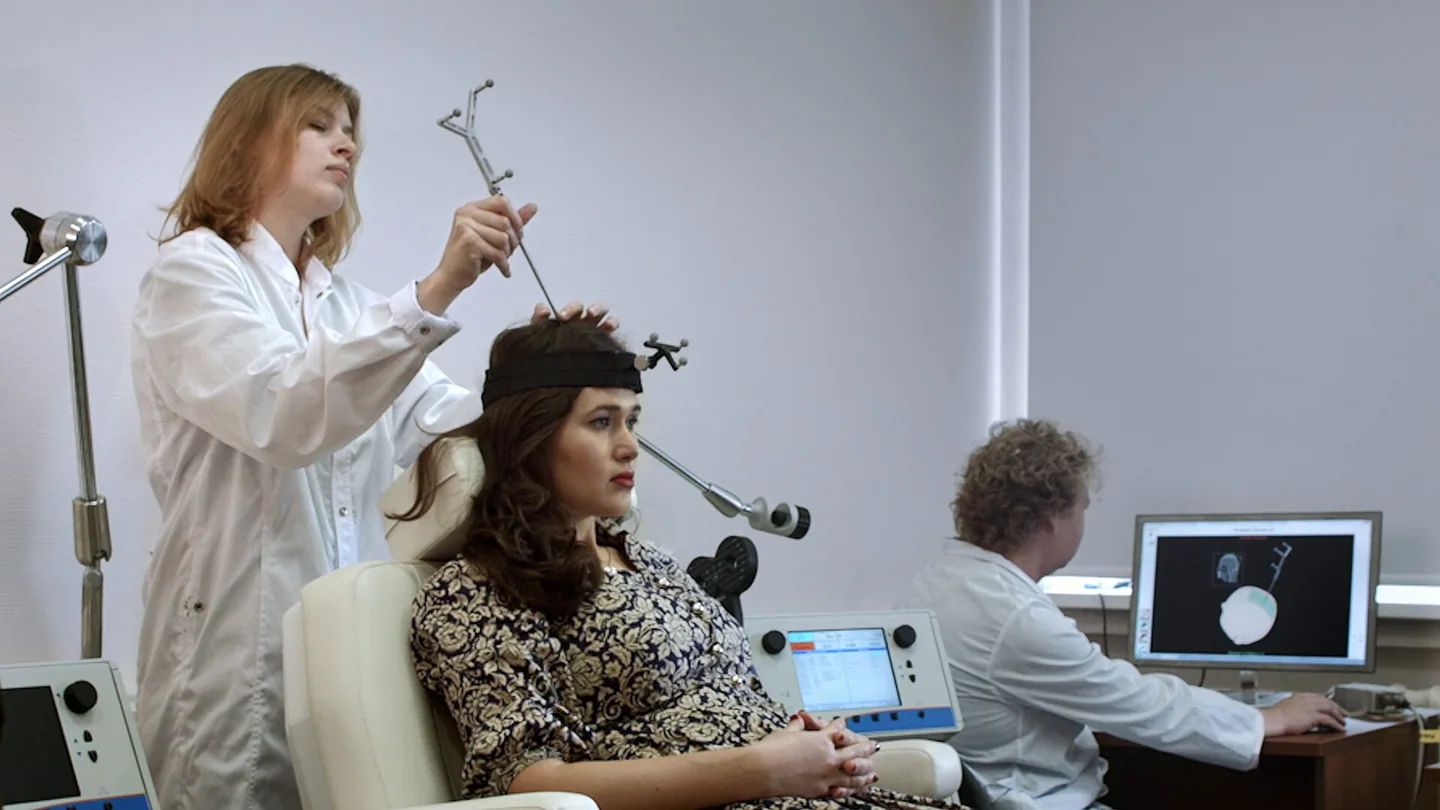
Abstract
Noninvasive neuromodulation spans two physically distinct families — magnetic stimulation that induces suprathreshold cortical currents, and electrical stimulation that shifts resting membrane potential below threshold. This review sets out first principles, coil and electrode physics, target localization and dose individualization, protocol architecture, the field-to-synapse mechanism, and the cleared-versus-investigational evidence and safety landscape.
Key findings
- Magnetic (TMS) and electrical (tES/CES) neuromodulation differ at first principles: TMS induces a focal, suprathreshold cortical field (~100 V/m at target, ~1–2 cm effective depth), while tES/CES deliver diffuse, low-intensity current with peak cortical fields well under 1 V/m.
- Coil geometry sets a focality–depth trade-off: figure-of-eight coils give a single focal hot spot; double-cone and H-coils reach deeper at the cost of focality.
- Dose is individualized — targeting strategies (from the legacy 5 cm rule to MRI-neuronavigation) and motor-threshold calibration (dose as a percentage of resting motor threshold) materially change what the cortex receives.
- Mechanism runs from field to synapse: high-frequency and intermittent theta-burst protocols bias toward LTP-like plasticity; 1 Hz and continuous theta-burst toward LTD-like effects.
- Methodology
- Structured narrative review of the mechanistic and clinical literature, organized around the physical mechanism, dosing, and evidence class. Efficacy ranges are pooled from published trials and reported as such; the review distinguishes cleared indications from investigational ones.
Two physical mechanisms
Noninvasive neuromodulation is often discussed as one category, but it rests on two distinct physical mechanisms that behave very differently in tissue.
- Magnetic stimulation (TMS) delivers a brief, high-intensity magnetic pulse through a coil. The field passes through the skull essentially unattenuated and induces a tangential electric field in the cortex strong enough to initiate action potentials directly — a focal, suprathreshold effect, roughly 100 V/m at target with an effective depth of one to two centimeters.
- Electrical stimulation (tES/CES) passes a small current between scalp electrodes. Much of it is shunted through the scalp; the residual intracerebral current is diffuse and subthreshold, acting by nudging resting membrane potential rather than firing neurons — peak cortical fields well under 1 V/m.
That distinction — suprathreshold and focal versus subthreshold and diffuse — governs almost everything downstream, from what each modality can plausibly do to how its dose is defined.
Targeting and dose
Where the field lands, and how strong it is, are not fixed by the device. Targeting strategies range from the legacy "5 cm rule" to scalp-based heuristics to MRI-neuronavigated functional targeting, and they produce materially different scatter on the cortical surface. Dose is individualized against the resting motor threshold — commonly expressed as a percentage of it — so that a nominally identical protocol delivers a calibrated stimulus rather than a fixed one.
From field to synapse
The mechanism runs across three scales: the induced field preferentially depolarizes at axonal bends and terminals; at the synapse, the pattern of stimulation biases plasticity toward strengthening (LTP-like, with high-frequency and intermittent theta-burst protocols) or weakening (LTD-like, with 1 Hz and continuous theta-burst); and at the network level, stimulation at one site propagates along functional connections.
Evidence and safety
The review closes on the evidence landscape — cleared versus investigational indications, reported response and remission ranges by protocol (pooled from published trials, and labeled as trials pooled rather than participants), and the safety ledger and contraindications that differ between the magnetic and electrical families.
Disclosures
Educational evidence review. It does not recommend any device, protocol, or treatment for any individual and is not medical advice. Reported efficacy ranges reflect pooled published trials, not new data.