
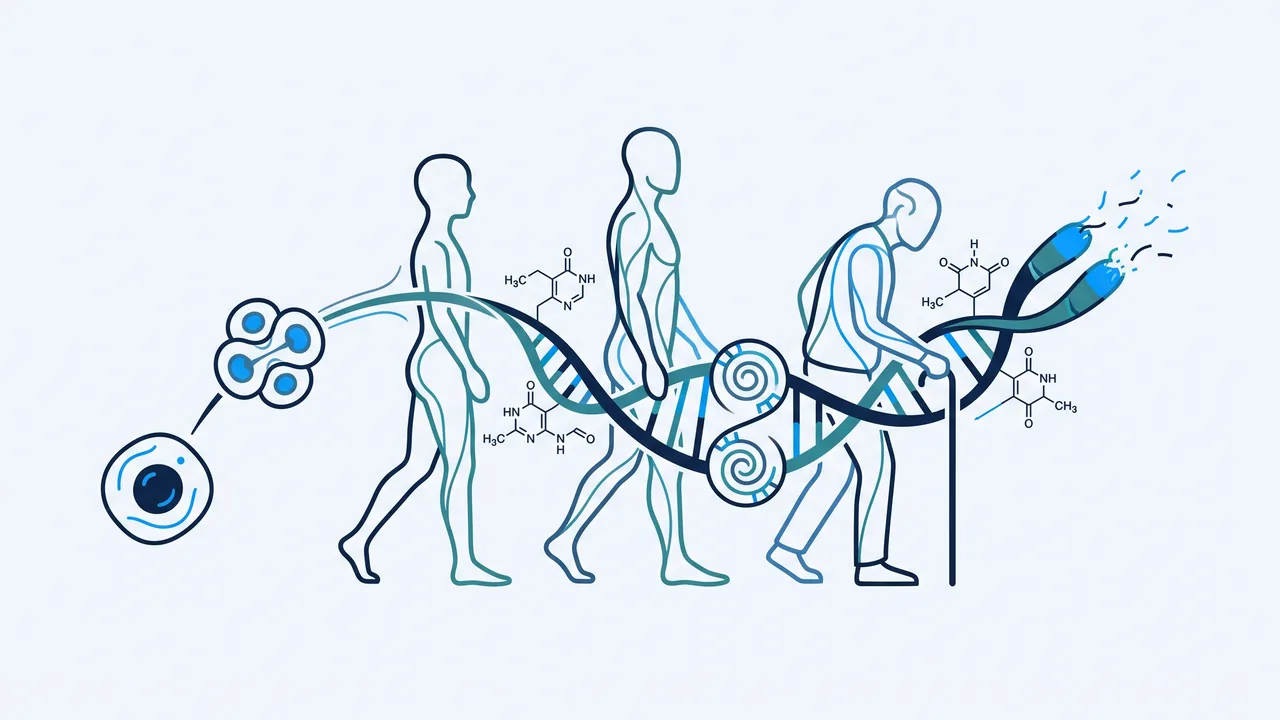
Biology of Aging
Foundational science and methods. A research review published by South Beach Longevity.
01 What aging is, and four things it is not
Aging, in the sense used here, is the time-dependent rise in mortality risk and the progressive loss of physiological reserve in an individual. Hayflick and Moorhead’s 1961 demonstration that cultured human fibroblasts have a finite proliferative life is still the cleanest experimental fact in the field (Hayflick and Moorhead, 1961). It is established as a cell-culture result. It is not a solved engineering brief for the organism.
Four things follow immediately.
First, aging is not chronological time. A calendar year is a coordinate. The biology is what happens to damage, repair, and regulation along that coordinate. Two people of the same age can differ in gait speed, immune repertoire, and remaining life expectancy by a margin large enough to matter clinically (Studenski et al., 2011; Fried et al., 2001). Treating the birthday as the phenotype is how a clock becomes a diagnosis.
Second, aging is not a single disease. Disease labels carve the same organism into billing categories. The age-specific rise in death rates persists after those labels are applied, and multi-system reserve loss is visible in people who do not yet carry a named diagnosis (Clegg et al., 2013; Beard et al., 2016). Calling aging “one treatable disease” is a regulatory or rhetorical move. It is not a finding.
Third, cellular senescence is not organismal aging. The word senescence is used for a stable cell-cycle arrest with a secretory phenotype, and also for the decline of the animal. Campisi’s reviews keep those uses apart (Campisi, 2013). Collapsing them is how a p16-positive cell becomes a theory of everything.
Fourth, a change in a biomarker is not rejuvenation. Horvath’s multi-tissue methylation clock estimates chronological age from cytosine methylation and does it well (Horvath, 2013). Moving the estimate is a measurement. Whether the organism has been returned to an earlier state of risk is a different claim, and it is the claim that almost never has the evidence it needs (Horvath and Raj, 2018; Moqri et al., 2023).
This article is the foundation title for the series that will take nutrition, restriction, exercise, and candidate interventions as neighbouring problems. Those titles inherit the distinctions drawn here. They do not inherit a licence to treat a pathway as a cause because it is famous.
02 Lifespan, healthspan, and the fact of mortality
Lifespan is duration to death. The word is incomplete until the population is named: mean, median, or maximum; wild or laboratory; all-cause or cause-deleted. Healthspan is the period free of a specified set of diseases or disabilities. The specification does the work. A healthspan defined as freedom from the first chronic diagnosis is not the same quantity as a healthspan defined as independence in the activities of daily living (Beard et al., 2016; Clegg et al., 2013).
Fries proposed that morbidity might compress into a shorter period before a later death (Fries, 1980). Crimmins and colleagues, tracking national morbidity and mortality, have shown that the compression is not automatic: years can be added that are lived with disease (Crimmins, 2011). That tension is established as a demographic finding. It is the reason this article refuses to treat “longer life” and “better later life” as one claim.
Fontana, Partridge, and Longo argued that extending healthy life span in model organisms is not the same project as treating late-life disease one organ at a time (Fontana, Partridge, and Longo, 2010). Kennedy and colleagues’ geroscience essay made the complementary point: aging is the major risk factor for a cluster of chronic diseases, and the cluster is not explained by any one of them (Kennedy et al., 2014). Both reviews are strongly supported as programme statements. Neither is a human outcome trial.
03 Demographic aging and the Gompertz problem
Human mortality, after childhood, rises approximately exponentially with age. Vaupel’s biodemography review is the clean modern statement: the age pattern is real, the variance around it is large, and the upper tail of survival has moved (Vaupel, 2010). That is a demographic observation, not a biological ceiling. It is established as a description of national survival. It is not evidence that the rise can continue without bound.
Jones and colleagues compared ageing across the tree of life and found that the human pattern — a long adult life followed by a steep rise in mortality — is one design among many (Jones et al., 2014). Some species show negligible senescence. Some die on a schedule that looks nothing like Gompertz. The comparative fact is established. It is the first warning against treating a mouse survival curve as a miniature human, and it is the reason this article will not call any mammal immortal on the strength of a captive colony.
04 Mutation accumulation, antagonistic pleiotropy, and the disposable soma
Evolutionary theories of aging do not compete with molecular catalogues. They explain why a soma that can repair itself in youth fails later.
Medawar’s mutation-accumulation argument is that alleles with late harmful effects escape selection because few individuals in the wild live long enough to express them. The antagonistic-pleiotropy argument is stronger: an allele can be selected because it helps early reproduction even if it harms the late soma. Kirkwood’s disposable-soma theory is the physiological version of the same trade-off: resources spent on reproduction are not spent on maintenance, and the allocation that maximises Darwinian fitness is not the allocation that maximises lifespan (Kirkwood, 1977; Kirkwood, 2000).
Those ideas are established as the evolutionary backbone of biogerontology. They are not, by themselves, molecular mechanisms. Kirkwood’s own restatement is explicit about the gap: understanding why aging evolves does not list the damage that actually accumulates (Kirkwood, 2000).
Blagosklonny’s quasi-programmed or hyperfunction account is a later, still-contested reading: aging as the continuation of growth and reproduction programmes that are not switched off (Blagosklonny, 2006). Gems’s hoverfly-and-wasp critique argues that the Hallmarks list can be read as a catalogue of consequences of such programmes rather than as independent primary causes (Gems, 2021). That critique is emerging. It is included here because a foundational article that treats the Hallmarks as settled law has already failed its own brief.
05 Species differences and the limits of extrapolation
Yeast, worms, flies, mice, and nonhuman primates are not small people. Kenyon’s 1993 demonstration that a daf-2 insulin/IGF-1 receptor mutation can double Caenorhabditis elegans lifespan is a landmark of invertebrate genetics (Kenyon et al., 1993). It is established as a worm result. The pathway is conserved. The effect size is not.
Liao, Rikke, Johnson, Diaz, and Nelson showed that even inside the laboratory mouse, the lifespan response to dietary restriction varies by genotype — including lines that live shorter when restricted (Liao et al., 2010). Mitchell, Yang, Gramlich, and colleagues later reported that sex, strain, and energy intake jointly determine which “hallmarks” move in mice (Mitchell et al., 2016). Those papers are strongly supported as a warning against treating “the mouse” as one organism.
The rhesus-macaque caloric-restriction programmes are the best available primate test, and they do not agree with each other in the way a press release would like. Colman, Anderson, Johnson, Kastman, and colleagues at Wisconsin reported delayed disease onset and improved survival (Colman et al., 2009). Mattison, Roth, Beasley, Tilmont, and colleagues at the NIA, using a different diet, a different control feeding regime, and a different starting age structure, did not find a significant longevity effect in their 2012 report (Mattison et al., 2012). A later combined analysis softened but did not erase the discrepancy (Mattison et al., 2017). The honest reading is strongly supported: primate restriction can improve metabolic health; it has not produced a single, transportable lifespan number.
A translation matrix belongs in the apparatus of this title, not as a decorative figure. The rule is simple. A mechanism conserved to humans is a candidate. A lifespan effect in a short-lived species is a hint. A human trial endpoint is the only thing that can carry a human claim.
06 The 2013 Hallmarks of Aging
López-Otín, Blasco, Partridge, Serrano, and Kroemer published “The Hallmarks of Aging” in 2013 as an explicit analogue of the Hanahan–Weinberg cancer hallmarks: a short list of cellular and molecular processes that are associated with aging and that, in at least some systems, can be experimentally manipulated (López-Otín et al., 2013). The original nine were genomic instability, telomere attrition, epigenetic alterations, loss of proteostasis, deregulated nutrient sensing, mitochondrial dysfunction, cellular senescence, stem-cell exhaustion, and altered intercellular communication.
The paper is established as the most cited organising scheme in contemporary geroscience. Kennedy and colleagues’ 2014 “geroscience” essay is the complementary programme statement: aging as the major risk factor for chronic disease, and therefore a legitimate research object rather than a background variable (Kennedy et al., 2014). Neither paper demonstrated that the list is complete, orthogonal, or causal in humans. López-Otín and colleagues said as much. The field often forgot.
Gems’s later critique, and Gladyshev’s damage-centred account, argue that a hallmark list can hide interdependence, circular definition, and the difference between a useful teaching device and a causal model (Gems, 2021; Gladyshev, 2021). Those critiques are strongly supported as methodological objections. They do not erase the empirical associations the 2013 paper collected.
07 The 2023 expansion and the competing maps
The 2023 sequel added disabled macroautophagy, chronic inflammation, and dysbiosis, and re-drew several of the original boxes (López-Otín et al., 2023). An expanding universe is an admission. It is also a temptation: every new process that changes with age can be promoted to a hallmark, and the list stops being a hypothesis.
Gems asked the question this article is required to ask: are the hallmarks causes, or are they descriptions of what a late soma looks like when developmental and nutrient-sensing programmes run too long (Gems, 2021)? A descriptive catalogue is not a theory of aging. The 1961 fibroblast limit was a fact. It was never a parts list (Hayflick and Moorhead, 1961).
This title treats the Hallmarks as a map. Maps are useful. They are not the territory, and they are not a parts list from which a drug can be ordered.
08 Mechanism, correlate, biomarker, causal driver, therapeutic target
Five words are used in longevity writing as if they were synonyms. They are not.
A mechanism is a process shown, in a specified system, to produce a phenotype. Telomere attrition is a mechanism of replicative arrest in cultured human fibroblasts (Harley, Futcher, and Greider, 1990; Hayflick and Moorhead, 1961). That does not make it the mechanism of human mortality.
A correlate co-varies with age or with an outcome. Grey hair is a correlate. So is a large fraction of the circulating proteome.
A biomarker is a measured proxy. Horvath’s clock is a biomarker of chronological age (Horvath, 2013). Levine’s PhenoAge and Lu’s GrimAge were built to predict mortality better than chronology (Levine et al., 2018; Lu et al., 2019). Belsky’s DunedinPACE estimates the pace of aging from a longitudinal cohort (Belsky et al., 2022). These are strongly supported as predictors in the cohorts that trained and tested them (Horvath and Raj, 2018). Prediction is not causation.
A causal driver is a node such that intervening on it changes the aging trajectory in the same system. Clearing p16-positive cells extends median lifespan in progeroid and, later, naturally aged INK-ATTAC mice (Baker et al., 2011; Baker et al., 2016). That is a causal claim in those mice. It is not a causal claim in people.
A therapeutic target is a tractable node. mTOR is a target because rapamycin moves it and because the Interventions Testing Program has repeatedly extended mouse lifespan with rapamycin (Harrison et al., 2009; Miller et al., 2014). Being a target does not decide whether mTOR hyperactivity is the cause of human aging. Lamming, Ye, Katajisto, Goncalves, and colleagues showed that rapamycin’s metabolic liabilities can dissociate from its longevity-adjacent effects (Lamming et al., 2012). The dissociation is strongly supported. It is the reason a target is not a diagnosis.
09 How the hallmarks interact, and why reductionism fails
The 2013 paper already drew arrows. Genomic instability promotes senescence; senescence secretes inflammatory mediators; inflammation accelerates stem-cell decline; nutrient sensing modulates autophagy; autophagy clears damaged mitochondria; damaged mitochondria produce signals that look like inflammation. The arrows are plausible as a cartoon. They are not a fitted systems model.
Yousefzadeh, Flores, Zhu, Dolan, and colleagues reported that an aged immune system can drive senescence in peripheral tissues in mice (Yousefzadeh et al., 2021). That is a mouse transplantation and genetic study, emerging as evidence that the immune hallmark is not a downstream passenger. It is not a human immune-aging trial.
A single-pathway explanation — “it is all mTOR,” “it is all NAD,” “it is all senescent cells” — fails the interaction map on its face. It also fails the evolutionary argument: a soma that fails in many ways at once is exactly what antagonistic pleiotropy and disposable-soma theory predict (Kirkwood, 1977; Kirkwood, 2000). Reductionism remains useful for experiments. It is a poor theory of the organism.
10 Genomic instability
Somatic mutation accumulates with age. Lodato, Rodin, Bohrson, Coulter, and colleagues reported that aging and neurodegeneration are associated with increased somatic mutations in human neurons (Lodato et al., 2018). Martincorena, Fowler, Wabik, Lawson, and colleagues showed that mutant clones colonise the histologically normal human oesophagus, with a landscape that looks more like a crowded precancer than like a quiet epithelium (Martincorena et al., 2018). Those sequencing studies are established as evidence that the genome of a fifty-year-old is not the genome of the same person at twenty.
Whether mutation causes aging, as opposed to cancer and tissue mosaicism, is a different claim. Schumacher, Pothof, Vijg, and Hoeijmakers reviewed DNA damage as a central aging mechanism and were careful about the gap between damage and organismal decline (Schumacher et al., 2021). Progeroid DNA-repair syndromes show that some repair defects produce phenotypes that resemble aging. Resemblance is not identity. The causal-driver status of ordinary somatic mutation in ordinary human aging remains unresolved.
11 Telomere attrition
Hayflick and Moorhead described a limited proliferative lifespan of cultured human fibroblasts in 1961 (Hayflick and Moorhead, 1961). Harley, Futcher, and Greider showed that telomeres shorten during that process (Harley, Futcher, and Greider, 1990). The fibroblast mechanism is established.
Human epidemiology is weaker than the cell biology. Average leukocyte telomere length associates with age and, in some cohorts, with disease and mortality. The associations are modest, reverse causation is plausible, and telomere length is a poor individual-level clock compared with methylation ages (Horvath and Raj, 2018). Telomere biology disorders — dyskeratosis congenita and related syndromes — show that extreme telomere failure is a disease driver (reviewed in the clinical telomere literature; not treated here as ordinary aging). Extreme monogenic failure is not a licence to treat ordinary shortening as the cause of ordinary aging.
12 Epigenetic alteration and the clocks
Horvath’s 2013 multi-tissue clock remains the reference implementation: hundreds of CpG sites, a penalised regression, and a strikingly accurate estimate of chronological age (Horvath, 2013). Horvath and Raj later reviewed the first generation of clocks and the first generation of over-readings: clocks predict age and sometimes death; they do not yet identify which methylation changes are causal, and they are sensitive to immune-cell composition (Horvath and Raj, 2018).
Second-generation clocks were trained on outcomes. Levine’s PhenoAge and Lu’s GrimAge improve mortality prediction (Levine et al., 2018; Lu et al., 2019). Belsky, Caspi, Corcoran, Houts, and colleagues’ DunedinPACE estimates pace rather than level (Belsky et al., 2022). Waziry, Ryan, Corcoran, Huffman, and colleagues reported that caloric restriction in CALERIE slowed DunedinPACE (Waziry et al., 2023). That is a randomised-trial biomarker finding in a defined, non-obese adult sample. It is emerging as evidence that a pace estimate can move. It is not a mortality result, and it is not a rejuvenation.
Poganik, Zhang, Baht, Tyshkovskiy, and colleagues reported that biological-age estimates can rise with stress and then recede (Poganik et al., 2023). Moqri, Herzog, Poganik, and the Biomarkers of Aging Consortium have tried to impose vocabulary on a field that was selling products faster than it was defining terms (Moqri et al., 2023). Both papers are used here as strongly supported cautions. A clock that moves after a marathon, a hip fracture, or a pregnancy is measuring something real. It is not measuring a trip backward through development.
13 Proteostasis, autophagy, and the protein-quality problem
Proteostasis is the cell’s ability to fold, traffic, and clear proteins. Hipp, Park, and Hartl reviewed the impairment of that network in protein-misfolding disease — a decline that becomes more costly as the organism ages (Hipp, Park, and Hartl, 2014). The direction is established: capacity declines, aggregates rise, and long-lived post-mitotic cells are the obvious victims. The quantitative contribution to human mortality is not established.
Autophagy is one clearance route. Aman, Schippers, Wong, van Dam, and colleagues reviewed autophagy in healthy aging and disease and did not pretend that “more autophagy” is a single lever (Aman et al., 2021). The 2023 hallmark paper promoted disabled macroautophagy to its own box (López-Otín et al., 2023). Promotion is not new evidence. Spermidine and related autophagy claims belong in sibling nutrition titles. This title records the process, not a supplement.
14 Mitochondrial dysfunction and the oxidative-stress hangover
Harman’s 1956 free-radical theory and its mitochondrial later form are the most famous aging theories that did not survive contact with the genetic tests (Harman, 1956). Trifunovic, Wredenberg, Falkenberg, Spelbrink, and colleagues’ mtDNA-mutator mouse, and Kujoth, Hiona, Pugh, Someya, and colleagues’ parallel report, showed that proofreading-deficient mitochondrial polymerase produces a progeroid phenotype (Trifunovic et al., 2005; Kujoth et al., 2005). That is strongly supported as evidence that enough mitochondrial DNA mutation can damage a mouse. It is not evidence that ordinary human aging is the mutator mouse.
Ristow, Zarse, Oberbach, Klöting, and colleagues reported that antioxidants can block health-promoting effects of exercise in humans — a randomised mechanistic study, not a longevity trial (Ristow et al., 2009). Sun, Youle, and Finkel reviewed mitochondrial quality control in aging without resurrecting the 1956 slogan (Sun, Youle, and Finkel, 2016). The current position, strongly supported, is that mitochondria change with age and that some of those changes matter. “Oxidative stress” as a master cause is a correlate that was over-promoted.
15 Nutrient sensing: mTOR, insulin/IGF, AMPK, and sirtuins
Nutrient-sensing pathways are the most experimentally tractable aging nodes, which is why they are also the most over-sold.
mTOR. Saxton and Sabatini’s review remains the reference map of the pathway (Saxton and Sabatini, 2017). Harrison, Strong, Sharp, Nelson, and colleagues reported that rapamycin started late in life extends median and maximal lifespan in genetically heterogeneous mice (Harrison et al., 2009). The Interventions Testing Program replicated and extended the result (Miller et al., 2014). Bitto, Ito, Pineda, LeTexier, and colleagues showed that a transient late-life course can be enough in mice (Bitto et al., 2016). Those ITP and related studies are established as mouse lifespan results. Mannick, Del Giudice, Lattanzi, Valiante, and colleagues, and the later Mannick trials, showed that low-dose mTOR inhibition can improve influenza-vaccine responses in older adults (Mannick et al., 2014). That is a human immune-response finding. It is not a lifespan finding. Lamming’s insulin-resistance paper is the metabolic cost that any human programme has to price (Lamming et al., 2012).
Insulin/IGF. The worm and fly genetics are established. Human genetics of exceptional longevity implicate IGF-1 and related loci among other signals; effect sizes are small and the phenotype is survival, not a mechanism (Deelen et al., 2019; Timmers et al., 2019; Melzer, Pilling, and Ferrucci, 2020). Fontana, Partridge, and Longo’s 2010 review is still the right caution against treating a dwarf mouse as a diet (Fontana, Partridge, and Longo, 2010).
AMPK. Energy-stress signalling is a plausible integrator. Hardie’s biochemistry is not in dispute. Human aging claims for AMPK activators other than the indirect and contested case of metformin belong in the intervention matrix, not in a mechanism paragraph.
Sirtuins and NAD. Burnett, Garcia, Bjedov, Coelho, and colleagues reported the absence of a Sir2 overexpression lifespan effect in the systems that had made the strongest claims (Burnett et al., 2011). That paper is strongly supported as a correction. NAD metabolites can change in tissues with age; supplementation can move NAD levels and some physiological readouts. Yoshino, Baur, and Imai’s 2021 muscle insulin-sensitivity trial of nicotinamide mononucleotide is a randomised human metabolic study (Yoshino et al., 2021). It is not a lifespan trial. Burnett’s correction is the reason this title will not treat sirtuins as conserved longevity genes (Burnett et al., 2011). The honest grade for NAD as a causal driver of human aging is plausible at the metabolite level, unverified as a geroprotector.
16 Cellular senescence and the SASP
Cellular senescence is a stable arrest that can be triggered by telomere dysfunction, oncogenes, and damage, and that is accompanied by a senescence-associated secretory phenotype. Coppé, Patil, Grieux, Sun, and colleagues defined the SASP in human fibroblasts (Coppé et al., 2008). Campisi’s 2013 review is the standard map (Campisi, 2013). McHugh and Gil, and Gorgoulis, Adams, Alimonti, Bennett, and colleagues, tried to impose definitions on a field that was using one word for several states (McHugh and Gil, 2018; Gorgoulis et al., 2019).
Baker, Wijshake, Tchkonia, LeBrasseur, and colleagues’ INK-ATTAC clearance papers are the causal-driver evidence in mice (Baker et al., 2011; Baker et al., 2016). Xu, Pirtskhalava, Farr, Weigand, and colleagues reported that a dasatinib-plus-quercetin combination improves physical function in old mice (Xu et al., 2018). Baar, Brandt, Putavet, Klein, and colleagues’ FOXO4-DRI peptide is a designed senolytic with mouse data (Baar et al., 2017). The mouse causal evidence is strongly supported. Early human senolytic studies exist; they are small, often open-label, disease-selected, and not lifespan results. Senolytics are targets. They are not a demonstrated reversal of human aging.
17 Stem-cell exhaustion
Tissues that renew depend on stem and progenitor cells. Goodell and Rando reviewed stem cells and healthy aging without claiming that every late-life failure is a stem-cell failure (Goodell and Rando, 2015). Heterochronic parabiosis later became a systems experiment: Ma, Wang, Palovics, Chen, and colleagues’ 2022 atlas is a description of what a shared circulation does to stem-cell and tissue programmes, not a product (Ma et al., 2022). Those studies are strongly supported as mouse evidence that the stem-cell niche is partly systemic. They are the origin of a blood-factor industry that this article does not underwrite.
Loffredo, Steinhauser, Jax, Gannon, and colleagues reported GDF11 as a circulating rejuvenation factor for the heart (Loffredo et al., 2013). Egerman, Cadena, Gilbert, Meyer, and colleagues reported that GDF11 increases with age and inhibits skeletal-muscle regeneration (Egerman et al., 2015). The contradiction is established as a controversy. Ma, Wang, Palovics, Chen, and colleagues’ 2022 parabiosis atlas is a systems description, not a product (Ma et al., 2022). The lesson for this title is the same as for GDF-11’s sibling article: a spectacular mouse paper is a starting point. It is not a human therapy.
18 Intercellular communication, inflammaging, and the extracellular matrix
Altered intercellular communication was the 2013 residual box: everything that is not inside one cell. Franceschi, Bonafè, Valensin, Olivieri, and colleagues named inflammaging in 2000: a chronic, low-grade, sterile inflammatory tone that rises with age (Franceschi et al., 2000). Franceschi, Garagnani, Parini, Giuliani, and Santoro restated it with two decades of data (Franceschi et al., 2018). Ferrucci and Fabbri reviewed inflammageing as a risk factor for chronic disease (Ferrucci and Fabbri, 2018). Furman, Campisi, Verdin, Carrera-Bastos, and colleagues placed inflammation in the larger “chronic inflammatory” disease cluster (Furman et al., 2019). The association is established. Causation — inflammation as the driver rather than a readout of damaged tissue, senescent cells, and an aging immune system — is partially established and still circular.
A stiff, cross-linked, less-renewed extracellular matrix is both a cause and a consequence of cellular aging. Advanced glycation and collagen crosslinking are old biochemistry. They are under-represented in hallmark cartoons and over-represented in tissues that actually fail: artery, lung, cartilage, lens. The ECM is strongly supported as a missing-from-the-slide problem, not as a new fashion (McHugh and Gil, 2018).
19 Immune aging and endocrine aging
Immune aging is not one defect. Haematopoietic output skews myeloid; naïve T-cell production falls after thymic involution; memory clones occupy space; vaccine responses weaken. Mannick’s everolimus trials, already cited, are the rare randomised human interventions that move an immune endpoint in older adults (Mannick et al., 2014). Yousefzadeh’s mouse immune-aging paper, already cited, is the rare causal design that puts the immune system upstream of peripheral senescence (Yousefzadeh et al., 2021). Human immune aging as a master driver remains emerging.
Endocrine aging is better described than explained. van den Beld, Kaufman, Zillikens, Lamberts, and Egan reviewed the physiology of endocrine systems with ageing: GH/IGF-1, gonadal steroids, adrenal androgens, thyroid, and the insulin axis do not decline on one clock (van den Beld et al., 2018). North and Sinclair reviewed the overlap of aging and cardiovascular disease without collapsing the two (North and Sinclair, 2012). Hormone replacement is a clinical literature of its own. This title records the axes. It does not prescribe them.
20 Microbiome interactions
Claesson, Jeffery, Conde, Power, and colleagues showed that gut microbiota composition correlates with diet and health in community-dwelling older adults (Claesson et al., 2012). O’Toole and Jeffery reviewed the aging microbiome (O’Toole and Jeffery, 2015). Thevaranjan, Puchta, Schulz, Naidoo, and colleagues reported that age-associated microbial dysbiosis promotes intestinal permeability and systemic inflammation in mice (Thevaranjan et al., 2017). Human association is established. Mouse causation is strongly supported in the systems tested. Human causation — dysbiosis as a driver of aging rather than a shadow of diet, drugs, and dentition — is unresolved. The 2023 hallmark promotion of dysbiosis should be read as a research agenda, not as a verdict.
21 Organ-system aging
Organs do not age in unison. North and Sinclair reviewed the overlap of arterial and cardiac aging with cardiovascular disease (North and Sinclair, 2012). Wyss-Coray reviewed brain ageing, neurodegeneration, and the limited sense in which “rejuvenation” has been shown in mice (Wyss-Coray, 2016). Kidney filtration declines with a wide variance; some of that decline is disease, some is nephron loss, and some is the price of surviving other diseases. Muscle loses motor units and type-II fibre area; Cruz-Jentoft’s EWGSOP2 statement is the current operational definition of sarcopenia, not a mechanism (Cruz-Jentoft et al., 2019). Bone remodelling uncouples. Lung elastic recoil falls. Skin thins. The list is established as descriptive physiology.
The series implication is practical. A article on nutrition for aging, or on endurance training, or on a candidate drug, inherits organ-specific endpoints. It does not inherit the right to say that a change in one organ is a change in aging.
22 Frailty, resilience, and functional decline
Fried, Tangen, Walston, Newman, and colleagues defined a frailty phenotype: shrinking, weakness, exhaustion, slowness, and low activity (Fried et al., 2001). Clegg, Young, Iliffe, Rikkert, and Rockwood’s Lancet review is the clinical synthesis, covering both the Fried phenotype and deficit-accumulation approaches (Clegg et al., 2013). Studenski, Perera, Patel, Rosano, and colleagues showed that gait speed predicts survival in older adults with a dose-response that a molecular clock would envy (Studenski et al., 2011). Those constructs are established as prognostic tools.
Resilience is the complementary idea: the capacity to recover from a stressor. It is easier to praise than to measure. This article treats resilience as a research target, not as a completed metric. Functional decline — the loss of the ability to walk, transfer, remember, and manage a household — is the outcome that healthspan language is trying to name. It is also the outcome that most “rejuvenation” papers do not measure.
Beard, Officer, de Carvalho, Sadana, and colleagues’ World Report on Ageing and Health is the public-health frame: intrinsic capacity, environment, and the difference between a molecular story and a life that can still be lived (Beard et al., 2016). A foundational biology article that ignored that frame would have mistaken the cell for the person.
23 Landmark studies and the intervention evidence
A short timeline, kept honest:
| Year | Study | Species | What it showed | What it did not |
|---|---|---|---|---|
| 1961 | Hayflick and Moorhead | Human cells | Finite fibroblast proliferation | Organismal aging |
| 1977 | Kirkwood disposable soma | Theory | Maintenance–reproduction trade-off | A molecular list |
| 1993 | Kenyon daf-2 | Worm | Large lifespan extension via IIS | Human effect size |
| 2022 | Ma parabiosis atlas | Mouse | Shared circulation remaps stem-cell programmes | A human plasma product |
| 2009 | Harrison ITP rapamycin | Mouse | Late-life rapamycin extends lifespan | A human dosing schedule |
| 2009 / 2012 | Colman / Mattison CR | Rhesus | Metabolic benefit; discordant survival | A single primate answer |
| 2011 / 2016 | Baker INK-ATTAC | Mouse | Clearing p16+ cells helps | A licensed senolytic |
| 2013 | Horvath clock | Human | Methylation predicts chronological age | Causal rejuvenation |
| 2014 / 2018 | Mannick everolimus | Human | Better vaccine response | Lifespan or healthspan |
| 2015 | CALERIE phase 2 | Human | Restriction is feasible; physiology moves | Mortality |
| 2019 | Fahy TRIM | Human, small | Thymus imaging and clock shifts | Controlled rejuvenation |
| 2023 | Waziry CALERIE / DunedinPACE | Human | Pace estimate slowed | Death or disability |
Harrison, Strong, Sharp, Nelson, Astle, Flurkey, Nadon, Wilkinson, Frenkel, Carter, Pahor, Javors, Fernandez, and Miller’s 2009 rapamycin paper is the cleanest pharmacological lifespan result in mammals (Harrison et al., 2009). CALERIE is the cleanest human restriction physiology programme (Ravussin et al., 2015; Waziry et al., 2023; Spadaro et al., 2022). TAME, the proposed metformin trial, is a design for a geroprotector outcome, not a result (Justice et al., 2018). Bannister, Holden, Jenkins, Morgan, and colleagues’ observational metformin-survival signal is confounded by indication and by the healthy-user problem (Bannister et al., 2014). The UKPDS metformin arm is a diabetes trial (UK Prospective Diabetes Study Group, 1998). Observational immortality on metformin is not a geroscience result.
Mitchell’s mouse paper already showed that how much, which sex, and which strain jointly determine what restriction does to hallmarks (Mitchell et al., 2016). Timing of feeding is a further design variable, not a human fasting protocol.
24 Lifespan versus healthspan; clocks, reversal, and the word rejuvenation
A longer life that is a longer decline is a failure of the healthspan claim. A shorter life with a compressed morbidity is a different failure. Most animal papers report survival. Most human papers report a surrogate. The mismatch is the central translational defect of geroscience.
Fahy, Brooke, Watson, Good, and colleagues’ TRIM study — recombinant GH, DHEA, and metformin in a small, uncontrolled male sample — reported thymic imaging changes and a shift in epigenetic age (Fahy et al., 2019). It is emerging as a hypothesis-generating human observation. It is not a randomised demonstration of rejuvenation, and GH is not a geroprotector in any straightforward sense.
Lu, Zhang, Chen, Singh, and colleagues reported recovery of youthful epigenetic information after injury in the mouse ganglion-cell system (Lu et al., 2020). Takahashi and Yamanaka’s 2006 reprogramming paper is the method, not the aging claim (Takahashi and Yamanaka, 2006). Partial reprogramming is emerging as one of the most important experimental tools in the field. It is also the setting in which the word “reversal” is used with the least discipline. Teratoma risk, incomplete resetting, and the difference between a retinal axon and a human life are not fine print.
A clock that runs backward after a fever resolves has not reversed aging (Poganik et al., 2023). A clock that runs backward after a 12-week diet has not shown that the diet is a geroprotector. Moqri and colleagues’ consortium vocabulary is the minimum standard this series will use: a biomarker of aging must be defined, validated, and separated from a biomarker of disease and from a marketing claim (Moqri et al., 2023).
25 Is aging one treatable disease? The red-team case
The assigned red-team brief is: assume contemporary geroscience overstates how well the fundamental causes of human aging are understood. Build the strongest scientific case.
The case is as follows.
The Hallmarks are a teaching taxonomy. They were proposed as such (López-Otín et al., 2013). They have been treated as a parts list. Gems’ hoverfly critique and Gladyshev’s damage account are not nihilism. They are the observation that a list of things that change with age can be assembled without knowing which changes are necessary, which are sufficient, and which are scars (Gems, 2021; Gladyshev, 2021).
Single-pathway stories fail on contact with genetics and with one another. Rapamycin, senolytic clearance, parabiosis, NAD repletion, and reprogramming do not converge on one node. Liao’s genotype-dependent restriction result shows that even “eat less” is not one intervention (Liao et al., 2010). Burnett’s Sir2 correction is what a field looks like when a favourite gene is asked to replicate (Burnett et al., 2011). Ristow’s exercise-and-antioxidant trial is what a field looks like when a favourite theory is asked to predict a human physiology result (Ristow et al., 2009).
Preclinical-to-human extrapolation is systematically optimistic. Worm effect sizes do not survive the mouse. Mouse effect sizes do not survive the rhesus disagreement. The rhesus disagreement has not been resolved by a human lifespan trial, because no ethical, funded human lifespan trial of a geroprotector has been completed. CALERIE measured physiology (Ravussin et al., 2015). Mannick measured vaccine response (Mannick et al., 2014). Xu measured physical function in old mice, not a human lifespan (Xu et al., 2018). Those are the right early designs. They are not the designs that industry press releases describe.
Survivorship and publication bias are not hypothetical. The ITP exists because single-lab mouse lifespan studies were not reproducible enough. The papers that did not extend lifespan are under-represented in reviews. Exceptional-longevity genetics recover small effects after large samples (Deelen et al., 2019; Timmers et al., 2019). That is what a highly polygenic, highly environmental trait looks like. It is not what a single-target disease looks like.
“Reversal” is usually a limited phenotype. A methylation shift, a progenitor assay, a retinal axon, a vaccine titre. Hayflick’s limit was a fibroblast culture. It is still being asked to carry an industry.
Aging-as-disease is a category error with regulatory uses. Beard’s WHO frame and Clegg’s frailty frame describe a person. A disease code describes a billing event. The biology in Parts Two to Four is real. It does not become one ICD entity because that would make trial design easier.
Resolution of the red-team case: PARTIALLY ACCEPTED. Geroscience has identified conserved, experimentally tractable nodes. It has not identified the fundamental causes of human aging in the sense a physicist would mean, or in the sense a regulator would need to license a drug “for aging.” The overstatement is real. The nihilistic conclusion — that nothing is known — is false.
26 What is established, what is not, and the register of unresolved science
Established. Aging is a rise in mortality and a loss of reserve. Evolutionary trade-off theories explain why a soma fails. Fibroblasts have a replicative limit tied to telomeres. Somatic mutation and epigenetic drift accumulate. Nutrient-sensing and senescent-cell clearance can extend mouse lifespan. Human restriction can be done and moves physiology. Frailty and gait speed predict death. The Hallmarks are a useful map.
Strongly supported but not settled. Inflammaging as a contributor. Immune aging as an upstream driver in mice. mTOR inhibition as a human immune modulator. Second-generation clocks as mortality predictors. Primate restriction as a metabolic, not a unified longevity, result.
Emerging. Human senolytics. Partial reprogramming as a tool. Pace-of-aging clock responses to restriction. Microbiome as a driver rather than a shadow.
Unresolved. The necessary and sufficient causes of human aging. The right primary endpoint for a geroprotector. Whether aging is compressible as Fries hoped or expandable as Crimmins has feared. How to translate a heterogeneous mouse to a heterogeneous human. Whether any clock measures a reversible cause rather than a useful shadow.
Sibling articles will take nutrition, restriction, exercise, and named candidates. They inherit this register. They do not close it.
27 References
The numbered list is generated at build from verified NCBI MEDLINE records. Unresolved identifiers are refused.
28 Evidence handling
Study type is labelled in the reporting sentence. Animal and in-vitro results are not phrased as human outcomes. Conflicting evidence is presented as conflict. Quantitative claims in the body are restricted to findings carried by the verified reference list. Pipeline notes, corpus-scan counts, and project codes do not appear in the published text.
Adversarial resolutions used in the body. Hallmarks as causal mechanisms: PARTIALLY ACCEPTED as a map, REJECTED as a complete causal set. Single-pathway explanations: REJECTED. Preclinical-to-human extrapolation: PARTIALLY ACCEPTED with mandatory species labels. Lifespan versus healthspan: ACCEPTED as a real distinction. Biomarker change as rejuvenation: REJECTED. Aging as one treatable disease: REJECTED. Reversal on clocks or limited phenotypes: PARTIALLY ACCEPTED as experimental language, REJECTED as a clinical claim. Survivorship and publication bias: ACCEPTED as a live distortion.
Continue reading