
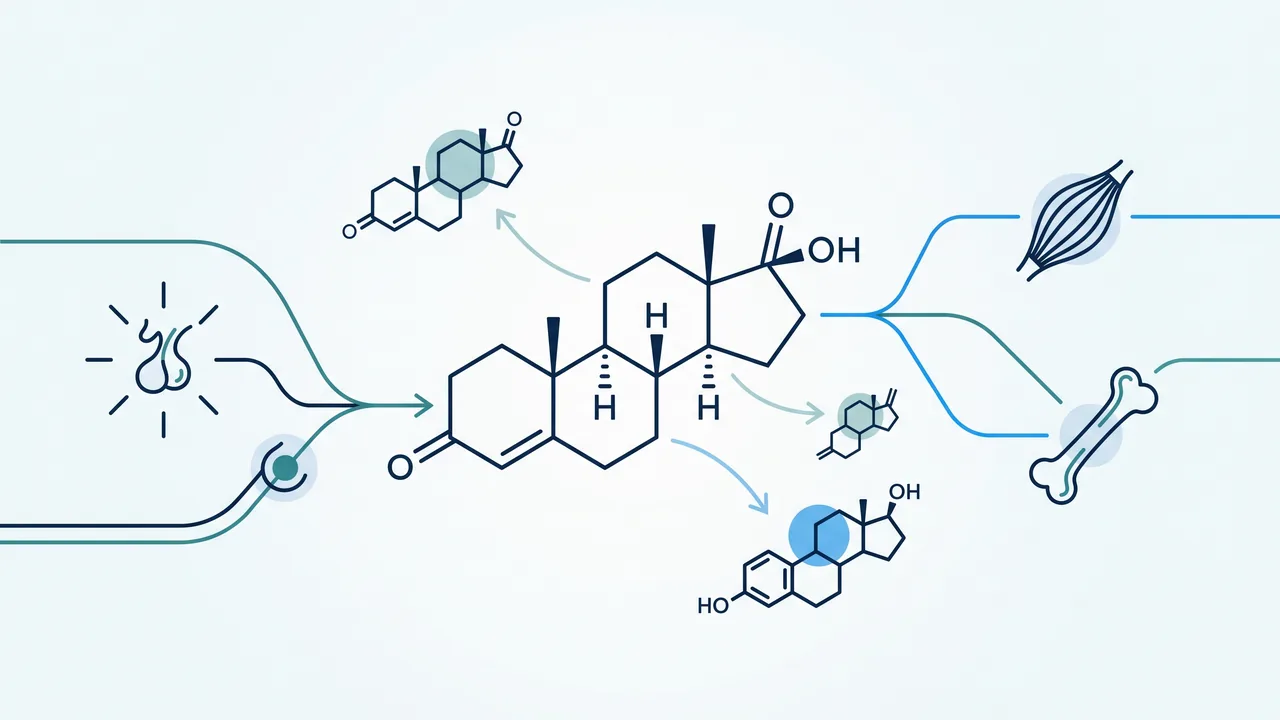
Dehydroepiandrosterone
Hormones and hormone precursors. A research review published by South Beach Longevity.
Every finding is labelled, in the sentence that reports it, by the kind of study that produced it. An adrenal-insufficiency replacement trial is not an aging trial. A vaginal prasterone label is not an oral-capsule study. A rise in circulating dehydroepiandrosterone or its sulfate is a hormone-level change, not a clinical outcome. Where two results conflict, both are given. Amounts, routes, and durations appear only as reported experimental or labelled parameters, always with the population attached. Nothing here is a recommendation. Findings are graded in place as established, strongly supported, emerging, plausible, or speculative. Two further labels mark careful absences rather than verdicts: not established, where the evidence is too thin to place a claim on the ladder at all — untested or insufficient, an absence of proof rather than disproof; and not supported, where the weight of evidence leans against a claim but stops short of a formal refutation.
01 What this document is, and five things it is not
This article is a research review of dehydroepiandrosterone (DHEA) and its circulating sulfate (DHEA-S): adrenal steroidogenesis, the age-related fall that made the molecule famous, conversion to androgens and estrogens, tissue-specific intracrinology, pharmacokinetics, sex differences, and the human outcome file that was asked to carry an anti-aging claim. It is written against a market that treats a falling adrenal androgen as a deficiency and a restored number as restored youth.
Five things follow immediately.
First, this is not a hormone-use or dosing guide. No amount, route, or schedule is recommended for any person. Figures that appear later are study or labelled parameters attached to named populations.
Second, it is not a proof that age-related decline is deficiency. Circulating DHEA-S falls across adult life in both sexes (Orentreich, Brind, Rizer, and Vogelman, 1984; Orentreich, Brind, Vogelman, Andres, and Baldwin, 1992). That physiology is established. Calling the later-life value a deficiency requires a clinical syndrome, not a percentile on a young-adult curve.
Third, it is not an anti-aging manual. The two-year Mayo randomised trial of DHEA in elderly men and women did not restore body composition, physical performance, or insulin sensitivity to a youthful state when DHEA-S was returned to the young-adult range (Nair et al., 2006). A youthful number without youthful function is the controlling negative.
Fourth, it is not a licence to collapse three evidence objects. Oral dietary-supplement DHEA, hospital or endocrine replacement in adrenal insufficiency, and licensed vaginal prasterone for dyspareunia are different experiments. The last is a labelled product. The first is not.
Fifth, it is not medical advice. This document recommends no use of any compound, product, or protocol.
02 Chemistry: DHEA is not DHEA-S
Dehydroepiandrosterone is 3β-hydroxyandrost-5-en-17-one, a C19 Δ5 steroid. PubChem records it as CID 5881, molecular formula C19H28O2, molecular weight 288.4, exact mass 288.2089, IUPAC name (3S,8R,9S,10R,13S,14S)-3-hydroxy-10,13-dimethyl-1,2,3,4,7,8,9,11,12,14,15,16-dodecahydrocyclopenta[a]phenanthren-17-one, InChIKey FMGSKLZLMKYGDP-USOAJAOKSA-N, and CAS 53-43-0 (PubChem, 2026). Those identifiers are established as database facts. They are not a biological argument.
The sulfate ester, DHEA-S, is a different circulating object. It is formed mainly by SULT2A1 in the adrenal, circulates at micromolar concentrations while unconjugated DHEA circulates at nanomolar concentrations, and has a longer plasma half-life (Kroboth et al., 2000; Legrain et al., 2000). Treating a DHEA-S laboratory report as if it were free DHEA, or treating a change in one as a change in the other, is an identity error. Both are used in this literature. They are not interchangeable analytes.
A naming trap sits on the same record. Prasterone is the International Nonproprietary Name for DHEA. Intravaginal prasterone is a licensed product for moderate-to-severe dyspareunia due to menopause (FDA, 2016). Oral DHEA sold as a dietary supplement is not that product. Citing the vaginal label as if it were an oral anti-aging warrant is the same category error this series has already named for other molecules.
The molecule is a steroid, not a peptide. It is lipophilic (XLogP on the PubChem record is 3.2) and a substrate for the peripheral enzymes that make androgens and estrogens (PubChem, 2026; Labrie et al., 1998). Those facts explain first-pass sulfation and tissue conversion. They do not licence a claim that "DHEA becomes testosterone" in every tissue of every adult.
03 Adrenal steroidogenesis and the zona reticularis
The adult adrenal cortex is zonally specialised. Zona glomerulosa makes mineralocorticoids. Zona fasciculata makes cortisol. Zona reticularis makes DHEA and DHEA-S (Auchus and Rainey, 2004; Hui et al., 2009; Rege et al., 2014). That anatomy is established. Papers that speak of "adrenal androgens" as if they were interchangeable with cortisol replacement are mixing zones.
The enzymatic story is CYP11A1 (cholesterol side-chain cleavage) to pregnenolone, then CYP17A1 17α-hydroxylase and 17,20-lyase activity toward DHEA (Miller and Auchus, 2011). High CYP17A1 17,20-lyase activity and low 3β-hydroxysteroid dehydrogenase in the reticularis favour DHEA over Δ4 products inside the gland (Hui et al., 2009). Sulfation by SULT2A1 then exports DHEA-S. Those steps are established as steroidogenic biochemistry. They are not a proof that later-life reticularis involution is a disease.
Adrenarche is the childhood onset of reticularis function, typically in the mid-first decade, marked by a rise in DHEA-S before gonadarche (Auchus and Rainey, 2004). It is a developmental event. It is not "the beginning of aging." Using adrenarche papers as anti-aging warrants is a citation error.
ACTH is a trophic stimulus for the inner zones, but DHEA-S and cortisol can dissociate: the age-related fall in DHEA-S occurs while cortisol production is comparatively preserved (Labrie et al., 1998; Orentreich et al., 1984). That dissociation is strongly supported. It is why "support the adrenals" slogans that treat DHEA-S as a cortisol proxy are chemically false.
04 Conversion, enzymes, and tissue-specific intracrinology
Labrie named the problem. Peripheral tissues express the enzymes that convert DHEA and DHEA-S into active androgens and estrogens, and they can do so without returning a proportional increment of those active hormones to the general circulation (Labrie, 1991; Labrie et al., 1998; Labrie, Luu-The, Bélanger, Lin, Simard, and Labrie, 2005). That framework is strongly supported as a description of local steroid metabolism. It is not a proof that every oral DHEA capsule produces a therapeutically useful local androgen or estrogen in the tissue of commercial interest.
The enzyme list is first-order, not decorative. Steroid sulfatase (STS) can liberate DHEA from DHEA-S. 3β-HSD yields androstenedione. 17β-HSD isoforms yield testosterone. 5α-reductase yields dihydrotestosterone. Aromatase yields estrone and estradiol. Each tissue's enzyme set is a different experiment (Labrie et al., 2005; Miller and Auchus, 2011). Skin, liver, adipose, prostate, breast, bone, brain, and vaginal epithelium are not one conversion table.
Two consequences follow for every later section.
A circulating increment is a surrogate. Oral DHEA reliably raises DHEA and DHEA-S, and in women often raises androstenedione and testosterone more than in men, because men already have a testicular testosterone production that dwarfs the adrenal contribution (Morales, Nolan, Nelson, and Yen, 1994; Arlt et al., 1998; Nair et al., 2006). Those hormone-level changes are established as pharmacodynamic facts. They are not muscle, bone, mood, or longevity outcomes.
Sex is not a subgroup. In women after menopause, circulating testosterone and estradiol are largely products of peripheral conversion of adrenal precursors (Labrie et al., 1998; Labrie et al., 2015). In men, testicular testosterone remains the dominant circulating androgen. The same oral exposure is therefore a different endocrine event in the two sexes. Every matrix in this document splits them.
05 Age-related decline, and why it is not automatically deficiency
Orentreich, Brind, Rizer, and Vogelman measured serum DHEA-S across adulthood and documented a progressive decline in both sexes after a peak in early adult life (Orentreich et al., 1984). The same group later reported long-term longitudinal measurements in men and confirmed that the cross-sectional fall is not an artifact of surviving healthier people (Orentreich et al., 1992). Those papers are established as descriptive endocrine epidemiology. They are the factual core of every later "adrenopause" slogan.
Labrie, Bélanger, Cusan, Gomez, and Candas quantified the later-life collapse of circulating DHEA and DHEA-S and argued that, in women, this removes the principal precursor for peripheral sex-steroid formation (Labrie et al., 1998). That precursor arithmetic is strongly supported. The inference that the arithmetic constitutes a disease requiring replacement is a separate claim. It is plausible as a hypothesis. It is not established as a diagnosis.
The word "adrenopause" is the marketing gift. Cortisol does not pause. Aldosterone does not pause. A selective fall in a precursor is not a menopause of the adrenal. Using a coinage that sounds like a deficiency syndrome is how a percentile becomes a product.
Epidemiological associations exist and must be stated without being promoted. Lower DHEA-S has been associated, in observational cohorts, with higher all-cause or cardiovascular mortality in some older populations (Barrett-Connor, Khaw, and Yen, 1986). Those associations are emerging as epidemiology and speculative as proof that raising DHEA-S would change the endpoint. Reverse causation, comorbidity, and residual confounding are live alternative explanations. A low DHEA-S can mark illness. Marking illness is not the same as causing it, and it is not a licence to treat the marker.
06 Pharmacokinetics: oral DHEA is a first-pass sulfate story
Oral DHEA undergoes extensive first-pass metabolism. What rises most in plasma is DHEA-S, with smaller and more variable increments in unconjugated DHEA and downstream androgens (Arlt et al., 1998; Legrain et al., 2000; Kroboth et al., 2000). Those pharmacokinetic papers are established as human exposure measurements. They are why an oral-capsule study cannot be cited as if it were an intravenous or vaginal-epithelial exposure.
Three practical consequences.
Interindividual variability is large. The same oral amount does not produce the same androgen increment in every adult. Sex, body composition, baseline DHEA-S, and enzyme polymorphisms all sit on the path (Kroboth et al., 2000; Legrain et al., 2000).
Women show larger relative androgen increments than men. Arlt and colleagues and later replacement trials recorded this repeatedly (Arlt et al., 1998; Morales et al., 1994; Nair et al., 2006). It is strongly supported. It is also the reason androgenic adverse effects cluster in women.
Vaginal prasterone is a local-exposure design. Circulating sex-steroid increments after licensed vaginal doses are intended to remain small relative to oral replacement (Labrie et al., 2009; FDA, 2016). Using oral PK to interpret the vaginal product, or the reverse, is a route error.
This document specifies no amount. Every milligram figure below is a reported study or labelled-protocol parameter.
07 Sex differences that are not optional
The sex split is structural.
In men, testicular testosterone dominates circulating androgen. Oral DHEA can raise DHEA-S into the young-adult range without producing a clinically important testosterone increment (Nair et al., 2006). Prostate and erythrocytosis questions still attach to any androgenic exposure, but the male oral-DHEA file is largely a precursor-and-estrogen file, not a testosterone-replacement file.
In women, especially after menopause, the same oral exposure is a meaningful androgen and estrogen precursor load (Labrie et al., 1998; Morales et al., 1994). Acne, hirsutism, androgenic alopecia, voice change, and lipid shifts are the expected androgenic vocabulary. Endometrial and breast questions attach to the estrogenic fork. The Endocrine Society's androgen-therapy guideline in women treated the evidence as insufficient for routine use and required that any androgen discussion be sex-specific (Wierman et al., 2014).
Trials that pool sexes and then report a single "DHEA effect" are, unless they pre-specified the split, a design defect. The matrices keep the split.
08 The replacement hypothesis, and the trials that tested it
The hypothesis is simple enough to name. If DHEA-S falls with age, and if that fall causes later-life losses of muscle, bone, vitality, sexuality, and cognition, then restoring a youthful DHEA-S should restore those functions.
Early small studies made the hypothesis look kind. Morales, Nolan, Nelson, and Yen gave DHEA to middle-aged and older men and women for six months, raised DHEA-S, reported a rise in IGF-I, and recorded improved perceived well-being (Morales et al., 1994). That paper is strongly supported as a pharmacodynamic and self-report study of modest size. It is not a functional aging trial. It became, commercially, a warrant.
Baulieu and colleagues then ran DHEAge: a randomised, placebo-controlled year of oral DHEA in 280 men and women aged 60–79 (Baulieu et al., 2000). Bone density moved in women over 70 at some sites. Libido and sexual function signals appeared in older women. Skin hydration improved. Muscle and metabolic endpoints did not reconstitute youth. The paper is strongly supported as a mixed, sex- and age-stratified year-long trial. It is not a general anti-aging proof.
Nair, Rizza, O'Brien, and colleagues at Mayo randomised elderly men to DHEA, a testosterone patch, or placebo, and elderly women to DHEA or placebo, for two years (Nair et al., 2006). DHEA-S returned to the young-adult range. The primary physical and metabolic outcomes — body composition, peak oxygen uptake, insulin sensitivity, and quality of life — did not show a clinically important DHEA benefit versus placebo. Small bone-density movements appeared at selected sites. That trial is established as the most important negative-to-null aging RCT in this file. It is the paper the slogan has to survive. It does not.
Villareal and Holloszy reported a six-month randomised trial in which DHEA reduced abdominal fat and improved insulin action (Villareal and Holloszy, 2004). That result is emerging to strongly supported for those intermediate endpoints in that shorter design. It does not outrank Nair by being earlier or more agreeable. Duration, sample, and endpoint hierarchy differ. Both papers can be true. Averaging them into "DHEA burns fat and restores youth" is the error.
The honest summary of the replacement hypothesis after these trials is uncomfortable for both camps. Oral DHEA is not inert. It changes hormone levels and can move selected bone, skin, or fat measurements. It is also not a rejuvenation drug. The Mayo two-year trial is the controlling functional result in healthy older adults (Nair et al., 2006).
09 Body composition, muscle, and strength
Percheron, Hogrel, Denot-Ledunois, and colleagues tested DHEA against muscle function in older adults and did not find a strength restoration (Percheron et al., 2003). That trial is strongly supported as a negative muscle-function result. Morales and Yen's well-being paper did not measure dynamometry as a primary (Morales et al., 1994). Nair and colleagues' fat-free-mass and performance measures did not support a DHEA effect at two years (Nair et al., 2006).
Villareal and Holloszy's abdominal-fat and insulin-action result sits next to those negatives without cancelling them (Villareal and Holloszy, 2004). Intermediate imaging endpoints are not strength. Strength is not youth.
The grade for oral DHEA as a muscle- or strength-restoring agent in healthy older adults is not established, and the best long trial is null (Nair et al., 2006; Percheron et al., 2003). The grade for selected short-term reductions in abdominal fat is emerging. The grade for a general body-composition anti-aging claim is speculative.
10 Bone
Bone is the aging endpoint that has moved most often, and still not far enough to become a treatment claim.
Jankowski, Gozansky, Schwartz, and colleagues reported randomised evidence that DHEA can increase bone mineral density at some sites in older adults, with the signal stronger in women (Jankowski et al., 2006; Jankowski et al., 2008). von Mühlen, Laughlin, Kritz-Silverstein, Bergstrom, and Bettencourt reported related bone findings (von Mühlen et al., 2008). Baulieu's DHEAge bone movements in women over 70 belong in the same class (Baulieu et al., 2000). Nair and colleagues saw small BMD changes that did not reconstitute a therapeutic bone drug (Nair et al., 2006).
Elraiyah, Sonbol, Wang, and the Mayo systematic-review group, working for the Endocrine Society's androgen guideline process, judged the bone and other outcome evidence in women insufficient for a treatment recommendation (Elraiyah et al., 2014). That review is strongly supported as a synthesis. It is not a new trial.
No adequate fracture-endpoint programme exists. BMD is a surrogate. A surrogate movement in a subset of older women is emerging. A claim that DHEA prevents osteoporotic fracture is speculative. Licensed osteoporosis drugs are a different evidence class and are not this molecule.
11 Sexual function, and the vaginal product that is not the capsule
Oral DHEA and sexual function is a sex-split, mixed file.
In older women, DHEAge reported improvements in libido and sexual interest, particularly in the older stratum (Baulieu et al., 2000). Panjari, Bell, and Davis tested oral DHEA in postmenopausal women and did not find a consistent sexual-function benefit that would support a general claim (Panjari et al., 2009). Elraiyah and colleagues' synthesis again judged the evidence insufficient for routine use (Elraiyah et al., 2014). Grade for oral DHEA as a general female sexual-function therapy: emerging at best, not established.
In men, the oral file is weaker still. Corona, Rastrelli, Giagulli, and Maggi's reviews of hormonal contributors to erectile function do not convert DHEA into a first-line male sexual therapy (Corona et al., 2013). Grade: speculative to emerging, not a substitute for the established erectile-dysfunction trial literature.
Vaginal prasterone is a different object. Labrie, Archer, Bouchard, and colleagues developed intravaginal DHEA for vaginal atrophy and dyspareunia; randomised trials showed local improvement in symptoms and epithelial maturation with limited intended systemic exposure (Labrie et al., 2009; Labrie et al., 2015). The Food and Drug Administration approved Intrarosa (prasterone) vaginal inserts for moderate-to-severe dyspareunia due to menopause (FDA, 2016). That labelled indication is established as a regulator decision on a specific product, route, and endpoint. It is not an oral-supplement indication. It is not an anti-aging indication. It is not a licence to treat every DHEA bottle as a vaginal-atrophy drug.
The commercial habit is to let the vaginal label halo the oral capsule. The halo is illegitimate.
12 Mood and cognition
Wolkowitz, Reus, Keebler, and colleagues reported antidepressant signals with DHEA in small randomised samples (Wolkowitz et al., 1999). Schmidt, Daly, Bloch, and colleagues later reported a crossover trial in midlife-onset major and minor depression (Schmidt et al., 2005). Those papers are emerging as mood trials in defined depressive samples. They are not a wellness-mood licence, and they are not a substitute for the antidepressant evidence base.
Grimley Evans, Malouf, Huppert, and van Niekerk's Cochrane review of DHEA for cognitive function in elderly people did not find a cognitive benefit that would support a treatment claim (Grimley Evans, Malouf, Huppert, and van Niekerk, 2006). Later small cognition studies have not reversed that synthesis. Grade for DHEA as a cognitive enhancer in healthy older adults: not established, Cochrane-negative. Grade as an antidepressant: emerging in selected mood samples, speculative in the well.
The marketing sentence "DHEA is a neurosteroid, therefore it improves memory" is a mechanism-to-outcome leap. Neurosteroid chemistry in the brain is real. An oral-capsule memory claim is not thereby true.
13 Adrenal insufficiency: the medical context that is not aging
Arlt, Callies, van Vlijmen, and colleagues randomised women with adrenal insufficiency to DHEA replacement and reported improvements in well-being and sexuality (Arlt et al., 1999). Hunt, Gurnell, and colleagues and later work in hypoadrenal women belong to the same medical object (Hunt et al., 2000; Gurnell et al., 2008). Alkatib, Cosma, Elamin, and colleagues' systematic review treated the well-being signal as suggestive but not definitive across the small file (Alkatib et al., 2009).
This literature is strongly supported as the most coherent medical-use file DHEA has. It is also the file the supplement market most likes to borrow. The borrowing is illegitimate. These participants lacked adrenal androgen production because they lacked adrenal glands or ACTH drive. A healthy older adult with a low-normal DHEA-S for age is not in that experiment.
Glucocorticoid and mineralocorticoid replacement remain the defining treatments of adrenal insufficiency. DHEA in that setting is an investigational or adjunct androgen-precursor question, not a substitute, and not a dosing instruction in this document (Arlt et al., 1999; Wierman et al., 2014).
14 Menopause-related uses beyond the vagina
Once vaginal prasterone is set aside, the remaining menopause claims — hot flushes, systemic genitourinary syndrome by oral route, "androgen deficiency of menopause," skin, vitality — rest on a thin and mixed oral file (Baulieu et al., 2000; Panjari et al., 2009; Elraiyah et al., 2014; Labrie et al., 2015). The Endocrine Society did not recommend routine androgen or DHEA therapy for women (Wierman et al., 2014).
Labrie's later argument that menopause is, in part, a loss of adrenal precursor input to intracrine sex-steroid formation is a mechanistic thesis with plausible biochemistry and unproven systemic-outcome support (Labrie et al., 2015). Biochemistry is not a prescribing document. This article does not become one.
15 Fertility contexts and diminished ovarian reserve
Gleicher, Weghofer, and Barad popularised oral DHEA in women with diminished ovarian reserve, largely from observational and self-controlled series (Barad and Gleicher, 2006; Gleicher and Barad, 2011). Wiser, Gonen, Younes, and colleagues reported a small randomised trial suggesting improved IVF outcomes (Wiser et al., 2010). Subsequent randomised and systematic work has been inconsistent; Narkwichean, Maalouf, Campbell, and Jayaprakasan and later syntheses did not convert DHEA into a standard ovarian-reserve therapy (Narkwichean et al., 2013).
Grade for DHEA as a fertility intervention in diminished ovarian reserve: emerging and conflicted. Grade as a general fertility or "ovarian aging" supplement: speculative. Observational IVF series are not a reason to treat every low AMH as a DHEA indication. This document is not a fertility protocol.
16 Safety, at the same volume as efficacy
Androgenic effects in women are the leading expected adverse vocabulary: acne, hirsutism, oily skin, androgenic alopecia, and, less often, voice deepening. They follow from the sex-specific pharmacodynamics already stated (Morales et al., 1994; Arlt et al., 1998; Panjari et al., 2009). Grade: established as the dominant female oral-DHEA tolerability problem. They are not "detox reactions."
Estrogenic effects are the other fork: breast tenderness, and theoretical endometrial stimulation when peripheral aromatisation is active (Labrie et al., 2005; Wierman et al., 2014). Vaginal prasterone labelling carries hormone-sensitive-cancer warnings even at a local route (FDA, 2016). Grade for a demonstrated increase in breast or endometrial cancer from oral supplement use in healthy women: not established as a trial result, plausible as a mechanistic concern that forbids casual use in hormone-sensitive disease. Absence of a large cancer-endpoint trial is not reassurance.
Lipids. Oral DHEA has been reported to lower HDL cholesterol in some replacement studies (Morales et al., 1994; Nair et al., 2006). That is a strongly supported pharmacodynamic risk signal, not a proven cardiovascular-outcome harm. It is also not a "heart health" talking point in the other direction. Observational DHEA-S–mortality associations do not license a lipid benefit claim.
Prostate. In men, any precursor that can become testosterone or DHT raises a prostate question. The oral DHEA trials in older men were not powered for prostate-cancer incidence (Nair et al., 2006). Grade for proven prostate-cancer causation by oral DHEA: not established. Grade for treating DHEA as prostate-safe because it is "not testosterone": speculative, and rejected here.
Hormone-sensitive conditions. Breast cancer, endometrial cancer, endometriosis, uterine fibroids, prostate cancer, and undiagnosed vaginal bleeding are the clinical contexts in which a precursor that can become sex steroids is a first-order problem (FDA, 2016; Wierman et al., 2014). This document does not convert that sentence into a screening protocol. It records the concern at the same volume as the efficacy claims.
Interactions and assay noise. DHEA can perturb steroid immunoassays and can interact conceptually with other hormonal therapies; product content of over-the-counter DHEA has been shown to vary (Parasrampuria, Schwartz, and Petesch, 1998). Product-content variation is strongly supported as a quality problem. It is one more reason a paper about "DHEA" is not a paper about a standardised pharmaceutical exposure unless the product was assayed.
Sport status. DHEA is a prohibited anabolic agent under the World Anti-Doping Agency list (WADA, 2026). That is a regulatory fact, not a proof of anabolic efficacy at supplement exposures. It is, however, a complete answer to the claim that DHEA is "just a hormone precursor, not a steroid in the sport sense."
This document specifies no dose. Every milligram figure above is a reported study or labelled-protocol parameter attached to a named population.
17 Regulatory split: supplement, medicine, prohibited substance
Three legal objects share a structure.
In the United States, oral DHEA is sold as a dietary supplement and was excluded from the Anabolic Steroid Control Act's scheduling of anabolic steroids (DEA / Congress, 2004). That is a legal classification. It is not a safety review and not an efficacy finding.
Vaginal prasterone is a prescription drug with an FDA-approved indication for postmenopausal dyspareunia (FDA, 2016). That is a different legal object.
WADA prohibits DHEA in sport (WADA, 2026). Other jurisdictions treat oral DHEA as a prescription medicine rather than a supplement. Local law is not evidence.
The commercial pattern is the NAC pattern with a steroid: a real endocrine molecule, a real labelled product on one route, and a wellness claim on another.
18 Research matrices
Endocrine identity
| Object | What it is | What it is not |
|---|---|---|
| Unconjugated DHEA | Nanomolar circulating Δ5 C19 steroid (Kroboth et al., 2000) | DHEA-S; testosterone; a youth index |
| DHEA-S | Micromolar sulfate with long half-life; adrenal export form (Orentreich et al., 1984; Legrain et al., 2000) | Free DHEA; a deficiency diagnosis at a low-for-youth value |
| Intracrine conversion | Tissue enzymes making androgens or estrogens locally (Labrie, 1991; Labrie et al., 2005) | A blood test that names the product |
| Adrenarche | Developmental onset of zona reticularis (Auchus and Rainey, 2004) | The start of a deficiency disease |
| "Adrenopause" | A slogan for the later-life DHEA-S fall | A cortisol pause; a licensed diagnosis |
Landmark randomised and controlled human trials
| Trial / synthesis | Population | Design | Primary lesson locked here | Grade |
|---|---|---|---|---|
| Morales et al., 1994 | Midlife/older men and women | 6-month replacement | Hormone levels and well-being; not a functional aging trial | Strongly supported as PD / self-report |
| Baulieu et al., 2000 (DHEAge) | 280 adults 60–79 | 1-year RCT | Mixed: bone/libido/skin in subsets; not muscle youth | Strongly supported as mixed |
| Villareal and Holloszy, 2004 | Older adults | 6-month RCT | Abdominal fat and insulin action moved | Emerging / strongly supported for those endpoints |
| Percheron et al., 2003 | Older adults | RCT, muscle function | No strength restoration | Strongly supported negative |
| Nair et al., 2006 | Elderly men and women | 2-year RCT (DHEA ± T in men) | Youthful DHEA-S, no youthful function | Established controlling negative-to-null |
| Arlt et al., 1999 | Women with adrenal insufficiency | RCT replacement | Well-being and sexuality in AI | Strongly supported in that population |
| Schmidt et al., 2005; Wolkowitz et al., 1999 | Depressive samples | RCT / crossover | Mood signal in patients, not the well | Emerging |
| Panjari et al., 2009 | Postmenopausal women | RCT, sexual function | Oral DHEA not a general sexual therapy | Strongly supported as limited |
| Labrie et al., 2009, 2016; FDA, 2016 | Postmenopausal dyspareunia | Vaginal prasterone RCTs + label | Local product, local indication | Established as labelled use |
| Wiser et al., 2010; Narkwichean et al., 2013 | Diminished ovarian reserve / IVF | Small RCT + mixed synthesis | Conflicted fertility file | Emerging / conflicted |
| Grimley Evans et al., 2006 | Elderly cognition | Cochrane | No cognitive-treatment claim | Established as a null synthesis |
| Elraiyah et al., 2014; Wierman et al., 2014 | Women, androgen / DHEA | Systematic review + guideline | Insufficient for routine use | Strongly supported as synthesis |
Aging claims versus what was measured
| Claim family | Surrogate that moved | Outcome that did not | May one cite the other? |
|---|---|---|---|
| Youth restored | DHEA-S returned to young-adult range (Nair et al., 2006) | Body composition, VO2, insulin sensitivity, QoL at 2 years | No |
| Muscle / strength | Hormone increments | Percheron null; Nair null | No |
| Fat loss | 6-month visceral-fat imaging (Villareal and Holloszy, 2004) | Durable, fracture- or mortality-relevant benefit | No |
| Bone youth | BMD at some sites, mainly women (Jankowski et al., 2006; Baulieu et al., 2000) | Fracture prevention | No |
| Vitality | Morales well-being; AI well-being | Healthy-aging function in Nair | No |
| Cognition | Neurosteroid mechanism talk | Cochrane null (Grimley Evans et al., 2006) | No |
| Longevity | Observational DHEA-S–mortality links (Barrett-Connor et al., 1986) | Any randomised survival benefit | No |
Sexual function
| Population / route | Best evidence locked here | Grade | Generalise to oral wellness use? |
|---|---|---|---|
| Older women, oral | DHEAge subset positive (Baulieu et al., 2000); Panjari et al., 2009 limited | Emerging / mixed | No |
| Postmenopausal dyspareunia, vaginal prasterone | Labrie trials; FDA, 2016 | Established as labelled local use | No — different object |
| Men, oral | Sparse; not a substitute for ED trials (Corona et al., 2013) | Speculative to emerging | No |
| Adrenal-insufficient women | Arlt et al., 1999 | Strongly supported in AI | No |
Bone
| Question | Evidence | Grade |
|---|---|---|
| Does oral DHEA raise BMD at some sites in older women? | Jankowski et al., 2006, 2008; Baulieu et al., 2000; Nair et al., 2006 (small) | Emerging to strongly supported as a surrogate |
| Is the effect larger in women than men? | Sex-split in the same papers | Strongly supported as a pattern |
| Does it prevent fractures? | No adequate programme | Speculative |
| Is it a licensed osteoporosis therapy? | No | Established negative as a regulatory fact |
| Does Endocrine Society recommend it for bone in women? | Elraiyah et al., 2014; Wierman et al., 2014 | Insufficient |
Safety
| Risk | Who bears it first | Evidence class | Grade |
|---|---|---|---|
| Acne, hirsutism, androgenic hair change | Women on oral DHEA | Trials and PD (Morales et al., 1994; Arlt et al., 1998) | Established |
| HDL reduction | Both sexes, reported in replacement studies | PD / RCT (Morales et al., 1994; Nair et al., 2006) | Strongly supported as a lipid shift |
| Breast / endometrial concern | Women; estrogenic fork | Mechanism + label warnings (Labrie et al., 2005; FDA, 2016) | Plausible; cancer-endpoint unproven |
| Prostate concern | Men | Mechanism; trials underpowered (Nair et al., 2006) | Plausible; causation unproven |
| Hormone-sensitive disease | Anyone with relevant history | Label and guideline (FDA, 2016; Wierman et al., 2014) | Established as a contraindication class on the drug label |
| Product-content variation | Supplement buyers | Assay study (Parasrampuria et al., 1998) | Strongly supported |
| Sport prohibition | Tested athletes | WADA list (WADA, 2026) | Established as a rule |
19 Critical questions
Does restoring a youthful DHEA or DHEA-S concentration restore youth? No. Nair and colleagues returned DHEA-S to the young-adult range for two years and did not restore body composition, performance, insulin sensitivity, or quality of life (Nair et al., 2006). The number moved. Youth did not. Grade of the automatic inference: speculative, and rejected here.
Is age-related decline automatically deficiency? No. Orentreich and colleagues established the decline (Orentreich et al., 1984; Orentreich et al., 1992). Deficiency is a clinical inference that requires a syndrome — as in adrenal insufficiency (Arlt et al., 1999) — not a position on a young-adult curve. Treating every later-life value as hypoadrenalism is a category error.
Do anti-aging claims survive the trial file? Not as a general claim. DHEAge is mixed and subset-bound (Baulieu et al., 2000). Villareal and Holloszy moved fat and insulin action in six months (Villareal and Holloszy, 2004). Percheron did not move strength (Percheron et al., 2003). Nair is the long, controlling functional result and it is null on the outcomes that would make "anti-aging" a scientific sentence (Nair et al., 2006). Selected surrogate movements are not a longevity indication.
Are surrogate hormone-level changes clinical outcomes? No. Raising DHEA, DHEA-S, androstenedione, or testosterone is pharmacodynamics (Arlt et al., 1998; Morales et al., 1994; Legrain et al., 2000). Muscle, fracture, cognition, mood in the well, fertility live-birth, and survival are outcomes. Intracrinology makes the gap wider: the blood may not even report the tissue product (Labrie et al., 2005).
Is sex-specific risk optional? No. Women carry the androgenic adverse-effect load and the estrogenic tissue questions. Men carry the prostate question and a smaller circulating-testosterone increment. Vaginal prasterone and oral DHEA split again by route. Wierman and colleagues' guideline and the Intrarosa label both treat sex and hormone-sensitive disease as first-order (Wierman et al., 2014; FDA, 2016). A pooled "DHEA is safe" sentence is a defect.
20 What is known, and what is sold
What is known is sharp. DHEA is an adrenal C19 precursor; DHEA-S is its circulating reservoir; both fall with age; conversion is tissue-specific; oral exposure is a first-pass sulfate story with a larger androgen increment in women (Orentreich et al., 1984; Labrie et al., 1998; Arlt et al., 1998; Kroboth et al., 2000). In women with adrenal insufficiency, replacement trials can move well-being and sexuality (Arlt et al., 1999). In postmenopausal dyspareunia, vaginal prasterone is a licensed local product (FDA, 2016). In healthy older adults, the two-year Mayo trial is the paper that matters for the youth claim, and it does not support that claim (Nair et al., 2006). Bone surrogates can move. Fractures, cognition, general sexual function on the oral route, and longevity have not been won.
What is sold is a collapse. A falling number, a hospital-sounding hormone, a vaginal label, an adrenal-insufficiency paper, and a bottle. The implied warrant is that restoring the number restores the person. The warrant fails on the trial that restored the number (Nair et al., 2006).
A reader who wants a single sentence can have it. Dehydroepiandrosterone is an established adrenal precursor whose sulfate declines with age; that decline is not automatically a deficiency; oral DHEA does change hormone levels and can move selected bone, fat, skin, or mood measurements; it is not a demonstrated rejuvenation, muscle, cognitive, or longevity agent; vaginal prasterone is a different, labelled object; and sex-specific androgenic and estrogenic risk is part of the molecule, not a footnote (Orentreich et al., 1984; Nair et al., 2006; Arlt et al., 1999; Labrie et al., 2015; FDA, 2016; Wierman et al., 2014).
That sentence is longer than the four letters on the bottle, and the extra length is the point. Set the replacement logic aside and what remains is a prohormone with a genuine role in adrenal insufficiency, a licensed vaginal preparation, and no trial support for the anti-aging promise the four letters carry.
This document describes published research. It does not recommend human use of any compound, product, or protocol and specifies no dose, route, or schedule for any person. It is not medical advice. Adrenal insufficiency, hormone-sensitive cancer, and postmenopausal dyspareunia are clinical problems for licensed clinicians, not for a article.
21 References
22 Evidence handling
Findings are labelled in the reporting sentence by design: randomised trial, longitudinal cohort, pharmacokinetic study, systematic review, regulator instrument, or database record. Animal and in-vitro results are not used here to imply a human outcome except as enzyme biochemistry that human papers already treat as established.
Conflicting evidence is kept in the same section. Villareal and Holloszy are not averaged with Nair. DHEAge subset signals are not asked to carry a general anti-aging claim. Arlt's adrenal-insufficiency trial is not asked to treat healthy aging. Labrie's vaginal programme is not asked to licence an oral capsule.
Quantitative claims were locked to verified NCBI records or to regulator and database pages fetched for this build. Candidate PubMed identifiers that resolved to a different paper were discarded and not cited.
References are generated from those verified records plus the non-PubMed regulator and database sources listed with them. Internal production logs are not part of this apparatus.
Continue reading