
Horny Goat Weed
Botanical extracts and whole herbs. A research review published by South Beach Longevity.
Horny Goat Weed
Epimedium species, icariin and human evidence: where the natural-Viagra claim outruns the trial fileHorny goat weed is a market name for Epimedium leaf, sold as a sexual tonic and often branded natural Viagra. The chemistry of icariin is real. In-vitro phosphodiesterase-5 inhibition is real and weak. Authentic human efficacy for erectile dysfunction, libido, menopause, and bone is scarce, formula-bound, or absent. Adulteration with undeclared PDE5 drugs is the documented consumer hazard. This article keeps those layers apart.
Compiled by South Beach Longevity · 20 August 2026 Copyright 2026 Series SBL-41 / SP-HORNY-GOAT-WEED · Register A scientific article Sources peer-reviewed cell, animal, and human studies; regulator warning lists; trial-registry records; labelled reviews · verified NCBI records Constraint This document describes published research. It is not medical advice. No human use, dose, route or schedule is recommended anywhere in this document.
How to read this document Every finding is labelled, in the sentence that reports it, by the kind of study that produced it. An IC50 on recombinant PDE5A1 is not an International Index of Erectile Function score. A cavernous-nerve-injury rat is not a man with vasculogenic erectile dysfunction. A 24-month bone-density trial of a flavonoid mixture is not a fracture trial and is not a sexual-function trial. A product that contains undeclared sildenafil is not evidence that Epimedium works. Where two enzyme assays disagree, both numbers are given. Amounts and durations appear only as reported experimental parameters, always with the population attached. Nothing here is a recommendation. Findings are graded in place as established, strongly supported, emerging, plausible, or speculative. Two further labels mark careful absences rather than verdicts: not established, where the evidence is too thin to place a claim on the ladder at all — untested or insufficient, an absence of proof rather than disproof; and not supported, where the weight of evidence leans against a claim but stops short of a formal refutation.
01 What this document is, and four things it is not
This article is a research review of horny goat weed: the Epimedium species sold under that name, the prenylflavonoid glycoside icariin that is used as a marker, the in-vitro PDE5 and nitric-oxide hypotheses that underwrite the aisle, the human trials that actually exist, and the adulteration record that dominates the safety file. It is written against a market that treats a leaf powder as natural Viagra.
Four things follow immediately.
First, this is not a demonstration that Epimedium is sildenafil. Xin, Kim, Lin and colleagues showed that icariin inhibited cGMP-specific PDE5 isolated from human platelets, with an IC50 of 0.432 micromol per litre against papaverine at 0.680 micromol per litre (Xin et al., 2003). Dell'Agli, Galli, Dal Cero and colleagues later measured icariin against human recombinant PDE5A1 at an IC50 of 5.9 micromol per litre, against sildenafil at 74 nanomol per litre — roughly eighty-fold weaker — and showed that a synthetic hydroxyethyl derivative, not the parent glycoside, approached sildenafil's potency (Dell'Agli et al., 2008). Those are enzyme assays. They are established as descriptions of those assays. They are not an erection in a man, and they are not a licence to treat a capsule as a PDE5 drug.
Second, it is not a substitute of rodent cavernosum for human efficacy. Shindel, Xin, Lin and colleagues gavaged icariin in dimethyl sulfoxide to cavernous-nerve-injured rats and recorded higher intracavernosal-pressure ratios and more nNOS positivity than placebo (Shindel et al., 2010). Liu, Xin and colleagues recorded similar direction in castrated rats (Liu et al., 2005). Those papers are strongly supported as rat hemodynamics under those injuries. They are not men with diabetes, atherosclerosis, or radical prostatectomy.
Third, it is not proof that oral icariin reaches the enzyme it inhibited in a dish. Teo, Cheong, Cazenave-Gassiot and colleagues gave 30 healthy men single oral amounts of a standardized Epimedium prenylflavonoid extract. Parent icariin, icariside I, and icaritin were below detection. The circulating species were icariside II and, later, desmethylicaritin, with a desmethylicaritin Tmax near 24 hours (Teo et al., 2019). Wu, Kim, and Han showed that human intestinal isolates convert icariin rapidly to icariside II before absorption (Wu, Kim, and Han, 2016). An IC50 quoted for the parent glycoside does not describe the oral human exposure. Grade for that pharmacokinetic split: strongly supported.
Fourth, it is not medical advice and it is not a clean-plant story. Campbell, Clark, Stecher and colleagues found undeclared PDE5-inhibitor pharmaceuticals or analogues in 74 of 91 convenience-store and customs samples labelled as herbal or natural sexual-performance products (Campbell et al., 2013). The United States Food and Drug Administration's tainted-sexual-enhancement list, scraped for this title on 20 August 2026, carried 433 public notifications and stated that the list is a fraction of the market. A product that works like sildenafil may contain sildenafil. This document describes published research. It recommends no product, extract, dose, route, or schedule for any person.
The working thesis is narrower than the aisle. Epimedium is a real genus with a real marker flavonoid. In-vitro PDE5 inhibition is real and, against sildenafil, weak. Oral icariin is not the circulating human species. Standalone human evidence for erectile dysfunction, libido, and vasomotor menopause is absent or formula-bound. The one adequate bone-density trial is a mixture, not a leaf powder, and it is not a fracture trial. The documented consumer hazard is adulteration. The rest of the document is that sentence, unpacked.
02 The English name and the Chinese herb
Horny goat weed, barrenwort, and bishop's hat are English names for Epimedium, a genus in the Berberidaceae. In Chinese materia medica the aerial parts are Herba Epimedii, yin yang huo. Ma, He, Yang and colleagues, in a genus ethnopharmacology review, counted more than 260 reported constituents across the genus, most of them flavonoids, and recorded the traditional indications as kidney-yang deficiency, impotence, and musculoskeletal weakness (Ma et al., 2011, as restated in Li, Li, Mei, and Lu, 2015). Traditional use is a history of practice. It is not a modern efficacy file. Grade for the identity of the English market name with Epimedium leaf: established. Grade for traditional-use claims as human outcome evidence: not supported.
The market flattened the genus into one powder. The pharmacopoeia did not. Chinese Pharmacopoeia species used as Herba Epimedii include Epimedium brevicornum, E. sagittatum, E. pubescens, E. koreanum, and E. wushanense. Icariin content, epimedin A/B/C ratios, and leaf morphology differ by species, harvest, and processing (Wang, Liang, Guo, and Xiao, 2010; heating-process content work, 2019). A capsule labelled horny goat weed does not name a species until the label, or an assay, does. Section 05 returns to authentication.
03 Icariin and the prenylflavonoid family
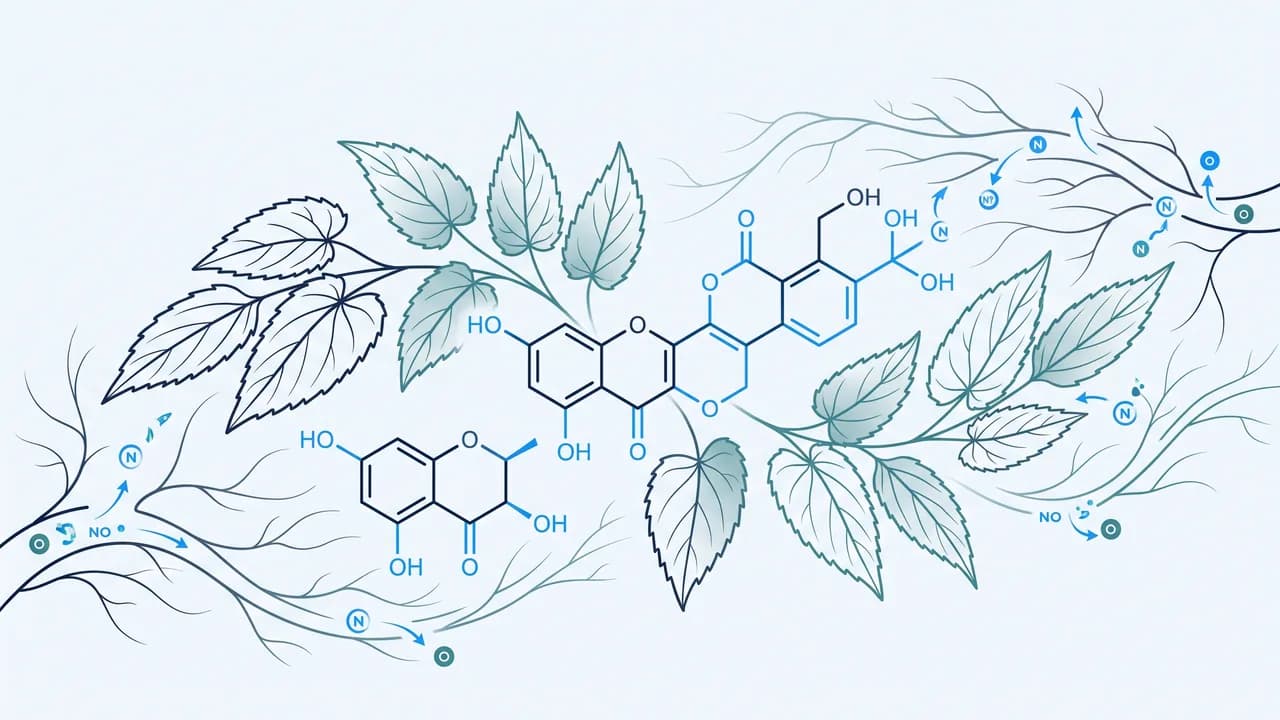
Icariin is a prenylated flavonol glycoside. PubChem records CID 5318997, molecular formula C33H40O15, molecular weight 676.7, and InChIKey TZJALUIVHRYQQB-XLRXWWTNSA-N (PubChem Compound summary for icariin, retrieved 20 August 2026). The aglycone is icaritin. Sequential deglycosylation produces icariside I (loss of rhamnose) or icariside II / baohuoside I (loss of glucose), then icaritin, then desmethylicaritin. Epimedin A, B, and C are related prenylflavonoid glycosides that travel with icariin in leaf extracts. Grade for the chemistry: established.
The commercial habit is to standardise a powder to a declared icariin percentage. That is a marker claim. It is not a statement that icariin is the circulating human drug, and it is not a statement that two products with the same icariin number are the same extract. Teo et al. (2019) and Yong, Cheong, Huang and colleagues (2021) measured the metabolites, not the parent, in human serum. Section 06 is the pharmacokinetic home of that point.
04 Botanical authentication
Medicinal Epimedium species are close enough that leaf shape and market name do not settle identity. Wang, Liang, Guo, and Xiao designed allele-specific PCR primers from ITS sequence that distinguished E. koreanum from other medicinal species in crude drugs and decoction pieces (Wang et al., 2010). HPLC fingerprinting and icariin-content assays are the complementary chemical layer. Heating and processing change measured icariin (2019 Zhongguo Zhong Yao Za Zhi process paper in the reviewed record). Grade for the existence of molecular and chromatographic authentication methods: strongly supported. Grade that commercial horny-goat-weed capsules are routinely authenticated to species: not supported.
Project 06, queried read-only for this title, held four document hits: an EST dataset on E. sagittatum, a hepatitis/cirrhosis review, and two icariin/icariside cell papers. None was a human erectile-dysfunction trial. The evidence spine is NCBI, FDA instruments, and the trial registry, not the Project 06 store.
05 Species variation and icariin as a moving number
Icariin content is not a species constant. Harvest time, plant part, species, and post-harvest heat all move the number. Pharmacopoeial species are not interchangeable raw materials. A product standardised to 10 percent icariin from E. sagittatum is not the Zhang 2007 flavonoid mixture and is not the Yong 2021 prenylflavonoid extract. Grade for species- and process-dependent content: strongly supported. Grade for interchangeability of commercial powders: not supported.
The implication for every later table is the same. When a trial names a defined extract, that extract is the intervention. When a label names horny goat weed, the intervention is unknown until assayed.
06 Oral fate in humans
Two human pharmacokinetic papers carry this section.
Teo et al. (2019) randomised 30 healthy men to a single oral administration of 370, 740, or 1110 mg of a standardised Epimedium prenylflavonoid extract or placebo. The extract was tolerated in that design; no adverse effects were reported in the paper. Icariside II reached Tmax at 4.1–4.3 hours. Desmethylicaritin reached Tmax at 24.1–24.4 hours and showed a dose-related rise in Cmax and AUC. Icariin, icariside I, and icaritin were below detection. The authors noted that metabolite levels were in the range of anti-osteoporotic cellular and animal work and called for postmenopausal studies. That last sentence is a rationale, not a result. Grade for the metabolite map in those 30 men: strongly supported.
Yong et al. (2021) randomised 58 postmenopausal women, mean age 57.9 years, to 740 mg daily of a purified Epimedium prenylflavonoid extract or placebo for six weeks. The main circulating metabolites were again desmethylicaritin, icaritin, and icariside II; icariin and icariside I were below detection. Median desmethylicaritin Cmax was 60.9 nM. Safety laboratories were quiet. Bone-specific alkaline phosphatase rose relative to placebo (p < 0.05). TRAF6 in circulating osteoclast-precursor monocytes showed a trend (p = 0.068). This is a six-week surrogate trial. It is not a BMD trial and it is not a sexual-function trial. Grade for safety and metabolite detection in that sample: strongly supported. Grade for a bone-clinical claim from BSAP alone: emerging, and not inherited by the aisle.
Wu, Kim, and Han (2016) showed that human intestinal isolates convert icariin to icariside II quickly, and that one isolate proceeds to icaritin and desmethylicaritin. They argued that pharmacokinetic work should follow the metabolites. Teo and Yong did. Dish assays of parent icariin often do not.
07 PDE5 in the dish
The natural-Viagra claim lives here. The human file does not.
Xin et al. (2003) isolated PDE5 from human platelets and PDE4 from rat liver. Icariin IC50 was 0.432 micromol per litre on PDE5 and 73.50 micromol per litre on PDE4, a PDE4/PDE5 ratio of 168. Papaverine was 0.680 and 3.07 micromol per litre. The conclusion that icariin “may be developed into an oral effective agent for the treatment of ED” is the authors’ inference. It is not a trial result. Grade for the platelet-enzyme IC50 in that paper: established as an assay result. Grade for the developmental claim: speculative.
Ning, Xin, Lin, Banie, Lue, and Lin (2006) expressed PDE5A1, A2, and A3 in insect cells. Icariin IC50 values were 1.0, 0.75, and 1.1 micromol per litre, about three-fold weaker than zaprinast. In rat cavernous smooth-muscle cells they used 100 and 200 micromol per litre icariin — two orders of magnitude above the enzyme IC50 — to hold cGMP after sodium nitroprusside. Grade for isoform IC50s: established. Grade that those cell concentrations describe oral human exposure: not supported.
Dell'Agli et al. (2008) screened extracts used for male impotence against human recombinant PDE5A1. Only E. brevicornum extract (80 percent inhibition at 50 micrograms per millilitre) and icariin (IC50 5.9 micromol per litre) were active. Tribulus, Ferula, and Cinnamomum were not. Sildenafil IC50 was 74 nanomol per litre. A synthetic 3,7-bis(2-hydroxyethyl)icaritin derivative reached 75 nanomol per litre. That derivative is a medicinal-chemistry object. It is not a tea, and it is not a capsule of leaf. Grade for the recombinant IC50 and the derivative result: established. Grade that commercial horny goat weed contains that derivative: not supported.
The Xin and Dell'Agli parent-icariin IC50s differ by about an order of magnitude (0.43 versus 5.9 micromol per litre). Different enzyme sources, different purity, different assays. Both sit in the micromolar band. Sildenafil sits in the nanomolar band. The aisle collapsed that gap.
08 Nitric oxide and the cavernosum in animals
The second preclinical story is nitric oxide / cGMP in penile tissue.
Jiang, Hu, Wang and colleagues incubated rabbit corpus cavernosum with icariin and measured cGMP accumulation, with sildenafil as comparator, and recorded PDE5 mRNA changes in rat penis (Jiang et al., 2006). Ning et al. (2006) held cGMP in SNP-treated rat cavernous smooth-muscle cells at 100–200 micromol per litre. Liu et al. (2005) castrated Wistar rats, gavaged icariin, and measured ICP on cavernous-nerve stimulation plus NOS isoform expression. Shindel et al. (2010) used a bilateral cavernous-nerve-injury model, four weeks of daily gavage, and reported higher ICP/MAP, more nNOS and calponin, and neurite outgrowth from cultured pelvic ganglia. Diabetic and spontaneously hypertensive rat papers in the reviewed record (Liu et al., 2011; Zhang et al., 2012; later SHR eNOS-uncoupling papers) continue the same animal register.
These studies are strongly supported as descriptions of those models. They are not human erectile-dysfunction trials. DMSO gavage, nerve crush, streptozotocin diabetes, and castration are experimental injuries. They are not the typical buyer. Ho and Tan, reviewing herbal ED management in 2011, listed Epimedium/icariin among botanicals studied for ED and stated that of the list, only Panax ginseng, Butea superba, and yohimbine had published human studies — and that those human trials were not robust (Ho and Tan, 2011). That 2011 sentence is the honest map of the human ED file as it then stood. The harvest for this title did not find a later standalone Epimedium or icariin ED RCT that overturns it.
09 Bone in the dish and the ovariectomised rat
Icariin and related prenylflavonoids have a large osteoblast / osteoclast / ovariectomised-rat literature. Li, Li, Mei, and Lu (2015) summarised osteoprotective, cardiovascular, and other preclinical themes and called icariin a candidate in bone-tissue engineering. That is a review of mostly non-human work. Grade for a rich preclinical bone file: strongly supported. Grade that the preclinical file is human anti-fracture evidence: not supported. The human bone papers are Zhang et al. (2007) and Yong et al. (2021). They live in Part Three.
10 Estrogenic activity as a hypothesis, not a menopause licence
Prenylflavonoids from Epimedium bind estrogen-related assays in cells. Wong, Shen, Lee, Li, and Yong (2009) reported pharmacokinetics of prenylflavonoids with dynamics of estrogen action in sera after ingestion of Epimedium — an early human-serum / bioassay paper, not a hot-flush trial. Dietz, Hajirahimkhan, Dunlap, and Bolton reviewed botanicals for women's health and treated Epimedium as a phytoestrogen-adjacent file that still needed clinical definition (Dietz et al., 2016). A phytoestrogen assay is not a vasomotor-symptom RCT. The harvest query for Epimedium and hot flush returned zero PubMed hits. Grade for estrogenic activity in selected assays: plausible. Grade for a menopause-symptom claim: not supported.
11 How the human file is organised
The required human questions are sexual function, erectile dysfunction, libido, menopause, and bone health. Preclinical papers are not reused as answers. Combination formulas are not reused as Epimedium monotherapy. Surrogate markers are not reused as fractures or IIEF scores. Table 1 is the census.
| Question | Best human object | What it is not | Grade |
|---|---|---|---|
| Erectile dysfunction | No standalone Epimedium or icariin RCT in the reviewed record | Shindel 2010 rats; Cappra 2013 multi-herb; dish PDE5 | Not supported as monotherapy |
| Sexual function (broader) | Same empty monotherapy file; online-product surveys | Consumer reviews on Amazon (Balasubramanian 2019) | Not supported |
| Libido | No adequate RCT identified | Traditional-use language; rat intromission (Makarova 2007) | Not supported |
| Menopause (vasomotor) | Zero harvest hits for hot flush / hot flash | Phytoestrogen assays; bone trials in postmenopausal women | Not supported |
| Bone density | Zhang 2007, 24-month EPF mixture RCT, n=85 completers | Isolated icariin; fracture endpoint; horny-goat-weed powder | Emerging for that mixture |
| Bone surrogates | Yong 2021, 6-week extract RCT, n=58, BSAP | BMD; fracture; sexual function | Emerging as PK/safety + BSAP |
| Human PK / safety of a defined extract | Teo 2019 (30 men, single dose); Yong 2021 (58 women, 6 weeks) | Commercial powders; ED efficacy | Strongly supported for those extracts |
12 Sexual function and erectile dysfunction
The honest sentence is short. The reviewed record did not contain a randomised, placebo-controlled, monotherapy trial of Epimedium leaf or of icariin that used a validated erectile-function instrument in men with erectile dysfunction.
What the reviewed record did contain, and what must not be substituted:
Shindel et al. (2010) and the diabetic/SHR rat series are animal hemodynamics. Makarova, Pozharitskaya, Shikov and colleagues gavaged a lipid suspension of E. koreanum extract to aged rats and counted intromissions and ejaculations (Makarova et al., 2007). That is sexual behaviour in rats.
Punyawudho, Puttilerpong, Wirotsaengthong, and Aramwit randomised 63 Thai men with mild or mild-to-moderate ED to Cappra, a traditional multi-herb medicine used in Thailand, or placebo in a two-week crossover (Punyawudho et al., 2013). Sixty-one completed. Mean change in IIEF erectile-function domain was 4.87 versus 3.44 (p = 0.032). Adverse events included dizziness, face numbness, and tachycardia. Cappra is not Epimedium. A two-week multi-herb crossover is not a species article. Grade for Cappra in that sample: emerging for that product. Grade as Epimedium evidence: not applicable.
Ho and Tan (2011) stated that Epimedium/icariin lacked published human ED studies at the time of their review. Balasubramanian, Thirumavalavan, Srivatsav and colleagues (2019) analysed the top Amazon ED supplements; ginseng, horny goat weed, L-arginine, and tongkat ali were the most frequent ingredients. Frequency on a marketplace is not efficacy. Corazza, Martinotti, Santacroce and colleagues (2014) mapped online sexual-enhancement products containing yohimbine, maca, horny goat weed, and Ginkgo and recorded psychiatric and addictive-behaviour reports in the surrounding literature. That is a public-health map, not an IIEF trial.
ClinicalTrials.gov, queried for this title, returned 21 studies that matched Epimedium, icariin, horny goat weed, or yinyanghuo. None was a dedicated ED-efficacy RCT of Epimedium monotherapy. NCT02931305 is the Yong/Teo Phase 1 programme in healthy men. Other hits were TCM formulas, icaritin oncology capsules, bipolar and memory icariin pilots, and an acne study. Registry presence is not a result.
Grade for human ED efficacy of horny goat weed or icariin: not supported. The natural-Viagra claim is a marketing inheritance from the dish and the rat.
13 Libido
No adequate human libido RCT of Epimedium or icariin was identified in the reviewed record. Traditional-use language (kidney-yang, impotence) is not a desire-domain score. Makarova et al. (2007) is rat sexual behaviour. Grade: not supported.
14 Menopause as a vasomotor claim
The harvest query for Epimedium and hot flush or hot flash returned zero records. Postmenopausal women appear in this literature as the population of bone trials (Zhang et al., 2007; Yong et al., 2021), not as a vasomotor-symptom file. Dietz et al. (2016) is a women's-health botanical review, not a hot-flush meta-analysis of Epimedium. Grade for vasomotor menopause: not supported. Grade for “studied in postmenopausal women” as a menopause-symptom claim: a category error.
15 Bone health in humans
Two trials, one mixture, one extract, neither a fracture study.
Zhang, Qin, and Shi (2007) randomised 100 healthy late postmenopausal women (natural menopause 10–18 years; lumbar T-score between −2 and −2.5) to a daily Epimedium-derived phytoestrogen flavonoid mixture — reported as 60 mg icariin, 15 mg daidzein, and 3 mg genistein — or placebo. All participants received 300 mg elemental calcium daily. Eighty-five completed 24 months. Repeated-measures ANOVA showed group-by-time interactions at femoral neck (p = 0.045) and lumbar spine (p = 0.006). Placebo BMD declined (femoral neck −1.8 percent at 24 months, p = 0.048; lumbar spine −2.4 percent, p = 0.002). The EPF group did not show a matching decline (femoral neck +1.6 percent, p = 0.148; lumbar spine +1.3 percent, p = 0.091). Endometrial thickness and serum estradiol were reported as without a detectable hyperplasia signal in the abstract. This is a single-centre BMD trial of a mixture that includes soy isoflavones, not of horny-goat-weed powder, and not of isolated icariin. It has no fracture endpoint. Grade: emerging for that mixture on BMD maintenance versus calcium-only placebo in late postmenopausal women with low-normal T-scores. Grade as evidence that aisle horny goat weed prevents fractures: not supported.
Yong et al. (2021) is the six-week extract RCT already described. BSAP moved; TRAF6 trended; BMD was not the endpoint. Grade: emerging as a short surrogate and as a safety/PK package for that extract.
The two papers do not license a general bone-health claim for commercial horny goat weed. They do show that defined prenylflavonoid preparations have been tested in postmenopausal women for bone-related outcomes, and that the better BMD paper used a mixture.
16 What human PK does and does not licence
Teo 2019 and Yong 2021 are the strongest human papers this title has that are not Zhang 2007. They establish that a defined extract can be given to healthy men once, and to postmenopausal women for six weeks, with quiet routine laboratories in those samples, and that the circulating chemistry is not parent icariin. They do not establish ED efficacy, libido, vasomotor relief, or fracture reduction. Using them as a safety blanket for unassayed sexual-enhancement capsules is the same category error as using Xin 2003 as a Viagra analogue.
17 Standardisation is not identity
A label percent icariin is a manufacturing specification. It does not name the species, the epimedin profile, the residual solvents, or the undeclared PDE5 analogue. It does not make two capsules bioequivalent. Teo and Yong used defined extracts in capsules they controlled. The Amazon objects in Balasubramanian et al. (2019) did not. Grade for marker standardisation as a quality tool: plausible when paired with species authentication and contaminant testing. Grade as a substitute for those: not supported.
18 Adulteration with undeclared PDE5 inhibitors
This is the load-bearing product-quality finding.
Gratz, Flurer, and Wolnik (2004) published an LC-ESI-MS method and applied it to dietary supplements and bulk herbal materials for sildenafil, tadalafil, and vardenafil. Gryniewicz, Reepmeyer, Kauffman, and Buhse (2009) used ion mobility spectrometry on 26 herbal products claiming to enhance male sexual performance and detected approved ED drugs and synthetic analogues. Campbell et al. (2013) found PDE5-inhibitor pharmaceuticals or analogues in 81 percent of 91 samples; 18 of 40 sildenafil/tadalafil-containing samples exceeded 110 percent of the highest approved drug-product strength; no sample declared a synthetic substance. Cohen and Venhuis (2013) framed the same problem for a clinical readership: adulterated sexual-enhancement supplements are not mojo. Later screening papers in the reviewed record continue the analytical series into 2026.
The FDA page “Sexual Enhancement and Energy Product Notifications,” scraped from the local Firecrawl instance on 20 August 2026, listed 433 entries and stated that the list covers only a small fraction of contaminated products, that absence from the list is not a safety finding, and that products are often sold as dietary supplements or all-natural treatments. Notifications in the visible window included named male-enhancement brands with hidden drug ingredients. The page is a regulator warning list, not a prevalence survey. Grade that undeclared PDE5 drugs occur in sexual-enhancement products marketed as herbal or natural: established. Grade that a given horny-goat-weed bottle is adulterated: unknown until assayed. Grade that a dramatic sexual response to an untested capsule is evidence for icariin: not supported; the competing explanation is a hidden drug.
19 Regulatory and consumer-information warnings
The FDA tainted-sexual-enhancement notifications are the primary English-language regulator instrument for this aisle (FDA, Sexual Enhancement and Energy Product Notifications, retrieved 20 August 2026). The Agency states that contaminated products are medication health fraud, that they can cause hospitalisation, and that social-media reviews are not a quality system.
NCCIH did not host a dedicated horny-goat-weed herb page at the URL used for this review; the request returned not found. MedlinePlus, as of the 20 August 2026 scrape, stated that Therapeutic Research Center Natural Medicines herb articles were unavailable from 29 July 2025. The consumer-information hole is itself a finding: there is no current NIH herb article for this title to lean on. WebMD's ingredient page — labelled here as secondary commercial medical writing — states that benefits are not well defined, that some horny-goat-weed products have contained undeclared prescription medicines, and that nitrates and other ED drugs are interaction concerns (WebMD, Horny Goat Weed, retrieved 20 August 2026). Those three points agree with the primary file. They are not used as efficacy evidence.
20 Cardiovascular and psychiatric case reports
Partin and Pushkin (2004) reported tachyarrhythmia and hypomania with horny goat weed in a letter to Psychosomatics. The product was not chemically authenticated in the MEDLINE record. A letter is a signal, not an incidence rate. Metz, Weston, and Barker (2009) reported a vasculitic rash after Ginkgo biloba and/or horny goat weed; attribution to Epimedium alone is not possible. Corazza et al. (2014) collected mood, anxiety, hallucination, and addictive-behaviour reports around online sexual-enhancement products that may contain yohimbine, maca, horny goat weed, or Ginkgo — a mixed-exposure literature.
Teo 2019 and Yong 2021 are the opposite object: defined extracts, short designs, quiet routine laboratories in those samples. They do not cancel the case letters, and the case letters do not cancel the PK papers. Grade for a characteristic cardiotoxicity of authenticated Epimedium: insufficient. Grade that unassayed sexual-enhancement capsules can cause PDE5-drug adverse effects, including nitrate interactions: established as a class warning for the adulterated aisle.
21 Interactions
If a capsule contains undeclared sildenafil, tadalafil, or an analogue, the interaction file is the PDE5-drug file: organic nitrates, guanylate-cyclase stimulators, and some antihypertensives. Campbell et al. (2013) and the FDA list make that the first interaction to write down.
If a capsule contains only Epimedium prenylflavonoids, the interaction file is thinner. Theoretical concerns follow from weak PDE5 activity, phytoestrogen assays, and hormone-sensitive-cancer caution in secondary sources. Yong 2021 did not report a nitrate-challenge study. No adequate clinical interaction trial of authenticated Epimedium with nitrates was identified. Grade for nitrate interaction of an adulterated product: established as a sildenafil-class risk. Grade for nitrate interaction of an authenticated, unadulterated extract at studied exposures: plausible as a theoretical residual, not established as a measured human interaction.
Hormone therapy and hormone-sensitive cancers sit in the phytoestrogen-hypothesis column (Dietz et al., 2016; Zhang et al., 2007 endometrial surveillance). They are cautions from mechanism and from one BMD trial's safety appendix, not from an oncology RCT.
22 Safety matrix
| Hazard | Evidence object | Population | Grade |
|---|---|---|---|
| Undeclared PDE5 drug or analogue | Campbell 2013; Gratz 2004; Gryniewicz 2009; FDA 433-notification list | Sexual-enhancement marketplace | Established as a class |
| Nitrate / PDE5-drug interaction | Follows if adulterated; not measured for clean extract | Men using nitrates or sGC stimulators | Established if adulterated; insufficient if clean |
| Tachyarrhythmia / hypomania | Partin and Pushkin 2004 letter | One reported case, product unassayed | Insufficient |
| Vasculitic rash | Metz 2009, Ginkgo and/or HGW | One case, mixed exposure | Insufficient |
| Routine labs, defined extract | Teo 2019; Yong 2021 | 30 men single dose; 58 women 6 weeks | Quiet in those samples; not a long-term file |
| Endometrial hyperplasia on EPF mixture | Zhang 2007 surveillance | Late postmenopausal women, 24 months | No detectable hyperplasia in that trial |
| Pregnancy / lactation | No adequate human file | — | Insufficient |
| Hepatotoxicity of authenticated leaf | No LiverTox record specific to Epimedium in the reviewed record | — | Insufficient |
The dominant, documented risk is not a unique Epimedium toxin. It is a hidden drug in a bottle that borrowed a plant name.Viagra and erectile-dysfunction markets that returned were off-topic (Alzheimer's sildenafil; commercial tadalafil spam). The challenge is therefore the interrogation method, not a price. Five claims were required. All five fail as stated.
Natural Viagra. Xin 2003 and Dell'Agli 2008 show micromolar PDE5 inhibition. Sildenafil is nanomolar. Teo 2019 does not detect parent icariin after oral extract. There is no standalone human ED RCT. The name is a marketing inheritance. Fails.
Human-evidence abundance. The human file that survives labelling is PK/safety of defined extracts (Teo 2019; Yong 2021), one BMD mixture trial (Zhang 2007), and a six-week BSAP trial (Yong 2021). ED, libido, and vasomotor menopause are empty or formula-bound. Scarcity is the finding, not a gap to be papered with rats.
In-vitro PDE5 as clinical proof. Enzyme IC50s are real. They are not IIEF scores. Ning 2006 needed 100–200 micromol per litre in cells. The circulating human species is not the parent glycoside. Fails as a clinical argument.
The plant is the hazard. Case letters exist. The analytical and regulator file says the aisle hazard is undeclared PDE5 drugs (Campbell 2013; FDA list). A clean extract and a spiked capsule are different objects. Adulteration is the load-bearing safety claim.
Traditional use equals modern efficacy. Yin yang huo is a historical practice. Ho and Tan (2011) already separated that history from a robust human ED trial. This harvest did not find the missing trial. Traditional use is not a substitute endpoint.
24 Standing constraint
This document describes published research on Epimedium species, icariin, related prenylflavonoids, and the products sold as horny goat weed. It is not medical advice. It does not recommend a species, extract, product, dose, route, or schedule for any person. It does not recommend sildenafil, tadalafil, or any other drug. A man with erectile dysfunction, a woman with menopausal symptoms or low bone density, or anyone taking nitrates needs a clinician, not a capsule that borrowed a plant name.
25 Evidence handling
Study type is named in the reporting sentence. Human trials are not pooled with rats. Combination formulas are not scored as Epimedium. Surrogates are not scored as fractures or erections. Secondary consumer pages are labelled. FDA notification counts are a regulator list, not a denominator. Project 06 was read-only and was not a substitute library. Project 07 was discovery-only. ## 99 References
Continue reading