
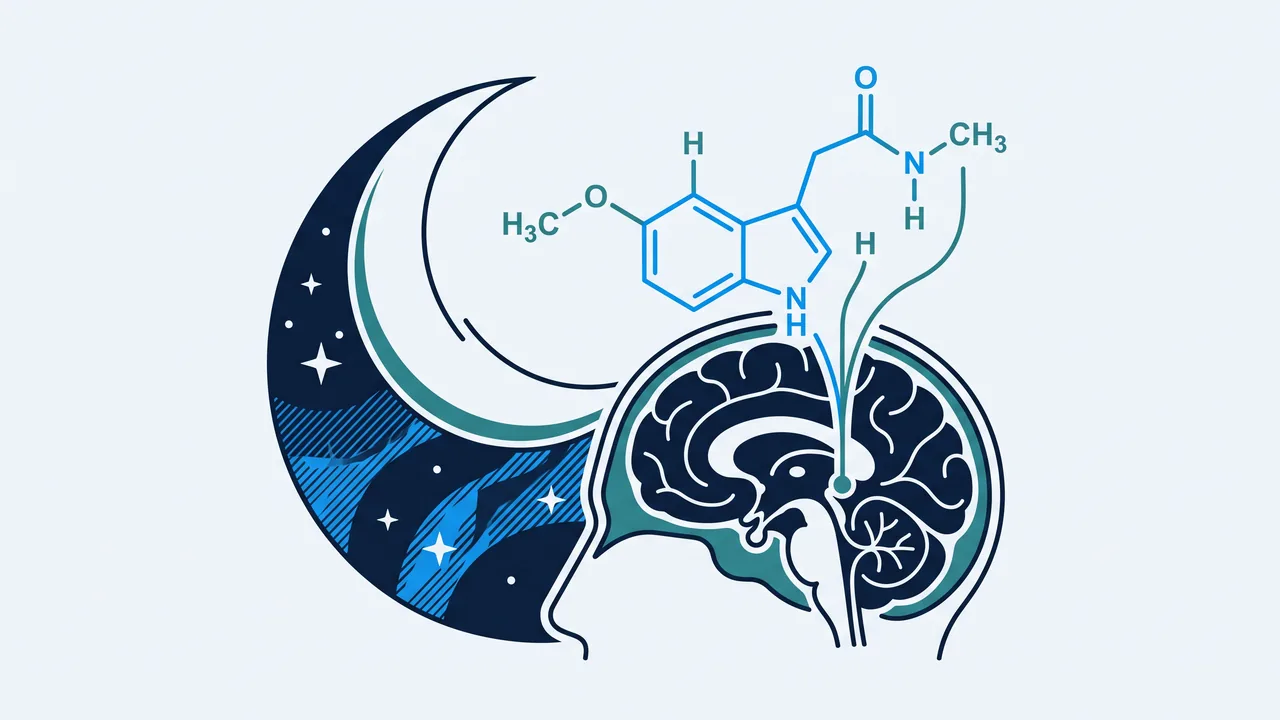
Melatonin
Hormones and hormone precursors. A research review published by South Beach Longevity.
Every finding is labelled, in the sentence that reports it, by the kind of study that produced it. A pineal enzyme paper is not a sleep trial. A phase-response curve is not a hypnotic effect. A licensed prolonged-release tablet is not a US gummy. Where two results conflict, both are given. Amounts, routes, and clock times appear only as reported experimental or labelled parameters, always with the population attached. Nothing here is a recommendation. Findings are graded in place as established, strongly supported, emerging, plausible, or speculative. Matrices use five harvest grades: STRONG, MODERATE, LIMITED, INCONSISTENT, NOT SUPPORTED.
01 What this document is, and four things it is not
This article is a research review of melatonin: pineal synthesis, light and suprachiasmatic-nucleus regulation, MT1 and MT2 receptors, dim-light melatonin onset, circadian phase shifting, pharmacokinetics, immediate versus prolonged-release products, age effects, the human sleep and circadian-disorder record, product quality, and safety. It is written against a market that treats one indoleamine as a general hypnotic, a clock reset, an antioxidant, and a youth hormone.
Four things follow immediately.
First, this is not a sleep protocol and not medical advice. Reported milligrams and clock times are study or labelling parameters. They are not instructions for any reader.
Second, a hypnotic effect is not a chronobiotic effect. A small shortening of sleep-onset latency after an evening capsule is one object. A timed shift of the endogenous melatonin rhythm is another. Lewy, Ahmed, Jackson, and Sack showed that exogenous melatonin shifts human circadian rhythms according to a phase-response curve (Lewy et al., 1992). Ferracioli-Oda, Qawasmi, and Bloch meta-analysed melatonin for primary sleep disorders and found small effects on sleep timing and quality (Ferracioli-Oda, Qawasmi, and Bloch, 2013). Those papers do not license one another.
Third, the bottle is not the molecule. Erland and Saxena measured melatonin content in commercial natural-health products and found serotonin in some lots and melatonin amounts that ran from far below to many-fold above the label (Erland and Saxena, 2017). Cohen, Avula, Wang, Katragunta, and Khan measured melatonin and cannabidiol in US melatonin gummies and found wide quantity error and undeclared cannabidiol in some products (Cohen et al., 2023). A labelled milligram is not a verified dose.
Fourth, endogenous pineal melatonin is not an anti-aging drug. Extra-pineal synthesis exists (Slominski et al., 2008). Reiter’s antioxidant chemistry is a laboratory literature (Reiter et al., 2016). It is not a human longevity trial.
02 Chemistry and pineal synthesis
Melatonin is N-acetyl-5-methoxytryptamine, an indoleamine. PubChem records the formula C13H16N2O2 and a molecular weight of 232.28. It is not a peptide, not a protein amino acid, and not a vitamin. There is no melatonin RDA built from nitrogen balance.
Pineal synthesis is a four-step path from tryptophan. Serotonin is N-acetylated by arylalkylamine N-acetyltransferase (AANAT) and then O-methylated by hydroxyindole-O-methyltransferase (HIOMT / ASMT). Klein named AANAT “the Timezyme” because nocturnal AANAT activity is the rate-limiting, tightly gated step that makes the night signal (Klein, 2007). That biochemistry paper is established as an account of pineal timing. It is not a dosing paper.
Bernard, Donohue, and Klein mapped human HIOMT in pineal, retina, and a retinoblastoma line (Bernard, Donohue, and Klein, 1995). Donohue, Roseboom, and Illnerova cloned human HIOMT and found a LINE-1 fragment in a cDNA clone and in pineal mRNA (Donohue et al., 1993). The last enzymatic step is strongly supported. Extra-pineal synthesis, including in skin, is a separate object (Slominski et al., 2008). A night capsule does not “replace the pineal.” It adds an exogenous pulse on top of whatever the gland and other tissues are already doing.
Claustrat, Brun, and Chazot reviewed the basic physiology and pathophysiology of melatonin production (Claustrat, Brun, and Chazot, 2005). Zawilska, Skene, and Arendt set that physiology against biological-rhythm pharmacology (Zawilska, Skene, and Arendt, 2009). Arendt’s later “characteristics, concerns, and prospects” essay remains the register-A frame for what is known and what is sold (Arendt, 2005). Brzezinski’s New England Journal of Medicine primer is the matching clinical introduction (Brzezinski, 1997). Those are syntheses. They are strongly supported as maps. They are not licences for later marketing claims.
03 Light, the SCN, and nocturnal secretion
The master clock sits in the suprachiasmatic nuclei. Light reaches it through intrinsically photosensitive retinal ganglion cells. Brainard, Hanifin, Greeson, and colleagues measured an action spectrum for melatonin regulation in humans and treated the result as evidence for a novel circadian photoreceptor (Brainard et al., 2001). Lockley, Brainard, and Czeisler showed high sensitivity of the human melatonin rhythm to short-wavelength light (Lockley, Brainard, and Czeisler, 2003). Gooley, Rajaratnam, Brainard, and colleagues showed that spectral responses depend on irradiance and duration (Gooley et al., 2010). Those human physiology papers are established. Evening light is not a trivial confounder of a melatonin trial. It is part of the same system.
Zeitzer, Dijk, Kronauer, and Czeisler measured the sensitivity of the human circadian pacemaker to nocturnal light for both melatonin suppression and phase resetting (Zeitzer et al., 2000). Cajochen, Zeitzer, and Czeisler reported a dose–response for light intensity against ocular and electroencephalographic correlates of alertness (Cajochen, Zeitzer, and Czeisler, 2000). Czeisler, Shanahan, Klerman, and colleagues showed that bright light can still suppress melatonin in some people classified as blind (Czeisler et al., 1995). Residual photoreception is therefore a measured human fact, not a slogan.
Cajochen, Kräuchi, and Wirz-Justice reviewed melatonin’s role in human circadian rhythms and sleep (Cajochen, Kräuchi, and Wirz-Justice, 2003). The honest sentence is narrow. Endogenous melatonin is a hand of the clock and a modest facilitator of sleep propensity in the biological night. It is not the clock itself. Light is the stronger zeitgeber.
04 MT1 and MT2 receptors
The receptors that matter for circadian and sleep pharmacology are two G-protein-coupled receptors, MT1 and MT2. Reppert, Weaver, and Ebisawa cloned a mammalian melatonin receptor that mediates reproductive and circadian responses (Reppert, Weaver, and Ebisawa, 1994). Dubocovich, Delagrange, Krause, and colleagues issued the IUPHAR nomenclature, classification, and pharmacology of those receptors (Dubocovich et al., 2010). Jockers, Delagrange, Dubocovich, and colleagues updated that classification (Jockers et al., 2016). Receptor identity is established.
What is not established is a simple mapping from receptor to consumer claim. MT1 and MT2 are not interchangeable. They are expressed in SCN, other brain regions, and peripheral tissues, including pancreatic islets — a fact that will return in the glucose section. Binding in a membrane assay is not proof that a gummy occupied those receptors at a relevant free concentration.
05 Dim-light melatonin onset
Dim-light melatonin onset (DLMO) is the operational marker of circadian phase in sighted humans. Lewy and Sack defined it as such (Lewy and Sack, 1989). Lewy, Cutler, and Sack later treated the endogenous melatonin profile itself as a phase marker (Lewy, Cutler, and Sack, 1999). Pandi-Perumal, Smits, Spence, and colleagues reviewed DLMO as a tool for sleep and chronobiological disorders (Pandi-Perumal et al., 2007). Keijzer, Smits, Duffy, and colleagues argued that DLMO should be measured before treating circadian rhythm sleep–wake disorders (Keijzer et al., 2014). Murray, Stone, Abbott, and colleagues published an at-home salivary DLMO protocol (Murray et al., 2024). Those papers are strongly supported as method. They are not a licence to treat every late sleeper as a melatonin-deficiency case.
DLMO is also the reason “take it at bedtime” is not a chronobiotic instruction. Bedtime is a behaviour. DLMO is a phase. They coincide in some people and diverge in others.
06 Age and the endogenous profile
Ageing changes both the circadian and the homeostatic regulation of sleep. Dijk, Duffy, Riel, Shanahan, and Czeisler used forced desynchrony to separate those processes and to watch melatonin and temperature rhythms in older adults (Dijk et al., 1999). Cajochen, Münch, Knoblauch, Blatter, and Wirz-Justice reviewed the age-related change (Cajochen et al., 2006). Kripke, Elliott, Youngstedt, and Rex measured light phase-response curves in older and young women and men (Kripke et al., 2007). Those human physiology papers are strongly supported. They do not say that every older adult is melatonin-deficient, and they do not say that replacement restores youth.
Haimov, Lavie, Laudon, Herer, Vigder, and Zisapel tested melatonin “replacement” in elderly insomniacs (Haimov et al., 1995). Garfinkel, Laudon, Nof, and Zisapel reported improved sleep quality with controlled-release melatonin in elderly people (Garfinkel et al., 1995). Hughes, Sack, and Lewy then asked whether melatonin and circadian phase explain age-related sleep-maintenance insomnia and tested replacement in that frame (Hughes, Sack, and Lewy, 1998). The last paper is the brake. A falling night-time melatonin number is not automatically the cause of middle-of-the-night waking, and replacement is not automatically a maintenance hypnotic.
07 Hypnotic effect is not chronobiotic effect
This is the controlling distinction of the article.
A hypnotic effect is a near-term change in sleep propensity, sleep-onset latency, or sleep continuity after a dose, usually taken close to desired bedtime. Zhdanova, Wurtman, Lynch, Ives, Dollins, Morabito, Matheson, and Schomer reported sleep-inducing effects of low evening doses in a clinical-pharmacology design (Zhdanova et al., 1995). That is a hypnotic-class observation. It is emerging as a small, short-horizon effect. It is not a clock reset.
A chronobiotic effect is a shift of circadian phase — DLMO, core temperature minimum, or the sleep–wake cycle itself — according to a phase-response curve. Lewy and colleagues demonstrated that curve for melatonin (Lewy et al., 1992). Burgess, Revell, and Eastman measured a three-pulse phase-response curve to three milligrams (Burgess, Revell, and Eastman, 2008). Burgess, Revell, Molina, and Eastman then compared 0.5 mg and 3.0 mg daily pulses and found that the curves are not simply scaled versions of one another (Burgess et al., 2010). Lewy, Emens, Sack, Hasler, and Bernert reported that low, but not high, doses entrained a free-running blind person with a long circadian period (Lewy et al., 2002). More is not a larger chronobiotic.
Cajochen, Kräuchi, and Wirz-Justice already warned that melatonin’s sleep and circadian roles must be kept distinct (Cajochen, Kräuchi, and Wirz-Justice, 2003). This article enforces that warning.
08 Phase-response curve and timing
The melatonin phase-response curve has an advance zone in the biological afternoon and early evening and a delay zone in the biological morning (Lewy et al., 1992; Burgess, Revell, and Eastman, 2008). Light’s curve is not the same object. Rüger, St Hilaire, Brainard, Khalsa, Ronda, Kronauer, Czeisler, and Lockley measured a human phase-response curve to a single 6.5-hour pulse of short-wavelength light (Rüger et al., 2013). Morning light tends to advance; evening light tends to delay. Melatonin taken in the afternoon or early evening tends to advance; melatonin taken in the morning tends to delay. Combining afternoon melatonin with morning intermittent bright light can enlarge an advance (Revell et al., 2006).
Those are human laboratory curves. They are strongly supported. They are not a consumer schedule. The curve is plotted against circadian phase, not against the bedroom clock. Without a phase estimate — DLMO or a careful sleep-diary proxy — “three hours before bed” is a guess.
| Window (relative to DLMO / biological night) | Expected direction | Load-bearing sources | Grade |
|---|---|---|---|
| Biological afternoon / early evening | Advance | Lewy 1992; Burgess 2008, 2010; Revell 2006 | STRONG as physiology; LIMITED as unsupervised self-timing |
| Near habitual bedtime in an on-phase sleeper | Small hypnotic, little phase | Zhdanova 1995; insomnia metas | LIMITED hypnotic; NOT a chronobiotic use |
| Biological morning | Delay | Lewy 1992; Burgess 2008 | STRONG as physiology; rarely the consumer intention |
| Combined with opposing light | Light can cancel or add | Zeitzer 2000; Revell 2006; Burgess/Sharkey/Eastman 2002 | STRONG as interaction |
09 Pharmacokinetics of exogenous melatonin
Oral melatonin undergoes substantial first-pass metabolism. DeMuro, Nafziger, Blask, Wu, and Bertino measured absolute bioavailability and found it low and variable (DeMuro et al., 2000). Fourtillan, Brisson, Gobin, Ingrand, Decourt, and Girault measured daytime bioavailability of deuterated melatonin (Fourtillan et al., 2000). Andersen, Werner, Rosenkilde, and colleagues compared oral and intravenous kinetics in healthy volunteers (Andersen et al., 2016). Harpsøe, Andersen, Gögenur, and Rosenberg systematically reviewed the clinical pharmacokinetics (Harpsøe et al., 2015). Immediate-release oral melatonin typically appears in plasma within an hour and is cleared with a short half-life. Those papers are strongly supported as disposition. They are not brain-concentration papers, and they are not a licence to treat labelled milligrams as a linear exposure scale.
Facciolá, Hidestrand, von Bahr, and Tybring identified cytochrome P450 isoforms involved in hepatic melatonin metabolism (Facciolá et al., 2001). CYP1A2 is the dominant isoform in that microsomal work. Härtter, Wang, Weigmann, Tergau, Wetzel, and Hiemke showed that fluvoxamine, unlike several other antidepressants, strongly inhibits melatonin biotransformation (Härtter et al., 2001). Grözinger, Härtter, Wang, Röschke, Hiemke, and colleagues reported the same interaction in a patient with a low-amplitude melatonin profile (Grözinger et al., 2000). The interaction is established. It will return under safety.
10 Immediate versus prolonged release
Immediate-release melatonin produces a sharp plasma peak and a short tail. That shape can serve a sleep-onset or a timed-pulse chronobiotic experiment. It is a poor match for a desire to hold plasma melatonin across a night of sleep-maintenance insomnia.
Prolonged-release 2 mg melatonin — the Circadin formulation — was tested as a specified medicine in older adults with primary insomnia. Lemoine, Nir, Laudon, and Zisapel reported improved sleep quality and morning alertness in patients aged 55 years and older, without withdrawal effects in that protocol (Lemoine et al., 2007). Wade, Ford, Crawford, McMahon, Nir, Laudon, and Zisapel reported quality-of-sleep and next-day-alertness outcomes in patients aged 55–80 years (Wade et al., 2007). Wade and colleagues later published a six-month randomised placebo-controlled trial and an age-cut-off analysis (Wade et al., 2010; Wade et al., 2011). Luthringer, Muzet, Zisapel, and Staner measured sleep and psychomotor performance in elderly patients (Luthringer et al., 2009). Those are moderately supported as evidence for that formulation, in that age band, on those endpoints. They are not evidence for a 10 mg US gummy.
Pediatric prolonged-release melatonin — Slenyto — is a different specified object (Gringras et al., 2017). Roth, Nir, and Zisapel piloted prolonged-release melatonin in totally blind subjects (Roth, Nir, and Zisapel, 2015). Do not pool Circadin, Slenyto, a research immediate-release capsule, and a gummy into one “melatonin works” sentence.
| Formulation | Plasma shape | Evidence object in the reviewed record | Do not treat as |
|---|---|---|---|
| Immediate-release oral | Fast peak, short half-life | SOL experiments; PRC pulses; jet-lag trials | A maintenance hypnotic or a verified gummy dose |
| Prolonged-release 2 mg (Circadin class) | Flattened night profile | Older-adult primary insomnia RCTs (Lemoine, Wade) | A US dietary-supplement claim |
| Pediatric PR (Slenyto class) | Specified pediatric PR | ASD / Smith–Magenis insomnia RCTs (Gringras, Maras, Malow) | OTC use in typically developing toddlers |
| Sublingual / spray / transdermal | Different Tmax claims | Sparse locked PK relative to oral IR/PR | Interchangeable with oral IR |
| Gummy / chewable | Candy delivery, variable assay | Cohen 2023; Lelak 2022 | Circadin or Slenyto |
11 Age as a pharmacokinetic and an indication modifier
Wade’s age-cut-off analysis treated age and endogenous melatonin as predictors of prolonged-release response (Wade et al., 2011). Haimov and Garfinkel worked in elderly insomniacs (Haimov et al., 1995; Garfinkel et al., 1995). Hughes, Sack, and Lewy did not find a simple replacement story for age-related maintenance insomnia (Hughes, Sack, and Lewy, 1998). The honest split is this. Older adults are the Circadin trial population. They are also the population in whom endogenous amplitude and sleep consolidation have already changed (Dijk et al., 1999; Cajochen et al., 2006). Age licences a question. It does not licence “more milligrams because the pineal is gone.”
12 Insomnia and sleep-onset latency
The adult primary-insomnia file is a stack of meta-analyses and one major guideline, not a single decisive trial.
Ferracioli-Oda, Qawasmi, and Bloch meta-analysed melatonin for primary sleep disorders and reported small improvements in sleep-onset latency, total sleep time, and sleep quality (Ferracioli-Oda, Qawasmi, and Bloch, 2013). Buscemi, Vandermeer, Hooton, and colleagues reached a similar small-effect conclusion for exogenous melatonin in primary sleep disorders (Buscemi et al., 2005). The earlier AHRQ evidence report is the matching technology assessment (Buscemi et al., 2004). Brzezinski, Vangel, Wurtman, Nir, Ford, Nader, and Zhdanova meta-analysed exogenous melatonin and sleep (Brzezinski et al., 2005). Auld, Maschauer, Morrison, Skene, and Riha reviewed efficacy in primary adult sleep disorders and treated the signal as modest and indication-specific (Auld et al., 2017). Costello, Lentino, Boyd, Corpe, Sharp, Murray, and Deuster ran a rapid evidence assessment of melatonin for “healthy sleep” (Costello et al., 2014). Grade for a small reduction of sleep-onset latency in mixed primary-sleep-disorder samples: LIMITED. Grade for melatonin as a general insomnia medicine comparable to a benzodiazepine-receptor agonist: NOT SUPPORTED.
Sateia, Buysse, Krystal, Neubauer, and Heald, writing the 2017 American Academy of Sleep Medicine pharmacologic guideline for chronic insomnia in adults, issued a weak recommendation that clinicians not use melatonin for sleep-onset or sleep-maintenance insomnia versus no treatment (Sateia et al., 2017). That is a guideline judgment on the adult insomnia evidence base. It is not a finding that Circadin trials did not exist, and it is not a finding about delayed sleep–wake phase. The payer-perspective companion records how that judgment was received (Sateia, Sherrill, and Winter-Rosenberg, 2017).
Circadin-class prolonged-release 2 mg in adults aged 55 years and older is a narrower object (Lemoine et al., 2007; Wade et al., 2007; Wade et al., 2010). Grade for improved subjective sleep quality and morning alertness in that labelled band: MODERATE. Do not export it to a 25-year-old with a gummy.
13 Sleep-maintenance claims
Consumer language treats melatonin as a drug for staying asleep. The locked record does not.
Hughes, Sack, and Lewy tested melatonin replacement specifically in age-related sleep-maintenance insomnia and did not support a simple hypnotic-replacement account (Hughes, Sack, and Lewy, 1998). The primary-insomnia metas show a more coherent signal for sleep-onset latency than for consolidated maintenance (Ferracioli-Oda, Qawasmi, and Bloch, 2013; Buscemi et al., 2005; Auld et al., 2017). Sateia’s guideline groups sleep-maintenance insomnia with the same weak recommendation against melatonin (Sateia et al., 2017). Prolonged-release trials in older adults measured sleep quality, not a rescue of every middle-of-the-night awakening (Lemoine et al., 2007; Wade et al., 2007). Grade for melatonin as a general sleep-maintenance hypnotic: NOT SUPPORTED. Grade for a modest quality signal with specified prolonged-release melatonin in older primary insomnia: LIMITED to MODERATE, formulation-bound.
| Indication | Best locked evidence | Grade | What the grade refuses |
|---|---|---|---|
| Adult primary insomnia, SOL | Ferracioli-Oda 2013; Buscemi 2005; Brzezinski 2005; Auld 2017 | LIMITED | A first-line hypnotic |
| Adult chronic insomnia, AASM 2017 | Sateia 2017 weak recommendation against | NOT a guideline-endorsed adult insomnia drug | Circadin’s EMA label is a different object |
| Sleep maintenance, mixed adults | Hughes 1998; metas; Sateia 2017 | NOT SUPPORTED as a class claim | Quality signal in PR ≥55 y is not “maintenance cured” |
| Older-adult PR 2 mg (Circadin class) | Lemoine 2007; Wade 2007, 2010, 2011 | MODERATE for quality / morning alertness | Export to IR gummies or to young adults |
| “Healthy sleep” in unselected adults | Costello 2014 | LIMITED / weak | A wellness warrant |
14 Delayed sleep–wake phase
Delayed sleep–wake phase disorder is a circadian diagnosis, not an insomnia diagnosis that happens to start late. Sack, Auckley, Auger, Carskadon, Wright, Vitiello, and Zhdanova reviewed delayed sleep-phase disorder in the 2007 American Academy of Sleep Medicine series (Sack et al., 2007b). Morgenthaler, Lee-Chiong, Alessi, and colleagues issued practice parameters (Morgenthaler et al., 2007). Auger, Burgess, Emens, Deriy, Thomas, and Sharkey updated the intrinsic circadian-disorder guideline in 2015 (Auger et al., 2015). van Geijlswijk, Korzilius, and Smits meta-analysed exogenous melatonin in delayed sleep-phase disorder and found advances of sleep onset and of DLMO (van Geijlswijk, Korzilius, and Smits, 2010). That meta-analysis is moderately supported as a chronobiotic result. It is not a hypnotic result, and it is not a licence to take a large evening dose “to knock out.”
Keijzer, Smits, Duffy, and colleagues argued for measuring DLMO before treating circadian disorders (Keijzer et al., 2014). Without phase, a timed melatonin pulse is a guess that can land in the wrong half of the curve.
15 Jet lag
Herxheimer and Petrie’s Cochrane review concluded that melatonin can prevent or reduce jet lag, with a clearer story for eastward travel (Herxheimer and Petrie, 2002). Herxheimer and Waterhouse restated that in BMJ (Herxheimer and Waterhouse, 2003). Herxheimer later updated the Clinical Evidence summary (Herxheimer, 2014). Sack’s New England Journal of Medicine clinical-practice article is the matching narrative review (Sack, 2010). Suhner, Schlagenhauf, Höfer, Johnson, Tschopp, and Steffen compared melatonin and zolpidem for jet-lag symptoms (Suhner et al., 2001). Waterhouse, Reilly, Atkinson, and Edwards reviewed coping strategies (Waterhouse et al., 2007). Grade for a timed melatonin pulse as one component of jet-lag adaptation, especially eastward: MODERATE. Grade for melatonin as a substitute for light timing, sleep opportunity, and the destination clock: NOT SUPPORTED.
Sack, Auckley, Auger, and colleagues had already placed jet lag among the circadian rhythm sleep disorders, not among primary insomnias (Sack et al., 2007a). That classification is load-bearing.
16 Shift work
Burgess, Sharkey, and Eastman reviewed bright light, darkness, and melatonin as tools for circadian adaptation in night-shift workers (Burgess, Sharkey, and Eastman, 2002). Sack’s 2007 part I review treated shift-work disorder as a circadian problem (Sack et al., 2007a). The locked file is thinner than the jet-lag file. Night work is a moving target: the worker’s “day” is not a one-time phase jump. Grade for melatonin as an aid to partial adaptation under controlled light–dark scheduling: LIMITED. Grade for melatonin as a general treatment that makes night shift safe or healthy: NOT SUPPORTED.
17 Other circadian disorders
Non-24-hour sleep–wake rhythm disorder in totally blind people is the cleanest chronobiotic demonstration in the reviewed record. Sack, Brandes, Kendall, and Lewy showed that melatonin can entrain free-running circadian rhythms in blind people (Sack et al., 2000). Lewy, Emens, Sack, Hasler, and Bernert then showed that a low dose, not a high dose, entrained a long-period subject (Lewy et al., 2002). Roth, Nir, and Zisapel piloted prolonged-release melatonin in totally blind subjects (Roth, Nir, and Zisapel, 2015). Grade for timed melatonin as an entraining agent in free-running blind people: MODERATE to STRONG in the Sack 2000 design. Grade for “higher is better” in that setting: NOT SUPPORTED — the Lewy 2002 case is a direct rebuttal.
Advanced sleep–wake phase and irregular sleep–wake rhythm are covered in Sack part II and in Auger 2015 (Sack et al., 2007b; Auger et al., 2015). They are not the consumer use-case and are not re-tried here as insomnia.
| Circadian disorder | Best locked evidence | Grade | adversarial note |
|---|---|---|---|
| DSWPD | van Geijlswijk 2010; Auger 2015; Sack 2007b | MODERATE as timed chronobiotic | Not a bedtime hypnotic |
| Jet lag, especially eastward | Herxheimer/Petrie 2002; Herxheimer 2003; Sack 2010 | MODERATE | Light and sleep opportunity still dominate |
| Shift-work disorder | Burgess/Sharkey/Eastman 2002; Sack 2007a | LIMITED | Adaptation is partial and schedule-bound |
| N24 in totally blind people | Sack 2000; Lewy 2002 | MODERATE–STRONG | Low, not high, dose in the long-period case |
| Adult chronic insomnia as if it were CRSWD | Sateia 2017 vs Ferracioli-Oda 2013 | Do not reclassify | Phase disorder ≠ insomnia |
18 Children and adolescents
The pediatric file is two objects that the aisle sells as one.
Neurodevelopmental insomnia under trial conditions. Gringras, Gamble, Jones, and colleagues ran the MENDS randomised trial of melatonin for sleep problems in children with neurodevelopmental disorders (Gringras et al., 2012). Wasdell, Jan, Bomben, Freeman, Rietveld, Tai, Hamilton, and Weiss tested controlled-release melatonin for delayed sleep phase and impaired maintenance in children with neurodevelopmental disabilities (Wasdell et al., 2008). Gringras, Nir, Breddy, Frydman-Marom, and Findling tested pediatric prolonged-release melatonin for insomnia in children with autism spectrum disorder (Gringras et al., 2017). Maras, Schroder, Malow, Findling, Breddy, Nir, Frydman-Marom, and Gringras reported longer-term efficacy and safety of that formulation (Maras et al., 2018). Malow, Findling, Schroder, Maras, Breddy, Nir, Zisapel, and Gringras reported sleep, growth, and puberty after two years (Malow et al., 2021). Schroder and colleagues reported behaviour and caregiver quality-of-life outcomes (Schroder et al., 2019) and later reviewed the pediatric prolonged-release file (Schroder et al., 2021). Grade for specified pediatric prolonged-release melatonin in ASD / related neurodevelopmental insomnia, under trial conditions: MODERATE. That grade does not transfer to typically developing children, and it does not transfer to gummies.
Unsupervised pediatric exposure. Lelak, Vohra, Neuman, Toce, and Seth reported a 530 percent rise in US pediatric melatonin ingestions from 2012 to 2021, with 260,435 poison-center reports and a rise in hospitalizations and serious outcomes driven by unintentional ingestions in children aged five years and under (Lelak et al., 2022). That is a public-health surveillance paper. It is established as an exposure trend. It is not a trial of efficacy, and it is the opposite of a safety reassurance.
Health Canada’s 2015 pediatric safety review, recovered by local Firecrawl, recorded conflicting neurological adverse-event reports and, at that date, no authorised melatonin product for children under 12 years. Canada later licensed natural-health-product articles with tight claim language. Those are regulator instruments, not pediatric outcome trials.
19 Older adults
Older adults appear in three places and must not be averaged.
They are the physiology of a changing circadian and homeostatic system (Dijk et al., 1999; Cajochen et al., 2006; Kripke et al., 2007). They are the Circadin trial population (Lemoine et al., 2007; Wade et al., 2007; Wade et al., 2010; Luthringer et al., 2009). They are the population in whom Hughes, Sack, and Lewy tested — and did not confirm — a simple replacement account of sleep-maintenance insomnia (Hughes, Sack, and Lewy, 1998). Grade for specified prolonged-release 2 mg in older primary insomnia: MODERATE for subjective quality and morning alertness. Grade for melatonin as restoration of a youthful night hormone: NOT SUPPORTED.
20 REM-sleep behaviour disorder
Kunz and Bes reported an open-label pilot of melatonin in REM-sleep behaviour disorder and discussed a possible effect on REM regulation (Kunz and Bes, 1999). Kunz later asked why melatonin might work in that disorder (Kunz, 2013). McGrane, Leung, St Louis, and Boeve critically reviewed the evidence (McGrane et al., 2015). Aurora, Zak, Maganti, Auerbach, Casey, Chowdhuri, Karippot, Ramar, Kristo, and Morgenthaler issued the 2010 American Academy of Sleep Medicine best-practice guide (Aurora et al., 2010). Howell, Avidan, Foldvary-Schaefer, Malkani, Trotti, and colleagues issued the 2023 clinical practice guideline and a companion systematic review (Howell et al., 2023a; Howell et al., 2023b). Grade for melatonin as a considered option in RBD under specialist practice: LIMITED to MODERATE, guideline-bound and still thinner than a large modern RCT. Grade for a consumer gummy as RBD treatment: NOT SUPPORTED.
21 Product quality: labelled versus measured
Erland and Saxena analysed commercial melatonin products and found two defects at once: melatonin content that missed the label by a wide margin, and serotonin in some lots (Erland and Saxena, 2017). Serotonin is a pharmacologically active tryptamine. It is not an inert impurity. That paper is established as a product-quality finding. It is not a clinical-efficacy paper.
Cohen, Avula, Wang, Katragunta, and Khan measured melatonin and cannabidiol in melatonin gummies sold in the United States (Cohen et al., 2023). Quantity missed the label across a wide range. Some products contained cannabidiol that was not declared. That research letter is established as a gummy-market finding. It is the load-bearing citation against any sentence that treats a US gummy milligram as a dose.
Lelak and colleagues then showed what an unregulated, candy-like market does in households with young children (Lelak et al., 2022). Product quality is a safety object, not an appendix.
| Finding | Source | Grade | Consequence for this article |
|---|---|---|---|
| Label-claim fold-error in NHPs / supplements | Erland and Saxena, 2017 | STRONG as analytics | No US retail milligram is treated as verified exposure |
| Serotonin in some lots | Erland and Saxena, 2017 | STRONG as analytics | Contaminant is bioactive |
| Gummy quantity error; undeclared CBD | Cohen et al., 2023 | STRONG as analytics | Gummies are not Circadin |
| Pediatric ingestion surge | Lelak et al., 2022 | STRONG as surveillance | Candy form is part of the harm |
| Circadin / Slenyto specified content | EMA public summaries (Firecrawl PDFs); Lemoine; Gringras | Specified medicines | Do not collapse into the US aisle |
22 Regulatory differences
In the United States, melatonin is sold as a dietary supplement. The Food and Drug Administration does not pre-approve dose, purity, or label claim before marketing. Local Firecrawl recovered the Agency’s general dietary-supplement page. That is a DSHEA fact. It is not a melatonin article, and it is not a safety proof.
In the European Union, prolonged-release melatonin 2 mg (Circadin) is an authorised medicine for the short-term treatment of primary insomnia characterised by poor quality of sleep in patients aged 55 years or over. Pediatric prolonged-release melatonin (Slenyto) is an authorised medicine for insomnia in children and adolescents with autism spectrum disorder and/or Smith–Magenis syndrome, where sleep-hygiene measures have been insufficient. Local Firecrawl recovered the EMA public-summary PDFs. The HTML EPAR landing pages returned no markdown. The PDFs are the regulator instruments used here.
Canada treats melatonin as a licensed natural health product. Local Firecrawl recovered Health Canada oral and sublingual articles (dated in the recovered files to 19 December 2025) that confine claims and do not license a general-health or longevity use. The 2015 MedEffect pediatric review is a separate, earlier instrument.
Australia’s Therapeutic Goods Administration ARTG landing page was recovered as a generic search page, not as a melatonin article. This document does not invent an Australian product label from that page.
Jurisdictions do not agree on what melatonin is. A US gummy, a Canadian NHP, and an EU medicine are three regulatory objects. Efficacy sentences must name which one they are talking about.
23 Very-high-dose consumer practice
Consumer titration — 10 mg, 20 mg, stacked gummies — treats melatonin as a sedative whose effect scales with milligrams. The locked chronobiotic record says the opposite. Lewy and colleagues entrained a long-period blind subject with a low dose and not with a high dose (Lewy et al., 2002). Burgess and colleagues showed that 0.5 mg and 3.0 mg produce different phase-response curves, not a bigger version of the same curve (Burgess et al., 2010). Circadin evidence is 2 mg prolonged-release in older adults (Lemoine et al., 2007; Wade et al., 2007). Oral bioavailability is low and variable (DeMuro et al., 2000; Harpsøe et al., 2015), so labelled milligrams are already a poor exposure scale even before Erland and Cohen.
Andersen, Gögenur, Rosenberg, and Reiter reviewed human safety and found a generally favourable short-term profile with thin long-term and high-dose data (Andersen et al., 2016). That is not a licence for chronic high-dose self-administration. Grade for “more is better”: NOT SUPPORTED. Grade for high-dose daily use as a well-characterised regimen: NOT SUPPORTED.
24 Next-day effects and vivid dreams
Besag, Vasey, Lao, and Wong systematically reviewed adverse events associated with melatonin for primary or secondary sleep disorders. Headache, somnolence, vivid dreams or nightmares, mood change, and gastrointestinal effects dominate; serious events were uncommon in trials, and reporting was incomplete (Besag et al., 2019). That review is strongly supported as an adverse-event map. It is not a high-dose gummy surveillance system.
Circadin-era trials were designed around morning alertness rather than hangover. Wade 2007 and Lemoine 2007 reported next-day alertness as an outcome (Wade et al., 2007; Lemoine et al., 2007). Luthringer and colleagues measured psychomotor performance in elderly patients (Luthringer et al., 2009). Those results apply to prolonged-release 2 mg in older adults. They do not apply to a large immediate-release pulse with an unassayed content. Immediate-release 5–10 mg labelled products have a different Cmax and Tmax than prolonged-release 2 mg (Harpsøe et al., 2015). “No next-day effect” is NOT SUPPORTED as a class claim.
Vivid dreams are a recognised, usually reversible, reported effect (Besag et al., 2019). They are not a unique toxicity and they are not a therapeutic feature.
25 Blood pressure, glucose, and endocrine uncertainty
Night-time melatonin can lower nocturnal blood pressure in selected hypertensive samples. Scheer, Van Montfrans, van Someren, Mairuhu, and Buijs reported a reduction in men with essential hypertension (Scheer et al., 2004). Grossman, Laudon, Yalcin, Zengil, Peleg, Sharabi, Kamari, Shen-Orr, and Zisapel reported a reduction in nocturnal hypertension (Grossman et al., 2006). Grossman, Laudon, and Zisapel meta-analysed nocturnal blood-pressure randomised trials (Grossman, Laudon, and Zisapel, 2011). Direction in those trials is down at night, not pressor. That is still a safety object for people on antihypertensives and for uncontrolled self-dosing. Melatonin is NOT SUPPORTED as an antihypertensive medicine.
Glucose is the harder metabolic file. Common variation at MTNR1B, the gene encoding MT2, raises fasting glucose and type 2 diabetes risk and impairs early insulin secretion (Lyssenko et al., 2009; Prokopenko et al., 2009; Bouatia-Naji et al., 2009). Tuomi, Nagorny, Singh, and colleagues argued that increased melatonin signalling is a type 2 diabetes risk factor (Tuomi et al., 2016). Mulder asked whether melatonin signalling and diabetes risk are a matter of too little, too much, or just right (Mulder, 2017). Those genetic and physiologic papers are strongly supported as a warning against treating evening melatonin as metabolic optimization. They contradict both the antioxidant-longevity story and high-dose nightly self-administration in people with or at risk for type 2 diabetes.
Reproductive and developmental endocrine uncertainty is not closed. The longest specified pediatric endocrine follow-up in the reviewed record is Malow and colleagues’ two-year pediatric prolonged-release series, which reported sleep, growth, and puberty in children with autism spectrum disorder (Malow et al., 2021). That is a trial-population follow-up. It is emerging as reassurance inside that protocol. It is not a licence for years of unsupervised gummy use in typically developing children, and it is not a reproductive-safety file for adolescents or adults.
26 Drug interactions
Fluvoxamine is the must-cite pharmacokinetic interaction (Grözinger et al., 2000; Härtter et al., 2001). CYP1A2 inhibition raises melatonin exposure. Other CYP1A2 inhibitors are a mechanistic class, not automatically proven clinical interactors. Facciolá’s microsomal map is the enzyme paper (Facciolá et al., 2001). Zisapel assessed drug-interaction and long-term-safety questions in a pharmaceutical frame (Zisapel, 2022). Alcohol, benzodiazepines, and other hypnotics are additive-sedation objects (Besag et al., 2019), not CYP objects. Product-quality error means that a labelled milligram cannot be used as the input to an interaction calculation for a US gummy (Erland and Saxena, 2017; Cohen et al., 2023).
27 Pediatric long-term evidence gaps
What exists: specified pediatric prolonged-release trials in autism-spectrum and related neurodevelopmental insomnia, with extension data including two-year growth and puberty (Gringras et al., 2017; Maras et al., 2018; Malow et al., 2021). What does not exist in the reviewed record: an adequate long-term randomised safety set for typically developing children on unsupervised immediate-release or gummy products; a closed file on seizure threshold and psychiatric adverse events; a closed reproductive-endocrine file for peripubertal use outside the Slenyto-class extensions. Andersen’s human-safety review and Besag’s adverse-event review are largely adult and short-horizon (Andersen et al., 2016; Besag et al., 2019). Lelak’s ingestion paper is the pediatric harm that the market actually produced (Lelak et al., 2022). Grade for “children’s melatonin is harmless because it is natural”: NOT SUPPORTED.
28 Antioxidant and anti-aging claims
Reiter, Mayo, Tan, Sainz, Alatorre-Jimenez, and Qin titled a paper “Melatonin as an antioxidant: under promises but over delivers” (Reiter et al., 2016). The title is promotional. The evidence remains chemical and preclinical. Reiter’s 1995 review compiled early antioxidant evidence (Reiter et al., 1995). Hardeland reviewed a multiplicity of antioxidative mechanisms (Hardeland, 2005). Tan, Manchester, Terron, Flores, and Reiter described a never-ending chemistry with reactive oxygen and nitrogen species (Tan et al., 2007). Reiter, Tan, and Galano later wrote that melatonin “exceeds expectations” (Reiter, Tan, and Galano, 2014). Cardinali reviewed melatonin and healthy aging (Cardinali, 2021). Witt-Enderby asked whether melatonin is a fountain of youth (Witt-Enderby, 2013). This article locks those papers in order to refuse the transfer.
Posadzki, Bajpai, Kyaw, and colleagues published an umbrella review of melatonin health outcomes and mechanisms (Posadzki et al., 2018). An umbrella review is a map of other reviews. It is not a longevity trial. This harvest contains no adequate randomised trial of all-cause mortality, frailty, or a validated aging-clock endpoint. Extra-pineal synthesis (Slominski et al., 2008) further blocks the idea that a night gummy replaces a declining “youth hormone.” Grade for melatonin as a human anti-aging therapy: NOT SUPPORTED. Grade for antioxidant chemistry in dishes and animals: plausible as laboratory mechanism, speculative as a clinical claim.
| Safety or claim object | Best locked evidence | Grade | What fails |
|---|---|---|---|
| Short-term adult AE profile | Andersen 2016; Besag 2019 | MODERATE as short-horizon map | High-dose chronic use; gummy assay |
| Next-day residual, PR 2 mg ≥55 y | Wade 2007; Lemoine 2007; Luthringer 2009 | LIMITED–MODERATE, formulation-bound | Class claim of no hangover |
| Vivid dreams | Besag 2019 | Established as a reported AE | Unique toxicity or benefit |
| Nocturnal blood pressure | Scheer 2004; Grossman 2006, 2011 | LIMITED as a night-time BP lowering signal | Antihypertensive indication |
| Glucose / MTNR1B | Lyssenko 2009; Prokopenko 2009; Tuomi 2016; Mulder 2017 | STRONG as genetic/physiologic warning | Metabolic-optimization claim |
| Fluvoxamine / CYP1A2 | Härtter 2001; Grözinger 2000; Facciolá 2001 | STRONG as PK interaction | Treating labelled mg as exposure |
| Pediatric long-term, typically developing | Gap; contrast Malow 2021 vs Lelak 2022 | NOT SUPPORTED as “safe because natural” | Transfer of Slenyto extensions |
| Antioxidant / anti-aging | Reiter 2016 and the challenge set | NOT SUPPORTED as human longevity | Chemistry ≠ healthspan |
| More is better | Lewy 2002; Burgess 2010; DeMuro 2000 | NOT SUPPORTED | Consumer titration |
29 Adversarial resolution
The six challenges the assignment required are resolved against the locked file.
Very-high-dose consumer practice. Chronobiotic effect is phase- and dose-windowed. Lewy 2002 and Burgess 2010 are direct negatives of monotonic titration. Circadin is 2 mg prolonged-release. High-dose daily safety is thin (Andersen 2016).
“More is better.” Failed as a general rule. Failed specifically as a chronobiotic rule. Failed as an exposure rule because oral bioavailability is low and variable and because the label is not the assay.
Antioxidant / anti-aging claims. Laboratory chemistry is real and large. Human anti-aging transfer is NOT SUPPORTED. MTNR1B glucose risk runs the other way.
Sleep-maintenance claims. Failed as a class claim. A quality signal in older-adult prolonged-release trials is not middle-of-the-night rescue. Hughes 1998 and Sateia 2017 are the brakes.
Consumer gummy accuracy. Failed. Cohen 2023 and Erland 2017 are analytic facts. Lelak 2022 is the household consequence.
Long-term pediatric assumptions. Failed as a generalisation from “natural” or from adult short-term safety. Specified Slenyto-class extensions exist. Unsupervised gummy use in typically developing children does not inherit them.
Tordjman’s pharmacology-and-benefits review is a synthesis to use cautiously (Tordjman et al., 2017). Benefits language is not a substitute for the indication-specific grades above.
30 Standing constraint
This document describes published research. It is not medical advice. No human use, dose, route, clock time, or schedule is recommended anywhere in this document. A reported trial parameter is not an instruction. A labelled milligram on a US product is not a verified dose.
31 References
The numbered list is generated at build from NCBI-verified records and from regulator instruments recovered in the reviewed record. In-text citations use author–year keys that resolve to those records.
32 Evidence handling
Every quantitative or regulatory claim in the body traces to a locked NCBI record or to a named regulator instrument. Findings are labelled by study type in the sentence that reports them. Animal and in-vitro antioxidant chemistry is never phrased as a human longevity result. Immediate-release, prolonged-release, pediatric prolonged-release, and US retail gummies are never averaged. Hypnotic and chronobiotic effects are never collapsed.
Conflicting evidence is presented as conflict. Ferracioli-Oda’s small positive insomnia signal and Sateia’s weak recommendation against melatonin for adult chronic insomnia are both kept. Circadin’s EMA authorisation and AASM 2017 are both kept. Gringras’s pediatric prolonged-release trials and Lelak’s ingestion surveillance are both kept. A newer null or a guideline judgment does not erase an older positive; it changes what the positive may be used to say.
Project 06 was queried read-only. The ten-part ingestion pipeline was not run and project06_catalog.sqlite was not written. Project 07 was not present on disk as a discovery source. Local Firecrawl supplied regulator pages; EMA HTML landing pages returned no markdown and were replaced by public-summary PDFs. The LiverTox Bookshelf scrape for the first candidate identifier returned the wrong chapter; the melatonin LiverTox chapter is cited only as the NCBI PMID stub (LiverTox, 2012) and is not quoted from the failed scrape.
Five matrix grades describe the reviewed record in hand, not the compound’s commercial future. STRONG means replicated human measurement or a regulator instrument. MODERATE means a coherent trial or meta-analytic signal in a named population and formulation. LIMITED means a real but small, short, or narrow signal. INCONSISTENT means conflict that was not resolved by study quality alone. NOT SUPPORTED means the claim fails in the reviewed record.
This title is a South Beach Longevity science article. It is not a Radix peptide article, not Project 05, and not a sibling of SBL-41/SP-L-THEANINE except as a neighbouring sleep-adjacent research review. L-theanine is a tea amide. Melatonin is a pineal indoleamine. They are not interchangeable calmatives.
Continue reading