
How the U.S. Research Peptide Market Works
There is no dominant maker and no gatekeeper — just dozens of independent storefronts selling a shared, narrow catalog of compounds under a 'research use only' label. That structure explains almost everything a buyer sees.
Abstract
The U.S. market for research-use-only (RUO) peptides is a fragmented field of dozens of independent online storefronts selling a couple of dozen recurring compounds. This explainer maps its structure: a supply chain in which bulk peptide is synthesized upstream — often imported — then vialed, branded, and shipped domestically, so that manufacturing is not the competitive moat; the axes on which sellers actually compete (price per milligram, catalog breadth, third-party-testing claims, and brand); the shape of demand across compounds, including the GLP-1 spillover that dominates both interest and regulatory attention; and the legal frame that makes this a research-chemical market rather than a medicines market. Under U.S. law a 'research use only' label does not control a product's intended use: marketed for human use, these peptides are unapproved new drugs, distinct from the lawful 503A and 503B compounding pathways. The analysis rests on South Beach Longevity's owned market dataset and on FDA primary regulatory records; seller counts are a coverage proxy, not audited revenue.
Key findings
- The market is fragmented: a recent snapshot tracks 65 independent storefronts carrying just 23 recurring compounds, with staples like BPC-157 stocked by nearly half of them and a long tail carried by only a handful of sellers apiece.
- Manufacturing is not the moat. Bulk peptide is synthesized upstream and often imported, then vialed, branded, and fulfilled downstream — so competition runs on price, catalog breadth, testing claims, and brand, not on making the molecule.
- Sellers compete on independent axes: the cheapest listing for a compound beats its category median by about a third on average, catalog breadth ranges from one SKU to two dozen, and certificate-of-analysis claims are marketing signals, not verified quality.
- Legally this is a research-chemical market, not a medicines market. A 'research use only' label does not control intended use; marketed for human use, a peptide is an unapproved new drug under FDA law, and the FDA has issued warning letters to sellers in this market.
- It is distinct from 503A and 503B pharmacy compounding — both lawful, FDA-recognized routes with conditions (licensure, prescription or registration, manufacturing standards, inspection) that an RUO storefront meets none of.
- Seller counts are a proxy for catalog presence, not audited revenue or market share; the durable signal is the market's structure, not any single figure from a moving snapshot.
- Methodology
- Structural analysis of South Beach Longevity's owned research-use-only peptide market dataset — observed public retail listings across 65 sellers and 23 compounds, organized into 30 like-for-like comparison groups (same compound, comparable dosage form and single-unit size), captured in an August 2026 snapshot and derived from the project database. Regulatory and legal facts are verified against U.S. Food and Drug Administration primary pages, linked in the references. Contains no confidential cost or margin data and names no individual seller.
- Geography
- United States research-use-only market
- Study period
- August 2026 snapshot
Ask how the U.S. research-peptide market works and the honest first answer is that it barely looks like a drug market at all. There is no dominant manufacturer, no small set of brands, and no gatekeeper deciding who may sell. Instead there is a sprawling field of independent online storefronts — dozens of them — each offering roughly the same couple of dozen compounds under a "for research use only" label. A recent snapshot tracked sixty-five distinct sellers carrying just twenty-three compounds. The staples are everywhere: one repair peptide, BPC-157, turns up in thirty-two of those storefronts, and a short list of others appears in twenty or more. What differs from shop to shop is rarely the molecule. It is the vial, the presentation, the price, the testing claims, and the brand.
That structure — many small sellers, a shared and narrow catalog, and almost nothing to stop a new entrant — explains most of what a buyer or an observer actually sees, including the wide price differences covered in the companion piece. This explainer steps back from price to the market as a whole: who sells, how the supply chain runs, what sellers compete on, where the demand really sits, and the legal frame that makes this a research-chemical market rather than a market in medicines.
A market of many small sellers
The defining fact of the sell side is fragmentation. The snapshot's sixty-five storefronts are largely separate businesses, and the roster mixes recognizable brands with bare-domain shops that amount to little more than a catalog and a checkout. That mix is the tell: when both established names and one-page storefronts sell the identical compound, the barrier to entry is low — a hosted storefront, a supplier, and a fulfillment arrangement are enough to begin.
The catalog those sellers share is narrow and repetitive. A handful of compounds are effectively mandatory stock, carried by almost everyone, because a storefront that lacks them looks incomplete. BPC-157 leads at thirty-two of the sixty-five sellers; CJC-1295 and epithalon follow at twenty-two each, GHK-Cu at twenty, MOTS-c at seventeen, and NAD+ at sixteen. Below them stretches a long tail of compounds carried by only a few shops apiece. The result is less a diversified industry than a crowd of similar stores selling from a common shelf — a shape that drives everything else.
The supply chain: why the field is so crowded
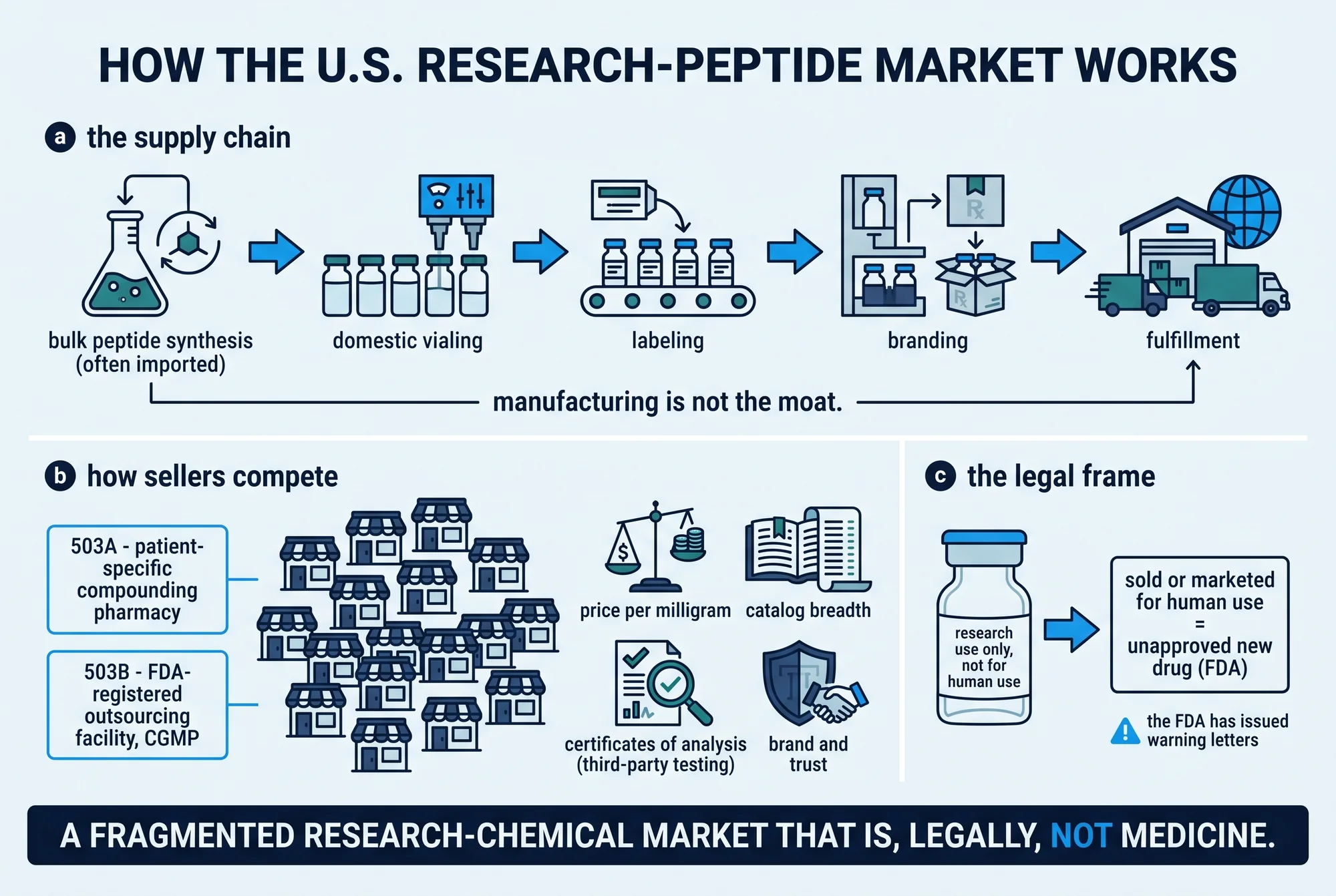
To see why so many sellers can coexist, follow the product backwards. A finished retail vial ends a chain that begins with bulk peptide synthesized in quantity, frequently overseas, then imported, then vialed, labeled, branded, and shipped domestically. The chemically demanding step — making and purifying the peptide — happens upstream and at scale. The steps a buyer pays a premium for happen downstream: filling and finishing the vial, presenting it, standing behind it, and getting it to the door.
This is why manufacturing is not the competitive moat. If making the molecule were the constraint, competitors would compete the price down toward the cost of production and the field would consolidate around whoever made it cheapest. That is not what the data shows. The same compound spreads a median of roughly threefold between its cheapest and dearest per-milligram listing, and adding sellers does not close the gap — BPC-157, carried by more than thirty of them, still ranges more than fivefold. Competition on the molecule itself would erase a spread like that; its persistence tells you the contest is elsewhere. The companion explainer traces that price dispersion in detail.
External evidence points the same way on sourcing. In 2026 the FDA launched a "Green List" initiative aimed explicitly at protecting Americans from illegally imported GLP-1 drug ingredients — an acknowledgment, from the regulator, that bulk active-ingredient sourcing for this market runs substantially through overseas import channels. The owned data cannot put a number on that: it does not measure how much synthesis happens in any particular country, or how cost splits between synthesis and finishing. The shape is clear — bulk upstream and often imported, value added downstream — but it stays qualitative here rather than inventing a figure the data cannot support.
What sellers actually compete on
With manufacturing off the table, competition runs on a handful of other axes, largely independent of one another.
Price is the most visible. The only honest cross-seller comparison is the price per milligram of the same compound at a comparable vial size — the subject of the companion piece. Across the snapshot, the cheapest listing for a compound undercut that compound's category median by about a third on average, and in ten of thirty like-for-like groups the best price beat the median by more than forty per cent. Price leadership is also concentrated and, tellingly, behavioral: in nearly half of those groups the single cheapest listing came from just three sellers, and some sellers sit in the cheapest third of every group they enter while others are reliably expensive. A shop consistently cheap across many compounds is telling you something durable; a shop cheapest on one popular item is telling you about that item alone.
Catalog breadth is a second axis, and a positioning choice in its own right. Matched-SKU breadth runs from single-product shops to broad-line catalogs carrying two dozen or more of the tracked compounds — a general store versus a specialist — and buyers read it accordingly.
Third is testing. Sellers compete heavily on advertised certificates of analysis and third-party purity and identity testing, and the tracking behind this piece records those claims as a first-class signal. But a certificate on a product page is a marketing claim until it is independently verified, and it belongs in a different column from price. Purity, identity, and sterility are established by analytical methods — chromatography, mass spectrometry, sterility and endotoxin testing — not by what a listing costs or asserts. Price and quality are independent axes: a low price is not evidence of poor material, and a high one is not evidence of good. The claims are recorded as claims, with no composite "quality score" built on top.
The remainder is brand and convenience — presentation, shipping speed, customer service, the general impression of trustworthiness. When two sellers offer chemically comparable material, much of what separates them is this package of trust and convenience, not anything in the vial.
What the market stocks, and where the demand really is
Lay the catalog out by how many sellers carry each compound and it forms a short head and a long tail: a few ubiquitous staples stocked by most of the market, then a steady fall to compounds carried by only a handful of shops.
That distribution is easy to misread, because seller counts measure catalog presence, not demand. The clearest example is the GLP-1 and weight-management category, which drives the surrounding surge of interest. In raw coverage it looks modest: retatrutide appears at twelve sellers, tirzepatide at six, semaglutide at five. Those thin bars seem to mark a small corner of the market. They are nothing of the kind. Two forces hold the counts down: GLP-1 lines are frequently sold behind account logins or quote gates, so a public snapshot captures them poorly, and they sit at the center of FDA enforcement, which pushes them off open catalogs. Yet GLP-1 compounds command the highest prices per milligram in the whole market — the category runs near the top of a roughly eighty-fold range separating it from high-dose ancillary compounds like NAD+ at the bottom — and they are the demand engine pulling new entrants in. They are capture-thin, not demand-thin, and the distinction matters for anyone reading the chart above.
The spillover shows up in the catalog's shape, too. Alongside single compounds, the market sells GLP-1 blends and co-formulations — compounds combined with one another, or with vitamins, amino acids, and NAD+. That pattern runs directly into a regulatory concern: the FDA has stated that the safety and effectiveness of combining semaglutide with added ingredients such as vitamin B-12, B-6, L-carnitine, or NAD has not been established. What reads as product innovation on a storefront is, to the regulator, an unstudied combination.
The legal frame: a research-chemical market, not a medicines market
Everything so far describes commerce. Why this behaves like a research-chemical market rather than a pharmacy comes down to law, worth setting out precisely, because the labels involved are easy to misread.
"Research use only" is a label, not a legal safe harbor
The products carry some version of "for research use only" or "not for human consumption," and are neither FDA-approved drugs nor dietary supplements. It is tempting to read that label as a category of permitted, unregulated sale. It is not. The FDA's consistent position is that the label does not control what the product legally is. When a product's own website and labeling — the marketing claims, the dosing suggestions, the framing around human goals — establish that it is intended for human use, the product becomes a "drug" under Section 201(g)(1) of the Federal Food, Drug, and Cosmetic Act, which defines a drug partly by intended use: something meant to treat disease or to affect the structure or function of the body.
From there the chain is short. A drug that is not generally recognized as safe and effective is a "new drug" under Section 201(p); a new drug without an approved application is an unapproved new drug under Section 505(a); and introducing it into interstate commerce violates Section 301(d). The "research only" caveat does not interrupt that sequence, because intended use, not the disclaimer, is what the statute turns on. This is not hypothetical: the FDA has issued warning letters to sellers in this market on exactly these grounds across 2024 through 2026. Those letters are public enforcement records; this piece treats active enforcement as a structural fact about the market and does not single out individual storefronts.
Why this is not pharmacy compounding
A common confusion files these storefronts alongside compounding pharmacies, which also supply drugs that never went through full FDA approval. They are not the same, and the difference is the entire point. Compounding has two lawful, FDA-recognized pathways, each with defined conditions.
Section 503A covers traditional pharmacy compounding: a licensed pharmacist in a state-licensed pharmacy, or a licensed physician, preparing a drug for an individual patient, generally against a patient-specific prescription. When its conditions are met, the compounded drug is exempt from three federal requirements — FDA new-drug approval, current good manufacturing practice, and labeling with adequate directions for use — and it may not be essentially a copy of a commercially available drug.
Section 503B covers outsourcing facilities: a facility that registers with the FDA and may compound in larger volumes without a patient-specific prescription, supplying office stock to clinicians, for instance. In exchange it takes on more obligation, not less. It is exempt from FDA approval and adequate-directions labeling, but it must comply with current good manufacturing practice, it is inspected by the FDA on a risk-based schedule, and it may not compound essentially copies of an approved drug.
Both pathways are lawful exceptions with conditions attached: licensure, a prescription or registration, manufacturing standards, inspection. An FDA-approved drug clears full pre-market review; a 503A or 503B compounded drug is a recognized exception with a defined framework around it. A research-use-only storefront meets none of these — no approval, no prescription requirement satisfied, no manufacturing-standard or inspection regime, only a label. That absence, not the chemistry, is what places it outside the medicines system and inside the research-chemical market.
GLP-1: the sharp end
The GLP-1 compounds concentrate every strand of this frame: they are the market's demand engine, its highest-priced category, and the focus of its most active enforcement. The FDA maintains a standing warning about unapproved GLP-1 drugs used for weight loss, citing dosing errors, adverse events serious enough to require hospitalization, and the use of unapproved salt forms — semaglutide sodium or semaglutide acetate — that are different active ingredients from the base semaglutide in approved medicines, and whose properties the agency says it cannot assume are equivalent. In 2026 it went further, proposing to exclude semaglutide, tirzepatide, and liraglutide from the list of bulk substances that even registered 503B outsourcing facilities may compound, on the finding that there is no clinical need to do so — narrowing the lawful route as well as the unlawful one.
The contrast the reader should keep is simple. The approved GLP-1 medicines — semaglutide as Ozempic and Wegovy, tirzepatide as Mounjaro and Zepbound — cleared full FDA approval. The research-use-only versions, and many compounded ones, did not. And a molecule with no approved competitor to copy, like retatrutide, is carried more widely on open catalogs than one under intense enforcement, which is part of why the newest pre-approval compounds are so visible in this market.
How to read the market
Put together, the structure suggests a few durable habits.
Treat coverage as coverage, not size. Seller counts measure how many storefronts carry a compound, not how much of it sells — a compound can be everywhere and minor, or thinly listed and in heavy demand, as the GLP-1 lines are.
Assume where you buy matters as much as what you buy. In a market this dispersed, the storefront drives both price and the credibility of the testing behind the product, and neither travels with the compound.
Keep price and quality in separate columns. A higher price is not evidence of better material, nor a lower one of worse; purity and identity are laboratory questions, answered by testing, not by a price tag or an advertised claim.
And hold onto the legal frame. Whatever a storefront looks like, a research-use-only peptide is not an approved medicine and not a compounded prescription — that is the legal category the whole market sits in.
What remains uncertain
These are the limits a careful reader should carry out. The dataset is a single snapshot of sixty-five sellers and twenty-three compounds — a capture, not a census; the field is larger, and the numbers age as prices and rosters change week to week. Listed prices are not necessarily transacted prices, once discounts, minimums, shipping, and wholesale tiers are counted. Coverage is thinnest exactly where interest is highest: the account-gated GLP-1 lines are best read as lower bounds on their true presence, not precise counts, and raw outlier cells are quarantined rather than reported, so the durable figures are medians. The supply-chain picture is qualitative by necessity — the owned data does not quantify country of origin or the synthesis-versus-finishing cost split — and while sellers plainly compete on testing claims, this piece does not publish a verified rate of genuine third-party testing, which would require returning to the underlying database. The durable content here is the structure; any single number is the perishable part.
This analysis draws on South Beach Longevity's owned research-use-only peptide market dataset — observed public retail listings across sixty-five sellers and twenty-three compounds, organized into thirty like-for-like comparison groups and captured in an August 2026 snapshot — together with U.S. Food and Drug Administration primary regulatory records, verified against FDA.gov and linked in the references for one-click confirmation. It contains no confidential cost or margin data and names no individual seller; seller counts proxy catalog presence, not audited revenue or market share. It is market analysis, not medical or legal advice, and describes a research-chemical market, not a market in medicines. For the price-dispersion mechanics referenced throughout, see Why Peptide Prices Vary; for related coverage, see the Peptide markets hub.
References
- 1.U.S. Food and Drug Administration. FD&C Act Provisions that Apply to Human Drug Compounding (Sections 503A and 503B). Link
- 2.U.S. Food and Drug Administration. Information for Outsourcing Facilities (Section 503B): registration, CGMP compliance, and risk-based inspection. Link
- 3.U.S. Food and Drug Administration. FDA's Concerns with Unapproved GLP-1 Drugs Used for Weight Loss. Link
- 4.U.S. Food and Drug Administration. FDA Launches 'Green List' to Protect Americans from Illegal Imported GLP-1 Drug Ingredients (press announcement, 2026). Link
- 5.U.S. Food and Drug Administration. FDA Proposes to Exclude Semaglutide, Tirzepatide, and Liraglutide on the 503B Bulks List (press announcement, 2026). Link
- 6.U.S. Food and Drug Administration. Warning Letters (public enforcement database). Link
Disclosures
Market analysis only. Figures describe observed retail listings for research-use-only products and are not endorsements, price quotes, or recommendations to purchase or use any compound. Regulatory statements summarize public FDA positions and are not legal advice. Contains no confidential cost or margin data and names no individual seller.