
What Is a Peptide?
It is a short chain of amino acids — the same building blocks as a protein, only fewer of them. That one fact explains why peptides are among the most precise molecules in medicine and among the most misunderstood products sold online.
Abstract
A peptide is a short chain of amino acids joined by peptide bonds — the same chemistry that builds proteins, on a smaller scale. This explainer defines the peptide, places it on the size spectrum between small-molecule drugs and proteins, and shows why the boundary with proteins is an admitted labelling convention rather than a fixed rule. It explains how many peptides act as the body's signalling molecules, usually by binding receptors, and why their short half-life and poor oral absorption make them difficult to turn into drugs. It sets out the historical landmarks — insulin's clinical debut in 1922, the first synthesis of a peptide hormone, the first protein sequence — and the dated figures for how many peptide medicines now exist. It closes on the distinction that matters most for a general reader: the difference between an approved peptide medicine and a peptide sold 'for research use only.'
Key findings
- A peptide is a short chain of amino acids joined by peptide (amide) bonds — the same chemistry as a protein, on a smaller scale (Chemistry LibreTexts; Doig, 2017).
- The line between 'peptide' and 'protein' is a loose labelling convention, not a rule: sources place it anywhere from about 40–50 to 50–100 amino acids, which is why insulin (51 amino acids) is called a protein while GLP-1 (30) is a peptide (counts from Sanger, 1955, and Holst, 2007).
- Peptides occupy the middle ground between small-molecule drugs and large proteins, valued for combining high selectivity with a smaller, more tractable structure (Fosgerau & Hoffmann, 2015; Muttenthaler et al., 2021).
- They make difficult drugs: proteases destroy native peptides within minutes, and unmodified peptides have oral bioavailability that is in most cases below 1%, so most are injected — chemical modification is how the field extends their working life (Zupancic & Bernkop-Schnürch, 2017; Holst, 2007; Wong et al., 2016).
- Peptides are established medicines — more than 80 have reached the market worldwide (Muttenthaler et al., 2021) — but many peptides sold today are unapproved 'research use only' chemicals, a regulatory status that is not a claim about quality or safety (Operation Supplement Safety).
A peptide is a short chain of amino acids — the same building blocks that make up proteins, strung together in the same way, only fewer of them. That is the whole definition. Everything else worth knowing about peptides, including why they have become some of the most interesting molecules in medicine and some of the most misunderstood products sold online, follows from that single structural fact.
The word describes chemistry, not quality. It tells you a molecule is a chain of amino acids and nothing more — not whether a particular product is pure, effective, approved, or safe to put in your body. Holding those two ideas together — the elegant biology and the unregulated marketplace — is what this explainer is for. It is the doorway to South Beach Longevity's deeper Therapeutic peptides research, which carries the mechanisms and the compound-by-compound evidence in depth.
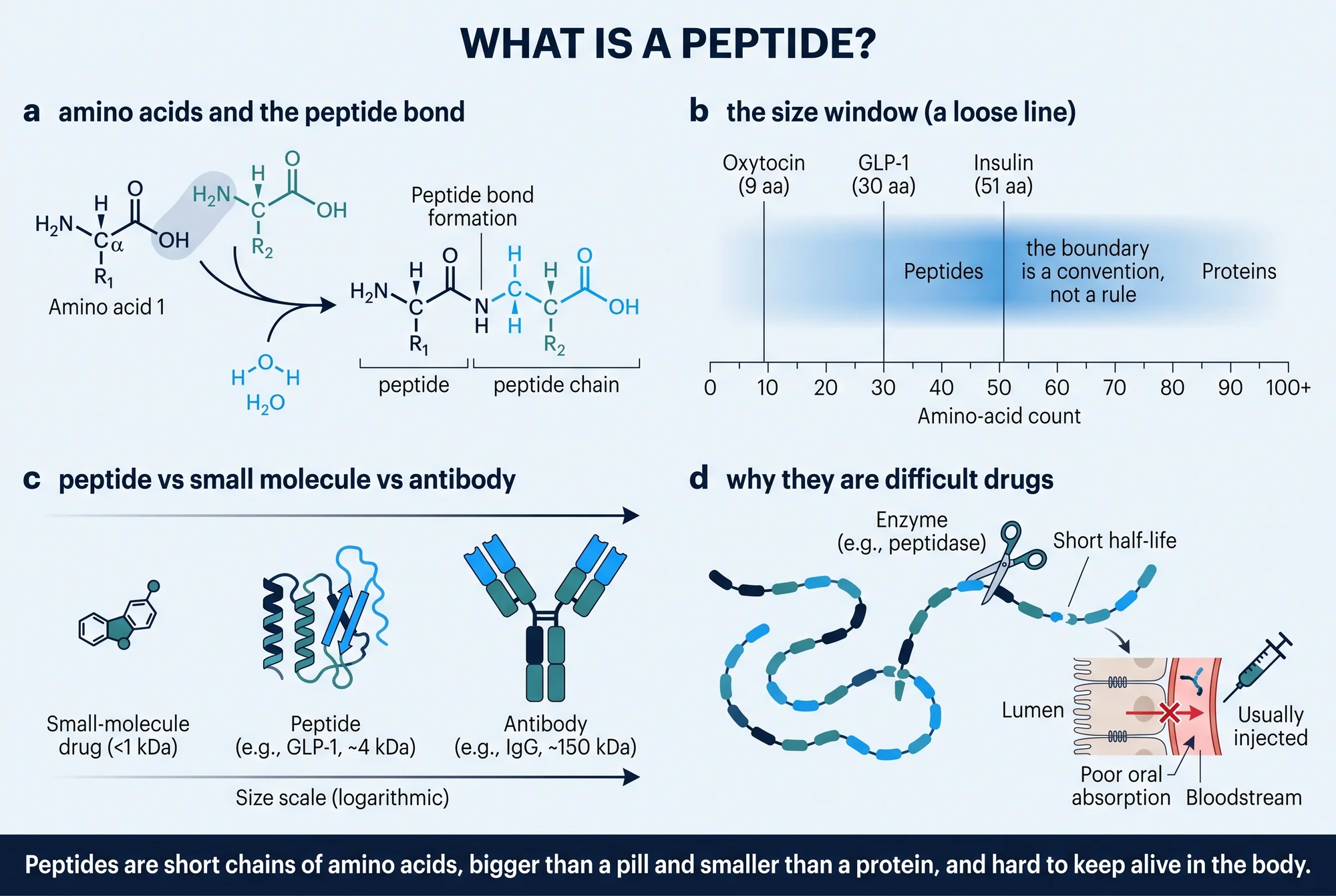
What a peptide is made of
Proteins and peptides are assembled from a shared alphabet of 20 standard amino acids, the set specified by the genetic code (Doig, 2017). (A couple of rarer amino acids are slotted in by some organisms, but the standard 20 do almost all of the work.) Each amino acid carries an amino group at one end and a carboxyl group at the other, and a peptide forms when these are linked: the carboxyl group of one amino acid reacts with the amino group of the next, releasing a single molecule of water and leaving behind the amide linkage that chemists call a peptide bond (Chemistry LibreTexts). Repeat that reaction and the chain grows, amino acid by amino acid.
Because each link joins a free amino end to a free carboxyl end, a peptide chain has a direction. By convention it is read and written from the N-terminus, the end with a free amino group, to the C-terminus, the end with a free carboxyl group (Chemistry LibreTexts). The order of the amino acids along that chain — the sequence — is what separates one peptide from another, and it dictates the shape the chain folds into and the job it can do. Change the order and you change the molecule. That relationship between sequence, structure, and function is a thread the deeper peptide-science material develops in its own right.
Peptide or protein? A line that moves
If a peptide and a protein are both chains of amino acids, where is the line between them? The honest answer is that there is no sharp one. Size is the usual criterion — peptides are short, proteins are long — but the cutoff is a convention that has been drawn loosely and inconsistently. The University of Queensland's Institute for Molecular Bioscience puts the boundary at "approximately 50–100 amino acids" and adds, plainly, that the classification "is a little loose" (counts from Sanger, 1955, and Holst, 2007); other teaching sources draw it nearer 40 to 50. Chains sitting in the ambiguous middle are often just called polypeptides.
The disagreement is not sloppiness. It is the point. Where a molecule stops being a peptide and starts being a protein is a human label for a gradual change, not a boundary in nature. Insulin is the clean illustration: at 51 amino acids it sits one residue above the commonly cited line near 50, and it is conventionally called a protein hormone — while GLP-1, at 30 amino acids, is unambiguously a peptide (Sanger, 1955; Holst, 2007; Blaskovich, 2017). The same molecule can be described as a "large peptide" or a "small protein" depending on which reputable source you happen to read.
The practical lesson: treat "peptide" and "protein" as two ends of one continuous spectrum of chain length, with a broad, soft band — not a wall — near fifty amino acids.
Between a pill and an antibody
That middling size is exactly what makes peptides interesting as medicines. Drug molecules tend to fall into two camps. Small-molecule drugs are tiny; they are comparatively easy to manufacture and can often be swallowed, but their small size frequently means they bind their targets less selectively. Large biologics such as antibodies sit at the other extreme: they are exquisitely specific, but they are big, complex, expensive to make, and impossible to take as a tablet.
Peptides bridge the two regimes (Muttenthaler et al., 2021; Wang et al., 2022). They are large enough to fold into shapes that fit a target with something approaching a protein's precision, yet small enough to be built by chemical synthesis rather than grown in living cells. One widely cited review characterises them as "highly selective and efficacious and, at the same time, relatively safe and well tolerated" (Fosgerau & Hoffmann, 2015). The ambition of the field is to capture an antibody's specificity in a molecule closer to a small drug's simplicity — which is why the comparison across therapeutic modalities is a subject in its own right.
How peptides carry a message
Many peptides are the body's messengers. Hormones, neurotransmitters, and growth factors are frequently peptides, and they work by carrying a chemical signal from the cell that releases them to a distant cell that receives it (Muttenthaler et al., 2021; Holst, 2007). The receiving cell recognises the peptide through a receptor — a protein, usually embedded in the cell's outer membrane, shaped to catch one specific signal and translate it into action inside the cell. (How peptides act on the human body is a foundation topic on its own.)
Most peptide hormones are read by one great family of receptors, the G-protein-coupled receptors, or GPCRs — the most intensively studied and most successfully drugged receptor class in all of pharmacology. To give a sense of scale, one survey counted 475 drugs, about 34% of all medicines approved by the U.S. Food and Drug Administration, acting at 108 different GPCRs (Hauser et al., 2017). That figure spans every kind of drug, not peptides alone; the point is that the doorway peptides most often use is also the one medicine has learned to open best.
"Most" is not "all". Insulin does not act through a GPCR at all: it signals through the insulin receptor, a receptor tyrosine kinase — a different class entirely. The general rule and its most famous exception belong in the same breath, because "peptides act through GPCRs" is a useful generalisation, not a law.
Three familiar peptides show the range. Oxytocin, a chain of just 9 amino acids, is a peptide hormone that acts through a GPCR, and it holds a place in history as the first peptide hormone ever made in a laboratory. GLP-1, at 30 amino acids, is a gut hormone that works through its own GPCR to help regulate blood sugar and appetite; it is the molecule behind a generation of metabolic drugs and the subject of its own explainer, What Is GLP-1 and How Does It Work?. Insulin, at 51 amino acids, is the master regulator of blood glucose and the standing exception to the GPCR rule. Between them they map the territory: a handful of amino acids up to a few dozen, most passing through the common receptor doorway and one going its own way.
Why peptides make difficult drugs
If peptides are such capable signals, why is every peptide not simply a pill? Because the very features that make them good biological messengers make them poor drugs.
The first problem is speed of destruction. The body is built to switch its own signals off quickly, and it does so with proteases, the enzymes that snip peptide chains apart. A natural signalling peptide can be gone in a minute or two. GLP-1 is the textbook case: it is "extremely rapidly metabolized and inactivated by the enzyme dipeptidyl peptidase IV" — DPP-4 — and in one human study only about 20% of administered GLP-1 remained intact after the enzyme had gone to work (Holst, 2007; Deacon et al., 1995). A drug that vanishes in ninety seconds is not much use unless it can be re-injected every ninety seconds.
The second problem is that peptides are almost impossible to swallow. Because of their size, their water-loving chemistry, and the gauntlet of digestive enzymes in the gut, unmodified peptides have an oral bioavailability that is "in most cases below 1%" (Zupančič & Bernkop-Schnürch, 2017) — meaning that of a swallowed dose, less than a hundredth reaches the bloodstream intact. Insulin is the classic example: its poor oral absorption is attributed to "its high molecular weight, susceptibility to enzymatic proteolysis and low diffusion rate across the mucin barrier", which is why "daily subcutaneous insulin injection is standard management" (Wong et al., 2016). Most peptide drugs are injected for exactly this reason. Injection routes around both the proteases of the gut and the barrier of the gut wall.
The field's response is chemistry. By modifying a peptide — altering its structure so that proteases no longer recognise it, attaching a fatty acid so that it clings to blood proteins and lingers, or wrapping it in a delivery system — researchers extend a peptide's working life from minutes toward days, and occasionally coax it past the gut (Muttenthaler et al., 2021; Wang et al., 2022; Zupančič & Bernkop-Schnürch, 2017). The modern GLP-1 medicines are the clearest success: the natural hormone lasts about a minute, while its engineered descendants last roughly a week — the full story of that re-engineering belongs to the GLP-1 explainer. How peptides are cleared and delivered is developed further in the deeper material on peptide pharmacokinetics and delivery.
Peptides as medicine: a short history and a moving count
Peptides are neither a new nor a fringe class of medicine. The story begins in Toronto in 1921–22, where insulin was isolated from pancreas and, in 1922, first used to treat a patient — the first peptide or protein hormone put to work as a medicine (Hegele, 2020). Two mid-century landmarks then established that peptides could be understood and built, not merely extracted, and they are worth keeping distinct, because they are routinely confused:
- In 1953, Vincent du Vigneaud achieved the first chemical synthesis of a peptide hormone, oxytocin — work recognised with the 1955 Nobel Prize in Chemistry (du Vigneaud, 1953). Oxytocin was the first peptide hormone made from scratch.
- In 1955, Frederick Sanger determined the complete amino-acid sequence of insulin, the first protein ever fully sequenced — work recognised with the 1958 Nobel Prize in Chemistry (Sanger, 1955). Insulin was the first protein whose exact sequence was known.
The distinction is precise: oxytocin was first synthesised, insulin was first sequenced. A generation later, in 1982, recombinant human insulin (Humulin) became the first recombinant-DNA drug approved for human use, the moment peptides and proteins became manufacturable at industrial scale rather than harvested from animal pancreas (Smithsonian National Museum of American History).
How many peptide medicines exist today? There is no single tidy number, because the answer depends on how a peptide drug is defined and on the date the question is asked. The defensible figures come from the review literature, and each carries its own year: more than 80 peptide drugs have reached the market worldwide, for conditions from diabetes to cancer to chronic pain (Muttenthaler et al., 2021); over 60 are approved across the United States and other major markets, with over 150 more in active development (Lau & Dunn, 2018); and approximately 140 peptide therapeutics were in clinical trials as of the middle of the last decade (Fosgerau & Hoffmann, 2015). These are not one measurement taken three times. They are three snapshots from different reviews, dates, and definitions, and the honest way to read them is as a class that is both well established and still growing quickly — not as a single authoritative tally.
Approved medicine, or "research chemical"?
For a general reader, the most useful thing to understand about peptides is not chemistry at all. It is that the word on a label tells you nothing about a product's legal or clinical status. Insulin and several GLP-1 drugs are FDA-approved medicines, reviewed for safety, purity, and effectiveness at a defined dose. Many other peptides sold today are not. They are marketed under labels such as "research use only", "for research purposes only", or "not for human consumption" (Operation Supplement Safety).
"Research use only" is a regulatory status, not a grade of quality. It means a product has not been evaluated or approved for human clinical use; it does not certify that the substance is pure, correctly dosed, safe, or effective. The U.S. Department of Defense's Operation Supplement Safety states the case bluntly for one widely sold example: "BPC-157 is not a dietary ingredient. It is an unapproved drug and cannot be legally prescribed or sold over the counter" (Operation Supplement Safety) — and yet it is sold widely with a research-use disclaimer.
It helps to keep the regulatory categories separate. An FDA-approved drug has cleared review. A compounded preparation is made for an individual patient under specific federal rules — a narrow, conditional pathway, and one an FDA advisory committee has been asked to apply to particular peptides (AJMC, 2023). A research-use-only chemical has not been approved for people at all. And an unapproved drug is simply that. These are legal distinctions with real consequences, and a product can wear a scientific-sounding name while occupying the weakest of them. This page defines a chemical class; it makes no claim about whether any specific research-use peptide is safe or effective. Those questions belong to the individual compound monographs this series links to.
Common misunderstandings
A few misconceptions are worth correcting directly.
"Peptide" is not a safety label. It is a chemical category — a chain of amino acids — and nothing more (Chemistry LibreTexts). It does not mean natural-and-therefore-safe, high-quality, or approved. That a molecule is a peptide, or that a peptide occurs naturally in the body, does not establish that a marketed product containing it is pure, effective, or legal to use (Operation Supplement Safety; Fosgerau & Hoffmann, 2015). An endogenous signalling molecule and an unregulated research chemical can both be described, accurately, as "peptides".
The peptide-versus-protein boundary is a convention, not a contradiction. Because the size cutoff is a loose human agreement, two reputable sources can call the same molecule a "peptide" and a "protein" without either being wrong (Blaskovich, 2017; Chemistry LibreTexts). That is a feature of scientific language, not a flaw in the science.
Being the body's own messenger is not a guarantee of benefit. The biology is genuinely elegant and the marketplace is genuinely unregulated; both are true at once. Keeping them in view together is the whole reason to start with the question "what is a peptide?" rather than with a product.
This explainer defines what a peptide is and how peptides work as signals and as medicines, drawing only on verified primary and authoritative sources: peer-reviewed reviews and physiology papers retrieved from PubMed, Nobel Prize records, the Smithsonian National Museum of American History, and U.S. Department of Defense safety guidance. Definitional chemistry and the peptide/protein size convention are labelled as conventions rather than empirical findings; the drug-landscape figures carry their source years (2015, 2018, 2021) and are review snapshots, not a single current count. It is educational and is not medical advice, a prescription, or an endorsement of any product — approved medicines, compounded preparations, and research-use-only chemicals bearing the same name are not equivalent. For the science beneath this doorway, see the Therapeutic peptides hub and, for a worked example of a peptide re-engineered into a medicine, What Is GLP-1 and How Does It Work?.
References
- 1.AJMC. FDA panel backs 6 peptides for compounding (report on the FDA Pharmacy Compounding Advisory Committee and the 503A bulk drug substances process). 2023. Link
- 2.Blaskovich M. Explainer: peptides vs proteins — what's the difference? Institute for Molecular Bioscience, University of Queensland; 2017. Link
- 3.Chemistry LibreTexts. The peptide bond (Section 9.3). CHEM 309, American River College. Link
- 4.Deacon CF, Nauck MA, Toft-Nielsen M, Pridal L, Willms B, Holst JJ. Both subcutaneously and intravenously administered glucagon-like peptide I are rapidly degraded from the NH2-terminus in type II diabetic patients and in healthy subjects. Diabetes. 1995;44(9):1126-1131. doi:10.2337/diab.44.9.1126
- 5.Doig AJ. Frozen, but no accident — why the 20 standard amino acids were selected. FEBS J. 2017;284(9):1296-1305. doi:10.1111/febs.13982
- 6.du Vigneaud V. First chemical synthesis of a peptide hormone (oxytocin), 1953. The Nobel Prize in Chemistry 1955. NobelPrize.org, Nobel Prize Outreach. Link
- 7.Fosgerau K, Hoffmann T. Peptide therapeutics: current status and future directions. Drug Discov Today. 2015;20(1):122-128. doi:10.1016/j.drudis.2014.10.003
- 8.Hauser AS, Attwood MM, Rask-Andersen M, Schiöth HB, Gloriam DE. Trends in GPCR drug discovery: new agents, targets and indications. Nat Rev Drug Discov. 2017;16(12):829-842. doi:10.1038/nrd.2017.178
- 9.Hegele RA, Maltman GM. Insulin's centenary: the birth of an idea. Lancet Diabetes Endocrinol. 2020;8(12):971-977. doi:10.1016/S2213-8587(20)30337-5
- 10.Holst JJ. The physiology of glucagon-like peptide 1. Physiol Rev. 2007;87(4):1409-1439. doi:10.1152/physrev.00034.2006
- 11.Lau JL, Dunn MK. Therapeutic peptides: historical perspectives, current development trends, and future directions. Bioorg Med Chem. 2018;26(10):2700-2707. doi:10.1016/j.bmc.2017.06.052
- 12.Muttenthaler M, King GF, Adams DJ, Alewood PF. Trends in peptide drug discovery. Nat Rev Drug Discov. 2021;20(4):309-325. doi:10.1038/s41573-020-00135-8
- 13.Operation Supplement Safety (Uniformed Services University / U.S. Department of Defense). BPC-157: a prohibited peptide and an unapproved drug found in health and wellness products. Link
- 14.Sanger F. First complete amino-acid sequence of a protein (insulin), completed 1955. The Nobel Prize in Chemistry 1958. NobelPrize.org, Nobel Prize Outreach. Link
- 15.Smithsonian National Museum of American History. Recombinant drugs / birth of biotech: Humulin (human insulin, recombinant-DNA origin), FDA-approved 1982. Link
- 16.Wang L, Wang N, Zhang W, Cheng X, Yan Z, Shao G, Wang X, Wang R, Fu C. Therapeutic peptides: current applications and future directions. Signal Transduct Target Ther. 2022;7(1):48. doi:10.1038/s41392-022-00904-4
- 17.Wong CY, Martinez J, Dass CR. Oral delivery of insulin for the treatment of diabetes: status quo, challenges and opportunities. J Pharm Pharmacol. 2016;68(9):1093-1108. doi:10.1111/jphp.12607
- 18.Zupančič O, Bernkop-Schnürch A. Lipophilic peptide character — what oral barriers fear the most. J Control Release. 2017;255:242-257. doi:10.1016/j.jconrel.2017.04.038
Disclosures
Educational content explaining a chemical class. Not medical advice, a prescription, or an endorsement of any product. Approved medicines, compounded preparations, and research-use-only chemicals bearing the same name are not equivalent. The peptide drug-landscape figures are review snapshots carrying their source years (2015, 2018, 2021), not a single current tally.