
What Is GLP-1 and How Does It Work?
The gut hormone behind the most consequential metabolic drugs in a generation — what it is, what it does in the body, and what the trials actually show.

Abstract
Glucagon-like peptide-1 (GLP-1) is an incretin hormone secreted by the gut after eating. It stimulates insulin only when blood glucose is high, suppresses glucagon, slows gastric emptying, and signals satiety to the brain — but it survives in the blood for only a minute or two before an enzyme destroys it. The modern GLP-1 medicines are engineered to resist that enzyme and last days. This review explains the physiology, the drug design, the verified weight and cardiovascular trial results, and the side effects and open questions that belong beside them.
Key findings
- GLP-1 is a gut hormone that lowers glucose in a self-limiting way: it stimulates insulin only when glucose is elevated, which is why it carries little intrinsic risk of hypoglycemia (Kreymann et al., 1987; Holst, 2007).
- It works on four targets — pancreas (insulin up, glucagon down), stomach (emptying slowed), and brain (appetite down) — but native GLP-1 lasts only about 1–2 minutes before the enzyme DPP-4 inactivates it (Deacon et al., 1995).
- The drugs are re-engineered to resist DPP-4. In pivotal trials, mean weight loss reached 14.9% with semaglutide (STEP 1) and 20.9% with tirzepatide (SURMOUNT-1); the investigational triple agonist retatrutide reached 24.2% in a phase 2 trial (Wilding et al., 2021; Jastreboff et al., 2022, 2023).
- Benefits extend beyond weight: semaglutide cut major cardiovascular events by 20% in people with obesity but not diabetes (SELECT, HR 0.80) and slowed kidney disease in diabetes (FLOW, HR 0.76).
- The costs sit beside the benefits: gastrointestinal side effects are common, most lost weight returns after stopping, lean-mass loss is debated, and a thyroid-tumor boxed warning derives from rodents with uncertain human relevance.
You have made GLP-1 many times today without noticing. Every time you eat, cells lining your small intestine release a hormone — glucagon-like peptide-1 — that quietly tells your pancreas to release insulin, tells your stomach to slow down, and tells your brain that you have had enough. It is one of the body's own signals for handling a meal. The medicines that have reshaped obesity and diabetes care are engineered, long-lasting copies of it.
Understanding the drugs starts with understanding the hormone: what it is, the four things it does, and the single inconvenient fact — it is destroyed within a minute or two of being made — that everything about the drug design exists to solve.
The hormone your gut makes after a meal
GLP-1 is a small peptide — a chain of 30 amino acids — released by endocrine cells (called L-cells) in the lining of the intestine within minutes of food arriving (Holst, 2007; Baggio & Drucker, 2007). It belongs to a class of gut hormones called incretins: signals released by the digestive tract that amplify the body's insulin response to a meal. The foundational human experiment showed that infusing GLP-1 to mimic post-meal levels raised insulin and lowered both glucagon and blood glucose — and did so more potently than the other main incretin, GIP (Kreymann et al., 1987).
The defining limitation of the natural hormone is how briefly it lasts. An enzyme called DPP-4 (dipeptidyl peptidase-4) clips GLP-1 almost the moment it appears; in healthy volunteers, only about 20% of infused GLP-1 remained intact, the rest already inactivated (Deacon et al., 1995). Its functional half-life is on the order of one to two minutes (Holst, 2007). That is fine for a signal the gut re-releases with every meal, and fatal for a drug, which cannot be re-infused every ninety seconds. That brevity is the problem every GLP-1 medicine was built to solve.
What GLP-1 does in the body
GLP-1 acts on four targets, and the way it does so is as important as the fact that it does.
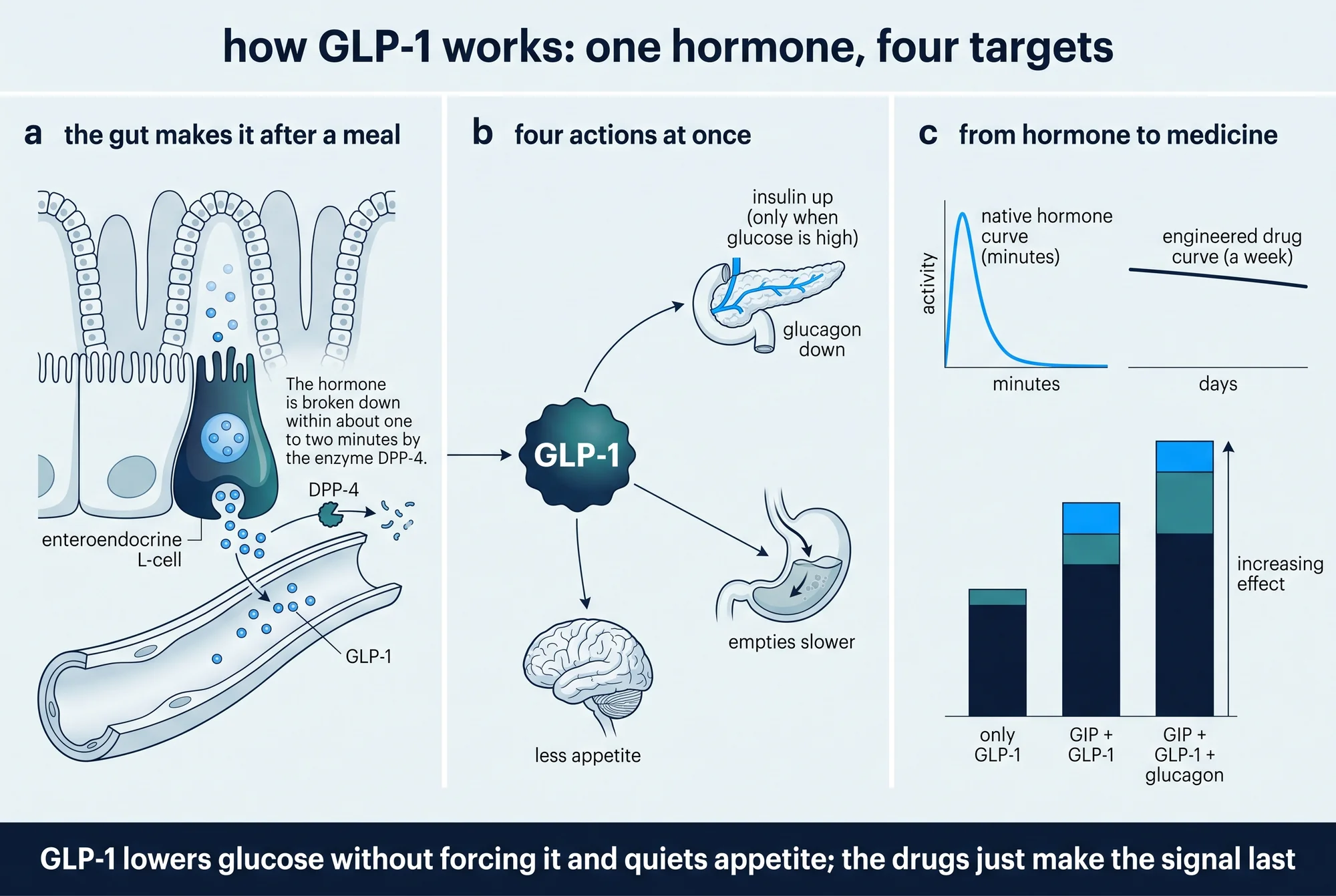
At the pancreas, GLP-1 stimulates insulin release — but in a self-limiting way. The effect is glucose-dependent: it operates when blood glucose is elevated and fades as glucose falls (Kreymann et al., 1987; Holst, 2007). That single property is why GLP-1-based therapy rarely causes dangerous low blood sugar on its own, a crucial contrast with insulin injections or sulfonylureas. GLP-1 also suppresses glucagon, the hormone that tells the liver to release stored glucose, which further blunts the post-meal glucose rise (Baggio & Drucker, 2007).
At the stomach, GLP-1 slows gastric emptying. In healthy volunteers this braking effect was strong enough that, on balance, giving GLP-1 with a meal produced no rise or even a fall in meal-related insulin rather than the expected increase — the delayed delivery of nutrients mattered more (Nauck et al., 1997). Slower emptying means food stays in the stomach longer, and fullness lasts.
At the brain, GLP-1 acts as a satiety signal. GLP-1 receptors sit in the hypothalamus and brainstem, and delivering GLP-1 into the brain reduces feeding; work with the analogue liraglutide localized the effect to specific appetite-regulating neurons in the arcuate nucleus (Turton et al., 1996; Secher et al., 2014). It is worth being precise about the evidence here: the neuron-level detail comes from animal studies, synthesized into the human account by physiology reviews (Drucker, 2018). The direction of effect — less hunger — is well established; the fine wiring is mapped mostly in animals.
From hormone to medicine
Because native GLP-1 is destroyed in minutes, the entire pharmaceutical project was an exercise in defeating DPP-4 and extending the hormone's life (Baggio & Drucker, 2007). The engineering succeeded dramatically: semaglutide was designed to resist the enzyme and to bind to a blood protein that keeps it in circulation, giving it a half-life of about a week — enough for a once-weekly injection (Marso et al., 2016). A signal that once lasted ninety seconds now lasts seven days.
The approved and investigational agents form a clear progression, and it helps to keep three categories straight:
- GLP-1 receptor agonists (single-target): exenatide, the first in class, was approved for type 2 diabetes in 2005; liraglutide followed for diabetes (2010) and then obesity as Saxenda (2014); dulaglutide in 2014; and semaglutide as Ozempic for diabetes (2017), as an oral tablet Rybelsus (2019), and — at a higher dose — as Wegovy for chronic weight management (2021).
- Dual GIP/GLP-1 agonist: tirzepatide is a single molecule that activates two incretin receptors. It was approved as Mounjaro for diabetes (2022) and Zepbound for obesity (2023).
- Investigational triple agonist: retatrutide adds a third target, the glucagon receptor. It is not approved for any use; its phase 3 program is ongoing.
The distinction between an FDA-approved medicine, a compounded copy, and an unapproved research chemical carrying the same name is not academic — only the first has been reviewed for safety, purity, and efficacy at a defined dose.
How much weight? What the trials show
The efficacy that drove the public interest is real and, in the pivotal trials, large. The figure below shows mean weight change in each drug's own trial, arranged by how many hormone receptors the drug engages.
In STEP 1, semaglutide 2.4 mg produced a mean loss of 14.9% of body weight over 68 weeks, versus 2.4% on placebo, and half of participants lost at least 15% (Wilding et al., 2021). In SURMOUNT-1, the dual agonist tirzepatide reached 20.9% at its highest dose over 72 weeks (Jastreboff et al., 2022). The investigational triple agonist retatrutide reached 24.2% at 48 weeks in a phase 2 trial — a striking figure that must carry its caveat: it is early-stage and not yet confirmed in phase 3 (Jastreboff et al., 2023). Context matters, too: in people who also have type 2 diabetes, the same drugs produce somewhat less weight loss — tirzepatide reached about 14.7% in SURMOUNT-2 (Garvey et al., 2023).
Beyond weight and glucose
The most consequential trials of the last few years asked whether these drugs prevent disease, not just weight. The evidence separates cleanly by strength.
Established, in large randomized trials. In SELECT, semaglutide reduced major cardiovascular events — cardiovascular death, heart attack, or stroke — by 20% (hazard ratio 0.80) in more than 17,000 people who had established heart disease and obesity but not diabetes (Lincoff et al., 2023). This is the pivotal "benefit beyond weight" result: a weight-management drug lowering hard cardiovascular outcomes. In diabetes, the earlier SUSTAIN-6 trial found a similar cardiovascular benefit (HR 0.74) — while also flagging a signal that belongs in the same breath: a significant increase in diabetic retinopathy complications (HR 1.76) (Marso et al., 2016). And in FLOW, semaglutide slowed the progression of kidney disease in people with type 2 diabetes and chronic kidney disease by 24% (HR 0.76) (Perkovic et al., 2024).
Promising but partial. For fatty liver disease, a phase 2 trial found semaglutide resolved steatohepatitis in 59% of patients versus 17% on placebo — but did not significantly improve the more important measure, liver fibrosis, in that trial (Newsome et al., 2021). Genuine progress on inflammation; unproven, there, on scarring.
Preliminary. Effects on the brain's reward circuitry — on alcohol use or addiction — are an active research area with real biological plausibility, since GLP-1 receptors sit in reward-related brain regions. But controlled human outcome evidence is still thin, and these claims should be read as hypotheses under test, not demonstrated effects. (For a fuller treatment of the downstream and secondary effects, see our study After the Weight Comes Off.)
The side effects and the limits
Every one of those benefits arrives with a cost, and the costs are not footnotes.
Gastrointestinal effects are the common, expected downside — nausea, vomiting, diarrhea, constipation — usually mild to moderate and concentrated during dose escalation (Wilding et al., 2021; Newsome et al., 2021). They are, mechanistically, the flip side of the same slowed gastric emptying that produces fullness. In the pivotal trials, they led a small minority to discontinue.
Most of the lost weight returns if the drug is stopped. When semaglutide was withdrawn after a run-in, participants regained weight rather than holding it (Rubino et al., 2021); in the STEP 1 extension, people regained about two-thirds of what they had lost within a year of stopping, and their metabolic improvements faded with it (Wilding et al., 2022). This is the evidence behind treating obesity as a chronic condition: the drugs manage it while taken, rather than curing it.
Lean-mass loss is real but contested. Rapid weight loss of any kind sheds some lean mass, and GLP-1-based weight loss is no exception; estimates range widely across studies. But "lean mass" is not the same as muscle — it includes organs, bone, and fluid — and imaging work suggests much of the change is the expected adaptation to a smaller body, with the greatest concern reserved for older and frailer patients (Neeland et al., 2024). It is an open question, not a settled harm.
The thyroid-tumor boxed warning derives from rodents. GLP-1 drugs carry a warning about medullary thyroid cancer. Its basis is that these drugs caused thyroid C-cell tumors in rats and mice — but the effect appears species-specific: humans and monkeys have far fewer of the relevant receptors in the thyroid, and monkeys given very high doses for nearly two years did not develop the changes (Bjerre Knudsen et al., 2010). The warning is a real precaution; its long-term human relevance remains genuinely uncertain.
What remains uncertain
- Long-term safety and durability are not yet known. The obesity indications are recent, and the longest controlled follow-up runs only a few years.
- Muscle and function over years of use, especially in older people, need more evidence (Neeland et al., 2024).
- Retatrutide's headline number is phase 2 and investigational; it must be confirmed before it can be weighed against the approved drugs (Jastreboff et al., 2023).
- Cost, access, and supply shape who actually benefits — but these are economic and policy questions, not measures of the drugs' biology, and should not be confused with them.
The common misunderstanding
It is often said that these drugs "just make you nauseous, so you eat less." That is not what the evidence shows. Appetite reduction is a distinct, receptor-mediated brain effect that occurs at doses and in people without significant nausea; the queasiness and the fullness share a mechanism but are not the same thing (Turton et al., 1996; Drucker, 2018). A second, subtler error is to treat the drugs as identical to the natural hormone. They are deliberately not identical — the whole point of the engineering was to make a molecule the body's off-switch, DPP-4, cannot catch.
This review summarizes published human and mechanistic evidence through 2024, with FDA-approval status as of 2026, on what GLP-1 is and how it works. Every trial figure is drawn from the primary publication. It is educational and is not medical advice, a prescription, or an endorsement of any product; approved medicines, compounded copies, and research-use-only chemicals bearing these names are not equivalent. See also What Is Metabolic Health? and the GLP-1s hub.
References
- 1.Kreymann B, Williams G, Ghatei MA, Bloom SR. Glucagon-like peptide-1 7-36: a physiological incretin in man. Lancet. 1987;2(8571):1300-1304. doi:10.1016/s0140-6736(87)91194-9
- 2.Holst JJ. The physiology of glucagon-like peptide 1. Physiol Rev. 2007;87(4):1409-1439. doi:10.1152/physrev.00034.2006
- 3.Baggio LL, Drucker DJ. Biology of incretins: GLP-1 and GIP. Gastroenterology. 2007;132(6):2131-2157. doi:10.1053/j.gastro.2007.03.054
- 4.Drucker DJ. Mechanisms of action and therapeutic application of glucagon-like peptide-1. Cell Metab. 2018;27(4):740-756. doi:10.1016/j.cmet.2018.03.001
- 5.Deacon CF, Nauck MA, Toft-Nielsen M, et al. Both subcutaneously and intravenously administered GLP-1 are rapidly degraded from the NH2-terminus. Diabetes. 1995;44(9):1126-1131. doi:10.2337/diab.44.9.1126
- 6.Nauck MA, Niedereichholz U, Ettler R, et al. GLP-1 inhibition of gastric emptying outweighs its insulinotropic effects in healthy humans. Am J Physiol. 1997;273(5):E981-E988. doi:10.1152/ajpendo.1997.273.5.E981
- 7.Turton MD, O'Shea D, Gunn I, et al. A role for glucagon-like peptide-1 in the central regulation of feeding. Nature. 1996;379(6560):69-72. doi:10.1038/379069a0
- 8.Secher A, Jelsing J, Baquero AF, et al. The arcuate nucleus mediates GLP-1 receptor agonist liraglutide-dependent weight loss. J Clin Invest. 2014;124(10):4473-4488. doi:10.1172/JCI75276
- 9.Wilding JPH, Batterham RL, Calanna S, et al. Once-weekly semaglutide in adults with overweight or obesity (STEP 1). N Engl J Med. 2021;384(11):989-1002. doi:10.1056/NEJMoa2032183
- 10.Jastreboff AM, Aronne LJ, Ahmad NN, et al. Tirzepatide once weekly for the treatment of obesity (SURMOUNT-1). N Engl J Med. 2022;387(3):205-216. doi:10.1056/NEJMoa2206038
- 11.Jastreboff AM, Kaplan LM, Frías JP, et al. Triple-hormone-receptor agonist retatrutide for obesity — a phase 2 trial. N Engl J Med. 2023;389(6):514-526. doi:10.1056/NEJMoa2301972
- 12.Garvey WT, Frias JP, Jastreboff AM, et al. Tirzepatide once weekly for the treatment of obesity in people with type 2 diabetes (SURMOUNT-2). Lancet. 2023;402(10402):613-626. doi:10.1016/S0140-6736(23)01200-X
- 13.Lincoff AM, Brown-Frandsen K, Colhoun HM, et al. Semaglutide and cardiovascular outcomes in obesity without diabetes (SELECT). N Engl J Med. 2023;389(24):2221-2232. doi:10.1056/NEJMoa2307563
- 14.Marso SP, Bain SC, Consoli A, et al. Semaglutide and cardiovascular outcomes in patients with type 2 diabetes (SUSTAIN-6). N Engl J Med. 2016;375(19):1834-1844. doi:10.1056/NEJMoa1607141
- 15.Rubino D, Abrahamsson N, Davies M, et al. Effect of continued weekly subcutaneous semaglutide vs placebo on weight-loss maintenance (STEP 4). JAMA. 2021;325(14):1414-1425. doi:10.1001/jama.2021.3224
- 16.Wilding JPH, Batterham RL, Davies M, et al. Weight regain and cardiometabolic effects after withdrawal of semaglutide: the STEP 1 trial extension. Diabetes Obes Metab. 2022;24(8):1553-1564. doi:10.1111/dom.14725
- 17.Neeland IJ, Linge J, Birkenfeld AL. Changes in lean body mass with GLP-1-based therapies and mitigation strategies. Diabetes Obes Metab. 2024;26(Suppl 4):16-27. doi:10.1111/dom.15728
- 18.Bjerre Knudsen L, Madsen LW, Andersen S, et al. GLP-1 receptor agonists activate rodent thyroid C-cells causing calcitonin release and C-cell proliferation. Endocrinology. 2010;151(4):1473-1486. doi:10.1210/en.2009-1272
- 19.Newsome PN, Buchholtz K, Cusi K, et al. A placebo-controlled trial of subcutaneous semaglutide in nonalcoholic steatohepatitis. N Engl J Med. 2021;384(12):1113-1124. doi:10.1056/NEJMoa2028395
- 20.Perkovic V, Tuttle KR, Rossing P, et al. Effects of semaglutide on chronic kidney disease in patients with type 2 diabetes (FLOW). N Engl J Med. 2024;391(2):109-121. doi:10.1056/NEJMoa2403347
Disclosures
Educational review of published evidence. Not medical advice, a prescription, or a recommendation to use any drug. Trial doses and durations are reported as study parameters with their populations. FDA-approval status is stated as of 2026; retatrutide is investigational and not approved.