
Beta-Alanine
Amino acids and derivatives. A research review published by South Beach Longevity.
Beta-Alanine
Carnosine loading is real; the performance claim is narrower than the market sentenceBeta-alanine is a non-proteinogenic amino acid whose oral use reliably raises skeletal-muscle carnosine. The loading result is established. The performance claim is narrower: it is duration-dependent, modest, and not licensed by carnosine content alone. This article grades that gap. It is not a dosing guide.
Compiled by South Beach Longevity · 20 August 2026 Copyright 2026 Series SBL-41 / SP-BETA-ALANINE · Register A scientific article Sources peer-reviewed human trials, meta-analyses, consensus statements, and labelled animal or in-vitro work · verified NCBI records Constraint This document describes published research. It is not medical advice. No human use, dose, route or schedule is recommended anywhere in this document.
How to read this document Every finding is labelled, in the sentence that reports it, by the kind of study that produced it. In vitro means a cell, a purified enzyme, or a skinned fibre. Animal names the species. Human means people. A rise in muscle carnosine is a biochemical endpoint. It is not a race time. Amounts and durations appear only as reported experimental parameters, always with the population attached. Nothing here is a recommendation. Findings are graded in place as established, strongly supported, emerging, plausible, or speculative. Two further labels mark careful absences rather than verdicts: not established, where the evidence is too thin to place a claim on the ladder at all — untested or insufficient, an absence of proof rather than disproof; and not supported, where the weight of evidence leans against a claim but stops short of a formal refutation.
01 The controlling question
The market sentence is simple. Beta-alanine is the buffering amino acid. Take it, raise muscle carnosine, and high-intensity work gets better — cycling, running, rowing, combat, the gym, ageing muscle. The laboratory sentence is longer. Beta-alanine is the rate-limiting precursor of carnosine, a histidine-containing dipeptide stored in millimolar amounts in human skeletal muscle (Harris et al., 2006; Boldyrev, Aldini, and Derave, 2013). Oral beta-alanine raises that store. That fact has been replicated with biopsy and with proton magnetic resonance spectroscopy, in untrained men, in sprinters, in older adults, and over 24 weeks (Hill et al., 2007; Derave et al., 2007; del Favero et al., 2012; Saunders et al., 2017). Almost everyone loads (Rezende et al., 2020).
This article asks two questions and refuses to let them collapse. First: what is established about the chemistry, the synthase, histidine supply, fibre-type stores, intracellular buffering, pharmacokinetics, paresthesia, and sustained-release delivery? Second: for which exercise durations, sports, and populations has a performance benefit been demonstrated, once carnosine elevation is kept off the finish line?
The sibling title on ergogenic aids already placed beta-alanine in a moderate, mid-duration band. This title is the compound cut of that sentence. It keeps the biochemistry. It drops the brochure.
02 Chemistry of beta-alanine
Beta-alanine is 3-aminopropanoic acid. The amino group sits on the β-carbon, not the α-carbon of proteinogenic alanine. It is not encoded. It is not a peptide. It is a small, zwitterionic amino acid that humans obtain from hepatic synthesis and from the hydrolysis of dietary histidine-containing dipeptides in meat and fish (Harris, Wise, Price, Kim, Kim, and Sale, 2012; Everaert et al., 2011). Vegetarians, whose diets lack those dipeptides, carry lower gastrocnemius carnosine than omnivores in a human cross-section (Everaert et al., 2011).
Tiedje, Stevens, Barnes, and Weaver reviewed beta-alanine as a candidate small-molecule neurotransmitter: it occurs in the central nervous system, it is released in a calcium-dependent manner in some preparations, and it is promiscuous at glycine, GABA-A, GABA-C, and GAT sites (Tiedje, Stevens, Barnes, and Weaver, 2010). That review is plausible as neurochemistry. It is not a performance mechanism, and it is not a licence to treat oral beta-alanine as a nootropic. Hoffman and colleagues could not detect a brain-carnosine change by proton spectroscopy in soldiers whose muscle carnosine rose (Hoffman et al., 2015).
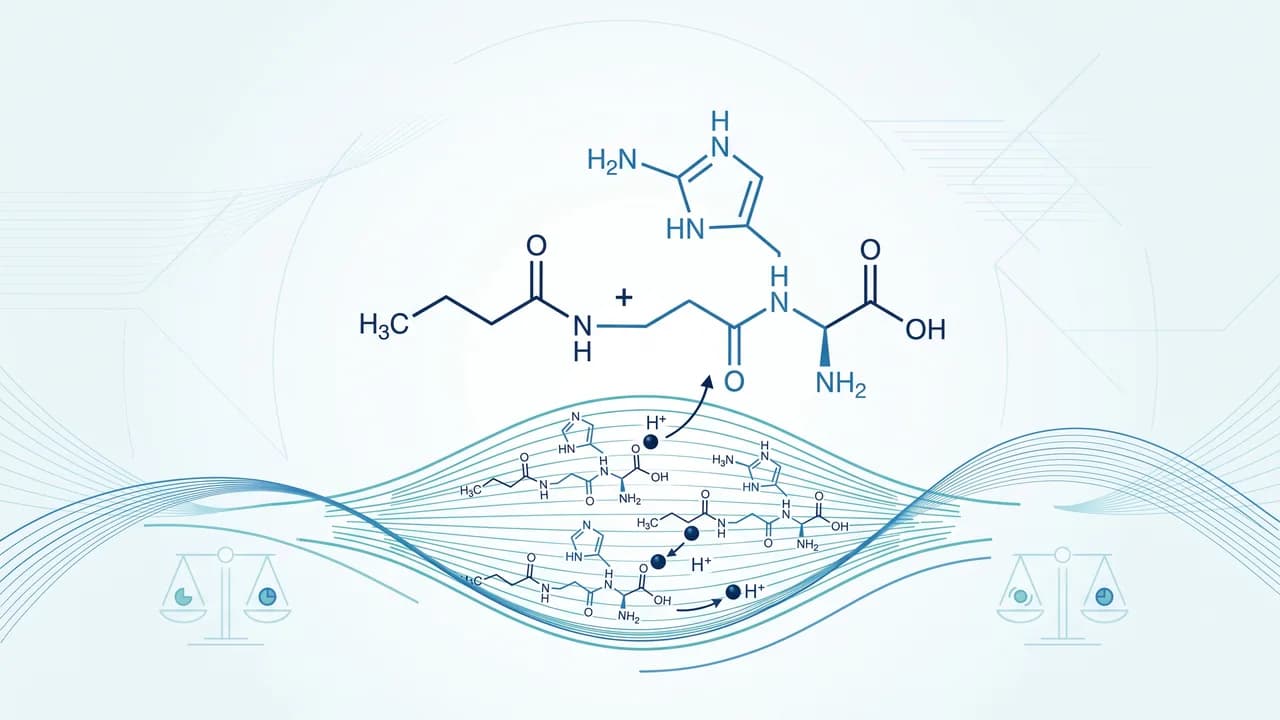
The dipeptide that matters for this title is carnosine: β-alanyl-L-histidine. Boldyrev, Aldini, and Derave reviewed a century of biochemistry: pH buffering, metal chelation, carbonyl quenching, and a long list of preclinical disease models (Boldyrev, Aldini, and Derave, 2013). Histidine supplies the imidazole. Beta-alanine supplies the abundance. That division of labour is the first fact the market sentence gets right, and the last fact it is entitled to without evidence.
03 Carnosine synthase
Carnosine synthase was a named activity before it was a gene. Drozak, Veiga-da-Cunha, Vertommen, Stroobant, and Van Schaftingen purified the chicken-muscle enzyme, showed that the nucleotide product is ADP rather than AMP, and identified the ligase as ATP-grasp domain-containing protein 1 — ATPGD1, now CARNS1 (Drozak et al., 2010). Expressed mouse and human enzymes made carnosine and homocarnosine and preferred β-alanine to γ-aminobutyrate by 15- to 25-fold catalytic efficiency. That paper is established as enzyme identification in vitro and in transfected cells. It is not a human biopsy.
Sale, Saunders, and Harris stated the kinetic argument that made supplementation intelligible: muscle and plasma histidine sit high relative to the synthase Km; muscle beta-alanine sits low and the Km is higher; therefore precursor supply, not the enzyme, limits synthesis (Sale, Saunders, and Harris, 2010). Harris and colleagues later wrote that an equimolar amount of ingested carnosine produces the same muscle-carnosine rise as beta-alanine, because plasma carnosinase hydrolyses the dipeptide before it can be useful as itself (Harris et al., 2012). Human loading is a beta-alanine story even when the capsule says carnosine.
Spelnikov and Harris fitted a first-order synthesis-plus-decay model to slow-release supplementation data in the 1.6–6.4 g·day−1 window (Spelnikov and Harris, 2019). The model is emerging as a description of those series. It is not a personal calculator.
04 Histidine is not the missing piece — until it is
Blancquaert and colleagues tested the missing-piece hypothesis directly in humans. Fifteen men and fifteen women received, for 23 days, either 6 g·day−1 beta-alanine, 3.5 g·day−1 L-histidine, or both (Blancquaert et al., 2017). Histidine alone did not raise soleus, gastrocnemius, or biopsy carnosine. Beta-alanine did. Adding histidine did not load more than beta-alanine alone. Plasma histidine fell 30.6% and muscle histidine 31.6% on beta-alanine; co-ingestion prevented the fall. The paper is established as a rate-limit result and emerging as a depletion warning. The authors said the physiological meaning of the histidine decline was not determined.
Church and colleagues, using a sustained-release preparation, compared 6 g·day−1 for four weeks with 12 g·day−1 for two weeks in humans (Church et al., 2017). Both raised muscle carnosine versus placebo. Plasma histidine fell in the higher-daily-intake group. Muscle histidine did not show a group-by-time interaction. Dolan and colleagues, in a Bayesian risk meta-analysis of human trials, found no main effect on muscle histidine (effect size −0.15; 95% credible interval −0.64 to 0.33) (Dolan et al., 2019). The honest sentence is therefore split. Histidine is not rate-limiting. It is not unlimited. A decline appears in some protocols and does not survive as a pooled main effect. No trial in this bibliography has shown a clinical histidine-deficiency syndrome from beta-alanine.
05 Skeletal-muscle carnosine and fibre type
Mannion, Jakeman, Dunnett, Harris, and Willan measured quadriceps carnosine in 50 healthy humans: mean 20.0 (SD 4.7) mmol·kg−1 dry mass; men 21.3 versus women 17.5; anserine undetectable (Mannion et al., 1992). Over pH 7.1–6.5 they estimated that the dipeptide buffered 2.4–10.1 mmol H+·kg−1 dry mass, about 7% of total muscle buffering at those baseline stores. That paper is established as a baseline map. It is also the paper that said carnosine was of “only limited importance” at those concentrations. Loading studies exist because that fraction is not fixed.
Everaert and colleagues, in 149 humans, found men 36%, 28%, and 82% higher than women in soleus, gastrocnemius, and tibialis anterior; vegetarian gastrocnemius 26% lower than omnivores; soleus carnosine negatively related to age; no relation to CNDP1 genotype or plasma carnosinase (Everaert et al., 2011). Harris and colleagues listed species, fibre type, diet, and sex as determinants and estimated a washout half-life of 5–9 weeks (Harris et al., 2012). Type II fibres start higher. Hill and colleagues found type IIa carnosine 1.71 times type I at baseline and equal relative increases in both after supplementation (Hill et al., 2007). Kendrick and colleagues, dissecting MHC-typed fibres after 6.4 g·day−1 for four weeks, saw rises in type I, IIa, IIx, and hybrids, with or without isokinetic training; training alone did not raise carnosine (Kendrick et al., 2009).
Bex and colleagues showed, in humans, that the same oral protocol raised carnosine more in the trained muscles of kayakers, cyclists, and swimmers than in untrained muscles or in non-athletes (Bex et al., 2014). That is a muscle-use result, not a talent result. de Salles Painelli and colleagues later showed that 12 weeks of HIIT raised muscle carnosine in vegetarian men who ingested no dietary beta-alanine (de Salles Painelli et al., 2018). Training is not inert. It is also not a substitute for the oral-loading literature, and its contribution to in-vitro buffering in that trial was small.
06 Intracellular buffering and Ca2+ sensitivity
The imidazole of carnosine has a pKa near 6.8, inside the intracellular pH range of high-intensity contraction (Sale, Saunders, and Harris, 2010; Boldyrev, Aldini, and Derave, 2013; Matthews, Artioli, Turner, and Sale, 2019). That is why the molecule is discussed as a buffer. Mannion’s 7% estimate was for unloaded muscle. After Hill’s +58.8% to +80.1% rises, the buffer share is larger. It is still one contributor among phosphates, proteins, and bicarbonate. Lancha Junior, Painelli, Saunders, and Artioli reviewed intracellular and extracellular buffering strategies together and kept that proportion in view (Lancha Junior et al., 2015).
Buffering is not the only proposed action. Dutka and Lamb, in mechanically skinned rat fibres, found that 4–16 mM carnosine increased Ca2+ sensitivity of the contractile apparatus (approximately +0.02 to +0.09 pCa units) and that force potentiation was “seemingly totally explicable” by that sensitization, not by extra sarcoplasmic-reticulum release (Dutka and Lamb, 2004). Dutka, Lamboley, McKenna, Murphy, and Lamb then repeated the experiment in skinned human vastus lateralis fibres: 8 and 16 mM carnosine raised pCa50 in type I and type II fibres; type I fibres showed additional potentiation of caffeine-induced responses suggestive of Ca2+-induced Ca2+ release (Dutka et al., 2012). Those concentrations are in the range attained by supplementation. The preparations are in vitro. They are strongly supported as a second mechanism. They are not a human time trial.
Matthews and colleagues reviewed the physiological-role list — pH, calcium, energy metabolism, reactive species, a possible Ca–H exchanger — and noted that performance papers still outrun mechanism papers (Matthews, Artioli, Turner, and Sale, 2019). This article follows that warning. A fibre that is more Ca2+-sensitive and a fibre that buffers H+ better can both fatigue later. Neither finding tells a coach which event will move.
07 Pharmacokinetics
Harris and colleagues measured human plasma beta-alanine after chicken-broth dipeptides and after 10, 20, and 40 mg·kg−1 of a commercial instant-release product (Harris et al., 2006). Peaks were 428, 47, 374, and 833 μM; concentrations had returned to baseline by two hours; urinary loss of the free amino acid was less than 5%. Four weeks at 3.2 or 6.4 g·day−1, given as 400 or 800 mg split doses, or an isomolar carnosine arm, raised vastus lateralis carnosine by 42.1%, 64.2%, and 65.8%. That paper is the loading foundation. It is also the paper that made 800 mg boluses famous for sensory side effects.
Stellingwerff, Anwander, Egger, Buehler, Kreis, Décombaz, and Boesch compared 3.2 then 1.6 g·day−1 with 1.6 g·day−1 for eight weeks in humans (Stellingwerff et al., 2012). The absolute carnosine increase was about 2.01 mmol·kg−1 wet weight per 100 g consumed, depending on cumulative intake, not on baseline content, muscle, or daily rate inside that window. Washout was 0.18–0.43 mmol·kg−1·week−1, about 2% per week. Baguet and colleagues had already shown 2–4% per week washout after 4.8 g·day−1, with group return to baseline by nine weeks and a 6- versus 15-week split between low and high responders (Baguet et al., 2009). Carnosine is stable in myocytes because they lack carnosinase. Crossover designs that ignore that fact are invalid. Saunders and colleagues excluded crossovers from their 2017 meta-analysis for that reason (Saunders et al., 2017).
Rezende and colleagues fitted a Bayesian Emax model to the published loading record and to 99 individual laboratory biopsies (Rezende et al., 2020). Response to supplementation was 99.3% (95% CrI 96.2–100). Sex and baseline did not matter. Common protocols did not approach saturation. Esteves and colleagues, in an individual-participant meta-analysis of the CCT110% test, found a large intervention-response variance for muscle carnosine and none for time-to-exhaustion: the SD of change scores was the same on beta-alanine and placebo (Esteves et al., 2021). People differ in how much they load. They do not, on that evidence, differ in a supplement-specific performance response.
08 Paresthesia
Oral instant-release boluses above about 800 mg commonly produce pins-and-needles, itching, or flushing (Harris et al., 2006; Artioli et al., 2010; Trexler et al., 2015). Décombaz, Beaumont, Vuichoud, Bouisset, and Stellingwerff compared 1.6 g as a solution with 1.6 g as slow-release tablets in humans (Décombaz et al., 2012). Peak plasma concentration was 248 versus 82 μM; time to peak 0.5 versus 1.0 h; area under the curve not different; urinary loss 663 versus 202 μmol; retention 96.3% versus 98.9%. Symptom scores on the tablets were “very low” and did not differ from placebo. The time course of “pins and needles” after the solution nearly tracked the plasma curve, with a sensory Tmax of 15 minutes.
Liu, Sikand, Ma, Tang, Han, Li, Sun, LaMotte, and Dong showed, in mice, that β-alanine-evoked itch behaviour requires MrgprD, a G-protein-coupled receptor on a cutaneous sensory-neuron subset that does not innervate deep tissue (Liu et al., 2012). That paper is strongly supported as a mouse receptor result. Human assignment of the supplement tingle to MrgprD remains plausible. Bellinger and Minahan tested the athlete belief that the tingle is the work. In competitive cyclists, a 1-km time trial under crossed information and content conditions showed no reliable benefit of acute beta-alanine; some riders reported placebo effects (Bellinger and Minahan, 2016). Acute paresthesia is not an ergogenic mechanism. It is a plasma-concentration event.
Dolan and colleagues estimated the odds ratio for paraesthesia versus placebo at 8.9 (95% CrI 2.2–32.6) and found it the only reported side effect in their human risk set (Dolan et al., 2019). Dropout rates matched placebo.
09 Sustained-release formulations
Sustained-release tablets were built to flatten the plasma peak. Décombaz et al. (2012) established that pharmacokinetic claim. Stellingwerff, Décombaz, Harris, and Boesch restated it: similar AUC, less urinary loss, fewer symptoms (Stellingwerff, Décombaz, Harris, and Boesch, 2012). Church et al. (2017) used a sustained-release product to test a higher daily intake over a shorter calendar. Varanoske and colleagues compared 6 g·day−1 sustained-release with rapid-release for 28 days in humans (Varanoske et al., 2019). Carnosine rose 50.1% (3.87 mmol·kg−1 wet weight) on sustained-release and 37.9% (2.62 mmol·kg−1) on rapid-release; only the sustained-release contrast with placebo reached p=0.010. Isometric fatigue was attenuated on both active arms. Paresthesia was more frequent on rapid-release. That is a loading-and-tolerability result. It is not a race-time superiority result.
Spelnikov and Harris modelled a branded slow-release product (Spelnikov and Harris, 2019). Brand names appear in this bibliography because they appear in the papers. They are not endorsements. A proprietary claim that sustained-release beta-alanine outperforms instant-release on a closed performance test, after matching total intake and attained carnosine, is not established in this record.
10 Duration dependence
Hobson, Saunders, Ball, Harris, and Sale meta-analysed 15 manuscripts, 57 measures, 360 humans (Hobson et al., 2012). Beta-alanine improved outcomes versus placebo (median effect size 0.374 versus 0.108). Exercise capacity improved; exercise performance did not (p=0.204). Efforts lasting 60–240 s improved (p=0.001). Efforts longer than 240 s improved with a weaker p-value (0.046). Efforts shorter than 60 s did not (p=0.312). The median effect was a 2.85% improvement (IQR −0.37 to 10.49) after a median 179 g total beta-alanine.
Saunders, Elliott-Sale, Artioli, Swinton, Dolan, Roschel, Sale, and Gualano updated the map: 40 double-blind, placebo-controlled studies, 65 protocols, 70 measures, 1,461 humans, crossovers excluded (Saunders et al., 2017). Overall effect size 0.18 (95% CI 0.08–0.28). Exercise duration moderated the effect (p=0.004). Within 0.5–10 minutes, capacity effect size was 0.50 (0.25–0.75) and performance effect size 0.11 (−0.20 to 0.42). Training status did not moderate (p=0.559). Total grams ingested did not (p=0.438). Co-supplementation with sodium bicarbonate produced the largest contrast versus placebo in that analysis (0.43; 0.22–0.64) — a between-study observation, not a new factorial trial.
The International Society of Sports Nutrition position stand stated the same window in consensus language: daily 4–6 g for at least 2–4 weeks; more pronounced effects in open-ended tasks lasting 1–4 minutes; endurance beyond 25 minutes under-researched (Trexler et al., 2015). Quesnele and colleagues, a year earlier, had already said the safety reporting was thin (Quesnele, Laframboise, Wong, Kim, and Wells, 2014). Dolan et al. (2019) later thickened the safety side. The duration window has not moved.
| Duration | What the metas say | What single trials add |
|---|---|---|
| < 60 s | Hobson: no benefit | LIST sprints null; 10-s road sprints null; 20-m RSA, beta-alanine alone null |
| 60–240 s | Hobson p=0.001; ISSN 1–4 min | Hill CCT110%; Ducker 800 m in club runners; Derave 400-m trained null |
| ~4–10 min | Hobson >240 s p=0.046; Saunders capacity > performance | Rowing 2,000 m mixed; elite 4-min TT weak |
| > 10 min | ISSN: sparse | Chung 1-h TT null despite doubled carnosine; VO2max unchanged |
11 Capacity is not a race
Hill, Harris, Kim, Harris, Sale, Boobis, Kim, and Wise had 13 men take a commercial beta-alanine product for four weeks, eight of them for ten; matched placebo controls completed the same CCT110% (Hill et al., 2007). Muscle carnosine rose 58.8% then 80.1%. Total work done rose 13.0% then a further 3.2%. Placebo work did not change. Taurine did not change. The increase in work “followed” the increase in carnosine inside that test. That sentence is true of that test. It is the sentence later papers over-applied.
Hobson’s split between capacity and performance exists because time-to-exhaustion and a fixed-distance race are not the same statistic. Saunders et al. (2017) reproduced the split. A 13% rise in work at 110% of Wmax is a laboratory capacity result. A 2.85% median across mixed tests is already smaller. A closed 4-minute time trial in cyclists with VO2max near 67 ml·kg−1·min−1 can be non-significant (Howe, Bellinger, Driller, Shing, and Fell, 2013). Practical meaning begins after that distinction, not before it.
12 Repeated bouts
Derave, Ozdemir, Harris, Pottier, Reyngoudt, Koppo, Wise, and Achten supplemented 400-m sprint-trained humans with 4.8 g·day−1 for four weeks (Derave et al., 2007). Soleus carnosine rose 47%, gastrocnemius 37%. Dynamic knee-extension torque in the fourth and fifth of five 30-contraction bouts improved. Isometric endurance at 45% MVC did not. Indoor 400-m time did not. The same trial is a loading success, a repeated-bout success, and a race-distance null. That is the pattern, not a failure of the pattern.
Tobias and colleagues assigned 37 judo and jiu-jitsu athletes to factorial beta-alanine and bicarbonate arms and ran four 30-s upper-body Wingates (Tobias et al., 2013). Each agent alone raised total work about 7–8%; together, 14%. Saunders, Sale, Harris, and Sunderland found no LIST sprint improvement after four weeks in elite and non-elite games players — and no pre-supplementation decrement to repair (Saunders, Sale, Harris, and Sunderland, 2012). Ducker, Dawson, and Wallman found beta-alanine alone unhelpful for 20-m repeated sprints; bicarbonate carried the effect (Ducker, Dawson, and Wallman, 2013). Repeated-bout claims are task-dependent. They are not a team-sport generalisation.
13 Cycling
Cycling is where the capacity result is cleanest and the field result is thinnest.
van Thienen, Van Proeyen, Vanden Eynde, Puype, Lefere, and Hespel gave moderately to well-trained cyclists 2–4 g·day−1 for eight weeks (van Thienen et al., 2009). After 110 minutes of simulated racing, a 10-minute time trial was unchanged at about 300 W. The final 30-s isokinetic sprint gained 11.4% peak power (95% CI 7.8–14.9) and 5.0% mean power (2.0–8.1). Blood lactate and pH did not differ. That is an end-sprint result, not an endurance result.
Chung, Baguet, Bex, Bishop, and Derave doubled gastrocnemius and soleus carnosine (+143% and +161%) with 6.4 g·day−1 for six weeks in well-trained cyclists and triathletes (Chung et al., 2014). A laboratory 1-hour time trial did not improve; both groups drifted slower. Systemic acidosis was only moderate (pH 7.30–7.40). The paper is the cleanest human demonstration that a very large carnosine rise can sit next to a null endurance performance. Perim and colleagues later raised muscle carnosine 9.4 mmol·kg−1 dry mass in cyclists and found no benefit for 10-s sprints or a 4-km uphill time trial at the end of a 125-minute road simulation (Perim et al., 2022). Carnosine change did not correlate with performance change (r=0.32, p=0.37).
Howe et al. (2013) in highly trained cyclists (VO2max 67 ml·kg−1·min−1): four-minute average power not statistically improved (p=0.25; 44% likely); isokinetic force improved. Bellinger, Howe, Shing, and Fell: beta-alanine plus placebo +1.6% (p=0.20); bicarbonate arms +3.1% and +3.3% (Bellinger et al., 2012). Sale, Saunders, Hudson, Wise, Harris, and Sunderland: CCT110% time-to-exhaustion +12.1% on beta-alanine, +16.2% with added bicarbonate, the extra 4.1% not significant (Sale et al., 2011). Walter, Smith, Kendall, Stout, and Cramer: six weeks of HIIT raised VO2peak in women with or without 1.5 g beta-alanine; there was no additive oxygen-uptake effect (Walter et al., 2010). Stout and colleagues, in young women, moved ventilatory threshold, PWCFT, and time-to-exhaustion without moving VO2max (Stout et al., 2007).
The cycling sentence that survives: laboratory capacity at severe intensities can move; closed time trials in trained riders often do not; long endurance does not; VO2max does not.
14 Rowing
Baguet, Bourgois, Vanhee, Achten, and Derave supplemented 18 Belgian elite rowers with 5 g·day−1 or placebo for seven weeks (Baguet et al., 2010). Soleus carnosine rose 45.3%, gastrocnemius 28.2%. Baseline carnosine correlated with 100-, 500-, 2,000-, and 6,000-m speed. After supplementation the beta-alanine group was 4.3 s faster than placebo, having been 0.3 s slower (p=0.07). The carnosine change correlated with the 2,000-m change (r=0.498, p=0.042). The paper is emerging. It is a correlation-plus-borderline time-trial paper in a small elite sample.
Ducker, Dawson, and Wallman ran duplicate 2,000-m ergometer races around 28 days at about 80 mg·kg−1·day−1 in well-trained men (Ducker, Dawson, and Wallman, 2013). The beta-alanine group improved 2.9 ± 4.1 s; placebo slowed 1.2 ± 2.9 s; p=0.055; effect size 0.20; the authors called the result inconclusive. Hobson, Harris, Martin, Smith, Macklin, Gualano, and Sale, using magnitude-based inferences in 20 well-trained rowers, called 6.4 g·day−1 for four weeks “very likely” beneficial (6.4 ± 8.1 s versus placebo), bicarbonate “likely” (3.2 ± 8.8 s), and the combination a small additional 1.1 ± 5.6 s (Hobson et al., 2013). Three trials, one muscle-carnosine data set, all hovering around a few seconds on a six-to-seven-minute piece. Rowing is not a settled ergogenic claim. It is a plausible 6-minute claim with a p-value problem.
15 Running
Ducker, Dawson, and Wallman gave recreational club runners 80 mg·kg−1·day−1 for 28 days and repeated 800-m track races (Ducker, Dawson, and Wallman, 2013). Post-supplementation times were faster after beta-alanine (−3.64 ± 2.70 s, −2.46%) than placebo (−0.59 ± 2.54 s), with a moderate effect size. Derave et al. (2007) had already shown that a verified carnosine rise does not move a 400-m time in trained sprinters. The two distances sit on either side of Hobson’s 60-second fence, and they behave as the fence predicts. One club 800-m trial is emerging. It is not a championship-standard 800-m literature.
16 Combat and team sports
de Andrade Kratz and colleagues assigned 23 highly trained judo athletes to 6.4 g·day−1 or placebo for four weeks (de Andrade Kratz et al., 2017). Throws in a randori-plus-SJFT protocol increased on beta-alanine; blood pH and bicarbonate fell equally; the lactate response was larger. Tobias et al. (2013) is the upper-body intermittent companion. These are emerging sport-specific test results. They are not bout-win probabilities.
Saunders and colleagues reported a 34.3% YoYo IR2 improvement in amateur footballers after 12 weeks, against a 7.3% placebo decline (Saunders, Sunderland, Harris, and Sale, 2012). Eight of nine supplemented players improved. The LIST sprint paper, in a mixed elite and non-elite games sample, was null (Saunders, Sale, Harris, and Sunderland, 2012). YoYo IR2 is a progressive intermittent capacity test lasting several minutes of accumulated high-intensity running. A 20-m shuttle with long recoveries is not. Team-sport marketing that cites one and not the other is a selection.
Hoffman, Landau, Stout and colleagues studied elite combat soldiers. After 28 days, jump power, shots on target, and target-engagement speed improved versus placebo; a 4-km run did not; serial subtraction did not (Hoffman et al., 2014). After 30 days in a second sample, muscle carnosine rose, brain carnosine did not; a 50-m casualty carry and a serial-subtraction test under stress improved; a 2.5-km run, a 1-minute sprint, repeated 30-m sprints, and marksmanship did not (Hoffman et al., 2015). Military tasks are mixed because they are mixed tasks. A casualty carry is not a 2.5-km run.
Hoffman, Ratamess, Faigenbaum and colleagues gave college football players 4.5 g·day−1 for about 30 days: no significant fatigue-rate change on line drills or a 60-s Wingate; higher bench-press training volume; lower subjective fatigue (Hoffman et al., 2008). That is a training-volume paper, not a game-output paper.
17 Resistance training
Kendrick, Harris, Kim, Kim, Dang, Lam, Bui, and Smith put 26 sports-science students through ten weeks of resistance training at 6.4 g·day−1 or placebo (Kendrick et al., 2008). Muscle carnosine rose 12.81 ± 7.97 mmol·kg−1 dry mass on beta-alanine and did not rise on placebo. Whole-body strength, isokinetic force, muscular endurance, mass, and percent fat did not differ. Training alone did not change carnosine. The paper is strongly supported as a null for conventional strength outcomes after a verified load.
Hoffman, Ratamess, Kang, Mangine, Faigenbaum, and Stout compared placebo, creatine, and creatine plus beta-alanine across ten weeks in collegiate football players (Hoffman et al., 2006). Strength improved in both creatine arms versus placebo. Lean-mass and fat-percentage changes were larger in the combination arm. The design does not isolate beta-alanine. Culbertson, Kreider, Greenwood, and Cooke reviewed the combination as a research question, not a settled synergy (Culbertson, Kreider, Greenwood, and Cooke, 2010). Beta-alanine is not a strength amino acid on the Kendrick evidence. Creatine remains the strength result in that triad.
18 Endurance
The endurance claim is the one the duration table already killed. Chung et al. (2014) doubled carnosine and did not improve a 1-hour laboratory time trial. van Thienen et al. (2009) did not move a 10-minute time trial after two hours of work. Walter et al. (2010) added nothing to HIIT-induced VO2peak. Stout et al. (2007) moved threshold measures without moving VO2max. Trexler et al. (2015) said performances longer than 25 minutes needed more research. The research that arrived is mostly null. Endurance racing is not an intracellular-buffering event in the sense this molecule can buy.
19 Older adults
Stout, Graves, Smith, Hartman, Cramer, Beck, and Harris assigned 26 men and women aged 55–92 years to 2.4 g·day−1 or placebo for 90 days (Stout et al., 2008). Physical working capacity at the fatigue threshold rose 28.6% on beta-alanine and did not change on placebo. Muscle carnosine was not measured. The authors speculated about falls and independent living. That speculation is speculative. The PWCFT result is strongly supported as a laboratory capacity result in that sample.
del Favero and colleagues gave healthy 60- to 80-year-olds 3.2 g·day−1 sustained-release or placebo for 12 weeks (del Favero et al., 2012). Gastrocnemius carnosine rose 85.4% versus 7.2%. Time-to-exhaustion in a constant-load test rose 36.5% versus 8.6%; incremental time-to-exhaustion 12.2% versus 0.1%. Changes in carnosine correlated with both capacity changes (r=0.62 and 0.48). McCormack and colleagues fortified an oral nutritional supplement with 800 or 1,200 mg beta-alanine twice daily for 12 weeks in older adults; PWCFT rose 17.8% and 13.6% versus a 6.3% decline on the unfortified supplement (McCormack et al., 2013). Sit-to-stand also moved in some arms. These are human capacity and function-test papers. They are not mortality, frailty-index, or fall-count trials.
20 Trained versus untrained
Saunders et al. (2017) found no training-status moderation of the performance effect size. de Salles Painelli, Saunders, Sale, Harris, Solis, Roschel, Gualano, and Artioli split trained and non-trained cyclists and saw total-work increases on four Wingates in both beta-alanine groups (de Salles Painelli et al., 2014). Derave et al. (2007) loaded trained sprinters and still could not move a 400-m time. Chung et al. (2012) found an unclear 0.4% ± 0.8% effect on elite and sub-elite swimming competition times, with a transient training-set flicker at four weeks that was gone at ten. Howe et al. (2013) and Bellinger et al. (2012) are the highly trained cycling caution. Baguet et al. (2010) is the elite rowing maybe.
The sentence that survives is not “elites do not respond.” It is that elites often race closed, short, or already-buffered events in which a 0.18 effect size is easy to lose, and that field championships are not CCT110%. Rezende et al. (2020) says they still load. Esteves et al. (2021) says their capacity-test variance is not a special responder class. Loading is democratic. Performance is not.
21 Sodium bicarbonate
Beta-alanine is an intracellular histidine buffer. Bicarbonate is an extracellular proton sink. The combination is mechanistically tidy and empirically uneven.
Sale et al. (2011): CCT110% +12.1% beta-alanine, +6.5% bicarbonate, +16.2% both; the extra 4.1% not significant, ~70% probability of a meaningful difference on magnitude-based inferences. Bellinger et al. (2012): bicarbonate improved a 4-minute cycling trial; beta-alanine did not; the additive effect was “minimal.” Tobias et al. (2013): clear additivity on upper-body intermittent Wingates (+7, +8, +14%). Hobson et al. (2013): small additional rowing effect. Painelli and colleagues: 100- and 200-m swim improvements on each agent; further combination effect non-significant but “probable” (Painelli et al., 2013). Ducker, Dawson, and Wallman (2013, repeated sprints): bicarbonate, not beta-alanine, did the work.
Curran-Bowen, Guedes da Silva, Barreto, Buckley, and Saunders meta-analysed ten studies (243 humans) that had isolated and combined arms (Curran-Bowen et al., 2024). In that selected set, neither agent alone had a significant effect (beta-alanine SMD 0.18, 95% CI −0.06 to 0.43; bicarbonate 0.17, −0.08 to 0.41). The combination did (0.32, 0.07–0.57). The isolated estimates are the Saunders 2017 overall number with the confidence interval widened by a smaller, combination-capable literature. The paper does not erase the 40-study map. It does say that, where both have been tested together, the stack is the finding that survives their pooling. Additivity is emerging to strongly supported for some intermittent upper-body and capacity tests. It is not a general racing stack.
22 Safety, taurine, histidine
Dolan et al. (2019) remains the risk paper: 101 human and 50 animal studies; paraesthesia the only reported human side effect; dropout matched to placebo; a small ALT effect size (0.27) still inside reference ranges; no main human effect on muscle taurine or histidine. Saunders, Franchi, de Oliveira and colleagues biopsied men after 24 weeks at 6.4 g·day−1 sustained-release: muscle taurine unchanged, renal, hepatic, and muscle-enzyme markers unchanged, no chronic sensory side effects in those completers (Saunders et al., 2020). Hill et al. (2007) had already seen unchanged taurine at ten weeks.
The taurine worry is biochemical, not clinical. Liu, López-Corcuera, Nelson, Mandiyan, and Nelson cloned a mouse-brain taurine/β-alanine transporter (Liu et al., 1992). Dolan found murine muscle-taurine depletion only when drinking water was at least 3% beta-alanine. Human trial doses are not that experiment. Histidine decline in Blancquaert et al. (2017) is real in that protocol and not a pooled main effect. Quesnele et al. (2014) were right that early papers under-reported symptoms. They are no longer the last word on harm.
This is a safety description of the published healthy-adult record. It is not a licence, and it is not a paediatric, pregnancy, or disease-state review.
23 Proprietary sustained-release claims
What is substantiated: a flatter plasma curve, less urinary loss, fewer paresthesias, and — in Varanoske et al. (2019) — a carnosine rise that beat placebo when instant-release at the same daily gram amount did not quite. What is not substantiated: a unique performance claim for a brand, a requirement that only sustained-release loads muscle, or an acute race-morning tablet. Bellinger and Minahan (2016) already separated the tingle from the work. Instant-release, split across the day, loaded muscle in Harris et al. (2006) and Hill et al. (2007). Sustained-release is a tolerability and pharmacokinetic refinement. Treating it as a different drug is marketing.
24 Carnosine as a surrogate
A surrogate has to predict the outcome that matters. Muscle carnosine predicts itself. Rezende et al. (2020) says almost everyone who ingests enough beta-alanine will raise it. Hill et al. (2007) saw work and carnosine rise together on CCT110%. del Favero et al. (2012) correlated carnosine change with time-to-exhaustion in older adults. Baguet et al. (2010) correlated it with a 2,000-m change at p=0.07. Chung et al. (2014) and Perim et al. (2022) raised carnosine and did not improve the endurance tests they chose. Esteves et al. (2021) found intervention-specific variance for carnosine and none for CCT110% time-to-exhaustion.
The honest rule: carnosine elevation confirms that the precursor reached the muscle. It does not confirm that the event will change. Using it as a sufficient surrogate is how a 1-hour time trial gets sold as a Hill test.
25 Answers that fit the evidence
Which durations benefit? The 60–240 s band is the replicated meta-analytic finding (Hobson et al., 2012). The 0.5–10 minute window is the Saunders update, with capacity stronger than performance (Saunders et al., 2017). Below about a minute, the class effect is absent. Beyond about ten minutes of continuous work, the best-loaded endurance trials are null.
Are the effects practically meaningful? A median 2.85% (Hobson) or an effect size of 0.18 (Saunders) can matter in a capacity test or a close 800-m. It is easy to lose in an elite closed race, a championship swim meet (Chung et al., 2012), or a 1-hour ride. “Meaningful” is task-specific. It is not a lifestyle adjective.
Is carnosine elevation an adequate surrogate? No. It is a necessary mechanistic intermediate and a near-universal response. It is not a sufficient performance endpoint.
Do elite athletes respond similarly? They load. Their race tests are less kind. Training status did not moderate Saunders’ effect size. Highly trained swimming, cycling, and 400-m papers are full of unclear or null closed performances. Elite rowing remains a few-seconds argument.
Are proprietary sustained-release claims substantiated? For pharmacokinetics and paresthesia, yes. For superior performance at matched exposure, no.
Does bicarbonate add meaningful benefit? Sometimes, in intermittent upper-body and some capacity designs (Tobias et al., 2013; Sale et al., 2011; Curran-Bowen et al., 2024). Not as a reliable additive on every closed trial (Bellinger et al., 2012; Ducker repeated sprints). The combination is a second intracellular/extracellular experiment, not a default stack.
What does not survive: beta-alanine as a general endurance aid; beta-alanine as a 1RM strength aid; beta-alanine as a brain-carnosine nootropic; the tingle as proof of efficacy; histidine as the rate-limiting precursor; human taurine depletion at trial doses; a longevity claim. Those sentences belong to other brochures.
26 Standing constraint
Reported milligram amounts, daily totals, and week counts in this document are experimental parameters attached to named samples. They are not a protocol for any reader. South Beach Longevity does not recommend human use of beta-alanine, carnosine, or sodium bicarbonate, and specifies no dose, route, or schedule.
Evidence handling
Findings are labelled in the reporting sentence by study type. Animal and in-vitro results are not phrased as human outcomes. Conflicting trials are left in conflict; a newer null does not automatically erase an older capacity result, and a capacity result does not automatically save a race. Evidence grades — established, strongly supported, emerging, plausible, speculative — sit next to the claim they govern. References were verified against NCBI records harvested on 20 August 2026. No PMID was assigned from memory. Project 06 was searched read-only and was not a material source for this title. Local Firecrawl was used only for open texts. This title is not a Radix peptide article and is not filed with the peptide series.
Protocol and performance matrix
Amounts are experimental parameters.
| Study | Sample | Protocol as reported | Carnosine | Endpoint | Result |
|---|---|---|---|---|---|
| Harris 2006 | Healthy men | 3.2 / 6.4 g·d−1, 4 wk | +42 / +64 / +66% | Loading / PK | Established load |
| Hill 2007 | Men | 4–10 wk CarnoSyn | +59 / +80% | CCT110% TWD | +13.0 then +3.2% |
| Derave 2007 | Trained sprinters | 4.8 g·d−1, 4 wk | +47 / +37% | 5×30; 400 m | Bouts 4–5 yes; 400 m no |
| van Thienen 2009 | Trained cyclists | 2–4 g·d−1, 8 wk | — | 10-min TT; 30-s sprint | TT no; PPO +11.4% |
| Baguet 2010 | Elite rowers | 5 g·d−1, 7 wk | +45 / +28% | 2,000 m | 4.3 s; p=0.07 |
| Kendrick 2008 | Students + RT | 6.4 g·d−1, 10 wk | +12.8 mmol·kg−1 dm | Strength / composition | Load yes; performance no |
| del Favero 2012 | 60–80 y | 3.2 g·d−1 SR, 12 wk | +85% vs +7% | TLIM; incremental | +36.5%; +12.2% |
| Chung 2014 | Trained cyclists | 6.4 g·d−1, 6 wk | +143 / +161% | 1-h TT | Null |
| Perim 2022 | Cyclists | 6.4 g·d−1, 28 d | +9.4 mmol·kg−1 dm | Sprints; 4-km uphill | Null |
| Saunders 2017a | Active men | 6.4 g·d−1, 24 wk | +11 to +21 mmol·kg−1 dm | CCT110% | Capacity improved |
| Hobson 2012 | 360 participants | Median 179 g | Mixed | Mixed | +2.85%; 60–240 s |
| Saunders 2017b | 1,461 participants | Chronic | Mixed | 70 measures | ES 0.18 |
Exercise-duration table
| Band | Meta-analytic result | Single-trial colour | Verdict |
|---|---|---|---|
| < 60 s | Hobson p=0.312 | LIST, 10-s, 20-m RSA null for BA alone | No class benefit |
| 60–240 s | Hobson p=0.001 | Hill capacity; club 800 m; trained 400 m null | Strongest band |
| ~4–10 min | Hobson p=0.046; Saunders capacity > performance | Rowing mixed; elite 4-min TT weak | Possible / mixed |
| > 10 min | Sparse; ISSN flag | 1-h TT null; VO2max null | Not demonstrated |
| Intermittent | Not a single moderator | YoYo yes; LIST no; judo yes | Task-dependent |
Carnosine-response table
| Source | Carnosine change | Companion finding |
|---|---|---|
| Harris 2006 | +42 to +66% at 4 wk | Isomolar carnosine ≈ 6.4 g BA |
| Hill 2007 | +59 / +80% | Equal fibre-type rise; taurine unchanged |
| Baguet 2009 | +23 to +39% | Washout 2–4%·wk−1; ~9 wk baseline |
| Stellingwerff 2012 | +2.01 mmol·kg−1 ww / 100 g | Cumulative grams, not daily rate |
| Blancquaert 2017 | BA ± HIS load; HIS alone no | Plasma/muscle HIS −31% on BA |
| Saunders 2017 24-wk | +11.4 to +21.2 mmol·kg−1 dm | TauT down; not saturated |
| Rezende 2020 | 99.3% responders | Common protocols ≪ Emax |
| Varanoske 2019 | SR +50%; RR +38% | Only SR vs PLA p=0.010 |
| Mannion 1992 | 20.0 ± 4.7 mmol·kg−1 dm | ~7% of buffer at baseline |
| de Salles Painelli 2018 | HIIT 15.8→20.6 mmol·kg−1 dm | No dietary BA (vegetarians) |
Sport-specific evidence
| Sport | Best result | Limit |
|---|---|---|
| Laboratory cycling capacity | Hill; Saunders 24-wk; Esteves +7.7 s TTE | Not a race |
| Road / 1-h cycling | Chung; Perim | Null after large loads |
| Rowing 2,000 m | Baguet; Ducker; Hobson | Seconds; p near 0.05 |
| 800-m running | Ducker club | One RCT |
| 400-m running | Derave | Null when loaded |
| Elite swimming meets | Chung 2012 | Unclear 0.4% |
| Football YoYo IR2 | Saunders 2012 | Capacity test, not match play |
| Judo / BJJ tests | Kratz; Tobias | Specific tests |
| Military tasks | Hoffman 2014–15 | Task-selective |
| Resistance 1RM | Kendrick 2008 | Null |
| Older-adult capacity | Stout; del Favero; McCormack | Not a falls trial |
Safety and paresthesia
| Topic | Result | Grade |
|---|---|---|
| Paresthesia | Tracks IR plasma peak; OR 8.9 vs placebo | Established |
| MrgprD | Required for β-alanine itch in mice | Strongly supported (mouse) |
| SR symptoms | ≈ placebo at 1.6 g (Décombaz) | Established |
| Human taurine | Unchanged at 10 wk and 24 wk | Strongly supported (no depletion) |
| Histidine | Falls in some protocols; no meta main effect | Emerging / not clinical |
| Labs | Trivial ALT signal; 24-wk chemistries stable | Strongly supported |
| Acute tingle as ergogenic | 1-km TT null (Bellinger 2016) | Strongly supported (not a mechanism) |
References
Continue reading