
Training Adaptation
Exercise and training interventions. A research review published by South Beach Longevity.
Training Adaptation
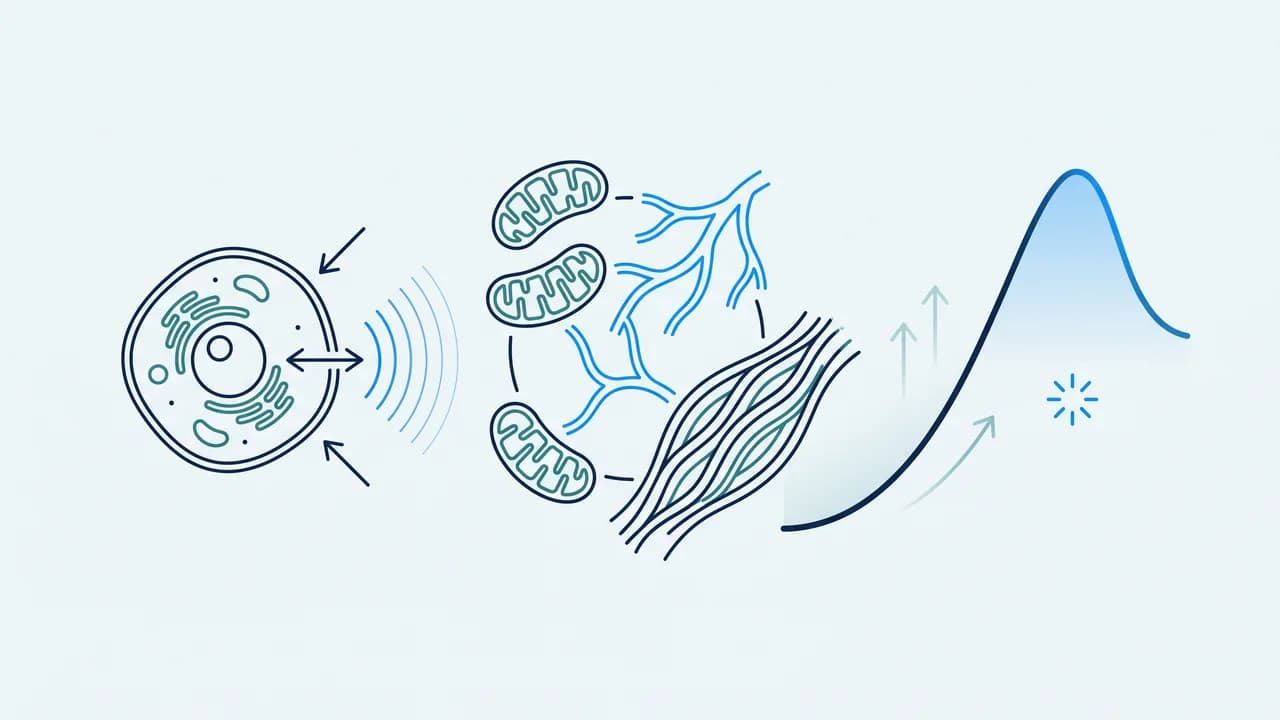
How humans change when the same work is repeatedRepeated physical work changes the human body because tissues and systems restore themselves to a new operating point after a transient disturbance. Supercompensation, molecular cartoons, acute hormone spikes, and “responder” labels are secondary stories that sometimes describe a slice of that process and often overclaim it. Chronic adaptation is not the acute response written larger. No single recovery window or genetic switch explains the longitudinal human record.
Compiled by South Beach Longevity · 20 August 2026 Copyright 2026 Series SBL-41 / SP-TRAINING-ADAPTATION · Register A scientific article Sources peer-reviewed human trials, consensus statements, meta-analyses, and labelled animal or in-vitro work · verified NCBI records Constraint This document describes published research. It is not medical advice. No human use, dose, route or schedule is recommended anywhere in this document.
How to read this document Every finding is labelled, in the sentence that reports it, by the kind of study that produced it. A biopsy after one session is not a six-month MRI. A pathway phosphorylation is not a performance change. A recreational cohort is not an elite cohort. Where two results conflict, both are given. Amounts and durations appear only as reported experimental parameters, always with the population attached. Nothing here is a recommendation. Findings are graded in place as established, strongly supported, emerging, plausible, or speculative. Two further labels mark careful absences rather than verdicts: not established, where the evidence is too thin to place a claim on the ladder at all — untested or insufficient, an absence of proof rather than disproof; and not supported, where the weight of evidence leans against a claim but stops short of a formal refutation.
01 What training adaptation is, and four things it is not
Training adaptation is the set of durable changes in structure and function that follow repeated exercise stimuli and persist beyond the session that produced them. The ACSM’s quantity-and-quality statement treats cardiorespiratory, resistance, flexibility, and neuromotor work as distinct stimuli with distinct expected outcomes, not as interchangeable “exercise” (Garber et al., 2011). Kraemer and Ratamess, reviewing resistance-training fundamentals, restated the same architecture for load, volume, rest, and frequency (Kraemer and Ratamess, 2004). Those papers are consensus and narrative maps. They are strongly supported as descriptions of what the societies then judged the human record to say. They are not licences to treat every number in them as a prescription, and they are not used that way here.
Four things follow immediately.
First, adaptation is not the workout. Heart rate, lactate, delayed-onset soreness, and a post-session testosterone spike are responses. A larger left ventricle, a thicker myofibril, a stiffer tendon, and a higher capillary density are adaptations. Mixing the two vocabularies is how a two-hour hormone curve becomes a six-week programme.
Second, it is not a single tissue event. Neural drive, muscle protein, tendon collagen, bone mineral, plasma volume, mitochondrial reticulum, and motor maps change on different clocks. A programme that “works” for hypertrophy can be silent for bone and costly for tendon.
Third, it is not supercompensation as a universal waveform. The Soviet-derived cartoon — fatigue, recovery, overshoot, decay — is a useful sketch for glycogen and for some performance tests. It is a poor model of hypertrophy, of tendon, of bone, and of skill. Part Five returns to that as an adversarial question, not as a late caveat.
Fourth, it is not medical advice and it is not a training programme. This document describes published research. It recommends no load, split, altitude camp, supplement, or sleep schedule for any person.
Sibling articles in this series take sports nutrition and strength training as neighbouring cuts. This title is the physiology of repeated work itself. Dietary-protein evidence is spent here only as a constraint on remodeling. Strength-training programming is not spent as if it were the whole of adaptation.
02 Homeostasis and allostasis
Homeostasis is the defence of a regulated variable — core temperature, arterial pH, plasma osmolality — by negative feedback. Cannon’s word is still the right word for those loops. Exercise perturbs them. Training does not abolish them.
Allostasis is Sterling and Eyer’s later claim that stability is achieved through change: the brain predicts demand and shifts operating points rather than waiting for an error (Sterling and Eyer, 1988). McEwen then named allostatic load as the cumulative cost of those shifts when they are frequent, prolonged, or poorly recovered (McEwen, 1998; McEwen, 2000). Those papers are conceptual and neuroendocrine, not training trials. They are strongly supported as a vocabulary for why a stressor can be both adaptive and expensive. They are not a licence to treat every hard session as “hormesis” and every easy day as “homeostasis.”
The useful cut for this article is operational. An acute session is a disturbance. Recovery is the return of the regulated variables and the repair of the disturbed tissue. Adaptation is a change in the set of structures that will meet the next disturbance with a smaller error or a higher ceiling. Allostatic language is appropriate when the “recovery” is actually a new operating point — a larger plasma volume, a lower resting heart rate, a higher mitochondrial density. It is inappropriate when it is used to baptize overreaching as wisdom.
Selye’s general adaptation syndrome — alarm, resistance, exhaustion — is the historical parent of almost every popular training-stress cartoon (Selye, 1936; Selye, 1950). It is a mid-century endocrine story about noxious agents. It is not established as a model of periodized human training. Treating GAS as the physiology of a mesocycle is a category error that later sections will refuse.
03 Stress-response theory and its limits
Exercise is a stressor in the narrow sense: it raises sympathetic drive, cortisol, cytokines, and heat, and it damages some sarcomeres. The repeated-bout literature exists because that damage is real and because it lessens (Hyldahl and Hubal, 2014; McHugh, 2003; Nosaka et al., 2001). The overtraining-consensus literature exists because the same stressor, undosed, can fail the person (Meeusen et al., 2013).
What stress-response theory cannot do is rank stimuli. A 5×5 squat, a 40-minute threshold run, and a novel downhill bout all raise “stress.” They do not raise the same tissues. Specificity (section 07) is the correction. Fitness–fatigue (section 12) is the correction for time. Individual variation (section 11) is the correction for the person. A theory that says only “stress plus rest equals growth” has already left the human record.
04 Supercompensation: history, use, and failure as a universal model
Supercompensation, in the form that entered Western coaching, is a one-factor waveform: a session depletes a quality; recovery restores it; if the next session arrives at the overshoot, the quality ratchets. Yakovlev’s biochemical work on glycogen is the respectable ancestor. Banister’s impulse-response models and later fitness–fatigue formulations are the respectable descendants that split the waveform into two components because one component could not fit the data (Banister et al., 1975; Busso, 2003).
Where the cartoon is strongly supported: muscle glycogen after depleting endurance work really does overshoot under high-carbohydrate restoration (the biopsy tradition that sports-nutrition articles already carry). Some laboratory performance tests show a delayed peak after a concentrated load. That is a real phenomenon in a real substrate.
Where it fails as a universal model is not subtle.
Hypertrophy is not an overshoot of a depleted store. It is a slow change in net protein balance across many meals and many sessions (Phillips, 2014; Morton et al., 2018). Tendon collagen and bone mineral do not “supercompensate” on a 48-hour clock (Bohm, Mersmann, and Arampatzis, 2015; Kohrt et al., 2004). Motor learning consolidates; it does not refill. Mitochondrial biogenesis is a transcriptional and organellar programme measured in weeks, not a bounce (Holloszy, 1967; Lundby and Jacobs, 2016). Kiely’s critiques of periodization-as-law are the coaching-theory statement of the same objection: the waveform is a metaphor that has been asked to govern tissues it never measured (Kiely, 2012; Kiely, 2018).
Established: some substrates and some tests overshoot after depletion-plus-restoration. Not established: a single recovery peak that times every quality in every person. Part Five, question one, restates this as an adversarial finding rather than a polite reservation.
05 Acute response versus chronic adaptation
The most expensive confusion in the field is temporal.
An acute response is measured in minutes to days: phosphorylation of mTORC1 substrates, a rise in mixed-muscle protein synthesis, a plasma-volume shift, a delayed-onset force loss, a cortisol curve, a hepcidin pulse. A chronic adaptation is measured in weeks to years: fibre cross-sectional area, VO₂max, tendon stiffness, bone mineral density, haemoglobin mass, skill retention.
The two are related. They are not interchangeable. An mTORC1 phosphorylation that fails to predict hypertrophy in a later biopsy study is not a scandal. It is a reminder that a necessary signal is not a sufficient outcome (Figueiredo, 2019; Atherton and Smith, 2012). West and Phillips showed that post-exercise systemic hormone excursions that look impressive on a graph do not determine the hypertrophy that follows (West and Phillips, 2012; West et al., 2010). Morton, Oikawa, Wavell and colleagues later reported that neither load nor those systemic hormone differences explained hypertrophy when effort and volume were matched in a trained sample (Morton et al., 2016). Those are human resistance-training experiments. They are strongly supported as evidence against spending the acute hormone curve as if it were the adaptation. They are not evidence that hormones are irrelevant to muscle. They are evidence that the session spike is the wrong object.
Damas, Phillips, Libardi and colleagues made the same temporal cut for damage: early muscle-protein-synthesis elevations after novel eccentric work track repair more than growth; later, as the repeated-bout effect reduces damage, the synthesis signal aligns better with hypertrophy (Damas et al., 2016). That is a human time-course study. It is strongly supported as a warning label on every “anabolic” biopsy taken in week one.
06 Dose–response and time course
Dose in training is not a milligram. It is a combination of intensity, volume, frequency, density, and novelty, delivered to a specific tissue, in a specific person, over a specific time.
Rhea, Alvar, Burkett, and Ball’s early meta-analysis of strength-training dose–response, and Peterson, Rhea, and Alvar’s later strength-maximization synthesis, are the quantitative ancestors of the “how many sets” argument (Rhea et al., 2003; Peterson et al., 2005). Schoenfeld, Ogborn, and Krieger’s volume meta-analysis, and Grgic, Schoenfeld, Davies and colleagues’ frequency work, are the later hypertrophy cut (Schoenfeld et al., 2017; Grgic et al., 2018). These are meta-analyses. They inherit publication bias, mixed trainedness, and the fact that “set” is not a biological unit. They are strongly supported as evidence that, within studied ranges, more hard sets generally produce more hypertrophy and more strength, with diminishing returns. They are not evidence for a universal weekly number.
Time course is tissue-specific. Neural strength gains are measurable within days to a few weeks (Moritani and deVries, 1979; Sale, 1988). Visible hypertrophy is slower; MRI and biopsy changes are usually discussed in weeks to months (Wernbom, Augustsson, and Thomeé, 2007). Tendon stiffness and cross-sectional area move on a scale of months (Bohm, Mersmann, and Arampatzis, 2015). Bone mineral density, when it moves at all in adults, is a matter of many months to years (Kohrt et al., 2004; Watson et al., 2018). Mitochondrial and capillary changes are intermediate — weeks for enzyme and volume-density signals, longer for a stable ultrastructure (Hoppeler et al., 1985; Lundby and Jacobs, 2016). Heat acclimation is faster: classic human series show large plasma-volume and sweat adaptations within 7–14 days (Périard, Racinais, and Sawka, 2015). Live-high, train-low haematological effects are discussed in weeks (Levine and Stray-Gundersen, 1997). Detraining clocks are not the reverse of training clocks (Mujika and Padilla, 2000; Coyle et al., 1984). Table B is the map. The map is not a prescription.
07 Specificity
The SAID principle — specific adaptation to imposed demands — is the least glamorous and the most durable claim in the field. A movement, a metabolic pathway, a contraction speed, and a posture that were not trained will not be the ones that change most. Sale’s neural-adaptation reviews and the ACSM progression models both treat specificity as a first principle, not a slogan (Sale, 1988; American College of Sports Medicine, 2009).
Specificity is not a ban on transfer. Heavy resistance work can raise running economy in some endurance samples; aerobic work can interfere with strength and hypertrophy in others (Hickson, 1980; Wilson et al., 2012; Nader, 2006). Those are interference and transfer findings. They do not cancel specificity. They qualify it. The concurrent-training literature is strongly supported as evidence that two stimuli can share a person and still compete. It is not evidence that “cardio kills gains” as a universal law. Hickson’s original sequential-endurance-then-strength design is a particular protocol in a particular sample. Wilson’s meta-analysis is a mixed bag of protocols. Both are better than the slogan.
Skill is the sharpest form of specificity. Motor-learning work treats task, context, and feedback as first-order variables (Wolpert, Diedrichsen, and Flanagan, 2011). A hypertrophied muscle that has not practiced the skill is not a skilled muscle. Section 24 returns to that without letting skill swallow physiology.
08 Overload
Overload is the requirement that the stimulus exceed the recently habitual demand of the tissue. Without it, the error signal is too small to pay for remodeling. The ACSM progression models and Kraemer and Ratamess treat progressive overload as the operational form of this idea (American College of Sports Medicine, 2009; Kraemer and Ratamess, 2004).
Overload is not “more is better.” It is “enough, of the right kind, recovered from.” A novel downhill run is an overload for the repeated-bout system and a poor hypertrophy stimulus. A 1RM attempt is an overload for high-threshold motor units and a poor mitochondrial stimulus. Bone wants unusual strain and rest (Turner and Robling, 2003). Tendon wants long-duration or high-strain loading that muscle can produce faster than collagen can adapt (Magnusson et al., 2008; Bohm, Mersmann, and Arampatzis, 2015). Naming every hard session “overload” erases those differences.
09 Progression
Progression is the planned change in overload as adaptation raises the habitual demand. Garber and colleagues and the ACSM resistance-training position stand are the institutional statements (Garber et al., 2011; American College of Sports Medicine, 2009). Issurin’s block-periodization reviews are one coaching architecture for concentrating stimuli (Issurin, 2010). Kiely’s papers are the objection that those architectures have been treated as laws (Kiely, 2012; Kiely, 2018).
Strongly supported: unprogressed programmes plateau. Emerging as a comparative claim: any one periodization algebra (linear, undulating, block) is superior for all outcomes. The human comparative literature is small, noisy, and often confounded by unequal work. This article does not pick a winner. It records that progression is the biological requirement and that the calendar used to express it is a coaching tool.
10 Reversibility
Reversibility is the claim that adaptations decay when the stimulus is removed or falls below the maintenance threshold. Mujika and Padilla’s detraining reviews remain the field map (Mujika and Padilla, 2000; Mujika and Padilla, 2001). Coyle, Martin, Sinacore, Joyner, and Holloszy measured the time course of VO₂max, stroke volume, and mitochondrial-enzyme loss after endurance training stopped (Coyle et al., 1984). Those human experiments are established for the endurance qualities they measured. They are not a universal half-life for every tissue.
Bone, tendon, and skill decay on different clocks. Myonuclei and “muscle memory” are a live argument, not a settled gift (Gundersen, 2016; Murach et al., 2019). Sections 27–28 treat loss and regain as first-order physiology, not as a footnote to motivation.
11 Individual variation
People do not adapt equally. That sentence is established. What it means is not.
The HERITAGE Family Study showed wide familial aggregation of VO₂max trainability after a standardized endurance programme (Bouchard et al., 1999; Bouchard et al., 2011). Timmons and colleagues later proposed molecular predictors of that trainability (Timmons et al., 2010). Those are important human datasets. They are strongly supported as evidence that some of the variance is biological and familial. They are not a licence to label a person a “nonresponder” after a short, single-mode trial.
Hecksteden, Kraushaar, Scharhag-Rosenberger and colleagues, and Atkinson and Batterham, are the statistical correction: much of what looks like individual response is measurement error, within-subject variation, and the absence of a comparator arm that would reveal how the same person would have changed without the programme (Hecksteden et al., 2015; Atkinson and Batterham, 2015). Ross, de Lannoy, and Stotz argued that “no responders” to exercise — in the sense of people who cannot improve a cardiometabolic marker under any well-built programme — are far rarer than popular summaries of HERITAGE implied, especially if the outcome or the dose is allowed to change (Ross et al., 2015; Pickering and Kiely, 2019).
Established: interindividual variance is large. Strongly supported: some of it is genetic and familial. Strongly supported: naive responder labels overfit noise. Part Five, questions two and seven, refuse the marketing versions of both halves.
12 Fitness–fatigue and exact recovery-window prescriptions
Banister’s fitness–fatigue impulse-response model, and Busso’s later systems-model work, treat performance as the difference between a slow positive component and a faster negative component (Banister et al., 1975; Busso, 2003). That is a better cartoon than one-factor supercompensation because it can produce a delayed peak without pretending that every quality shares a clock.
It is still a cartoon. The components are inferred from performance, not assayed as tissues. They do not tell a coach when a tendon has finished adding collagen. They do not tell a molecular paper when mTORC1 has “done enough.”
Exact recovery-window prescriptions — “wait 48 hours,” “the anabolic window is 30 minutes,” “take 72 hours after legs” — fail for the same reason. Schoenfeld, Aragon, and Krieger’s nutrient-timing meta-analysis found little unique effect of immediate post-exercise protein once daily protein was adequate (Schoenfeld et al., 2013). Areta, Burke, Ross and colleagues showed that the distribution of a fixed protein dose over 12 hours changed myofibrillar synthesis more than a single bolus in trained men (Areta et al., 2013). Those are human tracer and meta-analytic findings about protein, not about a universal recovery hour. Muscle damage, neural fatigue, glycogen, and tendon pain do not share a timer. Strongly supported: some qualities have characteristic time courses. Not established: a single window that should be printed on a gym wall. Part Five, question six, is this paragraph’s adversarial form.
13 Neural adaptation
Early strength gains outrun hypertrophy. Moritani and deVries separated neural and hypertrophic contributions in a human training study that remains the type specimen (Moritani and deVries, 1979). Sale’s reviews named the mechanisms: recruitment, rate coding, synchronization, and reduced antagonist coactivation (Sale, 1988). Duchateau and Enoka, and Aagaard’s later human work, kept the claim inside electrophysiology rather than mysticism (Duchateau and Enoka, 2002; Aagaard, 2003).
Henneman’s size principle — motor units recruited in order of size — is the spinal rule those adaptations work with, not against (Henneman, Somjen, and Carpenter, 1965). High-threshold units are not “woken up” by novelty branding. They are recruited when the force demand requires them, whether the load is heavy or the effort is high under a lighter load (Mitchell et al., 2012; Burd et al., 2010).
Established: neural adaptation is a first-weeks strength mechanism. Strongly supported: it continues, in subtler forms, as skill and intent change. Not established: that “mind–muscle connection” marketing is a measured recruitment strategy. Cross-education — strength gain in the untrained limb — is a real neural finding and a reminder that the nervous system is not a spectator (Lee and Carroll, 2007).
14 Hypertrophy
Skeletal-muscle hypertrophy is an increase in fibre and whole-muscle cross-sectional area driven by a prolonged positive net protein balance. Schoenfeld’s mechanisms review and Wackerhage, Schoenfeld, Hamilton and colleagues’ later mechanistic paper are the maps (Schoenfeld, 2010; Wackerhage et al., 2019). Mechanical tension is the load-bearing stimulus. Metabolic stress and damage are secondary suspects that have been asked to do more work than the human record pays them.
Load is not the same as tension. Mitchell, Churchward-Venne, West and colleagues showed that 30% and 80% of 1RM, taken to volitional failure, produced similar hypertrophy in young men (Mitchell et al., 2012). Burd, West, Staples and colleagues showed that low-load work can raise myofibrillar protein synthesis when effort is high (Burd et al., 2010). Morton et al. (2016) extended the load-independence claim in trained men and, in the same design, undercut the systemic-hormone story. These are human experiments. They are strongly supported for hypertrophy under effort-matched conditions in the samples studied. They are not evidence that load never matters for strength, tendon, or bone. Strength remains more load-specific than size.
Volume has a dose–response within studied ranges (Schoenfeld et al., 2017; Wernbom, Augustsson, and Thomeé, 2007). Frequency is mostly a way of distributing volume (Grgic et al., 2018). Protein intake constrains the remodeling that the stimulus requests (Morton et al., 2018; Areta et al., 2013). Satellite cells and myonuclear addition are part of the cellular story; they are not a licence to treat every session as a stem-cell treatment (Gundersen, 2016).
What hypertrophy is not: a 24-hour “anabolic window,” a testosterone spike, a pump, or a reason to randomize exercises weekly so the muscle stays “confused.”
15 Tendon
Tendon adapts more slowly than muscle and fails more expensively when that fact is ignored. Magnusson, Narici, Maganaris, and Kjaer’s reviews, and Bohm, Mersmann, and Arampatzis’s systematic review of human tendon adaptation, are the field map (Magnusson et al., 2008; Bohm, Mersmann, and Arampatzis, 2015). High-magnitude loading can increase stiffness and, with time, cross-sectional area. The time course is months, not sessions. Kongsgaard, Reitelseder, Pedersen and colleagues showed that heavy and light resistance loading can change patellar-tendon properties in humans, with load mattering (Kongsgaard et al., 2007). Arampatzis, Karamanidis, and Albracht related strain magnitude to Achilles-tendon adaptation (Arampatzis, Karamanidis, and Albracht, 2007).
Strongly supported: tendon is a trainable collagenous tissue with a slow clock. Established as a clinical problem: muscle can outpace tendon, especially when hypertrophy and sprint or plyometric intent arrive together in a previously underloaded person. This document does not prescribe a tendon programme. It records that a hypertrophy success can be a tendon failure on a four-month delay.
16 Bone
Frost’s mechanostat is the conceptual parent: bone models and remodels to keep strain in a range (Frost, 1987). Turner and Robling translated that into exercise terms — unusual, high-rate, rest-interrupted strain is more osteogenic than long, monotonous work (Turner and Robling, 2003). Kohrt, Bloomfield, Little, Nelson, and Yingling’s ACSM position stand on physical activity and bone health is the institutional human map (Kohrt et al., 2004). Howe, Shea, Dawson and colleagues’ Cochrane review of exercise for osteoporosis is the clinical-synthesis cut (Howe et al., 2011). Watson, Weeks, Weis and colleagues’ LIFTMOR trial showed that supervised high-intensity resistance and impact training improved bone and function in postmenopausal women with low bone mass, against a background of safety monitoring that the popular summary often drops (Watson et al., 2018).
Strongly supported: site-specific, high-strain, progressive loading can raise or preserve bone mineral density in defined adult samples. Established: swimming and non-impact endurance are weaker osteogenic stimuli. Not established: that any popular “bone workout” generalizes across age, sex, drugs, and baseline density. Bone’s clock is the slowest in Table B. Detraining and aging do not wait for the article to finish the sentence.
17 Cardiovascular
Endurance training raises VO₂max by some combination of a larger stroke volume, a larger blood volume, and, to a lesser and more argued extent, a higher arteriovenous oxygen difference. Joyner’s limiting-factors reviews and Bassett and Howley’s textbook statement remain the architecture (Joyner and Coyle, 2008; Bassett and Howley, 2000). Convertino’s blood-volume work showed that plasma volume can rise within days and that the expansion is a first cardiovascular adaptation (Convertino, 1991). Hellsten and Nyberg reviewed the vascular and cardiac phenotype of the trained human (Hellsten and Nyberg, 2015).
Established: regular endurance work raises VO₂max in previously untrained adults, with a wide individual range (Bouchard et al., 1999). Strongly supported: the early change is heavily central (volume, stroke volume). Peripheral vascular and cardiac remodeling continue on a longer clock. Resistance training is a weaker VO₂max stimulus and a stronger pressure-load stimulus. This is specificity, not a value judgement.
18 Mitochondrial and capillary
Holloszy’s rat-muscle work is the biochemical founding document: endurance training increases mitochondrial enzyme activity (Holloszy, 1967). It is animal work and is labelled as such. Hoppeler’s human ultrastructure biopsies showed that the organelle and the capillary respond together in trained muscle (Hoppeler et al., 1985). Lundby and Jacobs reviewed the human mitochondrial-biogenesis record and the limits of using PGC-1α as if it were the adaptation (Lundby and Jacobs, 2016). Saltin, Andersen, and Henriksson’s capillary series is the human perfusion map (Andersen and Henriksson, 1977; Saltin and Gollnick, 1983).
Established in animals; strongly supported in humans: repeated endurance work increases mitochondrial volume density and oxidative enzymes. Strongly supported: capillary density and perfusion capacity rise with endurance work. Time course is weeks for enzymes, longer for a stable ultrastructure. Detraining of these qualities is faster than many athletes wish (Coyle et al., 1984). Sprint and resistance work produce smaller, different mitochondrial signals; they are not “the same adaptation with heavier weights.”
19 Metabolic
Hawley, Hargreaves, Joyner, and Zierath’s review of endurance-training adaptations is the current metabolic map: glycogen sparing at a given absolute load, higher fat oxidation at submaximal work, higher lactate threshold, and a higher ceiling (Hawley et al., 2014). Coffey and Hawley’s molecular-bases paper is the signalling companion and, read carefully, a warning against treating any one kinase as the programme (Coffey and Hawley, 2007). Brooks’s lactate work relocated lactate from a waste story to a shuttle and a signaling story (Brooks, 2018). That is a mechanistic reframe. It does not make lactate “fuel” into a training system.
Concurrent training is the metabolic-and-molecular collision. Hickson’s interference experiment, Nader’s mechanistic review, and Wilson’s meta-analysis are the three layers (Hickson, 1980; Nader, 2006; Wilson et al., 2012). AMPK-related endurance signals and mTORC1-related growth signals can antagonize in time and in a person. How much they antagonize depends on volume, intensity, sequencing, and trainedness. Strongly supported: interference is real and dose-sensitive. Not established: that a particular hour-of-day split abolishes it.
20 Endocrine
The endocrine system participates in training. That is not the same as “the post-workout hormone spike builds the muscle.”
Kraemer and Ratamess mapped acute and chronic endocrine responses to resistance exercise (Kraemer and Ratamess, 2005). The acute curves are real. West, Burd, Staples, and Phillips, and the Morton 2016 trained-men trial, are the human tests of whether those curves explain hypertrophy. They do not, when effort and protein are controlled (West and Phillips, 2012; Morton et al., 2016). Chronic training can lower resting cortisol in some designs, raise or spare sex hormones in others, and improve insulin sensitivity in many. Those are system adaptations. They are not a reason to chase the largest acute testosterone number.
Reproductive hormones are a different, load-bearing file. Low energy availability disrupts luteinizing-hormone pulsatility in short human experiments and clusters with bone and performance costs in athletes (Loucks and Thuma, 2003; Mountjoy et al., 2018). That belongs to the sports-nutrition sibling as a primary subject. It is restated here because an “adaptive” training load that collapses energy availability is not an endocrine success.
21 Immune
Nieman’s J-shaped curve — moderate exercise lowers infection risk, extreme exercise raises it — is the most repeated picture in exercise immunology (Nieman, 1994). Gleeson’s reviews kept the claim inside mucosal immunity, training load, and illness logs (Gleeson, 2007). Campbell and Turner later argued that the “exercise-induced immune suppression” story, and parts of the J-curve, had been over-read from older, smaller, and confounded datasets (Campbell and Turner, 2018).
Strongly supported: heavy endurance blocks associate with more self-reported upper-respiratory symptoms in some athlete cohorts. Emerging / conflicting: that this is a simple immunosuppression that proves the J-curve as drawn. Not established: that a particular “immune-boosting” session timing is a measured intervention. Illness during a training camp is a contact, sleep, energy-availability, and travel problem as much as a leukocyte problem. This article will not pretend otherwise.
22 Thermoregulatory
Heat acclimation is one of the fastest, most reproducible human training adaptations. Périard, Racinais, and Sawka’s review, and Sawka’s earlier ACSM fluid and heat work, describe expanded plasma volume, earlier sweating, more dilute sweat, lower heart rate at a given work rate, and improved thermal comfort over roughly 7–14 days of repeated heat-plus-work (Périard, Racinais, and Sawka, 2015; Sawka et al., 2007). Decay is also fast: days to a few weeks, depending on the quality and the residual heat exposure.
Established: heat acclimation changes the cardiovascular and sudomotor phenotype. Strongly supported: it can improve performance in the heat. Not established: that the same block is a general “fitness” stimulus in the cool, or that a sauna protocol is interchangeable with trained heat work in every study that has been asked to say so. Specificity still applies. The heat is part of the stimulus.
23 Altitude
Hypoxia is a different stressor. Levine and Stray-Gundersen’s live-high, train-low experiments are the human performance type specimens: living at moderate altitude to raise erythropoietin and haemoglobin mass, while keeping interval quality at low altitude (Levine and Stray-Gundersen, 1997; Stray-Gundersen, Chapman, and Levine, 2001). West’s high-altitude medicine reviews are the pathophysiology map for higher elevations, where the story becomes illness and limit, not a camp (West, 2012).
Strongly supported: some athletes increase haemoglobin mass and sea-level endurance performance with well-built live-high, train-low exposures. Established: the individual range is wide, and iron status, illness, and training quality can erase the mean effect. Not established: that any altitude tent or weekend in the mountains is the Levine protocol. Chronic mountain residence is not a training camp. Acute hypoxic workouts without a haematological living stimulus are a different, thinner file.
24 Motor-learning adaptation
Skill is physiology. Wolpert, Diedrichsen, and Flanagan’s motor-learning review treats prediction, error, and variability as the machinery (Wolpert, Diedrichsen, and Flanagan, 2011). Fitts’s law is the older speed–accuracy constraint those systems live inside (Fitts, 1954). Neural adaptation (section 13) is the strength cut of the same nervous system. Motor learning is the map cut.
Practice structure — blocked versus random, constant versus variable, frequent versus faded feedback — changes retention and transfer more than it changes the next five minutes. That literature is strongly supported in laboratory tasks and emerging as a direct explanation of sport-skill periodization. It is already enough to retire “muscle confusion.” Randomizing exercises every session to “keep the body guessing” is a hypertrophy and measurement problem wearing a motor-learning costume. Variability can help skill. Novelty that prevents progressive overload does not help size. Part Five, question five, is this distinction enforced.
25 Repeated-bout effect
A novel eccentric or unaccustomed bout produces soreness, force loss, and creatine-kinase leakage. A second similar bout produces less of all three. That is the repeated-bout effect. McHugh’s review, Nosaka’s experimental series, Clarkson and Hubal’s damage review, and Hyldahl and Hubal’s later mechanistic review are the human file (McHugh, 2003; Nosaka et al., 2001; Clarkson and Hubal, 2002; Hyldahl and Hubal, 2014). Neural, extracellular-matrix, and fibre-level explanations all have evidence; no single explanation has exclusive rights.
Damas et al. (2016) is the bridge to hypertrophy: early “anabolic” signals after damaging work are partly repair. Established: the repeated-bout effect is real and large. Strongly supported: it is one reason beginners both grow and stop being destroyed. Not established: that seeking damage is a hypertrophy method. Damage is a cost that can accompany tension. It is not the point of tension.
26 Fatigue–adaptation interaction
Fatigue is the acute reduction in force or power. Enoka and Duchateau’s reviews refuse a single-site story: it is muscular, spinal, and supraspinal in proportions that depend on the task (Enoka and Duchateau, 2008; Enoka and Duchateau, 2016). Adaptation is the chronic change that makes the same task less fatiguing, or that raises the task that produces the same fatigue.
Overreaching is a planned, reversible performance dip. Overtraining syndrome is a diagnosis of exclusion after prolonged underperformance, with mood, sleep, and endocrine clutter (Meeusen et al., 2013; Fry and Kraemer, 1997). The consensus is explicit that there is no single biomarker. Fitness–fatigue models can describe a dip. They cannot diagnose the syndrome.
The interaction that matters for this article is ordinary: fatigue is both the cost of the stimulus and the thing that, if it persists, prevents the next quality stimulus. A programme that is always fatigued is not therefore always adapting. A programme that is never fatigued may not have overloaded the tissue it named. The data do not support a third, mystical state in which exhaustion is itself the adaptation.
27 Detraining
Mujika and Padilla defined detraining as the partial or complete loss of training-induced adaptations after a reduction or cessation of training (Mujika and Padilla, 2000; Mujika and Padilla, 2001). Coyle et al. (1984) measured a rapid fall in VO₂max and stroke volume in the first 12–21 days of inactivity in endurance-trained men, with mitochondrial enzymes falling on a similar early clock and a slower residual. Strength and hypertrophy decay more slowly than endurance enzymes in many reports, but they do decay. Bone and tendon are slower still.
Established: endurance cardiovascular and mitochondrial qualities are perishable on a scale of weeks. Strongly supported: reduced, not zero, training can maintain much of the phenotype — the maintenance dose is smaller than the acquisition dose, which is why reversibility is not a moral failing. Taper is not detraining. Taper is a planned reduction that tries to shed fatigue faster than fitness. When it works, it is fitness–fatigue. When it fails, it is just less training.
28 Retraining
Retraining is faster than first-time training for some qualities. That is the respectable core of “muscle memory.” Gundersen’s myonuclear-permanence hypothesis is the cellular claim: myonuclei added during hypertrophy persist through atrophy and licence faster regain (Gundersen, 2016). Murach, Dungan, Dupont-Versteegden and colleagues have argued that the story is less tidy — myonuclear loss, satellite-cell dependence, and epigenetic marks are all live variables (Murach et al., 2019). Staron’s older human fibre-type and training–detraining–retraining series is the histological ancestor.
Strongly supported: prior training leaves a residue that can accelerate regain of muscle size and strength. Emerging / conflicting: that the residue is specifically long-lived myonuclei as opposed to residual mass, skill, tendon, or epigenetic marks. Not established: that a distant training history is a permanent hypertrophy advantage large enough to skip progressive work. Neural skill memory is less controversial than nuclear memory and is already enough to explain why a returning lifter’s first month looks magical.
29 Age
Ageing reduces muscle mass, motor-unit number, VO₂max, tendon stiffness, and osteogenic responsiveness. Lexell’s autopsy and biopsy work on ageing human muscle is the structural type specimen (Lexell, 1995). Fiatarone, Marks, Ryan and colleagues showed that even institutionalized nonagenarians can increase strength and, to a point, muscle size with high-intensity resistance work (Fiatarone et al., 1990). That trial is small and famous. It is strongly supported as evidence that the adaptive machinery is not retired at 90. It is not evidence that ageing is optional.
Dose–response changes. Older adults often need a higher protein dose to reach the same myofibrillar-synthesis plateau (Moore et al., 2015, from the nutrition sibling article; restated here as a constraint). Recovery between high-force sessions often lengthens. Bone and tendon become less forgiving of novelty. None of that cancels overload. It changes the cost of a careless overload.
30 Sex
Sex differences in absolute strength and hypertrophy are large and mostly dimorphic-mass differences. Relative hypertrophy from comparable resistance programmes is more similar than popular summaries admit (Hunter, 2014; Tarnopolsky, 2008). Substrate use, iron status, and the menstrual-cycle file are real and unevenly studied. Female athletes are not under-studied because they are complicated. They are under-studied because the trials were not done.
Established: men, on average, have more muscle mass and absolute strength. Strongly supported: women adapt to resistance and endurance training; exclusion from a trial is not a finding. Emerging: cycle-phase programming as a performance enhancer. Not established: that a programme copied from a young-male sample can be sold, untested, as sex-specific science merely by changing the colour of the graph.
Energy availability and bone (section 20; sports-nutrition sibling) remain the load-bearing female-athlete file. They are not a reason to treat male athletes as immune to low EA.
31 Genetics
HERITAGE is the existence proof of familial trainability variance (Bouchard et al., 1999; Bouchard et al., 2011). Candidate-gene era promises — ACE I/D, ACTN3 R577X as destiny — did not survive as deterministic switches. Genome-wide work has found polygenic signals of small effect. Timmons’s molecular predictors are signatures, not diagnoses (Timmons et al., 2010).
Strongly supported: genetics contribute to baseline capacity and to trainability. Not established: that a consumer gene panel should assign a sport or a “nonresponder” identity. A polygenic score that explains a sliver of VO₂max variance is a research object. It is not a personality. Part Five, question seven, refuses the deterministic product.
32 Epigenetics
Exercise changes DNA methylation, histone marks, and non-coding RNAs in muscle and other tissues. Voisin’s reviews of exercise and the methylome, and Ehlert, Simon, and Moser’s earlier mapping, are the surveys (Voisin et al., 2015; Ehlert, Simon, and Moser, 2013). Acute marks after a session are not the same as a stable trained epigenome. Transgenerational claims are a different, much weaker file.
Emerging: epigenetic marks are part of the molecular memory of training. Plausible: they contribute to retraining speed. Speculative: that they justify a product, a “reset,” or a claim that the father’s intervals will be inherited as fitness. This article will not launder a methylation array into a lineage.
33 Training history
The same programme is not the same stimulus in a novice, an intermediate, and a previously trained returner. Ceiling effects, residual adaptations, skill, and injury history all change the error signal. HERITAGE’s untrained adults are not a national-team camp. Fiatarone’s nonagenarians are not collegiate athletes. Damas’s early-damage weeks are not a powerlifter’s hypertrophy block.
Training history is why “evidence-based” numbers stolen from a meta-analysis of mixed samples become folklore. The meta-analysis can be right on average and still be the wrong object for the person in front of the rack. That is not an excuse to ignore evidence. It is the reason evidence must keep its population attached.
34 Nutrition
Nutrition is a constraint on adaptation, not a substitute for the stimulus. The 2016 joint position of the Academy of Nutrition and Dietetics, Dietitians of Canada, and the ACSM is the institutional map (Thomas, Erdman, and Burke, 2016). Protein dose and distribution change the remodeling that resistance work requests (Areta et al., 2013; Morton et al., 2018). Carbohydrate availability changes the quality of high-intensity work and the restoration of glycogen. Energy availability, if low enough, can cancel the endocrine and bone adaptations this article otherwise describes (Loucks and Thuma, 2003; Mountjoy et al., 2018).
The sports-nutrition sibling spends these claims as primary subjects. Here they are boundary conditions. A hypertrophy paper that does not control protein is a poorer hypertrophy paper. An altitude camp in an iron-deficient athlete is a poorer haematology experiment. A heat camp in a person who is already in low EA is not a thermoregulatory success.
35 Sleep
Sleep is both a recovery process and a performance variable. Halson’s athlete-sleep reviews, Fullagar, Skorski, Duffield and colleagues’ performance review, and Dattilo and colleagues’ muscle-recovery paper are the human file (Halson, 2014; Fullagar et al., 2015; Dattilo et al., 2011). Restriction impairs skill, mood, and some metabolic and muscle-protein outcomes. Extension and nap studies are smaller and more mixed.
Strongly supported: inadequate sleep degrades the expression of fitness and the quality of the next stimulus. Emerging: that a particular sleep-extension protocol is a reliable performance enhancer in already-sleeping athletes. Not established: that a wearable “readiness” score is a measured recovery window. Sleep is necessary. It is not a supercompensation timer.
36 Supercompensation as a universal model
Charge. The waveform is taught as the physiology of training.
Verdict. Fail as a universal model. Keep as a substrate-specific sketch. Glycogen and some performance tests overshoot. Hypertrophy, tendon, bone, mitochondria, and skill do not share that clock (Kiely, 2012; Kiely, 2018; Bohm, Mersmann, and Arampatzis, 2015; Damas et al., 2016). Fitness–fatigue is a better two-component cartoon and is still a cartoon (Banister et al., 1975; Busso, 2003). A coaching culture that times every quality to a single peak will be right about some Tuesdays and wrong about the year.
37 Responder / nonresponder labeling
Charge. Short trials sort people into adaptive castes.
Verdict. Fail as a label; keep as a variance. HERITAGE proves familial trainability variance (Bouchard et al., 1999). Hecksteden, Atkinson and Batterham, Ross, and Pickering and Kiely prove that the caste system overfits error and under-samples alternative doses and outcomes (Hecksteden et al., 2015; Atkinson and Batterham, 2015; Ross et al., 2015; Pickering and Kiely, 2019). A person who did not raise VO₂max in a 20-week cycle trial is not thereby a person who cannot raise strength, or VO₂max under a different dose. The word “nonresponder,” used without a specified outcome, dose, duration, and error model, is a marketing term.
38 Acute hormonal response theories
Charge. The post-session testosterone, GH, or cortisol curve is the cause of hypertrophy or of “overtraining.”
Verdict. Fail as a hypertrophy mechanism; keep as a descriptive response. West and Phillips and Morton et al. (2016) are the human tests. The curve does not determine the growth. Kraemer and Ratamess remain useful as phenomenology (Kraemer and Ratamess, 2005). Overtraining consensus explicitly refuses a single endocrine diagnostic (Meeusen et al., 2013). Chasing the largest acute spike is a category error with a laboratory graph for a costume.
39 Molecular-signaling overinterpretation
Charge. A phosphorylation, a PGC-1α rise, or an mTORC1 cartoon is the adaptation.
Verdict. Fail as a substitute outcome; keep as a hypothesis generator. Coffey and Hawley, Lundby and Jacobs, Atherton and Smith, and Figueiredo are the warnings (Coffey and Hawley, 2007; Lundby and Jacobs, 2016; Atherton and Smith, 2012; Figueiredo, 2019). Damas et al. (2016) is the human time-course correction: early MPS can be repair. A biopsy at 3 hours is not a 12-week MRI. Animal signalling papers, when cited at all, stay labelled as animal signalling papers.
40 Muscle confusion
Charge. Muscles adapt to a programme and stop adapting unless the exercises are constantly changed.
Verdict. Fail. Specificity and progressive overload require recognizable repeated demand (Sale, 1988; American College of Sports Medicine, 2009). Motor-learning variability can help skill (Wolpert, Diedrichsen, and Flanagan, 2011). Randomizing the hypertrophy stimulus prevents the volume of tension from being progressed or even measured. The repeated-bout effect reduces damage; it does not freeze hypertrophy. A plateau is a dose, recovery, protein, sleep, or ceiling problem. It is not a muscle that became bored.
41 Exact recovery-window prescriptions
Charge. A numbered hour or day is the physiology of recovery.
Verdict. Fail as a universal number; keep as tissue-specific time courses. Table B is the alternative. Glycogen, damage, neural drive, tendon pain, bone, and heat-acclimation decay do not share a timer (Périard, Racinais, and Sawka, 2015; Bohm, Mersmann, and Arampatzis, 2015; Schoenfeld et al., 2013; Areta et al., 2013). Fitness–fatigue can fit a delayed peak in a performance series. It cannot issue a 48-hour law.
42 Genetic determinism
Charge. Genes assign the sport, the caste, and the ceiling.
Verdict. Fail as destiny; keep as a variance component. Bouchard’s familial aggregation is real (Bouchard et al., 1999; Bouchard et al., 2011). Polygenic scores and candidate genes are not coaching documents. Epigenetic marks are not inheritance of intervals (Voisin et al., 2015). Training history, nutrition, sleep, and the actual dose still move the person who was not born with the favourite haplotype. The ceiling is encountered in the gym and the lab, not in a cheek swab sold as a personality.
A gene panel that reports ACTN3 or ACE status has told the buyer something about a variant. It has not measured trainability, has not specified an outcome, and has not replaced the error model that Hecksteden, Atkinson, and Batterham asked for. HERITAGE remains a family study of a standardized endurance dose. It is not a licence to sell a caste. The seven charges in this part fail for the same structural reason: they take a real slice of the record and spend it as the whole.
Table A. Tissue and system adaptation matrix
| Tissue / system | Dominant stimulus in the human record | Acute response (hours–days) | Chronic adaptation (weeks–years) | Grade | Common overclaim |
|---|---|---|---|---|---|
| Neural | High-effort force, skill practice | Reduced drive, some potentiation | Recruitment, rate coding, skill | Established | “Mind–muscle” as a method |
| Muscle (hypertrophy) | Mechanical tension × effort × volume | MPS, damage, swelling | Fibre / whole-muscle CSA | Established | Hormone spike; damage-seeking |
| Tendon | High strain, slow clock | Cell signalling, possible pain | Stiffness, later CSA | Strongly supported | That it adapts at muscle speed |
| Bone | Unusual high-rate strain + rest | Marker noise | BMD / geometry, site-specific | Strongly supported | Swimming as osteogenic equal |
| Cardiovascular | Endurance / intermittent aerobic | HR, plasma-volume shift | SV, blood volume, VO₂max | Established | Resistance as a VO₂max method |
| Mitochondrial | Repeated endurance | PGC-1α and related signals | Volume density, enzymes | Strongly supported (human) | The signal is the organelle |
| Capillary | Endurance, some interval | Angiogenic signals | Density, perfusion | Strongly supported | Instant “vascularity” |
| Metabolic | Mode-specific work | Substrate shifts, lactate | Threshold, fuel selection | Strongly supported | Lactate as a training system |
| Endocrine | The work plus EA | Session hormone curves | Resting set-points; EA-sensitive | Mixed | Curve equals hypertrophy |
| Immune | Load, contact, sleep, EA | Cell trafficking | Uncertain “fitness” of immunity | Conflicting | J-curve as law |
| Thermoregulatory | Repeated heat + work | Heat strain | PV, sweat, HR in heat | Established | Sauna = heat camp in all trials |
| Haematological / altitude | Living hypoxia | EPO | Haemoglobin mass (some people) | Strongly supported | Weekend altitude as LHTL |
| Motor maps | Task practice | Error, variability | Retention, transfer | Strongly supported | Muscle confusion |
Table B. Time-course matrix
| Quality | Typical first measurable change | Typical consolidation | Typical early detraining | Notes |
|---|---|---|---|---|
| Neural strength | Days–2 weeks | Weeks | Weeks; skill more durable | Moritani and deVries 1979 |
| Hypertrophy (MRI / biopsy) | ~3–6 weeks (later than swelling) | Months | Slower than enzymes; residual memory argued | Damas 2016; Wernbom 2007 |
| Tendon stiffness | Weeks–months | Many months | Slow | Bohm 2015 |
| Bone BMD | Many months | Years | Slow; age- and site-dependent | Kohrt 2004; Watson 2018 |
| Plasma volume | 3–7 days | Days–weeks | Days–weeks | Convertino 1991; heat literature |
| VO₂max | 2–6 weeks | Months | 12–21 days substantial in Coyle 1984 | Wide individual range |
| Mitochondrial enzymes | 1–3 weeks | Weeks–months | Days–weeks | Holloszy animal; Coyle human loss |
| Capillary density | Weeks | Months | Slower than enzymes | Hoppeler; Saltin |
| Heat acclimation | 4–7 days | 7–14 days | Days–3 weeks | Périard 2015 |
| LHTL haematology | Weeks of living hypoxia | Weeks | Weeks | Levine 1997; individual |
| Repeated-bout protection | Within 1–several weeks | Months of retention possible | Fades without exposure | Hyldahl 2014 |
| Motor skill | Session-to-session | Sleep-dependent consolidation | More durable than enzymes | Wolpert 2011 |
Times are characteristic ranges from the cited human (or labelled animal) literature, not prescriptions.
Table C. Modality and adaptation matrix
| Modality | Neural / skill | Hypertrophy | Tendon | Bone | VO₂max / CV | Mito / capillary | Heat | Haematology |
|---|---|---|---|---|---|---|---|---|
| Heavy resistance | High | High if volume | High if strain | High if impact/load | Low–modest | Low | Low | Low |
| Hypertrophy-style resistance | High-moderate | High | Moderate | Moderate | Low–modest | Low | Low | Low |
| Plyometric / sprint | High | Modest | High demand | High if impact | Modest | Modest | Low | Low |
| Continuous endurance | Task-specific | Low | Low–modest | Weak if non-impact | High | High | If hot | If hypoxic living |
| Interval endurance | High for the task | Low–modest | Modest | Variable | High | High | If hot | If hypoxic living |
| Concurrent | Split | At risk if endurance high | Mixed | Mixed | High if aerobic large | High if aerobic large | If hot | If hypoxic living |
| Heat training | — | — | — | — | Performance in heat | — | High | No (not altitude) |
| Live high, train low | — | — | — | — | Indirect via Hb mass | Indirect | — | High if it works |
“High / modest / low” is a qualitative reading of the human record, not a score.
Table D. Detraining and retraining
| Quality | Loss when stimulus falls | Residual after weeks–months | Retraining | Evidence |
|---|---|---|---|---|
| VO₂max / SV | Fast (days–weeks) | Partial | Faster than first-time in previously trained | Coyle 1984; Mujika 2000 |
| Mitochondrial enzymes | Fast | Low | Rapid regain common | Coyle 1984; Holloszy tradition |
| Hypertrophy | Moderate | Residual mass + possible nuclear/epigenetic marks | Often faster | Gundersen 2016 vs Murach 2019 |
| Max strength | Moderate; skill helps | Neural residue | Fast | Sale 1988; Mujika 2001 |
| Tendon | Slow | High residual | Slow | Bohm 2015 |
| Bone | Slow | High residual | Slow | Kohrt 2004 |
| Heat acclimation | Fast | Low | Fast re-acclimation often reported | Périard 2015 |
| Haematological LHTL | Weeks | Variable | Re-exposure needed | Levine 1997 |
| Skill | Slow | High | Fast | Wolpert 2011 |
Table E. Interindividual-response evidence
| Claim | Landmark human evidence | What the paper actually measured | What it does not licence |
|---|---|---|---|
| Familial VO₂max trainability | Bouchard et al., 1999; 2011 (HERITAGE) | Standardized endurance programme; family aggregation | A sport assignment; a caste |
| Molecular prediction of trainability | Timmons et al., 2010 | RNA signatures vs VO₂max change | A consumer test with clinical authority |
| Error-aware individual response | Hecksteden et al., 2015; Atkinson and Batterham, 2015 | Statistical framing of true vs error variance | Treating every delta as biology |
| “No nonresponders” if dose/outcome can change | Ross et al., 2015; Pickering and Kiely, 2019 | Re-reading of trainability claims | That everyone gets every adaptation from one programme |
| Hormone spike ≠ hypertrophy | West and Phillips, 2012; Morton et al., 2016 | Human resistance trials | That hormones are irrelevant |
| Load ≠ hypertrophy if effort matched | Mitchell et al., 2012; Burd et al., 2010 | Young / mixed men, failure protocols | That load never matters for strength or tendon |
| Early MPS ≠ growth | Damas et al., 2016 | Time-course MPS vs CSA | Week-one biopsies as programme proof |
Evidence handling
Study type is named in the reporting sentence. Animal and in-vitro results are not phrased as human outcomes. Consensus statements are secondary maps to primary trials. Meta-analyses inherit the bias of their inputs. Conflict is left as conflict: myonuclear memory versus Murach; J-curve versus Campbell and Turner; HERITAGE variance versus naive nonresponder labels; supercompensation as glycogen fact versus universal law.
| Grade | Meaning here |
|---|---|
| Established | Repeated human experiments or field measurements, stable direction |
| Strongly supported | Consistent human trials or high-quality syntheses, residual caveats of population or size |
| Emerging | Coherent human signal, thin or new |
| Plausible | Mechanism plus weak or indirect human data |
| Speculative | Marketing, pathway, or wrong-population leap |
| Conflicting | Two verified readings point opposite ways on the same claim |
Adversarial resolution
Seven adversarial questions were required. They are answered in Part Five and restated here as a panel table. Citations are author–year from the NCBI-verified store; famous papers absent from the store are labelled in the reviewed record notes, not invented.
| Lens | Load-bearing objection | Resolution in this text |
|---|---|---|
| Exercise physiologist | Do not collapse tissues into one waveform | Tables A–B; §§04, 36 |
| Statistician | Responder labels overfit error | §11; Table E; §§37, 42 |
| Endocrinologist | Acute hormone curves are not hypertrophy | §§05, 20, 38 |
| Molecular biologist | Signals are not outcomes | §§05, 18, 39 |
| Strength coach | Muscle confusion and novelty branding | §§07, 24, 40 |
| Recovery specialist | No universal hour | §§12, 41; Table B |
| Geneticist | Variance is not destiny | §§31–32, 42 |
Unresolved: a preregistered, error-modelled multi-outcome trainability trial that retires “nonresponder” as a free-standing noun; a human myonuclear-permanence study that closes Gundersen versus Murach; a female replication of several male-only hypertrophy and LHTL specimens at the same dose.
Limitations and sibling scope
The evidential spine is peer-reviewed literature verified against NCBI; general reference and news databases were consulted only to locate literature, not as evidence. This title does not replace the sports-nutrition or strength-training siblings. It does not prescribe a programme, altitude camp, diet, or sleep schedule.
Standing constraint
This document describes published research. It is not medical advice. No human use, dose, route or schedule is recommended anywhere in this document.
Glossary
Acute response. A change measured in minutes to days that need not persist. Chronic adaptation. A structural or functional change that outlasts the session. Allostasis. Stability through a changed operating point. Supercompensation. A one-factor overshoot cartoon; valid for some substrates, not a universal law. Fitness–fatigue. A two-component performance model inferred from outcomes, not a tissue assay. Repeated-bout effect. Reduced damage after a second similar unaccustomed bout. Trainability. The change a person shows under a specified dose and outcome — not a caste. SAID. Specific adaptation to imposed demands.
References
Numbered, surname-sorted, verified against NCBI records. In-prose citations are author–year. No identifier was assigned from memory; every PMID was confirmed against its NCBI record.
Continue reading