
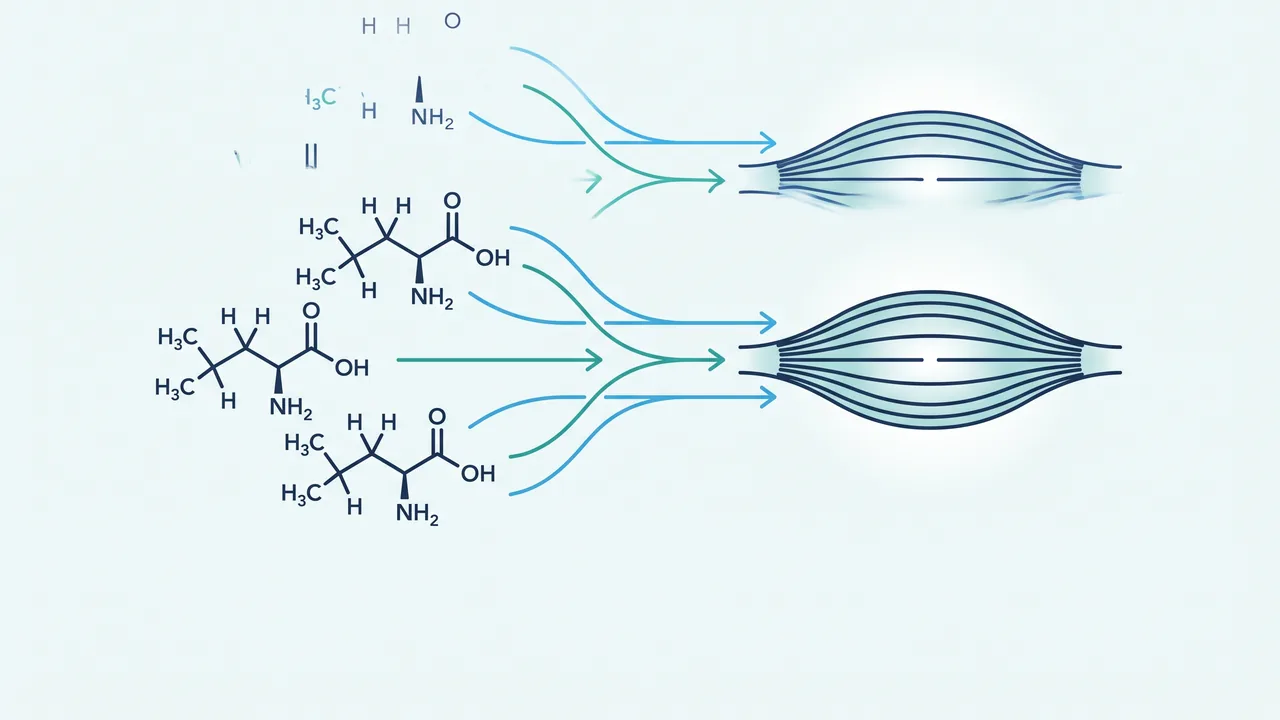
Branched-Chain Amino Acids
Amino acids and derivatives. A research review published by South Beach Longevity.
Branched-Chain Amino Acids
Leucine, isoleucine, and valine graded against complete protein, not against a labelLeucine, isoleucine, and valine are three essential amino acids with a shared first catabolic step and a commercial reputation that treats the trio as a muscle programme. The biochemistry is real. The programme is not. This article keeps the sensing, the tracer increments, the training trials, and the circulating metabolomic signal in separate sentences. It is not a supplementation guide.
Compiled by South Beach Longevity · 20 August 2026 Copyright 2026 Series SBL-41 / SP-BCAAS · Register A scientific article Sources peer-reviewed human tracer, biopsy, and training studies · consensus protein statements · metabolomic epidemiology · labelled animal and cell work · verified NCBI records Constraint This document describes published research. It is not medical advice. No human use, dose, route or schedule is recommended anywhere in this document.
How to read this document Every finding is labelled, in the sentence that reports it, by the kind of study that produced it. In vitro means a cell or a reconstituted system. Animal names the species. Human means people. A phosphorylated kinase is not muscle protein accretion. An acute myofibrillar fractional synthetic rate is not hypertrophy. A circulating BCAA concentration is not a dietary confession. Amounts and durations appear only as reported experimental parameters, always with the system attached. Nothing here is a recommendation. Findings are graded in place as established, strongly supported, emerging, plausible, or speculative. Two further labels mark careful absences rather than verdicts: not established, where the evidence is too thin to place a claim on the ladder at all — untested or insufficient, an absence of proof rather than disproof; and not supported, where the weight of evidence leans against a claim but stops short of a formal refutation.
01 The controlling question
The market sentence is simple: BCAAs build muscle, speed recovery, delay fatigue, and, depending on the week, either protect metabolic health or cause diabetes. The laboratory sentence is longer. Leucine, isoleucine, and valine are indispensable amino acids. They share a branched aliphatic side chain and a first oxidative pathway that skeletal muscle can run without the liver (Harper, Miller, and Block, 1984; Brosnan and Brosnan, 2006; Neinast, Murashige, and Arany, 2019). Leucine is a nutrient input to mTORC1 (Wolfson et al., 2016; Chen et al., 2021). Isolated BCAAs can raise human myofibrillar protein synthesis above a fasted or carbohydrate baseline after resistance exercise (Jackman et al., 2017). They cannot, by themselves, supply the other essential amino acids that net protein accretion consumes (Volpi et al., 2003; Wolfe, 2017).
This article asks two questions and refuses to let them collapse. First: what is established about the three amino acids as nutrients, fuels, and signals? Second: when they are isolated from complete protein or from a full essential-amino-acid (EAA) set, what human outcomes — acute muscle protein synthesis (MPS), hypertrophy, strength, soreness, endurance, calorie-restricted lean-mass retention, aging — actually move, and by how much?
The sibling title on ergogenic aids already treats isolated amino-acid powders as a weaker object than food protein. This title is the mechanism and trial cut of that warning. It keeps the biochemistry. It drops the scoop.
02 Leucine, isoleucine, valine
The three BCAAs are L-leucine, L-isoleucine, and L-valine. They are proteinogenic, dietary-essential in humans, and chemically grouped by a branched aliphatic side chain, not by a shared anabolic destiny (Rose, 1957; Harper, Miller, and Block, 1984). Leucine is ketogenic. Valine is glucogenic. Isoleucine is mixed. That carbon-fate difference matters once the shared dehydrogenase step is passed. It does not license treating “BCAAs” as one drug.
In human plasma they are among the more abundant free amino acids. They compete with other large neutral amino acids, including tryptophan and tyrosine, for transport at the blood–brain barrier (Fernstrom, 2013; Newsholme and Blomstrand, 2006). That competition is the entire mechanistic premise of the central-fatigue hypothesis. It is a transport argument. It is not a finish-line argument.
Commercial mixtures usually isolate the three from the other six EAAs — histidine, lysine, methionine, phenylalanine, threonine, and tryptophan — and from the non-essential amino acids that complete a food protein. The isolation is the product. It is also the scientific limit.
03 Essentiality
Rose’s adult-human depletion work established that leucine, isoleucine, and valine cannot be omitted from the diet without negative nitrogen balance (Rose, 1957). That is established as nutritional essentiality. It is not a licence to sell the three as a complete protein replacement.
Human muscle protein synthesis after feeding is driven primarily by the essential set, not by the non-essential remainder. Volpi and colleagues showed, in healthy older adults, that EAAs were primarily responsible for the amino-acid stimulation of muscle protein anabolism; adding non-essential amino acids did not increase the response (Volpi et al., 2003). That human tracer result is strongly supported and will be used later as a comparator. It cuts both ways. It elevates EAAs over dispensable amino acids. It does not elevate three EAAs over nine.
Dietary protein already contains BCAAs. Whey is leucine-rich relative to many plant isolates; soy and casein are not leucine-empty (Tang et al., 2009; Tipton et al., 2004). A person eating enough high-quality protein is already ingesting leucine, isoleucine, and valine in a matrix that includes the rest of the set. The isolated powder is an argument that the matrix is optional. The rest of this document tests that argument.
04 Catabolism: BCAT and BCKDH
BCAA disposal begins with reversible transamination by branched-chain aminotransferase (BCAT), producing the corresponding branched-chain keto acids — α-ketoisocaproate from leucine, α-keto-β-methylvalerate from isoleucine, and α-ketoisovalerate from valine — and transferring the nitrogen to α-ketoglutarate (Harper, Miller, and Block, 1984; Brosnan and Brosnan, 2006; Hutson, Sweatt, and Lanoue, 2005). The committed oxidative step is the mitochondrial branched-chain α-keto acid dehydrogenase complex (BCKDH), a thiamine-dependent complex regulated by phosphorylation, analogous in logic to pyruvate dehydrogenase (Shimomura and Harris, 2006; Neinast, Murashige, and Arany, 2019). After BCKDH, the three carbon skeletons diverge toward acetyl-CoA and/or succinyl-CoA.
This pathway is established as mammalian biochemistry. Maple syrup urine disease is the human genetic proof that BCKDH failure is not a lifestyle talking point. Whole-body quantitative fate mapping in mice later showed that oxidation is tissue-distributed and that circulating concentrations report the balance of release and disposal, not a single organ’s diet (Neinast et al., 2019). That animal flux paper is a warning label for every later epidemiology section: a plasma number is a remainder.
05 Skeletal muscle as the principal catabolic organ
Unlike most amino acids, the BCAAs can be transaminated at high capacity in skeletal muscle. Harper, Miller, and Block reviewed that extrahepatic first step as a defining feature of the group (Harper, Miller, and Block, 1984). Brosnan and Brosnan restated the enzyme-and-substrate regulation: muscle BCAT is abundant; liver BCKDH is abundant; the two organs share the work (Brosnan and Brosnan, 2006). During prolonged exercise, human muscle oxidises BCAAs as a minor fuel (Rennie et al., 2006; Gibala, 2001). The contribution to ATP is small relative to carbohydrate and fat (Hargreaves and Spriet, 2020). “Burned in muscle” is therefore true and commercially oversold in the same breath.
Adipose tissue also catabolises BCAAs. Herman and colleagues showed, in mice, that adipose BCAA metabolism modulates circulating BCAA levels (Herman et al., 2010). That animal finding is one of the load-bearing reasons circulating BCAAs rise in insulin-resistant humans without anyone having to eat more BCAA powder. The later epidemiology section will need this sentence again.
06 Leucine sensing and mTORC1
mTORC1 integrates amino acids, growth-factor input, and energy status and, when active, promotes anabolic translation and restrains autophagy (Saxton and Sabatini, 2017; Bar-Peled and Sabatini, 2014). Leucine is the BCAA that the sensing literature actually resolved. Wolfson and colleagues identified Sestrin2 as a leucine sensor for the mTORC1 pathway in cells (Wolfson et al., 2016). Saxton and colleagues supplied the structural basis for that sensing (Saxton et al., 2016). Chen and colleagues later identified SAR1B as an additional leucine sensor that regulates mTORC1 (Chen et al., 2021). Those papers are established as signalling biochemistry. They are not a human hypertrophy protocol.
In rat muscle, oral leucine stimulates translation initiation (Anthony et al., 2000; Anthony et al., 2001). In humans, leucine-enriched nutrients activate mTOR signalling and can raise MPS, especially when the rest of the EAA set is present or when a suboptimal protein dose is being rescued (Drummond and Rasmussen, 2008; Churchward-Venne et al., 2014). Kimball and Jefferson reviewed the molecular routes through which BCAAs, and leucine in particular, talk to translation (Kimball and Jefferson, 2006). Established as a nutrient-sensing axis. Not a proof that three capsules replace dinner.
Isoleucine and valine are weaker mTORC1 agonists in this literature. They are still essential. Treating “BCAAs” as a synonym for “the leucine sensor” is the first commercial simplification this document refuses.
07 Muscle protein synthesis is a measurement
Human MPS is usually reported as a fractional synthetic rate from a stable-isotope tracer, often with a muscle biopsy, over hours, not weeks (Atherton and Smith, 2012; Wolfe, 2017). Resistance exercise and protein feeding raise mixed-muscle or myofibrillar FSR. The dose–response for ingested high-quality protein after resistance exercise in young men saturates near a modest serving of whey; more protein raises oxidation more than it raises MPS (Moore et al., 2009). Witard and colleagues later showed that 40 g of whey raised myofibrillar MPS more than 20 g after a meal-like feeding, with a smaller increment beyond 20 g (Witard et al., 2014). Older adults generally need a larger relative protein dose to reach a similar myofibrillar response (Moore et al., 2015; Cuthbertson et al., 2005).
Two interpretive rules follow immediately. First, an acute FSR increment is not hypertrophy. Hypertrophy is a chronic imbalance of synthesis and breakdown, plus satellite-cell, connective-tissue, and training variables that a four-hour infusion does not see (Atherton and Smith, 2012; Plotkin et al., 2021). Second, raising MPS with a mixture that lacks the other EAAs can look anabolic on a tracer and still be substrate-limited for net accretion (Wolfe, 2017; Jackman et al., 2017). The commercial sentence “increases protein synthesis” is therefore often true and still empty.
08 Isolated BCAAs cannot maximise MPS
Jackman and colleagues gave resistance-trained men 5.6 g of BCAAs after a bout of resistance exercise and measured myofibrillar FSR. BCAA ingestion stimulated MPS relative to a placebo, by about 22 percent in that design, but the increment was less than the roughly 50 percent or greater responses previously reported for whey protein containing a similar leucine dose plus the rest of the EAA set (Jackman et al., 2017). The paper is human, biopsy-tracer, and strongly supported as a description of that protocol. It is the cleanest single demonstration that isolated BCAAs are a partial signal.
Wolfe’s 2017 review stated the stoichiometric point without euphemism: muscle protein is more than leucine, isoleucine, and valine; stimulating synthesis without supplying the other EAAs cannot maximise net protein deposition (Wolfe, 2017). Fuchs and colleagues later showed that ingesting BCAAs or branched-chain keto acids can raise MPS in vivo in humans — again a stimulation, again not a complete-protein comparison that would close the case (Fuchs et al., 2019). Blomstrand and colleagues had already shown that BCAAs activate key enzymes in protein synthesis after exercise and that resistance exercise plus BCAAs increases p70S6K phosphorylation in human muscle (Blomstrand et al., 2006; Karlsson et al., 2004). Signalling is not the missing six amino acids.
The answer to the first red-team question is therefore already on the table. Isolated BCAAs can raise MPS. They cannot maximise it in the sense the complete EAA or intact-protein literature uses that word.
09 Leucine versus BCAAs versus EAA versus protein
Churchward-Venne and colleagues tested the rescue question directly. A suboptimal protein dose supplemented with leucine, or with a full EAA mixture, was compared with a larger protein dose for myofibrillar MPS after resistance exercise in young men. Leucine could restore much of the MPS response of the higher protein dose in the early window; the EAA mixture and the higher protein dose remained the more complete comparators across the full measurement (Churchward-Venne et al., 2012). A later trial from the same group showed that leucine supplementation of a low-protein mixed-macronutrient beverage enhanced integrated myofibrillar MPS (Churchward-Venne et al., 2014). Those are human feeding-plus-exercise designs. They support leucine as a rescue additive to inadequate protein, not as a replacement for adequate protein.
Katsanos and colleagues showed that older adults required a higher leucine proportion within an EAA mixture to stimulate MPS comparably to younger adults (Katsanos et al., 2006). The same group had already shown that aging diminishes accretion after a small EAA bolus (Katsanos et al., 2005). Volpi’s EAA-versus-NEAA result sits beside those papers: the essential set is the anabolic unit (Volpi et al., 2003). Tang and colleagues showed that whey hydrolysate raised MPS more than casein or soy after resistance exercise, consistent with digestion rate and leucine content, not with a BCAA-only mechanism (Tang et al., 2009). Tipton and colleagues showed that intact proteins produce muscle anabolism after exercise (Tipton et al., 2004). Børsheim and colleagues showed that EAAs support muscle protein recovery from resistance exercise (Børsheim et al., 2002). Biolo and colleagues showed that an abundant amino-acid supply enhances the metabolic effect of exercise on muscle protein (Biolo et al., 1997).
The hierarchy that survives is not subtle. Complete high-quality protein is the reference human intervention for feeding-induced MPS. A full EAA blend is a close mechanistic cousin. Leucine can rescue a low protein dose. Isolated BCAAs sit below both. That hierarchy is strongly supported in acute human tracer work. It is the comparison the label usually refuses.
10 Acute MPS study table
| Study | Population / design | Intervention as reported | MPS readout | Grade |
|---|---|---|---|---|
| Jackman et al., 2017 | Trained men; post-RE | 5.6 g BCAAs vs placebo | Myofibrillar FSR ↑ vs placebo; smaller than typical whey | Strongly supported: partial stimulus |
| Churchward-Venne et al., 2012 | Young men; post-RE | Low protein ± leucine or EAA vs 25 g whey | Leucine rescued early MPS; protein/EAA more complete | Strongly supported: rescue, not replacement |
| Churchward-Venne et al., 2014 | Young men | Low-protein beverage ± leucine | Integrated myofibrillar MPS ↑ with leucine | Strongly supported in that low-protein setting |
| Fuchs et al., 2019 | Men | BCAA or BCKA ingestion | MPS ↑ in vivo | Supported stimulation; not a protein comparator |
| Moore et al., 2009 | Young men; post-RE | Graded whey protein | Mixed-muscle FSR plateau ~20 g | Established protein dose–response |
| Witard et al., 2014 | Young men | 0, 10, 20, 40 g whey | Myofibrillar FSR; 20–40 g window | Strongly supported |
| Volpi et al., 2003 | Older adults | EAA vs EAA+NEAA | EAA carried the anabolic effect | Established essential-set result |
| Katsanos et al., 2006 | Older vs young | EAA mixtures differing in leucine | Older adults needed more leucine | Strongly supported |
| Tang et al., 2009 | Young men; post-RE | Whey vs casein vs soy | Whey > soy ≈ casein for MPS | Strongly supported food-protein comparison |
| Karlsson et al., 2004 | Men; RE ± BCAAs | BCAAs | p70S6K phosphorylation ↑ | Signalling, not FSR hypertrophy |
| Blomstrand et al., 2006 | Review / human signalling | BCAAs after exercise | Translation-factor activation | Mechanistic, not a training outcome |
| Wolfe, 2017 | Critical review | Isolated BCAAs | Stoichiometric limit on net accretion | Strongly supported argument |
Acute MPS changes are established as real and not established as a sufficient cause of greater hypertrophy. That is the second red-team question, and the training record is where it is tried.
11 Hypertrophy and strength
Plotkin and colleagues reviewed isolated leucine and BCAA supplementation for muscular strength and hypertrophy and did not find a compelling case that either, added to an already protein-adequate diet, produces meaningful extra lean mass or strength (Plotkin et al., 2021). That narrative review is the right object: it asks the commercial question rather than the tracer question. Spillane, Emerson, and Willoughby conducted an eight-week heavy-resistance trial with BCAA supplementation and did not produce a persuasive hypertrophy advantage over training plus diet (Spillane, Emerson, and Willoughby, 2012). Verhoeven and colleagues found that long-term leucine supplementation did not increase muscle mass or strength in healthy elderly men (Verhoeven et al., 2009). Leenders and colleagues likewise found that prolonged leucine supplementation did not augment muscle mass or affect glycaemic control in older men with type 2 diabetes who were already eating protein (Leenders et al., 2011).
Protein supplementation, by contrast, has a meta-analytic signal for resistance-training lean-mass and strength gains, especially when baseline protein is low and training is real (Cermak et al., 2012; Morton et al., 2018). The ISSN position stand on protein and exercise treats intact protein, and the full EAA complement, as the feeding unit; it does not install isolated BCAAs as a first-line hypertrophy agent (Jäger et al., 2017). Those documents are human evidence syntheses. They are strongly supported as a description of the protein literature. They are not a brand endorsement.
The practical remainder is harsh and small. If habitual protein is inadequate, the evidence-based repair is protein, or a complete EAA mixture, not a BCAA isolate. If habitual protein is already adequate, isolated BCAAs are a weak hypertrophy intervention. That is the third red-team question, answered in the negative for typical gym use.
12 Long-term training matrix
| Study or synthesis | Duration / n (as reported) | Training | Feeding context | Hypertrophy / strength | Grade |
|---|---|---|---|---|---|
| Spillane, Emerson, and Willoughby, 2012 | 8 weeks | Heavy resistance | BCAA vs placebo | No compelling extra mass/performance | Human RCT; limited |
| Verhoeven et al., 2009 | 3 months; healthy older men | None imposed as the test | Leucine vs placebo | No increase in mass or strength | Strongly supported negative |
| Leenders et al., 2011 | 6 months; older men with T2D | Habitual | Leucine vs placebo | No extra muscle mass | Strongly supported negative |
| Plotkin et al., 2021 | Narrative review | Mixed | Isolated leu / BCAA | Insufficient for hypertrophy/strength | Fair reading of the trials |
| Cermak et al., 2012 | Meta-analysis | Resistance-type | Protein supplements | Lean mass and strength ↑ | Protein, not BCAA isolate |
| Morton et al., 2018 | Meta-regression | Resistance training | Protein supplements | Diminishing returns as intake rises | Protein adequacy is the lever |
| Jäger et al., 2017 | ISSN position stand | Exercise | Protein / EAA | Intact protein as the unit | Consensus, not a trial |
| Dudgeon, Kelley, and Scheett, 2016 | Caloric restriction + RT | Resistance | BCAA vs carbohydrate | Claimed lean-mass retention | Emerging; see §17 |
| Aguiar / Trabal leucine + RT | Weeks to months | Resistance | Free leucine | Inconsistent mass effects | Weak as a class |
The matrix is lopsided on purpose. The protein-plus-training cell is populated. The isolated-BCAA-plus-adequate-protein cell is thin and mostly negative. A document that treated those two cells as interchangeable would be writing advertising.
13 Recovery and soreness
This is the endpoint class where isolated BCAAs look least like a null. Howatson and colleagues reported that BCAA ingestion reduced markers of exercise-induced muscle damage and soreness in resistance-trained men after damaging exercise (Howatson et al., 2012). Jackman and colleagues had earlier found that BCAA ingestion can ameliorate soreness from eccentric exercise without a matching functional rescue large enough to rewrite training practice (Jackman et al., 2010). Coombes and McNaughton reported lower serum creatine kinase and lactate dehydrogenase after prolonged exercise with BCAA supplementation (Coombes and McNaughton, 2000). Greer and colleagues found mixed indicator changes after endurance exercise (Greer et al., 2007). Shimomura and colleagues reported reduced delayed-onset muscle soreness after squat exercise with BCAAs in a small human design (Shimomura et al., 2010) and reviewed “nutraceutical” muscle effects more broadly (Shimomura et al., 2006). VanDusseldorp and colleagues tested BCAAs around acute eccentric exercise and reported recovery-marker changes that were modest relative to the marketing (VanDusseldorp et al., 2018).
Fouré and Bendahan asked, as a critical literature review, whether BCAA supplementation is an efficient strategy against skeletal muscle damage; the answer was cautious and condition-dependent, not a blanket yes (Fouré and Bendahan, 2017). Fedewa and colleagues meta-analysed BCAAs and muscle soreness and found a small effect that does not automatically become a performance effect (Fedewa et al., 2019). Rahimi and colleagues similarly treated exercise-induced muscle-damage markers as a mixed, often surrogate, literature (Rahimi et al., 2017).
The honest grade: emerging to strongly supported for small reductions in soreness or damage markers in some protocols; not established as a practically meaningful recovery technology once protein is adequate and training is programmed. A slightly less sore next morning is not a hypertrophy pathway. That is the fourth red-team question.
| Study | Damaging stimulus | BCAA contrast | Soreness / CK / function | Practical meaning |
|---|---|---|---|---|
| Howatson et al., 2012 | Resistance damage, trained men | BCAA vs placebo | Lower soreness and damage markers | Small; trained sample |
| Jackman et al., 2010 | Eccentric exercise | BCAA vs placebo | Less soreness; function less clear | Symptom more than capacity |
| Coombes and McNaughton, 2000 | Prolonged exercise | BCAA vs placebo | Lower CK / LDH | Surrogate enzymes |
| Greer et al., 2007 | Endurance | BCAA | Mixed damage indicators | Not a finish-time paper |
| Shimomura et al., 2010 | Squat | BCAA | Lower DOMS | Small human design |
| VanDusseldorp et al., 2018 | Eccentric | BCAA | Modest recovery markers | Not a training rewrite |
| Fouré and Bendahan, 2017 | Review | BCAA vs control | Condition-dependent | Critical, not promotional |
| Fedewa et al., 2019 | Meta-analysis | BCAA | Small soreness effect | Statistical, not necessarily useful |
14 Oxidation during exercise
During prolonged exercise, human skeletal muscle increases BCAA oxidation. Rennie and colleagues treated BCAAs as both fuels and anabolic signals and kept the two roles from collapsing (Rennie et al., 2006). Gibala reviewed skeletal-muscle amino-acid metabolism during exercise (Gibala, 2001). Knapik and colleagues measured leucine metabolism during fasting and exercise in humans (Knapik et al., 1991). Hargreaves and Spriet’s later energy-metabolism review keeps carbohydrate and fat as the dominant working fuels (Hargreaves and Spriet, 2020).
The quantitative point is the anti-advertisement. BCAA oxidation rises. It still accounts for a small fraction of exercise ATP. A product that sells itself as “muscle fuel” is selling a real pathway at the wrong scale. The pathway is established. The scale is established. The slogan is not.
15 Central-fatigue hypotheses
Newsholme and Blomstrand proposed that rising free tryptophan, falling plasma BCAAs, and increased brain serotonin contribute to central fatigue in prolonged exercise (Newsholme and Blomstrand, 2006; Newsholme, Blomstrand, and Ekblom, 1992; Blomstrand, 2001). Blomstrand reported that ingesting BCAAs during sustained exercise could change perceived exertion or some performance slices in selected designs (Blomstrand et al., 1991; Blomstrand et al., 1997). The hypothesis is mechanistically tidy: BCAAs and tryptophan share LAT1-family transport; changing the ratio should change brain tryptophan influx; serotonin should follow; fatigue should follow (Fernstrom, 2013; Davis, Alderson, and Welsh, 2000).
The human performance tests did not instal the tidy story as fact. van Hall, Raaymakers, Saris, and Wagenmakers ingested BCAAs and tryptophan during sustained exercise and did not find the predicted performance pattern that would confirm the hypothesis as a practical ergogenic (van Hall et al., 1995). Meeusen and colleagues reviewed central fatigue as a serotonin-plus-much-else problem — dopamine, noradrenaline, cytokines, heat, and motivation — and treated the BCAA remedy as unproven (Meeusen et al., 2006; Meeusen and Roelands, 2018). Watson, Shirreffs, and Maughan tested acute BCAA supplementation on prolonged exercise capacity in the heat and did not convert the hypothesis into a reliable endurance aid (Watson, Shirreffs, and Maughan, 2004).
Plausible as a neurotransmitter-transport hypothesis. Not established as a reason to drink BCAAs for a personal best. Heat, carbohydrate, and pacing remain the adult variables.
16 Endurance
Gualano and colleagues reported that BCAA supplementation enhanced exercise capacity and lipid oxidation during endurance exercise after muscle glycogen depletion in a small human design (Gualano et al., 2011). That is one protocol, after a glycogen manipulation, not a season of road racing. The broader endurance literature is dominated by carbohydrate availability, not by BCAA powders (Hargreaves and Spriet, 2020). ISSN protein guidance does not relocate endurance feeding from carbohydrate and total protein onto an isolated BCAA (Jäger et al., 2017).
Grade for isolated BCAAs as an endurance ergogenic: emerging at best, protocol-bound, and commercially inflated. A glycogen-depleted laboratory ride is not a marathon nutrition plan.
17 Calorie restriction
When energy intake falls, lean-mass retention is a protein-and-training problem first. Mettler, Mitchell, and Tipton showed that increased protein intake reduces lean-body-mass loss during weight loss in athletes (Mettler, Mitchell, and Tipton, 2010). Helms and colleagues systematically reviewed protein during caloric restriction in lean resistance-trained athletes and again landed on protein, not on a three-amino-acid isolate (Helms et al., 2014). Longland and colleagues showed that higher compared with lower dietary protein during an energy deficit plus intense exercise promoted greater lean-mass gain and fat loss (Longland et al., 2016). Hector and Phillips reviewed protein recommendations for weight loss in elite athletes as a protein-distribution problem (Hector and Phillips, 2018).
Dudgeon, Kelley, and Scheett reported that BCAA supplementation with resistance training helped maintain lean mass during a caloric-restricted diet in a single-blind matched-group design (Dudgeon, Kelley, and Scheett, 2016). Mourier and colleagues had earlier combined caloric restriction with BCAA supplementation and reported body-composition shifts in a small human wrestler-adjacent design (Mourier et al., 1997). Those papers are emerging. They are not a reason to prefer BCAAs over an isonitrogenous complete protein during a cut. Dudgeon’s later whey-plus-restriction paper is a reminder that the same laboratory also studies intact protein (Dudgeon, Kelley, and Scheett, 2017). When both objects exist, the isolate has to beat the food. It has not.
18 Aging
Older muscle is less sensitive to a small EAA or protein bolus — anabolic resistance — and often needs more leucine within the EAA set to reach a young-like MPS response (Volpi et al., 2000; Katsanos et al., 2005; Katsanos et al., 2006; Cuthbertson et al., 2005; Fujita and Volpi, 2006). PROT-AGE and ESPEN expert groups therefore emphasise protein intake and exercise for older adults, not a BCAA isolate as the primary tool (Bauer et al., 2013; Deutz et al., 2014). Cruz-Jentoft and colleagues’ EWGSOP2 sarcopenia consensus is a case-finding and measurement document; it does not install BCAA powders as treatment (Cruz-Jentoft et al., 2019).
Murphy and colleagues found that leucine supplementation enhanced integrative myofibrillar protein synthesis in free-living older men consuming lower- and higher-protein diets — an acute-to-integrated tracer result, not a hypertrophy trial (Murphy et al., 2016). Verhoeven 2009 and Leenders 2011, already cited, are the long-term leucine negatives in older men. Paddon-Jones and Rasmussen discussed dietary protein and sarcopenia prevention as a meal-protein problem (Paddon-Jones and Rasmussen, 2009). Wolfe’s underappreciated-muscle essay is a public-health argument for muscle, not for a particular powder (Wolfe, 2006).
Strongly supported: older adults often need more high-quality protein, and leucine content within that protein matters. Not established: chronic isolated BCAA or leucine supplementation as a sarcopenia therapy when protein is already adequate.
19 Obesity and insulin resistance
Felig, Marliss, and Cahill reported elevated plasma amino acids, including the BCAAs, and altered insulin secretion in human obesity in 1969 (Felig, Marliss, and Cahill, 1969). That human observation is fifty years older than the supplement panic it is now asked to serve. Newgard and colleagues, in 2009, described a BCAA-related metabolomic signature that differentiated obese and lean humans and, in rats, linked a high-fat diet plus BCAAs to insulin resistance — an animal accompaniment, not a human dietary verdict (Newgard et al., 2009). Wang and colleagues showed that metabolite profiles, including BCAAs, associated with incident diabetes in Framingham (Wang et al., 2011). Newgard later reviewed the interplay of lipids and BCAAs in insulin-resistance development (Newgard, 2012). Lynch and Adams reviewed BCAAs in metabolic signalling and insulin resistance without collapsing association into a grocery-list cause (Lynch and Adams, 2014). White and Newgard restated BCAAs in disease as a scientific problem, not a slogan (White and Newgard, 2019). Batch and colleagues treated circulating BCAAs as biomarkers of metabolic wellness (Batch et al., 2013). Würtz and colleagues found BCAAs and aromatic amino acids predictive of insulin resistance in young adults (Würtz et al., 2013).
This cluster is established as association and emerging as mechanism. It is not a randomised verdict on BCAA powders.
20 Why association is not dietary causation
A high circulating BCAA concentration can mean increased release, decreased disposal, altered gut or microbiome handling, impaired adipose BCAA catabolism, or some mixture. Herman’s adipose paper already showed that adipose BCAA metabolism modulates circulating levels in mice (Herman et al., 2010). Insulin resistance itself can change BCAA disposal. Reverse causation is therefore not a footnote. It is a live design.
Lotta and colleagues used human genetics: a predisposition to impaired BCAA metabolism associated with type 2 diabetes risk, which is evidence about disposal machinery, not about drinking a gym product (Lotta et al., 2016). That Mendelian-randomisation-adjacent result is often misread as “BCAAs cause diabetes.” It is closer to “people whose enzymes leave BCAAs in the blood have higher diabetes risk.” Those are different sentences.
Neinast, Jang, Hui, and colleagues’ quantitative whole-body fate map is the experimental rebuke to naive dietary inference: tissues differ; circulating BCAAs are a balance sheet (Neinast et al., 2019). White, McGarrah, Grimsrud, and colleagues showed that BCKDH kinase and phosphatase determine BCAA flux — again a disposal paper (White et al., 2018).
The fifth red-team question — is the metabolic-disease association causal? — therefore splits. Causal language is licensed for impaired BCAA catabolism as a correlate and possible contributor to insulin-resistant physiology in animals and in human genetics. Causal language is not licensed for the claim that ordinary dietary BCAA supplements, in people who eat mixed diets, cause obesity or type 2 diabetes. The owner instruction for this title is the correct scientific instruction: do not infer that dietary BCAAs cause insulin resistance merely from circulating metabolomic associations.
21 Restriction in animals is not a human supplement verdict
Fontana, Cummings, Arriola Apelo, Lamming, and colleagues showed that decreasing BCAA consumption improved metabolic health in mice (Fontana et al., 2016). Cummings and colleagues restored metabolic health in mice by decreasing BCAA intake (Cummings et al., 2018). Richardson and colleagues reported sex-specific benefits of lifelong dietary BCAA restriction for frailty and lifespan in mice (Richardson et al., 2021). Yu and colleagues argued that the adverse metabolic effects of BCAAs in mice were mediated by isoleucine and valine more than by leucine (Yu et al., 2021). Solon-Biet, Simpson, Le Couteur, and colleagues showed that macronutrient balance, not only calories, shapes cardiometabolic health, reproduction, and lifespan in aging mice (Solon-Biet et al., 2015).
Those papers are animal, often lifelong or semi-lifelong, and strongly supported as descriptions of those colonies. They are a reason to take circulating BCAAs and dietary amino-acid pattern seriously in metabolic research. They are not a human instruction to avoid dietary leucine, and they are not a proof that a 5 g gym scoop causes the Newgard signature. A mouse diet that subtracts BCAAs for a lifetime is not the inverse of a human who adds a powder to an already protein-replete diet for eight weeks. Directional symmetry is a rhetorical trick.
22 Metabolic epidemiology table
| Study | Species | Design | Exposure | Finding | Causal licence |
|---|---|---|---|---|---|
| Felig, Marliss, and Cahill, 1969 | Human | Cross-sectional | Obesity | Elevated plasma AAs including BCAAs | Association |
| Newgard et al., 2009 | Human + rat | Metabolomics; diet in rats | Obesity; HF + BCAA in rats | Signature differentiates obese/lean; rat IR with HF+BCAA | Human association; animal diet model |
| Wang et al., 2011 | Human | Prospective metabolomics | Circulating metabolites | BCAAs associated with incident diabetes | Association / prediction |
| Newgard, 2012 | Review | — | Lipids + BCAAs | Interplay in IR development | Mechanistic synthesis |
| Lynch and Adams, 2014 | Review | — | BCAAs / IR | Signalling and resistance map | Not a trial |
| White and Newgard, 2019 | Review | — | BCAAs in disease | Disease-facing synthesis | Not dietary proof |
| Herman et al., 2010 | Mouse | Adipose BCAA metabolism | Tissue disposal | Adipose modulates circulating BCAAs | Animal mechanism |
| Lotta et al., 2016 | Human | Genetic predisposition | Impaired BCAA metabolism | Higher T2D risk | Machinery, not scoop |
| Neinast et al., 2019 | Mouse | Whole-body isotope fate | BCAA disposal | Tissue-specific oxidation | Balance sheet, not menu |
| White et al., 2018 | Mouse / biochemical | BCKDH kinase/phosphatase | Flux control | Disposal enzymes set BCAA levels | Mechanism |
| Fontana et al., 2016 | Mouse | Decreased dietary BCAAs | Restriction | Improved metabolic health | Animal diet |
| Richardson et al., 2021 | Mouse | Lifelong BCAA restriction | Restriction | Sex-specific frailty/lifespan | Animal longevity |
| Yu et al., 2021 | Mouse | Ile / Val vs Leu | Restriction / excess | Ile and Val drive adverse effects | Animal, amino-acid-specific |
| Batch et al., 2013 | Human | Biomarker | Circulating BCAAs | Metabolic-wellness discrimination | Association |
| Würtz et al., 2013 | Human | Young adults | Circulating BCAAs | Predict insulin resistance | Association |
23 Comparison matrix
| Outcome | Isolated BCAAs | Isolated leucine | Complete EAA blend | Complete protein |
|---|---|---|---|---|
| mTORC1 / translation signalling | Yes, leucine-dominant | Strongest single AA signal | Yes, with substrate | Yes, with food matrix |
| Acute MPS vs fasted / CHO | Partial ↑ (Jackman 2017) | Can rescue low protein (C-V 2012/14) | Near-protein in many designs | Reference stimulus (Moore; Witard; Tang) |
| Maximise MPS / net accretion | No (Wolfe 2017) | No, if other EAAs absent | Much closer | Best-supported |
| Hypertrophy / strength with adequate protein | Weak / null (Plotkin; Spillane; Verhoeven) | Weak / null long-term (Verhoeven; Leenders) | Limited as a powder vs food | Meta-analytic support when intake was low (Cermak; Morton) |
| Recovery / soreness | Small marker effects (Howatson; Fedewa) | Not the usual test article | Not the usual test article | Protein supports repair as food |
| Endurance performance | Unreliable (van Hall; Meeusen) | Not indicated | Not indicated | Carbohydrate + energy dominate |
| Calorie-restricted lean mass | Emerging, inferior question (Dudgeon; Mourier) | Not preferred | Possible in principle | Stronger evidence (Mettler; Longland; Helms) |
| Aging / sarcopenia | Not a therapy | Meal leucine within protein matters | EAA boluses used as probes | PROT-AGE / ESPEN unit is protein + exercise |
| Insulin resistance | Circulating association ≠ scoop causation | Restriction in mice ≠ human advice | — | Energy surplus and IR physiology dominate |
24 Adversarial resolutions
adversarial review was not used to price these claims. The questions are resolved editorially against the verified record.
Can BCAAs maximise MPS without all EAAs? No. They can raise MPS. Maximisation, in the sense used by the complete-protein and EAA literature, requires the rest of the essential set (Jackman et al., 2017; Wolfe, 2017; Volpi et al., 2003; Churchward-Venne et al., 2012).
Do acute MPS changes produce greater hypertrophy? Not by themselves. Acute FSR is a different object from months of DXA or fibre-area change. The isolated-BCAA and isolated-leucine training record is weak; the protein-plus-training record is stronger (Atherton and Smith, 2012; Plotkin et al., 2021; Cermak et al., 2012; Morton et al., 2018).
Are BCAAs useful when protein intake is already adequate? Seldom for hypertrophy or strength. Possible small soreness effects do not rewrite that sentence (Plotkin et al., 2021; Fedewa et al., 2019; Jäger et al., 2017).
Are recovery benefits practically meaningful? Usually no, sometimes a little. Marker and soreness effects exist in some protocols. Functional and training-quality effects are smaller and inconsistent (Howatson et al., 2012; Fouré and Bendahan, 2017; Jackman et al., 2010).
Is the metabolic-disease association causal? Not as a dietary-BCAA-causes-diabetes claim. The circulating association is established. Impaired disposal and adipose catabolism are plausible to strongly supported mechanisms. Human genetic evidence points at metabolism, not at gym products. Mouse restriction is not a human supplement verdict (Felig, Marliss, and Cahill, 1969; Newgard et al., 2009; Lotta et al., 2016; Herman et al., 2010; Fontana et al., 2016).
25 Commercial rhetoric
The strongest case against BCAA advertising is not that leucine is fake. The strongest case is that the rhetoric commits five substitutions.
It substitutes three EAAs for nine (Volpi et al., 2003; Wolfe, 2017). It substitutes a kinase cascade for net protein balance (Wolfson et al., 2016; Jackman et al., 2017). It substitutes a four-hour FSR for a twelve-week lean-mass change (Atherton and Smith, 2012; Plotkin et al., 2021). It substitutes a soreness scale for recovered performance (Fedewa et al., 2019). It substitutes a metabolomic association for a dietary cause of diabetes (Newgard et al., 2009; Lotta et al., 2016).
After those substitutions are refused, what remains is a real nutrient class, a real leucine sensor, a real but partial MPS stimulus, a weak hypertrophy agent once protein is adequate, a small and inconsistent recovery literature, a failed central-fatigue product claim, and a circulating biomarker that is more interesting than the powder aisle. That is not a small remainder. It is also not what was advertised.
Hepatic encephalopathy is the clinical setting in which BCAA mixtures have a separate, contested medical literature (Marchesini et al., 2003; Gluud et al., 2017). That literature is not a gym argument and is not converted into one here. Holeček has reviewed BCAA regulation and the side-effect profile of amino-acid supplements as a caution against treating isolates as inert candy (Holeček, 2018; Holeček, 2023). Caution is not a protocol.
26 Standing constraint
Standing constraint This document describes published research. It is not medical advice. No human use, dose, route or schedule of branched-chain amino acids, leucine, essential-amino-acid blends, protein supplements, or any dietary pattern is recommended anywhere in this document.
References
Verified NCBI records, sorted by first author, replace this stub at build.
Evidence handling
Study type is labelled in the reporting sentence. Animal and in-vitro results are never phrased as human outcomes. Phospho-mTOR, p70S6K, and myofibrillar FSR are treated as different objects from hypertrophy. Circulating BCAA concentration is treated as a balance of production and disposal, not as a dietary diary. When a mouse restriction study and a human metabolomic cohort are both cited, the species and the design stay in the sentence. Project 06 was queried read-only for orientation and is not a human MPS corpus. Project 07 news, if reachable, is discovery only and is not a warrant. Project 05 remains not imported and is not this title. Local Firecrawl was used only to retrieve open full text already identified by PMID. No recalled PMID was kept if mapped it to an unrelated paper.
Limitations and sibling titles
This title does not re-try creatine, taurine, or glycine as ergogenic or longevity objects; those live in their own SBL-41 scientific articles. It does not re-try resistance training or endurance training as interventions. It is a South Beach Longevity science article, not a Radix peptide title. Its two figures are original schematics, captioned as projected; no commissioned or third-party plate is used.
Coverage is limited to MEDLINE records that survived title-checked NCBI resolution. Recalled PMIDs that mapped to unrelated 2025–2026 papers were discarded before drafting. Human trials that compare isonitrogenous BCAAs with intact protein for hypertrophy remain fewer than the advertising implies; that scarcity is a finding, not a gap to be filled from memory.
Glossary
BCAA. Leucine, isoleucine, and valine; a chemical class, not a complete protein.
BCAT. Branched-chain aminotransferase; reversible transamination to BCKAs.
BCKDH. Branched-chain α-keto acid dehydrogenase; committed oxidative step.
EAA. Essential amino acid; nine in adult human nutrition, not three.
FSR. Fractional synthetic rate; acute tracer estimate of protein synthesis.
mTORC1. Mechanistic target of rapamycin complex 1; leucine-sensitive anabolic kinase module.
Anabolic resistance. Reduced MPS response to a given protein or EAA bolus, common in older adults.
Continue reading