
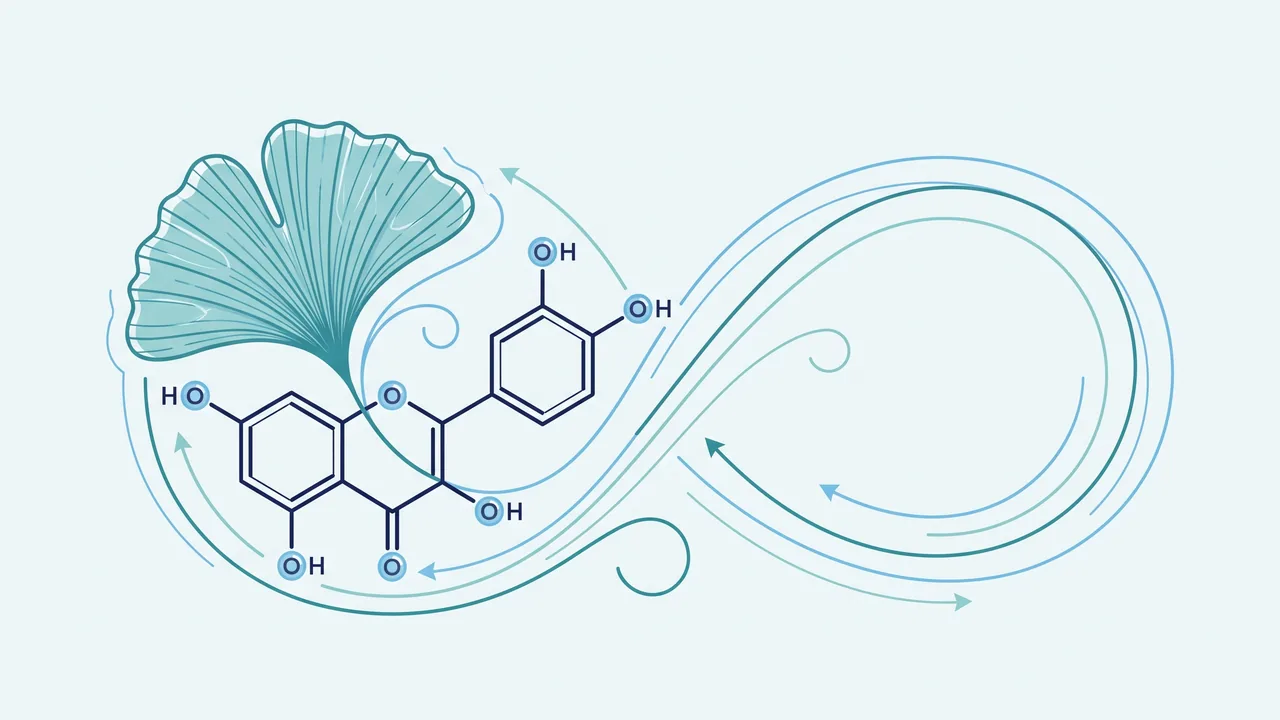
Ginkgo Biloba
Botanical extracts and whole herbs. A research review published by South Beach Longevity.
Every finding is labelled, in the sentence that reports it, by the kind of study that produced it. A standardized EGb 761 trial is not a retail-capsule study. A dementia-treatment trial is not a prevention trial. A prevention trial is not a memory-enhancement study in healthy adults. A flavone-glycoside HPLC number is not a ginkgolide exposure. Where two results conflict, both are given. Amounts and durations appear only as reported experimental or labelled parameters, always with the population and the product attached. Nothing here is a recommendation. Findings are graded in place as established, strongly supported, emerging, plausible, or speculative. Two further labels mark careful absences rather than verdicts: not established, where the evidence is too thin to place a claim on the ladder at all — untested or insufficient, an absence of proof rather than disproof; and not supported, where the weight of evidence leans against a claim but stops short of a formal refutation.
01 What this document is, and four things it is not
This article is a research review of Ginkgo biloba: the chemistry of its leaf flavone glycosides and terpene lactones, the standardized pharmaceutical-grade extracts studied as EGb 761 and its 24/6 relatives, the platelet-activating-factor and cerebral-blood-flow hypotheses that still travel with the name, and the human evidence on dementia, cognitive impairment, prevention of cognitive decline, tinnitus, anxiety, peripheral arterial disease, and sexual-function claims. It is written against a market that treats a living fossil, a hospital-era phytopharmaceutical, and a grocery-aisle capsule as one object.
Four things follow immediately.
First, this is not a treatment manual. Dementia, tinnitus, claudication, and anticoagulant management are clinical problems. The large prevention trials that failed to stop dementia belong to epidemiology, not to a bottle (DeKosky et al., 2008; Vellas et al., 2012; NCCIH, 2026). Those papers are established as evidence that daily EGb 761 did not prevent dementia in the populations they enrolled. They are not a licence to take ginkgo, and they are not a licence to ignore it.
Second, it is not a tree article. The seed, the leaf, the crude powder, and the acetone-dried 24/6 extract are different chemical objects. Raw and roasted seeds carry 4'-O-methylpyridoxine (ginkgotoxin). Standardized leaf extracts are specified to limit ginkgolic acids and to contain defined flavone-glycoside and terpene-lactone fractions (van Beek and Montoro, 2009; PubChem, 2026; NCCIH, 2026). Treating every "ginkgo" label as EGb 761 is an identity error.
Third, it is not an approval document for memory marketing. The United States dietary-supplement aisle and the European herbal-medicine dossier are different legal instruments. The European Medicines Agency's Committee on Herbal Medicinal Products has a bibliographic "well-established use" conclusion for a specified dry leaf extract in mild dementia, and a separate "traditional use" conclusion for powdered leaf in minor circulatory complaints (EMA HMPC, 2026). Those are regulator categories. They do not repeal GEM or GuidAge, and they do not make a generic retail capsule a phytopharmaceutical.
Fourth, it is not medical advice. This document recommends no use, dose, route, or schedule for any person.
02 Botany: one species, three ingestible objects
Ginkgo biloba L. is the last living species of Ginkgoales, a gymnosperm lineage that is routinely called a living fossil (NCCIH, 2026; LiverTox, 2018). The vernacular names — maidenhair tree, fossil tree, Japanese silver apricot — describe the same organism. They do not describe the same product.
Three ingestible objects must be kept apart.
The leaf is the source of the modern extract literature. Flavone glycosides of quercetin, kaempferol, and isorhamnetin, and the unique terpene trilactones, are leaf constituents (van Beek and Montoro, 2009; Ude, Schubert-Zsilavecz, and Wurglics, 2013).
The seed (the "silver apricot") is a food in some East Asian cuisines and a poison when eaten raw or in quantity. It is the principal dietary source of ginkgotoxin. Seed poisoning is a clinical entity, not a footnote to a memory capsule (Kajiyama, Fujii, Takeuchi, and Manabe, 2002; NCCIH, 2026).
The extract is a manufactured fraction. EGb 761 and extracts specified to its 24/6 pattern are acetone-water dry extracts of leaf, standardized to about 24 percent flavone glycosides and 6 percent terpene lactones, with ginkgolic acids held to a few parts per million (van Beek and Montoro, 2009; Ude, Schubert-Zsilavecz, and Wurglics, 2013). Powdered leaf is a different preparation. The EMA HMPC treats them as different medicines (EMA HMPC, 2026).
A fourth object sits on the shelf and is not a botanical entity at all: the retail blend whose flavonoid number was achieved with rutin, quercetin, or Sophora japonica material rather than with ginkgo leaf (Wohlmuth, Savage, Dowell, and Mouatt, 2014; Frommenwiler, Booker, Vila, Heinrich, and Reich, 2019). Section 16 returns to that object.
03 Flavone glycosides: a class, not a drug
The flavone glycosides counted in a 24 percent specification are chiefly glycosides of quercetin, kaempferol, and isorhamnetin (van Beek and Montoro, 2009). PubChem records the aglycones as CID 5280343 (quercetin, C15H10O7, 302.23) and CID 5280863 (kaempferol, C15H10O6, 286.24) (PubChem, 2026). Those identifiers are established as database facts. They are not a dementia argument.
Two chemical traps sit on the same assay.
The first is aglycone versus glycoside. Acid hydrolysis followed by HPLC of quercetin, kaempferol, and isorhamnetin is a quality-control method. It reports a flavonoid number. It does not report which glycosides were present, how they were absorbed, or whether the terpene lactones were present at all (van Beek and Montoro, 2009). A bottle that meets a flavonoid number can still be empty of ginkgolides.
The second is adulteration by flavonoid spike. Rutin and quercetin are cheap. Sophora flower is rich in rutin. A product can pass a flavonol-aglycone assay and still not be a ginkgo leaf extract (Wohlmuth, Savage, Dowell, and Mouatt, 2014; Frommenwiler, Booker, Vila, Heinrich, and Reich, 2019). That is established as an analytical finding in surveyed retail products. It is the reason a flavone number cannot be asked to carry a clinical claim.
The flavone fraction is often given the antioxidant and vascular-smooth-muscle story. Antioxidant chemistry in a beaker is plausible. It is not a substitute for a dementia endpoint. Ude, Schubert-Zsilavecz, and Wurglics, reviewing pharmacokinetics, treated the flavonoids as extensively metabolized, poorly bioavailable as parent glycosides, and not interchangeable with the terpene lactones (Ude, Schubert-Zsilavecz, and Wurglics, 2013). That review is strongly supported as a PK map. It is not an efficacy paper.
04 Terpene lactones: ginkgolides and bilobalide
The terpene lactones are the chemical objects that are actually unusual. Ginkgolides A, B, C, and J are diterpene trilactones. Bilobalide is a sesquiterpene trilactone. Both classes are, for practical purposes, unique to Ginkgo (Stromgaard and Nakanishi, 2004; van Beek and Montoro, 2009).
PubChem records ginkgolide B as CID 11973122, C20H24O10, molecular weight 424.4, InChIKey SQOJOAFXDQDRGF-ZMVGXLHTSA-N (PubChem, 2026). Bilobalide is CID 73581, C15H18O8, 326.30, InChIKey MOLPUWBMSBJXER-YDGSQGCISA-N (PubChem, 2026). Those identifiers are established.
A 6 percent terpene-lactone specification typically allocates a few percent to the ginkgolides and a few percent to bilobalide (van Beek and Montoro, 2009; Ude, Schubert-Zsilavecz, and Wurglics, 2013). The exact split is a batch specification, not a clinical proof. What matters for this article is the split of jobs.
Ginkgolide B is the platelet-activating-factor receptor antagonist that made the 1980s mechanism story. Bilobalide is the object more often given a neuronal or mitochondrial story in later reviews (Stromgaard and Nakanishi, 2004; Ude, Schubert-Zsilavecz, and Wurglics, 2013). Those assignments are plausible as pharmacology. They are not interchangeable, and neither is a flavone glycoside.
Ginkgolic acids are alkylphenols. They are limited in pharmaceutical-grade extracts because they are allergenic and cytotoxic in vitro, not because they are the active drug (Ahlemeyer, Selke, Schaper, Klumpp, and Krieglstein, 2001; van Beek and Montoro, 2009). A product that does not control them is not EGb 761-type, whatever its flavonoid number.
05 EGb 761-type standardization
EGb 761 is a specific dry extract of Ginkgo biloba leaf, developed as a phytopharmaceutical and used as the investigational product in the trials that still dominate the file (DeKosky et al., 2008; Vellas et al., 2012; Schneider, DeKosky, Farlow, Tariot, Hoerr, and Kieser, 2005). The 24/6 specification — about 24 percent flavone glycosides and 6 percent terpene lactones, with ginkgolic acids held very low — is the quality argument that distinguishes it from powdered leaf and from unstandardized tinctures (van Beek and Montoro, 2009).
That specification is established as a manufacturing claim and as the product identity of the large modern trials. It is not a proof that every capsule labelled "standardized ginkgo 24/6" is EGb 761. Other manufacturers have made 24/6 extracts. Some of those extracts have been studied. Many retail products use the numbers as advertising copy (Wohlmuth, Savage, Dowell, and Mouatt, 2014; Frommenwiler, Booker, Vila, Heinrich, and Reich, 2019).
Ude, Schubert-Zsilavecz, and Wurglics reviewed the pharmacokinetics of the named constituents after oral extract. Terpene lactones are more bioavailable as parent compounds than the flavonoid glycosides; the flavonoids appear largely as metabolites (Ude, Schubert-Zsilavecz, and Wurglics, 2013). That is strongly supported as human PK. It is the reason a "24 percent flavonoids" headline is a poor exposure argument.
The EMA HMPC's dry-extract conclusion applies to a specified acetone dry extract, not to every ginkgo tea, powder, or multi-herb blend (EMA HMPC, 2026). The Committee's powdered-leaf conclusion is traditional use for minor circulatory sensations, and only after serious disease has been excluded. Those two sentences are the European split. This article will not collapse them.
06 The platelet-activating-factor hypothesis
Ginkgolide B is a platelet-activating-factor (PAF) receptor antagonist. That pharmacology is real and is the reason the compound has a life in experimental inflammation and thrombosis papers (Stromgaard and Nakanishi, 2004). The hypothesis that followed was simple: block PAF, reduce platelet aggregation and microvascular inflammation, improve cerebral or peripheral perfusion, and therefore treat dementia, tinnitus, or claudication.
The first clause is strongly supported as receptor pharmacology. The last clause is a staircase. PAF antagonism in a binding assay is not a change in human cerebral perfusion. A change in perfusion, if it occurred, would not automatically be a change in memory or in a tinnitus score. LiverTox, summarizing the clinical file, already treated the scientific bases of the marketed effects as not well established (LiverTox, 2018).
Human bleeding and anticoagulant-interaction concerns are sometimes hung on this same PAF story. Case reports of spontaneous bleeding exist (Rowin and Lewis, 1996; Bent, Goldberg, Padula, and Avins, 2005). Controlled work on warfarin pharmacodynamics — in one locked study, of ginkgo and ginger together — has not shown a consistent, large potentiation of the sort the case reports imply (Jiang, Williams, Liauw, Ammit, and Roufogalis, 2005; Jiang, Blair, and McLachlan, 2006). The honest grade for a clinically important antiplatelet effect of ordinary oral extract in adults is plausible, not established. The honest grade for using the PAF story as a dementia or tinnitus proof is speculative.
07 Cerebral blood flow: a mechanism that was asked to do too much
The second inherited mechanism is cerebral blood flow. Small imaging and Doppler studies have reported changes in regional flow or in blood-viscosity markers after extract (Mashayekh, Pham, Yousem, Dizon, Barker, and Lin, 2011). Those papers are emerging as physiology. They are not dementia trials.
Two inferences fail immediately.
A change in a flow signal is not a change in cognition. GEM and GuidAge measured dementia incidence, not a Doppler endpoint (DeKosky et al., 2008; Vellas et al., 2012). If flow were the controlling mechanism and the extract reliably improved flow in the relevant tissue, those trials should have been easier to win than they were.
A flow story in a diseased brain is not a flow story in a healthy adult. Solomon, Cerhan, and colleagues tested memory enhancement in older people without cognitive impairment and found nothing on standardized neuropsychological tests (Solomon, Adams, Silver, Zimmer, and DeVeaux, 2002). Importing a dementia-flow hypothesis into a "brain health" capsule is the same category error as importing an acetaminophen protocol into a glutathione slogan.
The EMA HMPC still writes that the exact way the dry extract works in dementia is not fully understood and lists neuronal protection, blood-flow regulation, and free-radical language as thoughts, not as settled mechanism (EMA HMPC, 2026). That sentence is the correct grade: plausible, not established.
08 Dementia treatment: older positives, later mixed
The treatment file and the prevention file are different experiments. They are routinely sold as one.
Kanowski, Herrmann, Stephan, Wierich, and Horr reported a 24-week randomised, placebo-controlled outpatient trial of EGb 761 in mild to moderate Alzheimer-type or multi-infarct dementia (Kanowski, Herrmann, Stephan, Wierich, and Horr, 1996). Le Bars, Katz, Berman, Itil, Freedman, and Schatzberg reported a 52-week North American randomised, double-blind, placebo-controlled trial of EGb 761 120 mg daily in Alzheimer disease or multi-infarct dementia (Le Bars, Katz, Berman, Itil, Freedman, and Schatzberg, 1997). Those papers are strongly supported as the historical positives that put ginkgo into late-1990s dementia practice and into American memory marketing. They are not prevention trials. They enrolled people who already had dementia. Dropout and intention-to-treat handling in Le Bars have been argued ever since. A 1-to-2-point ADAS-Cog difference, even if real, is a small clinical increment. It is not a licence to advertise "memory" to people who do not have dementia.
Schneider, DeKosky, Farlow, Tariot, Hoerr, and Kieser later reported a 26-week multi-centre randomised trial of EGb 761 120 mg or 240 mg daily versus placebo in Alzheimer disease. The primary cognitive and clinician-global analyses did not separate drug from placebo (Schneider et al., 2005). That paper is strongly supported as a later, larger, and negative treatment trial on the same extract family. It is the first reason the 1990s positives cannot be treated as the last word.
Subsequent industry-associated 24-week trials in dementia with neuropsychiatric features reported benefits on cognition and behaviour at 240 mg daily (Ihl, Bachinskaya, Korczyn, Vakhapova, and colleagues, 2011; Herrschaft, Nacu, Likhachev, Sholomov, Hoerr, and Schlaefke, 2012). Those papers are emerging to strongly supported as positive trials in their enrolled samples. They are not GEM. They are not healthy-adult studies. They do not convert Schneider's null into an error. Birks and Grimley Evans, in the Cochrane review of cognitive impairment and dementia, treated the whole file as inconsistent and not convincingly clinically meaningful (Birks and Grimley Evans, 2009). Hashiguchi, Ohta, Shimizu, Maruyama, and colleagues later meta-analysed dementia trials; Yuan, Wang, Shi, and Lin overviewed systematic reviews and reported a pooled cognitive signal with the usual heterogeneity tax (Hashiguchi, Ohta, Shimizu, Maruyama, and colleagues, 2015; Yuan, Wang, Shi, and Lin, 2017). A meta-analysis of mixed small positives and later mixed large trials is emerging. It does not outrank a purpose-built prevention programme.
NCCIH's public synthesis is blunt: ginkgo has not been shown to be beneficial for preventing or slowing dementia; extract may have a modest benefit for dementia symptoms, particularly at relatively high amounts, but the evidence is inconsistent (NCCIH, 2026). That is the correct public sentence. This article will not sweeten it.
09 Prevention: GEM, GuidAge, and the trial that measured decline
The prevention file is the file that memory marketing cannot survive.
DeKosky, Williamson, Fitzpatrick, Kronmal, Ives, Saxton, Lopez, Burke, Carlson, Fried, Kuller, Robbins, Tracy, Woolard, Dunn, Sugarman, and the Ginkgo Evaluation of Memory Study Investigators randomised 3,069 community volunteers aged 75 years or older with normal cognition or mild cognitive impairment to EGb 761 120 mg twice daily or placebo. Median follow-up was 6.1 years. Dementia incidence was 3.3 per 100 person-years on extract and 2.9 per 100 person-years on placebo (hazard ratio 1.12, 95 percent confidence interval 0.94 to 1.33, P = 0.21). Alzheimer disease was not reduced (hazard ratio 1.16, 0.97 to 1.39) (DeKosky et al., 2008). The trial is established as a large, long, negative prevention result. NCCIH funded it with the National Institute on Aging and cites it as the reason prevention claims fail (NCCIH, 2026).
Snitz, O'Meara, Carlson, Arnold, Ives, Rapp, Saxton, Lopez, Dunn, Sink, DeKosky, and the GEM Study Investigators analysed the same cohort for the rate of cognitive decline. EGb 761 did not slow decline on the cognitive battery the trial was built to test (Snitz et al., 2009). That paper is established as a negative decline result in the same extract, the same amount, and the same older population. Prevention of a diagnosis and slowing of a slope are different endpoints. GEM lost both.
Vellas, Coley, Ousset, Berrut, Dartigues, Dubois, Grandjean, Pasquier, Piette, Robert, Touchon, Rouaud, Hanon, Andrieu, and the GuidAge Study Group randomised 2,854 adults aged 70 years or older who had spontaneously reported memory complaints to EGb 761 120 mg daily or placebo for five years. Incident Alzheimer disease did not differ significantly (hazard ratio 0.84, 95 percent confidence interval 0.60 to 1.18). A protocol-specified analysis restricted to the last three years of follow-up was more favourable; that analysis is not the primary (Vellas et al., 2012). GuidAge is established as a second large, long, negative-or-null prevention result. It is not a positive trial that GEM somehow missed. It is not a licence to quote the last-three-years slice as if it were the trial.
Two prevention trials, two continents, one extract family, no prevention. Older favourable treatment trials do not outrank that pair by being earlier. Industry 24-week dementia-with-NPS trials do not outrank it by being later. The honest grade for EGb 761 as dementia prevention in older adults is established negative. The honest grade for generic retail ginkgo as dementia prevention is not even a tested claim.
10 Memory marketing in healthy adults
Solomon, Adams, Silver, Zimmer, and DeVeaux randomised 230 older adults without cognitive impairment to a widely sold ginkgo product (Ginkoba, 40 mg three times daily) or placebo for six weeks. Standardized tests of learning, memory, attention, and concentration did not improve (Solomon et al., 2002). The trial is strongly supported as a negative healthy-older-adult result. It is also a product-identity document: the investigational object was a retail brand, not a named EGb 761 dementia programme.
NCCIH's current consumer page is more general and more damning. Dietary supplements containing ginkgo have been marketed for "brain health"; it is uncertain whether they influence cognitive performance in healthy people; much of the research is of low quality (NCCIH, 2026). That is established as the United States complementary-medicine institute's public position. It is not a secret. It is on the same web as the bottles.
Acute student or young-adult studies that report a change on a laboratory attention task are a different experiment again. They are small, short, and easy to over-interpret. They do not repair Solomon. They do not repair GEM. Grade for memory enhancement in healthy adults: speculative, and rejected here as a marketing claim.
The red-team challenge in section 20 restates the point as a yes-or-no. The answer is no.
11 What a Cochrane review is, and is not
Birks and Grimley Evans concluded that the evidence for ginkgo in cognitive impairment and dementia was inconsistent and unconvincing as a clinically meaningful treatment (Birks and Grimley Evans, 2009). Hilton, Zimmermann, and Hunt concluded that the evidence did not demonstrate that ginkgo is effective for tinnitus (Hilton, Zimmermann, and Hunt, 2013). Nicolaï, Kruidenier, Bendermacher, Prins, Stokmans, Broos, and Teijink concluded that ginkgo had a modest, questionably relevant effect on walking distance in intermittent claudication, and that newer trials were less encouraging than older ones (Nicolaï et al., 2013).
Those reviews are strongly supported as maps. They are not primary data. They do not replace GEM. They do not replace Drew and Davies. They do what a good review is for: they stop a reader from treating the most favourable trial as the literature.
12 Tinnitus
Drew and Davies reported a double-blind, placebo-controlled trial of 1,121 people with tinnitus, treated for twelve weeks with a standardized ginkgo extract (LI 1370). The extract was no better than placebo (Drew and Davies, 2001). The trial is established as a large, negative tinnitus result. It is also a product-identity document: LI 1370 is not EGb 761. If the marketing move is "but that was the wrong extract," the burden is to produce a comparably large, blinded EGb 761 tinnitus trial that wins. That trial is not the file.
Hilton, Zimmermann, and Hunt's Cochrane review did not find reliable evidence of effectiveness (Hilton, Zimmermann, and Hunt, 2013). NCCIH states that research suggests ginkgo is not helpful for tinnitus (NCCIH, 2026). LiverTox, in a single clause, grouped tinnitus with dementia and claudication as indications in which trials showed no or only modest effects (LiverTox, 2018).
The honest grade for ginkgo as a tinnitus treatment is established negative at the scale that matters, with leftover speculative room only for a different extract, a different tinnitus subtype, and a trial that has not been run. Selling "ginkgo for ringing ears" from pre-2001 series is obsolete.
13 Anxiety
Woelk, Arnoldt, Kieser, and Hoerr reported a randomised, double-blind, placebo-controlled trial of EGb 761 in generalized anxiety disorder and adjustment disorder with anxious mood (Woelk, Arnoldt, Kieser, and Hoerr, 2007). Higher daily amounts separated from placebo on the Hamilton Anxiety scale. The trial is emerging to strongly supported as a single positive GAD/adjustment study on a named extract. It is not a first-line anxiolytic programme. It has not been repeated at GEM scale. NCCIH treats anxiety as one of several conditions with a small amount of evidence and an inconclusive overall file (NCCIH, 2026).
Grade for EGb 761 in the specific anxiety sample Woelk enrolled: emerging. Grade for retail ginkgo as a general anxiety supplement: speculative. Grade for using Woelk to sell memory: a category error.
14 Peripheral arterial disease
Gardner, Taylor-Piliae, Kiazand, Nicholus, and colleagues randomised adults with peripheral artery disease to EGb 761 300 mg daily or placebo and measured treadmill walking time. The extract did not improve maximal walking time (Gardner et al., 2008). That paper is strongly supported as a modern, negative PAD result on the named extract.
Nicolaï and colleagues' Cochrane review of intermittent claudication found a modest increase in walking distance of questionable clinical relevance, with later trials weaker than earlier ones (Nicolaï et al., 2013). Pittler and Ernst's earlier review had been more optimistic (Pittler and Ernst, 2000). The direction of travel is the same direction as the dementia file: older positives, later disappointment.
The EMA HMPC's traditional-use conclusion for powdered leaf in heaviness of the legs and cold extremities is a bibliographic traditional-use instrument, not a walking-distance RCT, and it requires that serious disease be excluded first (EMA HMPC, 2026). It is not Gardner. It is not a claudication licence for a 24/6 capsule.
Grade for EGb 761 as a claudication drug: emerging at most, leaning negative after Gardner and the later Cochrane. Grade for generic ginkgo as a circulation tonic: speculative.
15 Sexual-function claims
Cohen and Bartlik reported an open series of ginkgo for antidepressant-induced sexual dysfunction that was widely cited in the late 1990s (Cohen and Bartlik, 1998). Wheatley then ran a triple-blind, placebo-controlled trial of ginkgo in sexual dysfunction attributed to antidepressant drugs and did not confirm a useful effect (Wheatley, 2004). Kang, Lee, Kim, and Shin, and later reviews, left the file mixed-to-negative (Kang, Lee, Kim, and Shin, 2002; Tam, Yiu, Tsang, and Ip, 2011).
An open series is a hypothesis. A blinded trial that fails is the test. Grade for ginkgo as a treatment of antidepressant-associated sexual dysfunction: speculative to emerging-negative. Grade for ginkgo as a general sexual-function supplement: speculative. The PAF and "circulation" stories are the same staircase as in section 6.
16 Pharmaceutical-grade extract is not retail ginkgo
The controlling identity claim of this article is not subtle.
EGb 761 and extracts studied as that object are defined dry leaf extracts with a 24/6 constituent window and a ginkgolic-acid limit (van Beek and Montoro, 2009; Ude, Schubert-Zsilavecz, and Wurglics, 2013). GEM, GuidAge, Schneider, Ihl, Herrschaft, Woelk, and Gardner used that object or a named relative (DeKosky et al., 2008; Vellas et al., 2012; Schneider et al., 2005; Ihl et al., 2011; Herrschaft et al., 2012; Woelk, Arnoldt, Kieser, and Hoerr, 2007; Gardner et al., 2008). Solomon used a retail brand (Solomon et al., 2002). Drew and Davies used LI 1370 (Drew and Davies, 2001). Powdered leaf in the EMA dossier is a third object (EMA HMPC, 2026).
Retail products labelled "Ginkgo biloba 24/6" have been shown, in surveyed samples, to fail terpene-lactone specifications, to carry flavonoid profiles consistent with adulteration by rutin or Sophora, or to miss the leaf-extract fingerprint altogether (Wohlmuth, Savage, Dowell, and Mouatt, 2014; Frommenwiler, Booker, Vila, Heinrich, and Reich, 2019). Those papers are strongly supported as product-identity evidence. They are the reason a GEM citation on a grocery label is a false identity.
Generalising EGb 761 results to all ginkgo products is therefore not a conservative scientific move. It is a category error. It fails in both directions. A negative GEM result does not prove that a different, unstudied extract is useless. A positive Ihl result does not prove that a rutin-spiked capsule works. The only honest sentence is: the trial belongs to the product that was in the capsule.
17 Adulteration is a first-order finding
Wohlmuth, Savage, Dowell, and Mouatt analysed commercial ginkgo products and found flavonol-glycoside to terpene-lactone ratios inconsistent with authentic leaf extract, consistent with addition of flavonols (Wohlmuth, Savage, Dowell, and Mouatt, 2014). Frommenwiler, Booker, Vila, Heinrich, and Reich, using HPTLC fingerprinting, showed that purity and authenticity of ginkgo products can be read from a simplified chromatographic identity test — and that the test exists because identity fails in the market (Frommenwiler, Booker, Vila, Heinrich, and Reich, 2019).
Those papers are strongly supported as surveys of the market that exists, not of the extract that was in GEM. A reader who cites DeKosky while buying an untested capsule is citing a different object.
Adulteration also wrecks safety inference. A ginkgolic-acid limit and a ginkgotoxin argument apply to a characterised extract. A spiked or substituted product has a different impurity profile. The safety section that follows is about characterised leaf extract and about seeds. It is not a warranty for every bottle.
18 Safety, at the same volume as efficacy
Common effects. Gastrointestinal upset, headache, and dizziness are the usual trial events. In the large trials they were not clearly more frequent than placebo (DeKosky et al., 2008; LiverTox, 2018; NCCIH, 2026). Grade: established as the ordinary tolerability picture for characterized leaf extract.
Bleeding. Case reports of spontaneous haemorrhage, including in people also taking antiplatelet drugs or warfarin, exist and are the reason every serious review mentions bleeding (Rowin and Lewis, 1996; Bent, Goldberg, Padula, and Avins, 2005; Sierpina, Wollschlaeger, and Blumenthal, 2003; LiverTox, 2018). Controlled pharmacodynamic work with warfarin has not shown a consistent, large INR shift (Jiang, Williams, Liauw, Ammit, and Roufogalis, 2005; Jiang, Blair, and McLachlan, 2006). Kellermann and Kloft, reviewing bleeding risk, treated a clinically important haemorrhagic effect as unproven in the aggregate but not dismissable in individuals (Kellermann and Kloft, 2011). Grade for a population-level bleeding epidemic: not established. Grade for a clinically relevant interaction risk that a person on anticoagulants must take seriously: plausible to emerging. This document does not convert that sentence into a dosing rule.
Anticoagulants and antiplatelet drugs. NCCIH states that ginkgo may increase bleeding risk in people taking anticoagulant drugs such as warfarin and may interact with other drugs (NCCIH, 2026). LiverTox records instances of excessive bleeding attributed to those combinations (LiverTox, 2018). The PAF story makes the combination biologically unsurprising. The randomised INR work makes a large, reliable potentiation unproven. Both sentences can be true.
Seizures and ginkgotoxin. 4'-O-methylpyridoxine (PubChem CID 76581, C9H13NO3, 183.20) is a B6-antagonist neurotoxin concentrated in seeds (PubChem, 2026; Kajiyama, Fujii, Takeuchi, and Manabe, 2002; Fujisawa, Hori, Nakajima, Shimada, and colleagues, 2002). Seed poisoning — including in children fed ginkgo nuts — is established as a clinical entity. Leaf extracts contain far less, but they are not a reason to treat seeds as the extract. Using a GEM safety table to reassure a seed eater is a category error.
Raw and roasted seeds. NCCIH states that fresh seeds are toxic when consumed orally and that serious effects have occurred with roasted seeds and with the crude plant (NCCIH, 2026). That is established. It is not a leaf-extract finding.
Liver. LiverTox assigns likelihood score E: unlikely cause of clinically apparent liver injury. Ginkgo has not been specifically linked to enzyme elevations or to acute liver injury in the way that would put it on a hepatotoxicity shortlist (LiverTox, 2018). Grade for hepatotoxicity of characterized leaf extract: not established. That is not a purity warranty for an adulterated product.
Pregnancy. NCCIH states that ginkgo may be unsafe in pregnancy (NCCIH, 2026). This article records that warning. It does not invent a trial.
Product identity as a safety variable. An uncharacterized capsule can carry ginkgolic acids, a flavonoid spike, a different herb, or a different impurity. Adulteration papers are therefore safety papers (Wohlmuth, Savage, Dowell, and Mouatt, 2014; Frommenwiler, Booker, Vila, Heinrich, and Reich, 2019).
This document specifies no dose. Every milligram figure above is a reported study or labelled-protocol parameter attached to a named population and a named product.
19 Six research matrices
Dementia
| Question | Best human evidence locked here | Grade | Product in that evidence | Generalise to retail ginkgo? |
|---|---|---|---|---|
| Prevent dementia in older adults | GEM: 3,069, age 75+, EGb 761 120 mg twice daily, median 6.1 y; HR 1.12 (0.94-1.33) (DeKosky et al., 2008) | Established negative | EGb 761 | No |
| Prevent Alzheimer disease | GEM AD HR 1.16 (0.97-1.39); GuidAge 2,854, age 70+, 120 mg daily, 5 y, HR 0.84 (0.60-1.18) (DeKosky et al., 2008; Vellas et al., 2012) | Established negative / primary null | EGb 761 | No |
| Treat established dementia (1990s) | Kanowski et al., 1996; Le Bars et al., 1997 | Strongly supported as historical positives; small effects, argued ITT | EGb 761 | No |
| Treat Alzheimer disease (later) | Schneider et al., 2005 null; Ihl 2011 and Herrschaft 2012 positives in NPS dementia | Conflicted; later 24-week NPS trials emerging to strongly supported in those samples | EGb 761 | No |
| Cochrane map | Birks and Grimley Evans, 2009; Yuan et al., 2017 | Inconsistent; not a prevention rescue | Mixed extracts | No |
| EU HMPC dry extract | Bibliographic well-established use in mild dementia (EMA HMPC, 2026) | Regulator category, not a trial | Specified acetone dry extract | No |
Cognition
| Question | Best human evidence locked here | Grade | Product | Generalise to healthy adults? |
|---|---|---|---|---|
| Slow cognitive decline in older adults | Snitz et al., 2009 (GEM battery) | Established negative | EGb 761 | Already that population; still no |
| Memory enhancement, healthy older adults | Solomon et al., 2002, n=230, 6 weeks, Ginkoba 40 mg tid | Strongly supported negative | Retail brand | That is the population; result is no |
| "Brain health" marketing | NCCIH, 2026 | Uncertain; much of the research low quality | Mixed | Claim rejected |
| Mild cognitive impairment as a prevention target | GEM included MCI; no dementia reduction (DeKosky et al., 2008) | Established negative for prevention | EGb 761 | No |
Tinnitus
| Question | Best human evidence locked here | Grade | Product | Notes |
|---|---|---|---|---|
| Treat tinnitus | Drew and Davies, 2001, n=1,121, 12 weeks | Established negative | LI 1370 | Not EGb 761; still the scale that matters |
| Cochrane | Hilton, Zimmermann, and Hunt, 2013 | No reliable effect | Mixed | Does not revive pre-2001 series |
| Public synthesis | NCCIH, 2026; LiverTox, 2018 | Not helpful / no or modest effects | Mixed | Marketing is behind the file |
Circulation
| Question | Best human evidence locked here | Grade | Product | Notes |
|---|---|---|---|---|
| Intermittent claudication, modern RCT | Gardner et al., 2008, EGb 761 300 mg daily, treadmill time | Strongly supported negative | EGb 761 | Not a walking-distance win |
| Intermittent claudication, reviews | Pittler and Ernst, 2000 more optimistic; Nicolaï et al., 2013 modest and later-weaker | Conflicted, direction toward disappointment | Mixed | Older is not better |
| Minor circulatory sensations | EMA HMPC traditional use for powdered leaf (EMA HMPC, 2026) | Traditional-use instrument | Powdered leaf | Serious disease must be excluded |
| Cerebral blood flow as a clinical proof | Mashayekh et al., 2011 and related imaging | Emerging physiology | Extract | Not a dementia or memory endpoint |
| PAF antagonism as a clinical proof | Stromgaard and Nakanishi, 2004 | Strongly supported as receptor pharmacology | Ginkgolide B | Staircase to disease claims is speculative |
Extract
| Object | What it is | What it may inherit | What it may not inherit |
|---|---|---|---|
| EGb 761 / 24/6 pharma-grade dry extract | Acetone-water leaf extract, flavone glycosides ~24%, terpene lactones ~6%, ginkgolic acids limited (van Beek and Montoro, 2009) | GEM, GuidAge, Schneider, Ihl, Herrschaft, Woelk, Gardner | Solomon; Drew; powdered-leaf traditional use; adulterated retail |
| Other named extracts (LI 1370, Ginkoba) | Specified commercial extracts in their own trials | Their own RCTs only | EGb 761 prevention or NPS-dementia results |
| Powdered leaf | Dried leaf powder | EMA traditional use for minor circulatory sensations | Dementia prevention; GEM; Ihl |
| Retail "24/6" without a locked fingerprint | A label claim | Nothing until chemistry is shown | Any clinical paper |
| Flavonoid-spiked / Sophora / rutin products | Adulterated or substituted material (Wohlmuth et al., 2014; Frommenwiler et al., 2019) | An authenticity failure | Safety or efficacy of EGb 761 |
| Seeds / nuts | Food and poison; ginkgotoxin (Kajiyama et al., 2002) | Seed-poisoning case series | Leaf-extract trial safety |
Safety
| Hazard | What the locked sources show | Grade | Applies to |
|---|---|---|---|
| Ordinary GI / headache | Common, similar to placebo in large trials (DeKosky et al., 2008; LiverTox, 2018) | Established as ordinary events | Characterized leaf extract |
| Bleeding, population | Case reports; no consistent large warfarin-INR effect (Rowin and Lewis, 1996; Jiang et al., 2005; Kellermann and Kloft, 2011) | Plausible / emerging as individual risk; not established as a population epidemic | Leaf extract, especially with anticoagulants |
| Anticoagulant / antiplatelet combination | NCCIH and LiverTox warn; PD work mixed (NCCIH, 2026; LiverTox, 2018; Jiang et al., 2005) | Plausible to emerging | People on those drugs |
| Ginkgotoxin seizures | Seed poisoning established (Kajiyama et al., 2002; Fujisawa et al., 2002; PubChem CID 76581) | Established for seeds | Seeds >> leaf extract |
| Raw / roasted seeds | Toxic; serious events reported (NCCIH, 2026) | Established | Seeds, not 24/6 capsules |
| Hepatotoxicity | LiverTox E: not specifically linked (LiverTox, 2018) | Not established for characterized extract | Not a purity warranty |
| Pregnancy | NCCIH: may be unsafe (NCCIH, 2026) | Warning recorded, not a trial | All ingestible ginkgo |
| Adulteration / ginkgolic acids | Market surveys fail identity; alkylphenols limited in pharma grade (Wohlmuth et al., 2014; Ahlemeyer et al., 2001) | Strongly supported as a market fact | Retail more than EGb 761 |
| CYP interaction | In-vitro inhibition; little human metabolic effect at ordinary exposure (LiverTox, 2018; Ude et al., 2013) | Plausible in vitro, not established clinically | Characterized extract |
20 Critical questions
adversarial review, searched for this compilation, had liquid questions about Alzheimer disease and dementia in general and no usable, high-volume market on ginkgo itself. The challenge is therefore run here, on the evidence file, not on a the evidence.
Does memory-enhancement marketing in healthy adults survive the locked trials? No. Solomon, Adams, Silver, Zimmer, and DeVeaux is a negative randomised test in the marketed population (Solomon et al., 2002). NCCIH says the brain-health claim is uncertain and that much of the research is low quality (NCCIH, 2026). GEM and Snitz are not healthy-adult memory trials, and citing them as if they were is a population error. Grade of the marketing inference: speculative, and rejected.
Do older favourable trials outrank large modern studies? No. Kanowski and Le Bars are real 1990s treatment positives (Kanowski et al., 1996; Le Bars et al., 1997). Schneider is a later treatment null (Schneider et al., 2005). GEM and Snitz are large, long, negative prevention and decline results (DeKosky et al., 2008; Snitz et al., 2009). GuidAge's primary analysis is a null (Vellas et al., 2012). Ihl and Herrschaft are later 24-week positives in dementia with neuropsychiatric features (Ihl et al., 2011; Herrschaft et al., 2012). Those last two do not reopen prevention. Earlier is not better. Smaller is not wiser. The commercially convenient order is 1997 then 2012 NPS. The evidential order is 2008, 2009, and GuidAge's primary.
Do tinnitus claims survive Drew and Cochrane? No. Drew and Davies randomised 1,121 people and lost (Drew and Davies, 2001). Hilton, Zimmermann, and Hunt did not rescue the indication (Hilton, Zimmermann, and Hunt, 2013). NCCIH says research suggests ginkgo is not helpful for tinnitus (NCCIH, 2026). The remaining move — "wrong extract" — is an untested hope, not a result.
May EGb 761 results be generalised to all ginkgo products? No. Product-identity surveys show that a non-trivial fraction of retail products are not authentic leaf extract (Wohlmuth, Savage, Dowell, and Mouatt, 2014; Frommenwiler, Booker, Vila, Heinrich, and Reich, 2019). Solomon and Drew already used different named products. Powdered leaf is a different EMA object (EMA HMPC, 2026). The trial belongs to the capsule. Generalisation in either direction — importing GEM's prestige onto a spiked bottle, or dismissing GEM because a tea failed — is the error this article exists to catch.
A fifth question is implied by the European dossier. Does HMPC well-established use repeal GEM? No. Well-established use is a bibliographic regulatory category for a specified dry extract in mild dementia. GEM is a randomised prevention trial in older adults. They answer different questions. Citing HMPC as if it were a prevention win is the same collapse as citing Le Bars as if it were GEM.
21 What is known, and what is sold
What is known is sharp. Ginkgo biloba leaf contains flavone glycosides and unique terpene lactones. EGb 761-type extracts are a defined 24/6 object with a ginkgolic-acid limit (van Beek and Montoro, 2009; Ude, Schubert-Zsilavecz, and Wurglics, 2013). That object did not prevent dementia or slow cognitive decline in GEM and did not prevent Alzheimer disease in GuidAge's primary analysis (DeKosky et al., 2008; Snitz et al., 2009; Vellas et al., 2012). It did not enhance memory in the locked healthy-older-adult trial (Solomon et al., 2002). A large tinnitus trial on another standardized extract was negative (Drew and Davies, 2001). PAD and sexual-function claims did not survive their better tests (Gardner et al., 2008; Wheatley, 2004). Anxiety has a single named-extract signal (Woelk, Arnoldt, Kieser, and Hoerr, 2007). Seeds poison. Retail products adulterate. Bleeding is a live individual concern next to anticoagulants and a weak population effect (NCCIH, 2026; Jiang et al., 2005; LiverTox, 2018).
What is sold is a collapse. One tree, one word, a 1997 JAMA halo, a 24/6 sticker, a brain-health banner, and a tinnitus afterthought. The European well-established-use sentence and the American GEM sentence are both real. They are not the same sentence.
The extract is real. The large modern trials are real. The slogan is not.
A reader who wants a single sentence can have it. Standardized EGb 761-type Ginkgo biloba leaf extract is an established negative for dementia prevention and for slowing cognitive decline in the older adults GEM and GuidAge enrolled; it is a conflicted treatment for established dementia, with 1990s positives, a later Alzheimer null, and later 24-week signals in neuropsychiatric dementia; it is not a demonstrated memory enhancer in healthy adults; it is an established negative for tinnitus at the scale of Drew and Davies; it is not a licence to treat every retail ginkgo bottle as EGb 761; and its first-order safety problems are bleeding next to anticoagulants, ginkgotoxin in seeds, and a market that does not reliably sell the extract the trials used (DeKosky et al., 2008; Snitz et al., 2009; Vellas et al., 2012; Solomon et al., 2002; Drew and Davies, 2001; Wohlmuth, Savage, Dowell, and Mouatt, 2014; NCCIH, 2026).
That sentence is longer than the word on the bottle, and the extra length is the point. The European well-established-use dossier and the American GEM null answer different questions of different preparations; held apart, they leave a standardized extract with a modest, contested case in narrow settings and no support for the general memory banner.
This document describes published research. It does not recommend human use of any compound, product, or protocol and specifies no dose, route, or schedule for any person. It is not medical advice. Dementia, tinnitus, claudication, seizure, and anticoagulant management are problems for licensed clinicians, not for a article.
22 References
23 Evidence handling
Findings are labelled in the reporting sentence by design: randomised trial, pharmacokinetic review, chemical-authentication survey, Cochrane review, regulator instrument, or database record. Animal and in-vitro results are not used here to imply a human outcome except where they define a chemical hazard (ginkgolic acids, ginkgotoxin) or a receptor mechanism (PAF) that the text then refuses to promote into a clinical claim.
Conflicting evidence is kept in the same section. Le Bars and Schneider are not averaged. GEM's hazard ratio is not dropped in favour of GuidAge's last-three-years slice. Ihl and Herrschaft are not asked to reopen prevention. Drew and Davies are not asked to become EGb 761, and EGb 761 is not asked to become Drew.
Quantitative claims were locked to verified NCBI records or to NCCIH, EMA HMPC, LiverTox, and PubChem pages fetched for this build. Candidate PubMed identifiers that resolved to a different paper were discarded and not cited.
References are generated from those verified records plus the non-PubMed regulator and database sources listed with them. Internal production logs are not part of this apparatus. Project 06 was queried read-only; the catalog was not written. Local Firecrawl retrieved the NCCIH, EMA, and PubChem pages. The first LiverTox URL in the reviewed record resolved to the wrong chapter and was replaced with the Ginkgo record (NBK548847) and the local LiverTox chapter already held in the Project 06 corpus.
Continue reading