
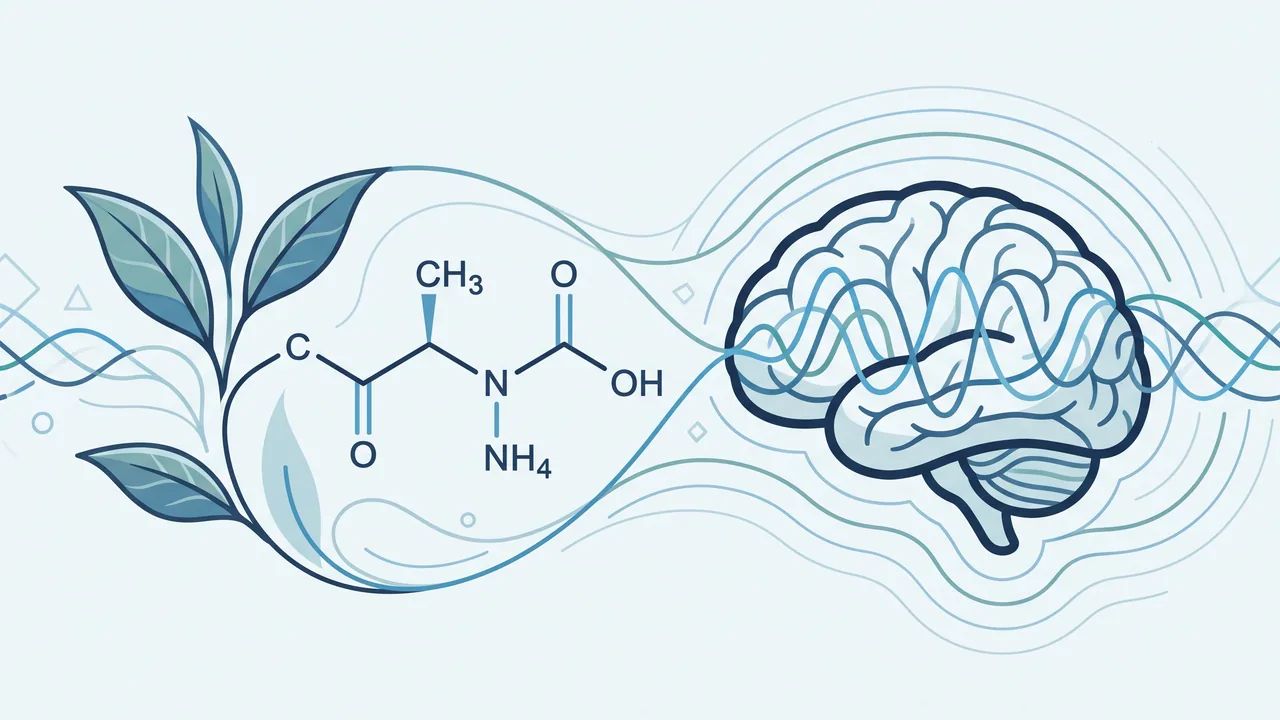
L-Theanine
Amino acids and derivatives. A research review published by South Beach Longevity.
L-Theanine
A tea amino acid whose relaxation claim is larger than the controlled human recordL-theanine is a non-protein amino acid that tea makes in quantity and that the supplement trade sells as calm without sleepiness. The chemistry is clean. The EEG story is older than the clinical one. This article keeps theanine alone apart from theanine plus caffeine, and it does not let tea epidemiology stand in for the molecule.
Compiled by South Beach Longevity · 20 August 2026 Copyright 2026 Series SBL-41 / SP-L-THEANINE · Register A scientific article Sources peer-reviewed human trials, meta-analyses, labelled animal and in-vitro work, and regulator opinions · verified NCBI records Constraint This document describes published research. It is not medical advice. No human use, dose, route or schedule is recommended anywhere in this document.
How to read this document Every finding is labelled, in the sentence that reports it, by the kind of study that produced it. An increase in posterior alpha power is not a treatment for anxiety. A tea-drinking cohort is not a theanine trial. A caffeine-plus-theanine attention task is not a theanine-alone result. Amounts and durations appear only as reported experimental parameters, always with the population attached. Nothing here is a recommendation.
Findings are graded in place as established, strongly supported, supported, emerging, plausible, or speculative, and where a claim fails on its own evidence, as refuted. Two further labels mark careful absences rather than verdicts: not established, where the evidence is too thin to place a claim on the ladder at all — untested or insufficient, an absence of proof rather than disproof; and not supported, where the weight of evidence leans against a claim but stops short of a formal refutation. They grade the reviewed record in hand, not the compound’s commercial future. Theanine-alone rows and theanine-plus-caffeine rows are never collapsed.
01 What L-theanine is — and what it is not
L-theanine is N-ethyl-L-glutamine, also written γ-glutamylethylamide. It is a non-proteinogenic amino acid. Tea (Camellia sinensis) accumulates it. Mammals do not encode it as a residue in protein. Vuong, Bowyer, and Roach mapped isolation, synthesis, and food occurrence and treated the molecule as characteristic of tea, not of the human diet at large (Vuong, Bowyer, and Roach, 2011). Türközü and Şanlier’s later review is the matching food-science survey (Türközü and Şanlier, 2017).
Four things follow immediately and will be enforced for the rest of this document.
First, L-theanine is not a protein amino acid and not a peptide. There is no theanine codon and no theanine RDA built from nitrogen balance. Protein-requirement language does not apply. The molecule is a side-chain amide of glutamate, not a chain of residues.
Second, L-theanine is not tea. A cup of tea also delivers caffeine, catechins, theobromine, fluoride, and a ritual. Observational associations with green-tea drinking are mixture epidemiology. They are not a theanine exposure trial. Vuong and colleagues showed that extraction conditions move theanine yield from leaf; brew is not a capsule (Vuong et al., 2011). That measurement is established as a warning against treating “tea” and “theanine” as synonyms.
Third, L-theanine is not D-theanine. Commercial enzymatic material sold as Suntheanine is the L-enantiomer. Tea leaf is overwhelmingly L. Receptor papers that used racemic or unspecified theanine must be labelled as such. Stereochemistry is load-bearing because glutamate-site ligands are stereoselective.
Fourth, this document is not medical advice and not a relaxation protocol. Reported milligrams appear only as study parameters attached to named populations. They are not instructions for any reader.
02 Chemistry and stereochemistry
The carbon skeleton is glutamate. The side-chain carboxylate has been converted to an N-ethylamide. At physiological pH the α-amino and α-carboxylate are ionised; the molecule is a zwitterion with a neutral amide. It is small, polar, and chemically quiet. That quietness is why tea can store millimolar leaf concentrations and why oral doses appear in plasma as the intact amide rather than as an immediate glutamate spike (Scheid et al., 2012; Terashima, Takido, and Yokogoshi, 1999).
The L-enantiomer is the tea enantiomer and the supplement enantiomer that the human trials used. Kakuda’s receptor work treated theanine as a weak ligand at ionotropic glutamate receptors (Kakuda, 2002; Kakuda et al., 2002). Weak is the operative word. Binding is strongly supported as a laboratory fact. High-affinity antagonism of NMDA, AMPA, or kainate receptors in living human cortex is not established by those membranes. Stereochemistry matters because the glutamate site prefers L-ligands. A D-contaminant, if present, would not license the same sentence.
Commercial forms are not one substance-history. Enzymatic L-theanine produced from glutamine and ethylamine (often trademarked Suntheanine) appears in several of the human EEG and stress papers. Other products are extracted from tea or made by chemical amidation (Vuong, Bowyer, and Roach, 2011). Analytical identity (chiral HPLC, optical rotation, residual ethylamine, residual caffeine/catechins in tea extracts) is a product-quality question, not a clinical one. This article grades the molecule as studied, not every bottle on a shelf.
03 Tea occurrence and biosynthesis
Sakato isolated theanine from gyokuro in 1949 and named it from thea — a historical agricultural-chemistry note that is not a PubMed clinical record (Sakato, 1949). Shade-grown leaves, used for gyokuro and matcha, accumulate more theanine because light-driven conversion into catechins is reduced. That agronomic fact is established in the tea-chemistry literature (Vuong, Bowyer, and Roach, 2011; Vuong et al., 2011). Ordinary green, oolong, and black infusions still contain theanine; the amount moves with cultivar, plucking, and extraction conditions.
Biosynthesis in tea is a glutamine-to-ethylamine transfer onto glutamate, catalysed in the leaf. The plant stores the product in the free-amino-acid pool. It is a flavour molecule — sweet, brothy, a contributor to umami — as well as a nitrogen reserve (Vuong, Bowyer, and Roach, 2011). Taste characterisation is food science. It is not a CNS mechanism.
A typical cup is a theanine-plus-caffeine delivery system. Extraction yields vary with water conditions (Vuong et al., 2011) and are often well below the 200 mg capsules used in laboratory stress studies. That gap is the first reason tea epidemiology cannot be read as a 200 mg theanine trial.
04 Isolation, naming, and commercial forms
The 1949 isolation paper is a Japanese agricultural-chemistry note, not a clinical trial (Sakato, 1949). The later industrial story is enzymatic L-theanine sold under trademarks such as Suntheanine; Lyon, Kapoor, and Juneja named that material in the ADHD-sleep study (Lyon, Kapoor, and Juneja, 2011). Some later trials do not name the source. Where the source is unnamed, the article says so.
Eschenauer and Sweet’s 2006 pharmacy review collected the early neuropharmacology and the then-thin human file (Eschenauer and Sweet, 2006). Nathan, Lu, Gray, and Stough’s neuropharmacology note is the matching psychopharmacology survey (Nathan et al., 2006). Both are syntheses. They are strongly supported as maps of a small literature. They are not a licence to treat every later marketing claim as already reviewed.
05 Absorption and plasma kinetics
Oral L-theanine is absorbed. Scheid, Teekachunhatean, Laisney, and colleagues measured kinetics after tea and after theanine and found rapid appearance in plasma, with a time to peak on the order of an hour and a plasma half-life on the order of an hour in that protocol (Scheid et al., 2012). That human PK paper is supported. It is not a brain-concentration paper.
Terashima, Takido, and Yokogoshi’s rat time-course showed theanine appearing in serum, liver, brain, and urine after oral administration, with tissue amino-acid shifts that were time-dependent and not a simple glutamate flood (Terashima, Takido, and Yokogoshi, 1999). That is an animal disposition study. It is strongly supported as a map of where the molecule goes in the rat. It is not a human CSF curve.
Caffeine co-ingestion is a separate kinetic question. Combination trials in Part Four measured performance, not a full interaction PK. Do not infer that theanine delays caffeine absorption, or the reverse, from attention scores.
06 Metabolism and elimination
The amide can be hydrolysed to glutamate and ethylamine. Scheid and colleagues recovered ethylamine in urine after oral theanine (Scheid et al., 2012). Intact theanine is also excreted. The metabolic neighbourhood is therefore glutamine/glutamate plus a small alkylamine, not a unique human cofactor.
That hydrolysis is why a “theanine raises brain glutamate” slogan is too coarse. A rise in peripheral glutamate after hydrolysis is not proof of synaptic glutamate release. Yokogoshi, Kobayashi, Mochizuki, and Terashima measured brain monoamines and amino acids after theanine in the rat and reported transmitter shifts that were region-specific (Yokogoshi et al., 1998). Those are animal neurochemistry results. They are emerging as mechanism. They are not human microdialysis.
07 CNS exposure
The rat brain sees theanine after oral or parenteral doses (Terashima, Takido, and Yokogoshi, 1999; Yokogoshi et al., 1998). Blood–brain barrier passage is strongly supported in rodents. Direct human brain or CSF quantification after ordinary oral amounts remains thin. White and colleagues used magnetoencephalography as a functional readout, not as a concentration assay (White et al., 2016). Gomez-Ramirez, Kelly, Montesi, and Foxe used scalp EEG the same way (Gomez-Ramirez et al., 2007). Functional imaging is not a mass-spectrometric exposure.
The gap matters for every glutamatergic sentence that follows. Receptor affinities measured in membranes can be real and still be irrelevant if free theanine at the synapse never approaches those concentrations. Kakuda’s binding paper does not close that gap (Kakuda et al., 2002).
08 Glutamatergic hypotheses
Theanine is a glutamate analogue. Kakuda, Nozawa, Sugimoto, and Niino reported inhibition of [³H]AMPA, [³H]kainate, and [³H]MDL 105,519 (NMDA-site) binding (Kakuda et al., 2002). Kakuda’s accompanying neuroprotection paper treated that weak antagonism as a candidate explanation for theanine’s effects against glutamate excitotoxicity in models (Kakuda, 2002). Those are in-vitro and animal results. They are plausible as a laboratory mechanism. They are not a demonstrated anxiolytic mechanism in people.
Ota, Wakabayashi, Sato, and colleagues used proton MRS in patients with schizophrenia and reported a change in a glutamatergic MRS signal after L-theanine (Ota et al., 2015). That is a disease-population imaging pilot. It is emerging. It does not generalise to healthy-adult relaxation, and it does not prove synaptic NMDA blockade.
The honest sentence is narrower than the marketing sentence. Theanine can interact with glutamate receptors in dishes and can change MRS signals in a small clinical sample. That is not the same claim as “theanine is a glutamate-calming amino acid that explains alpha waves and sleep.”
09 Other transmitter hypotheses
Yokogoshi and colleagues reported changes in brain serotonin, dopamine, and related amino acids after theanine in the rat (Yokogoshi et al., 1998). Later animal stress papers, including Unno’s theanine-and-psychosocial-stress series, treated GABAergic and monoaminergic shifts as candidate mediators of an anti-stress phenotype (Unno et al., 2013). Those packages are emerging. They are species-labelled.
Human trials almost never measure CSF transmitters. They measure VAS stress, STAI, PSQI, reaction time, and EEG. Mechanism-as-outcome is refused. A fall in a stress score is not proof that GABA rose.
10 Stress-physiology hypotheses
Kimura, Ozeki, Juneja, and Ohira put healthy adults under mental-arithmetic stress after 200 mg L-theanine or placebo and reported reductions in heart-rate and salivary secretory-IgA responses together with lower subjective stress (Kimura et al., 2007). That is a small acute laboratory study. It is the load-bearing human stress-physiology paper in the reviewed record. Grade: EMERGING, not because the methods were careless, but because n = 12 and the endpoint is a laboratory stressor.
Yoto, Motoki, Murao, and Yokogoshi compared L-theanine and caffeine under physical or psychological stress and reported that theanine attenuated the blood-pressure rise in that protocol (Yoto et al., 2012). Again: acute, small, healthy. Grade: EMERGING.
Unno and colleagues also reported an anti-stress effect in pharmacy students during a practice period, using a theanine intervention and salivary-stress markers (Unno et al., 2013). That is a small human field study, not a GAD trial. Separate animal psychosocial-stress papers from the same group remain species-labelled. Neither licences a general “adaptogen” claim.
11 Stress and anxiety
The human anxiety file is two objects: laboratory stress in healthy volunteers, and clinical anxiety disorders.
Laboratory stress. Kimura et al., 2007, is the cleanest acute physiological study (Kimura et al., 2007). White, de Klerk, Paterson, and colleagues tested 200 mg in healthy adults with a cognitive-stress battery and MEG; subjective stress moved in some analyses and alpha-band activity moved in some conditions (White et al., 2016). Hidese, Ota, Wakabayashi, Noda, and colleagues gave 200 mg daily for four weeks to healthy adults and reported reductions in stress-related symptom scores plus sleep and verbal-fluency movement (Hidese et al., 2019). Williams, Everett, Butler, and Brown’s review collected that healthy-adult stress file and treated it as suggestive rather than settled (Williams et al., 2016). Grade for a short-term reduction of laboratory or questionnaire stress in healthy adults: EMERGING.
Clinical anxiety. Lu, Gray, Ruwe-Hayler, and Camfield compared 200 mg L-theanine with 1 mg alprazolam and placebo in an anticipatory-anxiety model. Theanine increased a “tranquil” rating at rest. Neither theanine nor alprazolam reduced anxiety during the threat condition in that design (Lu et al., 2004). Sarris, Byrne, Bousman, Cribb, and colleagues tested L-theanine as adjunctive treatment in generalised anxiety disorder; the primary HAM-A contrast did not separate from placebo (Sarris et al., 2019). Those two papers are the brake. Grade for theanine as an anxiolytic medicine in GAD or anticipatory anxiety: NOT SUPPORTED.
The commercial sentence “clinically proven for anxiety” collapses those two objects. This article does not.
12 Attention and cognition without caffeine
Theanine-alone cognition in healthy adults is thinner than the combination file.
Hidese et al., 2019, reported verbal-fluency and letter-fluency movement after four weeks in healthy adults (Hidese et al., 2019). Baba, Inagaki, Okada, Nagai, and colleagues tested a 12-week course in middle-aged and older adults and reported Stroop and verbal-fluency improvements on selected analyses (Baba et al., 2021). Camfield, Scholey, and colleagues tested tea constituents — L-theanine, caffeine, and EGCG — in an acute design and did not treat isolated theanine as a general cognitive enhancer (Camfield et al., 2014).
Grade for isolated theanine as a general cognitive enhancer in healthy adults: EMERGING at best, NOT ESTABLISHED across tasks. Grade for isolated theanine as a treatment for cognitive impairment: NOT SUPPORTED.
Dassanayake, Kahathuduwa, and Weerasinghe later reported neurophysiological attention measures after theanine (Dassanayake, Kahathuduwa, and Weerasinghe, 2022). That is a surrogate-heavy paper. It is filed under EEG in section 18, not as a clinical cognition trial.
13 Sleep
Lyon, Kapoor, and Juneja gave 400 mg L-theanine to boys with ADHD and reported improved objective sleep quality on actigraphy (Lyon, Kapoor, and Juneja, 2011). That is a special-population paediatric study, not a general insomnia trial. Hidese et al., 2019, reported PSQI movement in healthy adults after four weeks (Hidese et al., 2019). Sarris et al., 2019, reported some insomnia-item movement as a secondary finding in GAD, against a negative primary anxiety endpoint (Sarris et al., 2019). Grade for isolated theanine as a hypnotic: NOT SUPPORTED. Grade for a modest improvement in sleep quality scores in selected samples: EMERGING. Actigraphy in ADHD boys is not adult primary insomnia.
14 Relaxation without sedation
This is the marketing hinge. The supporting human sentences are: increased resting “tranquil” ratings (Lu et al., 2004); reduced laboratory-stress ratings and autonomic responses (Kimura et al., 2007; Yoto et al., 2012); increased resting alpha in some EEG sessions (Nobre, Rao, and Owen, 2008; White et al., 2016); and the absence of a robust sedative signal in the acute healthy-adult trials.
The opposing human sentences are: no reduction of anticipatory anxiety under threat (Lu et al., 2004); no primary GAD benefit (Sarris et al., 2019); small n; industry-adjacent products; and EEG that is a surrogate.
Grade for “relaxation without sedation” as a phenomenological description of some acute healthy-adult sessions: EMERGING. Grade for the same phrase as a clinically demonstrated anxiolytic profile: NOT SUPPORTED.
Sedation was not systematically excluded with a driving simulator or a validated psychomotor battery in every positive stress paper. “Without sedation” is often an inference from the absence of reported sleepiness, not a pre-specified non-inferiority test against a sedative.
15 Blood pressure and acute stress responses
Yoto et al., 2012, is the load-bearing acute BP-under-stress paper (Yoto et al., 2012). Yokogoshi, Mochizuki, and Saitoh’s older spontaneously-hypertensive-rat work showed a blood-pressure reduction after theanine in that model (Yokogoshi, Mochizuki, and Saitoh, 1995). Rogers, Smith, Heatherley, and colleagues studied tea, caffeine, and theanine in humans and reported that theanine could attenuate caffeine’s blood-pressure effect in some analyses (Rogers et al., 2008).
Grade for a durable antihypertensive indication: NOT SUPPORTED. Grade for an acute attenuation of a laboratory stressor’s pressor response: EMERGING. Tea-drinking BP epidemiology is not filed here.
16 Psychiatric and special-population pilots
Ritsner, Miodownik, Ratner, and colleagues tested L-theanine as an adjunct in schizophrenia and reported movement on positive, negative, and anxiety symptom scales (Ritsner et al., 2011). Ota et al., 2015, is the MRS companion in a related clinical frame (Ota et al., 2015). Lyon et al., 2011, is the ADHD-sleep study (Lyon, Kapoor, and Juneja, 2011). Sarris et al., 2019, is the GAD adjunct (Sarris et al., 2019).
These are disease-population pilots. They do not generalise to healthy adults, and they do not generalise to each other. Grade: EMERGING as signals; NOT SUPPORTED as licensed psychiatric indications.
17 Theanine plus caffeine
This is a different evidence object. Haskell, Kennedy, Milne, Wesnes, and Scholey tested 250 mg L-theanine, 150 mg caffeine, the combination, and placebo in healthy adults. The combination improved attention and reduced distractibility more cleanly than either component alone in that design (Haskell et al., 2008). Owen, Parnell, De Bruin, and Rycroft used tea-like amounts — 100 mg theanine plus 50 mg caffeine — and reported faster, more accurate attention switching (Owen et al., 2008). Giesbrecht, Rycroft, Lorenzetti, and Schmitt used 97 mg theanine plus 40 mg caffeine and reported improved attention switching and alertness (Giesbrecht et al., 2010). Foxe, Morie, Rand-Giovannetti, and colleagues tested caffeine and theanine on the maintenance of visuospatial attention during a sustained-attention task; the combination was the cleaner arm (Foxe et al., 2012). Kelly, Gomez-Ramirez, Montesi, and Foxe reported that the combination, not always theanine alone, moved oscillatory alpha in a way that tracked the cognitive effect (Kelly et al., 2008). Kahathuduwa, Dassanayake, Weerasinghe, and Amarakoon added an fMRI attention design (Kahathuduwa et al., 2017). Dodd, Kennedy, Riby, and Haskell-Ramsay ran a further double-blind combination study (Dodd et al., 2015). Giles, Mahoney, and Kanarek examined caffeine and theanine on attention and did not treat theanine as a simple amplifier of every caffeine effect (Giles et al., 2017).
Dietz and Dekker’s green-tea phytochemical review and Camfield’s acute tea-constituent study both treat the combination, not isolated theanine, as the more coherent cognitive story (Dietz and Dekker, 2017; Camfield et al., 2014).
Grade for a short-lived improvement on laboratory attention and alertness tasks after theanine-plus-caffeine in healthy young adults: SUPPORTED. Grade for isolated theanine as the active fraction of that combination: NOT SUPPORTED — the factorial papers are the reason. Grade for academic, occupational, or clinical cognitive outcomes: NOT SUPPORTED.
Rogers et al., 2008, is the mood/jitter paper: caffeine can raise jitteriness; theanine may blunt some of that in a tea-component design (Rogers et al., 2008). That is a combination-psychology finding, not a theanine-alone anxiolytic.
18 EEG and alpha-wave surrogates
Kakuda, Nozawa, Unno, and colleagues evaluated theanine against caffeine stimulation with EEG as early as 2000 (Kakuda et al., 2000). Nobre, Rao, and Owen summarised the later alpha-band line and placed an alpha rise at roughly 45–60 minutes after a 50 mg session (Nobre, Rao, and Owen, 2008). Gomez-Ramirez et al. measured alpha during intersensory selective attention (2007) and during a visuo-spatial attention task (2009); theanine changed alpha, but not always as a simple “more alpha equals more calm” story — task-related alpha can fall when attention is deployed (Gomez-Ramirez et al., 2007; Gomez-Ramirez et al., 2009). White et al., 2016, added MEG (White et al., 2016). Kelly et al., 2008, and Foxe et al., 2012, tied oscillatory change to combination cognition (Kelly et al., 2008; Foxe et al., 2012).
Alpha is a real electrophysiological signal. It is also a popular wellness metaphor. The two must be kept apart.
What the EEG file can show: oral theanine can change posterior or attention-related alpha in small laboratory sessions. Grade for that electrophysiological claim: SUPPORTED.
What the EEG file cannot show: that those changes are clinically meaningful, that they mediate anxiety reduction, that they prove “relaxed alertness” as a medical state, or that they predict sleep or GAD outcomes. Grade for clinical meaning of alpha change: NOT SUPPORTED.
Dimpfel’s Source-of-theanine EEG work sits in the same surrogate class (Dimpfel, 2007). It does not upgrade the clinical grade.
19 Tea epidemiology is not a theanine trial
Green-tea cohorts have been associated with cardiovascular, metabolic, and mortality signals in observational work. Those papers measure a beverage habit. They do not measure plasma theanine, they do not randomise theanine, and they cannot hold caffeine, catechins, smoking, diet, and socioeconomic confounding still.
Bryan’s review of tea’s psychological effects and Dietz and Dekker’s phytochemical review both treat tea as a mixture (Bryan, 2008; Dietz and Dekker, 2017). Einöther and Martens reviewed acute tea effects the same way (Einöther and Martens, 2013).
Grade for attributing tea-epidemiology findings to L-theanine: NOT SUPPORTED. That is a Adversarial resolution, not a footnote.
20 Safety and product quality
Borzelleca and Peters reported a 13-week dietary toxicity and toxicokinetic study of L-theanine in rats and did not find a pattern that would mark the compound as acutely hostile at the doses tested (Borzelleca and Peters, 2006). Human trials in the reviewed record report headache, gastrointestinal discomfort, or nothing distinctive; they are short and small. Shao-and-Hathcock-style risk assessments in the amino-acid literature are not a substitute for long-term disease-outcome safety.
Special populations: pregnancy and lactation have a LactMed-class evidence gap rather than a demonstrated harm signal. Psychiatric adjunct papers (Ritsner et al., 2011; Sarris et al., 2019) are not a general safety licence. Product quality varies: tea extracts can carry caffeine; chemical syntheses can carry residual ethylamine; chiral purity is not guaranteed by the word “theanine” on a label.
Grade for short-term tolerability in healthy-adult trials: SUPPORTED (generally tolerated in that file). Grade for long-term disease-outcome safety: NOT ESTABLISHED.
21 Regulation and health-claim status
L-theanine is sold as a dietary ingredient, not as an approved anxiolytic or hypnotic drug. An EFSA panel opinion in the reviewed record evaluated a black-tea attention claim and did not convert a tea mixture into an isolated-theanine medicine (EFSA NDA Panel, 2018). Camfield’s acute constituent study is the matching scientific caution (Camfield et al., 2014). This article does not treat a GRAS or novel-food status as efficacy.
22 Research matrices
Cognition and attention — isolated theanine
| Study | Population | Design | Amount as studied | Endpoint | Direction | Grade contribution |
|---|---|---|---|---|---|---|
| Hidese et al., 2019 | Healthy adults, n = 30 | R, 4 weeks | 200 mg/day | Verbal / letter fluency; STAI/SDS | Positive on selected tests | EMERGING |
| Baba et al., 2021 | Middle-aged / older | R, 12 weeks | ~100 mg/day class | Stroop, verbal fluency | Positive on selected analyses | EMERGING |
| Camfield et al., 2014 | Healthy adults | Acute tea constituents | Theanine, caffeine, EGCG | Cognition, mood | Isolated theanine not a general enhancer | Brake |
| Dassanayake et al., 2022 | Healthy adults | Acute neurophysiology | As reported | Attention EEG/ERP | Surrogate | Not a clinical grade |
Cognition and attention — theanine plus caffeine
| Study | Population | Design | Amounts as studied | Isolated theanine? | Endpoint | Direction | Grade contribution |
|---|---|---|---|---|---|---|---|
| Haskell et al., 2008 | Healthy, n = 24 | R, XO, factorial | 250 mg theanine, 150 mg caffeine | Yes, as an arm | Attention, mood | Combo cleanest | SUPPORTED spine |
| Owen et al., 2008 | Healthy, n = 27 | R, XO | 100 mg + 50 mg | Combo | Attention switching | Positive combo | SUPPORTED |
| Giesbrecht et al., 2010 | Healthy, n = 44 | R | 97 mg + 40 mg | Combo | Attention, alertness | Positive combo | SUPPORTED |
| Foxe et al., 2012 | Healthy, n = 27 | R, factorial | Caffeine + theanine | Yes, as an arm | Visuospatial sustained attention | Combo cleaner | SUPPORTED |
| Kelly et al., 2008 | Healthy | Factorial + EEG | Combination | Yes, as an arm | Alpha + cognition | Combo | Surrogate + task |
| Kahathuduwa et al., 2017 | Healthy | Acute fMRI | Combination | Combo | Attention network | Positive combo | EMERGING–SUPPORTED |
| Dodd et al., 2015 | Healthy | R, DB | Combination | Combo | Cognition | Combination file | EMERGING–SUPPORTED |
| Giles et al., 2017 | Healthy | Factorial | Caffeine, theanine | Yes | Attention | Not a simple add | Qualifier |
| Rogers et al., 2008 | Healthy | Tea-component | Caffeine ± theanine | Partial | Mood, BP, jitter | Theanine blunts some caffeine | Combination psychology |
Stress and anxiety
| Study | Population | Design | Isolated? | Endpoint | Direction | Grade |
|---|---|---|---|---|---|---|
| Kimura et al., 2007 | Healthy, n = 12 | Acute stressor | Yes, 200 mg | HR, sIgA, VAS | Reduced stress response | EMERGING |
| Lu et al., 2004 | Healthy, n = 16 | Anticipatory anxiety | Yes, 200 mg vs alprazolam | Tranquil rating; threat anxiety | Rest +; threat null | NOT ESTABLISHED |
| White et al., 2016 | Healthy, n = 34 | Acute cognitive stress + MEG | Yes, 200 mg | Stress, alpha | Mixed | EMERGING |
| Yoto et al., 2012 | Healthy | Physical / psychological stress | Yes vs caffeine | BP | Theanine attenuated rise | EMERGING |
| Hidese et al., 2019 | Healthy, n = 30 | 4 weeks | Yes, 200 mg/day | STAI, SDS, PSQI | Improved scores | EMERGING |
| Sarris et al., 2019 | GAD adjunct | R, DB | Yes, 450–900 mg class | HAM-A primary | Null primary | NOT SUPPORTED as anxiolytic |
| Unno et al., 2013 | Pharmacy students | Field intervention | Yes as reported | Salivary stress markers | Reduced in that period | EMERGING |
| Unno et al., 2013 | Mice / tea models | Preclinical | N/A | Stress behaviour | Positive animal | Not a human grade |
Sleep
| Study | Population | Design | Isolated? | Endpoint | Direction | Grade |
|---|---|---|---|---|---|---|
| Lyon, Kapoor, Juneja, 2011 | Boys with ADHD | Controlled, 400 mg | Yes | Actigraphy sleep quality | Improved | EMERGING (special population) |
| Hidese et al., 2019 | Healthy adults | 4 weeks, 200 mg/day | Yes | PSQI | Improved score | EMERGING |
| Sarris et al., 2019 | GAD | Adjunct RCT | Yes | Insomnia items (secondary) | Some movement | Not a primary sleep trial |
| Isolated theanine as hypnotic | — | — | — | Sleep onset as a drug | Absent | NOT SUPPORTED |
EEG surrogate table
| Study | Amount as studied | Signal | Task | Clinical endpoint attached? | Grade as physiology | Grade as clinical meaning |
|---|---|---|---|---|---|---|
| Kakuda et al., 2000 | As reported | EEG vs caffeine stimulation | Resting / stimulation | No | SUPPORTED | NOT SUPPORTED |
| Nobre, Rao, Owen, 2008 | 50 mg class | ↑ alpha ~45–60 min | Resting / review | No | SUPPORTED | NOT SUPPORTED |
| Gomez-Ramirez et al., 2007 | 250 mg | Alpha during visuo-spatial attention | Attention | No | SUPPORTED | NOT SUPPORTED |
| Gomez-Ramirez et al., 2009 | 250 mg | Intersensory attention alpha | Attention | No | SUPPORTED | NOT SUPPORTED |
| Kelly et al., 2008 | Combo ± theanine | Alpha tracks combo cognition | Attention | No | SUPPORTED | NOT SUPPORTED |
| White et al., 2016 | 200 mg | MEG alpha, mixed stress | Cognitive stress | Subjective stress only | EMERGING–SUPPORTED | NOT SUPPORTED |
| Foxe et al., 2012 | Combo | Task-switching + EEG context | Switching | No | SUPPORTED as combo | NOT SUPPORTED |
| Dimpfel, 2007 | Source theanine | EEG profile | Resting | No | EMERGING | NOT SUPPORTED |
23 Adversarial resolutions
Are alpha-wave changes clinically meaningful? No. Resolved on Nobre 2008, Gomez-Ramirez 2007/2009, White 2016, Kelly 2008, and the absence of a mediation analysis linking alpha to HAM-A, PSQI, or functional outcomes. Alpha is a real surrogate. Clinical meaning is NOT SUPPORTED.
Does “relaxation without sedation” withstand controlled evidence? Only as a weak phenomenological description of some acute healthy-adult sessions (Kimura 2007; Lu 2004 rest condition; Hidese 2019 scores). It fails as a clinical anxiolytic profile (Lu 2004 threat condition; Sarris 2019 primary). Sedation was not rigorously excluded. Grade: EMERGING as a laboratory mood description; NOT SUPPORTED as a therapeutic claim.
Are benefits mainly apparent when combined with caffeine? For attention and alertness in healthy adults, yes. Haskell 2008, Owen 2008, Giesbrecht 2010, Foxe 2012, and Camfield 2014 are the spine. Isolated-theanine cognition is thinner. Stress and sleep claims live in the theanine-alone file and remain EMERGING. Grade: SUPPORTED for the combination-cognition claim; NOT SUPPORTED for isolated theanine as the combination’s active fraction.
Are small subjective outcomes vulnerable to expectancy? Yes. The positive healthy-adult stress papers are small, often crossover or single-site, often industry-adjacent (Suntheanine), and often VAS/STAI/PSQI. Expectancy and residual caffeine in tea-extract products are live threats. Sarris 2019 is the useful negative control: a larger, clinical, primary endpoint did not move. Grade of the threat: STRONGLY SUPPORTED as a methodological caution. It does not prove every positive result is fake; it forbids over-reading them.
Are tea epidemiology findings incorrectly attributed to theanine? Yes, if they are. Tea is a mixture. Vuong 2011 showed extraction yield is not a capsule. Bryan 2008, Dietz and Dekker 2017, and Einöther and Martens 2013 treat tea psychology as mixture psychopharmacology. Attribution of tea-cohort outcomes to L-theanine is NOT SUPPORTED.
24 Where the record stands
The chemistry is established. Tea occurrence is established. Human plasma kinetics are supported. Rodent CNS exposure is strongly supported; human brain concentration is not. Glutamatergic binding is a plausible laboratory mechanism and a not established clinical mechanism. Alpha-band change is a supported electrophysiological finding with no demonstrated clinical meaning.
Theanine alone has an emerging healthy-adult stress and sleep-quality file and a negative primary GAD test. Theanine plus caffeine has a supported short-task attention file in young adults. Neither object is a medicine. Neither object inherits tea’s observational reputation.
What would change the grades: a multi-site GAD or insomnia RCT with a pre-specified primary; a factorial theanine × caffeine trial with a functional (not only laboratory) endpoint; a human CSF or PET exposure study that meets Kakuda-range receptor occupancy; a mediation test from alpha to a clinical scale. Until those exist, the aisle is ahead of the file.
Standing constraint This document describes published research. It is not medical advice. No human use, dose, route or schedule is recommended anywhere in this document.
25 Evidence handling
Study types are labelled in the sentence that reports them. Animal neurochemistry, membrane binding, EEG, healthy-adult laboratory tasks, disease-population pilots, systematic reviews, and tea epidemiology are not interchangeable. Conflict is presented in the same section as the positive finding. Amounts are study parameters, not recommendations.
References in the numbered list are generated from verified NCBI records (05_reference_list.py). Project 06 was used for discovery only; Project 05 remains NOT_IMPORTED. This title is not a Radix peptide article and is not filed in Desktop\PEPTIDE MONOGRAPHS.
Sibling scope: Amino-Acid Nutrition is the class title. This article is the theanine depth title. Tea as a beverage, caffeine as a stimulant, and green-tea catechins are neighbouring files, not this one.
References
Continue reading