
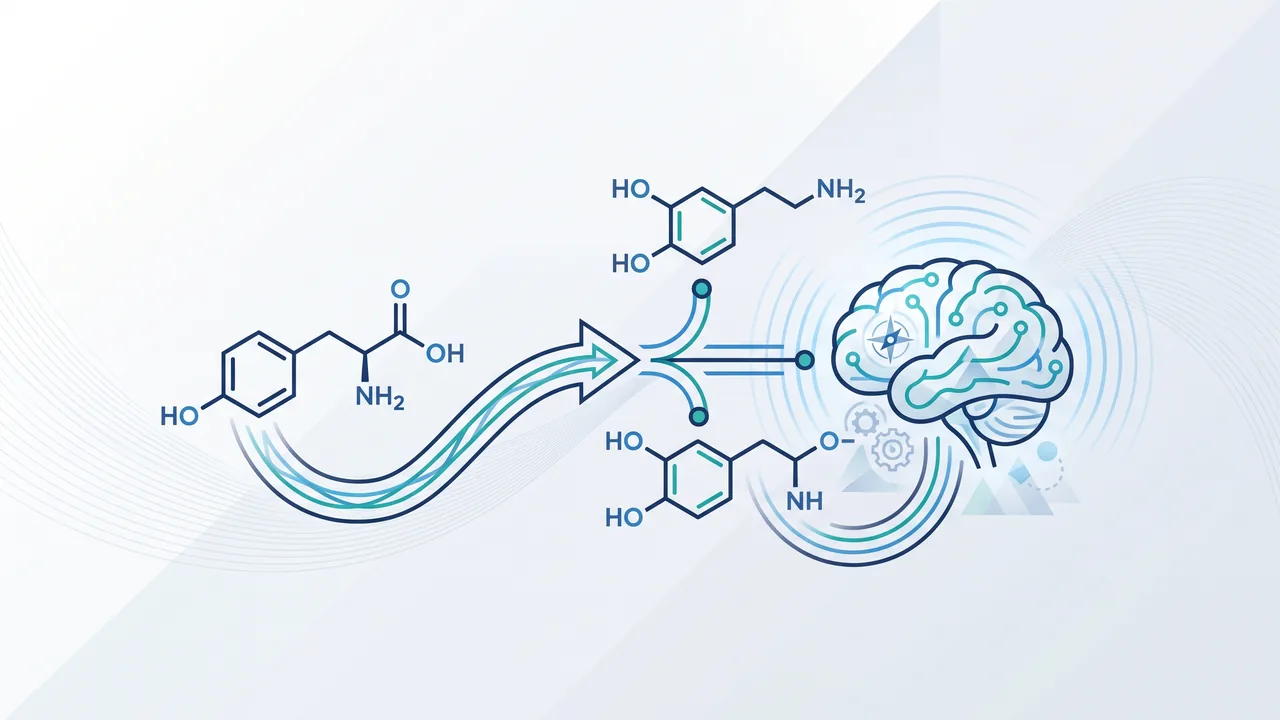
L-Tyrosine and N-Acetyl-L-Tyrosine
Amino acids and derivatives. A research review published by South Beach Longevity.
L-Tyrosine and N-Acetyl-L-Tyrosine
A catecholamine precursor whose cognitive effects are stress-contingent, and an acetylated form that dissolves more readily than it deliversL-tyrosine is the immediate precursor of the catecholamines and a residue that thyroglobulin iodinates. Raising its plasma level can matter when tyrosine hydroxylase is not already saturated and when other large neutral amino acids are not occupying the same transporter. That is a stress-physiology claim, not a stimulant claim. N-acetyl-L-tyrosine does not inherit it by dissolving more readily.
Compiled by South Beach Longevity · 20 August 2026 Copyright 2026 Series SBL-41 / SP-L-TYROSINE-AND-NALT · Register A scientific article Sources peer-reviewed human trials, labelled animal and in-vitro work, parenteral nutrition studies, verified NCBI records Constraint This document describes published research. It is not medical advice. No human use, dose, route or schedule is recommended anywhere in this document.
How to read this document Every finding is labelled, in the sentence that reports it, by the kind of study that produced it. In vitro means a cell or a reconstituted enzyme. Animal names the species. Human means people. A plasma tyrosine rise is not a brain dopamine rise. A working-memory task under cold water is not a civilian mood claim. Amounts and durations appear only as reported experimental parameters, always with the system attached. Nothing here is a recommendation. Findings are graded in place as established, strongly supported, emerging, plausible, or speculative. Two further labels mark careful absences rather than verdicts: not established, where the evidence is too thin to place a claim on the ladder at all — untested or insufficient, an absence of proof rather than disproof; and not supported, where the weight of evidence leans against a claim but stops short of a formal refutation.
01 The controlling question
The market sentence is simple: tyrosine makes dopamine; more tyrosine makes more dopamine; more dopamine makes a person sharper, calmer under pressure, or both. The laboratory sentence is longer. L-tyrosine is an aromatic amino acid. Phenylalanine hydroxylase can make it from L-phenylalanine. Tyrosine hydroxylase can hydroxylate it to L-DOPA. Aromatic L-amino acid decarboxylase, dopamine β-hydroxylase, and phenylethanolamine N-methyltransferase finish the catecholamine chain. Thyroglobulin uses other tyrosine residues as the scaffold for iodothyronines (Contreras-Jurado, 2025; Young and Arvan, 2026). Those facts are established as biochemistry. They do not licence a stimulant.
This article asks five questions and refuses to let them collapse. First: under what conditions is tyrosine hydroxylase precursor-sensitive rather than enzyme-saturated? Second: do the human trials that survive a hostile reading cluster under acute stress, or do they also appear at rest? Third: are military and laboratory stressors generalisable to ordinary cognitive load? Fourth: is N-acetyl-L-tyrosine a superior tyrosine source, or a solubility patch that the kidney largely returns unused? Fifth: are catecholamine mechanisms, and stimulant-like marketing, over-read from a plasma amino-acid change?
The sibling titles on ergogenic aids and amino-acid nutrition already grade many consumer amino acids. This title is the tyrosine depth cut. It keeps the chemistry. It drops the slogan.
02 Chemistry and nutritional identity
L-tyrosine is 2-amino-3-(4-hydroxyphenyl)propanoic acid. The phenolic hydroxyl is the chemical fact that later matters twice: once for the tetrahydropterin-dependent aromatic hydroxylases, and once for iodination on thyroglobulin. It is a large neutral amino acid. It shares the System L transporter at the blood–brain barrier with phenylalanine, tryptophan, leucine, isoleucine, valine, and methionine (Pardridge and Oldendorf, 1975; Fernstrom, 2013).
Nutritionally, tyrosine is dispensable when phenylalanine hydroxylase and tetrahydrobiopterin are intact, and conditionally indispensable when they are not. That is a metabolic classification, not a marketing category. The consumer word “essential” is doing different work from the nutrition word. This document uses the metabolic one.
Oral L-tyrosine raises plasma tyrosine in humans. Glaeser, Melamed, Growdon, and Wurtman reported that a single oral load elevated plasma tyrosine (Glaeser et al., 1979). Melamed and colleagues then showed, in eleven humans eating 113 g of protein per day, that 100 mg/kg/day of L-tyrosine, given in three divided doses before meals, raised plasma tyrosine further and increased the plasma tyrosine ratio to the competing large neutral amino acids from 0.13 to 0.21 (Melamed et al., 1980). The other competing amino acids did not rise. That ratio, not the absolute tyrosine concentration, is the variable the blood–brain barrier sees (Wurtman and Fernstrom, 1975; Fernstrom, 2013).
A carbohydrate load can move the same ratio from the other side. Pan, Mauron, Glaeser, and Wurtman showed that oral glucose lowered plasma large-neutral-amino-acid concentrations in humans, with branched-chain amino acids falling 35–41% after a 50 g glucose drink and tryptophan falling less, so the tryptophan ratio rose (Pan et al., 1982). The paper is a glucose paper. It is cited here because it demonstrates the competitive arithmetic: an amino-acid ratio can change without anyone swallowing the amino acid of interest.
03 Phenylalanine, PAH, and the first hydroxylase
Phenylalanine hydroxylase (PAH) converts L-phenylalanine to L-tyrosine using tetrahydrobiopterin and a non-heme iron centre. Tyrosine hydroxylase (TH) and tryptophan hydroxylase are the sibling enzymes (Fitzpatrick, 2015; Fitzpatrick, 2023; Roberts and Fitzpatrick, 2013). The three share a catalytic domain and a tetrahydropterin-dependent electrophilic aromatic substitution. They do not share regulation. PAH is activated by phenylalanine binding to an allosteric site. TH is regulated by catecholamine binding in the active site and by phosphorylation (Fitzpatrick, 2015). Treating “the hydroxylases” as one switch is the first collapse this title refuses.
PAH deficiency is phenylketonuria. That disease is not a tyrosine-supplement article, and this document does not treat it as one. It is mentioned only to fix the nutritional relationship: when PAH cannot make tyrosine, tyrosine becomes an indispensable amino acid. That is a disease-state fact. It is not evidence that a person with intact PAH is tyrosine-deficient at breakfast.
04 Thyroid hormone is a tyrosine chemistry, not a tyrosine pill
Thyroid follicular cells iodinate selected tyrosine residues on thyroglobulin. Mono- and di-iodotyrosine are the stored iodide forms; T4 and T3 are the hormonogenic products liberated after endocytosis and lysosomal proteolysis (Contreras-Jurado, 2025; Young and Arvan, 2026). The chemistry is established. The inference that oral L-tyrosine or NALT is a thyroid intervention is speculative and is not supported by any human thyroid-function trial in the verified set for this title.
Young and Arvan’s 2026 review is a thyroglobulin and evolution paper. It is not a supplement paper. Contreras-Jurado’s overview is a methods-volume chapter on thyroid-hormone biochemistry. Neither paper measures TSH, free T4, or free T3 after tyrosine ingestion. The commercial sentence that “tyrosine supports thyroid” is a residue-to-gland leap. This document records the residue and stops.
05 Two commercial objects that must not be collapsed
L-tyrosine is the free amino acid. N-acetyl-L-tyrosine (NALT) is the N-acetylated analogue invented because free tyrosine is poorly soluble in parenteral amino-acid solutions (Magnusson et al., 1989; Hoffer et al., 2003; Van Goudoever et al., 1994). The acetylation solves a pharmacy problem. Whether it solves a delivery problem is Part Four.
Calling NALT “tyrosine” in a product title is the same error as calling a dipeptide “the amino acid.” The label names a precursor. The physiology asks whether deacetylation occurs at a useful rate, in a useful compartment, without dumping most of the dose into urine. Those are empirical questions. They are not implied by solubility.
06 LAT1 and competition among large neutral amino acids
Pardridge and Oldendorf measured blood–brain-barrier amino-acid transport in the anaesthetised rat with a carotid single-injection method. The fourteen amino acids they tested showed saturable Michaelis–Menten kinetics; Km values ranged from 0.09 mM (arginine) to 0.75 mM (cycloleucine) (Pardridge and Oldendorf, 1975). The paper is the kinetic foundation for later System L / LAT1 (SLC7A5) work. Scalise and colleagues reviewed the human LAT1/CD98 heterodimer as a sodium-independent antiporter of large neutral amino acids, expressed at the blood–brain barrier and placenta (Scalise et al., 2018). That is established as transporter biology.
Fernstrom’s 2013 synthesis is the load-bearing human-nutrition statement. Ingesting large neutral amino acids modifies tryptophan and tyrosine uptake into brain and their conversion to serotonin and catecholamines because the transporter is competitive. Raising blood tyrosine raises tyrosine uptake. Raising blood branched-chain amino acids lowers tyrosine and tryptophan uptake. Protein meals, in that review, swing brain tryptophan and serotonin far more than they swing tyrosine and catecholamine synthesis (Fernstrom, 2013). The asymmetry matters. A protein shake is not a tyrosine-loading experiment, and a tyrosine capsule is not a protein meal.
Wurtman and Fernstrom had already shown, in the rat, that a protein-free carbohydrate meal raises brain tryptophan and serotonin, while adding protein suppresses those rises because protein contributes more competing large neutral amino acids than tryptophan (Wurtman and Fernstrom, 1975). A 40% protein meal, in the same paper, raised brain tyrosine and accelerated catecholamine synthesis as estimated by DOPA accumulation after decarboxylase inhibition. Those are animal precursor-availability results. They are strongly supported as rat neurochemistry. They are not a human dosing protocol.
07 Tyrosine hydroxylase and the saturation problem
TH is the first committed step of catecholamine synthesis. Roberts and Fitzpatrick reviewed the catalytic cycle: a tetrahydropterin-dependent generation of an Fe(IV)=O intermediate, then electrophilic aromatic hydroxylation of tyrosine to L-DOPA (Roberts and Fitzpatrick, 2013). The enzyme can be precursor-sensitive. It is not always waiting.
The Wurtman laboratory’s rat microdialysis papers are the cleanest statement of when precursor supply matters. During, Acworth, and Wurtman showed that intraperitoneal tyrosine raised extracellular dopamine in striatum and nucleus accumbens, more so in accumbens, and that the rise was transient (During, Acworth, and Wurtman, 1988; During, Acworth, and Wurtman, 1989; Acworth, During, and Wurtman, 1988). Pretreatment with haloperidol or partial nigrostriatal lesioning enlarged and prolonged the effect, which the authors read as receptor-mediated feedback limiting the response under basal firing (During, Acworth, and Wurtman, 1989). Phenylalanine at 200 mg/kg raised striatal dopamine release; 500 mg/kg did not; 1,000 mg/kg reduced it — a reminder that the competing LNAA can cut both ways (During, Acworth, and Wurtman, 1988).
Lehnert, Reinstein, Strowbridge, and Wurtman showed, in the rat, that uncontrollable tail-shock depleted norepinephrine and reduced exploration, and that a tyrosine-enriched diet prevented some of those changes (Lehnert et al., 1984). That is the animal warrant later military papers invoke. It is an animal stress result. It is strongly supported for that protocol. It is not a human office-stress result.
The controlling biochemical claim is therefore conditional. TH is precursor-sensitive when firing is high and stores are being drawn down. Under basal conditions, feedback and saturation limit the effect (Acworth, During, and Wurtman, 1988; During, Acworth, and Wurtman, 1989; Lehnert and Wurtman, 1993). Young restated the same rule for clinicians: tyrosine does not seem to enhance catecholamine release when neurons fire at basal rates, but it does when firing is increased by stress (Young, 2007). That sentence is the thesis of Part Three.
08 Dopamine, norepinephrine, epinephrine
The pathway after L-DOPA is textbook and established: AADC to dopamine, dopamine β-hydroxylase to norepinephrine, PNMT to epinephrine in the adrenal medulla and a few brainstem neurons. This document does not re-litigate the enzymes. It litigates the inference.
A plasma tyrosine rise after an oral load (Glaeser et al., 1979; Melamed et al., 1980) is a human pharmacokinetic fact. A striatal dopamine rise after intraperitoneal tyrosine in a rat (During, Acworth, and Wurtman, 1988) is an animal dialysis fact. A better score on a delayed matching-to-sample task in cold air (Shurtleff et al., 1994; Mahoney et al., 2007) is a human behavioural fact. Connecting the three into “tyrosine increases dopamine, therefore working memory improved” is a mechanism story. It is plausible. It is not measured in the same subjects in the verified set.
Lieberman reviewed military nutrition and cognitive performance and wrote that tyrosine “appears to prevent the substantial decline in various aspects of cognitive performance and mood associated with many kinds of acute stress” (Lieberman, 2003). That is a reviewer’s summary of a military literature, not a dopamine assay. The same laboratory later reported that tyrosine increased anger during severe psychological stress (Lieberman et al., 2015). A precursor that can raise anger under stress is not a general mood tonic. It is a catecholamine-adjacent intervention with a sign that can flip.
09 What a plasma rise does and does not prove
Melamed and colleagues showed that oral tyrosine can raise the plasma tyrosine ratio in fed humans (Melamed et al., 1980). Wurtman and colleagues later showed that ordinary carbohydrate-rich or protein-rich meals also move tryptophan and tyrosine ratios (Wurtman et al., 2003; Fernstrom et al., 2013). The existence of a plasma effect is established. The size of the brain effect in a resting adult is the open variable.
Fernstrom’s LNAA review is explicit that protein-induced swings are large for tryptophan/serotonin and minimal for tyrosine/catecholamines (Fernstrom, 2013). That is the opposite of the consumer intuition that “protein equals dopamine.” If a mixed meal barely moves catecholamine synthesis, a modest tyrosine capsule at rest has a steep hill to climb. The trials that report behavioural change almost all add a stressor that is supposed to steepen that hill. Part Three tests whether they did.
10 Acute laboratory stress
Deijen and Orlebeke gave 16 healthy young humans 100 mg/kg tyrosine or placebo in a crossover design and imposed 90 dB noise during stress-sensitive tasks. Tyrosine improved performance on two tasks the authors judged highly stress-sensitive, and lowered diastolic blood pressure at 15 minutes but not at one hour. Mood, systolic pressure, and heart rate did not change (Deijen and Orlebeke, 1994). That is a human acute-stress trial. It is emerging: small n, noise as the stressor, two tasks of several.
Dollins, Krock, Storm, Wurtman, and Lieberman tested 100 mg/kg tyrosine against lower-body negative pressure in 20 humans. Tyrosine increased pulse pressure and increased an auditory event-related potential amplitude (P300–N300) that the authors treated as an electrophysiological correlate of attention (Dollins et al., 1995). Cardiovascular stress, not a desktop workload. Emerging.
Young’s 2007 clinical note is the unfriendly summary of this literature. What has been shown, he wrote, is that L-tyrosine prevents some of the cognitive decline in response to physical stressors of military interest — cold, cold plus hypoxia, extended wakefulness, lower-body negative pressure. Patients imagining help with psychosocial stress are imagining a different experiment (Young, 2007). The note is not a systematic review. It is an accurate description of the trial menu.
11 Sleep deprivation
Neri, Wiegmann, Stanny, Shappell, McCardie, and McKay kept humans awake through a night of continuous work and gave 150 mg/kg tyrosine in a split dose after six hours, or cornstarch placebo. Tyrosine ameliorated the usual decline on a psychomotor task and reduced lapse probability on a high-event-rate vigilance task for on the order of three hours (Neri et al., 1995). The authors called the treatment relatively benign at that amount. Human, sleep-loss, short window. Emerging.
Magill, Waters, Bray, Volaufova, Smith, and Lieberman compared tyrosine 150 mg/kg, caffeine, phentermine, D-amphetamine, and placebo after overnight sleep deprivation in healthy young men. Sleep deprivation impaired visual scanning, running memory, logical reasoning, mathematical processing, Stroop, tracking, and visual vigilance. Tyrosine improved several of those tests and was less effective than D-amphetamine (Magill et al., 2003). Waters and colleagues, in the companion sleep paper, found that tyrosine given after 36 hours without sleep had no significant effect on sleep-drive or recovery-sleep architecture, unlike amphetamine and phentermine; it did stimulate prolactin (Waters et al., 2003). The pair is important. A compound that is weaker than amphetamine on depleted performance and inert on sleep architecture is not a stimulant in the pharmacological sense. It is a precursor with a narrow behavioural residue.
12 Cold and hypoxia
Banderet and Lieberman exposed humans to 4.5 hours of cold and hypoxia in a double-blind crossover and gave 100 mg/kg tyrosine. In subjects who showed average or greater environmental responses, tyrosine decreased symptoms, adverse moods, and performance impairments (Banderet and Lieberman, 1989). That paper is the ancestor of the military tyrosine story. Human, combined environmental stress, responder-defined analysis. Emerging to strongly supported as a description of that protocol; not a general stress claim.
Shurtleff, Thomas, Ahlers, and Schrot first showed the cold/working-memory effect in the rat on delayed matching-to-sample (Shurtleff et al., 1993). Shurtleff, Thomas, Schrot, Kowalski, and Harford then tested eight men at 4 °C or 22 °C after 150 mg/kg tyrosine or placebo. Cold reduced matching accuracy at the longest delay. Tyrosine restored accuracy at that delay to the 22 °C level and had no effect at 22 °C (Shurtleff et al., 1994). The last clause is the document’s most important negative. At thermal comfort, the same load did nothing.
Mahoney, Castellani, Kramer, Young, and Lieberman immersed 19 volunteers in cold water, used 300 mg/kg tyrosine in two food bars, and found fewer correct Match-to-Sample responses and slower, more error-prone choice reaction time in the cold, with tyrosine increasing correct responses and shortening study time (Mahoney et al., 2007). O’Brien, Mahoney, Tharion, Sils, and Castellani lowered core temperature to 35.5 °C and found that tyrosine prevented the cold-associated drop in Match-to-Sample accuracy and marksmanship relative to a warm control, while a step test still fell 11% on both cold trials (O’Brien et al., 2007). Working memory and a psychomotor aiming task moved. Gross physical output did not. Human, cold, strongly supported for those tasks in those protocols.
13 Military studies and generalisability
Deijen, Wientjes, Vullinghs, Cloin, and Langefeld studied 21 cadets during a combat training course. Ten received a 2 g tyrosine protein-rich drink daily for five days; eleven received an isocaloric carbohydrate drink. On day 6 the tyrosine group performed better on a memory and a tracking task and had lower systolic blood pressure. Mood did not change. MHPG was measured; the abstract does not report a catecholamine-metabolite rescue (Deijen et al., 1999). The comparator is carbohydrate, not an isonitrogenous tyrosine-free amino-acid mix. That is a design limit, not a fatal one. Human, field stress, emerging.
Owasoyo, Neri, and Lamberth reviewed tyrosine as a candidate countermeasure for military sustained operations — continuous work beyond 12 hours, sleep loss, fatigue — and laid out the animal-to-human warrant: stress depletes brain norepinephrine; depletion tracks performance decrement; tyrosine may refill the precursor pool (Owasoyo, Neri, and Lamberth, 1992). Lieberman’s 2003 Appetite review placed tyrosine beside caffeine, tryptophan, and carbohydrate as military food constituents and judged tyrosine useful against acute-stress decline (Lieberman, 2003).
Generalisability is the hostile question. Young’s answer is no: the stressors are physical and occupational, the amounts are many times dietary intake, and the civilian reader is imagining psychosocial relief that was not tested (Young, 2007). Lieberman and colleagues later gave tyrosine under severe psychological stress and found increased anger (Lieberman et al., 2015). A literature built on cold, hypoxia, and sleep loss does not automatically describe a difficult meeting. The correct grade for generalisation to ordinary cognitive load is speculative.
14 Working memory, attention, and cognitive control at low stress
Colzato, Jongkees, Sellaro, and Hommel reported that tyrosine promoted 2-back but not 1-back performance in healthy humans, which they read as selective support for working-memory updating when demand is high (Colzato et al., 2013). Colzato, Jongkees, Sellaro, and van den Wildenberg reported more efficient stopping on a stop-signal task without faster go-reaction time (Colzato et al., 2014). Steenbergen, Sellaro, Hommel, and Colzato reported reduced switching costs, which they called cognitive flexibility (Steenbergen et al., 2015). Colzato and colleagues later found that DRD2 C957T genotype moderated tyrosine’s effects on stop-signal and N-back: T/T homozygotes, argued to have lower striatal dopamine, showed larger benefits (Colzato et al., 2016). Jongkees, Hommel, and Colzato argued in a 2014 commentary that individual dopamine-related differences may explain mixed cognitive-control results (Jongkees, Hommel, and Colzato, 2014).
These are human, mostly young, mostly laboratory, often not environmentally stressed. They are emerging. They do not cancel Shurtleff’s 22 °C null. They suggest that “high cognitive demand” can substitute, in some tasks, for “cold water.” They do not show a general nootropic at rest. Bloemendaal and colleagues tested healthy older adults (61–72 years) and found no group-level effect on reactive or proactive inhibition; with age in the model, tyrosine became detrimental to proactive slowing and reduced fronto-striatal signal (Bloemendaal et al., 2018). Age is not a small covariate. An intervention that can look helpful in a student stop-signal task and harmful in an older proactive-inhibition task is not a tonic.
15 Mood
Gelenberg and colleagues treated 65 outpatients with RDC major depression in a double-blind comparison of oral L-tyrosine 100 mg/kg/day, imipramine, or placebo for four weeks. Tyrosine increased MHPG excretion. Imipramine decreased it. There was no evidence of antidepressant activity (Gelenberg et al., 1990). An earlier open discussion had been more hopeful (Gelenberg et al., 1982). The controlled trial is the one that counts. Meyers’s 2000 review of neurotransmitter precursors for depression is a secondary summary and does not override the Gelenberg null (Meyers, 2000).
Lieberman et al., 2015, is the other mood paper that matters: under severe psychological stress, tyrosine increased anger. Banderet and Lieberman, 1989, had reported fewer adverse moods under cold and hypoxia. The sign is context-bound. “Mood support” as a standing claim is not established.
16 Exercise
Tumilty, Davison, Beckmann, and Thatcher reported that 150 mg/kg tyrosine, versus placebo, increased cycling time to exhaustion at 68% VO2peak in 30 °C, 60% relative humidity, in eight moderately trained men: 80.3 ± 19.7 versus 69.2 ± 14.0 minutes. The plasma tyrosine-to-LNAA ratio rose 2.9-fold. Core temperature, heart rate, and perceived exertion at exhaustion were similar despite the longer time (Tumilty et al., 2011). That is a human constant-load heat trial. Emerging.
The same group then asked whether the same amount improved self-paced performance in the heat. The title of the 2014 paper is the result: failure of oral tyrosine supplementation to improve exercise performance in the heat (Tumilty et al., 2014). Watson, Enever, Page, and Stockwell, using 150 mg/kg in a warm environment, found no difference in cycling capacity (61.4 versus 60.2 minutes), heart rate, or core temperature, despite a marked rise in plasma tyrosine (Watson et al., 2012). Coull, Chrismas, Watson, Horsfall, and Taylor ran a two-study military-heat protocol to identify a serum-optimal amount and then test cognitive and physical performance; the MEDLINE abstract records the design, not a positive endpoint (Coull et al., 2016).
The exercise record is therefore a single constant-load heat positive, a self-paced heat null from the same laboratory, and an independent warm-environment null. That is conflict, not a training recommendation. Not established as an ergogenic aid.
| Context | Design (as reported) | Amount (as reported) | Primary finding | Grade |
|---|---|---|---|---|
| Cold + hypoxia | Human crossover, n not in abstract; 4.5 h | 100 mg/kg | Fewer symptoms, adverse moods, impairments in average-or-greater responders (Banderet and Lieberman, 1989) | Emerging / protocol-bound |
| Noise stress | Human crossover, n=16 | 100 mg/kg | Two stress-sensitive tasks improved; mood unchanged (Deijen and Orlebeke, 1994) | Emerging |
| Combat course | Human parallel, n=21 cadets, 5 days | 2 g/day in a protein drink vs carbohydrate | Memory and tracking better; SBP lower; mood unchanged (Deijen et al., 1999) | Emerging |
| Cold air, DMTS | Human, n=8 men | 150 mg/kg | Cold deficit at 16 s delay reversed; no effect at 22 °C (Shurtleff et al., 1994) | Strongly supported for that task |
| Cold water, WM | Human, n=19 | 300 mg/kg | Match-to-Sample improved vs cold/placebo (Mahoney et al., 2007) | Strongly supported for that task |
| Cold, core 35.5 °C | Human, n=15 | 300 mg/kg | WM and marksmanship preserved; step test not (O’Brien et al., 2007) | Strongly supported for those tasks |
| Sleep loss, night work | Human, split dose | 150 mg/kg | ~3 h less psychomotor decline and fewer lapses (Neri et al., 1995) | Emerging |
| Sleep loss vs stimulants | Human men | 150 mg/kg | Several tests improved; weaker than D-amphetamine (Magill et al., 2003) | Emerging |
| Sleep architecture | Human, n=76 men, 40.5 h wake | 150 mg/kg | No sleep-drive or recovery-sleep effect; prolactin rose (Waters et al., 2003) | Null on sleep |
| LBNP | Human, n=20 | 100 mg/kg | Pulse pressure and P300–N300 increased (Dollins et al., 1995) | Emerging |
| Heat, constant load | Human, n=8 | 150 mg/kg | Longer time to exhaustion (Tumilty et al., 2011) | Emerging; unreplicated in self-paced follow-up |
| Heat, self-paced | Human | same laboratory amount | No performance improvement (Tumilty et al., 2014) | Null |
| Warm exercise | Human, n=8 | 150 mg/kg | No capacity difference (Watson et al., 2012) | Null |
| Rest / 22 °C cognition | Human, Shurtleff arm | 150 mg/kg | No DMTS effect (Shurtleff et al., 1994) | Null at thermal comfort |
| Depression RCT | Human, n=65, 4 weeks | 100 mg/kg/day | No antidepressant activity (Gelenberg et al., 1990) | Null |
| Severe psychological stress | Human | as reported in Lieberman et al., 2015 | Anger increased | Adverse directional finding |
| Domain | Rest / low demand | High cognitive demand | Physical / environmental stress | Grade |
|---|---|---|---|---|
| Working memory | Null at 22 °C (Shurtleff et al., 1994) | 2-back improved (Colzato et al., 2013) | Cold DMTS improved (Shurtleff et al., 1994; Mahoney et al., 2007; O’Brien et al., 2007) | Stress- and demand-contingent |
| Attention / vigilance | Not established at rest | ERP amplitude under LBNP (Dollins et al., 1995) | Fewer lapses in sleep loss (Neri et al., 1995) | Emerging under depletion |
| Inhibitory control | Genotype-dependent (Colzato et al., 2016) | Stop-signal more efficient (Colzato et al., 2014) | Not the military endpoint | Emerging; age-reversed in Bloemendaal et al., 2018 |
| Flexibility | Switching costs reduced (Steenbergen et al., 2015) | Same papers | Not tested as combat flexibility | Emerging |
| Mood | Depression RCT null (Gelenberg et al., 1990) | — | Adverse moods down in cold/hypoxia (Banderet and Lieberman, 1989); anger up in psychological stress (Lieberman et al., 2015) | Context-bound; not a tonic |
| Sleep | — | — | No recovery-sleep architecture effect (Waters et al., 2003) | Null |
17 Solubility is a real problem and a real invention
Free L-tyrosine is poorly soluble. Parenteral amino-acid solutions therefore under-supply tyrosine unless a more soluble precursor is used. N-acetyl-L-tyrosine and tyrosine dipeptides were the two industrial answers (Van Goudoever et al., 1994; Druml et al., 1991; Hoffer et al., 2003). That pharmacy fact is established. It is the only NALT claim that does not need a trial.
The consumer inference — more soluble, therefore better delivered — is the claim that needs a trial. Solubility is a property of the bottle. Delivery is a property of deacetylation, tissue extraction, and urinary loss.
18 Deacetylation: rat kidney is not a human plasma rise
Neuhäuser, Welsch, and Bässler showed that rat kidney and liver homogenates deacetylate N-acetyl-L-tyrosine; muscle does not. Kidney activity per unit weight exceeded liver (Neuhäuser, Welsch, and Bässler, 1982). Neuhäuser and colleagues then showed that, in growing rats on four weeks of TPN, N-acetyl-L-tyrosine or glycyl-L-tyrosine could replace two-thirds of phenylalanine without loss of weight gain or nitrogen balance, with 11% of infused NALT and 0.5% of glycyl-L-tyrosine appearing in urine (Neuhäuser et al., 1985). The rat can use NALT. That is established as rat TPN physiology.
Wykes, House, Ball, and Pencharz compared phenylalanine, N-acetyltyrosine, and glycyltyrosine as aromatic sources in TPN-fed neonatal piglets. Nitrogen balance and utilisation were higher on phenylalanine and glycyltyrosine than the abstract’s wording assigns to a NALT advantage; the paper is a tyrosine-precursor comparison in piglets, not a human oral-bioavailability study (Wykes et al., 1994). Species matter. The rat paper cannot carry a human capsule.
19 Human parenteral pharmacokinetics
Magnusson, Ekman, Wångdahl, and Wahren infused 5 g of NALT over four hours in eleven healthy humans. Plasma NALT rose rapidly. Plasma tyrosine rose about 25%. Urinary NALT over four hours accounted for 56% of the infused amount. There was no net splanchnic production of tyrosine. The kidney released a small amount (10 ± 3 µmol/min). The authors concluded that under these conditions the usefulness of NALT as a tyrosine precursor in humans is not apparent (Magnusson et al., 1989). That sentence is the load-bearing human NALT finding in this bibliography.
Druml, Lochs, Roth, and Hübl compared alanyl-tyrosine, glycyl-tyrosine, and N-acetyltyrosine in healthy controls and haemodialysis patients. Whole-body clearance of NAc-Tyr was 284 ± 24 ml/min in controls, versus 3,169 and 1,781 ml/min for the two dipeptides. In dialysis patients, NAc-Tyr clearance fell further. Plasma tyrosine did not increase with NAc-Tyr in the manner seen with the dipeptides (Druml et al., 1991). Hoffer and colleagues noted that NALT is commonly used in adult parenteral nutrition and that human studies indicate considerable urinary loss of the intact acetylated amino acid; they stated that retention had not been well studied in parenterally fed adults (Hoffer et al., 2003).
Van Goudoever and colleagues compared three paediatric amino-acid solutions in 20 low-birth-weight neonates. On the solution containing acetylated tyrosine, 38% of N-acetyl-L-tyrosine intake was excreted in urine. Plasma N-acetyl-L-tyrosine (331 ± 74 µmol/L) exceeded plasma tyrosine (105 ± 108 µmol/L) (Van Goudoever et al., 1994). Christensen, Helms, Veal, and Boehm reported clearance of N-acetyl-L-tyrosine in infants receiving a paediatric amino-acid solution (Christensen et al., 1993). The neonatal papers are TPN papers. They are not oral-supplement papers. They still answer the delivery question: a large fraction of NALT can remain NALT.
20 Oral comparative bioavailability
The verified set contains no adequate human oral crossover of equimolar L-tyrosine versus NALT with plasma free tyrosine as the primary endpoint. A PubMed search for “N-acetyl-L-tyrosine oral bioavailability human” returned no additional resolved trial in the reviewed record. That absence is a finding. It is not filled from memory.
What can be said without inventing a trial: oral L-tyrosine raises plasma tyrosine and the tyrosine/LNAA ratio in humans (Glaeser et al., 1979; Melamed et al., 1980; Tumilty et al., 2011; Watson et al., 2012). Intravenous NALT raises plasma NALT sharply, raises free tyrosine modestly, and loses about half the dose to urine in healthy adults (Magnusson et al., 1989). If oral NALT must first be absorbed and then deacetylated, the parenteral human data do not predict an advantage over free tyrosine. They predict a risk of incomplete conversion.
21 Does greater solubility improve functional tyrosine delivery?
No, not on the human evidence in this set. Solubility is established. Functional delivery — a rise in free tyrosine comparable to L-tyrosine, a rise in the tyrosine/LNAA ratio, a stress-contingent cognitive effect — is not established for NALT. The best human pharmacokinetic paper concludes that usefulness is not apparent (Magnusson et al., 1989). The best neonatal paper shows plasma NALT higher than plasma tyrosine and 38% urinary loss (Van Goudoever et al., 1994). The rat TPN success (Neuhäuser et al., 1985) is a species result. Using it to sell a capsule is a species error.
| Object | Solubility | Human free-Tyr response | Urinary loss of intact precursor | Functional CNS claim | Grade |
|---|---|---|---|---|---|
| L-tyrosine, oral | Low | Rise and ratio rise (Glaeser et al., 1979; Melamed et al., 1980) | Not the limiting issue in these papers | Stress-contingent cognition, mixed (Part Three) | PK established; function conditional |
| NALT, intravenous | High | ~25% tyrosine rise after 5 g / 4 h (Magnusson et al., 1989) | 56% of dose in 4 h (Magnusson et al., 1989) | None measured in that study | Poor precursor efficiency |
| NALT, neonatal TPN | High | Plasma NALT > plasma Tyr (Van Goudoever et al., 1994) | 38% of intake (Van Goudoever et al., 1994) | Not a cognition study | Incomplete deacetylation |
| NALT vs dipeptides | High | Tyr did not rise as with Ala-Tyr / Gly-Tyr (Druml et al., 1991) | Clearance far slower than dipeptides | None | Inferior to dipeptides as a Tyr source |
| NALT, oral consumer use | High | No adequate human crossover in this set | Unknown orally | Not licensed by IV data | Speculative superiority claim |
| NALT, rat TPN | High | Supports growth when replacing Phe (Neuhäuser et al., 1985) | 11% (Neuhäuser et al., 1985) | Not human | Animal only |
22 Safety and interactions
The human trials in this set are short. Neri and colleagues called 150 mg/kg “relatively benign” across a night of work (Neri et al., 1995). Gelenberg’s four-week depression trial found dry mouth more common with imipramine than with tyrosine; it is not a long-term healthy-user safety study (Gelenberg et al., 1990). Young noted that safety data on long-term L-tyrosine use in healthy people are lacking, and that 2.5 g three times daily for two weeks in mild essential hypertension changed neither benefit nor harm on the limited measures of heart rate and blood pressure (Young, 2007). Waters and colleagues observed a prolactin rise after tyrosine in sleep-deprived men (Waters et al., 2003). Lieberman and colleagues observed increased anger under severe psychological stress (Lieberman et al., 2015).
Theoretical interactions follow from the pathway, not from a dedicated interaction trial in this set. A precursor that can be catecholamine-adjacent is a poor object to stack, in reasoning, with monoamine-oxidase inhibition. That is a pharmacological caution, not a measured human MAOI trial here. Melanoma and melanin arguments that treat dietary tyrosine as a pigment-cell fuel are speculative in this bibliography; Nagatsu’s neuromelanin reviews are Parkinson-pathology papers, not supplement-safety papers, and are not used as such.
NALT’s distinct safety issue is accumulation of the acetylated species when deacetylation is slow, documented as high plasma NALT in neonates (Van Goudoever et al., 1994) and as low clearance relative to tyrosine dipeptides (Druml et al., 1991). That is a TPN problem. It is also a reason not to treat NALT as interchangeable with tyrosine in any other compartment.
| Topic | Evidence in this set | Grade |
|---|---|---|
| Short-term tolerability in trials | Described as relatively benign overnight (Neri et al., 1995); limited AE signal vs imipramine (Gelenberg et al., 1990) | Emerging, short |
| Long-term healthy-user safety | Explicitly lacking (Young, 2007) | Gap |
| Blood pressure | Acute diastolic dip then equalisation (Deijen and Orlebeke, 1994); lower SBP in cadets (Deijen et al., 1999) | Emerging, not an indication |
| Prolactin | Rise after tyrosine in sleep deprivation (Waters et al., 2003) | Human signal |
| Affect | Anger increased under severe psychological stress (Lieberman et al., 2015) | Human adverse direction |
| MAOI / stimulant stacking | Pathway-based caution; no dedicated trial here | Unmeasured |
| Thyroid function after oral Tyr/NALT | No trial in this set | Gap |
| NALT accumulation | High plasma NALT, urinary loss (Magnusson et al., 1989; Van Goudoever et al., 1994; Druml et al., 1991) | Established in PN |
| Pregnancy, paediatrics (oral) | Neonatal TPN papers only; not oral supplement ethics | Not established |
23 Stimulant-like marketing
Magill and colleagues put tyrosine in a head-to-head with caffeine, phentermine, and D-amphetamine after sleep loss. Tyrosine helped some tests. D-amphetamine helped more (Magill et al., 2003). Waters and colleagues showed that tyrosine does not do what those stimulants do to sleep drive or recovery sleep (Waters et al., 2003). Shurtleff and colleagues showed no cognitive effect at 22 °C (Shurtleff et al., 1994). Gelenberg and colleagues showed no antidepressant effect (Gelenberg et al., 1990). Lieberman and colleagues showed more anger under psychological stress (Lieberman et al., 2015).
A stimulant raises catecholamine signalling by blocking reuptake or increasing release, with a characteristic arousal, sleep, and abuse pharmacology. Tyrosine is a substrate. Sometimes, under depletion, a substrate can be measured on a task. That is not the same pharmacology. Marketing that borrows stimulant language — “focus,” “energy,” “pre-workout dopamine” — is borrowing a class tyrosine does not occupy. The grade for stimulant-like claims is not justified.
24 The five questions, answered
Does tyrosine improve cognition under normal conditions, or mainly under acute stress? Mainly under acute stress and, in a thinner student literature, under high task demand. The cleanest null is Shurtleff et al., 1994, at 22 °C. The cleanest positives are cold, hypoxia, sleep loss, and a combat course (Banderet and Lieberman, 1989; Shurtleff et al., 1994; Mahoney et al., 2007; O’Brien et al., 2007; Neri et al., 1995; Magill et al., 2003; Deijen et al., 1999). Young’s 2007 reading still holds.
Are military stress studies generalisable? Not without a new experiment. The stressors are cold, hypoxia, sleep loss, LBNP, and combat training. The amounts are pharmacological relative to diet (Young, 2007). Psychological stress can move affect in the opposite of the advertised direction (Lieberman et al., 2015). Generalisation to civilian cognitive load is speculative.
Is NALT a superior source? Not on human evidence. It is a more soluble precursor that healthy adults excrete in large fraction when given intravenously, with only a modest free-tyrosine rise (Magnusson et al., 1989; Druml et al., 1991). Oral superiority has no adequate trial in this set. Rat utilisation does not close the gap (Neuhäuser et al., 1985).
Are catecholamine mechanisms overinterpreted? Often. The rat dialysis and depletion papers are real (During, Acworth, and Wurtman, 1989; Lehnert et al., 1984). The human trials measure tasks, moods, and sometimes plasma amino acids, not central dopamine. Fernstrom’s review already warns that protein meals move serotonin chemistry more than catecholamine chemistry (Fernstrom, 2013). Mechanism language that treats every working-memory point as a dopamine proof is over-read.
Are stimulant-like marketing claims justified? No. Head-to-head sleep-deprivation pharmacology, sleep architecture, the rest-condition null, the depression null, and the anger signal all refuse the comparison (Magill et al., 2003; Waters et al., 2003; Shurtleff et al., 1994; Gelenberg et al., 1990; Lieberman et al., 2015).
| Claim | Mechanism object | Human functional object | Overinterpretation risk |
|---|---|---|---|
| Oral Tyr raises plasma Tyr / ratio | PK (Glaeser et al., 1979; Melamed et al., 1980) | Established | Low if left as PK |
| Plasma ratio gates brain uptake | LAT1 competition (Fernstrom, 2013; Pardridge and Oldendorf, 1975) | Strongly supported as rule; human brain Tyr rarely measured | Medium if a capsule is treated as a measured brain level |
| High TH firing + precursor → more DA | Rat dialysis (During, Acworth, and Wurtman, 1989) | Animal established | High if imported wholesale into a human task |
| Stress depletes NE; Tyr refills | Rat shock (Lehnert et al., 1984); military reviews (Owasoyo et al., 1992) | Animal + review warrant | High without a human central metabolite |
| Better DMTS in the cold | Human behaviour | Strongly supported as behaviour | High if captioned “dopamine restored” |
| NALT = better Tyr | Solubility | Human IV data contradict efficiency | Very high |
25 What remains
L-tyrosine is a real precursor and a real LNAA competitor. The human behavioural signal that survives is narrow: acute environmental or occupational stress, especially cold and sleep loss, on working memory and a few related tasks, in short studies, at amounts far above diet. At rest, and as an antidepressant, the same molecule is quiet. In older adults on proactive inhibition, it can look worse (Bloemendaal et al., 2018). In psychological stress, it can look angrier (Lieberman et al., 2015).
N-acetyl-L-tyrosine is a real solubility solution and a poor human tyrosine donor in the papers that measured it. Greater solubility does not, in this bibliography, improve functional tyrosine delivery.
The honest remainder is a conditional precursor, a military and laboratory stress literature that should not be sold as a lifestyle stimulant, and an acetylated analogue that still owes the field an oral bioequivalence trial it has not received.
Standing constraint This document describes published research. It is not medical advice. No human use, dose, route or schedule of L-tyrosine, N-acetyl-L-tyrosine, phenylalanine, or any catecholamine-related intervention is recommended anywhere in this document.
References
Verified NCBI records, sorted by first author, replace this stub at build.
Evidence handling
Study type is labelled in the reporting sentence. Animal and in-vitro results are never phrased as human outcomes. Plasma tyrosine, the tyrosine/LNAA ratio, microdialysate dopamine, a delayed matching-to-sample score, and a marketing sentence about dopamine are treated as different objects. When a rat dialysis paper and a human cold-water trial are both cited, the species and the assay stay in the sentence. A newer null from the same laboratory (Tumilty et al., 2014 after Tumilty et al., 2011) is presented as conflict, not deleted. Project 06 was queried read-only; title hits for “tyrosine” were mostly tyrosine-kinase oncology papers and “NALT” hits were naltrexone. Those homographs were discarded. Project 07 was discovery-only and was not used as evidence. Project 05 remains not imported. Local Firecrawl retrieved open full text only for PMIDs already resolved by NCBI.
Limitations and sibling titles
This title does not re-grade the broader amino-acid or ergogenic matrices; those live in SBL-41/SP-AMINO-ACID-NUTRITION and SBL-41/SP-ERGOGENIC-AIDS. It does not treat phenylketonuria as a supplement indication. It is a South Beach Longevity science article, not a Radix peptide title. Its figures are original schematics, captioned as such; no commissioned or third-party plate is used.
Coverage is limited to MEDLINE records that survived title-checked NCBI resolution. Recalled or search-adjacent PMIDs that mapped to tyrosine kinases, naltrexone, or unrelated 2025–2026 papers were discarded before drafting. The 2015 Jongkees meta-analysis was sought by name and did not resolve on the first two passes; the 2013–2016 Colzato/Jongkees primary trials that did resolve are cited instead. An oral L-tyrosine versus NALT crossover, if it exists outside this set, is a coverage gap and is not invented.
Glossary
LNAA. Large neutral amino acids sharing System L / LAT1: tyrosine, phenylalanine, tryptophan, leucine, isoleucine, valine, methionine.
NALT / NAT / NAc-Tyr. N-acetyl-L-tyrosine; the N-acetylated analogue used in some parenteral amino-acid solutions.
Plasma tyrosine ratio. Tyrosine divided by the sum of competing LNAA; the variable the blood–brain barrier sees.
Precursor sensitivity. The condition in which TH velocity increases when tyrosine supply increases, typically when firing is high and feedback is reduced.
System L / LAT1. SLC7A5/CD98 heterodimer; sodium-independent antiport of LNAA at the blood–brain barrier.
Continue reading