
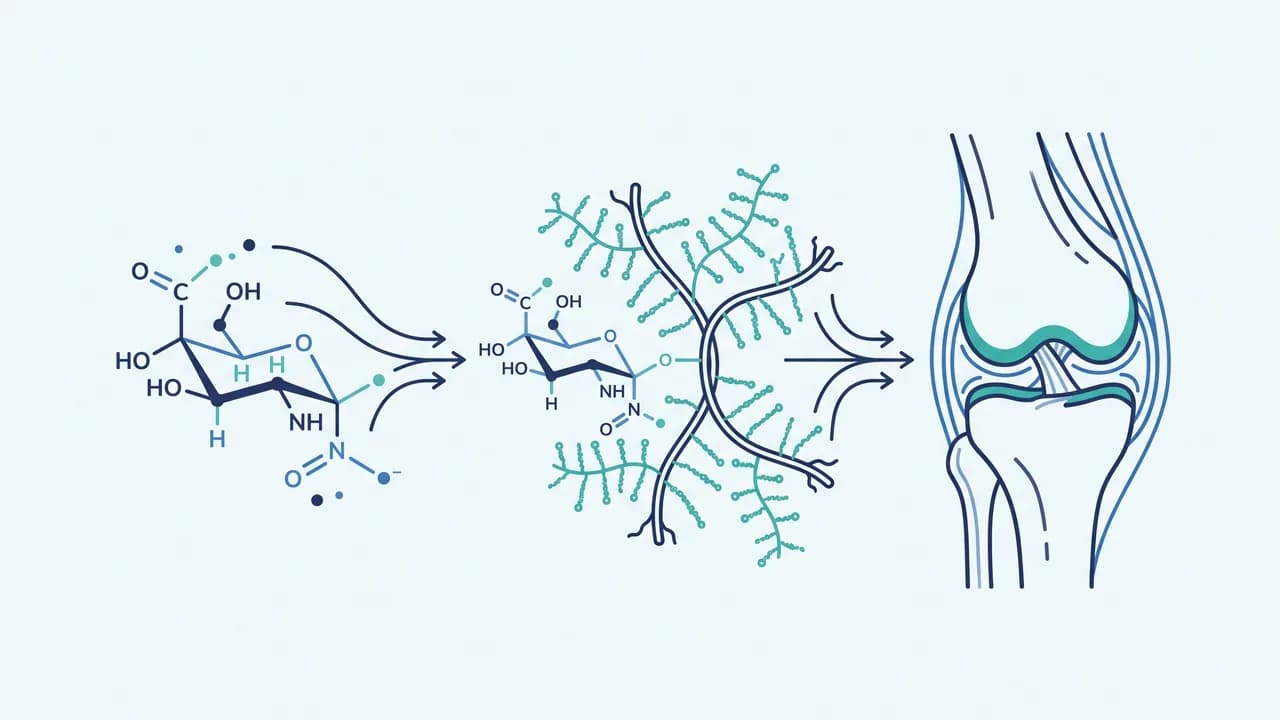
Glucosamine
Metabolic cofactors and energy intermediates. A research review published by South Beach Longevity.
Every finding is labelled, in the sentence that reports it, by the kind of study that produced it. A European prescription salt is not a United States supplement capsule. A three-year industry-linked joint-space trial is not a network meta-analysis of large independent programmes. A chondrocyte culture is not a human outcome. Where two results conflict, both are given. Doses, routes, and durations appear only as reported experimental or labelled parameters, always with the population attached. Nothing here is a recommendation. Findings are graded in place as established, strongly supported, emerging, plausible, or speculative. Two further labels mark careful absences rather than verdicts: not established, where the evidence is too thin to place a claim on the ladder at all — untested or insufficient, an absence of proof rather than disproof; and not supported, where the weight of evidence leans against a claim but stops short of a formal refutation.
01 What this document is, and four things it is not
This article is a research review of oral glucosamine as a candidate for osteoarthritis pain, function, and structural progression. It keeps four commercial objects apart: glucosamine sulfate of unspecified or mixed composition; glucosamine hydrochloride; patented crystalline glucosamine sulfate; and glucosamine plus chondroitin combinations. It is written against a market that treats those objects as one name.
Four things follow immediately.
First, this is not a treatment manual. Osteoarthritis care is a clinical decision. Exercise, weight loss, and non-steroidal anti-inflammatory drugs sit on the strong-recommendation side of contemporary guidelines in a way glucosamine does not (Kolasinski et al., 2020; Bannuru et al., 2019). Reported trial regimens are experimental or labelled parameters, not a schedule for any person.
Second, it is not a cartilage-biology licence. Aggrecan and other proteoglycans are established as the load-bearing chemistry of articular cartilage (Roughley and Mort, 2014). That fact does not prove that an oral amino-sugar rebuilds a human joint.
Third, it is not a claim that European prescription products and United States dietary supplements are interchangeable. The European Medicines Agency inventories nationally authorised glucosamine medicinal products (EMA, 2022). In the United States the same molecule is sold as a dietary supplement under a different statute (FDA, 2026). Regulatory class is part of the evidence object.
Fourth, it is not medical advice. This document recommends no use, dose, route, or schedule for any person.
02 Chemistry: sulfate, hydrochloride, and the crystalline salt
D-glucosamine is a hexosamine. PubChem records the free base as CID 439213, molecular formula C6H13NO5, molecular weight 179.17, exact mass 179.07937252, IUPAC name (3R,4R,5S,6R)-3-amino-6-(hydroxymethyl)oxane-2,4,5-triol, InChIKey MSWZFWKMSRAUBD-IVMDWMLBSA-N, topological polar surface area 116 square angstroms, and XLogP −2.8 (PubChem, 2026a). Those identifiers are established as database facts. They are not a biological argument.
The commercial salts are different records. Glucosamine hydrochloride is CID 91431, formula C6H14ClNO5, molecular weight 215.63 (PubChem, 2026b). A glucosamine sulfate record on PubChem is a bis-glucosamine sulfuric-acid pair, CID 73415774, formula C12H28N2O14S, molecular weight 456.42. “Glucosamine sulfate” on a bottle may mean a stabilized crystalline double salt, a sulfate with potassium or sodium chloride, or a label that does not specify the counter-ion. Treating every sulfate label as the Rotta crystalline product is an identity error.
Patented crystalline glucosamine sulfate — often abbreviated pCGS in later reviews — is the specific oral powder used in the three-year Reginster and Pavelka programmes and in the six-month GUIDE trial (Reginster et al., 2001; Pavelka et al., 2002; Herrero-Beaumont et al., 2007). Bruyère, Altman, and Reginster later argued that this prescription formulation should be differentiated from other glucosamine sulfate and hydrochloride products (Bruyère, Altman, and Reginster, 2016). That is a society-algorithm claim. It is strongly supported as a statement that the literature is formulation-stratified. It is not independent proof that every pCGS bottle is disease-modifying.
03 Cartilage, proteoglycans, and the candidate argument
Articular cartilage withstands compression because aggrecan carries dense chondroitin-sulfate and keratan-sulfate chains and assembles with hyaluronan and link protein (Roughley and Mort, 2014). Ageing and osteoarthritis change both synthesis and cleavage. Matrix metalloproteinases and aggrecanases degrade the aggregate; fragments appear in synovial fluid as a marker of ongoing destruction. That biochemistry is established. It is the reason glucosamine was a candidate: the molecule is a hexosamine that can, in culture, enter hexosamine pathways and alter chondrocyte output.
Largo and colleagues showed that glucosamine sulfate inhibited interleukin-1-beta-induced NF-kappa-B activation, COX-2 expression, and prostaglandin E2 release in cultured human osteoarthritic chondrocytes (Largo et al., 2003). That paper is strongly supported as an in-vitro mechanism study. It is not a human structural outcome. Concentrations that move a transcription factor in a dish are not automatically the concentrations Persiani later measured in synovial fluid after an oral crystalline-sulfate powder (Persiani et al., 2007). Using Largo as proof that a supermarket capsule “calms joint inflammation” is a category error.
The candidate argument therefore splits. Cartilage biology is real. Oral delivery into that biology is a pharmacokinetic and clinical question. The rest of this document is the second question.
04 What oral delivery can and cannot do
Setnikar, Palumbo, Canali, and Zanolo gave carbon-14-labelled glucosamine sulfate to six healthy men by intravenous, intramuscular, or oral routes (Setnikar et al., 1993). After oral administration, free glucosamine was not detectable in plasma by their method; radioactivity incorporated into plasma proteins followed a pattern similar to parenteral use but at about one-fifth the concentration; the oral area under the curve was 26 percent of the intravenous or intramuscular value. They attributed the gap to first-pass hepatic metabolism. That paper is established as an early human radiotracer study in a tiny sample. It is not a modern mass-spectrometric bioavailability number, and it is not a joint-space trial.
Two consequences follow. First, an intravenous hexosamine experiment — including later clamp studies that used intravenous glucosamine to induce insulin resistance — is not an oral-capsule study (Muniyappa et al., 2006). Second, “90 percent absorbed” in a radiotracer sense is not “90 percent of unchanged glucosamine reaches the joint.” Setnikar’s own oral data already refuse that collapse.
05 Human pharmacokinetics of the crystalline powder
Persiani, Roda, Rovati, Locatelli, and Giacovelli measured plasma glucosamine after once-daily oral crystalline glucosamine sulfate powder at 750, 1,500, and 3,000 milligrams in twelve healthy volunteers, using liquid chromatography–mass spectrometry (Persiani et al., 2005). Endogenous plasma glucosamine was already present (10.4–204 nanograms per millilitre). At the 1,500-milligram once-daily regimen used in the later osteoarthritis trials, peak concentrations were about 10 micromolar and rose more than thirty-fold from baseline. Pharmacokinetics were linear between 750 and 1,500 milligrams and less than dose-proportional at 3,000 milligrams. Elimination half-life was only tentatively estimated at about 15 hours. That paper is established as a human pharmacokinetic study of that powder. It is not a pain trial.
Persiani, Rotini, Trisolino, Rovati, and Locatelli then sampled plasma and synovial fluid together in twelve osteoarthritic patients after fourteen once-daily 1,500-milligram doses of the same crystalline powder (Persiani et al., 2007). Median post-treatment plasma glucosamine was 1,282 nanograms per millilitre (7.17 micromolar); median synovial fluid was 777 nanograms per millilitre (4.34 micromolar). The two compartments were highly correlated. The authors placed both in a 10-micromolar range. That paper is strongly supported as evidence that, after this specific oral product, glucosamine is measurable in the joint. It is a twelve-person open study. It does not show that a hydrochloride capsule, a combination tablet, or an unspecified sulfate reaches the same synovial concentration.
The honest PK sentence is therefore narrow. Oral crystalline glucosamine sulfate produces micromolar plasma and synovial concentrations in the studies that measured them. Oral radiotracer work showed extensive first-pass handling of the labelled carbon. Hydrochloride products used in GAIT and in Kwoh’s MRI trial were not accompanied by the Persiani synovial dataset. Extrapolating 10 micromolar from a Rotta powder to a United States capsule is speculative.
06 European prescription-grade crystalline glucosamine sulfate
In a substantial part of Europe, glucosamine is a nationally authorised medicine, not only a food supplement. The EMA’s 2022 PSUSA list treats glucosamine as an active substance with nationally authorised medicinal products (EMA, 2022). The pivotal symptom and structure trials that later reviews call “prescription-grade” used a once-daily 1,500-milligram crystalline sulfate powder (Reginster et al., 2001; Pavelka et al., 2002; Herrero-Beaumont et al., 2007).
Bruyère, Altman, and Reginster, writing for an ESCEO algorithm context, argued that this pCGS formulation is superior to other glucosamine sulfate and hydrochloride regimens and may delay structural change (Bruyère, Altman, and Reginster, 2016). That paper is a recommendation-and-survey synthesis by authors closely associated with the positive three-year programmes. Grade it as emerging for the regulatory-differentiation claim — the trial map is in fact formulation-stratified — and as plausible, not independently established, for the stronger disease-modification and joint-replacement-delay sentences. Those sentences recycle the same industry-linked file that Wandel, Vlad, and Runhaar later placed under a different light (Wandel et al., 2010; Vlad et al., 2007; Runhaar et al., 2017).
07 United States supplement formulations
In the United States, glucosamine is sold as a dietary supplement (FDA, 2026). The largest independent American programme, GAIT, used glucosamine hydrochloride 1,500 milligrams daily, chondroitin sulfate 1,200 milligrams daily, the combination, celecoxib, or placebo (Clegg et al., 2006). Houpt and colleagues had already tested the hydrochloride salt for eight weeks (Houpt et al., 1999). Kwoh and colleagues later tested a 1,500-milligram hydrochloride beverage for 24 weeks with MRI endpoints (Kwoh et al., 2014). Rindone’s Veterans Affairs trial used 500 milligrams three times daily for two months without specifying a crystalline sulfate identity (Rindone et al., 2000).
These are not failed copies of the Reginster powder. They are different products, different regulatory objects, and different trial designs. Vlad and colleagues’ heterogeneity analysis is the quantitative statement of that split: hydrochloride effect size 0.06; Rottapharm-product effect size 0.55; industry-involved trials 0.47–0.55 versus 0.05–0.16 without industry involvement (Vlad et al., 2007). The American supplement aisle is the hydrochloride-and-combination world. Citing Reginster as if it were a Costco bottle is the commercial move this article is written against.
08 Glucosamine plus chondroitin as a different product
Chondroitin sulfate is a glycosaminoglycan, not a hexosamine salt. Combination products therefore have two putative agents and a third object: the combination itself.
GAIT’s combination arm was not significantly better than placebo on the primary 20-percent pain-response in the overall cohort (6.5 percentage points above placebo; P = 0.09). In the pre-specified moderate-to-severe pain subgroup the combination response was 79.2 percent versus 54.3 percent on placebo (P = 0.002) (Clegg et al., 2006). A subgroup after a null primary is emerging, not a new primary.
MOVES compared chondroitin sulfate 400 milligrams plus glucosamine hydrochloride 500 milligrams three times daily with celecoxib 200 milligrams daily for six months in 606 patients with Kellgren–Lawrence 2–3 knees and WOMAC pain of at least 301 on a 0–500 scale. Adjusted WOMAC pain change was −185.7 versus −186.8, meeting a non-inferiority margin of −40 (Hochberg et al., 2016). That trial is strongly supported as a non-inferiority comparison of a combination against celecoxib. It has no placebo arm and no glucosamine-alone arm. It cannot attribute the result to glucosamine.
Fransen and colleagues’ LEGS trial randomised 605 people to glucosamine sulfate 1,500 milligrams, chondroitin sulfate 800 milligrams, both, or placebo for two years. The combination reduced two-year joint-space narrowing versus placebo by 0.10 millimetres (95 percent CI 0.002 to 0.20; P = 0.046). Single-agent arms did not. Pain did not differ among the four groups (Fransen et al., 2015). A 0.10-millimetre radiographic difference without a symptom difference is a structural number in search of a clinical meaning. It is also a combination result.
Reichenbach and colleagues’ chondroitin meta-analysis is the warning label for the partner molecule: when analysis was restricted to three large intention-to-treat trials, the pain effect size was −0.03 (95 percent CI −0.13 to 0.07), about 0.6 millimetres on a 10-centimetre visual analogue scale (Reichenbach et al., 2007). Michel and colleagues’ two-year chondroitin-alone trial found less joint-space loss than placebo (0.00 versus 0.14 millimetres) without a significant symptom effect (Michel et al., 2005). Those papers belong to chondroitin. They are not glucosamine results.
09 Pain and function: crystalline sulfate trials
Reginster, Deroisy, Rovati, Lee, Lejeune, and colleagues randomised 212 patients with knee osteoarthritis to 1,500 milligrams oral glucosamine sulfate or placebo once daily for three years (Reginster et al., 2001). Mean joint-space loss at three years was −0.31 millimetres (95 percent CI −0.48 to −0.13) on placebo and −0.06 millimetres (−0.22 to 0.09) on glucosamine sulfate. WOMAC symptoms worsened slightly on placebo and improved on glucosamine sulfate. Safety withdrawals did not differ. The paper is a randomised, double-blind, placebo-controlled trial. It is strongly supported as a positive three-year result for that product on those radiographic and WOMAC endpoints. It is an industry-linked Rotta-product trial. It is not a class result.
Pavelka, Gatterová, Olejarová, Machacek, Giacovelli, and Rovati randomised 202 patients to the same once-daily 1,500-milligram glucosamine sulfate or placebo for three years (Pavelka et al., 2002). Minimum medial joint-space change was −0.19 millimetres (95 percent CI −0.29 to −0.09) on placebo and +0.04 millimetres (−0.06 to 0.14) on glucosamine sulfate (P = 0.001). Severe narrowing greater than 0.5 millimetres occurred in 14 percent versus 5 percent (P = 0.05). Symptoms improved 20–25 percent on glucosamine sulfate versus modestly on placebo. Grade: strongly supported as a second three-year Rotta-product trial. The two papers are not independent replications in the sense of a different sponsor, a different product, and a different radiography protocol.
Herrero-Beaumont and colleagues’ GUIDE trial randomised 318 patients to glucosamine sulfate 1,500 milligrams once daily, acetaminophen 3 grams daily, or placebo for six months (Herrero-Beaumont et al., 2007). The primary Lequesne index fell 3.1 points on glucosamine sulfate and 1.9 on placebo (difference −1.2; 95 percent CI −2.3 to −0.8; P = 0.032). Acetaminophen’s 2.7-point fall was not significantly different from placebo. OARSI responders were 39.6 percent, 33.3 percent, and 21.2 percent. Grade: strongly supported as a six-month symptom trial of the prescription formulation against placebo, with acetaminophen as a side comparator that missed significance.
Noack, Fischer, Förster, Rovati, and Setnikar randomised 252 outpatients to glucosamine sulfate 500 milligrams three times daily or placebo for four weeks. Evaluable responder rates were 55 percent versus 38 percent; intention-to-treat 52 percent versus 37 percent (Noack et al., 1994). Müller-Fassbender, Bach, Haase, Rovati, and Setnikar compared the same 500-milligram three-times-daily sulfate with ibuprofen 400 milligrams three times daily for four weeks in 200 hospitalised patients. Success rates at four weeks were 48 percent versus 52 percent; adverse events were 6 percent versus 35 percent (Müller-Fassbender et al., 1994). Those early Rotta-linked trials are emerging as short symptom studies. They are not structure trials, and they are not independent of the later three-year file.
Hughes and Carr, in a United Kingdom rheumatology clinic, randomised 80 patients to glucosamine sulfate 1,500 milligrams daily or placebo for six months. Area-under-the-curve pain did not differ (mean difference 0.15 millimetres; 95 percent CI −8.78 to 9.07). The placebo response was 33 percent (Hughes and Carr, 2002). That paper is strongly supported as a negative independent symptom trial of a sulfate product that was not the Reginster three-year programme. It is one of the reasons “sulfate” is not a sufficient identity.
Rozendaal, Koes, van Osch, Uitterlinden, and colleagues randomised 222 primary-care patients with hip osteoarthritis to 1,500 milligrams oral glucosamine sulfate or placebo once daily for two years (Rozendaal et al., 2008). WOMAC pain difference was −1.54 (95 percent CI −5.43 to 2.36); WOMAC function −2.01 (−5.38 to 1.36); joint-space narrowing −0.029 (−0.122 to 0.064). Half the patients had Kellgren–Lawrence grade 1. Grade: established as a negative independent hip trial. Knee-positive three-year papers do not outrank a hip-negative paper by being about a more famous joint.
10 Pain and function: hydrochloride and unspecified salts
Houpt, McMillan, Wein, and Paget-Dellio randomised patients to glucosamine hydrochloride or placebo for eight weeks. The primary WOMAC pain difference from week 0 to week 8 was not met. Diary pain and examination favoured glucosamine in some secondary windows; 40 percent of placebo and 49 percent of glucosamine subjects said they were better (P = 0.58) (Houpt et al., 1999). Grade: strongly supported as a negative or near-negative hydrochloride primary.
Rindone, Hiller, Collingham, and colleagues randomised 98 Veterans Affairs patients to glucosamine 500 milligrams three times daily or placebo for two months. Walking and resting visual-analogue scores did not differ at 30 or 60 days (Rindone et al., 2000). Grade: strongly supported as a negative two-month trial in that population.
Clegg and colleagues’ GAIT randomised 1,583 patients with symptomatic knee osteoarthritis to glucosamine hydrochloride 1,500 milligrams daily, chondroitin sulfate 1,200 milligrams, both, celecoxib 200 milligrams, or placebo for 24 weeks (Clegg et al., 2006). The primary outcome was a 20 percent decrease in knee pain. Placebo response was 60.1 percent. Glucosamine was 3.9 points higher (P = 0.30); chondroitin 5.3 (P = 0.17); combination 6.5 (P = 0.09); celecoxib 10.0 (P = 0.008). Adverse events were mild and even. Grade: established as a large negative overall result for hydrochloride and for chondroitin, with a celecoxib assay sensitivity that worked. The moderate-to-severe combination subgroup remains emerging.
Sawitzke and colleagues followed a radiographic GAIT subset for 24 months. Among 662 patients, odds of a 20 percent WOMAC-pain reduction versus placebo were 1.16 for glucosamine, 0.83 for the combination, 0.69 for chondroitin, and 1.21 for celecoxib — none statistically significant. No treatment achieved a clinically important WOMAC difference versus placebo (Sawitzke et al., 2010). Grade: strongly supported as a two-year negative symptom extension of the American hydrochloride-and-combination file.
Cibere and colleagues discontinued glucosamine in 137 current users who had already reported at least moderate improvement. Disease flare occurred in 42 percent of placebo and 45 percent of glucosamine patients (difference −3 percent; 95 percent CI −19 to 14) (Cibere et al., 2004). Grade: strongly supported as a negative discontinuation trial. People who believe they are responders did not flare more when the product was withdrawn under blind.
11 Combination-product trials, without attribution to glucosamine
The combination file has already been stated. GAIT overall null, subgroup positive (Clegg et al., 2006). GAIT two-year symptom extension null (Sawitzke et al., 2010). MOVES non-inferior to celecoxib without placebo (Hochberg et al., 2016). LEGS combination-only 0.10-millimetre joint-space signal without pain separation (Fransen et al., 2015). Simental-Mendía and colleagues’ 2018 meta-analysis found glucosamine and chondroitin each reduced visual-analogue pain, but the combination did not (weighted mean difference −0.28 millimetres; 95 percent CI −8.87 to 8.32) (Simental-Mendía et al., 2018). Zhu and colleagues similarly found the combination not superior to placebo on the endpoints they pooled (Zhu et al., 2018). Those syntheses are emerging as a warning against assuming additivity. They do not rescue glucosamine by averaging it with chondroitin.
12 Structural progression and joint-space width
The structure file is smaller than the pain file and more dependent on two papers.
Reginster 2001 and Pavelka 2002 are the positive three-year crystalline-sulfate joint-space trials, already numbered (Reginster et al., 2001; Pavelka et al., 2002). Bruyère and colleagues’ post-hoc pool of postmenopausal women from those two studies reported no narrowing on glucosamine sulfate (+0.003 millimetres; 95 percent CI −0.09 to 0.11) versus −0.33 millimetres (−0.44 to −0.22) on placebo (Bruyère et al., 2004). A post-hoc sex-stratum of the same two trials is not a third trial.
Sawitzke and colleagues’ GAIT structure report enrolled 572 knees with Kellgren–Lawrence 2 or 3 and baseline joint-space width of at least 2 millimetres. Adjusted mean two-year joint-space loss on placebo was 0.166 millimetres. No treatment group differed significantly from placebo. Power was reduced by sample size, measurement variance, and smaller-than-expected loss (Sawitzke et al., 2008). Grade: strongly supported as a negative two-year radiographic result for hydrochloride, chondroitin, and the combination.
Rozendaal’s hip trial found no joint-space difference at two years (Rozendaal et al., 2008). Kwoh and colleagues randomised 201 people with chronic knee pain to 1,500 milligrams glucosamine hydrochloride in a beverage or placebo for 24 weeks. The adjusted odds ratio for decreased cartilage-damage worsening on 3-tesla WORMS MRI was 0.938 (95 percent CI 0.528 to 1.666). Urinary CTX-II did not fall (Kwoh et al., 2014). Grade: strongly supported as a negative short MRI-and-biomarker trial of hydrochloride.
Wandel and colleagues’ network meta-analysis of ten large trials (3,803 patients) found differences in minimal joint-space width that were “all minute, with 95 percent credible intervals overlapping zero” (Wandel et al., 2010). Grade: strongly supported as a synthesis that refuses a class-wide structural effect once trial size is restricted.
Radiographic millimetres are not a patient. Tubach and colleagues estimated minimal clinically important improvement for knee pain at −19.9 millimetres on a visual analogue scale and for WOMAC function at −9.1 (Tubach et al., 2005). A 0.10-millimetre LEGS combination difference, or a 0.25-millimetre separation between Reginster arms, must be read against that scale of what a person notices. Structure-modification language that skips that step is marketing.
13 Meta-analyses and the clinical-importance problem
McAlindon, LaValley, Gulin, and Felson’s 2000 JAMA meta-analysis of fifteen glucosamine or chondroitin trials found moderate-to-large effects and low quality scores; only one study described allocation concealment adequately (McAlindon et al., 2000). Grade: established as an early synthesis that already flagged quality. It is not the last word after GAIT.
Towheed and colleagues’ 2005 Cochrane review of twenty trials found a pooled pain standardised mean difference of −0.61 (95 percent CI −0.95 to −0.28) and a Lequesne function difference of −0.51 (−0.96 to −0.05). Restriction to eight trials with adequate allocation concealment failed to show benefit for pain and WOMAC function. WOMAC outcomes overall were not significant. Ten Rotta-preparation trials drove the positive pool (Towheed et al., 2005). Grade: established as the allocation-concealment split that later papers keep rediscovering.
Vlad, LaValley, McAlindon, and Felson’s 2007 analysis of fifteen knee or hip pain trials gave a summary effect size of 0.35 (95 percent CI 0.14 to 0.56) with I-squared 0.80. Industry-involved trials clustered at 0.47–0.55; trials without industry involvement at 0.05–0.16. Hydrochloride 0.06; sulfate 0.44; Rottapharm 0.55 versus 0.11 for the rest (Vlad et al., 2007). Grade: established as the heterogeneity paper for this literature.
Wandel, Jüni, Tendal, Nüesch, Villiger, and colleagues restricted to large trials (more than 200 patients) and found pain differences versus placebo of −0.4 centimetres for glucosamine, −0.3 for chondroitin, and −0.5 for the combination on a 10-centimetre visual analogue scale. None of the 95 percent credible intervals crossed their prespecified minimal clinically important difference of −0.9 centimetres. Industry-independent trials were smaller (interaction P = 0.02) (Wandel et al., 2010). Grade: established as the clinical-importance paper. A statistically detectable 4 millimetres on a 100-millimetre scale is not, on their rule, a difference a patient would value.
Tubach’s MCII for knee pain was −19.9 millimetres — about twice Wandel’s −0.9-centimetre threshold and an order of magnitude above Wandel’s pooled glucosamine estimate (Tubach et al., 2005; Wandel et al., 2010). GUIDE’s 1.2-point Lequesne difference is a group mean, not a proportion of patients crossing MCII. Richy’s 2003 meta-analysis, performed before GAIT, reported “highly significant” glucosamine effects on joint-space narrowing and WOMAC (Richy et al., 2003). After GAIT, Wandel, Sawitzke, Rozendaal, and Runhaar, that 2003 pool is a historical layer, not a superseding one.
Runhaar and the OA Trial Bank obtained individual patient data from six of 21 eligible trials (1,663 participants; five industry-independent, n = 1,625). Glucosamine was no better than placebo for pain or function at three or 24 months, including in predefined subgroups of pain, body-mass index, sex, structure, or inflammation (Runhaar et al., 2017). Industry-sponsored datasets were largely not shared. Grade: strongly supported as an IPD null in the independent file, and as a missing-data finding about the industry file.
Later meta-analyses reopen the door a crack without erasing Wandel. Ogata and colleagues found a marginally favourable visual-analogue pain effect and a non-significant WOMAC function effect (Ogata et al., 2018). Simental-Mendía found visual-analogue pain reductions for glucosamine and for chondroitin separately, not for the combination, and no WOMAC benefit (Simental-Mendía et al., 2018). Zhu found glucosamine significant only for stiffness (Zhu et al., 2018). Kongtharvonskul’s network meta-analysis reported WOMAC improvements versus placebo that look larger than Wandel’s large-trial restriction (Kongtharvonskul et al., 2015). Those papers are emerging. They do not cancel a large-trial, IPD, and allocation-concealment literature that keeps collapsing toward a small or null independent effect.
14 Publication, sponsor, and formulation bias
The bias file is not a rumour. Vlad quantified it (Vlad et al., 2007). Wandel tested the industry interaction and found it (Wandel et al., 2010). Towheed showed that concealment quality removes the pain signal (Towheed et al., 2005). Runhaar showed that the datasets shared with an independent bank are the null ones (Runhaar et al., 2017). McAlindon’s 2000 quality scores were already poor (McAlindon et al., 2000). Reichenbach showed the same small-trial inflation for chondroitin (Reichenbach et al., 2007).
Formulation is entangled with sponsorship. The largest positive structure trials used a patented crystalline sulfate and Rotta-linked authorship (Reginster et al., 2001; Pavelka et al., 2002). The largest independent American programme used hydrochloride and was null (Clegg et al., 2006; Sawitzke et al., 2008). ESCEO’s pCGS-differentiation paper is written by authors of the positive file (Bruyère, Altman, and Reginster, 2016). That does not make the chemistry false. It makes “the sulfate works, the hydrochloride does not” a hypothesis that is plausible and still not cleanly separated from “the sponsored trials were positive.”
The correct reading is uncomfortable for both camps. Collapsing the literature into “glucosamine works” ignores GAIT, Rozendaal, Hughes, Cibere, Kwoh, Wandel, and Runhaar. Collapsing it into “glucosamine is nothing” ignores two three-year crystalline-sulfate programmes and GUIDE. The honest sentence is the split.
15 Combination-product attribution
A combination response is a combination result. GAIT’s only statistically significant symptom signal in the published primary paper sat in the combination, in a subgroup (Clegg et al., 2006). MOVES never isolated glucosamine (Hochberg et al., 2016). LEGS’ only structural signal was the combination (Fransen et al., 2015). Simental-Mendía’s combination pain pool was null (Simental-Mendía et al., 2018). Assigning those results to “glucosamine” is a naming error. Assigning them to chondroitin alone is the same error in the other direction. The third object — the pair — is what was tested.
16 Guidelines and regulatory class
Kolasinski and colleagues’ 2019 ACR/Arthritis Foundation guideline, published in 2020, is a GRADE instrument. The strong recommendations listed in the paper are exercise, weight loss, self-efficacy programmes, tai chi, cane, specified orthoses and braces, topical and oral NSAIDs, and intra-articular glucocorticoid injections (Kolasinski et al., 2020). Glucosamine is not on that strong-for list. This article does not substitute a full guideline table for the paper.
Bannuru and colleagues’ 2019 OARSI guideline set core treatments as arthritis education and structured land-based exercise, with dietary weight management for knee osteoarthritis, and placed topical NSAIDs at Level 1A for the knee (Bannuru et al., 2019). Glucosamine is not a core treatment in that abstract.
Bruyère, Altman, and Reginster’s ESCEO-context paper recommends chronic SYSADOA including glucosamine sulfate and advocates prescription pCGS over other preparations (Bruyère, Altman, and Reginster, 2016). That is a European algorithm position, not a replication of GAIT.
NICE’s NG226 is the United Kingdom osteoarthritis guideline instrument fetched for this build (NICE, 2022). Local guidelines are not interchangeable with ACR or OARSI. EMA’s PSUSA list confirms that glucosamine exists as a nationally authorised medicine in Europe (EMA, 2022). FDA’s dietary-supplement page is the United States counterpart class (FDA, 2026). The two classes explain why a European label and an American bottle can cite different papers without either citation being a lie about its own object.
17 Gastrointestinal effects
Across the locked trials, gastrointestinal events are the leading oral tolerability finding and are generally close to placebo. Clegg reported mild, infrequent, evenly distributed adverse events (Clegg et al., 2006). Reginster and Pavelka found no difference in safety withdrawals (Reginster et al., 2001; Pavelka et al., 2002). Müller-Fassbender recorded 6 percent adverse events on glucosamine sulfate versus 35 percent on ibuprofen, mostly gastrointestinal on the NSAID (Müller-Fassbender et al., 1994). Fransen reported possibly related events in 6 percent over two years (Fransen et al., 2015). Hathcock and Shao’s observed-safe-level assessment placed the highest clinical-trial intakes they reviewed at 2,000 milligrams daily for glucosamine and 1,200 milligrams daily for chondroitin sulfate (Hathcock and Shao, 2007). That paper is a risk-assessment essay, not a licence and not a dose instruction. Grade for ordinary-trial GI tolerability: strongly supported as favourable relative to NSAIDs, not as “no gastrointestinal effect.”
18 Shellfish allergy
Much commercial glucosamine is manufactured from crustacean-shell chitin. The theoretical risk is residual shellfish protein, not the hexosamine itself. Gray, Baker, and Kaliner’s 2004 letter asked whether glucosamine is safe in seafood allergy (Gray, Baker, and Kaliner, 2004). A letter is a question. It is not a challenge trial. Grade: plausible as a labelling and history-taking issue; not established as a demonstrated high rate of anaphylaxis from oral glucosamine in allergic patients. Plant-fermentation products exist as a different manufacturing story; they were not the GAIT or Reginster objects. Conflating “derived from shell” with “contains shrimp tropomyosin at a meal-level dose” is the misconception. The opposite misconception — “it is an amino-sugar, therefore allergy is impossible” — is also unsupported by a dedicated oral-challenge literature in the reviewed record.
19 Glucose and diabetes
Intravenous glucosamine can induce insulin resistance in experimental settings. Muniyappa and colleagues tested the oral question directly: a randomised, placebo-controlled, double-blind crossover of oral glucosamine 500 milligrams three times daily for six weeks in 20 lean and 20 obese subjects, with hyperinsulinaemic-isoglycaemic clamps and endothelial-function measures. Compared with placebo, oral glucosamine did not cause insulin resistance or endothelial dysfunction in lean subjects or significantly worsen those findings in obese subjects (Muniyappa et al., 2006). Grade: strongly supported as a negative six-week oral metabolic study at that regimen. It is not a multi-year diabetes-outcome trial. Extrapolating the intravenous hexosamine literature to an oral supplement, after Muniyappa, is obsolete.
20 Warfarin and other interactions
Knudsen and Sokol described a 71-year-old man on stable warfarin whose INR rose from 2.3 to 3.9 after he increased a glucosamine hydrochloride–chondroitin product, then to 4.7 after a dose reduction, and returned toward the prior range after the supplement stopped. They identified 20 MedWatch reports of glucosamine or glucosamine–chondroitin with warfarin associated with altered coagulation (Knudsen and Sokol, 2008). Grade: emerging as a pharmacovigilance signal and a single well-described case. It is not a randomised interaction trial. It is enough to keep warfarin in the same document as the osteoarthritis file. Combination products again prevent clean attribution to glucosamine alone.
LiverTox inventories drug-induced liver injury; the glucosamine chapter was fetched for this build as a labelled secondary source (NIDDK, 2012). Isolated liver-injury reports in a LiverTox file are not a hepatotoxicity rate from the osteoarthritis RCTs, which did not signal a hepatic problem at trial scale (Clegg et al., 2006; Reginster et al., 2001). Grade for routine hepatotoxicity in OA trials: not established. Grade for rare idiosyncratic reports: plausible, case-level.
21 Standing constraint
What is known is a split file. Crystalline glucosamine sulfate has two three-year knee programmes and a six-month symptom trial that are positive on their endpoints (Reginster et al., 2001; Pavelka et al., 2002; Herrero-Beaumont et al., 2007). Hydrochloride and independent sulfate programmes, the largest American trial, a hip trial, a discontinuation trial, an MRI trial, a large-trial network meta-analysis, and an independent IPD meta-analysis are null or below a clinical-importance threshold (Clegg et al., 2006; Rozendaal et al., 2008; Cibere et al., 2004; Kwoh et al., 2014; Wandel et al., 2010; Runhaar et al., 2017; Vlad et al., 2007). Combination products cannot donate their results to glucosamine. Safety in trials is generally favourable; shellfish history, warfarin, and intravenous-versus-oral glucose stories remain specific.
What is sold is a collapse. One name, a cartilage cartoon, a European prescription aura, and an American bottle. The extra length of this document is the point.
This document describes published research. It does not recommend human use of any compound, product, or protocol and specifies no dose, route, or schedule for any person. It is not medical advice. Osteoarthritis care belongs to licensed clinicians and to the people who live with the joint, not to a article.
22 Formulation matrix
| Object | Chemical identity in this file | Typical regulatory class | Human PK locked here | May one cite it as “glucosamine”? |
|---|---|---|---|---|
| Free base | C6H13NO5; CID 439213 (PubChem, 2026a) | Not the commercial object | No | Only as chemistry |
| Glucosamine hydrochloride | C6H14ClNO5; CID 91431 (PubChem, 2026b) | US dietary supplement (FDA, 2026) | Not the Persiani synovial series | Yes, if the trial used HCl |
| Unspecified / mixed sulfate | Label-dependent salt | Mixed | Setnikar radiotracer (Setnikar et al., 1993) | Only with the product named |
| Crystalline GS (pCGS) | Rotta-lineage once-daily powder | EU nationally authorised medicine (EMA, 2022) | Persiani 2005, 2007 | Yes, for that powder only |
| GS + chondroitin | Two agents | Combination supplement or SYSADOA pair | Not isolated | No |
23 Osteoarthritis RCT matrix
| Trial | Population / duration | Product in the paper | Primary result | Grade |
|---|---|---|---|---|
| Reginster et al., 2001 | Knee OA, n=212, 3 y | GS 1500 mg once daily | JSW and WOMAC favoured GS | Strongly supported (industry-linked) |
| Pavelka et al., 2002 | Knee OA, n=202, 3 y | GS 1500 mg once daily | JSW and symptoms favoured GS | Strongly supported (same product family) |
| Herrero-Beaumont et al., 2007 | Knee OA, n=318, 6 mo | Prescription GS 1500 mg; acetaminophen side arm | Lequesne −1.2 vs placebo | Strongly supported |
| Noack et al., 1994 | Knee OA, n=252, 4 wk | GS 500 mg t.i.d. | Responders 52% vs 37% ITT | Emerging |
| Müller-Fassbender et al., 1994 | Knee OA, n=200, 4 wk | GS vs ibuprofen | Symptom equivalence; fewer AE on GS | Emerging |
| Hughes and Carr, 2002 | Knee OA, n=80, 6 mo | GS 1500 mg | Pain AUC null | Strongly supported negative |
| Rozendaal et al., 2008 | Hip OA, n=222, 2 y | GS 1500 mg | WOMAC and JSW null | Established negative |
| Houpt et al., 1999 | Knee OA, 8 wk | Hydrochloride | Primary WOMAC pain not met | Strongly supported negative |
| Rindone et al., 2000 | VA knee OA, n=98, 2 mo | Glucosamine 500 mg t.i.d. | VAS rest/walk null | Strongly supported negative |
| Clegg et al., 2006 | Knee OA, n=1583, 24 wk | HCl, CS, both, celecoxib | Overall primary null; celecoxib + | Established |
| Sawitzke et al., 2010 | GAIT subset, n=662, 24 mo | Same arms | No clinically important WOMAC vs placebo | Strongly supported |
| Cibere et al., 2004 | Current users, n=137, 6 mo | Discontinuation | Flare 45% vs 42% | Strongly supported negative |
| Kwoh et al., 2014 | Chronic knee pain, n=201, 24 wk | HCl beverage | WORMS and CTX-II null | Strongly supported negative |
| Fransen et al., 2015 | Knee OA, n=605, 2 y | GS, CS, both | Combo JSN 0.10 mm; pain null | Emerging (combo only) |
| Hochberg et al., 2016 | Knee OA severe pain, n=606, 6 mo | CS+GH vs celecoxib | Non-inferior on WOMAC pain | Strongly supported (not vs placebo) |
24 Structural-outcome matrix
| Paper | Joint / method | Product | Result | Clinical meaning |
|---|---|---|---|---|
| Reginster et al., 2001 | Knee, mean JSW 3 y | Crystalline GS | −0.06 vs −0.31 mm | Positive in that trial; MCII not a millimetre scale |
| Pavelka et al., 2002 | Knee, min JSW 3 y | Crystalline GS | +0.04 vs −0.19 mm | Same family as Reginster |
| Bruyère et al., 2004 | Post-hoc postmenopausal pool | Same two trials | +0.003 vs −0.33 mm | Not a third trial |
| Sawitzke et al., 2008 | Knee min JSW 2 y | HCl / CS / combo | No arm vs placebo | Underpowered; expected loss small |
| Rozendaal et al., 2008 | Hip JSN 2 y | GS | −0.029 mm (CI crosses 0) | Negative |
| Kwoh et al., 2014 | 3T WORMS, 24 wk | HCl | OR 0.94 for less worsening | Negative short MRI |
| Fransen et al., 2015 | Knee JSN 2 y | Combo vs placebo | 0.10 mm (0.002–0.20) | Tiny; no pain split; combo |
| Wandel et al., 2010 | Network, large trials | Mixed | JSW CIs overlap 0 | Class-wide structure refused |
| Michel et al., 2005 | Knee JSW 2 y | Chondroitin alone | 0.00 vs 0.14 mm loss | Not glucosamine |
25 Meta-analysis matrix
| Synthesis | Restriction | Pain / function | Structure | Bias finding |
|---|---|---|---|---|
| McAlindon et al., 2000 | 15 trials, quality scored | Moderate–large; poor quality | Not the later file | Quality already low |
| Towheed et al., 2005 | 20 RCTs; 8 concealed | Concealed: pain/WOMAC fail | Rotta-heavy | Concealment removes signal |
| Vlad et al., 2007 | 15 DBRPC | ES 0.35; I2=0.80 | — | Industry 0.47–0.55 vs 0.05–0.16; HCl 0.06 |
| Richy et al., 2003 | Pre-GAIT | Positive WOMAC | Positive JSN | Pre-dates independent large trials |
| Wandel et al., 2010 | 10 trials, n>200, 3803 pts | −0.4 cm GS; MCID −0.9 cm not crossed | Minute, CI includes 0 | Independent smaller (P=0.02) |
| Runhaar et al., 2017 | IPD, 5 independent, n=1625 | Null 3 and 24 mo; null subgroups | — | Industry data mostly not shared |
| Reichenbach et al., 2007 | Chondroitin | Large-trial ES −0.03 | — | Small-trial inflation |
| Ogata et al., 2018 | Knee, 2003–2016 | VAS marginal; WOMAC NS | Insufficient | — |
| Simental-Mendía et al., 2018 | Placebo RCTs | VAS + for each; combo null; WOMAC NS | — | Combo not additive |
| Zhu et al., 2018 | 30 trials | GS stiffness only | — | Combo not superior to placebo |
| Kongtharvonskul et al., 2015 | Network vs diacerein/NSAID | WOMAC favoured GS vs placebo | — | Broader inclusion than Wandel |
26 Safety matrix
| Question | Best evidence locked here | Grade | What it is not |
|---|---|---|---|
| GI effects | Even with placebo in GAIT/Reginster/Pavelka; fewer AE than ibuprofen (Müller-Fassbender et al., 1994) | Strongly supported as generally favourable | Proof of no GI effect |
| Shellfish allergy | Manufacturing from chitin; Gray, Baker, and Kaliner, 2004 letter | Plausible labelling issue | Anaphylaxis rate; “impossible because it is an amino-sugar” |
| Glucose / insulin | Muniyappa et al., 2006 oral clamp crossover, 6 wk | Strongly supported negative for that oral regimen | Multi-year diabetes outcomes; IV hexosamine studies |
| Warfarin | Knudsen and Sokol, 2008 case + 20 MedWatch reports | Emerging signal | Randomised interaction trial; glucosamine-only attribution |
| Hepatotoxicity | OA RCTs without hepatic signal; LiverTox chapter (NIDDK, 2012) | Trial-scale not established; case-level plausible | A rate |
| Upper-intake essay | Hathcock and Shao, 2007 OSL | Risk-assessment opinion | A recommended intake |
The safety file is not a warrant for unsupervised combination use, and it is not a claim that “natural” means empty of interaction. Gastrointestinal events in the locked osteoarthritis trials sit near placebo and below ibuprofen (Clegg et al., 2006; Müller-Fassbender et al., 1994). The glucose question that still circulates is an intravenous hexosamine result that Muniyappa’s oral clamp did not reproduce (Muniyappa et al., 2006). Warfarin remains a case-and-surveillance problem, often in combination products (Knudsen and Sokol, 2008). Shellfish allergy remains a manufacturing-history question without an oral-challenge series in the reviewed record (Gray, Baker, and Kaliner, 2004). Those four sentences are the safety file. They are not a fifth efficacy argument.
27 Critical questions
Do formulation-dependent trial outcomes survive as a real split, or only as a sponsorship artefact? Both. Vlad’s hydrochloride-versus-Rottapharm split and the Persiani synovial series make a chemical-and-exposure difference plausible and, for the crystalline powder versus GAIT hydrochloride, strongly supported as a description of different objects. The same split is also the industry split. Until an independent three-year crystalline-sulfate programme exists, “the sulfate is the medicine and the hydrochloride is the supplement” remains a hypothesis that fits the map and has not been randomised against itself.
Are small pain effects clinically important? On Wandel’s prespecified −0.9-centimetre rule, no: glucosamine’s −0.4 centimetres does not cross it (Wandel et al., 2010). On Tubach’s knee-pain MCII of −19.9 millimetres, the pooled large-trial effect is smaller still (Tubach et al., 2005). GUIDE’s 1.2-point Lequesne difference is a group mean (Herrero-Beaumont et al., 2007). Statistical significance in a Rotta trial is not a patient-level importance proof.
Does publication and sponsor bias explain the positive file? It explains a large part of the heterogeneity (Vlad et al., 2007; Wandel et al., 2010; Towheed et al., 2005; Runhaar et al., 2017). It does not require that Reginster and Pavelka fabricated radiographs. It does require that those papers not be allowed to stand for the class.
Do structural-modification claims hold? They hold as the findings of two three-year crystalline-sulfate trials and a post-hoc postmenopausal pool (Reginster et al., 2001; Pavelka et al., 2002; Bruyère et al., 2004). They do not hold as a class effect after Sawitzke, Rozendaal, Kwoh, and Wandel (Sawitzke et al., 2008; Rozendaal et al., 2008; Kwoh et al., 2014; Wandel et al., 2010). Joint-space millimetres without a symptom difference, as in LEGS’ combination arm, are not a clinical victory (Fransen et al., 2015).
Can combination-product results be attributed to glucosamine? No. GAIT’s subgroup, MOVES, and LEGS’ structural signal are combination objects (Clegg et al., 2006; Hochberg et al., 2016; Fransen et al., 2015). Simental-Mendía’s combination pain pool was null (Simental-Mendía et al., 2018). Attribution to one partner is a naming error.
28 References
29 Evidence handling
Findings are labelled in the reporting sentence by design: randomised trial, pharmacokinetic study, systematic review, network or IPD meta-analysis, guideline instrument, regulator list, or database record. Animal work was not needed for the controlling claims. The one in-vitro paper used here (Largo et al., 2003) is labelled as culture and is not asked to carry a human outcome.
Conflicting evidence is kept in the same section. Reginster and GAIT are not averaged. GUIDE and Hughes are not averaged. LEGS’ combination millimetre is not assigned to glucosamine. ESCEO’s pCGS advocacy is not treated as a replication of Wandel.
Quantitative claims were locked to verified NCBI records or to FDA, NICE, EMA, PubChem, and LiverTox pages fetched for this build. Candidate identifiers that resolved to a different paper were discarded and not cited.
References are generated from those verified records plus the non-PubMed regulator and database sources listed with them. Internal production logs are not part of this apparatus.
Continue reading