
Methylsulfonylmethane
Metabolic cofactors and energy intermediates. A research review published by South Beach Longevity.
Every finding is labelled, in the sentence that reports it, by the kind of study that produced it. A knee osteoarthritis pilot is not a disease-modifying trial. A glucosamine combination bottle is not an MSM-alone result. A rat excretion curve is not a human cartilage argument. Where two results conflict, both are given. Doses, routes, and durations appear only as reported experimental parameters, always with the population attached. Nothing here is a recommendation. Findings are graded in place as established, strongly supported, emerging, plausible, or speculative.
01 What this document is, and four things it is not
This article is a research review of methylsulfonylmethane: its chemistry as dimethyl sulfone, its place in sulfur metabolism, its occurrence in food and its industrial origin, the pharmacokinetics that show absorption without a demonstrated biosynthetic job, the proposed anti-inflammatory and redox mechanisms, and the human claims that now travel under the three-letter name MSM. It is written against a market that treats a stable oxidation product as a sulfur donor, a joint rebuild, a recovery agent, and a detox.
Four things follow immediately.
First, this is not a treatment manual. Knee osteoarthritis is a clinical diagnosis. The small randomised trials that report Western Ontario and McMaster Universities Osteoarthritis Index (WOMAC) or visual-analogue-scale (VAS) changes belong to those trials (Kim et al., 2006; Usha and Naidu, 2004; Debbi et al., 2011). They are not a licence to take capsules for "joint support."
Second, it is not a sulfur-amino-acid article. Methionine, cysteine, and taurine are the dietary sulfur species that enter protein and glutathione chemistry. Methylsulfonylmethane is a sulfone. The oxidation state of its sulfur is not interchangeable with a thiol. Treating every "organic sulfur" bottle as if it were cysteine is an identity error.
Third, it is not a combination-product article. Glucosamine, chondroitin sulfate, collagen hydrolysate, and hyaluronate have their own files. When they sit in the same capsule as methylsulfonylmethane, a positive score cannot be attributed to the sulfone (Clegg et al., 2006; Alekseeva et al., 2015; Ayhan et al., 2024). Those products are assessed here only to keep the attribution honest.
Fourth, it is not medical advice. This document recommends no use, dose, route, or schedule for any person.
02 Chemistry: dimethyl sulfone, not DMSO, not cysteine
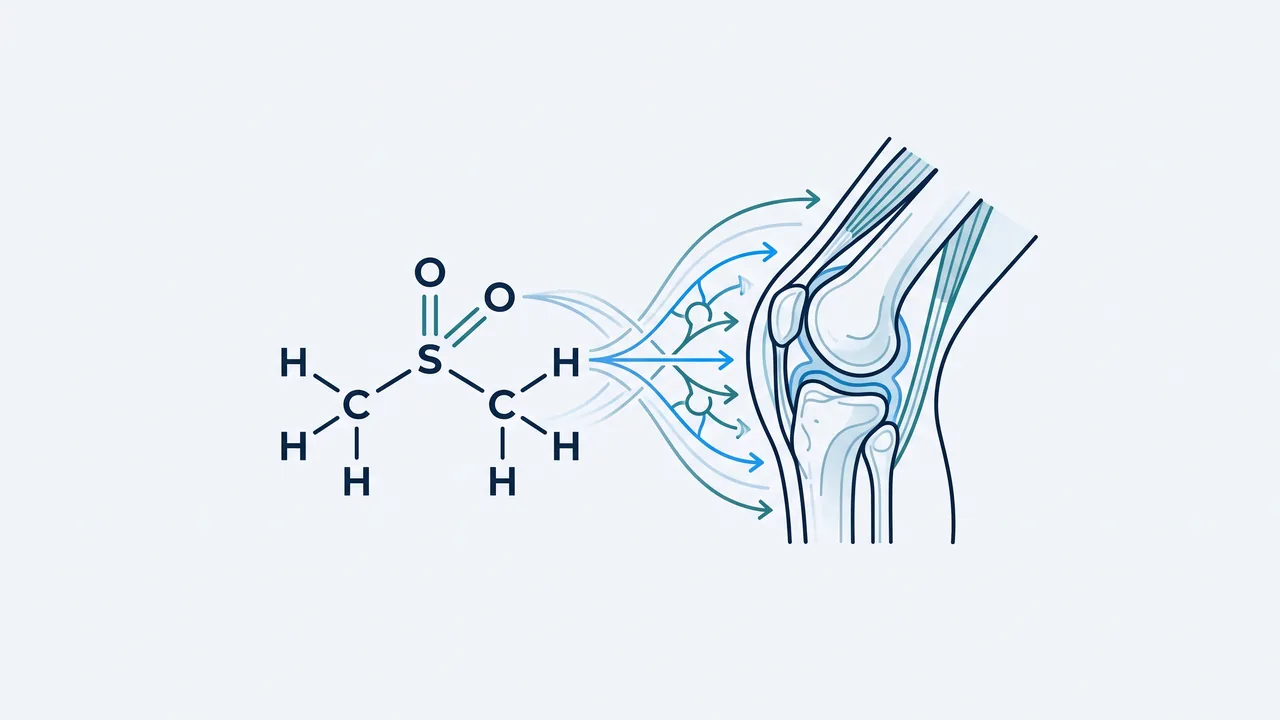
Methylsulfonylmethane is dimethyl sulfone. PubChem records it as CID 6213, molecular formula C2H6O2S, molecular weight 94.14, exact mass 94.00885060, IUPAC name methylsulfonylmethane, InChIKey HHVIBTZHLRERCL-UHFFFAOYSA-N, CAS 67-71-0, UNII 9H4PO4Z4FT, and SMILES CS(=O)(=O)C (PubChem, 2026). Those identifiers are established as database facts. They are not a biological argument.
The functional group is a sulfone: two methyl groups bound to a hexavalent sulfur that already carries two oxygens. XLogP is −0.4; topological polar surface area is 42.5 angstroms squared (PubChem, 2026). The molecule is small, polar, and chemically dull. That dullness is the point. It is the two-electron oxidation product of dimethyl sulfoxide (DMSO). Hucker and colleagues showed that DMSO is metabolised to dimethyl sulfone in the rat and in man (Hucker et al., 1966). That conversion is established as xenobiotic oxidation. It does not make DMSO and MSM interchangeable medicines. DMSO is a solvent with its own toxicology and osmolality effects (Runckel and Swanson, 1980). MSM is the downstream sulfone.
A naming trap sits on the same record. Synonyms include DMSO2, methyl sulfone, sulfonylbismethane, and MSM (PubChem, 2026). MSM is also a common acronym in other literatures. Treating every "MSM" hit as this molecule is an identity error; the reviewed record for this build discarded those collisions.
The molecule is not a peptide, not an amino acid, and not a glycosaminoglycan. It contains sulfur. That is the entire chemical warrant for the donor story. It is not enough.
03 Sulfur metabolism and the donor claim
The commercial sentence is simple: joints, hair, skin, and nails need sulfur; MSM is sulfur; therefore MSM rebuilds those tissues. The biochemistry is not that sentence.
Sulfur amino-acid nutrition is a methionine-and-cysteine problem. Those amino acids enter protein synthesis, glutathione synthesis, taurine synthesis, and sulfate generation after oxidation of the side chain. Methylsulfonylmethane does not sit on that pathway as a precursor in any textbook sense. Butawan, Benjamin, and Bloomer, writing a review that includes an employee of a major MSM manufacturer, still treated the donor claim as unfinished: older guinea-pig work with radiolabel suggested microbial conversion into methionine and cysteine, later rat work recovered labelled sulfur mainly as urinary metabolites that were not identified, and "further study regarding the activity of MSM as a sulfur donor is ongoing" (Butawan, Benjamin, and Bloomer, 2017). In humans they recorded no MSM-dose-dependent trends in plasma sulfate or homocysteine (Butawan, Benjamin, and Bloomer, 2017). That human negative is strongly supported as a reason not to treat MSM as a sulfate or homocysteine donor. The microbial-conversion story remains plausible in animals and speculative as an explanation of human joint or skin claims.
Wong, Bloomer, Benjamin, and Buddington measured small-intestinal absorption of MSM in mice and accumulation of the sulfur moiety in selected tissues after eight days (Wong et al., 2017). Absorption appeared passive and high-capacity. That paper is established as mouse absorption physiology. It is not a cartilage-synthesis assay. Accumulation of a sulfur label is the expected consequence of absorbing a sulfur-containing molecule. It is not evidence that the sulfur was reduced, installed into glycosaminoglycans, or used to build keratin. The authors' opening claim that methionine and cysteine "may not always be consumed in adequate amounts to meet sulfur requirements" is a nutritional hypothesis, not a finding of that absorption experiment (Wong et al., 2017).
The honest grade for "MSM is a biological sulfur donor for human connective tissue" is speculative. The honest grade for "MSM contains sulfur and is absorbed" is established. The market sells the first sentence with the warrant of the second.
04 Dietary occurrence and industrial origin
Dimethyl sulfone is a real food constituent at low concentration. Williams isolated it from cows' milk in 1966 (Williams, 1966). Al-Attabi, D'Arcy, and Deeth, reviewing volatile sulfur compounds in ultra-high-temperature milk, listed dimethyl sulfone among the species that rise with heat processing (Al-Attabi, D'Arcy, and Deeth, 2009). Butawan, Benjamin, and Bloomer summarised occurrence in fruits, vegetables, grains, and beverages, and noted that food concentrations sit in the hundredths of a part per million, so a bioactive supplement amount cannot be eaten as food (Butawan, Benjamin, and Bloomer, 2017). Those occurrence facts are established. They are not a dose argument and they are not a health claim.
Commercial MSM is manufactured by oxidising DMSO with hydrogen peroxide and purifying by crystallisation or distillation (Butawan, Benjamin, and Bloomer, 2017). The manufactured molecule is chemically the same as the food molecule. "Natural MSM" as a purity claim is therefore a marketing distinction, not a structural one.
Engelke and colleagues confirmed dimethyl sulfone in human cerebrospinal fluid and blood plasma by NMR (Engelke et al., 2005). Willemsen, Engelke, van der Graaf, and Wevers later showed that ingestion of a dietary-supplement product produced a 3.15 ppm resonance in brain proton MR spectra and in cerebrospinal fluid of a four-year-old girl, at 1.2 mmol per litre in brain tissue and 1.7 mmol per litre in cerebrospinal fluid (Willemsen et al., 2006). That case is established as proof that oral MSM reaches the central nervous system in measurable amounts. It is also a reminder that an "innocent" supplement can appear as an unexpected spectroscopic peak. Crossing the blood–brain barrier is a disposition fact. It is not an efficacy fact.
05 Pharmacokinetics: absorbed, excreted, little transformed
Magnuson, Appleton, and Ames gave male Sprague-Dawley rats a single oral 500 mg per kilogram dose of [35S]methylsulfonylmethane. Mean tmax was 2.1 hours, Cmax 622 microgram-equivalents per millilitre, AUC0-inf 15,124 hour·microgram-equivalents per millilitre, and half-life 12.2 hours. Soft-tissue distribution was fairly homogeneous, with relatively lower concentrations in skin and bone. After 120 hours, 85.8 percent of the radioactivity was in urine and 3 percent in feces; no quantifiable tissue radioactivity remained (Magnuson, Appleton, and Ames, 2007). Those numbers are established as rat radiokinetic measurements. They are the strongest available ADME file. They are not human pharmacokinetics.
The rat curve is the opposite of a "builds tissues" story. A molecule that is absorbed quickly, distributed widely, and almost entirely in the urine by day five is a molecule that was not retained as cartilage. Skin and bone were the lower-concentration sites, not the higher.
Human kinetic work is thinner. Butawan, Benjamin, and Bloomer, citing a human report, placed oral absorption under one hour and a general half-life greater than twelve hours, and noted that 3 g daily for four weeks raised serum MSM in twenty healthy men, with a further rise at week 4 versus week 2 in most of them (Butawan, Benjamin, and Bloomer, 2017). Those human detections are strongly supported as evidence that oral MSM is absorbed and accumulates while intake continues. They do not identify metabolites, do not measure incorporation into protein, and do not convert a serum rise into a joint or recovery outcome.
The Willemsen spectroscopic case remains the cleanest demonstration that the parent sulfone itself, not a reduced thiol, is what appears in human brain and cerebrospinal fluid after ingestion (Willemsen et al., 2006). Parent-molecule detection is evidence against a rapid reductive "activation" to cysteine.
06 Proposed anti-inflammatory and redox mechanisms
The mechanism literature is mostly in-vitro and animal, with a smaller human overlay of cytokines and antioxidant assays around exercise.
Butawan, Benjamin, and Bloomer reviewed inhibition of NF-κB nuclear translocation, reduced transcription of interleukin-1, interleukin-6, and tumour necrosis factor, and possible Nrf2-linked antioxidant-enzyme effects (Butawan, Benjamin, and Bloomer, 2017). Those pathways are plausible as cell-culture pharmacology. They are not a demonstrated mechanism of the osteoarthritis pilots. No MSM trial in this file biopsied synovium or cartilage in people.
van der Merwe and Bloomer supplemented physically active men with 3 g daily or placebo for 28 days before 100 eccentric knee-extension repetitions, then measured lipopolysaccharide-stimulated cytokine release in blood and isolated mononuclear cells (van der Merwe and Bloomer, 2016). That paper is emerging as an ex-vivo immune-modulation signal in a small exercise sample. It is not an osteoarthritis mechanism paper, and it comes from a laboratory that has repeatedly partnered with the same manufacturer.
Withee, Tippens, Dehen, and colleagues tested MSM around a half-marathon and reported effects on exercise-induced oxidative stress and muscle damage (Withee et al., 2017). Barmaki, Bohlooli, Khoshkhahesh, and Nakhostin-Roohi randomised eighteen active men to 50 mg per kilogram MSM or placebo in water for ten days before a 14 km run; creatine kinase and bilirubin rose less at 24 hours in the MSM arm, and total antioxidant capacity rose in that arm (Barmaki et al., 2012). Nakhostin-Roohi, Barmaki, Khoshkhahesh, and Bohlooli, in a related eighteen-man protocol, reported lower post-run malondialdehyde, protein carbonyl, and oxidised glutathione with the same ten-day regimen (Nakhostin-Roohi et al., 2011). Those papers are emerging as short, small, biomarker trials in young men. They are not joint-structure trials, and a change in a plasma redox marker is not a recovery or performance outcome.
The mechanism stack that the aisle uses — NF-κB down, antioxidant capacity up, therefore joints rebuild — is a category error. The first two clauses are plausible in selected assays. The third is speculative.
07 Safety, GRAS language, and the long-term gap
Horváth, Noker, Somfai-Relle, Glávits, Financsek, and Schauss gave rats a single gavage of 2 g per kilogram and a daily 1.5 g per kilogram for 90 days. They reported no deaths, no gross lesions, no organ-weight change, and normal renal histology (Horváth et al., 2002). That paper is established as a short rodent toxicology file. It is not a human chronic-safety file. The authors' own preface noted that despite popularity there was little published toxicology.
Butawan, Benjamin, and Bloomer reported that one branded product (OptiMSM) received FDA GRAS status in 2007 and that MSM is well tolerated by most people at up to four grams daily, with few and mild side effects (Butawan, Benjamin, and Bloomer, 2017). GRAS for a specified use is established as a regulatory status for that product and use. It is not a clinical-outcome proof, and a review with a manufacturer employee is not an independent safety trial. Kim and colleagues, in the 6 g daily osteoarthritis pilot, recorded gastrointestinal symptoms, headache, insomnia, fatigue, or concentration problems in a majority of the MSM arm when later reviewers tabulated adverse events (Kim et al., 2006; Debbi et al., 2011, citing Brien). Usha and Naidu reported that all treatments were well tolerated and that minor gastrointestinal effects occurred in about 5 percent without naming the arm (Usha and Naidu, 2004). Debbi and colleagues reported no new side effects in their 3.375 g daily, 12-week sample (Debbi et al., 2011). Tennent, Hylden, Kocher, Aden, and Johnson, in 180 military trainees taking 3 g daily for eight weeks, treated the regimen as safe while finding no efficacy (Tennent et al., 2017).
The honest safety grade is therefore split. Short-term oral use in the trial file is strongly supported as generally tolerated, with gastrointestinal and headache signals that are real and not always rare. Long-term safety beyond a few months, in older adults with comorbidity, and at the higher ends of commercial intake, is emerging at best and mostly unmeasured. GRAS language does not close that gap.
Miller, Thompson, Pavlenco, and colleagues randomised 22 overweight or obese adults to daily MSM or placebo and looked at high-density-lipoprotein cholesterol and cardiometabolic markers (Miller et al., 2021). That trial is too small to move the safety or efficacy file. It is listed so it is not later cited as a hidden cardiovascular outcome study.
08 Osteoarthritis: MSM alone
The MSM-alone osteoarthritis file is small, short, and subjective.
Kim, Axelrod, Howard, Buratovich, and Waters randomised 50 adults aged 40–76 with knee osteoarthritis pain to 3 g twice daily (6 g per day) or placebo for 12 weeks. Compared with placebo, MSM decreased WOMAC pain and physical-function impairment (P < 0.05) and improved some SF-36 activities of daily living (P < 0.05). WOMAC stiffness and aggregated total scores did not change notably. The authors called the study a pilot and stated that benefits and safety in managing osteoarthritis, and in long-term use, cannot be confirmed from it (Kim et al., 2006). That paper is emerging as a short, single-centre signal on two WOMAC subscales. It is not disease-modifying evidence. The authors themselves refused the stronger reading.
Usha and Naidu randomised 118 patients with mild-to-moderate knee osteoarthritis to glucosamine 500 mg, MSM 500 mg, both, or placebo, each three times daily for 12 weeks. Mean pain index fell from 1.74 ± 0.47 to 0.65 ± 0.71 with glucosamine, from 1.53 ± 0.51 to 0.74 ± 0.65 with MSM, and from 1.7 ± 0.47 to 0.36 ± 0.33 with the combination (P < 0.001 for the combination contrast they emphasise). Swelling and Lequesne index also favoured combination (Usha and Naidu, 2004). The MSM-alone arm is emerging. The paper's introduction already calls MSM "an effective natural analgesic and anti-inflammatory agent" before the results — that sentence is authors' framing, not a finding. The 500 mg three-times-daily MSM amount is far below Kim's 6 g daily, so the two positives are not the same experiment.
Debbi, Agar, Fichman, and colleagues randomised 49 adults (mean age 68) with ACR clinical and radiographic knee osteoarthritis to 1.125 g three times daily (3.375 g per day) or placebo for 12 weeks (NCT01188213). Between-group differences favoured MSM for WOMAC physical function (14.6 mm, 95% CI 4.3 to 25.0; P = 0.04) and WOMAC total (15.0 mm, 95% CI 5.1 to 24.9; P = 0.03). WOMAC pain (12.4 mm, 95% CI 0.0 to 24.8; P = 0.08) and stiffness (P = 0.08) were not significant. VAS for pain differed at P = 0.05 with a point estimate of 0.7 on their scale. Secondary Knee Society scores did not differ. The authors' own conclusion was that improvements "are small and it is yet to be determined if they are of clinical significance" (Debbi et al., 2011). That is emerging, and the paper is unusually honest about clinical importance. Several baselines (sex, BMI, ALF) differed between arms and were adjusted; that is a fragility, not a fatal defect, but it is a fragility.
Brien, Prescott, Bashir, Lewith, and Lewith systematically reviewed DMSO and MSM to November 2007. They found six studies and 681 knee-osteoarthritis patients in total, but only 168 patients in MSM trials, of whom 52 were on active MSM. Both MSM trials then available reported pain improvement versus comparator, with methodological caveats on dose and duration. Their conclusion: no definitive conclusion; MSM data were "positive but not definitive" (Brien et al., 2008). That review is strongly supported as a description of how thin the file was. Debbi later cited the same review's pooled VAS change of 6.34 mm as statistically visible and not clinically important (Debbi et al., 2011).
Liu, Machado, Eyles, Ravi, and Hunter, in a 2018 systematic review and meta-analysis of oral supplements for osteoarthritis, treated MSM among many agents and did not promote it to the short list of supplements with larger effects (Liu et al., 2018). The NIH Office of Dietary Supplements osteoarthritis fact sheet and the NCCIH glucosamine-and-chondroitin page likewise do not treat MSM as an established disease-modifying therapy (ODS, 2026; NCCIH, 2026).
The later, larger MSM-alone trial that is often omitted from marketing is Tennent and colleagues: 180 military trainees, aged 18–40, randomised to 3 g OptiMSM or placebo for eight weeks, with Knee Injury and Osteoarthritis Outcome Score (KOOS) and Profile of Mood States as outcomes. Three grams daily produced no significant improvement on the five KOOS subscales or the six POMS subscales at 30 or 60 days (Tennent et al., 2017). That paper is strongly supported as a negative preventive trial in a young, high-impact population. It is not an osteoarthritis-treatment trial. It is the best available answer to the question "does MSM keep active knees from hurting?" The answer in that design was no.
09 Pain and function: what WOMAC and VAS can and cannot say
The outcomes that move in the MSM osteoarthritis file are questionnaires. WOMAC pain, WOMAC function, VAS, Lequesne, SF-36, and KOOS are legitimate patient-reported instruments. They are also subjective, placebo-sensitive, and easy to over-read.
Debbi and colleagues restated the OMERACT–OARSI responder rule: either a 50 percent improvement in pain or function with a 20 mm decrease, or a 20 percent improvement in both with a 10 mm decrease, on 0–100 mm scales (Debbi et al., 2011). Their own between-group WOMAC function difference of 14.6 mm and pain difference of 12.4 mm sit near the edge of that rule and, in their words, may not be clinically important. Kim's significant subscales coexisted with unchanged stiffness and unchanged aggregated total (Kim et al., 2006). That pattern — some subscales move, the aggregate does not — is what a small, noisy, subjective trial looks like.
Wandel, Jüni, Tendal, and colleagues, in a 2010 BMJ network meta-analysis of glucosamine and chondroitin, prespecified a minimal clinically important difference of 0.9 cm on a 10 cm VAS and concluded that the effects versus placebo were smaller than that (Wandel et al., 2010). That paper is not an MSM trial. It is the correct calibration for reading small millimetre changes on arthritis pain scales. Importing a statistically significant WOMAC delta as "MSM works for joints" without that calibration is the error this section exists to prevent.
Tennent's KOOS-null result in 180 trainees is the other calibration: when the sample is larger and the population is not a clinic OA cohort, the questionnaire does not move (Tennent et al., 2017). Subjective benefit in a 50-person, 12-week OA pilot and subjective null in a 180-person, 8-week military trial can both be true. They cannot both be collapsed into "MSM improves joint pain."
10 Combination products: glucosamine, chondroitin, and attribution
The aisle rarely sells MSM alone. It sells MSM with glucosamine, chondroitin, collagen, hyaluronate, or boswellia. Attribution dies at the capsule.
Clegg, Reda, Harris, and the GAIT investigators randomised 1,583 patients with symptomatic knee osteoarthritis to glucosamine, chondroitin sulfate, both, celecoxib, or placebo. In the overall sample the supplements did not reduce pain effectively; a possible benefit of the combination appeared in a moderate-to-severe subgroup (Clegg et al., 2006). GAIT contains no MSM. It is in this article because it is the largest randomised file on the two partners MSM is most often stacked with. Those partners do not have a clean, large, overall-sample win of their own. Adding MSM to an uncertain pair does not inherit a certainty the pair never had. NCCIH's current fact sheet keeps glucosamine and chondroitin in that same cautious register (NCCIH, 2026).
Usha and Naidu's four-arm trial is the only randomised design in this file that isolates MSM, glucosamine, and the pair (Usha and Naidu, 2004). Combination looked better than either agent on pain index and swelling. That is emerging as a 12-week, single-centre interaction signal. It is not a licence to read every later GCM bottle as confirmed MSM synergy.
Lubis, Siagian, Wonggokusuma, Marseto, and Setyohadi compared glucosamine–chondroitin with and without MSM (Lubis et al., 2017). Alekseeva, Sharapova, Kashevarova, and colleagues reported an open-label randomised comparison of ARTRA MSM FORTE — 400 mg chondroitin sulfate, 500 mg glucosamine hydrochloride, 300 mg MSM, and 10 mg sodium hyaluronate — in 100 patients with Kellgren–Lawrence knee osteoarthritis (Alekseeva et al., 2015). Ayhan, Demirci Çoban, Utkan Karasu, and colleagues tested hydrolysed type II collagen plus MSM plus glucosamine sulfate plus chondroitin sulfate on knee symptoms (Ayhan et al., 2024). Those papers may be emerging as combination-product studies. They are silent about MSM. An open-label four-ingredient tablet cannot identify which ingredient, if any, moved the score.
The rule used in every matrix below: MSM-alone evidence is one column. Combination evidence is another. No result moves from the second column into the first.
11 Exercise soreness and recovery
The recovery file is smaller than the joint file and more manufacturer-adjacent.
Kalman, Feldman, Scheinberg, Krieger, and Bloomer gave eight moderately trained men 1.5 g or 3.0 g MSM daily for 28 days plus two recovery days, without a placebo, then used 18 sets of knee extension as a damage protocol. Muscle soreness on a 5-point Likert scale showed a 1.0-point dose-related difference that missed significance (P = 0.080). Fatigue trends missed significance. Trolox-equivalent antioxidant capacity rose after exercise at 3.0 g (P = 0.035). Homocysteine fell after exercise for both doses combined (P = 0.007). Glutathione and total work did not change. The authors described the design as a pilot and said more work with a larger sample and a placebo was needed (Kalman et al., 2012). That paper is plausible as a dose-finding sketch and not a recovery claim. n = 8, open label, manufacturer product, authors' own caveats.
Barmaki 2012 and Nakhostin-Roohi 2011, already cited, are the cleaner small randomised designs: eighteen men, ten days, 50 mg per kilogram, 14 km run, biomarker endpoints (Barmaki et al., 2012; Nakhostin-Roohi et al., 2011). Withee 2017 and van der Merwe 2016 add half-marathon and eccentric-exercise cytokine work (Withee et al., 2017; van der Merwe and Bloomer, 2016). The cluster is emerging for selected blood markers after a single hard session. It is speculative as a training, soreness, or performance claim in athletes. Kalman recorded no performance change. Tennent recorded no KOOS or mood change in 180 trainees (Tennent et al., 2017). Those two nulls on function sit next to the biomarker positives and are not cancelled by them.
12 Skin, cosmetic, and allergy claims
Muizzuddin and Benjamin reported a two-part oral-MSM skin study. Part I: 20 participants, 3 g daily or placebo for 16 weeks, with visual and self-assessed wrinkles and texture. Part II: 63 participants, 1 g or 3 g daily for 16 weeks, with expert grading, corneometer, and cutometer. They reported reduced facial wrinkles and roughness versus placebo at 3 g daily (P < 0.05) (Muizzuddin and Benjamin, 2020). One author is employed by Bergstrom Nutrition. The paper's preamble already assigns MSM "known benefits" for joint health, sports nutrition, immune function, and anti-ageing. That preamble is marketing language inside a journal article. The study is emerging as a manufacturer-linked cosmetic signal and not independent dermatology. Sixteen weeks of appearance scores are not a collagen-synthesis demonstration.
Barrager, Veltmann, Schauss, and Schiller enrolled 55 people with seasonal allergic rhinitis; 50 completed 2,600 mg daily for 30 days in an open-label, uncontrolled design. Respiratory symptoms and energy were scored on a Seasonal Allergy Symptom Questionnaire (Barrager et al., 2002). Without a placebo, seasonal change, and regression to the mean are competing explanations. The design is not an efficacy trial. The grade for MSM in allergic rhinitis is speculative. A later comment in the same journal already treated the paper as methodologically weak; this article does not need that comment to discard an uncontrolled 30-day series.
Herschler's original patents, as summarised by Butawan, Benjamin, and Bloomer, offered MSM for skin quality by "acting as a sulfur donor to keratin" (Butawan, Benjamin, and Bloomer, 2017). That is the donor claim again, now wearing a cosmetic. It remains speculative.
13 Detox and related commercial language
No trial in the reviewed record measured a detoxification endpoint. There is no MSM randomised trial of toxin clearance, liver "cleanse," hangover, or heavy-metal excretion. The word detox does not become science by being printed next to a sulfone.
Two nearby facts get borrowed. First, DMSO is a solvent that can carry other molecules; MSM is its oxidation product (Hucker et al., 1966). Solvent behaviour of the parent is not a chelation claim for the sulfone. Second, glutathione and cysteine chemistry is a real detoxification literature — for other molecules, in other articles. MSM is not N-acetylcysteine and is not glutathione.
The grade for detox, cleanse, parasite, and "body sulfur" claims is speculative, and the file is empty rather than mixed. An empty file is a finding.
14 Regulatory and claim status
In the United States, MSM is sold as a dietary supplement. One purified product's GRAS notice is the regulatory fact most often cited (Butawan, Benjamin, and Bloomer, 2017). GRAS is a safety-in-use determination for specified conditions. It is not an osteoarthritis indication, not a structure/function licence for detox, and not a finding that WOMAC changes are clinically important.
The NIH ODS osteoarthritis professional fact sheet and the NCCIH glucosamine-and-chondroitin page are the public-health documents that sit next to this file. Neither treats MSM as an established disease-modifying therapy (ODS, 2026; NCCIH, 2026). An EFSA journal page for a 2009 MSM health-claim opinion was requested from the local Firecrawl instance for this build and returned a server error; it is therefore not cited. Absence of that retrieval is not a silent claim that Europe authorised a joint claim.
This article does not inventory every national label or every structure/function disclaimer on a bottle.
15 Five research matrices
Osteoarthritis, MSM alone
| Study | n / weeks | Amount reported | Primary-type outcome | Grade | Disease-modifying? |
|---|---|---|---|---|---|
| Kim et al., 2006 | 50 / 12 | 3 g twice daily | WOMAC pain and function P < 0.05; stiffness and total not | Emerging | No |
| Usha and Naidu, 2004 (MSM arm) | 118 in four arms / 12 | 500 mg three times daily | Pain index 1.53 to 0.74 | Emerging | No |
| Debbi et al., 2011 | 49 / 12 | 1.125 g three times daily | WOMAC function +14.6 mm; pain NS; authors: small, clinical importance unknown | Emerging | No |
| Brien et al., 2008 | 52 on MSM across two trials | Mixed | "Positive but not definitive" | Strongly supported as a thin-file verdict | No |
| Tennent et al., 2017 | 180 / 8 | 3 g daily | KOOS and POMS null (prevention, not OA clinic) | Strongly supported as a negative | No |
Recovery and exercise
| Study | n / design | What moved | What did not | Grade |
|---|---|---|---|---|
| Kalman et al., 2012 | 8, open, two doses, no placebo | TEAC at 3 g; soreness P = 0.080 | Work; glutathione | Plausible sketch, not a claim |
| Barmaki et al., 2012 | 18, 10 days, 14 km | CK, bilirubin, TAC | Performance not the endpoint | Emerging biomarkers |
| Nakhostin-Roohi et al., 2011 | 18, same cluster | MDA, PC, GSSG | Same limit | Emerging biomarkers |
| van der Merwe and Bloomer, 2016 | Active men, 28 days, eccentric | Ex-vivo cytokines | Not a field performance trial | Emerging |
| Withee et al., 2017 | Half-marathon | Selected oxidative-stress marks | Not a season of training | Emerging |
| Tennent et al., 2017 | 180 trainees | — | KOOS, POMS | Strongly supported null on symptoms |
Combination products
| Product / paper | Ingredients besides MSM | Design | May one cite it as MSM? |
|---|---|---|---|
| Usha and Naidu, 2004 combo arm | Glucosamine | Four-arm RCT | Only as a combination signal |
| Clegg et al., 2006 (GAIT) | None — no MSM | 1,583-patient RCT | No; partner-drug context only |
| Wandel et al., 2010 | Glucosamine, chondroitin | Network meta-analysis | No; scale calibration only |
| Lubis et al., 2017 | Glucosamine, chondroitin | GC ± MSM | Combination only |
| Alekseeva et al., 2015 | Glucosamine, chondroitin, hyaluronate | Open-label comparative | No |
| Ayhan et al., 2024 | Type II collagen, glucosamine, chondroitin | Combination supplement | No |
| Liu et al., 2018 | Many supplements | Systematic review | Only if the MSM subset is isolated |
Mechanism
| Claim | Best object in this file | Grade | Human joint tissue? |
|---|---|---|---|
| Absorbed, distributed, excreted | Magnuson rat 35S; human serum/CNS detection | Established (disposition) | No |
| Sulfur donor to methionine/cysteine | Older animal radiolabel; no human sulfate/homocysteine trend | Speculative in people | No |
| NF-κB / cytokine inhibition | Cell culture; van der Merwe ex-vivo blood | Plausible / emerging | No |
| Antioxidant capacity | Small exercise biomarker trials | Emerging | No |
| Cartilage preservation | Not shown in a human structural endpoint | Speculative | No |
| Detox / cleanse | No trial | Speculative (empty) | No |
Safety
| Object | What it shows | What it does not show | Grade |
|---|---|---|---|
| Horváth et al., 2002 | Rat 2 g/kg acute; 1.5 g/kg × 90 days, no gross toxicity | Human years | Established rodent |
| GRAS (OptiMSM, 2007, via Butawan) | Specified-use safety status | Indication; independence | Established as status |
| Kim / Usha / Debbi / Tennent | Short-term GI and headache signals; often "well tolerated" | Decades; high commercial amounts; comorbidity | Strongly supported short-term |
| Willemsen et al., 2006 | CNS millimolar resonance after a supplement | Harm from that peak | Established detection |
| Long-term human safety | Not in this file | — | Unmeasured |
16 Adversarial resolutions
Is MSM a biological sulfur donor for human connective tissue? No, not on present evidence. The sulfur is a sulfone. Rat radioactivity leaves in urine. Human plasma sulfate and homocysteine do not show an MSM-dose trend in the review that is otherwise most sympathetic (Butawan, Benjamin, and Bloomer, 2017; Magnuson, Appleton, and Ames, 2007). Tissue accumulation of a label is not incorporation into glycosaminoglycans. Grade of the donor inference: speculative, and rejected here as a controlling claim.
Do the tiny osteoarthritis trials establish a treatment effect? They establish a short, small, subjective, mixed file. Kim and Usha are positive on selected scores. Debbi is positive on function, null on pain, and self-described as possibly not clinically important. Brien, with 52 people on MSM, already refused a definitive conclusion (Brien et al., 2008). That is not a therapeutic standard. Grade: emerging, not established.
Are subjective pain outcomes being over-read? Yes. WOMAC and VAS can move a few millimetres without meeting a responder rule. Wandel's 0.9 cm calibration for related supplements is the right scale (Wandel et al., 2010). Kim's unchanged aggregate and Debbi's own caution are already in the primary papers.
Can combination products be attributed to MSM? No. GAIT has no MSM. ARTRA MSM FORTE and the 2024 collagen–MSM–glucosamine–chondroitin tablet are multi-ingredient objects (Clegg et al., 2006; Alekseeva et al., 2015; Ayhan et al., 2024). Usha's four-arm design is the only attributional tool in the file, and it remains a single 12-week centre.
Is detox a real MSM endpoint? No. The harvest contains no detoxification trial. Borrowing DMSO solvent lore or glutathione lore is a category error.
Is long-term safety established? No. Ninety-day rat gavage and twelve-week human trials are not a chronic file (Horváth et al., 2002; Kim et al., 2006; Debbi et al., 2011). GRAS is not that file. The gap is reported, not filled.
adversarial review was queried for osteoarthritis-and-supplement questions during this build; no usable market resolved these scientific claims. The resolutions above are the adversarial ledger. They bind the manuscript. They are not tone suggestions.
17 What is known, and what is sold
What is known is sharp. Methylsulfonylmethane is dimethyl sulfone, CID 6213, the oxidation product of DMSO, present at trace levels in food and manufactured by oxidising DMSO (PubChem, 2026; Hucker et al., 1966; Williams, 1966). It is absorbed and largely excreted; in the rat, 86 percent of a radiolabel is in the urine by day five (Magnuson, Appleton, and Ames, 2007). It appears unchanged in human brain and cerebrospinal fluid after a supplement is swallowed (Willemsen et al., 2006). Short osteoarthritis pilots report small WOMAC or pain-index movements and, in the most careful of them, doubt their own clinical importance (Kim et al., 2006; Usha and Naidu, 2004; Debbi et al., 2011). A larger preventive trial in trainees is null (Tennent et al., 2017). Recovery papers move blood markers in tiny samples and do not move work. Combination bottles are silent about MSM. Detox is not a result. Long-term safety is not a result.
What is sold is a collapse. One name, three letters, a sulfur atom, a joint photograph, a detox headline, and a glucosamine partner to carry the attribution. The review that is most often used as a scientific brochure for the molecule lists a manufacturer employee among its authors and still cannot close the donor claim (Butawan, Benjamin, and Bloomer, 2017).
The molecule is real. The absorption is real. The slogan is not.
A reader who wants a single sentence can have it. Methylsulfonylmethane is an established small sulfone that people absorb and excrete; it is an emerging candidate for small, short, subjective improvements in some knee-osteoarthritis pilots and some exercise-biomarker studies; it is not a demonstrated sulfur donor, cartilage rebuild, recovery drug, cosmetic, allergy treatment, or detox agent; combination products cannot be cited as MSM evidence; and long-term safety is unmeasured beyond the short trial window.
That sentence is longer than the three letters on the bottle, and the extra length is the point. Taken away from its glucosamine partner and the detox headline, methylsulfonylmethane is a well-tolerated sulfone with small, mostly combination-derived osteoarthritis signals and no mechanism that requires it.
This document describes published research. It does not recommend human use of any compound, product, or protocol and specifies no dose, route, or schedule for any person. It is not medical advice. Osteoarthritis, allergic disease, and exercise injury are clinical problems for licensed clinicians, not for a article.
18 References
19 Evidence handling
Findings are labelled in the reporting sentence by design: randomised trial, open-label series, systematic review, pharmacokinetic study, spectroscopic case, rodent toxicology, database record, or regulator-adjacent status. Animal and in-vitro results are not used here to imply a human outcome. Mouse absorption is kept in the mouse bin. Cell-culture NF-κB is kept in the culture bin.
Conflicting evidence is kept in the same section. Kim and Debbi are not averaged with Tennent. Usha's combination arm is not asked to carry MSM-alone claims. Butawan, Benjamin, and Bloomer is cited as a useful map and as a conflicted source, not as an independent verdict.
Quantitative claims were locked to verified NCBI records, to PubChem CID 6213, or to NIH pages fetched for this build. Candidate PubMed identifiers that resolved to a different paper were discarded and not cited. Project 06 full-text search returned no MSM documents in the live catalog; Project 07 discovery returned one false-positive acronym hit. Neither emptiness was filled from memory.
References are generated from those verified records plus the non-PubMed database and NIH sources listed with them. Internal production logs are not part of this apparatus.
Continue reading