
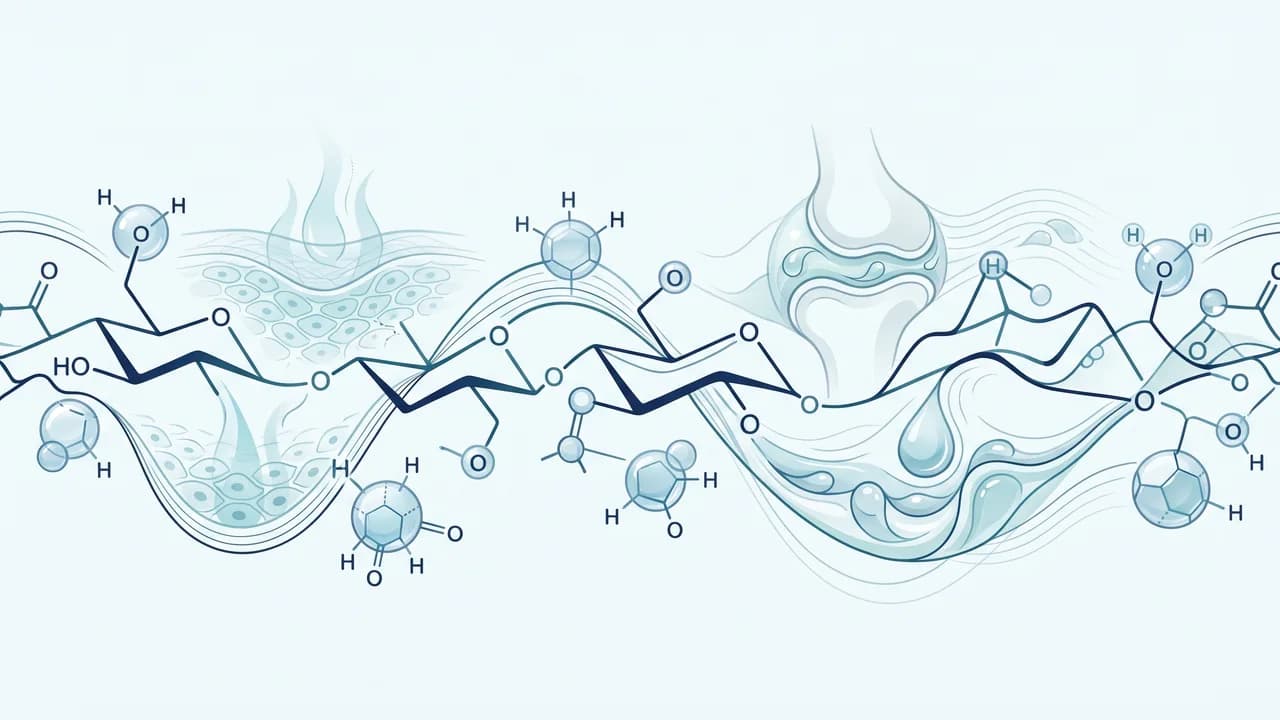
Hyaluronic Acid
Metabolic cofactors and energy intermediates. A research review published by South Beach Longevity.
Hyaluronic Acid
Oral, topical and injectable biology: one polymer, four routes that do not share evidenceHyaluronan is one polymer with four commercial lives: an oral supplement powder, a topical cosmetic film, an intra-articular viscosupplement, and a crosslinked dermal-filler implant. Native extracellular-matrix hyaluronan is a fifth object, the biological one. Those five do not share a route, a molecular-weight distribution, a residence time, or a safety file. This article grades each file inside the route that generated it. It is not a protocol.
Compiled by South Beach Longevity · 20 August 2026 Copyright 2026 Series SBL-41 / SP-HYALURONIC-ACID · Register A scientific article Sources peer-reviewed human trials, consensus statements, meta-analyses, pharmacokinetic studies, and labelled animal or in-vitro work Constraint This document describes published research. It is not medical advice. No human use, dose, route or schedule is recommended anywhere in this document.
Every finding is labelled, in the sentence that reports it, by the kind of study that produced it. In vitro means a cell or a reconstituted system. Animal names the species. Human means people. A guideline is a voted position, not a new trial. A review is secondary. Native matrix biology is not a delivery claim. A cosmetic instrument reading is not dermal hyaluronan mass. An intra-articular effect size is not an oral result. A filler harm is not a capsule risk. Amounts appear only as reported experimental parameters, always with the population attached. Nothing here is a recommendation. Findings are graded in place as established, strongly supported, emerging, plausible, inconsistent, or not supported. Formal evidence classes used in the matrices are defined in the Apparatus.
01 What this document is, and four things it is not
This article is a route-separated scientific reference for hyaluronan. It asks which human claims survive once chemistry, molecular weight, and route of administration are kept apart, and which claims are route extrapolations, metabolite inferences, or manufacturer-sponsored surrogates. The lexical collapse of five objects into one aisle word is the error the rest of the document refuses.
Four things follow immediately.
First, this is not a use guide. Balazs and Denlinger described, in a 1989 review, how elastoviscous hyaluronan created viscosurgery and viscosupplementation; equine traumatic arthritis was already in wide veterinary use, while human idiopathic osteoarthritis had not received wide acceptance as of that date (Balazs and Denlinger, 1989). Tezel and colleagues later reviewed injectable hyaluronan fillers as gels that differ in crosslinking, hardness, viscosity, extrusion force, concentration, and hydration (Tezel et al., 2008). Those papers classify products. They do not license a capsule, cream, injection, or implant for any person.
Second, it is not a licence to move evidence across routes. Oral products in the reviewed record are dietary supplements or foods (Kawada et al., 2014; Kawada et al., 2015; Doleckova et al., 2025). Intra-articular hyaluronan is a device-class intervention aimed at a pathological liquid compartment (Balazs and Denlinger, 1993). The U.S. Food and Drug Administration treats dermal fillers as medical-device implants, labelled for adults aged 22 years and older on specified facial and hand sites (FDA dermal-fillers page, fetched for this review). A cream is a surface film. Those regulatory classes are established. Shared International Nonproprietary Name is not shared evidence.
Third, it is not a demonstration that swallowed hyaluronan reconstitutes dermis or synovium. No human oral intact-polymer pharmacokinetic study sits in the reviewed record. The animal radiolabel stories disagree on how much carbon or metal leaves the gut, and they track labels, not a synovial lubricant (Balogh et al., 2008; Oe et al., 2014; Laznicek et al., 2012; Kimura et al., 2016).
Fourth, it is not medical advice and it is not a ranking of brands. Combination drinks that contain hyaluronan plus krill oil, Boswellia, carnosine, or collagen are not hyaluronan-only evidence (Hill et al., 2023; Ricci et al., 2017; Guaitolini et al., 2019; Montero-Vilchez et al., 2025). Industry names travel in the same sentence as the result. A significant p-value on crow's-feet replicas is not longevity medicine.
The working thesis is narrower than the label. Hyaluronan biology is established. The commercial object sold as hyaluronic acid is four objects. Human evidence must be graded inside the route that generated it.
02 Chemistry: a linear glycosaminoglycan, not a protein
Hyaluronan is a non-sulphated glycosaminoglycan of repeating D-glucuronic acid and N-acetyl-D-glucosamine (Brown and Jones, 2005; Papakonstantinou, Roth, and Karakiulakis, 2012). Oe, Sakai, Masuda, and Yamamoto, writing the full text of a Kewpie-conducted human trial, state that the disaccharides are linked by alternating beta-1,4 and beta-1,3 bonds, and that the Hyabest lots used in that trial were 95 percent hyaluronan by HPLC (Oe et al., 2017). It is not a protein. Papakonstantinou and colleagues state that, unlike other glycosaminoglycans, hyaluronan is not covalently attached to a protein core, though it may form aggregates with proteoglycans (Papakonstantinou et al., 2012). Grade for linear glycosaminoglycan identity: established.
Crosslinked filler hyaluronan is a chemically modified object. De Boulle and colleagues, in a filler-manufacturer-adjacent review with non-U.S. government research support, described 1,4-butanediol diglycidyl ether (BDDE) crosslinking and residual unreacted BDDE in finished filler of less than 2 ppm (De Boulle et al., 2013). That chemistry does not travel to an oral powder or a leave-on cream. Grade for commercial molecular-weight specification is only emerging: labels in the reviewed record rarely match a stated trial distribution. Doleckova and colleagues used sodium hyaluronate of 1.8 MDa (Doleckova et al., 2025). Michelotti and colleagues used a mixed "full-spectrum" lot sold as ExceptionHYAL Star (Michelotti et al., 2021). Those are different ingested objects.
The discovery-era primary that named the vitreous polysaccharide is absent from this review. This document does not reconstruct it.
03 Molecular weight is not a footnote
Function is size-dependent. Stern's 2004 review of the catabolic cascade assigns space-filling, hydrating, anti-angiogenic, and immunosuppressive behaviour to a high-molecular-weight polymer in the 10^4 kDa class, and angiogenic, immunostimulatory, and inflammatory behaviour to fragments of about 20 kDa (Stern, 2004). Scheibner and colleagues showed, in vitro and in mice, that low-molecular-weight hyaluronan engages Toll-like receptor 2 as a danger signal through MyD88, IRAK, TRAF6, protein kinase C zeta, and NF-kappaB, and that high-molecular-weight hyaluronan can inhibit that Toll-like receptor 2 signal (Scheibner et al., 2006). That fragment biology is established as receptor science. It is not a benefit of a supplement.
Topical molecular weight changes penetration and wrinkle instruments. Pavicic, Gauglitz, Lersch, and colleagues, in a human split-face vehicle-controlled trial with non-U.S. government research support, applied 0.1 percent hyaluronan creams of 50, 130, 300, 800, and 2000 kDa twice daily for 60 days in 76 women aged 30 to 60 years. All molecular weights improved hydration and cutometer R2 versus vehicle. Only 50 and 130 kDa improved wrinkle roughness Ra and Rz versus vehicle (Pavicic et al., 2011). Essendoubi and colleagues, using Raman spectroscopy on ex vivo human skin, found that 20 to 300 kDa crossed the stratum corneum and that 1000 to 1400 kDa did not (Essendoubi et al., 2016). Grade: strongly supported for topical stratum-corneum penetration as a size effect.
Oral trials in the reviewed record used 2 kDa, 300 kDa, 800 kDa, 1.8 MDa, and mixed "full-spectrum" lots (Oe et al., 2017; Kawada et al., 2015; Doleckova et al., 2025; Michelotti et al., 2021). Oe and colleagues found that both 2 kDa and 300 kDa "inhibited wrinkles" in title language, but only the 300 kDa Hyabest lot beat placebo on wrinkle-volume ratio at eight weeks (Oe et al., 2017). Molecular weight is not a simple smaller-is-better oral rule. Grade for a single oral-molecular-weight law: inconsistent.
Intravenous molecular-weight comparisons are a different route. Svanovsky, Laznicek, Laznickova, and colleagues injected 10, 100, and 450 kDa indium-111-DTPA-hyaluronan intravenously into male Wistar rats and recovered 50 to 54 percent of the 10 and 100 kDa doses in liver at five minutes versus 80 percent of the 450 kDa dose (Svanovsky et al., 2008). That is animal, intravenous clearance. It is not oral absorption.
A Caco-2 molecular-weight permeation paper often cited in this literature was not retrieved as a primary record. Oe and colleagues paraphrase a lower-molecular-weight preference in one sentence of the 2017 full text (Oe et al., 2017). That paraphrase is not a first-instance citation.
Itano, Sawai, Yoshida, and colleagues compared the three mammalian hyaluronan synthases in vitro. Expression of HAS1, HAS2, or HAS3 in COS-1 cells or rat 3Y1 fibroblasts produced a hyaluronan coat; HAS1 coats were smaller than HAS2 or HAS3 coats. Membrane-fraction kinetics differed in stability, elongation rate, and apparent Km for UDP-N-acetylglucosamine and UDP-glucuronic acid. HAS3 synthesised hyaluronan of 1 x 10^5 to 1 x 10^6 Da, shorter than HAS1 and HAS2 products of 2 x 10^5 to about 2 x 10^6 Da. In stable transfectants, HAS2 secreted extremely large hyaluronan with average mass greater than 2 x 10^6 Da (Itano et al., 1999). Itano and Kimata later reviewed the same isoform split as a regulatory fact: cytokine control and embryonic timing differ by isoform (Itano and Kimata, 2002). Grade: established that synthase isoform changes product size. That enzymology does not specify what a capsule contains.
04 Extracellular matrix, skin, cartilage, synovial fluid
Native hyaluronan is a matrix constituent. That fact is not a delivery claim. Stern's review states a total body burden of 15 g in a 70 kg person and daily cycling of 5 g (Stern, 2004). Papakonstantinou and colleagues, in a 2012 review, state that skin holds about 50 percent of total body hyaluronan, that dermal content exceeds epidermal, and that papillary dermis holds more than reticular dermis. Epidermal hyaluronan is mainly extracellular in the upper spinous and granular layers; basal hyaluronan is more intracellular (Papakonstantinou et al., 2012). Oe and colleagues repeat the 50 percent skin-share figure in the background of the Kewpie trial (Oe et al., 2017). Grade: established that native hyaluronan is a major extracellular-matrix glycosaminoglycan. The 50 percent figure is a review statement, not a measurement performed in the oral trials.
The same review states a blood half-life of 3 to 5 minutes, a skin half-life of less than a day, and a cartilage half-life of 1 to 3 weeks (Papakonstantinou et al., 2012). Those are review statements. The primary turnover papers they rest on were not retrieved as first-instance records in the reviewed record. Papakonstantinou and colleagues also write that exogenous hyaluronan is cleared from the dermis and is rapidly degraded (Papakonstantinou et al., 2012). That sentence is a reason not to treat a cream or a capsule as a depot.
Maytin's review treats hyaluronan as more than a wrinkle filler: fibroblasts and keratinocytes produce it, and CD44 mediates signalling (Maytin, 2016). Toole's 2004 review reframes hyaluronan as a pericellular cue rather than extracellular glue (Toole, 2004). The store record for Toole carries no extractable abstract numbers; it is used here only for that conceptual frame.
Photoaged human dermis is a different file from a supplement label. Yoshida, Nagaoka, and colleagues, in human biopsies, reported less and smaller hyaluronan, higher HYBID, and lower HAS1 and HAS2 in photoaged skin, with papillary-dermis hyaluronan loss correlating with wrinkling and sagging (Yoshida et al., 2018). Grade: strongly supported as tissue biology. Those biopsies did not test an oral or topical product.
Chondrocyte CD44 internalises hyaluronan in cell and cartilage systems (Aguiar, Knudson, and Knudson, 1999; Knudson and Knudson, 2004). Receptor occupancy on a chondrocyte in culture is not synovial lubrication from a swallowed powder.
Swallowing 80 to 200 mg of a trial powder does not replace a 15 g body pool that cycles 5 g per day. That arithmetic is a scale check, not a dose.
05 Wound healing
Injury biology is not a cosmetic or supplement endpoint. Papakonstantinou and colleagues review a rise in hyaluronan synthesis after injury and regulation of inflammatory, fibroblast, and epithelial responses; they also associate prolonged hyaluronan with fetal scar-free repair (Papakonstantinou et al., 2012). Maytin covers the same injury register (Maytin, 2016). Grade: strongly supported as review of injury biology.
Mouse genetics sharpen the point without creating a human indication. Mack, Feldman, Itano, Kimata, Lauer, Hascall, and Maytin found enhanced inflammation and accelerated closure after tetradecanoylphorbol-acetate or full-thickness wounding in Has1/Has3-null mice that still express Has2 (Mack et al., 2012). Hoxb13-knockout mouse skin has high hyaluronan and enhanced healing (Mack et al., 2003). TSG-6 knockout delays closure and disorders inflammation in mice (Shakya, Mack, Alipour, and Maytin, 2020). Hyperglycemia-altered hyaluronan is reviewed as a contributor to impaired diabetic wound healing (Shakya, Wang, Mack, and Maytin, 2015). Proteoglycans and glycosaminoglycans in healing and fibrosis are a separate review file (Ghatak et al., 2015).
Accelerated closure in knockout mice is not a human oral-hyaluronan wound claim. No oral or topical supplement randomised trial in the reviewed record is a wound-healing trial. Grade as an oral-supplement wound indication: not supported.
06 Receptor biology
CD44, RHAMM, Toll-like receptor 2, and HYBID are not interchangeable with lubrication. CD44 is the principal membrane hyaluronan receptor; isoforms govern adhesion and migration in cell and cartilage work (Aguiar, Knudson, and Knudson, 1999; Knudson and Knudson, 2004; Papakonstantinou et al., 2012). RHAMM mediates hyaluronan-dependent locomotion and ERK signalling in cell-biology papers that, in the reviewed record, sit largely in tumour, lymphocyte, and motility systems (Turley, 1992; Zhang et al., 1998; Cheung, Cruz, and Turley, 1999). Grade: established that the receptors exist and are size-sensitive.
Yoshida, Nagaoka, and colleagues showed, in human skin fibroblasts, that KIAA1199 (HYBID, CEMIP) binds and depolymerises hyaluronan independent of CD44 and HYAL in that system, with expression also correlating in osteoarthritic and rheumatoid synovium (Yoshida et al., 2013). A later review treats HYBID and TMEM2 (CEMIP2) as distinct degradative proteins (Yoshida, Inoue, and Okada, 2025). Grade: strongly supported as dermal and synovial catabolic biology. Those papers are not oral trials.
Oe, Yoshida, and Masuda, in a 2016 review with Kewpie-linked authors, infer intestinal-epithelium receptor binding as a mechanism for oral knee-pain effects (Oe et al., 2016). That is a mechanism inferred from symptoms, not a human pharmacokinetic proof that oral hyaluronan occupies synovial CD44. Grade: plausible that fragments or oligosaccharides could signal in gut. Not supported that oral hyaluronan occupies synovial CD44 as a lubricant.
07 Degradation
Catabolism is local and rapid. Commercial "more hyaluronan" slogans skip this. Stern's cascade names CD44, HYAL-1, HYAL-2, and the lysosomal exoglycosidases beta-glucuronidase and beta-N-acetylglucosaminidase, with stepwise oligomer biology (Stern, 2004). HYBID is a major dermal and synovial depolymeriser in the human-cell and biopsy papers already cited (Yoshida et al., 2013; Yoshida et al., 2018). Yoshida and colleagues explicitly treat the CD44/HYAL role in dermal depolymerisation as controversial relative to HYBID (Yoshida et al., 2013). Grade: established that hyaluronan is actively degraded. Strongly supported that HYBID matters in human skin.
Oral fate is an animal file and it does not agree with itself. Kimura, Maeshima, and colleagues found orally administered hyaluronan absent from rat feces, not degraded by artificial gastric or intestinal juice, degraded by cecal content, with oligosaccharides crossing excised large intestine, and with disaccharides, tetrasaccharides, and polysaccharides distributed to rat skin after oral 300 kDa hyaluronan (Kimura et al., 2016). Oe, Yoshida, and colleagues, using carbon-14 hyaluronan in male Sprague-Dawley rats, reported a plasma radioactivity peak at eight hours, approximately 90 percent "absorbed" and used as energy or tissue constituent, skin counts higher than blood at 24 and 96 hours, and more than 90 percent excreted in expired air or urine by 168 hours (Oe et al., 2014). Carbon-14 in expired air is metabolite and carbon dioxide accounting. Balogh, Polyak, and colleagues recovered 86.7 to 95.6 percent of oral technetium-99m high-molecular-weight hyaluronan radioactivity in rats, almost all in feces, with tissue counts from 15 minutes to 48 hours and joint, vertebra, and salivary scintigraphy at four hours (Balogh et al., 2008). Laznicek, Laznickova, Cozikova, and colleagues found no significant absorption of oral technetium-99m hyaluronan (0.1 to 1 MDa) to the central compartment in rats, and only traces after oral carbon-14 hyaluronan (Laznicek et al., 2012). Cozikova and colleagues showed, in vitro, that indium-111-DTPA-hyaluronan was destroyed in artificial gastric juice by 48 hours, a label-stability warning (Cozikova et al., 2010). Grade for quantitative oral bioavailability: inconsistent. Grade that degradation products equal intact synovial or dermal hyaluronan: not supported.
Filler hyaluronan is BDDE-crosslinked and is reversed by hyaluronidase (De Boulle et al., 2013; Juhasz, Levin, and Marmur, 2017). Intra-articular crosslinking is said to prolong residence time without a number in hours (Henrotin et al., 2015). Unmodified intra-articular residence in hours is unverified in the reviewed record.
08 How this article grades evidence
The grading rule is operational, not decorative. Intra-articular meta-analyses disagree in magnitude and in whether the difference clears a minimal clinically important difference (Arrich et al., 2005; Bannuru et al., 2011; Colen et al., 2012; Miller and Block, 2013). Guidelines split: the 2013 American Academy of Orthopaedic Surgeons guideline does not support viscosupplementation (Jevsevar, 2013); OARSI 2014 voted intra-articular hyaluronan uncertain (McAlindon et al., 2014); OARSI 2019 assigned knee Level 1B or 2 by comorbidity and did not recommend hip or polyarticular use (Bannuru et al., 2019). The 2019 American College of Rheumatology / Arthritis Foundation abstract in this store does not state a hyaluronan clause; its strong-yes list includes intra-articular glucocorticoid, not hyaluronan (Kolasinski et al., 2020). Oral skin trials are industry-proximate and use cosmetic surrogates (Oe et al., 2017; Michelotti et al., 2021; Gollner et al., 2017). Oral pharmacokinetics are animal and label-dependent (Balogh et al., 2008; Oe et al., 2014; Laznicek et al., 2012; Kimura et al., 2016).
A larger paper count is not a merged evidence file. Formal matrix grades (STRONG through INSUFFICIENT EVIDENCE) are defined in the Apparatus. Commercial prevalence never raises a grade. Grade for this methods claim: established.
09 Route map
Five objects, four commercial routes. Figure 1 is the map. Shared chemistry of the linear polymer is not shared pharmacokinetics.
| Route | What this review contains | Grade that the file is distinct |
|---|---|---|
| Native extracellular matrix | Reviews plus HYBID, HAS, and CD44 biology | Established |
| Oral supplement or food | Animal pharmacokinetics plus small human cosmetic and joint randomised trials | Established as a separate file |
| Topical cosmetic | Molecular-weight penetration plus vehicle-controlled hydration trials | Established as a separate file |
| Intra-articular device | Large meta-analyses plus a split guideline map | Established as a separate file |
| Crosslinked filler implant | Rheology, BDDE, blindness case series, hyaluronidase reversal | Established as a separate file |
Molecular weight cuts across those columns without merging them. Figure 2 is the size map for the reviewed record. Empty cells in the later route-by-weight table are absences.
10 Oral supplementation: what is swallowed
The ingested object is a powder, extract, drink, or yoghurt, not synovial fluid. Typical trial amounts in the reviewed record are 80 mg per day of Hyal-Joint chicken-comb extract in Kalman and colleagues (Kalman et al., 2008); 120 mg per day in Kawada, Oe, and Hsu (Kawada et al., 2015; Oe et al., 2017; Hsu et al., 2021); 200 mg per day in Tashiro and in Michelotti's ExceptionHYAL Star trial (Tashiro et al., 2012; Michelotti et al., 2021); and 60 or 120 mg per day of 1.8 MDa sodium hyaluronate in Doleckova and colleagues (Doleckova et al., 2025). Sources include biofermentation (Hyabest in Oe 2017; FS-HA in Michelotti 2021) and chicken-comb extract (Hyal-Joint; Mobilee 65 percent hyaluronan in Sanchez et al., 2014). Grade: established that swallowed products are powders or extracts at tens to hundreds of milligrams. Not supported that they are chemically native synovial hyaluronan.
Many labelled "oral hyaluronan" products are combinations. Gollner, Voss, and colleagues tested Regulatpro Hyaluron, an oral solution plus biotin, vitamin C, copper, and zinc, in 20 women for 40 days with no placebo (Gollner et al., 2017). Guaitolini and colleagues tested 200 mg hyaluronan plus 500 mg L-carnosine plus 400 mg methylsulfonylmethane (Guaitolini et al., 2019). Hill and colleagues tested FlexPro MD, krill oil plus astaxanthin plus low-molecular-weight hyaluronan (Hill et al., 2023). Ricci and colleagues compared intra-articular hyaluronan with oral Syalox, 300 mg hyaluronan plus Boswellia then 150 mg hyaluronan, without a placebo (Ricci et al., 2017). Montero-Vilchez and colleagues tested Dermial HAm, hyaluronan plus sulphated glycosaminoglycans plus collagen (Montero-Vilchez et al., 2025). Combo trials cannot isolate hyaluronan. Molecular weight on a label is often a mean, not a distribution; Oe and colleagues report means of about 2 kDa and about 300 kDa (Oe et al., 2017).
Those milligram amounts are study facts attached to those samples. They are not replacement doses for a 15 g body pool.
11 Does oral hyaluronan reach tissues intact?
This is the thesis hinge. Four animal stories, one missing Caco-2 primary, and no human intact-polymer pharmacokinetic study.
Balogh and colleagues gave a single oral dose of technetium-99m high-molecular-weight hyaluronan to Wistar rats and Beagle dogs. Urinary plus fecal recovery in rats was 86.7 to 95.6 percent of radioactivity, almost all in feces. Tissue radioactivity appeared from 15 minutes and persisted 48 hours, with a pattern different from free pertechnetate. Scintigraphy showed non-alimentary signal in joints, vertebrae, and salivary glands at four hours. Twenty-four-hour autoradiography labelled skin, bone, and joint pieces after the hyaluronan tracer and not after pertechnetate (Balogh et al., 2008). Technetium can dissociate. Fecal recovery of most counts argues against large intact-polymer absorption. Industry-adjacent non-U.S. government support is recorded on related radiolabel work in the reviewed record.
Oe and colleagues gave carbon-14 hyaluronan orally or intravenously to male Sprague-Dawley rats aged 7 to 8 weeks. After the oral dose, plasma radioactivity peaked at eight hours. The authors stated that approximately 90 percent of carbon-14 hyaluronan was absorbed from the digestive tract and used as an energy source or a structural constituent of tissues. Radioactivity was higher in skin than blood at 24 and 96 hours. More than 90 percent was excreted in expired air or urine by 168 hours, without excessive accumulation (Oe et al., 2014). Carbon-14 tracks carbon, including carbon dioxide. Kewpie-linked authors recur on this paper.
Kimura and colleagues, in rats, found orally administered hyaluronan undetectable in feces, undegraded by artificial gastric or intestinal juice, and degraded by cecal bacteria. Oligosaccharide hyaluronan passed excised large-intestine sacs. After oral 300 kDa hyaluronan, disaccharides, tetrasaccharides, and polysaccharides were distributed to rat skin (Kimura et al., 2016). That is the fragment and oligosaccharide hypothesis, not dermal reconstitution of a 300 kDa polymer.
Laznicek and colleagues qualify Balogh directly. Oral technetium-99m hyaluronan of 0.1 to 1 MDa showed no significant absorption to the central compartment in rats. A preliminary oral carbon-14 study showed only traces absorbed. Intravenous material cleared rapidly into liver (Laznicek et al., 2012).
Kawada, Matsuda, and colleagues, in a human review, assert that ingested hyaluronan is absorbed and partly distributed to skin, without a recovery table (Kawada et al., 2014). Kawada 2015 is a dry-skin human randomised trial, not a bioavailability study (Kawada et al., 2015).
The four animal stories must not be averaged into one bioavailability percentage. Bacterial oligosaccharides in rat skin are not intact 300 to 800 kDa hyaluronan in human dermis. Scintigraphic technetium spots are not intact polymer in cartilage. Grade: not supported that intact oral high-molecular-weight hyaluronan reconstitutes human dermis or synovium. Plausible, on animal evidence, that fragments, oligosaccharides, and local gastrointestinal signalling occur. Inconsistent quantitative bioavailability.
12 Topical cosmetic use
Surface hydration is strongly supported. Deep dermal reconstitution by an intact high-molecular-weight cream is not supported.
Pavicic and colleagues' human vehicle-controlled molecular-weight trial is the load-bearing cosmetic experiment (Pavicic et al., 2011). Essendoubi and colleagues supply the ex vivo human Raman split: 20 to 300 kDa through stratum corneum; 1000 to 1400 kDa impermeable (Essendoubi et al., 2016). Farwick, Gauglitz, and colleagues, in reconstituted human epidermis with non-U.S. government support, found about 50 kDa penetrated better than larger hyaluronan, altered tight-junction genes and proteins, and did not raise TNF-alpha versus 20 kDa (Farwick et al., 2011). Low-molecular-weight topical gene effects in a reconstituted epidermis are not oral reconstitution of dermis.
Jegasothy, Zabolotniaia, and Bielfeldt tested a "nano-HA" lotion, serum, and cream twice daily for eight weeks in 33 women (mean age 45.2 years) against an untreated control, not a vehicle. The Forlle'd / DermAvance-sponsored full text claims wrinkle depth up to 40 percent, hydration up to 96 percent, and elasticity up to 55 percent at eight weeks, with chromameter Day 57 versus Day 1 at P less than 0.001 (Jegasothy et al., 2014). Those effect sizes are extreme relative to Pavicic's vehicle-controlled molecular-weight study. Grade: emerging at best, and methodologically weaker than Pavicic.
Muhammad, Novianto, and colleagues randomised 36 people aged 60 to 80 years with xerosis. Stratum corneum capacitance was 56.37 arbitrary units on low-molecular-weight hyaluronan, 52.37 on high-molecular-weight hyaluronan, and 49.01 on vehicle. Transepidermal water loss and SRRC did not differ (Muhammad et al., 2024). Gregoire and colleagues found an ELISA valid in stratum corneum only, not epidermis or dermis: residual hyaluronan at least 8-fold at 24 hours after one application and at least 31-fold after seven daily applications (Gregoire et al., 2023). High-molecular-weight topical hyaluronan is largely a surface film.
Brown and Jones reviewed hyaluronan as a topical drug vehicle, including 3 percent diclofenac in 2.5 percent hyaluronan (Solaraze). That is pharmacology of a drug gel, not anti-ageing (Brown and Jones, 2005). Microneedle adenosine-in-hyaluronan work changes the barrier and is not leave-on cream evidence (Jang et al., 2020). Robinson and colleagues' open-label serum is named as such (Robinson et al., 2022).
Grade: strongly supported that topical hyaluronan hydrates stratum corneum and that low-molecular-weight material enters stratum corneum better than high-molecular-weight material. Emerging for wrinkle-depth reduction limited to low-molecular-weight leave-on creams versus vehicle. Not supported as dermal-matrix reconstitution by intact high-molecular-weight cream. Cosmetic hydration is not clinical anti-ageing and is not joint therapy.
13 Intra-articular clinical use
Intra-articular hyaluronan is a device-class injection into a joint. Balazs and Denlinger defined viscosupplementation as restoration of elastoviscosity in a pathological liquid compartment; devices remain "for various periods" depending on the viscosupplement and the pathophysiology (Balazs and Denlinger, 1993). Products differ: unmodified rooster-comb hyaluronan versus chemically modified hylan (Hamburger, Lakhanpal, Mooar, and Oster, 2003). Pseudoseptic and severe acute inflammatory reactions have been reported especially with hylan (Hamburger et al., 2003; Goldberg and Coutts, 2004; Tahiri et al., 2007; Aydin et al., 2017). Versus saline, Miller and colleagues' safety meta-analysis of 35 randomised trials (8078 participants) found local adverse-event risk ratio 1.21 (1.07 to 1.36); serious adverse events were not clearly increased (Miller et al., 2020 safety). Grade: established as a used intervention with a contested benefit. Effect sizes and the guideline split occupy section 22.
Ricci and colleagues compared intra-articular hyaluronan with oral Syalox (hyaluronan plus Boswellia) and reported improvement in both arms without a placebo (Ricci et al., 2017). That design does not convert oral hyaluronan into non-injected viscosupplementation.
14 Dermal filler contexts
Fillers are chemically modified implants. Stocks, Sundaram, Michaels, and colleagues showed that elasticity, firmness, viscosity, and particle size differ by manufacturing (Stocks et al., 2011). Sundaram and Cassuto compared cohesive polydensified matrix hyaluronan (lowest G-prime and viscosity, highest tan delta), NASHA (highest G-prime, bolus behaviour), and Hylacross (intermediate), and treated those rheology numbers as predictors of tissue integration pattern (Sundaram and Cassuto, 2013). Tezel and Fredrickson listed degree of crosslinking, gel hardness, extrusion force, concentration, and hydration as the manufacturing variables (Tezel and Fredrickson, 2008). De Boulle and colleagues stated residual BDDE below 2 ppm (De Boulle et al., 2013). Wojtkiewicz, Stachura, and colleagues, in a 2024 scoping review, argued that possible BDDE harms may be overlooked and that industry-sponsored safety reviews may under-report (Wojtkiewicz et al., 2024). Juhasz and colleagues, in 15 humans, found 20 units and 40 units of hyaluronidase both degraded several commercial hyaluronan fillers over 14 days, without a difference between those two amounts (Juhasz et al., 2017). Wu and colleagues reviewed reversibility with hyaluronidase (Wu et al., 2022; Wu et al., 2023). Grade: established as a distinct, chemically modified implant class.
The FDA page in the reviewed record classifies these products as implants, not for breast, buttock, feet, glabella, nose, or periorbit on the unapproved list, and lists necrosis, blindness, and stroke as intravascular risks. Neocollagenesis discussions in filler papers are not oral biology (Carruthers, Carruthers, and Humphrey, 2014). Filler volume and neocollagenesis do not transfer to a capsule or a cream.
15 Molecular-weight by route matrix
One matrix, no shared cells. Empty cells are absences.
| MW band in the reviewed record | Oral | Topical | Intra-articular | Filler |
|---|---|---|---|---|
| Oligosaccharide / about 2 kDa | Oe 2017 Hyabest capsule; Caco-2 primary missing | Farwick 20 kDa proinflammatory concern in vitro | Not a viscosupplement | Not a filler |
| About 50 to 130 kDa | No isolated oral cell in the reviewed record | Pavicic wrinkle signal; Farwick 50 kDa | Some low-MW products exist as comparators (Zhao et al., 2016) | --- |
| About 300 to 800 kDa | Kawada 300 k and 800 k; Oe 300 k | Hydration without wrinkle versus vehicle (Pavicic) | Product-specific | --- |
| 1 MDa or native-like | Doleckova 1.8 MDa oral sodium hyaluronate | Raman: 1000 to 1400 kDa impermeable to SC | Unmodified HA viscosupplements | Native HA is not the implant |
| Crosslinked / hylan | --- | --- | Hylan G-F 20; Gel-200 | BDDE gels |
Grade: strongly supported as a planning matrix. Figure 2 is the size map; this table is the route-by-band ledger. Empty cells stay empty.
16 Skin hydration
Stratum corneum water is a surrogate. It is not dermal hyaluronan mass.
The human randomised file is small and product-proximate. Kawada and colleagues (61 people with dry skin; Kewpie-linked authors) found moisture up versus placebo on 120 mg per day of 800 kDa or 300 kDa hyaluronan, with the 300 kDa residual at two weeks after stopping (Kawada et al., 2015). Hsu and colleagues (40 people; Kewpie authors including Oe, Matsuoka, and Masuda) found stratum corneum water and transepidermal water loss improved versus placebo (Hsu et al., 2021). Michelotti and colleagues reported hydration +10.6 percent at 28 days on ExceptionHYAL Star (Michelotti et al., 2021). Doleckova and colleagues (150 adults; no sponsor in the abstract) found the 120 mg 1.8 MDa arm improved hydration and reduced transepidermal water loss versus placebo (Doleckova et al., 2025). Amin and colleagues' seven-trial meta-analysis found hydration significant and transepidermal water loss not (Amin et al., 2025). Gollner and colleagues' Regulatpro Hyaluron drink had no placebo (Gollner et al., 2017). Gao and colleagues (129 women) reported hydration after 2 to 8 weeks; the dose is not in the abstract (Gao et al., 2023).
Oe 2017 did not use corneometry as primary; luster and suppleness rose in the placebo arm as well (Oe et al., 2017). Combo trials are not hyaluronan-only (Montero-Vilchez et al., 2025; Grier-Welch et al., 2025; Guaitolini et al., 2019). Jegasothy's topical "up to 96 percent" hydration figure must not be transferred to oral use.
| Trial | Design / n | Amount and object | Duration | Extractable hydration result | Product or sponsor named |
|---|---|---|---|---|---|
| Kawada 2015 | RCT, DB, PC; 61 dry skin | 120 mg/d; 800 k and 300 k | 6 wk | Moisture up versus placebo; 300 k residual at +2 wk | Kewpie-linked authors |
| Oe 2017 | RCT, DB, PC; 60 / replica 50 | 120 mg/d Hyabest 2 k or 300 k | 12 wk | Not a corneometry primary; luster/suppleness rose in all arms | Kewpie conducted the trial |
| Hsu 2021 | RCT, DB, PC; 40 | 120 mg/d | 12 wk | SC water and TEWL versus placebo | Kewpie authors (Oe, Matsuoka, Masuda) |
| Michelotti 2021 | RCT, DB, PC; 60 women | 200 mg/d FS-HA | 28 d | Hydration +10.6% | ExceptionHYAL Star |
| Gao 2023 | RCT, DB; 129 women | Dose not in abstract | to 12 wk | Hydration 2 to 8 wk; no effect size in abstract | None in abstract |
| Doleckova 2025 | RCT, DB, PC; 150 | 1.8 MDa SH 60 or 120 mg/d | 12 wk | SH120 hydration up, TEWL down versus placebo | None in abstract |
| Gollner 2017 | Open, no placebo; 20 | Combo drink | 40 d | "Significant" hydration | Regulatpro Hyaluron |
| Amin 2025 | Meta of 7 RCTs | Oral HA | --- | Hydration significant; TEWL not | Secondary |
Grade: emerging for small, often industry-run randomised trials showing stratum-corneum hydration versus placebo. Not a dermal hyaluronan-mass claim. Not clinical anti-ageing, disease modification, or joint lubrication.
17 Elasticity
Cutometer R parameters are not dermal collagen histomorphometry. Hsu and colleagues reported elasticity improved versus placebo at 8 and 12 weeks in 40 humans on 120 mg per day (Hsu et al., 2021). Michelotti and colleagues reported elasticity and firmness +5.1 percent at 28 days on ExceptionHYAL Star (Michelotti et al., 2021). Doleckova and colleagues reported elasticity up versus placebo on the 120 mg 1.8 MDa arm (Doleckova et al., 2025). Amin and colleagues found elasticity significant in the seven-trial meta-analysis (Amin et al., 2025). Gollner and colleagues reported elasticity up on an uncontrolled combo drink (Gollner et al., 2017). Guaitolini and colleagues reported glabella elasticity +22.6 percent on hyaluronan plus carnosine plus methylsulfonylmethane (Guaitolini et al., 2019). That last number is a combo result.
Where an isolated hyaluronan effect size is given, it is small (+5.1 percent in Michelotti). Grade: emerging as a cosmetic instrument signal. Not supported as restoration of youthful dermal mechanics. Filler-like lift and intra-articular rheology do not transfer.
18 Wrinkles
Oe, Sakai, Yoshida, and Masuda randomised 60 humans (replica analysis n = 50: 18 / 16 / 16) to 120 mg per day Hyabest 2 kDa or 300 kDa or placebo for 12 weeks. Kewpie Corporation conducted the trial. The 300 kDa arm's wrinkle-volume ratio beat placebo at eight weeks, p less than 0.05. Absolute replica means overlapped heavily; change-from-baseline drove the claim. Subjective wrinkles also improved in placebo at 8 and 12 weeks. Luster and suppleness rose in all groups versus baseline at 12 weeks (Oe et al., 2017). Hsu and colleagues reported wrinkle assessment improved versus placebo (Hsu et al., 2021). Michelotti and colleagues reported wrinkle depth -18.8 percent and volume -17.6 percent at 28 days on ExceptionHYAL Star (Michelotti et al., 2021). Doleckova and colleagues reported periorbital wrinkle depth down versus placebo on the 120 mg arm (Doleckova et al., 2025). Amin and colleagues found wrinkle depth significant and wrinkle volume not significant (Amin et al., 2025). Gao and colleagues reported epidermal thickness at 12 weeks, which is not a wrinkle metric (Gao et al., 2023).
Photoaging HYBID biology was not an endpoint in these randomised trials (Yoshida et al., 2018). Small n, crow's-feet replicas, and manufacturer proximity are the file. Grade: emerging for modest replica and instrument changes. Inconsistent on volume versus depth (Amin). Not supported as structural anti-ageing or as equivalence to filler. "Relieves wrinkles" in a title is not a clinical ageing-disease claim.
19 Joint pain
Oral joint trials are small, often product-named, and sometimes contaminated by exercise or second actives. Kalman, Heimer, and Valdeon ran a pilot human randomised trial of Hyal-Joint 80 mg per day in 20 people: WOMAC pain did not differ (P = 0.943); function and total scores were likewise null (Kalman et al., 2008). Tashiro and colleagues found JKOM improved in both 200 mg per day hyaluronan and placebo arms when both did quadriceps exercise; hyaluronan was better only in subjects aged 70 or younger at months 2 and 4 (Tashiro et al., 2012). Nelson and colleagues' Oralvisc trial in 40 people with obese knee osteoarthritis improved pain, function, and cytokines and lowered synovial hyaluronan turnover by heavy water; the authors said disease modification would need further study (Nelson et al., 2015). Sanchez and colleagues reported pain, effusion, and strength gains on Mobilee yoghurt versus placebo (Sanchez et al., 2014). Oe 2016 is a narrative review with no pooled effect size (Oe et al., 2016). Hill and colleagues' FlexPro MD combo and Ricci and colleagues' Syalox (hyaluronan plus Boswellia) versus intra-articular hyaluronan without placebo cannot isolate hyaluronan (Hill et al., 2023; Ricci et al., 2017).
| Trial | Design / n | Object | Duration | Extractable joint result | Isolation |
|---|---|---|---|---|---|
| Kalman 2008 | Pilot RCT, DB, PC; 20 | Hyal-Joint 80 mg/d | 8 wk | WOMAC pain NS (P = 0.943) | HA extract; tiny n |
| Tashiro 2012 | RCT, DB, PC; 60 KL 2-3 | 200 mg/d HA + exercise both arms | 12 mo | JKOM improved in both; HA better if age 70 or under at mo 2 and 4 | Exercise confound |
| Nelson 2015 | RCT, DB, PC; 40 obese | Oralvisc | 3 mo | Pain/function and cytokines; no ES in abstract | Product named |
| Sanchez 2014 | RCT, DB, PC | Mobilee yoghurt | 90 d | Pain, effusion, strength versus placebo | 65% HA extract |
| Hill 2023 | RCT, DB, PC; 100 / PP 75 | FlexPro MD | 12 wk | K-VAS -20.8 vs -10.6 mm | Combo |
| Ricci 2017 | RCT, 2-arm, no placebo; 60 | IA HA vs Syalox oral | 3 mo | Both improved | Oral arm combo |
| Oe 2016 | Review of RCTs 2008-2015 | Oral HA | --- | Narrative positive; no pooled ES | Kewpie-linked |
Intra-articular meta-analysis effect sizes (Bannuru peak 0.46; Bellamy 28 to 54 percent pain improvement from baseline) must not be attached to capsules. Grade: emerging for small industry randomised trials on symptoms. Inconsistent (Kalman null on primary pain). Not supported as viscosupplementation from within.
20 Osteoarthritis
Symptom trials are not disease-modifying osteoarthritis drug evidence. Populations in the reviewed record include Kellgren-Lawrence 2 to 3 (Tashiro et al., 2012), Kellgren-Lawrence 2 or higher (Kalman et al., 2008), "early" osteoarthritis (Ricci et al., 2017), and obese knee osteoarthritis (Nelson et al., 2015). Nelson's heavy-water glycosaminoglycan turnover change is biochemical, not radiographic disease modification. No oral randomised trial in the reviewed record reports joint-space narrowing or cartilage magnetic-resonance morphometry as a positive disease-modifying claim in the abstracts used here.
American College of Rheumatology, OARSI, and American Academy of Orthopaedic Surgeons documents in this store are about injected hyaluronan, not oral (Jevsevar, 2013; McAlindon et al., 2014; Bannuru et al., 2019; Kolasinski et al., 2020). Grade: not supported as disease-modifying osteoarthritis therapy. Emerging as a symptomatic adjunct in small trials. Cartilage regeneration is not supported. Oral hyaluronan is not guideline osteoarthritis treatment on this record.
21 Industry funding and surrogate endpoints
The oral cosmetic file is product-proximate. Kewpie Corporation conducted Oe 2017; Hyabest lots are named; authors Oe, Masuda, and Yoshida recur across Kawada 2015, Kawada 2014, Oe 2014, Oe 2016, and Hsu 2021 (Oe et al., 2017). Named products in the same sentence as results: Hyal-Joint (Kalman et al., 2008); Oralvisc (Nelson et al., 2015); ExceptionHYAL Star (Michelotti et al., 2021); Mobilee (Sanchez et al., 2014); Syalox (Ricci et al., 2017); Regulatpro Hyaluron (Gollner et al., 2017); Dermial HAm (Montero-Vilchez et al., 2025); FlexPro MD (Hill et al., 2023); Forlle'd / DermAvance nano-HA (Jegasothy et al., 2014). Publication types frequently say "Research Support, Non-U.S. Gov't" without a company name (Pavicic et al., 2011; Farwick et al., 2011; Balogh et al., 2008; Miller safety; Tezel et al., 2008; De Boulle et al., 2013). Doleckova 2025 (n = 150) and Gao 2023 (n = 129) abstracts do not name a sponsor.
Surrogates in this file are corneometer, cutometer, replica Ra and Rz, transepidermal water loss, JKOM, WOMAC, and visual analogue scales. They are not dermal hyaluronan mass and they are not synovial rheology. Industry funding does not automatically falsify a result. It does forbid treating the file as independent clinical anti-ageing. A randomised design is not independence from the manufacturer. Grade: established that the oral cosmetic file is heavily product-proximate and surrogate-based.
22 Viscosupplementation: effect size and the guideline split
Injected hyaluronan has a large randomised corpus and a contested magnitude. Bellamy and colleagues' Cochrane reviews found the class generally better than placebo, with 5-to-13-week pain improvement from baseline of 28 to 54 percent in the 2006 update, and with heterogeneity by product (Bellamy et al., 2005; Bellamy et al., 2006). Bannuru and colleagues' meta-analysis of 54 trials (7545 participants) versus placebo reported effect size 0.31 at week 4, peak 0.46 at week 8, and 0.21 at week 24; they treated an effect size above 0.20 as clinically relevant on an individual-patient basis (Bannuru et al., 2011). Versus corticosteroids, steroids were better at week 2 and hyaluronan better by weeks 12 to 26 (Bannuru et al., 2009). Versus oral NSAIDs, neither was favoured (Bannuru et al., 2014). A 2015 network meta-analysis found hyaluronan pain effect size 0.63 versus oral placebo and warned of an intra-articular placebo effect (Bannuru et al., 2015). Arrich and colleagues' systematic review of 22 trials found movement-pain differences of -3.8 to -7.1 mm on a 100 mm scale against a 15 mm standard they treated as clinically meaningful, with no function gain, and judged the intervention not clinically effective on that standard (Arrich et al., 2005). Colen and colleagues found a weighted mean difference of 10.20 visual-analogue units versus saline and called whether that meets a minimal important difference "debatable" (Colen et al., 2012). Miller and Block, restricting to U.S.-approved products versus saline, reported pain standardised mean difference 0.38 to 0.43 versus saline and 1.07 to 1.37 versus baseline, the latter including placebo response (Miller and Block, 2013; Strand et al., 2015). Miller and colleagues versus oral NSAIDs found pain standardised mean difference 0.15 and called it "not clinically important" (Miller et al., 2020). Zhao and colleagues found pain at 2 to 3 months favoured hylan G-F 20 over low-molecular-weight hyaluronan with high heterogeneity (Zhao et al., 2016). Adams and colleagues, in a human randomised trial of 102 knees, found three weekly hylan G-F 20 injections no different from NSAID plus arthrocenteses at 12 weeks; at 26 weeks both hylan arms exceeded NSAID alone (Adams et al., 1995). Guidelines do not speak with one voice. Jevsevar's 2013 AAOS guideline "does not support the use of viscosupplementation" (Jevsevar, 2013). OARSI 2014 voted intra-articular hyaluronan uncertain (McAlindon et al., 2014). OARSI 2019 assigned Level 1B or Level 2 for knee by comorbidity and did not recommend hip or polyarticular osteoarthritis (Bannuru et al., 2019). The 2019 ACR/AF guideline abstract in this store does not mention hyaluronan; its strong-yes list includes intra-articular glucocorticoid (Kolasinski et al., 2020). A 2022 AAOS summary calls for better hyaluronan research; recommendation strength is not stated in that abstract (Brophy and Fillingham, 2022). EUROVISCO expert consensus calls viscosupplementation effective for mild to moderate knee osteoarthritis; that is opinion plus literature, not a new meta-analysis (Henrotin et al., 2015). A widely cited sceptical intra-articular meta-analysis is absent from this review and is not reconstructed.
Several positive meta-analyses include industry-supported authors or U.S.-approved-product restrictions (Miller and Strand series; Miller 2020 safety, non-U.S. government support). Grade: inconsistent on whether the effect clears a minimal clinically important difference. Established that a guideline split exists. Strongly supported that any benefit, if real, peaks weeks after injection and is not immediate steroid-like analgesia. These effect sizes do not transfer to oral or topical use. "Safe and effective" in a U.S.-approved-product meta-analysis does not settle AAOS 2013.
| Source | Design | n / k | Key number | Position |
|---|---|---|---|---|
| Arrich 2005 | SR/MA | 22 trials | VAS -3.8 to -7.1 mm; MCID about 15 mm | Not clinically effective on that standard |
| Bellamy 2006 | Cochrane | 76 trials | Pain from baseline 28 to 54% at 5 to 13 wk | Class generally better than placebo; heterogeneous |
| Bannuru 2011 | MA vs placebo | 54 trials, 7545 | Peak ES 0.46 at week 8 | Authors treat ES >0.20 as relevant |
| Bannuru 2009 | MA vs CS | 7 trials, 606 | CS better wk 2; HA better wk 12 to 26 | Time course, not oral |
| Bannuru 2014 | MA vs NSAIDs | 5 trials, 712 | ES -0.07 | No difference |
| Bannuru 2015 | NMA | 33,243 | HA ES 0.63 vs oral placebo | Authors warn of IA placebo |
| Colen 2012 | SR/MA | 74 RCTs | WMD 10.20 VAS vs saline | MCID "debatable" |
| Miller/Strand | SR/MA, US-approved | 29 studies, 4866 | vs saline pain SMD 0.38 to 0.43 | Restricted product set |
| Miller 2020 vs NSAIDs | 6 RCTs, 831 | Pain SMD 0.15 | "Not clinically important" | |
| AAOS 2013 | CPG | --- | Does not support | Guideline |
| OARSI 2014 | CPG | --- | Uncertain | Guideline |
| OARSI 2019 | CPG | --- | Knee 1B/2; not hip/polyarticular | Guideline |
23 Residence time versus "lubricates from within"
The slogan is rhetoric. It is not a pharmacokinetic finding in any oral abstract in the reviewed record.
Balazs and Denlinger stated that viscosupplements remain for various periods depending on the nature of the viscosupplement and the pathophysiology (Balazs and Denlinger, 1993). Henrotin and colleagues state that crosslinking prolongs intra-articular residence time and give no hours (Henrotin et al., 2015). Exact synovial half-life of unmodified intra-articular hyaluronan in hours is unverified here. This document does not print an hours-to-days figure.
Oral carbon-14 excretion is dominated by expired air (Oe et al., 2014). Oral technetium-99m counts are mostly fecal (Balogh et al., 2008) or show no significant absorption (Laznicek et al., 2012). Filler persistence is crosslinking and rheology (Tezel et al., 2008; De Boulle et al., 2013), not oral pharmacokinetics. Rat-skin oligosaccharides after oral 300 kDa hyaluronan (Kimura et al., 2016) are not synovial lubrication. Grade: not supported as a pharmacokinetic statement for oral hyaluronan. Established as advertising copy.
24 Filler rheology, crosslinking, and reversal
Fillers are engineered gels. Stocks and colleagues and Sundaram and Cassuto quantified elasticity, viscosity, particle size, G-prime, and tan delta by manufacturing family (Stocks et al., 2011; Sundaram and Cassuto, 2013). Tezel and Fredrickson listed the same manufacturing levers (Tezel and Fredrickson, 2008). De Boulle and colleagues described BDDE epoxides as neutralised, with residual BDDE below 2 ppm, and claimed degradation to ordinary metabolites (De Boulle et al., 2013). Allergan- and Galderma-adjacent reviews are common in this set (Tezel, De Boulle, Sundaram). Wojtkiewicz and colleagues call industry-sponsored safety reviews incomplete (Wojtkiewicz et al., 2024). Keizers and colleagues associated a high-crosslink hyaluronan filler with adverse effects (Keizers et al., 2018). Juhasz and colleagues showed enzymatic reversibility at 20 and 40 units of hyaluronidase over 14 days in 15 humans (Juhasz et al., 2017). Grade: established that fillers are engineered gels and are enzymatically reversible.
Hyaluronidase "safety" does not apply to oral hyaluronan. There is no oral filler to reverse. Gel rheology does not predict capsule behaviour.
25 Filler harms that oral and topical files do not contain
Intravascular filler injury is a device-injection harm. Beleznay, Carruthers, Humphrey, and Jones compiled 98 published vision-change cases: glabella 38.8 percent, nose 25.5 percent, nasolabial fold 13.3 percent, forehead 12.2 percent; autologous fat 47.9 percent, hyaluronan 23.5 percent; central-nervous-system complications 23.5 percent; most vision loss permanent (Beleznay et al., 2015). Beleznay and colleagues added 48 cases from January 2015 to September 2018: nose 56.3 percent, glabella 27.1 percent; hyaluronan now 81.3 percent of reported cases; complete recovery 20.8 percent, partial 16.7 percent (Beleznay et al., 2019). Doyon, Beleznay, and colleagues added 365 cases from September 2018 to March 2023: nose 40.6 percent, forehead 27.7 percent, glabella 19.0 percent; hyaluronan 79.6 percent; no recovery 68.2 percent, partial 25.8 percent, complete 6.0 percent of 318 with outcomes; stroke-like features 19.2 percent; hyaluronidase near the site in 70.1 percent. No treatment, including hyaluronidase, was significantly associated with visual improvement (P greater than 0.05) (Doyon et al., 2024). Signorini, Liew, and colleagues classified early events (vascular infarction, inflammation, misplacement) and late events (nodules, granulomas, discoloration) (Signorini et al., 2016). Funt and Pavicic reviewed most adverse events as mild and transient, with serious events rare and technique- and anatomy-dependent (Funt and Pavicic, 2013; Funt and Pavicic, 2015). Artzi, Cohen, and colleagues described delayed inflammatory reactions (Artzi et al., 2020). The hylan intra-articular file of pseudosepsis is still injected material and still not oral (Goldberg and Coutts, 2004; Hamburger et al., 2003). The FDA page lists necrosis, blindness, stroke, and death as rare intravascular risks. Grade: established that intravascular filler injury is a device-injection harm absent from oral and topical safety files. These counts are not risks of a capsule or a cream. Conversely, short oral randomised trials that report no serious product adverse events say nothing about fillers.
26 Adversarial resolutions
The objections below are live constraints. Listing them does not convert a commercial claim into a yes. Each item is resolved as ACCEPTED, PARTIALLY ACCEPTED, or REJECTED on this review.
- Route extrapolation: evidence generated on one hyaluronan object licences a claim for another. REJECTED. Native matrix biology, oral powders, topical films, intra-articular devices, and BDDE-crosslinked implants do not share route, molecular-weight distribution, residence time, or safety file (sections 09 to 15). Bannuru's peak effect size of 0.46 is an intra-articular meta-analysis result (Bannuru et al., 2011). Pavicic's 50 and 130 kDa wrinkle signal is a leave-on cream result (Pavicic et al., 2011). Neither number is an oral finding.
- Oral bioavailability: swallowed high-molecular-weight hyaluronan arrives intact in human dermis or synovium in amounts that reconstitute those matrices. REJECTED as a pharmacokinetic claim. No human intact-polymer study is in the reviewed record. Balogh's fecal recovery of most technetium-99m counts, Oe's carbon-14 appearance in expired air, Laznicek's "no significant absorption" and "only traces," and Kimura's cecal oligosaccharides are animal stories that do not agree and must not be averaged (Balogh et al., 2008; Oe et al., 2014; Laznicek et al., 2012; Kimura et al., 2016). PARTIALLY ACCEPTED as a narrower fragment hypothesis: animal evidence makes oligosaccharide appearance and local gastrointestinal signalling plausible. That is not dermal or synovial reconstitution.
- Cosmetic surrogates: a corneometer, cutometer, or crow's-feet replica change is structural anti-ageing, dermal hyaluronan-mass restoration, or joint therapy. REJECTED. Kawada, Hsu, Michelotti, Doleckova, and Amin report instrument hydration or wrinkle-depth signals in small human randomised trials (Kawada et al., 2015; Hsu et al., 2021; Michelotti et al., 2021; Doleckova et al., 2025; Amin et al., 2025). Those endpoints are stratum-corneum water and surface geometry. They are not HYBID reversal (Yoshida et al., 2018), not dermal mass, and not synovial rheology. Amin found wrinkle volume and transepidermal water loss not significant. Oe's placebo arm improved on subjective wrinkles (Oe et al., 2017).
- Manufacturer-sponsored evidence: a randomised, double-blind, placebo-controlled design makes the oral cosmetic file independent clinical anti-ageing. REJECTED as independence. Kewpie conducted Oe 2017. ExceptionHYAL Star, Hyal-Joint, Oralvisc, Mobilee, Regulatpro Hyaluron, Dermial, FlexPro MD, and Forlle'd / DermAvance are named in the same sentences as their results (sections 16 to 21). PARTIALLY ACCEPTED as reportable data: industry proximity does not automatically falsify a p-value, and Doleckova 2025 and Gao 2023 abstracts do not name a sponsor. The file remains product-proximate and surrogate-based. Combo products (Hill et al., 2023; Guaitolini et al., 2019; Ricci et al., 2017) are not hyaluronan-only evidence.
- "It lubricates joints from within." REJECTED. The sentence does not appear as a pharmacokinetic finding in any oral abstract in the reviewed record. Intra-articular residence in hours is unverified. Oral carbon is burned or excreted (Oe et al., 2014). Oral metal labels are mostly fecal or unabsorbed (Balogh et al., 2008; Laznicek et al., 2012). Kalman found no WOMAC pain difference on Hyal-Joint (Kalman et al., 2008). Tashiro's signal sits on an exercise co-intervention (Tashiro et al., 2012). Nelson's Oralvisc cytokine and heavy-water findings are not radiographic disease modification (Nelson et al., 2015). Guideline documents in this store address injected hyaluronan (Jevsevar, 2013; Bannuru et al., 2019).
- Intra-articular viscosupplementation is settled as clinically important. REJECTED as settled. ACCEPTED as contested. Arrich judged the millimetre differences below a 15 mm standard (Arrich et al., 2005). Colen called the 10.20 visual-analogue weighted mean difference's importance debatable (Colen et al., 2012). Bannuru 2011 and the Miller/Strand U.S.-approved series report larger standardised effects (Bannuru et al., 2011; Miller and Block, 2013). AAOS 2013 does not support the intervention; OARSI 2019 is knee-conditional (Jevsevar, 2013; Bannuru et al., 2019). A missing sceptical meta-analysis is not filled from memory.
- Filler safety and oral-trial tolerance are one safety file. REJECTED. Beleznay and Doyon vision-loss counts, delayed nodules, and FDA intravascular warnings are implant-injection harms (Beleznay et al., 2015; Beleznay et al., 2019; Doyon et al., 2024). Short oral randomised trials that report good tolerance do not speak to those events. Intra-articular local adverse-event risk ratio 1.21 versus saline is a third file (Miller et al., 2020). Fairness clause: Pavicic's vehicle-controlled molecular-weight trial, Bannuru's time-course versus corticosteroids, and Stern's size-dependent catabolism remain load-bearing science. A article that mentioned only Kalman and Arrich would be as distorted as a brochure that mentioned only Michelotti's +10.6 percent and Bannuru's 0.46.
27 Safety by route
Three risk families must be kept apart: inherent to the solute on that route, inherent to the act of injection, and arising from chemically modified gels. Cross-route transfer in either direction is refused.
| Route | What this review supports | Grade |
|---|---|---|
| Oral short randomised trial | Abstracts report good tolerance; Kalman, Oe, Hsu, and Doleckova texts used here do not report serious product adverse events | Emerging (short, selected, often industry). Not a lifetime safety file |
| Topical cosmetic | Local irritation is not a major theme in these trials; Solaraze is a drug gel (Brown and Jones, 2005) | Strongly supported as generally well tolerated on intact skin in these trials |
| Intra-articular | Local pain and swelling common; local adverse-event RR 1.21 versus saline (Miller et al., 2020); rare pseudosepsis especially with hylan (Hamburger et al., 2003; Goldberg and Coutts, 2004); infection after intra-articular injection is a separate orthopaedic file | Strongly supported local reactions; emerging for rare severe reactions |
| Filler implant | Bruising and edema common; blindness, stroke, and necrosis rare but documented at scale (Beleznay et al., 2015; Beleznay et al., 2019; Doyon et al., 2024); delayed nodules | Established harm class that oral and topical files lack |
This document recommends no human use, dose, route, or schedule.
28 What would change the verdict
Falsifiers, not slogans. An oral tissue-reconstitution claim, currently not supported, would be strengthened by human pharmacokinetics showing intact labelled polymer of stated molecular weight in dermis or synovium at quantified mass. That study is absent. Independent, non-manufacturer oral randomised trials with a pre-registered minimal important difference on joint structure or dermal hyaluronan mass are absent. A head-to-head oral versus intra-articular trial with a placebo and an isolated hyaluronan oral arm is absent; Ricci 2017 is not that study (Ricci et al., 2017). Intra-articular clinical use would be stabilised by resolution of the minimal-important-difference and guideline split with a pre-specified, allocation-concealed, intention-to-treat, saline-controlled programme that survives Arrich-type quality filters (Arrich et al., 2005). Inclusion of the missing sceptical meta-analysis as a first-party store record would let that pole be cited without reconstruction. Filler-safety language would change if a treatment statistically improved visual outcomes after intravascular occlusion. Doyon and colleagues found none (Doyon et al., 2024). The verdict would not move on more crow's-feet replica p-values from Kewpie-adjacent 120 mg per day trials, more Raman proof that low-molecular-weight hyaluronan enters stratum corneum, or more consensus statements that viscosupplementation is "effective" without new patient-level data. Current verdict, graded. Hyaluronan biology: established. Oral intact reconstitution of dermis or synovium: not supported. Oral cosmetic hydration and wrinkle surrogates: emerging, industry-tinged. Intra-articular benefit: inconsistent versus minimal important difference, established as contested. Fillers: established as chemically modified implants with a unique harm file. "It lubricates joints from within" is copy, not pharmacokinetics.
This document describes published research. It is not medical advice. It is not a dosing guide, injection protocol, prescribing guide, compounding recipe, or self-treatment manual. No human use, dose, route or schedule is recommended anywhere in this document.
Evidence handling
Claim travels to a PMID or a named regulator page, then to species and route, then to a number, then to an industry flag, then to a grade. Abstracts are first. Full text is used only where named in the reviewed record: Oe 2017 (PMC5522662), Jegasothy 2014 (PMC3970829), Papakonstantinou 2012 (PMC3583886), and the FDA dermal-fillers page. Study type is labelled in the reporting sentence. Conflicting results stay in the same section. Industry or product names sit in the same sentence as the result. Amounts are study facts with the population attached. Routes are never pooled. Journalism is discovery, not first-instance citation. Primary papers that are famous and absent from this review are listed as missing. They are not reconstructed: the 1934 vitreous-polysaccharide discovery paper; the classic turnover and synovial-clearance primaries; a Caco-2 molecular-weight permeation primary; a widely cited sceptical intra-articular meta-analysis; the ACR/AF 2019 hyaluronan clause as wording. Papakonstantinou 2012, Toole 2004, Itano 1999, and Stern 2004 are in the store and are cited as first instance where used. Matrix grades
| Grade | Criterion |
|---|---|
| STRONG | Adequately powered randomised evidence, or a systematic review of such trials, internally consistent, inside one route |
| MODERATE | Smaller randomised trials or consistent controlled human data with residual limits of power, endpoint, or generality |
| LIMITED | Open-label, pilot, or n too small for the claim |
| INCONSISTENT | Controlled human results disagree across trials or quality filters |
| PRECLINICAL ONLY | Cells or animals only |
| NOT SUPPORTED | Adequate test negative, or claim contradicted inside the same route |
| INSUFFICIENT EVIDENCE | Not adequately tested |
| In-text grades (established / strongly supported / emerging / plausible / inconsistent / not supported) are the running language. Matrix grades above are the Apparatus mapping. |
Route matrix
| Object | Route | Best human evidence in the reviewed record | In-text grade | Matrix grade |
|---|---|---|---|---|
| Native ECM hyaluronan | None (biology) | Stern 2004; Papakonstantinou 2012; Yoshida 2018 biopsies | Established as matrix GAG | STRONG as biology; not a product |
| Oral powder / extract / drink | Oral | Small RCTs on SC hydration and symptoms | Emerging (surrogates); not supported as reconstitution | LIMITED / INCONSISTENT |
| Topical cream / serum | Cutaneous | Pavicic 2011 vehicle RCT; Essendoubi 2016 Raman | Strongly supported hydration and LMW SC entry | MODERATE (cosmetic) |
| Viscosupplement | Intra-articular | Large metas; split guidelines | Inconsistent vs MCID; established as contested | INCONSISTENT |
| Crosslinked filler | Implant injection | Rheology reviews; vision-loss series | Established as modified implant with unique harms | STRONG as device class |
MW matrix
| Band | What changes | What this review must not infer |
|---|---|---|
| ~20 kDa fragments | Stern inflammatory / angiogenic class; Scheibner TLR2 (in vitro / mouse) | A supplement benefit |
| 50 to 130 kDa topical | Pavicic wrinkle roughness vs vehicle; Farwick 50 kDa in vitro | Oral dermal reconstitution |
| 300 to 800 kDa oral lots | Kawada moisture; Oe 300 k wrinkle-volume vs placebo at 8 wk | Intact polymer in dermis |
| 1 MDa and above topical | Raman impermeable to SC (1000 to 1400 kDa) | Deep dermal delivery from a moisturizer |
| Crosslinked / hylan | IA residence claimed longer; filler implant rheology | Oral capsule behaviour |
Skin matrix
| Claim | Best evidence | Grade |
|---|---|---|
| Native skin holds a large HA fraction | Papakonstantinou 2012 review; Oe 2017 background | Established as review statement |
| Photoaged dermis: less HA, more HYBID | Yoshida 2018 human biopsies | Strongly supported |
| Oral SC hydration vs placebo | Kawada, Hsu, Michelotti, Doleckova, Amin | Emerging |
| Oral elasticity instrument signal | Hsu, Michelotti +5.1%, Doleckova, Amin | Emerging |
| Oral wrinkle replicas | Oe 300 k at 8 wk; Michelotti; Amin depth yes / volume no | Emerging / inconsistent |
| Topical hydration all MW vs vehicle | Pavicic 2011 | Strongly supported |
| Topical wrinkle vs vehicle only LMW | Pavicic 50 and 130 kDa | Emerging |
| HMW cream reconstitutes dermis | Raman + Gregoire ELISA SC-only | Not supported |
Joint matrix
| Claim | Best evidence | Grade |
|---|---|---|
| Oral isolated HA reduces WOMAC pain | Kalman 2008 Hyal-Joint, n = 20 | Not supported in that pilot |
| Oral HA symptoms in small RCTs | Tashiro (exercise both arms); Sanchez Mobilee; Nelson Oralvisc | Emerging / inconsistent |
| Oral HA is a DMOAD | No JSN or MRI morphometry claim in abstracts used | Not supported |
| IA HA vs placebo, time course | Bannuru 2011 peak ES 0.46 at week 8 | Strongly supported as a delayed signal |
| IA HA clears MCID | Arrich vs Bannuru / Miller | Inconsistent |
| IA HA guideline position | AAOS 2013 no; OARSI 2014 uncertain; OARSI 2019 knee only | Established split |
| Oral HA is viscosupplementation from within | No PK; combo and tiny pilots | Not supported |
Safety matrix
| Route | Dominant harm class in the reviewed record | Transfer to other routes |
|---|---|---|
| Oral | Short-trial tolerance; no lifetime file | Forbidden |
| Topical | Generally quiet on intact skin; drug gels are drugs | Forbidden |
| Intra-articular | Local reactions RR 1.21; rare hylan pseudosepsis | Forbidden |
| Filler | Intravascular vision loss, stroke, necrosis; delayed nodules | Forbidden |
Glossary
Hyaluronan / hyaluronic acid / HA. Linear non-sulphated glycosaminoglycan of repeating D-glucuronic acid and N-acetyl-D-glucosamine. The names are used interchangeably in commerce. This document treats them as one polymer name and four commercial objects. Sodium hyaluronate. The sodium salt used in several oral trials (Doleckova 1.8 MDa). HAS1, HAS2, HAS3. Mammalian hyaluronan synthases with distinct kinetics and product-size ranges (Itano et al., 1999). HYAL-1, HYAL-2. Classical hyaluronidases in Stern's cascade. HYBID / KIAA1199 / CEMIP. Dermal and synovial hyaluronan-depolymerising protein, CD44/HYAL-independent in Yoshida's fibroblast system. CD44. Principal membrane hyaluronan receptor. RHAMM. Receptor for hyaluronan-mediated motility. TLR2. Toll-like receptor 2; low-molecular-weight hyaluronan danger signal in Scheibner 2006 (in vitro / mouse). BDDE. 1,4-Butanediol diglycidyl ether; filler crosslinker. Residual unreacted BDDE less than 2 ppm in De Boulle 2013. Hylan. Chemically modified hyaluronan used as some viscosupplements (for example hylan G-F 20). Viscosupplementation. Intra-articular device concept: restore elastoviscosity of a pathological liquid compartment (Balazs and Denlinger, 1993). MCID. Minimal clinically important difference. Arrich used about 15 mm on a 100 mm movement-pain visual analogue scale. ExceptionHYAL Star, Hyabest, Hyal-Joint, Oralvisc, Mobilee, Syalox, Regulatpro Hyaluron, Dermial, FlexPro MD, Forlle'd / DermAvance. Product or manufacturer names that travel with the trial that used them.
Unresolved science
Human pharmacokinetics of intact oral polymer of stated molecular weight in dermis or synovium at quantified mass. Independent oral randomised trials on dermal hyaluronan mass or joint structure with a pre-registered minimal important difference. A hyaluronan-only oral arm versus intra-articular hyaluronan versus placebo. First-instance retrieval of the missing turnover primaries, the Caco-2 permeation primary, and the missing sceptical intra-articular meta-analysis. ACR/AF 2019 hyaluronan clause as published wording. A treatment that statistically improves visual outcome after intravascular filler occlusion. Intra-articular residence time of unmodified hyaluronan in hours from a retrieved primary. Whether Doleckova 2025 and Gao 2023 have unnamed sponsors once full texts are read.
References
Reference list generated at build from the verified citation store. Do not hand-edit.
Continue reading