
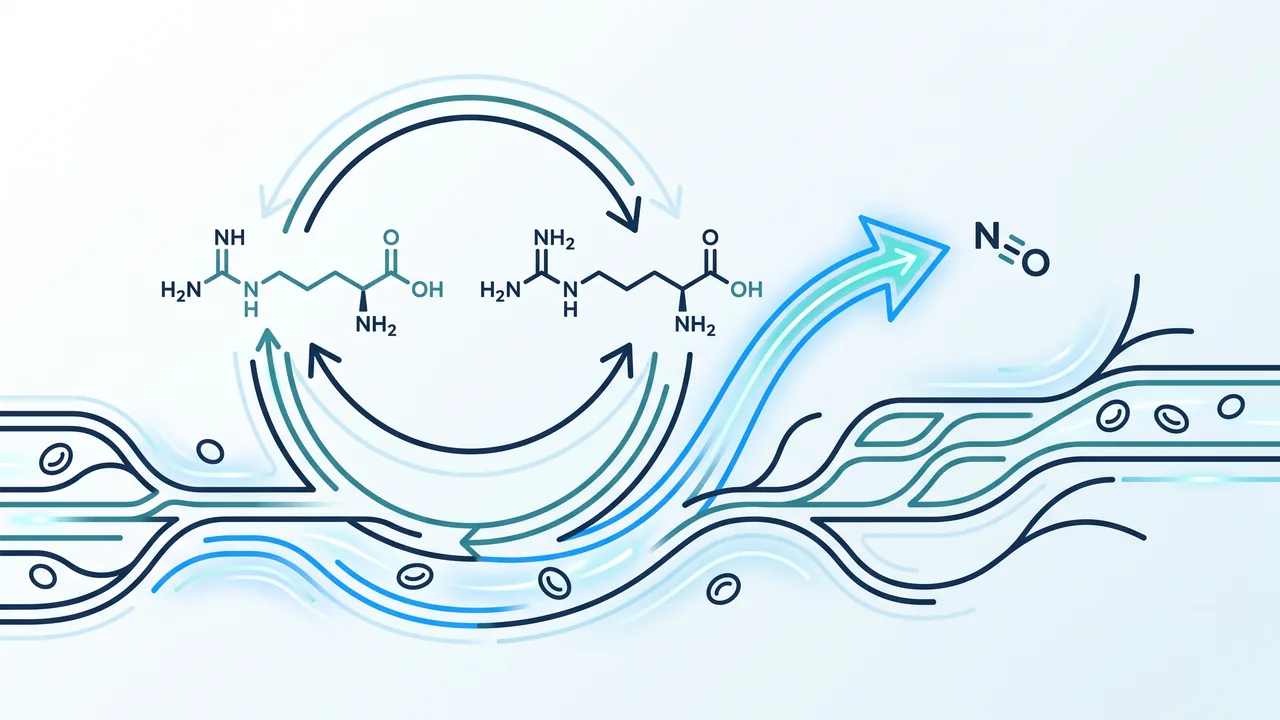
L-Citrulline and Citrulline Malate
Amino acids and derivatives. A research review published by South Beach Longevity.
Evidence is labelled by study type in the sentence that reports it. In vitro and animal findings are never phrased as human outcomes. Human randomized means people under allocation. A meta-analysis is named as such. A review is secondary. Amounts and durations appear only as reported study parameters, always with the population attached.
Findings are graded in place as established, strongly supported, emerging, plausible, or speculative. L-citrulline and citrulline malate are kept in separate sentences. An 8 g citrulline-malate load is not converted to citrulline milligrams unless the paper assayed the ratio. Blood-flow or nitric-oxide markers are not treated as work performed. No product, dose, or regimen is recommended.
Abstract
L-Citrulline is a non-proteinogenic α-amino acid (C6H13N3O3) produced by ornithine transcarbamylase in the urea cycle and by nitric-oxide synthase as a co-product of nitric oxide. Curis and colleagues divided mammalian citrulline metabolism into three tissue geometries: hepatic urea-cycle turnover that does not export citrulline; local recycling of citrulline to arginine in nitric-oxide-producing cells; and an intestinal–renal axis in which enterocytes release citrulline that the kidney converts to arginine (Curis et al., 2005). Windmueller and Spaeth, in the rat, showed that intestinally derived citrulline largely escapes the liver, that the kidney takes up most of that flux, and that renal arginine release accounts for most of the citrulline taken up (Windmueller and Spaeth, 1981). In humans with a short bowel, postabsorptive plasma citrulline tracks remaining enterocyte mass (Crenn et al., 2000).
Oral L-arginine is a poor plasma-arginine donor because enterocyte arginase captures a large first-pass fraction. Oral L-citrulline is not a substrate for that enzyme in the same way. In a double-blind crossover in 20 healthy volunteers, L-citrulline raised the AUC and Cmax of plasma arginine more effectively than L-arginine; 3 g twice daily moved the arginine/ADMA ratio from 186 ± 8 to 278 ± 14 and increased urinary nitrate and cGMP, without improving flow-mediated dilation over baseline (Schwedhelm et al., 2008). The Citrudose study showed dose-ranging plasma arginine rises after 2–15 g oral citrulline in eight men, with saturation of renal conversion at the highest loads (Moinard et al., 2008). In eight older men, isomolar citrulline produced more arginine availability than arginine itself (Moinard et al., 2016). That pharmacokinetic superiority is established. Translation to endothelial function, blood pressure, erectile hardness, and exercise work is a different file.
Citrulline malate is a salt or blend. Most performance papers report 8 g and imply a 2:1 citrulline:malate ratio. Independent product chemistry does not honour that implication. Chappell, Allwood, Johns and colleagues used 8 g at a 1.11:1 ratio, found no German-volume-training benefit, and stated that assayed products disagreed with manufacturers’ claims (Chappell et al., 2018). Gough and colleagues summarised nuclear-magnetic-resonance analyses at about 1.6:1, some as low as 1.1:1, so 8 g of a 1.1:1 product supplies about 4.2 g citrulline rather than about 5.3 g (Gough et al., 2021). Malate is anaplerotically plausible (Bendahan et al., 2002); it has not been isolated from citrulline in a milligram-matched human trial. Resistance-exercise results for the salt are mixed: Pérez-Guisado and Jakeman reported large last-set and soreness effects (Pérez-Guisado and Jakeman, 2010); Gonzalez, Farney, Chappell, Cunniffe, and da Silva did not reproduce a general ergogenic claim (Gonzalez et al., 2018; Farney et al., 2019; Chappell et al., 2018, 2020; Cunniffe et al., 2016; da Silva et al., 2017). Meta-analyses find small effects with confidence intervals that barely clear zero (Trexler et al., 2019; Vårvik et al., 2021). Acute 6 g L-citrulline was null for repetitions, time to exhaustion, VO2max, and flow-mediated dilation (Cutrufello et al., 2015). Beetroot juice raised NOx; citrulline malate did not match that NOx rise; neither improved isokinetic work (Trexler et al., 2019). Blood-pressure meta-analysis of L-citrulline reports a modest systolic reduction in small trials (Barkhidarian et al., 2019). Mild-erectile-hardness data exist in a single-blind, 24-man study of 1.5 g/day L-citrulline (Cormio et al., 2011). The evidence justifies a precise pharmacokinetic sentence. It does not justify a gym-floor sentence that citrulline, or citrulline malate, is a proven performance drug.
01 Chemistry of L-citrulline
L-Citrulline is (S)-2-amino-5-(carbamoylamino)pentanoic acid. The free-acid formula is C6H13N3O3; the conventional molecular weight is 175.19. It is a non-proteinogenic α-amino acid. Ribosomes do not encode it. The carbamoyl nitrogen on the side chain is the chemical fact that separates it from ornithine (which lacks that urea-like substitution) and from arginine (which carries a guanidino group instead). At physiological pH the α-carboxyl is deprotonated and the α-amino group is protonated; the ureido nitrogen is not a strong base. The molecule is therefore less cationic than arginine or ornithine and is not a substrate for arginase.
The name is historical, not botanical marketing. Watermelon (Citrullus lanatus) is a dietary source of free citrulline, and feeding watermelon raises plasma arginine in adults (Collins et al., 2007). Food-form citrulline is still citrulline. It is not citrulline malate, and a watermelon-juice arm is not a salt trial (Cutrufello et al., 2015). Stereochemistry is not optional: the enzymes of the urea cycle and of arginine resynthesis act on the L isomer. D-citrulline is not this article.
Two biosynthetic routes produce L-citrulline in mammals. Ornithine transcarbamylase condenses L-ornithine with carbamoyl phosphate inside mitochondria and yields L-citrulline as the urea-cycle intermediate. Nitric-oxide synthase oxidises the guanidino carbon of L-arginine and releases nitric oxide plus L-citrulline as co-products. Those two citrullines are chemically identical. Their tissue of origin, their next enzyme, and what a plasma measurement of citrulline means are not identical (Curis et al., 2005; Bahri et al., 2013).
02 Three tissue geometries, not one cycle
Curis, Nicolis, Moinard, Osowska, Zerrouk, Bénazeth and Cynober divided mammalian citrulline metabolism into three geometries that must not be collapsed (Curis et al., 2005).
Hepatic urea-cycle turnover makes and consumes citrulline inside the hepatocyte. Periportal hepatocytes express the full cycle. They do not export citrulline as a circulating arginine precursor. A urea-cycle lecture is therefore not a description of oral citrulline kinetics. Moinard and Cynober later restated citrulline as a nitrogen-homeostasis player whose circulating pool is largely extrahepatic (Moinard and Cynober, 2007; Breuillard et al., 2015).
Local nitric-oxide recycling reconverts citrulline to arginine inside nitric-oxide-producing cells by argininosuccinate synthase and lyase. That loop can support nitric-oxide output when extracellular arginine is limited. It is a cell-autonomous salvage path. It is not the explanation of why a 3 g oral load raises plasma arginine in a healthy volunteer.
The intestinal–renal axis is the circulating story. Enterocytes synthesise citrulline from glutamine and related precursors and release it into portal blood. Ligthart-Melis and colleagues showed in humans that the route of labelled glutamine administration (enteral versus parenteral) changes conversion into citrulline and arginine, which is the expected signature of an intestinal first step (Ligthart-Melis et al., 2007). The kidney takes that citrulline up and converts it to arginine by ASS and ASL. Van de Poll and colleagues reviewed renal amino-acid exchange and placed that conversion among the kidney’s inter-organ jobs (van de Poll et al., 2004). Osowska and colleagues, in the rat after massive intestinal resection, showed that citrulline restored arginine pools and nitrogen balance where arginine itself did not (Osowska et al., 2004). That is an animal resection experiment. It is not a human sports trial. It is the mechanistic reason a short-bowel plasma-citrulline marker exists.
03 Intestinal mass, plasma citrulline, and what a number is not
Crenn, Coudray-Lucas, Thuillier, Cynober and Messing showed that postabsorptive plasma citrulline in humans with a short bowel tracks remaining absorptive enterocyte mass and grades intestinal failure (Crenn et al., 2000). The same group extended the marker to villous atrophy (Crenn et al., 2003) and reviewed it as a biomarker of enterocyte-mass reduction (Crenn et al., 2008). Crenn and Cynober later discussed the practical implication for nutrition support after resection: arginine metabolism changes when the intestinal citrulline factory is lost (Crenn and Cynober, 2010; Curis et al., 2007). Established: plasma citrulline is a gut-mass marker in those clinical settings. It is not a sports-performance biomarker, and a high plasma citrulline after a capsule is pharmacokinetics, not proof that enterocytes have grown.
Bahri and colleagues characterised citrulline uptake in a human intestinal epithelial cell model (Bahri et al., 2008). That is in vitro transport work. It supports the claim that enterocytes handle citrulline as a defined substrate. It does not measure a gym outcome.
04 Two labelled objects already
The rest of this article keeps two commercial objects in separate sentences. L-Citrulline is the free amino acid just defined. Citrulline malate is a salt or blend of citrulline and malic acid. Gough and colleagues treat them as non-interchangeable experimental objects and treat manufacturer ratio claims as a quality-control problem for the performance file (Gough et al., 2021). Part Three is the labelling and malate file. Parts Two and Four are, unless a sentence names the salt, the free amino acid. Pooling them under the word “citrulline” is the category error this document exists to refuse.
L-Citrulline is a defined non-proteinogenic amino acid produced in the urea cycle and as a nitric-oxide synthase co-product. Circulating citrulline is largely an intestinal export converted to arginine in the kidney (Windmueller and Spaeth, 1981; Curis et al., 2005). Plasma citrulline marks enterocyte mass in short-bowel and villous-atrophy settings (Crenn et al., 2000, 2003). L-Citrulline and citrulline malate are not one experiment (Gough et al., 2021).
05 First-pass: why oral arginine is a poor plasma-arginine donor
Oral L-arginine is a substrate for enterocyte and hepatic arginase. A large first-pass fraction never reaches the systemic circulation as arginine. Oral L-citrulline is not that substrate. It survives the gut and liver, appears in plasma, and is converted to arginine in kidney and other ASS/ASL-expressing tissues. That is the pharmacokinetic rationale for preferring citrulline as an oral arginine-delivery molecule. It is a first-pass argument. It is not an outcome argument.
Windmueller and Spaeth, in vascularly perfused rat intestine, showed that intestinally derived citrulline largely escapes hepatic uptake, that the kidney takes up most of the circulating load (about 83 percent of intestinal release in that preparation), and that renal arginine release accounts for most of the citrulline taken up (Windmueller and Spaeth, 1981; Windmueller and Spaeth, 1977). That is established as organ physiology in the rat. Human oral pharmacokinetics later asked whether the same geometry appears as a plasma-arginine advantage.
06 Human pharmacokinetics
Schwedhelm, Maas, Freese, Jung, Lukacs, Jambrecina, Miranda, Strobel, Baldus, Boger and colleagues randomised 20 healthy volunteers in a double-blind crossover through six one-week oral regimes of L-citrulline, L-arginine, and placebo (Schwedhelm et al., 2008). L-Citrulline raised the area under the curve and the Cmax of plasma arginine more than L-arginine (P < 0.01). At 3 g twice daily, trough arginine and the arginine/ADMA ratio moved from 186 ± 8 to 278 ± 14. Urinary nitrate rose from 92 ± 10 to 125 ± 15 µmol/mmol creatinine; cGMP rose from 38 ± 3.3 to 50 ± 6.7 nmol/mmol creatinine. No regime improved flow-mediated dilation over baseline. Pooled FMD correlated with the change in arginine/ADMA. Established: oral L-citrulline is superior to oral L-arginine for raising plasma arginine in this design. Not demonstrated: an FMD improvement over baseline in these healthy volunteers.
The Citrudose study gave 2, 5, 10, or 15 g oral L-citrulline to eight fasting healthy men (Moinard et al., 2008). Plasma citrulline, ornithine, and arginine rose. Arginine Cmax ranged from 146 ± 8 to 303 ± 11 µmol/L across that load range; Tmax was about 1.2–2.3 h. Insulin and growth hormone did not change. At the highest loads citrulline accumulated, consistent with saturation of renal argininosuccinate synthase. Established: dose-ranging plasma amino-acid kinetics in healthy men. Not a performance trial. Not a licence to treat 15 g as a studied sports load.
Moinard, Maccario, Walrand, Lasserre, Marc, Boirie and Cynober then compared isomolar oral loads in eight fasting older men: 10 g L-citrulline versus 9.94 g L-arginine (Moinard et al., 2016). Arginine availability was higher after citrulline; arginine elimination was higher after the arginine load. Strongly supported in that older-male sample: citrulline remains the better in-vivo arginine precursor. The trial did not measure FMD, blood pressure, or work.
Collins and colleagues showed that watermelon feeding raises plasma arginine in adults (Collins et al., 2007). That is food-form confirmation of the same precursor logic. McKinley-Barnard, Andre, Morita and Willoughby reported higher nitrite/NOx 30 minutes after exercise with 2 g/day L-citrulline plus glutathione for seven days in resistance-trained men (McKinley-Barnard et al., 2015). That is a combination product. It is not isolated-citrulline pharmacokinetics and is not used below as a citrulline-alone nitric-oxide result.
07 Nitric oxide, endothelium, and the missing translation
Endothelial nitric-oxide synthase uses L-arginine; L-citrulline is the co-product. Raising plasma arginine and the arginine/ADMA ratio is a rational way to feed that enzyme if substrate or competitive methylarginines are limiting. Schwedhelm et al. (2008) moved those numbers and moved urinary nitrate and cGMP without moving FMD over baseline. That dissociation is the load-bearing human fact for this Part: a better precursor can move nitric-oxide-related metabolites without moving the endothelial function test that the marketing sentence wants.
Wijnands and colleagues, in rodent endotoxemia, found citrulline a more suitable substrate than arginine for restoring nitric-oxide production and microcirculation (Wijnands et al., 2012, 2014). That is animal pathophysiology under inflammatory arginase pressure. It is not a human gym or clinic outcome. El-Hattab and colleagues reported restoration of impaired nitric-oxide production in MELAS with citrulline and arginine supplementation (El-Hattab et al., 2012). That is a mitochondrial-disease experiment. It is not a retail endothelial claim and is not pooled with healthy-volunteer FMD.
Jourdan, Nair, Carter and colleagues reported that citrulline stimulated muscle protein synthesis in the post-absorptive state in healthy people fed a low-protein diet, in a pilot (Jourdan et al., 2015). Sureda and colleagues reported effects of oral L-citrulline on neutrophil oxidative burst and nitric-oxide production after exercise (Sureda et al., 2009). Those are labelled as what they are: a low-protein MPS pilot and an immune-cell exercise study. They are not resistance-repetition evidence.
08 Citrulline versus arginine: pharmacokinetic matrix
Amounts and durations are reported experimental parameters. They are not recommendations.
| Source | Design / n | Load as published | Plasma arginine | NO-related marker | FMD / function | Grade |
|---|---|---|---|---|---|---|
| Windmueller and Spaeth, 1981 | Perfused rat organs; A–V differences | Endogenous intestinal release | Kidney takes ~83% of intestinal CIT and returns ARG | Not a human PK trial | Not applicable | Established (animal) intestinal–renal axis |
| Schwedhelm et al., 2008 | DB RPC crossover; 20 healthy volunteers; 1 week each | Highest CIT 3 g twice daily vs ARG vs placebo | CIT raised AUC and Cmax more than ARG (P < 0.01); ARG/ADMA 186 ± 8 → 278 ± 14 | Urinary nitrate and cGMP up | No regime improved FMD over baseline | Established PK; FMD not demonstrated |
| Moinard et al., 2008 (Citrudose) | 8 fasting healthy men; four oral loads | 2, 5, 10, 15 g CIT | ARG Cmax 146 ± 8 to 303 ± 11 µmol/L; Tmax ~1.2–2.3 h | Insulin and GH unchanged | Not measured | Established dose-ranging PK; high-dose CIT accumulates |
| Moinard et al., 2016 | 8 fasting older men; isomolar loads | 10 g CIT vs 9.94 g ARG | ARG availability higher after CIT | Not an FMD trial | Not measured | Strongly supported in older men |
| Collins et al., 2007 | Watermelon feeding, adults | Dietary watermelon (free CIT + ARG) | Plasma arginine rose | Food matrix, not a salt | Not a resistance trial | Established food-form CIT raises plasma ARG |
Is citrulline superior to arginine for raising plasma arginine? Yes, in the human trials designed to ask that question (Schwedhelm et al., 2008; Moinard et al., 2016). That is a pharmacokinetic result. It is not a performance result, a blood-pressure result, or an erectile-function result.
09 Citrulline malate is a different experimental object
Citrulline malate is citrulline plus malate, as a salt or as a blend. Malate is a tricarboxylic-acid-cycle intermediate. Citrulline is the urea-cycle / nitric-oxide precursor already described. Combining them on a label does not merge their evidence files. Gough, Sparks, McNaughton, Higgins, Newbury, Trexler and colleagues stated the point as a review conclusion: L-citrulline and citrulline malate are not interchangeable experiments, and the resistance and high-intensity file is equivocal once product chemistry is taken seriously (Gough et al., 2021).
Most performance papers report an 8 g citrulline-malate load and imply a 2:1 citrulline:malate ratio. At a true 2:1, 8 g of the salt contains about 5.3 g citrulline. That conversion is arithmetic on an assumed ratio. It is not a measured milligram count unless the paper assayed the product. This article does not convert “8 g CM” into citrulline milligrams in any trial that did not report the assay.
10 Ratio, labels, and 1:1 versus 2:1
Chappell, Allwood, Johns, Brown, Sultana, Anand and colleagues used 8 g citrulline malate at a 1.11:1 ratio in recreationally active men and women under German Volume Training (Chappell et al., 2018). Repetitions and peak forces did not improve. Muscle soreness was higher on the salt, not lower. The authors stated that chemical analyses of reviewed products disagreed with manufacturers’ claims. That sentence is a methods fact about the literature, not a rumour about one bottle.
The same group later used 8 g at 1.1:1, with 6 g citric acid as placebo, in 19 resistance-trained participants doing German Volume Training curls (Chappell et al., 2020). Total repetitions were null. Soreness was lower on citrulline malate in that second paper; the 2018 paper had moved soreness the other way. Neither trial is a replication of Pérez-Guisado and Jakeman (2010). Both are among the few papers that name an assayed ratio in the public record harvested here.
Gough et al. (2021) summarised nuclear-magnetic-resonance analyses of commercial citrulline malate at about 1.6:1, with some products as low as 1.1:1. Eight grams of a 1.1:1 product supplies about 4.2 g citrulline rather than about 5.3 g. Cunniffe, Papageorgiou, O’Brien, Davies, Grimble and Cardinale gave 12 g citrulline malate to ten well-trained men: plasma citrulline rose 8.8-fold, so some citrulline was absorbed; the ratio was still not the published experimental variable; time to exhaustion, peak power, fatigue index, and acid–base measures were null (Cunniffe et al., 2016). Absorption is not label accuracy.
| Item | What the record actually says | Consequence for reading trials |
|---|---|---|
| Two commercial objects | L-Citrulline is the free amino acid. Citrulline malate is a salt or mixture (Gough et al., 2021). | Pooling “citrulline” RCTs without naming the salt is a category error. |
| Stated 2:1 | Most CM performance papers report 2:1. At 2:1, 8 g CM contains about 5.3 g citrulline. | If the bottle is not 2:1, the methods-page milligrams are wrong. |
| Assayed 1.1:1 | Chappell et al., 2018 used 8 g at 1.11:1; product assays disagreed with labels. Gough et al., 2021: commercial NMR ~1.6:1, some 1.1:1 (~4.2 g CIT in 8 g). | A large fraction of the 8 g CM file is dose-uncertain. |
| Chappell GVT 2020 | 8 g CM at 1.1:1; placebo 6 g citric acid; GVT curls null for reps. | One of the few trials that names the assayed ratio. |
| Pérez-Guisado and Jakeman, 2010 | 8 g CM; ratio not given in the PubMed abstract. | Cannot convert 8 g CM to citrulline milligrams from the abstract. |
| Cunniffe et al., 2016 | 12 g CM; plasma CIT ×8.8. | PK of the product is not labelled 2:1. |
| Cutrufello et al., 2015 | Isolated L-citrulline 6 g vs watermelon juice ~1.0 g citrulline vs placebo. | Pure CIT / food, not CM. |
11 Does malate add an independent benefit?
Bendahan, Mattei, Ghattas, Confort-Gouny, Le Guern and Cozzone gave 6 g/day citrulline/malate for 15 days to 18 men with fatigue and measured finger-flexion energetics by 31P magnetic resonance spectroscopy (Bendahan et al., 2002). Oxidative ATP production rate rose 34 percent and phosphocreatine recovery rose 20 percent; fatigue sensation fell. The authors invoked malate anaplerosis as a mechanistic account. The design is not a conventional placebo-controlled resistance RCT, and it does not equalize citrulline milligrams while varying only malate. Malate as anaplerosis is therefore plausible. Malate as a demonstrated clinical increment over matched citrulline is not demonstrated. The missing experiment is a citrulline-matched, malate-controlled human arm. Until that arm exists, malate is a hypothesis attached to a salt.
12 Pure L-citrulline versus citrulline malate
| Domain | Pure L-citrulline | Citrulline malate | Can they be pooled? |
|---|---|---|---|
| Chemistry | Free amino acid | Salt or blend; malate is a TCA intermediate | No |
| Human PK to arginine | Schwedhelm 2008; Moinard 2008/2016 | Sparse product-level PK; Cunniffe 2016 shows a plasma CIT rise after 12 g | Only as “a citrulline source,” not dose-matched |
| Vascular / blood pressure | Figueroa line; Ochiai 2012; Barkhidarian 2019 | Not the object of the L-citrulline BP meta-analysis | No |
| Erectile hardness | Cormio 2011 (single-blind 1.5 g/day) | Not this file | No |
| Resistance muscular endurance | Cutrufello 2015 acute 6 g: null reps, TTE, VO2, FMD | Mixed 8 g file; Vårvik 2021 small +3 reps; Trexler 2019 SMD 0.20 mixing forms | Hazardous |
| Soreness / recovery | Rhim 2020 mixes forms | Pérez-Guisado −40%; da Silva 2017 null; Chappell 2018 more soreness on CM | Hazardous |
| Independent malate test | — | No human RCT equalizes citrulline milligrams and varies only malate | The missing experiment |
Is citrulline malate research confounded by uncertain actual citrulline doses? Yes, whenever the ratio is unassayed. Gough et al. (2021) treat manufacturer ratio claims as a quality-control problem for the whole file. Is malate mechanistically or clinically important? Mechanistically plausible (anaplerosis; Bendahan et al., 2002). Clinically unisolated.
13 Blood pressure
This Part is L-citrulline unless a sentence names the salt. Barkhidarian, Khorshidi, Shab-Bidar and Hashemi meta-analysed L-citrulline supplementation and blood pressure across eight trials and ten datasets at reported loads of 3–9 g/day (Barkhidarian et al., 2019). Systolic pressure: mean difference −4.10 mm Hg (95% CI −7.94 to −0.26). Diastolic: −2.08 mm Hg (−4.32 to 0.16), significant only in the ≥6 g/day subgroup. Trial n ranged from 12 to 34. The systolic point estimate is modest; the interval barely clears zero; the samples are small. Grade: emerging to strongly supported for a modest systolic reduction in that evidence base, not a drug-class antihypertensive result.
Figueroa, Trivino, Sanchez-Gonzalez and Vicil gave 6 g/day L-citrulline for four weeks to 17 young normotensive men in crossover (Figueroa et al., 2010). Resting blood pressure was not reduced. Cold-pressor brachial systolic pressure was −6 ± 11 mm Hg and aortic systolic −4 ± 10 mm Hg versus placebo. That is an acute-stress blood-pressure finding in young men, not a hypertension trial. Figueroa, Alvarez-Alvarado, Ormsbee and colleagues later combined L-citrulline with whole-body vibration training in obese postmenopausal women with high blood pressure (Figueroa et al., 2015). Combined interventions are not citrulline-alone evidence and are not cited as such below.
Figueroa, Wong, Jaime and Gonzales, in a 2017 review, placed the antihypertensive signal in pre-hypertension and hypertension rather than in normotensives, and treated acute citrulline or watermelon as generally poor for exercise tolerance (Figueroa et al., 2017). Allerton, Proctor, Stephens, Dugas, Spielmann and Irving reviewed cardiometabolic effects of L-citrulline in the same direction: oral arginine is inefficient; citrulline is the better arginine-delivery molecule; blood-pressure promise sits in pre-/hypertensive samples (Allerton et al., 2018). Those are secondary syntheses. They do not outrank the Barkhidarian numbers or the Schwedhelm FMD null.
14 Endothelial function and stiffness
Schwedhelm et al. (2008) is the cleanest endothelial-function experiment attached to the pharmacokinetic claim, and it did not improve FMD over baseline. Ochiai, Hayashi, Morita, Ina, Maeda, Watanabe and colleagues gave 5.6 g/day L-citrulline for seven days to 15 middle-aged men selected for brachial–ankle pulse-wave velocity above 1400 cm/s (Ochiai et al., 2012). baPWV fell versus placebo; blood pressure did not differ between groups; NOx and arginine/ADMA rose. Grade: emerging — small n, parallel groups, selected high-stiffness sample. A stiffness change in that design is not a demonstration that healthy-volunteer FMD will move, and it is not a demonstration that citrulline malate will move either.
Cutrufello, Gadomski and Zavorsky measured FMD among other endpoints after acute 6 g L-citrulline or watermelon juice (~1 g citrulline) in 22 mixed-sex participants and found FMD null with the rest of the performance battery (Cutrufello et al., 2015). Acute precursor loading is not the Ochiai week-long stiffness protocol. The two results can both be true. Neither is a licence to treat nitric-oxide slogans as endothelial outcomes.
15 Erectile function where evidence exists
Cormio, De Siati, Lorusso, Selvaggio, Mirabella, Sanguedolce and colleagues studied 24 men with mild erectile dysfunction (erection hardness score 3) in a single-blind design: one month placebo, then 1.5 g/day L-citrulline for one month (Cormio et al., 2011). Erection hardness score moved from 3 to 4 in 50 percent on citrulline versus 8.3 percent on placebo; intercourses per month moved from 1.37 to 2.3 on citrulline. The authors stated that the amino acid was less effective than PDE5 inhibitors. Grade: emerging. The trial is small and not double-blind. It is L-citrulline, not citrulline malate. It is not a substitute for a PDE5-inhibitor programme, and this document does not recommend any use, dose, or combination.
Barassi and colleagues reported that endogenous arginine and citrulline levels differ by erectile-dysfunction etiology (Barassi et al., 2017). That is observational biochemistry, not a supplement RCT. Shirai, Hiramatsu, Aoki and colleagues studied oral L-citrulline plus trans-resveratrol as add-on to PDE5 inhibitors in a small crossover pilot (Shirai et al., 2018). Combination pilots are not citrulline monotherapy and are not pooled with Cormio. Shiota, Hotta, Kataoka, Morita, Maeda and Kimura improved erectile function with oral L-citrulline in rats with acute arteriogenic erectile dysfunction (Shiota et al., 2013). That is an animal finding. It is not a human outcome.
16 Cardiovascular and erectile evidence matrix
| Outcome | Key human record | Form | Result as published | Grade |
|---|---|---|---|---|
| Resting FMD (healthy, 1 week) | Schwedhelm et al., 2008 | L-CIT and ARG | No regime improved FMD over baseline despite ARG/ADMA and nitrate/cGMP movement | PK established; FMD not demonstrated |
| baPWV / stiffness | Ochiai et al., 2012 | L-CIT 5.6 g/d × 7 d; n=15 selected high PWV | baPWV down vs placebo; BP not different between groups | Emerging |
| BP response to cold pressor | Figueroa et al., 2010 | L-CIT 6 g/d × 4 weeks; 17 young normotensive men | Resting BP not reduced; CPT brachial SBP −6 ± 11 mm Hg | Emerging for stress BP in young men |
| Resting BP meta-analysis | Barkhidarian et al., 2019 | L-CIT 3–9 g/d; 8 trials / 10 datasets | SBP MD −4.10 mm Hg (−7.94, −0.26); DBP NS overall | Emerging–strongly supported for modest SBP; small trials |
| ED, mild, erection hardness | Cormio et al., 2011 | L-CIT 1.5 g/d × 1 month; n=24; single-blind | EHS 3→4 in 50% vs 8.3% placebo | Emerging; not double-blind |
| ED, PDE5i combination | Shirai et al., 2018 | CIT + trans-resveratrol | Combination pilot | Do not pool with Cormio |
| ED, rat arteriogenic | Shiota et al., 2013 | Oral CIT in rats | Animal | Not a human outcome |
Amounts appear only as published experimental parameters, always with the population. This document does not recommend citrulline, citrulline malate, or any combination with antihypertensives or PDE5 inhibitors for any person.
17 Resistance exercise and muscular endurance
The performance file is mostly citrulline malate at a labelled 8 g, ratio often unstated. Pure L-citrulline is a thinner file. They are not pooled into one ergogenic sentence.
Pérez-Guisado and Jakeman gave 8 g citrulline malate before a 16-set bench protocol in 41 men and reported 52.92 percent more repetitions in the last set versus placebo, with 40 percent less soreness at 24–48 hours and gastrointestinal discomfort in 14.63 percent (Pérez-Guisado and Jakeman, 2010). The ratio is not in the PubMed abstract. Wax, Kavazis, Weldon and Sperlak reported more repetitions versus placebo on leg press, hack squat, and leg extension to failure after 8 g in 12 advanced men, without lactate, heart-rate, or blood-pressure differences (Wax et al., 2015). Wax, Kavazis and Luckett reported more chin-ups, reverse chin-ups, and push-ups after 8 g in 14 trained men (Wax et al., 2016). Glenn, Gray, Jensen, Stone and Vincenzo reported improved maximal strength and anaerobic power after acute citrulline malate in female masters tennis athletes (Glenn et al., 2016). Those are the positive poles of the salt file. They are small, protocol-specific, and ratio-uncertain except where later papers assayed the product.
Gonzalez, Spitz, Ghigiarelli, Sell and Mangine gave 8 g citrulline malate to 12 recreationally resistance-trained men for five bench-press sets of 15 at 75 percent of 1RM: repetitions did not increase versus placebo, and set 3 was worse on the salt; swelling and subjective measures were not different (Gonzalez et al., 2018). Farney, Bliss, Hearon and Salazar found null peak torque, power, fatigue, and lactate after 8 g in a mixed-sex recreationally trained circuit (Farney et al., 2019). Chappell et al. (2018, 2020) are the assayed-ratio German Volume Training nulls already stated. Cutrufello et al. (2015) is the pure-citrulline acute 6 g null for repetitions, time to exhaustion, VO2max, and FMD. That last trial is the load-bearing pure-citrulline performance experiment in this article, and it is null.
Trexler, Persky, Ryan, Schwartz, Stoner and Smith-Ryan meta-analysed acute citrulline supplementation (forms mixed, loads ≥3 g) on high-intensity strength and power: 12 studies, 13 samples, n=198, standardised mean difference 0.20 (95% CI 0.01–0.39) (Trexler et al., 2019). Each contributing study’s confidence interval crossed null. Vårvik, Bjørnsen and Gonzalez restricted the question to citrulline malate and repetition performance: eight trials, n=137, about +3 ± 5 repetitions (6.4 percent), SMD 0.196; lower-body p=0.051 (Vårvik et al., 2021). Gonzalez and Trexler’s later narrative review treated the sports evidence as limited and protocol-specific, not as a general ergogenic law (Gonzalez and Trexler, 2020). Emerging, small, and form-confounded is the honest grade. A last-set bench effect in one 2010 protocol is not a class effect.
18 Soreness and recovery
Pérez-Guisado and Jakeman’s 40 percent soreness reduction is the sentence the recovery market quotes. da Silva, Jacinto, de Andrade, Roveratti, Estoche, Balvedi and colleagues gave 6 g citrulline malate to nine untrained men and found null repetitions, EMG, creatine kinase, testosterone:cortisol, and soreness versus placebo at 24–72 hours (da Silva et al., 2017). Chappell et al. (2018) found more soreness on the salt; Chappell et al. (2020) found less. Rhim, Kim, Park and Jang meta-analysed citrulline (forms mixed) on perceived exertion, muscle soreness, and lactate (Rhim et al., 2020). Mixed-form recovery metas inherit the labelling problem. Recovery is not established as a citrulline-malate class effect. It is a split file.
19 Aerobic performance
Cunniffe et al. (2016) is the high-intensity cycling experiment already cited: 12 g citrulline malate, plasma citrulline up 8.8-fold, time to exhaustion null. Cutrufello et al. (2015) is the acute 6 g L-citrulline VO2max and time-to-exhaustion null. Figueroa et al. (2017) judged acute citrulline and watermelon generally poor for exercise tolerance, with more interest in chronic vascular protocols than in a race-day capsule. Viribay, Fernández-Landa, Castañeda-Babarro, Collado, Fernández-Lázaro and Mielgo-Ayuso systematically reviewed citrulline and aerobic outcomes and found mixed, limited evidence (Viribay et al., 2022). Aerobic performance is not demonstrated as a general effect of either object. Bendahan et al. (2002) remains a 31P-MRS energetics study in fatigued men, not a VO2max or time-trial RCT.
20 Pump is not performance
Trexler, Keith, Schwartz, Ryan, Stoner, Persky and Smith-Ryan compared 8 g citrulline malate, beetroot juice, and placebo in 27 recreationally active men performing five sets of 30 isokinetic extensions (Trexler et al., 2019). Beetroot raised NOx; citrulline malate did not match that NOx rise; neither improved isokinetic work, blood flow, or exercise economy. A later submaximal protocol from the same group is consistent with the same dissociation (Trexler et al., 2020). That comparison is the load-bearing human experiment for the marketing word “pump.” Nitric-oxide metabolites and subjective fullness are not work performed. Citrulline malate that fails to match beetroot NOx and still fails to move isokinetic work is not a hidden performance effect waiting for a better pump photograph.
21 Performance RCT matrix
Reported study parameters only. “8 g CM” is not converted to citrulline milligrams unless the paper assayed the ratio.
| Trial | Form / stated load | Population / protocol | Primary performance result | Soreness / recovery | Notes |
|---|---|---|---|---|---|
| Bendahan et al., 2002 | CM 6 g/d × 15 d | 18 men with fatigue; finger flexion 31P-MRS | +34% oxidative ATP rate; +20% PCr recovery | Fatigue sensation down | Not a conventional placebo RCT; malate anaplerosis invoked |
| Pérez-Guisado and Jakeman, 2010 | CM 8 g acute | 41 men; 16-set bench | +52.92% reps in last set vs placebo | −40% soreness 24–48 h | Ratio unstated in abstract; GI 14.63% |
| Cutrufello et al., 2015 | L-CIT 6 g or watermelon ~1 g CIT | 22 mixed-sex; 5-set reps, TTE, VO2max, FMD | Null all endpoints | — | Pure CIT / food, acute |
| Wax et al., 2015 / 2016 | CM 8 g | Advanced / trained men; failure sets | More reps vs placebo | Lactate NS | Ratio unstated |
| Cunniffe et al., 2016 | CM 12 g | 10 well-trained men; sprints + TTE | Null TTE, PP, fatigue index, acid–base | — | Plasma CIT ×8.8 confirms absorption |
| da Silva et al., 2017 | CM 6 g | 9 untrained men; recovery 24–72 h | Null reps, EMG, CK, T:C | Soreness not improved vs PL | Recovery, not acute pump |
| Gonzalez et al., 2018 | CM 8 g | 12 rec-trained men; bench 5×15 at 75% 1RM | No increase vs PL (set 3 worse on CM) | Swelling/subjective NS | Non-replication of the 2010 last-set claim |
| Farney et al., 2019 | CM 8 g | 12 mixed-sex rec-trained; circuit | Null peak torque, power, fatigue, lactate | — | |
| Chappell et al., 2018 / 2020 | CM 8 g at 1.11:1 / 1.1:1 | GVT isokinetic / curls | Null reps and peak forces | 2018 more soreness; 2020 less | Assayed ratio; 2020 placebo = 6 g citric acid |
| Trexler et al., 2019 (Sports Med) | Mixed CIT/CM ≥3 g | 12 studies / 13 samples, n=198 | SMD 0.20 (0.01–0.39) | — | Small; forms mixed; each study CI crossed null |
| Trexler et al., 2019 (JSCR beetroot) | CM 8 g vs BEET vs PL | 27 rec-active men; 5×30 isokinetic | Null performance, blood flow, economy | — | BEET raised NOx; CM did not match. Pump ≠ work |
| Vårvik et al., 2021 | CM 6–8 g | 8 trials, n=137 | +3 ± 5 reps (6.4%); SMD 0.196 | — | Small; CM-specific |
22 Adversarial resolutions
Q1. Is citrulline superior to arginine for raising plasma arginine? Yes. Schwedhelm et al. (2008) and Moinard et al. (2016) are the human trials that asked. Grade: established as pharmacokinetics.
Q2. Does this translate to meaningful performance? Not automatically, and not as a class. Acute 6 g L-citrulline was null (Cutrufello et al., 2015). Citrulline-malate repetition metas sit near SMD 0.20 with intervals that barely clear zero (Trexler et al., 2019; Vårvik et al., 2021). Positive 8 g salt trials exist; so do nulls from Gonzalez, Farney, Chappell, and Cunniffe. Grade: emerging and small where present; not established as a general ergogenic effect.
Q3. Is citrulline malate research confounded by uncertain actual citrulline doses? Yes, whenever the ratio is unassayed. Independent product chemistry (Chappell et al., 2018; Gough et al., 2021) is the reason an 8 g methods line is not a citrulline milligram count.
Q4. Is malate mechanistically or clinically important? Mechanistically plausible (Bendahan et al., 2002). Clinically unisolated. No citrulline-matched malate-controlled human RCT is in this file.
Q5. Are “pump” outcomes being confused with performance? Yes, in the marketing sentence. Trexler et al. (2019) raised NOx with beetroot, not equivalently with citrulline malate, and neither improved isokinetic work. Blood-flow and NOx markers are not repetitions completed.
Oral L-citrulline raises circulating arginine more honestly than oral arginine because it bypasses first-pass arginase. That pharmacokinetic fact is established. It does not automatically produce meaningful resistance-exercise, aerobic, blood-pressure, or erectile outcomes. Citrulline malate is not L-citrulline: ratio, labelled citrulline mass, and the independent contribution of malate are often unmeasured. Muscle pump is not performance.
23 Evidence handling
Peer-reviewed identifiers were taken from NCBI records retrieved on 20 August 2026. In-prose citations are author–year. The numbered list is sorted by first-author surname. Study type is named in the reporting sentence. Animal and cell findings are not rewritten as human outcomes. A plasma-arginine increment, an NOx increment, and a pulse-wave-velocity change are labelled as the measurements they are; they are not rewritten as work performed or as clinical events. Project 06 and Project 07 Peptide News were searched as read-only discovery layers; they are not cited as scientific authorities. HOUSE_STYLE section 8a (peptide bioregulators) does not apply. This title is not a Radix peptide article and is not filed to Desktop\PEPTIDE MONOGRAPHS.
Wrong recall identifiers were discarded before drafting. Schwedhelm et al. (2008) is PMID 17662090 (PMC2291275). Cormio et al. (2011) is PMID 21195829. Chappell product chemistry lives inside PMID 30097067, not a separate labelling paper. Those collisions are recorded so they are not reintroduced.
24 Scope relative to sibling articles
This title is the L-citrulline / citrulline-malate article in the SBL-41 series. It is not the L-arginine article, which owns the oral-arginine safety file including VINTAGE MI. It is not the L-ornithine article, which owns OKG and LOLA. Arginine appears here only as the first-pass comparator and as the product of renal ASS/ASL. Ornithine appears only as the urea-cycle neighbour. Watermelon appears only as a food-form citrulline source. MELAS nitric-oxide work appears only to forbid its use as a retail endothelial claim. This document does not recommend a food, supplement, dose, route, or schedule for any person.
25 References
59 peer-reviewed records below were verified against NCBI MEDLINE XML on 20 August 2026. Full-text for open PMC records was taken from NCBI PMC efetch; local Firecrawl at was queried first and returned 408 timeouts on several PMC URLs, so NCBI was used as the full-text source of record for those items.
- Allerton TD, Proctor DN, Stephens JM, Dugas TR, Spielmann G, Irving BA. l-Citrulline Supplementation: Impact on Cardiometabolic Health. Nutrients. 2018;10(7). PMID 30029482 · doi:10.3390/nu10070921 · PMC6073798
- Bahri S, Curis E, El Wafi FZ, Aussel C, Chaumeil JC, Cynober L et al.. Mechanisms and kinetics of citrulline uptake in a model of human intestinal epithelial cells. Clin Nutr. 2008;27(6):872-80. PMID 18834650 · doi:10.1016/j.clnu.2008.08.003
- Bahri S, Zerrouk N, Aussel C, Moinard C, Crenn P, Curis E et al.. Citrulline: from metabolism to therapeutic use. Nutrition. 2013;29(3):479-84. PMID 23022123 · doi:10.1016/j.nut.2012.07.002
- Barassi A, Corsi Romanelli MM, Pezzilli R, Damele CA, Vaccalluzzo L, Goi G et al.. Levels of l-arginine and l-citrulline in patients with erectile dysfunction of different etiology. Andrology. 2017;5(2):256-261. PMID 28178400 · doi:10.1111/andr.12293
- Barkhidarian B, Khorshidi M, Shab-Bidar S, Hashemi B. Effects of L-citrulline supplementation on blood pressure: A systematic review and meta-analysis. Avicenna J Phytomed. 2019;9(1):10-20. PMID 30788274 · PMC6369322
- Bendahan D, Mattei JP, Ghattas B, Confort-Gouny S, Le Guern ME, Cozzone PJ. Citrulline/malate promotes aerobic energy production in human exercising muscle. Br J Sports Med. 2002;36(4):282-9. PMID 12145119 · doi:10.1136/bjsm.36.4.282 · PMC1724533
- Breuillard C, Cynober L, Moinard C. Citrulline and nitrogen homeostasis: an overview. Amino Acids. 2015;47(4):685-91. PMID 25676932 · doi:10.1007/s00726-015-1932-2
- Burton-Freeman B, Freeman M, Zhang X, Sandhu A, Edirisinghe I. Watermelon and L-Citrulline in Cardio-Metabolic Health: Review of the Evidence 2000-2020. Curr Atheroscler Rep. 2021;23(12):81. PMID 34894302 · doi:10.1007/s11883-021-00978-5
- Chappell AJ, Allwood DM, Johns R, Brown S, Sultana K, Anand A et al.. Citrulline malate supplementation does not improve German Volume Training performance or reduce muscle soreness in moderately trained males and females. J Int Soc Sports Nutr. 2018;15(1):42. PMID 30097067 · doi:10.1186/s12970-018-0245-8 · PMC6086018
- Chappell AJ, Allwood DM, Simper TN. Citrulline Malate Fails to Improve German Volume Training Performance in Healthy Young Men and Women. J Diet Suppl. 2020;17(3):249-260. PMID 30458655 · doi:10.1080/19390211.2018.1513433
- Collins JK, Wu G, Perkins-Veazie P, Spears K, Claypool PL, Baker RA et al.. Watermelon consumption increases plasma arginine concentrations in adults. Nutrition. 2007;23(3):261-6. PMID 17352962 · doi:10.1016/j.nut.2007.01.005
- Cormio L, De Siati M, Lorusso F, Selvaggio O, Mirabella L, Sanguedolce F et al.. Oral L-citrulline supplementation improves erection hardness in men with mild erectile dysfunction. Urology. 2011;77(1):119-22. PMID 21195829 · doi:10.1016/j.urology.2010.08.028
- Crenn P, Coudray-Lucas C, Thuillier F, Cynober L, Messing B. Postabsorptive plasma citrulline concentration is a marker of absorptive enterocyte mass and intestinal failure in humans. Gastroenterology. 2000;119(6):1496-505. PMID 11113071 · doi:10.1053/gast.2000.20227
- Crenn P, Vahedi K, Lavergne-Slove A, Cynober L, Matuchansky C, Messing B. Plasma citrulline: A marker of enterocyte mass in villous atrophy-associated small bowel disease. Gastroenterology. 2003;124(5):1210-9. PMID 12730862 · doi:10.1016/s0016-5085(03)00170-7
- Crenn P, Messing B, Cynober L. Citrulline as a biomarker of intestinal failure due to enterocyte mass reduction. Clin Nutr. 2008;27(3):328-39. PMID 18440672 · doi:10.1016/j.clnu.2008.02.005
- Crenn P, Cynober L. Effect of intestinal resections on arginine metabolism: practical implications for nutrition support. Curr Opin Clin Nutr Metab Care. 2010;13(1):65-9. PMID 19915459 · doi:10.1097/MCO.0b013e328333c1a8
- Cunniffe B, Papageorgiou M, OʼBrien B, Davies NA, Grimble GK, Cardinale M. Acute Citrulline-Malate Supplementation and High-Intensity Cycling Performance. J Strength Cond Res. 2016;30(9):2638-47. PMID 26808848 · doi:10.1519/JSC.0000000000001338
- Curis E, Nicolis I, Moinard C, Osowska S, Zerrouk N, Bénazeth S et al.. Almost all about citrulline in mammals. Amino Acids. 2005;29(3):177-205. PMID 16082501 · doi:10.1007/s00726-005-0235-4
- Curis E, Crenn P, Cynober L. Citrulline and the gut. Curr Opin Clin Nutr Metab Care. 2007;10(5):620-6. PMID 17693747 · doi:10.1097/MCO.0b013e32829fb38d
- Cutrufello PT, Gadomski SJ, Zavorsky GS. The effect of l-citrulline and watermelon juice supplementation on anaerobic and aerobic exercise performance. J Sports Sci. 2015;33(14):1459-66. PMID 25517106 · doi:10.1080/02640414.2014.990495
- da Silva DK, Jacinto JL, de Andrade WB, Roveratti MC, Estoche JM, Balvedi MCW et al.. Citrulline Malate Does Not Improve Muscle Recovery after Resistance Exercise in Untrained Young Adult Men. Nutrients. 2017;9(10). PMID 29057836 · doi:10.3390/nu9101132 · PMC5691748
- El-Hattab AW, Hsu JW, Emrick LT, Wong LJ, Craigen WJ, Jahoor F et al.. Restoration of impaired nitric oxide production in MELAS syndrome with citrulline and arginine supplementation. Mol Genet Metab. 2012;105(4):607-14. PMID 22325939 · doi:10.1016/j.ymgme.2012.01.016 · PMC4093801
- El-Hattab AW, Emrick LT, Craigen WJ, Scaglia F. Citrulline and arginine utility in treating nitric oxide deficiency in mitochondrial disorders. Mol Genet Metab. 2012;107(3):247-52. PMID 22819233 · doi:10.1016/j.ymgme.2012.06.018
- Farney TM, Bliss MV, Hearon CM, Salazar DA. The Effect of Citrulline Malate Supplementation on Muscle Fatigue Among Healthy Participants. J Strength Cond Res. 2019;33(9):2464-2470. PMID 29176388 · doi:10.1519/JSC.0000000000002356
- Figueroa A, Trivino JA, Sanchez-Gonzalez MA, Vicil F. Oral L-citrulline supplementation attenuates blood pressure response to cold pressor test in young men. Am J Hypertens. 2010;23(1):12-6. PMID 19851298 · doi:10.1038/ajh.2009.195
- Figueroa A, Alvarez-Alvarado S, Ormsbee MJ, Madzima TA, Campbell JC, Wong A. Impact of L-citrulline supplementation and whole-body vibration training on arterial stiffness and leg muscle function in obese postmenopausal women with high blood pressure. Exp Gerontol. 2015;63:35-40. PMID 25636814 · doi:10.1016/j.exger.2015.01.046
- Figueroa A, Wong A, Jaime SJ, Gonzales JU. Influence of L-citrulline and watermelon supplementation on vascular function and exercise performance. Curr Opin Clin Nutr Metab Care. 2017;20(1):92-98. PMID 27749691 · doi:10.1097/MCO.0000000000000340
- Figueroa A, Jaime SJ, Morita M, Gonzales JU, Moinard C. L-Citrulline Supports Vascular and Muscular Benefits of Exercise Training in Older Adults. Exerc Sport Sci Rev. 2020;48(3):133-139. PMID 32568925 · doi:10.1249/JES.0000000000000223
- Glenn JM, Gray M, Jensen A, Stone MS, Vincenzo JL. Acute citrulline-malate supplementation improves maximal strength and anaerobic power in female, masters athletes tennis players. Eur J Sport Sci. 2016;16(8):1095-103. PMID 27017895 · doi:10.1080/17461391.2016.1158321
- Gonzalez AM, Spitz RW, Ghigiarelli JJ, Sell KM, Mangine GT. Acute Effect of Citrulline Malate Supplementation on Upper-Body Resistance Exercise Performance in Recreationally Resistance-Trained Men. J Strength Cond Res. 2018;32(11):3088-3094. PMID 29210953 · doi:10.1519/JSC.0000000000002373
- Gonzalez AM, Trexler ET. Effects of Citrulline Supplementation on Exercise Performance in Humans: A Review of the Current Literature. J Strength Cond Res. 2020;34(5):1480-1495. PMID 31977835 · doi:10.1519/JSC.0000000000003426
- Gough LA, Sparks SA, McNaughton LR, Higgins MF, Newbury JW, Trexler E et al.. A critical review of citrulline malate supplementation and exercise performance. Eur J Appl Physiol. 2021;121(12):3283-3295. PMID 34417881 · doi:10.1007/s00421-021-04774-6 · PMC8571142
- Jourdan M, Nair KS, Carter RE, Schimke J, Ford GC, Marc J et al.. Citrulline stimulates muscle protein synthesis in the post-absorptive state in healthy people fed a low-protein diet - A pilot study. Clin Nutr. 2015;34(3):449-56. PMID 24972455 · doi:10.1016/j.clnu.2014.04.019 · PMC4309748
- Ligthart-Melis GC, van de Poll MC, Dejong CH, Boelens PG, Deutz NE, van Leeuwen PA. The route of administration (enteral or parenteral) affects the conversion of isotopically labeled L-[2-15N]glutamine into citrulline and arginine in humans. JPEN J Parenter Enteral Nutr. 2007;31(5):343-48; discussion 349-50. PMID 17712141 · doi:10.1177/0148607107031005343
- McKinley-Barnard S, Andre T, Morita M, Willoughby DS. Combined L-citrulline and glutathione supplementation increases the concentration of markers indicative of nitric oxide synthesis. J Int Soc Sports Nutr. 2015;12:27. PMID 26097441 · doi:10.1186/s12970-015-0086-7 · PMC4472409
- Moinard C, Cynober L. Citrulline: a new player in the control of nitrogen homeostasis. J Nutr. 2007;137(6 Suppl 2):1621S-1625S. PMID 17513438 · doi:10.1093/jn/137.6.1621S
- Moinard C, Nicolis I, Neveux N, Darquy S, Bénazeth S, Cynober L. Dose-ranging effects of citrulline administration on plasma amino acids and hormonal patterns in healthy subjects: the Citrudose pharmacokinetic study. Br J Nutr. 2008;99(4):855-62. PMID 17953788 · doi:10.1017/S0007114507841110
- Moinard C, Maccario J, Walrand S, Lasserre V, Marc J, Boirie Y et al.. Arginine behaviour after arginine or citrulline administration in older subjects. Br J Nutr. 2016;115(3):399-404. PMID 26619904 · doi:10.1017/S0007114515004638
- Ochiai M, Hayashi T, Morita M, Ina K, Maeda M, Watanabe F et al.. Short-term effects of L-citrulline supplementation on arterial stiffness in middle-aged men. Int J Cardiol. 2012;155(2):257-61. PMID 21067832 · doi:10.1016/j.ijcard.2010.10.004
- Osowska S, Moinard C, Neveux N, Loï C, Cynober L. Citrulline increases arginine pools and restores nitrogen balance after massive intestinal resection. Gut. 2004;53(12):1781-6. PMID 15542514 · doi:10.1136/gut.2004.042317 · PMC1774314
- Papadia C, Osowska S, Cynober L, Forbes A. Citrulline in health and disease. Review on human studies. Clin Nutr. 2018;37(6 Pt A):1823-1828. PMID 29107336 · doi:10.1016/j.clnu.2017.10.009
- Pérez-Guisado J, Jakeman PM. Citrulline malate enhances athletic anaerobic performance and relieves muscle soreness. J Strength Cond Res. 2010;24(5):1215-22. PMID 20386132 · doi:10.1519/JSC.0b013e3181cb28e0
- Rhim HC, Kim SJ, Park J, Jang KM. Effect of citrulline on post-exercise rating of perceived exertion, muscle soreness, and blood lactate levels: A systematic review and meta-analysis. J Sport Health Sci. 2020;9(6):553-561. PMID 33308806 · doi:10.1016/j.jshs.2020.02.003 · PMC7749242
- Schwedhelm E, Maas R, Freese R, Jung D, Lukacs Z, Jambrecina A et al.. Pharmacokinetic and pharmacodynamic properties of oral L-citrulline and L-arginine: impact on nitric oxide metabolism. Br J Clin Pharmacol. 2008;65(1):51-9. PMID 17662090 · doi:10.1111/j.1365-2125.2007.02990.x · PMC2291275
- Shiota A, Hotta Y, Kataoka T, Morita M, Maeda Y, Kimura K. Oral L-citrulline supplementation improves erectile function in rats with acute arteriogenic erectile dysfunction. J Sex Med. 2013;10:2423-9. PMID 23844604 · doi:10.1111/jsm.12260
- Shirai M, Hiramatsu I, Aoki Y, Shimoyama H, Mizuno T, Nozaki T et al.. Oral L-citrulline and Transresveratrol Supplementation Improves Erectile Function in Men With Phosphodiesterase 5 Inhibitors: A Randomized, Double-Blind, Placebo-Controlled Crossover Pilot Study. Sex Med. 2018;6(4):291-296. PMID 30150102 · doi:10.1016/j.esxm.2018.07.001 · PMC6302103
- Sureda A, Cordova A, Ferrer MD, Tauler P, Perez G, Tur JA et al.. Effects of L-citrulline oral supplementation on polymorphonuclear neutrophils oxidative burst and nitric oxide production after exercise. Free Radic Res. 2009;43(9):828-35. PMID 19585317 · doi:10.1080/10715760903071664
- Trexler ET, Persky AM, Ryan ED, Schwartz TA, Stoner L, Smith-Ryan AE. Acute Effects of Citrulline Supplementation on High-Intensity Strength and Power Performance: A Systematic Review and Meta-Analysis. Sports Med. 2019;49(5):707-718. PMID 30895562 · doi:10.1007/s40279-019-01091-z
- Trexler ET, Keith DS, Schwartz TA, Ryan ED, Stoner L, Persky AM et al.. Effects of Citrulline Malate and Beetroot Juice Supplementation on Blood Flow, Energy Metabolism, and Performance During Maximum Effort Leg Extension Exercise. J Strength Cond Res. 2019;33(9):2321-2329. PMID 31343548 · doi:10.1519/JSC.0000000000003286
- Trexler ET, Keith DS, Lucero AA, Stoner L, Schwartz TA, Persky AM et al.. Effects of Citrulline Malate and Beetroot Juice Supplementation on Energy Metabolism and Blood Flow During Submaximal Resistance Exercise. J Diet Suppl. 2020;17(6):698-717. PMID 31456449 · doi:10.1080/19390211.2019.1650866
- van de Poll MC, Soeters PB, Deutz NE, Fearon KC, Dejong CH. Renal metabolism of amino acids: its role in interorgan amino acid exchange. Am J Clin Nutr. 2004;79(2):185-97. PMID 14749222 · doi:10.1093/ajcn/79.2.185
- Viribay A, Fernández-Landa J, Castañeda-Babarro A, Collado PS, Fernández-Lázaro D, Mielgo-Ayuso J. Effects of Citrulline Supplementation on Different Aerobic Exercise Performance Outcomes: A Systematic Review and Meta-Analysis. Nutrients. 2022;14(17). PMID 36079738 · doi:10.3390/nu14173479 · PMC9460004
- Vårvik FT, Bjørnsen T, Gonzalez AM. Acute Effect of Citrulline Malate on Repetition Performance During Strength Training: A Systematic Review and Meta-Analysis. Int J Sport Nutr Exerc Metab. 2021;31(4):350-358. PMID 34010809 · doi:10.1123/ijsnem.2020-0295
- Wax B, Kavazis AN, Weldon K, Sperlak J. Effects of supplemental citrulline malate ingestion during repeated bouts of lower-body exercise in advanced weightlifters. J Strength Cond Res. 2015;29(3):786-92. PMID 25226311 · doi:10.1519/JSC.0000000000000670
- Wax B, Kavazis AN, Luckett W. Effects of Supplemental Citrulline-Malate Ingestion on Blood Lactate, Cardiovascular Dynamics, and Resistance Exercise Performance in Trained Males. J Diet Suppl. 2016;13(3):269-82. PMID 25674699 · doi:10.3109/19390211.2015.1008615
- Wijnands KA, Vink H, Briedé JJ, van Faassen EE, Lamers WH, Buurman WA et al.. Citrulline a more suitable substrate than arginine to restore NO production and the microcirculation during endotoxemia. PLoS One. 2012;7(5):e37439. PMID 22666356 · doi:10.1371/journal.pone.0037439 · PMC3362574
- Wijnands KA, Hoeksema MA, Meesters DM, van den Akker NM, Molin DG, Briedé JJ et al.. Arginase-1 deficiency regulates arginine concentrations and NOS2-mediated NO production during endotoxemia. PLoS One. 2014;9(1):e86135. PMID 24465919 · doi:10.1371/journal.pone.0086135 · PMC3897658
- Windmueller HG, Spaeth AE. Vascular perfusion of rat small intestine: metabolic studies with isolated and in situ preparations. Fed Proc. 1977;36(2):177-81. PMID 838086
- Windmueller HG, Spaeth AE. Source and fate of circulating citrulline. Am J Physiol. 1981;241(6):E473-80. PMID 7325229 · doi:10.1152/ajpendo.1981.241.6.E473
Continue reading