
Vitamin D
Vitamins. A research review published by South Beach Longevity.
Vitamin D
A steroid hormone whose deficiency diseases are settled and whose community supplementation outcomes are notVitamin D is sold as a single number: a 25-hydroxyvitamin D concentration that is said to prove deficiency and to promise extra-skeletal benefit once raised. The literature does not keep one number. It keeps a hormone pathway, an unstable assay, a threshold fight, settled deficiency diseases, and a set of large trials that mostly fail to move cancer, cardiovascular disease, infection, mood, cognition, or death. This article forces each claim to keep the evidence class that produced it. It is a research review. It is not medical advice.
Compiled by South Beach Longevity · 20 August 2026 Copyright 2026 Series SBL-41 / SP-VITAMIN-D · Register A scientific article Sources peer-reviewed physiology, assays, trials, meta-analyses, and labelled secondary instruments · verified NCBI records Constraint This document describes published research. It is not medical advice. No human use, dose, route or schedule is recommended anywhere in this document.
How to read this document Every finding is labelled, in the sentence that reports it, by the kind of study that produced it. Cutaneous synthesis is not a serum target. A 25(OH)D immunoassay is not a free-hormone measurement. An observational association is not a randomized effect. A subgroup or post-hoc analysis is not a primary result. Amounts and durations appear only as reported study or official-instrument parameters, always with the population attached. Nothing here is a recommendation.
01 What vitamin D is (and is not)
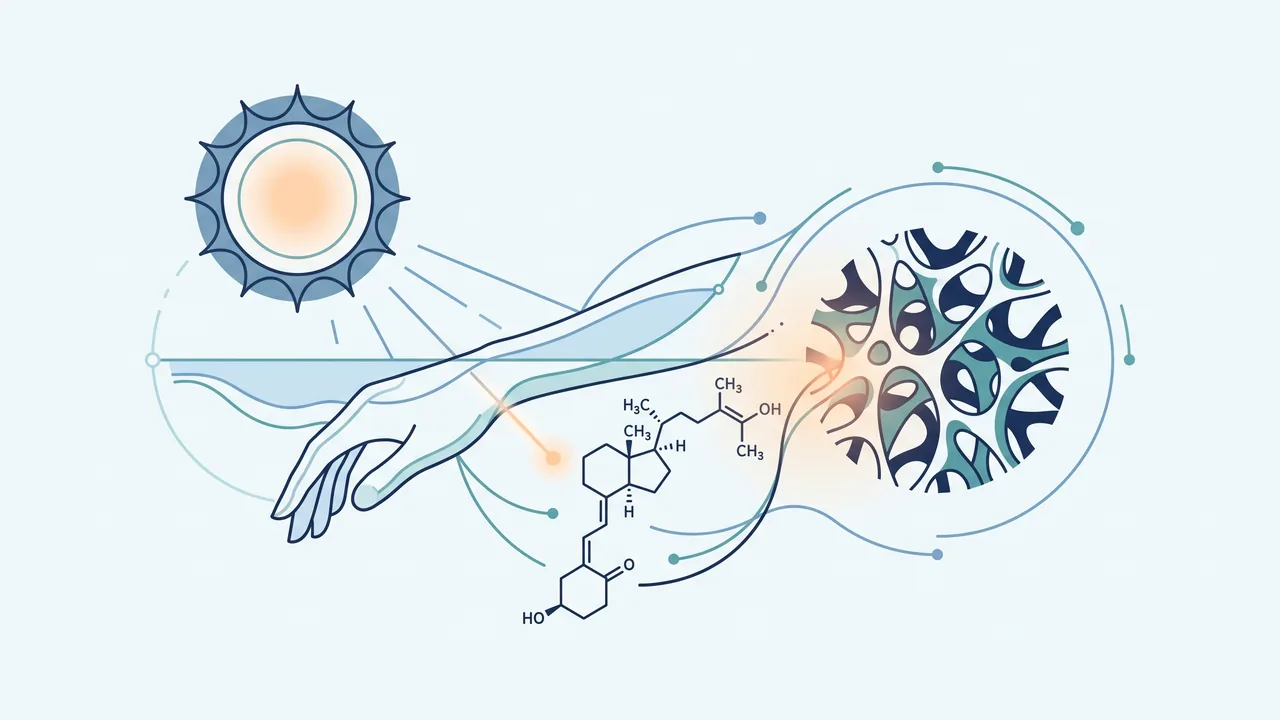
Vitamin D is a secosteroid. The commercial word is a vitamin. The physiology is a hormone precursor that is inert until it is hydroxylated twice (Institute of Medicine, 2011; Holick, 2007). Food, fortification, and capsules supply D2 or D3. Ultraviolet B supplies D3 in skin. Neither supply is calcitriol. The first hepatic product, 25-hydroxyvitamin D, is the circulating exposure marker. The second, chiefly renal, product is 1,25-dihydroxyvitamin D, the VDR ligand that moves calcium and phosphate (DeLuca, 2004; Christakos et al., 2016).
What it is not: a single “optimal” nanogram target; a general anti-inflammatory drug; a cancer-prevention programme; or a substitute for calcium, load-bearing work, or the diseases that produce low 25(OH)D as a consequence. Extra-renal 1α-hydroxylase and extra-skeletal VDR expression are real laboratory facts (Bikle, 2014; Hewison, 2012). They are not a warrant that raising serum 25(OH)D in a replete adult will change a clinical endpoint.
02 D2 and D3
Ergocalciferol (D2) and cholecalciferol (D3) differ in the side chain. Both are absorbed in the small intestine by passive diffusion and by carrier proteins; dietary fat helps, but some absorption occurs without it (Silva and Furlanetto, 2018). Both must be 25-hydroxylated and then 1α-hydroxylated. Head-to-head pharmacokinetic work generally finds D3 more effective at raising and sustaining 25(OH)D than equal-unit D2, particularly with intermittent dosing, though both can correct frank deficiency (Tripkovic et al., 2012; Heaney et al., 2011). Calcifediol (25-hydroxycholecalciferol) raises 25(OH)D faster, per microgram, than D3 (Quesada-Gomez and Bouillon, 2018; Graeff-Armas et al., 2020). Faster is not an outcome. This article treats D2 and D3 as related prohormones, not as interchangeable trial interventions.
03 Cutaneous synthesis and UVB
7-Dehydrocholesterol in epidermis is photolysed by UVB (approximately 290–315 nm) to previtamin D3, which thermally isomerises to D3 (Holick et al., 1980). Webb, Kline, and Holick showed that season and latitude can extinguish that reaction: at mid-to-high latitudes in winter, the solar zenith angle leaves too little UVB at ground level for useful cutaneous production (Webb, Kline, and Holick, 1988). Clothing, glass, shade, sunscreen, and time of day do the same job without a change in latitude.
Melanin competes for UVB. Clemens and colleagues showed that increased skin pigment reduces the rise in circulating vitamin D3 after a given UVB exposure (Clemens et al., 1982). Age reduces the skin’s 7-dehydrocholesterol store and its capacity to produce D3 (MacLaughlin and Holick, 1985). Those are optical and biochemical facts. They are not a diagnosis of disease in a darker-skinned person whose total 25(OH)D is lower on an immunoassay while PTH, calcium, and bone mineralisation are not.
Cutaneous synthesis is self-limited. Prolonged UVB converts previtamin D3 and D3 into inactive photoproducts; the skin does not manufacture unlimited hormone (Holick, 2007). That limit is one reason “more sun” is not a dose–response curve that can be read off a bottle.
04 Hepatic 25-hydroxylation
Vitamin D from skin or gut is carried, largely on vitamin D–binding protein, to the liver. Microsomal CYP2R1 is the principal 25-hydroxylase in humans; genetic loss of CYP2R1 produces a rare form of vitamin D–dependent rickets (Cheng et al., 2004). CYP27A1 and other CYPs contribute. The product, 25(OH)D, has a circulating half-life of about 15 days and is the exposure marker used in almost every survey and trial (Institute of Medicine, 2011). It is not the active hormone. Its concentration is a stock, not a flux, and it is interpreted only after the assay, the binding protein, and the season are named.
05 Renal 1α-hydroxylation, PTH, and FGF23
CYP27B1 in the proximal tubule produces 1,25(OH)2D. PTH induces the enzyme; FGF23 and 1,25(OH)2D itself repress it; phosphate status is part of the same loop (Fraser and Kodicek, 1970; Shimada et al., 2004; Bergwitz and Jüppner, 2010). Circulating 1,25(OH)2D has a half-life measured in hours and is tightly regulated. It does not fall until deficiency is severe, which is why it is a poor status marker (Institute of Medicine, 2011). Extra-renal CYP27B1 in macrophages and other cells can make local calcitriol under cytokine control (Adams and Hewison, 2012; Liu et al., 2006). Local production is a paracrine fact. It is not evidence that a community capsule will reproduce macrophage 1,25(OH)2D in a person whose renal axis is intact.
06 VDR and the calcium–phosphate economy
The vitamin D receptor is a nuclear receptor that, with RXR, binds vitamin D response elements and regulates a small, well-characterised set of mineral-transport genes — TRPV6, calbindins, NCX1, PMCA1b, and phosphate transporters among them (Pike and Meyer, 2010; Haussler et al., 2013; Christakos et al., 2016). The organism-level job is to keep the calcium–phosphate product high enough for mineralisation and neuromuscular stability, and to do so without unrestrained bone resorption. VDR-null mice and hereditary vitamin D–resistant rickets show what happens when that job fails: hypocalcaemia, rickets or osteomalacia, hyperparathyroidism, and alopecia in complete receptor loss (Bouillon et al., 2008).
The cascade belongs here, with the receptor, not after the extra-skeletal warning.
PTH rises when 25(OH)D is low enough, or calcium intake low enough, to threaten ionised calcium. The IOM committee treated the 25(OH)D–PTH–calcium–bone chain as the indicator with a public-health warrant (Institute of Medicine, 2011). Extra-skeletal VDR catalogues were not accepted as DRI indicators. That decision is still the live disagreement.
07 Extra-skeletal receptor geography is not a clinical claim
VDR and CYP27B1 appear in immune cells, muscle, endothelium, breast, colon, prostate, and brain (Bouillon et al., 2008; Bikle, 2014). Liu, Adams, and colleagues showed that TLR triggering of human macrophages induces CYP27B1 and cathelicidin in a vitamin D–dependent circuit (Liu et al., 2006; Wang et al., 2004). That is a mechanism paper. It predicts that a frankly deficient macrophage might make less antimicrobial peptide. It does not predict that 2,000 IU daily in a VITAL-like population will prevent pneumonia, tuberculosis, or autoimmunity. The leap from receptor map to community outcome is the central extra-skeletal error in this literature.
The same error appears in reverse. A null community trial does not disprove macrophage 1,25(OH)2D. It disproves the claim that the two objects are the same experiment. Hewison’s reviews of immune vitamin D and Adams’s descriptions of extra-renal 1α-hydroxylase remain laboratory and tissue facts (Hewison, 2012; Adams and Hewison, 2012). They explain why a frankly deficient, hospitalised, or granulomatous patient is a different biochemical setting from VITAL. They do not license a 30 ng/mL treat-to-target programme in people whose renal CYP27B1, PTH, and calcium are intact. Figure 1 is the hormone’s job. It is not a map of indications.
08 25(OH)D as a circulating marker
Serum 25(OH)D is the main indicator of vitamin D exposure from skin, food, and supplements (Institute of Medicine, 2011). One nmol/L equals 0.4 ng/mL; one ng/mL equals 2.5 nmol/L. The IOM committee was explicit that 25(OH)D is a biomarker of exposure and that its status as a biomarker of effect — relating a given concentration to a health outcome — was not established for extra-skeletal endpoints (Institute of Medicine, 2011). ODS restates the same distinction (Office of Dietary Supplements, 2026). Treating a stock measurement as a causal intermediate is how observational curves become supplementation slogans.
09 Assay variability
The two common methods are competitive immunoassay and LC-MS/MS. They do not report the same number. Binkley and colleagues showed that assay variation can reclassify the same person as deficient or sufficient (Binkley et al., 2004). Carter’s DEQAS programme documented persistent between-laboratory scatter for 25(OH)D (Carter, 2009; Carter, 2011). The Vitamin D Standardization Program was built because those differences were large enough to move prevalence estimates and guideline thresholds (Sempos et al., 2018; Sempos and Binkley, 2020). NIST SRM 972 and related reference materials exist because the field needed a commutable anchor (Phinney et al., 2012).
A 20 ng/mL cut on an unstandardised immunoassay is not the IOM’s 50 nmol/L on a standardised LC-MS/MS. A 30 ng/mL Endocrine Society 2011 cut applied to NHANES immunoassay vintages is a different object again. Sempos and Binkley called the resulting guideline paralysis by its right name: the threshold argument cannot be settled while the measurement is not (Sempos and Binkley, 2020).
10 Binding protein and free hormone
Most circulating 25(OH)D is bound to vitamin D–binding protein (DBP, GC); a smaller fraction is albumin-bound; a few percent is free (Bikle et al., 1986; Chun et al., 2014). Powe and colleagues reported that Black Americans had lower total 25(OH)D and lower DBP than White Americans, with similar calculated bioavailable 25(OH)D, and questioned whether total 25(OH)D overstates deficiency in that population (Powe et al., 2013). Subsequent work challenged the DBP assay used in that paper and found smaller ancestry differences in DBP when monoclonal and LC-MS/MS methods were used (Nielson et al., 2016; Aloia, 2008). The controversy is not a sideshow. It is a reminder that a total 25(OH)D number inherits the binding-protein genotype, the assay, and the free-hormone hypothesis before it inherits a disease label.
GC and CYP2R1 variants are among the common genetic determinants of 25(OH)D (Wang et al., 2010). A genome-wide association study in 79,366 European-ancestry individuals mapped that architecture further (Jiang et al., 2018). Genetics moves the marker. It does not, by itself, move fractures or infarcts.
11 Season, latitude, clothing, and geography
25(OH)D falls in winter at latitudes where Webb’s UVB cutoff applies (Webb, Kline, and Holick, 1988). Cashman and colleagues documented widespread winter 25(OH)D below 50 nmol/L in European surveys (Cashman et al., 2016). Clothing, indoor work, air pollution, and institutionalisation can produce the same winter number at a sunny latitude. Geography is a UVB budget, not a race, and not a treatment indication.
Rostand’s older geographic blood-pressure hypothesis treated UV and vitamin D as a possible contributor to racial and latitudinal blood-pressure patterns (Rostand, 1997). That is an ecological sketch. It is not VITAL.
12 Pigmentation, race, and population surveys
NHANES and related U.S. surveys consistently show lower mean total 25(OH)D in non-Hispanic Black than in non-Hispanic White participants (Looker et al., 2002; Schleicher et al., 2016). Harris and colleagues reviewed that pattern and the incomplete mapping from total 25(OH)D to PTH and bone in African Americans (Harris, 2006; Aloia, 2008). Brown and colleagues convened an NIH panel on the “vitamin D paradox”: lower total 25(OH)D with higher bone mineral density and lower fracture rates in Black Americans than the total-25(OH)D narrative predicts (Brown et al., 2018). The 2024 Endocrine Society issued a separate communication on vitamin D, skin pigmentation, and race rather than burying the problem in a footnote (Endocrine Society, 2024).
A survey prevalence built by applying 30 ng/mL to an immunoassay in a highly pigmented population is not a count of osteomalacia. It is a count of a cut. The IOM’s 50 nmol/L bone indicator and the 2011 Endocrine Society’s 30 ng/mL sufficiency claim do not become the same fact when they are applied to the same NHANES file.
13 Deficiency, insufficiency, and the threshold fight
The IOM 2011 committee, using bone and mineral indicators, treated serum 25(OH)D below 30 nmol/L (12 ng/mL) as increasing the risk of deficiency (rickets, osteomalacia); 30 to 50 nmol/L (12 to 20 ng/mL) as potentially inadequate for some; and 50 nmol/L (20 ng/mL) or more as sufficient for nearly all of the general North American population (Institute of Medicine, 2011; Ross et al., 2011). Concentrations above 125 nmol/L (50 ng/mL) were flagged for possible adverse effects. Those are committee cuts on a bone indicator, not a discovered biological switch.
Holick’s 2011 Endocrine Society guideline set deficiency below 20 ng/mL and insufficiency at 21–29 ng/mL, and recommended 30 ng/mL or more (Holick et al., 2011). Rosen and other IOM members published the rebuttal: the 30 ng/mL target was not supported by the DRI evidence review (Rosen et al., 2012). Bouillon and others continued to argue for higher “optimal” concentrations from observational curves (Bouillon et al., 2013). That is the threshold fight. It is not a new data set. It is two uses of the same marker.
The 2024 Endocrine Society guideline reversed the testing culture it had helped create. For generally healthy adults it suggested against routine 25(OH)D testing and against empiric supplementation above IOM DRIs in adults under 75, because outcome-specific 25(OH)D thresholds have not been established in trials (Demay et al., 2024). It allowed empiric supplementation suggestions in children (rickets and possible respiratory infection), pregnancy, high-risk prediabetes as an adjunct to lifestyle, and adults 75 and older for a possible mortality signal — all as low-certainty or moderate suggestions, and still without a treat-to-target 25(OH)D number (Demay et al., 2024). USPSTF 2021 concluded that evidence was insufficient to assess screening asymptomatic community-dwelling nonpregnant adults (U.S. Preventive Services Task Force, 2021; Krist et al., 2021). SACN 2016, working from musculoskeletal outcomes in the United Kingdom, set a 25 nmol/L population protective threshold — a third instrument, not a conversion of IOM or Endocrine Society cuts (Scientific Advisory Committee on Nutrition, 2016).
ODS notes the NHANES contradiction that the deficiency narrative prefers to skip: most people in the United States consume less vitamin D from food than the EAR, yet most have 25(OH)D at or above the IOM 50 nmol/L cut once endogenous production is counted (Office of Dietary Supplements, 2026). Intake-from-food is not status. Status-by-30-ng/mL is not osteomalacia.
The table is the instrument ledger. The figure is the same ledger drawn as a strip. Neither converts a winter immunoassay into osteomalacia.
| Instrument | 25(OH)D cut (as stated) | Indicator | Testing stance |
|---|---|---|---|
| IOM / FNB 2011 | <12 ng/mL risk; ≥20 ng/mL sufficient for most | Bone / mineral | Status marker, not a screen mandate |
| Endocrine Society 2011 | <20 deficient; 21–29 insufficient; ≥30 target | Broader, including extra-skeletal hopes | Encouraged testing and treat-to-target |
| Endocrine Society 2024 | No outcome-specific threshold established | Empiric suggestions in named groups only | Against routine 25(OH)D testing |
| SACN 2016 | 25 nmol/L population protective | Musculoskeletal (UK) | Population, not individual treat-to-target |
| USPSTF 2021 | Not a treatment target | Screening benefit/harm | I statement, asymptomatic community adults |
14 Rickets and osteomalacia
Nutritional rickets and osteomalacia are the settled deficiency diseases. Without enough 1,25(OH)2D-driven calcium and phosphate absorption, osteoid does not mineralise (Wharton and Bishop, 2003; Munns et al., 2016; Bhan, Rao, and Rao, 2010). Priemel and colleagues, in a bone-biopsy series, found mineralisation defects clustering at lower 25(OH)D, with no perfect serum switch (Priemel et al., 2010). Global consensus recommendations treat prevention of nutritional rickets as a public-health problem of intake, sunlight, and calcium, not as a warrant for extra-skeletal treat-to-target (Munns et al., 2016). That is the part of the vitamin D story that does not need a large modern RCT to remain true.
15 Osteoporosis, BMD, and mineralisation
Osteoporosis is a mass-and-architecture disease. Osteomalacia is a mineralisation disease. Conflating them is how every low T-score becomes a vitamin D deficiency. Reid and colleagues’ meta-analysis of vitamin D supplements on bone mineral density found little or no clinically useful BMD effect in community adults who were not frankly deficient (Reid, Bolland, and Grey, 2014). LeBoff and colleagues, in the VITAL bone ancillary, found that 2,000 IU D3 daily did not improve BMD or structure versus placebo in a generally vitamin D–replete older U.S. population (LeBoff et al., 2020; LeBoff et al., 2022). Burt and colleagues’ Calgary trial of high-dose D3 (including 10,000 IU daily) reported reduced volumetric BMD versus 400 IU — the opposite of a “more is denser” slogan (Burt et al., 2019).
Chapuy’s 1992 trial in French nursing-home women, using vitamin D3 plus calcium, reduced hip fractures in a population with low 25(OH)D and low calcium intake (Chapuy et al., 1992). That result still stands. It is not VITAL. It is not a community 50-year-old with a 28 ng/mL immunoassay.
16 Fractures
The fracture record is indication- and population-bound. Chapuy 1992 is positive in institutionalised older women given D plus calcium (Chapuy et al., 1992). Trivedi’s four-monthly 100,000 IU D3 trial in older British people reported fewer fractures (Trivedi, Doll, and Khaw, 2003). RECORD, a secondary-prevention trial of 800 IU D3, calcium, both, or neither after low-trauma fracture, did not show a significant reduction in further fractures (Grant et al., 2005). The Women’s Health Initiative calcium-plus-D trial (1,000 mg calcium and 400 IU D3) did not reduce hip fracture in the intention-to-treat population; a per-protocol analysis in adherent women was more favourable and is a secondary reading (Jackson et al., 2006). DIPART’s patient-level pooled analysis of major vitamin D fracture trials found that vitamin D plus calcium reduced fractures, while vitamin D alone did not (DIPART Group, 2010). Bolland’s trial-sequential meta-analysis concluded that community vitamin D supplementation does not reduce musculoskeletal events in a way that supports routine use (Bolland, Grey, and Avenell, 2018). Zhao and colleagues’ JAMA meta-analysis of community-dwelling older adults found no significant association of calcium, vitamin D, or both with hip, non-vertebral, or total fracture (Zhao et al., 2017). LeBoff’s VITAL fracture analysis — 25,871 participants, 2,000 IU D3, median 5.3 years — found no reduction in incident total, non-vertebral, or hip fractures (LeBoff et al., 2022). USPSTF 2018 recommended against supplementation with 400 IU or less of vitamin D and 1,000 mg or less of calcium for primary fracture prevention in community-dwelling postmenopausal women, and issued an I statement for higher doses and for men (Grossman et al., 2018; Kahwati et al., 2018).
The pattern is not mysterious. Benefit clusters where 25(OH)D is low, calcium is low, age is high, and the setting is institutional or otherwise calcium-co-supplemented. Null results cluster where the population is community-dwelling and already near the IOM sufficiency cut. Treating every null community trial as a failed replication of Chapuy is a category error.
17 Falls
Falls are a different endpoint from fractures. Bischoff-Ferrari and colleagues reported fall reductions in some older populations given daily vitamin D (Bischoff-Ferrari et al., 2004; Bischoff-Ferrari et al., 2009). Sanders and colleagues’ Australian trial of a single annual 500,000 IU oral D3 dose in older women increased falls and fractures versus placebo (Sanders et al., 2010). Smith’s annual intramuscular D2 trial did not reduce fractures and belongs with the bolus family (Smith et al., 2007). ViDA’s monthly 100,000 IU regimen did not reduce falls in the primary analysis (Khaw et al., 2017). DO-HEALTH tested monthly 2,000 IU-equivalent D3 with omega-3 and strength training in European older adults; vitamin D alone did not produce the functional package its advocates wanted (Bischoff-Ferrari et al., 2020). Bolland’s trial-sequential work on falls reached the same community-level conclusion as for fractures: the remaining uncertainty does not justify universal supplementation (Bolland, Grey, and Avenell, 2018). Bolus and daily regimens are not interchangeable. The fall literature is one of the places that fact is expensive.
18 Muscle and exercise
Skeletal muscle expresses VDR; proximal weakness is a classical feature of osteomalacia (Ceglia, 2009; Girgis et al., 2013). That does not make 25(OH)D a performance drug. Beaudart’s systematic review found mixed, often small effects of supplementation on strength, mass, and power, with more signal in older and deficient groups (Beaudart et al., 2014). Stockton’s review similarly confined strength effects to people with 25(OH)D below about 25 nmol/L (Stockton et al., 2011). Athlete studies measure 25(OH)D enthusiastically and change performance unreliably (Close et al., 2013; Owens, Fraser, and Close, 2015). VITAL and DO-HEALTH did not establish an exercise or physical-function benefit that survives as a primary claim (LeBoff et al., 2020; Bischoff-Ferrari et al., 2020). Muscle is a deficiency organ. It is not a repletion sport.
| Question | Population | Regimen (as reported) | Primary or governing result | Source |
|---|---|---|---|---|
| Hip fracture, institutional | French nursing-home women | D3 + calcium | Fewer hip fractures | Chapuy et al., 1992 |
| Secondary fracture | RECORD, recent low-trauma fracture | 800 IU D3 ± calcium | No significant further-fracture reduction | Grant et al., 2005 |
| Fracture, community women | WHI | 400 IU D3 + 1,000 mg Ca | ITT hip fracture not reduced | Jackson et al., 2006 |
| Fracture, pooled | DIPART | D ± calcium, mixed | D+Ca reduced fractures; D alone did not | DIPART Group, 2010 |
| Fracture, community | VITAL | 2,000 IU D3 daily | No reduction in total, non-vertebral, or hip fracture | LeBoff et al., 2022 |
| Community MSK | Bolland TSA | Mixed | Does not support routine community supplementation | Bolland et al., 2018 |
| Community fracture MA | Zhao 2017 | Ca, D, or both | No significant fracture reduction | Zhao et al., 2017 |
| BMD, high dose | Calgary | up to 10,000 IU D3 daily | Lower volumetric BMD vs 400 IU | Burt et al., 2019 |
| Falls / fractures, bolus | Sanders 2010 | 500,000 IU yearly | More falls and fractures | Sanders et al., 2010 |
19 The observational pattern
Low 25(OH)D associates with almost every chronic disease that makes people stay indoors, lose weight, become inflamed, or die soon: cardiovascular disease, cancer, infection, autoimmunity, depression, cognitive decline, and all-cause death (Wang et al., 2008; Giovannucci et al., 2008; Melamed et al., 2008; Autier et al., 2014; Theodoratou et al., 2014). Autier’s review is the clean statement of the problem: 25(OH)D behaves as a negative acute-phase and frailty marker; raising it with a capsule does not reproduce the observational curve (Autier et al., 2014; Autier et al., 2017). Reverse causation and confounding are not polite caveats. They are the default explanation until a trial moves the endpoint.
20 Cardiovascular disease
Wang, Giovannucci, and others reported inverse associations between 25(OH)D and incident cardiovascular events (Wang et al., 2008; Giovannucci et al., 2008). WHI calcium-plus-D did not reduce cardiovascular events (Hsia et al., 2007). VITAL’s primary major-cardiovascular-event result was null: 2,000 IU D3 daily, 25,871 U.S. adults, median 5.3 years, hazard ratio 0.97 (0.85–1.12) (Manson et al., 2019). ViDA’s monthly 100,000 IU regimen in 5,110 New Zealand adults was null for cardiovascular disease (Scragg et al., 2017). Barbarawi’s meta-analysis of supplementation and cardiovascular risk was likewise null (Barbarawi et al., 2019). EVITA tested higher-dose D3 in advanced heart failure and did not rescue the indication (Zittermann et al., 2017). The observational association is large. The randomized effect in replete or lightly insufficient populations is not.
21 Cancer
Garland’s ecological and observational programme treated solar UV and 25(OH)D as cancer-protective (Garland et al., 2006). Lappe’s Nebraska trial of calcium plus 1,100 IU D3 reported lower incident cancer as a secondary finding in a small population (Lappe et al., 2007); a later replication was less decisive (Lappe et al., 2017). WHI calcium-plus-D did not reduce colorectal cancer (Wactawski-Wende et al., 2006). VITAL’s primary invasive-cancer result was null: hazard ratio 0.96 (0.88–1.06); death from any cause 0.99 (0.87–1.12) (Manson et al., 2019). Secondary and post-hoc VITAL analyses — cancer death after latency exclusion, advanced cancer, BMI interaction — have been reported and are not the primary endpoint (Chandler et al., 2020; Manson et al., 2020). ViDA was null for cancer (Scragg et al., 2018). D-Health, 21,315 Australian adults aged 60–84 given 60,000 IU monthly, did not reduce cancer incidence (Neale et al., 2022). Keum’s meta-analysis suggested a possible reduction in cancer mortality but not incidence — a pattern that, if real, is still not VITAL’s primary result (Keum et al., 2019). Bjelakovic’s Cochrane reviews did not establish cancer prevention (Bjelakovic et al., 2014).
22 Respiratory infection
Martineau’s 2017 individual-participant meta-analysis reported a reduction in acute respiratory infection, with a stronger signal for daily or weekly dosing and in people with 25(OH)D below 25 nmol/L (Martineau et al., 2017). Jolliffe’s 2021 update attenuated the overall effect and kept the dosing-frequency and baseline-deficiency caveats (Jolliffe et al., 2021). Murdoch’s New Zealand RCT of monthly D3 in healthy adults was null (Murdoch et al., 2012). ViDA’s respiratory analyses were not a mandate for monthly bolus prevention (Martineau et al., 2019). VITAL’s respiratory ancillary was not a primary-win pneumonia trial (Camargo et al., 2020). Urashima’s Japanese schoolchild trial reported less influenza A with daily D3 — a small, specific, winter, paediatric result (Urashima et al., 2010). The 2024 Endocrine Society’s paediatric respiratory suggestion rests on that class of evidence, graded low (Demay et al., 2024). Adult community bolus is the wrong reading of Martineau.
23 Autoimmunity
Hahn and colleagues reported that VITAL D3, 2,000 IU daily, reduced incident autoimmune disease as a secondary/ancillary endpoint (hazard ratio 0.78, 0.61–0.99), with a clearer signal after two years (Hahn et al., 2022). Omega-3 was not significant alone; the combination was reported. This is the strongest extra-skeletal randomized signal in the modern mega-trial set. It is still not a primary VITAL endpoint, not a treat-to-target 25(OH)D protocol, and not a replication. It is a finding that deserves a dedicated confirmatory trial, not a slogan that “vitamin D prevents autoimmunity.”
24 Depression and cognition
Observational reviews link low 25(OH)D to depression and to cognitive impairment (Anglin et al., 2013; Annweiler et al., 2013). VITAL-DEP found no reduction in depression or mood scores with 2,000 IU D3 over a median of 5.3 years in 18,353 adults without a current depressive disorder (Okereke et al., 2020). Dean’s small trial of supplementation on cognition and emotion in healthy young adults was null (Dean et al., 2011). DO-HEALTH did not establish a cognitive claim for vitamin D alone (Bischoff-Ferrari et al., 2020). D-Health ancillary mood analyses have not converted a monthly bolus into an antidepressant (Pham et al., 2021). Low 25(OH)D in late-life cognitive decline is expected: people with dementia go outside less. That is reverse causation until a trial says otherwise.
25 Mortality
Melamed’s NHANES analysis associated low 25(OH)D with higher all-cause mortality (Melamed et al., 2008). Chowdhury and Gaksch reported similar observational and IPD patterns (Chowdhury et al., 2014; Gaksch et al., 2017). Rejnmark’s individual-patient meta-analysis found that vitamin D with calcium reduced mortality, while vitamin D alone did not — a DIPART-shaped result (Rejnmark et al., 2012). Bjelakovic’s Cochrane mortality review was cautious and calcium-entangled (Bjelakovic et al., 2014). Zhang’s later supplementation-and-mortality meta-analysis reported a small all-cause reduction that is sensitive to trial mix and dose schedule (Zhang et al., 2019). VITAL’s all-cause death result was null (Manson et al., 2019). D-Health’s primary outcome was all-cause mortality; the published main result did not establish a mortality benefit from monthly 60,000 IU in older Australians (Neale et al., 2022). The 2024 Endocrine Society’s suggestion of empiric vitamin D in adults 75 and older for possible mortality benefit is a low-to-moderate-certainty reading of that mixed trial set, not a licence for high-dose bolus (Demay et al., 2024).
26 Why large RCTs keep coming back null
The mega-trials share a design that the observational literature cannot forgive and cannot replace. They enrol community adults who are not osteomalacic. Mean baseline 25(OH)D is often already near or above 20 ng/mL. The contrast is a capsule versus placebo, not deficiency versus repletion. Follow-up of five years can miss a latency cancer effect and can still be long enough to rule out a large cardiovascular effect. Multiplicity is real: VITAL’s secondaries (BMI, advanced cancer, autoimmune, latency death) are a family of looks. Adherence is good enough that a null is not an untested hypothesis. The honest reading is Autier’s: the observational marker is mostly the disease. The capsule is not.
Pittas’s D2d trial in high-risk prediabetes is the important partial exception: 4,000 IU D3 daily did not meet its primary diabetes-prevention endpoint in the whole cohort, with possible benefit in the lowest-baseline and highest-on-treatment subgroups (Pittas et al., 2019). The 2024 Endocrine Society used that class of evidence to suggest empiric vitamin D as an adjunct to lifestyle in high-risk prediabetes — again without a 25(OH)D treat-to-target (Demay et al., 2024). A missed primary with a subgroup is not VITAL-level proof. It is also not nothing.
The trial table is the claim ledger. The figure is the same ledger with the secondaries left off the page.
| Trial | N / population | Regimen | Primary extra-skeletal or named primary | Result |
|---|---|---|---|---|
| VITAL | 25,871 U.S. adults | 2,000 IU D3/d, 5.3 y | Invasive cancer; major CVD | HR 0.96 (0.88–1.06); 0.97 (0.85–1.12) |
| VITAL-DEP | 18,353 subset | 2,000 IU D3/d | Depression / mood | Null |
| VITAL bone | VITAL | 2,000 IU D3/d | Incident fractures | Null |
| VITAL autoimmune | VITAL ancillary | 2,000 IU D3/d | Incident autoimmune disease | HR 0.78 (0.61–0.99), not a primary |
| ViDA | 5,110 NZ adults | 100,000 IU/month | CVD | Null |
| D-Health | 21,315 AU adults 60–84 | 60,000 IU/month | Mortality (and cancer analyses) | No established benefit |
| D2d | 2,423 high-risk prediabetes | 4,000 IU D3/d | New diabetes | Primary missed |
| WHI CaD | 36,282 postmenopausal | 400 IU D3 + 1 g Ca | Hip fracture; colorectal cancer | ITT null |
| RECORD | 5,292 after fracture | 800 IU D3 ± Ca | Further fractures | Null |
Read the table as a hierarchy, not as a menu. VITAL’s two primaries and VITAL bone are the community-adult answers. ViDA and D-Health test a different object: a monthly bolus in a generally older, already-supplemented or sun-capable population. D2d is a high-risk glycaemic cohort, not a community-prevention trial. WHI and RECORD are calcium-entangled and, in RECORD, secondary-prevention after fracture. Hahn’s autoimmune row is in the table so it cannot be hidden; it is labelled ancillary because that is what it is. A reader who wants a single “vitamin D works / does not work” cell will not find one. That is the result.
27 Hypercalcemia and toxicity
Vitamin D toxicity is hypercalcaemia from unregulated 25(OH)D occupancy of binding sites and inappropriate 1,25(OH)2D action, usually after prolonged intake far above DRI, manufacturing errors, or unlicensed high-dose products (Vieth, 1999; Hathcock et al., 2007; Jones, 2008; Marcinowska-Suchowierska et al., 2018). The IOM UL for adults is 4,000 IU (100 mcg) daily; the committee flagged serum 25(OH)D above 125 nmol/L for possible harm (Institute of Medicine, 2011). ODS notes that 3.2% of U.S. adults in 2013–2014 already took 4,000 IU or more (Rooney et al., 2017; Office of Dietary Supplements, 2026). Hypercalcaemia is uncommon at DRI-range intakes in people without granulomatous disease, Williams syndrome, or CYP24A1 loss. It is not rare enough, at bolus and compounding errors, to treat “vitamin D is safe at any dose” as a finding (Marcinowska-Suchowierska et al., 2018).
28 Kidney stones
WHI calcium-plus-D increased kidney stones (Jackson et al., 2006). Malihi and colleagues reviewed adverse events from large-dose supplementation, including hypercalciuria and stones (Malihi et al., 2016; Malihi et al., 2019). Stones are a calcium-and-volume problem as much as a vitamin D problem. Trials that add calcium and vitamin D together cannot donate their stone signal to vitamin D alone, and trials of vitamin D alone cannot wash WHI’s stone signal out of calcium-plus-D practice.
29 Bolus dosing
Sanders 2010 is the governing safety-and-efficacy paper for annual 500,000 IU oral D3 in older women: more falls, more fractures (Sanders et al., 2010). ViDA’s 100,000 IU monthly regimen was not cardioprotective and is the wrong schedule for any Martineau-style infection hypothesis that favoured daily or weekly dosing (Scragg et al., 2017; Martineau et al., 2017). D-Health’s 60,000 IU monthly primary mortality result did not redeem the schedule (Neale et al., 2022). The 2024 Endocrine Society preferred daily lower-dose empiric supplementation over non-daily higher doses in the older-adult mortality suggestion (Demay et al., 2024). Bolus is a compliance idea. It is not a physiological idea. CYP24A1 and FGF23 exist to dispose of pulses.
30 U-shaped associations
Observational mortality and some cardiovascular series are U- or J-shaped: low 25(OH)D and high 25(OH)D both associate with harm (Melamed et al., 2008; Durup et al., 2012; Sempos et al., 2013). Assay artefact, supplementation of the already-ill, and residual confounding all produce the right-hand arm. The IOM’s caution above 125 nmol/L is a risk-management cut, not a demonstration that 50 ng/mL causes death. Burt’s high-dose BMD loss is a randomized reminder that the right-hand arm is not only an epidemiological ghost (Burt et al., 2019). “Optimal” as 40–60 ng/mL is an observational brand. It is not a trial target.
| Hazard | Typical setting | What the evidence is | What it is not |
|---|---|---|---|
| Hypercalcaemia / toxicity | Prolonged very high intake; errors; CYP24A1; granuloma | Established clinical toxicology | A reason to fear DRI-range food fortification |
| Stones | WHI Ca+D; some high-dose series | Calcium-plus-D ITT signal | Proven D-alone community stone epidemic |
| Falls / fractures | Annual 500,000 IU (Sanders) | Randomized harm | A defect of daily DRI-range intake |
| BMD loss | Calgary 10,000 IU daily | Randomized volumetric BMD decline | Proof that 2,000 IU daily harms bone |
| U-shaped death | Observational 25(OH)D | Association | A trial-defined upper efficacy target |
31 Required matrices
The threshold, RCT, meta-analysis, bone, extra-skeletal, and safety matrices are the tables in sections 13, 16, 20–25, and 30. They are not decorative. They are the claim ledger in compact form. A sentence that cannot find its cell is an unsourced sentence.
32 Critical questions, answered from evidence
Live adversarial reviewers were not invoked. Charges were applied as a six-lens adversarial panel after the papers.
Widespread deficiency. Charge: most people are deficient. Record: food intake is below EAR; IOM-standardised status is not; 30 ng/mL survey cuts manufacture prevalence; pigmentation and DBP change the number (Institute of Medicine, 2011; Office of Dietary Supplements, 2026; Powe et al., 2013; Brown et al., 2018). Resolution: deficiency as osteomalacia/rickets is real and uncommon in fortified, sun-capable adults. Deficiency as “below 30 ng/mL” is a policy object.
Target-level claims. Charge: everyone should be above 30 or 40 ng/mL. Record: IOM 20 ng/mL bone sufficiency; ES 2011 30 ng/mL; ES 2024 no outcome-specific threshold; assay non-commutability (Ross et al., 2011; Holick et al., 2011; Demay et al., 2024; Sempos and Binkley, 2020). Resolution: no treat-to-target number survives the 2024 guideline and the mega-trials.
Observational versus randomized. Charge: inverse 25(OH)D curves justify capsules. Record: Autier; VITAL; ViDA; D-Health; VITAL-DEP; Barbarawi (Autier et al., 2014; Manson et al., 2019; Scragg et al., 2017; Neale et al., 2022; Okereke et al., 2020). Resolution: the marker is not the intervention.
Large-dose bolus. Charge: monthly or yearly megadoses are efficient prevention. Record: Sanders harm; ViDA and D-Health nulls; Martineau daily/weekly preference; ES 2024 daily preference (Sanders et al., 2010; Scragg et al., 2017; Neale et al., 2022; Martineau et al., 2017; Demay et al., 2024). Resolution: bolus fails both efficacy and, in Sanders, safety.
“Optimal” concentrations. Charge: 40–60 ng/mL is optimal. Record: observational U-shape; IOM adverse flag above 50 ng/mL; Calgary BMD; no trial treats to that band (Institute of Medicine, 2011; Burt et al., 2019). Resolution: optimal is undefined for extra-skeletal endpoints.
Non-skeletal benefit claims. Charge: VDR everywhere means clinical benefit everywhere. Record: receptor maps versus VITAL/ViDA/D-Health primaries; Hahn autoimmune as the serious exception that still needs confirmation (Bouillon et al., 2008; Manson et al., 2019; Hahn et al., 2022). Resolution: mechanism is not an outcome.
Subgroup and post-hoc findings. Charge: BMI, race, baseline 25(OH)D, latency cancer death, or D2d quartiles rescue the hypothesis. Record: those analyses exist and some are biologically plausible. Resolution: they are hypotheses. They are not primaries.
33 Standing constraint
This document describes published research. It is not medical advice. No human use, dose, route or schedule is recommended anywhere in this document. IOM RDAs, ULs, and trial regimens are reported as the instruments and protocols that they are. They are not a personal prescription.
34 Evidence handling
Peer-reviewed physiology and genetics are labelled as such. Assay and standardisation papers are measurement evidence. IOM, SACN, USPSTF, ODS, and Endocrine Society texts are instruments, not data. Observational associations are labelled observational. Randomized primaries outrank secondaries. Meta-analyses are only as good as their trial mix and their handling of bolus versus daily and deficient versus replete. Project 06 was read only; Project 05 is not imported; Project 07 news text was discovery-only and was not used as evidence. Local Firecrawl retrieved open methods and guideline pages. NCBI supplied bibliographic records. No third-party figure has been reproduced.
35 What remains after the cuts
Vitamin D is a hormone. Rickets and osteomalacia are its deficiency diseases. The calcium–phosphate axis is the DRI indicator that survived an evidence review. 25(OH)D is a useful exposure marker and a poor extra-skeletal causal intermediate. Assays still disagree. Thresholds are instruments. Pigmentation and binding protein change the meaning of a total 25(OH)D before a disease word is attached. Community mega-trials of supplementation have not moved cancer, cardiovascular disease, depression, cognition, or — in VITAL — fractures. Bolus dosing has failed more loudly than daily DRI-range intake. Hahn’s autoimmune signal and selected cancer-mortality secondaries remain open. They are not a new deficiency pandemic, and they are not a reason to treat a winter immunoassay as a diagnosis.
References
Continue reading