
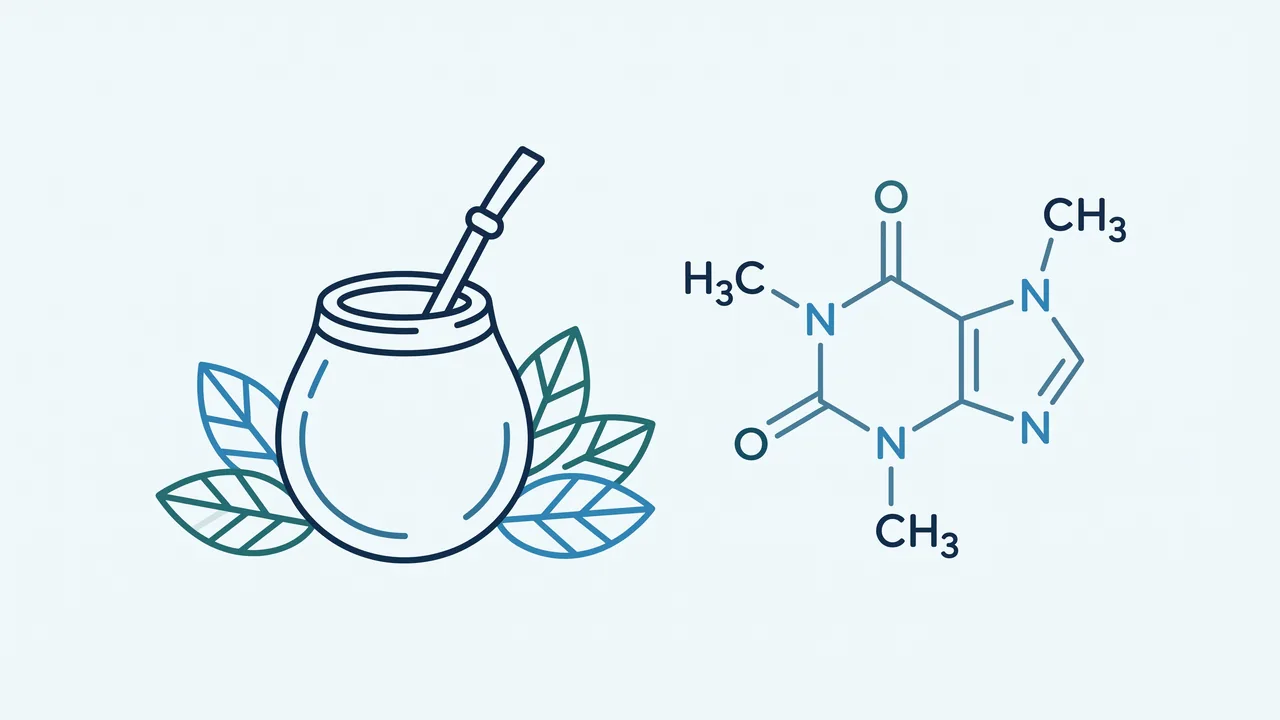
Yerba Mate
Botanical extracts and whole herbs. A research review published by South Beach Longevity.
Yerba Mate
Compiled by South Beach Longevity · 20 August 2026 Copyright 2026 Series SBL-41 / SP-YERBA-MATE · Register A scientific article Sources peer-reviewed human trials, pooled case–control epidemiology, IARC evaluations, analytical chemistry, and labelled preclinical work · verified NCBI records Constraint This document describes published research. It is not medical advice. No human use, dose, route or schedule is recommended anywhere in this document.
How to read this document Every finding is labelled, in the sentence that reports it, by the kind of study that produced it. A chlorogenic-acid chromatogram is not a weight-loss trial. A very-hot chimarrao case-control odds ratio is not a verdict on cold terere. An extract capsule is not a gourd. Amounts and durations appear only as reported experimental parameters, always with the population attached. Nothing here is a recommendation. Findings are graded in place as established, strongly supported, supported, emerging, plausible, or speculative, and where a claim fails on its own evidence, as refuted. Two further labels mark careful absences rather than verdicts: not established, where the evidence is too thin to place a claim on the ladder at all — untested or insufficient, an absence of proof rather than disproof; and not supported, where the weight of evidence leans against a claim but stops short of a formal refutation. They grade the reviewed record in hand, not the plant's commercial future. Infusion rows, extract rows, and multi-ingredient stacks are never collapsed. Temperature, smoke-drying polycyclic aromatic hydrocarbons, and Ilex phytochemistry are never collapsed.
01 What yerba mate is — and what it is not
Yerba mate is the dried leaf, and usually some stem, of Ilex paraguariensis A. St.-Hil. (Aquifoliaceae), prepared as an infusion. Heck and de Mejia’s food-science review remains the standard English-language map of chemistry, technology, and claimed uses (Heck and de Mejia, 2007). Bracesco, Sanchez, Contreras, Menini, and Gugliucci placed the same plant in its Guarani-to-Southern-Cone social history and noted that biomedical work still lagged coffee and tea (Bracesco et al., 2011).
Five separations are load-bearing for the rest of this document.
First, yerba mate is not coffee and not tea. It shares methylxanthines with both and chlorogenic acids with coffee. It does not share Camellia catechin dominance, and it does not share coffee’s roasting-of-seed chemistry. Mixture epidemiology from coffee or green tea is not a mate trial.
Second, yerba mate is not a single serving. Traditional chimarrão and mate-with-bombilla are repeated infusions of the same charge. Daily caffeine can match or exceed a coffee habit even when a first cup looks modest (Heck and de Mejia, 2007; Bracesco et al., 2011).
Third, yerba mate is not its extract. Spray-dried powders and capsules used in later trials are dose forms. They do not inherit gourd temperature, bombilla flow, or smoke-drying exposure. IARC’s 2016 beverage evaluation does not classify capsules (IARC, 2018; Loomis et al., 2016).
Fourth, yerba mate is not a proven weight-loss medicine, antioxidant therapy, or categorically healthy beverage. Those sentences are marketing. The human record is thinner and more specific.
Fifth, this document is not medical advice and not a brewing protocol. Reported millilitres, grams, and degrees appear only as study parameters attached to named populations.
02 Botanical identity
The accepted species is Ilex paraguariensis A. St.-Hil., a South American holly. Commercial yerba is leaf plus stemlets after sapeco (rapid heat) and drying. Older epidemiologic papers sometimes print Ilex paraguayensis; that is a historical spelling, not a second species (Castellsagué et al., 2000; Heck and de Mejia, 2007).
Related Ilex species have been used as substitutes or admixtures. Heck and de Mejia noted technological and botanical variation around the commercial leaf; product identity is not guaranteed by the word “mate” on a label (Heck and de Mejia, 2007). Adulteration is a product-identity problem. It is not a licence to treat every Southern Cone holly infusion as chemically identical.
This article grades I. paraguariensis as studied. It does not grade every regional holly infusion.
03 Caffeine, theobromine, and theophylline
The stimulant fraction is methylxanthine. Caffeine (1,3,7-trimethylxanthine) is the dominant alkaloid. Theobromine is consistently present. Theophylline is trace when it is found at all (Vieira et al., 2010; Heck and de Mejia, 2007). Oñatibia-Astibia, Franco, and Martínez-Pinilla summarised the shared pharmacology: gastrointestinal absorption, CNS penetration, adenosine-receptor antagonism, and psychostimulant action that is more obvious in acute intake (Oñatibia-Astibia, Franco, and Martínez-Pinilla, 2017).
Published leaf ranges move with cultivar, leaf age, and method. Vieira and colleagues measured mate powder residue at 1.01 g caffeine and 0.10 g theobromine per 100 g, with 4,5-dicaffeoylquinic acid as the major phenolic in that residue (Vieira et al., 2010). Heck and de Mejia reviewed wider leaf ranges and the practical point that repeated gourd infusions can accumulate a coffee-like daily caffeine load (Heck and de Mejia, 2007). Marketing that calls mate “gentler than coffee” is a serving-size claim, not a molecular one. That distinction is established.
There is no mate-specific exemption from caffeine safety limits. Nawrot and colleagues’ Health Canada-era synthesis treated caffeine from all dietary sources as one exposure (Nawrot et al., 2003). The EFSA CEF Panel later restated the NDA 2015 thresholds when it declined to run caffeine and theobromine through the flavouring Procedure: 5.7 mg/kg body weight per day in adults other than pregnant or lactating persons, and 3 mg/kg in children, adolescents, pregnant, and lactating persons — corresponding, at 70 kg, to the familiar 400 mg/day adult figure (EFSA CEF Panel, 2017). Those numbers are caffeine-class, not mate-class.
04 Chlorogenic acids, saponins, and the polyphenol fraction
The non-xanthine fraction that the trade calls “antioxidants” is largely caffeoylquinic and dicaffeoylquinic acids, with rutin and related flavonoids. Heck, Schmalko, and Gonzalez de Mejia quantified total polyphenols in 15 commercial teas at 100.3 to 179.7 mg chlorogenic-acid equivalents per gram of dry leaf; oxygen-radical absorbance capacity in the same set ran 1.5 to 4.1 mmol Trolox equivalents per gram (Heck, Schmalko, and Gonzalez de Mejia, 2008). Growing condition (plantation versus forest) and drying method moved the phenolic fingerprint. That is analytical fact. It is not a disease-prevention trial.
Saponins contribute bitterness and appear in preclinical anti-inflammatory and adipocyte papers. They are EMERGING as human evidence objects. Gambero and Ribeiro’s obesity review is mostly cellular and rodent work (Gambero and Ribeiro, 2015). It is not a substitute for an infusion weight trial.
05 Processing, smoking, and drying
Traditional production flash-heats the leaf (sapeco), then dries it. Barbacuá drying uses wood smoke. Hot-air or carijo methods use less or no smoke. Heck, Schmalko, and Gonzalez de Mejia showed that growing and drying conditions change phenolic composition (Heck, Schmalko, and Gonzalez de Mejia, 2008). That is food chemistry.
A separate literature measures polycyclic aromatic hydrocarbons deposited during smoke-drying. Kamangar, Schantz, Abnet, Fagundes, and Dawsey found high carcinogenic PAH levels in commercial yerba and in both hot (80 °C) and cold (5 °C) infusions (Kamangar et al., 2008). Golozar and colleagues later showed large brand, batch, and processing variation; method of drying moved PAH content (Golozar et al., 2012). Zuin, Montero, Bauer, and Popp developed an analytical method that detected a suite of PAHs in mate teas (Zuin et al., 2005). Urinary metabolites confirm internal exposure in drinkers, including after tobacco adjustment in southern Brazilian samples (Fagundes et al., 2006; Lopes et al., 2018).
PAH contamination is documented exposure. It is not the IARC Group 2A agent of 2016. The Working Group assigned that group to drinking very hot beverages, not to mate-as-plant and not to PAH as the classification basis (IARC, 2018). Conflating the three is the central error in popular cancer writing about mate.
06 Preparation traditions — hot versus cold
Chimarrão (Brazil) and mate-with-bombilla (Argentina, Uruguay, Paraguay) charge a gourd, pour hot water, and drink through a metal straw. IARC’s exposure chapter records traditional added-water temperatures of about 70–80 °C (IARC, 2018). That band sits above the Working Group’s “very hot” cut of 65 °C.
Mate cocido is pot-brewed, more like tea. Tereré is the Paraguayan cold infusion, often iced. Commercial tea bags, ready-to-drink cold cans, and instant powders are later industrial forms. They are not the exposure that populated the Southern Cone case–control literature.
Temperature at the lips is not temperature in the kettle. Self-report categories (warm / hot / very hot) dominate the epidemiology. Islami, Pourshams, and colleagues, in a Golestan tea study used here only as a thermal parallel, measured actual drinking temperature in a cohort subset and found only moderate agreement with self-report (Islami, Pourshams, et al., 2009). That measurement problem travels with every mate temperature odds ratio.
07 Alertness
Acute mate can raise subjective energy, focus, and concentration. Alkhatib and Atcheson’s crossover in twelve active women, 2 g yerba mate versus placebo before a 30-minute cycle at individualised intensity, improved POMS focus, energy, and concentration during exercise (Alkhatib and Atcheson, 2017). That is SUPPORTED evidence for mood-state alertness in a small, exercise-bound sample.
Outlaw and colleagues reported similar mood shifts with a commercial thermogenic stack that included yerba mate plus anhydrous caffeine (Outlaw et al., 2013). That trial is not a mate-alone result. Stacking is labelled as stacking.
The mechanism on offer is caffeine-class adenosine antagonism, with a theobromine contribution (Oñatibia-Astibia, Franco, and Martínez-Pinilla, 2017; Nawrot et al., 2003). A unique “clean energy” pathway for mate is NOT SUPPORTED.
08 Cognition
No mate-only human trial in the reviewed record used a validated cognitive battery — working memory, executive function, reaction time under a named test. Alkhatib and Atcheson measured POMS, not cognition (Alkhatib and Atcheson, 2017). Formal cognition is therefore NOT SUPPORTED. Nootropic aisle copy that treats mate as a thinking drug is extrapolating from stimulant mood.
09 Exercise
The strongest performance signal is acute fat oxidation after standardised pre-exercise capsules, not after a shared gourd.
Alkhatib randomised fourteen adults in a crossover to 1000 mg yerba mate or placebo sixty minutes before incremental exercise. Fatty-acid oxidation rose about 24 per cent across submaximal stages versus placebo (Alkhatib, 2014). Alkhatib and Atcheson later reported 2 g yerba mate raising FAO from 0.17 to 0.21 g/min during a 30-minute cycle in twelve women (Alkhatib and Atcheson, 2017). Those two trials are STRONGLY SUPPORTED for an acute, capsule-standardised, laboratory FAO endpoint. They are EMERGING as evidence that traditional chimarrão is an endurance aid.
A later multi-ingredient “fat-loss” product containing mate, guarana, anhydrous caffeine, and yohimbine also raised FAO (Alkhatib et al., 2015). That row is EMERGING and is not mate.
Caffeine-matched controls are mostly absent. Attribution to chlorogenic acids rather than methylxanthines is NOT ESTABLISHED.
10 Appetite and weight
Alkhatib and Atcheson recorded lower VAS hunger, prospective consumption, and desire to eat during the exercise protocol after 2 g mate (Alkhatib and Atcheson, 2017). Acute VAS during exercise is SUPPORTED for a session effect. It is NOT SUPPORTED as a free-living satiety medicine. Clark and Slavin’s fibre-satiety review is not a mate paper and is not used as one (Clark and Slavin, 2013).
Weight-loss marketing points at Kim, Oh, Kim, Chae, and Chae: a 12-week double-blind, placebo-controlled capsule trial in thirty Korean adults with obesity (BMI 25–35 kg/m²). Three grams of extract per day reduced fat mass, per cent body fat, and waist–hip ratio versus placebo (Kim et al., 2015). That is SUPPORTED evidence for a high-dose extract in a small, single-ethnicity sample. It is NOT SUPPORTED as proof that a casual infusion “melts fat.” Gambero and Ribeiro’s review is largely preclinical (Gambero and Ribeiro, 2015). Detox-tea copy that cites “clinical studies” without naming the 3 g/day capsule protocol is category error.
Traditional infusion as a weight-loss intervention is NOT SUPPORTED in the verified set.
11 Glucose
Mate-alone glycaemic control is NOT SUPPORTED. Derosa and colleagues’ three-month trial combined I. paraguariensis with white mulberry and chromium picolinate in pre-diabetes; fasting glucose and HOMA-IR fell (Derosa et al., 2020). Combination products are labelled as combination products. de Morais and colleagues’ 40-day infusion study did not treat glucose as a primary endpoint; triglycerides were unchanged (de Morais et al., 2009). Acute caffeine can impair glucose tolerance in some settings (Nawrot et al., 2003). Anti-diabetes marketing that treats polyphenol mechanism papers as clinical proof is refused.
12 Lipids
The best human metabolic trial in the reviewed record is de Morais et al. (2009): a single-blind controlled infusion study, 102 adults, 330 mL three times daily of green or roasted mate for 40 days. In dyslipidaemic participants, LDL-cholesterol fell 8.1 per cent at 20 days and 8.6 per cent at 40 days; HDL rose on the early measurement. Normolipidaemic participants showed an 8.7 per cent LDL reduction. Participants already on long-term statins showed an additional LDL reduction in the 10–13 per cent range. Triglycerides did not fall (de Morais et al., 2009).
That is STRONGLY SUPPORTED for a short infusion effect on LDL/HDL in this design, with the limitations of single-blind allocation and a 40-day horizon. It is NOT SUPPORTED for triglyceride lowering. It is not a licence for unlimited intake: caffeine load and, in smoke-dried brands, PAH exposure travel with the same cup.
13 Cardiovascular effects
Blood-pressure lowering by mate is NOT SUPPORTED. The 2007 Harvard Heart Letter item is a consumer query, not a trial (Lee, 2007). Nawrot and colleagues recorded caffeine’s acute pressor potential (Nawrot et al., 2003). An acute hemodynamic comparison of hot versus cold caffeinated herbal tea is temperature-confounded and is EMERGING (Maufrais, Sarafian, Dulloo, and Montani, 2018). Becker and colleagues’ 60-day spray-dried extract capsule run in fourteen healthy volunteers reported routine labs and ECG within reference ranges — a small safety signal, not a cardiovascular-outcome trial (Becker et al., 2019).
Endothelial or “heart-healthy beverage” branding from ORAC scores and acute hemodynamics is premature.
14 Antioxidant and polyphenol claims
In vitro LDL protection and high ORAC values are easy to produce from caffeoylquinic-rich extracts (Heck and de Mejia, 2007; Heck, Schmalko, and Gonzalez de Mejia, 2008). Gugliucci reported decreased oxidability of human LDL after mate intake — a 1996 biochemical observation, not an event trial (Gugliucci, 1996). Matsumoto and colleagues found changes in antioxidant-enzyme mRNA and plasma antioxidant status in healthy young women after mate tea (Matsumoto et al., 2009). Becker et al. saw rises in serum antioxidant capacity and enzyme activities on capsules (Becker et al., 2019).
Those rows are SUPPORTED for surrogate biomarkers. Disease prevention inferred from ORAC is NOT SUPPORTED. ORAC is a test-tube score. It is not a clinical outcome. The “highest-antioxidant superfood” sentence is rhetoric.
15 What IARC actually classified
This is the section that popular writing gets wrong.
In 1991, IARC Monographs Volume 51 evaluated mate. Hot mate drinking was Group 2A (probably carcinogenic to humans), on limited human evidence concentrated on the oesophagus. Mate without temperature specification was Group 3 (not classifiable). Coffee at that time was Group 2B for bladder. Those 1991 labels are verified here from Volume 116’s retrospective text and the Volume 116 Q&A, not from a retrieved Volume 51 evaluation PDF (IARC, 2018).
In May 2016 a new Working Group re-evaluated coffee, mate, and very hot beverages. The published article is Volume 116 (2018). The news piece is Loomis et al. in The Lancet Oncology (Loomis et al., 2016). IARC press release 244 and the Volume 116 Q&A state the operational cut: “very hot” means above 65 °C. Overall evaluations, verified from the fetched Volume 116 chapter:
- Drinking very hot beverages at temperatures above 65 °C is Group 2A.
- Drinking mate that is not very hot is Group 3.
- Drinking coffee is Group 3 (reclassified from 1991 Group 2B).
Christopher Wild’s sentence in PR244 is the one that should have ended the “mate causes cancer” headline: it is the temperature, rather than the drinks themselves, that appears responsible (IARC, 2016). Traditional maté and some teas were cited as drunk at about 70 °C in high-incidence regions.
IARC classifications are hazard statements. They are not individual risk predictions and they are not attributable fractions.
16 Esophageal squamous-cell carcinoma — the Southern Cone file
The human signal that forced the 1991 hot-mate classification, and that still anchors the thermal argument, is esophageal squamous-cell carcinoma in southern South America.
Vassallo, Correa, De Stefani, and colleagues’ Uruguay hospital case–control study associated mate drinking with ESCC after tobacco and alcohol terms (Vassallo et al., 1985). Castellsagué, Muñoz, De Stefani, Victora, Castelletto, and Rolón pooled five hospital case–control studies — 830 cases, 1,779 controls — and, after tobacco and alcohol adjustment, found both heavy mate drinking (>1 L/day) and self-reported very hot mate associated with ESCC in men and women. Amount and temperature interacted (Castellsagué et al., 2000).
Sewram, De Stefani, Brennan, and Boffetta, in a Montevideo hospital series (344 cases, 469 controls), reported a dose response: relative risk 2.84 (95 per cent CI 1.41–5.73) for more than 1 L/day versus never drinkers, and an almost twofold increase for self-reported very hot versus warmer mate; combined high volume at very hot temperature reached OR 2.95 (1.30–6.74) (Sewram et al., 2003).
Lubin, De Stefani, Abnet, and colleagues pooled a Uruguay series with the IARC multinational study: 1,400 cases and 3,229 controls. Ever versus never mate: OR 1.60 (1.2–2.2). Odds rose linearly with litres per day-year. Excess OR per LPDY increased across self-reported temperature bands and was highest for very hot mate; the warm band was not statistically significant (Lubin et al., 2014). That temperature gradient, after tobacco, alcohol, age, sex, and centre, is the strongest epidemiologic argument that heat — not merely “being a mate drinker” — carries the association. Grade for the thermal ESCC association: STRONGLY SUPPORTED. Grade for warm mate alone: NOT SUPPORTED.
Andrici and Eslick’s meta-analysis of nine studies (1,565 ESCC cases) pooled ever-versus-never mate at OR 2.57 (1.66–3.98) and high-versus-low consumption at OR 2.76 (1.33–5.73) (Andrici and Eslick, 2013). That synthesis is SUPPORTED as a crude plant-plus-habit signal. Temperature was not uniformly modelled across included studies. It cannot overrule the stratified Lubin result or the IARC split.
17 Thermal injury is not unique to mate
If temperature is the agent, other very hot drinks should show the same tumour. They do.
Islami, Pourshams, and colleagues, in Golestan, northern Iran — a high-ESCC region that drinks tea, not mate — found hot tea OR 2.07 (1.28–3.35) and very hot tea OR 8.16 (3.93–16.9) versus lukewarm or warm, with a measured subset drinking at or above 65 °C (Islami, Pourshams, et al., 2009). Islami, Boffetta, Ren, and colleagues’ systematic review of high-temperature beverages and foods concluded that most studies of tea, coffee, and mate show higher ESCC risk at higher drinking temperatures (Islami, Boffetta, et al., 2009). IARC used that cross-beverage pattern, plus limited animal evidence for very hot water, to name very hot beverages as the Group 2A agent (IARC, 2018).
Thermal injury is therefore not a mate-specific chemical story. It is a physical exposure that mate happens to deliver in the Southern Cone because the ritual pours 70–80 °C water into a gourd and the drinker often does not wait.
18 PAH contamination is real and is a different hypothesis
Smoke-dried yerba can be a PAH vehicle. Kamangar et al. (2008) measured 21 PAHs, including benzo[a]pyrene, in dry leaf and in hot and cold infusions. Cold water still extracted PAHs; heat is not required for transfer into the drink. Golozar et al. (2012) showed that brand, batch, and processing method — barbacuá versus cleaner heat — move the concentration by large factors. Fagundes et al. (2006) and Lopes et al. (2018) found higher urinary PAH metabolites in mate drinkers. A 2019 environmental-carcinogenesis review treated PAHs as a potential source of mate’s observed carcinogenicity (Oranuba, Deng, Peng, Dawsey, and Kamangar, 2019).
What this does not do: it does not make IARC’s 2016 Group 2A a PAH classification. The Working Group knew the PAH papers and still assigned the group to temperature. The residual amount effect in some models after temperature strata (Lubin et al., 2014; Andrici and Eslick, 2013) leaves room for a chemical co-factor. That room is EMERGING as causal proof. Smoking remains a shared PAH source. Attributing ESCC to “the plant” because the leaf can carry soot is a category error.
19 Upper aerodigestive cancers
Goldenberg, Golz, and Joachims reviewed mate as a reported risk factor for oral, oropharyngeal, esophageal, and laryngeal cancer (Goldenberg, Golz, and Joachims, 2003; Goldenberg et al., 2002). Loria, Barrios, and Zanetti’s Pan American review reached a similar narrative conclusion (Loria, Barrios, and Zanetti, 2009). Those reviews are EMERGING. They assemble case–control associations; they do not isolate temperature from leaf from tobacco from alcohol from HPV where HPV matters.
IARC Volume 116’s site-by-site narrative is less tidy for oral cavity, oropharynx, and larynx than for ESCC. Some substudies conflict on whether hotter or cooler mate looks worse — a pattern that weakens a simple plant-carcinogen story and is graded NOT ESTABLISHED for Ilex chemistry as a UADT agent. The thermal parallel remains SUPPORTED where drinks are very hot.
20 Confounding — what the association still has to survive
Tobacco and alcohol are the dominant ESCC causes in many populations and are endemic in the same social settings as heavy mate. The major studies adjust for them (Castellsagué et al., 2000; Sewram et al., 2003; Lubin et al., 2014). Residual confounding is unlikely to invent a temperature gradient, but it can inflate amount effects. Lubin et al. noted stronger mate trends in some never-smoker subsets — a finding that argues against pure smoking residual, not for a plant carcinogen.
Diet, salt meat, low fruit and vegetable intake, and socioeconomic position travel with Southern Cone ESCC (Castellsagué et al., 2000; De Stefani et al., 2003). Oral hygiene is under-measured. HPV is more central to oropharyngeal SCC elsewhere than to ESCC in high-mate regions. Reverse causation (symptom-driven temperature change) is possible but does not explain lifetime litres-per-day-year.
The honest residual is this: amount and temperature are collinear in real life. People who drink many litres of chimarrão are the people who drink it hot. IARC’s decision to classify the temperature agent, and to leave not-very-hot mate in Group 3, is a judgement that the stratified and parallel-beverage evidence is stronger than the unstratified ever-versus-never ORs. This article follows that judgement and keeps the PAH file open beside it.
21 Extracts, tea bags, and cold cans are not chimarrão
IARC’s mate epidemiology set is traditional hot infusion in South America. Capsules have no thermal injury pathway. Cold tereré and ready-to-drink cans sit in the Group 3 band if they are not very hot. A 3 g/day Korean extract RCT (Kim et al., 2015) cannot inherit a Uruguay ESCC odds ratio, and a Uruguay ESCC odds ratio cannot be used to scare a cold can. Generalising traditional consumption to supplements is NOT SUPPORTED.
22 Caffeine exposure
Mate caffeine counts toward the same daily total as coffee, tea, cola, cocoa, and anhydrous caffeine. Nawrot et al. (2003) concluded that habitual intakes up to 400 mg/day in healthy adults were not associated with adverse effects in the evidence they reviewed, with tighter figures discussed for women of childbearing age. The EFSA CEF Panel (2017), citing the NDA 2015 caffeine opinion, used 5.7 mg/kg/day (adults except pregnancy/lactation) and 3 mg/kg/day (pregnant, lactating, children, adolescents), and a 200 mg single-sitting adult figure in that framework. Heavy gourd users can reach those totals without noticing, because the serving is not one cup.
23 Pregnancy
There is no adequate mate-specific pregnancy RCT in the reviewed record. Caffeine-class limits apply. EFSA’s 3 mg/kg/day band for pregnant and lactating persons is the verified threshold in this packet (EFSA CEF Panel, 2017). Clinical summaries often render that as about 200 mg/day total caffeine. Mate is not exempt. Fetal-growth and miscarriage associations with high caffeine remain a caffeine-file question, not a holly-file question.
24 Blood pressure and sleep
Acute caffeine can raise blood pressure; chronic effects in habitual users are debated (Nawrot et al., 2003). Mate-specific antihypertensive evidence is NOT SUPPORTED. Sleep disruption from evening methylxanthines is STRONGLY SUPPORTED as a class effect (Nawrot et al., 2003; Oñatibia-Astibia, Franco, and Martínez-Pinilla, 2017). Theobromine does not cancel caffeine.
25 Drug interactions and stacking
Caffeine is a CYP1A2 substrate. Slow metaboliser genotypes prolong effect; that is pharmacology, not a mate-specific trial (class evidence; Nawrot et al., 2003). Adenosine-receptor drugs and stimulant stacks are the practical interaction surface. Outlaw et al. (2013) and Alkhatib et al. (2015) studied products that pair mate with anhydrous caffeine and, in one case, yohimbine. Those products are not traditional infusions. MAOI labels warn on stimulants; no mate-specific MAOI trial was located. The caution is EMERGING and extrapolated.
26 Contamination, hepatitis, and product quality
PAH is the best-documented contaminant (section 18). Pesticide and heavy-metal surveillance exists in the wider botanical literature but did not yield a single global residue synthesis in the reviewed record; systematic heavy-metal harm from mate is NOT SUPPORTED as a claim. Traditional wet-gourd hygiene is a microbial practice issue, not a trial endpoint.
Rodriguez, Teixeira Yokoda, Payton, Pai, and Byrne described acute hepatitis attributed to Ilex paraguariensis tea (Rodriguez et al., 2019). That is EMERGING (n = 1). Becker et al. (2019) saw no laboratory signal in fourteen healthy capsule users over 60 days. Preclinical papers sometimes report hepatoprotection. Human hepatotoxicity is not an established class effect; idiosyncratic injury cannot be excluded. Herb-induced liver injury assessment remains case-level (RUCAM-type frameworks), not a mate article conclusion.
27 Chemistry matrix
| Constituent or entity | Published range / status | Evidence | Grade |
|---|---|---|---|
| Ilex paraguariensis A. St.-Hil. | Canonical species; leaf + stem | Heck and de Mejia, 2007; Bracesco et al., 2011 | STRONGLY SUPPORTED (identity) |
| Related Ilex substitutes | Documented as commercial identity problem | Heck and de Mejia, 2007 | EMERGING |
| Caffeine | Leaf ~0.6–1.7% class; powder 1.01 g/100 g in one residue | Vieira et al., 2010; Heck and de Mejia, 2007 | STRONGLY SUPPORTED |
| Theobromine | Powder 0.10 g/100 g in same residue | Vieira et al., 2010 | STRONGLY SUPPORTED |
| Theophylline | Trace | Heck and de Mejia, 2007 | EMERGING |
| Chlorogenic / diCQAs | 100.3–179.7 mg CGA-eq/g dry leaf (15 teas) | Heck, Schmalko, and Gonzalez de Mejia, 2008 | STRONGLY SUPPORTED |
| Saponins / flavonoids | Identified; human outcome data thin | Gambero and Ribeiro, 2015 | EMERGING |
| Process PAHs | High, variable by brand/batch/method | Kamangar et al., 2008; Golozar et al., 2012 | STRONGLY SUPPORTED (exposure) |
28 Metabolic and performance matrix
| Endpoint | Infusion | Extract / capsule | Stack / caffeine-class | Grade |
|---|---|---|---|---|
| Alertness | POMS ↑ in n=12 exercise crossover | — | Stacks also ↑ mood | SUPPORTED |
| Cognition | No validated battery | — | — | NOT SUPPORTED |
| Exercise FAO | Not the gourd | 1–2 g pre-exercise ↑ FAO | Multi-ingredient FAO ≠ mate | STRONGLY SUPPORTED (acute capsule); EMERGING (tradition) |
| Appetite | Acute VAS during exercise | — | — | SUPPORTED (session) |
| Weight | No adequate infusion RCT | 3 g/day, 12 wk, n=30 ↓ fat | Preclinical reviews | SUPPORTED (extract); NOT SUPPORTED (tea) |
| Glucose | Not a primary endpoint | Combo with mulberry + Cr | Caffeine can worsen OGTT | NOT SUPPORTED (mate alone) |
| Lipids | 40-day infusion ↓ LDL, ↑ HDL; TG unchanged | — | — | STRONGLY SUPPORTED (LDL/HDL); NOT SUPPORTED (TG) |
| Blood pressure | No RCT | Small safety run-in | Acute caffeine pressor | NOT SUPPORTED (lowering) |
| Antioxidant / ORAC | Enzyme mRNA, TAS, LDL oxidability | Capsule biomarkers | ORAC ≠ outcome | SUPPORTED (surrogate); NOT SUPPORTED (prevention) |
29 Cancer-epidemiology matrix
| Study | Design | Exposure | Outcome | Estimate | Grade |
|---|---|---|---|---|---|
| Vassallo et al., 1985 | Hospital CC, Uruguay | Ever mate | ESCC | Association after tobacco/alcohol | EMERGING |
| Castellsagué et al., 2000 | Pooled 5 CC; 830/1779 | Amount + very hot | ESCC | Heavy + very hot; interaction | STRONGLY SUPPORTED (thermal) |
| Sewram et al., 2003 | Hospital CC; 344/469 | >1 L/d; very hot | ESCC | RR 2.84 (1.41–5.73); very hot OR 1.87 (1.17–3.00) | SUPPORTED |
| Lubin et al., 2014 | Pooled; 1400/3229 | Ever; LPDY; temperature | ESCC | Ever OR 1.60 (1.2–2.2); warm NS; very hot gradient | STRONGLY SUPPORTED |
| Andrici and Eslick, 2013 | Meta; 9 studies | Ever / high vs low | ESCC | OR 2.57 (1.66–3.98) ever | SUPPORTED (unstratified) |
| Islami, Pourshams, et al., 2009 | CC + temp survey, Iran | Tea temperature | ESCC | Very hot tea OR 8.16 (3.93–16.9) | STRONGLY SUPPORTED (parallel) |
| Islami, Boffetta, et al., 2009 | Systematic review | High-T drinks/foods | ESCC | Temperature pattern across beverages | SUPPORTED |
| IARC Vol. 116 / Loomis, 2016 | WG evaluation | >65 °C beverages; mate not very hot | Hazard | Group 2A / Group 3 | STRONGLY SUPPORTED (classification) |
| Kamangar et al., 2008; Golozar et al., 2012 | Analytical | PAH in leaf/infusion | Exposure | High, variable | SUPPORTED (exposure) |
| Lopes et al., 2018; Fagundes et al., 2006 | Biomarker | Urinary PAH metabolites | Exposure | Higher in drinkers | SUPPORTED |
| Goldenberg 2002/2003; Loria 2009 | Reviews | Mate habit | UADT | Narrative association | EMERGING / NOT ESTABLISHED |
30 Preparation-temperature matrix
| Modality | Typical heat | IARC band | Cancer reading |
|---|---|---|---|
| Chimarrão / bombilla | 70–80 °C pour | Very hot if drunk hot | STRONGLY SUPPORTED thermal ESCC file |
| Mate cocido | Hot if drunk at once | Depends on lip temperature | EMERGING |
| Warm mate (self-report) | ≤65 °C operationally | Not very hot / Group 3 | NOT SUPPORTED (Lubin warm) |
| Tereré / iced / many RTDs | Cold | Group 3 | NOT SUPPORTED (ESCC) |
| Extract / capsule | None | Out of beverage evaluation | Do not inherit Group 2A |
| Barbacuá-dried leaf | Any of the above | Contaminant track | SUPPORTED PAH exposure |
31 Safety matrix
| Topic | Finding | Grade |
|---|---|---|
| Adult caffeine (all sources) | ≤400 mg/day / 5.7 mg/kg framework (Nawrot; EFSA CEF citing NDA 2015) | STRONGLY SUPPORTED (class) |
| Single sitting | 200 mg adult figure in EFSA framework | STRONGLY SUPPORTED (class) |
| Pregnancy / lactation | 3 mg/kg/day band; mate counts | STRONGLY SUPPORTED (class); EMERGING (mate-specific) |
| Sleep | Evening methylxanthines impair sleep | STRONGLY SUPPORTED (class) |
| Blood pressure | Acute pressor possible; no mate BP-lowering RCT | SUPPORTED caution; NOT SUPPORTED benefit |
| CYP1A2 / stacks | Stimulant stacking documented in commercial products | SUPPORTED (product) |
| PAH | Documented in brands and urine | STRONGLY SUPPORTED (exposure) |
| Hepatitis | One 2019 case report | EMERGING |
| Heavy metals as class harm | Not shown in the reviewed record | NOT SUPPORTED |
32 What remains unresolved
The attributable fraction of Southern Cone ESCC that belongs to temperature versus PAH versus residual confounding has not been partitioned. Intra-gourd temperature-decay curves are thinly measured. Cold-mate epidemiology is one-study thin. There is no large, caffeine-matched, infusion RCT for weight, glucose, or cognition. Capsule extract chemistry is not standardised across brands. Pediatric cultural exposure lacks trial safety data. IARC Volume 51’s original evaluation PDF was not retrieved in this build; 1991 group labels rest on Volume 116’s account.
33 Controlling idea, restated
Yerba mate is a methylxanthine-and-chlorogenic-acid infusion. Alertness and a short-term LDL shift are the honest human headlines. Weight-loss and antioxidant longevity claims are larger than the controlled record. The cancer headline that matters is not “mate is a carcinogen.” It is that very hot beverages are Group 2A, traditional chimarrão is often very hot, smoke-drying can add PAHs as a separate exposure, and mate that is not very hot remains Group 3. A capsule is not a gourd. A gourd is not a health halo.
References
Continue reading