
When Peptide Production Goes Wrong Impurities, contamination, sterility failures, and patient risk
A peptide vial can look right on a certificate and still be the wrong object to put into a human body. Chemical purity is not pharmaceutical quality. Sterility is not the same as endotoxin control. A research laboratory’s chromatogram is not a factory’s release decision. This monograph is about everything that can break between a sequence and a safe injectable — and about how those breaks look different depending on who made the vial.
Read for scientific and industry-analysis literacy: what fails, how failures escape ordinary tests, and how producer categories differ in quality-system depth. Sibling monographs own adjacent lanes — GPM 09 for certificate-of-analysis literacy and critical quality attributes; GPM 14 for who may produce under which legal regime; GPM 15 for plant and scale-up engineering. This document does not recommend human use of any peptide, and it does not provide sterile injectable recipes or unlicensed manufacturing procedures. Regulatory warning letters are labelled as inspectional allegations unless a separate adjudication is cited.
Section 01The controlling idea: quality is not a percentage
People reach for a purity number the way travellers reach for a boarding pass. Ninety-nine percent sounds like a closed case. It is not. A percentage on a certificate of analysis is usually a chromatographic claim under a particular method, not a proof that the vial contains the right molecule in the right amount, free of living microbes, free of bacterial endotoxin, free of dangerous particulates, and made inside a system that can say no.
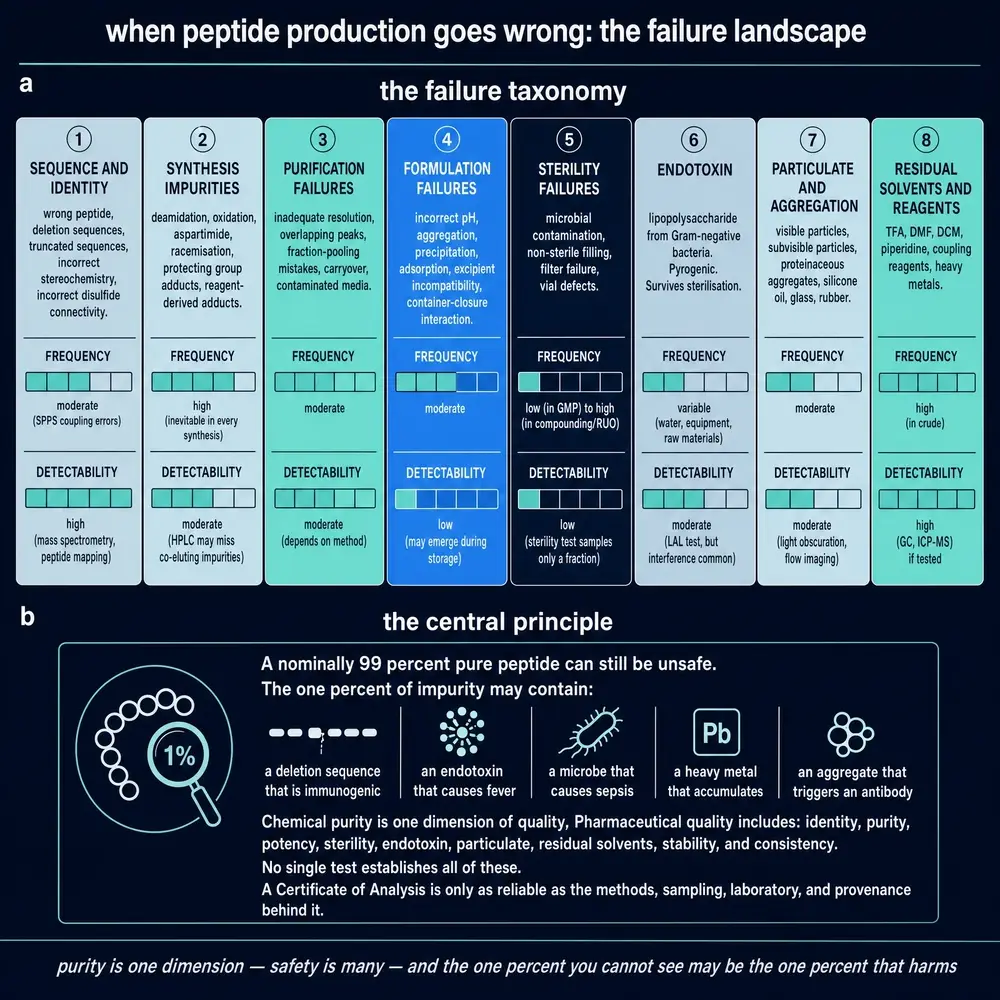
The controlling idea of this monograph is blunt. Chemical purity is not pharmaceutical quality. Identity, purity, assay, potency, sterility assurance, endotoxin control, elemental and residual cleanliness, container-closure integrity, and provenance are separate claim lanes. Collapsing them into a single area-percent figure is how research readers, clinicians, and patients get misled — and, in documented cases, harmed. Figure 1 maps the stages where those lanes break.
Those claim lanes are why the rest of this monograph is organised as a failure taxonomy rather than as a purity tutorial. A reader who keeps the lanes separate can evaluate a certificate, a warning letter or a purchase study without collapsing every defect into a single area-percent argument. A reader who does not will keep being surprised by vials that look clean on paper and unsafe in use.
This monograph explains failure mechanisms and quality systems for research readers. It does not recommend that any person use any peptide, and it specifies no dose, route or schedule. It does not provide sterile-suite recipes, fill volumes, sterilisation cycles or step-by-step instructions for unlicensed manufacture of injectable drugs.
Local corpus work for this monograph scanned 10,204 shared-library full-text assets and retained 216 topic-relevant documents (~4,582 printed-page equivalents), of which 22 were exported for full reading. That library is strong on peptide chemistry and formulation language; it is thinner on producer-category enforcement and gray-market field studies. Those chapters therefore lean on primary FDA records and recent peer-reviewed purchase analyses alongside the open literature.
Section 02Discovery history I — from septic injections to aseptic discipline
Injectable medicine did not begin with cleanrooms. It began with the recognition that piercing skin and vein bypasses the body’s ordinary defences. Nineteenth-century aseptic and antiseptic practice — the slow industrialisation of Pasteur’s and Lister’s insights — made parenteral therapy conceivable at scale. The lesson that still governs peptide vials is older than SPPS: what you inject does not get a second chance at the gut wall.
That is why sterile injectable peptides are judged by a harder standard than an oral tablet or a research reagent sold for cell culture. Route changes risk. A failure mode that would be a quality nuisance in a topical product can become a bloodstream infection, a pyrogenic crisis, or a meningitis cluster when the same carelessness meets a syringe.
Section 03Discovery history II — fever, rabbits, and blue blood
By the mid-twentieth century, manufacturers knew that some sterile-looking injectables still made patients spike fevers. The industrial answer was the rabbit pyrogen test: inject a sample, watch the animal’s temperature. It worked well enough to become a pharmacopeial gate, and poorly enough that everyone wanted something faster and more specific.
In the 1950s, Frederick Bang noticed that horseshoe-crab blood clotted oddly in the presence of Gram-negative bacteria. Working with Jack Levin, he showed in the 1960s that the clotting cascade in Limulus amebocytes was triggered by bacterial endotoxin — lipopolysaccharide from the outer membrane of Gram-negative organisms. That observation became the Limulus amebocyte lysate (LAL) test, later written into USP <85> Bacterial Endotoxins Test, and still evolving toward recombinant Factor C and monocyte-activation approaches.5
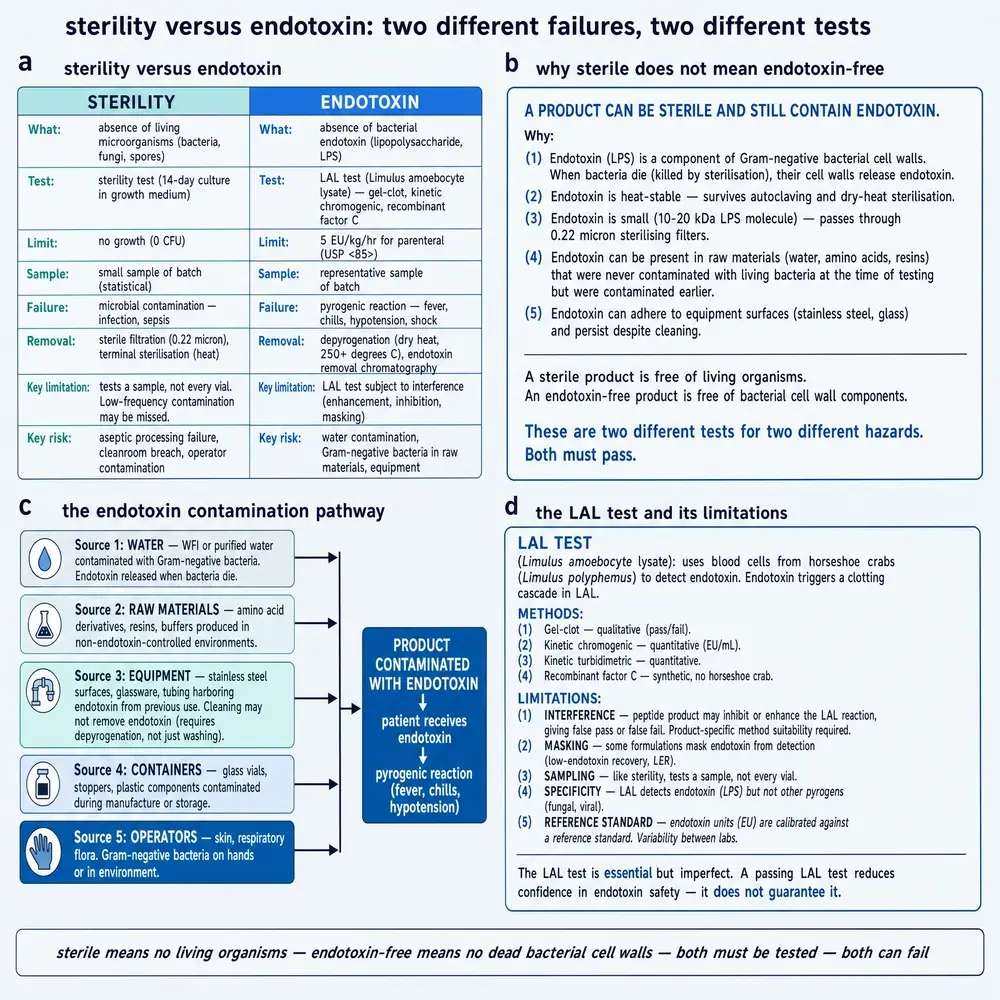
The conceptual split that matters for peptide products is simple and still widely misunderstood: sterility asks whether living microbes are present; endotoxin testing asks whether a toxic bacterial fragment is present. Dead bacteria can leave endotoxin behind. Ordinary sterilising filtration is not a reliable depyrogenation step. Figure 2 keeps the two hazards on separate panels because a vial can pass one lane and fail the other.
Section 04Discovery history III — Merrifield’s gift and the deletion grammar
When R. B. Merrifield introduced solid-phase peptide synthesis, he did more than speed up chain assembly. He created a characteristic impurity grammar. Incomplete couplings produce deletion sequences. Incomplete deprotections leave chemical ghosts. Aspartimide rearrangements and racemisation invent isomers that look almost like the drug. Purification by reversed-phase chromatography became both the solution and a new temptation: if the main peak is tall enough, the certificate can say “99%.”6
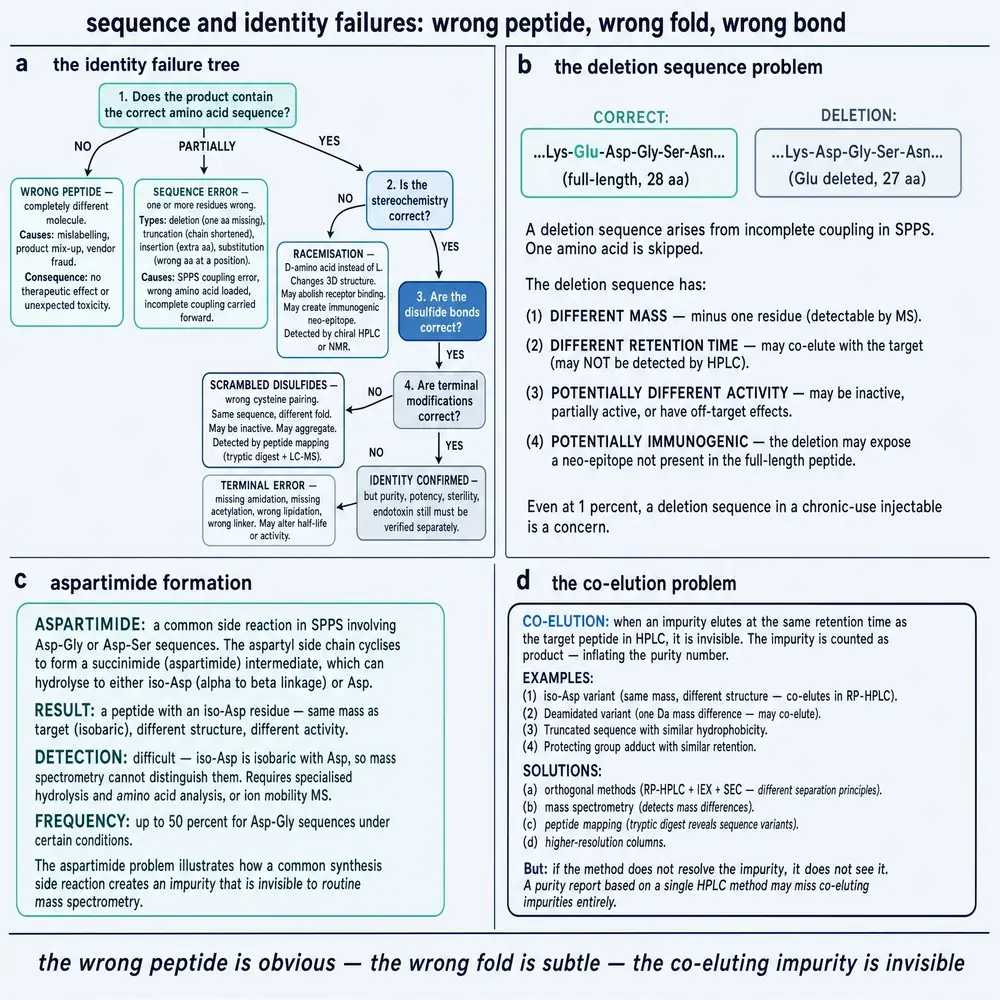
Figure 3 shows why near-neighbor deletions are philosophically dangerous. They are often biologically plausible, chromatographically close, and easy to under-measure when methods are weak. The purity percentage then becomes a story about integration events rather than a story about what is in the vial. Aspartimide rearrangements and iso-Asp isobaric variants make the same point from chemistry rather than from labelling: same mass, different structure, hard to see without the right orthogonal method.
Section 05Discovery history IV — NECC and the compounding inflection
In 2012, methylprednisolone injections compounded at the New England Compounding Center were contaminated with fungi. Patients developed fungal meningitis. Hundreds were sickened; dozens died. The outbreak is not a peptide story in the narrow chemical sense. It is the sterility-assurance story that still frames every sterile compounding conversation in the United States.2
Claim type: established public-health record and subsequent criminal proceedings. The policy consequence was the Drug Quality and Security Act, which sharpened the distinction between traditional 503A patient-specific compounding and 503B outsourcing facilities that make larger batches under federal CGMP expectations. When later warning letters tell a 503B peptide compounder that it produced drugs under insanitary conditions, they are speaking inside that post-NECC grammar: lack of assurance of sterility is already a patient-risk event, even before a pathogen is cultured from a vial.
That grammar matters for peptide readers because the 2020s shortage era pulled sterile peptide compounding and gray-market “research” vials into the same public conversation. The NECC record is not a claim that every compounder is NECC. It is the reason sterility-assurance failures are treated as patient-risk events before an outbreak is required to prove the point, and why later chapters separate producer categories by quality-system depth rather than by marketing language.
Section 06Discovery history V — scarcity, shortages, and the gray market
The 2020s added a commercial accelerant. Demand for incretin peptide medicines outran ordinary pharmacy and clinic supply in multiple markets. Compounders scaled. Online sellers advertised research vials with purity claims that looked like pharmaceutical CoAs. Some of those products were later shown, in peer-reviewed purchase studies, to be chemically and microbiologically unlike their labels.1
None of this proves that every compounder is reckless or that every overseas API plant is corrupt. It proves that incentive pressure plus opaque provenance is a failure mode of its own. When patients and clinics cannot get an approved product, the market invents substitutes. Some substitutes are carefully made under a lawful compounding rationale. Some are aspirational chemistry with a laser-printed certificate. The rest of this monograph teaches how to tell the difference in principle — without pretending a blog post is a batch record.
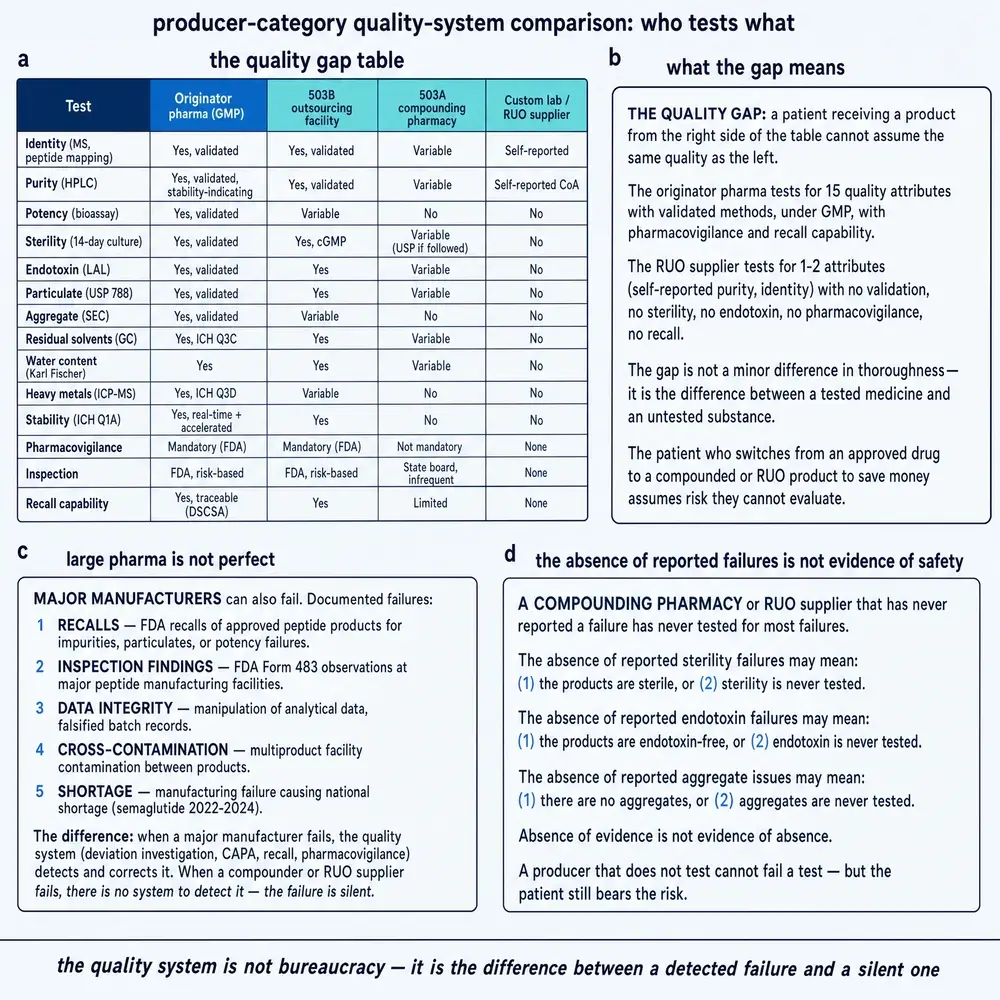
Figure 4 previews the control envelopes compared in Part Four: approved manufacturers, outsourcing facilities, 503A pharmacies, custom synthesis labs, and gray-market sellers are not interchangeable systems that happen to print similar PDFs. The rest of Part One simply teaches how to keep those categories, and the evidence that supports them, from collapsing back into a purity slogan.
Section 07How to read the rest of this document
Evidence is stacked in a deliberate order: statutes and regulations; pharmacopeial and regulator guidance; inspection and recall records; peer-reviewed manufacturing and analytical literature; court and enforcement records; official company responses; then cautious secondary reporting. Anonymous internet claims are leads, never foundations.
Where this monograph says warning letter, read regulator allegation based on inspectional observations, unless a court judgment is cited. Where it says recall for lack of sterility assurance, do not silently upgrade that to confirmed patient isolates. Where it says author inference, the inference is labelled. Recency is weighted — findings from 2023–2026 are preferred when they are not contradicted by a preponderance of older evidence — but a new preprint does not erase NECC, and a new HPLC method does not erase endotoxin biology.
Parts Two and Three build the failure taxonomy and the deep chapters on purity, endotoxin, sterility, and metals. Part Four compares producer categories without national stereotyping. Part Five reads documented cases and returns to the standing constraint: this is a research monograph about risk literacy, not a use guide.
Section 08Sequence and identity failures
The most brutal failure is also the simplest to state: the vial does not contain the peptide named on the label. Wrong sequence, truncated sequence, incorrect stereochemistry, wrong terminal amide or acid, wrong disulfide connectivity, wrong lipid or linker, wrong salt form, or a wholesale product mix-up all belong here. Some of these failures are synthesis accidents. Some are labelling accidents. Some, in gray markets, are substitutions.
Identity testing — mass spectrometry, peptide mapping, amino-acid analysis, chromatographic retention against a qualified reference — exists because HPLC area percent cannot see a wrong molecule that happens to look tidy. A custom laboratory CoA that reports “identity: confirmed by MS” without spectrum, method, or reference-standard traceability is a weaker claim than it sounds.
Section 09Synthesis-related impurities
Solid-phase synthesis invents a catalogue. Incomplete coupling yields deletion sequences. Capping strategies convert failures into truncated acetylated fragments. Incomplete deprotection leaves protecting-group ghosts. Aspartimide formation rearranges aspartate-rich stretches. Racemisation at activated residues creates diastereomers. Over-acylation, branching, reagent-derived adducts, and resin- or linker-derived species thicken the crude. Figure 3 (Part One) remains the visual for near-neighbor deletions.
The practical problem is not that impurities exist — every real synthesis makes them. The problem is that many are close: similar hydrophobicity, similar UV response, easy to hide under a main peak when the method is optimistic. Figure 5 places these defects at the synthesis stage before purification is asked to perform miracles.
Section 10Recombinant-production impurities
When the peptide or peptide-protein is made in cells, the impurity catalogue relocates. Host-cell proteins, residual host-cell DNA, fermentation-media components, incorrectly processed precursors, incomplete cleavage tags, misfolded species, incorrect disulfide pairing, and aggregates join endotoxin as process-typical concerns. Downstream purification must be designed for that catalogue, not for SPPS deletions. A recombinant insulin DSP review literature makes the point in engineering detail: inclusion-body routes and chromatographic trains fail in characteristic ways when host impurities are underestimated.8
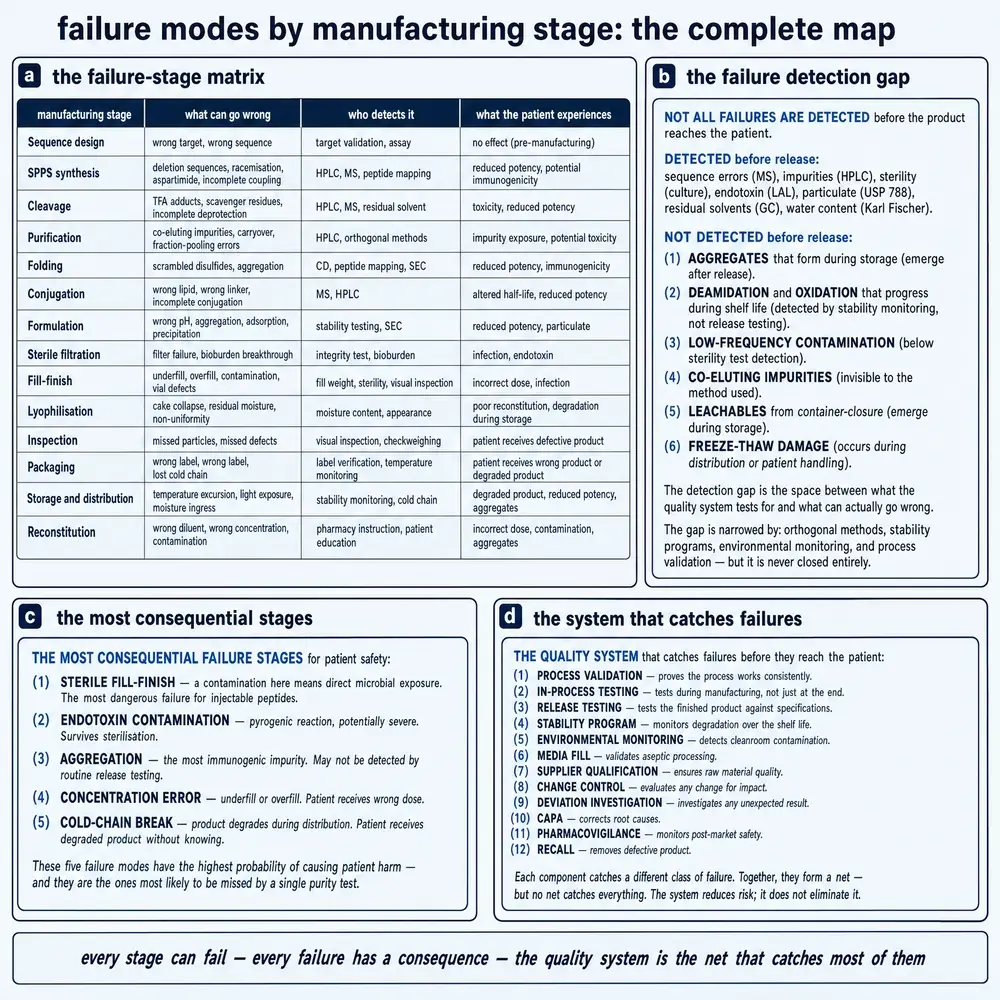
Section 11Purification failures
Purification is where optimistic CoAs are born. Inadequate chromatographic resolution, overlapping peaks, overloaded columns, mistaken fraction pooling, contaminated media, carryover, reprocessing under yield pressure, and batch blending can all convert a separable crude into a misleadingly clean story.
Figure 3 is the diagram to keep on the desk: one peak is not one molecule. Without orthogonal detection — LC-MS, peak purity tools, forced-degradation challenge of the method — area percent can report confidence the chemistry did not earn. Peak integration errors and selective exclusion of inconvenient shoulders are not folklore; they are ordinary analytical failure modes when governance is weak.
Section 12Formulation failures
A correct drug substance can still become a bad drug product. Wrong concentration, wrong pH, wrong tonicity, incompatible buffer, missing stabiliser, oxidation, adsorption to glass or filters, aggregation, precipitation, preservative failure, light or oxygen exposure, and container-closure interactions (leachables/extractables) all sit here. Excipients are not inert scenery. Polysorbates can hydrolyse; buffers can catalyse deamidation; interfaces can seed aggregates.
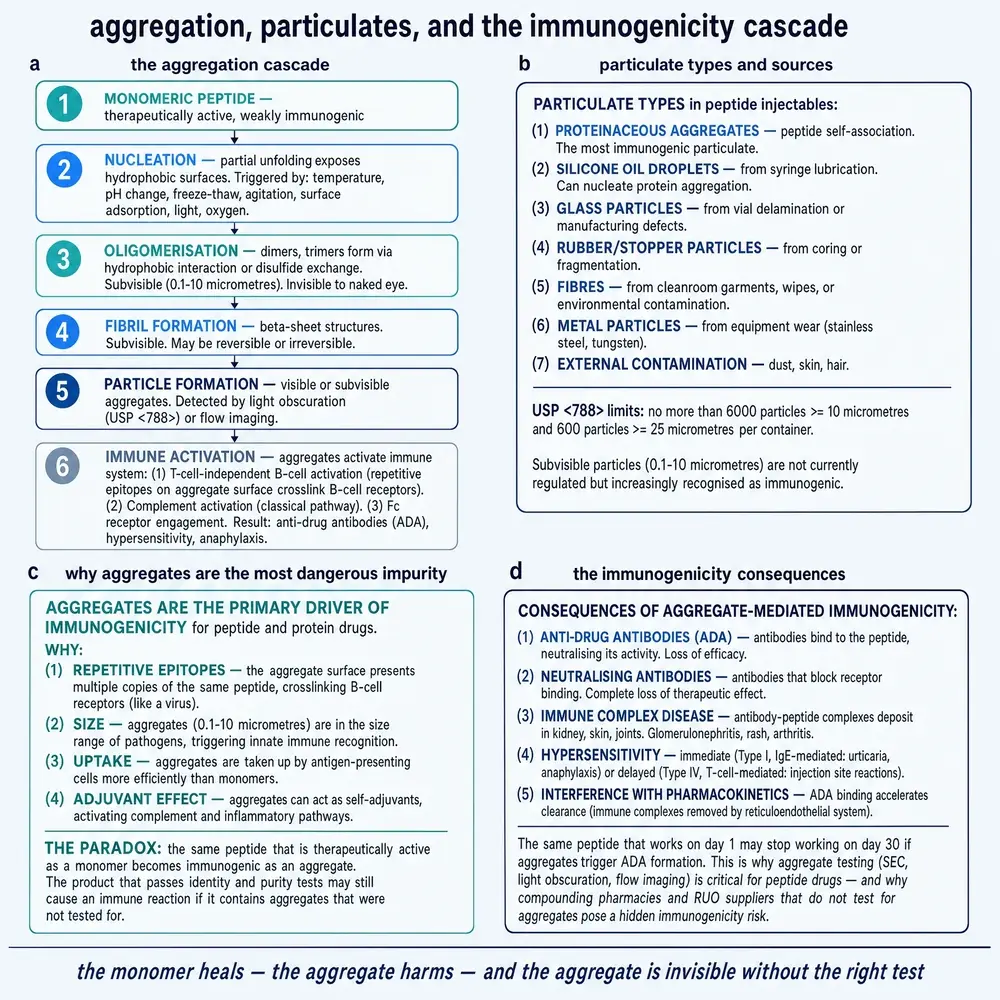
Figure 6 sketches the path from monomer to visible particle. Shear, freeze-thaw, and hostile interfaces accelerate it. For injectable peptides, particulates are not a cosmetic defect; they are a safety attribute under pharmacopeial particulate expectations.
Section 13Lyophilization failures
Freeze-drying protects many peptides and invents its own failure atlas: incomplete drying, excessive residual moisture, cake collapse, meltback, vial-to-vial variability, poor reconstitution, aggregation during freezing, potency loss, inadequate stopper seating, vacuum failure, and uneven primary or secondary drying at scale.
A beautiful cake photograph is not a moisture specification. A reconstitution instruction on a research website is not a validated cycle. The lyophilisation failure atlas in Figure 7 lists the modes that turn solid-looking product into a dose the label no longer describes.
Section 14Fill-finish failures
Fill-finish is where chemistry meets microbiology in a hurry. Incorrect fill volume, concentration nonuniformity, filter failure, microbial ingress, stopper and vial defects, closure-integrity failure, particulate introduction, line mix-ups, labelling errors, and inadequate visual inspection all belong here.
Container-closure integrity is part of the sterile boundary. A cracked vial, a mis-seated stopper, or a bad crimp is not packaging trivia. The same plate marks the ingress paths that environmental monitoring cannot see once the lot has left the filling line.
Section 15Storage and distribution failures
After release, the product can still be ruined. Temperature excursions, accidental freezing, light exposure, moisture ingress, delayed shipping, informal cold chains, repeated freeze-thaw, and relabelling of expired material are distribution failure modes.
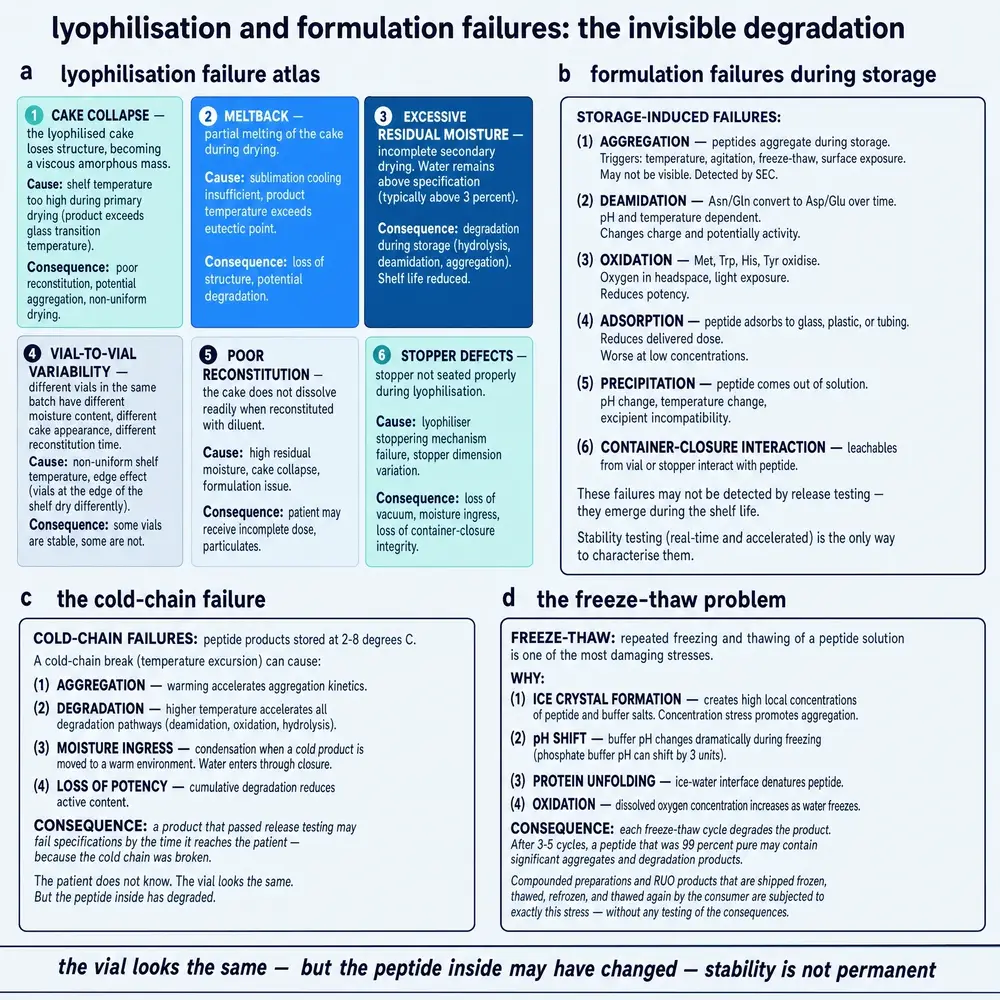
Figure 7 treats temperature as a process parameter in transit. A purity CoA printed at the factory does not know what happened on a loading dock in July. Informal courier chains, clinic refrigerators that cycle near freezing, and repeated freeze–thaw of reconstituted vials turn a release-time certificate into a historical document rather than a description of what reaches the patient.
Section 16What routine tests catch — and what they miss
Figure 5 divides the world into failures ordinary testing tends to see and failures that can escape. Gross mis-identity (if identity is tested), major HPLC impurities, some endotoxin loads (when the method is suitable), visible particles, and a sterility sample that happens to hit contamination are often detectable. Low-level uneven contamination, co-eluting near-neighbors, LER-masked endotoxin, fabricated or unrepresentative certificates, and post-release cold-chain damage can escape. Sampling is not omniscience. Methods are not prophets. Paperwork is not physics.
Section 17What “98%” and “99%” may mean
Purity language is a dialect with false friends. HPLC or UPLC area percent is a relative detector response under a method. Chromatographic purity is usually the same family. Chemical purity, when honestly defined, often implies a mass-balance view after water, residual solvents, and counterions are accounted for. Peptide content or net peptide content asks how much peptide mass sits in the solids. Salt-corrected and water-corrected assays adjust the arithmetic. Potency asks a biological question. Vial assay asks how much active is in the container. Sequence identity asks whether the intended primary structure is present.
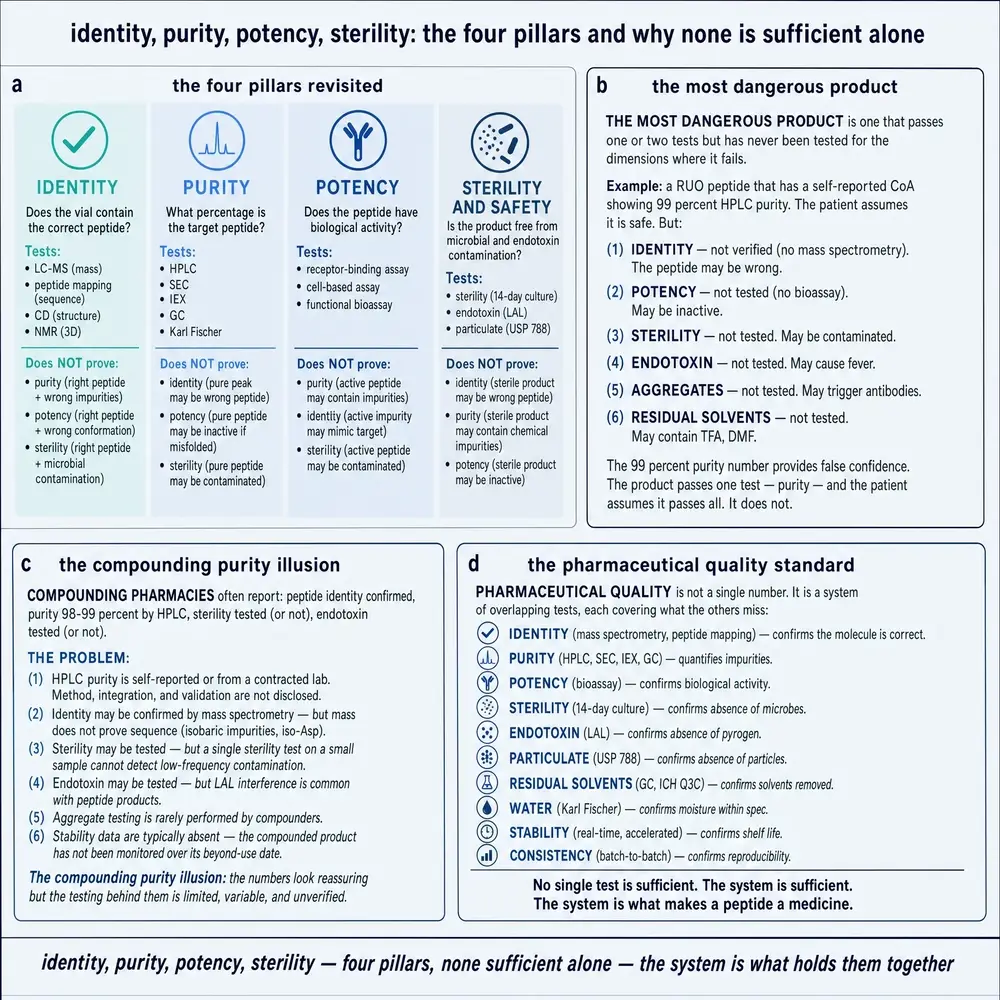
These terms are not interchangeable. Figure 9 separates identity, purity, assay, and potency because transitive inference across lanes is how certificates become talismans. Sterility assurance and endotoxin control are still further lanes.
Section 18The arithmetic that misleads
A product reported as 98% pure nominally contains a 2% chromatographically observed impurity fraction. A product reported as 99% pure nominally contains 1%. Moving from 98% to 99% is a one percentage-point change in total material and a 50% relative reduction in the nominal impurity fraction.
That relative cut can matter. It can also be theatre. If the “impurity” is mostly well-controlled water or counterion accounted elsewhere, the drama is misplaced. If the 1% is a potent deletion peptide, an immunogenic aggregate seed, or an unidentified reactive species, the drama is understated. Figure 8 shows the arithmetic and why illustrative chromatograms without method metadata are not CoAs.
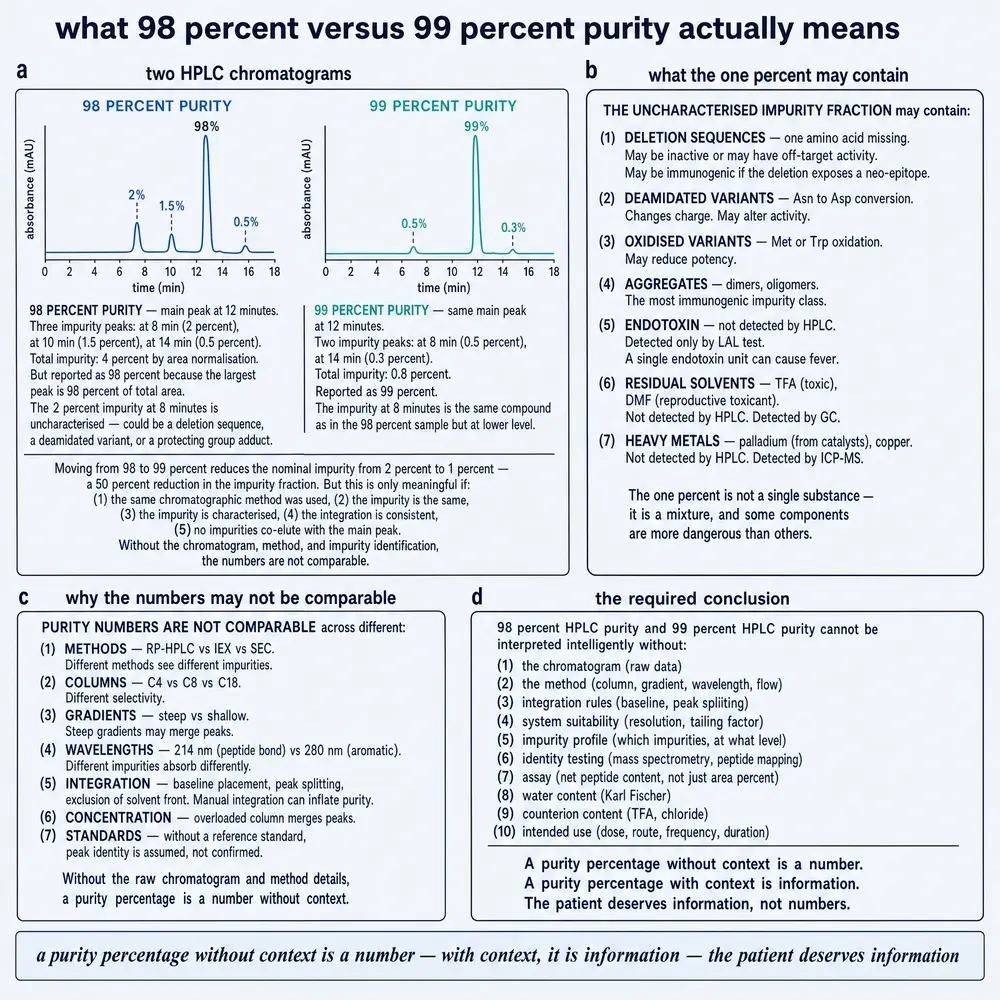
Section 19Why a 99% product can still be unsafe
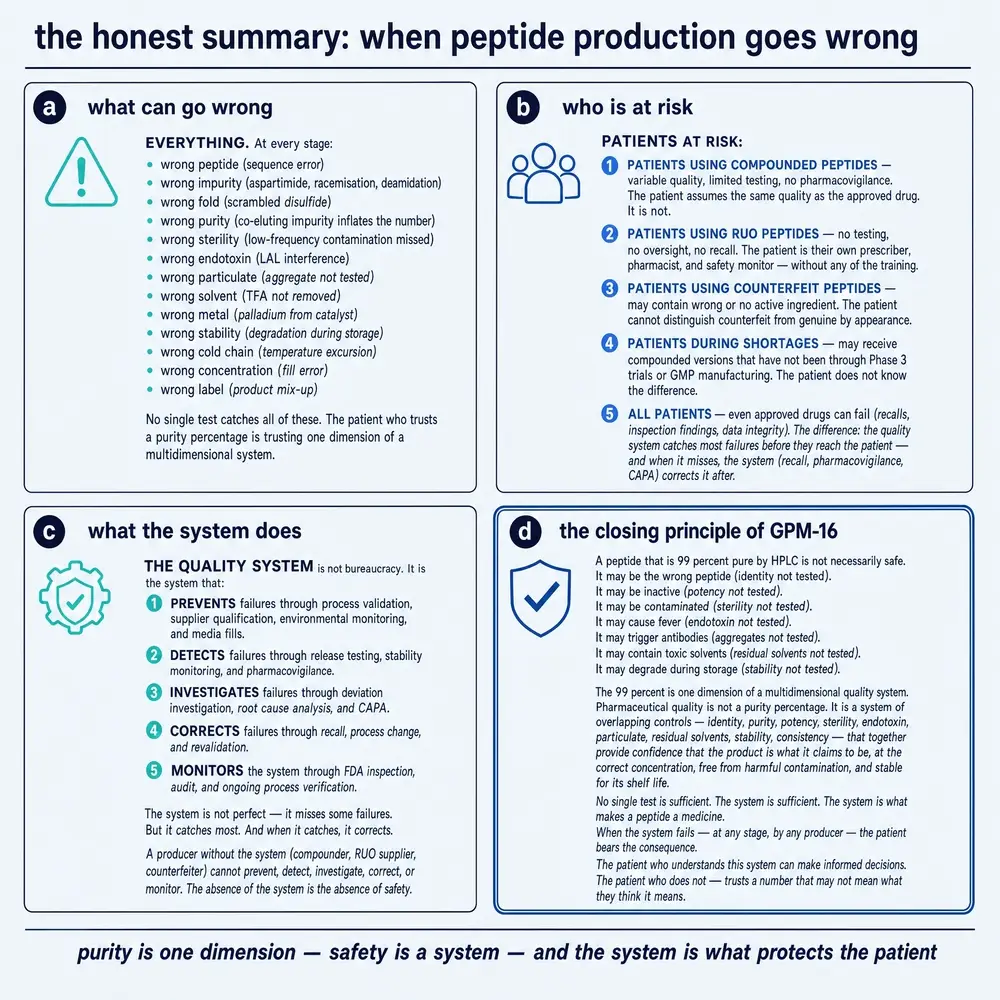
Because the percentage may be wrong; because the impurity may be active; because the vial may be nonsterile; because endotoxin may be present; because the identity may be wrong; because the assay may not match the label; because the certificate may describe a different lot than the one shipped; because aggregation and particulates do not care about your area-percent pride.
“98% HPLC purity” and “99% HPLC purity” cannot be interpreted intelligently without the chromatogram, method, integration rules, system-suitability results, impurity profile, identity testing, assay, water content, counterion content, and intended use.
A human observational laboratory purchase study of no-prescription online “semaglutide” vials found measured purity on the order of roughly 8–14% against label claims near 99%, content exceeding label claims by roughly 29–39%, and detectable endotoxin despite no viable organisms at the time of sterility testing.1 That is not a verdict on all compounded peptides. It is a verdict on the fantasy that a printed percentage is reality.
Section 20Endotoxin — structure, pathways, clinical risk
Bacterial endotoxin is lipopolysaccharide from Gram-negative outer membranes. It is not alive. A solution can be sterile and still contain endotoxin. Ordinary sterilising filtration does not reliably remove it. In parenteral use, endotoxin can drive fever, chills, inflammatory responses, hypotension, and severe systemic reactions. Risk depends on dose and route. Product-specific limits exist inside pharmacopeial bacterial-endotoxins frameworks; they are not a universal sticker. Figure 2 maps contamination entry points: water, equipment, materials, containers, operators, and the persistence of LPS after cells die.14
Section 21Endotoxin testing and its failure modes
Gel-clot, kinetic chromogenic, and kinetic turbidimetric LAL methods, plus recombinant Factor C and recombinant cascade reagents, are the modern toolbox. Each requires product-specific suitability. Inhibition and enhancement can invalidate a run. Sample dilution is a tool, not a charm.
Low endotoxin recovery (LER) — also discussed as endotoxin masking — is the failure mode that most unsettles release laboratories. In some formulations that combine surfactants with chelators, spiked endotoxin activity falls over a hold-time study and cannot be rescued by ordinary dilution. FDA and EMA have required hold-time studies for relevant biologic presentations. In at least one FDA-discussed monoclonal-antibody case narrative, endotoxin that LAL could not recover still provoked fever in rabbits.7 Masking is therefore not a pedantic analytical quarrel; it is a possible false-negative pathway. Peptide formulations are not all LER-prone, but any polysorbate-plus-chelator presentation inherits the question.
Section 22Sterility, sterility testing, and sterility assurance
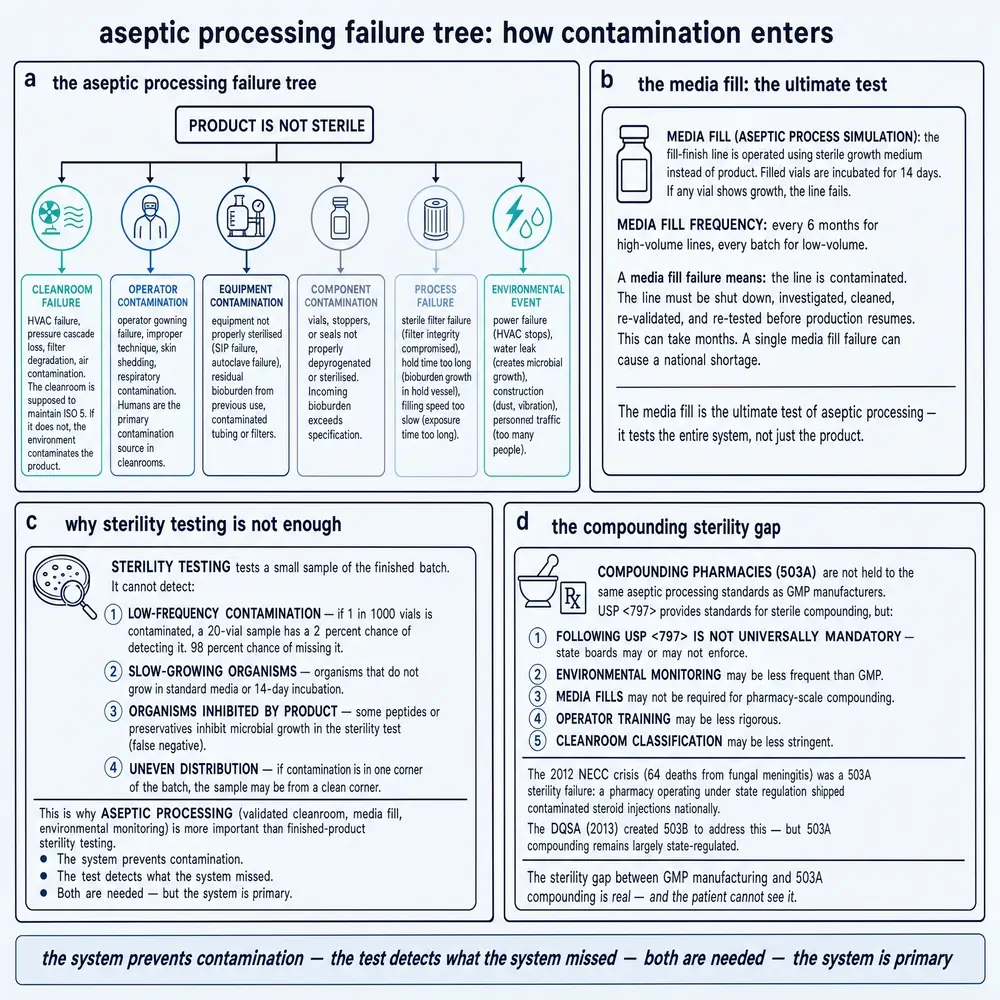
Sterility is a state. Sterility testing is a sample. Sterility assurance is a system. Aseptic processing manufactures a sterile product without terminal sterilisation of the filled unit — the usual situation for peptides that cannot survive terminal heat or radiation. Media fills, environmental monitoring, bioburden control, and container-closure integrity are how assurance is built. Figure 10 places finished-product testing at the edge of that system, not at its centre. Figure 10 lists where aseptic processes break in inspection histories: airflow visualisation gaps, operator technique, ignored environmental recoveries, weak media fills, utility breaches, and packaging defects.9
A passing sterility test does not prove every vial is sterile. Microbes may be unevenly distributed. Incubation may miss fastidious organisms. Product may inhibit recovery. Sampling can miss low-frequency contamination. That is why FDA recall language so often says lack of assurance of sterility rather than waiting for a body count.
That is also why inspection language spends so much time on airflow visualisation, glove and gown discipline, environmental-monitoring trends, media-fill design, utility integrity and line clearance. Those controls are not bureaucratic ornament. They are the practical substitute for testing every vial. When they are weak, a passing sterility sample can coexist with a process that is already losing its margin. When they are strong, a single adverse environmental recovery can stop a campaign before patients ever see the lot. The failure tree in the next figure is therefore a map of system breaks, not a list of exotic organisms.
Compounding and outsourcing contexts inherit the same physics with thinner institutional scaffolding. A 503A cleanroom that skips media fills, or a 503B suite that treats ISO 5 recoveries as paperwork rather than process signals, is replaying the NECC lesson in a newer regulatory vocabulary. The category labels differ; the contamination pathways do not.
Keep that distinction in mind when a certificate reports “sterile” without saying which assurance system produced the claim. A validated aseptic process with trending EM data and periodic media fills is not the same object as a one-time culture of a few vials. Both may print the word sterile. Only one of them is answering the question patients actually need answered.
Section 23Elemental impurities and process metals
Lead, arsenic, cadmium, and mercury are the classic toxic heavy-metal concerns. Palladium, platinum, nickel, copper, iron, chromium, and cobalt are often process-relevant — catalysts, steel, tools, filters. ICH Q3D reframes the problem as risk-based elemental-impurity assessment with route-specific exposure logic, typically supported by ICP-MS or ICP-OES with controlled digestion and blank correction. Figure 11 refuses the lazy phrase “heavy metals passed.” Identity, concentration, route, and method matter.4
Section 24Residuals, particles, and invisible companions
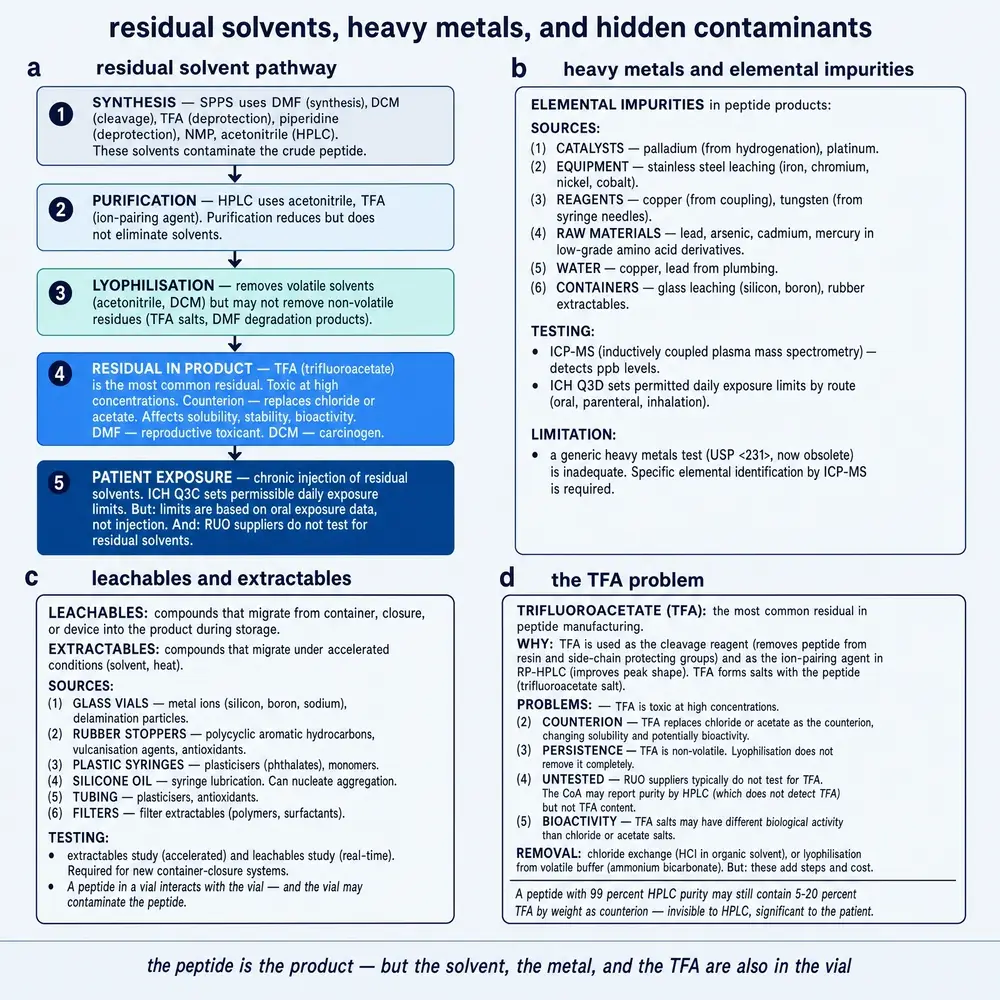
Residual solvents, coupling and cleavage reagents, trifluoroacetate and other counterions, residual water, cleaning-agent residues, plasticisers, silicone oil, tungsten, glass particles, rubber-stopper extractables, filter extractables, leachables, visible and subvisible particles, fibers, proteinaceous aggregates, microbial DNA, host-cell contaminants, and cross-contamination from other products complete the contamination taxonomy. Figure 11 groups the chemical hitchhikers. None of them are proven absent by an HPLC purity line alone.
Trifluoroacetate is the everyday example that purity language conceals. A peptide reported as 99% by HPLC area can still carry a substantial TFA counterion mass that HPLC never counted as an impurity peak. Residual DMF, DCM or scavenger fragments, stopper leachables and subvisible silicone droplets belong to the same family of companions: real, sometimes consequential, and invisible to a certificate that only prints an area percent. The next figure keeps solvents, metals and those hitchhikers on one map so the reader stops asking a purity line to do work it cannot do.
Section 25Comparison framework without stereotypes
Country of origin is not a certificate of analysis. Firm size is not a sterility assurance level. A research CoA is not a batch-release package. Figure 4 compares categories by quality-system depth: process validation, aseptic capability, release logic, and characteristic residual risks. Variation inside every row is large. The point of the table is to stop category errors — not to crown saints or condemn nations.
Section 26Major approved-drug manufacturers
Originator and major generic manufacturers of peptide drugs operate inside validated commercial processes, supplier qualification, process and analytical validation, environmental monitoring, aseptic processing controls, data-integrity expectations, deviation systems, CAPA, stability programs, pharmacovigilance, regulator inspections, and formal batch release. That architecture is why approved peptide medicines have a different risk envelope from research vials.
It is not why they never fail. Large firms still issue recalls, still receive inspectional observations, and still discover that a contract steriliser, a stopper lot, or a cold-chain lane broke. Mature quality systems reduce frequency and improve detection; they do not repeal entropy. When this monograph cites a large-manufacturer recall, it does so from verified records — not from the folklore that “big pharma never errs” or the opposite folklore that scale equals corruption.
A 2026 Class II recall narrative for octreotide acetate for injectable suspension cited lack of assurance of sterility after quality-system deficiencies identified at a contract manufacturer during FDA inspection (Teva / Pharmathen reporting chain in secondary recall databases).13 Claim type: recall classification and stated reason as reported in enforcement listings; readers should confirm lot-level detail on FDA’s primary recall database before treating any secondary aggregator as authoritative.
Section 27CDMOs and peptide API suppliers
Contract development and manufacturing organisations sit in a split-brain arrangement. The sponsor owns the product responsibility patients feel; the contractor owns the batch record the inspector reads. Quality agreements, technology transfer, method transfer, sample retention, data ownership, subcontracting limits, and campaign-changeover controls determine whether that split is governed or merely hoped. Capacity pressure and campaign manufacture raise cross-contamination and hurry-up risks. When failure occurs, finger-pointing is not a CAPA.
Peptide API suppliers — including highly capable plants in China, India, Europe, and North America — vary from ICH-inspected commercial manufacturers to export brokers with thin visibility. The analytical question is always the same: who made this lot, under which quality system, with which retained samples, and with which right to audit?
Section 28503A compounding pharmacies
Traditional 503A compounding is patient-specific. Done well, it fills clinical gaps that approved catalogues do not cover. Done as repeated commercial-scale copying of approved drugs without the corresponding manufacturing system, it imports NECC’s lesson without NECC’s honesty. Sterile compounding standards, beyond-use dating logic, environmental monitoring, and personnel qualification matter. State oversight varies. Federal attention intensifies when compounding looks like unapproved manufacturing.
A 503A pharmacy is not an FDA-approved manufacturer. That sentence is not an insult. It is a category boundary. Clinical value and industrial risk can coexist in the same building; literacy is knowing which activity is happening on which day.
Section 29503B outsourcing facilities
Section 503B outsourcing facilities may make larger batches, supply office stock under defined conditions, and are obligated to comply with CGMP. They are inspected by FDA. They must meet labelling and adverse-event reporting expectations that differ from 503A practice. They are not NDA/BLA holders for the compounded copies they produce.
Recent warning letters to 503B facilities show recurring themes: inadequate dynamic smoke studies, weak responses to ISO 5 microbial recoveries, media fills that do not simulate worst-case operations, incomplete investigations, and insanitary aseptic practices.1011 Claim type: FDA warning-letter allegations. ProRx, LLC (Exton, PA) received an amended warning letter dated 4 March 2025 after a July–August 2024 inspection; the letter acknowledges a voluntary recall for lack of sterility assurance and a temporary cessation of sterile production. Tailstorm Health (Medivant) received an April 2025 warning letter with related sterile production concerns and a bevacizumab syringe recall for lack of sterility assurance. These are not “peptide scandals” in every vial detail; they are sterility-assurance system failures in facilities that also handled high-demand peptide compounding in the same era.
The useful reading habit is therefore not “503B equals safe” and not “503B equals scandal.” It is to ask which CGMP obligations were alleged to have failed, whether sterile production stopped, whether a recall issued for lack of sterility assurance, and whether the firm’s response closed the loop. Those questions travel into the custom-lab and gray-market discussion that follows, where the same words appear with far less institutional machinery behind them.
Section 30Custom labs, China/India supply variation, gray market and counterfeit
Custom peptide laboratories excel at sequence customization and milligram-to-gram chemistry. Their CoAs often report HPLC purity and mass. Many have no sterile manufacturing capability and do not claim pharmaceutical release. A chemically correct research peptide is not, thereby, a clinically suitable injectable. Treating a research CoA as a substitute for pharmaceutical quality is a category error with patient consequences if someone injects the material anyway.
Chinese and Indian producers include major reputable GMP manufacturers, smaller export-oriented suppliers, contract API plants, and research-grade houses. Inspection histories, supply-chain depth, subcontracting, broker opacity, sample-versus-production discrepancies, and data-integrity concerns vary by firm — as they do in the United States and Europe. Pricing and scale advantages are real. So is quality variation. Country of origin alone is an inadequate risk model; unverifiable brokers are a strong one.
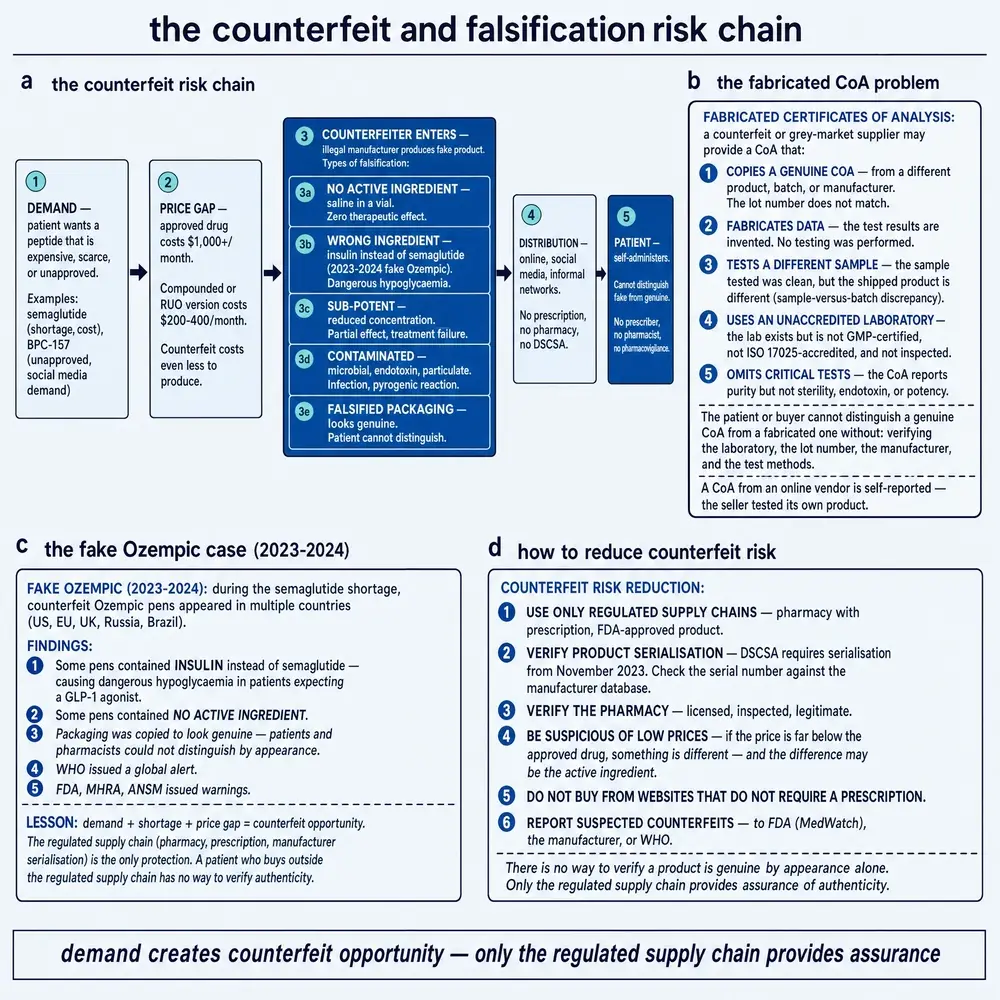
Gray-market and counterfeit operations invent a different catalogue: false labelling, vial substitution, diluted or absent active, incorrect sequence or salt, copied packaging, fabricated CoAs, unverifiable lots, nonsterile filling, endotoxin contamination, undisclosed excipients, and informal cold chains. The JMIR 2024 online semaglutide purchase study is the empirical exhibit: illegal pharmacy links were common in search results; delivered vials failed visual quality rubrics; purity collapsed relative to label claims; endotoxin was detected; some purchases were pure nondelivery fraud.1
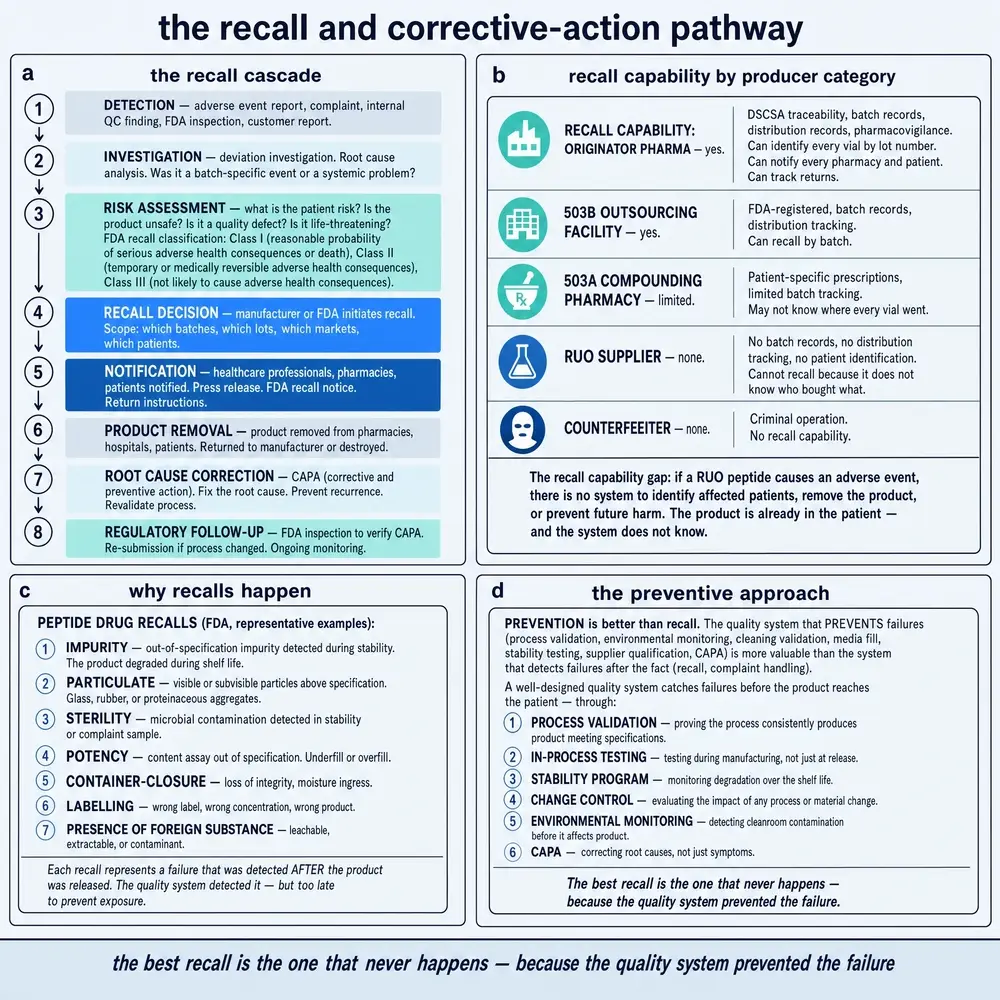
The producer-category comparison therefore ends where a mature quality system begins: with the ability to detect a failure, remove product, and prevent recurrence. Part Five turns from category risk to documented cases and the standing constraint that keeps this monograph out of dosing and sterile-recipe territory.
Section 31Case atlas — how to read enforcement records
A warning letter is not a conviction. A Form FDA 483 is not a final agency action. A company response is not an exoneration. A Class II recall for lack of sterility assurance means the agency believes temporary or medically reversible adverse health consequences are possible and the probability of serious harm is remote — not that patients were proven infected. Figure 13 (Part Four) shows what mature systems do after a signal: investigate, dispose, correct, prevent, and verify. Paper CAPA without cultural change is how the same observations return. Read each case below as a quality-system story first and a product story second: what control was missing, what signal arrived late, what patients could not see from a certificate, and what the record actually proves versus what secondary reporting infers. Where a primary FDA letter, recall notice or outbreak report is cited, treat that text as the claim; where a secondary aggregator summarises lot detail, treat the detail as provisional until confirmed on the agency’s own listing.
Section 32Documented cases
NECC, 2012 (historical anchor). Contaminated sterile compound compounded injections; fungal meningitis outbreak; major morbidity and mortality; DQSA regulatory restructuring. 2 Claim type: public-health and criminal-case record.
ProRx, LLC, 2024–2025 (503B). FDA inspection 15 July–2 August 2024; Form FDA 483; amended warning letter 4 March 2025; voluntary recall for lack of sterility assurance (22 August 2024); sterile production ceased 7 August 2024 per letter acknowledgements. 10 Claim type: regulator warning letter / firm-acknowledged recall actions. Secondary reporting ties the facility to high-volume compounded incretin peptides; the primary FDA letter is about sterile-production conditions and 503B conditions, not a peptide identity assay.
Tailstorm / Medivant, 2025 (503B). Warning letter 8 April 2025 after autumn 2024 inspection; sterile-production deficiencies alleged; bevacizumab syringe recall for lack of sterility assurance.11 Claim type: warning letter.
GenoGenix GHK-Cu injection recall (Class II, initiated 30 July 2025; recall no. D-0051-2026 in secondary listings). Reason stated: lack of assurance of sterility. 12 Claim type: recall listing via secondary aggregator — confirm on FDA primary enforcement report before treating lot details as final.
Online no-prescription semaglutide purchase study (JMIR 2024 / PMC11582493). Market surveillance plus test purchases: delivered vials showed low measured purity versus ~99% claims, super-potent content versus label, endotoxin detected, no viable organisms at sterility testing, packaging noncompliance; some pen purchases were nondelivery scams. 1 Claim type: peer-reviewed laboratory and market study of illicit channels.
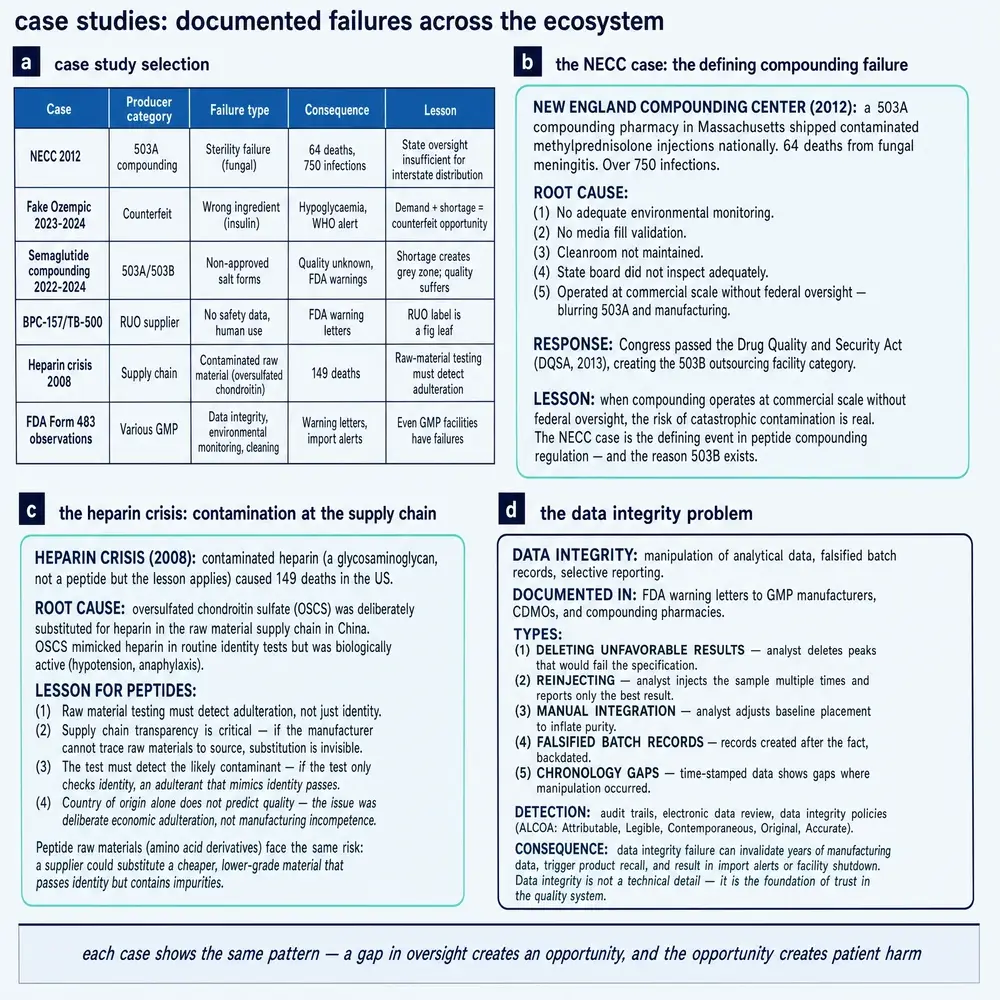
Visible particulates RCA in therapeutic protein products (PMC12657923, 2025). Root-cause investigation methods for visible particles — a fill-finish and materials failure lens applicable to parenteral peptides.3 Claim type: peer-reviewed manufacturing investigation paper.
Absences stated honestly. This monograph does not force a unique, well-documented “Chinese peptide factory scandal” or “Indian peptide factory scandal” into the narrative where primary evidence is thin or non-specific. Cross-national GMP inspection findings exist across many dosage forms; peptide-specific attribution requires firm-level records, not nationality as a proxy. Likewise, not every large pharmaceutical peptide manufacturer has a recent public peptide sterility catastrophe on the record; residual risk is argued from system properties and verified recalls, not invented drama.
What the case atlas does show, repeatedly, is a pattern: a gap in oversight or testing creates an opportunity; the opportunity becomes a silent product attribute; patients discover the attribute only after exposure, complaint or outbreak. The closing plate that follows restates the monograph principle without adding a new case: purity is one dimension, safety is a system, and the system is what makes a peptide a medicine rather than an unverified substance.
Section 33What mature quality systems do after failure
They stop the line. They quarantine. They investigate with a scope wide enough to catch sister lots. They identify root cause without stopping at “human error” as a slogan. They dispose of product. They implement corrective and preventive actions. They check whether the CAPA worked. They tell regulators and, when required, the public. They retain samples and data so the story can be reconstructed. Facilities that skip those steps can still print certificates. They cannot print trust.
Section 34Contradictions and unresolved risks
LER’s clinical meaning for every peptide formulation remains incompletely mapped; hold-time studies are a regulatory response to uncertainty, not a finished textbook. The practical importance of 98% versus 99% HPLC purity remains impurity-specific — a contradiction only if someone insists on a universal answer. Detection of substandard and falsified medicines improves, but purchase studies remain snapshots. Open JATS libraries under-index producer-category enforcement narratives; that is a corpus gap, not proof that enforcement is rare.
Section 35Weighing the evidence
Recency is weighted for compounding-era enforcement and gray-market field analytics (2023–2026). Historical anchors (asepsis, LAL, Merrifield, NECC) stay load-bearing because they define the categories. In vitro analytical papers inform method limits. Animal pyrogen data inform endotoxin biology. Human observational harm appears in outbreak records and adverse-event databases and is labelled as such. Author inferences — for example, that incentive pressure during shortages amplifies category errors — are argued from those records, not from vibes.
Section 36Standing constraint
No human use, dose, route or schedule is recommended anywhere in this document. Reported study parameters, recall classifications and inspection findings are described for research and industry-analysis literacy only. This monograph does not provide instructions for manufacturing, sterilising or covertly producing injectable peptides. For verification logic and CoA literacy see GPM 09; for plant engineering see GPM 15; for legal producer categories see GPM 14.
A1References
- Ashraf AR, Mackey TK, Civljak R, et al.. Multifactor quality and safety analysis of semaglutide products sold by online sellers without a prescription: market surveillance, content analysis, and product purchase evaluation study. Journal of Medical Internet Research. 2024;26:e65440.
PMID 39509151 · doi:10.2196/65440 · PMC11582493 - Centers for Disease Control and Prevention. Multistate outbreak of fungal infection associated with injection of methylprednisolone acetate solution from a single compounding pharmacy — United States, 2012. MMWR Morbidity and Mortality Weekly Report. 2012;61(41):839-842.
PMID 23076093 - de Luna IF, Telikepalli SN, Carrier M, Ripple D, Srinivasan C, O’Connor T, et al.. Root cause analysis investigation of visible particulates in therapeutic protein drug products using morphologically directed Raman spectroscopy. Scientific Reports. 2025;15:42026.
PMID 41291196 · doi:10.1038/s41598-025-97097-x · PMC12657923 - International Council for Harmonisation. ICH Q3D(R2) Guideline for elemental impurities. ICH Harmonised Guideline. 2022.
- Levin J, Bang FB. The role of endotoxin in the extracellular coagulation of Limulus blood. Bulletin of the Johns Hopkins Hospital. 1964;115:265-274.
- Merrifield RB. Solid phase peptide synthesis. I. The synthesis of a tetrapeptide. Journal of the American Chemical Society. 1963;85(14):2149-2154.
doi:10.1021/ja00897a025 - Reyes-Candau-Chacon. FDA perspective on recombinant endotoxin detection systems (USP workshop presentation). U.S. Food and Drug Administration / USP workshop materials. 2023.
- Siew YY, Zhang W. Downstream processing of recombinant human insulin and its analogues production from E. coli inclusion bodies. Bioresources and Bioprocessing. 2021;8(1):65.
PMID 34336550 · doi:10.1186/s40643-021-00419-w · PMC8313369 - U.S. Food and Drug Administration. Sterile drug products produced by aseptic processing — current good manufacturing practice (guidance for industry). FDA Guidance. 2004.
- U.S. Food and Drug Administration. Amended warning letter to ProRx, LLC (696742) — Exton, Pennsylvania. FDA Warning Letters. 2025.
- U.S. Food and Drug Administration. Warning letter to Tailstorm Health Inc. dba Medivant Health (703497). FDA Warning Letters. 2025.
- U.S. Food and Drug Administration. Firm-initiated Class II recall — GHK-Cu (copper peptide) for injection; lack of assurance of sterility (recall D-0051-2026 in enforcement listings). FDA Enforcement Reports / secondary listings. 2025.
- U.S. Food and Drug Administration. Firm-initiated Class II recall — octreotide acetate for injectable suspension; lack of assurance of sterility associated with contract-manufacturer inspection findings (D-0405-2026 in secondary listings). FDA Enforcement Reports / secondary listings. 2026.
- United States Pharmacopeial Convention. USP General Chapter <85> Bacterial Endotoxins Test (framework reference). United States Pharmacopeia. 2024.
A2Evidence handling
Study types are labelled in the sentence that reports them. Animal and in-vitro results are never phrased as human outcomes. Regulator warning letters are treated as inspectional allegations unless a separate adjudication is cited. Recall “lack of assurance of sterility” language is not silently upgraded to confirmed contamination. Conflicting evidence is presented as conflict. Recency is weighted when not contradicted by a preponderance of older evidence. Local corpus statistics (10,204 scanned; 216 reading-corpus documents; 22 read in full) describe the shared Therapeutic Peptide Research Library sweep performed for this monograph; they do not replace primary citations.
Figure artwork in this monograph is commissioned for the series or authored for this document. No third-party figure has been reproduced. Glossary terms below are working definitions for reading the body, not a substitute for pharmacopeial wording.
A3Glossary
Aseptic processing. Manufacture of a sterile product without terminal sterilisation of the filled container.
Bioburden. Microbial load present before a sterilising step.
CCI. Container-closure integrity.
CoA. Certificate of analysis.
Deletion sequence. Peptide missing one or more residues relative to the intended sequence.
Endotoxin. Lipopolysaccharide from Gram-negative bacteria; a pyrogen.
LER. Low endotoxin recovery; time-dependent loss of spiked endotoxin activity in some formulations.
Media fill. Process simulation using growth medium instead of product.
Net peptide content. Peptide mass fraction of total solids after corrections as defined.
Sterility assurance. Confidence conferred by a validated manufacturing system, not by a single test.
503A / 503B. US compounding categories under the FDCA as amended by DQSA.
A4Abbreviations
API · BET · BUD · CAPA · CCI · CDMO · CGMP · CoA · DQSA · EM · EMA · EU · FDA · HCP · HPLC · ICH · ICP-MS · LAL · LER · LPS · MAT · OOS · PDE · Ph. Eur. · rFC · RUO · SPPS · TFA · UPLC · USP · WFI
A5Manufacturing-failure taxonomy (summary)
Identity/sequence · synthesis impurities · recombinant impurities · purification failures ·
formulation failures · lyophilization failures · fill-finish/CCI · storage/distribution · analytical
escape · documentation/data-integrity failures. Full taxonomy: project
notes/MANUFACTURING_FAILURE_TAXONOMY.md.
A6Producer-category comparison (summary)
Approved manufacturers · CDMO/API suppliers · 503B outsourcing facilities · 503A pharmacies ·
custom/RUO laboratories · gray-market/counterfeit sellers. Geography is not a quality certificate.
Full comparison: notes/PRODUCER_CATEGORY_COMPARISON.md.
A7Regulatory and pharmacopeial appendix
Key frameworks referenced: USP <71> / <85> / particulate chapters; ICH Q3C/Q3D; FDA aseptic processing guidance; EMA guideline on development and manufacture of synthetic peptides; FDCA §§503A/503B; 21 CFR 211. Numeric pharmacopeial tables are not reproduced as harvested copyrighted text.
A8Documented-failure appendix
See Section 32 and notes/DOCUMENTED_FAILURE_APPENDIX.md / case-study memorandum
for ProRx, Medivant, NECC, JMIR online semaglutide study, GHK-Cu and octreotide recall listings, and
stated absences.
A9Limitations
Open JATS coverage of producer-category and gray-market topics is thin relative to chemistry papers. Some automated “substantive” full-text exports were off-topic false positives and were not treated as manufacturing-failure primaries. Secondary recall aggregators were used only with explicit claim-type labels pending primary FDA confirmation of lot detail. This monograph is not a legal opinion and not clinical advice.

Continue exploring