
Regulation, Access, and the Peptide Marketplace How peptide products move from discovery to the shelf — and what the labels actually mean
A peptide does not travel as a bare sequence. It travels with a passport: a status, a manufacturer, a process history, and a set of claims. Confusing one passport for another is how clinics, compounders, online shops and dinner-table arguments go wrong. This monograph maps the passports without mistaking any of them for a guarantee of safety, efficacy, or purity.
Section 01Two vials, one sequence name
Imagine two small glass vials. Both are labelled with the same peptide name — a familiar incretin analogue, a growth-hormone secretagogue, a repair peptide from the wellness-clinic menu. One vial arrived through a licensed pharmacy as an approved finished medicine, in a pen or carton whose manufacturer, lot and labelled indication can be traced. The other arrived in a padded envelope, sold as a “research chemical,” accompanied by a PDF certificate of analysis and a sentence that says it is not for human use. A third product, somewhere in between, was mixed in a compounding pharmacy during a shortage and looks almost like the first.
To a casual eye they are the same molecule. To regulators, insurers, inspectors and forensic chemists they are not. The difference is not mystical. It is the difference between a product — a specific manufacturer, process, formulation, container, labelling and quality system — and a sequence string that anyone can print on a label. This monograph is about that difference, and about the marketplace that grows wherever the difference is ignored.12, 25
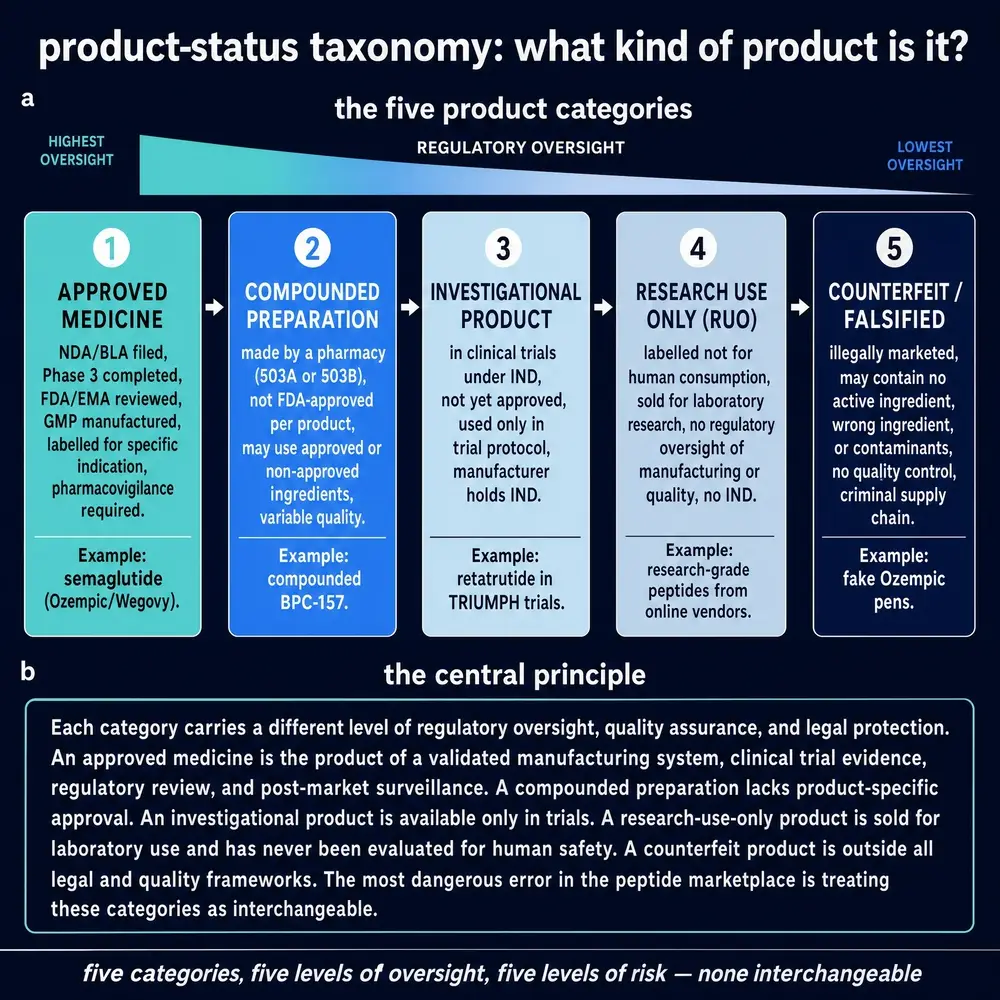
Primary jurisdiction for the structural account is the United States: the Food and Drug Administration (FDA), the Federal Food, Drug, and Cosmetic Act (FD&C Act), the Public Health Service Act for many biologics, and the Drug Quality and Security Act (DQSA) framework for compounding. Other regulators — the European Medicines Agency (EMA), the UK MHRA, Health Canada, Japan’s PMDA, Australia’s TGA, and the World Health Organization — appear as comparisons, always labelled by jurisdiction. Time-sensitive claims carry an effective or access date. Binding law is distinguished from guidance; proposed rules from final rules; official text from secondary commentary.
Section 02Nine distinctions that prevent expensive mistakes
Before the history and the pathways, nine distinctions have to be said plainly. They are the load-bearing walls of the rest of the document.
- Research use only (RUO) is a regulatory and commercial designation, not evidence of safety or efficacy in humans. In FDA’s IVD framework, RUO labelling marks a research-phase product and warns against diagnostic use; it is not a toxicology dossier in disguise.
- A compounded preparation is not automatically equivalent to an approved product that shares an active-ingredient name.
- Analytical purity alone does not establish suitability for human administration. An HPLC peak is not a finished-drug release package.
- Knowledge of a peptide sequence does not establish final-product quality — folding, impurities, aggregates, sterility, endotoxin, container closure and process history all remain open questions.
- Approval applies to a specific product, manufacturer, process, formulation, route, indication, labelling and quality system — not to a free-floating sequence.
- Legal availability and scientific effectiveness are different questions.
- Legal restriction and biological danger are also different questions. A product may be unlawful without being uniquely toxic, or lawful without being wise for a given patient.
- A certificate of analysis does not substitute for regulatory manufacturing oversight.
- Products bearing similar labels may not be pharmaceutically or clinically interchangeable.
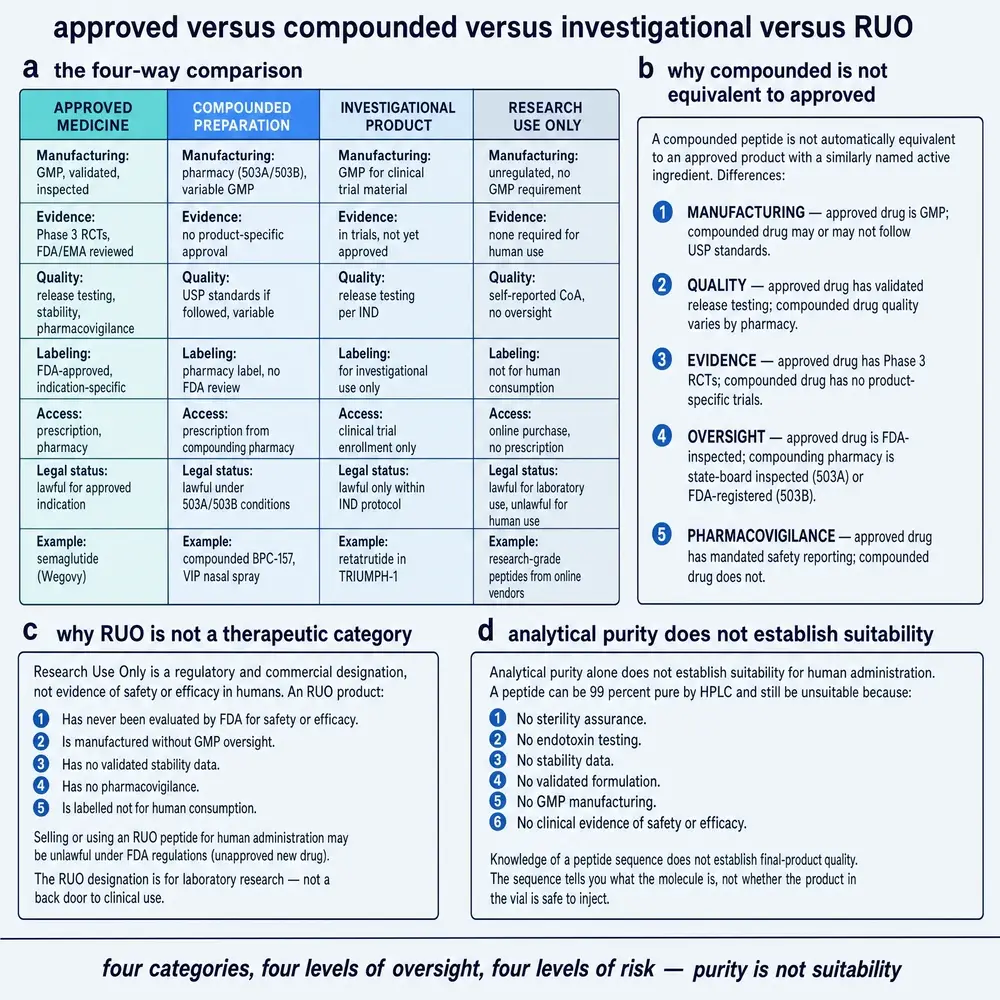
Keep those nine lines in view. Every later section is an expansion of one of them. The empirical literature in the local corpus — especially on counterfeit semaglutide reporting, falsified performance-enhancing drugs, and social discourse around shortages — shows what happens when the distinctions collapse in public.3, 12, 25
Section 03What this monograph will and will not do
It will walk a peptide product from discovery through intellectual property, preclinical work, clinical authorisation, manufacturing oversight, approval, prescribing, compounding, distribution, reimbursement, online commerce, pharmacovigilance and enforcement. It will weigh recent evidence more heavily when older evidence does not contradict it. It will treat in-vitro, animal and human information as different grades of claim. It will tell the discovery history of the regulatory system itself, because the passport system is as much an invention as any peptide.
It will not rank “peptides” as a class for safety. It will not convert shortage politics into dosing advice. It will not treat spontaneous adverse-event databases as incidence rates. And it will not pretend that the open-access scientific corpus alone contains a complete comparative-law treatise; where the gated literature is thin — especially on RUO commerce and 503A/503B practice as primary subjects — the text says so and leans on dated official frameworks instead.
Section 04Before peptides had passports
Modern drug regulation is young compared with medicine, and even younger compared with the body’s own peptide signalling. Insulin entered clinical use in the early 1920s as a physiological rescue long before the contemporary approval machine existed. Secretin had already taught physiologists that a chemical message could travel in blood. The twentieth century then built, in stages, a legal machine that could ask whether a manufactured message was identity-true, safe enough, effective for a labelled use, and made under conditions that could be inspected. Peptides inherited that machine; they did not invent it.
In the United States the first national food-and-drug statute of 1906 targeted adulteration and misbranding more than premarket proof. The 1938 Federal Food, Drug, and Cosmetic Act, spurred by the sulfanilamide elixir disaster, required safety evidence before marketing. The 1962 Kefauver–Harris Amendments, after thalidomide, added substantial evidence of effectiveness and tightened manufacturing and advertising controls. Biologics had a partly separate ancestry under the Public Health Service Act, which still matters for many protein and some peptide products routed through biologics licensing.
Those statutes created the modern idea that a medicine is not merely a substance but a reviewed product. That idea is the ancestor of every later distinction in this monograph.
Section 05Generics, biologics, and the two clocks
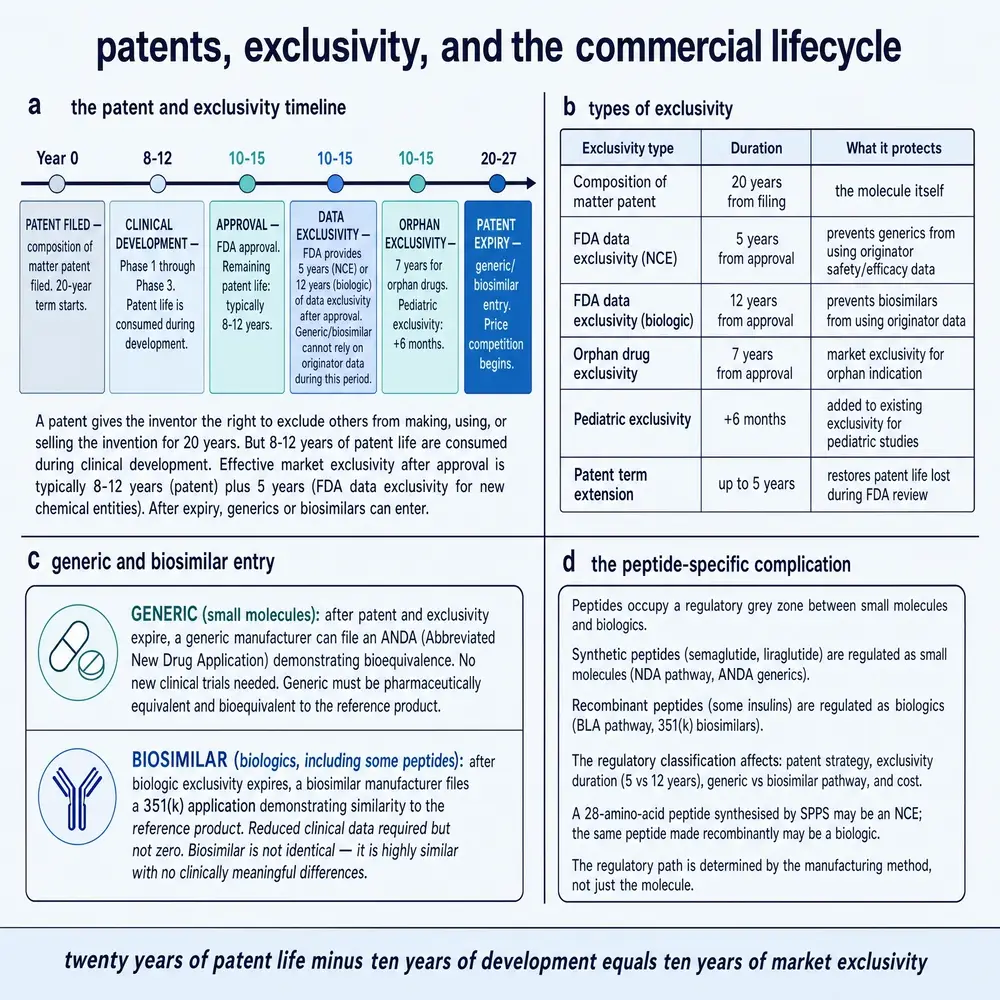
The Hatch–Waxman Act of 1984 built the abbreviated pathway for small-molecule generics and a system of patent listings and exclusivities that still structures how competition arrives after an innovator’s head start. Biologics later received their own abbreviated pathway under the Biologics Price Competition and Innovation Act (BPCIA, 2010), with biosimilarity and, in the United States, a distinct interchangeability designation that Europe does not copy in the same form.6, 10
For peptides the classification question — drug versus biologic, 505(b)(2) versus stand-alone NDA, biosimilar versus new active substance — is not academic. It chooses which clock runs: patent term, data exclusivity, orphan exclusivity, pediatric extension. Those clocks change access and price. They do not change whether a grey-market vial is what it claims to be.
Section 06Compounding’s modern statute, written in tragedy
Pharmacy compounding is older than the FDA. What is modern is the federal attempt to draw a bright line between traditional patient-specific compounding and industrial-scale production that looks like manufacturing without approval. In 2012, contaminated methylprednisolone from the New England Compounding Center caused a fungal meningitis outbreak that killed and injured on a national scale. Congress answered in 2013 with the Drug Quality and Security Act, clarifying section 503A traditional compounding and creating section 503B outsourcing facilities that may compound without patient-specific prescriptions under a different set of conditions, including registration and stronger quality expectations.
That history became a live peptide story when GLP-1 receptor agonists entered FDA’s drug shortage list amid explosive demand. Shortage status temporarily changed what compounders could lawfully attempt. When supply began to stabilize, FDA published policy clarifications for compounders and later shortage-resolution memoranda — including a December 2024 reevaluation concluding that the tirzepatide injection shortage was resolved.18, 20 Agency communications also warn that adverse events linked to compounded versions are likely underreported because many state-licensed 503A pharmacies are not required to submit adverse-event reports to FDA in the same way outsourcing facilities and manufacturers are.19
Clinical and policy literature now treats compounded GLP-1 products as an access phenomenon with categorical limits: surveys of direct-to-consumer compounded markets, obesity-medicine association FAQs, and access reviews all stress that a compounded preparation is not automatically an approved product with a similar active-ingredient name.2, 4, 5, 13
Section 07Why peptides stress the passport system
Peptides stress the system for reasons the companion monographs in this series have already mapped: they are potent, often parenteral, often cold-chain dependent, often hard to orally deliver, and highly attractive for metabolic and performance markets. When an approved peptide becomes famous, demand outruns supply, insurance coverage lags indication, and online speech fills with workarounds.1, 5, 12 The regulatory machine answers with shortage lists, compounding boundaries, importation rules, warning letters and pharmacovigilance. The illicit machine answers with look-alike pens, wrong APIs and certificates that certify the wrong question.3, 14, 25
The next parts follow the lawful path first, then the marketplace after the stamp, then the surveillance and enforcement loop that tries — imperfectly — to keep the passports honest.
Section 08Discovery is not a product
A therapeutic peptide usually begins as a physiological insight, a natural ligand, a phage-display hit, or a designed analogue. That beginning creates intellectual property: composition claims, method claims, formulation claims, device claims, manufacturing know-how. Licensing and technology transfer move those rights between universities, biotechs and larger manufacturers. None of that activity, by itself, authorises a pharmacy shelf.
Patents and regulatory exclusivities are two clocks. A patent is a private right to exclude; exclusivity is a regulatory bar that can block competitors even when patents are weak or expired. Hatch–Waxman and the BPCIA organise those clocks differently for drugs and biologics. Orphan designation, pediatric exclusivity and patent-term restoration can extend the commercial head start. Loss of exclusivity can invite biosimilars or generics and can also intensify secondary-market pressure when brand supply or price remains difficult.6, 10
Section 09Investigational status
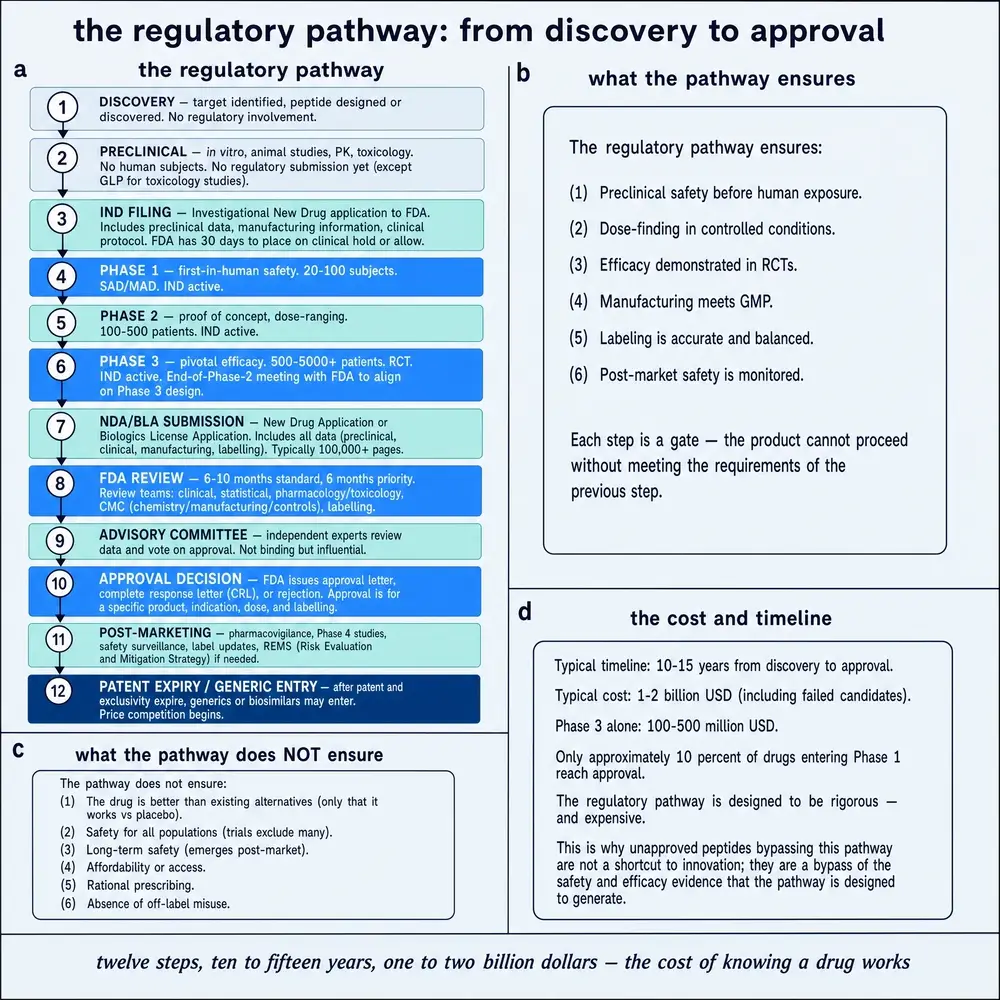
Before marketing approval, a peptide intended for clinical investigation in the United States generally needs an Investigational New Drug (IND) application (or an analogous clinical trial authorisation elsewhere). The IND is not a mini approval of efficacy. It is permission to study, conditioned on manufacturing controls, nonclinical support, a protocol, and human-subject protections (IRB/ethics review, informed consent, GCP). Trial material is a controlled product with its own CMC story. It is not a consumer good, and it is not the same object as an approved pen sold years later under a brand name.
Clinical development then accumulates evidence in phases. Companion monograph GPM 10 treats evidence standards in depth; here the regulatory point is simpler: marketing approval asks whether a defined product, made a defined way, has a favourable benefit–risk profile for a labelled use in a studied population. It does not ask whether a sequence is interesting on a forum.
Section 10Manufacturing regulation and quality systems
Chemistry, manufacturing and controls (CMC) are where sequence romanticism goes to die. Solid-phase or recombinant manufacture, purification, formulation, aseptic fill–finish, device assembly, stability, and release testing sit under current good manufacturing practice (cGMP). Critical quality attributes — identity, purity, potency, sterility, endotoxin, particulates, aggregation — are controlled by a system, not by a single PDF.6
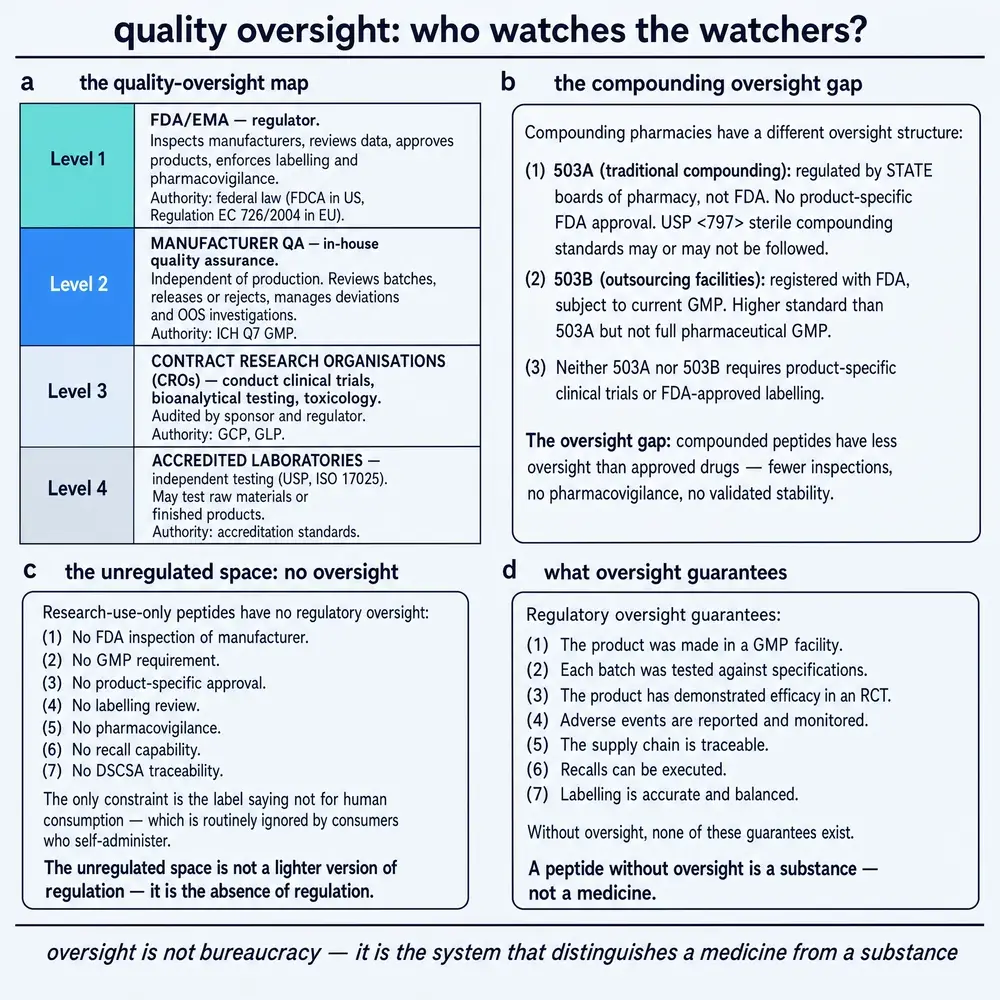
A certificate of analysis can be true as far as it goes and still answer the wrong question. It may report an HPLC purity for a research lot without establishing validated sterile manufacture for injection. Companion monograph GPM 09 treats manufacturing verification in detail; this monograph only needs the governance moral: oversight attaches to systems and products, not to sequence names.
Section 11Marketing approval and labeling
In the United States, most peptide drugs reach the market through an NDA (including 505(b)(2) where appropriate) or a biologics license application (BLA). Europe uses marketing authorisation applications, often through the EMA’s centralised procedure for innovative biologics and certain other classes. Accelerated approval, conditional authorisation, breakthrough therapy, priority review and orphan pathways change timelines; they do not erase the product specificity of the eventual stamp.
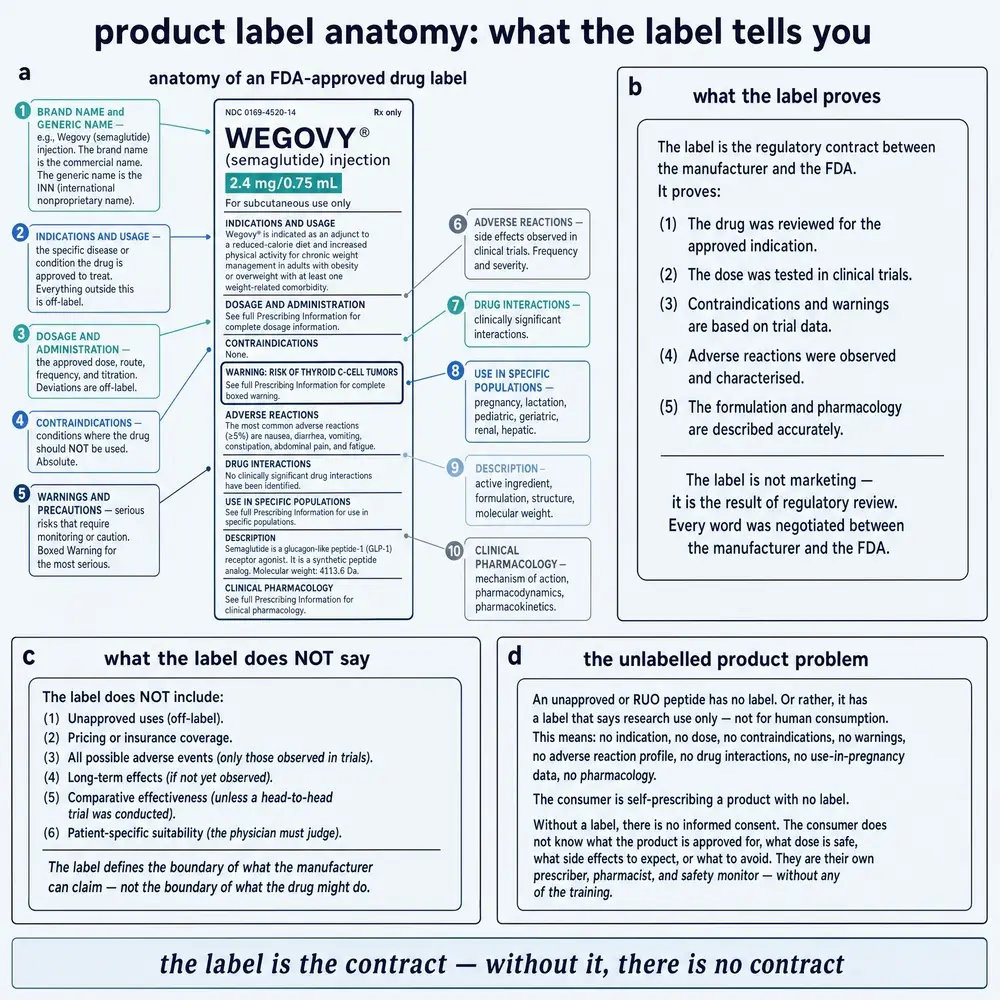
The label — Prescribing Information in the US, SmPC in the EU — is the public face of what was reviewed: indication, contraindications, warnings, use instructions as studied, storage, identifiers. Off-label prescribing by licensed clinicians is a separate legal and professional question from marketing an unapproved use. Combination products (peptide plus pen, autoinjector, pump, or other device constituent) add device regulation to the same passport. Approval of the combination is not approval of a loose vial that merely shares the active moiety’s name.
Section 12Postmarket commitments begin at approval
Approval is not the end of regulation. Risk Evaluation and Mitigation Strategies (REMS), pharmacovigilance plans, postmarketing requirements and commitments, periodic safety updates and lot-level traceability continue after launch. Biologics and advanced therapies often carry additional monitoring flags in European systems.6 The next part asks what happens when the approved product meets payers, shortages and the open internet.
Section 13Roles: who is accountable for what
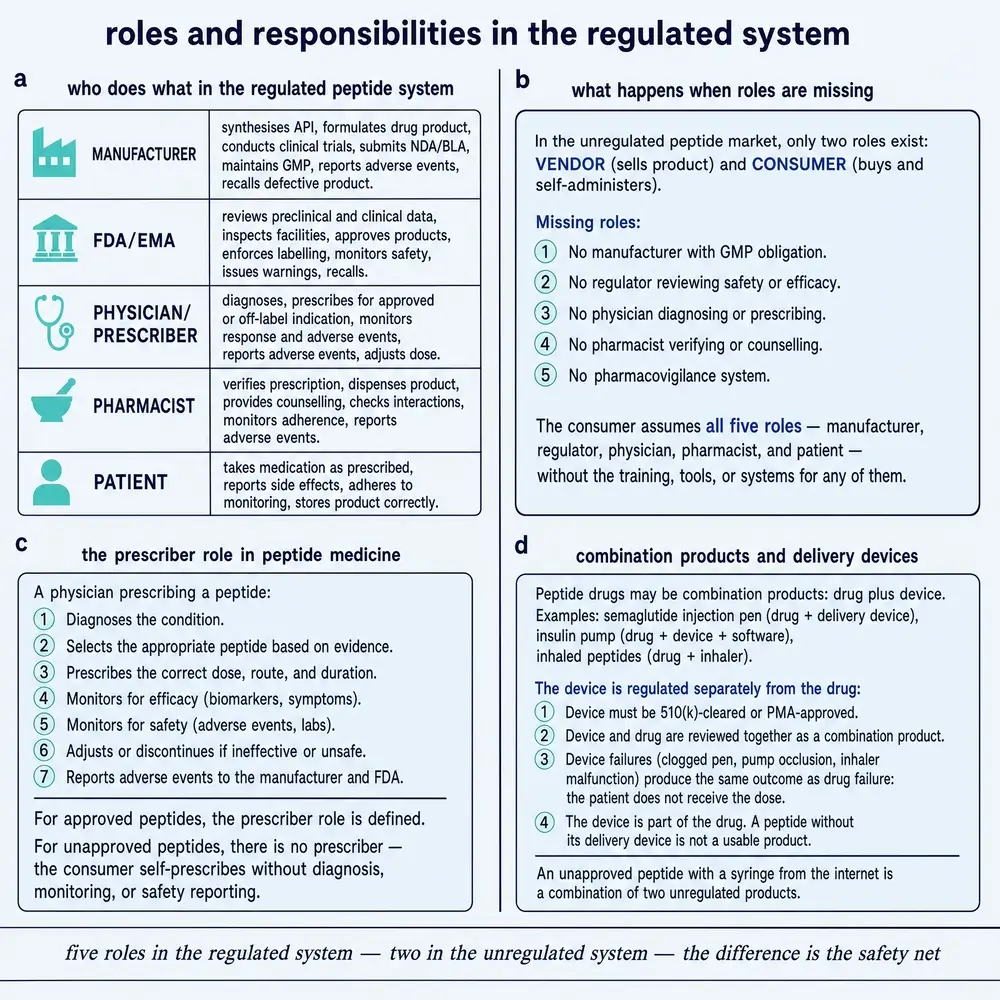
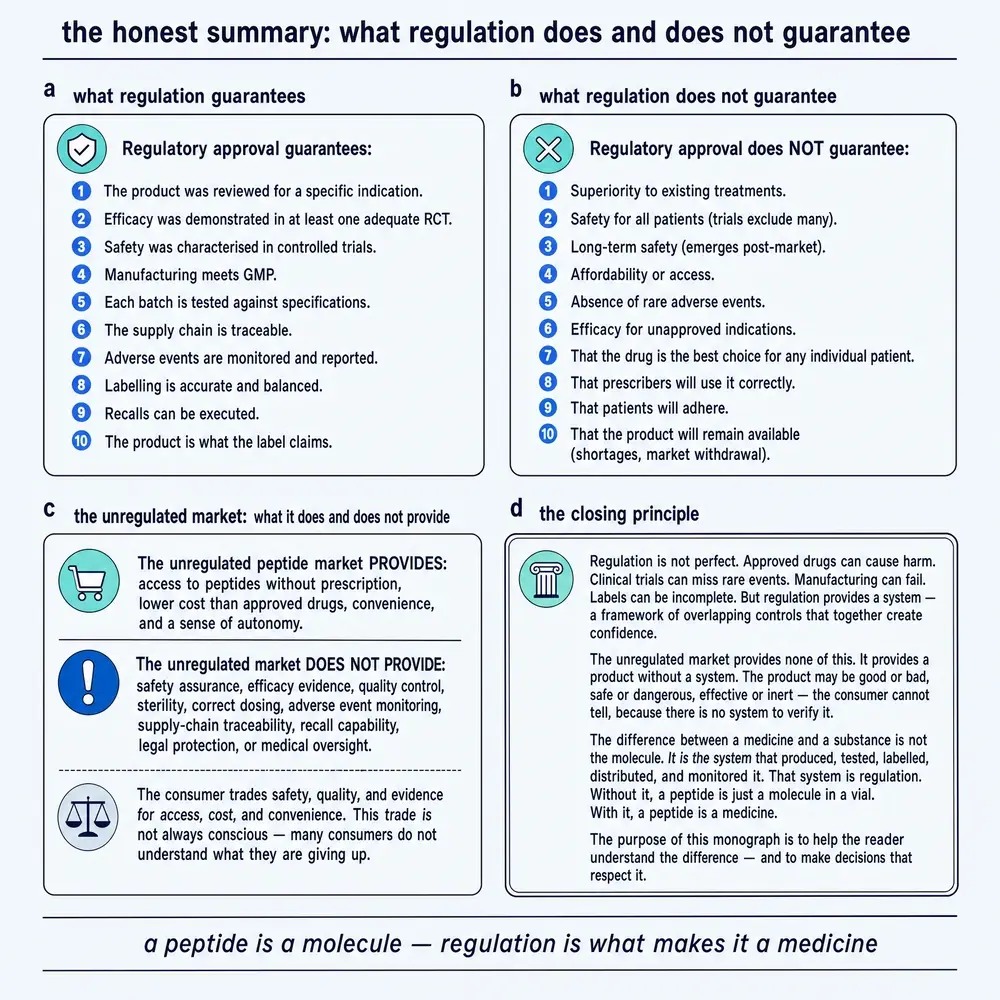
An approved peptide medicine is a relay. The manufacturer owns the CMC and the labelled claims. Distributors and wholesalers move sealed product under licensure and, in the United States, under the Drug Supply Chain Security Act (DSCSA) traceability framework. Pharmacies dispense; prescribers decide whether a labelled or professionally judged use is appropriate for a patient. Each role has a different duty. Collapsing them — treating an online vendor as if it were a manufacturer’s quality unit — is how accountability evaporates.
Section 14Reimbursement is a second gate
Marketing approval makes a product legal to sell for its labelled use. It does not compel any insurer to pay. Formularies, prior authorisation, step edits, health-technology assessment abroad, and list-price politics decide lived access. Biosimilar and generic entry can lower prices where pathways and procurement exist; they do not automatically appear the day a patent expires.6, 10
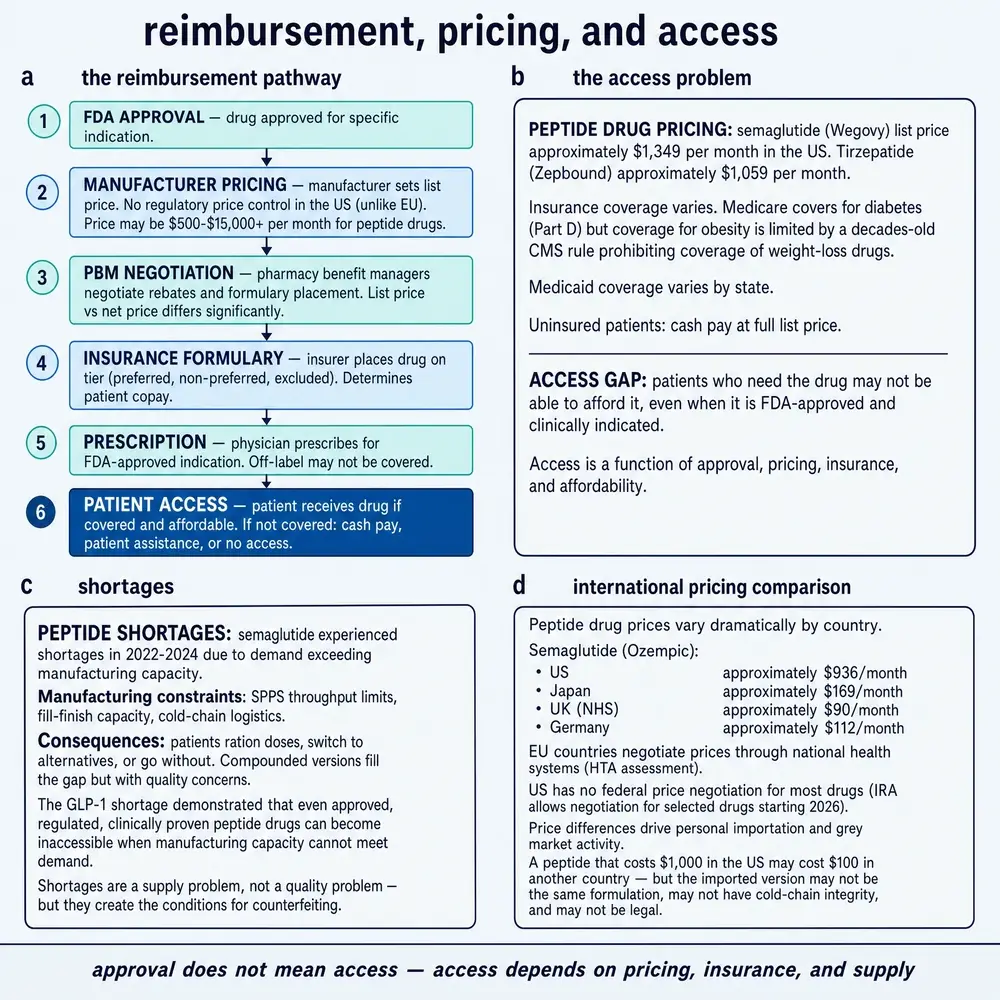
When coverage lags demand, public speech fills with workarounds. An analysis of semaglutide discourse on X (2021–2024) found persistent themes of insurance, coupons, supply and regulatory controversy, with sentiment declining during shortage and safety-news windows.12 Access reviews of compounded GLP-1 agonists likewise read compounding as a response to coverage and supply friction — not as proof of therapeutic equivalence.5, 13 That is sociology of access, not a finding that any workaround is lawful or pharmaceutically equivalent.
Section 15Shortages change legal weather
Drug shortage listings are administrative facts with legal consequences. In the United States, shortage status has interacted with compounding permissions for 503A pharmacies and 503B outsourcing facilities. Tirzepatide injection products were added to FDA’s shortage list in December 2022; FDA later removed them and, in a December 2024 memorandum, reaffirmed after reevaluation that the shortage was resolved.18 Parallel policy pages clarify wind-down expectations for compounders as national GLP-1 supply stabilizes.20 Social and clinical commentary tracked that arc in real time.12 The governance lesson is sharper than any single molecule: shortage is not a permanent alternative approval pathway.
Section 16Compounded preparations
Compounding can be legitimate, carefully done, and still categorically different from an approved product. Under US federal law, 503A traditional compounding is tied to patient-specific prescriptions and state pharmacy regulation, with federal conditions. 503B outsourcing facilities may compound without patient-specific prescriptions if they meet 503B’s conditions, including registration and stricter quality expectations, but they are not thereby excused into silent NDA territory. Bulk-substance restrictions, “essentially a copy” limits, and shortage-linked permissions are technical and time-sensitive.
Field evidence now exists beyond statute. A Colorado study of direct-to-consumer compounded GLP-1 offerings mapped a retail marketplace that grew inside shortage politics.4 Obesity Medicine Association FAQs and later access reviews warn clinicians and patients against treating compounded copies as interchangeable with approved pens.2, 5 Global commentary describes a wider rise in compounded weight-loss medicines as a public-health worry precisely because quality systems and adverse-event visibility are uneven.13 FDA’s own communications underscore underreporting risk for compounded-product adverse events.19
Separately, FDA’s 2026 proposal not to place semaglutide, tirzepatide and liraglutide on the 503B Bulks List — still a proposal as of the access date of this rewrite — shows how the agency is trying to close a bulk-API pathway even after shortage weather changes.15, 16, 17
Section 17Research-use-only materials and laboratory standards
RUO labelling, in FDA’s in-vitro diagnostic guidance, is a warning structure for research-phase products: “For Research Use Only. Not for use in diagnostic procedures.” The guidance is explicit that merely placing an RUO label on a product does not create an exemption if other evidence shows clinical intended use.22 The designation is about intended use and distribution, not about proving human safety. Peptide “research chemicals” sold online often borrow the cultural force of that phrase while sitting far outside a reviewed IVD or drug framework. A laboratory reference standard used to calibrate an assay is another object again: valuable for analytics, silent on clinical use.
Section 18Online commerce and falsified products
The internet sells narratives as efficiently as it sells vials. Approved medicines, compounded preparations, RUO chemicals and falsified look-alikes can appear in adjacent search results with similar stock photography. WHO and national regulators have repeatedly warned that a large fraction of medicines purchased from non-established online pharmacies may be substandard or falsified; forensic work on illicit performance-enhancing and post-cycle markets shows undeclared APIs, missing APIs and theatrical “anti-counterfeit” stickers.3, 25
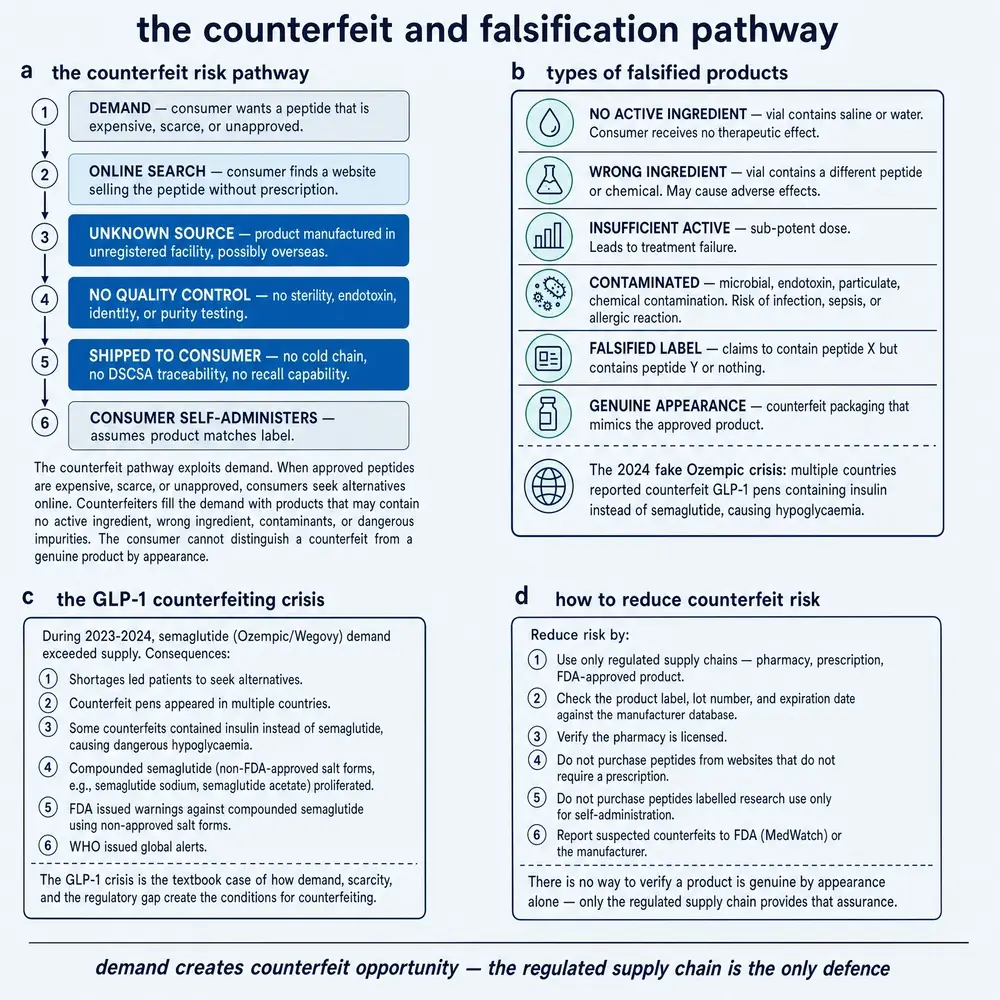
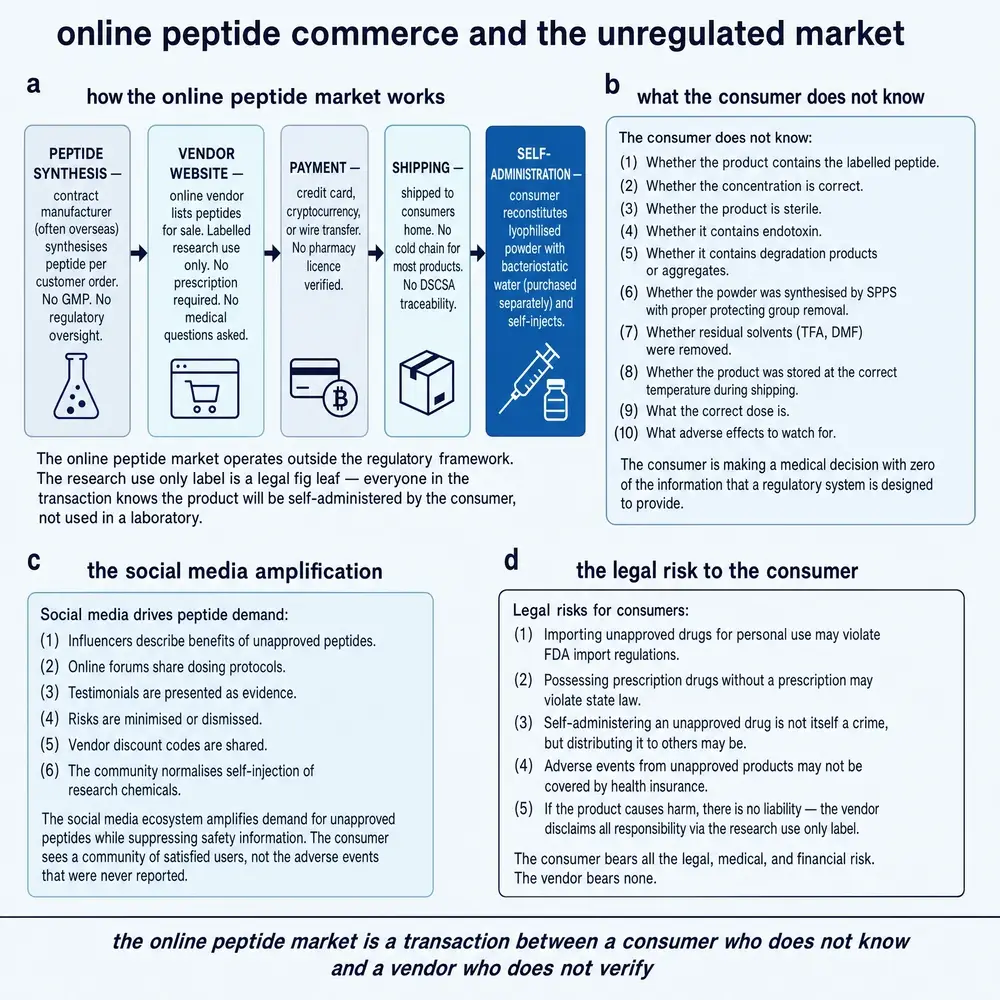
A 2026 EudraVigilance analysis identified hundreds of semaglutide individual case safety reports coded with counterfeit/tampering terms across 2018–2025 (0.49% of semaglutide ICSRs in that extract), with a higher share of serious outcomes than non-counterfeit-coded reports and disproportional reporting of hypoglycaemia and drug ineffectiveness — signals that the authors treat as suspicion-coded pharmacovigilance, not laboratory proof of every case.25 Case-level clinical reports of metabolic crises after counterfeit semaglutide exposure reinforce the same pathway from grey supply to harm, without converting anecdote into incidence.14
Enforcement examples are concrete. A September 2025 FDA warning letter to “GLP-1 Solution” addresses website offers of compounded and related peptide products and the drug-claim consequences under the FD&C Act — a case-specific illustration of how online marketing meets the statute, not a general verdict on every compounder.21
Section 19Importation and supply-chain integrity
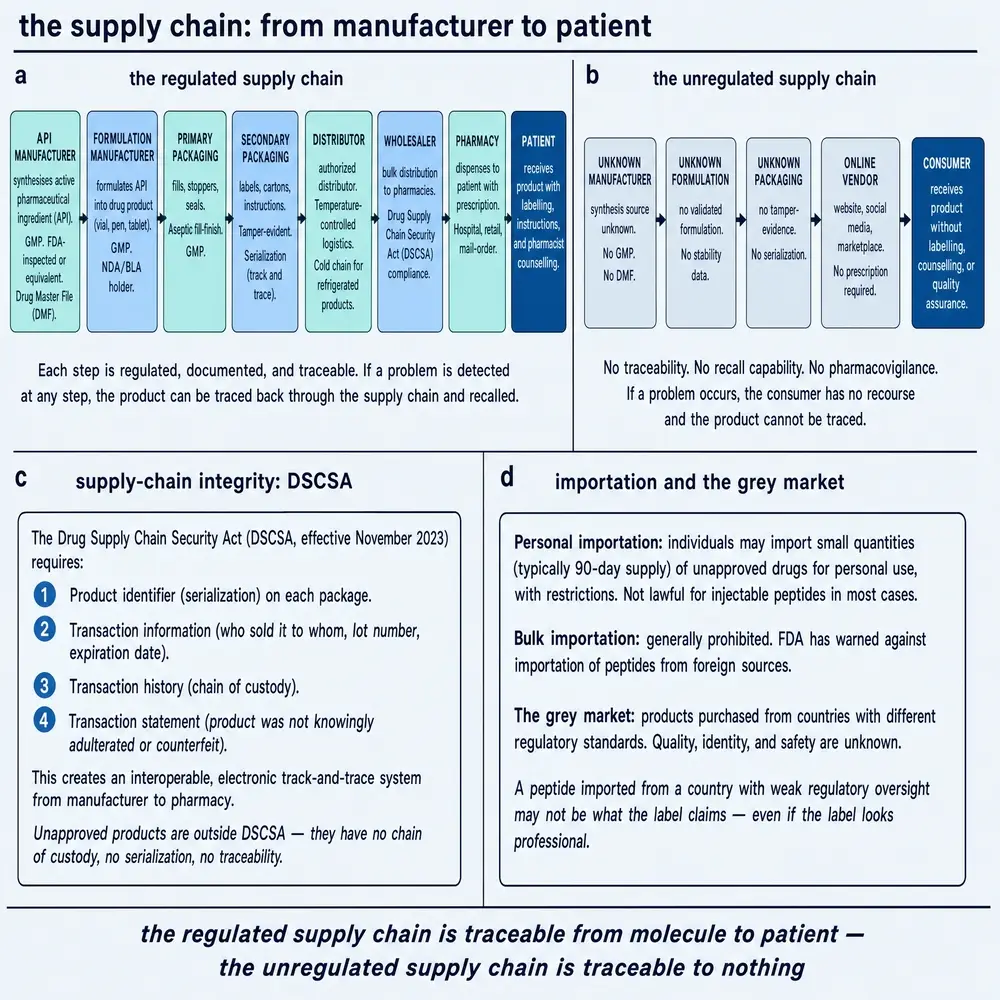
Personal importation, parallel trade, diverted cold-chain product and fraudulent customs declarations each create different risk profiles. DSCSA serialization aims to make legitimate US prescription-drug packages traceable. Falsifiers attack the weakest verification habit: trusting a logo, a pen shape, or a QR code that resolves to a theatre website.3 Prescribers and pharmacists remain the lawful professional interface for approved medicines; manufacturers remain accountable for the products they release. Online vendors who will not name a quality system are not a fourth estate of pharmacy.
Section 20Pharmacovigilance is a loop, not a verdict
After a peptide medicine is marketed, the evidence base becomes messier and more important. Spontaneous reporting systems — FAERS in the United States, EudraVigilance in the EU, VigiBase globally — collect adverse-event reports from health professionals, patients and manufacturers. Disproportionality metrics (ROR, PRR and kin) can flag reporting patterns. They do not, alone, measure incidence, prove causation, or distinguish a true liability from stimulated reporting, confounding by indication, or product quality failure.7, 8, 11
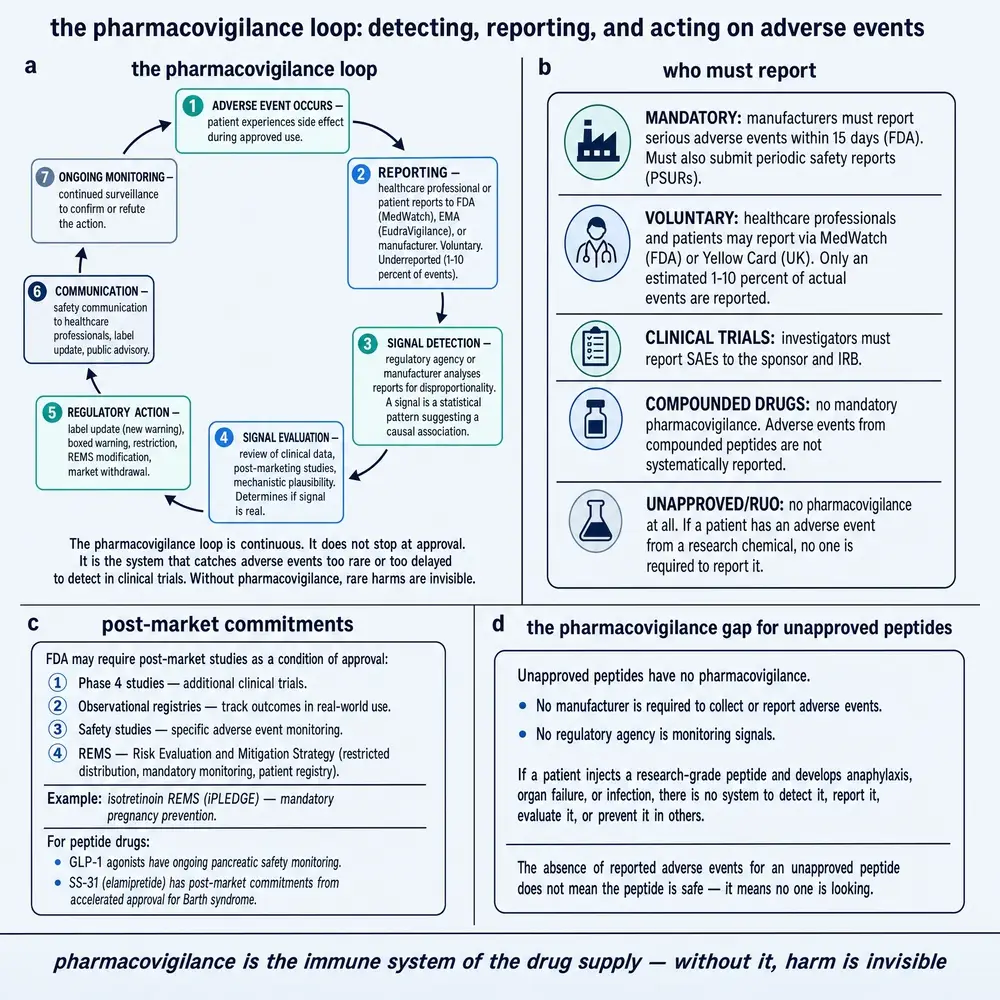
The local corpus is rich in this genre for GLP-1 receptor agonists and other peptide hormones: metabolic and nutritional adverse-event patterns, pulmonary signal reviews, neurological and dermatologic case series, and molecule-specific FAERS analyses for agents such as triptorelin, teduglutide and insulin glargine.1, 7, 8, 23, 24 Read together, they support a governance conclusion more than a league table of harms: postmarket learning is real, product-specific, and easily misread when databases are treated as epidemiology.
Counterfeit-coded reports sit inside the same loop. They may capture true falsified exposure, suspected diversion, or coding artefacts. Laboratory confirmation is the exception.25 Policy responses still matter: regulators issue alerts, manufacturers harden packaging, and clinicians are asked to document lot numbers when product quality is in doubt.6 FDA’s public pages on unapproved GLP-1 drugs used for weight loss add a further asymmetry: compounded-product adverse events may be systematically under-captured relative to approved-product reports.19
Section 21Adverse-event reporting duties
Manufacturers of approved products carry mandatory reporting duties. Clinicians and patients often report voluntarily (for example through MedWatch). Serious unexpected reactions in trials follow expedited rules. The vocabulary — adverse event, adverse drug reaction, SUSAR, MedDRA preferred terms — is how the loop stays machine-readable. None of it converts a forum anecdote into a labelled warning by itself; label updates and REMS changes are deliberate regulatory acts after evaluation.
Section 22Enforcement without romance
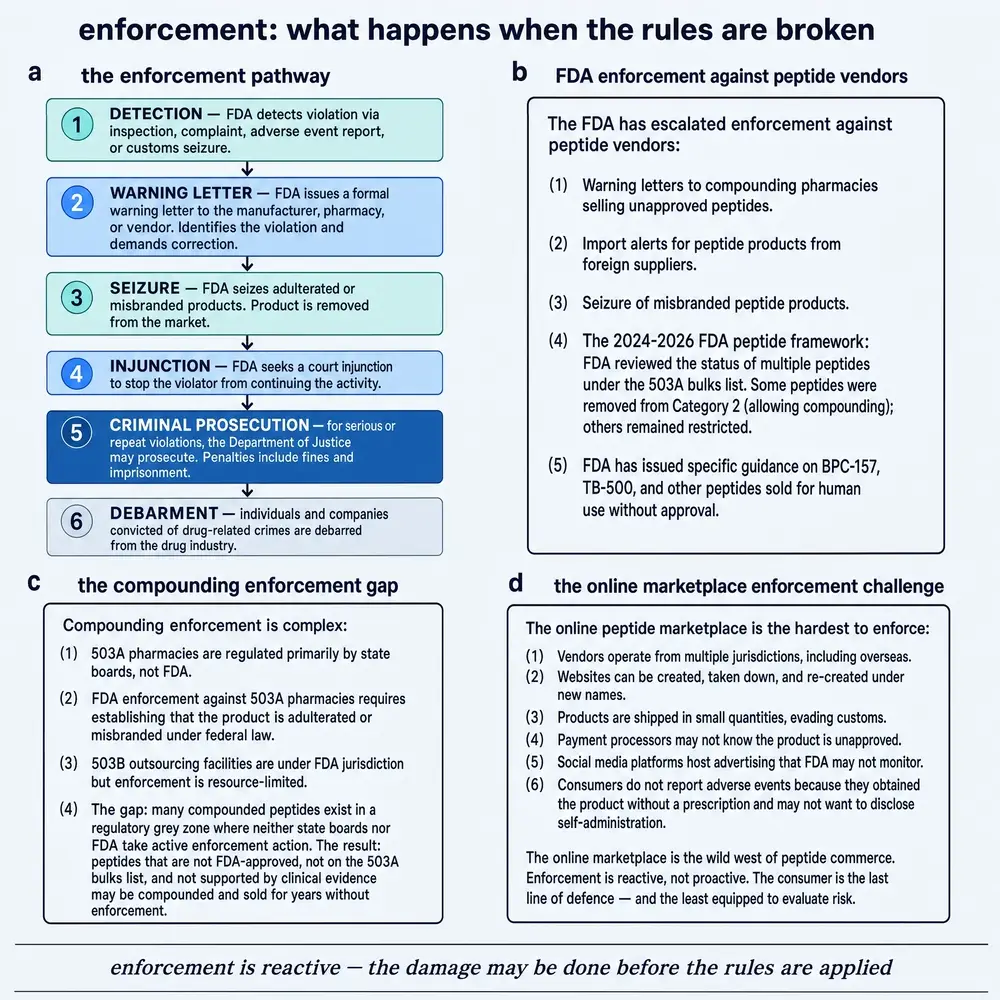
When products are adulterated, misbranded, unapproved as new drugs, or sold with false RUO theatre, FDA and sister agencies can inspect, list observations, issue warning letters, detain imports, seize goods, seek injunctions, and in some cases pursue criminal prosecution. State boards discipline pharmacies and prescribers. Customs services intercept parcels. The ladder is real; it is also resource-constrained.
Recent peptide-adjacent enforcement is visible in the public record. FDA has stated an intention to act against non-FDA-approved GLP-1 drugs and against promotional claims that cast compounded products as generics or as clinically proven equivalents of approved medicines.19 Case letters such as the September 2025 warning to GLP-1 Solution show how website claims for compounded and related peptide offerings are evaluated under drug definitions and intended-use doctrine.21 Enforcement is not a guarantee that every unlawful vial is caught, which is why passport literacy for readers still matters.
Section 23International differences without false equivalence
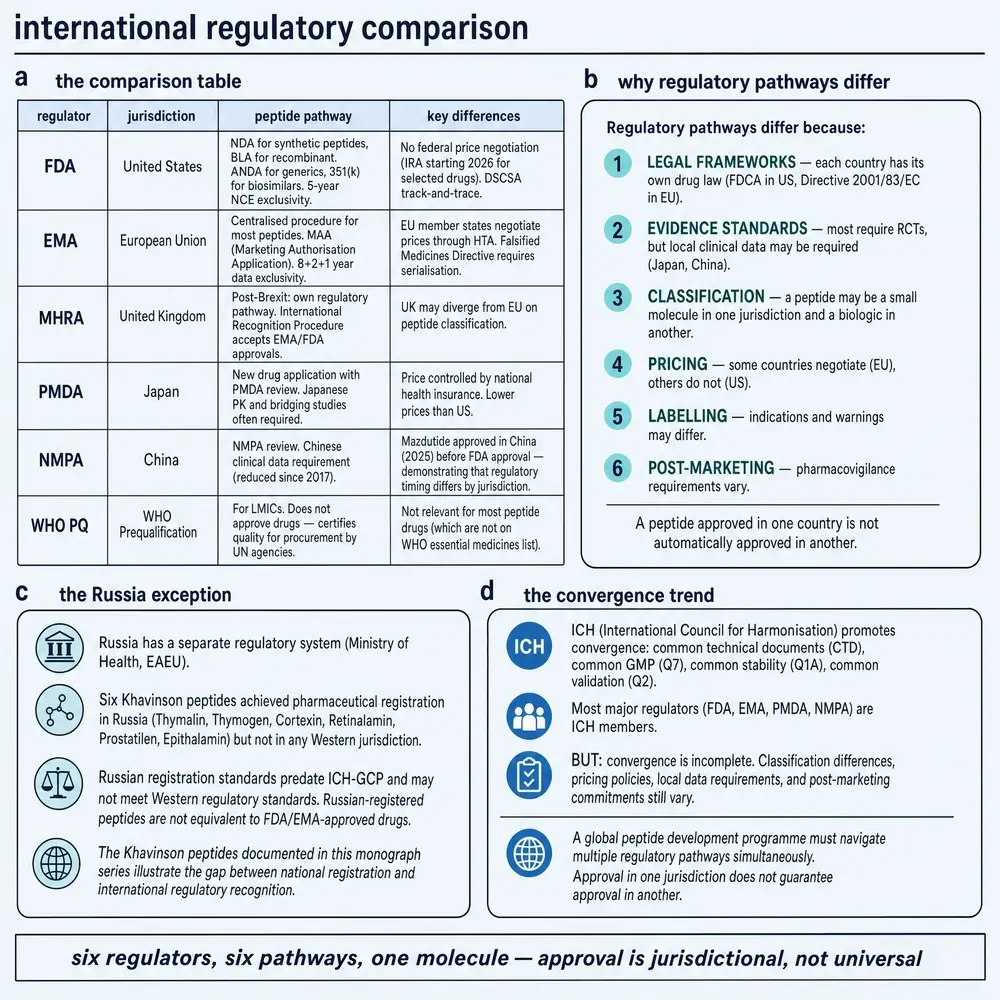
EMA centralised authorisation, UK MHRA decisions after Brexit, Health Canada notices, PMDA review in Japan, TGA in Australia, and WHO prequalification or medical-product alerts are not interchangeable stamps. Biosimilar policy diverges: the US interchangeability designation has no simple EMA twin.6 Compounding law is highly jurisdiction-specific. Online pharmacy regulation ranges from tightly supervised distance selling to near-lawlessness. A peptide lawful in one country as a prescription medicine may be unapproved in another; an unapproved status is not, by itself, a physicochemical description.
Section 24What a careful reader should ask
Faced with any peptide product in conversation, clinic or commerce, the passport questions are ordinary and powerful:
- What is the legal status — approved product, investigational, compounded, RUO/research chemical, laboratory standard, or unknown?
- Who is the manufacturer, and can the lot be traced?
- What process and quality system stand behind the vial, beyond a purity percentage?
- What claims are being made, and who is accountable for them?
- Is access pressure (price, shortage, coverage) being mistaken for evidence?
- If harm is suspected, was the product’s identity verified, or only its story?
Those questions do not require a law degree. They require resisting the oldest marketplace spell: the belief that a familiar sequence name is already a medicine.
Section 25Glossary
503A / 503B. US FD&C Act compounding pathways: traditional patient-specific compounding (503A) and outsourcing facilities (503B).
BLA. Biologics License Application (US).
cGMP. Current good manufacturing practice.
CoA. Certificate of analysis — analytical snapshot, not a full quality system.
DSCSA. Drug Supply Chain Security Act (US traceability framework).
Exclusivity. Regulatory market protection distinct from patent rights.
FAERS / EudraVigilance / VigiBase. Spontaneous adverse-event reporting systems (US / EU / global).
IND / CTA. Investigational New Drug (US) / clinical trial authorisation (common non-US term).
Interchangeability. US biosimilar designation allowing pharmacy substitution under state law; not identical to EMA biosimilarity.
NDA. New Drug Application (US).
Pharmacovigilance. Postmarket surveillance for safety and product-quality problems.
RUO. Research use only — a designation/labelling posture, not proof of human safety or efficacy.
Shortage list. Regulator-maintained list whose status can change compounding and access conditions.
Section 26Jurisdiction table (selected)
| Jurisdiction | Regulator | Primary passport | Notes |
|---|---|---|---|
| United States | FDA | NDA / BLA; IND; 503A/B | Primary framing of this monograph |
| European Union | EMA + NCAs | MAA / centralised | EudraVigilance PV |
| United Kingdom | MHRA | UK MA | Post-Brexit autonomy |
| Canada | Health Canada | NDS / DIN | National review |
| Japan | PMDA / MHLW | JNDA | Local bridging common |
| Australia | TGA | ARTG entry | National scheduling |
| Global | WHO | Prequalification / alerts | Not a national MA |
Section 27Product-status decision tree (text)
- Is there a marketing authorisation / NDA / BLA for this finished product from this manufacturer? → Approved medicine pathway (still check lot, labelling, storage).
- Else, is it authorised investigational material under IND/CTA for a protocol? → Investigational.
- Else, is it a pharmacy compound under a lawful 503A/503B (or local) exemption with a prescription/facility basis? → Compounded preparation (not an approved copy).
- Else, is it explicitly labelled and distributed as RUO / laboratory reagent / reference standard without clinical claims? → Research/lab material (not a safety certificate).
- Else → treat as unknown / high risk of unapproved or falsified marketing until proven otherwise.
Section 28Dated regulatory source map (abridged)
| Instrument | Jurisdiction | Character | Date note |
|---|---|---|---|
| FD&C Act (incl. 503A/503B) | US | Binding statute | As amended; DQSA 2013 |
| PHS Act biologics provisions | US | Binding statute | BLA pathway |
| 21 CFR 809.10 RUO/IUO labelling | US | Binding regulation | IVD labelling |
| FDA RUO/IUO IVD guidance (2013) | US | Guidance (not binding) | Access 5 Aug 2026 |
| Tirzepatide shortage resolution memo | US FDA | Administrative determination | 19 Dec 2024 memo; first listed 15 Dec 2022 |
| FDA GLP-1 compounder policy clarification | US FDA | Agency communication | Access 5 Aug 2026 |
| FR 2026-08552 503B Bulks List proposal | US | Proposed determination | 1 May 2026; not final |
| FR 2026-12937 comment-period extension | US | Notice | 26 Jun 2026; Docket FDA-2018-N-3240 |
| Directive 2010/84/EU (PV) | EU | Binding EU law | Additional monitoring context |
Fuller tables live in notes/DATED_REGULATORY_SOURCE_MAP.md and notes/LEGAL_REGULATORY_APPENDIX.md.
Section 29Supply-chain risk appendix (summary)
Highest-risk junctions for peptide products: (1) online non-pharmacy sellers; (2) shortage-driven grey channels; (3) diverted or poorly stored cold-chain packs; (4) look-alike pens and forged authentication sites; (5) CoA-only research chemicals marketed with clinical innuendo. Local forensic and PV anchors: PMC11962791; PMC13168152; PMC12950111; PMC11703442. Details: notes/SUPPLY_CHAIN_RISK_APPENDIX.md.
Section 30Unresolved jurisdiction register
- Final FDA rule status on 503B bulk exclusions for named GLP-1 agonists (proposed in 2026; watch Federal Register).
- State-by-state US pharmacy and telehealth variations — not mapped here.
- Cross-border personal importation case law — fact-specific.
- True incidence of falsified peptide exposures — unknown; PV codes are not denominators.25
- Dedicated OA full texts on RUO peptide commerce remain sparse relative to FAERS studies (corpus limitation).
See notes/UNRESOLVED_JURISDICTION_REGISTER.md.
Section 31Limitations and adversarial notes
Corpus skew. Read-in-full articles skew toward GLP-1 pharmacovigilance. Structural law is therefore carried by dated official frameworks plus a smaller set of marketplace/forensic papers. That is a feature of the OA library, not a claim that PV is the whole of regulation.
Spontaneous reporting limits. ROR elevations are hypothesis-generating.7, 11
Counterfeit coding. “Counterfeit” in EV/FAERS often means reporter suspicion.25
Not legal advice. Operational compliance requires current official text and qualified counsel.
No human-use recommendations. Access and shortage history are descriptive.
Section 32References
Entries are numbered and sorted by first-author surname. Every bibliographic entry was resolved from the source record’s own metadata — never from recall. In-text citations are the superscript numbers throughout the document. Official statutes and guidance cited narratively above are jurisdiction-dated in the source map and are not duplicated as PMC records.
- Ahuja A, Prasad S, Manoharan S, Sen A, Rana R, Mody M, et al.. Pulmonary adverse events associated with GLP-1 receptor agonists: a systematic review of respiratory safety signals. Cardiovascular diabetology. Endocrinology reports. 2026;12:43.
PMID 42316363 · doi:10.1186/s40842-026-00311-6 · PMC13281493 - Bays HE, Fitch A, Francavilla Brown C, Younglove C, Christensen SM, Alexander LC. Frequently asked questions to the 2023 obesity medicine association position statement on compounded peptides: A call for action. . 2024:100122.
PMID 39228749 · doi:10.1016/j.obpill.2024.100122 · PMC11369382 - Blazewicz A, Poplawska M, Daniszewska B, Piorunska K, Karynski M. Illegal and falsified medicines self-administrated in not approved post-cycle therapy after the cessation of anabolic-androgenic steroids – qualitative analysis. Frontiers in Chemistry. 2025;13:1536858.
PMID 40177353 · doi:10.3389/fchem.2025.1536858 · PMC11962791 - DiStefano MJ, Dardouri M, Moore GD, Saseen JJ, Nair KV. Compounded glucagon-like peptide-1 receptor agonists for weight loss: the direct-to-consumer market in Colorado. Journal of Pharmaceutical Policy and Practice. 2024;18(1):2441220.
PMID 39776466 · doi:10.1080/20523211.2024.2441220 · PMC11703442 - Dudding J. Navigating Access: The Future of Compounded GLP-1 Receptor Agonists for Weight Loss. . 2025:252-254.
PMID 40787017 · PMC12331335 - Guarnieri L, Bosco F, Corasaniti MT, Citraro R, De Sarro G. Migraine, monoclonal antibodies, and monitoring: a review of pharmacovigilance in the era of biologics. Frontiers in Pharmacology. 2026;17:1822176.
PMID 42292852 · doi:10.3389/fphar.2026.1822176 · PMC13260513 - He L, Li Q, Yang Y, Li J, Luo W, Huang Y, et al.. Pharmacovigilance study of GLP-1 receptor agonists for metabolic and nutritional adverse events. Frontiers in Pharmacology. 2024;15:1416985.
PMID 39040467 · doi:10.3389/fphar.2024.1416985 · PMC11260617 - Jia W, Wang T. Triptorelin associated adverse events evaluated using FAERS pharmacovigilance data. Scientific Reports. 2025;15:32042.
PMID 40890214 · doi:10.1038/s41598-025-16734-7 · PMC12402341 - Kaplon H, Reichert JM. Antibodies to watch in 2021. mAbs. 2021;13(1):1860476.
PMID 33459118 · doi:10.1080/19420862.2020.1860476 · PMC7833761 - Kawalec P, Stawowczyk E, Tesar T, Skoupa J, Turcu-Stiolica A, Dimitrova M, et al.. Pricing and Reimbursement of Biosimilars in Central and Eastern European Countries. Frontiers in Pharmacology. 2017;8:288.
PMID 28642700 · doi:10.3389/fphar.2017.00288 · PMC5463127 - Li J, Liang J, Zhang W, He J, Ye X. Integrated Evidence from VigiBase and Clinical Trials: A Comprehensive Pharmacovigilance Analysis of Seven Glucagon-Like Peptide 1 Receptor Agonists (GLP-1 RAs). Diabetes Therapy. 2026;17(6):853.
PMID 42012593 · doi:10.1007/s13300-026-01872-6 · PMC13253940 - Momeni P, Laverghetta G, Ligatti J, Li L. Topic and Sentiment Trends in Semaglutide Discussions on X: Subpopulation-Based Longitudinal Analysis. Online Journal of Public Health Informatics. 2026;18:e80660.
PMID 41734897 · doi:10.2196/80660 · PMC12976598 - Sood N, Garg R. Global Rise of Compounded Weight-Loss Medicines: A Worrisome Trend. . 2025:bvaf084.
PMID 40520450 · doi:10.1210/jendso/bvaf084 · PMC12164287 - Sterckx M, De Keyser L. Euglycemic Ketoacidosis Following the Use of Counterfeit Semaglutide for Weight Loss. . 2026:e102627.
PMID 41773123 · doi:10.7759/cureus.102627 · PMC12950111 - U.S. Food and Drug Administration. FDA Proposes to Exclude Semaglutide, Tirzepatide, and Liraglutide on 503B Bulks List. FDA Press Announcement. 2026. (agency press announcement (secondary to Federal Register notice); accessed 2026-08-05).
source - U.S. Food and Drug Administration. List of Bulk Drug Substances for Which There Is a Clinical Need Under Section 503B of the Federal Food, Drug, and Cosmetic Act. Federal Register. 2026;91:23431. (proposed determination / notice (not a final rule); accessed 2026-08-05).
source - U.S. Food and Drug Administration. List of Bulk Drug Substances for Which There Is a Clinical Need Under Section 503B; Extension of Comment Period. Federal Register. 2026. (notice; comment-period extension (Docket FDA-2018-N-3240); accessed 2026-08-05).
source - U.S. Food and Drug Administration. Resolution of Tirzepatide Injection Product Shortage and Supply Status. FDA CDER Drug Shortage memorandum. 2024. (agency shortage determination memorandum; accessed 2026-08-05).
source - U.S. Food and Drug Administration. FDA's Concerns with Unapproved GLP-1 Drugs Used for Weight Loss. FDA Drug Alerts and Statements. 2025. (agency safety/communications page (guidance-level communication); accessed 2026-08-05).
source - U.S. Food and Drug Administration. FDA clarifies policies for compounders as national GLP-1 supply begins to stabilize. FDA Drug Alerts and Statements. 2025. (agency policy clarification page; accessed 2026-08-05).
source - U.S. Food and Drug Administration. Warning Letter: GLP-1 Solution (715883). FDA Warning Letters. 2025. (enforcement correspondence (case-specific); accessed 2026-08-05).
source - U.S. Food and Drug Administration. Distribution of In Vitro Diagnostic Products Labeled for Research Use Only or Investigational Use Only — Guidance for Industry and FDA Staff. FDA Guidance. 2013. (guidance (not binding); accessed 2026-08-05).
source - Wang T, He G, Xiong W, Huang J. Adverse drug events associated with insulin glargine: a real-world pharmacovigilance study based on the FAERS database. Frontiers in Pharmacology. 2025;16:1563238.
PMID 40356973 · doi:10.3389/fphar.2025.1563238 · PMC12066629 - Wang X, Chen H, Han S, Li L, Chen H, Yang B. The real-world analysis of adverse events with teduglutide: a pharmacovigilance study based on the FAERS database. Frontiers in Pharmacology. 2024;15:1404658.
PMID 39329127 · doi:10.3389/fphar.2024.1404658 · PMC11424547 - Zinzi A, Gaio M, Ruggiero R, Mascolo A, Riemma MA, Cipriani M, et al.. Unmasking counterfeit semaglutide: analysis of real-world safety data from EudraVigilance. Frontiers in Pharmacology. 2026;17:1805842.
PMID 42137313 · doi:10.3389/fphar.2026.1805842 · PMC13168152 - Zou S, Ouyang M, Zhao Y, Cheng Q, Shi X, Sun M. A disproportionality analysis of adverse events caused by GnRHas from the FAERS and JADER databases. Frontiers in Pharmacology. 2024;15:1392914.
PMID 39027335 · doi:10.3389/fphar.2024.1392914 · PMC11254796
Continue exploring