
Manufacturing and Verifying Therapeutic Peptides Synthesis, purity, potency, and product quality
A certificate of analysis is not a molecule; it is a claim about a molecule under named methods, sampling and laboratory conditions. Quality in therapeutic peptides is a system property: identity is not purity, purity is not potency, potency is not sterility, and none of those guarantees a correct fold, an acceptable aggregate burden, or an endotoxin-safe parenteral product. This monograph follows the chain from tissue extract through solid-phase chemistry and recombinant factories to the analytics that make or break a release decision — and situates that chain against the regulatory and industrial control-strategy vocabulary that now frames synthetic-peptide chemistry, manufacturing and controls (CMC).
Section 01Quality is a system property
Every therapeutic peptide that reaches a vial has survived a gauntlet that biology never designed it to endure. The molecule must be assembled or expressed, folded or cyclised when nature demands it, purified away from deletion sequences and host debris, formulated so that it does not aggregate or deamidate on the shelf, filled without microbial or particulate contamination, and then verified by methods that actually ask the questions that matter. Fail any one of those stages and the certificate of analysis (CoA) may still look tidy — until a patient, a regulator, or a later orthogonal assay reveals what the chosen methods never saw.
The controlling idea of this document is therefore blunt.
Identity ≠ purity ≠ potency ≠ sterility ≠ endotoxin-free ≠
correct fold. A mass spectrum can confirm the expected molecular
weight and still miss a regioisomer. An HPLC purity of “98%” can hide
deletion peptides that co-elute. A cell assay can report activity while the
batch carries aggregates that later drive immunogenicity concerns. A
sterility test samples a few containers, not the universe of risk. A CoA is
only as good as the methods, the sampling plan, the validation, the
laboratory that ran it, and the provenance of the material behind the
label.
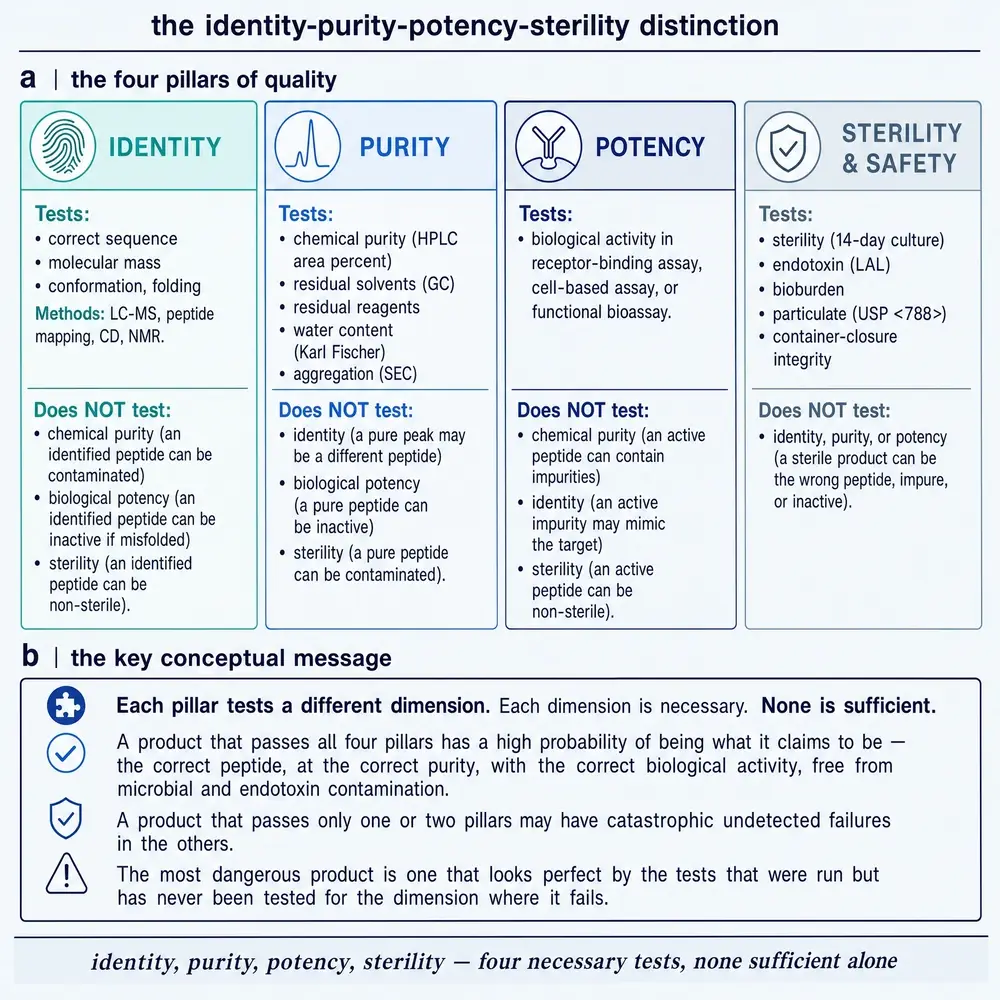
Those separations are not academic. Immunogenicity risk arguments for peptide impurities, higher-order structure expectations in generic peptide PSGs, and the insistence on orthogonal characterisation in EMA synthetic- peptide guidance all exist because transitive inference failed in real review settings. A manufacturer who reports only RP purity is not “almost done”; they have answered one claim lane. A research buyer who treats that number as total quality has imported the same category error into the laboratory.6
That non-transitive grammar is not merely pedagogical. Contemporary regulatory and analytical reviews of therapeutic peptides and proteins treat identity, purity, potency and stability as separately argued attributes, each requiring methods fit for the claim and specifications justified by product knowledge rather than by habit.617 ICH Q6B (Specifications: Test Procedures and Acceptance Criteria for Biotechnological/Biological Products) supplies the classic identity / purity / potency / quantity logic for proteins and polypeptides and their derivatives; synthetic peptides sit partly beside and partly outside that biotech frame, which is why later Parts return to both Q6B principles and the newer synthetic-peptide instruments discussed in the Apparatus.
Therapeutic-peptide reviews of discovery, synthesis and clinical translation likewise frame manufacturing and analytical advances as the enablers that finally made historically unstable messengers into practical drug modalities.30 Stability in liquid formulations remains a standing constraint; lyophilization, sequence editing and delivery devices are responses to that constraint, not decorations. The manufacturing monograph you are reading is therefore not a side topic to pharmacology — it is the condition under which pharmacological claims become chemically intelligible.
This monograph explains scientific principles, industrial history and quality logic for research readers. It does not recommend that any person use any peptide, and it specifies no dose, route or schedule. It does not provide sterile-suite recipes, fill volumes, sterilisation cycles or step-by-step instructions for unlicensed manufacture of injectable products. Where literature reports process conditions, those reports are historical and scientific observation, not operational advice. Research-use-only (RUO) materials remain RUO regardless of how complete their CoA appears.
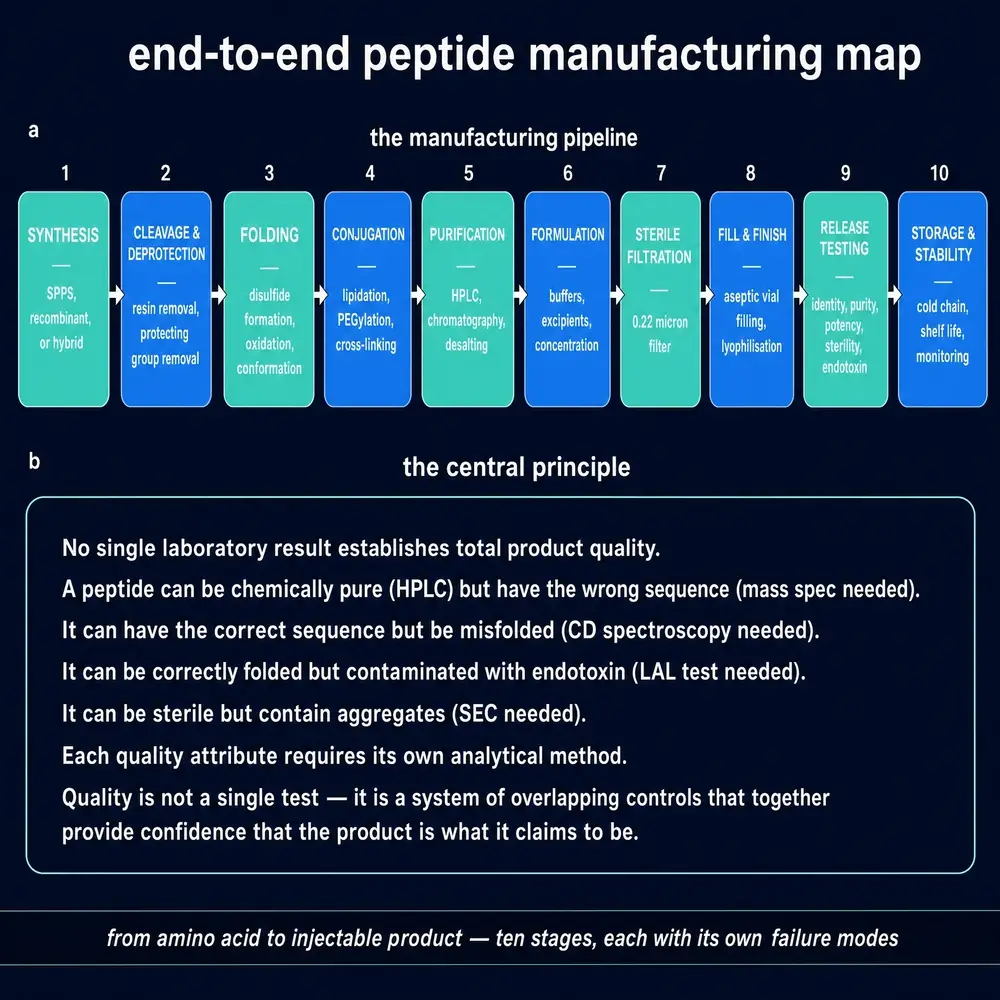
Figure 2 maps the end-to-end argument the rest of the Parts unpack: synthesis or expression → cleavage or harvest → folding and conjugation when required → purification → formulation and lyophilisation → aseptic fill and container closure → cold chain → release analytics that interrogate critical quality attributes (CQAs). No single laboratory result establishes total product quality. The sections that follow show why that sentence is not a slogan but a structural fact about peptides — and why manufacturing history is the story of inventing new impurity taxonomies and then inventing methods and control strategies to see them. Readers who want only a purchasing checklist will be disappointed; readers who want to understand why checklists fail without process knowledge are the intended audience.
Section 02Tissue extracts and the first quality crisis
The modern peptide industry begins, as so much of endocrinology does, with insulin. In the early 1920s, Banting, Best, Collip and Macleod turned canine and then bovine and porcine pancreatic extracts into a medicine that could reverse diabetic ketoacidosis. The triumph created an immediate quality problem: how much active hormone was in a given vial, how variable was one animal pancreas from the next, and how did one compare batches when the molecule itself had not yet been sequenced? Potency was defined operationally — by blood-glucose response in animals — long before primary structure was known. That historical fact still echoes: potency and identity are different questions, and the field learned to measure activity before it could fully name the molecule.6
Tissue extraction scaled into an industry. Porcine and bovine insulin supplied generations of patients, but species differences, limited pancreas supply, and impurity-driven immunogenicity made the process a standing lesson in why “natural source” is not a synonym for “clean product.” Downstream processing — acid–ethanol extraction, isoelectric precipitation, crystallisation, and later chromatographic polishing — became as important as the harvest itself. Contemporary reviews of recombinant insulin manufacture still begin from that inheritance: the molecule’s clinical indispensability forced purification science to mature under pressure.22
Other tissue- and gland-derived peptides followed similar arcs. Pituitary extracts, gut hormones and later urinary gonadotropins taught the same hard lesson: biological starting material carries host proteins, viruses (where relevant), endotoxin risk, and batch-to-batch compositional drift. Quality, in that era, was inseparable from the animal, the slaughterhouse logistics, and the assay animal. The factory had not yet become a chemist’s bench, but the quality problem was already a system problem: harvest, purification, assay and presentation had to agree, or the vial lied.
It is worth lingering on what “potency first” meant for later CMC culture. When activity is the only trustworthy number, manufacturers learn to treat bioassay governance — reference preparations, parallel-line statistics, invalid-assay rules — as the spine of release, even while chemistry catches up. When chemistry later becomes exquisite, the temptation is to demote potency to a courtesy test. History argues against that temptation whenever higher-order structure or disulfide connectivity can fail silently. Modern specification science still carries both inheritances: physicochemical identity packs on one side, justified biological activity on the other.617 The tissue era also taught a supply lesson that returns in contemporary GLP-1 fill-finish debates: clinical indispensability without manufacturing headroom creates quality pressure, because every shortcut looks like compassion until an impurity or sterility failure teaches otherwise.
Section 03Merrifield, the solid phase, and a new impurity grammar
In 1963, R. Bruce Merrifield published solid-phase peptide synthesis (SPPS): anchor the C-terminal amino acid to an insoluble resin, build the chain by iterative coupling and deprotection, then cleave the finished peptide into solution. The practical revolution was not merely convenience. By making excess reagents and washing steps routine, SPPS made medium-length peptides manufacturable without the heroic fragment condensations of classical solution chemistry. It also invented a new impurity grammar. Incomplete coupling leaves deletion sequences. Incomplete deprotection leaves truncated or capped chains. Side reactions during cleavage generate modifications that travel with the product into purification. The synthetic peptide was no longer “whatever the gland made”; it was a statistical population of sequences centred on the intended one.2613 Classical solution fragment condensations did not vanish; they remain part of hybrid and green-synthesis conversations precisely because linear SPPS waste and length limits are real. The historical hinge is that Merrifield made the impurity problem industrial and therefore measurable.
Fmoc/tBu chemistry later displaced much Boc/Bzl practice for many research and manufacturing settings, softening some HF-era hazards while preserving the same logical structure: protect, couple, deprotect, repeat, cleave. Green and atom-efficient alternatives — including exploratory N-to-C elongation with minimal protecting groups, solvent substitution, and wash-elimination strategies — continue to appear in the literature, precisely because classical C-to-N SPPS is powerful and wasteful at once. A multi-company Process Mass Intensity (PMI) assessment of synthetic peptide processes has placed average SPPS PMI near thirteen thousand — unfavourable beside typical small-molecule and even many biopharmaceutical PMI figures — which is why sustainability is now inseparable from manufacturing science for this modality.2612513
SPPS also democratised analogues. Once a chain could be built on resin, non-natural residues, D-amino acids, lipidations and cyclisations became design tools rather than curiosities. That freedom is why modern amylin, GLP-1 and oxytocin analogues can be tuned for fibrillation resistance, chemical stability and imaging — and why analytical methods must keep pace with structural creativity.82030 The quality implication does not change with the colour of the chemistry: every cycle is an opportunity for a process impurity, and every impurity that survives purification becomes a CQA problem. Analogue programmes therefore inherit a double burden: prove that the intentional edit does what pharmacology asks, and prove that the process impurities created while installing that edit remain controlled. Imaging tracers and amylin analogues in the corpus make the analytical half of that burden concrete.208
Section 04Recombinant insulin and the factory organism
The next discontinuity was recombinant DNA. When human insulin could be expressed in microbes, the industry traded slaughterhouse variability for fermentation variability — a different beast, but still a beast. Escherichia coli often deposits insulin precursors as inclusion bodies that must be solubilised and refolded; yeast hosts may secrete precursors but can introduce glycosylated product-related variants that downstream chromatography must remove. Biosimilar insulin programmes make the point explicit: different hosts and processes can still converge on highly similar drug substance if the CQAs are defined, measured orthogonally, and controlled.101122
Recombinant manufacture relocated quality risk into host-cell protein (HCP), residual DNA, residual enzymes used for precursor conversion, refolding isomers, and the chromatography trains that separate them. It also forced a more formal language of comparability. When a manufacturer changes a resin, a column order, or a host, the question is not whether the process “looks similar” but whether the totality of structural, physicochemical and functional evidence still supports the same clinical expectations. Insulin aspart and insulin glargine biosimilar characterisation studies in the reading corpus are textbook demonstrations of that totality-of-evidence mindset.1011
Expression platforms continue to diversify. High-titer inclusion-body switches, plant and yeast systems for peptides such as exendin-4, and hybrid chemical–biological routes all appear in recent literature. The historical lesson remains: the host is part of the product’s impurity profile until purification and analytics prove otherwise.191 Downstream processing reviews of recombinant insulin from E. coli inclusion bodies still read as purification essays first and fermentation essays second — a reminder that the factory organism is only half the quality story.22
Biosimilar characterisation packages also quietly teach manufacturing readers how to read a modern quality story. They risk-rank CQAs, deploy orthogonal structural and functional methods, and present stability and forced-degradation arms as part of sameness — not as afterthoughts. That is the template later Parts reuse when discussing synthetic peptides that are not biosimilars: define what matters, measure it more than one way, and refuse transitive inference across claim lanes.1011 Glycosylation case studies on human insulin variants reinforce the same reflex: a modification that looks “biological” can still be a product-related quality attribute with functional consequences.16
Section 05The modern hybrid: chemistry meets biology
Today’s therapeutic peptide is often neither purely synthetic nor purely recombinant. Long chains may be assembled as fragments and ligated. Disulfides may be formed regioselectively after SPPS rather than left to oxidative folding alone. Fatty-acid side chains for albumin binding are installed chemically on recombinantly produced backbones, or the entire lipidated analogue is made on resin. Semi-synthesis and enzymatic conversion of precursors blur the old boundary between “biologic” and “small molecule.”153272130
Hybrid manufacture multiplies the quality surface area. A batch may carry synthetic deletion peptides and host-cell residuals; conjugations may leave residual reagents; lipidation may create regioisomers; PEGylation may produce positional isoforms with different potencies. The industrial response has been Quality by Design (QbD): define a quality target product profile (QTPP), risk-rank CQAs, identify critical process parameters, and build a control strategy that links process understanding to release testing. Insulin biosimilar dossiers in the corpus show that vocabulary in working form.1011 Industry perspectives on therapeutic-peptide control strategy (for example the 2025 Organic Process Research & Development perspective on current practices, and earlier PolyPeptide Group control-strategy series) underline a further point: health-agency harmonisation for synthetic-peptide API control strategies across clinical development and commercialisation remains incomplete, so manufacturers must justify phase-appropriate controls rather than assume a single global template.
Environmental and sustainability pressures add a further modern chapter. Coupling reagents, solvents and protecting-group waste from classical SPPS are no longer treated as invisible costs; greener elongation strategies, solvent substitution research and wash-reduction methods are part of manufacturing science, not only academic green chemistry. Quality and sustainability are not opposites, but they can trade off if a greener route introduces new impurity classes that methods do not yet resolve.26125 The ACS Green Chemistry Institute Pharmaceutical Roundtable PMI compilation for synthetic peptides — forty processes across development stages, partitioned into synthesis, purification and isolation — is the most comprehensive public environmental metric set for the modality to date. Its headline comparison (SPPS PMI on the order of ~13,000 versus far lower small-molecule medians and lower average biopharmaceutical PMI) does not tell a manufacturer which solvent to use tomorrow; it tells executives and process chemists that peptide manufacture cannot hide behind “complex modality” rhetoric when the mass intensity is structural.12
Control-strategy literature fills the space between chemistry and regulation. Industry perspectives published in Organic Process Research & Development (2025) argue that health-agency expectations for synthetic peptide API controls are not fully harmonised across clinical development and commercialisation, so sponsors must articulate phase-appropriate in-process controls, impurity fate/purge arguments and release tests rather than inherit a single template. Earlier PolyPeptide Group control-strategy papers (Parts I–III in the trade/technical literature) likewise walk from impurity taxonomy through analytical orthogonality to specification setting. Those sources are named here as industrial reasoning, not as substitutes for primary agency text. They matter because they show practitioners treating CQAs as design targets rather than as laboratory afterthoughts — the same move insulin biosimilar packages make with QTPP language.1011
Regulatory instruments have begun to catch up with that hybrid reality. In the United States, FDA finalised industry guidance in 2021 on abbreviated new drug applications (ANDAs) for certain highly purified synthetic peptide drug products that refer to listed drugs of recombinant DNA origin (Federal Register availability notice, 20 May 2021, Docket FDA-2017-D-5767), addressing peptides such as glucagon, liraglutide, nesiritide, teriparatide and teduglutide. Subsequent Agency communications (including July 2026 product-specific guidance updates) state that this 2021 guidance has been withdrawn because it no longer reflects current scientific thinking, with revision planned on the Center for Drug Evaluation and Research guidance agenda. In Europe, EMA’s Guideline on the Development and Manufacture of Synthetic Peptides (EMA/CHMP/CVMP/QWP/367182/2025; effective 1 June 2026) clarifies impurity control for chemically synthesised peptides — notably that synthetic peptides sit outside ICH Q3A small-molecule impurity thresholds and are anchored instead to European Pharmacopoeia expectations for substances for pharmaceutical use, while elemental impurities and nitrosamine risk assessment remain under ICH Q3D and ICH M7 where applicable. Those instruments are named here as regulatory geography; their implications for impurity taxonomy, orthogonal characterisation and release logic are developed in Parts Four and Five and listed with URLs in the Apparatus.
Section 06What history was really teaching
Read as quality history rather than hero narrative, the path from pancreas extract to hybrid manufacturing teaches four durable lessons. First, the assay defines the product until structure and orthogonal methods catch up — early insulin potency units preceded sequence knowledge. Second, every platform invents its own impurity taxonomy — animal proteins, deletion peptides, HCPs, refolding isomers, conjugation by-products. Third, comparability is empirical: changing the host or the resin changes the burden of proof, not merely the story told in a brochure. Fourth, release is a decision under uncertainty, bounded by validated methods and sampling, never by a single reassuring number.
A fifth lesson is now unavoidable: control strategy is literature and practice, not a slogan. Specifications without process understanding are incomplete; process understanding without orthogonal analytics is wishful. Reference standards for synthetic peptide therapeutics illustrate the same point at the laboratory bench: identity, content and impurity claims depend on how standards are vialed, characterised and value-assigned.18
Before leaving history, a note on what this monograph will and will not treat as evidence. Peer-reviewed PMC literature in the local reading corpus and newly integrated open PMC records supply the numbered bibliography. Regulatory instruments are named by official title and, in the Apparatus, by public URL; their numeric tables are not harvested into this document. Industry perspectives and Federal Register / agency announcements encountered through API research are used to locate the live status of guidance — especially the FDA 2021 ANDA peptide guidance withdrawal/update path — without inventing citations or pretending a blog is a statute. Where a load- bearing quantitative claim appears (for example PMI magnitudes from the ACS GCIPR peptide study), it is tied to a citable open record.12 Where process/scale effects on GLP-1 analogue quality are discussed, the primary journal locus is named in prose because that article is not held as a PMC key in the local bibliography file.
Part Two descends into the chemistry of making the chain — including
deletion, truncation, racemisation, capping and Endo-Xaa impurity science, and
the green-chemistry pressure measured by PMI and wash elimination. Part Three
follows folding, conjugation, purification, formulation, crystalline-versus-
amorphous lyophilization risk, and fill-finish as a quality/supply reality at
principle level. Part Four is the analytical argument: HPLC is not identity;
LC–MS, mapping and reference standards are; sterility and endotoxin are
separate lanes. Part Five returns to release, scale-up, validation, the
evolving FDA/EMA/ICH frame and the standing research-use constraint that
governs this series. The end-to-end map is not a process flow-chart for a
plant; it is a map of claims, and every claim needs a
method.
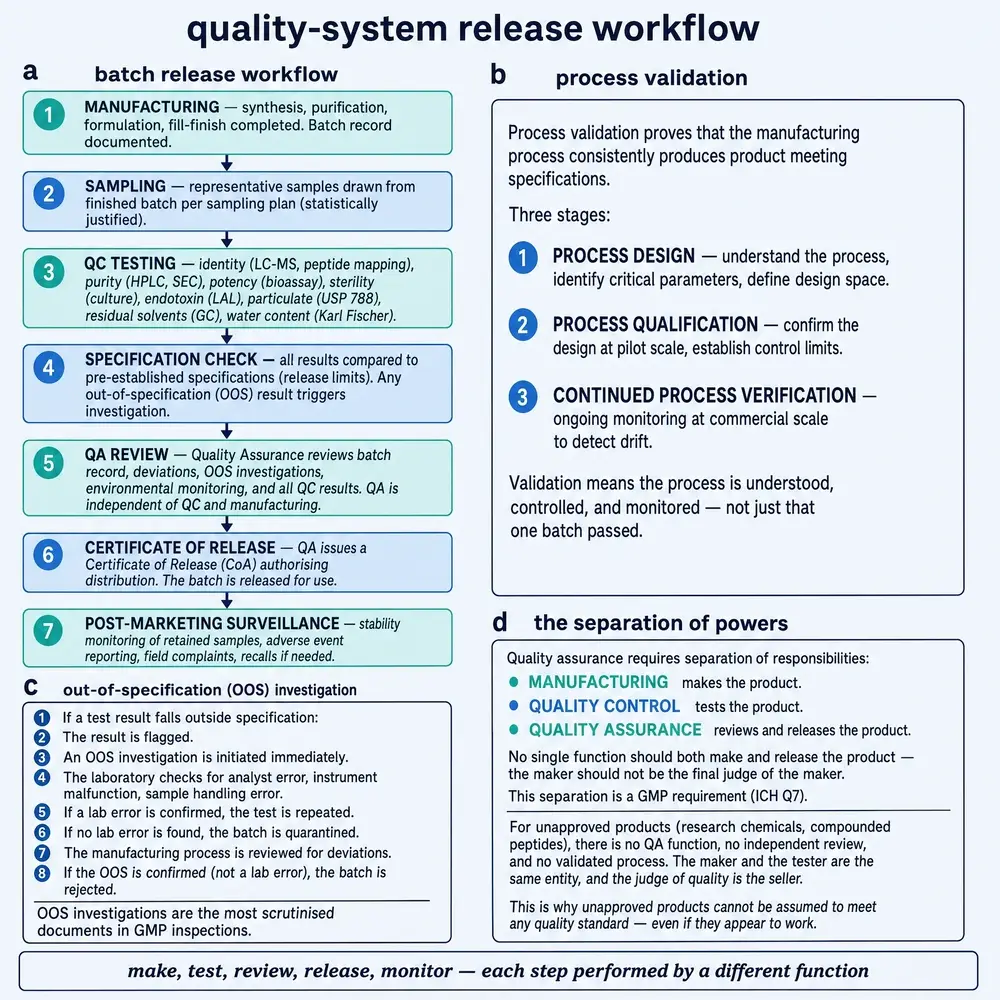
Section 07Solid-phase peptide synthesis as a repeating machine
Solid-phase peptide synthesis is easiest to understand as a machine with a
small instruction set. An amino acid is anchored to a resin bead through its
carboxyl end. The temporary protecting group on its amine is removed. The next
protected amino acid is activated and coupled. The cycle repeats until the
sequence is complete. Global cleavage and side-chain deprotection then release
the crude peptide into solution for purification. The power of the method is
that reagents can be used in excess and washed away; the vulnerability is that
every imperfect step is covalently archived on the growing
chain.
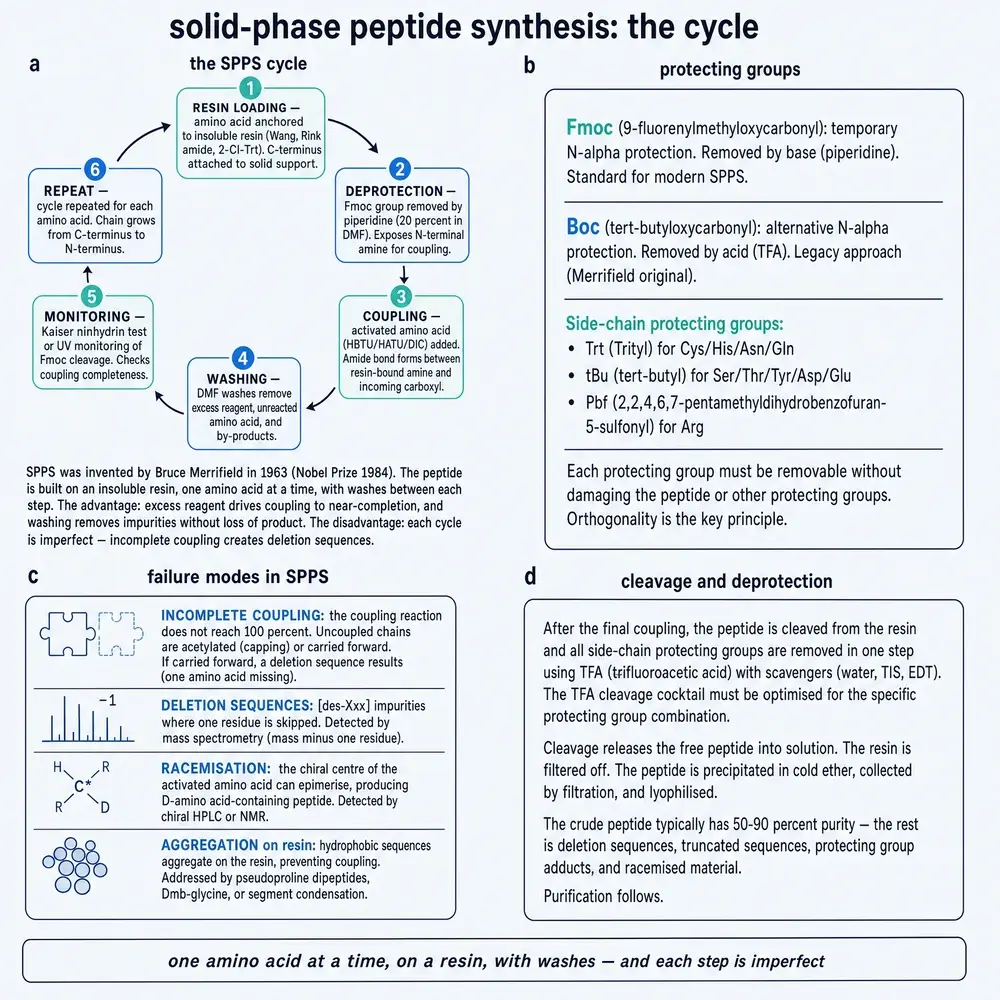
Two large chemical families dominate practice. Boc chemistry historically used acid-labile temporary protection and often required harsh final cleavage. Fmoc chemistry uses base-labile temporary protection and acid-labile side-chain groups, and it became the default for much research and manufacturing SPPS because the iterative chemistry is milder and more automation-friendly. Neither family abolishes difficult sequences: aggregation on resin, slow couplings at hindered residues, and aspartimide formation remain standing failure modes. The manufacturing question is never whether SPPS can make a peptide; it is whether the crude purity and impurity profile are compatible with a scalable purification and a defensible release specification.13
Automation does not abolish chemistry. Synthesisers make excess equivalents, double couplings and wash programmes repeatable; they also make it easy to scale a bad method. In-process controls therefore belong in the automation recipe, not only in the release laboratory. Small-scale cleave-and-check LC–MS after difficult junctions, real-time UV or conductivity monitoring where available, and deliberate hold-point samples before global cleavage are how manufacturers avoid discovering a deletion catastrophe only after preparative chromatography has already consumed a solvent plant. The same discipline applies when greener solvents or wash-elimination protocols are introduced: automation must be re-qualified against impurity endpoints, not only against cycle time.512
Longer targets strain the machine. Cumulative yield falls with length; deletion and truncation impurities multiply; on-resin aggregation can stall elongation. Fragment condensation, native chemical ligation, and specialised platforms for long peptides exist precisely because a single continuous SPPS run is not always the rational process. Recent assembly platforms for long peptides underscore that “synthetic” now includes modular strategies, not only residue-by-residue marathon syntheses.22630 Kent’s fundamental account of SPPS and green chemical peptide synthesis pushes the same modular conclusion from a sustainability angle: retain the polymer-supported advantages of stepwise synthesis where they help, then converge via ligation of unprotected segments rather than treating ever-longer linear SPPS as destiny.13
Solvent burden is not a side note. Industrial SPPS has long relied on amide solvents such as DMF and NMP and on chlorinated wash solvents in many historical recipes; regulatory and occupational pressure on those solvents is one reason green-chemistry programmes treat peptide manufacture as a priority modality. PMI benchmarking across dozens of synthetic peptide processes confirms that synthesis, purification and isolation each contribute heavily to mass intensity, with SPPS typically dominating the environmental footprint relative to small-molecule norms.12 On average, the compiled SPPS PMI near ~13,000 stands far above reported small-molecule medians (roughly 168–308 in the same discussion frame) and above an approximate biopharmaceutical PMI near ~8,300 — magnitudes that justify treating solvent redesign as a core process-development workstream.12 Wash-elimination and solvent-minimisation research — including total wash elimination strategies demonstrated for SPPS — aims to cut that solvent load without surrendering coupling efficiency or impurity control.5 Those innovations succeed only if impurity analytics remain as demanding as the chemistry claims to be green.
Section 08Resin, loading, and the hidden variables of the bead
The resin is not inert furniture. Swelling in the working solvent governs reagent access. Loading (millimoles of sites per gram) trades throughput against inter-chain crowding. Linkers determine whether cleavage yields a C-terminal acid or amide and under what conditions. Poor swelling or overloaded resin can convert a textbook coupling into a mixture of full-length and deletion products that later HPLC may struggle to resolve. Fundamental physicochemical accounts of the peptide–resin continuum still explain why stepwise SPPS became nearly universal for chemical peptide manufacture: the insoluble support makes excess reagents practical, but it also couples local microenvironment to impurity outcome.13
Side-chain protecting groups are the other half of the resin story. They must survive iterative deprotection of the temporary N-protecting group, yet fall cleanly in the global deprotection. Incomplete removal leaves partially protected species; premature loss creates branched or modified impurities. Arg, Trp, Met, Cys and Asp/Asn centres are perennial trouble spots, each with characteristic side reactions under acidic cleavage conditions. Manufacturing process development therefore treats protecting-group choice as a CQA-relevant decision, not a catalogue default.
Green-chemistry critiques of SPPS often begin here: the molecular weight of protecting groups and coupling reagents can rival or exceed that of the amino acid being installed, so atom economy is structurally poor even when the peptide itself is short. Alternative elongation logics — including N-to-C strategies that minimise protecting-group manipulations, convergent ligation of unprotected segments, and greener solvent systems — are best read as attempts to change that material balance without surrendering stereochemical control.261213
Section 09Coupling, activation, and the errors that become the product
A peptide bond on resin is formed when an activated carboxyl of the incoming amino acid is attacked by the free amine of the anchored chain. Carbodiimides, uronium/aminium reagents and related activators exist to make that step fast and complete. Excess amino acid and double coupling are common responses to difficult residues. The quality stakes are specific and should be named as industry practice names them:
- Deletion sequences — incomplete coupling leaves chains missing one or more residues; hydrophobicity differences from the parent may be slight, so RP selectivity can fail.
- Truncations — premature chain termination, often after capping of unreacted amines, produces shorter acetylated (or otherwise blocked) species that may or may not separate cleanly.
- Racemisation / epimerisation — over-activation or prolonged exposure can invert the incoming residue; a diastereomer may co-elute under one HPLC method and resolve under another.
- Insertion and related sequence errors — excess reagent chemistry and impure amino-acid starting materials can introduce unexpected residues.
- Endo-Xaa C-terminal impurities — mechanism studies of SPPS have identified Endo-Xaa-type C-terminal impurity formation pathways that require deliberate DoE-informed control and suppression rather than hope that purification will always rescue the crude (see, for example, process-chemistry investigations of Endo-Xaa impurity formation and control in Organic Process Research & Development).
Epimerisation deserves emphasis because HPLC purity can look excellent while stereochemical integrity is compromised. For peptides whose biology depends on a precise three-dimensional presentation — disulfides, receptor contacts, amyloid-prone stretches — a stereochemical impurity is not a pedantic concern. Process descriptions in modern analogue programmes quietly spend enormous effort on couplings next to N-alkylated residues and other hindered junctions for exactly this reason.8 Quality-by-design treatments of the SPPS coupling step likewise frame incomplete coupling, additions and N-terminal failures as predictable kinetic outcomes under improper conditions, not as mysterious batch weather.
Capping protocols occupy a double role. They convert failed couplings into truncated species that are often easier to purge chromatographically than near-isobaric deletions — and they can themselves create a truncation impurity catalogue that must be monitored. Orthogonal capping followed by selective removal strategies appears in recent peptide-purification research precisely because HPLC alone is solvent-hungry and imperfectly parallelisable at scale. The manufacturing moral is unchanged: capping is a control tool, not a licence to ignore coupling efficiency.
Analytical in-process controls — ninhydrin or colorimetric amine tests, small-scale cleave-and-check LC–MS, real-time monitoring in automated rigs — exist to catch failures before a kilogram of resin becomes a kilogram of disappointment. They do not replace release testing; they reduce the chance that release testing is asked to purify a disaster.
Starting-material quality is part of the same impurity grammar. Amino-acid derivatives can carry enantiomeric contaminants, under-protected species, dipeptide impurities and their own residual solvents or metals; those species can map into the finished peptide as stereoisomers, insertions or elemental burden. EMA synthetic-peptide guidance (discussed in Part Five and listed in the Apparatus) explicitly pushes sponsors to understand starting-material synthetic routes and to assess which upstream impurities can affect the API impurity profile. That is not a purchasing footnote. It is process chemistry extended one step upstream of the first resin loading. Non-peptidic conjugation components — linkers, PEG reagents, fatty-acid active esters — require the same upstream criticality assessment when they become part of the drug substance.
Difficult-sequence chemistry deserves a separate honesty clause. On-resin aggregation, aspartimide formation at Asp–Gly and related motifs, and slow couplings at N-alkylated or sterically hindered junctions are not exotic failure modes; they are expected failure modes that force either sequence redesign, backbone protection, specialised coupling cocktails, or fragment strategies. Recent literature on aspartimide prevention, green global deprotection acids, and aqueous or DMF-free SPPS platforms shows how active the field remains — and how each proposed fix must be re-validated against impurity analytics, not celebrated on yield alone.1330 A greener solvent that raises deletion burden is not a sustainability win; it is a relocated quality failure.
Section 10Cleavage, deprotection, and the birth of the crude peptide
Cleavage is the moment the synthesis stops being a solid-phase story and becomes a solution impurity story. Strong acid (classically TFA cocktails for Fmoc chemistry) releases the peptide from the linker and removes side-chain protection. Scavengers are included because the cleavage cocktail generates reactive cations that otherwise alkylate Trp, Met, Cys and Tyr. Inadequate scavenging is a classic route to modified impurities that share the mass neighbourhood of the parent and complicate both purification and MS interpretation.
Work-up — precipitation, washing, drying — creates the crude peptide lot that purification will see. Residual scavengers, protecting-group debris and trifluoroacetate counter-ions become part of the material’s early life. For cysteine-rich targets, the cleavage redox environment also sets up the folding problem of Part Three: free thiols may oxidise indiscriminately if mishandled. Regioselective disulfide strategies sometimes begin with orthogonal Cys protection that survives cleavage in a planned pattern, precisely so that folding is not left entirely to chance.153
At this stage the honest description of the product is “crude.” A research CoA that reports only a final HPLC purity after aggressive purification, without acknowledging crude complexity, teaches the wrong lesson about manufacturing risk. Industrial SPPS is judged by what the crude contains and whether the purification train can remove it reproducibly at scale. Process- and scale-dependent impurity shifts reported for GLP-1 analogues in pharmaceutical-research case studies reinforce the same warning: changing reactor scale or process mode can change which related substances dominate, even when the intended sequence is unchanged (see Eggen et al., Pharmaceutical Research 37:120, 2020, “Influence of Production Process and Scale on Quality of Polypeptide Drugs: a Case Study on GLP-1 Analogs,” DOI 10.1007/s11095-020-02817-9). The paper’s lesson for readers of this monograph is methodological rather than product-specific: comparability and control strategy must be built against the impurity catalogue the process actually generates at the scale that will be commercialised.
Wash chemistry sits between coupling success and environmental cost. Classic SPPS uses large wash volumes to remove excess reagents before the next deprotection or coupling; those washes dominate solvent PMI. Total wash elimination and related solvent-minimisation strategies demonstrate that, under suitable conditions, reagent removal can be redesigned rather than merely diluted away.5 The quality gate for any such redesign is unchanged: demonstrate that residual reagents and by-products do not create new related substances or catalytic degradants that later analytics miss. Green chemistry without orthogonal impurity control is green advertising.
Section 11Recombinant expression: the chain made by a cell
Recombinant peptide production recruits a living cell as the assembly line. A gene encodes a precursor; the host transcribes and translates it; the precursor is harvested from inclusion bodies or secretion medium; enzymatic or chemical conversion yields the mature sequence; chromatography removes process- and product-related impurities. For insulin and many analogues, this pathway is the industrial backbone, with decades of optimisation around titre, refolding yield and chromatographic resolution.2210
Host choice reshapes the impurity profile. E. coli offers speed and high expression but often demands refolding from aggregates and careful endotoxin control. Yeast may secrete more native-like material yet introduce glycosylated variants that must be cleared to below quantification for a faithful insulin analogue. Plant and other eukaryotic systems appear in research-scale peptide production with their own residual-protein and glycosylation considerations. None of these hosts is universally superior; each relocates the purification burden.11119
Endotoxin control deserves explicit mention even in a chemistry-heavy Part. Gram-negative fermentation can load lipopolysaccharide into early process streams; inadequate clearance converts an otherwise elegant recombinant route into a pyrogen problem that HPLC purity will never disclose. BET methods, process hold points and validated clearance arguments are therefore part of making the chain, not only part of filling the vial.1910 Synthetic routes relocate the microbiological conversation toward facility hygiene, water quality and fill-finish, but they do not abolish it for parenteral presentations.
Downstream processing of recombinant human insulin and analogues from E. coli inclusion bodies remains a canonical case study: solubilisation, renaturation, enzymatic maturation and multi-mode chromatography must remove both product-related isomers and process-related residuals before drug-substance specifications are even in view.22 Platform tags that force inclusion-body formation and then enable efficient renaturation — as in the Numaswitch approach for teriparatide and other small proteins — illustrate a modern recombinant logic: use aggregation deliberately for titre and proteolysis protection, then solve renaturation with a designed switch rather than heroic trial-and-error. Release analytics for such products still ask the familiar questions: identity by MS and mapping, purity by orthogonal HPLC, residuals of host DNA/protein/endotoxin, and a functional readout against a reference standard.19
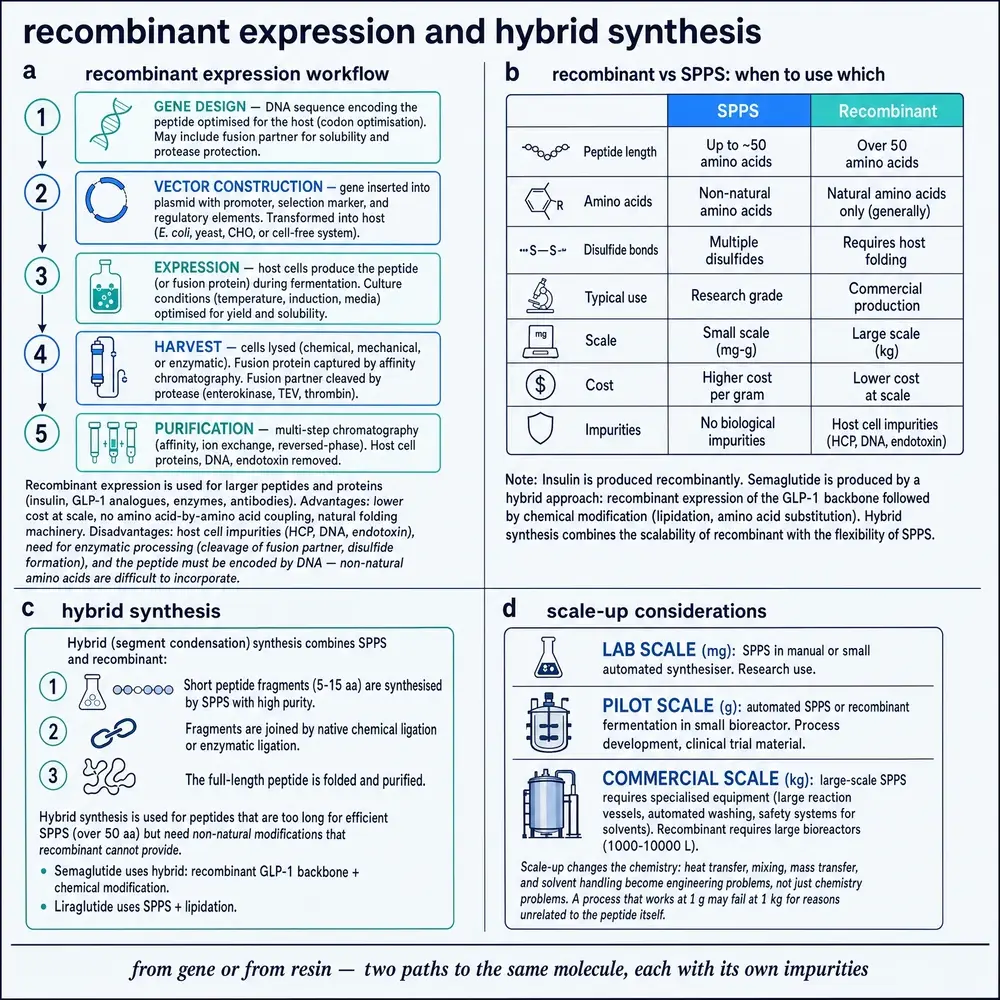
Comparisons of impurity profiles for the same peptide sequence made by synthetic versus recombinant routes (for example teriparatide studied by LC–HRMS in process-analytical literature) make the platform lesson concrete: “same sequence” does not imply “same related-substance catalogue.” Control strategies must therefore be route-aware. That lesson also disciplines generic and biosimilar thinking: sameness arguments must confront the impurity grammar of the proposed route, not only the amino-acid string shared with the reference product. FDA PSG themes on impurity thresholds and innate immune response testing exist because peptide-related impurities can carry immunogenicity risk that sequence identity alone does not erase.
Section 12Hybrid and fragment strategies
When a target is too long, too decorated, or too disulfide-dense for a single comfortable SPPS or a single tidy expression, manufacturers combine modes. Fragments may be synthesised separately and joined. Recombinant backbones may receive chemical lipidation or PEG. Orthogonal protecting groups may enable one-pot regioselective disulfide formation that would be unreliable under thermodynamic oxidative folding alone. Solution-phase N-to-C fragment couplings with improved atom economy are entering the same conversation for mid-sized peptides.1532621
Hybrid routes create hybrid impurity budgets. A lipidated GLP-2 analogue carries both peptide-process impurities and conjugation-related species; a PEGylated GLP-1 carries positional isomers; a chemically driven disulfide pattern can leave palladium or scavenger residuals if metal-mediated steps are used. The control strategy must name those species and assign methods that can see them. Comparability after a route change is therefore not a paperwork exercise: changing from pure SPPS to semi-synthesis can alter which impurities are even possible.2729
Industry control-strategy writing for synthetic therapeutic peptide APIs has long insisted on the same hierarchy Part One previewed: understand the process impurity taxonomy, build in-process controls where failures are born, purify with justified pooling criteria, and release with orthogonal methods anchored to characterised reference standards.18 Harmonisation gaps across agencies mean that “phase-appropriate” is not a euphemism for lax; it is a demand for explicit justification as development progresses.
DoE and mechanistic kinetic modelling of coupling steps are how modern process chemists convert that hierarchy into experiments. Incomplete coupling, additions and N-terminal failures become predicted outcomes under mapped ranges of equivalents, temperature and time rather than mysterious batch weather. Endo-Xaa impurity mechanism studies similarly show that some C-terminal related substances require targeted suppression chemistry, not only tighter HPLC cuts. The research reader does not need the kinetic equations; the research reader needs the moral: SPPS impurities are often lawful chemical consequences, and lawful consequences are controllable when measured.
A final synthesis-side distinction matters for readers who compare CoAs across vendors. “Synthetic” on a label does not disclose whether the route was linear Fmoc SPPS, Boc chemistry, fragment condensation, ligation, or a hybrid with recombinant fragments. Each route writes a different impurity diary. Asking for the route class, the crude purity before preparative HPLC, and the orthogonal identity methods is therefore not pedantry; it is the minimum literacy required to interpret a purity percentage. Research materials sold with HPLC-only identity claims should be treated as analytically under-specified for any experiment that depends on molecular sameness.618
Recombinant and synthetic routes also differ in what “batch” means. A fermentation batch may be defined at harvest; an SPPS batch may be defined at cleavage or after pooling of purified fractions; a conjugated batch may be defined after the conjugation quench. EMA synthetic-peptide guidance pays explicit attention to batch definition, splitting, pooling and reprocessing because ambiguity here is how impurity histories become untraceable. Industry control-strategy papers make the same point in process-chemistry language: if you cannot draw the material genealogy, you cannot defend the impurity justification.
Part Three assumes the chain now exists — synthetic, recombinant, or hybrid — and asks what must happen before it is a formulated, fill-finished drug product candidate: fold it correctly, conjugate if required, purify ruthlessly, formulate against degradation, dry it or keep it in solution wisely, and protect sterility and container integrity without pretending those operations are laboratory theatre. The chain-making story ends where the product-making story begins; both are quality stories.
Section 13Folding and the disulfide problem
For many bioactive peptides, the covalent sequence is not the drug. The drug
is the sequence plus the correct disulfide connectivities and the
three-dimensional presentation those bonds enforce. Insulin’s three
disulfides, conotoxins’ knotted frameworks, and linaclotide’s
compact cysteine pattern are not decorative; they are the structure–function
link. A misfolded isomer can share a mass with the native molecule and fail in
a potency assay — or worse, pass a weak assay and fail in
vivo.
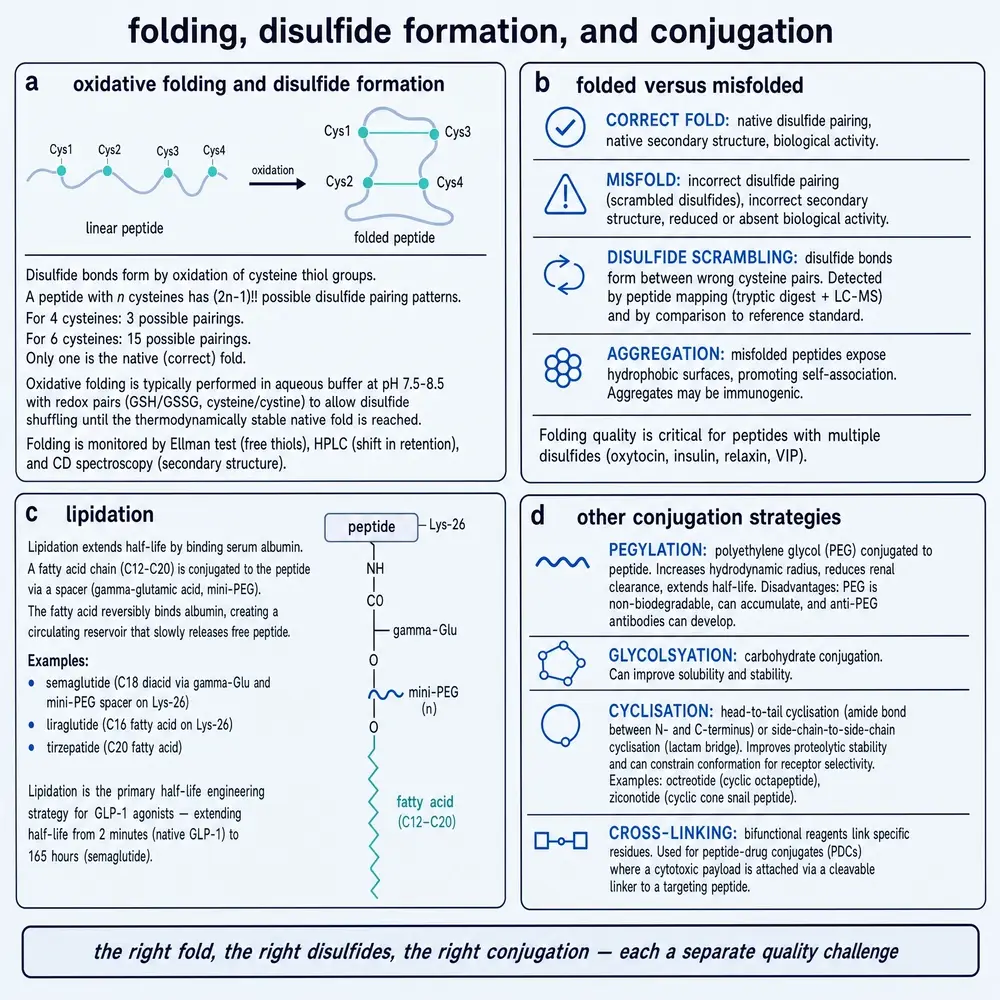
Two broad strategies dominate. Oxidative folding relies on thermodynamic control under redox buffers, accepting that the correct isomer must win out among many possibilities — seventy-five disulfide isomers are possible for three bonds, and kinetic traps are common. Stepwise or one-pot regioselective formation uses orthogonal Cys protection and chemoselective chemistry (including ultrafast Pd/UV/disulfiram and related approaches) to build the native pattern by design. Recent reviews of directed oxidative folding for disulfide-rich peptides emphasise that pathway control is now an engineering discipline: inefficient pairing lowers yield, invites functional instability through isomerisation, and can defeat sequence engineering that looked perfect on paper.153
Analytics for folding are orthogonal by necessity. Non-reduced peptide mapping and MS confirm connectivity; CD, NMR and crystallography speak to higher-order structure; potency assays ask whether the fold is functionally native. Biosimilar insulin characterisation packages show how these tools are bundled when the disulfide pattern is a “very high” criticality attribute.1011 Incorrect fold is a purity problem, a potency problem and an identity problem at once — which is why it belongs in Part Three as a manufacturing operation and in Part Four as a CQA cluster.
Directed folding strategies also change the impurity budget. Orthogonal protection schemes can leave residual protecting-group fragments or require metal-mediated steps whose residuals must be cleared; thermodynamic folding can leave scrambled isomers that co-mass with the native drug. Reviews of disulfide-rich peptide engineering treat folding pathway control as enabling technology for both manufacturing yield and functional reliability after sequence edits.315 In either strategy, the release question is the same: which method proves native connectivity at the level the CQA ranking demands?
Section 14Conjugation, lipidation, and intentional modification
Many contemporary therapeutic peptides are not naked sequences. Fatty-acid chains enable reversible albumin binding and extended exposure. PEG enlarges hydrodynamic size and can alter clearance. Chelator or fluorophore attachments create imaging tracers. Glycoalkylation and other side-chain edits appear in research conjugates. Each intentional modification is also an impurity generator: incomplete conjugation, over-conjugation, regioisomers and residual reagents travel with the product unless purification and methods are built for them.272123
Lipidation chemistry for incretin and amylin analogues is now a mature design lever, but it changes formulation space. Hydrophobic side chains can promote self-association; linker chemistry can create new degradation paths; the modified peptide may require different chromatographic selectivity than the parent. Acylation studies on GLP-2 and enzymatic mono-PEGylation of GLP-1 illustrate the analytical burden: prove site selectivity, prove residual unconjugated peptide is controlled, and prove the conjugate retains the intended pharmacological direction.27218 Advanced native MS of liraglutide oligomerisation pathways further shows that lipidated incretins can hide association states that ordinary denaturing HPLC never reports as “impurities” yet still matter to physical quality.14
From a quality-system perspective, conjugation is a critical process step with its own critical process parameters. Stoichiometry, pH, solvent composition, temperature and quench conditions are not details for the process-development notebook alone; they are determinants of the CQA profile that release testing will later certify — or fail. EMA synthetic-peptide guidance explicitly treats conjugation chemistry as part of the manufacture and characterisation story rather than as an afterthought bolted onto a naked peptide specification (see Apparatus for the official instrument designation and URL).
Conjugation also forces a second reference-standard conversation. The naked peptide standard may no longer be the right comparator once a fatty acid or PEG is installed; the conjugated reference must itself be characterised for site occupancy, residual unconjugated peptide and potency.18 Positional isomers of PEGylation or acylation can share mass and frustrate simple MS identity tests, which is why peptide mapping, side-chain selective chemistry and orthogonal chromatography appear together in serious conjugate packages.2127 Research materials that report only “lipidated peptide, 95% HPLC” without site selectivity data are analytically incomplete for structure–function work.
Section 15Purification: chromatography as the moral centre of manufacturing
If synthesis creates the impurity problem, purification is where honesty becomes quantitative. Reversed-phase HPLC (and its preparative counterparts) separates many peptide impurities by hydrophobicity; ion-exchange exploits charge; size-exclusion targets aggregates and fragments; affinity or mixed-mode steps appear when selectivity demands them. Industrial insulin trains combine low- and high-pressure chromatographic stages precisely because no single mode removes every process- and product-related impurity.2210
Two distinctions matter for readers of CoAs. Process-related impurities (host-cell protein, DNA, reagents, residual solvents, enzymes, resin leachables) come from how the peptide was made. Product-related impurities (deletions, truncations, deamidations, oxidations, isomers, aggregates) are variants of the peptide itself. Methods must be chosen for the class they claim to control. A reversed-phase purity number does not speak to endotoxin; a host-cell protein ELISA does not speak to deletion peptides. EMA’s synthetic-peptide guideline restates the same split in regulatory language: peptide-related impurities versus non-peptide impurities (reagents, solvents, elemental impurities, potential mutagenic species), with synthetic peptides excluded from ICH Q3A thresholds and anchored instead to Ph. Eur. expectations for substances for pharmaceutical use.
Preparative chromatography also forces trade-offs that research-scale cartridges hide. Resolution versus throughput, solvent consumption, peptide losses on column, and pool-cut decisions all shape both yield and impurity carry-over. A wider pool raises yield and impurity burden; a tighter pool does the reverse. Validated pooling criteria are therefore part of the control strategy, not an operator preference — a point industry control-strategy documents and the EMA synthetic-peptide guideline both emphasise when they distinguish acceptable repurification from uncontrolled reprocessing.
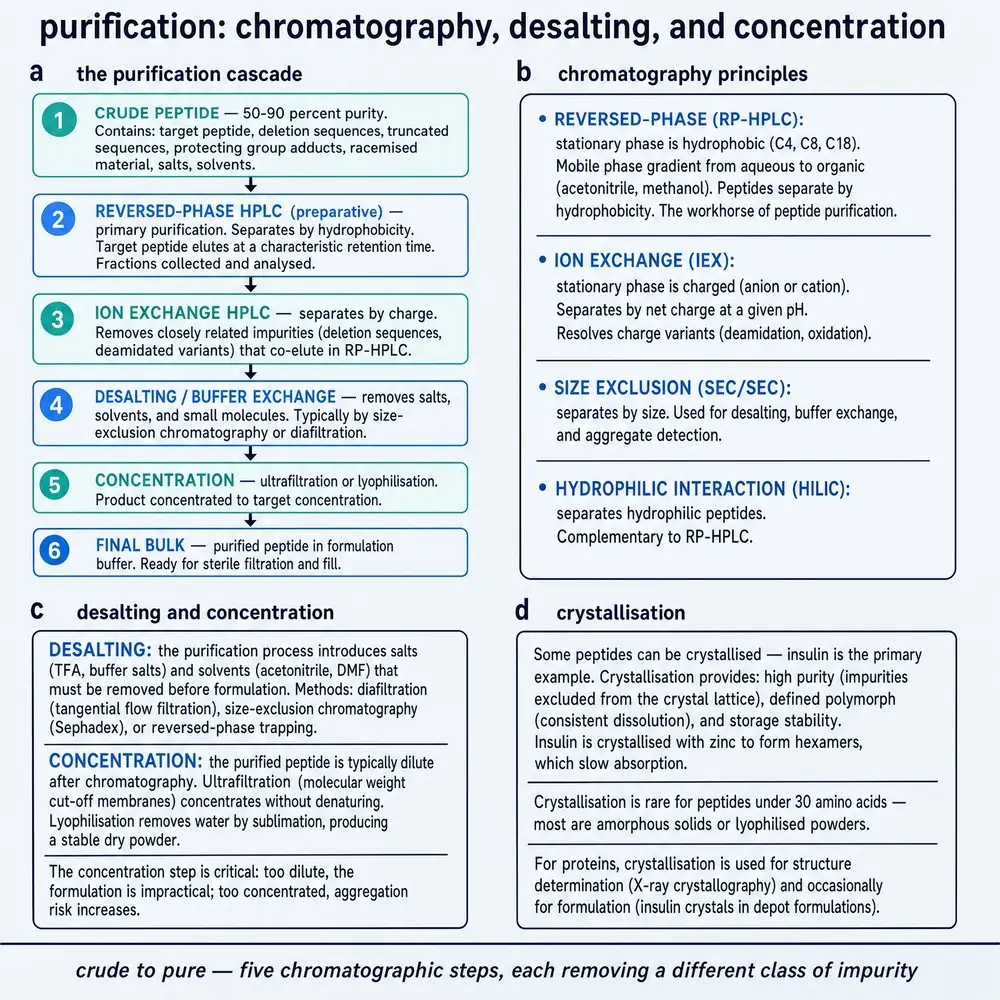
Process and scale effects matter here as much as in synthesis. Case-study literature on GLP-1 analogues has shown that production process and scale can shift polypeptide impurity profiles even when the intended molecule is unchanged; purification and analytical methods must therefore be challenged against the impurity catalogue the actual process generates, not against a generic textbook list. Multicolumn and continuous chromatographic concepts appear in therapeutic-peptide purification research for the same reason batch RP at industrial scale is solvent-hungry and time-hungry: the purification train is often the PMI and schedule bottleneck after SPPS itself.12 Catch-and-release or orthogonal-capping purification ideas try to reduce reliance on heroic HPLC, but they succeed only when the impurity chemistry of the crude matches the capture chemistry’s assumptions.
Recombinant DSP remains the comparative baseline for what a mature peptide purification culture looks like. Insulin trains documented in the corpus combine clarification, refolding or conversion steps, and successive chromatographic modes because product-related isomers and process-related residuals rarely share a single separation principle.22 Synthetic-peptide plants that pretend one preparative RP cut can replace that depth of thinking are recreating the tissue-era mistake: believing a single powerful unit operation can redeem an uncharacterised mixture.
Section 16Formulation and the myth of the inert excipient
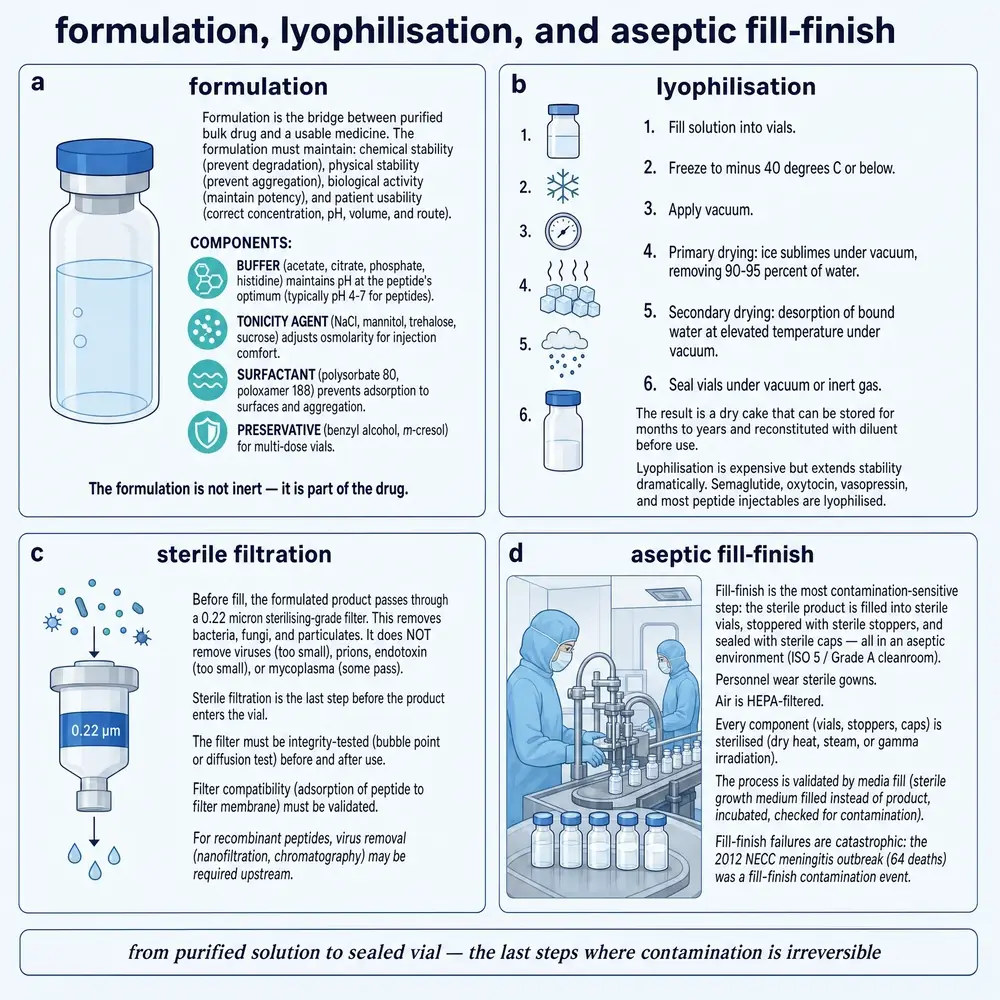
A formulated peptide is a small society of chemicals. Buffers set pH into a stability window. Tonicity agents manage osmolality. Surfactants may limit interfaces that seed aggregation. Phenol and m-cresol in insulin products are not optional flavourings; they help lock quaternary structure and provide antimicrobial protection in multi-dose presentations. Zinc and related ions can organise hexamers. Polyols and sugars stabilise during freezing and drying. None of these is guaranteed inert after months of storage.102411
Excipient quality is product quality. Glycerol that oxidises on repeated opening can generate aldehyde and ketone impurities that covalently modify a model peptide and collapse its assay content under stress; mannitol under the same abuse can remain comparatively stable. The practical moral is double: choose excipients with an eye on their physical state and oxidation susceptibility, and treat excipient storage and repeated use as controlled operations. A perfect drug substance can be ruined by a degraded polyol.24 The crystalline-excipient stability risk discussed in Section 17 is the solid-state twin of this lesson: an excipient chosen for cake elegance or tonicity can still be the dominant long-term degradation driver.9
Buffer species deserve the same suspicion. Phosphate, citrate, histidine and acetate systems differ in freezing behaviour, metal coordination and pH shift on lyophilization; phenol and m-cresol alter insulin association states while serving antimicrobial roles; zinc and other ions can organise multimers that change both potency presentation and fibrillation risk. None of these facts yields a universal buffer recipe — and this monograph will not invent one. They yield a CQA habit: formulate with the impurity and aggregation analytics of Part Four already in mind.1011
Formulation design for fibrillation-prone sequences — human amylin analogues among them — shows how chemical engineering of the sequence and formulation pH travel together. Petrelintide’s development narrative is explicitly about achieving chemical and physical stability near neutral pH so that co-formulation becomes conceivable; that is manufacturing science in the service of product quality, not a clinical dosing discussion.8 Aggregation propensity belongs in formulation risk assessment for the same reason EMA and USP peptide-quality discussions treat oligomers and high-molecular-weight species as quality attributes, not as optional biophysics.
Section 17Lyophilization: water, cake, and the solid-state bargain
Lyophilization removes water so that mobility-driven degradation slows. The bargain is that freezing and drying stresses can themselves denature, aggregate or shift pH locally, and that the dried cake retains residual moisture that still permits solid-state chemistry. Cycle design (freezing, primary drying, secondary drying), cake appearance, residual water and reconstitution behaviour are therefore quality-relevant outputs, not cosmetic manufacturing preferences. Practical development literature for lyophilized protein products emphasises the same point: residual moisture, cake elegance and reconstitution are CQA-adjacent outputs that must be designed, not hoped for.4
Solid-state insulin studies sharpen the chemistry. Under elevated temperature and humidity, covalent aggregation and deamidation proceed even when secondary structure after reconstitution looks largely intact; disulfide exchange can dominate covalent aggregation pathways in the solid state. Analytical methods benchmarked on solution degradants — CD, SEC, RP-HPLC, reductive chain separation — translate to solid-state programmes and show why “it is dry, therefore stable” is a superstition.7
Crystalline versus amorphous excipient behaviour is a second solid-state lesson that recent polypeptide lyophilization work makes explicit. Crystalline excipients such as mannitol are common in freeze-dried chemically synthesised drug products, yet crystallisation can jeopardise long-term stability of freeze-dried polypeptide formulations — a risk pattern familiar from monoclonal-antibody experience and now demonstrated for model polypeptides including glucagon and insulin. Correlation of mannitol crystallisation with reduced long-term stability argues for deliberate amorphous/crystalline design rather than automatic selection of a crystallising bulking agent.9 Residual moisture testing (Karl Fischer or justified alternatives) remains the quiet companion measurement: water is both a plasticiser for solid-state reactions and a specification attribute for many lyophilized presentations.
For drug substance intended for later formulation, lyophilized powders also carry counter-ion and residual-solvent histories from purification. Loss-on-drying or Karl Fischer water, residual solvent panels, and cake elegance (collapse, melt-back) belong in the specification conversation whenever the solid state is part of the product’s life cycle.1018 Reference-standard vialing and lyophilization for synthetic peptides illustrate how much analytical care attaches even to the materials used to calibrate release assays. Content uniformity across vials, moisture uptake on storage, and the two-step value-assignment logic described for peptide reference standards are not boutique concerns for standards organisations alone; they preview the same solid-state disciplines commercial drug-product lyophilization must obey.18
Formulation scientists sometimes inherit a false dichotomy: crystalline bulking agents for elegant cakes versus amorphous glasses for protein stabilisation. The polypeptide evidence argues for case-by-case design. Mannitol crystallisation can produce pharmaceutically beautiful cakes and still correlate with poorer long-term polypeptide stability; amorphous stabilisers may protect the peptide while complicating cake mechanics or residual moisture targets.9 Surfactants, buffers that crystallise or shift pH on freezing, and amino-acid stabilisers each add further degrees of freedom. Practical lyophilized-protein development advice — even when written primarily for antibodies — transfers as method: map critical formulation attributes, challenge the cycle, and verify stability with methods that see both chemical and physical change.4
Section 18Aseptic fill-finish and container-closure integrity
Parenteral peptide products are typically aseptically filled rather than terminally sterilised, because heat or radiation that would kill organisms would also destroy the molecule. Conceptually, aseptic fill-finish is an exercise in keeping a sterile drug product sterile while it moves into its final container: sterilising filtration where the product allows it, controlled environments, validated container and closure processing, and in-process checks that the operation remains in a state of control.
This monograph deliberately stops at principles. It does not provide sterile suite layouts, gowning recipes, fill volumes, sterilisation cycle parameters or step-by-step instructions that would enable unlicensed sterile manufacture. Those belong inside licensed facilities operating under pharmaceutical quality systems. What a research reader must still understand is the quality logic: sterility assurance is probabilistic and process-based; a sterility test on a sample cannot prove the untested remainder of the lot; container-closure integrity (CCI) failures can admit contamination or destroy the microenvironment the formulation needs.
Fill-finish capacity has become a quality-and-supply reality for high-demand peptide injectables, including GLP-1 receptor agonist products. Public industry reporting describes large capital programmes to expand aseptic fill-finish capacity — including multi-billion-dollar facility investments reported for major manufacturers — and chronic tightness in existing capacity. The scientific point for this monograph is not a market forecast and not a facility blueprint: when fill-finish is the bottleneck, API hold times lengthen, intermediate stability windows are stressed, tech-transfer risk multiplies across CDMO networks, and multi-site comparability becomes a standing regulatory conversation. Capacity pressure does not excuse weak sterility assurance; it explains why fill-finish is a strategic CQA environment rather than a silent last step after API success. Readers should also separate three different “capacity” meanings that popular coverage conflates: chemical API tonnes, aseptic vial/syringe/pen filling lines, and device assembly. A surplus in one does not redeem a deficit in another.
Microbiological and particulate CQAs at fill-finish are independent of API HPLC purity, but they interact with formulation choices. Preservatives in multi-dose presentations, silicone oil in syringes, tungsten from some needle manufacturing histories, and extractables/leachables from elastomers are all classic parenteral concerns that peptide products inherit. This monograph names those categories so research readers recognise why a research powder CoA and a licensed parenteral CoA are different documents. It does not provide sterile processing parameters.
Particulates — visible and subvisible — are part of the same chapter. Proteinaceous particles, silicone oil droplets from stoppers and syringes, and extrinsic contamination occupy different risk categories and need different investigative tools. A clear vial is not evidence of a clean particle profile. Micro-flow imaging and related particle-morphology tools appear in parenteral protein literature precisely because counting particles without classifying them can mis-assign risk. Peptide products inherit that lesson whenever association, fibrillation or device silicone can generate particles that chemistry-only CoAs never mention.
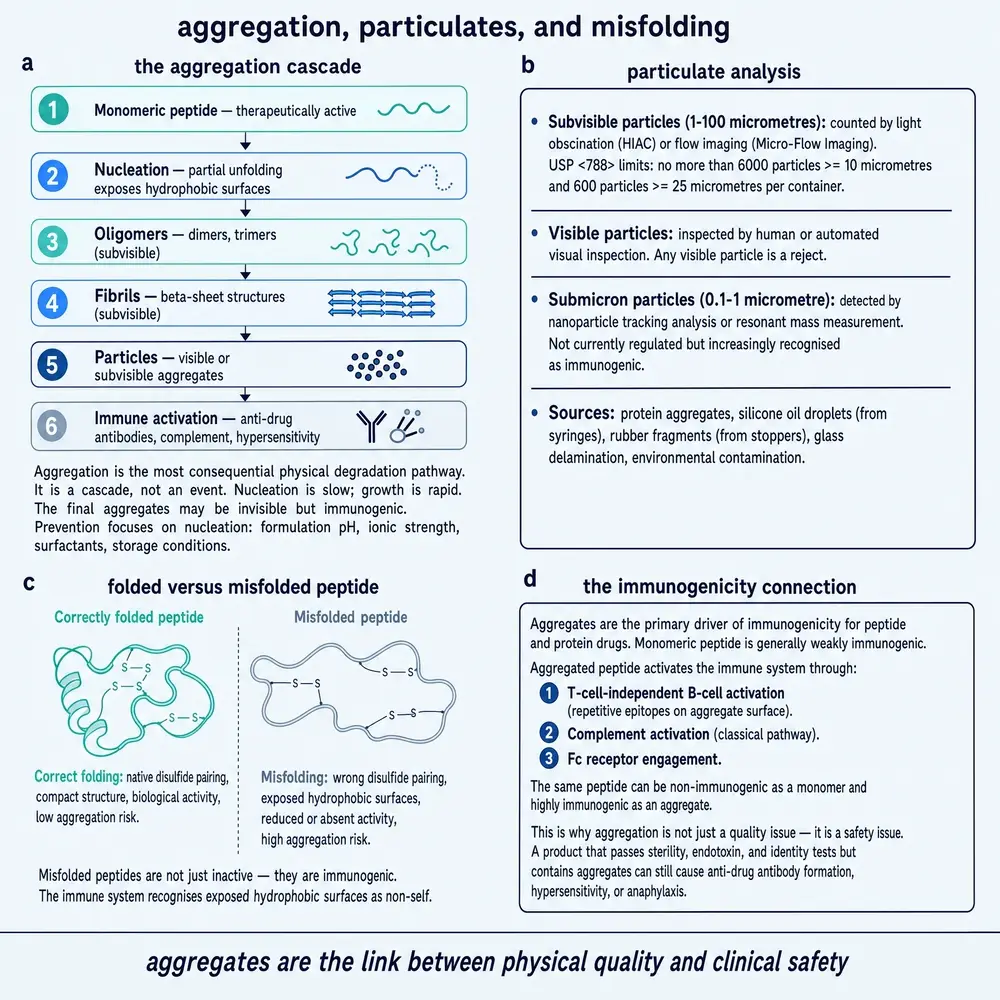
Container-closure integrity closes the fill-finish argument at principle level. CCI failures can admit microbes, alter headspace, or allow moisture ingress that accelerates solid-state or solution degradation. Dye ingress, vacuum decay, helium leak and other methods exist in the parenteral toolkit; choosing among them is a validated engineering decision inside licensed facilities. For this monograph, the only required claim is conceptual: sterility assurance and CCI are process attributes supported by testing, not synonyms of a clean HPLC trace.
Section 19Cold chain, in-use stability, and the product after release
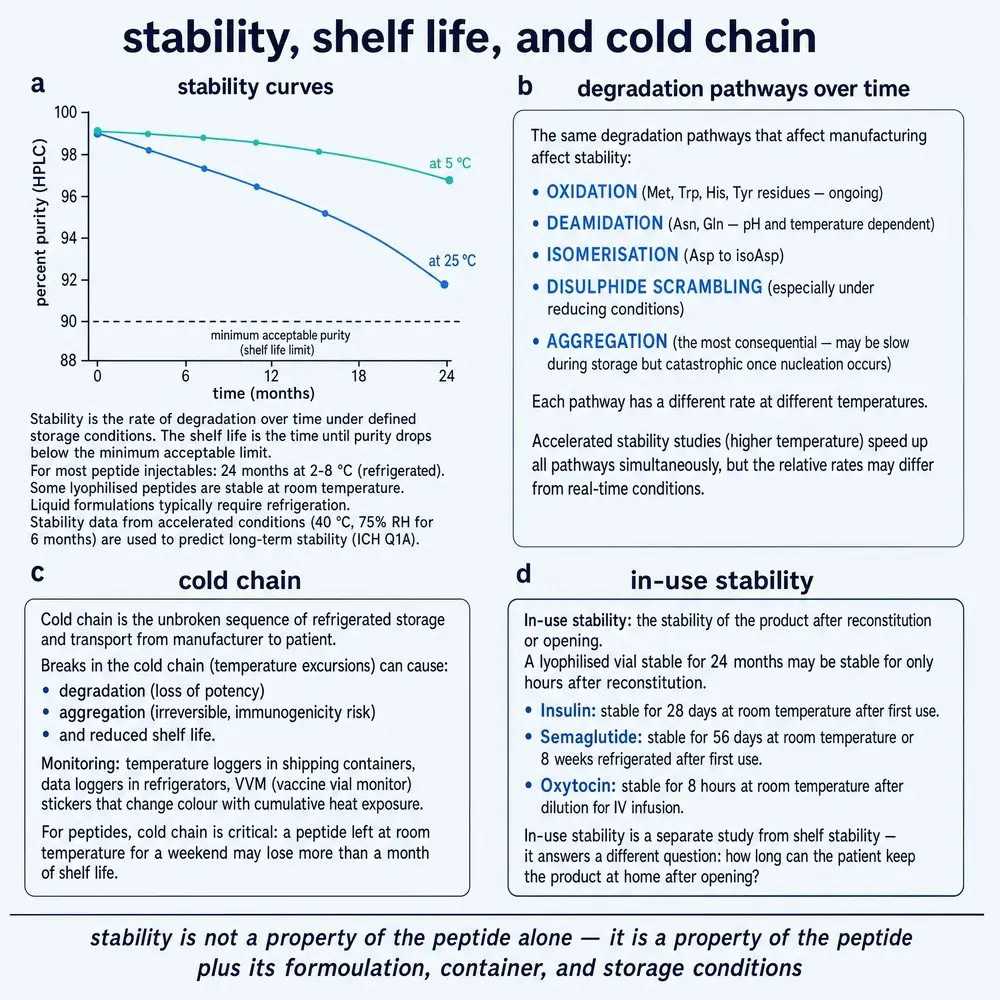
Release is not the end of quality. Peptides remain perishable after they leave the warehouse logic of the manufacturer. Cold-chain excursions, agitation, light, repeated vial entries and in-use holding times all re-open degradation pathways that development studies tried to close. Insulin and related products generate some of the clearest literature on how assay, related impurities and high-molecular-weight protein evolve under accelerated, forced-degradation and in-use protocols.107
Container and device design participate in that story. Adsorption to surfaces, leachables, moisture ingress through closures, and freeze–thaw in distribution can alter delivered dose and impurity profile even when the release CoA was impeccable. Quality is therefore not only a factory attribute; it is a life-cycle attribute stretching from synthesis to the last authorised in-use condition described in the relevant pharmaceutical information — information this research monograph does not convert into advice.
Forced-degradation logic previewed here and developed in Part Four is the bridge: heat, humidity, oxidation, light and justified pH stress reveal which methods are stability-indicating and which soft spots the sequence actually has. Deamidation, oxidation, aspartimide chemistry and aggregation are not generic risks; they are molecule-specific manufacturing and storage problems.876
One more formulation–analytics bridge belongs here before Part Four. Forced-degradation design should be sequence-informed: asparagine and glutamine deamidation, methionine and tryptophan oxidation, aspartimide at sensitive motifs, disulfide exchange, and fibrillation-prone hydrophobic stretches are not equally likely in every peptide.87 Lipidated analogues add self-association pathways that may require native MS or orthogonal biophysics beyond RP purity.14 Excipient reactivity — oxidised polyols, reactive carbonyls, peroxide in surfactants — can create degradants that look like “mysterious product-related impurities” until the formulation ledger is examined.24 A stability programme that stresses only the API in water and never the formulated presentation is asking the wrong question for drug-product CQAs.
Cold-chain and in-use studies also expose the difference between drug- substance and drug-product thinking. A lyophilized cake that is stable at controlled room temperature for months may become fragile after reconstitution; a refrigerated solution that is chemically stable may fibrillate under shipping agitation; a multi-dose vial may accumulate silicone and proteinaceous particles after repeated entries. None of those outcomes is visible in a synthesis CoA. They are why Part Three insists that quality is a life-cycle attribute, and why Part Four’s CoA literacy questions ask what was out of scope.
Taken together, Part Three argues that the chain is not yet a product when synthesis ends. Folding, conjugation, purification pool cuts, excipient phase behaviour, residual moisture, aseptic fill-finish capacity and cold-chain life-cycle stresses each rewrite the impurity and aggregate ledger. The operations are inseparable from the analytics that follow: without Part Four’s methods, Part Three’s process stories cannot be verified; without Part Three’s process stories, Part Four’s methods do not know what to look for.
Part Four turns from operations to measurement: the CQAs and the analytical matrix that make the claims in Parts Two and Three scientifically legible.
Section 20Identity, sequence, and mass
Identity answers a deceptively plain question: is this the molecule we intend? For peptides, the first modern answer is usually mass spectrometry — intact mass for the expected molecular weight, reduced mass for separate chains where disulfides apply, and peptide mass fingerprinting or MS/MS sequencing after controlled digestion. Intact mass alone is not a full identity test: isomers, disulfide scramble patterns and some modifications can share a mass. Mapping under reducing and non-reducing conditions is how insulin programmes confirm both sequence and native disulfide linkages.1011
HPLC purity is not identity. A single main peak under reversed-phase UV detection can be the wrong regioisomer, the wrong diastereomer, or a co-eluting mixture. Regulatory and analytical reviews of therapeutic peptides therefore treat LC–MS and peptide mapping as partners to chromatography, not as optional academic extras.6 EMA synthetic-peptide expectations similarly call for orthogonal structural characterisation — mass spectrometry, amino-acid analysis, peptide mapping, NMR and circular dichroism as scientifically justified — rather than reliance on a purity chromatogram alone.
Higher-order identity — secondary, tertiary and quaternary structure — needs orthogonal spectroscopy and sometimes calorimetry or crystallography. Far- and near-UV circular dichroism, FTIR amide bands, intrinsic fluorescence, NMR fingerprint overlays and DSC melting transitions appear repeatedly in biosimilar insulin packages because primary structure similarity does not, by itself, prove conformational similarity.101116
Reference standards make identity claims quantitative. For synthetic peptide therapeutics, well-characterised reference standards support identity, purity and strength tests; value assignment often uses a mass-balance approach on bulk material followed by assignment to vialed lyophilized standards, with NMR, MS and chromatography among the characterisation tools. Chiral or isobaric amino acids may require additional techniques beyond routine HPLC.18 Without a named reference standard and a method with stated discriminating power, “identity confirmed” is marketing language. Identity methods can be excellent and still incomplete: a method validates only what it was designed to detect, at the resolution its sample preparation and data analysis allow.
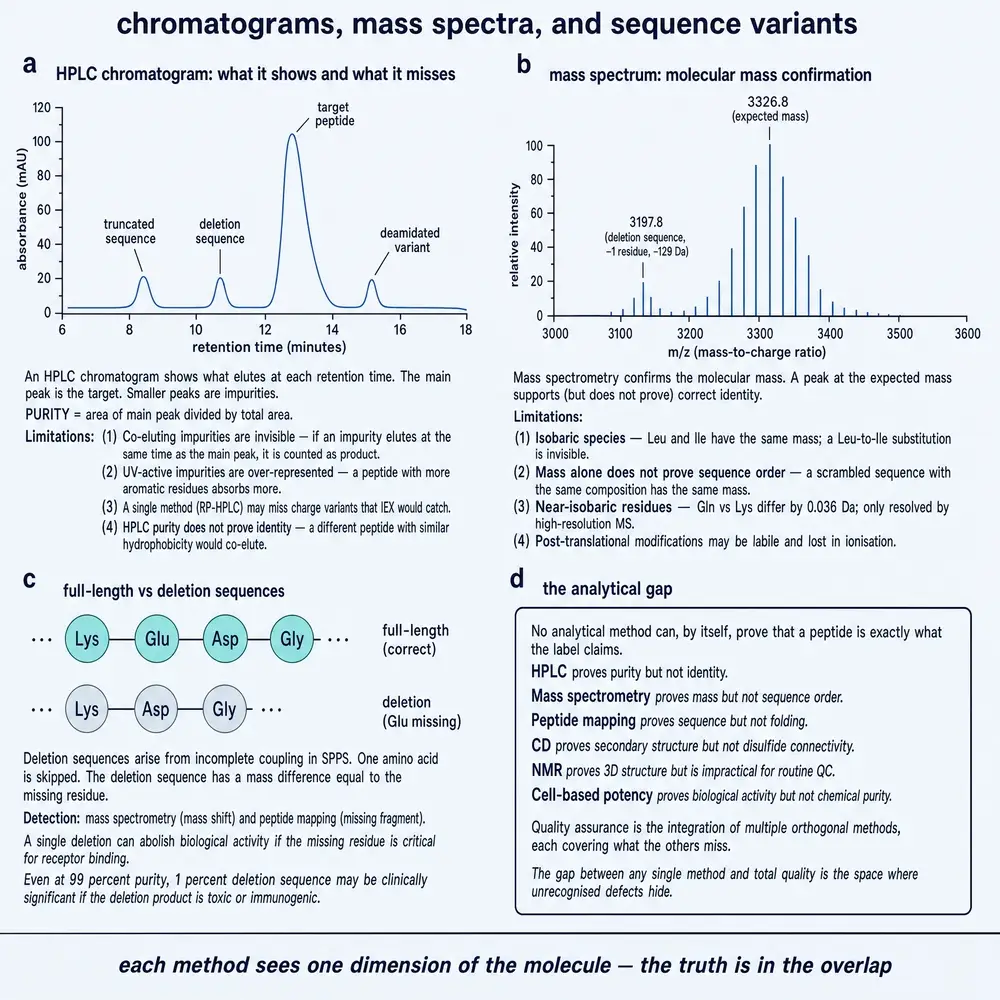
Amino-acid analysis, N-terminal sequencing and chiral amino-acid methods remain useful when MS alone cannot settle composition or stereochemistry. They are slower and more consumptive than a quick intact-mass check, which is exactly why under-specified CoAs omit them. For peptides containing multiple isobaric residues or D-amino acid edits, omission is not efficiency; it is blindness.186
Peptide mapping protocols — enzymatic digestion followed by LC–MS of the resulting fragments — supply sequence coverage and can locate modifications that intact mass merely implies. Mapping is not magic: missed cleavages, incomplete coverage of difficult stretches, and disulfide-aware versus reduced workflows change what the map can claim. Even mature biotherapeutic mapping methods require protocol discipline; peptide APIs deserve no less. For synthetic peptides with non-canonical residues, mapping enzymes and fragmentation schemes must be justified rather than copied from proteomics defaults.618
Higher-order structure assessment sits in a regulatory conversation that sponsors must navigate carefully. Some product-specific and regional expectations emphasise secondary/tertiary structure; others also discuss quaternary association states and oligomers as quality-relevant. SEC, SEC-MALS, AUC, NMR and CD answer different slices of that question. The analytical error is to report a CD overlay as if it closed oligomer risk, or an SEC monomer peak as if it closed secondary-structure drift. Orthogonal packs exist because each method is partially blind.1014
Section 21Purity and the impurity taxonomy
Purity is always purity with respect to a method. Reversed-phase HPLC with UV detection is the workhorse for many product-related impurities: deamidations, isomerisations, oxidations and some truncations. Size-exclusion HPLC targets high-molecular-weight protein. Capillary electrophoresis and ion-exchange add charge-based selectivity when RP selectivity fails. The numerical purity on a CoA is the area percentage under stated integration rules — not a metaphysical fraction of truth.10
Insulin aspart impurity chemistry is a useful teaching example. Asn deamidation at A21 or B3, Asp isomerisation at B28, and covalent high-molecular-weight species form a named catalogue with RP and SE methods built to resolve them. Forced-degradation and accelerated studies then show how those species grow, which is how stability-indicating capability is argued.107 Deletion peptides from SPPS add another catalogue entirely: full-length versus des-X species may be barely resolved if hydrophobicity differences are slight (see the full-length versus deletion schematic in Part Two).
Process-related purity is a parallel ledger: residual solvents, reagents, metals, host-cell protein, host-cell DNA, residual cleavage enzymes, endotoxin. Each typically needs its own method family. Collapsing all of that into a single “purity %” is how CoAs become misleading. For synthetic peptides destined for human medicinal products, the European regulatory frame now states explicitly that ICH Q3A impurity thresholds do not apply; peptide-related impurity reporting, identification and qualification logic is instead tied to Ph. Eur. substances-for-pharmaceutical-use expectations, while elemental impurities and nitrosamine risks remain under ICH Q3D and ICH M7 as applicable (official instrument names and URLs in the Apparatus). Trade summaries commonly quote Ph. Eur.-anchored thresholds on the order of >0.1% report / >0.5% identify / >1.0% qualify; those numeric anchors should always be confirmed against the primary Ph. Eur. and EMA texts rather than treated as immutable folklore.
U.S. generic-peptide expectations have likewise moved toward explicit impurity, innate-immunity, higher-order structure and biological-activity assessment themes in product-specific guidances, especially as the 2021 highly purified synthetic peptide ANDA guidance was withdrawn for revision (status path in Part Five and Apparatus). The research moral is not to memorise every PSG table; it is to recognise that impurity control for peptides is now a first-class regulatory science problem, not a borrowed small-molecule afterthought.6
ICH Q6B’s purity logic for biotechnological products remains instructive even when a synthetic peptide is not formally inside Q6B’s scope: distinguish product-related variants from process-related impurities and contaminants; justify what is measured routinely versus what was used only for characterisation; and refuse to pretend that one chromatographic purity number covers the ledger.617
Section 22Potency and the bioassay problem
Potency asks whether the batch does the biological work expected of the molecule, at the strength expected, relative to a reference standard. For insulin analogues, that may include receptor binding kinetics, cell-based phosphorylation or glucose-uptake assays, and historically animal bioidentity tests. For other peptides, cAMP accumulation, receptor signalling, or antimicrobial killing assays play analogous roles. Potency is not redundant with purity: a chemically pure inactive isomer can fail potency; a partially impure batch can still meet a potency specification if the assay is insensitive to the impurity.11108
Q6B-style specification thinking treats biological activity as a core category for many polypeptide products precisely because physicochemical identity does not guarantee function. Whether a finished synthetic-peptide product requires a routine potency assay can depend on whether activity is governed by primary sequence alone or by higher-order structure — a distinction EMA synthetic-peptide guidance invites sponsors to justify rather than assume.6
Bioassays are variable. Cell banks drift; animals differ; reagents age. Parallel-line analyses, system-suitability criteria and reference-standard governance exist because a potency number without those controls is anecdote. Mitogenic off-target panels for insulin analogues illustrate another nuance: functional characterisation may include assays that are not the labelled mechanism but speak to safety-relevant signalling similarity.11 Readers should treat research-vendor “activity” claims with particular caution when the assay is unnamed, the standard is unspecified, or the matrix is a novel analogue without a public reference method. Relative potency without a characterised reference standard is especially treacherous: two laboratories can report different “100%” values for the same powder if their standards differ in content assignment or impurity burden.18 Potency is a relational claim; name both sides of the relation.
Section 23Sterility, endotoxin, and particulates
Sterility testing asks whether viable microorganisms are detectable under the conditions of the test in the units examined. It is necessary for sterile products and insufficient as a sole sterility assurance strategy — process design and monitoring carry the heavier load. Bacterial endotoxin testing (for example, gel-clot or photometric limulus amoebocyte lysate methods) addresses pyrogenic lipopolysaccharide risk from Gram-negative hosts and other contamination routes. A peptide can be chemically beautiful and endotoxic.1019
Particulates occupy a third axis. Visible particles, subvisible particles, and nanometre-scale aggregates are not interchangeable. Silicone oil, proteinaceous particles and extrinsic fibres require different investigative responses. Schematically, particle analysis sits beside SEC and light scattering as part of the physical-quality toolkit, not as an optional aesthetic check.
None of these microbiological or particulate attributes is implied by an HPLC purity percentage. That sentence is worth reading twice whenever a CoA offers chemistry without microbiology for a material intended for injection research models. Fill-finish capacity constraints discussed in Part Three do not alter the analytical rule: sterility and endotoxin are independent claim lanes. Research materials intended only for non-parenteral in vitro work may justifiably omit sterility testing; the omission should be explicit, not hidden behind a chemistry-only certificate that looks like a drug-product CoA.
Section 24Residuals, water, and aggregation
Residual solvent panels, residual moisture, residual counter-ions and residual conjugating reagents are the quiet CQAs. They rarely star in marketing summaries and frequently decide whether a synthetic or recombinant batch is pharmaceutically acceptable. Karl Fischer titration, loss-on-drying, GC residual solvents and specific reagent assays appear throughout insulin and peptide release packages for that reason.1019 Lyophilized polypeptide programmes that ignore residual moisture while celebrating a crystalline cake risk exactly the solid-state instability pathway crystalline excipients can worsen.94
Aggregation is both a purity attribute and a safety-relevant structural attribute. SEC tracks covalent or stable high-molecular-weight species under dissociating mobile phases; AUC, light scattering and thioflavin-type assays address other layers of self-association and fibrillation risk. Amylin and insulin literatures are rich in fibrillation mechanics; lipidated incretins add oligomerisation pathways visible to advanced native MS. The analytical moral is familiar: choose the method for the aggregate class you fear.8251428
Excipient-derived covalent modifications — as when oxidised glycerol aldehydes attack thymopentin — blur the line between residual control and product-related impurity control. The degradant is not present at release from the peptide process; it grows from the formulation’s other ingredients.24
Section 25The analytical method matrix
The useful way to read peptide analytics is as a matrix: rows are CQAs, columns are method families, and cells say whether a method is primary, orthogonal, supportive or blind. Identity leans on MS and mapping; higher-order structure on CD/NMR/FTIR/DSC; product-related purity on RP-HPLC; aggregates on SEC and orthogonal biophysics; potency on bioassay; safety residuals on HCP, DNA, endotoxin, solvents; formulation components on specific assays for phenol, zinc, pH, osmolality.10116
Orthogonality is not decoration. Two methods that fail for the same reason are not orthogonal. RP-HPLC and SE-HPLC are orthogonal for many peptides because they separate on different physicochemical principles; two RP methods with similar selectivity may not be. Biosimilar programmes institutionalise this thinking when they demand state-of-the-art orthogonal packs rather than a single comforting chromatogram. Industry control-strategy literature for synthetic peptide APIs likewise recommends at least two orthogonal methods for comprehensive impurity and identity assessment — typically pairing chromatography with mass spectrometry and mapping rather than declaring victory after one UV trace.
Method validation — specificity, accuracy, precision, linearity, range, detection/quantitation limits, robustness — decides whether a number is fit for release use. An academic HPLC trace can be scientifically informative without being a validated GMP method. Confusing the two is a common source of false confidence in research settings. Multi-attribute LC–MS methods (MAM) emerging in biotherapeutic testing illustrate the direction of travel: monitor many product quality attributes at amino-acid resolution, but only after the method’s claims are validated for the decisions they support. Unified multiplex platforms for therapeutic-peptide characterisation appear in the analytical chemistry literature for the same reason: expedite method development without surrendering the orthogonal breadth regulators expect for complex peptide APIs.6
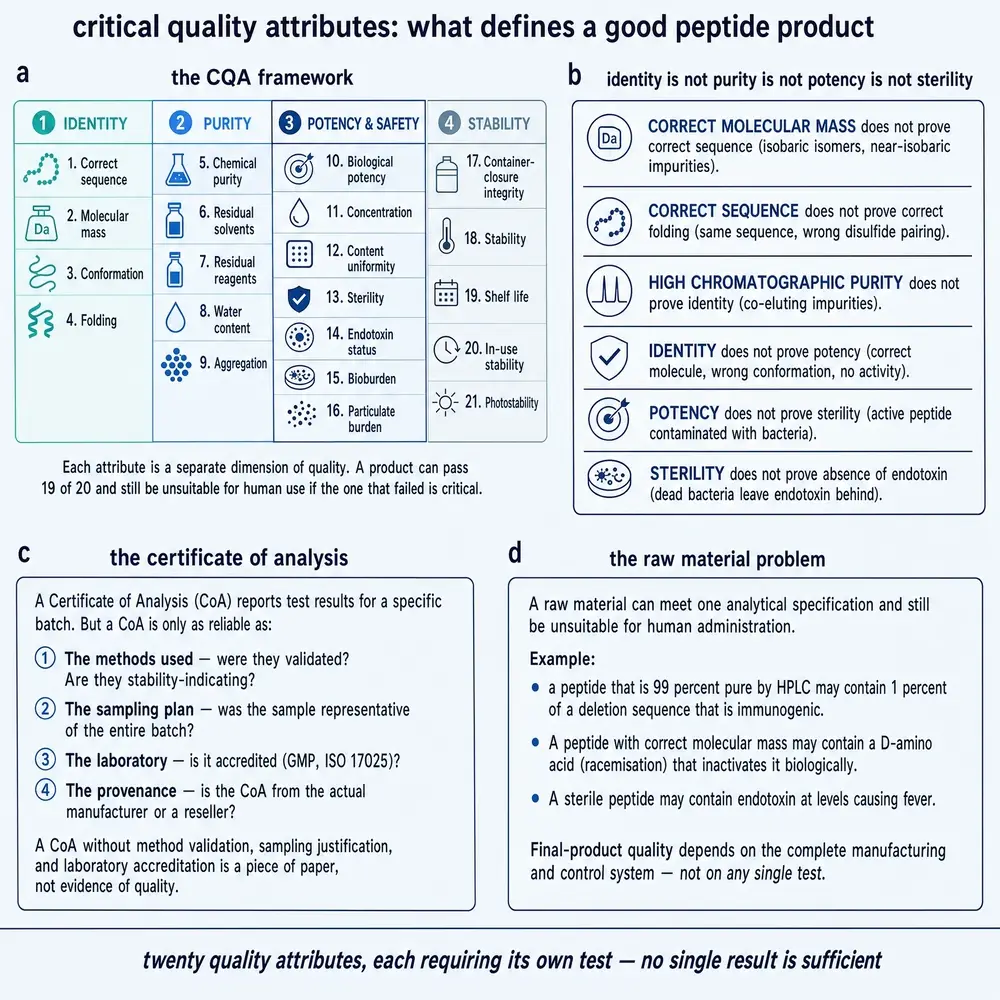
A practical way to stress-test an analytical package is to ask which impurity class would be invisible if it were present at a pharmaceutically relevant level. Deletion peptides near the parent hydrophobicity challenge RP. Diastereomers challenge non-chiral methods. Scrambled disulfides challenge intact mass. Reversible oligomers challenge denaturing SEC. Host-cell proteins outside ELISA coverage challenge immunoassays. Silicone droplets challenge chemistry-only particulate thinking. If the package cannot name a detection strategy for each feared class, the package is incomplete — even if every current batch looks clean.
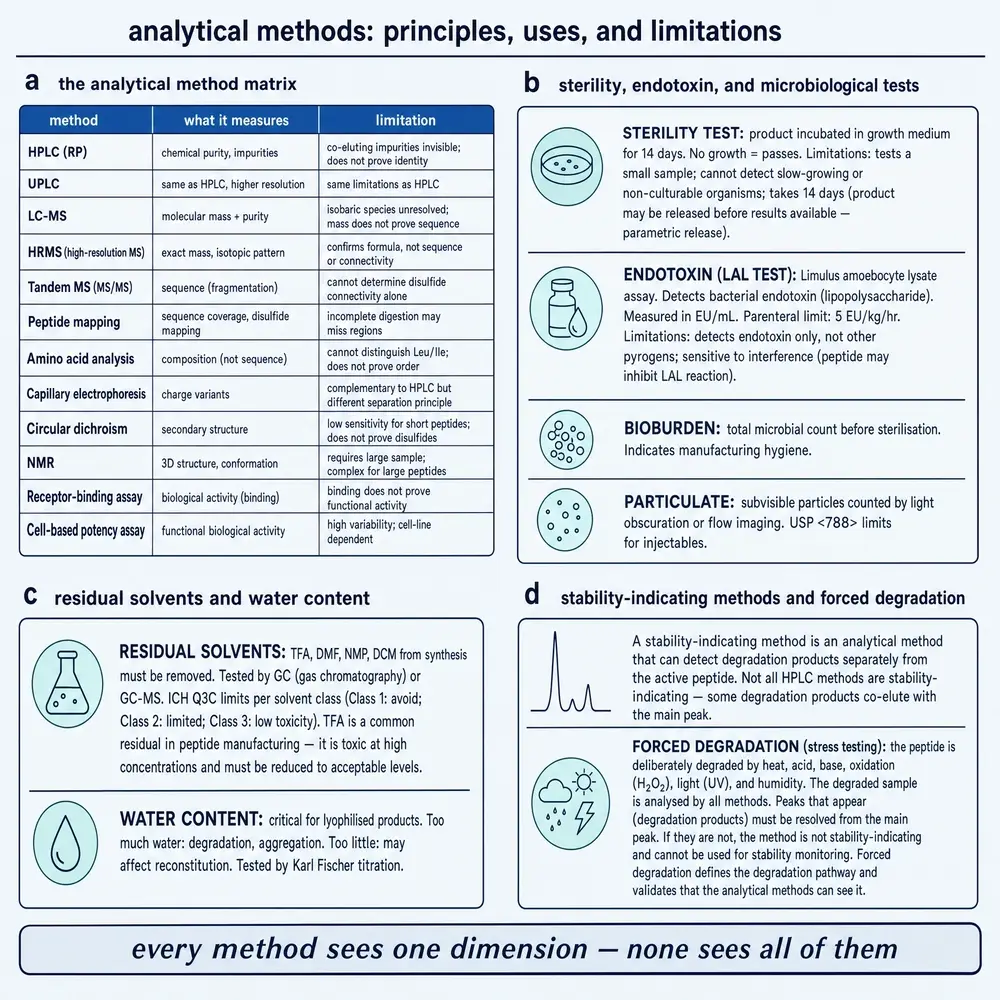
Section 26Stability-indicating methods and forced degradation
A method is stability-indicating when it can resolve the drug from its degradation products and track relevant changes over time. Forced degradation — heat, humidity, oxidation, light, acid/base where scientifically justified — is how that capability is challenged. Insulin aspart and glargine programmes document accelerated, forced and in-use arms with assay, related impurities and HMWP as the attributes expected to move.107 Regulatory analysis reviews likewise place stability testing and forced-degradation design inside the same quality grammar as identity and purity.6
Solid-state and solution pathways differ. Deamidation and covalent aggregation may dominate powders under humid heat, while interfacial aggregation and fibrillation may dominate agitated solutions. Sequence-specific chemistry matters: asparagine-rich amylin analogues demanded deliberate residue deletion and disulfide replacement to achieve neutral-pH chemical stability. Stability programmes that ignore the molecule’s known soft spots are theatre.87 Excipient phase behaviour (crystalline versus amorphous) can rewrite the solid-state soft-spot list even when the peptide sequence is unchanged.9
Shelf-life claims, where they exist for authorised products, rest on these data under pharmaceutical regulation. This research monograph records the scientific structure of that argument; it does not assign dating periods to research materials.
Forced-degradation studies also discipline method development priorities. If oxidation products dominate under peroxide stress but the release RP method cannot resolve them from the parent, the method is not stability-indicating for that pathway. If solid-state humidity stress generates covalent aggregates visible only by SEC or reductive chain analysis, an RP-only stability programme is theatre.7 If crystalline mannitol destabilises a freeze-dried polypeptide over long storage, XRPD and residual-moisture trending belong beside RP purity in the stability story.9 The matrix in Section 25 is therefore not a menu; it is a set of forced choices driven by the molecule’s actual soft spots.
Section 27What a CoA can and cannot certify
Pull the threads together. A responsible CoA for a therapeutic-peptide research material names the methods, the specifications, the laboratory, the batch genealogy and the date. It distinguishes identity, purity attributes, potency (if claimed), water, residuals and microbiological attributes appropriate to the intended research use. It does not certify what it did not measure. It cannot convert a research-use-only material into a medicine. It cannot make HPLC stand in for LC–MS identity, or a purity percentage stand in for endotoxin control, or a reference-standard-free assay stand in for potency.186
Ask of every certificate: Which CQAs are covered? Which methods? What is the reference standard? What was sampled? What is out of scope? If sterility or endotoxin is relevant to the experimental use and absent from the CoA, that absence is information. If purity is reported without method identity, the number is unfinished. If identity is claimed from HPLC alone, the claim is unfinished.
Regulatory analysis reviews published in 2025 synthesise FDA, ICH and EMA expectations into a single practical warning for laboratories: physical and chemical characterisation must be tailored to each peptide or protein drug, because instability modes and impurity catalogues are not interchangeable across the modality.6 That warning is the analytical twin of Part Two’s route-aware impurity grammar. It also explains why reference standards and forced-degradation libraries are worth the cost: without them, laboratories optimise methods against clean standards and then meet dirty batches unprepared.18
Research-vendor CoAs deserve a final, blunt paragraph. A purity percentage without method identity, wavelength, integration rules and system suitability is unfinished. An “MS confirmed” tick without mass accuracy, adduct interpretation or comparison to a reference is unfinished. An “endotoxin tested” claim without method and limit is unfinished. Absence of sterility or bioburden data is information when the material will enter an injection model. None of these literacy points authorises human use; they exist to stop researchers from mistaking a marketing PDF for pharmaceutical release.6
Figure 1 is the schematic reminder for the whole Part: separate claim lanes, separate methods, no transitive magic between them. Part Five places those analytics inside release decisions, scale-up, validation, the evolving FDA/EMA/ICH frame and the environment in which manufacturing science now operates. Analytics without a release and regulatory frame are unfinished; a regulatory frame without analytics is empty procedure.
Section 28Release is a decision, not a printout
Batch release is the formal judgement that a lot conforms to its specification and was made under a controlled process. The analytical results are inputs to that judgement; they are not the judgement itself. Out-of-specification investigations, invalid assay rules, reference-standard failures and environmental monitoring excursions can all stop a release even when a subset of results looks acceptable. Conversely, retests without investigation discipline can manufacture false comfort.
Specifications should be clinically and scientifically justified where the product is a medicine, and scientifically justified for the stated research context where it is not. Tightening a purity limit below what methods can reliably measure is theatre; loosening a potency limit until any batch passes is abdication. Insulin biosimilar programmes illustrate a mature pattern: define QTPP from reference-product understanding, risk-rank CQAs, and build specifications that reflect impact on biological activity, PK/PD, immunogenicity and safety uncertainty.1011 Broader regulatory-science writing on protein-therapeutic specifications likewise emphasises that acceptance criteria are not merely process capability snapshots; they should reflect efficacy and safety reasoning, with growing attention to patient-centric specification design.17
ICH Q6B remains the clearest international statement of specification logic for biotechnological products built from proteins and polypeptides: a specification is a list of tests, analytical procedures and acceptance criteria, justified by characterisation and manufacturing experience, covering identity, purity/impurities, potency and quantity as relevant. Synthetic peptides do not always sit neatly inside Q6B, but the grammar — characterisation is broader than routine release testing; specifications are part of a control strategy, not a substitute for one — transfers intact.617
Sampling is part of the decision. A sterility test on a few containers, a composite assay sample, or a top-and-bottom tank sample each answers a different statistical question. Readers of CoAs who ignore sampling are reading poetry. Reference-standard governance is likewise part of release: content uniformity, identity confirmation and stability of the standard decide whether the batch number is comparable to last month’s.18 Out-of-trend results — still inside specification but drifting relative to historical process capability — deserve investigation culture too. Waiting for an OOS before noticing that deletion peptides are rising across campaigns is how chronic process problems become acute release crises.
Section 29Scale-up and the process that changes its mind
A route that works in a fume hood can fail in a plant for boring reasons: heat-transfer lags, mixing times, local pH excursions during titration, chromatography loadings that alter selectivity, hold times that invite degradation, and filtration areas that shear or adsorb product. Peptide SPPS scale-up adds resin swelling variability and cleavage exotherms; recombinant scale-up adds oxygen-transfer and inclusion-body refolding kinetics that do not linearise with volume.2219
Process and scale can change impurity catalogues even when the intended sequence is fixed. Pharmaceutical-research case studies on GLP-1 analogues have documented that production process and manufacturing scale influence polypeptide drug quality attributes — a concrete warning against assuming that a laboratory impurity profile will survive plant transfer unchanged. Comparability after scale change is therefore an evidence problem: structural and impurity profiles, stability behaviour and functional assays should be compared against the pre-change baseline with predefined acceptance logic. “It is the same SOP with a bigger reactor” is not evidence.
Technology transfer between sites multiplies the same issue: water quality, raw-material grades, equipment surface materials and analyst practice all imprint on peptides. A successful transfer ends in demonstrated equivalent control, not in shipped paperwork alone. Fill-finish tech transfer carries the additional burden that aseptic processing states of control are site-specific; API comparability does not automatically confer drug-product comparability.
Section 30Validation, continuous control, and documentation
Validation is the documented demonstration that a process or method consistently does what it claims. Process validation links critical process parameters to CQAs across challenged ranges. Analytical validation links method performance to the decisions the method supports. Cleaning validation asks whether residues of a previous peptide or detergent will not contaminate the next. Computerised-system controls increasingly sit beside all three.
ICH pharmaceutical-development and quality-risk-management principles (Q8/Q9 and related quality guidelines, together with Q10 pharmaceutical quality-system expectations) supply the shared grammar even when exact pharmacopeial acceptance tables are not reproduced in this open corpus. The reading corpus shows those principles in operation whenever authors risk-rank attributes, justify methods and present control strategies for insulin analogues and other peptide products.1011 Industry perspectives on therapeutic-peptide control strategy note the continuing lack of full health-agency harmonisation for synthetic peptide API controls across clinical development and commercialisation; that gap does not excuse improvisation. It demands explicit, phase-appropriate justification of what is controlled in-process versus at release.
Documentation is not bureaucracy for its own sake. Without batch records, method versions, reference-standard logs and deviation histories, a CoA is an orphan number. Provenance — who made the material, from which master batch records, under which quality system — is part of what the CoA implicitly asserts.
Continuous process verification and lifecycle method management extend the same idea past traditional three-batch process validation. Peptide processes drift when raw-material suppliers change, when resin lots swell differently, when chromatographic media age, or when analytical columns lose selectivity. A control strategy that cannot detect drift will eventually release a batch that meets yesterday’s impurity catalogue and fails tomorrow’s patient or regulator. Industry control-strategy perspectives exist because that drift is normal; the abnormal response is pretending specifications alone will catch everything without process vigilance.
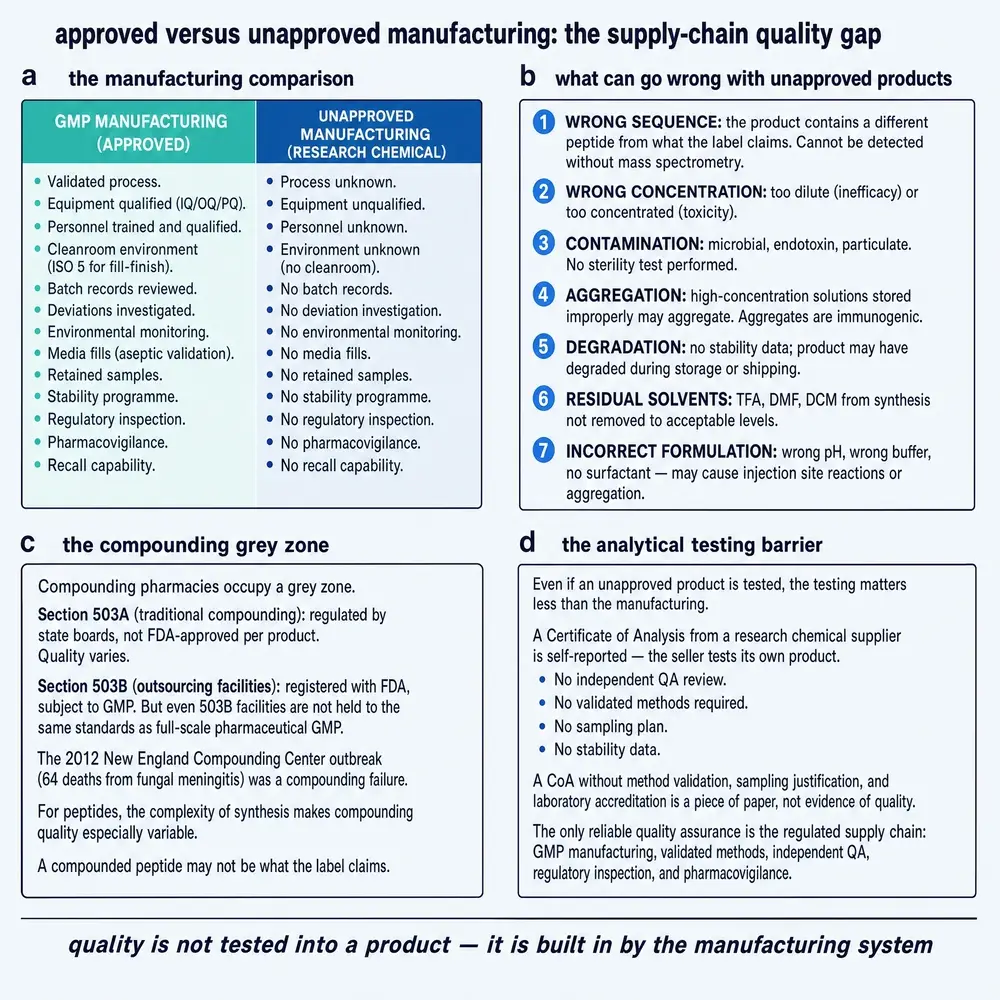
Section 31Regulatory geography, environment, and manufacturing stewardship
Peptide manufacturing now sits inside a denser regulatory geography than the early recombinant-insulin era. Three instruments deserve careful naming because secondary summaries often over-simplify them.
FDA ANDA peptide guidance (2021 status path). FDA issued final guidance for industry, ANDAs for Certain Highly Purified Synthetic Peptide Drug Products That Refer to Listed Drugs of rDNA Origin (May 2021), with Federal Register availability on 20 May 2021 (Docket FDA-2017-D-5767). The guidance addressed highly purified synthetic peptides referencing recombinant listed drugs — historically including glucagon, liraglutide, nesiritide, teriparatide and teduglutide — and framed impurity and immunogenicity evaluation expectations for ANDA pathways. Historical Agency presentations summarised its impurity logic as controlling common peptide impurities relative to the reference listed drug and characterising new peptide-related impurities above defined thresholds, with immunogenicity risk assessment tools in the evaluation toolkit. In July 2026, FDA announced withdrawal of that 2021 guidance because it no longer reflects the Agency’s current scientific thinking, concurrent with revised draft product-specific guidances for certain injectable peptide products covering recombinant, synthetic and semi-synthetic ANDA submissions, innate immune response testing, impurity thresholds, higher-order structure assessment and biological activity assessment. FDA has stated an intention to revise the withdrawn guidance on the CDER guidance agenda. Readers should therefore treat the 2021 text as historically important but not as current Agency thinking, and should follow the live FDA guidance page and PSG dockets rather than archived secondary blogs. The scientific continuity across that status change is the insistence that synthetic peptide generics are not ordinary small-molecule ANDAs: impurity catalogues, higher-order structure and biological activity remain first-class review themes even as the documentary vehicle evolves from a single cross-cutting guidance toward PSGs plus a planned revision.
EMA synthetic peptides guideline. EMA’s Guideline on the Development and Manufacture of Synthetic Peptides (EMA/CHMP/CVMP/QWP/367182/2025), effective 1 June 2026, clarifies quality expectations for chemically synthesised peptide active substances. Central points for manufacturing readers include: synthetic peptides are excluded from ICH Q3A impurity thresholds; peptide-related impurity control is anchored to Ph. Eur. substances-for-pharmaceutical-use expectations; elemental impurities fall under ICH Q3D; nitrosamine risk assessment under ICH M7 applies to synthetic peptide actives used in human finished products; orthogonal characterisation is expected; and manufacturing descriptions must make pooling, purification and conjugation strategies scientifically legible. The guideline’s impurity taxonomy matches the monograph’s process- versus product-related split: peptide- related impurities (truncations, deletions, insertions, racemisation products, degradation species) versus non-peptide impurities (reagents, solvents, elementals, potential mutagenic species). Exact numeric thresholds belong to the primary Ph. Eur. and EMA texts (URLs in Apparatus). Trade summaries that quote >0.1% / >0.5% / >1.0% report/identify/qualify anchors are useful orientation only after primary-text confirmation.
ICH Q6B and adjacent quality guidance. Q6B continues to supply identity/purity/potency/quantity specification logic for biotechnological products composed of proteins and polypeptides. It does not by itself solve synthetic-peptide impurity thresholds, but it remains the intellectual parent of much orthogonal characterisation practice reviewed in contemporary peptide analytical guidance literature.6 Q6B’s distinction between full characterisation and routine specification tests is especially useful for peptides: development may deploy NMR, crystallography, advanced native MS and extensive mapping, while release keeps a justified subset that still protects CQAs. Setting specifications only because “the process delivered it” without linking limits to clinical or toxicological relevance is the failure mode Q6B and later patient-centric-specification discussions both warn against.17
How these instruments interact in practice. A recombinant insulin biosimilar dossier may lean on Q6B-like characterisation and biosimilarity totality-of-evidence logic.1011 A synthetic GLP-1 analogue ANDA in the United States must now track live FDA PSGs and the withdrawal/update path of the 2021 highly purified synthetic peptide guidance rather than assume the 2021 text still speaks. A synthetic peptide MAA in Europe must absorb EMA/CHMP/CVMP/QWP/367182/2025 impurity and characterisation expectations, including Ph. Eur. anchoring outside ICH Q3A. Hybrid conjugates inherit whichever route-defining steps create their impurity catalogues. The research reader’s takeaway is not a filing checklist; it is that “peptide CMC” is no longer a single informal custom. It is a family of adjacent frameworks that must be matched to route, region and development phase.
Industry control-strategy writing fills gaps where agency harmonisation is still incomplete. The 2025 OPRD perspective on therapeutic-peptide control strategy and the earlier PolyPeptide control-strategy series are useful precisely because they show practitioners arguing purge factors, in-process controls and phase-appropriate specifications in public technical prose. Those arguments should be read alongside, not instead of, primary FDA, EMA and ICH texts. Where secondary trade summaries quote Ph. Eur. thresholds numerically, confirm against the pharmacopeia and the EMA guideline PDF before treating the numbers as authoritative.
Environmental stewardship intersects that regulatory frame. SPPS consumes solvents and coupling reagents at rates that multi-company PMI studies have quantified as far above typical small-molecule medians; chromatography consumes acetonitrile and other organics at preparative scale; recombinant trains consume water, energy and cleaning chemicals.1226 Wash-elimination and greener solvent programmes are manufacturing-science responses, not public-relations accessories.513 Stewardship fails if solvent substitution alters impurity profiles that methods cannot see, or if waste pressure shortens cleaning below validated limits. Convergent ligation of unprotected segments, as advocated in fundamental green-SPPS essays, is one long-term path that retains polymer-supported advantages while attacking protecting-group waste.13 Hybrid chemical–biological routes may shift burden from solvent mass to fermentation energy and HCP clearance; the PMI ledger simply moves, it does not vanish.
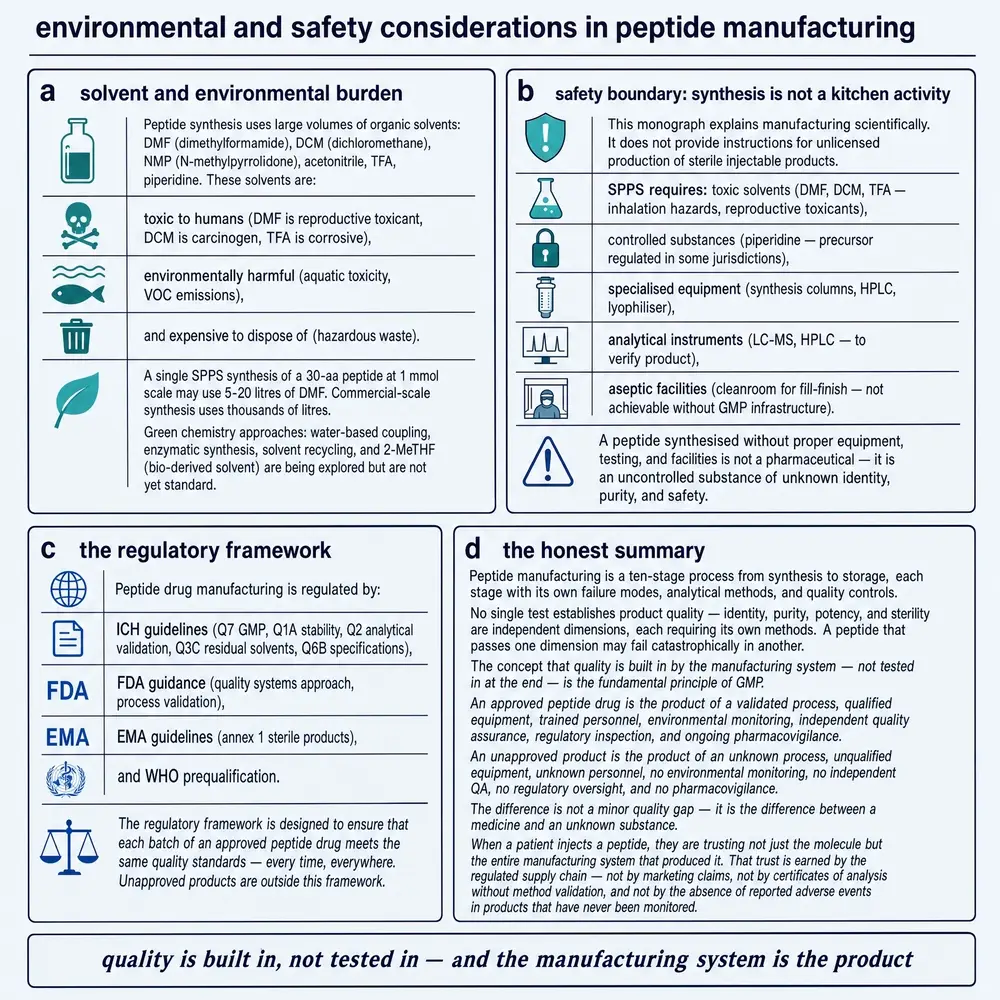
Scale-up validation and continuous process verification close the loop between stewardship and release. A solvent-reduced process that has not been challenged for impurity fate is not validated. A continuous chromatography concept that has not demonstrated equivalent impurity clearance to the registered batch process is not a drop-in green upgrade. Documentation must capture which CQA risks were reopened by each sustainability change — exactly the comparability discipline Part Five already demanded for ordinary scale changes.
Worker safety and environmental hygiene are likewise part of the real manufacturing system: potent peptides, allergens, and large volumes of TFA or piperidine are not abstract hazards. This monograph notes their existence without providing operational handling recipes.
Supply-chain quality completes the stewardship picture. Amino-acid derivative suppliers, resin manufacturers, chromatography media vendors and fill-finish CDMOs each contribute critical materials whose change control belongs inside the peptide maker’s quality system. A greener solvent swap at a contract manufacturer, a new protecting-group reagent lot with higher enantiomeric impurity, or a stopper silicone oil change can each move CQAs without any intentional process redesign. The documentation disciplines of Section 30 exist partly to make those external changes visible before release testing is asked to explain a surprise peak.
Section 32The standing research-use constraint
This series is research literature for educated readers, not a prescribing manual and not a contract-manufacturing playbook. Nothing in GPM 09 authorises human administration of any peptide. Nothing here is a substitute for licensed manufacturing under applicable law and pharmaceutical quality systems. Process science is described at the level of principles, history and quality logic; sterile injectable manufacture is not taught as a DIY craft. Regulatory instruments are named so that research readers can navigate the literature honestly; they are not reproduced as compliance checklists for unlicensed manufacture. If a sentence in this monograph can be misread as a fill recipe, dose schedule, or instruction to compound a sterile injectable outside a licensed quality system, that reading is wrong: the governing constraint is the callout below and the footer Research Use Only language.
No human use, dose, route or schedule is recommended anywhere in this document. No unsafe operational sterile-manufacturing SOP is provided. Research-use-only materials remain research-use-only regardless of how complete their CoA appears. Quality literacy is not permission. Regulatory URLs and guidance names are for scientific orientation only; they do not authorise manufacture or clinical use.
What, then, should a research reader carry out of Part Five? First, treat release as a decision architecture: specifications, sampling, investigations, reference standards and process history. Second, treat scale-up and tech transfer as impurity-profile experiments, not as volume arithmetic — especially for GLP-1-class polypeptides where process/scale effects are documented in the pharmaceutical literature. Third, treat the regulatory map as live: FDA’s 2021 highly purified synthetic peptide ANDA guidance was issued, then withdrawn with an announced revision path alongside updated peptide PSGs; EMA’s synthetic-peptide guideline is in force from June 2026 with Ph. Eur.-anchored impurity logic outside ICH Q3A; ICH Q6B still teaches specification grammar for polypeptides even when synthetic peptides need additional instruments. Fourth, treat sustainability metrics such as PMI as manufacturing-science data that reopen CQA questions when processes change.12 Fifth, refuse any reading of this monograph as permission to dose humans or to assemble a sterile injectable outside licensed pharmaceutical quality systems.
The controlling idea returns for the last time. Quality is a system property. Identity, purity, potency, sterility, endotoxin control, aggregation state and fold are separate claims, each needing methods, sampling and a laboratory worthy of trust. A CoA is a structured assertion, not a talisman. Manufacturing history — from pancreas extracts through Merrifield’s resin to recombinant and hybrid factories, and into today’s FDA/EMA/ICH control-strategy debates — is the story of inventing those claims and then inventing ways to challenge them. The Apparatus that follows gathers the glossary, taxonomies, matrices, regulatory URLs and references that make the argument navigable for research readers and manufacturing-literate scientists alike.
Section A1References
The list below is numbered and sorted by first-author surname. Every entry was resolved from the source record’s own metadata — author, title, journal, year, volume, issue, pages and identifiers — and never from recall. In-text citations are the superscript numbers throughout the document. Regulatory instruments named in prose are listed with official URLs in Section A7; they are not substituted for peer-reviewed bibliography entries. Newly integrated open PMC records from the API research pass are included when cited in the body; industry perspectives without PMC keys remain prose designations only.
- Akter S, Afrin S, Kim J, Kang J, Razzak MA, Berggren P, et al.. Production of active Exendin-4 in Nicotiana benthamiana and its application in treatment of type-2 diabetics. Frontiers in Plant Science. 2022;13:1062658.
PMID 36618620 · doi:10.3389/fpls.2022.1062658 · PMC9812950 - AlShaer D, Al Musaimi O, Williams DR. Application of the OBIMAP (One-Bead Interchain Multipeptide Assembly Platform) to Long Peptide Synthesis: Liraglutide as a Case Study. ACS Omega. 2026;11(13):21369.
PMID 41970854 · doi:10.1021/acsomega.6c00648 · PMC13063175 - Cheng X, Wu C. Directing the oxidative folding of disulfide-rich peptides for enhanced engineering and applications. Chemical Science. 2025;16(41):19012-19025.
PMID 41079656 · doi:10.1039/d5sc05617a · PMC12509089 - Cheng Y, Duong HTT, Hu Q, Shameem M, Tang XC. Practical advice in the development of a lyophilized protein drug product. Antibody Therapeutics. 2025;8(1):13-25.
PMID 39839910 · doi:10.1093/abt/tbae030 · PMC11744310 - Collins JM, Singh SK, White TA, Cesta DJ, Simpson CL, Tubb LJ, et al.. Total wash elimination for solid phase peptide synthesis. Nature Communications. 2023;14(1):8168.
PMID 38071224 · doi:10.1038/s41467-023-44074-5 · PMC10710472 - Elsayed YY, Kühl T, Imhof D. Regulatory Guidelines for the Analysis of Therapeutic Peptides and Proteins. Journal of Peptide Science. 2025;31(3):e70001.
PMID 39921384 · doi:10.1002/psc.70001 · PMC11806371 - Fagan A, Bateman LM, O’Shea JP, Crean AM. Elucidating the Degradation Pathways of Human Insulin in the Solid State. Journal of Analysis and Testing. 2024;8(3):288-299.
PMID 39184306 · doi:10.1007/s41664-024-00302-5 · PMC11338979 - Fischer Munch H, Just R, Mosolff Mathiesen J, Eriksson P, Skodborg Villadsen J, Vestergaard B, et al.. Development of Petrelintide: a Potent, Stable, Long-Acting Human Amylin Analogue. Journal of Medicinal Chemistry. 2025;68(22):23925-23940.
PMID 41217931 · doi:10.1021/acs.jmedchem.5c01185 · PMC12670398 - Gao H, Ouyang J, Hu ZB, Fang WJ. The Detrimental Effects of Crystalline Excipients: How They Jeopardize the Long-Term Stability of Freeze-Dried Polypeptide Formulations. Pharmaceutics. 2025;17(12):1543.
PMID 41471057 · doi:10.3390/pharmaceutics17121543 · PMC12736198 - Ghade NS, Thappa DK, Lona J, Krishnan AR, Sonar SM. Comparative physicochemical and structural characterisation studies establish high biosimilarity between BGL-ASP and reference insulin aspart. Scientific Reports. 2024;14:4224.
PMID 38378730 · doi:10.1038/s41598-024-54819-x · PMC10879530 - Goyal P, Pai HV, Kodali P, Vats B, Vajpai N, Annegowda S, et al.. Physicochemical and functional characterization of MYL-1501D, a proposed biosimilar to insulin glargine. PLoS ONE. 2021;16(6):e0253168.
PMID 34133466 · doi:10.1371/journal.pone.0253168 · PMC8208551 - Kekessie I, Wegner K, Martinez I, Kopach ME, White TD, Tom JK, et al.. Process Mass Intensity (PMI): A Holistic Analysis of Current Peptide Manufacturing Processes Informs Sustainability in Peptide Synthesis. The Journal of Organic Chemistry. 2024;89(7):4261-4282.
PMID 38508870 · doi:10.1021/acs.joc.3c01494 · PMC11002941 - Kent SBH. Fundamental Aspects of SPPS and Green Chemical Peptide Synthesis. Journal of Peptide Science. 2025;31(5):e70013.
PMID 40210223 · doi:10.1002/psc.70013 · PMC11985259 - Kuo S, Xi Z, Cong X, Yan X, Russell DH. Dissecting Hidden Liraglutide Oligomerization Pathways via Direct Mass Technology, Electron-Capture Dissociation, and Molecular Dynamics. Analytical Chemistry. 2025;97(25):13465.
PMID 40521838 · doi:10.1021/acs.analchem.5c01851 · PMC12224166 - Laps S, Atamleh F, Kamnesky G, Sun H, Brik A. General synthetic strategy for regioselective ultrafast formation of disulfide bonds in peptides and proteins. Nature Communications. 2021;12:870.
PMID 33558523 · doi:10.1038/s41467-021-21209-0 · PMC7870662 - Li Y, Liu W, Liu D, Wang R, Zhang Y, Li X, et al.. Deciphering the significant impact of natural glycosylation on human insulin. Acta Pharmaceutica Sinica. B. 2025;15(11):5880-5890.
PMID 41311403 · doi:10.1016/j.apsb.2025.08.005 · PMC12648096 - Limpikirati PK, Mongkoltipparat S, Denchaipradit T, Siwasophonpong N, Pornnopparat W, Ramanandana P, et al.. Basic regulatory science behind drug substance and drug product specifications of monoclonal antibodies and other protein therapeutics. Journal of Pharmaceutical Analysis. 2024;14(6):100916.
PMID 39035218 · doi:10.1016/j.jpha.2023.12.006 · PMC11259812 - McCarthy D, Han Y, Carrick K, Schmidt D, Workman W, Matejtschuk P, et al.. Reference Standards to Support Quality of Synthetic Peptide Therapeutics. Pharmaceutical Research. 2023;40(6):1317-1328.
PMID 36949371 · doi:10.1007/s11095-023-03493-1 · PMC10338602 - Nguyen B, Tieves F, Rohr T, Wobst H, Schöpf FS, Solano JDM, et al.. Numaswitch: an efficient high-titer expression platform to produce peptides and small proteins. AMB Express. 2021;11:48.
PMID 33765268 · doi:10.1186/s13568-021-01204-w · PMC7994495 - Pascali G, Parmar A, Zanoni S, Arthur A, Hering A, Teakle N, et al.. Development and characterisation of novel oxytocin analogues for PET imaging. Communications Chemistry. 2025;8:328.
PMID 41193665 · doi:10.1038/s42004-025-01649-1 · PMC12589438 - Selis F, Schrepfer R, Sanna R, Scaramuzza S, Tonon G, Dedoni S, et al.. Enzymatic mono-pegylation of glucagon-like peptide 1 towards long lasting treatment of type 2 diabetes. Results in Pharma Sciences. 2012;2:58-65.
PMID 25755995 · doi:10.1016/j.rinphs.2012.09.001 · PMC4167179 - Siew YY, Zhang W. Downstream processing of recombinant human insulin and its analogues production from E. coli inclusion bodies. Bioresources and Bioprocessing. 2021;8(1):65.
PMID 34336550 · doi:10.1186/s40643-021-00419-w · PMC8313369 - Songok AC, Panta P, Doerrler WT, Macnaughtan MA, Taylor CM, Silman I. Structural modification of the tripeptide KPV by reductive “glycoalkylation” of the lysine residue. PLoS ONE. 2018;13(6):e0199686.
PMID 29953505 · doi:10.1371/journal.pone.0199686 · PMC6023233 - Sun M, Liao J, Jing Z, Gao H, Shen B, Xu Y, et al.. Effects of polyol excipient stability during storage and use on the quality of biopharmaceutical formulations. Journal of Pharmaceutical Analysis. 2022;12(5):774.
PMID 36320601 · doi:10.1016/j.jpha.2022.03.003 · PMC9615580 - Surin AK, Grishin SY, Galzitskaya OV. Determination of amyloid core regions of insulin analogues fibrils. Prion. 2020;14(1):149.
PMID 32543316 · doi:10.1080/19336896.2020.1776062 · PMC7518739 - Tatsumi T, Sasamoto K, Matsumoto T, Hirano R, Oikawa K, Nakano M, et al.. Practical N-to-C peptide synthesis with minimal protecting groups. Communications Chemistry. 2023;6:231.
PMID 37884638 · doi:10.1038/s42004-023-01030-0 · PMC10603086 - Trier S, Linderoth L, Bjerregaard S, Andresen TL, Rahbek UL, Castanho MARB. Acylation of Glucagon-Like Peptide-2: Interaction with Lipid Membranes and In Vitro Intestinal Permeability. PLoS ONE. 2014;9(10):e109939.
PMID 25295731 · doi:10.1371/journal.pone.0109939 · PMC4190408 - Yordanova Y, Vanderlinden W, Stoll R, Rüdiger D, Tosstorff A, Zaremba W, et al.. Zn2+-triggered self-assembly of Gonadorelin [6-D-Phe] to produce nanostructures and fibrils. Scientific Reports. 2018;8:11280.
PMID 30050082 · doi:10.1038/s41598-018-29529-w · PMC6062538 - Zhang T, Shi L, Xu Y, Li Y, Li S, Guan B, et al.. Purified PEGylated human glucagon-like peptide-2 reduces the severity of irradiation-induced acute radiation enteritis in rats. Journal of Radiation Research. 2018;60(1):7.
PMID 30247656 · doi:10.1093/jrr/rry076 · PMC6373673 - Zheng B, Wang X, Guo M, Tzeng CM. Therapeutic Peptides: Recent Advances in Discovery, Synthesis, and Clinical Translation. International Journal of Molecular Sciences. 2025;26(11):5131.
PMID 40507941 · doi:10.3390/ijms26115131 · PMC12154100
Section A2Glossary
ANDA. Abbreviated new drug application; U.S. pathway for generic drug products, including certain synthetic peptides referencing listed drugs.
Aggregation. Self-association of peptide molecules into dimers, oligomers, fibrils or particles; may be covalent or non-covalent.
BET. Bacterial endotoxins test.
CCI (container-closure integrity). Ability of the primary pack to maintain the intended barrier against contamination and exchange.
CoA (certificate of analysis). Batch document reporting results against specifications for named methods.
Control strategy. Planned set of controls derived from product and process understanding that assures process performance and product quality (in-process, procedural and release controls).
CQA (critical quality attribute). A physical, chemical, biological or microbiological property that should be within an appropriate limit to ensure product quality.
Deletion peptide. Sequence missing one or more amino acids, typically from incomplete SPPS coupling.
Endotoxin. Lipopolysaccharide from Gram-negative bacteria; a pyrogenicity and immunogenicity concern in parenteral products.
HCP / HCDNA. Host-cell protein / host-cell DNA residuals from recombinant production.
HMWP. High-molecular-weight protein; often measured by size-exclusion chromatography.
Identity. Confirmation that the material is the intended molecular entity (sequence, mass, connectivity, higher-order structure as applicable).
PMI (process mass intensity). Mass of materials used to produce a unit mass of product; a sustainability metric for manufacturing.
Potency. Biological activity relative to a reference standard under a stated assay.
Process-related impurity. Impurity arising from manufacture (reagents, host residuals, solvents), not a structural variant of the peptide.
Product-related impurity. Molecular variant of the peptide (truncation, modification, isomer, aggregate).
QTPP. Quality target product profile; prospective summary of quality characteristics needed for the intended product.
PSG. Product-specific guidance (FDA), often used for generic development recommendations for particular drug products.
RUO. Research use only; materials and this monograph are not medicines and do not authorise human administration.
SPPS. Solid-phase peptide synthesis.
Sterility. Absence of viable microorganisms as demonstrated by a defined test and assured by process design.
Section A4Manufacturing taxonomy (summary table)
| Mode | What is assembled | Characteristic impurity themes | Typical verification emphasis |
|---|---|---|---|
| Tissue / extract (historical) | Glandular peptides | Host proteins, species variants, potency drift | Bioassay, purification history |
| SPPS / chemical | Protected chain on resin | Deletions, truncations, racemisation, capping products, cleavage mods, Endo-Xaa-type species, residual reagents | LC–MS identity, orthogonal RP purity, residuals, chiral/isobaric checks as needed |
| Recombinant | Precursor in host cell | HCP, DNA, endotoxin, refold isomers, glycosylation (host-dependent) | Mapping, HCP/DNA/endotoxin, higher-order structure |
| Hybrid / conjugate | Backbone + chemical edit | Regioisomers, residual conjugating agents, mixed catalogues | Site selectivity, orthogonal purity, potency |
Section A5CQA framework (summary table)
| CQA cluster | Examples | Why it is not interchangeable |
|---|---|---|
| Identity / structure | Sequence, mass, disulfides, fold | Correct mass ≠ correct isomer or fold; HPLC ≠ identity |
| Purity (product-related) | Deamidation, deletion, oxidation, diastereomers | Method-defined; co-elution possible |
| Aggregates / particles | HMWP, fibrils, subvisible particles | May be invisible to RP purity |
| Potency | Receptor / cell / bioidentity assays | Inactive impurities can hide; active degradants can mislead |
| Safety residuals | HCP, DNA, solvents, metals, reagents, nitrosamine/elemental risk where applicable | Independent of peptide HPLC purity |
| Microbiology | Sterility, endotoxin, bioburden | Independent of chemical identity |
| Formulation / presentation | pH, water, excipient phase, preservatives, CCI, appearance | Drug substance pass ≠ drug product pass |
Section A6Analytical method matrix (summary)
| Question | Primary tools | Common orthogonal partners | Typical blind spots |
|---|---|---|---|
| What molecule is this? | Intact / reduced MS; peptide mapping | Edman / terminal sequencing; NMR; reference-standard comparison | Co-mass isomers; unscanned modifications; HPLC-only claims |
| Is the fold / disulfide pattern native? | Non-reduced mapping; CD; NMR | DSC; crystallography; potency | Low-level scrambled isomers |
| How chemically pure? | RP-HPLC–UV | IEX; CE; LC–MS impurity ID | Co-elution; non-UV impurities; diastereomers |
| Aggregates? | SE-HPLC | AUC; MALS; ThT / DLS; native MS as relevant | Reversible oligomers dissociated by mobile phase |
| Is it active? | Cell-based / binding / bioidentity | Second functional assay; justified omission only with science | Matrix interference; non-specific activity |
| Host / process residuals? | HCP ELISA; qPCR DNA; GC solvents | Orthogonal HCP coverage checks; specific reagent assays | ELISA under-coverage of HCPs |
| Endotoxin / sterility? | BET; compendial sterility | Alternative pyrogen strategies where justified | Sampling limits; inhibition/enhancement in BET |
| Solid-state / residual water? | Karl Fischer; XRPD; DSC | Cake elegance; reconstitution assays | “Dry therefore stable” superstition; crystalline excipient risk |
Section A7Regulatory appendix (instruments and URLs)
Authorised peptide medicines are developed and controlled under regional pharmaceutical law and under internationally harmonised quality expectations. Exact numeric acceptance criteria from copyrighted pharmacopeial text are not reproduced here as harvested tables; principles are explained from the open reading corpus, secondary discussion in cited papers, and official public instrument pages listed below.10116
ICH and related quality guidance (designations).
- ICH Q6B — Specifications: test procedures and acceptance criteria
for biotechnological/biological products (identity, purity, potency, quantity
logic for proteins/polypeptides).
PDF: https://database.ich.org/sites/default/files/Q6B%20Guideline.pdf
EMA landing: https://www.ema.europa.eu/en/ich-q6b-specifications-test-procedures-acceptance-criteria-biotechnological-biological-products-scientific-guideline - ICH Q8(R2) / Q9 / Q10 — pharmaceutical development, quality risk management, pharmaceutical quality system.
- ICH Q3C — residual solvents; ICH Q3D — elemental impurities; ICH M7 — mutagenic impurities / nitrosamine risk framework (applicable to synthetic peptide actives in human products per EMA synthetic-peptide guideline).
- ICH Q5C / Q1A(R2) — stability testing principles for biotech and new drug substances/products as relevant.
FDA — synthetic peptide ANDA guidance path (report carefully).
- Federal Register availability notice (20 May 2021) for ANDAs for Certain Highly Purified Synthetic Peptide Drug Products That Refer to Listed Drugs of Recombinant Deoxyribonucleic Acid Origin; Guidance for Industry (Docket FDA-2017-D-5767): https://www.federalregister.gov/documents/2021/05/20/2021-10603/abbreviated-new-drug-applications-for-certain-highly-purified-synthetic-peptide-drug-products-that
- FDA announcement of revised draft product-specific guidances for certain generic peptide products and withdrawal of the May 2021 guidance (content current as of 28 July 2026 in the digest capture): https://www.fda.gov/drugs/drug-alerts-and-statements/fda-publishes-revised-draft-product-specific-guidances-certain-generic-peptide-products
- Historical guidance title for search: ANDAs for Certain Highly Purified Synthetic Peptide Drug Products That Refer to Listed Drugs of rDNA Origin (May 2021; withdrawn; revision planned on CDER guidance agenda per Agency statement).
EMA — synthetic peptides.
- Guideline on the Development and Manufacture of Synthetic Peptides (EMA/CHMP/CVMP/QWP/367182/2025; effective 1 June 2026): https://www.ema.europa.eu/en/documents/scientific-guideline/guideline-development-manufacture-synthetic-peptides_en.pdf
- Scientific-guideline landing (monitor for updates): https://www.ema.europa.eu/en/synthetic-peptides-scientific-guideline
Pharmacopeial designations (examples; numeric tables not harvested).
- USP <71> / Ph. Eur. sterility; USP <85> / Ph. Eur. BET; USP <788> particulate matter; residual-solvent and water chapters; Ph. Eur. general monograph Substances for pharmaceutical use (peptide-related impurity threshold anchor for synthetic peptides under EMA guideline); USP-NF <1503> quality attributes of synthetic peptide drug substances (where applicable).
Industry and secondary technical sources used for orientation (not numbered bibliography substitutes).
- Therapeutic Peptides Control Strategy: Perspective on Current Industry Practices, Org. Process Res. Dev. (2025), DOI 10.1021/acs.oprd.4c00386 — industry perspective on phase-appropriate synthetic peptide API controls amid incomplete agency harmonisation.
- PolyPeptide Group “Control Strategies for Synthetic Therapeutic Peptide APIs” Parts I–III (technical/trade PDFs) — impurity taxonomy, analytics and specification reasoning.
- Eggen et al., Influence of Production Process and Scale on Quality of Polypeptide Drugs: a Case Study on GLP-1 Analogs, Pharm. Res. 37:120 (2020), DOI 10.1007/s11095-020-02817-9.
- RAPS / FDA news capture in the project API digest regarding July 2026 peptide PSG updates and withdrawal of the May 2021 ANDA peptide guidance (confirm on FDA.gov).
Biosimilarity frameworks for insulin analogues illustrate the regulatory logic of orthogonal structural, physicochemical and functional evidence as a totality rather than a single assay gate.1011 Research-use materials are not medicines and do not inherit marketing authorisation by analytical resemblance. Always verify live guidance status on the issuing agency site before relying on any secondary summary.
API-research integration note. Tavily, Exa, Europe PMC and
attempted Firecrawl captures (see notes/api_research/DIGEST.md)
were used to locate live regulatory URLs, open PMC reviews on analysis and
reference standards, PMI/green-SPPS papers, lyophilization excipient-risk
papers, and industry control-strategy loci. Firecrawl fetches of some FDA/ICH/EMA
landing pages returned empty in the research run; Federal Register, FDA alert
pages and EMA PDF links from Tavily were therefore used as the public URL
spine in this appendix. Numeric pharmacopeial thresholds quoted in trade
summaries were treated as provisional pending primary-text confirmation.
Section A8Analytical limitations
Every method has a failure mode. UV area percent assumes comparable response factors. Mass spectrometry can miss poorly ionising species. Bioassays vary. HCP ELISAs cover the antigens they were raised against. Sterility tests sample sparsely. SEC mobile phases can hide reversible self-association. NMR and crystallography are powerful and not always practical at release. HPLC cannot certify identity. This monograph therefore treats analytics as a portfolio of partial views. Preference is given to recent corpus and API-discovered open findings when they are not contradicted by a preponderance of older evidence; contradictions are labelled where they matter (for example, competing solid-state insulin aggregation mechanisms, or crystalline-excipient risk versus traditional bulking-agent practice).796
Additional limitations specific to this rewrite’s evidence base:
pharmacopeial full-text tables are not held locally; some Firecrawl fetches of
FDA/ICH/EMA landing pages returned empty, so URL spines rely on Federal
Register, FDA alert pages, EMA PDF links and ICH database links recovered via
Tavily; the Pharm. Res. 2020 GLP-1 process/scale paper and the 2025
OPRD control-strategy perspective are discussed by bibliographic designation
in prose because they are not open-PMC bibliography keys in
manifest/05_references.json; classical Merrifield 1963 primary
history remains secondary-supported through modern corpus discussion.
Section A9Safety boundary
GPM 09 describes manufacturing and verification science for research readers. It does not recommend human use of any peptide and does not specify dose, route or schedule. It does not provide operational instructions for unlicensed sterile manufacture of injectable products. Where process conditions appear in cited literature, they are reported as scientific history, not as enabling recipes. Potent peptides, solvents and microbiological controls are hazardous in real facilities; licensed pharmaceutical quality systems exist to govern those hazards. Research-use-only status is not cured by analytical completeness. Regulatory URLs are provided for literacy, not as a DIY manufacturing licence.
No human use, dose, route or schedule is recommended. No sterile-suite SOP or batch recipe for unlicensed parenteral production is provided. Quality literacy supports safer research judgement; it is not authorisation to treat humans or to manufacture sterile drugs outside applicable law.
Continue exploring