
Vilon Lys-Glu — the shortest bioactive word in the Khavinson catalogue, a stated null on pericentromeric chromatin, and the closed literature that is almost all the evidence there is
Take blood from someone in their late seventies or eighties, culture the lymphocytes, and add a peptide of two amino acids. According to every study that has looked, the chromatin that age has packed shut begins to loosen, and ribosomal genes light up again — yet the dense structural blocks beside the centromeres stay put. In mice, the same dipeptide is reported to extend lifespan and suppress spontaneous tumors. Almost every experiment that supports either claim comes from one research family. This monograph reports both halves at once, because neither is intelligible without the other.
Section 01A two-letter instruction
The experiment is almost austere. Blood is drawn from volunteers of advanced age. The lymphocytes are separated and cultured. A synthetic dipeptide is added to the medium: lysine bonded to glutamate, a molecule small enough that writing it out in full barely costs a breath. The cultures are then scored for how tightly their chromatin is packed — by silver staining of nucleolus organiser regions, by calorimetry, by the polymorphism of the dense C-bands that flank the centromeres.
The reported result is that the chromatin loosens, but not everywhere. Total heterochromatin unrolls. Ribosomal genes reactivate. Genes that had been silenced by the slow condensation of euchromatin into facultative heterochromatin are described as released. The pericentromeric structural blocks of chromosomes 1 and 9, however, stay condensed. The paper that established this pattern for Vilon alone states the negative in its own conclusions (Lezhava et al., 2004). A three-peptide comparison with Epitalon and Livagen states it again: those longer peptides move the pericentromeric blocks; Vilon does not (Lezhava et al., 2006).
That combination — a vivid positive and a clean null, in human cells taken from actual old people — is rarer in this literature than a casual reader would guess. Ageing at the level of the genome is partly a story of accumulating silence. A molecule of 275 daltons that reverses part of that silence, and refuses another part, is a genuinely interesting object if the picture is true. It is also the kind of claim that can be checked, because it names compartments and chromosomes.
And that is where this document has to turn, in its first section rather than its last. In the indexed literature the primary experimental record on this compound is concentrated in the St Petersburg Institute of Bioregulation and Gerontology under Vladimir Khavinson and collaborators, and in Teimuraz Lezhava’s cytogenetics group in Tbilisi. Independent replications outside that network are essentially absent from the English index. There is no well-matched registered interventional trial for synthetic Vilon in the major registries checked for this build (ClinicalTrials.gov, 2026). There is no pharmacokinetic study in any species. Formal toxicology to international package standards was not identified. The research library this monograph is written from holds three scientific PDFs that mention the compound — class reviews, not Vilon-primary papers — and a thirty-page internal dossier whose substantive sections are mostly flagged as empty. The corpus assembled here was therefore built from PubMed records, those local reviews, and open abstracts. That is not a footnote about method. It is the same fact as the thinness of the literature, seen from the shelf.
None of that makes the findings false. A result is not disconfirmed by the absence of a second laboratory; it is merely untested by one. But it does determine what kind of thing the findings are. They form an internally consistent body of work, repeated across more than two decades by people who know how to run the assays, and they have never been subjected to either of the two mechanisms science actually uses to check itself: an unrelated group trying the same experiment, and a properly registered trial in people. Reading it well means holding both facts at once.
Every experimental result below is labelled by study type in the sentence that reports it: human cells in culture, mouse in vivo, rat in vivo, cell culture, human clinical observation. That labelling is not decoration. In this literature the distance between a result in a dish and a claim about a person is routinely covered in a single sentence of an abstract, and the labelling is what makes the jump visible when it happens. Amounts used in experiments appear only as reported study parameters. This document recommends no human use, dose, route or schedule.
Section 02What “bioregulator” is claiming
Most of the compounds in this monograph series are understood the same way. A peptide arrives at the outside of a cell, fits into a receptor built to receive it or something like it, and the receptor does the rest: a conformational change, a cascade, a measurable output. The peptide never goes anywhere. That model earns its keep by being fragile. It gives a binding constant, a displacement curve, a knockout that abolishes the effect, and therefore a set of experiments that can prove the model wrong.
The Khavinson short peptides claim something else. The proposition is that peptides of two to four residues cross the plasma membrane, cross the nuclear envelope, and act on DNA and chromatin directly — binding nucleic acids at particular sequences, binding histones, altering which genes are available to be transcribed (Khavinson et al., 2012; Khavinson et al., 2021). There is no named receptor for Vilon. In the class’s own framing, that is the point rather than an omission: these molecules are said to be regulatory signals small enough to read the genome themselves.
Two things follow, and both belong here before any data appear.
The first is that “bioregulator” is not a pharmacological classification recognised outside this literature. It is a term of art belonging to one programme. It does not appear in standard regulatory nomenclature, it maps onto no established mechanism class in ordinary textbooks, and in commercial material it often functions as a category a compound can be placed in without the evidence that placing a compound in a real class would demand. Within the literature itself the term does real work. Between the literature and the marketplace it does something else.
The second is about falsifiability. The receptor model is fragile by design. The bioregulator model, as this literature has usually tested it, is not. Docking produces a score for almost every ligand. Quenching produces a constant for molecules that interact at all. Cytochemical observation of chromatin state can always find a direction. Against that background, Vilon’s stated failure to decondense pericentromeric heterochromatin is unusually valuable: it is one of the few places where an experiment in this corpus could have come out the other way and did not. Section 07 returns to that null at length, because it is the corpus’s most trustworthy single datum.
Section 03Lys-Glu
Vilon is a dipeptide. The sequence, written from the amino terminus, is lysine–glutamate; the one-letter code is KE; the International Nonproprietary-style trade name in this literature is Vilon. PubChem indexes the structure as lysylglutamic acid, CID 7010502, formula C11H21N3O5, relative molecular mass 275.30 (PubChem CID 7010502, 2026). That is small even by the standards of this class. Livagen is four residues and roughly 461 daltons. Epitalon is four. Thymogen is two, like Vilon, but a different two: glutamate–tryptophan.
Those neighbours matter because the KE stem is shared. Add aspartate and the designation becomes KED — Vesugen, a vascular tripeptide with its own literature. Add alanine to that and it is Livagen, KEDA. Add tryptophan instead and it is Pancragen. A text search that matches on the shorter code returns the siblings. Section 12 returns to what that has cost commercial and secondary writing; here it is enough to say that every claim below was gated on the name Vilon or on Lys-Glu in explicit bioregulator context, not on bare KE.
Catalog prose also carries the aliases Normoftal and Normophthal, usually in an ophthalmic framing. This monograph treats those as product aliases for the same sequence, not as evidence that chromatin or lifespan papers are about eye drops. Where a source does not say “eye,” this document does not invent an ocular indication.
A CAS number commonly quoted in vendor material is 45234-02-4. The identity used here rests on the PubChem structure record rather than on any single vendor line. Where commercial pages and structure registries disagree elsewhere in this series, the disagreement has sometimes been catastrophic; for Vilon the PubChem record is clean and was available locally under the Project 05 compound key P039.
Section 04Thymalin, Thymogen, and an unsettled isolation story
Every synthetic short peptide in this class has a natural peptide-complex counterpart, and the monograph is required to name it, pair it, and compare the two (house style §8a.2). For Vilon the pairing is with the thymic arm of the programme. The parent extract is Thymalin, prepared from thymus. Beside Vilon on that arm sits Thymogen (Glu-Trp), which this series has already established was isolated from Thymalin by chromatography — sequenced out of the extract, then resynthesised. That is a different epistemic object from a peptide designed from bulk amino-acid composition, which is the documented story for Epitalon from Epithalamin.
Where does Vilon sit on that axis? The 2020 Russian class review available in the local library states that the dipeptide Lys-Glu was detected by UHPLC–MS and received the name Vilon, and that the motif appears as a fragment in several cytokines (interleukins and interferon-α among them) (Khavinson et al., 2020). Detection by high-sensitivity chromatography–mass spectrometry is not nothing. It is also not automatically the same sentence as “HPLC isolation of the active principle of Thymalin.” Secondary English sources sometimes call Vilon the shortest bioactive fragment of Thymalin. That language is marketing-adjacent until a primary methods paper settles isolation versus design.
The commissioned identity plate that follows restates the programme’s Thymalin→KE story; Section 04’s qualifications on isolation and route travel with its caption.
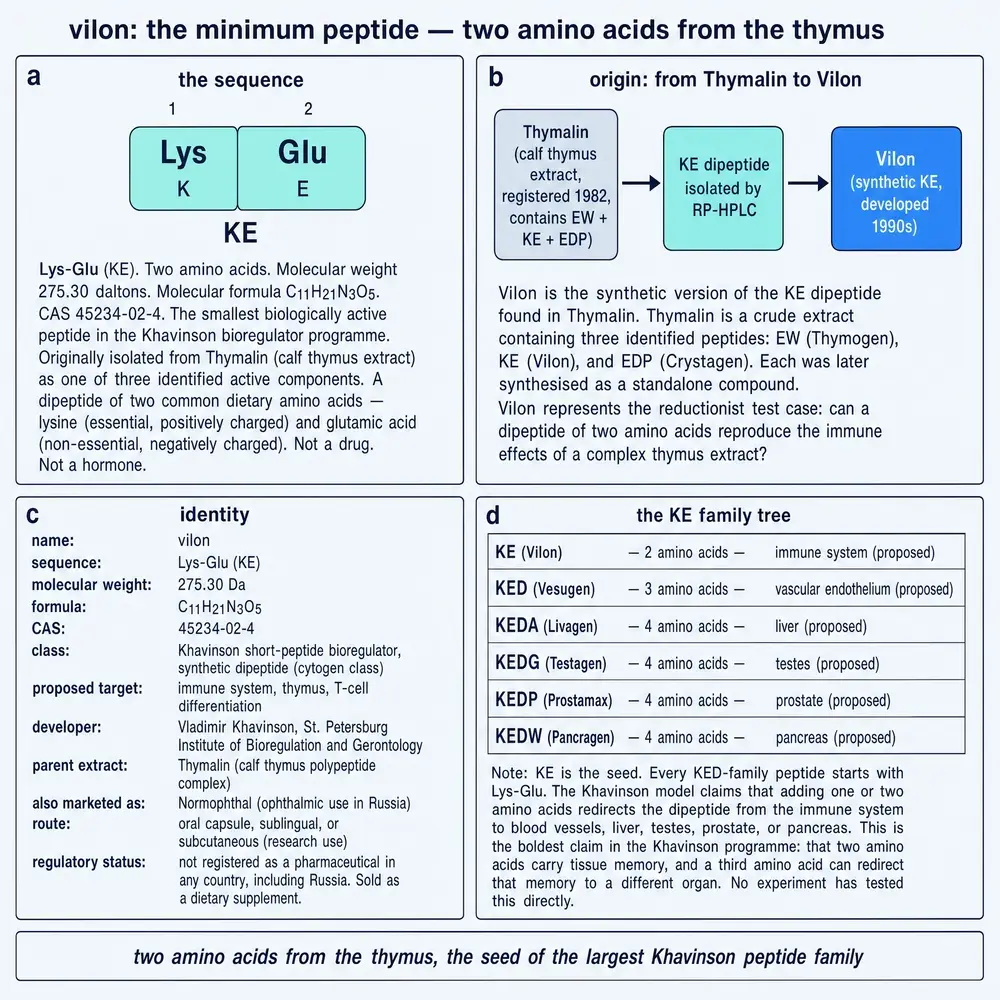
This document therefore reports the pairing as programme association plus UHPLC–MS detection, and reports the isolated-versus-designed distinction as unsettled in the English-indexed record. It does not repeat “active fragment of Thymalin” as established fact.
Regulatory asymmetry follows the class pattern. Thymalin has a long history of clinical use in Russia as a thymus preparation. Synthetic Vilon circulates internationally as a research chemical and in region-specific products without FDA or EMA approval as a drug. Long-horizon human outcome data, where they exist at all for the thymic arm, almost always belong to the extract or to mixed peptide courses — not cleanly to KE alone. Section 10 will return to one human observational series that does name Vilon; it will also say what that series can and cannot support.
Section 05The programme and the people
The St Petersburg Institute of Bioregulation and Gerontology did not begin with Vilon. It began, by the group’s own retrospective dating, in 1973–74, with a programme to extract peptide complexes from organs and later to make short synthetic analogues of the motifs those extracts contained (Anisimov et al., 1994; Khavinson & Anisimov, 2009). The public face of that programme for half a century has been Vladimir Kh. Khavinson. On the early mouse lifespan papers that first put Vilon into the English index, the authorship also includes V. G. Morozov and a cluster of colleagues at the same institute (Khavinson et al., 2000b).
The chromatin half of the story is not St Petersburg alone. It is a collaboration with Teimuraz Lezhava’s cytogenetics laboratory in Tbilisi — the same group that appears throughout the Livagen and Epitalon records. The Vilon-only chromatin paper in Biogerontology (2004) carries both names. The three-peptide comparison in Georgian Medical News (2006) is Lezhava’s group. The 2020 and 2023 re-tests of “old” chromatin are the same design family again (Lezhava et al., 2020; Lezhava et al., 2023). Continuity of method is a strength when you want to compare years. Continuity of authorship is a limitation when you want an independent check.
Commercial material about Khavinson peptides sometimes wraps the origin story in “secret military research” and closed Soviet institutes. The documented record available in open indexed sources is a gerontology and bioregulation programme that published, patented, and eventually sold products. Those are different stories. This monograph uses the documented one. A 1997 Russian patent for immunomodulatory activity is cited in the 2020 review (Khavinson et al., 2020); the lifespan and tumor papers appear in 2000; the chromatin paper that defines Vilon’s specificity appears in 2004. That is the chronology the reader needs.
Context matters because the 1970s–1990s Soviet and post-Soviet gerontology scene was not the NIH trial ecosystem. Small-peptide research, thymus extracts, and pineal preparations occupied a legitimate niche in that scientific culture. Judging the work only by twenty-first-century Western trial standards without saying so is as distorting as accepting every abstract as settled pharmacology. The honest middle is to read the experiments as experiments, credit their internal coherence, and refuse to let institutional unfamiliarity either romanticise or erase them.
Section 06Unpacking aged chromatin — and what Vilon does not touch
The central cellular claim is simple enough to say in one sentence. In cultured lymphocytes from old people, Vilon induces progressive deheterochromatinization of facultative heterochromatin, reactivates ribosomal genes by unpacking nucleolus organiser regions, and does not decondense pericentromeric structural heterochromatin (Lezhava et al., 2004). That sentence is from a primary paper whose subject is this dipeptide alone. Everything interesting in the chromatin half of this monograph is a gloss on it.
Heterochromatin, for a non-specialist reader, is DNA wound so tightly that the transcription machinery cannot easily reach it. Some of it is structural and permanent — the dense blocks beside centromeres that help chromosomes segregate correctly when a cell divides. Some of it is facultative: regions that were once readable and have been packed shut, often with age. Nucleolus organiser regions hold the ribosomal RNA genes; when they are packed, protein synthesis capacity is constrained at the root. The Vilon paper reports movement in the facultative and NOR compartments and stillness in the pericentromeric one. Labelled throughout: human cells in culture, not a treated person.
Why does the null matter as much as the positive? Because pericentromeric decondensation is exactly the signature claimed for Livagen and Epitalon in the same assay family. If every peptide moved every compartment, the organ-specificity story of the whole catalogue would collapse into a generic chromatin loosener. Vilon’s refusal is what makes the grid in the next section a real grid rather than a row of identical ticks.
Section 07The head-to-head
A side-by-side test in one system is worth more than any number of single-peptide studies when the claim is specificity. This literature ran one. Five short peptides — Vilon, Epithalon, Livagen, Prostamax and Cortagen — were examined on leukocytes from subjects aged seventy-five to eighty-eight (Khavinson et al., 2004). A tighter three-peptide comparison with Epitalon, Livagen and Vilon states the pericentromeric split in plain language (Lezhava et al., 2006). The Vilon-only paper had already stated the negative for the dipeptide alone (Lezhava et al., 2004).
Read the first three columns and every peptide looks alike: ribosomal genes on, total heterochromatin unpacked, facultative genes released. Read the last two columns and the class separates. Livagen and Epitalon decondense pericentromeric heterochromatin of chromosomes 1 and 9. Vilon does not. A null reported twice, once inside a comparison and once on its own, is the most solid single finding in this corpus. It is also the finding most often blurred when secondary writers treat “Khavinson peptides” as interchangeable.
Section 08How a dipeptide could reach DNA at all
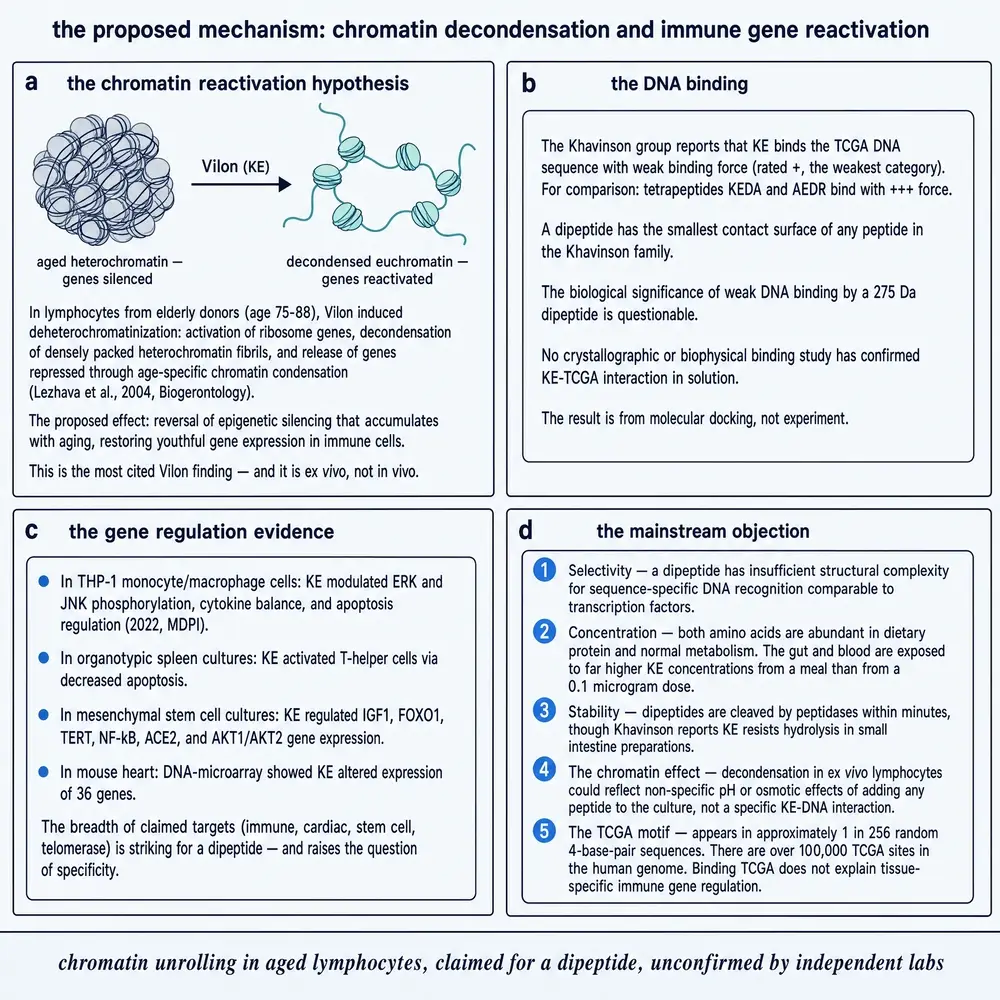
If the chromatin results are real, the peptide has to get inside the cell and preferably inside the nucleus. The class literature argues that short peptides do exactly that. Fluorescence-labelled short peptides have been shown to enter HeLa cell nuclei and to bind DNA and oligonucleotides in vitro (Fedoreyeva et al., 2011). Related work reports interactions with histones and site-specific DNA binding that modulates endonuclease activity (Fedoreyeva et al., 2013; Khavinson et al., 2011). Docking studies map dipeptide motifs onto double-stranded DNA (Kolchina et al., 2019). More recently, transporter feasibility via LAT and PEPT family proteins has been modelled for a panel of ultrashort peptides (Khavinson et al., 2023).
What must be said next is less comfortable and more important. Much of that mechanistic scaffolding was built on peptides that are not Lys-Glu. Nuclear-entry imaging, histone panels and docking atlases often feature Epitalon, Pinealon, Vesugen-family sequences and others. Citing them as class context is legitimate. Treating them as if they were Vilon-specific measurements is not. The KE motif does appear in sequence-selective DNA-binding discussions in the systematic review literature (Khavinson et al., 2021), but the evidential grade for “Vilon enters a nucleus and binds TCGA” is lower than the grade for “Vilon changes chromatin cytochemistry in aged lymphocytes.” Section 02 already noted the falsifiability problem for docking and quenching. It remains the right caution here.
Section 09Mice, tumors, and a microarray
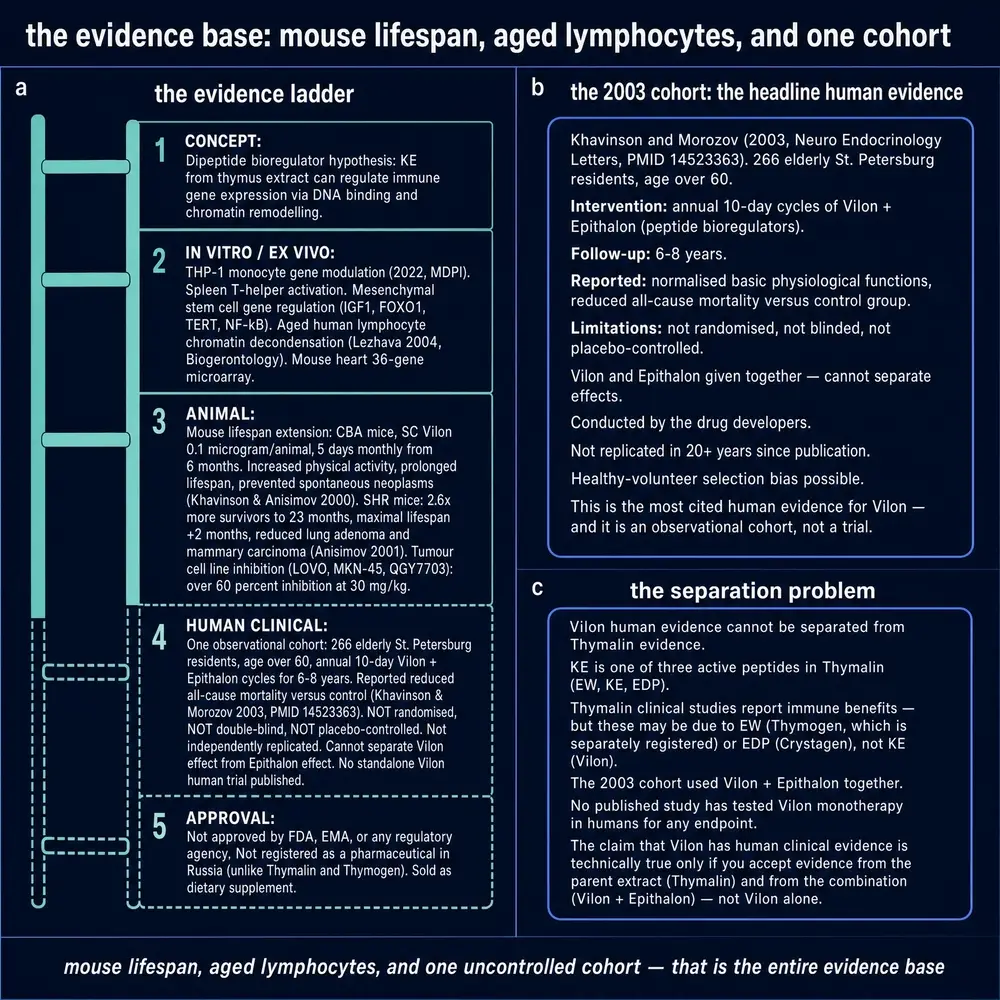
Long before the chromatin papers, Vilon entered the English index as a geroprotector and tumor-modulating dipeptide in mice. In female CBA mice, subcutaneous administration beginning at six months of age was reported to increase physical activity and endurance, decrease body temperature, prolong lifespan, and prevent the development of spontaneous neoplasms, without unfavourable effects on development and without altering age-related estrous changes or free-radical process markers as reported in that study (Khavinson et al., 2000b). A related Doklady note frames the same dipeptide as inhibiting spontaneous tumor growth and increasing lifespan (Khavinson & Anisimov, 2000a). These are animal experiments. The amounts and schedules used are study parameters for rodents, not recommendations for any person, and they are not repeated here as guidance.
The animal record then fans out. Induced bladder neoplasms in rats were studied with Epithalone (Pliss et al., 2001). Mammary carcinogenesis in transgenic erbB-2/neu mice was studied with Epitalon (Alimova et al., 2002). Combined effects with cyclophosphane on tumor transplants and lymphoid explants were examined across ages (Barykina et al., 2003). Aged rats showed changes in intestinal absorption of glucose and glycine and in epithelial enzyme activities when Vilon and Epithalon were compared (Khavinson et al., 2002a; Khavinson et al., 2002b). In an experimental chronic renal failure model, Vilon altered transforming growth factor-β content and microvessel permeability endpoints (Gavrisheva et al., 2005). Breadth is real. So is the single-network provenance of nearly all of it.
The most mechanistically suggestive animal paper is not a lifespan study. It is a heart DNA-microarray experiment in mice. Of 15,247 clones, 300 changed more than two-fold under the conditions tested. Vilon alone changed 36; Epithalon alone changed 98; the combination changed 144. The authors conclude that the two peptides have specific effects on gene expression (Anisimov et al., 2002). Specificity of signature is exactly what a vague “bioregulator tonic” story would not predict. It is also still a rodent heart under experimental conditions, read out on the microarray technology of the early 2000s. Weight it as that.
Section 10Thymus cultures and a diabetes series
Given the thymic pairing, immunomodulation is the expected neighbourhood. In cultures of human and animal thymus cells, Vilon and an analogue increased expression of the lymphocyte differentiation marker CD5, with divergent effects on helper versus cytotoxic lineage markers depending on which dipeptide was used (Sevostianova et al., 2013). That is in-vitro cell culture evidence, consistent with a thymic-programme story, not a clinical protocol.
One English-indexed paper reports a human clinical series: elderly patients with type I diabetes mellitus, Vilon added to complex therapy, with observations on coagulation hemostasis and immune status (Kuznik et al., 2007). The abstract reports optimisation of natural anticoagulants (antithrombin III, protein C), stimulation of fibrinolysis, shifts in T- and B-cell markers and IgA, and — in most cases — a reduction in the insulin dose needed to stabilise carbohydrate metabolism. Those are observations from a published clinical series. They are not recommendations. Methodology and blinding details available in the English abstract are limited; the paper is Russian-language in Advances in Gerontology. Recency does not apply here — 2007 is mid-corpus — and independent confirmation was not identified. Report the existence of the series; do not promote it into a use case.
Section 11Recency, and why it earns weight here
The most recent primary chromatin studies re-test Epitalon, Livagen, Cortagen and Vilon on condensed “old” chromatin in lymphocytes from donors aged seventy-five to eighty-eight, using differential scanning calorimetry, NOR silver staining, C-heterochromatin polymorphism and sister-chromatid exchange (Lezhava et al., 2020; Lezhava et al., 2023). They report selective, region-specific deheterochromatinisation and activation of ribosomal-gene synthesis. That is the same design family as the work from 2002–2006.
Recency earns weight in this monograph because it is consistent with the earlier record, not because it is newest. A 2023 paper that contradicted the 2004 null would have forced a rewrite of Section 07. A 2023 paper that restates selective effects inside the same network strengthens confidence in internal reproducibility and does nothing, by itself, about external validity. That distinction is the whole of the weighing rule announced in the opening: freshness counts when it is not contradicted by a preponderance of prior evidence, and here the preponderance and the fresh work agree.
Section 12Siblings and specificity
The family in Section 04 has a naming problem that is not cosmetic. Its members are designated by their one-letter sequences, and because the sequences are short and share stems, several designations are strict prefixes or extensions of others. Lys–Glu is Vilon. Add aspartate and it is Vesugen, KED. Add alanine to that and it is Livagen, KEDA. Thymogen is a different thymic dipeptide entirely: Glu–Trp. Any literature search, any vendor comparison table, any secondary explainer that collapses these into “thymic peptides” or “KE peptides” has already made the error this section exists to prevent.
What the head-to-head actually establishes is modest and important. Vilon shares with Livagen and Epitalon the capacity, in this assay family, to reactivate ribosomal genes and unpack facultative heterochromatin in aged human lymphocytes in vitro. It does not share the pericentromeric effect. That is evidence of selectivity inside one experimental system. It is not proof of organ-specific medicine in a person. It is not proof that commercial products labelled with adjacent sequences are interchangeable. Kozlov et al. (2016), writing about the vasoprotective peptide KED, are writing about Vesugen — an identity trap this series has already had to mark on the Livagen monograph and must mark again here.
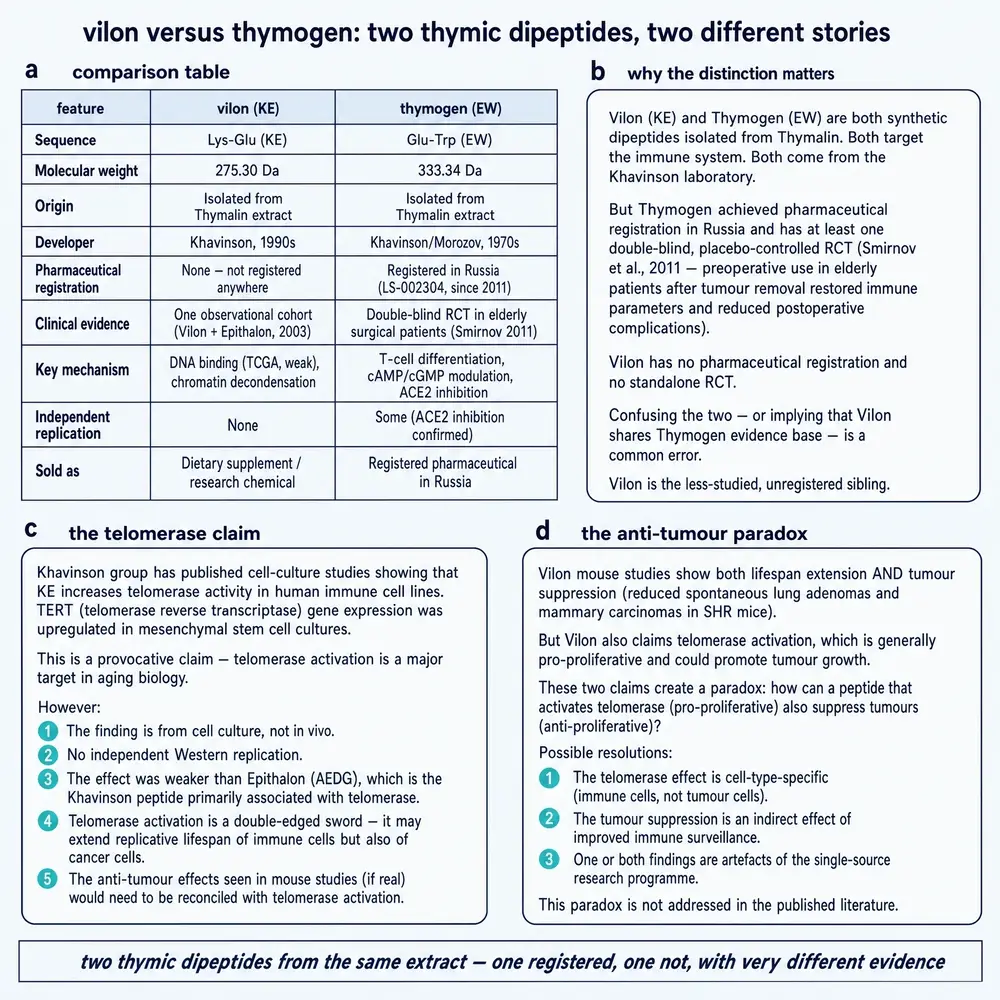
Against Thymogen the comparison is historical as much as biochemical. Both are two-residue products of the thymic programme. Only Thymogen has the clean HPLC-isolation-from-Thymalin story in this series’ register. Vilon has UHPLC–MS detection and cytokine-motif framing. Treating them as synonyms because both are “thymic dipeptides” erases the only distinction §8a.2 exists to preserve.
Section 13What is not known — stated at full volume
There is no published pharmacokinetic profile for Vilon: no half-life, no bioavailability, no distribution, no metabolism, no elimination, in any species. As an unmodified dipeptide of 275 daltons, rapid peptidase cleavage is a reasonable biochemical expectation; expectation is not measurement.
There is no formal toxicology package to international standards. The mouse chronic-administration papers report no unfavourable effects on development under their protocols (Khavinson et al., 2000b). Absence of reported harm in experiments not designed as toxicology is close to no information about rare or long-horizon risks. It is not nothing — incidental safety observations have value — and it must not be inflated into a completed safety file.
There is no well-matched registered interventional trial for synthetic Vilon in the registries checked for this build (ClinicalTrials.gov, 2026). The 2007 diabetes series is a published clinical observation, not a substitute for a registered, controlled trial with a public protocol.
There is no independent laboratory replication, outside the Khavinson–Lezhava network, of the chromatin or lifespan findings in the English-indexed record assembled here. Modern epigenomic methods that would stress-test the cytochemical story — ChIP-seq, ATAC-seq, bisulfite sequencing, single-cell chromatin accessibility — have not been applied to Vilon in any paper this corpus retrieved. The 2004–2023 chromatin series is internally consistent and methodologically continuous. It has not been adversarially checked.
Theoretical caveats cut both ways. For Livagen, this series noted that sustained pericentromeric decondensation could in principle affect chromosome segregation. Vilon’s null on that compartment means that particular theoretical worry attaches less to this dipeptide than to its cousins — which is not the same as a demonstration of safety. Facultative deheterochromatinization still changes which genes are available. Whether that is net beneficial in a living tissue over years is not a question this literature has answered with modern tools.
Section 14Believing a closed literature exactly as far as it has earned
Return to the opening image. Two amino acids. Aged human lymphocytes in a dish. Chromatin loosening where age had packed it, and refusing to loosen the structural blocks that Livagen and Epitalon move. Mice living longer, with fewer spontaneous tumors, in the hands of the same research tradition. A heart microarray in which Vilon and Epithalon refuse to write the same gene-expression signature. A thymus culture story. One human observational series. Three local scientific PDFs that mention the name. No independent replication. No pharmacokinetics. No matched registered trial.
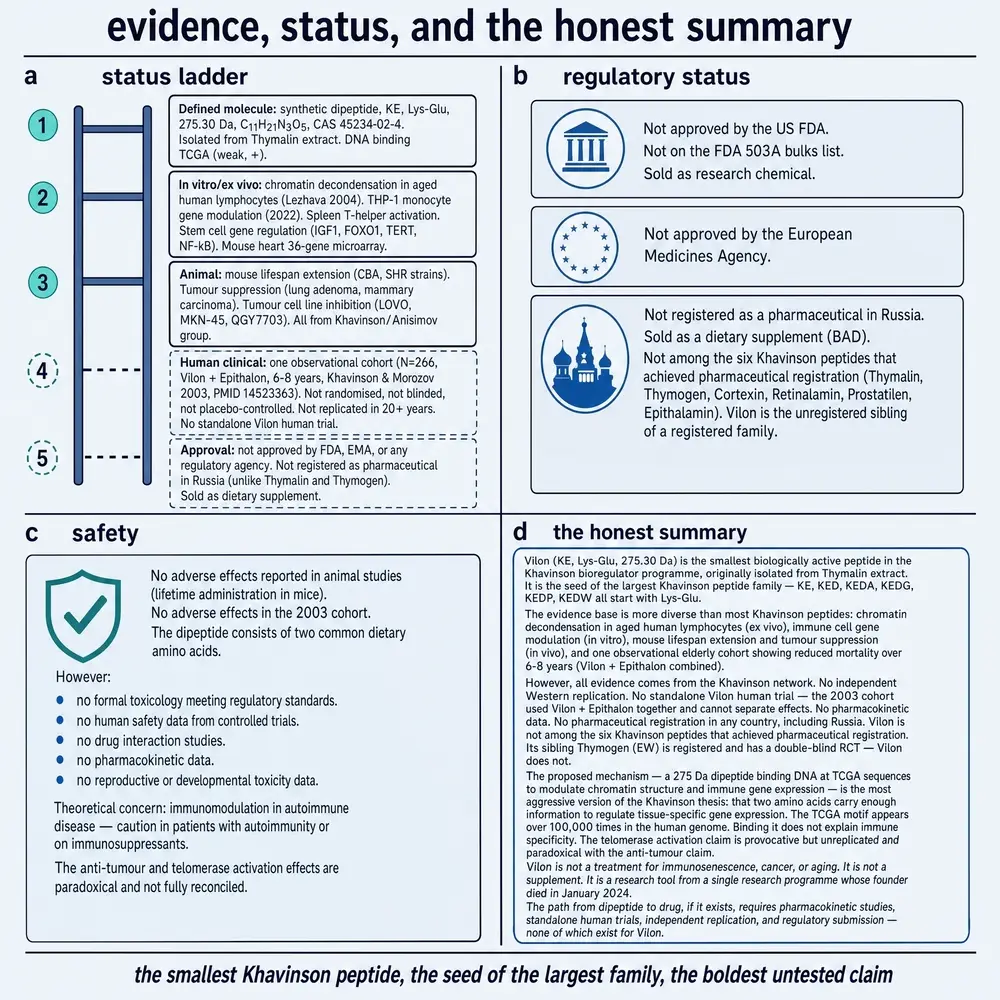
The honest ledger is not a shrug. Some things are established inside the record: identity; a repeated chromatin pattern with a stated null; animal lifespan and tumor endpoints; a distinctive microarray signature; in-vitro immune-marker shifts. Some things are plausible and not shown: nuclear entry and DNA binding of KE itself at the standard of the best class papers; transfer of Thymalin’s clinical history to the synthetic dipeptide; any Normoftal framing built from thymus data. Some things have never been tested: PK, formal tox, outside replication, modern epigenomics, a proper trial.
A two-letter instruction that loosens old chromatin selectively is a genuinely interesting claim with a genuinely coherent internal record — and an evidence base that has never been stress-tested by the two things science uses to check itself. Believing it exactly as far as it has earned means refusing both the vendor’s certainty and the cynic’s dismissal. The molecule is real. The experiments were done. The gaps are the finding as much as the positives are.
Research use only. This document describes published research. It does not recommend human use of Vilon or any related peptide and specifies no dose, route or schedule for any person. It is not medical advice.
Section 15References
- Alimova IN, Bashurin DA, Popovich IG, Zabezhinskiĭ MA, Volkov MA, Provinciali M et al.. [Effect of Epitalon and Vilon treatment on mammary carcinogenesis in transgenic erbB-2/NEU mice] Vopr Onkol 2002;48(1):57-60. PMID 12101568
- Anisimov SV, Bokheler KR, Khavinson VKh, Anisimov VN. Studies of the effects of Vilon and Epithalon on gene expression in mouse heart using DNA-microarray technology Bull Exp Biol Med 2002;133(3):293-9. PMID 12360356 · doi
- Anisimov VN, Khavinson VKh, Morozov VG. Twenty years of study on effects of pineal peptide preparation: epithalamin in experimental gerontology and oncology Ann N Y Acad Sci 1994;719:483-93. PMID 8010617 · doi
- Barykina OP, Iuzhakov VV, Chalisova NI, Kvetnoĭ IM, Konovalov SS. [Combined effect of vilon and cyclophosphane on tumor transplants and lymphoid tissue explants in mice and rats of various age] Adv Gerontol 2003;12:128-31. PMID 14743610
- Fedoreyeva LI, Kireev II, Khavinson VKh, Vanyushin BF. Penetration of short fluorescence-labeled peptides into the nucleus in HeLa cells and in vitro specific interaction of the peptides with deoxyribooligonucleotides and DNA Biochemistry (Mosc) 2011;76(11):1210-9. PMID 22117547 · doi
- Fedoreyeva LI, Smirnova TA, Kolomijtseva GY, Khavinson VKh, Vanyushin BF. Interaction of short peptides with FITC-labeled wheat histones and their complexes with deoxyribooligonucleotides Biochemistry (Mosc) 2013;78(2):166-75. PMID 23581987 · doi
- Gavrisheva NA, Malinin VV, Ses TP, Kozlov KL, Panchenko AV, Titkov AY. Effect of peptide Vilon on the content of transforming growth factor-beta and permeability of microvessels during experimental chronic renal failure Bull Exp Biol Med 2005;139(1):24-6. PMID 16142267 · doi
- Khavinson V, Linkova N, Diatlova A, Trofimova S. Peptide Regulation of Cell Differentiation Stem Cell Rev Rep 2020;16(1):118-125. PMID 31808038 · doi
- Khavinson VK, Anisimov VN, Zavarzina NY, Zabezhinskii MA, Zimina OA, Popovich IG et al.. Effect of vilon on biological age and lifespan in mice Bull Exp Biol Med 2000;130(7):687-90. PMID 11140587 · doi
- Khavinson VK, Lin'kova NS, Tarnovskaya SI. Short Peptides Regulate Gene Expression Bull Exp Biol Med 2016;162(2):288-292. PMID 27909961 · doi
- Khavinson VK, Linkova NS, Rudskoy AI, Petukhov MG. Feasibility of Transport of 26 Biologically Active Ultrashort Peptides via LAT and PEPT Family Transporters Biomolecules 2023;13(3). PMID 36979488 · doi · PMC10046148
- Khavinson VK, Popovich IG, Linkova NS, Mironova ES, Ilina AR. Peptide Regulation of Gene Expression: A Systematic Review Molecules 2021;26(22). PMID 34834147 · doi · PMC8619776
- Khavinson VKh, Lezhava TA, Malinin VV. Effects of short peptides on lymphocyte chromatin in senile subjects Bull Exp Biol Med 2004;137(1):78-81. PMID 15085253 · doi
- Khavinson VKh, Anisimov VN. A synthetic dipeptide vilon (L-Lys-L-Glu) inhibits growth of spontaneous tumors and increases life span of mice Dokl Biol Sci 2000;372:261-3. PMID 10944717
- Khavinson VKh, Egorova VV, Timofeeva NM, Malinin VV, Gordova LA, Gromova LV. Effect of Vilon and Epithalon on glucose and glycine absorption in various regions of small intestine in aged rats Bull Exp Biol Med 2002;133(5):494-6. PMID 12420071 · doi
- Khavinson VKh, Timofeeva NM, Malinin VV, Gordova LA, Nikitina AA. Effect of vilon and epithalon on activity of enzymes in epithelial and subepithelial layers in small intestine of old rats Bull Exp Biol Med 2002;134(6):562-4. PMID 12660839 · doi
- Khavinson VKh, Fedoreyeva LI, Vanyushin BF. Site-specific binding of short peptides with DNA modulated eukaryotic endonuclease activity Bull Exp Biol Med 2011;151(1):66-70. PMID 22442805 · doi
- Khavinson VKh, Solov'ev AIu, Zhilinskiĭ DV, Shataeva LK, Vaniushin BF. [Epigenetic aspects of peptide regulation of aging] Adv Gerontol 2012;25(1):11-22. PMID 22708439
- Khavinson VKh, Anisimov VN. [35-year experience in research of peptide regulation of aging] Adv Gerontol 2009;22(1):11-23. PMID 19827673
- Kolchina N, Khavinson V, Linkova N, Yakimov A, Baitin D, Afanasyeva A et al.. Systematic search for structural motifs of peptide binding to double-stranded DNA Nucleic Acids Res 2019;47(20):10553-10563. PMID 31598715 · doi · PMC6847403
- Kozlov KL, Bolotov II, Linkova NS, Drobintseva AO, Khavinson VK, Dyakonov MM et al.. [Molecular aspects of vasoprotective peptide KED activity during atherosclerosis and restenosis] Adv Gerontol 2016;29(4):646-650. PMID 28539025
- Kuznik BI, Isakova NV, Kliuchereva NN, Maleeva NV, Pinelis IS. [Effect of vilon on the immunity status and coagulation hemostasis in patients of different age with diabetes mellitus] Adv Gerontol 2007;20(2):106-15. PMID 18306698
- Lezhava T, Khavison V, Monaselidze J, Jokhadze T, Dvalishvili N, Bablishvili N et al.. Bioregulator Vilon-induced reactivation of chromatin in cultured lymphocytes from old people Biogerontology 2004;5(2):73-9. PMID 15105581 · doi
- Lezhava T, Monaselidze J, Kadotani T, Dvalishvili N, Buadze T. Anti-aging peptide bioregulators induce reactivation of chromatin Georgian Med News 2006;(133):111-5. PMID 16705247
- Lezhava T, Jokhadze T, Monaselidze J, Buadze T, Gaiozishvili M, Sigua T. EPIGENETIC MODIFICATION UNDER THE INFLUENCE OF PEPTIDE BIOREGULATORS ON "AGED" HETEROCHROMATIN Georgian Med News 2020;(309):120-124. PMID 33526740
- Lezhava T, Jokhadze T, Monaselidze J, Buadze T, Gaiozishvili M, Sigua T et al.. EPIGENETIC MODIFICATION UNDER THE INFLUENCE OF PEPTIDE BIOREGULATORS ON THE "OLD" CHROMATIN Georgian Med News 2023;(335):79-83. PMID 37042594
- Pliss GB, Mel'nikov AS, Malinin VV, Khavinson VKh. [Effect of vilon and epithalone on induction and growth of induced bladder neoplasms in rats] Vopr Onkol 2001;47(5):601-7. PMID 11785104
- Sevostianova NN, Linkova NS, Polyakova VO, Chervyakova NA, Kostylev AV, Durnova AO et al.. Immunomodulating effects of Vilon and its analogue in the culture of human and animal thymus cells Bull Exp Biol Med 2013;154(4):562-5. PMID 23486604 · doi
- Khavinson VKh et al.. Peptide medicines: past, present, future (peptide bioregulators review). Klinicheskaya Meditsina / Russian clinical medicine review, 2020;98(3):165-177. doi:10.30629/0023-2149-2020-98-3-165-177. Local full text; states UHPLC–MS detection of Lys-Glu (KE) named Vilon, and cytokine-motif framing. Resolved 4 August 2026. link
- National Center for Biotechnology Information. PubChem Compound Summary for CID 7010502, Lysylglutamic acid. Queried 4 August 2026. Formula C11H21N3O5; MW 275.30; InChIKey UGTZHPSKYRIGRJ-YUMQZZPRSA-N. Local cache: knowledge_base/pubchem/compound_cache/P039.json. link
- U.S. National Library of Medicine. ClinicalTrials.gov registry search for Vilon / Lys-Glu bioregulator interventional trials. Queried 4 August 2026. No well-matched interventional registration identified for synthetic Vilon as the investigational product. Absence reported as a finding. link
Section 16How this document was assembled
The Project 05 therapeutic-peptide research library was swept for full-text assets naming Vilon, Normoftal, Normophthal, or Lys-Glu in bioregulator context. Three scientific PDFs were retained (36 pages total): the 2020 Russian peptide-medicines review, the 2021 Molecules systematic review of peptide regulation of gene expression, and a thin 2013 class note. No peer-reviewed Vilon-primary full text was present under fulltext/. The Radix P039 dossier PDF (30 pages) and intake evidence map (7 pages) were read; the dossier’s substantive sections are largely evidence-gap placeholders and were not treated as authority. Vendor product and COA pages were used only for identity cross-check.
Primary experimental content was therefore assembled from PubMed records linked to compound P039 in radix_library.sqlite, plus chromatin and class-mechanism siblings required by the bioregulator contract. Twenty-eight PubMed identifiers were resolved against live NCBI records on 4 August 2026; three non-PubMed sources (the 2020 local review, PubChem CID 7010502, and a ClinicalTrials.gov absence finding) were declared explicitly. Bare sequence matches on KE / Lys-Glu without name context were rejected to avoid Vesugen and Livagen contamination. OpenStax p039* figure crops and training-site navigation noise were excluded.
Section 17Evidence handling
Study type is named in the sentence that reports each result. Human cells in culture are not human clinical evidence. Mouse and rat findings are labelled as such. The 2007 diabetes paper is labelled as human clinical observation with limited English methodological detail. Class-mechanism papers that did not test Lys-Glu are cited only for class context and marked as such in Section 08.
Conflict and agreement were weighed as follows. Where 2020–2023 chromatin re-tests agree with 2004–2006 findings, recency is given weight because it is consistent, not because it is new. Where secondary sources assert “active fragment of Thymalin” without a methods paper settling isolation, the claim is reported as unsettled. Where Vilon’s pericentromeric null is stated twice, that agreement is treated as the corpus’s strongest internal check. Absence of independent replication, pharmacokinetics, formal toxicology and matched registered trials is stated alongside efficacy findings, not quarantined into a late caveat.
No third-party published figure was reproduced. All graphics in this document are authored SVG emitted by this project’s figure toolkit, using theme colour tokens so light and dark editions render from one source.
Continue exploring