
The Hallmarks of Aging
A framework that sorts the biology of getting old into a short list of recurring processes — and, by its own authors' account, a map more than a proven catalogue of causes.
Abstract
The hallmarks of aging are an organizing framework, introduced by López-Otín and colleagues in 2013 and modeled on the hallmarks of cancer, that reduces the sprawling biology of aging to a small number of recurring processes. The original paper proposed nine hallmarks sorted into three categories — primary (accumulating damage), antagonistic (protective responses that turn harmful in excess), and integrative (whole-body consequences) — and a 2023 update expanded the set to twelve. The framework underpins geroscience: the proposition that targeting the shared biology of aging could delay several age-related diseases at once. Its explanatory limits are real. Nearly all causal demonstrations come from short-lived laboratory organisms and cultured cells, human evidence for the individual hallmarks is largely associational, and critics argue the hallmarks describe features of aging without yet explaining its causes. This review sets out what the framework claims, what qualifies as a hallmark, and where the evidence is strong, associational, or still missing.
Key findings
- The hallmarks of aging are a proposed organizing framework, not a settled fact: the 2013 paper described its nine hallmarks as 'tentative' and left their relative contributions to aging unresolved (López-Otín et al., 2013).
- The original nine are sorted into three categories — primary damage, antagonistic stress responses, and integrative whole-body consequences — and a 2023 update added three more (disabled macroautophagy, chronic inflammation, dysbiosis), bringing the total to twelve (López-Otín et al., 2013, 2023).
- Almost every causal demonstration behind the individual hallmarks comes from short-lived animals or cultured cells: a worm that lives twice as long from a single mutation (Kenyon et al., 1993), senescent-cell clearance extending healthspan in mice (Baker et al., 2016) — not from humans.
- In people, the evidence for individual hallmarks is largely associational: chronic low-grade inflammation tracks with age-related disease (Franceschi et al., 2000), and the epigenetic clock predicts age without being shown to cause aging (Horvath, 2013).
- The framework's rationale is geroscience: aging is the leading risk factor for most chronic disease, and it can be slowed in laboratory animals — though human modifiability remains the field's aim, not a settled result (Kennedy et al., 2014).
- Critics argue the hallmarks are a useful checklist but not a causal account of aging the way the hallmarks of cancer are for cancer (Gems & de Magalhães, 2021); a competing camp puts molecular damage at the causal center (Gladyshev et al., 2021).
Ask what causes aging and the answers tend to come in two unhelpful sizes: too many and too few. The hallmarks of aging are an attempt to make the question tractable — a proposed framework that gathers the biology of getting old into a short list of processes that recur across living things. Introduced in 2013 by Carlos López-Otín and colleagues, it named nine of them, later expanded to twelve, and sorted them into a few categories so that decades of scattered findings could share one vocabulary. Modeled deliberately on the influential hallmarks of cancer, it has become the field's common map.
The word to hold onto is map. The framework's own authors called the hallmarks "tentative," and said the hard part — working out how much each one actually contributes to aging — was still ahead (López-Otín et al., 2013). It is a way of organizing what is known and an agenda for what is not, drawn largely from short-lived laboratory animals and cultured cells. It is not a validated parts-list of human aging, and it is not a menu of treatments. Read that way, it is one of the most useful ideas in the modern biology of aging.
The framework, and the idea behind it
The hallmarks of aging arrived in a 2013 review in Cell, written by Carlos López-Otín, María Blasco, Linda Partridge, Manuel Serrano, and Guido Kroemer (López-Otín et al., 2013). Their move was one of consolidation. Research on aging had produced a long catalogue of molecular and cellular changes across yeast, worms, mice, and human tissue, but no shared structure to hold them. The paper proposed that most of what mattered could be captured by nine processes that recur across aging organisms — a small enough set to reason about, broad enough to cover the ground.
The format was borrowed on purpose. Two years earlier, Douglas Hanahan and Robert Weinberg had updated their enormously influential hallmarks of cancer, which distilled the causes of malignancy into a handful of acquired capabilities (Hanahan & Weinberg, 2011). The hallmarks of aging were built on that template, and the resemblance is the source of both the framework's appeal and its sharpest criticism, which we return to below.
Behind the taxonomy sits a scientific bet with real stakes, and it has its own name: geroscience. A 2014 paper set out the premise directly — aging is the single greatest risk factor for the majority of chronic diseases that drive illness and death, and, in the laboratory, mammalian aging can be slowed by genetic, dietary, and pharmacological means (Kennedy et al., 2014). If both of those are true, then the biology of aging is a shared root beneath many diseases, and treating that root might postpone several of them at once. That is the ambition the hallmarks are meant to serve. The qualifier travels with it: the evidence that aging can be slowed is strongest in model organisms, and moving the same levers in humans is the field's aspiration, not an established result.
The original nine, in three tiers
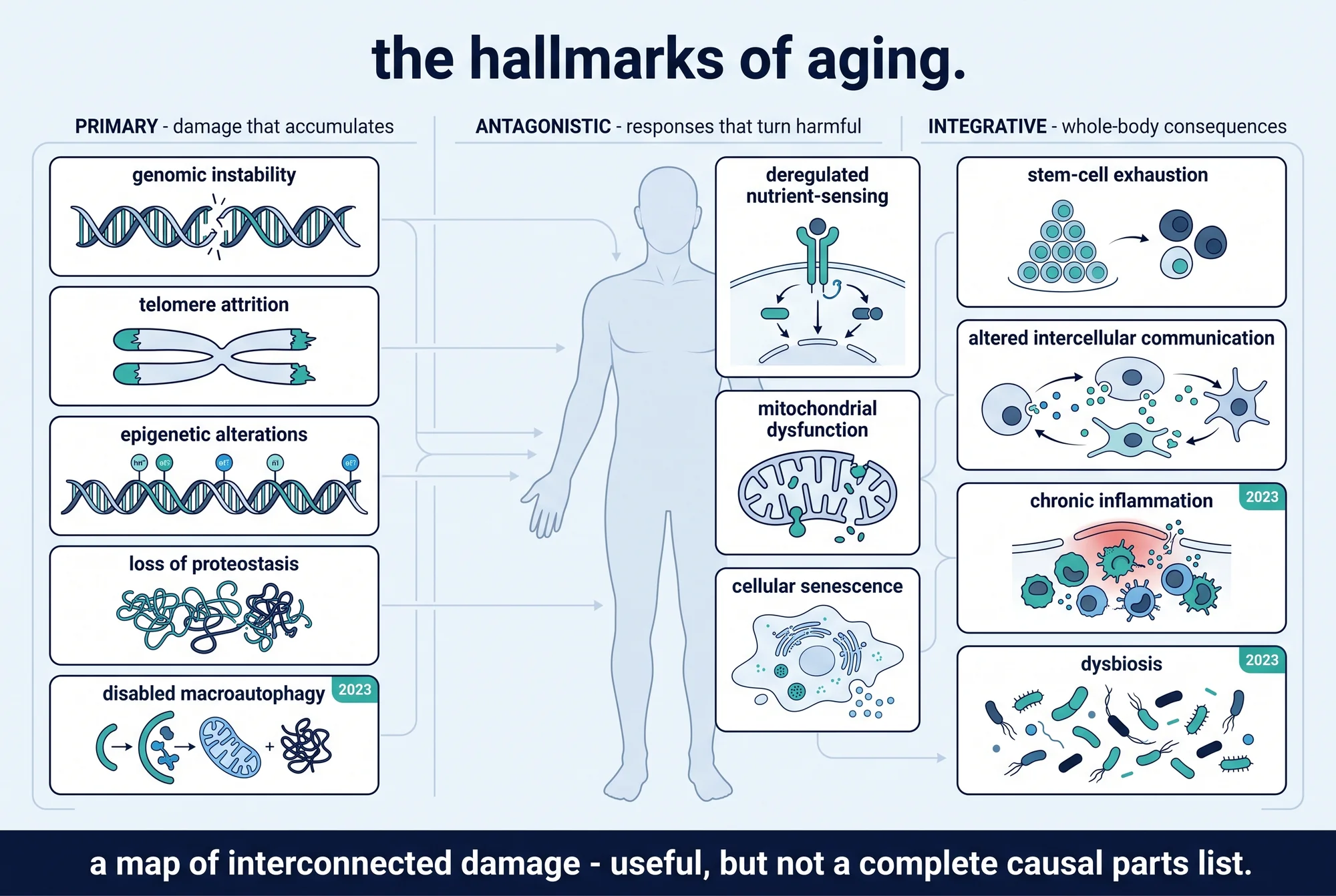
The 2013 paper did more than list nine processes; it sorted them into three tiers that describe how the processes relate. Reading them in order — cause, response, consequence — is the quickest way to grasp the framework.
The primary hallmarks are the damage itself, and the paper treats them as unambiguously harmful: genomic instability (accumulating DNA damage), telomere attrition (the erosion of chromosome ends), epigenetic alterations (drift in the chemical marks that switch genes on and off), and loss of proteostasis (the failing quality control that keeps proteins correctly folded). Telomere attrition shows how carefully these were established. The enzyme that rebuilds telomeres, telomerase, was discovered in 1985 in a pond protozoan, Tetrahymena — work that later won a Nobel Prize (Greider & Blackburn, 1985). Five years on, telomeres were shown to shorten as human fibroblasts divide in culture, and yet the authors of that study were explicit that it was not known whether the loss of DNA actually causes cells to age (Harley et al., 1990). The hallmark rests on a real, measurable change whose causal role was flagged as unproven from the very start.
The antagonistic hallmarks are the body's responses to stress and damage — deregulated nutrient-sensing, mitochondrial dysfunction, and cellular senescence — and their defining feature is that they help in small doses and harm when they run too hot for too long. Cellular senescence is the clearest case. A cell that stops dividing — the property Leonard Hayflick and Paul Moorhead first described in 1961, when they found that normal human cells in culture divide only a finite number of times before halting, the "Hayflick limit" — is, in youth, a defense: it is one way the body keeps damaged cells from becoming tumors (Hayflick & Moorhead, 1961). Let senescent cells accumulate over decades, though, and the same program contributes to tissue decline. Nutrient-sensing shows the malleability of the whole system: in 1993, mutating a single gene in the insulin/IGF-1 pathway more than doubled the lifespan of the worm C. elegans, one of the landmark demonstrations that aging is not fixed but can be genetically tuned (Kenyon et al., 1993). Mitochondrial dysfunction rounds out the tier — mice engineered to accumulate mitochondrial DNA mutations age prematurely, a causal link, though one established at mutation loads far above those of ordinary aging (Trifunovic et al., 2004).
The integrative hallmarks are what emerges when the damage can no longer be compensated: stem cell exhaustion (the depletion of the pools that renew tissue) and altered intercellular communication (the breakdown in how cells signal to one another, including a chronic, low-grade inflammatory tone that Claudio Franceschi and colleagues named "inflammaging" in 2000 and linked to age-related disease; Franceschi et al., 2000). These are the consequences you eventually see and feel. In the authors' logic, primary damage provokes antagonistic responses, and when both overwhelm the body's capacity to cope, the integrative hallmarks produce the decline we recognize as aging.
The 2023 expansion to twelve
A framework whose boundaries are still moving tells you something about its maturity, and the hallmarks moved. In 2023 the same five authors published an update, "Hallmarks of aging: an expanding universe," that added three processes and brought the total to twelve (López-Otín et al., 2023). The additions were disabled macroautophagy (a decline in the cell's system for clearing out and recycling its own worn components), chronic inflammation (the inflammaging concept, now promoted to a hallmark in its own right), and dysbiosis (disruption of the microbial communities of the gut and elsewhere). The 2023 paper also tied the twelve to a companion framework the group had proposed for what health, rather than aging, looks like at the molecular level (López-Otín & Kroemer, 2021).
The update is itself a piece of evidence. That the count grew by a third within a decade, from the same authors, is a candid signal that the list is a working model rather than a closed set. The 2023 paper is explicit about the bar a candidate must clear to count as a hallmark: it should manifest during normal aging; experimentally worsening it should accelerate aging; and targeting it should be able to slow, halt, or reverse aging (López-Otín et al., 2023). That third criterion is demanding, and it is met largely in model organisms rather than in people — a point that matters for reading the whole framework.
One caution belongs with any diagram of the twelve, Figure 1 included. The three-tier scheme — primary, antagonistic, integrative — was defined in 2013 for the original nine. Placing the three 2023 additions into those tiers (macroautophagy with the primary group; chronic inflammation and dysbiosis with the integrative group) is the conventional reading in the secondary literature, and a reasonable one, but it is not transcribed from a category table in the 2023 paper. It is a sensible convention, presented as such, not a verbatim extension of the original scheme.
What a hallmark is — and what it is not
A recurring source of confusion is that the word "hallmark" gets read as "cause." The individual hallmarks are not all the same kind of claim, and separating the kinds helps.
Some are mechanisms — biological processes with a plausible route to causing damage. Some are correlates or biomarkers — features that reliably travel with age without being shown to drive it. The clearest biomarker is the epigenetic clock: in 2013, Steve Horvath showed that the methylation state of 353 sites in the genome predicts a person's chronological age across many human tissues (Horvath, 2013). That is a genuinely useful measurement, but a clock is a readout, not an engine. Reading age off methylation is not evidence that methylation causes aging, and moving a clock is not proof of rejuvenation. Some hallmarks are, in humans, mainly associations: inflammaging is measured as a correlation between inflammatory markers and age-related disease, not as a demonstrated cause (Franceschi et al., 2000).
And some hallmarks come with a causal driver demonstrated — but almost always in a short-lived animal or in cultured cells, not in humans. The strongest causal evidence in the whole framework is for cellular senescence, and it is worth being precise about what it shows. Genetically clearing senescent cells delayed age-related disorders in a fast-aging mouse in 2011, and, more strikingly, extended median lifespan and healthspan in normal mice in 2016 (Baker et al., 2011; Baker et al., 2016). Those experiments launched the field of senolytics — drugs that aim to clear senescent cells — but they are mouse results, not an approved or validated human therapy. The same distinction applies to the intervention the framework is most associated with. Rapamycin, which inhibits a central nutrient-sensing pathway, extended lifespan in genetically diverse mice even when started late in life, by roughly 14% in females and 9% in males (Harrison et al., 2009). That is a landmark of mechanism research and a reason to study the pathway in people. It is not a human protocol, and nothing here — rapamycin, caloric restriction, or senolytics — should be read as a dose or a recommendation.
Put the pieces together and the honest summary is narrow but firm. The direct, causal evidence behind the individual hallmarks comes overwhelmingly from yeast, worms, flies, mice, and cell culture. In humans, the evidence for the individual hallmarks is mostly associational — biomarkers and correlations rather than proof of cause. A hallmark, in other words, marks a place where aging is happening or can be measured. It is not, by itself, proof of what makes a person age, and it is not a target shown to work as a treatment in people.
The critiques
The framework has serious critics, and their objection is not a quibble over which processes made the list. It is about what kind of thing the list is.
The most direct critique came from David Gems and João Pedro de Magalhães in 2021, in a paper aimed squarely at the framework's foundation (Gems & de Magalhães, 2021). They grant that the hallmarks are a useful shared overview and a practical checklist. But they draw a sharp contrast with the template the hallmarks were built on. The hallmarks of cancer work as a paradigm because they describe the causes of the disease with real explanatory power; the hallmarks of aging, the authors argue, do not do the same for aging — they describe its features. Worse, treating a descriptive list as though it were an explanation can obscure the fact that a genuine causal theory of aging is still missing. Their conclusion is that the field must look beyond the hallmarks to understand the process itself.
A related current comes from Vadim Gladyshev and colleagues, though it is better described as a competing way of organizing the same biology than as a point-by-point rebuttal. Its emphasis is cause first. One 2021 paper places the accumulation of molecular damage at the center of aging and notes how little that damage has actually been measured, especially in humans (Gladyshev et al., 2021). A companion piece argues, plainly, that aging research still lacks a common conceptual framework and should be built on causal primitives — damage, transformation, and the thresholds at which they matter — rather than on a catalogue of features (Moldakozhayev et al., 2021). The disagreement is not that the hallmarks are wrong, but that a feature list, however good, is not yet a theory of cause.
What remains uncertain
Several real limits belong beside the framework's usefulness.
The list is not proven complete, independent, or causal in humans. The authors themselves called the original nine "tentative" and left open how much each contributes to aging (López-Otín et al., 2013), and the fact that the count moved from nine to twelve in a decade is a reminder that the boundaries are still being drawn (López-Otín et al., 2023). The hallmarks are also, by the authors' account, interconnected rather than separate boxes, which makes assigning credit to any single one harder still.
The human evidence gap is the recurring theme. The strong causal experiments live in worms, mice, and cultured cells; the human-level evidence for the individual hallmarks is largely associational (Gems & de Magalhães, 2021). Whether the same mechanisms drive human aging to the same degree is, for most of the twelve, not yet established. Even the framework's diagrams carry an open question: the placement of the three 2023 additions into the original three tiers is a secondary-literature convention rather than a transcription from the 2023 paper, and it should be read as a reasonable layout, not settled canon.
Finally, none of the interventions that appear in discussions of the hallmarks — rapamycin, senescent-cell clearance, reduced insulin/IGF-1 signaling — is a validated human therapy. They are the reasons the underlying pathways are worth studying, and they are mechanism research. The distance between a doubled lifespan in a worm and a treatment for a person is the honest measure of how much of this science is still ahead.
This explainer reviews the origin, structure, and limits of the hallmarks-of-aging framework, from the 2013 paper that proposed it through the 2023 update that expanded it to twelve, alongside the geroscience rationale and the main critiques; the primary sources it draws on span 1961 to 2023. Causal results are labeled by the organism that produced them — worms, flies, mice, and cultured cells dominate, and most human evidence is associational rather than causal. It is educational analysis, not medical advice, a diagnosis, or a treatment recommendation, and the interventions it mentions are discussed only as mechanism research, without any dose or protocol. For related reading, see the Aging biology hub and the explainer on what longevity science is.
References
- 1.Baker DJ, Wijshake T, Tchkonia T, et al. Clearance of p16Ink4a-positive senescent cells delays ageing-associated disorders. Nature. 2011;479(7372):232-236. doi:10.1038/nature10600
- 2.Baker DJ, Childs BG, Durik M, et al. Naturally occurring p16Ink4a-positive cells shorten healthy lifespan. Nature. 2016;530(7589):184-189. doi:10.1038/nature16932
- 3.Franceschi C, Bonafè M, Valensin S, et al. Inflamm-aging: an evolutionary perspective on immunosenescence. Ann N Y Acad Sci. 2000;908:244-254. doi:10.1111/j.1749-6632.2000.tb06651.x
- 4.Gems D, de Magalhães JP. The hoverfly and the wasp: a critique of the hallmarks of aging as a paradigm. Ageing Res Rev. 2021;70:101407. doi:10.1016/j.arr.2021.101407
- 5.Gladyshev VN, Kritchevsky SB, Clarke SG, et al. Molecular damage in aging. Nat Aging. 2021;1(12):1096-1106. doi:10.1038/s43587-021-00150-3
- 6.Greider CW, Blackburn EH. Identification of a specific telomere terminal transferase activity in Tetrahymena extracts. Cell. 1985;43(2 Pt 1):405-413. doi:10.1016/0092-8674(85)90170-9
- 7.Hanahan D, Weinberg RA. Hallmarks of cancer: the next generation. Cell. 2011;144(5):646-674. doi:10.1016/j.cell.2011.02.013
- 8.Harley CB, Futcher AB, Greider CW. Telomeres shorten during ageing of human fibroblasts. Nature. 1990;345(6274):458-460. doi:10.1038/345458a0
- 9.Harrison DE, Strong R, Sharp ZD, et al. Rapamycin fed late in life extends lifespan in genetically heterogeneous mice. Nature. 2009;460(7253):392-395. doi:10.1038/nature08221
- 10.Hayflick L, Moorhead PS. The serial cultivation of human diploid cell strains. Exp Cell Res. 1961;25:585-621. doi:10.1016/0014-4827(61)90192-6
- 11.Horvath S. DNA methylation age of human tissues and cell types. Genome Biol. 2013;14(10):R115. doi:10.1186/gb-2013-14-10-r115
- 12.Kennedy BK, Berger SL, Brunet A, et al. Geroscience: linking aging to chronic disease. Cell. 2014;159(4):709-713. doi:10.1016/j.cell.2014.10.039
- 13.Kenyon C, Chang J, Gensch E, Rudner A, Tabtiang R. A C. elegans mutant that lives twice as long as wild type. Nature. 1993;366(6454):461-464. doi:10.1038/366461a0
- 14.López-Otín C, Blasco MA, Partridge L, Serrano M, Kroemer G. The hallmarks of aging. Cell. 2013;153(6):1194-1217. doi:10.1016/j.cell.2013.05.039
- 15.López-Otín C, Kroemer G. Hallmarks of health. Cell. 2021;184(1):33-63. doi:10.1016/j.cell.2020.11.034
- 16.López-Otín C, Blasco MA, Partridge L, Serrano M, Kroemer G. Hallmarks of aging: an expanding universe. Cell. 2023;186(2):243-278. doi:10.1016/j.cell.2022.11.001
- 17.Moldakozhayev A, Tskhay A, Gladyshev VN. Applying deductive reasoning and the principles of particle physics to aging research. Aging (Albany NY). 2021;13(18):22611-22622. doi:10.18632/aging.203555
- 18.Trifunovic A, Wredenberg A, Falkenberg M, et al. Premature ageing in mice expressing defective mitochondrial DNA polymerase. Nature. 2004;429(6990):417-423. doi:10.1038/nature02517
Disclosures
Educational review of published evidence. Not medical advice, diagnosis, or a treatment recommendation. Interventions such as rapamycin, caloric restriction, and senolytics are discussed only as mechanism research; study parameters are reported with the organism and design that produced them.