
What Is Longevity Science?
The field studies healthspan, not just lifespan — and its evidence runs from strong (ordinary lifestyle) through animal-only (the headline drugs) to unproven (what supplements promise).
Abstract
Longevity science studies not only how long people live but how long they live in good health — the healthspan — and tests whether the underlying biology of aging can be slowed to postpone age-related disease. This review maps what the field has actually demonstrated, from the strongest evidence to the weakest: large human studies show that not smoking and a cluster of ordinary lifestyle factors add roughly a decade or more of life expectancy; human caloric-restriction trials improve metabolic markers but have never measured lifespan; drugs such as rapamycin extend lifespan in mice with no completed human trial; metformin and senolytics are in early or unfunded human testing; and epigenetic clocks predict mortality without being proven therapeutic targets. Throughout, animal results are kept separate from human outcomes, observational associations from randomized trials, and biomarkers from endpoints. It closes with the field's central uncertainties and the documented gap between longevity marketing and longevity evidence.
Key findings
- Longevity science studies healthspan — years lived in good health — as much as lifespan, and asks whether the biology of aging can be targeted to postpone many diseases at once (Fries, 1980; Kennedy et al., 2014).
- The strongest human evidence points to behavior, not pills: not smoking and a cluster of ordinary healthy habits track with roughly 12–14 more years of life expectancy at age 50 (Jha et al., 2013; Li et al., 2018) — observational, but the largest effect sizes in the field.
- The drugs with the most dramatic data work in animals: rapamycin extends mouse lifespan (Harrison et al., 2009), but no equivalent human longevity trial has reported.
- The flagship human trial, TAME (metformin), is designed and awaiting full funding to launch and has not reported results; senolytic evidence remains a 14-person first-in-human pilot (Barzilai et al., 2016; Justice et al., 2019).
- Epigenetic aging clocks (Horvath, PhenoAge, GrimAge, DunedinPACE) strongly predict mortality but are measurement tools, not proven therapeutic targets — moving a clock has not been shown to extend life (Horvath, 2013; Lu et al., 2019; Belsky et al., 2022).
- Whether humans have a fixed maximum lifespan is genuinely contested (Dong et al., 2016; Barbi et al., 2018), and marketed anti-aging products routinely outrun their evidence (Olshansky et al., 2002).
Longevity science is easy to caricature — billionaires chasing immortality, young blood transfusions, a supplement shelf that grows by the week. The actual research field is more disciplined, and more interesting, than its marketing. It studies two linked questions: not only how many years a person lives, but how many of those years are spent in good health — and whether the biology of aging can be slowed enough to postpone the diseases that arrive with age. What it has demonstrated so far sorts cleanly into tiers of evidence, and the ordering runs opposite to the hype. The interventions with the strongest human proof are behaviors, not pills. The pills with the most spectacular results work in mice. And the products sold hardest as "anti-aging" sit at the bottom, where the evidence is null, absent, or misrepresented.
Three distinctions do most of the work in reading it honestly: healthspan is not the same as lifespan, an animal result is not a human outcome, and a biomarker that predicts aging is not a therapy that reverses it.
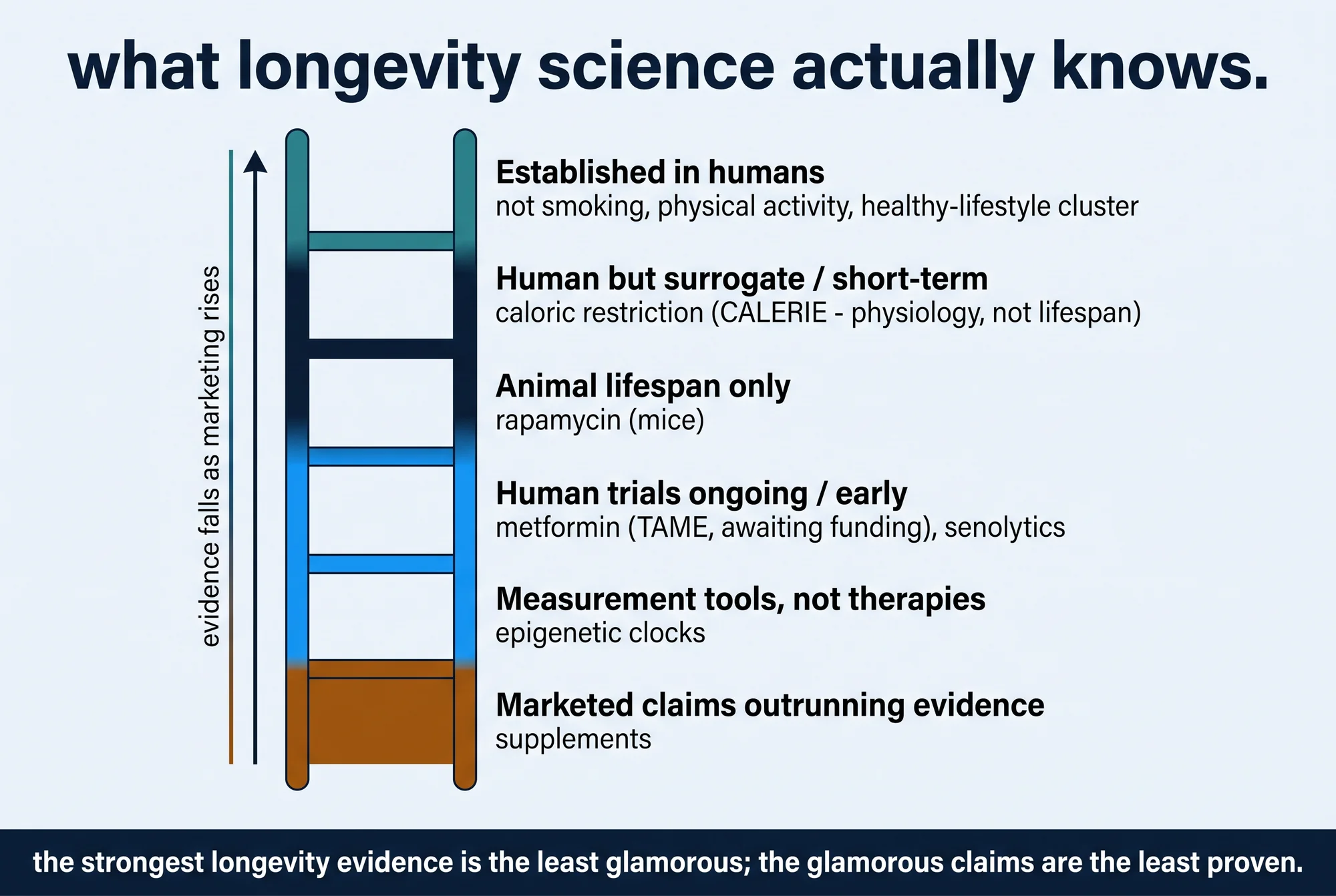
What longevity science actually studies
For most of the twentieth century, medicine measured its victories in lifespan — the average number of years people lived, which in the United States rose roughly from the mid-forties to the low-seventies across the century (Fries, 1980). Writing in 1980, the physician James Fries argued that this number could mislead. Average life expectancy had climbed, he noted, but the maximum human lifespan had not; the shape of survival was becoming more rectangular, with more people living in good health until a comparatively fixed wall near the end. His proposal, which named the field's central goal, was the compression of morbidity: if the age at which chronic illness and disability begin could be pushed back faster than the age of death, the sick stretch at the end of life would shrink. The distinction he drew — between how long you live and how long you live well — is the one longevity science still organizes itself around. The healthy years are the healthspan; the total years are the lifespan; and the field's ambition is to widen the first, not merely to extend the second.
That ambition rests on a hypothesis. Because aging is the single largest risk factor for most chronic disease — cancer, heart disease, diabetes, and dementia all climb steeply with age — a group of researchers proposed that intervening in the biology of aging itself might postpone these conditions together, rather than fighting them one at a time. This is the geroscience hypothesis, and its proponents note that aging in laboratory mammals "can be delayed with genetic, dietary, and pharmacologic approaches" (Kennedy et al., 2014). That claim has to be read as what it is: an organizing hypothesis with strong support in animals, not a demonstrated human therapy. The gap between those two — animal support and human proof — is the recurring theme of everything below.
What would longevity science target, mechanistically? The most-cited answer catalogs nine interacting cellular processes proposed as common denominators of aging in mammals — among them genomic instability, telomere attrition, cellular senescence, and deregulated nutrient sensing — collected under the heading "the hallmarks of aging" (López-Otín et al., 2013). The hallmarks are a conceptual map rather than a set of proven drug targets, and each is a research program in its own right; our companion explainer on the hallmarks of aging walks through them. For this overview, the point is narrower: aging is not treated here as a vague inevitability but as a set of concrete biological processes that researchers are trying to measure and move.
The maximum-lifespan question is unsettled
If average lifespan has risen so steadily, is there a ceiling? The demographers Jim Oeppen and James Vaupel documented that record life expectancy — the figure in whichever country was doing best in a given year — climbed in an almost straight line for roughly 160 years, repeatedly breaking limits that experts had declared biological (Oeppen & Vaupel, 2002). Every asserted ceiling, in their account, was eventually surpassed. Whether a maximum human lifespan exists is a separate and genuinely contested question, and it is worth seeing the disagreement rather than a tidy verdict.
On one side, an analysis of global demographic data argued that gains in survival tend to slow after about age 100 and that the age at death of the world's oldest verified person has not risen since the 1990s; the authors concluded that maximum human lifespan is effectively fixed, with the paper's own estimate placing the ceiling near 115 years (Dong et al., 2016). The claim drew immediate formal challenges in the same journal, which argued that the apparent limit was an artifact of how the data were grouped and analyzed rather than a biological wall (Lenart & Vaupel, 2017). Independent evidence complicated the picture further: using records for 3,836 Italians aged 105 and older, one study found that the risk of death essentially stops rising past about age 105 — a mortality "plateau" rather than an ever-steepening climb, which counts against a hard, fast-approaching wall (Barbi et al., 2018). The original authors replied and held their position (Milholland et al., 2017). The exchange remains open. The safe reading, and the one popular coverage most often gets wrong, is that the rise in average and record life expectancy is well established, while the existence and value of a fixed maximum is not.
What actually extends healthy life in humans
Here the evidence is strongest, and it is pointedly not pharmaceutical. The largest human studies in the whole field are about behavior, and two findings anchor the tier.
The first is smoking. In a US cohort of more than 200,000 adults, current smokers died at roughly three times the rate of never-smokers across ages 25 to 79, losing more than a decade of life expectancy — and cessation recovered most of it, dose-dependently by age. Quitting before 40 cut the excess risk of death from continued smoking by about 90 percent; quitting in one's late twenties, thirties, or forties recovered on the order of ten, nine, and six years respectively (Jha et al., 2013). No drug in the longevity pipeline has a human effect size approaching this.
The second is the cluster of ordinary habits. Following the Nurses' Health Study and the Health Professionals Follow-up Study — together more than 120,000 people — researchers scored five low-risk factors: never smoking, a healthy body weight, at least thirty minutes a day of moderate-to-vigorous activity, moderate alcohol intake, and a diet in the top 40 percent for quality. Adults who met all five had roughly a quarter the mortality rate of those who met none (hazard ratio 0.26). Translated into years, projected life expectancy at age 50 was 43.1 years for women and 37.6 for men with all five factors, against 29.0 and 25.5 with none — a gap of about 14.0 years for women and 12.2 years for men (Li et al., 2018).
Two honest qualifications travel with those numbers. Both studies are observational, so they establish strong association, not proof of cause; people who keep all five habits differ from those who keep none in ways that reach beyond the habits themselves. But the effect sizes are large and consistent, and the interventional trials that can support causal language — the randomized diabetes-prevention and weight-loss studies covered in our explainer on metabolic health — point the same way. The unglamorous levers are the best-evidenced thing longevity science has.
One rung down sits caloric restriction, the intervention with the deepest animal pedigree. Cutting calories reliably extends lifespan in short-lived species, and whether it does so in humans has been tested directly — but only on surrogates. In the two-year CALERIE trial, 218 non-obese adults were randomized to a 25 percent calorie-restriction target or to eat freely. They fell short of the target, achieving about 12 percent restriction, yet still lowered their metabolic rate beyond what weight loss alone would predict and improved a range of cardiometabolic and inflammatory markers, without harming quality of life (Ravussin et al., 2015). What the trial could not do is measure lifespan: two years of biomarkers in middle-aged adults is not a longevity outcome. CALERIE showed that sustained caloric restriction is feasible and that it moves predictors of health in the right direction. It did not show that people live longer, though it is often reported as if it had.
The pharmacological candidates
Below the human-behavioral tier, the evidence shifts from people to laboratory animals — and this is where longevity claims most often get ahead of themselves. The drugs with the most striking lifespan data have no completed human longevity trial, and the human trials that do exist are small, short, or measure something other than survival.
The strongest signal belongs to rapamycin, a drug that inhibits a nutrient-sensing pathway called mTOR. In the National Institute on Aging's Interventions Testing Program — a deliberately demanding design that tests compounds in genetically varied mice at three independent laboratories — rapamycin started late in life extended both median and maximum lifespan, by roughly 14 percent in females and 9 percent in males (Harrison et al., 2009). A second report from the same program, dosing earlier, found gains of about 10 percent in males and 18 percent in females (Miller et al., 2011). These are among the most reproducible lifespan results in mammals. They are also, without exception, results in mice. No completed human trial shows that rapamycin extends lifespan or healthspan, and reading the mouse data as though it were a human outcome is the single most common overreach in this area.
Metformin, a cheap and widely used diabetes drug, is the candidate proposed for the field's landmark test. Its advocates designed the TAME trial — Targeting Aging with Metformin — as a roughly six-year, fourteen-center, placebo-controlled study in adults aged 65 to 80, using a composite of age-related diseases, rather than any single condition, as its endpoint (Barzilai et al., 2016). TAME matters as much for its regulatory ambition — establishing that "aging" can serve as a trial endpoint at all — as for the drug. But its status has to be stated precisely: as of this writing, TAME is designed and awaiting full funding to launch, and it has not reported results. The only completed metformin-and-aging study is a 16-person pilot, the Metformin in Longevity Study, finished in 2015 — far too small to speak to longevity (Metformin in Longevity Study; Barzilai et al., 2016). Metformin is not, on current evidence, a proven human longevity drug.
Senolytics — drugs designed to clear the senescent "zombie" cells that accumulate with age — are earlier still. The first-in-human study combined two such agents in 14 patients with idiopathic pulmonary fibrosis; it was an open-label pilot whose primary goal was feasibility, not efficacy. Patients tolerated the regimen and showed gains in physical-function measures such as walking distance and gait speed, while lung function and self-reported health were unchanged (Justice et al., 2019). Fourteen patients, no placebo group, and functional surrogates rather than any longevity or even disease-progression endpoint: this is the earliest rung of human evidence — enough to justify larger trials, nowhere near proof.
Biological-age clocks: rulers, not cures
A parallel line of work asks a measurement question: can we tell how fast a person is actually aging, independent of their birthday? The leading tools read chemical marks on DNA — patterns of methylation that shift with age — and combine them into an estimate of "biological age." The first multi-tissue version used 353 such sites, calibrated across roughly 8,000 samples from dozens of tissue types, to estimate age throughout the body (Horvath, 2013). Later clocks were built explicitly to predict health rather than the calendar: PhenoAge, trained on clinical markers, outperformed the earlier clocks at predicting mortality, cancer, and physical decline (Levine et al., 2018); GrimAge predicted time to death with remarkable strength, along with time to heart disease and cancer (Lu et al., 2019); and DunedinPACE, built from two decades of organ-system measurements in a single birth cohort, estimates the rate at which someone is aging, year over year (Belsky et al., 2022).
These are genuine advances, and they are the field's best answer to the problem that no human trial can practically run to a lifespan endpoint. But one caveat carries the whole thread: the clocks are predictors, not proven targets. That a clock forecasts mortality does not establish that changing the clock changes the outcome. No cited study shows that a drug or behavior which moves an epigenetic clock thereby extends human life — that inference is precisely the open question the field is trying to answer. A clock is a ruler. A lower number after an intervention is a hypothesis to test, not a demonstrated cure, and "reversed my biological age" is a marketing sentence the underlying science does not yet support.
Why animal results so often fail in humans
The recurring caution — that a mouse result is not a human result — is not reflexive skepticism; it reflects a documented pattern, and two features of the biology explain it.
First, results are fragile even within the animal work. The Interventions Testing Program uses genetically varied mice at three separate sites precisely because single-strain, single-laboratory longevity findings so often fail to replicate. Inside that same program, compounds that had generated excitement elsewhere fell flat: resveratrol — the red-wine molecule marketed for years as a longevity supplement — and simvastatin showed no significant lifespan benefit, even though the resveratrol study's authors included the compound's best-known champions (Miller et al., 2011). Translation can fail before a human is ever involved.
Second, effects tend to shrink as species get longer-lived and more like us. Caloric restriction is the cautionary case. It extends lifespan robustly in short-lived animals, but in long-lived rhesus monkeys the two landmark studies disagreed: the National Institute on Aging's study found no significant survival benefit, while a Wisconsin study reported one (Mattison et al., 2012). A later joint analysis reconciled them, concluding that the health benefits are broadly real but depend heavily on when restriction begins, what the diet is made of, and how the study is designed (Mattison et al., 2017). The lesson generalizes. Short-lived models age fast and perturb easily, so their large effects routinely diminish or vanish in longer-lived species — and humans, who cannot be studied on a lifespan endpoint in any feasible trial, are the hardest case of all. That is why the field leans so heavily on the biomarkers and surrogate endpoints above, and why their unproven causal status matters so much.
The hype problem
The distance between what longevity science has shown and what "longevity" products claim is wide enough that the research community has formally disowned the commercial marketplace. A consensus statement signed by 52 aging researchers stated flatly that the anti-aging products then being sold "have no scientifically demonstrated efficacy, in some cases they may be harmful, and those selling them often misrepresent the science upon which they are based" (Olshansky et al., 2002). The statement is more than two decades old, and the specific products have turned over since, but its central caution has not dated: marketed longevity claims routinely outrun their evidence.
The pattern is consistent enough to name. Longevity marketing tends to make four moves the evidence does not license: presenting animal data as though it were a human result (the rapamycin and resveratrol stories); presenting a biomarker change as proven life extension (the clocks); presenting a hypothesis as an established therapy (geroscience itself, when a supplement is sold on it); and presenting a compound as validated when controlled trials are null or simply absent (resveratrol's flat result under rigorous testing is the clean example). A useful reader's habit is to ask, of any longevity claim, which tier it actually sits on: established in humans, human-but-surrogate, animal-only, early-trial, a measurement tool, or a marketing sentence.
What remains uncertain
Several open questions deserve to be stated plainly rather than smoothed over.
- The landmark human trial has not reported. TAME, the study designed to test whether a drug can target aging as such, is designed and awaiting full funding to launch; it has not delivered results, and no completed human trial establishes a pharmaceutical longevity effect (Barzilai et al., 2016).
- Clocks are not yet endpoints. Epigenetic clocks predict mortality well, but moving one has not been shown to extend life; their causal status is unresolved (Horvath, 2013; Lu et al., 2019; Belsky et al., 2022).
- The strongest human evidence is observational. The lifestyle findings that anchor the top tier come from cohorts, not randomized longevity trials — strong association, with causal support borrowed from shorter-term intervention studies rather than proven on a lifespan endpoint (Jha et al., 2013; Li et al., 2018).
- The maximum-lifespan question is open. Whether humans face a fixed ceiling remains actively disputed among demographers (Dong et al., 2016; Barbi et al., 2018).
- Caloric restriction's human payoff is unmeasured. CALERIE improved predictors of healthy aging; whether that translates into longer human life is untested and, on a two-year horizon, untestable (Ravussin et al., 2015).
The field is neither a fraud nor a solved problem. Its one very well-evidenced conclusion — that ordinary behaviors carry the largest known human effect on healthy longevity — sits beside a frontier of drugs and biomarkers that are genuinely promising and genuinely unproven in people. Not letting that frontier borrow the foundation's credibility is the discipline of reading longevity science honestly.
This review maps the longevity-science field for a general reader and sorts its interventions by the strength and directness of human evidence, drawing on human cohort studies, randomized trials, animal-lifespan experiments, methods papers, and a clinical-trial registry, with an evidence cutoff of August 2026. It is educational and is not medical advice, a diagnosis, or a treatment recommendation; study parameters are reported with the population, species, and design that produced them, and animal findings are never presented as human outcomes. For the mechanisms beneath the surface, see The Hallmarks of Aging and What Is Metabolic Health?, and browse the Longevity hub.
References
- 1.American Federation for Aging Research (AFAR). TAME - Targeting Aging with Metformin (program/trial page). afar.org/tame-trial. Accessed 2026-08-23. Link
- 2.Barbi E, Lagona F, Marsili M, Vaupel JW, Wachter KW. The plateau of human mortality: demography of longevity pioneers. Science. 2018;360(6396):1459-1461. doi:10.1126/science.aat3119
- 3.Barzilai N, Crandall JP, Kritchevsky SB, Espeland MA. Metformin as a tool to target aging. Cell Metab. 2016;23(6):1060-1065. doi:10.1016/j.cmet.2016.05.011
- 4.Belsky DW, Caspi A, Corcoran DL, et al. DunedinPACE, a DNA methylation biomarker of the pace of aging. eLife. 2022;11:e73420. doi:10.7554/eLife.73420
- 5.Dong X, Milholland B, Vijg J. Evidence for a limit to human lifespan. Nature. 2016;538(7624):257-259. doi:10.1038/nature19793
- 6.Fries JF. Aging, natural death, and the compression of morbidity. N Engl J Med. 1980;303(3):130-135. doi:10.1056/NEJM198007173030304
- 7.Harrison DE, Strong R, Sharp ZD, et al. Rapamycin fed late in life extends lifespan in genetically heterogeneous mice. Nature. 2009;460(7253):392-395. doi:10.1038/nature08221
- 8.Horvath S. DNA methylation age of human tissues and cell types. Genome Biol. 2013;14(10):R115. doi:10.1186/gb-2013-14-10-r115
- 9.Jha P, Ramasundarahettige C, Landsman V, et al. 21st-century hazards of smoking and benefits of cessation in the United States. N Engl J Med. 2013;368(4):341-350. doi:10.1056/NEJMsa1211128
- 10.Justice JN, Nambiar AM, Tchkonia T, et al. Senolytics in idiopathic pulmonary fibrosis: results from a first-in-human, open-label, pilot study. EBioMedicine. 2019;40:554-563. doi:10.1016/j.ebiom.2018.12.052
- 11.Kennedy BK, Berger SL, Brunet A, et al. Geroscience: linking aging to chronic disease. Cell. 2014;159(4):709-713. doi:10.1016/j.cell.2014.10.039
- 12.Lenart A, Vaupel JW. Questionable evidence for a limit to human lifespan. Nature. 2017;546(7660):E13-E14. doi:10.1038/nature22790
- 13.Levine ME, Lu AT, Quach A, et al. An epigenetic biomarker of aging for lifespan and healthspan. Aging (Albany NY). 2018;10(4):573-591. doi:10.18632/aging.101414
- 14.Li Y, Pan A, Wang DD, et al. Impact of healthy lifestyle factors on life expectancies in the US population. Circulation. 2018;138(4):345-355. doi:10.1161/CIRCULATIONAHA.117.032047
- 15.López-Otín C, Blasco MA, Partridge L, Serrano M, Kroemer G. The hallmarks of aging. Cell. 2013;153(6):1194-1217. doi:10.1016/j.cell.2013.05.039
- 16.Lu AT, Quach A, Wilson JG, et al. DNA methylation GrimAge strongly predicts lifespan and healthspan. Aging (Albany NY). 2019;11(2):303-327. doi:10.18632/aging.101684
- 17.Mattison JA, Roth GS, Beasley TM, et al. Impact of caloric restriction on health and survival in rhesus monkeys from the NIA study. Nature. 2012;489(7415):318-321. doi:10.1038/nature11432
- 18.Mattison JA, Colman RJ, Beasley TM, et al. Caloric restriction improves health and survival of rhesus monkeys. Nat Commun. 2017;8:14063. doi:10.1038/ncomms14063
- 19.Metformin in Longevity Study (MILES). ClinicalTrials.gov Identifier NCT02432287. Sponsor: Albert Einstein College of Medicine. Phase 4; enrollment 16; status Completed (primary completion 2015-09). Link
- 20.Milholland B, Dong X, Vijg J. 'Best-Guess' MRAD provides robust evidence for a limit to human lifespan: reply to de Grey. Rejuvenation Res. 2017;20(5):437-440. doi:10.1089/rej.2017.2008
- 21.Miller RA, Harrison DE, Astle CM, et al. Rapamycin, but not resveratrol or simvastatin, extends life span of genetically heterogeneous mice. J Gerontol A Biol Sci Med Sci. 2011;66(2):191-201. doi:10.1093/gerona/glq178
- 22.Oeppen J, Vaupel JW. Demography. Broken limits to life expectancy. Science. 2002;296(5570):1029-1031. doi:10.1126/science.1069675
- 23.Olshansky SJ, Hayflick L, Carnes BA. Position statement on human aging. J Gerontol A Biol Sci Med Sci. 2002;57(8):B292-B297. doi:10.1093/gerona/57.8.b292
- 24.Ravussin E, Redman LM, Rochon J, et al. A 2-year randomized controlled trial of human caloric restriction: feasibility and effects on predictors of health span and longevity. J Gerontol A Biol Sci Med Sci. 2015;70(9):1097-1104. doi:10.1093/gerona/glv057
Disclosures
Educational review of published evidence. Not medical advice, diagnosis, or a treatment recommendation. Study parameters are reported with the population, species, and design that produced them; animal findings are never presented as human outcomes.