
Price per Milligram
A vial is sold as a package at one sticker price, but the milligrams inside differ. Price per milligram is the only number that compares across sizes and sellers — here is how to compute it, why a bigger vial almost always wins, and where the unit breaks.
Abstract
A research-use-only peptide is sold as a finished vial at one sticker price, but the milligrams of compound inside a 5 mg vial and an 80 mg vial are not the same, so the sticker answers what the package costs, not what the compound costs. Price per milligram — unit price divided by the milligrams in the vial — is the only figure that compares across sizes and across sellers. In an August 2026 snapshot of sixty-five sellers, a 5 mg BPC-157 vial listing at a median $49.99 works out to $10.00 per milligram while a 10 mg vial at $60.00 is $6.00 per milligram: the larger vial costs more per vial and far less per milligram. Across BPC-157's full range of sizes, vial size alone moves the median per-milligram price roughly fourfold, from about $8.40 at the small end to $1.93 at the large end. The unit is only meaningful within a compound and within a category — per-milligram prices run about eighty-four-fold from GLP-1 compounds to high-dose ancillaries like NAD+ — and it is undefined for anything sold by volume or international units, where no milligram mass exists.
Key findings
- A vial is sold as a package at one sticker price, but the milligrams inside differ — so the only figure comparable across sizes and sellers is price per milligram: unit price divided by the milligrams in the vial.
- Sticker price can invert the ranking: a 5 mg BPC-157 vial at a median $49.99 ($10.00 per milligram) looks cheaper than a 10 mg vial at $60.00, but the 10 mg vial is $6.00 per milligram — cheaper where it counts.
- Bigger vials are almost always cheaper per milligram because fixed per-vial costs spread over more material; across BPC-157's sizes, vial size alone moves the per-milligram price about 4.4-fold (roughly $8.40 to $1.93 per milligram).
- Price per milligram compares within a compound and within a category, not across them: category medians run about eighty-four-fold from GLP-1 compounds (~$9.90/mg) to high-dose ancillaries such as NAD+ (~$0.12/mg), a difference of dose, not value.
- No mass, no price per milligram: products sold by volume (mL) or international units (IU) have no milligram denominator and cannot be placed on the per-milligram footing.
- Every figure is an August 2026 snapshot median of observed sell-list prices; listed prices are not transacted prices, and the durable takeaway is the method, not any single number.
- Methodology
- Observed public retail listings for research-use-only peptides across sixty-five sellers and twenty-three compounds, normalized to price per milligram (unit price divided by resolved milligram mass). Per-milligram figures are medians of competitor sell-list prices with outliers quarantined and single-unit sizes only; multi-unit packs, wholesale tiers, and products sold by volume or international units are excluded. No confidential cost or margin data is used. Snapshot, not a live quote.
- Geography
- United States research-use-only market
- Study period
- August 2026 snapshot
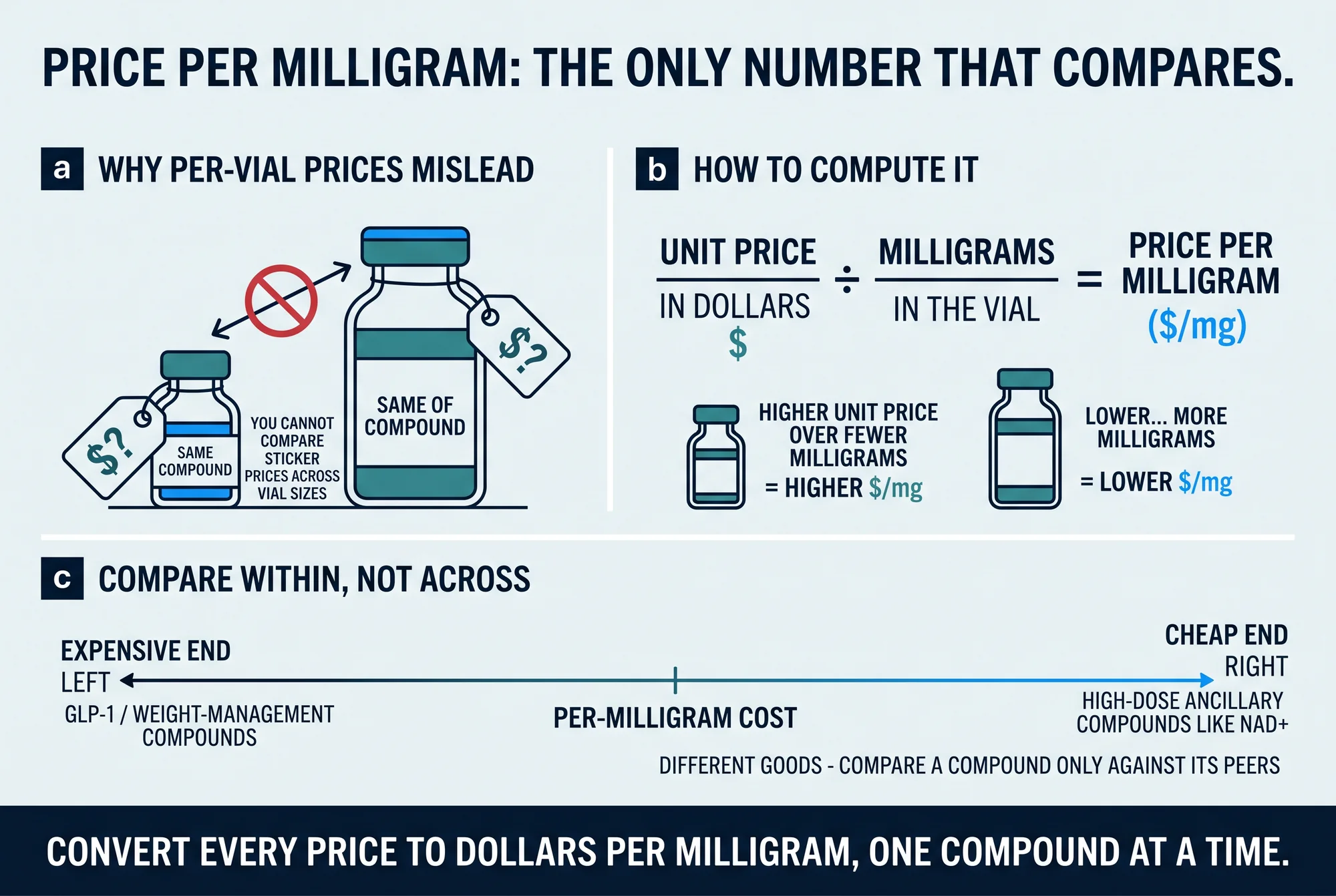
Two vials of the same peptide sit side by side. One holds 5 milligrams and lists at $49.99; the other holds 10 milligrams and lists at $60.00. By the price on the label the smaller vial wins — it is ten dollars cheaper. Put both on the same footing, though, and the ranking flips: the 5 mg vial costs $10.00 per milligram and the 10 mg vial costs $6.00. The bigger, "more expensive" vial is the better buy by a wide margin. That single inversion is why serious buyers in the research-use-only peptide market ignore the sticker and compare one number instead — price per milligram.
Price per milligram is simply the unit price divided by the milligrams of compound in the vial. It is the only figure that survives a comparison across vial sizes and across sellers, because it strips out the one thing the sticker hides: how much actual compound you are getting. This piece is about that unit — what it is, how to compute it, why a bigger vial is almost always cheaper by it, how far it reaches, and the one situation where it cannot be computed at all. For why the same compound's price fans out severalfold between sellers and how the market is built end to end, its two companions carry those arguments; here the subject is the milligram itself.
Why the sticker price misleads
A retail vial is a finished product with a single price on it — a 5 mg vial, a 10 mg vial, a 50 mg vial — and that price answers a narrow question: what does this package cost? It does not answer the question a buyer actually has, which is what does the compound cost. The two come apart the moment vial sizes differ, because the sticker bundles the compound together with everything around it and reports only the total.
Return to the two BPC-157 vials. The 5 mg vial's $49.99 and the 10 mg vial's $60.00 are both real median listings from the snapshot, and by sticker the smaller one is unambiguously cheaper. Yet nobody buys "a vial" as an end in itself; they buy the milligrams inside it. Measured that way the comparison reverses, and it is not close — $10.00 per milligram against $6.00. A buyer who ranks by sticker picks the worse value and never sees it. Comparing stickers across sizes is not a rough approximation of comparing per milligram; it can point the opposite way.
How to compute price per milligram
The arithmetic is deliberately dull: take the vial's price and divide by the number of milligrams of compound it contains. $49.99 in a 5 mg vial is $49.99 ÷ 5 = $10.00 per milligram. $60.00 in a 10 mg vial is $60.00 ÷ 10 = $6.00 per milligram. Every listing, from any seller, at any size, reduces to that one figure, and only then can two of them be set against each other honestly.
BPC-157, the most widely carried compound in the market, is sold in four vial sizes — 5, 10, 70, and 80 mg — and running the same division across them traces a falling line rather than a flat one. It is $10.00 per milligram at 5 mg and $6.00 at 10 mg, and it keeps dropping through the 70 and 80 mg vials. The chart below walks that ladder.
The shape is the whole point. Hold the compound fixed, change only the size of the package it ships in, and the per-milligram price still moves substantially. Which raises the obvious question: why should the same molecule cost several times more per milligram in a small vial than in a large one?
Why bigger vials cost less per milligram
Because a good deal of what you pay for is the vial, not the compound. Every vial carries a bundle of fixed costs that do not scale with the milligrams inside it: the glass vial and its stopper, the fill and the freeze-dry run that turns solution into a stable powder, the label, the box, domestic shipping, and payment processing. Those costs are incurred once per vial, and they are roughly the same whether the vial holds 5 milligrams or 80.
Spread a fixed cost over more milligrams and the cost per milligram falls — arithmetic, not a discount. The same overhead that lands heavily on each milligram in a 5 mg vial is diluted across sixteen times as many milligrams in an 80 mg vial, so its share of what each milligram costs shrinks accordingly. That is exactly the descent the chart shows. Quantified on our own medians, across BPC-157's full range the per-milligram price runs from about $8.40 at the small end (the outlier-screened median across its small vials, a touch below the single $10.00 listing used above) down to $1.93 at the large end — a roughly 4.4-fold swing produced by vial size alone. The compound did not change; only the quantity packaged with the same fixed overhead did.
A note on discipline: this is the mechanism, not a cost disclosure. The per-vial line items above — glass, fill, freeze-dry, label, shipping — are illustrative, and no dollar figure is attached to any manufacturing step. The point is qualitative and it is enough: fixed costs per vial, spread thinner over more milligrams, bend the per-milligram price downward as vials grow.
The practical consequence is that the only fair per-milligram comparison holds vial size roughly constant. Compare a 10 mg vial against another 10 mg vial, not a 10 mg vial against an 80 mg one — otherwise most of what you are "measuring" between two sellers is just the size effect.
Compare within a compound and a category, not across
Price per milligram is comparable within a compound and, more loosely, within a category of similar compounds. It is not a cross-category verdict, and reading it as one produces nonsense.
The category medians make the trap obvious:
| Category | Representative price per milligram |
|---|---|
| GLP-1 & weight management | $9.90 |
| Growth & anti-aging | $7.24 |
| Cognitive, aesthetic & ancillary | $4.45 |
| Repair & aesthetic | $4.34 |
| Bioregulators | $2.61 |
| High-dose ancillary (e.g. NAD+) | $0.12 |
From top to bottom that is roughly an eighty-four-fold range ($9.90 against $0.118). It would be a mistake to read it as GLP-1 compounds being "eighty times overpriced" or NAD+ being the bargain of the market. The spread is almost entirely a matter of dose. NAD+ ships in 500 to 1000 mg vials; a GLP-1 compound ships in something closer to 10 mg. Selling a molecule by the hundreds of milligrams drives its per-milligram price down; selling one by single milligrams keeps it high. They are different goods, dosed and used in different quantities, and their per-milligram prices are no more comparable than the price per gram of saffron and table salt.
So the unit answers "is this BPC-157 listing dear or cheap for BPC-157?" cleanly, and "is this GLP-1 compound dear or cheap against NAD+?" not at all.
No mass, no price per milligram
The unit has one hard precondition: a real mass in milligrams to divide by. Where that mass cannot be resolved, the denominator does not exist and no price per milligram can be computed — not approximately, not at all.
Some products yield no mass by design. Anything sold by volume (a number of milliliters) or by international units (IU) carries no milligram figure, because milliliters and IU are not milligrams and cannot be converted into them without information the listing does not provide. Such a product has no place on the per-milligram footing, and the honest move is to leave it off the comparison and say so, rather than invent a mass to make the arithmetic run. Guessing a denominator does not produce a cautious estimate; it produces a fabricated one, and it then contaminates every median it touches.
This is a feature of the unit, not a failure of it. "This product is sold in milliliters, so it has no comparable price per milligram" is the method refusing to compare what it cannot measure — which is exactly the discipline that makes the number trustworthy everywhere it does apply.
How to use it
Three habits turn the unit into a working tool, and each defends against a specific mistake.
Convert before you compare. Reduce every listing to price per milligram at a comparable vial size first, then rank. This one step dissolves most apparent bargains and surfaces the genuine ones, and it is what separates a real comparison from a sticker illusion.
Hold size roughly constant. Because vial size alone can move a compound's per-milligram price several-fold, a "cheap" seller quoting a large vial and a "dear" seller quoting a small one are not actually being compared until their sizes match. Most of a compound's apparent per-milligram spread is the size effect, not the sellers.
Do not read the number as a quality grade, and do not compute it off a wild price. A low price per milligram is not evidence of weak material, and a high one is not evidence of good material; identity, purity, and sterility are established by analytical testing, not by cost — a point the companion piece on why prices vary develops in full. And a per-milligram figure is only as sound as the price beneath it. Raw listings contain wild cells — a $703.99 vial of GHK-Cu here, a $5.00 vial of TB-500 there — that compute to per-milligram figures ($14.08 and $0.50) which are noise, not market facts. Work from medians across many sellers, never a single startling cell.
What the number can and cannot promise
Every figure here is a single August 2026 snapshot median, and it should be held that lightly. Prices and the roster of sellers move week to week, so any specific number ages quickly; the durable content is the method — compare per milligram, within a compound, at a comparable size — not the headline figure. Listed prices are also not transacted prices: discounts, order minimums, shipping, bundles, and separate wholesale tiers all move the real cost off the sticker and therefore off the computed per-milligram figure. Each per-milligram number is a median across a sample of sellers, so thinly covered compounds — anything carried by only a handful of retailers — carry wide uncertainty, and coverage is thinnest for exactly the newest and most restricted compounds, several GLP-1-class products among them, which are sold behind account gates that make like-for-like capture hard. Read those as indicative, not precise. None of this weakens the core claim; it sharpens it. The reason to compare per milligram is precisely that the market is noisy, moving, and easy to misread from a sticker.
This analysis draws on South Beach Longevity's research-use-only peptide-market dataset — observed public competitor retail listings across sixty-five sellers and twenty-three compounds, captured as an August 2026 snapshot and normalized to price per milligram. Only observed sell-list medians are used; no confidential cost or margin data appears here. It describes a market in research-use-only peptides, not medicines, and is offered as market analysis, not medical advice or a recommendation to purchase or use any compound. For why the same compound's price varies severalfold between sellers, see Why Peptide Prices Vary; for how the market is structured end to end, see How the U.S. Research Peptide Market Works.
References
- 1.South Beach Longevity. Research-use-only peptide market dataset: observed public competitor retail listings across 65 sellers and 23 compounds, normalized to price per milligram. August 2026 snapshot.
- 2.South Beach Longevity. Why Peptide Prices Vary. Market-intelligence explainer, 2026.
- 3.South Beach Longevity. How the U.S. Research Peptide Market Works. Market-intelligence explainer, 2026.
Disclosures
Market analysis only. Figures describe observed retail listings for research-use-only products and are not endorsements, price quotes, or recommendations to purchase or use any compound. Contains no confidential cost or margin data.