
Lifespan vs Healthspan
How long you live is not the same as how long you live well — and for a whole population the two differ by roughly a decade.
Abstract
Lifespan and healthspan name two different quantities: the length of a life, and the portion of it spent in good health. At the population level the second falls short of the first by roughly a decade — 9.6 years globally in 2019 by WHO estimates, and 12.7 years in the United States in 2021 by the Global Burden of Disease study, with each gap computed inside its own system. The most instructive figure is the US trajectory, where three decades of rising life expectancy were not matched by any gain in healthy life expectancy. Whether that sick period can be compressed toward the very end of life remains genuinely contested, and healthspan itself has no validated metric, so the numbers are best read as a well-sourced approximation rather than a precise truth. This review defines both terms, quantifies the gap, and sets out why the field increasingly treats healthy years, not total years, as the target.
Key findings
- Lifespan is how long you live; healthspan is how long you live free of chronic disease and disability. The distinction has anchored the field since Fries introduced it in 1980 (Fries, 1980).
- For a whole population, lifespan runs about a decade ahead of healthspan: globally in 2019, life expectancy was 73.1 years and healthy life expectancy 63.5 — a gap of 9.6 years (World Health Organization, 2019); in the US in 2021 the gap was wider, 12.7 years (GBD 2021 US Burden of Disease Collaborators, 2024).
- US life expectancy rose from 75.6 to 77.1 years between 1990 and 2021 while healthy life expectancy stayed flat (64.8 to 64.4). The added years were not healthy years (GBD 2021 US Burden of Disease Collaborators, 2024).
- Whether the sick period can be compressed toward the end of life is contested: Fries argues the evidence supports it (Fries et al., 2011); independent US trend data find the opposite (Crimmins & Beltrán-Sánchez, 2011).
- Healthspan has no accepted or validated metric; 'healthy' is a judgment call, so precise-sounding 'healthy years' figures inherit that softness (Kaeberlein, 2018).
- The geroscience argument is that targeting the biology of aging could postpone many age-related diseases at once and extend healthspan — a research goal, not a demonstrated human therapy (Kennedy et al., 2014).
Lifespan is how long you live. Healthspan is how long you live in good health — the years free of serious chronic disease and disability, before decline begins to limit ordinary life. For most of medical history there was little reason to separate the two: a life was counted at its end, and how the last stretch was spent lay largely beyond anyone's reach. The distinction matters now because the two have come apart. Across the twentieth century people gained decades of life, but the extra years have not all been healthy ones, and the difference between a long life and a long healthy life has become one of the organizing problems of longevity science.
The gap is not small. For a whole population it runs to roughly a decade: the average person lives about ten years longer than the average person stays in full health. That decade — spent with disease, disability, or both — is what separates lifespan from healthspan, and closing it, rather than simply adding more years at the end, is what the field increasingly means by success.
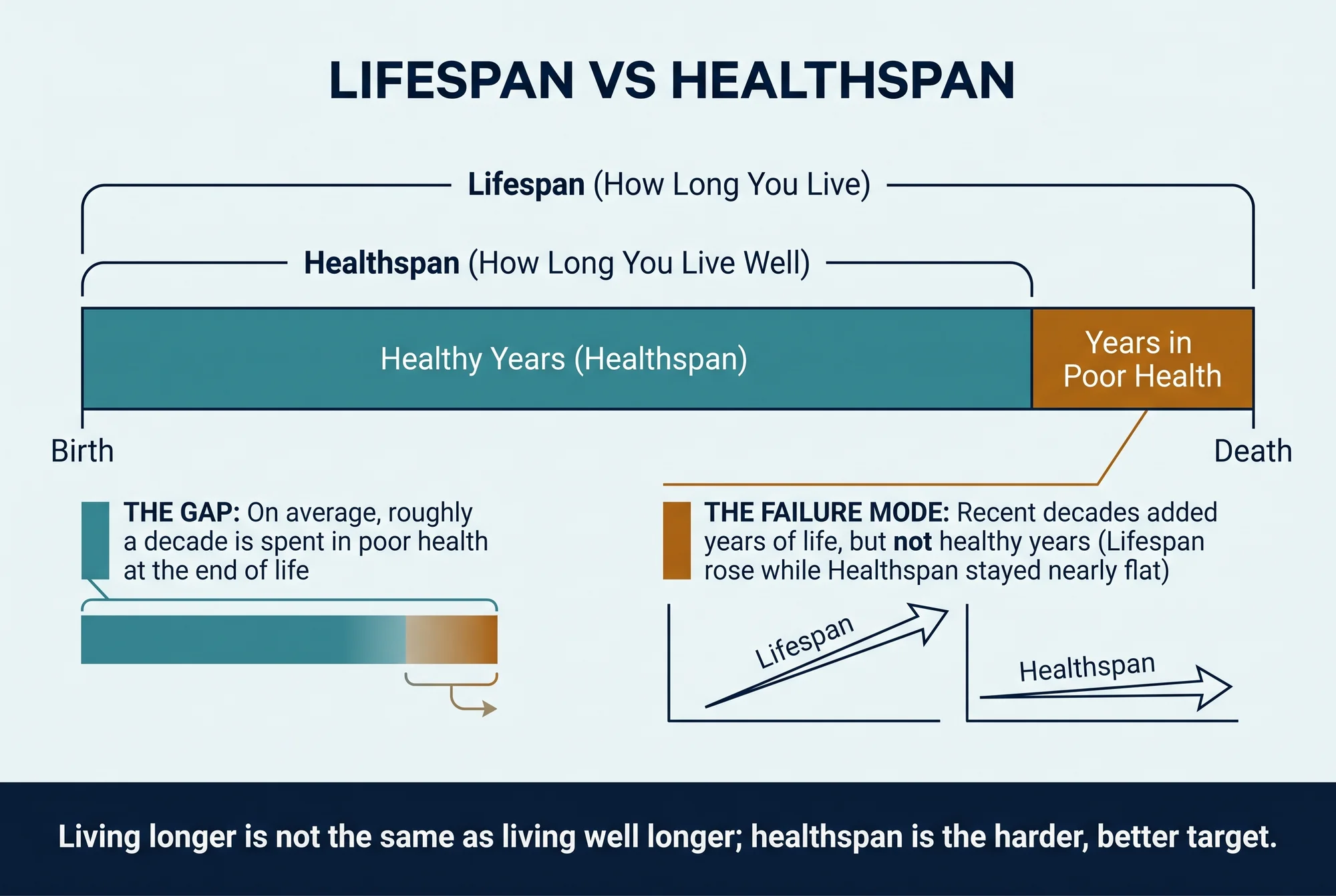
Two ideas: how long you live, and how long you live well
The vocabulary is recent, but the observation behind it is old. In 1980 the physician James Fries set out the frame that still governs the field: across the twentieth century, average life expectancy had climbed steeply — in his account, from roughly 47 to 73 years — while the maximum human lifespan had barely moved (Fries, 1980). More people were surviving into old age, so the survival curve was becoming, in his word, more "rectangular": fewer early deaths, then a sharper drop near a biological ceiling he placed at around 85 years. That rising average is the lifespan side of the pair, and it has kept climbing; record national life expectancy has increased steadily for more than a century, repeatedly passing limits that were asserted to be fixed (Oeppen & Vaupel, 2002).
Healthspan is the newer and softer term. It names the years lived in good health, free of major chronic disease and disability, and, unlike lifespan, it has no single agreed definition (Crimmins, 2015; Kaeberlein, 2018). That asymmetry is worth stating at the outset. Lifespan is a duration measured at a single unambiguous event, death. Healthspan is a duration spent in a state — "good health" — that has to be defined and operationalized before anyone can count it. One term is crisp, the other useful but blurred at the edges, and much of the difficulty in this article lives in the second.
The gap, in numbers
To measure healthspan across a population, demographers use healthy life expectancy, or HALE: the average number of years a person can expect to live in full health, with time spent in less-than-full health discounted according to the severity of disease and injury. Set HALE beside ordinary life expectancy, and the distance between them is the healthspan shortfall — the years the average person lives but does not live well.
The two best-sourced figures tell the same story from different vantage points. The World Health Organization's Global Health Estimates put global life expectancy at birth at 73.1 years in 2019 and global HALE at 63.5 years — a gap of 9.6 years, roughly a decade lived in diminished health (World Health Organization, 2019). For the United States, the Global Burden of Disease Study 2021 estimated life expectancy at 77.1 years and HALE at 64.4 years — a gap of 12.7 years, wider than the global figure (GBD 2021 US Burden of Disease Collaborators, 2024). A caution belongs with that comparison. The WHO and GBD figures come from two different estimation systems and two different years, so their exact levels are not interchangeable and should never be subtracted across systems. What they agree on is the shape — a gap of a decade or more, and a wider one in the United States — with each gap computed inside its own dataset.
The direction of travel is not obviously reassuring either. Globally, HALE has inched up, from 61.3 years in 2010 to 62.2 years in 2021 by the GBD accounting (GBD 2021 Diseases and Injuries Collaborators, 2024); and in the WHO series, both life expectancy and HALE rose between 2000 and 2019, with the gap widening slightly rather than closing (World Health Organization, 2019). Living longer, at the population scale, has so far tended to bring proportionally more time spent unwell, not less.
What the gap is made of
The decade of lost health is not one illness but an accumulation. The conditions that fill it are the chronic, age-related diseases — cardiovascular disease, cancer, type 2 diabetes, dementia, and the slow loss of mobility — and in later life they rarely arrive alone. In a cross-sectional study of 1,751,841 people in Scotland, 23.2% had two or more chronic conditions at once, a state called multimorbidity; it rose steeply with age and was present in most people aged 65 and older (Barnett et al., 2012). Disadvantage moved the whole picture earlier: multimorbidity began 10 to 15 years sooner in the most deprived areas, and mental-health problems climbed with each additional physical condition. The healthspan gap, in other words, is socially patterned as well as biological — worse, and starting younger, where deprivation is greatest.
Why these diseases cluster at the end of life has a common answer. Aging is the primary shared risk factor for most of them: the biological deterioration of aging is, in the framing of the hallmarks-of-aging literature, the main risk factor for cancer, diabetes, cardiovascular disorders, and neurodegeneration (López-Otín et al., 2013). That single upstream cause is the premise of geroscience (Kennedy et al., 2014), and it is why the illnesses that consume the gap tend to appear together and at the same stage of life. The cellular machinery behind it is the subject of a companion explainer on the hallmarks of aging; the metabolic thread running through much of it is covered in what metabolic health is.
The failure mode: added years that were not healthy years
The clearest warning about lifespan and healthspan comes from the United States, and it is a single pair of trend lines. Between 1990 and 2021, US life expectancy at birth rose from 75.6 to 77.1 years. Over the same three decades, US healthy life expectancy went from 64.8 to 64.4 years — essentially flat, and if anything slightly lower (GBD 2021 US Burden of Disease Collaborators, 2024). The country added about a year and a half of life and none of it as healthy years; the entire increment widened the gap, which grew from roughly 10.8 to 12.7 years. This is what it looks like when lifespan and healthspan come apart: more time alive, no more time well.
The pattern has a name. Long before the modern data, Gruenberg called it "the failures of success" — the idea that medicine's growing ability to keep chronically ill people alive lengthens the time lived with disease rather than curing it, so that saving lives can raise the population's total burden of illness (Gruenberg, 1977). The modern term is the expansion of morbidity, and the US figures are a textbook case of it. The point has been put plainly in the recent literature: life expectancy has risen by about three decades since the mid-twentieth century, but a parallel expansion of healthspan has not followed (Garmany et al., 2021). Adding years to a life is a different achievement from adding health to those years, and the two do not automatically travel together.
Compression of morbidity, and whether it is happening
That raises the question at the intellectual centre of the field: must the sick period expand as lifespan grows, or can it be compressed toward the very end of life? Fries's 1980 proposal was optimistic. If the age at which chronic illness first appears can be pushed back faster than the age at death rises, the total time spent ill shrinks — squeezed into a brief window before death rather than spread across decades (Fries, 1980). This is the compression-of-morbidity hypothesis, and it remains exactly that: a hypothesis, not a settled result.
The evidence for and against it genuinely conflicts. Reviewing twenty-year longitudinal studies, national disability trends, and randomized trials of risk-factor reduction, Fries and colleagues argued in a 2011 update that the case for compression is established in principle (Fries et al., 2011) — but this is the hypothesis's own originators making the case for their idea, and it has to be weighed against independent analyses. Those are less encouraging. Examining US data from 1998 to 2008, Crimmins and Beltrán-Sánchez found that disease prevalence had increased, that mobility had deteriorated, and that the length of life lived with disease had grown; the findings, they concluded, do not support recent compression of morbidity (Crimmins & Beltrán-Sánchez, 2011). A later review reconciled the two: there have been some reductions in physical disability and dementia, but disease prevalence has risen markedly, in part because treatment now keeps people alive with conditions they would once have died from — so, on balance, the population has "yet to experience much compression of morbidity" (Crimmins, 2015).
The honest summary is that compression is possible in principle and unproven in practice. There is real evidence that healthy behaviour postpones disability: in one large US cohort, adherence to five low-risk habits was associated with roughly 12 to 14 more years of life expectancy at age 50, although that is a projection of total lifespan rather than a direct measure of healthy years, and the study is observational (Li et al., 2018). But at the level of whole populations the sick period has not clearly shrunk, and by some measures it has grown. Which answer you get depends heavily on how morbidity is defined — which turns out to be the deeper problem.
Why healthspan, not lifespan, is the target
If the diseases that fill the gap share aging as their upstream cause, the target follows: intervene in the biology of aging, and many of those diseases might be postponed together, extending the healthy years rather than the sick ones. This is the organizing hypothesis of geroscience, and its stated goal is explicitly healthspan — the field has argued that expanding research aimed at extending human healthspan is a priority precisely because aging drives most chronic disease (Kennedy et al., 2014). The shift in emphasis has been made in as many words: a widely cited 2018 viewpoint by the demographer S. Jay Olshansky was titled, simply, "From Lifespan to Healthspan" (Olshansky, 2018).
The reason to prefer that target is written into the gap data. Extending lifespan on its own, without moving healthspan, only widens the gap; it produces the US pattern of more years, but sick ones. The geroscience aspiration is the reverse — push the onset of disease later, so that added years are healthy years, which is the compression-of-morbidity ideal restated as a research programme (Garmany et al., 2021). None of this means that any approved drug has been shown to extend human healthspan; it has not, and the evidence for specific interventions belongs in a separate discussion of what longevity science can and cannot yet do. The distinction matters because the space between genuine geroscience and "reverse-aging" marketing is where much overstatement lives — a panel of aging researchers has warned that many products sold on anti-aging claims have no demonstrated efficacy and that their sellers often misrepresent the science (Olshansky et al., 2002).
Why healthspan is hard to measure
The measurement problem is not a footnote; it shapes every number in this article. Kaeberlein put it bluntly in 2018: there are "no accepted or validated metrics for measuring healthspan," even as "increased healthspan" is routinely claimed as though it were a settled quantity (Kaeberlein, 2018). The standard definition — the period of life spent in good health, free of the chronic diseases and disabilities of aging — is unstable because "good health" is subjective, and because health is not a binary switch between well and unwell but closer to a continuous variable. His recommendation was restraint: treat healthspan as a conceptual construct until real measurement standards exist.
This is why the compression debate stays unresolved. Ask whether morbidity is compressing, and the answer changes with the definition of morbidity you use — free of major disease gives one result, free of mobility loss another, HALE's disability-weighted accounting a third (Crimmins & Beltrán-Sánchez, 2011). HALE is the best standardized proxy available, and this article leans on it for that reason, but it is a proxy, and different reasonable choices about what counts as healthy yield somewhat different gaps. Partly because healthspan is so hard to observe directly, researchers have turned to biological-age proxies — epigenetic "clocks" such as DNAm PhenoAge, trained to predict outcomes including mortality, physical functioning, and healthspan itself (Levine et al., 2018). A predictor, though, is not a definition, and certainly not a proven target for treatment. The soft measurement floor under "healthspan" is real, and the honest way to use precise-sounding healthy-years figures is as well-sourced approximations, not exact truths.
What remains uncertain
Several caveats belong beside the confidence:
- The global and US figures are not one dataset. The clean global numbers come from the WHO Global Health Estimates for 2019; the clean US numbers come from the Global Burden of Disease Study for 2021. Both are primary sources, and both show a gap of a decade or more, but they use different methods and different years, and their levels must not be subtracted across systems (World Health Organization, 2019; GBD 2021 US Burden of Disease Collaborators, 2024).
- Whether morbidity is compressing is genuinely unsettled. It is possible in principle and supported by some behavioural and trial evidence, but not clearly achieved at the population level, and the answer depends on how morbidity is defined (Fries et al., 2011; Crimmins & Beltrán-Sánchez, 2011; Crimmins, 2015).
- Healthspan has no validated metric. HALE is the best standardized proxy, but healthspan itself is definition-dependent, and precise-sounding "healthy years" numbers carry that softness (Kaeberlein, 2018).
- Some sources are used narrowly and on purpose. The expansion-of-morbidity thesis is attributed to Gruenberg's 1977 paper by its title and established role, not by quotation, because its full text was not retrievable (Gruenberg, 1977); the 2018 Olshansky viewpoint is cited as a named signpost for the "lifespan to healthspan" shift, not for any figure (Olshansky, 2018); and the behavioural-benefit numbers measure life expectancy, not healthy years directly (Li et al., 2018).
Related topics
This explainer is the focused companion to a broader overview of what longevity science is, and it sits alongside the hallmarks of aging, which covers the biology beneath late-life disease, and what metabolic health is, one of the clearest windows on how the healthy years are won or lost. All three sit under the Longevity hub.
This explainer covers the difference between lifespan and healthspan, the size of the gap between them in current population data, and the argument for treating healthy years, not total years, as the goal. Population figures are drawn from the WHO Global Health Estimates (2019) and the Global Burden of Disease Study 2021 and are reported within each system, never subtracted across the two; the peer-reviewed evidence was verified against the primary record, with an evidence cutoff at the GBD 2021 analyses published in 2024. It is educational and is not medical advice, a diagnosis, or a treatment plan; it describes population statistics and study findings rather than recommending any course of action.
References
- 1.Barnett K, Mercer SW, Norbury M, Watt G, Wyke S, Guthrie B. Epidemiology of multimorbidity and implications for health care, research, and medical education: a cross-sectional study. Lancet. 2012;380(9836):37-43. doi:10.1016/S0140-6736(12)60240-2
- 2.Crimmins EM. Lifespan and Healthspan: Past, Present, and Promise. Gerontologist. 2015;55(6):901-911. doi:10.1093/geront/gnv130
- 3.Crimmins EM, Beltrán-Sánchez H. Mortality and morbidity trends: is there compression of morbidity? J Gerontol B Psychol Sci Soc Sci. 2011;66(1):75-86. doi:10.1093/geronb/gbq088
- 4.Fries JF. Aging, natural death, and the compression of morbidity. N Engl J Med. 1980;303(3):130-135. doi:10.1056/NEJM198007173030304
- 5.Fries JF, Bruce B, Chakravarty E. Compression of morbidity 1980-2011: a focused review of paradigms and progress. J Aging Res. 2011;2011:261702. doi:10.4061/2011/261702
- 6.Garmany A, Yamada S, Terzic A. Longevity leap: mind the healthspan gap. NPJ Regen Med. 2021;6(1):57. doi:10.1038/s41536-021-00169-5
- 7.GBD 2021 Diseases and Injuries Collaborators. Global incidence, prevalence, years lived with disability (YLDs), disability-adjusted life-years (DALYs), and healthy life expectancy (HALE) for 371 diseases and injuries in 204 countries and territories and 811 subnational locations, 1990-2021: a systematic analysis for the Global Burden of Disease Study 2021. Lancet. 2024;403(10440):2133-2161. doi:10.1016/S0140-6736(24)00757-8
- 8.GBD 2021 US Burden of Disease Collaborators. The burden of diseases, injuries, and risk factors by state in the USA, 1990-2021: a systematic analysis for the Global Burden of Disease Study 2021. Lancet. 2024;404(10469):2314-2340. doi:10.1016/S0140-6736(24)01446-6
- 9.Gruenberg EM. The failures of success. Milbank Mem Fund Q Health Soc. 1977;55(1):3-24. Link
- 10.Kaeberlein M. How healthy is the healthspan concept? GeroScience. 2018;40(4):361-364. doi:10.1007/s11357-018-0036-9
- 11.Kennedy BK, Berger SL, Brunet A, Campisi J, Cuervo AM, Epel ES, et al. Geroscience: linking aging to chronic disease. Cell. 2014;159(4):709-713. doi:10.1016/j.cell.2014.10.039
- 12.Levine ME, Lu AT, Quach A, Chen BH, Assimes TL, Bandinelli S, et al. An epigenetic biomarker of aging for lifespan and healthspan. Aging (Albany NY). 2018;10(4):573-591. doi:10.18632/aging.101414
- 13.Li Y, Pan A, Wang DD, Liu X, Dhana K, Franco OH, et al. Impact of Healthy Lifestyle Factors on Life Expectancies in the US Population. Circulation. 2018;138(4):345-355. doi:10.1161/CIRCULATIONAHA.117.032047
- 14.López-Otín C, Blasco MA, Partridge L, Serrano M, Kroemer G. The hallmarks of aging. Cell. 2013;153(6):1194-1217. doi:10.1016/j.cell.2013.05.039
- 15.Oeppen J, Vaupel JW. Demography. Broken limits to life expectancy. Science. 2002;296(5570):1029-1031. doi:10.1126/science.1069675
- 16.Olshansky SJ. From Lifespan to Healthspan. JAMA. 2018;320(13):1323-1324. doi:10.1001/jama.2018.12621
- 17.Olshansky SJ, Hayflick L, Carnes BA. Position statement on human aging. J Gerontol A Biol Sci Med Sci. 2002;57(8):B292-B297. doi:10.1093/gerona/57.8.b292
- 18.World Health Organization. Global Health Estimates: Life expectancy and healthy life expectancy (HALE). WHO Global Health Observatory. Geneva: WHO. Accessed 2026-08-24. Link
Disclosures
Educational review of published evidence. Not medical advice, diagnosis, or a treatment recommendation. Population statistics are reported within the estimation system that produced them, and study findings are reported with the population and design that produced them.