
What Is mTOR?
The cell's nutrient-sensing switch between growth and self-repair — turned down, it extends life in worms, flies, and mice, which is why rapamycin is longevity science's most studied and most cautionary drug.
Abstract
mTOR, the mechanistic target of rapamycin, is a serine/threonine kinase that couples nutrient and growth-factor availability to the decision between cellular growth and maintenance. It operates as two complexes: mTORC1, the nutrient-sensitive, growth-driving unit that rapamycin acutely inhibits, and mTORC2, an off-target of rapamycin whose disruption carries metabolic costs. Active mTORC1 promotes protein synthesis and cell growth while suppressing autophagy through ULK1; the pathway is conserved from yeast to humans, and reducing its signalling extends lifespan in worms, flies, and mice. Rapamycin extends the lifespan of genetically heterogeneous mice even when begun late in life, yet every lifespan result to date is a model-organism result: chronic rapamycin impairs glucose metabolism in mice through mTORC2, and the only human trials of rapamycin analogues are small, short studies of immune function that report better vaccine responses and fewer infections in older adults, with no demonstrated effect on human lifespan. mTOR is among the best-characterised molecular switches in ageing biology and a clear illustration of the distance between a mechanism, a mouse, and a person.
Key findings
- mTOR — the mechanistic target of rapamycin — is a nutrient- and growth-factor-sensing kinase that runs as two complexes: mTORC1, which drives growth, and mTORC2, which rapamycin inhibits only as an off-target (Saxton & Sabatini, 2017; Kim et al., 2002; Sarbassov et al., 2005).
- When nutrients, insulin/IGF-1, and energy are plentiful, mTORC1 turns protein synthesis and growth on and switches autophagy — the cell's self-recycling program — off by phosphorylating ULK1; the AMPK energy sensor pushes the other way (Sancak et al., 2008; Gwinn et al., 2008; Kim et al., 2011).
- Reducing insulin/IGF-1–TOR signalling extends lifespan across model organisms — worms, flies, and mice — establishing a conserved, druggable axis but not a human outcome (Kenyon et al., 1993; Vellai et al., 2003; Kapahi et al., 2004; Selman et al., 2009).
- Rapamycin, isolated from Easter Island soil and FDA-approved as an immunosuppressant, extended the lifespan of genetically heterogeneous mice by 14% in females and 9% in males, measured at the age of 90% mortality, even when started late in life (Vézina et al., 1975; Harrison et al., 2009).
- Turning mTOR down is not simply good: chronic rapamycin also disrupts mTORC2 and impairs glucose tolerance in mice, though this metabolic cost is separable from the mTORC1-linked longevity effect (Lamming et al., 2012; Arriola Apelo & Lamming, 2016).
- Human trials of rapamycin analogues are early immune-function studies — better vaccine responses and fewer infections in older adults over weeks of dosing — with no demonstrated effect on human lifespan (Mannick et al., 2014; Mannick et al., 2018).
mTOR is a single enzyme, present in almost every one of your cells, that decides from moment to moment whether the cell should be building itself up or maintaining itself. Its name is unusually literal. mTOR stands for the mechanistic target of rapamycin — originally "mammalian" target of rapamycin — because it was first identified as the protein that the drug rapamycin latches onto and shuts down (Sabatini et al., 1994). When mTOR senses that raw materials are abundant, with amino acids from food on hand and insulin signalling a fed state, it steers the cell toward growth: making proteins, enlarging, dividing. When it senses scarcity, it does the reverse, easing off growth and switching on the cell's internal cleaning and recycling machinery. In the plainest terms, mTOR is the cell's "grow or maintain?" dial.
That dial sits surprisingly close to the biology of ageing. Across species from yeast to mice, turning mTOR signalling down lengthens life, and the single compound that most dependably extends the lifespan of laboratory mice — rapamycin — works by inhibiting it. Whether any of this carries over into longer or healthier human lives is a separate and still-unanswered question. The distance between the mouse result and the human hope runs through everything below.
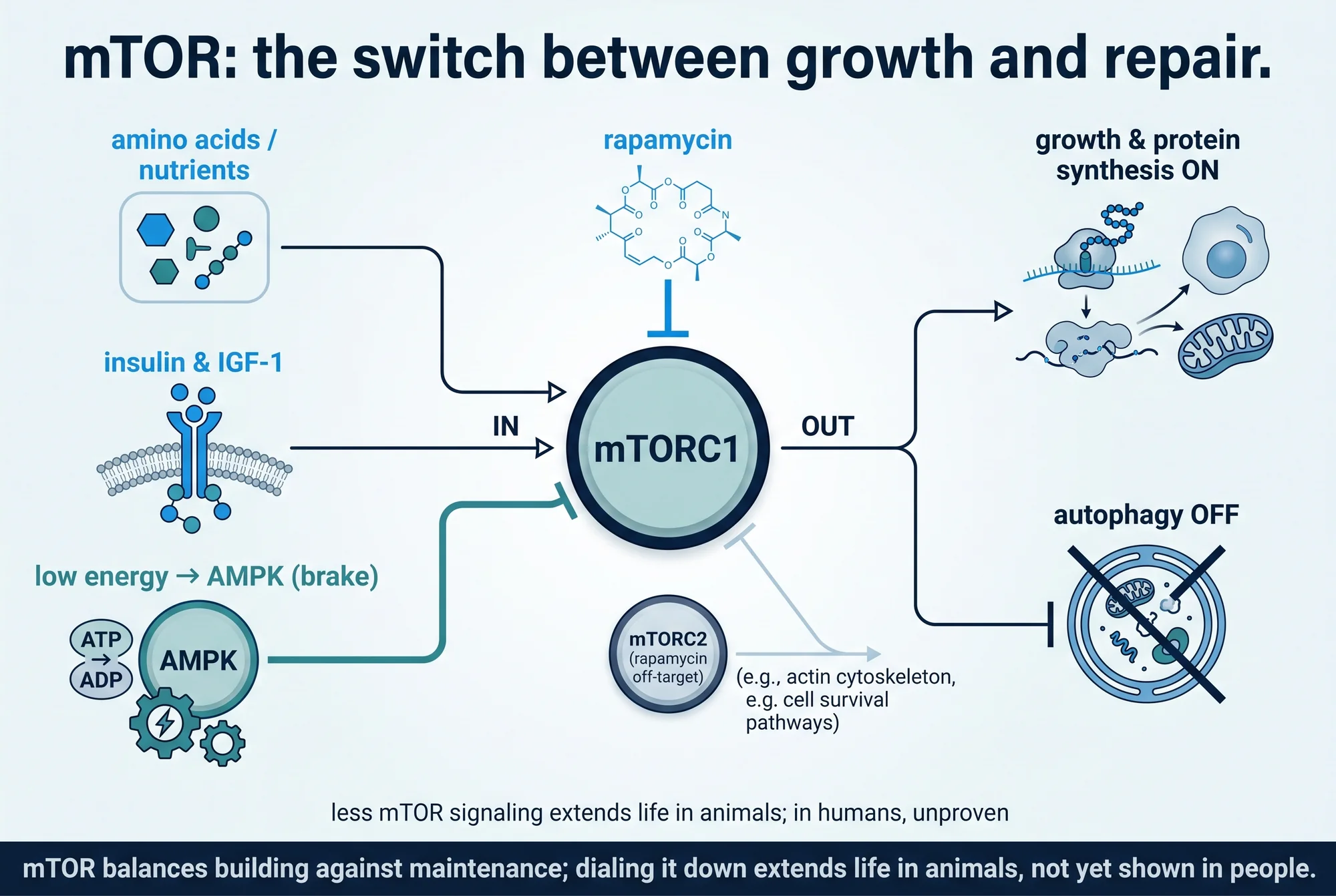
What mTOR is: the cell's growth-or-maintain switch
mTOR is a kinase — an enzyme that regulates other proteins by attaching phosphate groups to them — and its defining feature is that it acts as a master sensor. It coordinates cell growth and metabolism with the resources available in the environment, integrating signals about nutrients and growth factors into a single decision about whether to grow (Saxton & Sabatini, 2017). Its reach runs from protein synthesis at one end to autophagy at the other (Laplante & Sabatini, 2012).
The load-bearing structural fact is that mTOR does this work as two distinct complexes, not one. The first, mTORC1, is mTOR bound to a partner protein called raptor. This is the nutrient-sensitive, growth-driving unit, coupled to the cell's growth machinery and to control of cell size (Kim et al., 2002). It is also the complex that rapamycin blocks quickly and cleanly. The second, mTORC2, is mTOR bound to a different partner, rictor; it phosphorylates the signalling protein Akt and sits in a separate role governing metabolism and the cytoskeleton (Sarbassov et al., 2005). The two complexes also differ in how the drug reaches them: mTORC1 is acutely sensitive to rapamycin, whereas mTORC2 is only chronically sensitive inside a living animal (Arriola Apelo & Lamming, 2016). That asymmetry matters. When people speak of "inhibiting mTOR" for growth or longevity, they mean mTORC1; mTORC2 is where rapamycin's downsides come from, and the two arms recur throughout what follows.
What turns mTOR on, and what it does
mTORC1 listens to three input channels at once. The first is amino acids, the building blocks of protein: when they are present, a set of proteins called the Rag GTPases recruit mTOR to a compartment inside the cell where its activator sits, switching the complex on (Sancak et al., 2008). The second is hormonal. Insulin and IGF-1, the signals of a fed and growing body, feed into the same complex through the PI3K–Akt route, so that mTORC1 is reading both the raw materials for growth and the systemic instruction to grow (Saxton & Sabatini, 2017; Laplante & Sabatini, 2012). The third channel is energy, and it runs the other way. AMPK, a sensor activated when cellular fuel runs low, inhibits mTORC1 by directly modifying raptor, acting as a metabolic checkpoint that halts growth when energy is scarce (Gwinn et al., 2008). AMPK and mTOR are, in effect, opposite-facing gauges: AMPK reads "fuel is low, conserve," mTOR reads "fuel is high, grow."
What the switch does when it is on is equally two-sided. Active mTORC1 turns anabolic growth on, driving protein synthesis through its downstream effectors and increasing cell size (Kim et al., 2002; Saxton & Sabatini, 2017). At the same time, it turns autophagy off. Autophagy is the cell's program for breaking down and recycling its own worn components, a core maintenance and repair process, and mTOR suppresses it directly: under nutrient sufficiency, high mTOR activity phosphorylates a protein called ULK1 and prevents it from starting autophagy (Kim et al., 2011). Let mTOR activity fall — through scarcity, rapamycin, or rising AMPK — and the brake releases, so autophagy proceeds. mTOR is therefore a reciprocal switch: plenty means growth on and self-recycling off; scarcity reverses it. This is precisely the point at which mTOR hands off to a neighbouring subject: mTOR is the switch that keeps autophagy suppressed while food is plentiful.
Everything in this section is molecular mechanism observed in cells. It explains how the switch works. It does not, on its own, demonstrate a health or lifespan outcome in a living person, and that wall between mechanism and outcome is worth keeping intact as the stakes rise.
mTOR and lifespan
The nutrient-sensing axis that mTOR anchors is old and widely shared: the insulin/IGF-1-to-TOR pathway is conserved from yeast to humans (Kapahi et al., 2004; Saxton & Sabatini, 2017; Johnson et al., 2013). That conservation is why results in small, short-lived animals are taken seriously as clues to human ageing — and also why they remain only clues.
The lifespan evidence forms a ladder of model organisms. The first rung is a worm. A mutation in the gene daf-2, which encodes the worm's insulin/IGF-1 receptor, allows the roundworm Caenorhabditis elegans to live more than twice as long as normal, an effect that depends on a second gene, daf-16 (Kenyon et al., 1993). The next rung reached the pathway directly: inhibiting TOR itself extends lifespan in C. elegans (Vellai et al., 2003), and in the fruit fly Drosophila, dialling down the TOR signalling pathway lengthens life in a way that overlaps with the benefits of dietary restriction and depends on nutritional conditions (Kapahi et al., 2004). The rung that matters most for humans is a mammal. Deleting S6K1, one of the effectors downstream of mTORC1, increased lifespan in mice, along with resistance to a range of age-related problems and a gene-expression pattern resembling caloric restriction (Selman et al., 2009). This is genetic inhibition of the mTOR axis extending life in a mammal — still a mouse, but a mammal.
Reviewers reading across these experiments conclude that inhibiting the mTOR pathway extends lifespan in model organisms and protects against a growing list of age-related pathologies, and that dietary restriction and many independent longevity mutations converge on this same pathway (Johnson et al., 2013; Blagosklonny, 2006). One influential interpretation goes further and reframes ageing itself. In the hyperfunction, or quasi-programmed, hypothesis, ageing is not an active program for decline but the continued running of the TOR-driven growth program of youth, never switched off, becoming excessive and damaging in later life (Blagosklonny, 2006). It is the mTOR-specific version of an older idea in evolutionary biology — that a program selected to build the organism early can turn harmful once building is done. This is a hypothesis, not settled fact, and worth flagging as such.
The discipline for this whole section is simple: every lifespan result named here is a worm, a fly, or a mouse. Together they establish a conserved, druggable axis and strong biological plausibility. They do not establish a demonstrated human longevity effect. That distinction places mTOR squarely inside the "deregulated nutrient-sensing" theme of the hallmarks of ageing.
Rapamycin: from Easter Island soil to the mouse lifespan result
Rapamycin has a genuinely improbable origin. It was isolated from a soil bacterium, Streptomyces hygroscopicus, collected on Easter Island — Rapa Nui — and was first characterised as an antifungal antibiotic; its name comes from the island (Vézina et al., 1975). Its established clinical identity, though, has nothing to do with ageing. Under the generic name sirolimus (brand name Rapamune), rapamycin was approved by the U.S. Food and Drug Administration in 1999 to prevent organ rejection in kidney-transplant recipients, and it is used as an immunosuppressant (U.S. Food and Drug Administration; Arriola Apelo & Lamming, 2016). It is not approved for ageing, longevity, or healthspan, and no amount of promising animal data changes that status.
What makes rapamycin central to longevity science is the strength and rigour of its animal lifespan signal, which is entirely in mice. In the National Institute on Aging's Interventions Testing Program — a study run across three independent laboratories in genetically heterogeneous mice, designed specifically to weed out flukes — rapamycin extended both median and maximal lifespan even though it was started late in life, at 600 days of age. Measured at the age of 90% mortality, the increase was 14% in females and 9% in males (Harrison et al., 2009). A second report from the same program, starting rapamycin earlier at nine months of age, extended median survival by 18% in females and 10% in males, including maximum lifespan; and in the identical testing platform, two heavily promoted compounds, resveratrol and simvastatin, produced no significant effect on survival at all (Miller et al., 2011). That contrast is the useful lesson: under controlled testing, rapamycin worked where two better-marketed candidates did not.
Two cautions travel with those numbers. The percentages come from different studies at different starting ages and, crucially, different endpoints — Harrison's 14% and 9% are measured at the age of 90% mortality, while Miller's 18% and 10% are median survival — so they should not be merged or relabelled as one figure. And every value is a mouse result. There is no equivalent completed trial in people. Within the map of longevity science, rapamycin is the exemplar of the tier with the most dramatic animal lifespan data and no proven human effect; you can see where it sits relative to better-evidenced interventions in what longevity science actually is.
The double-edge: why turning mTOR down is not simply good
It would be easy to read the mouse data as an unqualified good-news story about switching mTOR off. The biology refuses to cooperate, and the reason lies in the two complexes. When rapamycin is given chronically, it does not stay confined to the growth-driving mTORC1. Over time it also disrupts mTORC2, and in mice that disruption impairs glucose tolerance and insulin action, in part by removing mTORC2's normal suppression of glucose production in the liver (Lamming et al., 2012). The same drug that lengthens a mouse's life can, at the same time, push its glucose metabolism in the direction of diabetes.
The redeeming detail is that benefit and harm are separable arms of the system. In the same work, reducing mTORC1 signalling on its own extended lifespan without the glucose defect: mice with genetically lowered mTORC1 activity lived longer yet kept normal glucose tolerance and insulin sensitivity (Lamming et al., 2012). Lowering mTORC1 tracks with the longevity signal; losing mTORC2 tracks with the metabolic penalty. This maps directly onto rapamycin's side-effect profile, because mTORC2 inhibition is held responsible for many of the drug's negative effects, and mTORC2 is disrupted only under sustained exposure while mTORC1 is blocked immediately (Arriola Apelo & Lamming, 2016; Sarbassov et al., 2005). The honest summary is that "turn mTOR down" is not a clean instruction. The intervention that looks pro-longevity in mice carries a real metabolic cost, and the upside and the downside run through different arms of the very system this article is about.
What the human evidence actually shows
Here the ceiling has to be stated plainly: there is no completed human lifespan or longevity trial of rapamycin or any related drug. The lifespan evidence stops at mice, and reviewers writing about mTOR and ageing say directly that adverse side effects currently rule out giving rapamycin to otherwise healthy people (Johnson et al., 2013; Arriola Apelo & Lamming, 2016).
The human trials that do exist were aimed at immune function, not longevity. In a placebo-controlled randomised trial, the rapamycin analogue RAD001 — everolimus — improved elderly volunteers' response to influenza vaccination by about 20% and reduced the proportion of exhausted-looking PD-1-marked T cells (Mannick et al., 2014). That is a surrogate immune endpoint, a better antibody response, not a longer life. A larger, still-early follow-up moved toward a clinical endpoint: a phase 2a randomised trial in 264 older adults gave a low-dose, TORC1-selective drug combination for six weeks and found a significant drop in the rate of infections participants reported over the following year, with stronger antiviral gene activity and improved vaccine responses (Mannick et al., 2018). Promising, but it rests on short dosing and soft endpoints, and it is not evidence of life extension.
The accurate headline is narrow: in people, mTOR inhibition has an early, real, but limited track record — better vaccine responses and fewer self-reported infections in older adults over weeks to months — and nothing at all on lifespan. None of this is a treatment recommendation; the doses and durations above are reported only as the parameters of the studies that produced them.
What remains uncertain
The most active uncertainties are practical, and they follow from the two complexes. Because the beneficial arm (mTORC1) and the harmful arm (mTORC2) differ in how sensitive they are to rapamycin, dose and timing genuinely matter. Researchers are actively testing whether intermittent dosing, or newer analogues designed to hit mTORC1 while sparing mTORC2, can capture the longevity-associated upside without the metabolic cost (Arriola Apelo & Lamming, 2016; Lamming et al., 2012). The move to low-dose, TORC1-selective drugs in the human immune trials is that same idea in early clinical form (Mannick et al., 2014; Mannick et al., 2018). Whether clean mTORC1-versus-mTORC2 selectivity can be achieved in a living body over the long term is an open problem, not a solved one; today's rapamycin is not cleanly selective in vivo once it is given for a while.
The largest unknown is human translation itself. The strongest lifespan data are in mice; the human data are short, surrogate-endpoint immune trials; and the reviewers who know the field flag that side effects currently block use in healthy people (Johnson et al., 2013; Arriola Apelo & Lamming, 2016). Whether the animal lifespan gains carry over to humans at all remains the central open question. It is worth ending on the double character that makes mTOR such an instructive case: it is one of the best-understood molecular switches in ageing biology and, at the same time, one of the clearest illustrations of how far apart a mechanism, a mouse, and a person can be.
This review covers what mTOR is, the two complexes it runs as, the inputs that switch it on and the growth-versus-autophagy outputs it controls, the animal evidence that reduced signalling extends lifespan, rapamycin's origin and its mouse lifespan results, the metabolic double-edge of mTOR inhibition, and the early human immune-function trials — drawn from primary studies, authoritative reviews, and a regulatory record retrieved from PubMed, PubMed Central, and the U.S. FDA. Evidence cutoff: sources as retrieved 24 August 2026. It is educational and is not medical advice, a diagnosis, or a treatment recommendation, and it names no dose or protocol for human use; rapamycin (sirolimus) is an FDA-approved immunosuppressant, not an approved treatment for ageing, and every lifespan figure cited is a model-organism result. For the broader framework, see The Hallmarks of Aging, the self-recycling process mTOR governs in Autophagy, and where rapamycin sits among interventions in What Is Longevity Science?; or browse the Aging biology hub.
References
- 1.Arriola Apelo SI, Lamming DW. Rapamycin: An InhibiTOR of Aging Emerges From the Soil of Easter Island. J Gerontol A Biol Sci Med Sci. 2016;71(7):841-849. doi:10.1093/gerona/glw090
- 2.Blagosklonny MV. Aging and immortality: quasi-programmed senescence and its pharmacologic inhibition. Cell Cycle. 2006;5(18):2087-2102. doi:10.4161/cc.5.18.3288
- 3.Gwinn DM, Shackelford DB, Egan DF, et al. AMPK phosphorylation of raptor mediates a metabolic checkpoint. Mol Cell. 2008;30(2):214-226. doi:10.1016/j.molcel.2008.03.003
- 4.Harrison DE, Strong R, Sharp ZD, et al. Rapamycin fed late in life extends lifespan in genetically heterogeneous mice. Nature. 2009;460(7253):392-395. doi:10.1038/nature08221
- 5.Johnson SC, Rabinovitch PS, Kaeberlein M. mTOR is a key modulator of ageing and age-related disease. Nature. 2013;493(7432):338-345. doi:10.1038/nature11861
- 6.Kapahi P, Zid BM, Harper T, et al. Regulation of lifespan in Drosophila by modulation of genes in the TOR signaling pathway. Curr Biol. 2004;14(10):885-890. doi:10.1016/j.cub.2004.03.059
- 7.Kenyon C, Chang J, Gensch E, Rudner A, Tabtiang R. A C. elegans mutant that lives twice as long as wild type. Nature. 1993;366(6454):461-464. doi:10.1038/366461a0
- 8.Kim DH, Sarbassov DD, Ali SM, et al. mTOR interacts with raptor to form a nutrient-sensitive complex that signals to the cell growth machinery. Cell. 2002;110(2):163-175. doi:10.1016/s0092-8674(02)00808-5
- 9.Kim J, Kundu M, Viollet B, Guan KL. AMPK and mTOR regulate autophagy through direct phosphorylation of Ulk1. Nat Cell Biol. 2011;13(2):132-141. doi:10.1038/ncb2152
- 10.Lamming DW, Ye L, Katajisto P, et al. Rapamycin-induced insulin resistance is mediated by mTORC2 loss and uncoupled from longevity. Science. 2012;335(6076):1638-1643. doi:10.1126/science.1215135
- 11.Laplante M, Sabatini DM. mTOR signaling in growth control and disease. Cell. 2012;149(2):274-293. doi:10.1016/j.cell.2012.03.017
- 12.Mannick JB, Del Giudice G, Lattanzi M, et al. mTOR inhibition improves immune function in the elderly. Sci Transl Med. 2014;6(268):268ra179. doi:10.1126/scitranslmed.3009892
- 13.Mannick JB, Morris M, Hockey HP, et al. TORC1 inhibition enhances immune function and reduces infections in the elderly. Sci Transl Med. 2018;10(449):eaaq1564. doi:10.1126/scitranslmed.aaq1564
- 14.Miller RA, Harrison DE, Astle CM, et al. Rapamycin, but not resveratrol or simvastatin, extends life span of genetically heterogeneous mice. J Gerontol A Biol Sci Med Sci. 2011;66(2):191-201. doi:10.1093/gerona/glq178
- 15.Sabatini DM, Erdjument-Bromage H, Lui M, Tempst P, Snyder SH. RAFT1: a mammalian protein that binds to FKBP12 in a rapamycin-dependent fashion and is homologous to yeast TORs. Cell. 1994;78(1):35-43. doi:10.1016/0092-8674(94)90570-3
- 16.Sancak Y, Peterson TR, Shaul YD, et al. The Rag GTPases bind raptor and mediate amino acid signaling to mTORC1. Science. 2008;320(5882):1496-1501. doi:10.1126/science.1157535
- 17.Sarbassov DD, Guertin DA, Ali SM, Sabatini DM. Phosphorylation and regulation of Akt/PKB by the rictor-mTOR complex. Science. 2005;307(5712):1098-1101. doi:10.1126/science.1106148
- 18.Saxton RA, Sabatini DM. mTOR Signaling in Growth, Metabolism, and Disease. Cell. 2017;168(6):960-976. doi:10.1016/j.cell.2017.02.004
- 19.Selman C, Tullet JMA, Wieser D, et al. Ribosomal protein S6 kinase 1 signaling regulates mammalian life span. Science. 2009;326(5949):140-144. doi:10.1126/science.1177221
- 20.U.S. Food and Drug Administration. Rapamune (sirolimus) Oral Solution and Tablets — prescribing information and approval history (NDA 021083, 021110). accessdata.fda.gov. Link
- 21.Vellai T, Takács-Vellai K, Zhang Y, Kovács AL, Orosz L, Müller F. Genetics: influence of TOR kinase on lifespan in C. elegans. Nature. 2003;426(6967):620. doi:10.1038/426620a
- 22.Vézina C, Kudelski A, Sehgal SN. Rapamycin (AY-22,989), a new antifungal antibiotic. I. Taxonomy of the producing streptomycete and isolation of the active principle. J Antibiot (Tokyo). 1975;28(10):721-726. doi:10.7164/antibiotics.28.721
Disclosures
Educational review of published evidence. Not medical advice, diagnosis, or a treatment recommendation. Rapamycin (sirolimus) is an FDA-approved immunosuppressant, not an approved treatment for ageing or longevity, and no mTOR inhibitor is approved for healthspan; study parameters are reported with the organism, population, and duration that produced them.