
What a Peptide COA Actually Tells You
A certificate of analysis is a batch-specific lab report. Each line on it answers exactly one question about one sample — and is silent on every question it did not ask.
Abstract
A certificate of analysis (COA) is the laboratory report a research peptide is sold with: under ICH Q7 it is issued per batch, listing the tests run, their acceptance limits, and the results. This explainer walks the load-bearing lines — identity by mass spectrometry, purity as an HPLC area percent, net peptide content by mass balance, and the water and counterion that make labeled milligrams overstate actual peptide — and shows that each test answers only its own question. It then establishes the central conceptual point: chemical purity, microbiological sterility (USP <71>), and bacterial endotoxin (USP <85>) are independent axes, so a 99% pure powder can still be non-sterile and pyrogenic. Finally it sets out the four things a COA cannot establish — that the vial matches the tested batch, that the certificate is authentic, that the material is safe or effective in humans, or that it is legal to use — and why independent, in-scope testing carries more weight than a seller's own certificate. The piece is educational, research-use-only in framing, and contains no dosing or medical advice.
Key findings
- A certificate of analysis is a batch-specific lab report: it records that specific tests, run on a specific sample, met specific limits — and each test answers only its own question (ICH Q7; Limpikirati et al., 2024).
- Identity (by mass spectrometry) asks whether it is the right molecule; purity (by HPLC, as an area percent) asks what fraction of the UV-detected material is the intended peptide; neither measures how much peptide is in the vial (McCarthy et al., 2023).
- Because water and counterions occupy real, variable mass, a vial's labeled milligrams can overstate the actual peptide — net peptide content must be measured by mass balance, not assumed (McCarthy et al., 2023).
- Chemical purity, sterility, and endotoxin are independent axes: a 99% pure powder can still be non-sterile and pyrogenic, because the HPLC method never tested for either (McCarthy et al., 2023; USP <71>; USP <85>; FDA aseptic-processing guidance).
- A COA does not establish that your vial is the batch that was tested, that the document is authentic, or that the material is safe or legal for human use — even regulated manufacturers must run their own identity test and validate a supplier's certificate (21 CFR 211.84; Operation Supplement Safety).
- Independent, in-scope testing carries more weight than a seller's own certificate, but 'third-party' names only who tested and who paid — it is necessary, not automatically sufficient (ISO/IEC 17025:2017).
A certificate of analysis — a COA — is the laboratory report a research peptide is sold with, and in an unregulated market it is one of the few genuinely informative documents a buyer sees. It is also narrower than it looks. A COA records that specific tests, run on a specific sample from a specific batch, gave specific results against specific limits. That is the whole of what it certifies: each test answers one question, and no test stands in for a question it did not ask. Read that way, it is a precise instrument; read as a general warrant of quality or safety, it is asked to prove things it never tested.
Its reach is bounded by which tests were run, on what sample, by which laboratory, and against what limits. This explainer walks the lines that carry the most weight — identity, purity, and how much peptide is in the vial — then the point missed most often, that purity is not sterility, and finally what even a flawless COA cannot establish. It is the short companion to South Beach Longevity's pair on how the research-peptide market works and why peptide prices vary, which argue that a certificate on a product page is a marketing claim until independently verified, and that price is no proxy for quality.
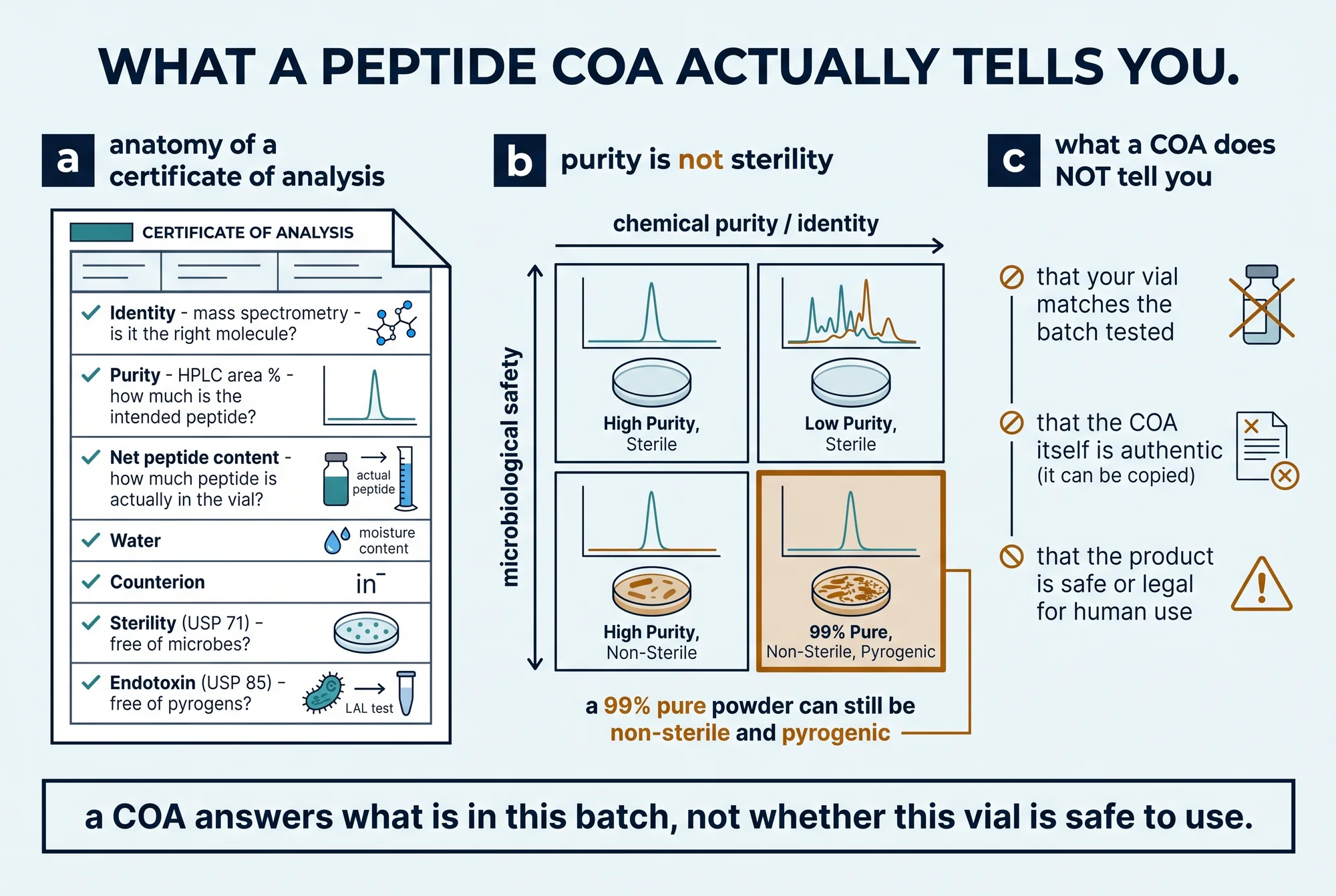
What a COA is: a batch test record
In the pharmaceutical quality system, the international good-manufacturing-practice guide for active ingredients, ICH Q7, requires an authentic certificate of analysis for each batch, listing the tests performed, the acceptance limits, and the numerical results (ICH Q7). The operative word is batch: a COA is not a statement about a product in the abstract but the record of conformance testing for one lot, against a written specification — the quality attributes to test, the methods used, and the acceptance criteria the results must meet (Limpikirati et al., 2024).
A peptide's specification draws on a familiar set of attributes: identity and sequence, chromatographic purity and related impurities, assay and net peptide content, biological potency where relevant, water, counterions, residual solvents, and, for a finished sterile product, sterility and bacterial endotoxin (McCarthy et al., 2023; Elsayed et al., 2025). A bulk powder and a filled vial emphasise different subsets, and the document is best understood as a messenger — its message only as wide as the questions its tests asked.
The lines that matter
Identity — is it the right molecule?
Identity is established primarily by mass spectrometry — an intact-mass measurement, usually run as liquid chromatography–mass spectrometry so the mass belongs to the chromatographic peak of interest, with tandem MS or peptide mapping supporting the amino-acid sequence (McCarthy et al., 2023). Strong identity work is orthogonal, corroborating the mass with retention against a qualified reference standard, amino-acid analysis, or nuclear magnetic resonance; in one worked example, leuprolide's theoretical monoisotopic mass of m/z 1209.6533 was measured at 1209.6515, with tandem MS returning full sequence coverage (McCarthy et al., 2023).
What identity does not prove matters as much. A correct nominal mass does not prove the correct sequence — isobaric amino acids, incorrect stereochemistry, or altered disulfide connectivity can each preserve a molecule's weight while changing what it is — and a database match is not a validated identity against a qualified standard (McCarthy et al., 2023). Identity is silent on how much peptide is present, and on whether the material is sterile.
Purity — what fraction is the intended peptide?
Purity is measured by reversed-phase HPLC (or its faster relative, UPLC) and reported as an area percent: components are separated by how strongly they cling to the column, and an ultraviolet detector reads them near 210 to 220 nanometres, where the peptide bond absorbs (McCarthy et al., 2023). The single most important literacy point on the document is that an area percent is not a mass percent. The pharmacopeial mass-balance method makes this explicit, treating HPLC impurities as a percentage of total detected chromatographic area while handling counterion and water gravimetrically, by weight (McCarthy et al., 2023).
So the purity figure describes only what the detector saw. It is blind to water and counterions, to contaminants that do not absorb UV, and to species hiding under the main peak, since anything co-eluting is counted as part of it. Integration and baseline choices move the number, and the purity of a bulk ingredient is not the quality of a finished vial. A "99% pure" line measures the chromatographic composition of what was detected — nothing else.
Net peptide content — how much peptide is in the vial?
Purity and identity leave one question untouched: how much peptide is actually there? Assay measures how much peptide is present relative to a qualified reference standard; net peptide content asks what fraction of the gross solid is peptide at all, rather than water, counterions, and other non-peptide mass, by a mass-balance design that identifies and subtracts every non-peptide component (McCarthy et al., 2023).
This is where labeled milligrams mislead. USP moved its peptide reference standards from powder to a lyophilised — freeze-dried — form specifically to remove "the need for the user to determine counter-ions and residual moisture," because those components take up real, variable weight; in one theoretical mass-balance illustration a material resolves to just 0.93 milligrams of peptide free base per milligram of solid — a worked pharmacopeial example, not a universal constant, since net peptide content is specific to the product and salt form and must be measured (McCarthy et al., 2023). So a vial can show excellent HPLC purity and the expected mass on MS and still contain less peptide than its label claims, because neither test measures quantity; USP adds that bias in assigning a content value yields an inaccurate figure (McCarthy et al., 2023).
Water and counterion — the mass that is not peptide
The two components that most often separate labeled from actual peptide have their own tests. Water is measured by Karl Fischer titration, the method of USP General Chapter <921>, because residual moisture in a lyophilised, hygroscopic peptide is a measurable part of its mass (McCarthy et al., 2023; USP <921>). Counterions — salt-forming ions such as acetate, trifluoroacetate, and chloride — are measured by ion chromatography or HPLC; trifluoroacetate is a common synthesis residue, and the salt form changes both the reported molecular weight and the net peptide content (McCarthy et al., 2023). Neither speaks to identity or purity; they account for the mass that is not peptide — exactly the mass a label most easily obscures.
Purity is not sterility
The tests so far all live on one axis, the chemical one; none examines whether anything is alive in the vial or whether it carries a bacterial toxin. Sterility is a microbiological attribute, tested by USP General Chapter <71> — membrane filtration or direct inoculation — and unrelated to any chemical measurement (USP <71>). It carries a hard inference limit: a sterility test examines only a small sample and cannot by itself prove a batch is sterile. FDA's aseptic-processing guidance says so directly — sterility tests are "limited in their ability to detect contamination because of the small sample size typically used" — and locates sterility assurance in process control, not end-product testing (FDA aseptic-processing guidance).
Endotoxin is a different hazard again: a fever-inducing — pyrogenic — fragment of the outer wall of Gram-negative bacteria, present even when nothing is alive (Tindall et al., 2021). It is measured by the Bacterial Endotoxins Test of USP General Chapter <85>, historically using Limulus amebocyte lysate from horseshoe-crab blood and increasingly an animal-free recombinant Factor C reagent shown to be equivalent, with results in endotoxin units against a product-specific limit (Tindall et al., 2021; Bolden & Smith, 2017; Muroi et al., 2019; USP <85>). An "endotoxin: pass" line without a method, limit, units, and dilution is analytically incomplete.
The headline follows. Chemical purity, sterility, and endotoxin are three independently measured attributes: HPLC purity and MS identity are chemical, while sterility (<71>) and endotoxin (<85>) are microbiological and pyrogen (McCarthy et al., 2023; USP <71>; USP <85>; Tindall et al., 2021). A method on one axis carries no information about another — which is why a 99% pure powder can still be non-sterile and pyrogenic, the HPLC method having tested for neither, while a sterile, low-endotoxin preparation can still be the wrong molecule or underfilled. Potency is a further axis, on some certificates and not most: chemical identity does not prove biological activity, and a biological response does not prove chemical purity, which is why formal characterisation pairs structural chemistry with functional assays (Ghade et al., 2024; Goyal et al., 2021; Elsayed et al., 2025). "Pure," "clean," and "tested" each describe one axis and are silent on the rest.
What a COA does not tell you
Four gaps remain even when every line on the certificate is genuine and passing.
It does not prove your vial is the batch that was tested
A COA is batch-specific, so its results transfer to a particular vial only if lot identity and chain of custody are intact (ICH Q7). Even a fully regulated drug manufacturer may not simply trust a supplier's certificate: 21 CFR 211.84(d)(2) requires it to run at least one specific identity test itself and to validate the supplier's results at appropriate intervals (21 CFR 211.84). If the regulated system will not accept a certificate at face value, a reader in an unregulated market has no stronger reason to.
It does not prove the document is authentic
A PDF is not self-authenticating. Certificates can be copied, templated, edited, or produced wholesale, and relying on one "in lieu of analysis" is a recognised quality risk until the issuing laboratory and its results are verified independently (21 CFR 211.84). This is structural, not an accusation against any seller: confirmation means contacting the named laboratory through independently sourced details — not a verification link or QR code hosted by the seller, which is part of the same claim.
It says nothing about human safety or effect
A COA reports chemistry and microbiology on a batch. It is not a clinical trial, and it does not establish that a substance is safe or effective in a person, at any amount. Analytical quality and clinical evidence are different categories of knowledge; a certificate speaks only to the first.
It does not make a product legal
A clean certificate does not change a product's regulatory status. The U.S. Department of Defense's Operation Supplement Safety, writing about one widely sold peptide, states the general case: such products are unapproved drugs, commonly labeled "research use only" or "not for human consumption," and that label is not a statement of safety, purity, or quality (Operation Supplement Safety). One clarification heads off a common error: the formal Code of Federal Regulations clause "For Research Use Only. Not for use in diagnostic procedures" — 21 CFR 809.10(c) — governs in-vitro diagnostic products, not research-chemical peptides, and should not be cited as the rule that governs a peptide vial (21 CFR 809.10). The peptide's "research use only" wording runs its legal course through intended-use doctrine under the Food, Drug, and Cosmetic Act, which the companion on how the research-peptide market works sets out.
Third-party testing versus a seller's own certificate
Not all certificates carry equal weight, for the same reason that governs regulated manufacturers: because the receiver of a material is expected to verify identity independently and validate the issuer's results, a seller's self-issued certificate is not sufficient on its own (21 CFR 211.84). Independent testing removes the conflict of interest built into a certificate whose author profits from the sale.
What "independent" should mean has a technical definition. ISO/IEC 17025:2017 specifies a laboratory's competence, impartiality, and consistent operation, and accreditation against it comes with a published scope listing the methods and matrices the lab is accredited for (ISO/IEC 17025:2017). An accreditation mark with no matching scope line for, say, peptide purity by HPLC or identity by LC-MS is not evidence of competence for that test — and impartiality, written into the standard, is exactly what a seller-funded, seller-hosted certificate lacks. Still, "third-party" names who tested and who paid, not a guarantee: an independent lab can be out of scope or test an unrepresentative sample, so independence is necessary but not by itself sufficient.
How to read a COA
Treat the following as a literacy guide, not a purchasing checklist. Look at identity, and by what method — mass spectrometry or LC-MS with sequence support, or retention against a qualified reference standard, not a bare "identity: pass." Read purity as what it is, a chromatographic area percent with an actual chromatogram and a stated method behind it. Ask whether net peptide content or assay is reported at all, or only purity, since water and counterion can occupy meaningful mass. Check that the batch or lot number matches the vial and that the dates — received, tested, reported — are present. Expect sterility and endotoxin as separate lines with their methods, limits, and units, and absent by default on a bulk-powder certificate, which tests neither. Finally, look for an independent, in-scope laboratory reachable directly, not through a seller-controlled link.
A few patterns are worth treating as warnings: a purity figure with no chromatogram; identity asserted from a database match alone; sterility "inferred" from an HPLC or MS result, which cannot speak to it; identical chromatograms across supposedly different lots; accreditation logos with no scope line; missing report numbers, methods, or units. None is proof of a problem on its own, but each marks a place where a document stops carrying the weight it appears to.
What remains uncertain
A COA is necessary but not sufficient. At its best it is a competent, independent, in-scope report on a representative sample — and even then it answers only the questions its tests asked. It is not a safety certificate, not a proof of legality, and not a guarantee about the specific vial in hand. Two limits generalise: absence of evidence is not evidence of absence, since a test that did not look for something says nothing about it, and a result on a sample is not a statement about the whole batch (FDA aseptic-processing guidance); and the quality of a document cannot upgrade the status of a product. A research-use-only chemical with a flawless certificate is still a research-use-only chemical — the paperwork does not make it a medicine, and price does not stand in for any of the tests above, the point developed in why peptide prices vary. For the chemistry beneath all this, and why one name can describe both an approved medicine and an unapproved chemical, see what a peptide is; the Therapeutic peptides hub collects the deeper analytical and market research behind this explainer, including the long-form technical treatment of peptide testing this piece is the short companion to.
This explainer covers what a certificate of analysis certifies about a batch of research peptide and what it does not, drawing only on verified primary and authoritative sources: peer-reviewed analytical and regulatory-science literature from PubMed with DOIs preserved, the United States Pharmacopeia general chapters for water, sterility, and the bacterial endotoxins test, ICH Q7, the U.S. Code of Federal Regulations, FDA guidance, ISO/IEC 17025, and U.S. Department of Defense safety guidance, to an evidence cutoff of 24 August 2026. The independence of the chemical and microbiological axes is a reasoned entailment of individually verified sources, not a single citation; the 0.93 milligram-per-milligram figure is a worked pharmacopeial illustration, not a market measurement. It is educational and is not medical, legal, or purchasing advice, and contains no dosing, route, or schedule. A clean COA does not make a research-use-only chemical a medicine; "research use only" is a labeling status, not a grade of quality. For the neighbouring questions, see how the research-peptide market works and why peptide prices vary.
References
- 1.21 CFR 211.84(d)(2). Current Good Manufacturing Practice for Finished Pharmaceuticals — Testing and approval or rejection of components. U.S. Code of Federal Regulations. Link
- 2.21 CFR 809.10(c). Labeling for in vitro diagnostic products — Research Use Only. U.S. Code of Federal Regulations. Link
- 3.Bolden J, Smith K. Application of Recombinant Factor C Reagent for the Detection of Bacterial Endotoxins in Pharmaceutical Products. PDA J Pharm Sci Technol. 2017;71(5):405-412. doi:10.5731/pdajpst.2017.007849
- 4.Elsayed YY, Kuhl T, Imhof D. Regulatory Guidelines for the Analysis of Therapeutic Peptides and Proteins. J Pept Sci. 2025;31(3):e70001. doi:10.1002/psc.70001
- 5.FDA. Guidance for Industry: Sterile Drug Products Produced by Aseptic Processing — Current Good Manufacturing Practice. U.S. Food and Drug Administration. Link
- 6.Ghade NS, Thappa DK, Lona J, Krishnan AR, Sonar SM. Comparative physicochemical and structural characterisation studies establish high biosimilarity between BGL-ASP and reference insulin aspart. Sci Rep. 2024;14(1):4224. doi:10.1038/s41598-024-54819-x
- 7.Goyal P, Pai HV, Kodali P, et al. Physicochemical and functional characterization of MYL-1501D, a proposed biosimilar to insulin glargine. PLoS One. 2021;16(6):e0253168. doi:10.1371/journal.pone.0253168
- 8.ICH Q7, Good Manufacturing Practice Guide for Active Pharmaceutical Ingredients, Section 11.4 (Certificates of Analysis). International Council for Harmonisation. Link
- 9.ISO/IEC 17025:2017. General requirements for the competence of testing and calibration laboratories. International Organization for Standardization / International Electrotechnical Commission. Link
- 10.Limpikirati PK, Mongkoltipparat S, Denchaipradit T, et al. Basic regulatory science behind drug substance and drug product specifications of monoclonal antibodies and other protein therapeutics. J Pharm Anal. 2024;14(6):100916. doi:10.1016/j.jpha.2023.12.006
- 11.McCarthy D, Han Y, Carrick K, Schmidt D, Workman W, Matejtschuk P, Duru C, Atouf F. Reference Standards to Support Quality of Synthetic Peptide Therapeutics. Pharm Res. 2023;40(6):1317-1328. doi:10.1007/s11095-023-03493-1
- 12.Muroi M, Ogura N, Mizumura H, Aketagawa J, Oda T, Tanamoto KI. Application of a Recombinant Three-Factor Chromogenic Reagent, PyroSmart, for Bacterial Endotoxins Test Filed in the Pharmacopeias. Biol Pharm Bull. 2019;42(12):2024-2037. doi:10.1248/bpb.b19-00517
- 13.Operation Supplement Safety (Uniformed Services University / U.S. Department of Defense). BPC-157: a prohibited peptide and an unapproved drug found in health and wellness products. Link
- 14.Tindall B, Demircioglu D, Uhlig T. Recombinant bacterial endotoxin testing: a proven solution. Biotechniques. 2021;70(5):290-300. doi:10.2144/btn-2020-0165
- 15.USP General Chapter <71> Sterility Tests. United States Pharmacopeia. Link
- 16.USP General Chapter <85> Bacterial Endotoxins Test. United States Pharmacopeia (harmonized US/EU/JP). Link
- 17.USP General Chapter <921> Water Determination (Karl Fischer titration). United States Pharmacopeia. Link
Disclosures
Educational content explaining what a certificate of analysis does and does not certify. Not medical, legal, or purchasing advice, and not an endorsement of any product. Contains no dosing, route, or schedule. A clean COA does not make a research-use-only chemical a medicine; 'research use only' is a labeling status, not a grade of quality. The independence of the chemical and microbiological axes is a reasoned entailment of individually verified sources; the 0.93 mg-per-mg figure is a worked pharmacopeial illustration, not a market measurement.