
5-amino-1MQ A methyl group, a metabolic thermostat, and the small molecule built to jam it
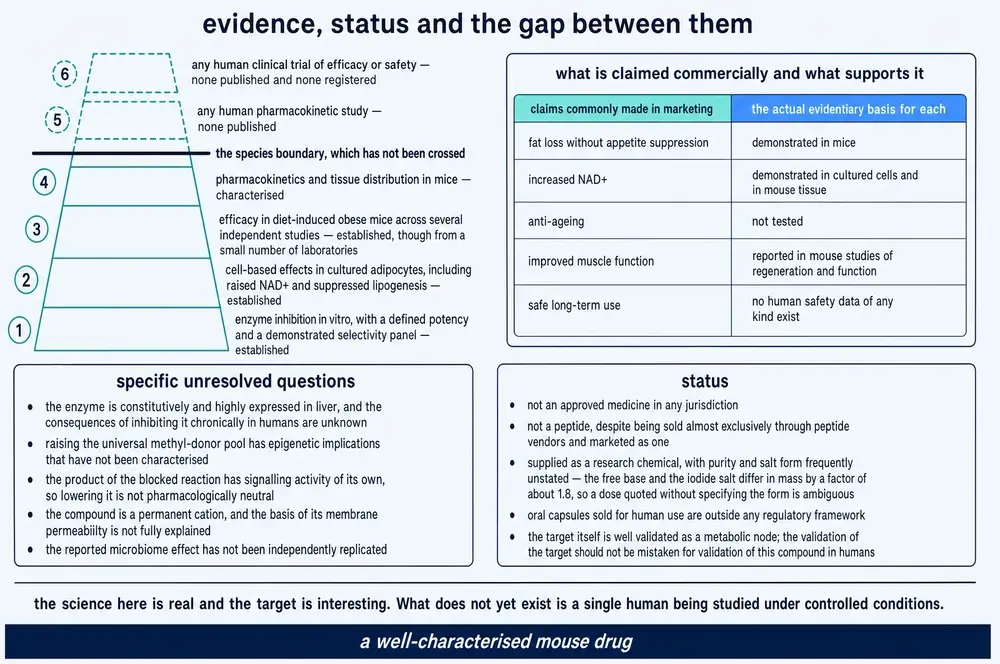
In 2014 a Harvard laboratory went looking for whatever gene swung hardest when fat cells were made insulin-sensitive or insulin-resistant. The answer was an enzyme almost nobody had been thinking about, whose only job is to stick a single methyl group onto vitamin B3. Silence it, and mice on a fattening diet stopped getting fat. Three years later a laboratory in Galveston screened its way to a small molecule that blocks the same enzyme, and gave it to obese mice: they lost weight without eating less. That compound is 5-amino-1MQ. It is not a peptide, although it is sold almost exclusively by peptide vendors. It has never been given to a human being in any published or registered study. It is swallowed as capsules by people who found it online, by a route that delivered three and a half per cent of the dose in the only species where anyone has measured it. In January 2026 the United States Food and Drug Administration named it in a warning letter. The target is real and interesting; this document is about the distance between that and the compound.
Findings are labelled by the kind of study that produced them, in the sentence that reports them. A result in a mouse is called a result in a mouse; a result in a dish of cultured cells is called that. Where a number appears, the species, the route and the duration travel with it. On this compound the discipline is not decorative, because there is no human evidence of any kind — every efficacy figure in these pages is a figure about mice, rats or cells.
Two distinctions do most of the work. The first is between the enzyme and the compound. Nicotinamide N-methyltransferase is a well-studied target with a large and mostly consistent literature behind it. 5-amino-1MQ is one early tool molecule aimed at that target, with a small and much thinner literature of its own. Evidence for the first is routinely quoted as though it were evidence for the second, and it is not. The second distinction is between 5-amino-1MQ and 1MQ. They differ by one amino group, they are sold side by side, and they are different molecules with different potencies. Every finding here names which one was studied.
No dose is recommended anywhere. Animal dosing regimens are reported because they are part of the evidence, always with species, route, frequency and duration attached. They are not scaled, converted, or offered as guidance, and the reasons they cannot be are in Section 19.
01A small molecule in a peptide market
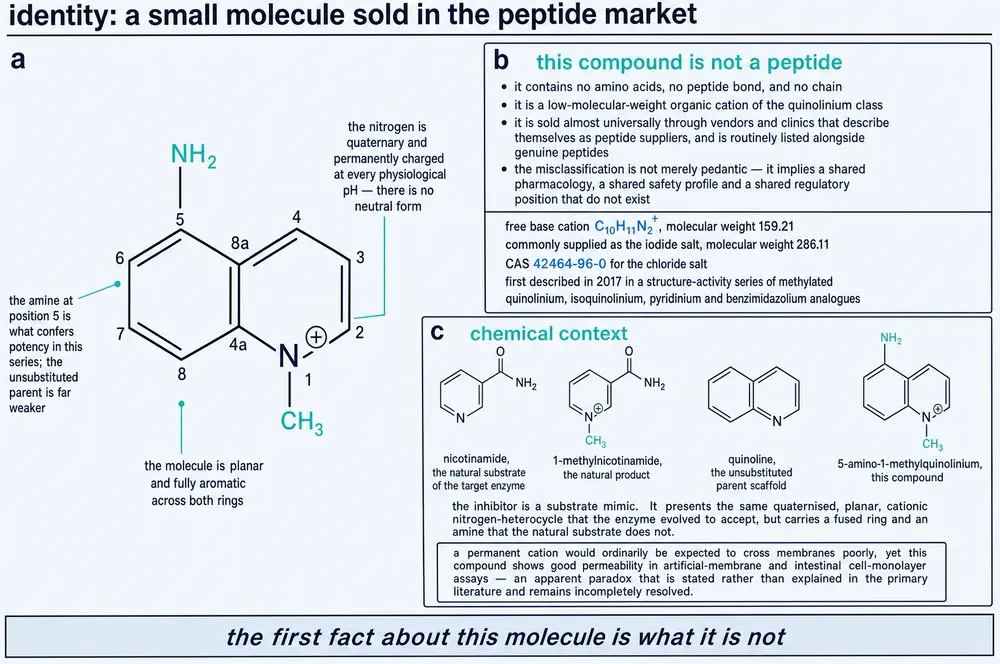
Almost everything sold in the research-chemical peptide market really is a peptide: a chain of amino acids linked by amide bonds, made on a solid-phase synthesiser, shipped as a lyophilised powder in a glass vial. 5-amino-1MQ is none of those things. It is a single fused aromatic ring system with a methyl group on its nitrogen — the kind of molecule a medicinal chemist would call a small-molecule heterocycle, and the kind of thing that turns up in a high-throughput screening library rather than in a peptide catalogue. It contains no amino acids, no peptide bond, and nothing that could be described as a chain.
This is not a quibble about vocabulary. Consider the description that a major vendor gave the compound on its own product page, archived in this project's library in January 2024: “5-amino-1MQ (5-amino-1methylquinolinium) an analogue of methylquinolinium, is a short peptide inhibitor of cytosolic nicotinamide N-methyltransferase.” A companion product page, selling 5-amino-1MQ together with nicotinamide mononucleotide and a second NNMT inhibitor, opens by describing all three as peptides. Nicotinamide mononucleotide is a nucleotide. The second inhibitor is a pyridine carboxamide. Neither is a peptide either.
Calling a quaternary ammonium cation a peptide imports a set of assumptions that do not hold. Peptides are, broadly, degraded by peptidases, cleared quickly, poorly absorbed from the gut for reasons of size and enzymatic lability, and — as a class — carry a reasonably well-understood regulatory position. A small permanently charged heterocycle has a different absorption problem, a different metabolic fate, a different distribution, and, as Section 23 sets out, a quite specific and unfavourable regulatory position of its own. The misclassification also travels into the practical: the same vendor page prints the molecular formula and mass of the free cation directly beside the registry number of the iodide salt, two facts about two different substances, presented as though they described one.
02Seven names for one molecule
A compound's name is its retrieval key. If a reader cannot find the literature, the literature might as well not exist; if a matcher cannot find it, a corpus is built on sand. 5-amino-1MQ has no settled name, and the variants in active use in peer-reviewed papers are these:
| Designation | Where it is used | Comment |
|---|---|---|
| 5-amino-1-methylquinolinium | the systematic cation name; most papers | correct |
| 5-amino-1-methyl quinolinium | Awosemo et al., 2021 | spaced variant |
| 5-amino-1-methylquinoline | Campagna et al., 2021; Kannt et al., 2018 | the free-base name for a species that has no free base |
| 5-amino-1-methylquinolium | Neelakantan et al., 2019; Sampson et al., 2021; Babula et al., 2024 | a persistent typographical error in the originating laboratory's own papers |
| 5-AMQ | Awosemo et al., 2021; Pompei et al., 2025 | collides with a Protein Data Bank accession — see Section 25 |
| 5A1MQ / 5A-1MQ / 5A-M1Q | Babula et al., 2024; Dimet-Wiley et al., 2022 and 2024 | the last is a transposition inside a single paper |
| 5MQ | Akar et al., 2021; Campagna et al., 2021 | reads as a different compound |
The last row is the one that matters. Read literally, 5MQ is 5-methylquinolinium — the 5-methyl analogue, a real and different substance with no amino group at all. Two papers nonetheless use it to mean 5-amino-1-methylquinolinium, and one of them contradicts itself while doing so. Akar and colleagues, reporting antiproliferative activity in cervical cancer cells, write in their abstract that the anti-proliferative effects “of 5-methylquinolinium (5MQ)” had not previously been tested; their keyword list and their own impact statement give the compound as 5-amino-1-methylquinolinium. The paper does not say which molecule was in the flask. Campagna and colleagues, studying the enzyme in endothelium, write “5-amino-1-methylquinoline – 5MQ”, which keeps the amino group and drops the quaternary nitrogen.
Neither is a scandal; both are ordinary slips of the kind that occur when a compound circulates faster than its nomenclature settles. But the consequences are real and they compound. A reader searching for “5-amino-1MQ” will not find the Akar paper. A reader searching for “5MQ” will find papers about several unrelated things. A supplier writing a certificate of analysis from a literature summary has seven strings to choose from and no authority to choose between them. And a reader trying to establish what has actually been demonstrated about this molecule has to reconcile a body of work that does not agree on what to call its own subject.
This document uses 5-amino-1MQ in running text, because that is the designation under which the compound is sold and therefore the one a reader is most likely to have encountered, and gives the systematic name 5-amino-1-methylquinolinium where precision is required.
Where a cited paper uses a different designation, the citation is to that paper's compound as this document has verified it, not to its label. Nothing in these pages is attributed to 5-amino-1MQ on the strength of the string “5MQ” alone.
03What it is made of, and why the dose is ambiguous
The molecule is a quinoline — a benzene ring fused to a pyridine ring — carrying a methyl group on the ring nitrogen and a primary amine at position 5 of the carbocyclic ring. Because the nitrogen carries four bonds it holds a permanent positive charge, at every pH the body can produce. There is no neutral form of this substance and there is no pH at which it becomes uncharged. That single fact shapes almost everything that follows: how it crosses membranes, how it is excreted, and why it resembles the product of the reaction it blocks.
The cation is C10H11N2+, formula weight 159.21, registered as CAS 685079-15-6. It is supplied as a salt, and which salt matters:
| Species | Formula | Formula weight | CAS |
|---|---|---|---|
| cation | C10H11N2+ | 159.21 | 685079-15-6 |
| iodide salt | C10H11IN2 | 286.11 | 42464-96-0 |
| chloride salt | C10H11ClN2 | 194.66 | — |
A quantity of the iodide salt contains 1.8 times less active substance than the same quantity of the cation. Fifty milligrams of iodide is 27.8 mg of 5-amino-1MQ; fifty milligrams of the chloride is 40.9 mg. A figure quoted without naming the salt is therefore ambiguous by nearly a factor of two, and vendor material routinely quotes such figures.
The primary literature is careful about this in a way the market is not, and the care is worth noticing because it is a useful check on the arithmetic. The first in-vivo study dosed mice at 20 mg/kg per injection, three times a day, which is 60 mg/kg of material per day — and reported the dose as “approximately 34 mg/kg/day of the parent compound, calculated according to free weight”. Sixty multiplied by 159.21/286.11 is 33.4. The authors were dosing the iodide and reporting the cation. A later study from the same programme states its dose as “32 mg/kg of active pharmaceutical ingredient” delivered as 4 mg/mL of the monochloride salt at 10 mL/kg — that is, 40 mg/kg of salt reported as 32 mg/kg of substance, which is the chloride's own conversion factor. Two conventions, two salts, both handled correctly, and neither obvious from the number alone.
An independent confirmation of the identity comes from an unexpected direction. The rat pharmacokinetic assay published in 2021 quantified the compound by tandem mass spectrometry on the transition m/z 159.100 → 90.00. The precursor mass of 159.1 is the cation and nothing else — not the iodide, not a hydrate, not a metabolite. Whatever was in that laboratory's vials, the species it measured in plasma was the one this section describes.
04One reaction, two currencies
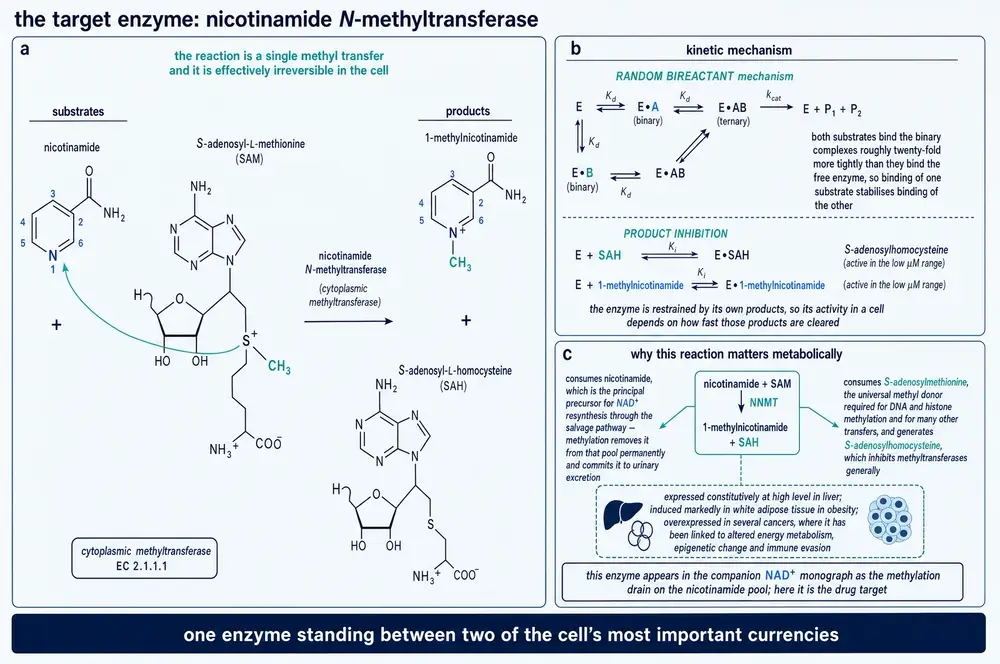
Nicotinamide N-methyltransferase does one thing. It takes a methyl group from S-adenosyl-L-methionine and attaches it to the ring nitrogen of nicotinamide — vitamin B3 — producing 1-methylnicotinamide and S-adenosyl-L-homocysteine. It is a cytosolic, single-chain enzyme of 264 amino acids and 29.6 kDa, encoded on human chromosome 11q23.1, carrying enzyme classification EC 2.1.1.1 (Roberti et al., 2021).
The transfer is direct and in-line: the crystal structure of the human ternary complex places the acceptor nitrogen 3.5 to 4.2 Å from the sulfur of the demethylated cofactor, a distance consistent with a linear transition state and slightly longer than the two single bonds that form and break. Mutating tyrosine 20 to alanine leaves 0.6 per cent of wild-type activity, and aspartate 197 to alanine 2.4 per cent, in both cases by wrecking cofactor affinity rather than catalysis — the Michaelis constant for the methyl donor rises 690-fold and 546-fold respectively while turnover number falls only about twofold. The two serines that hydrogen-bond the substrate's amide can each be removed with almost no effect.
What makes the reaction interesting is not its chemistry but its accounting. Each turnover spends one molecule from each of two pools the cell cannot easily refill.
The first is nicotinamide. More than eighty-five per cent of mammalian NAD+ is made not from scratch but by salvage, recycling nicotinamide released when NAD+-consuming enzymes do their work. Methylation takes a nicotinamide molecule out of that loop permanently: 1-methylnicotinamide cannot be salvaged, and NNMT is the only catabolic enzyme mammals have for nicotinamide. In adipose tissue this matters most, because fat has no alternative route — only liver and kidney can build NAD+ from tryptophan.
The second is S-adenosylmethionine, the universal methyl donor for DNA methylation, histone methylation, polyamine synthesis and a few hundred other transfers. Spending it produces S-adenosylhomocysteine, which inhibits methyltransferases generally, so the reaction taxes the cell's methylation capacity twice over. Here the tissue asymmetry runs the other way: in liver, glycine N-methyltransferase dominates transmethylation flux and buffers NNMT's contribution, whereas in adipose tissue NNMT is itself a major methyltransferase and its expression tracks with methyl-donor balance and histone methylation (Roberti et al., 2021).
The objection that will not go away
The elegance of the two-currency argument has a kinetic problem, and it is raised in this literature by researchers who are otherwise sympathetic to the target. The Michaelis constant of NNMT for nicotinamide is not settled — reported values in the corpus span 7 µM to 400 µM depending on the assay, and one direct binding measurement by nuclear magnetic resonance puts the dissociation constant above 5 mM. Take even the middle of that range and NNMT is a low-affinity enzyme for its own substrate. The salvage enzyme it is supposed to be competing with, nicotinamide phosphoribosyltransferase, operates in the low nanomolar range.
Two independent groups say plainly that this makes the depletion story hard to credit. Reviewing their own cardiac data, one team notes that NNMT's affinity is “several orders of magnitude lower” than the salvage enzyme's, so that recycling “may predominate over” methylation, and calls their own finding unexpected for that reason. The team that developed a rival inhibitor calls the NAD+-depletion mechanism “unlikely because of the high Km value of NNMT for nicotinamide compared to NAMPT” (Kannt et al., 2018). A 2024 review of the target's metabolic case goes further, observing that murine knockdown produced neither nicotinamide accumulation nor a significant change in hepatocyte NAD+, and concluding that NNMT may regulate energy metabolism by some other route altogether.
The figures below present the range rather than a single number, because averaging assays that differ by two orders of magnitude would manufacture a precision the field does not have.
05The knockdown that started it
The modern interest in this enzyme has a specific origin, and it was not a search for a weight-loss drug. In 2014 Daniel Kraus, Qin Yang, Barbara Kahn and colleagues at Beth Israel Deaconess Medical Center and Harvard were studying the glucose transporter GLUT4 in fat. They had two mouse lines — one with GLUT4 deleted from adipose tissue, one with it overexpressed — and they ran microarrays on white adipose tissue from both, asking which genes moved most in opposite directions. The answer, reported in Nature, was Nnmt: the most strongly reciprocally regulated gene in the comparison (Kraus et al., 2014).
They then knocked the enzyme down with antisense oligonucleotides in white adipose tissue and liver of mice fed a high-fat diet. The animals were protected against diet-induced obesity, with a 47 per cent reduction in relative fat mass, and the protection came from increased energy expenditure rather than from eating less. Adipose S-adenosylmethionine and NAD+ both rose.
The mechanistic chain they proposed is more specific than the two-currency story and considerably better evidenced. Raising the methyl-donor pool altered histone H3 lysine 4 methylation at the promoters of two enzymes of polyamine metabolism — ornithine decarboxylase and spermidine–spermine N1-acetyltransferase — raising their expression and activity. Polyamine synthesis and catabolism together form a futile cycle: making them consumes decarboxylated S-adenosylmethionine, acetylating them consumes acetyl-CoA, and the cycle turns without net product. Urinary and secreted diacetylspermine, a marker of that flux, rose. Critically, the increase in adipocyte oxygen consumption caused by NNMT inhibition was abolished when ornithine decarboxylase, the acetyltransferase, or polyamine oxidase were blocked in turn. The phenotype was mapped onto the pathway epistatically, not merely correlated with it.
The 2014 result is a genetic knockdown in mice, sustained over weeks, reducing the amount of enzyme present. It is not a drug, and it is not inhibition of the enzyme's active site. Those two interventions are not interchangeable: the corpus contains at least one line of evidence (Section 22) that NNMT's hepatic and endothelial functions are partly independent of its catalytic activity, which a small-molecule inhibitor would leave untouched while still removing the reaction product.
06Where the enzyme is, and when it rises
NNMT is a liver enzyme first. Human hepatic activity has been measured at 51 nanomoles of methyl-nicotinamide formed per hour per milligram of liver protein; the mouse figure is 16, about one third. It is present at intermediate levels in adipose tissue, skeletal muscle, kidney, lung, heart and several female reproductive tissues, and at low levels in brain, although two reviews in this corpus disagree about the brain in terms that cannot both be right — one calls expression there “very low”, the other calls it neuron-exclusive with regional variation.
Between individuals, human liver activity varies about fivefold, and the distribution is bimodal — a pattern that usually indicates a common genetic variant, though none has been definitively identified. Human genetics otherwise supports NNMT as a determinant of plasma homocysteine, which a family-based linkage study in Spain identified as its principal genetic determinant. The candidate-gene associations with obesity, hyperlipidaemia, type 2 diabetes and hypertension come almost entirely from two populations, have not been independently replicated, and no genome-wide significant signal at the locus appears anywhere in the corpus. No human loss-of-function data exists at all.
What makes the enzyme a target is that it rises in the diseases people want to treat, and falls when those diseases improve:
| Setting | Change | Study type |
|---|---|---|
| 3T3-L1 pre-adipocyte to mature adipocyte | NNMT protein ~37-fold higher; 1-methylnicotinamide ~7.5-fold higher | mouse cells |
| Adipose tissue, obesity | elevated in abdominal subcutaneous adipocytes of obese versus non-obese Pima Indians; correlates with fat mass in diet-induced obese mice | human observational; rodent |
| Insulin resistance and type 2 diabetes | adipose expression up; plasma 1-methylnicotinamide correlates with the degree of insulin resistance | human observational |
| Exercise and bariatric surgery | adipose expression and plasma product both fall | human observational |
| Skeletal muscle, ageing | ~3-fold higher protein in 24-month than 4-month mouse tibialis anterior; a dominant component of the sarcopenia expression signature | rodent |
| Peripheral artery disease | elevated messenger RNA and protein in human gastrocnemius; persistently elevated in mouse muscle stem cells after hindlimb ischaemia | human observational; rodent |
| Chronic kidney disease | rises with stage, correlates inversely with filtration rate; independent prognostic factor in a 68-patient cohort | human observational |
| Alzheimer's disease | 7.5 times more protein in medial temporal lobe than in healthy participants | human observational |
| Many solid tumours | overexpressed across most epithelial cancers; downregulated in hepatocellular carcinoma relative to adjacent liver, though the corpus also contains the opposite report | human observational |
The correlations are consistent and, in the metabolic setting, bidirectional — the enzyme goes up with the disease and down with successful treatment of it, which is more than most biomarkers manage. What they do not establish is direction of causation, and the association literature should not be read as though they did. The causal evidence is the knockdown work of Section 05 and the pharmacology of Part Four.
07The product is not waste
1-methylnicotinamide is usually introduced as the reaction's disposal product: methylated, no longer salvageable, oxidised by aldehyde oxidase to N1-methyl-2-pyridone-5-carboxamide in humans and its 4-pyridone isomer in rodents, and excreted. That framing is convenient for an inhibitor programme and it is not accurate. The product has a pharmacology of its own, and blocking the enzyme removes it.
It is antithrombotic, and the mechanism has been mapped. In rats with extracorporeal thrombus formation, 1-methylnicotinamide at 3 to 100 mg/kg produced a dose-dependent, sustained thrombolytic response accompanied by a rise in the stable prostacyclin metabolite. The response was dose-dependently blocked by rofecoxib and abolished by indomethacin, and was unaffected by inhibiting nitric oxide synthase — a cyclooxygenase-2-dependent effect. The same doses reduced arterial thrombosis in hypertensive rats. In vitro the molecule neither aggregated platelets nor dilated vessels, so it is not acting directly on either; the authors proposed that endogenous 1-methylnicotinamide, made in the liver by NNMT, is a physiological activator of prostacyclin production.
It is vasoprotective and antioxidant. It enhances endothelial nitric oxide production and improves endothelial function in hypercholesterolaemic mice; it activates NRF2 and suppresses NF-κB signalling, upregulating NAD(P)H quinone oxidoreductase 1, haem oxygenase-1 and glutamate–cysteine ligase in cardiomyocytes exposed to palmitate and in high-fat-fed mice. In atherosclerotic mice, 1-methylnicotinamide reduced plaque size and macrophage infiltration more effectively than nicotinamide itself.
It is hepatoprotective. Exogenous 1-methylnicotinamide prevents concanavalin-A-induced hepatitis in mice, and the protection is lost when the prostacyclin receptor is blocked.
And it restrains its own enzyme. 1-methylnicotinamide binds the enzyme–cofactor-product complex with a dissociation constant of about 80 nanomolar by surface plasmon resonance, independently confirmed by calorimetry (Akerud et al., 2025). The authors draw the obvious conclusion: “there should be substantial product inhibition unless the 1-MNA levels are kept low in vivo”. The enzyme is braked by what it makes.
None of which makes the molecule an unqualified good. Given to leptin-receptor-deficient mice at 100 mg/kg for four weeks it changed neither fasting glucose nor glycated haemoglobin, and body weight tended to rise. Supplementation worsened hepatic lipid accumulation in alcohol-fed mice. And its downstream oxidation products carry a human signal in the opposite direction: across two cohorts totalling 3,163 people, high circulating levels of the two pyridone metabolites were associated with increased risk of major adverse cardiovascular events — which is, in fact, the best human argument anywhere in this corpus for reducing flux through this enzyme.
The honest summary is that the reaction produces a signalling molecule with a mixed portfolio, that an inhibitor necessarily lowers it, and that no study in this corpus has measured what lowering it does in an animal over a long enough period to matter.
There is a deeper version of this problem, and it comes from evolutionary biology rather than pharmacology. A 2019 analysis of NAD+ signalling across deuterostomes argued that NNMT emerged precisely to keep nicotinamide low, because nicotinamide is a product inhibitor of the NAD+-consuming signalling enzymes — the sirtuins and the PARPs. On that reading the enzyme exists to stop those enzymes throttling themselves.
An inhibitor of NNMT raises intracellular nicotinamide. Nicotinamide inhibits sirtuin 1 and the PARPs. So the intended benefit — more NAD+, therefore more sirtuin activity — and an unintended consequence — more nicotinamide, therefore less sirtuin activity — push in opposite directions. No study in this corpus measures the net effect on sirtuin or PARP activity in a living animal after NNMT inhibition.
08A screen, a scaffold, and compound 1j
The compound came out of a collaboration between two Texas laboratories: Stanley Watowich's biochemistry group at the University of Texas Medical Branch in Galveston, and Stanton McHardy's medicinal chemistry group at the Center for Innovative Drug Discovery at the University of Texas at San Antonio. Harshini Neelakantan, then a pharmacologist at Galveston whose previous publications were on serotonin receptor agonists and opioid self-administration, is the first author of the chemistry paper and of the two in-vivo studies that followed.
Their route to a molecule was unglamorous and effective. Before they could screen anything they needed an assay: existing NNMT assays were coupled, slow and awkward, so in early 2017 the group published a non-coupled fluorescent method that watches the reaction directly and in real time (Neelakantan et al., 2017). With that in hand they screened N-methylated quinolinium, isoquinolinium, pyridinium and benzimidazolium analogues — small, flat, positively charged heterocycles chosen to resemble the molecule the enzyme already accepts — and reported inhibitors spanning more than a thousandfold in activity. The quinoliniums came out best, at around one micromolar. Docking the series into the substrate pocket of the published human structure produced a robust correlation between predicted interaction score and measured potency, which is the kind of result that lets a chemistry programme prioritise the next round of compounds with some confidence.
Within the series, one analogue carried a primary amine at position 5 of the carbocyclic ring, and it was the best of them. In the patent that the University of Texas System filed on 29 March 2018, claiming priority to 30 March 2017, it is compound 1j, and its half-maximal inhibitory concentration against the human enzyme is given as 1.2 µM. That is 5-amino-1MQ. The patent issued on 2 August 2022 as US 11,401,243, with Watowich, Neelakantan, Hua-Yu Wang and McHardy as inventors; a continuation issued in August 2024 extending the claimed uses to obesity, metabolic disorders, NNMT-expressing cancers including glioblastoma, Parkinson's disease, modulation of stem-cell differentiation, and muscular dystrophy.
The name is worth pausing on. “1j” is a compound number in a table, the tenth entry in a synthetic series. It was never christened, never given an INN, never assigned a development code by a company. It reached the consumer market under the string a chemist would write on a vial.
09How it binds
5-amino-1MQ occupies the nicotinamide site — the pocket where the methyl acceptor binds — and blocks the transfer by being in the way. It is not an allosteric inhibitor, and it is not a bisubstrate inhibitor reaching across both pockets; two independent papers describe it as a substrate-site, product-mimicking competitor.
The pocket rewards exactly what a quinolinium offers. The ligand ring stacks in a hydrophobic clamp between tyrosine 204 on a β-hairpin lid and leucine 164 in the central domain. Tyrosine 20 sits at the mouth of the methyl-transfer tunnel and hydrogen-bonds ring substituents at the corresponding position, which is the most plausible role for the 5-amino group, and the tunnel itself is a narrow linear channel of three and a half to four Ångströms.
Why the quaternary methyl helps has a good answer, though it comes from work on a different chemotype. Comparing thirteen matched pairs of neutral nicotinamide analogues and their methylated cations, one group found the cations bind the enzyme–product complex on average 3.5 log units — about three thousandfold — more tightly than the neutral parents bind the enzyme–cofactor complex, with association about elevenfold faster and dissociation more than three hundredfold slower. They attribute the difference to electrostatic complementarity with the post-catalytic state, and note in passing that the enzyme–product complex is intrinsically the most ligandable form of the protein (Akerud et al., 2025). A permanent positive charge is not incidental decoration on this scaffold; it is the reason a flat aromatic can bind an enzyme that evolved to bind a cation.
There is no crystal structure of 5-amino-1MQ bound to NNMT, and no published docking pose of it, anywhere in this corpus. Everything above is inference from the pocket and from analogous chemotypes. There is also no structure–activity study of the quinolinium series itself: no paper compares 5-amino-1MQ with the unsubstituted 1MQ under one assay, so the claim that the amine confers the potency — printed on this document's own Figure 1 — rests on the parent screening paper's ranking rather than on a published head-to-head number.
The one direct experiment ever performed on this pharmacophore was unflattering. Building an alkynyl bisubstrate compound around an amino-naphthalene head, described by its authors explicitly as “a bisubstrate analogue of the previously reported NNMT inhibitor 5-amino-1-methylquinolinium”, produced a molecule roughly 7,400-fold weaker than the benzamide-headed parent of the same series (Policarpo et al., 2019). Related substitutions in a second bisubstrate programme were similarly costly: replacing the benzamide with a naphthalene cost a hundred- to three-hundredfold, and replacing the amide with an ester cost about seven hundredfold. The nicotinamide pocket is built around a carboxamide and its hydrogen-bond network, and an amino-aryl system that cannot recruit that network has to pay for its binding entirely in stacking and charge.
10The permeability paradox
A permanently charged molecule should not cross a lipid membrane. The 2018 paper reports that this one does: in a parallel artificial-membrane assay, 5-amino-1MQ and its 7-amino isomer showed high passive permeability and active transport, with no detectable efflux in a Caco-2 monolayer, while the unsubstituted parent 1MQ and the reaction product 1-methylnicotinamide showed no passive permeability at all. The authors took this as evidence of likely high oral absorption and bioavailability.
That inference did not survive measurement, and Section 19 gives the number. But it is worth setting the in-vitro claim against what the wider literature says about charged NNMT ligands, because the pattern is consistent and it runs the other way. Across the matched neutral-and-cation series described above, the cations were on average fortyfold less potent in cells than against the purified enzyme, while their neutral parents were, if anything, slightly more potent in cells. 1-methylnicotinamide itself is inactive in cells below 30 µM. The whole design strategy of that programme — dose the neutral precursor and let the enzyme make the cation inside its own active site — exists because charged NNMT ligands do not readily get into cells.
The only cell-based work with 5-amino-1MQ itself points the same way. The 2025 study that reports the compound's potency value also ran it against four tumour cell lines, and required 100 µM — about eighty times its enzyme-level potency — to suppress product formation by half. At 10 µM, effects were absent in most lines at most time points. That eighty-fold gap is the honest measure of what the molecule does inside a cell, and it is roughly what a permanent cation would predict.
11Where it ranks
Judged as a molecule rather than as a story, 5-amino-1MQ is a first-generation tool compound and the field has moved past it. The comparison has to be made carefully, because potency values for this target come from at least five mutually incompatible assay systems — one shared compound, the bisubstrate control MS2756, differs elevenfold between two of them — so the figure below groups values by assay rather than pooling them.
Three anchors give the shape of it. Against the same purified human enzyme, the best small molecule from the Sanofi tricyclic programme is 33 nanomolar, roughly thirty-five times more potent. The bisubstrate inhibitors, which reach across both pockets at once, run from 1.6 nanomolar down to 500 picomolar — three orders of magnitude below 5-amino-1MQ, though measured differently again. And the field's own summary of itself, written in 2025, is that most NNMT inhibitors “display high nanomolar to low micromolar inhibitory effects in enzymatic assays but only a few show potent cellular inhibition”. At 1.2 µM, this compound sits at the weak end of that band, and it has been described in the same terms — “modest activity at µM levels”, “inhibiting NNMT at micromolar levels” — in 2019, in 2024 and in 2025. Nobody upgraded it.
Potency, though, is not why it matters. Of every NNMT inhibitor in this corpus, only three have ever been given to an animal: 5-amino-1MQ, and the two Sanofi compounds. No bisubstrate inhibitor has ever been dosed in vivo — a point the field has been making about itself since 2022 and which remains true through the most recent papers here. The molecule earned its place in the literature by being available, soluble, and good enough to test a hypothesis in a mouse, not by being the best inhibitor anyone had made.
The rivals, and what they showed that this compound did not
Two comparisons deserve to be drawn out, because both bear directly on how much confidence the 5-amino-1MQ animal data can carry.
The knockout control. When Kannt and colleagues tested their 6-methoxynicotinamide compound JBSNF-000088 in mice lacking NNMT entirely, it produced no metabolic benefit — exactly as it should if the drug works through the enzyme. That is a clean attribution. When the same programme later tested its more potent tricyclic successor JBSNF-000028 the same way, glucose tolerance improved and insulin fell in the knockout animals too, pointing to an effect beyond NNMT inhibition. The authors nominated their own compound's 90 per cent inhibition of monoamine oxidase A as the likely confound (Ruf et al., 2022). Two compounds from one laboratory, one clean and one not. No knockout control has ever been run for 5-amino-1MQ.
The models where it failed. Both Sanofi compounds produced clear metabolic benefit in diet-induced obese mice and then failed almost completely in leptin-deficient ob/ob and leptin-receptor-deficient db/db mice, where the only surviving effect was suppression of the reaction product. The authors attribute this to hyperphagia the compounds are not strong enough to override. 5-amino-1MQ has never been tested in either model, so its diet-induced-obesity result cannot be assumed to generalise — and the failure mode is already documented, twice, for structurally unrelated inhibitors of the same enzyme.
One further finding from the rival programmes belongs here because it is a criticism of the mechanism rather than of any molecule. The nicotinamide-analogue inhibitors are not classical blockers; they are slow substrates that the enzyme turns over. That means they keep consuming S-adenosylmethionine while they act. Measured in rats, the first-generation compound drove S-adenosylmethionine consumption to 470 per cent of baseline during maximal inhibition — a futile methyl sink several times larger than the natural substrate's. Whether this applies to a quaternised quinolinium, which has no free ring nitrogen to methylate, is not addressed anywhere in this corpus. It is a reasonable question and nobody has asked it in print.
12Five experiments, not six
Six papers report giving 5-amino-1MQ to mice for a metabolic or muscular purpose. They describe five experiments. The 2021 study of diet plus drug and the 2022 study of the caecal microbiome are the same animals: the second paper describes itself as a secondary-endpoint study on the same series of diets, correlates its results against the first paper's fat-pad metabolome, and reproduces its staggered two-day euthanasia schedule exactly. They are one cohort with two sets of readouts, and counting them as two independent confirmations overstates the record by twenty per cent.
All five used subcutaneous injection. Not one used the oral route. Every animal was a mouse. Five of the six papers used males only and the sixth used females only. The whole in-vivo programme traces to one laboratory at the University of Texas Medical Branch and its spin-out company, with a single exercise study run at the University of Kentucky.
Beyond those five, several groups have used the molecule without naming it. Papers on chronic kidney disease, peripheral artery disease and renal cell carcinoma report dosing “NNMTi” identified only as MedChemExpress HY-131042. That catalogue number resolves to quinolinium, 5-amino-1-methyl-, iodide, CAS 42464-96-0 — the subject of this monograph. A reader searching the literature by compound name will miss those papers entirely; a reader searching by catalogue number would not think to.
The reverse error is more dangerous and this document does not make it. The most impressive NNMT-inhibitor result published to date — a 2025 Nature paper showing that inhibition restores antitumour immunity — used NCGC00685960, a different molecule from a screen of 152,778 compounds, with a biochemical potency below 10 nanomolar, 47 per cent oral bioavailability, and counter-screening against 735 enzymes. It is not this compound and its results are not this compound's.
13Obesity, 2018: the founding result
Neelakantan and colleagues took male C57Bl/6 mice that had been fed a 45-per-cent-fat diet for sixteen weeks and had reached about 38 g, and randomised eighteen of them, nine per group. The treated animals received three subcutaneous injections a day — at roughly half past nine, half past one and half past five — of 20 mg/kg per injection, reported as about 34 mg/kg/day of the cation. This continued for eleven days.
Over those eleven days the control animals gained 0.6 ± 0.4 g, about 1.4 per cent, and the treated animals lost 2.0 ± 0.6 g, about 5.1 per cent. Repeated-measures analysis gave a treatment effect at p = 0.0028 and an interaction with time at p < 0.0001, with the separation significant from day six. Epididymal white adipose tissue fell by about 35 per cent, and adipocyte cross-sectional area by more than 30 per cent. Plasma total cholesterol was about 30 per cent lower.
The control that matters is the one for food intake. Cumulative consumption was 28.1 ± 1.2 g in controls and 26.2 ± 1.4 g in treated animals, not significantly different. Weight was lost while the animals ate the same amount. That is what separates this mechanism from appetite suppression, and it is the single most important observation in the dataset. It is also what makes the compound interesting to a market saturated with incretin agonists that work precisely by making people eat less.
Three things about this study deserve to travel with it. The cholesterol comparison was made against values “reported by the vendor for age-matched mice” rather than a concurrent lean control group. Plasma triglycerides were measured and then discarded, because haemolysis interfered with the assay — so this study contributes no triglyceride data at all. And the dose was chosen on the basis of an escalation study in two animals, ranging from 10 to 150 mg/kg/day, of which the paper reports only that 60 mg/kg/day was well tolerated. Every dose used in the subsequent literature descends from that sentence.
14Obesity, 2024: a longer study, and a smaller effect
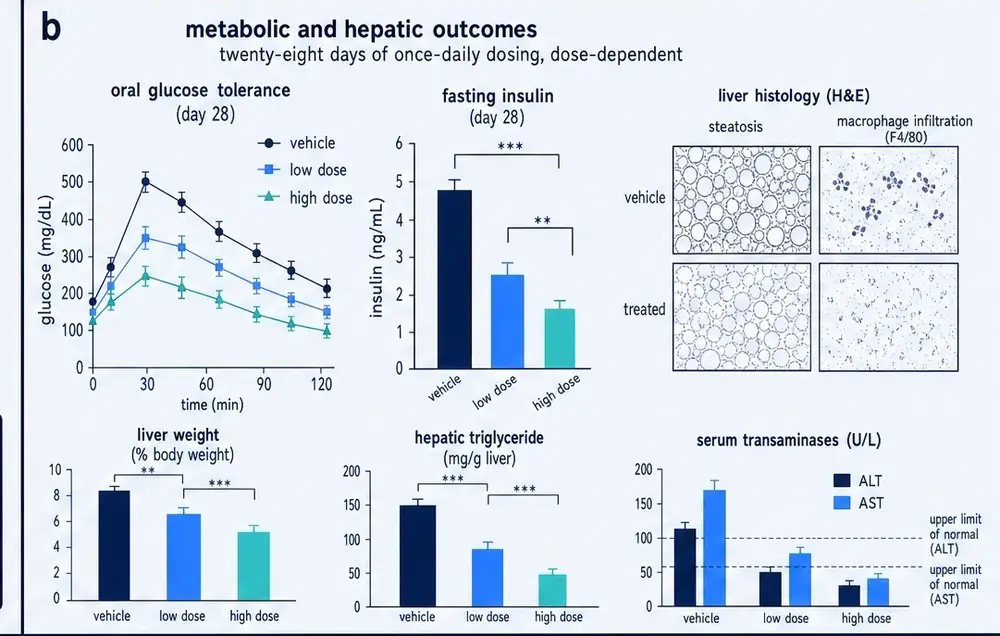
Six years later the same programme, now with a company affiliation, ran the study the first one had not. Eight mice per group, three groups, 10 or 32 mg/kg/day subcutaneously, once daily, for thirty days, with the efficacy work contracted to WuXi AppTec and the pharmacokinetics to XenoBiotic Laboratories.
The result is real and it is smaller than the headline usually suggests. High-dose animals gained 0.9 g against 5.4 g in controls and 5.2 g at the low dose — that is attenuation of weight gain, not weight loss. Fat mass rose 1.3 g against 4.7 g. Plasma insulin fell 9 per cent from baseline while rising 112 per cent in controls, and the effect survived adjustment for both terminal body weight and fat mass, which is a meaningful control. Glucose at fifteen and thirty minutes after an oral load was significantly lower. Liver weight averaged 1.4 g against 2.1 g; microvesicular steatosis fell 73 per cent; the NAFLD activity score, lobular inflammation, ballooning and macrophage marker all improved; alanine transaminase fell.
The low dose did essentially nothing on the primary endpoints. Fed-state blood glucose was unchanged throughout at either dose. Lean mass was unaffected. Serum lipids other than triglycerides moved only as non-significant trends, so the 30 per cent cholesterol reduction of 2018 was not reproduced here. And two markers — creatine kinase and lactate dehydrogenase — reached significance only at the low dose, which the paper does not reconcile.
Read across the whole record, the direction and size of the body-weight effect depend on the dose, the duration and what the animals were eating. Eleven days at roughly 34 mg/kg/day on a maintained high-fat diet produced a two-gram loss; thirty days at 32 mg/kg/day on a maintained high-fat diet produced a 0.9-gram gain; seven weeks at 32 mg/kg/day with a switch to a low-fat diet produced a 6.3-gram loss; eight weeks at 10 mg/kg/day in aged non-obese animals produced essentially nothing. There is no single number for what this compound does to body weight.
15Diet and drug together
The 2021 study asked a more useful question than either obesity study: what does the drug add to a dietary change someone is making anyway? Twenty-two diet-induced obese mice were switched from a Western diet to a low-fat diet and given either saline or the compound for about seven weeks, alongside eight lean controls.
Switching the diet alone produced an initial 4.3 g loss by day twenty, then a plateau and slight regain, ending at 2.9 g down. Adding the drug produced 6.3 g, and the treated animals ended the study “nearly indistinguishable” from lean controls on body weight and fat mass. In percentage terms the fat-mass loss was tenfold greater with the drug than with the diet switch alone — 29.3 per cent against 2.9 per cent. Liver fat and steatosis scores in the combined group matched the lean controls; the diet-switch-only group matched the obese controls.
The most interesting result in that paper is a negative one, and the authors report it plainly. They measured 170 metabolites in the fat pad expecting the treated animals' metabolome to shift from the obese profile toward the lean one. It did not. “Contrary to our expectations, NNMTi treatment did not simply shift the EWAT metabolomic profile from the obese state profile to the lean state profile, but instead produced a unique EWAT metabolomic signature.” The animals looked lean by every physiological measure and their fat tissue looked like neither obese nor lean tissue. Four essential amino acids and tyrosine rose well above both control groups; the nicotinamide-to-nicotinic-acid ratio rose, though only without correction for multiple comparisons; and for two metabolites the drug moved things away from the lean profile that the diet switch alone had approached.
16Muscle, twice
The muscle work is the strand that made the compound interesting to the longevity market, and it is two studies with different designs and partly divergent results.
2019, injury and regeneration. Forty-eight 24-month-old male mice received twice-daily subcutaneous injections at 5 or 10 mg/kg for two weeks, spanning a barium-chloride injury to one tibialis anterior. Muscle stem-cell proliferation rose 60 per cent at the low dose and 75 per cent at the high dose; mean myofibre cross-sectional area at one week was 1.8-fold larger at the high dose; and peak dorsiflexor torque normalised to body weight was 67 per cent higher.
Set against that: the total stem-cell pool was unchanged (209 ± 23, 213 ± 44 and 205 ± 9 cells per square millimetre across the three groups). Stem-cell fusion did not reach significance (p = 0.0686 at the top dose). The low dose failed on cross-sectional area entirely. Torque normalised to fibre size showed no difference — the muscle was bigger, not intrinsically stronger. And the three-week result depends on excluding one animal: the figure legend states that with that datapoint included the comparison is not significant.
2024, exercise. Thirty-five 22-month-old female mice received 10 mg/kg once daily for eight weeks, with or without progressive weighted wheel running. Grip strength rose about 40 per cent with the drug alone against about 20 per cent with exercise alone, and about 60 per cent with both — the finding that produced the headline that a drug outperformed exercise. Intramyocellular lipid fell more than 30 per cent in sedentary treated animals, to levels seen in exercised animals. Raw gastrocnemius mass rose.
And the qualifications are substantial. Grip strength normalised to body weight lost significance for the drug alone (p < 0.06), and the treated mice were about ten per cent heavier at baseline. Peak plantarflexor torque was not changed by the drug, by exercise, or by both — the endpoint that had improved 67 per cent in the 2019 study. Peak torque did not correlate with grip strength in any group. Fibre cross-sectional area was unchanged by the drug alone. Body-weight-normalised muscle masses were unaffected. And cumulative work during the fatigue task was significantly reduced in treated animals, which the authors attribute to lower per-contraction force. The sedentary groups were housed together and the exercised groups singly.
The two studies used different muscles, different sexes, different dosing frequencies and different injury states, so they are not a failed replication. But the plain reading is that a torque benefit is not a general property of this compound, and that the 2024 grip-strength result — the one that travelled — sits beside a measured decrement in sustained work output that did not.
17Elsewhere: tumours, kidneys, pancreas, gut
Outside metabolism and muscle, the compound has been used as a tool in five further in-vivo settings, and the pattern across them is consistent and important: where it works, it works on the tissue around the disease rather than on the diseased cells.
In ovarian cancer, 20 mg/kg intraperitoneally daily for ten days in nude mice reduced intraperitoneal tumour burden and raised histone H3K27 trimethylation in the stroma (Eckert et al., 2019). The same paper states that the inhibitor “did not affect the viability of CAFs or OvCa cells”, and that viability fell only at high concentrations. In bladder cancer, 10 mg/kg every twelve hours for nineteen days reduced tumour burden and shifted tumour-associated macrophages from an immunosuppressive to an inflammatory phenotype, with a clear trend toward added benefit alongside anti-PD-L1 antibody (Yang et al., 2024) — and in the same paper, overexpressing the enzyme in fibroblasts did not change their proliferation and did not directly affect the cancer cells.
In chronic pancreatitis, 20 mg/kg intraperitoneally daily for four weeks reduced fibrosis, collagen deposition and alternatively activated macrophages in a cerulein model, through a histone-methylation mechanism at a single gene promoter. In peripheral artery disease, the compound improved ischaemic muscle strength, power and total work without changing perfusion or capillary density (Dong et al., 2025) — and in the same experiment muscle mass and fibre size were unchanged and the reduction in necrosis reached only p = 0.08. In chronic kidney disease and in renal cell carcinoma the same catalogue compound reduced fibrosis and tumour growth respectively.
None of this is human evidence, and none of it is evidence that the molecule kills anything. The oncology results are real and they are microenvironmental. Presenting them to a consumer audience as anticancer activity would misdescribe what was measured.
18Mechanism: what is measured, and what is assumed
Almost every account of this compound — vendor pages, review articles, and the discussion sections of the primary papers themselves — explains it the same way: blocking the enzyme spares nicotinamide, nicotinamide is recycled into NAD+, NAD+ activates sirtuins, and the metabolic benefits follow. It is a clean story. Here is how much of it has been measured.
| Link in the chain | Status | What was actually measured |
|---|---|---|
| 1-methylnicotinamide falls | measured | Cultured mouse adipocytes, EC50 2.3 ± 1.1 µM, plateauing at ~40% of untreated. In mice, ~70% suppression in fat and ~40% in muscle one hour after dosing, and a 39% liver reduction against controls |
| NAD+ rises | equivocal, and never in a living animal | Cultured adipocytes: a 1.2–1.6-fold rise, but the main effect was p = 0.0568, significant at one concentration only. Cultured muscle cells: no change at all, with NADH rising 50% and the NAD+/NADH ratio falling 25–40%. No in-vivo NAD+ measurement exists in any of these studies. |
| S-adenosylmethionine rises | measured once | Cultured adipocytes, significant at 30 µM (p < 0.05); at 60 µM p = 0.06. Never measured in vivo. Its downstream epigenetic consequences are uncharacterised |
| Sirtuin activity rises | never measured | Sirtuin 1 appears in every mechanism diagram in this literature and in no assay. The only sirtuin data in the primary papers are counter-screens confirming the compound does not inhibit it |
| Polyamine flux rises | measured — for the knockdown, not the drug | The ornithine decarboxylase / acetyltransferase / polyamine oxidase chain, and the epistasis experiment that made it convincing, come from the 2014 antisense study. No polyamine has been measured after dosing this compound |
| Histone methylation changes | measured, in the stroma of tumours | Raised stromal H3K27 trimethylation in an ovarian model and at a specific promoter in a pancreatitis model. Not measured in adipose or muscle after dosing |
| Energy expenditure rises | never measured | No indirect calorimetry, no body temperature, no respiratory exchange ratio in any study of this compound. The energy-expenditure claim is inherited from the 2014 knockdown paper |
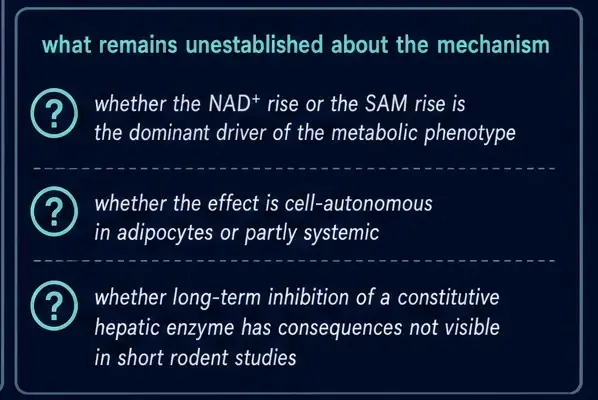
The honest position is that target engagement is well demonstrated and the downstream mechanism is largely inherited. The compound unquestionably lowers the reaction product in the tissues where it accumulates; that is measured directly, in three tissues, with a dose response. Everything after that step — the NAD+ rise, the sirtuin activation, the polyamine cycle, the increased energy expenditure — is either measured only in cells, or measured only for the genetic knockdown, or not measured at all. The mechanism is not wrong. It is, in this compound's own literature, substantially unverified.
In cultured muscle cells the compound did not raise NAD+. It raised NADH by about half and lowered the NAD+/NADH ratio by 25 per cent at 10 µM and 40 per cent at 30 µM. The authors read this as a deliberate shift toward glycolysis supporting differentiation, which is a reasonable interpretation. It is also the exact opposite of the direction the popular account of this compound describes, in the tissue that account most often invokes.
19The oral question
5-amino-1MQ is sold, overwhelmingly, as capsules to be swallowed. The pharmacokinetics were published in 2024, and they are the most consequential numbers in this document.
| Route | Dose | Cmax | AUC0–∞ | Terminal t½ | Note |
|---|---|---|---|---|---|
| Intravenous | 5 mg/kg | 2,009 ng/mL | 825 ng·h/mL | 6.3 h | clearance 101 mL/min/kg; Vss 39 L/kg |
| Subcutaneous, single | 25 mg/kg | 7,010 ng/mL | 7,031 ng·h/mL | 13.3 h | Tmax ~15 min |
| Subcutaneous, 5 days | 25 mg/kg | 5,130 ng/mL | 4,687 ng·h/mL | 12.8 h | no accumulation |
| Oral | 30 mg/kg | 14.5 ng/mL | 224 ng·h/mL | 14.8 h | bioavailability 3.5 % |
Read the oral row against the subcutaneous row above it. A dose six times larger produced a peak concentration 484 times lower. The authors attribute this to limited absorption plus extensive first-pass metabolism, and they measured the second part: in cryopreserved mouse hepatocytes the compound has a half-life under seven minutes and a clearance of 57.9 mL/min/kg.
For target engagement the relevant threshold is the potency against the mouse enzyme, 78 ng/mL. After parenteral dosing, plasma stayed above it for two to four hours. After oral dosing the peak concentration — 14.5 ng/mL — never reached it at all.
Two qualifications are owed. The first is that the 2018 paper predicted the opposite. Its artificial-membrane and Caco-2 results led its authors to suggest “high oral absorption and bioavailability”, and that prediction is still quoted. It was tested six years later and it was wrong. The second is species. The 2022 microbiome paper states that poor oral bioavailability is a mouse phenomenon “that does not occur in rats”, and there is supporting evidence: the 2021 rat study reports 38.4 per cent oral bioavailability after an oral dose, with a mean peak plasma concentration of 2,252 ng/mL. Rat and mouse differ elevenfold, which is a large enough gap that neither number can be assumed to describe a person.
What can be said is narrower and firmer. No efficacy study of this compound has ever used the oral route in any species. Every result in Part Four came from an injection. Whether swallowing it produces useful exposure in a human being is unknown, unmeasured, and — on the only direct comparison available in the species where efficacy was demonstrated — unlikely.
The tissue distribution is more encouraging and worth stating. After five days of subcutaneous dosing, the ratio of drug concentration in epididymal fat to plasma rose from 1.4 at one hour to 31.1 at eight hours, and in muscle from 2.2 to 17.0. Liver exposure was much lower, rising only from 0.09 to 1.4, with a correspondingly weaker suppression of the reaction product there. The compound accumulates in the two tissues the metabolic hypothesis cares about and largely spares the organ where the enzyme is most abundant — which is, on the argument of Section 22, probably the right way round.
20Selectivity, and the off-target nobody screened for
The 2018 paper's selectivity claim is repeated everywhere: the compound is described as showing “exceptional selectivity”, not inhibiting DNA methyltransferase 1, protein arginine methyltransferase 3, catechol O-methyltransferase, nicotinamide phosphoribosyltransferase or sirtuin 1. Those five results are real, and the panel has three limitations that are not usually quoted with it.
First, the concentrations. Catechol O-methyltransferase showed ten per cent inhibition at 600 µM with no concentration dependence; sirtuin 1 showed a “minor reduction” at 600 µM. Second, the nicotinamide phosphoribosyltransferase assay failed above 100 µM because the compound interfered with the readout, and the gap was filled with a different analogue whose data are not shown. Third, and most important, the panel contains five enzymes. It contains no receptor, no transporter, no ion channel, and none of the enzyme's own close relatives.
That last omission matters structurally. Searching the human NNMT structure against the structural database returns indolethylamine N-methyltransferase at 1.1 Å root-mean-square deviation over 257 alpha-carbons and 52 per cent sequence identity, and phenylethanolamine N-methyltransferase at 1.5 Å and 39 per cent. The cofactor site is conserved between them; only the acceptor pocket has diverged. Indolethylamine N-methyltransferase methylates tryptamine and serotonin. No published selectivity screen of 5-amino-1MQ has ever included it. More broadly, a high-throughput screen of 27,574 compounds across six small-molecule methyltransferases found that about seventy-two per cent of NNMT hits also inhibited at least one of the others — this is a promiscuous pocket, and five counter-targets is not a selectivity package.
In 2024 someone finally ran a broad panel, and it found something.
Tested at 10 µM against a commercial panel of receptors, enzymes and uptake transporters, 5-amino-1MQ showed no significant activity against anything except a 67.4 per cent inhibition of monoamine oxidase A (Babula et al., 2024).
The authors treat it in two ways at once. They concede it may be doing some of the pharmacological work — “it is possible that the improved OGT by 5A1MQ may, in part, be mediated by its inhibitory activity against MAO-A” — and they list it among the liabilities they are trying to engineer out of the next compound. Both are honest, and the second is the more telling: the developers regard this as a defect to be removed.
There is no half-maximal concentration for it, no counter-screen against monoamine oxidase B, no measurement of brain penetration in any study of this compound, and no monoamine measurement in any treated animal. Monoamine oxidase A inhibition is the pharmacology behind the tyramine pressor reaction and behind serotonin-syndrome interactions with serotonergic drugs. Nothing in this literature addresses either.
The finding is not isolated to this molecule. When the rival Sanofi tricyclic was run through the same kind of panel it inhibited monoamine oxidase A by 90 per cent at the same concentration, and that programme nominated it as the reason their compound improved glucose tolerance in mice that had no NNMT at all. Two structurally unrelated NNMT inhibitors, the same off-target, and in one of the two cases it demonstrably confounded the primary result.
21Safety: what exists, and what does not
The safety record for 5-amino-1MQ consists entirely of secondary observations made inside experiments designed to measure something else. There is no toxicology study of any kind. Set out honestly, this is what exists:
- A twenty-analyte plasma chemistry panel in 24-month-old mice after two weeks of twice-daily dosing, reporting no significant differences. The numeric values are in a table that is not reproduced in the retrievable text.
- A twenty-one-analyte panel after seven weeks of daily dosing, in groups reduced to three to six animals by insufficient blood volume, with several analytes excluded for haemolysis.
- Liver histology in two studies, showing improvement, with fibrosis either not observed or not scored.
- Food intake measured in three studies and unchanged in all three.
- A dose-escalation study in two animals.
- A statement that the compound produced “no observable adverse effects”.
And one finding that is presented as a benefit and is, on its face, a haematological change. In the thirty-day study, total white cell count fell significantly at the high dose, driven by a 31 per cent fall in lymphocytes and a 50 per cent fall in monocytes, with monocytes also significantly reduced at the low dose. No immune function assay, lymphoid organ weight, bone-marrow assessment or repeat count was performed in that study or any other.
Searched across this corpus and not found, for 5-amino-1MQ or for any NNMT inhibitor: any formal or regulated toxicology study; any genotoxicity testing; any reproductive or developmental toxicity study; any cardiovascular safety pharmacology, including hERG, blood pressure, electrocardiography or cardiac histology; any central-nervous-system or respiratory safety pharmacology; any brain exposure measurement; any drug–drug interaction package; any toxicokinetics linking exposure to a safety endpoint; any local tolerance or injection-site assessment; any recovery arm; any urinalysis, coagulation panel, kidney weight or renal histology; and any mortality figure in any paper.
Histopathology across the entire in-vivo record covers four tissues — fat, liver, pancreas and skeletal muscle — each in a single study. No kidney, heart, brain, spleen, thymus, bone marrow, lung, gut, adrenal, thyroid, gonad, skin or eye has ever been sectioned. The longest exposure anywhere is eight weeks. Every study used one sex. Every study used the mouse. No study disclosed the purity of the material dosed.
Two papers assert an absence of behavioural effects. Neither performed a behavioural assay.
22The case against blocking this enzyme
Almost everything written about NNMT for a general audience treats the enzyme as a straightforward liability. The primary literature does not, and the counter-evidence is substantial enough that it belongs in the main line of the argument rather than in a caveat at the end.
The enzyme protects human endothelial cells, and this compound removes the protection. Working in human microvascular and aortic endothelial cells, Campagna and colleagues found that NNMT is expressed at relatively high levels in endothelium and that inhibiting it — with 5-amino-1MQ, and separately with the 6-methoxynicotinamide compound — decreased cell viability under menadione-induced oxidative stress, with a fall in nuclear sirtuin 1 and a rise in its phosphorylated, degradation-marked form. This is the only direct test of the compound in normal human cells anywhere in this corpus, and the result is adverse. A 2024 review of the target for age-related disease closes its cardiovascular section with the corresponding recommendation: the potential adverse effects of NNMT inhibitors on the endothelium “should be thoroughly assessed”.
In the liver, the enzyme's activity looks beneficial. Expression correlates inversely with total cholesterol, low-density lipoprotein and triglycerides in both humans and mice. Hepatic knockdown does not raise NAD+ or the methylation ratio under normal conditions, because glycine N-methyltransferase buffers the flux. Supplementing the reaction product improves the metabolic profile of high-fat-fed mice and prevents an immune-mediated hepatitis. One review states the split directly: the enzyme “exerts a beneficial effect by regulating lipid parameters in the liver” while its adipose expression tracks with obesity and insulin resistance.
It is a phase II drug-metabolising enzyme, and nobody has asked the obvious question. Six independent papers in this corpus introduce NNMT as the enzyme responsible for the hepatic biotransformation and detoxification of pyridine-, quinoline- and other heterocycle-containing xenobiotics; it methylates quinoline itself with a Michaelis constant around 17 µM. The 2025 kinetics paper found that in human hepatocytes, methylation by NNMT was the major metabolic route for its test compound, that hepatocyte clearance exceeded microsomal clearance because microsomes lack the enzyme, and concluded that NNMT “could be a major clearance route in vivo” that drug developers need to account for. Not one paper in this corpus measures what inhibiting NNMT does to the clearance of any co-administered drug. The premise appears in every introduction and in no discussion.
Where the enzyme is lost, several tissues do worse. Knocking it down kills renal tubular epithelial cells and abolishes a protective pathway in intestinal epithelium, where the protection is explicitly methyltransferase-dependent — which is to say, exactly the function a catalytic-site inhibitor removes. In liver cancer cells NNMT is downregulated, and further knockdown helps the tumour survive nutrient starvation, producing xenografts that grew larger. In cultured neurons, overexpressing the enzyme confers resistance to mitochondrial toxins.
The clearest single test of the metabolic hypothesis largely failed. A 2025 study in hyperlipidaemic mice found that a systemic antisense oligonucleotide reduced atherosclerotic lesion area five- to tenfold — but that knocking the enzyme down selectively in liver and adipose tissue, the two organs that express it most and on which the whole metabolic argument rests, had little or no effect on lesion area, cholesterol, glucose, body weight or adiposity. The benefit traced to macrophages. In the same paper, feeding the reaction product produced a modest 33 per cent reduction in lesion area rather than the increase the standard mechanism predicts.
And the intervention may partly cancel itself. Section 07 set out the argument: nicotinamide inhibits sirtuins and PARPs, NNMT exists to keep nicotinamide low, and an inhibitor therefore raises the very molecule whose removal is supposed to be the benefit. There is a second edge to this. Raising intracellular nicotinamide inhibits PARP-1 and impairs single-strand break repair; in glioblastoma, NNMT inhibition is explicitly pursued as a radiosensitiser for that reason, and bladder cancer patients are infused with nicotinamide before radiotherapy on the same principle. Deliberate impairment of DNA repair is a legitimate goal in oncology. In an unmonitored person taking capsules, it is an untested consequence that nobody has looked for.
None of this establishes that inhibiting NNMT is a bad idea. Several of these findings are single studies; several are in tissues that a well-distributed drug might largely miss, and Section 19's distribution data suggest this one concentrates in fat and muscle rather than liver. The point is narrower and it is about what the evidence base can support. This is a target with a genuine two-sided literature, being sold on a one-sided summary of it.
23Regulation, the market, and the company
5-amino-1MQ is not an approved medicine in any jurisdiction. It is not a dietary ingredient. There is no investigational new drug application for it on the public record.
There are no clinical trials. ClinicalTrials.gov was searched on 2 August 2026 on two independent query shapes — one naming the compound and its abbreviations, one naming the enzyme, the inhibitor class and the sponsor. Both returned zero interventional studies, of this compound or of any NNMT inhibitor, in any indication. The reviews in this corpus say the same in their own words, repeatedly, from 2021 to 2026; a 2021 review projected first clinical use somewhere between 2031 and 2036.
The nearest human data is a phase 2a trial of the enzyme's substrate. Participants with mild cognitive impairment or mild Alzheimer's disease took 3 g of nicotinamide daily for a year. Plasma nicotinamide rose more than 130-fold and plasma 1-methylnicotinamide more than 600-fold, to 91 µM. The trial missed its primary endpoint. But it demonstrates, in humans, that this enzyme's flux is large enough to dominate the disposition of a three-gram daily load — and the authors' own proposal, that nicotinamide might have to be combined with an NNMT inhibitor to reach the brain, is the closest thing in this literature to a human plan. It remains a hypothesis in a discussion section.
The warning letter, and what it does and does not say
On 20 January 2026 the Center for Drug Evaluation and Research issued warning letter 718739 to GenoGenix LLC of Boca Raton, Florida, a facility that had registered as a 503B outsourcing facility on 4 February 2025 and was inspected that July. The finding naming this compound is unambiguous:
“Your facility compounded drug products using bulk drug substances that are not eligible for the use in compounding under section 503B, including 5-amino-1-methylquinolinium iodide (5-Amino-1MQ) and nicotinamide adenine dinucleotide (NAD+). Drug products compounded using 5-Amino-1MQ and NAD+ are not eligible for the exemptions provided by section 503B, because 5-Amino-1MQ and NAD+ do not appear on the 503B bulks list and are not used to compound a drug that appears on the drug shortage list.”
A footnote closes the remaining route: neither substance qualifies for the interim policy either, because that requires appearing on the list of bulk drug substances under evaluation — substances nominated with enough supporting data for the agency to assess them. 5-amino-1MQ is not there. Under corrective actions the agency records that the firm had not documented what became of the products containing it, or shown that it had stopped making them.
One thing that letter does not say, and that is widely reported as though it did. The same letter describes three patients who developed low blood pressure, uncontrollable shaking, shivers and body aches and were sent to an emergency room, and an unopened vial from the same lot assaying at 3,360 endotoxin units per millilitre. Those events belong to a nicotinamide adenine dinucleotide product, lot GG121624-023 — not to 5-amino-1MQ. Several secondary accounts place the two findings side by side in a way that invites the wrong inference. No adverse event involving 5-amino-1MQ appears anywhere in the letter. Its appearance there is a bulk-substance eligibility finding and nothing more.
That correction matters in both directions. It would have been convenient for this document's argument to report a safety signal, and there is not one. What the letter does establish is a regulatory position: a compound with no approval, no application, no nomination file, and therefore no lawful route into a compounded preparation in the United States.
The company, and the compound it is not developing
Ridgeline Therapeutics, a University of Texas spin-out in Houston founded out of the laboratory that made this molecule, has taken NNMT inhibition toward the clinic with funding from the National Institute on Aging's small-business programme and the Department of Defense. Harshini Neelakantan and Stanley Watowich carry Ridgeline affiliations on the papers from 2021 onward.
Its stated pipeline is a clinical candidate designated RT-002, described as completing preclinical manufacture and regulated safety studies ahead of a submission to the agency. The company describes its assets as “a series of selective small molecule NNMT inhibitors” and “novel lead drug candidates”.
Nowhere in the public record does the company state that RT-002 is 5-amino-1MQ, and the compound's own developers have written that they are working to improve its high metabolic clearance and to remove its monoamine oxidase A activity. The most economical reading is that the molecule being prepared for human testing is a successor, and that 5-amino-1MQ is the tool compound that established the hypothesis. If that reading is right, then the substance available to buy is the one the people who invented it decided not to take forward.
There is a word for what 5-amino-1MQ is, and the people who made it use it. Describing the compound in 2021, the group called it “an NNMT-selective probe small molecule inhibitor” and referred to “precedence using this probe molecule for proof-of-concept studies”. A probe is a tool for asking whether a target is worth pursuing. It is chosen for being available, soluble and good enough, and not for the properties a medicine needs — oral exposure, selectivity margins, metabolic stability, a safety package. Judged as a probe, this molecule has been a success: it converted a genetic hypothesis into a pharmacological one across five animal experiments and half a dozen disease models, at a potency the field had already left behind. Judged as a medicine, it has never been judged at all.
What is actually being sold
The market for this compound is large, and this project's own library measures it. A sweep of every document in the project's stores found 185 files that are genuinely about 5-amino-1MQ. Four of them are peer-reviewed scientific full texts. The rest — 121 pieces of trade and affiliate copy, 48 dated captures of vendor web pages, six product pages — are commerce. That ratio, better than forty to one, is itself a finding about the compound: it has a consumer literature roughly forty times the size of its scientific one.
The content of that commercial tier repays reading. One archived product page describes the molecule as a peptide, states without qualification that “inhibiting NNMT leads to significant weight loss, decreased fat mass and fat cell (adipocyte) size, and lower plasma cholesterol and glucose levels” with no species attached to any of it, and prints the iodide's registry number against the cation's mass. A companion product sells 5-amino-1MQ together with nicotinamide mononucleotide and JBSNF-000088 — that is, a second, structurally unrelated NNMT inhibitor — as a combination. No study of that combination exists anywhere.
This document describes published research. It does not recommend human use of 5-amino-1MQ, and it specifies no dose, route or schedule for any person.
The animal regimens reported in Part Four are evidence, not instructions. They cannot be converted into a human dose, and the reasons are specific rather than formulaic: every one of them was an injection, in a mouse, for eleven days to eight weeks; the oral route delivers 3.5 per cent of the dose in that species and eleven times more in another; a milligram figure is ambiguous by a factor of 1.8 unless the salt is named; the human enzyme is about three times more active than the mouse enzyme and differs at a residue known to change potency for related compounds by tenfold; and no human being has ever been given the compound under observation.
The target is well validated. The compound is a well-characterised mouse drug. Those are different statements, and the second does not become the first by being repeated.
24References
Generated from verified NCBI records rather than from recall. Author lists, journal names, volumes, pages and identifiers are taken from the PubMed record for each citation, and the build refuses to run if any identifier fails to resolve. This series has twice shipped reference lists drafted from memory in which identifiers pointed at real but unrelated papers.
That machinery verifies that an identifier is real. It cannot verify that the identifier is relevant, and on this compound the difference matters: “Neelakantan H” is at least three researchers, and an identifier carried in from an author search resolved cleanly, and correctly, to a paper on the phenotypic plasticity of a lichen mycobiont. It was removed by reading the generated list, which is the only step that catches it.
- Akar S, Duran T, Azzawri AA, Koçak N, Çelik Ç, Yıldırım Hİ. Small molecule inhibitor of nicotinamide N-methyltransferase shows anti-proliferative activity in HeLa cells. J Obstet Gynaecol. 2021;41(8):1240-1245.
PMID 33645410 · doi:10.1080/01443615.2020.1854696 - Akerud T, De Fusco C, Brandt P, Bergström F, Johansson P, Ek M, et al.. Mechanism and kinetics of turnover inhibitors of nicotinamide N-methyl transferase in vitro and in vivo. J Biol Chem. 2025;301(6):108492.
PMID 40209950 · doi:10.1016/j.jbc.2025.108492 · PMC12140953 - Awosemo O, Neelakantan H, Watowich S, Ma J, Wu L, Chow DS, et al.. Development & validation of LC-MS/MS assay for 5-amino-1-methyl quinolinium in rat plasma: Application to pharmacokinetic and oral bioavailability studies. J Pharm Biomed Anal. 2021;204:114255.
PMID 34304009 · doi:10.1016/j.jpba.2021.114255 - Babault N, Allali-Hassani A, Li F, Fan J, Yue A, Ju K, et al.. Discovery of Bisubstrate Inhibitors of Nicotinamide N-Methyltransferase (NNMT). J Med Chem. 2018;61(4):1541-1551.
PMID 29320176 · doi:10.1021/acs.jmedchem.7b01422 · PMC5823789 - Babula JJ, Bui D, Stevenson HL, Watowich SJ, Neelakantan H. Nicotinamide N-methyltransferase inhibition mitigates obesity-related metabolic dysfunction. Diabetes Obes Metab. 2024;26(11):5272-5282.
PMID 39161060 · doi:10.1111/dom.15879 · PMC11622326 - Campagna R, Mateuszuk Ł, Wojnar-Lason K, Kaczara P, Tworzydło A, Kij A, et al.. Nicotinamide N-methyltransferase in endothelium protects against oxidant stress-induced endothelial injury. Biochim Biophys Acta Mol Cell Res. 2021;1868(10):119082.
PMID 34153425 · doi:10.1016/j.bbamcr.2021.119082 - Chanvillard L, Lantermans HC, Wall C, Thevenet J, Butter LM, Tauzin L, et al.. NNMT inhibition counteracts tubular senescence and fibrosis in early stages of chronic kidney disease. Cell Rep. 2026;45(1):116823.
PMID 41543936 · doi:10.1016/j.celrep.2025.116823 - Chen D, Li L, Diaz K, Iyamu ID, Yadav R, Noinaj N, et al.. Novel Propargyl-Linked Bisubstrate Analogues as Tight-Binding Inhibitors for Nicotinamide N-Methyltransferase. J Med Chem. 2019;62(23):10783-10797.
PMID 31724854 · doi:10.1021/acs.jmedchem.9b01255 · PMC7296983 - Dimet-Wiley A, Wu Q, Wiley JT, Eswar A, Neelakantan H, Savidge T, et al.. Reduced calorie diet combined with NNMT inhibition establishes a distinct microbiome in DIO mice. Sci Rep. 2022;12(1):484.
PMID 35013352 · doi:10.1038/s41598-021-03670-5 · PMC8748953 - Dimet-Wiley AL, Latham CM, Brightwell CR, Neelakantan H, Keeble AR, Thomas NT, et al.. Nicotinamide N-methyltransferase inhibition mimics and boosts exercise-mediated improvements in muscle function in aged mice. Sci Rep. 2024;14(1):15554.
PMID 38969654 · doi:10.1038/s41598-024-66034-9 · PMC11226645 - Dong G, Choi J, Li Y, Muller DC, Li Z, Luo YE, et al.. Nicotinamide N-methyltransferase inhibition improves limb function in experimental peripheral artery disease. Physiol Rep. 2025;13(20):e70615.
PMID 41108586 · doi:10.14814/phy2.70615 · PMC12535215 - Eckert MA, Coscia F, Chryplewicz A, Chang JW, Hernandez KM, Pan S, et al.. Proteomics reveals NNMT as a master metabolic regulator of cancer-associated fibroblasts. Nature. 2019;569(7758):723-728.
PMID 31043742 · doi:10.1038/s41586-019-1173-8 · PMC6690743 - Gao Y, Martin NI, van Haren MJ. Nicotinamide N-methyl transferase (NNMT): An emerging therapeutic target. Drug Discov Today. 2021;26(11):2699-2706.
PMID 34029690 · doi:10.1016/j.drudis.2021.05.011 - Gao Y, van Haren MJ, Moret EE, Rood JJM, Sartini D, Salvucci A, et al.. Bisubstrate Inhibitors of Nicotinamide N-Methyltransferase (NNMT) with Enhanced Activity. J Med Chem. 2019;62(14):6597-6614.
PMID 31265285 · doi:10.1021/acs.jmedchem.9b00413 · PMC6713424 - Heide J, Bilecz AJ, Patnaik S, Allega MF, Donle L, Yang K, et al.. NNMT inhibition in cancer-associated fibroblasts restores antitumour immunity. Nature. 2025;645(8082):1051-1059.
PMID 40702186 · doi:10.1038/s41586-025-09303-5 · PMC13337316 - Kannt A, Rajagopal S, Kadnur SV, Suresh J, Bhamidipati RK, Swaminathan S, et al.. A small molecule inhibitor of Nicotinamide N-methyltransferase for the treatment of metabolic disorders. Sci Rep. 2018;8(1):3660.
PMID 29483571 · doi:10.1038/s41598-018-22081-7 · PMC5826917 - Kannt A, Rajagopal S, Hallur MS, Swamy I, Kristam R, Dhakshinamoorthy S, et al.. Novel Inhibitors of Nicotinamide-N-Methyltransferase for the Treatment of Metabolic Disorders. Molecules. 2021;26(4).
PMID 33668468 · doi:10.3390/molecules26040991 · PMC7918612 - Kraus D, Yang Q, Kong D, Banks AS, Zhang L, Rodgers JT, et al.. Nicotinamide N-methyltransferase knockdown protects against diet-induced obesity. Nature. 2014;508(7495):258-62.
PMID 24717514 · doi:10.1038/nature13198 · PMC4107212 - Liang R, Xiang Q, Dai M, Lin T, Xie D, Song Q, et al.. Identification of nicotinamide N-methyltransferase as a promising therapeutic target for sarcopenia. Aging Cell. 2024;23(9):e14236.
PMID 38838088 · doi:10.1111/acel.14236 · PMC11488295 - Mak TK, Li K, Zhao Z, Wang K, Zeng L, He Q, et al.. m6A demethylation of NNMT in CAFs promotes gastric cancer progression by enhancing macrophage M2 polarization. Cancer Lett. 2025;611:217422.
PMID 39725153 · doi:10.1016/j.canlet.2024.217422 - Meng Y, Iyamu ID, Ahmed NAM, Huang R. Comparative Analysis of Two NNMT Bisubstrate Inhibitors through Chemoproteomic Studies: Uncovering the Role of Unconventional SAM Analogue Moiety for Improved Selectivity. ACS Chem Biol. 2024;19(1):89-100.
PMID 38181447 · doi:10.1021/acschembio.3c00531 · PMC11955877 - Neelakantan H, Vance V, Wang HL, McHardy SF, Watowich SJ. Noncoupled Fluorescent Assay for Direct Real-Time Monitoring of Nicotinamide N-Methyltransferase Activity. Biochemistry. 2017;56(6):824-832.
PMID 28121423 · doi:10.1021/acs.biochem.6b01215 - Neelakantan H, Wang HY, Vance V, Hommel JD, McHardy SF, Watowich SJ. Structure-Activity Relationship for Small Molecule Inhibitors of Nicotinamide N-Methyltransferase. J Med Chem. 2017;60(12):5015-5028.
PMID 28548833 · doi:10.1021/acs.jmedchem.7b00389 - Neelakantan H, Vance V, Wetzel MD, Wang HL, McHardy SF, Finnerty CC, et al.. Selective and membrane-permeable small molecule inhibitors of nicotinamide N-methyltransferase reverse high fat diet-induced obesity in mice. Biochem Pharmacol. 2018;147:141-152.
PMID 29155147 · doi:10.1016/j.bcp.2017.11.007 · PMC5826726 - Neelakantan H, Brightwell CR, Graber TG, Maroto R, Wang HL, McHardy SF, et al.. Small molecule nicotinamide N-methyltransferase inhibitor activates senescent muscle stem cells and improves regenerative capacity of aged skeletal muscle. Biochem Pharmacol. 2019;163:481-492.
PMID 30753815 · doi:10.1016/j.bcp.2019.02.008 · PMC6469996 - Policarpo RL, Decultot L, May E, Kuzmič P, Carlson S, Huang D, et al.. High-Affinity Alkynyl Bisubstrate Inhibitors of Nicotinamide N-Methyltransferase (NNMT). J Med Chem. 2019;62(21):9837-9873.
PMID 31589440 · doi:10.1021/acs.jmedchem.9b01238 · PMC7955893 - Pompei V, Cecati M, Serritelli EN, Gerini E, Campagna R, Pozzi V, et al.. Small Molecule Inhibitors of Nicotinamide N-Methyltransferase Enzyme for the Treatment of Osteosarcoma and Merkel Cell Carcinoma: Potential for the Development of a Targeted Therapeutic Strategy. Biomolecules. 2025;15(11).
PMID 41301471 · doi:10.3390/biom15111553 · PMC12650368 - Roberti A, Fernández AF, Fraga MF. Nicotinamide N-methyltransferase: At the crossroads between cellular metabolism and epigenetic regulation. Mol Metab. 2021;45:101165.
PMID 33453420 · doi:10.1016/j.molmet.2021.101165 · PMC7868988 - Ruf S, Rajagopal S, Kadnur SV, Hallur MS, Rani S, Kristam R, et al.. Novel tricyclic small molecule inhibitors of Nicotinamide N-methyltransferase for the treatment of metabolic disorders. Sci Rep. 2022;12(1):15440.
PMID 36104373 · doi:10.1038/s41598-022-19634-2 · PMC9474883 - Sampson CM, Dimet AL, Neelakantan H, Ogunseye KO, Stevenson HL, Hommel JD, et al.. Combined nicotinamide N-methyltransferase inhibition and reduced-calorie diet normalizes body composition and enhances metabolic benefits in obese mice. Sci Rep. 2021;11(1):5637.
PMID 33707534 · doi:10.1038/s41598-021-85051-6 · PMC7952898 - van Haren MJ, Taig R, Kuppens J, Sastre Toraño J, Moret EE, Parsons RB, et al.. Inhibitors of nicotinamide N-methyltransferase designed to mimic the methylation reaction transition state. Org Biomol Chem. 2017;15(31):6656-6667.
PMID 28758655 · doi:10.1039/c7ob01357d - Yang M, Wang B, Hou W, Zeng H, He W, Zhang XK, et al.. NAD+ metabolism enzyme NNMT in cancer-associated fibroblasts drives tumor progression and resistance to immunotherapy by modulating macrophages in urothelial bladder cancer. J Immunother Cancer. 2024;12(7).
PMID 39067875 · doi:10.1136/jitc-2024-009281 · PMC11284830
Sources without a PubMed record
Regulatory instruments, patents, registry searches, chemical registry entries and archived commercial material have no PubMed record and are listed separately, so that the generated list above remains wholly machine-verified.
- U.S. Food and Drug Administration, Center for Drug Evaluation and Research. Warning Letter to GenoGenix LLC, WL #718739 — compounding with 5-amino-1-methylquinolinium iodide (5-Amino-1MQ) and nicotinamide adenine dinucleotide, bulk drug substances not eligible under section 503B. Issued 20 January 2026; inspection 14–18 July 2025.
https://www.fda.gov/inspections-compliance-enforcement-and-criminal-investigat - Watowich SJ, Neelakantan H, Wang HY, McHardy SF (inventors); Board of Regents, The University of Texas System (assignee). Quinoline derived small molecule inhibitors of nicotinamide N-methyltransferase (NNMT) and uses thereof. United States patent US11401243B2. Priority 30 March 2017; granted 2 August 2022. 5-amino-1-methylquinolinium is compound 1j, IC50 1.2 μM.
https://patents.google.com/patent/US11401243B2/en - Watowich SJ, Neelakantan H, Wang HY, McHardy SF (inventors); Board of Regents, The University of Texas System (assignee). Quinoline derived small molecule inhibitors of nicotinamide N-methyltransferase (NNMT) and uses thereof. United States patent US12071409B2. Priority 30 March 2017; granted 27 August 2024.
https://patents.google.com/patent/US12071409B2/en - U.S. National Library of Medicine. ClinicalTrials.gov — searched on two independent query shapes for 5-amino-1-methylquinolinium, 5-amino-1MQ, NNMT inhibitor, nicotinamide N-methyltransferase inhibitor and sponsor Ridgeline. No registered interventional study of this compound, or of any NNMT inhibitor, was located. Searched 2 August 2026.
https://clinicaltrials.gov/ - National Center for Biotechnology Information. PubChem compound summaries CID 950107 (5-amino-1-methylquinolinium cation, C10H11N2+, 159.21), CID 66522933 (iodide salt, C10H11IN2, 286.11, CAS 42464-96-0) and CID 176507677 (chloride salt, C10H11ClN2, 194.66). Accessed 2 August 2026.
https://pubchem.ncbi.nlm.nih.gov/compound/950107 - Ridgeline Therapeutics LLC. Science — corporate statement of a series of selective small-molecule NNMT inhibitors in preclinical development. The public record nowhere states that the clinical candidate is 5-amino-1MQ. Accessed 2 August 2026.
https://www.ridgelinetherapeutics.com/science - National Institute on Aging, U.S. National Institutes of Health. NIA Small Business Showcase — Ridgeline Therapeutics, LLC. Accessed 2 August 2026.
https://www.nia.nih.gov/research/sbir/nia-small-business-showcase/ridgeline-th - Peptide Sciences. 5-Amino-1MQ (60 Capsules) — archived product page describing the compound as “a short peptide inhibitor” and pairing the iodide salt’s CAS number with the cation’s formula and mass. 2023–2024 catalogue edition; archived capture 8 January 2024, held in project 05.
https://www.peptidesciences.com/5-amino-1mq-60-capsules
25How this document was assembled
The corpus was built against project 05, the Therapeutic Peptide Research Library, and two of the numbers below are more informative than the corpus figure itself.
The local sweep, and the ratio it exposed. Every file with a document extension in the project's stores was opened — 45,975 of them — and its extracted text searched. 186 contained a matching string and 185 were admitted as being about this compound. Of those, only 4 are peer-reviewed scientific full texts. The remaining 179 are trade and affiliate copy, vendor product pages captured repeatedly over several years, and this project's own earlier internal write-ups. For a compound with a large research-chemical market that split is not an inconvenience to be tidied away; it is a finding about the compound, and it is reported as one in Section 23.
The identity gate, and the two defects that reading the corpus exposed. Matching was delegated to one shared module so that the discovery scan, the harvest and the corpus prune could not drift apart. The compound has no settled name (Section 02), so the matcher admits seven designations and refuses three ambiguous ones without corroboration. Two errors in the first version of it were found only by reading the documents it returned, and neither would have shown up in any count:
- “5AMQ” is a Protein Data Bank accession code. A case-sensitive, word-bounded match on it — which is everything the series standard requires — matched PDB entry 5amq seventeen times in a homology-modelling paper on a haemorrhagic-fever polymerase that contains the string “NNMT” zero times. Because the arm sat among the designations that confirm on their own, it admitted a virology paper as primary literature. Requiring a separator did not repair it: the same paper writes “PDB ID: 5 amq”. The arm was demoted to require compound-level corroboration, and nothing real was lost, because the one paper that uses “5-AMQ” as its house abbreviation also spells the molecule out.
- There is an eighth designation, and missing it scored the compound's own papers against its sibling. Two papers write “5A-1MQ” throughout. The subject arm did not match that form, and the counter for the des-amino scaffold 1MQ — a different molecule — did, sixty-one times in one paper. Correcting it moved that paper from five subject mentions to sixty-six. The underlying cause will recur elsewhere and is worth stating: a negative lookbehind must be fixed-width, so excluding the subject's prefix from the sibling's counter needs one lookbehind per prefix, including one for each Unicode dash a typesetter may have used. A single (?<!amino-) fails silently on the non-breaking hyphen that PubMed Central emits.
The external harvest. A scoped PubMed query returned 188 records, of which 184 survived a relevance screen. Because PubMed indexes only titles, abstracts and MeSH terms, a second route searched PubMed Central's full text and returned 39 matches, of which 18 were invisible to the first. Stage 03 fetched the union: 117 documents.
The far-side screen, and how to read its largest class. Of those 117 documents, 72 never name the compound at all. That number is not a failure of the query — it is the target arm working as designed. This compound's own literature is the smallest in the series, so the harvest deliberately ran a second arm on the enzyme, and those documents are the evidence base for Part Two. A further 17 mention the compound below the substantive-use threshold and 1 carried no retrievable body text. That leaves 27 articles that discuss the compound itself.
Merging the local and fetched sets by PMCID and removing the 4 documents present in both gives the reading corpus this monograph is written from: 27 unique scientific full texts, roughly 495 printed-page equivalents, together with the complete 184-record metadata layer. Four external instruments were read directly rather than through any summary of them: the two granted patents, the FDA warning letter, and the chemical registry entries for the cation and both salts.
| Stage | What it does | Result |
|---|---|---|
| 01b | Targeted scan of the project's document stores | 45,975 files opened |
| 01c | Interrogation of the curated library database | SQL prefilter, gated in Python |
| 01g | Classification of local hits by source kind | 4 of 185 are literature |
| 02 | PubMed E-utilities harvest, date-partitioned | 188 records |
| 02b | PubMed Central full-text search | 39 matches |
| 03 | Open-access full-text retrieval of the union | 117 documents |
| 03c | Identity gate and substantive-use screen | 27 on the compound |
| 04 | Keyed union, de-duplication, inventory | 27 unique full texts |
| 05 | Reference list from verified NCBI records | 32 citations |
| 06 | Assembly of this document | 1 deliverable |
Commissioned artwork
Five plates were commissioned for this monograph against a caption list of five. Three were admitted and two were withheld. Both admitted structural plates carry a correction in their caption, and the reasons for every decision, value by value, are recorded in the project's artwork mapping file.
The pattern across the set decided how it was read. On every admitted plate the generator drew correct skeletons and wrong locants: two ring-fusion labels transposed on one, the ring numbering of two pyridines transposed on another. The numerals were therefore treated as unreliable annotation throughout while the bond skeletons were trusted — and the withheld plates are the exception that justifies the rule, because on those the skeletons themselves were wrong. One drew S-adenosylmethionine twice as a five-membered pyrazole with no adenine, no ribose and no S-methyl group, and drew the reaction's product as 2-methylpyridine, without the carboxamide or the positive charge that the surrounding argument turns on. It contradicted a plate in the same set that drew both molecules correctly, which settled the question without recourse to any source. The other was a table of doses, routes and durations whose route column read “intraperitoneal” in every populated row where all five Methods sections say subcutaneous, and which repeated the error inside its own boxed safety warning. A caption repairs a stray value on a sound plate; it does not repair a dose table that is wrong about the dose.
One further correction was made to an admitted plate. Its claims table credited the compound with raising NAD+ “in cultured cells and in mouse tissue”. NAD+ has never been measured in the tissue of a treated animal, so the plate understated its own argument, and the caption says so.
26Evidence handling
Findings are labelled by the kind of study that produced them, in the sentence that reports them, and the species is named every time. Animal and in-vitro results are never phrased so as to imply a human outcome. On this compound the discipline is load-bearing rather than decorative: there is no human evidence of any kind, so every efficacy statement in this document is a statement about mice, rats or cultured cells.
Two molecules, kept apart. 5-amino-1MQ and 1MQ differ by one amino group, come from the same screening series, and are sold beside each other. The second is the weaker inhibitor and is the subject of no study in Part Four. Every finding here names which was used. A third and more consequential separation is that the most impressive published NNMT-inhibitor result — the restoration of antitumour immunity in immunocompetent mice — used NCGC00685960, a different, far more potent, orally bioavailable molecule. It is not this compound and its results are not credited to it. In the other direction, several papers dose “NNMTi” identified only by a catalogue number that resolves to this compound; those are included, and named as such.
Salt and cation. Every milligram-per-kilogram figure is reported in the convention its source used, and where the source states which it means, this document says so. The two conventions differ by a factor of 1.8 for the iodide and 1.22 for the chloride, which is larger than most of the dose differences between studies.
Conflicting evidence is presented as conflict. Where two sources disagree — on the Michaelis constant, on whether the reaction product is inert or bioactive, on whether the enzyme is protective or harmful in liver, on whether oral bioavailability is 3.5 per cent or 38.4 per cent — both are given with the species and the assay, and the document does not choose where the evidence does not.
Two gaps, stated plainly. The founding structure–activity paper and the rat pharmacokinetic study are not open access; their numbers reach this document through their own abstracts, through the granted patents, and through papers that cite them, and the text says so where it matters. And the reading corpus is small by the standards of this series. That is not a defect of the search. It is the size of the literature.
Continue exploring