
Orforglipron A small molecule at a receptor built for a peptide
For twenty years the textbook explanation of why certain receptors could not be reached by ordinary drugs was this one. The receptor for GLP-1 — the gut hormone behind the obesity medicines that have reshaped medicine in the last decade — is activated by a thirty‑residue peptide using its whole length: a large outer domain catches the peptide’s tail, and that grip positions its head to drive down into the body of the receptor and switch it on. A small molecule cannot do that. It is too small to hold two distant parts of a protein in a particular relationship, and there is no small pocket sitting empty and waiting. So the drugs were peptides, and peptides are injections. Orforglipron is not a peptide. It is an ordinary organic molecule of the kind a pharmaceutical chemist makes in a flask, it is swallowed as a tablet with or without food, and on 1 April 2026 it was approved. It reached the receptor by a route nobody had designed for — and it works in people and not in mice, for a reason that turns out to be a single amino acid.
Findings are labelled by the kind of study that produced them, in the sentence that reports them. A result in a cell line is called a result in a cell line. For this compound the species label carries unusual weight, because orforglipron does not act on the ordinary laboratory rodent at all: every animal result quoted here comes from a primate, from a genetically modified mouse carrying the human receptor, or from an experiment that is about the difference between the two. Where a number comes from people, the trial, its size and its duration are given.
A note on doses. This document reports doses that were administered in registered clinical trials and strengths that appear on an approved label, because those are facts about the research. It recommends nothing. No dose, route or schedule in this document is offered for use by any person.
01The needle problem
Begin with the thing everyone already knows. The drugs that changed obesity medicine — semaglutide, tirzepatide and the rest — are injections. Weekly, subcutaneous, and for most of their history supplied in pens that need refrigeration. That is not a small inconvenience attached to an otherwise finished product. It is a constraint that runs through the whole system: through who starts treatment, through who is still taking it a year later, through what a health service can distribute, and through how much drug the world can physically make.
It is worth being precise about why the injection exists, because the reason is not caution or conservatism. These molecules are peptides — short chains of amino acids — and the human digestive tract is an apparatus evolved specifically to destroy such things and absorb the pieces. A peptide swallowed intact meets stomach acid, then a sequence of enzymes whose entire function is to cut peptide bonds, and then a wall of cells it is too large and too water-loving to cross. Injecting it is not a design choice. It is what is left when the alternative has been ruled out by chemistry.
So the question that produced this compound is a simple one to ask and was, for a long time, impossible to answer: could the same receptor be switched on by something that is not a peptide at all — something small, stable, and absorbable, of the kind that has been made into pills for a century?
02What GLP-1 is, and what its receptor does
Glucagon-like peptide-1 is a hormone released from L-cells in the lining of the small intestine when food arrives. It circulates at concentrations that are almost absurdly low — five to fifteen picomoles per litre (Kawai et al., 2020) — and at those concentrations it does several things at once. It tells the pancreas to release insulin, but only when blood glucose is already high, which is why drugs of this class lower glucose without the hypoglycaemia that insulin itself can cause. It slows the rate at which the stomach empties. And it acts in the brain, where it reduces appetite. That last effect is the one that turned a diabetes drug into the most consequential class in modern medicine.
The receptor it acts on sits on the surface of cells in the pancreas, the brain and the gut. Its potency is remarkable: a hormone present at a few parts per trillion produces a full physiological response, which tells you that the receptor is exquisitely well matched to its ligand. It is precisely that quality of fit that made the receptor look unapproachable by anything else.
03Class B, and the two-domain mechanism
Receptors of this kind are called class B G-protein-coupled receptors, and they share a structural signature: a large extracellular domain at the N-terminus, folded into a compact three-layer structure and stapled by three pairs of cysteine bridges, sitting on top of the seven membrane-spanning helices that all such receptors have (Kawai et al., 2020).
That extra domain is not decoration. It is the first half of a two-part mechanism, and the mechanism is worth understanding because everything else in this document follows from it. When GLP-1 arrives, the extracellular domain catches the peptide’s C-terminal end and holds it along a groove. Being held there, the peptide’s other end — its N-terminus — is positioned to reach down into a deep pocket inside the helical bundle. Its arrival there rearranges the helices, and that rearrangement is what the G protein on the inside of the cell detects. The tail supplies the grip; the head does the work.
Now consider what that implies for a would-be small-molecule drug. The peptide succeeds by making a very large contact area across two separated parts of the receptor. The buried surface between GLP-1 and the receptor’s membrane-spanning region alone is on the order of 737 square Ångströms. A small molecule of eight hundred daltons cannot make a contact of that size, and it cannot be in two places at once. There was no reason to expect a small, druggable cavity to exist in a receptor that had never needed one. For most of two decades the reasonable inference from the structural biology was that this class of receptor was, for small molecules, shut.
The inference was reasonable and it was wrong, though not in the way one might expect. The receptor did not turn out to have a hidden version of the peptide’s site that a small molecule could occupy. It turned out to have a different site altogether, in a place the peptide does not use, which becomes available only when the receptor is in a conformation the peptide itself prevents. That is the discovery this monograph is about, and section 07 describes it.
04The other solution: a peptide in a tablet
Before the small molecule arrived, the problem had already been given a different answer, and it is a real one that deserves credit rather than dismissal. Oral semaglutide is a peptide formulated as a tablet with an absorption enhancer — sodium N-(8-[2-hydroxybenzoyl]amino) caprylate, mercifully abbreviated to SNAC. The enhancer raises the pH immediately around the tablet, which protects the peptide from pepsin, and promotes its passage across the stomach lining. It works. It was approved. A peptide that should not survive the stomach reaches the bloodstream.
What it costs is worth stating plainly, because the contrast is the whole commercial and clinical argument for what came later. The fraction of the dose that reaches the circulation is under one per cent — between 0.4 and 1.0 per cent (Kawai et al., 2020). That is not a defect in the design; it is the price of pushing a peptide across a barrier built to stop it, and the approach is viable only because the peptide is so potent that a very small absorbed fraction is still a therapeutic dose. But the low and variable absorption has to be controlled, and it is controlled by instructing the patient. The tablet is taken after an overnight fast, with no more than about 120 millilitres of water, at least thirty minutes before any food, any other drink, or any other medicine.
There is a second cost, less often discussed. The approved oral doses do not reach the drug exposures achieved by the injection, so the tablet does not deliver the injection’s full effect on glucose and body weight (Kawai et al., 2020). The oral peptide is a real advance and a partial one.
Hold both of these in mind, because they define what a successful small-molecule agonist would have to be. Not merely oral — oral already existed. It would have to be oral without the fasting window, absorbed well enough that the constraint disappears rather than being managed, and made by ordinary chemical synthesis rather than by building a peptide chain. Whether it also had to match the injection’s efficacy is a question the market answered in 2025, and section 16 describes what happened when it did.
05Chugai, and a compound called OWL833
The compound was not found by Eli Lilly, and it was not found by structure-based design. It came out of Chugai Pharmaceutical in Japan, and it began the way a great many drugs begin and rather few are now admitted to begin: by putting a large number of compounds in front of cells and seeing whether any of them did anything. The cells were LLC-PK1 cells engineered to carry the human GLP-1 receptor; the screen looked for activation of the G protein; and the hits that emerged were then put through what the discovery paper describes, without embellishment, as multiple cycles of traditional structure–activity relationship work to optimise affinity and drug-like properties (Kawai et al., 2020).
That sentence deserves a moment. The prevailing account of why class B receptors resisted small molecules was a structural argument, and structural arguments are how modern drug discovery prefers to reason. What defeated the argument was an empirical screen that did not know about it. The compound was found before anyone could explain why it should exist, and the explanation — the cryo-EM structure in section 07 — arrived four years later, as a description of something that had already been shown to work.
The chemical series was a pyrazolopyridine one, and Chugai filed on it with a priority date of 26 September 2016. The compound was designated OWL833 and disclosed publicly in 2018, at the American Diabetes Association meeting, in an abstract reporting that an orally active non-peptide GLP-1 receptor agonist improved glucose tolerance and reduced food intake in cynomolgus monkeys. The first author was Takahiro Kawai, who would also be first author on the structural paper two years later.
This monograph is able to say what the screen was and what the chemistry series was, because the discovery paper states both. It is not able to say how large the screening library was, how many cycles of optimisation were run, or what the intermediate compounds looked like. No medicinal-chemistry discovery paper describing the campaign appears in the published literature. The account above is assembled from a patent, a conference abstract and two sentences in the introduction of a structural paper, and that is genuinely all there is.
06The deal
On 27 September 2018 Chugai announced that it had granted Eli Lilly worldwide rights to develop and commercialise OWL833. Chugai received fifty million dollars up front, with undisclosed development, regulatory and sales milestones and royalties to follow. The compound was described as ready to enter phase 1.
Chugai has not stated why it out-licensed rather than developing the compound itself, and this document will not supply a motive it cannot source. What can be said is what the transaction implies about scale: a global metabolic programme means tens of thousands of participants across dozens of countries and a cardiovascular outcomes trial running for the better part of a decade. That is a different order of undertaking from a phase 1 study, and it is the point at which a compound’s future stops being a scientific question and becomes an industrial one.
07The structure, 2020
In late 2020 a collaboration between Chugai, Lilly and Brian Kobilka’s laboratory published a cryo-electron microscopy structure of the human GLP-1 receptor bound to the compound — by then carrying the Lilly designation LY3502970 — in complex with its G protein and two stabilising antibody fragments. The global resolution was 3.1 to 3.2 Ångströms, with the density around the ligand itself between 2.8 and 3.4, good enough to place the molecule with confidence (Kawai et al., 2020). The coordinates were deposited as PDB entry 6XOX.
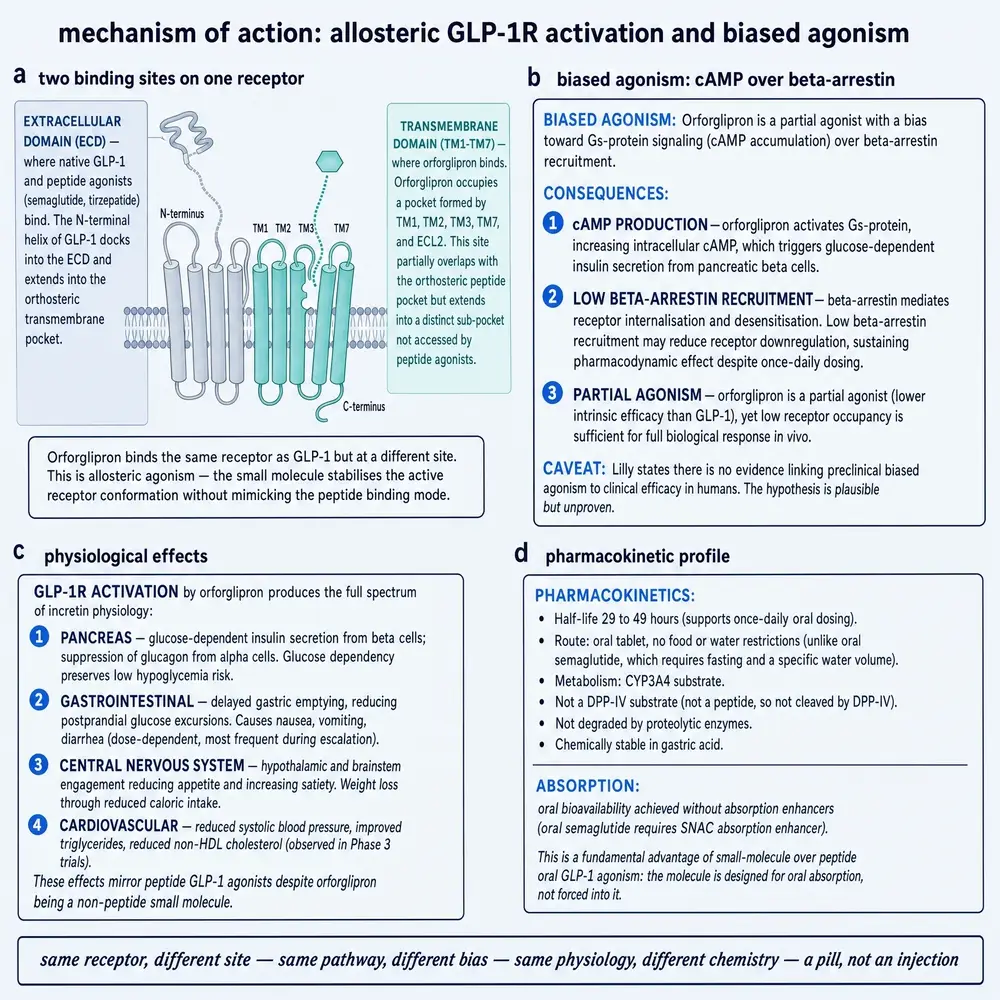
What it showed was not the pocket anyone had been looking for. The compound sits high in the receptor, at the top of the helical bundle, and it makes contact with the extracellular domain, with transmembrane helices 1, 2, 3 and 7, and with the second extracellular loop. It does not touch helices 4, 5 or 6. The peptide, by contrast, engages all of them but helix 4. The two ligands occupy the same general region of the receptor and interact with it in substantially different ways.
The scale of the interaction is the part that makes the achievement legible. The compound buries roughly 250 square Ångströms against the membrane-spanning region. GLP-1 buries 737. The small molecule is doing with a third of the contact area what the peptide does with all of it — and it is doing it at a location where the peptide makes almost no contact at all.
It is worth noting that this is not the only answer the receptor admits. Danuglipron, Pfizer’s oral small molecule, binds in a way that overlaps the peptide’s site much more closely and buries only about ninety square Ångströms. A third non-peptide agonist, TT-OAD2, occupies a pocket different again. Three small molecules, three distinct solutions: the receptor that was supposed to have no small-molecule site turned out to have several, and the reason none of them had been found was not that they were absent but that nobody had a structural reason to look.
08The tryptophan that only primates have
The most consequential finding in the structural paper is not about the binding site as such. It is about a single amino acid, and it explains a fact that had already been observed in the pharmacology and would otherwise have been merely inconvenient: the compound activates the human receptor and does nothing at all to the mouse one.
Position 33 of the receptor’s extracellular domain is a tryptophan in primates. In mice, rats, dogs and most other species it is a serine. In the structure, that tryptophan folds over the compound’s indole–tetrahydropyran arm and forms a lid on top of it, held in place by a hydrogen bond to a threonine in the second extracellular loop, by van der Waals contact with a glutamine in the first, and by the disulfide bridge that staples the two loops together. Serine is a much smaller residue. It cannot make the lid.
What raises this from a plausible story to an established cause is that it was tested in both directions, four separate ways. Swapping the mouse receptor’s extracellular domain for the human sequence made the mouse receptor responsive. The single point mutation, serine to tryptophan, did the same. The reciprocal mutation in the human receptor, tryptophan to serine, abolished activity. And a radioligand competition experiment showed that the human tryptophan is required for the compound to bind at all, not merely to signal once bound (Kawai et al., 2020). A gain of function and a loss of function, at the same residue, agreeing.
The consequence is stated most bluntly not in the scientific literature but on the product label, in the section explaining why the rodent carcinogenicity studies carry no information: orforglipron is not pharmacologically active in rats or mice.
Nearly the whole apparatus of preclinical pharmacology and toxicology is built on rodents. For this compound that apparatus does not apply, and the gap had to be filled deliberately: with cynomolgus monkeys, and with mice genetically engineered to carry the human receptor in place of their own. One such model, made by CRISPR replacement of the murine Glp1r gene with the human orthologue, was characterised and published as recently as 2026 and validated against both a peptide and a small molecule (Sonne et al., 2026) — that is, the tool for studying the drug in a rodent was still being built and published years after the drug had finished phase 3.
This is not an allegation of inadequacy; the regulatory package was evidently judged sufficient. It is a statement about what the word “preclinical” means for this compound, and it should be kept in mind wherever this document reports an animal result.
09Partial agonist, full effect
In cells, orforglipron is a potent but incomplete activator: it stimulates the receptor’s cAMP pathway with what the discovery paper calls partial agonist activity relative to native GLP-1. It also shows no detectable recruitment of β-arrestin, the protein that ordinarily arrives after a receptor is activated and begins the process of switching it off and pulling it inside the cell (Kawai et al., 2020). A drug that activates one arm of a receptor’s signalling and not another is called biased, and there is a long-standing hypothesis — still a hypothesis — that G-protein-biased GLP-1 agonism is therapeutically advantageous.
The structural explanation is specific and satisfying. Full activation of this receptor involves an arginine at the top of helix 7, and both orforglipron and TT-OAD2 leave it unengaged; the helix 6–loop–helix 7 region that arrestin coupling requires is therefore never stabilised. Danuglipron, whose carboxylate group does form an ion pair with that arginine, is correspondingly the fuller agonist. The bias is not an accident of the molecule; it is a consequence of which contact it does not make.
Several reviews in this document’s corpus describe orforglipron as a full agonist, in flat contradiction of the primary pharmacology. The disagreement is real, and it is more instructive than either claim taken alone.
It resolves because partial agonism is not a fixed property of a molecule. It is a property of a molecule measured in a particular system. Orforglipron behaves as a full agonist for cAMP where receptor density is high, and as a partial one where receptor expression is limiting. Both literatures are reporting real measurements, and the reviews describing full agonism are describing high-density conditions without saying so. The practical lesson is one this document applies throughout: an efficacy figure without its assay conditions attached is not yet a fact.
That leaves a genuine puzzle, which the discovery paper poses and answers with a proposal rather than a measurement. In humanised-receptor mice, an oral dose of the compound lowered glucose as effectively as exenatide — a full peptide agonist — and produced no effect at all in mice lacking the receptor, confirming the effect is on-target. How does a partial agonist match a full one in a living animal? The paper proposes substantial receptor reserve: that the system carries far more receptors than a maximal response requires, so a weaker agonist occupying more of them arrives at the same place. This is a reasonable and conventional explanation. It is also, in the corpus this document read, never actually measured for this compound — no receptor-occupancy value for orforglipron appears anywhere in it. It should be read as the field’s working account rather than as a demonstrated mechanism.
The animal pharmacokinetics pointed the same way as the pharmacology. After oral dosing the elimination half-life was 10.4 to 12.4 hours in rats (n = 4) and 3.4 to 4.6 hours in cynomolgus monkeys (n = 4), with oral bioavailability of 33 to 43 per cent and 21 to 28 per cent respectively (Kawai et al., 2020). Set those beside the under-one-per-cent figure for the oral peptide and the difference is not incremental. It is a difference in kind, and it is the difference the next part of this document is about.
10What orforglipron actually is
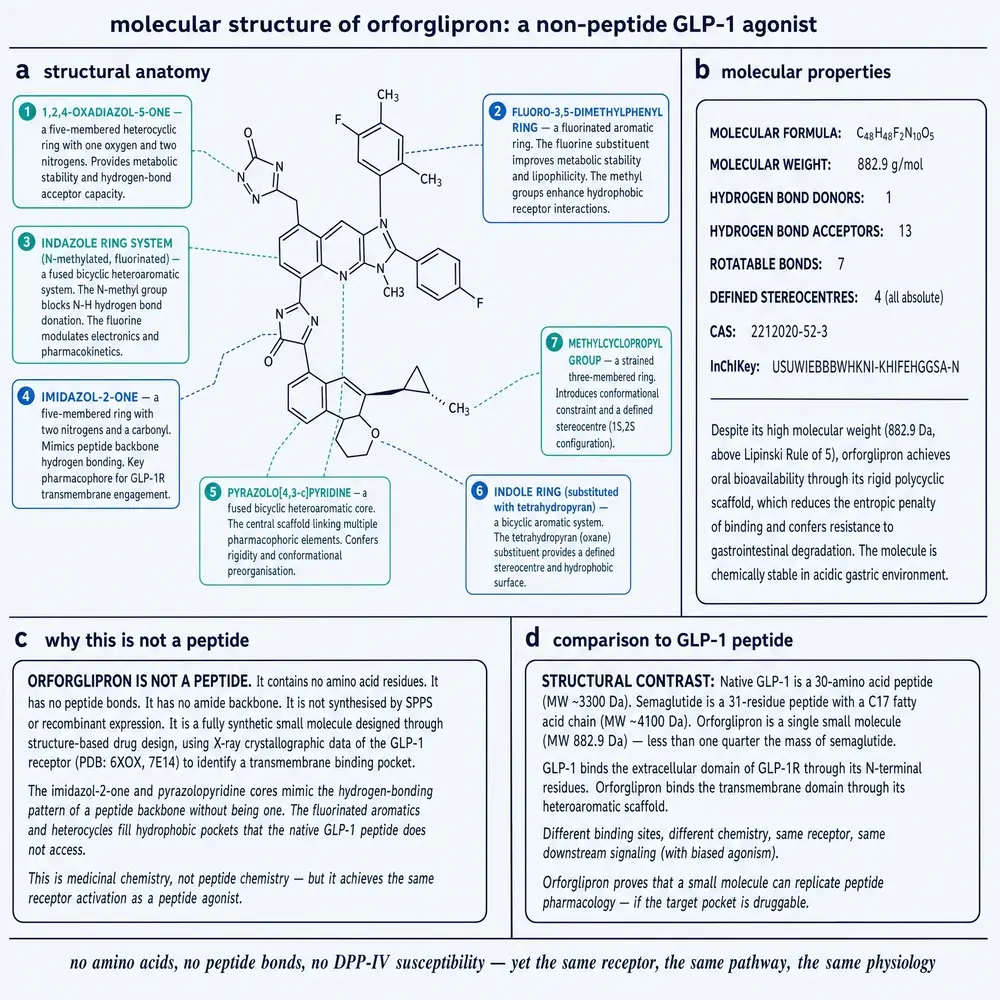
It is worth pausing on the object itself, because a good deal of confused writing about this compound comes from placing it in the wrong chemical family. Orforglipron is not a peptide, not a peptidomimetic, and not a modified version of anything biological. Its formula is C48H48F2N10O5 and its molecular weight is 883.
Structurally it is built on an indole, N-substituted and bearing a carboxamide that links it to a partially saturated pyrazolo[4,3-c]pyridine — the fragment that gives the Chugai patent its title. Hanging from that framework are a fluorinated methylindazole, a cyclic urea, a dimethyl-substituted tetrahydropyran, a methylcyclopropyl group and an oxadiazolone ring that serves as a stand-in for a carboxylic acid. There are four defined stereocentres. The material used in trials and sold as a tablet is the calcium salt, in which two molecules of the drug are paired with one calcium ion.
Two of these fragments matter beyond bookkeeping. The indole and the tetrahydropyran form the arm that sits under the tryptophan lid described in section 08 — the branch whose contact with a primate-specific residue decides whether the compound works at all. And the oxadiazolone is worth noting for what it is not: it is an acid mimic rather than an acid, and its counterpart in danuglipron — a genuine carboxylate — is the group that reaches the arginine at the top of helix 7 and makes that compound the fuller agonist. Two molecules in the same class, differing in how they terminate one arm, and differing in their signalling as a result.
11Beyond the rule of five
There is a rule of thumb, four decades old and named after Christopher Lipinski, that summarises what oral drugs have historically looked like: under five hundred daltons, not too greasy, not too many hydrogen-bonding groups. Orforglipron breaks it comfortably. At 883 daltons it is nearly twice the weight limit. Its computed lipophilicity is around 6.8 against a nominal ceiling of five. Its polar surface area, 144 square Ångströms, sits just above the figure usually quoted as the boundary for good oral absorption.
The rule was never a law, and Lipinski framed it as a description of what had historically been absorbed rather than a prescription for what could be. Its practical use was as a filter in the era when screening libraries were being assembled, and the compounds it filtered out were, for the most part, correctly filtered out. What has changed since is the kind of target that industry is willing to attempt. Interfaces between proteins, and receptors like this one that evolved to recognise something large, do not offer the neat enclosed cavity that a five-hundred-dalton molecule can fill. Reaching them at all requires a bigger molecule, and the question then becomes which of the rule’s criteria can be broken without losing oral absorption.
And it is absorbed extremely well. The temptation is to treat this as a paradox, or as evidence that the rules were always nonsense. It is neither. Look at which criteria it does not break. The molecule has exactly one hydrogen-bond donor. It has seven rotatable bonds across sixty-five heavy atoms, which for a molecule of that size is remarkably rigid. Hydrogen-bond donors are expensive to strip of their water when a molecule crosses a lipid membrane, and flexibility costs entropy on binding and on permeation. On the properties that most directly govern getting through a cell membrane, orforglipron is unusually well behaved; it is large and greasy in ways that turn out to matter less.
This pattern — large, rigid, few donors, orally absorbed — is common enough in modern medicinal chemistry to have a name, “beyond the rule of five”, and the compounds in it tend to be ones aimed at targets that small conventional molecules cannot reach. That is exactly the situation here. The explanation offered in this paragraph is the field’s standard account of why such molecules work and it is consistent with the measured properties; it is not a measurement of this compound’s permeability mechanism, and no such measurement appears in the corpus this document read.
12What a pill without an enhancer looks like
The number that settles the argument came from a study in which volunteers received orforglipron labelled with carbon-14, so that the fate of the dose could be followed directly. The arithmetic mean absolute oral bioavailability — the actual fraction of a swallowed dose reaching the bloodstream, measured against an intravenous reference — was 79.1 per cent. Recovery of radioactivity was 87 per cent in the faeces and 0.2 per cent in urine, and the estimated availability across the gut wall was about 0.88 (Morse et al., 2026). It should be said plainly that this document reads that figure at one remove: the disposition study itself is not in the reading corpus, and the value is quoted here from the drug-interaction paper that reports and relies on it.
Set that beside the 0.4–1 per cent of oral semaglutide and the comparison is not a matter of degree. Roughly four-fifths of one dose arrives; roughly one part in a hundred and fifty of the other does. Everything that follows from the difference — the absence of a fasting window, the tolerance of food, the smaller variability between people, the smaller quantity of drug substance needed per patient — is downstream of that single measurement.
The rest of the pharmacokinetic picture is unglamorous and, for a once-daily tablet, exactly what one would want. Clearance is low, at 7.7 to 15.8 litres per hour. The half-life is long — reported across single and multiple doses as 24.6 to 67.5 hours — which is comfortably supportive of daily dosing and means concentrations accumulate to a steady state rather than swinging. Median time to peak concentration is around six to eight hours, so the compound is absorbed steadily rather than in a spike.
“No food restriction” does not mean food has no effect. Taking the drug with food lowered the area under the concentration curve and the peak concentration by roughly 18 to 24 per cent, while leaving the time to peak and the half-life unchanged (Ma et al., 2024). That is a real effect and a small one, and it is small in a way that matters: because the shape of the curve does not change, the consequence is a modest shift in exposure rather than a different drug. For oral semaglutide the corresponding effect is not modest — taken with food, absorption approaches zero. The difference between managing a food effect with a patient instruction and ignoring it is the difference between these two numbers.
Two interactions are worth reporting because they are large and because they tell you how the compound is cleared. Given with clarithromycin, a strong inhibitor of the enzyme CYP3A4, exposure rose 3.54-fold. Given with carbamazepine, which induces the same enzyme, exposure fell by about 82 per cent (Morse et al., 2026). Laboratory work had suggested the metabolic load was split roughly evenly between CYP3A4 and CYP2J2; the clinical studies imply CYP3A4 carries appreciably more of it. In the other direction the compound is well behaved: it does not meaningfully alter the handling of the enzyme and transporter substrates that were tested alongside it.
That asymmetry — strongly affected by other drugs, barely affecting them — is a normal profile for a small molecule and a notable contrast with the peptide agonists, whose principal interaction concern is mechanical rather than metabolic: by slowing gastric emptying they change the absorption of whatever is swallowed alongside them.
13Phase 2
Two dose-ranging trials reported in 2023, one in each indication. In type 2 diabetes, orforglipron was compared against placebo and against injected dulaglutide over 26 weeks in 383 participants (Frias et al., 2023). In obesity, it was compared against placebo over 36 weeks in 272 participants without diabetes (Wharton et al., 2023). Both showed dose-dependent reductions in glycated haemoglobin and in body weight, both established the doses that phase 3 would carry forward, and both showed the gastrointestinal side-effect pattern that the class has had since exenatide.
What made them consequential was not the size of the effect but the fact of it: an orally administered non-peptide had produced the class effect in people. Everything after this point is a question of how much, at what cost in tolerability, and against which comparator.
14ACHIEVE: the diabetes programme
The phase 3 diabetes trials are named ACHIEVE and there are seven registered, five of which had reported when this document was compiled. They are arranged as a ladder of comparators, which is how a modern diabetes programme establishes where a drug belongs in a treatment sequence.
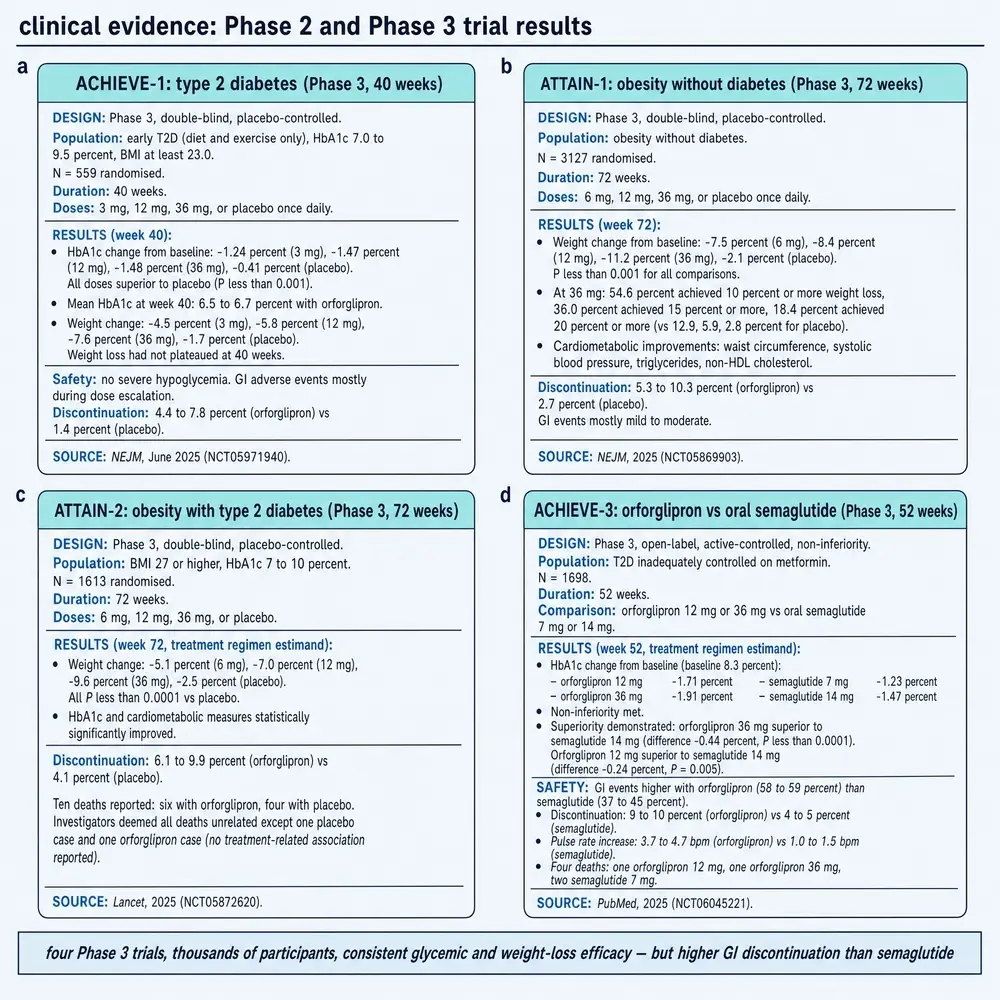
ACHIEVE-1 tested the drug against placebo in 559 people with early type 2 diabetes managed on diet and exercise alone, over 40 weeks (Rosenstock et al., 2025). From a baseline glycated haemoglobin of about 8.0 per cent, the reductions were 1.3 percentage points at 3 mg, 1.6 at 12 mg and 1.5 at 36 mg, against 0.1 on placebo. Between roughly 73 and 76 per cent of those on the drug reached a glycated haemoglobin below 7 per cent, against about 28 per cent on placebo. Body weight fell by 7.9 per cent at the highest dose.
ACHIEVE-2 compared it against dapagliflozin, and ACHIEVE-5 against placebo in people already on insulin — the population in which the relevant safety question is hypoglycaemia, and in which the trial reported no increase in risk. ACHIEVE-4, the largest and longest, compared the drug against insulin glargine in 2,749 people with diabetes and cardiovascular risk, with a primary endpoint of time to a first major adverse cardiovascular event.
ACHIEVE-4’s cardiovascular results are not in this document’s reading corpus. The registry supplies the design, the population and the endpoint definitions, and those are reported above. The hazard ratios have been announced publicly, but the paper reporting them is not among the documents this monograph read in full, and the registry has not posted results for that trial. Section 17 says what can and cannot be concluded from that position.
15ACHIEVE-3: the comparison the programme was built for
Of all the trials in the programme, one is the point. ACHIEVE-3 put orforglipron head to head against oral semaglutide — the only other GLP-1 receptor agonist that comes as a tablet — in 1,698 people over 52 weeks (Rosenstock et al., 2026). Everything in Part One about fasting windows and one-per-cent absorption was, in the end, an argument about whether the small molecule would beat the peptide on the peptide’s own oral ground.
It did. On glycated haemoglobin the differences favoured orforglipron by roughly 0.44 to 0.68 percentage points depending on the dose pair compared, with a substantially larger effect on body weight. Two cautions belong in the same breath. The trial was open-label, which is usual when comparing agents with different dosing requirements and is nonetheless a design that cannot exclude expectation effects on endpoints influenced by behaviour, of which body weight is one. And this document read those comparative figures in a review rather than in the trial report itself — the primary paper is not in its corpus.
16ATTAIN, and the day the share price fell
The obesity programme is named ATTAIN. ATTAIN-1 randomised 3,127 adults with obesity, or with overweight plus a weight-related condition and without diabetes, to three doses or placebo for 72 weeks (Wharton et al., 2025). ATTAIN-2 ran the same design in 1,613 people who also had type 2 diabetes, where weight loss is characteristically smaller, and reported about 10.5 per cent at the highest dose (Horn et al., 2026).
Before the numbers, a word about how they are reported, because this trial is the clearest illustration in the document of a distinction that is easy to miss and easy to exploit. A modern trial protocol specifies not one estimate of effect but several, called estimands, each defined by how it treats the people who stop taking the drug or start taking something else. The two that matter here point in predictable directions: an analysis restricted to those still on treatment will always flatter a drug relative to one that counts everybody randomised, because the people who stop are disproportionately those it did not suit. Neither is dishonest. Reporting one without saying which it is, and then comparing it to a rival’s other one, is.
ATTAIN-1’s headline is worth handling carefully, because it is reported in two different ways and both are correct. Under the efficacy estimand — which estimates what the drug does in people who take it as directed — weight fell 12.4 per cent at the highest dose against 0.9 per cent on placebo. Under the treatment-regimen estimand — which counts everyone randomised, including those who stopped — the figures are 11.2 and 2.1. These are not competing claims about one quantity; they are answers to two different questions, and a document that quotes one without saying which invites a comparison it cannot support.
On 7 August 2025, the day ATTAIN-1’s topline results were announced, Eli Lilly’s share price fell about 14 per cent — its worst single day in roughly a quarter of a century. The trial had met its primary endpoint. Nothing had failed. Analysts had modelled something closer to 15 per cent weight loss, and the delivered figure was around twelve.
It is tempting to file that under market irrationality, and it is more useful to read it as information about what the compound is for. A drug is not judged against placebo once a class already exists; it is judged against the best member of that class. Tirzepatide had reached about 22.5 per cent in its own phase 3 programme. Against that number, twelve per cent in a tablet is a different kind of proposition: not the most effective option, but the most administrable one. The market spent a day deciding which of those it had been promised.
17Beyond glucose and weight
The registered programme extends well past the two indications that produced the approval — fifty studies in all, of which twenty-five are phase 3. Trials are running or registered in obstructive sleep apnoea, hypertension, knee osteoarthritis, peripheral artery disease, female stress urinary incontinence, and in adolescents and children. A dedicated cardiovascular and kidney outcomes trial in more than seven thousand participants with established atherosclerotic disease or chronic kidney disease is enrolling, with primary completion scheduled for 2031.
Two observations about that list. The first is that its breadth is a statement of belief rather than of evidence: registration establishes that a question is being asked, not that it has been answered, and most of these studies have not reported. The second is a conspicuous absence. There is no registered orforglipron trial in metabolic dysfunction-associated steatohepatitis — the fatty-liver indication that most of the incretin field has moved into. Given what happened to the two compounds in section 19, the absence is at least interesting.
What the outcomes trial is for is worth stating plainly, because it is the single largest open question about this drug. The injectable agonists earned their place in cardiovascular medicine by demonstrating reductions in heart attacks, strokes and deaths in dedicated outcome trials, over years. Orforglipron has demonstrated improvements in the things that predict those events — weight, glycated haemoglobin, blood pressure, lipids (Wharton et al., 2025) — and has a cardiovascular safety trial completed against insulin. It has not yet demonstrated that it prevents the events themselves. Until 2031 or thereabouts, that claim belongs to the injectables and not to the tablet.
18The gastrointestinal tax
Every drug in this class makes a substantial minority of the people who take it feel sick, and orforglipron is no exception. In ATTAIN-1, at the highest dose over 72 weeks, nausea affected 33.7 per cent against 10.4 on placebo, constipation 25.4 against 9.3, vomiting 24.0 against 3.5, diarrhoea 23.1 against 9.6 and dyspepsia 14.1 against 5.0. The pattern is dose-related and it is front-loaded: these effects cluster during dose escalation and diminish with continued treatment, which is why the trials titrate.
The number that matters most is the last one, because it is the one that converts a side effect into a clinical fact. Discontinuation for adverse events rose from 5.1 per cent at the lowest dose to 10.3 per cent at the highest, against 2.6 per cent on placebo. Roughly one person in ten stopped the most effective dose because of how it made them feel. Any statement about what this drug achieves has to carry that alongside it.
Whether it is worse than the injectables is a question the evidence does not settle. In a network meta-analysis pooling several agents, orforglipron ranked highest for nausea — but the confidence interval around that estimate overlapped every injectable comparator, which means the ranking is not a separation. Two further cautions. There is no head-to-head trial against injectable semaglutide or tirzepatide on tolerability. And an increase in resting heart rate of around seven beats per minute has been reported, drawn from a single phase 2 trial; it is consistent with the class and it deserves confirmation in a larger dataset rather than repetition.
Two published papers in the reading corpus report gastrointestinal results that contradict their own underlying data, in one case describing nausea, vomiting and serious adverse events as less frequent on drug than on placebo — a reversal contradicted by every other source and by the trial reports those papers cite. They are named in the evidence dossier and their safety figures are not used anywhere in this monograph. Both remain uncorrected in the literature.
19The liver, and the two compounds that did not make it
This is the most important safety question about the class, and the common version of the story is wrong in a way worth correcting. The usual telling is that Pfizer lost two oral GLP-1 agonists to liver toxicity and that orforglipron survived. The two failures were not the same failure.
Lotiglipron had a real, reproducible and substantial signal. Transaminases above three times the upper limit of normal occurred in 6.6 per cent of participants in a diabetes trial and 6.0 per cent in an obesity trial, against 1.6 per cent on placebo, with values above eight times the limit in 1.8 per cent. There were no cases meeting Hy’s law — the combination of enzyme rise and jaundice that predicts serious outcomes — and no rise in bilirubin. Pfizer stopped the programme in June 2023. Notably, no patient characteristic identified who was at risk; the only thing that distinguished affected participants was drug exposure.
Danuglipron is a different case. Its own phase 2b trial found no participant with alanine transaminase above five times the limit, and Pfizer described the enzyme changes as in line with approved agents in the class. What ended it, in April 2025, was a single asymptomatic case of possible drug-induced liver injury in a later study, which resolved on stopping — together, the company said, with the totality of the data and regulatory input. The trial registry, it is worth noting, records no safety reason at all for danuglipron: it states only that the sponsor decided to discontinue. The liver attribution comes from the sponsor’s own announcement, and this document reports it as such.
Against that background, orforglipron’s hepatic data are reassuring and bounded. A pooled analysis across five randomised trials and roughly three thousand participants found hepatic adverse events no different from placebo at any dose; alanine transaminase actually fell on treatment, by about 11 units per litre at one dose; alkaline phosphatase and aspartate transaminase were unchanged (Wharton et al., 2026). No Hy’s law cases occurred.
The trials excluded people with advanced liver disease and with raised baseline enzymes, and liver chemistry was monitored to week 26. The pooled analysis says so, and it states in its own words that rare idiosyncratic liver injury cannot be excluded. Three thousand participants is enough to exclude a lotiglipron-sized signal comfortably; it is not enough to exclude an event occurring once in several thousand exposures, which is the frequency at which idiosyncratic hepatotoxicity characteristically appears and the reason such findings usually emerge after marketing rather than before it.
There is a plausible mechanistic reason the compounds might differ. Lotiglipron’s proposed failure mode was inhibition of its own clearance, producing exposure outliers — and exposure was the only thing that distinguished affected patients. Orforglipron has been characterised across six drug-interaction studies as a substrate of CYP3A4 and of hepatic transporters that does not itself meaningfully inhibit or induce them (Morse et al., 2026), and its exposure–response analyses show no relationship between exposure and liver enzymes. That is a coherent account of why one compound behaved differently from another. No source in this corpus actually draws the comparison, and it is offered here as a testable hypothesis rather than an established explanation.
20What is not known
A monograph that reports only what has been shown is only half a document. The following are open, and several of them are open in ways that a reader deciding what to think about this compound should weigh.
Duration. The longest exposures reported are around two years. This is a drug for chronic conditions, intended for indefinite use.
What happens on stopping. The weight-maintenance trial addresses the adjacent question — whether the drug holds weight lost on an injectable — rather than what happens after orforglipron itself is withdrawn. For the class as a whole, weight is substantially regained.
Body composition. How much of the weight lost is fat and how much is lean tissue is a live question for the entire class, and the mechanistic study that addresses it for this compound had not reported.
Outcomes. Whether the drug prevents cardiovascular and kidney events, as opposed to improving the measurements that predict them. Answer expected around 2031.
The preclinical asymmetry. Running underneath all of the above is the fact established in section 08: this compound does nothing in a rat or a mouse. The toxicology that ordinarily underwrites a new medicine’s long-term safety, and specifically the rodent carcinogenicity studies that support the class’s thyroid warning, cannot speak about this molecule’s pharmacology at all. The label states as much. The regulatory package was evidently judged sufficient, and it was assembled from primates and from engineered mice; that is a narrower base than the word usually implies, and it is a fact about this drug rather than a criticism of it.
21Approval, and what a pill changes
On 1 April 2026 the United States Food and Drug Administration approved orforglipron under the brand name Foundayo, indicated — in the label’s own words — in combination with a reduced-calorie diet and increased physical activity to reduce excess body weight and maintain weight reduction long term in adults with obesity, or adults with overweight in the presence of at least one weight-related comorbid condition. It carries the class boxed warning for thyroid C-cell tumours, alongside the statement that the compound is not pharmacologically active in rats or mice and produced no rodent tumours. A submission for type 2 diabetes followed in the second quarter of 2026 and was under review when this document was compiled.
The approval was itself unusual. Orforglipron was the first new molecular entity cleared under the FDA Commissioner’s National Priority Voucher pilot, and it was approved roughly fifty days after filing — the better part of a year ahead of its scheduled decision date. Supply-chain resilience is a stated priority of that programme, which is a useful clue to how the regulator was thinking about the compound.
Because the argument for a pill was never only about convenience. Peptide manufacture is a specialised business, and during the GLP-1 boom it was genuinely rate-limiting: shortages, rationing, compounded substitutes. The World Health Organization’s estimate is that current production capacity covers under ten per cent of global obesity even in favourable scenarios. A small molecule made by conventional synthesis, needing no cold chain and no needle, is a different industrial proposition.
That last paragraph is the argument this compound exists to make, and this document’s corpus does not contain the evidence for its economic half. No source read here compares the cost of goods for a peptide against a small molecule; the words that would appear in such an analysis do not appear in an economic context anywhere in the corpus. The capacity shortfall, the shortages and the cold-chain requirement are all sourced. The inference that a small molecule fixes them is reasonable, widely repeated, and as far as this reading goes, unevidenced.
And there is a result pointing the other way that deserves to be quoted rather than buried. In the best real-world test available — persistence on oral versus injectable semaglutide — patients stayed on the injectable longer. Whatever a tablet does for access, the assumption that oral administration automatically improves adherence has been tested once in this class and did not survive.
What can be said with confidence is narrower and still substantial. A receptor that the structural literature had good reason to consider closed to small molecules turned out to have a door in an unexpected place. A compound found by an old-fashioned screen, in a company that then handed it to someone else to develop, went through that door. It works in people because of an amino acid that people have and mice do not, which is why the animals in which it could be studied had to be made. And the result is a tablet that reaches four fifths of its dose into the blood, taken with or without food, which does rather less than the best injection and asks rather less of the person taking it.
This monograph describes published research. It does not recommend human use of orforglipron or of any related compound, and it specifies no dose, route or schedule for any person. The doses reported in it are parameters of registered clinical trials, and the tablet strengths are facts about an approved label; both are given with the population and duration attached. Nothing in this document is medical advice, and the decision to use or not use an approved medicine belongs to a patient and their clinician.
Section 22References
Every entry below was resolved against the National Library of Medicine's records during this build and read back against its author, journal, year and title line. None was written from recall. The build refuses to run if any identifier fails to resolve.
- Abdelrahman RM, Musa TH, Arbab IA, Suliman MH, Ahmed EO, Mohamed AN, et al.. Harnessing GLP-1 Receptor Agonists for Obesity Treatment: Prospects and Obstacles on the Horizon. J Obes. 2025;2025:9919810.
PMID 41333115 · doi:10.1155/jobe/9919810 · PMC12668848 - Amin NB, Frederich R, Tsamandouras N, Haggag AZ, Schuster T, Zmuda W, et al.. Evaluation of an oral small-molecule glucagon-like peptide-1 receptor agonist, lotiglipron, for type 2 diabetes and obesity: A dose-ranging, phase 2, randomized, placebo-controlled study. Diabetes Obes Metab. 2025;27(1):215-227.
PMID 39415344 · doi:10.1111/dom.16005 · PMC11618248 - Bhattarai HB, Paudel BS, Parajuli SR, Dahal K, Shah S, Bhattarai M, et al.. Gastrointestinal side effects of the non-peptide GLP-1 receptor agonists: A systematic review and meta-analysis. Medicine (Baltimore). 2025;104(52):e46671.
PMID 41465949 · doi:10.1097/MD.0000000000046671 · PMC12746972 - Buckeridge C, Cobain S, Bays HE, Matsuoka O, Fukushima Y, Halstead P, et al.. Efficacy and safety of danuglipron (PF-06882961) in adults with obesity: A randomized, placebo-controlled, dose-ranging phase 2b study. Diabetes Obes Metab. 2025;27(9):4915-4926.
PMID 40539310 · doi:10.1111/dom.16534 · PMC12326921 - Frias JP, Hsia S, Eyde S, Liu R, Ma X, Konig M, et al.. Efficacy and safety of oral orforglipron in patients with type 2 diabetes: a multicentre, randomised, dose-response, phase 2 study. Lancet. 2023;402(10400):472-483.
PMID 37369232 · doi:10.1016/S0140-6736(23)01302-8 - Gogineni P, Melson E, Papamargaritis D, Davies M. Oral glucagon-like peptide-1 receptor agonists and combinations of entero-pancreatic hormones as treatments for adults with type 2 diabetes: where are we now?. Expert Opin Pharmacother. 2024;25(7):801-818.
PMID 38753454 · doi:10.1080/14656566.2024.2356254 · PMC11195668 - Hageen AW, Gadelmawla AF, Saleh AO, Abdallfatah A, Mohamed MR, El-Nemr AF, et al.. The Gastrointestinal Safety of Orforglipron, a GLP-1 Receptor Agonist, in Adults With or Without Type 2 Diabetes: A Network Meta-Analysis of Randomized Controlled Trials. Endocrinol Diabetes Metab. 2026;9(3):e70222.
PMID 42116665 · doi:10.1002/edm2.70222 · PMC13161550 - Horn DB, Ryan DH, Kis SG, Alves B, Mu Y, Kim SG, et al.. Orforglipron, an oral small-molecule GLP-1 receptor agonist, for the treatment of obesity in people with type 2 diabetes (ATTAIN-2): a phase 3, double-blind, randomised, multicentre, placebo-controlled trial. Lancet. 2026;406(10522):2927-2944.
PMID 41275875 · doi:10.1016/S0140-6736(25)02165-8 - Kawai T, Sun B, Yoshino H, Feng D, Suzuki Y, Fukazawa M, et al.. Structural basis for GLP-1 receptor activation by LY3502970, an orally active nonpeptide agonist. Proc Natl Acad Sci U S A. 2020;117(47):29959-29967.
PMID 33177239 · doi:10.1073/pnas.2014879117 · PMC7703558 - Lempesis IG, Dalamaga M. Obesity pharmacotherapy reimagined: The era of multi-receptor agonists and next-generation metabolic modulators, perspectives and controversies. Metabol Open. 2026;30:100463.
PMID 41948476 · doi:10.1016/j.metop.2026.100463 · PMC13051938 - Lütkemeyer C, Pasqualotto E, Ferreira ROM, Chavez MP, Petris I, Dos Santos HV, et al.. Effects of once-daily oral orforglipron on weight and metabolic markers: a systematic review and meta-analysis of randomized controlled trials. Arch Endocrinol Metab. 2024;68:e230469.
PMID 39420937 · doi:10.20945/2359-4292-2023-0469 · PMC11460968 - Ma X, Liu R, Pratt EJ, Benson CT, Bhattachar SN, Sloop KW. Effect of Food Consumption on the Pharmacokinetics, Safety, and Tolerability of Once-Daily Orally Administered Orforglipron (LY3502970), a Non-peptide GLP-1 Receptor Agonist. Diabetes Ther. 2024;15(4):819-832.
PMID 38402332 · doi:10.1007/s13300-024-01554-1 · PMC10951152 - Ma X, Li YG, Raha S, Sperry DC, Coutant DE, Bhattachar S. Pharmacokinetic Bioequivalence of Orforglipron Tablets and Capsules in Healthy Participants With Obesity or Overweight. Diabetes Obes Metab. 2026;28(7):5803-5809.
PMID 41994902 · doi:10.1111/dom.70783 · PMC13243956 - Min JS, Jo SJ, Lee S, Kim DY, Kim DH, Lee CB, et al.. A Comprehensive Review on the Pharmacokinetics and Drug-Drug Interactions of Approved GLP-1 Receptor Agonists and a Dual GLP-1/GIP Receptor Agonist. Drug Des Devel Ther. 2025;19:3509-3537.
PMID 40330819 · doi:10.2147/DDDT.S506957 · PMC12052016 - Morse BL, Coutant DE, Ma X, Raha S, Aithal K, Nicoll C, et al.. Clinical Characterization of Enzyme and Transporter Precipitants to Evaluate Drug-Drug Interactions for Orforglipron, a Small Molecule Glucagon-Like Peptide-1 Receptor Agonist. Clin Pharmacol Ther. 2026.
PMID 42399716 · doi:10.1002/cpt.70377 · PMC13337131 - Niazi SK. Oral delivery of peptides and proteins: pharmacokinetic boundaries, negative selection, and route triage. Front Drug Deliv. 2026;6:1776167.
PMID 41939723 · doi:10.3389/fddev.2026.1776167 · PMC13047097 - Patel D. Small-Molecule Oral Versus Injectable Glucagon-Like Peptide-1 (GLP-1) Receptor Agonists: Comparative Efficacy, Safety, and Future Clinical Perspectives. Cureus. 2026;18(4):e107202.
PMID 42153087 · doi:10.7759/cureus.107202 · PMC13180026 - Pratt E, Ma X, Liu R, Robins D, Haupt A, Coskun T, et al.. Orforglipron (LY3502970), a novel, oral non-peptide glucagon-like peptide-1 receptor agonist: A Phase 1a, blinded, placebo-controlled, randomized, single- and multiple-ascending-dose study in healthy participants. Diabetes Obes Metab. 2023;25(9):2634-2641.
PMID 37344954 · doi:10.1111/dom.15184 - Pratt E, Ma X, Liu R, Robins D, Coskun T, Sloop KW, et al.. Orforglipron (LY3502970), a novel, oral non-peptide glucagon-like peptide-1 receptor agonist: A Phase 1b, multicentre, blinded, placebo-controlled, randomized, multiple-ascending-dose study in people with type 2 diabetes. Diabetes Obes Metab. 2023;25(9):2642-2649.
PMID 37264711 · doi:10.1111/dom.15150 - Rosenstock J, Hsia S, Nevarez Ruiz L, Eyde S, Cox D, Wu WS, et al.. Orforglipron, an Oral Small-Molecule GLP-1 Receptor Agonist, in Early Type 2 Diabetes. N Engl J Med. 2025;393(11):1065-1076.
PMID 40544435 · doi:10.1056/NEJMoa2505669 - Rosenstock J, Yabe D, Cox D, Li J, Denning M, Wu WS, et al.. Efficacy and safety of once-daily oral orforglipron compared with oral semaglutide in adults with type 2 diabetes (ACHIEVE-3): a multinational, multicentre, non-inferiority, open-label, randomised, phase 3 trial. Lancet. 2026;407(10534):1147-1160.
PMID 41765029 · doi:10.1016/S0140-6736(26)00202-3 - Santulli G. From needles to pills: oral GLP-1 therapy enters the obesity arena. Cardiovasc Diabetol Endocrinol Rep. 2025;11(1):31.
PMID 41053816 · doi:10.1186/s40842-025-00245-5 · PMC12498447 - Schnell O, Agarwal A, Azizi M, Ballwieser D, Barnard-Kelly K, Battelino T, et al.. CVOT Summit Report 2025: advances along the cardiovascular-kidney-metabolic disease continuum. Cardiovasc Diabetol. 2026;25(1).
PMID 42092956 · doi:10.1186/s12933-026-03140-0 · PMC13147710 - Sloop KW, Cox AL, Wainscott DB, White A, Droz BA, Stutsman C, et al.. The pharmacological basis for nonpeptide agonism of the GLP-1 receptor by orforglipron. Sci Transl Med. 2024;16(778):eadp5765.
PMID 39693407 · doi:10.1126/scitranslmed.adp5765 - Sonne N, Roque M, Zachariassen LF, Porsgaard T, Pors SE, Cavalera M, et al.. Generation and characterisation of a humanised GLP-1 receptor mouse model for translational drug development. EBioMedicine. 2026;124:106121.
PMID 41547115 · doi:10.1016/j.ebiom.2026.106121 · PMC12855590 - Welch M, Forst T, Jia W, Del Pino PO, Denning M, Wu WS, et al.. Orforglipron compared with dapagliflozin in adults with type 2 diabetes and inadequate glycaemic control with metformin (ACHIEVE-2): a multicentre, randomised, non-inferiority, open-label, phase 3 trial. Lancet. 2026;408(10550):125-140.
PMID 42259339 · doi:10.1016/S0140-6736(26)00800-7 - Wharton S, Blevins T, Connery L, Rosenstock J, Raha S, Liu R, et al.. Daily Oral GLP-1 Receptor Agonist Orforglipron for Adults with Obesity. N Engl J Med. 2023;389(10):877-888.
PMID 37351564 · doi:10.1056/NEJMoa2302392 - Wharton S, Aronne LJ, Stefanski A, Alfaris NF, Ciudin A, Yokote K, et al.. Orforglipron, an Oral Small-Molecule GLP-1 Receptor Agonist for Obesity Treatment. N Engl J Med. 2025;393(18):1796-1806.
PMID 40960239 · doi:10.1056/NEJMoa2511774 - Wharton S, Rosenstock J, Konige M, Lin Y, Duffin K, Wilson J, et al.. Treatment with orforglipron, an oral glucagon like peptide-1 receptor agonist, is associated with improvements of CV risk biomarkers in participants with type 2 diabetes or obesity without diabetes. Cardiovasc Diabetol. 2025;24(1):240.
PMID 40481478 · doi:10.1186/s12933-025-02781-x · PMC12142847 - Wharton S, Stefanski A, Chen J, Rao G, Twum EA, Denning M. Hepatic Safety of Orforglipron in Adults With Obesity or Overweight and/or Type 2 Diabetes: A Pooled Analysis of the Orforglipron Phase 3 Clinical Trials. Diabetes Obes Metab. 2026.
PMID 42338042 · doi:10.1111/dom.71032 - Zhou J, Wang F, Li S. The efficacy and safety of danuglipron and orforglipron in patients with type 2 diabetes and obesity: a systematic review and meta-analysis. Front Endocrinol (Lausanne). 2025;16:1646956.
PMID 41450584 · doi:10.3389/fendo.2025.1646956 · PMC12727569
Sources with no PubMed record. Structural, chemical, regulatory and registry material is listed separately so that the numbered list above stays wholly machine-verified.
- PubChem, National Library of Medicine. Orforglipron, compound summary, CID 137319706; and orforglipron calcium, CID 167713250. Molecular formula, molecular weight, computed physicochemical properties, InChIKey, CAS number and synonyms quoted in Sections 10 and 11 were retrieved from these records during the preparation of this document. The calcium salt record supplies the 2:1 stoichiometry..
https://pubchem.ncbi.nlm.nih.gov/compound/137319706 - Protein Data Bank. Cryo-EM structure of the human GLP-1 receptor bound to the non-peptide agonist LY3502970, entry 6XOX. Deposited with the paper cited as Kawai et al. 2020, together with Electron Microscopy Data Bank entry EMD-22283. The contacts and buried-surface values quoted in Section 07 are as published in that paper and are not recomputed here..
https://www.rcsb.org/structure/6XOX - United States National Library of Medicine. ClinicalTrials.gov registry records for orforglipron and LY3502970. The trial counts, phases, populations, comparators, enrolment figures, endpoint wording and study statuses in Sections 14, 15, 16 and 17 were read from the registry itself rather than from a summary of it, as house style section 10.8 requires. The registry is also the source for the statement that no orforglipron study has been terminated, withdrawn or suspended, and that none is registered in metabolic liver disease..
https://clinicaltrials.gov/ - United States Food and Drug Administration. FOUNDAYO (orforglipron) tablets, prescribing information; and the Commissioner's National Priority Voucher announcement of 1 April 2026. The approved indication is quoted verbatim in Section 21 from the label. The label is also the source for the boxed warning, the tablet strengths, and the statement that orforglipron is not pharmacologically active in rats or mice - which is quoted in Sections 08 and 20 because no paper in the corpus states it as plainly..
https://dailymed.nlm.nih.gov/dailymed/ - Chugai Pharmaceutical Co., Ltd.. Announcement of a license agreement with Eli Lilly and Company for OWL833, 27 September 2018. Source of the fifty-million-dollar upfront payment, the grant of worldwide rights, and the description of the compound as ready to enter phase 1, quoted in Section 06. Chugai states no rationale for out-licensing and this document supplies none..
https://www.chugai-pharm.co.jp/english/news/ - Kawai T, Tanino F, Fukazawa M, et al.. OWL833, an orally active nonpeptide GLP-1 receptor agonist, improves glucose tolerance by increasing insulin secretion and reduces food intake of cynomolgus monkeys. Diabetes 2018;67(Supplement 1):1118-P. The first public disclosure of the compound, cited in Section 05. A conference abstract; it carries no PubMed record and no full text, and nothing in this document rests on it beyond the fact and date of disclosure..
https://diabetesjournals.org/diabetes - Chugai Seiyaku Kabushiki Kaisha. Pyrazolopyridine derivative having GLP-1 receptor agonist effect, international publication WO2018056453A1. Priority date 26 September 2016, published 29 March 2018. Cited in Section 05 for the chemical series and the filing date only. The inventor names appear in the published record in Japanese script and are not transliterated here..
https://patents.google.com/patent/WO2018056453A1/en
Section 23How this document was assembled
The corpus was built against project 05, the Therapeutic Peptide Research Library, and against PubMed and PubMed Central. As with every compound in this series the interesting arithmetic is not what was collected but what had to be refused — and for this molecule the refusals take an unusual shape, because the usual problem does not arise.
The identity problem, inverted
Every previous monograph in this series has fought a compound name that also means something else. This one does not. “Orforglipron” is a coined international nonproprietary name of the 2020s: it is not a word, not a gene symbol, not a file format and not a statistical function. Of 119 PubMed records carrying it, 117 carry it in the title or abstract. The two development codes, LY3502970 and OWL833, are dense alphanumerics belonging to nothing else. The disqualify list that has done the heavy lifting in this pipeline since No. 22 is, for this compound, almost empty, and writing a long one would have been decoration.
What replaces it are two problems the series has met before in other forms.
The class stem. The suffix -glipron denotes a class, not a molecule: danuglipron, lotiglipron and aleniglipron all carry it. A matcher built on the stem admits every one of them, which is the trap No. 28 recorded for GHRP. The stem therefore appears in no admitting arm of the matcher; it appears only in the sibling counter. In the local store, three documents match the stem while never naming the subject, and all three are pure sibling papers.
The comparators, and the decision not to treat them as rivals. This is the single most consequential line in this document's configuration, and it was settled by measurement rather than by taste. Since No. 24 this pipeline has used strict dominance: a named relative mentioned at least as often as the subject takes the document back. Applied here it would be catastrophic. Among the 43 local documents that name orforglipron:
| Comparator | Mentioned at least as often as the subject |
|---|---|
| semaglutide | 34 of 43 documents |
| tirzepatide | 29 of 43 |
| liraglutide | 26 of 43 |
| GLP-1, the class term | 36 of 43 |
Wiring semaglutide in as a rival would have refused 34 of 43 genuine documents under strict dominance, and 21 of 43 even with a threefold margin. That is A24's ghrelin lesson in a third form: orforglipron's literature is a literature about the incretin class, in which orforglipron is the entrant being measured against the incumbents. A paper cannot report that a pill matched an injection without naming the injection more often than the pill. The comparators are therefore counted and reported, and they never refuse a document. The siblings do refuse — but only by a margin, not on a tie, so that a paper genuinely about danuglipron and orforglipron survives while a danuglipron paper that name-checks the subject once does not.
The matcher was break-tested before the first sweep rather than after, on twenty-five constructed traps: each sibling in isolation, the bare class stem, a sibling paper name-dropping the subject, a joint paper, two other Lilly incretin codes that differ from this one only in their digits, the development code embedded in a longer token, and a retraction notice. All twenty-five passed. Three arms were then verified to be load-bearing by breaking them on purpose — disabling the sibling margin admitted a danuglipron-dominant paper, tightening it to a bare tie lost a genuine joint paper, and wiring semaglutide in as a rival refused a genuine document at both margins.
One of those checks did real work. The joint-paper trap was first written with the subject slightly ahead, so it passed under strict dominance too and was not exercising the margin at all; the break-test caught that the test proved nothing, and it was rewritten on a ratio measured from the store rather than invented.
The local store
Every file with a document extension in the project's stores was opened — 0 of them — and its extracted text searched. 68 contained a designation and 2 were refused: 2 because a sibling dominated the subject, 0 on a retraction notice, and 0 for naming the field without naming the compound. That leaves 66 admitted.
Those were then classified by what kind of document they are, because a corpus figure that silently includes vendor pages is a claim about coverage the document does not have. The result here is unlike most of this series: 49 peer-reviewed full texts against 17 commercial and derived documents. GHK-Cu measured twenty to one the other way, sermorelin fifty to one and DSIP sixty-three to one. Orforglipron is an approved pharmaceutical rather than a research-use compound sold on the open market, and the shape of its local footprint reflects that.
The external harvest
The PubMed query ran in four arms — the compound by name and by both development codes; the receptor pharmacology that makes a small-molecule agonist remarkable; the sibling class, harvested deliberately so that this document can say what belongs to danuglipron rather than silently inheriting it; and the oral-peptide literature, which is the alternative solution to the same problem. Those arms returned 1,238 records, of which 531 passed record-level relevance. A separate full-text sweep of PubMed Central returned 363 body-text matches.
A17 moves the substantive-use screen in front of the fetch where a surface is too large to retrieve — tirzepatide's was 7,049 documents and glutathione's over two hundred thousand. This one is 363, comfortably below that threshold, so the front screen was not applied and every body-text hit became a fetch target. 572 full texts were retrieved and then screened on the far side, where nothing is counted without being read.
| Far-side screen | Documents | Enters the corpus |
|---|---|---|
| Substantive discussion of the compound | 0 | yes |
| Passing the substantive-mention threshold | 0 | yes |
| Named as a tool or comparator only | 0 | no |
| Not about this compound | 0 | no |
| Refused by the identity gate | 0 | no |
| No retrievable body text | 0 | no |
The reading corpus is 178 unique scientific full texts, about 2,938 printed-page equivalents. That figure is a keyed union of the local store and the external harvest, not a sum of the two; counting them separately would have double-counted the documents reachable by both routes.
The gap this document cannot close
Every phase 2 and phase 3 trial of orforglipron is published in the New England Journal of Medicine or The Lancet, and not one of them has a PubMed Central identifier. None was read as open-access full text by this pipeline. They are cited from verified indexed records, and where a per-arm number appears in this document it was read from a secondary source that reports it — most often the CVOT Summit report. This is the same limitation that applied to tirzepatide (No. 12) and semaglutide (No. 14), and it is stated here rather than allowed to hide behind the corpus figure. A reader should treat every trial result in Part Four as accurately transcribed at one remove, not as read from the trial report.
| Stage | What it did | Result |
|---|---|---|
| 00b | break-test the identity matcher before the first sweep | 25 traps, 3 arms verified load-bearing |
| 01b – 01g | sweep the local stores, gate, classify by source kind | 66 admitted, 49 peer-reviewed |
| 02 – 02b | PubMed and PubMed Central surfaces, partitioned under the retrieval ceiling | 1,238 and 363 |
| 02c – 02d | select targets and merge by key, not by sum | keyed union |
| 03 – 03c | fetch and screen on the far side | 572 fetched |
| 05 – 05c | resolve every reference against NCBI; inject figures and captions | 31 references, 17 figures |
| 06 – 07c | assemble, number figures, render both editions, stamp running furniture | 17 figures |
| 11 – 15 | density, margins, artwork, contrast and format gates | run against both editions |
What this build found in its own pipeline
This series records, repeatedly, that a fix written into its standard is not the same as a fix present in the code. This build audited the inherited stages against that standard before running them and repaired eleven defects, of which three would have corrupted the document silently rather than crashing: a screening stage still searching for FOXO4-DRI, the compound of No. 08, which reported 343 of 363 documents as containing no mention of the subject and retained none while exiting cleanly; a full-text search stage whose front screen still carried No. 39's query and pulled 2,373 cathelicidin records into the target list; and this Apparatus, which interpolated this document's real numbers into No. 39's narrative. All three produced plausible output. None raised an error.
Section 24Evidence handling
Study type is named in the sentence that reports the finding. A result in a cell line is called a result in a cell line. For this compound the species label carries more weight than usual: orforglipron is not pharmacologically active in rats or mice, so there is no ordinary rodent pharmacology to report, and every animal result in this document comes from a primate, from a mouse engineered to carry the human receptor, or from an experiment about the difference between the two. Where a result is quoted from a humanised model, that is stated.
Two estimands are two answers, not one number and one error. The phase 3 weight results are reported under both the efficacy estimand and the treatment-regimen estimand where this document's sources carry both, because they answer different questions — what the drug does in those who keep taking it, and what happens to everyone randomised. Neither is averaged into the other, and neither is quoted without being named.
Conflicting evidence is presented as conflict. Where the corpus disagrees with itself, this document says so and says which source carries the measurement. Two cases are load-bearing. The first is whether orforglipron is a partial or a full agonist: the primary pharmacology says partial, several reviews say full, and the resolution — that the answer depends on receptor density in the assay system — is more informative than either claim. The second is the two published analyses in this corpus that report gastrointestinal outcomes contradicting their own underlying data, in one case describing nausea and vomiting as less frequent on drug than on placebo. Those papers are named in the configuration and no safety figure in this document comes from them.
Adverse findings sit beside the efficacy figures. Discontinuation for adverse events is reported in the same section as the weight loss, not in a later one, because it is the number that most distinguishes a drug that works from a drug that is taken.
Registry and regulatory claims are verified against the instrument. Trial counts, phases, populations, comparators, enrolment, endpoint wording and study status were read from the trial registry itself rather than from a summary of it. Where the registry and a sponsor's announcement differ, both are reported: the registry records no safety reason for danuglipron's discontinuation, and this document says that the liver attribution comes from the sponsor rather than the register.
Values read at one remove are labelled as such. The absolute oral bioavailability figure of 79.1 per cent is quoted from the drug-interaction paper that reports and relies on it; the disposition study itself is not in this corpus, and the text says so at the point of use.
Absence is reported as a finding. Where an argument is widely repeated and this corpus does not contain evidence for it, this document says so — the economic case for a small molecule over a peptide is asserted throughout the literature and evidenced nowhere in the material read here, and section 21 states that plainly rather than repeating the claim or omitting it.
Continue exploring