
Eloralintide The second hormone the pancreas sends after a meal, and the analogue built to leave the bone receptor alone
In 1987 two laboratories, working independently on diseased pancreases, pulled the same unknown peptide out of the amyloid clogging the islets of people who had died with type 2 diabetes. It looked like wreckage. It turned out to be a hormone that the pancreas had been releasing alongside insulin at every meal for as long as there have been mammals, and one of the things it does is tell the brain to stop eating. Thirty-nine years later, Eli Lilly has an engineered version of that hormone in five phase 3 trials. In 263 people over forty-eight weeks it removed a fifth of body weight. In twenty-eight of those people, at one particular dose, it also caused nausea in nearly two out of three. Both of those numbers come from the same paper, and this document is an attempt to say exactly how much either of them is worth.
Every finding below is labelled by the kind of study that produced it, in the sentence that reports it. “In male Sprague Dawley rats” and “in 263 adults over forty-eight weeks” are not throat-clearing; they are the boundary of the claim. Eloralintide has a real human record, which is unusual for a compound in this series, and that makes the labelling more important rather than less — because the temptation to let a rat result and a trial result sit in the same paragraph as though they weighed the same is strongest when both exist.
Doses appear only as reported study parameters, always attributed and always with the species or population attached. Nothing here is a recommendation, and no dose, route or schedule is suggested for any person anywhere in this document. Where two published findings conflict — and on the question of tolerability they conflict sharply — both are given, with the reason one does or does not supersede the other.
01A very short history, and a very long one
Eloralintide is three years old. The first human being received a dose in March 2022; the molecule did not acquire its published name until 2024, and the paper describing how it was made appeared in October 2025, by which point 263 people had already been taking it for a year. As a compound it has almost no history at all.
The idea behind it is thirty-nine years old, and that is the part worth knowing. A reader who arrives at the clinical numbers without it will see a weight-loss drug that produces impressive figures, and will have no way of judging whether the design is clever or merely lucky. The four sections that follow are about a hormone, a receptor, and two earlier drugs. Eloralintide does not appear in any of them. When it does appear, in Part Two, every choice its chemists made will be legible as an answer to a specific problem that somebody else had already run into.
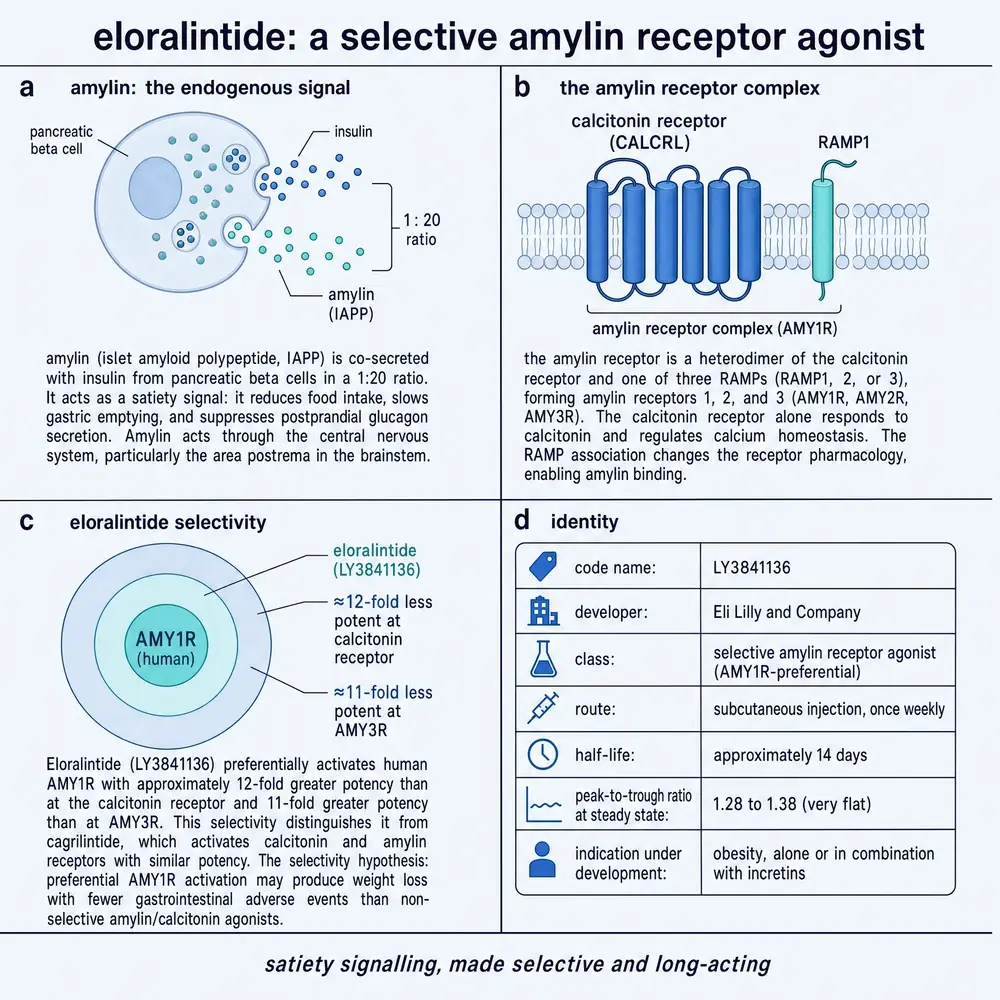
The one-paragraph version is this. The pancreas releases two hormones when you eat. Everyone knows the first. The second is amylin, discovered by accident in diseased tissue, and among its jobs is signalling to a small region at the base of the brain that a meal has arrived. Drugs based on amylin work — one has been approved since 2005 — but they have always suffered from the same structural problem: the receptor amylin acts on is not really a receptor of its own. It is a receptor for a different hormone wearing a costume. Miss the costume and you hit the other hormone's receptor instead, which governs calcium and bone. Eloralintide is the attempt to stop missing.
02Found in the wrong place
For most of the twentieth century, pathologists examining the pancreases of people who had died with type 2 diabetes kept finding the same thing: a pale, waxy deposit clogging the islets, the little clusters of hormone-producing cells scattered through the organ. It was amyloid — the same general class of misfolded protein aggregate found in the brain in Alzheimer's disease — and for decades nobody knew what it was made of.
In 1987 two groups found out within months of each other. Cooper and colleagues, working in Oxford, purified a peptide from amyloid-rich pancreatic tissue taken from people with type 2 diabetes and sequenced it (Cooper et al., 1987). Westermark and colleagues, in Sweden, isolated fibrils from an insulinoma and from the islets of diabetic patients and arrived at essentially the same molecule (Westermark et al., 1987). It was thirty-seven amino acids long, and it was clearly related to calcitonin gene-related peptide, a known signalling molecule — which was the first clue that it might be something other than debris.
The following year the case was made properly. Cooper's group argued that the peptide was a hormone rather than a waste product, and gave it the name amylin (Cooper et al., 1988). Leighton and Cooper showed in the same year that both amylin and calcitonin gene-related peptide made skeletal muscle resistant to insulin's effect on glycogen, which meant the molecule did something (Leighton et al., 1988). Sanke and colleagues established that it was cut from an 89-residue precursor, exactly as a real hormone should be (Sanke et al., 1988). And in 1989 Lukinius and colleagues used electron microscopy to show that amylin sits inside the same secretory granules as insulin, in the same cells (Lukinius et al., 1989). That is about as close to a definitive answer as cell biology gets. The beta cell does not release insulin and then, separately, release amylin. It packages them together and releases them together, in a fixed ratio, every time.
One further finding from that period matters more than it looks. Betsholtz and colleagues compared the amylin sequence across species and noticed that the rat version differs from the human version in a specific stretch in the middle of the molecule, and that the rat version does not form fibrils (Betsholtz et al., 1989). The aggregation was not an intrinsic property of being amylin; it was a property of a handful of residues in one region. Change them and the molecule stops clumping. Thirty-six years later that is precisely what eloralintide's chemists did, at positions eleven, fifteen and twenty-two.
A note on how a discovery gets framed. Amylin was found in a lesion, named for a pathology, and studied for years as a suspect in the destruction of beta cells. Its role as an ordinary satiety signal came later and had to be argued for. The compound in this document exists because that argument was won.
03The receptor had to be built before it could be found
Through the 1990s there was an awkward gap in the story. Amylin plainly acted on cells — inject it and animals stopped eating — but nobody could find a gene encoding an amylin receptor. Searches turned up the calcitonin receptor, which binds amylin weakly and is really the receptor for a different hormone, one concerned with calcium and bone. The binding was too poor to explain amylin's potency, and there was no second gene.
The resolution, which arrived in 1999, is one of the more elegant results in receptor pharmacology. Muff and colleagues showed that co-transfecting the calcitonin receptor together with a small accessory protein called RAMP1 produced something that behaved like an amylin receptor (Muff et al., 1999). Christopoulos and colleagues showed the same thing systematically across all three receptor activity-modifying proteins, generating three pharmacologically distinct receptors from one gene product (Christopoulos et al., 1999). The International Union of Pharmacology formalised the naming three years later: AMY1, AMY2 and AMY3, all built on the calcitonin receptor, distinguished only by which accessory protein is bolted alongside (Poyner et al., 2002). Hay and colleagues later assembled the field's canonical account of what these receptors do (Hay et al., 2015).
This is worth pausing on, because it is the whole reason eloralintide exists in the form it does. There is no such thing as an amylin receptor protein. There is a calcitonin receptor, and there is a chaperone that changes its mind about what it prefers to bind. Any molecule designed to activate the amylin receptors is therefore designed to activate a calcitonin receptor in a particular configuration — and the same molecule will, to some degree, activate the naked calcitonin receptor as well. Selectivity in this class is not the ordinary business of distinguishing two different proteins. It is the harder business of distinguishing one protein from itself, wearing a different hat.
The clinical stake in that distinction is straightforward. The calcitonin receptor's day job involves bone and calcium handling. A drug intended to make people less hungry has no business there.
Where in the brain any of this happens was worked out largely by Lutz and colleagues over two decades. Lesioning the area postrema and the adjacent nucleus of the solitary tract — a small region in the brainstem where the blood–brain barrier is leaky, so circulating hormones can reach neurons directly — abolishes amylin's effect on eating in rats (Lutz et al., 1998). The same lesion abolishes the effect of a chronic infusion (Lutz et al., 2001), and salmon calcitonin, which is a potent amylin-receptor agonist despite its name, suppresses feeding through those same receptors (Lutz et al., 2000). Later work extended the map: amylin signals onto POMC neurons in the arcuate nucleus of the hypothalamus (Lutz et al., 2018), and acts in concert with leptin (Li et al., 2015). More recent work has kept refining it. Carvas and colleagues reported that cagrilintide's effect on body weight runs through brain amylin receptors 1 and 3 (Carvas et al., 2025), and Ludwig and colleagues published a cross-species atlas of the dorsal vagal complex in 2026 (Ludwig et al., 2026). Mietlicki-Baase and colleagues review the current state of brain amylin signalling (Mietlicki-Baase et al., 2026).
None of that work was done with eloralintide. It is the map on which eloralintide is assumed to act, and the assumption has not been tested for this molecule.
04Pramlintide: the proof, and the ceiling
Native amylin is a poor drug. It aggregates, which makes it impossible to formulate, and it disappears from the bloodstream in minutes. The first successful modification exploited exactly the finding Betsholtz's group had reported: swap three residues in the aggregation-prone middle for the proline residues found in the rat sequence, and the molecule stays in solution. That is pramlintide, and it was approved in 2005 as an adjunct to insulin in diabetes.
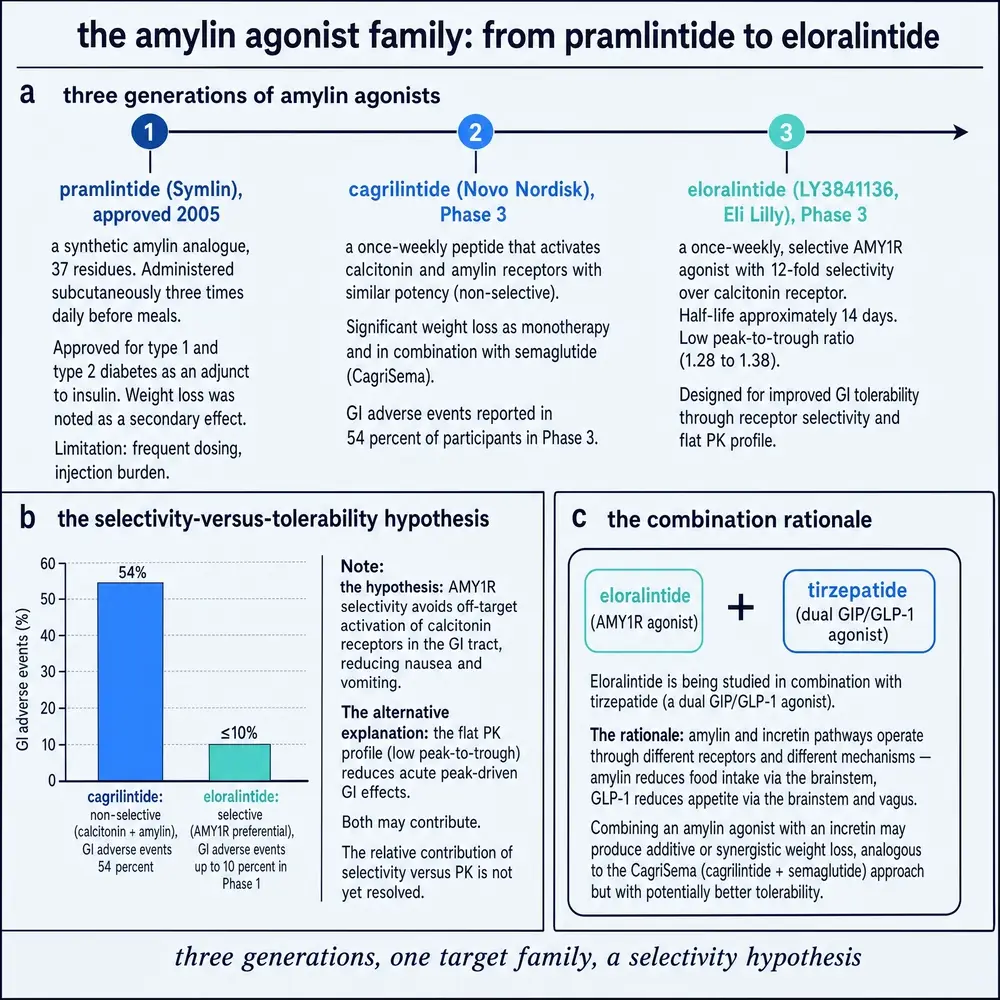
What pramlintide established is that the mechanism is real in humans. Chapman and colleagues showed in obese subjects that it reduced food intake and increased satiety (Chapman et al., 2005). Aronne and colleagues ran it in people with obesity but without diabetes and reported a progressive reduction in body weight over sixteen weeks (Aronne et al., 2007); Smith and colleagues followed the effect out to twelve months and found it sustained (Smith et al., 2008). Ravussin and colleagues combined it with metreleptin and got more weight loss than either alone, which was one of the first demonstrations that amylin agonism stacks with a second mechanism (Ravussin et al., 2009). Cort and colleagues later solved the solution structures of human amylin and pramlintide side by side, showing what the substitutions actually did to the molecule (Cort et al., 2009).
What pramlintide also established is the ceiling. The weight reductions were real and they were modest — single digits, against placebo, in trials lasting up to a year. And the drug had to be injected before every meal, because the half-life problem had not been solved, only the aggregation problem. A mealtime injection three times a day is a serious imposition for a weight-loss therapy, and it kept amylin a specialist adjunct rather than a mainstream option for two decades.
05Cagrilintide, and the object eloralintide was built against
The half-life problem was solved the way it has been solved for most modern peptide drugs: attach a fatty acid. A lipid tail binds reversibly to albumin, the most abundant protein in blood, and a peptide riding on albumin is cleared far more slowly than one travelling alone. Kruse and colleagues described the development of cagrilintide, an acylated amylin analogue designed for once-weekly dosing (Kruse et al., 2021).
It worked. Lau and colleagues reported a phase 2 trial in people with overweight or obesity in which once-weekly cagrilintide produced substantially more weight loss than placebo over twenty-six weeks (Lau et al., 2021). Enebo and colleagues reported the first co-administration study with semaglutide (Enebo et al., 2021), and by 2025 Garvey and colleagues had published REDEFINE 1, a phase 3 trial of the combination in 3,417 adults (Garvey et al., 2025). Amylin agonism had gone from a mealtime adjunct to a component of the most-watched obesity combination in development.
But cagrilintide is not selective. It activates the calcitonin receptor about as readily as it activates the amylin receptors — a design decision rather than an oversight, and one that was argued for on the grounds that calcitonin receptor activity might contribute to the effect. Larsen and colleagues examined exactly this question, comparing analogues with different receptor balances, and titled the paper with the question itself: does receptor balance matter? (Larsen et al., 2022). Structural work has since described how cagrilintide binds across the receptor family (Cao et al., 2025; Gu et al., 2026).
The question was live, and unresolved, and Eli Lilly answered it with a molecule. If a selective amylin-receptor agonist produced the same weight loss as a non-selective one with less nausea, the balance mattered and selectivity was worth having. If it did not, it did not. Eloralintide is that experiment. Every comparison in Part Three is against cagrilintide, run head to head, by the company whose molecule was on the other side.
06Four deliberate departures
Briere and colleagues published the structural description in October 2025, in the paper that carries the compound from discovery through to its first human data (Briere et al., 2025). It is short, and every element of it is a fix for a specific failure of the hormone it is derived from.
Start with the shape. Human amylin closes a loop near its N-terminus with a disulfide bridge — two sulfur atoms holding cysteine two and cysteine seven together. Disulfides are the standard way peptides hold a shape, and they have a standard weakness: a reducing environment breaks them. Eloralintide replaces that bridge with a methylene thioacetal, in which a single carbon atom sits between the two sulfurs. The geometry is close enough to preserve the loop and the chemistry is different enough that it cannot be reduced. Zhou and colleagues review this substitution as a general strategy in peptide design (Zhou et al., 2025). The claim is checkable against the deposited structure, and it checks: two sulfur atoms, one carbon between them, no disulfide bond anywhere in the molecule.
Second, the middle of the chain. Positions eleven, fifteen and twenty-two carry residues that no ribosome can install — they are not among the twenty amino acids the genetic code specifies. This is the aggregation problem being solved for the second time in the history of the class. Pramlintide solved it by borrowing three prolines from the rat sequence, which works because rat amylin does not form fibrils (Betsholtz et al., 1989). Eloralintide solves it with synthetic residues chosen rather than borrowed. The deposited structure contains an α-methylated benzyl residue and an N-methylated backbone amide, both of which are exactly the sort of modification that disrupts the flat, stacked beta-sheet geometry a fibril needs. Bousch and colleagues survey the design principles behind this kind of intervention (Bousch et al., 2026).
Third, the tail. The lysine at position twenty-six carries an appendage: two glutamate spacers, and then a twenty-carbon fatty diacid. This is the albumin trick, the same one used by cagrilintide and by most modern once-weekly peptides. The fatty chain binds reversibly to albumin, the most abundant protein in the blood; a peptide riding on albumin is filtered by the kidney far more slowly than one travelling alone. What it buys, in this molecule, is a half-life near two weeks — a point Section 13 returns to, because the size of that number turned out to be one of the two candidate explanations for how the drug behaved in its first human study.
Fourth, the ends. The C-terminus is amidated, which native amylin also is, and the whole molecule is described by its authors as a single enantiomer with every residue in the (L) configuration.
07Identity, and where the public record disagrees with itself
The chemical identity of a compound in this series is recomputed rather than transcribed. The deposited structure for eloralintide was pulled from PubChem, parsed, and its properties calculated from the atoms; the calculated values were then compared against what the database itself reports, and against what the primary paper says. Most of it agrees. Two things do not, and both are printed here rather than smoothed over.
| Property | Value used in this document | Basis |
|---|---|---|
| Molecular formula | C201H319N49O65S2 | Recomputed from the deposited structure; identical to the deposited formula |
| Average mass | 4526.17 Da | Recomputed; the record reports 4526 |
| Monoisotopic mass | 4523.2604 Da | Recomputed from the formula. The record's own exact-mass field says 4525.2671 — see below |
| Main chain | 37 residues, C-terminally amidated | Briere et al., 2025; the atom count independently supports 39 α-amino-acid units, which is 37 plus the two γ-glutamate spacers |
| Bridge | Methylene thioacetal, Cys2–Cys7 | Stated in the paper; confirmed by substructure search — one thioacetal, zero disulfides |
| Acylation | Lys26, two γ-Glu spacers, C20 linear saturated diacid | Stated in the paper; confirmed by substructure search |
| Stereochemistry | All-(L), single enantiomer | Attributed to the paper. The deposited record defines no stereocentres at all — see below |
| CAS | 2883634-40-8 | PubChem CID 175663130 |
| InChIKey | RLBIFQNAUXZCQB-UHFFFAOYSA-N | PubChem CID 175663130 |
The first discrepancy is arithmetical. A molecular formula fixes the monoisotopic mass exactly: add up the masses of the most abundant isotope of every atom and there is only one answer. Doing that with the formula the record itself publishes gives 4523.2604 Da. The record's exact-mass field says 4525.2671 Da. The gap is 2.0067 Da, which to three decimal places is the mass of two hydrogen atoms. The formula and the average mass agree with each other and with the recomputation; the exact-mass field is the outlier, and it is most easily explained as having been computed for a structure with two more hydrogens than the one deposited — which is what an open-chain precursor, before the bridge is closed, would look like. This document prints the formula-derived value.
The second discrepancy is about what the record does not say. The last block of the InChIKey is UHFFFAOYSA-N, which is the standard marker for a structure with no defined stereocentres. A 37-residue peptide has dozens. The deposited structure is therefore a connectivity diagram rather than a three-dimensional description, and it cannot corroborate the paper's statement that the molecule is all-(L) and a single enantiomer. That statement is true on the authority of the people who made the compound, which is a perfectly good authority; it is simply not independently confirmed by the public chemical record, and this table says so.
Neither of these findings is a problem with the drug. They are problems with a database entry, and they are recorded because the alternative — printing whichever number happens to appear on the summary page — would have produced a monograph asserting a mass that its own stated formula contradicts.
08Selectivity in a dish
The central design claim can be tested in cells, and Briere and colleagues tested it in the obvious way: express one receptor at a time in a cell line, add the drug, and measure both how tightly it binds and how strongly it signals. They used UMUC3 cells expressing either the human or the rat version of the calcitonin receptor, the amylin 1 receptor or the amylin 3 receptor, and read out cyclic AMP for potency and radioligand displacement for affinity (Briere et al., 2025).
In human receptors the result is a modest, consistent preference. Potency at the amylin 1 receptor was about twelve-fold better than at the calcitonin receptor and about eleven-fold better than at the amylin 3 receptor; binding affinity showed roughly eight-fold preferences in both directions. The molecule is a full agonist at all three — it is not a partial activator that fails to switch the calcitonin receptor on, it is simply worse at it. The authors summarise the profile as eight- to twelve-fold selectivity for the amylin 1 receptor.
Eight- to twelve-fold is a real difference and it is not an enormous one. For comparison, drugs routinely described as selective in other fields carry hundred- or thousand-fold margins. What this molecule has is a preference sufficient to allow a dose window in which the amylin receptors are heavily occupied and the calcitonin receptor is not — provided the dose stays inside it. Whether the clinical doses do stay inside it is not established by any experiment reported to date.
The rat numbers are the more interesting half of the figure, and they carry a warning for everything in Part Three. In rat cells the compound is forty-five-fold more potent at the amylin 1 receptor than at the calcitonin receptor, and one hundred and nine-fold higher in affinity. Against the amylin 3 receptor, however, the rat margin collapses to about three-fold, where the human margin was eight- to eleven-fold. The animal is not a scale model of the person. The molecule tested in rats is markedly better at avoiding the calcitonin receptor and markedly worse at distinguishing the two amylin subtypes than the molecule given to people. Every rat finding in this document was produced by a pharmacologically different drug, and the difference runs in both directions at once.
One methodological detail deserves recording because it bears on how the numbers should be read. These assays were run without albumin. Since the whole point of the acylation is that the molecule binds albumin, the concentrations at which it acts in a body are not the concentrations at which it acts in this dish. The authors addressed the point directly, retesting in the presence of albumin and reporting no significant potency shift and preserved selectivity over the human calcitonin receptor. That is the right control to have run, and it is a reassurance about rank order rather than about absolute potency.
09Rats stop eating
The entire preclinical record for this compound is one paper by one laboratory (Briere et al., 2025). That is worth stating before any of the findings, because it is the single most important fact about them. No independent group has reproduced any animal result described in this section. What follows is a well-designed set of experiments run by the company that owns the molecule, published after the drug had already completed a phase 2 trial, and not yet checked by anyone else.
The design was consistently comparative, which is the paper's chief virtue. Almost every animal experiment ran cagrilintide alongside, at matched doses, so the question being asked was never merely “does this work” but “does this work differently from the molecule already in phase 3.”
In lean male Sprague Dawley rats, a single subcutaneous dose across a range from 0.1 to 300 nmol/kg produced dose-proportional reductions in food intake and body weight. At the top of that range the animals lost 14.9 per cent of body weight (SE 0.6) by day four; cagrilintide at the same dose produced 14.5 per cent (SE 0.8). On the headline measure, in other words, the two molecules are interchangeable in a rat.
Where they separated was in how long the effect persisted relative to dose. Twenty-four hours after dosing, the amount of each drug needed to produce half its maximal effect on food intake was comparable. By ninety-six hours, eloralintide needed 3.7 nmol/kg (SE 1.1) against cagrilintide's 8.5 nmol/kg (SE 1.2) — a significant difference. The same comparison for body weight at ninety-six hours gave 6.1 against 11.4 nmol/kg and was not significant. The authors read the food-intake result as most likely a pharmacokinetic effect rather than a pharmacological one, and the pharmacokinetic data support them: in both rats and cynomolgus monkeys, eloralintide showed higher exposure, a longer half-life and flatter concentration curves than cagrilintide at matched doses. A drug still present at ninety-six hours will look more potent at ninety-six hours.
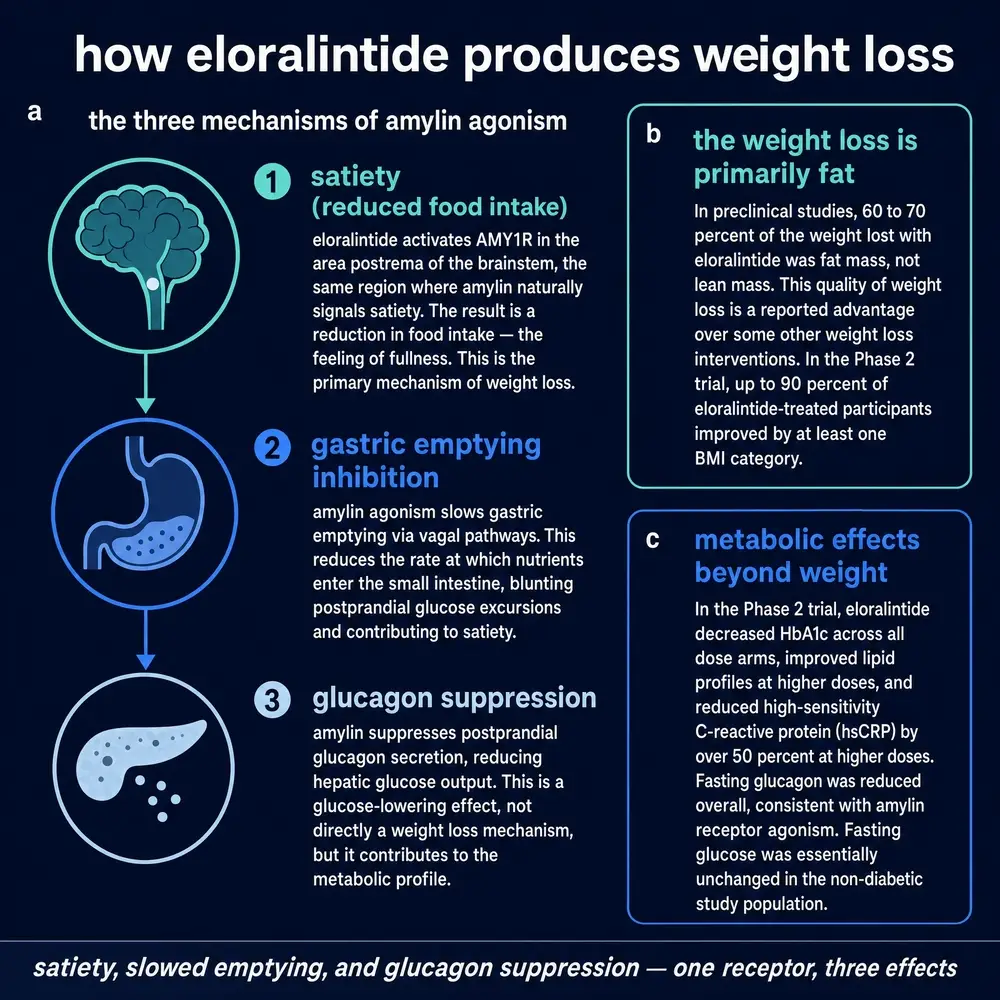
Repeated dosing in diet-induced obese rats — every three days, out to two weeks — likewise produced dose-proportional reductions in food intake and weight.
10Where the weight came from
The result the paper is built around is not about how much weight came off. It is about what the weight was made of.
Losing weight means losing fat and losing lean tissue, in some ratio, and the ratio is not fixed. It is a live concern for the whole obesity-drug field: Look and colleagues published body-composition data from the tirzepatide programme in 2025 precisely because the question of how much lean mass comes off with an incretin has become a clinical talking point (Look et al., 2025). Amylin agonists have long been argued to be more fat-specific than that, and this experiment was designed to test whether selectivity sharpens the effect further.
Male Long Evans diet-induced obese rats were dosed every three days for two weeks with vehicle, eloralintide at three dose levels, or cagrilintide at the top dose, with body composition measured by quantitative NMR. Five animals per group. Total weight loss slightly favoured the comparator: 11.1 per cent (SE 0.3) with eloralintide at 100 nmol/kg against 13.3 per cent (SE 0.8) with cagrilintide at the same dose, at day fifteen. Food intake fell comparably in both.
The composition differed. Of the weight cagrilintide removed, 63 per cent was fat. Of the weight eloralintide removed, 86, 91 and 80 per cent was fat at the 1, 10 and 100 nmol/kg doses respectively. The lean-mass difference reached statistical significance (p = 0.0101, one-way ANOVA).
Two qualifications belong immediately alongside that number, and both come from the authors. The first is a measurement issue: what quantitative NMR calls lean mass includes bone, water and other tissue as well as muscle, so a difference in lean mass is not automatically a difference in muscle. The second is more striking. The two drugs reduced food intake and body weight to a similar degree, and the authors state plainly that they do not know why the composition differed. They have a significant result and no mechanism for it.
An honest reading treats this as the most interesting unexplained finding in the compound's preclinical record, and as a hypothesis rather than a property. It is five rats per group, one experiment, one laboratory, unreplicated, with a proposed advantage its own discoverers cannot account for.
11Asking a rat about nausea
The commercial case for a selective amylin agonist rests on tolerability. If the molecule produces the same weight loss with less gastrointestinal misery, it wins; if not, selectivity is a curiosity. The trouble is that nausea is a reported sensation and rats do not file reports.
The standard workaround is conditioned taste avoidance. An animal is given something distinctive to drink — here a saccharin solution — and then dosed. If the dose makes it feel ill, it associates the taste with the illness and refuses the same drink days later. The refusal is measurable and the sensation is not, so the refusal stands in.
Lean male Sprague Dawley rats were offered saccharin, dosed once with eloralintide or cagrilintide across nine matched dose levels from 1 to 100 nmol/kg, and offered saccharin again three days later. The dose needed to produce half-maximal avoidance was 8.9 nmol/kg (SE 1.1) for eloralintide and 4.2 nmol/kg (SE 1.1) for cagrilintide. It took more than twice as much eloralintide to make a rat avoid the taste. Food intake suppression at twenty-four hours was similar for the two drugs, so the animals were eating less either way; only the aversion differed.
That is the design working as intended, and it is the clearest preclinical support for the selectivity hypothesis. The authors also give the obvious alternative explanation in their own limitations: the two molecules have different pharmacokinetics, cagrilintide has the shorter half-life and the earlier peak, and a drug that arrives faster and higher may simply be more aversive for reasons that have nothing to do with which receptor it prefers. A single-dose experiment measured over three days cannot separate those accounts.
12What the animal work establishes
Three things, with different degrees of confidence.
That the molecule reduces food intake and body weight in rats is established about as firmly as one laboratory can establish anything: two strains, lean and obese, single and repeated dosing, dose-proportional throughout, with an active comparator behaving as expected alongside. This is not a marginal effect requiring careful statistics to see.
That it spares lean mass relative to cagrilintide is a single significant result from five animals per group, using a measure that bundles bone and water in with muscle, and lacking any proposed mechanism. It is a finding worth pursuing and not yet a property of the drug.
That it is better tolerated than cagrilintide is supported by a rodent proxy for malaise, with a plausible confounder the authors themselves name.
Two structural limits apply to all of it. The first the authors state explicitly: eloralintide is selective for both amylin receptor subtypes in rats but for the amylin 1 receptor only in humans, so the animal model is not testing the human pharmacology. The second is that there is no agreed threshold for what counts as meaningful selectivity in this class — the paper says so in as many words. Eight- to twelve-fold is a number without a benchmark. Whether it is enough to matter clinically is not a question any rat can answer.
Nothing in Part Three is a human finding. Rats do not experience nausea, they avoid saccharin; they do not lose lean body mass in the sense a clinician means, they register a change in a quantitative NMR channel that includes water and bone. These experiments were designed to justify a clinical programme and they succeeded in doing so. They do not stand in for its results, which are in Part Four.
13One injection
The first human study of eloralintide opened on 30 March 2022 and ran until January 2024. Registered as NCT05295940, it enrolled 148 people and had two distinct parts, which were published separately, twenty-two months apart, by different first authors. The single-dose part appeared in October 2025 as the closing section of the discovery paper (Briere et al., 2025). The twelve-week part appeared in 2026 as a paper of its own (Bhattachar et al., 2026). Both are reported here as what they are: a phase 1 study, small, and designed to establish safety rather than efficacy.
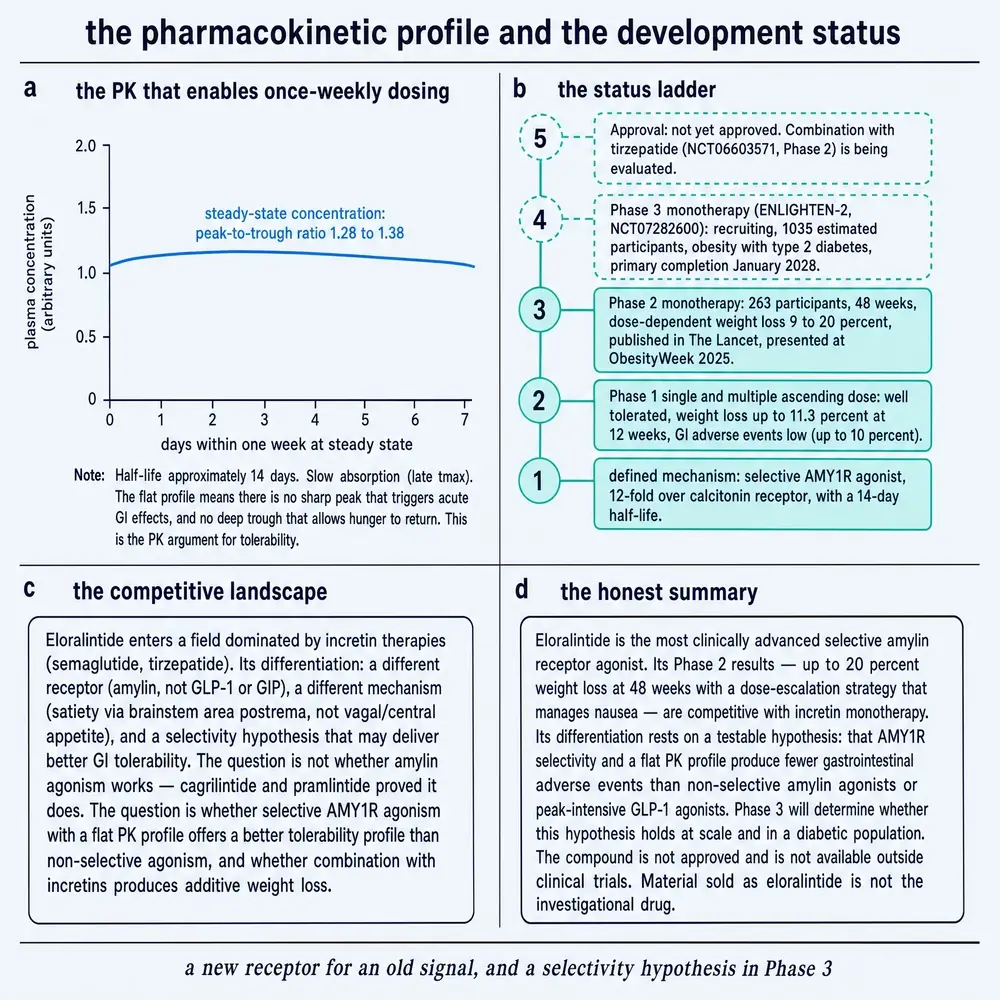
Take the pharmacokinetics first, because the molecule was built for them. After a single subcutaneous injection, concentrations peaked between three and five and a half days later — a median time to maximum of 72 to 132 hours — and then declined in a single smooth phase with a terminal half-life of 310 to 366 hours across the 0.4 to 12 mg range. That is twelve.9 to 15.3 days. For comparison, the authors note that cagrilintide's published half-life is 159 to 195 hours, roughly half. Exposure rose proportionally with dose; peak concentration rose slightly less than proportionally.
A half-life of two weeks against a dosing interval of one week produces something unusual: a concentration curve that barely moves. In the twelve-week part of the study, the ratio between peak and trough concentrations at steady state was between 1.28 and 1.38 (Bhattachar et al., 2026). The molecule does not spike after an injection and ebb before the next one; it sits at an almost constant level. Whether that flatness is why the drug was initially well tolerated is one of the two open explanations this document keeps returning to, and Section 16 is where the question becomes acute.
Forty-eight healthy participants received a single dose across six cohorts of six, with twelve on placebo. Their mean body-mass index was 27.5, which is to say the study population was mostly not obese — a point the authors flag themselves as limiting what the weight data can mean. Every participant completed. There were no serious adverse events and no discontinuations. Seventeen treatment-emergent adverse events were reported by ten of the forty-eight people in the study, nearly all mild. Four gastrointestinal events occurred, all in two participants, both at the highest 12 mg dose: one had two episodes of vomiting and mild nausea, the other had dyspepsia.
On weight, a single injection did nothing measurable at doses from 0.04 to 1.2 mg. At 4 mg the mean change from baseline was −2.5 per cent (SE 0.9) at day twenty-nine, and at 12 mg it was −4.4 per cent (SE 0.9), both significantly different from placebo and both still present four weeks after the only dose the participant received. That persistence is the pharmacokinetics made visible.
14Twelve weeks
The second part of the same registration gave 100 people with overweight or obesity twelve once-weekly doses at 1.2, 3, 6 or 12 mg, with twenty-seven on placebo, and followed them for ten weeks afterwards (Bhattachar et al., 2026). Cohort sizes were uneven — eight, six, twenty-three and thirty-six — which matters when reading any percentage from the smaller arms.
Weight fell in a dose-ordered way. At week twelve the placebo-adjusted least-squares mean reductions were 2.6 per cent at 1.2 mg, 8.9 per cent at 3 mg, 8.5 per cent at 6 mg and 11.3 per cent at 12 mg, against a placebo group that gained 0.2 per cent. The 3 and 6 mg arms are effectively tied, and the 3 mg arm contained six people, so the apparent ordering across the middle of the range should not be over-read.
Four other findings from this study bear on how the compound should be understood, and they point in different directions.
Gastric emptying appears to be affected transiently rather than persistently. The investigators used the absorption of orally administered acetaminophen as a surrogate: a drug that slows the stomach delays the appearance of paracetamol in the blood. On day three, after the first dose, exposures fell in a dose-related way, indicating slowed emptying. By day eighty, after eleven more doses, they had returned toward baseline, and no significant difference in time-to-peak was seen against placebo on either day. The authors contrast this with what is expected from native amylin and pramlintide, and suggest it may contribute to tolerability. It is a surrogate measure, an exploratory endpoint, in one study, and it has not been replicated.
Heart rate fell, in a dose-ordered way. Mean pulse rate at week twelve had declined by 7.1 bpm at 3 mg, 8.3 bpm at 6 mg and 14.4 bpm at 12 mg, against 3.4 bpm on placebo. No symptomatic bradycardia was reported and the electrocardiogram analyses were unremarkable. Fourteen beats per minute is a substantial change, its clinical meaning over longer exposure is unknown, and it is the finding in the human record that has received the least discussion relative to its size.
Glycaemic measures did not move. Fasting glucose was essentially unchanged. Oral glucose tolerance testing showed no treatment-related change in the area under the curve for glucose, insulin or C-peptide. Insulin-sensitivity indices showed no consistent pattern. The authors are careful about why: the population was normoglycaemic to begin with, the cohorts differed at baseline, and twelve weeks is short. Fasting glucagon fell overall, which is consistent with amylin pharmacology, but without a dose relationship. Nothing here establishes a metabolic benefit beyond weight, and the authors do not claim one.
Mood-related events occurred and were not trivial. Four participants reported mood symptoms: depressed mood in three, and persistent depressive disorder in one at the 12 mg dose, moderate in severity. All three participants in the 12 mg cohort with mood events were discontinued from treatment; the events resolved within two to four days. Eight participants reported fatigue. Two serious adverse events occurred in the study — a motor vehicle accident on placebo and an acute kidney injury at 6 mg, both judged unrelated by the investigator. Thirteen participants discontinued for adverse events, seven of them for COVID-19.
15Forty-eight weeks
Everything above is phase 1. The evidence that moved this compound into phase 3 is a single trial, and it is the strongest thing in this document (Billings et al., 2025).
Between February 2024 and August 2025, 263 adults were randomised at forty-six centres in the United States. Entry required a body-mass index of 30 or above, or 27 or above with at least one weight-related condition, and excluded type 2 diabetes. The population was heavier than in the earlier studies — mean weight 109.1 kg, mean body-mass index 39.1 — and was 78 per cent female. Participants received once-weekly subcutaneous placebo or eloralintide at 1, 3, 6 or 9 mg, or one of two escalation schemes, 6 mg rising to 9 and 3 mg rising to 9, for forty-eight weeks. The primary endpoint was percent change in body weight.
The placebo group finished the year 0.4 per cent lighter, with a confidence interval spanning zero. Every eloralintide arm separated cleanly. Weight fell by 9 per cent at 1 mg, 12 per cent at 3 mg, 18 per cent at 6 mg and 20 per cent at both 9 mg and the 6-to-9 escalation; the 3-to-9 escalation gave 16 per cent. The three top arms have confidence intervals that overlap one another almost completely, so the trial establishes that the top of the dose range works and does not establish which point in it works best.
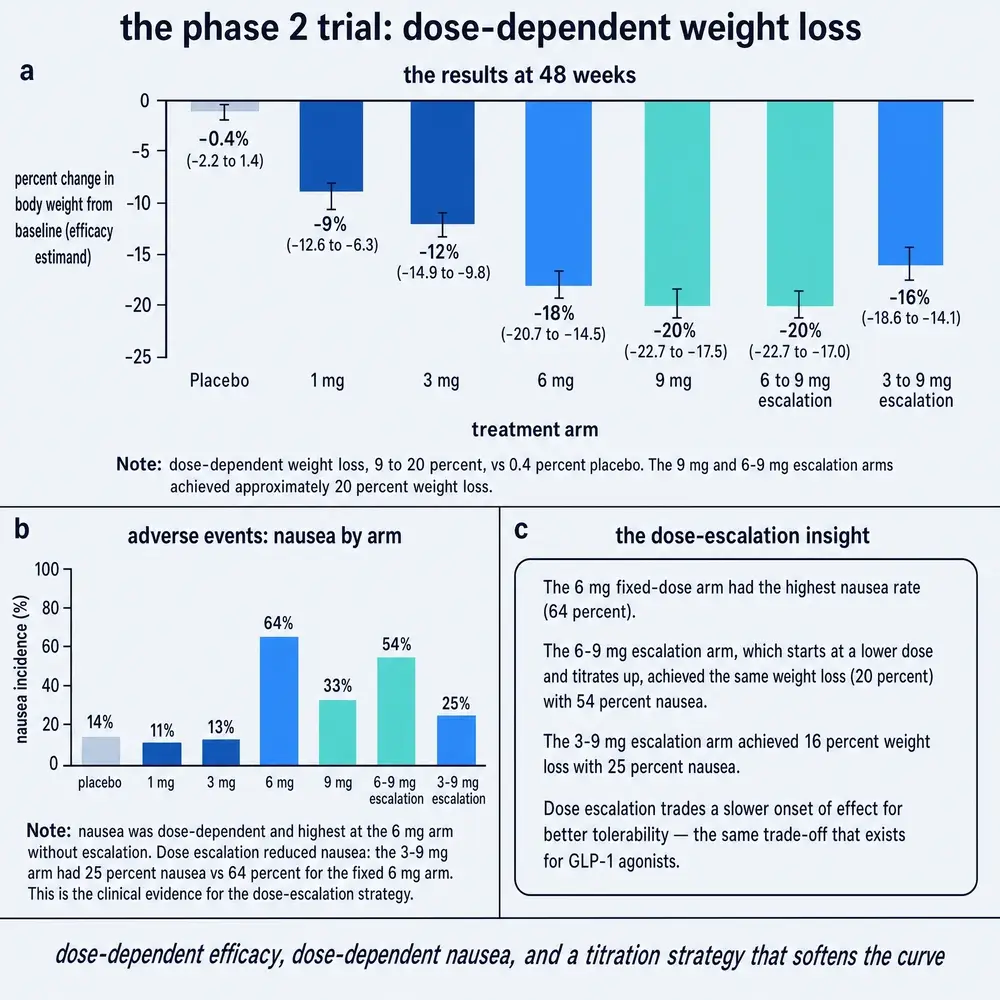
Twenty per cent of body weight over forty-eight weeks, from a molecule that is not an incretin and is given alone, is a result that would have been implausible five years ago. The nearest reference point is cagrilintide–semaglutide, which reached 20.4 per cent at sixty-eight weeks in REDEFINE 1 — but that was a combination of two drugs, in 3,417 people, over a longer period, in a phase 3 trial (Garvey et al., 2025). Placing the two numbers next to each other is useful for scale and misleading as a comparison, and Section 19 returns to why.
16The tolerability question
Here is the difficulty. The entire scientific rationale for building a selective amylin agonist was that selectivity should buy tolerability. The preclinical work supported it. The phase 1 work supported it. The phase 2 trial is harder to read.
Over twelve weeks in phase 1b, nausea was reported by 13.0 per cent of participants at 6 mg and 8.3 per cent at 12 mg, against nobody at all on placebo. Over forty-eight weeks in phase 2, nausea was reported by 64 per cent at 6 mg — the same nominal dose — and by 33 per cent at 9 mg, against 14 per cent on placebo. Fatigue followed a similar pattern, reaching 43 per cent at 9 mg and 46 per cent on the 6-to-9 escalation against 12 per cent on placebo.
Three observations, in descending order of confidence.
First, the low gastrointestinal burden reported from phase 1 did not survive a longer trial in a heavier population. Whatever the explanation, a reader who takes the phase 1 tolerability finding as the compound's tolerability profile is reading a twelve-week result as a forty-eight-week one. The authors of the phase 1 paper were explicit that their event rates were poorly estimated at that sample size, and they were right to be.
Second, the phase 2 dose-response is not monotonic and cannot yet be interpreted. The 6 mg arm reported roughly twice the nausea of the 9 mg arm. That arm contained twenty-eight people. A rate of 64 per cent in twenty-eight people carries a wide interval, the trial was not powered for adverse-event comparisons between arms, and no multiplicity adjustment applies. The most likely reading is noise, but it is noise that happens to sit on the dose the phase 1 study had also tested, which is exactly where a reader would like the estimate to be firm.
Third, the two studies did not count the same way. The phase 1b placebo group reported no nausea at all; the phase 2 placebo group reported 14 per cent. When the control arms differ that much, the active arms are not directly comparable either. The populations differed in weight and sex balance, the durations differed by a factor of four, the escalation schemes differed, and ascertainment over forty-eight weeks catches events that twelve weeks does not.
What can be said fairly is this. Against the class, the numbers remain defensible: cagrilintide's own phase 2 trial reported nausea in 20 to 47 per cent of participants across its dose range against 18 per cent on placebo (Lau et al., 2021), and Kamrul-Hasan and colleagues, in a network meta-analysis of six trials and 4,642 participants, found gastrointestinal events elevated across all high-dose amylin-based therapies while noting that only high-dose cagrilintide–semaglutide increased discontinuation for adverse events (Kamrul-Hasan et al., 2026). Eloralintide is not an outlier for badness. But the specific claim that selectivity delivers a materially gentler drug is not established by the human data as they currently stand, and the phase 1 result that appeared to establish it was measured over a quarter of the duration.
17The registered programme
Twenty studies naming eloralintide or LY3841136 were registered on ClinicalTrials.gov as of 3 August 2026, read directly from the registry rather than from any secondary list. They plan or have enrolled 9,209 participants between them. One has posted results.
Ten are phase 1, five are phase 2 and five are phase 3. The phase 3 programme opened between December 2025 and February 2026 — five registrations inside three months, accounting for 5,615 of the 9,209 participants — and covers obesity or overweight in three separate studies, obstructive sleep apnoea with obesity, and osteoarthritis with overweight or obesity. None will report for years.
The combination programme is substantial and largely unpublished. Five registrations give eloralintide alongside tirzepatide, including a 367-participant phase 2 and a 1,481-participant phase 2 platform study in which eloralintide is one investigational arm among several. Two more pair it with macupatide, a long-acting agonist at the receptor for glucose-dependent insulinotropic polypeptide (Heise et al., 2026) — a different mechanism again, and one of the two arms of tirzepatide's activity isolated as a single molecule. Two phase 1 studies enrol participants with hepatic impairment and with end-stage kidney disease, which is the ordinary business of characterising a drug in populations that clear it differently. One phase 1 study registered for July 2026 uses acetaminophen, which suggests the gastric-emptying question from Section 14 is being pursued deliberately.
A registry entry records what a sponsor intends to measure. It is not evidence that anything was found, and the enrolment figures above are largely planned rather than achieved. Nineteen of these twenty studies have published nothing. The gap between the size of this programme and the size of its published output is the central fact about the evidence base for this compound, and it will not close for several years.
18Weighing it
The table below is the document's own assessment, and it is worth saying plainly what the two columns mean, because they are different kinds of statement. The tier column is a fact: it records what sort of study produced the claim, and it is taken from the study itself. The strength column is a judgement, made for this monograph, about replication, sample size, directness and consistency. It is not a validated instrument and it comes from no source.
Two rows deserve comment. The claim that the compound causes little gastrointestinal upset scores one out of five not because the evidence is thin but because it is contradictory: strongly supported at twelve weeks, strongly contradicted at forty-eight, in trials that counted differently. A claim supported by one good study and undermined by another good study is weaker than a claim supported by nothing at all is uncertain, because it has been tested and has not survived cleanly.
The claim that eloralintide preserves lean mass in humans scores zero, and this is the gap most likely to be misread. The rat result is real and is described in Section 10. No human body-composition data for this compound have been published. Dual-energy X-ray absorptiometry is routine in obesity trials, and its absence from the phase 2 report is conspicuous given that lean-mass sparing is the compound's most distinctive preclinical claim. Until those data exist, the lean-mass story is a rodent story.
19Where it sits in the class
The amylin field in 2026 is crowded. Alongside eloralintide there is cagrilintide from Novo Nordisk, in phase 3 both alone and combined with semaglutide; petrelintide from Zealand Pharma, with a half-life near ten days and up to 8.6 per cent weight reduction at sixteen weeks in phase 1 (Brændholt Olsen and colleagues, 2026); and a set of further molecules — amycretin, MET-233i, AZD6234, ABBV-295 — at earlier stages. Alhazmi and colleagues survey the whole landscape as of April 2026 (Alhazmi et al., 2026), and Bailey reviews the medicinal chemistry that produced it (Bailey et al., 2026). Lempesis and colleagues place the class within the broader multi-receptor era (Lempesis et al., 2026).
The one quantitative attempt to rank them is a network meta-analysis by Kamrul-Hasan and colleagues, covering six trials and 4,642 participants across durations from twelve to sixty-eight weeks (Kamrul-Hasan et al., 2026). High-dose eloralintide placed second on percentage weight reduction, at 18.01 per cent below placebo, behind high-dose subcutaneous amycretin at 23.95 per cent and ahead of high-dose cagrilintide–semaglutide at 17.18 per cent. All three exceeded semaglutide 2.4 mg at 11.45 per cent and liraglutide 3.0 mg at 6.4 per cent. The authors' own conclusion is the one to carry forward: the data are sparse and of low certainty, the findings are preliminary, and they require confirmation in larger trials.
That caution is not boilerplate. A network meta-analysis compares trials that were never run against each other, and the trials in this network differ in almost every way that matters. Eloralintide's contribution is a 263-participant phase 2 at forty-eight weeks. Cagrilintide–semaglutide's is a 3,417-participant phase 3 at sixty-eight weeks. Placebo groups behaved very differently: eloralintide's lost 0.4 per cent, REDEFINE 1's lost 3.0 per cent with lifestyle intervention. A compound whose comparator group did nothing will look better than one whose comparator group lost weight, and the difference belongs to the trial design rather than to the drug.
The honest statement of position is therefore narrower than the ranking suggests. Eloralintide has produced the largest weight reduction yet reported for a selective amylin-receptor agonist given alone, in a mid-size phase 2 trial. Whether it is better than cagrilintide, petrelintide or amycretin is not known and will not be known until molecules are compared inside the same trial. No such trial is registered.
What can be said about mechanism is more interesting than the ranking. The compound was built to test whether receptor selectivity matters — the question Larsen and colleagues posed directly in 2022 (Larsen et al., 2022). Four years on, the answer is partial. Selectivity did not cost efficacy: a molecule that largely spares the calcitonin receptor produces weight loss at least as large as one that does not. That is a real result and it was not guaranteed. Whether selectivity buys tolerability — the reason anyone wanted it — remains open, for the reasons set out in Section 16.
20Evidence gaps and unresolved questions
No independent replication of anything. Every primary finding about this compound — in vitro, animal and human — comes from Eli Lilly or from investigators funded by Eli Lilly. That is normal for a molecule at this stage and it is still the largest single limitation on the evidence base. The one arm's-length assessment, the network meta-analysis, describes its own certainty as low.
No human body composition. Described in Section 18. The compound's most distinctive preclinical claim has no human counterpart.
No mechanism for the lean-mass finding. The authors of the rat study report a significant difference and state that they cannot explain it, given that food intake and total weight loss were comparable between the two drugs. An unexplained effect is not a discredited one, but it is not yet a property to build on.
No resolution of the tolerability contradiction. Thirteen per cent at twelve weeks and 64 per cent at forty-eight, at the same nominal dose, in trials whose placebo arms differed by fourteen percentage points. Until a single study covers both durations, or the phase 3 programme reports, the honest position is that the profile is not established.
No account of the heart-rate reduction. A mean fall of 14.4 bpm at the top phase 1b dose is a large physiological change. It was not accompanied by symptoms over twelve weeks and it has not been discussed in proportion to its size. Whether it persists over a year, and what it means in older or cardiovascularly compromised populations, is unknown.
No selectivity benchmark. The primary paper states that no minimum selectivity threshold has been established for this class. The compound is eight- to twelve-fold selective in human assays. Nobody can currently say whether that is a lot.
No in-vivo confirmation of receptor selectivity. Selectivity has been demonstrated in transfected cell lines. Whether the molecule is selective in a living human being, at the concentrations the clinical doses produce, has not been shown. The authors identify this explicitly as work still to be done.
No glycaemic or outcome data. The phase 1b population was normoglycaemic and nothing moved. A phase 2 study in type 2 diabetes opened in October 2025 and has not reported. No cardiovascular or other clinical-outcome trial is registered for this compound.
No independent chemical characterisation. The structure is described in one paper and deposited in one database record whose exact-mass field contradicts its own formula and which defines no stereochemistry (Section 07). No independent analytical report exists in the literature.
21What would change the picture
Unusually for a compound in this series, most of the open questions have a scheduled answer. The five phase 3 registrations opened between December 2025 and February 2026 and will run for a year or more of treatment plus analysis; the earliest plausible reports fall in 2027 and 2028. They will settle the tolerability question by weight of numbers, because a 1,980-participant trial estimates a nausea rate with an interval a twenty-eight-person arm cannot.
Three specific readouts would each resolve something the current record cannot.
A phase 3 report including dual-energy X-ray absorptiometry would convert the rat lean-mass finding into a human claim or retire it. Nothing in the registered protocols guarantees that body composition is being measured, and its absence from the phase 2 publication is the reason this is listed first.
The tirzepatide combination studies — five registrations, the largest enrolling 1,481 participants — will show whether amylin agonism adds to incretin agonism in the way cagrilintide adds to semaglutide, and at what tolerability cost. Bhattachar and colleagues note that the cagrilintide–semaglutide combination brings additivity for gastrointestinal adverse events as well as for efficacy; whether a selective amylin agonist behaves differently in combination is precisely the experiment that would make selectivity matter.
An independent laboratory reproducing the receptor pharmacology would be the cheapest and most valuable single contribution anyone outside Lilly could make. The assays are standard, the comparator molecules are available, and the entire design rationale rests on a selectivity ratio that one group has measured once.
Eloralintide is a selective amylin-receptor agonist with a two-week half-life that has produced, in a single 263-participant phase 2 trial over forty-eight weeks, a 20 per cent reduction in body weight against a placebo group that lost almost nothing. That result is real, recent, and the largest reported for any amylin-receptor agonist given alone. It is also unreplicated, sponsor-generated, accompanied by a nausea rate that the earlier and smaller trials did not predict, and unsupported by any human measurement of what the lost weight was made of. The compound's central scientific claim — that selectivity for the amylin receptor over the calcitonin receptor makes for a gentler drug — has been demonstrated in rats, supported over twelve weeks in humans, and complicated over forty-eight. It is a genuinely promising molecule whose entire primary evidence base is three papers and one meta-analysis, and the programme that will test it properly is already running.
22References
Generated from verified NCBI records rather than from recall. Every author list, journal name, volume, page range and identifier below was fetched from PubMed and read back before this build was permitted to run. That check is not a formality. On the previous build in this series, seven of twenty citation keys drafted from memory named the wrong first author. On this one, four of 44 did — a paper attributed to Sharma is by Lempesis, one attributed to Urva is by Heise, one attributed to Zhang is by Zhou, and one first author's compound surname had been truncated to its second word. The works were the right works in every case; the attributions were not.
- Alhazmi A, le Roux CW. Amylin Analogs: The Next Major Class of Weight Loss Therapy: A Review of Experimental Data and Early-Phase Clinical Trials. Diabetes Obes Metab. 2026.
PMID 42452898 · doi:10.1111/dom.71074 - Aronne L, Fujioka K, Aroda V, Chen K, Halseth A, Kesty NC, et al.. Progressive reduction in body weight after treatment with the amylin analog pramlintide in obese subjects: a phase 2, randomized, placebo-controlled, dose-escalation study. J Clin Endocrinol Metab. 2007;92(8):2977-83.
PMID 17504894 · doi:10.1210/jc.2006-2003 - Bailey CJ, Flatt PR, Conlon JM. Long-acting amylin-related peptides as therapies for obesity and type 2 diabetes. Peptides. 2026;196:171480.
PMID 41747885 · doi:10.1016/j.peptides.2026.171480 - Betsholtz C, Christmansson L, Engström U, Rorsman F, Svensson V, Johnson KH, et al.. Sequence divergence in a specific region of islet amyloid polypeptide (IAPP) explains differences in islet amyloid formation between species. FEBS Lett. 1989;251(1-2):261-4.
PMID 2666169 · doi:10.1016/0014-5793(89)81467-x - Bhattachar S, Tham LS, Tidemann-Miller B, Ibriga H, Qu H, Briere DA, et al.. Eloralintide, a selective, long-acting amylin receptor agonist for treatment of obesity: Phase 1 proof of concept. Diabetes Obes Metab. 2026;28(4):2651-2660.
PMID 41559929 · doi:10.1111/dom.70439 · PMC12992164 - Billings LK, Hsia S, Bays H, Tidemann-Miller B, O'Hagan J, Tham LS, et al.. Eloralintide, a selective amylin receptor agonist for the treatment of obesity: a 48-week phase 2, multicentre, double-blind, randomised, placebo-controlled trial. Lancet. 2025;406(10520):2631-2643.
PMID 41207310 · doi:10.1016/S0140-6736(25)02155-5 - Bousch C, Bérubé F, Babych M, Ongeri S, Bourgault S. Molecular Mechanisms of Islet Amyloid Polypeptide Aggregation: Towards Chemical Strategies to Prevent Amyloid Formation and to Design Non-Aggregating Peptide Therapeutics. Int J Mol Sci. 2026;27(6).
PMID 41898461 · doi:10.3390/ijms27062598 · PMC13026743 - Briere DA, Qu H, Lansu K, He MM, Moyers JS, Coskun T, et al.. Eloralintide (LY3841136), a novel amylin receptor agonist for the treatment of obesity: From discovery to clinical proof of concept. Mol Metab. 2025;102:102271.
PMID 41109426 · doi:10.1016/j.molmet.2025.102271 · PMC12640043 - Brændholt Olsen M, Griffin J, Hövelmann U, Macura S, Fredsted Hagen B, Hesse D, et al.. Safety, Tolerability, Pharmacokinetics, and Pharmacodynamics of Petrelintide for Weight Management: Two Randomized, Controlled Phase 1 Trials. Diabetes Obes Metab. 2026;28(7):5915-5925.
PMID 42017294 · doi:10.1111/dom.70753 · PMC13243934 - Cao J, Belousoff MJ, Johnson RM, Keov P, Mariam Z, Deganutti G, et al.. Structural and dynamic features of cagrilintide binding to calcitonin and amylin receptors. Nat Commun. 2025;16(1):3389.
PMID 40204768 · doi:10.1038/s41467-025-58680-y · PMC11982234 - Carvas AO, Leuthardt A, Kulka P, Lommi G, Hassan S, Coester B, et al.. Cagrilintide lowers bodyweight through brain amylin receptors 1 and 3. EBioMedicine. 2025;118:105836.
PMID 40609154 · doi:10.1016/j.ebiom.2025.105836 · PMC12270663 - Chapman I, Parker B, Doran S, Feinle-Bisset C, Wishart J, Strobel S, et al.. Effect of pramlintide on satiety and food intake in obese subjects and subjects with type 2 diabetes. Diabetologia. 2005;48(5):838-48.
PMID 15843914 · doi:10.1007/s00125-005-1732-4 - Christopoulos G, Perry KJ, Morfis M, Tilakaratne N, Gao Y, Fraser NJ, et al.. Multiple amylin receptors arise from receptor activity-modifying protein interaction with the calcitonin receptor gene product. Mol Pharmacol. 1999;56(1):235-42.
PMID 10385705 · doi:10.1124/mol.56.1.235 - Cooper GJ, Willis AC, Clark A, Turner RC, Sim RB, Reid KB. Purification and characterization of a peptide from amyloid-rich pancreases of type 2 diabetic patients. Proc Natl Acad Sci U S A. 1987;84(23):8628-32.
PMID 3317417 · doi:10.1073/pnas.84.23.8628 · PMC299599 - Cooper GJ, Leighton B, Dimitriadis GD, Parry-Billings M, Kowalchuk JM, Howland K, et al.. Amylin found in amyloid deposits in human type 2 diabetes mellitus may be a hormone that regulates glycogen metabolism in skeletal muscle. Proc Natl Acad Sci U S A. 1988;85(20):7763-6.
PMID 3051005 · doi:10.1073/pnas.85.20.7763 · PMC282273 - Cort JR, Liu Z, Lee GM, Huggins KN, Janes S, Prickett K, et al.. Solution state structures of human pancreatic amylin and pramlintide. Protein Eng Des Sel. 2009;22(8):497-513.
PMID 19596697 · doi:10.1093/protein/gzp029 · PMC2719500 - Enebo LB, Berthelsen KK, Kankam M, Lund MT, Rubino DM, Satylganova A, et al.. Safety, tolerability, pharmacokinetics, and pharmacodynamics of concomitant administration of multiple doses of cagrilintide with semaglutide 2·4 mg for weight management: a randomised, controlled, phase 1b trial. Lancet. 2021;397(10286):1736-1748.
PMID 33894838 · doi:10.1016/S0140-6736(21)00845-X - Garvey WT, Blüher M, Osorto Contreras CK, Davies MJ, Winning Lehmann E, Pietiläinen KH, et al.. Coadministered Cagrilintide and Semaglutide in Adults with Overweight or Obesity. N Engl J Med. 2025;393(7):635-647.
PMID 40544433 · doi:10.1056/NEJMoa2502081 - Gu YM, Yuan QN, Li X, He Q, Xu HE, Zhao LH. Structural and mechanistic insights into dual activation of cagrilintide in amylin and calcitonin receptors. Acta Pharmacol Sin. 2026;47(1):162-172.
PMID 40847076 · doi:10.1038/s41401-025-01635-2 · PMC12764919 - Hay DL, Chen S, Lutz TA, Parkes DG, Roth JD. Amylin: Pharmacology, Physiology, and Clinical Potential. Pharmacol Rev. 2015;67(3):564-600.
PMID 26071095 · doi:10.1124/pr.115.010629 - Heise T, Zijlstra E, Mari A, Roell WC, Mather KJ, Haupt A, et al.. Insulin Sensitivity and Beta Cell Function With Macupatide Alone or With Dulaglutide in Type 2 Diabetes: A Phase 1b, Randomised Controlled Trial. Diabetes Obes Metab. 2026;28(8):7196-7206.
PMID 42229460 · doi:10.1111/dom.70863 · PMC13341334 - Kamrul-Hasan ABM, Khalil I, Mahajan K, Dutta D, Banerjee M, Pappachan JM. Novel Amylin-Based Therapies for Weight Management in Adults With Overweight or Obesity Without Diabetes: A Network Meta-Analysis. Endocrinol Diabetes Metab. 2026;9(3):e70247.
PMID 42175595 · doi:10.1002/edm2.70247 · PMC13240113 - Kruse T, Hansen JL, Dahl K, Schäffer L, Sensfuss U, Poulsen C, et al.. Development of Cagrilintide, a Long-Acting Amylin Analogue. J Med Chem. 2021;64(15):11183-11194.
PMID 34288673 · doi:10.1021/acs.jmedchem.1c00565 - Larsen AT, Mohamed KE, Sonne N, Bredtoft E, Andersen F, Karsdal MA, et al.. Does receptor balance matter? - Comparing the efficacies of the dual amylin and calcitonin receptor agonists cagrilintide and KBP-336 on metabolic parameters in preclinical models. Biomed Pharmacother. 2022;156:113842.
PMID 36242844 · doi:10.1016/j.biopha.2022.113842 - Lau DCW, Erichsen L, Francisco AM, Satylganova A, le Roux CW, McGowan B, et al.. Once-weekly cagrilintide for weight management in people with overweight and obesity: a multicentre, randomised, double-blind, placebo-controlled and active-controlled, dose-finding phase 2 trial. Lancet. 2021;398(10317):2160-2172.
PMID 34798060 · doi:10.1016/S0140-6736(21)01751-7 - Leighton B, Cooper GJ. Pancreatic amylin and calcitonin gene-related peptide cause resistance to insulin in skeletal muscle in vitro. Nature. 1988;335(6191):632-5.
PMID 3050530 · doi:10.1038/335632a0 - Lempesis IG, Dalamaga M. Obesity pharmacotherapy reimagined: The era of multi-receptor agonists and next-generation metabolic modulators, perspectives and controversies. Metabol Open. 2026;30:100463.
PMID 41948476 · doi:10.1016/j.metop.2026.100463 · PMC13051938 - Li Z, Kelly L, Heiman M, Greengard P, Friedman JM. Hypothalamic Amylin Acts in Concert with Leptin to Regulate Food Intake. Cell Metab. 2015;22(6):1059-67.
PMID 26655697 · doi:10.1016/j.cmet.2015.10.012 - Look M, Dunn JP, Kushner RF, Cao D, Harris C, Gibble TH, et al.. Body composition changes during weight reduction with tirzepatide in the SURMOUNT-1 study of adults with obesity or overweight. Diabetes Obes Metab. 2025;27(5):2720-2729.
PMID 39996356 · doi:10.1111/dom.16275 · PMC11965027 - Ludwig MQ, Coester B, Gordian D, Hassan S, Tomlinson AJ, Toure MH, et al.. A cross-species atlas of the dorsal vagal complex reveals neural mediators of the effects of cagrilintide on energy balance. Nat Metab. 2026;8(6):1350-1367.
PMID 42260119 · doi:10.1038/s42255-026-01539-3 · PMC13303089 - Lukinius A, Wilander E, Westermark GT, Engström U, Westermark P. Co-localization of islet amyloid polypeptide and insulin in the B cell secretory granules of the human pancreatic islets. Diabetologia. 1989;32(4):240-4.
PMID 2668077 · doi:10.1007/BF00285291 - Lutz TA, Senn M, Althaus J, Del Prete E, Ehrensperger F, Scharrer E. Lesion of the area postrema/nucleus of the solitary tract (AP/NTS) attenuates the anorectic effects of amylin and calcitonin gene-related peptide (CGRP) in rats. Peptides. 1998;19(2):309-17.
PMID 9493863 · doi:10.1016/s0196-9781(97)00292-1 - Lutz TA, Tschudy S, Rushing PA, Scharrer E. Amylin receptors mediate the anorectic action of salmon calcitonin (sCT). Peptides. 2000;21(2):233-8.
PMID 10764950 · doi:10.1016/s0196-9781(99)00208-9 - Lutz TA, Mollet A, Rushing PA, Riediger T, Scharrer E. The anorectic effect of a chronic peripheral infusion of amylin is abolished in area postrema/nucleus of the solitary tract (AP/NTS) lesioned rats. Int J Obes Relat Metab Disord. 2001;25(7):1005-11.
PMID 11443499 · doi:10.1038/sj.ijo.0801664 - Lutz TA, Coester B, Whiting L, Dunn-Meynell AA, Boyle CN, Bouret SG, et al.. Amylin Selectively Signals Onto POMC Neurons in the Arcuate Nucleus of the Hypothalamus. Diabetes. 2018;67(5):805-817.
PMID 29467172 · doi:10.2337/db17-1347 · PMC5910000 - Mietlicki-Baase EG. Brain Amylin Signaling, Feeding, and Reward. Compr Physiol. 2026;16(2):e70120.
PMID 41793055 · doi:10.1002/cph4.70120 · PMC13001112 - Muff R, Bühlmann N, Fischer JA, Born W. An amylin receptor is revealed following co-transfection of a calcitonin receptor with receptor activity modifying proteins-1 or -3. Endocrinology. 1999;140(6):2924-7.
PMID 10342886 · doi:10.1210/endo.140.6.6930 - Poyner DR, Sexton PM, Marshall I, Smith DM, Quirion R, Born W, et al.. International Union of Pharmacology. XXXII. The mammalian calcitonin gene-related peptides, adrenomedullin, amylin, and calcitonin receptors. Pharmacol Rev. 2002;54(2):233-46.
PMID 12037140 · doi:10.1124/pr.54.2.233 - Ravussin E, Smith SR, Mitchell JA, Shringarpure R, Shan K, Maier H, et al.. Enhanced weight loss with pramlintide/metreleptin: an integrated neurohormonal approach to obesity pharmacotherapy. Obesity (Silver Spring). 2009;17(9):1736-43.
PMID 19521351 · doi:10.1038/oby.2009.184 · PMC2754219 - Rubino DM, Greenway FL, Khalid U, O'Neil PM, Rosenstock J, Sørrig R, et al.. Effect of Weekly Subcutaneous Semaglutide vs Daily Liraglutide on Body Weight in Adults With Overweight or Obesity Without Diabetes: The STEP 8 Randomized Clinical Trial. JAMA. 2022;327(2):138-150.
PMID 35015037 · doi:10.1001/jama.2021.23619 · PMC8753508 - Sanke T, Bell GI, Sample C, Rubenstein AH, Steiner DF. An islet amyloid peptide is derived from an 89-amino acid precursor by proteolytic processing. J Biol Chem. 1988;263(33):17243-6.
PMID 3053705 - Smith SR, Aronne LJ, Burns CM, Kesty NC, Halseth AE, Weyer C. Sustained weight loss following 12-month pramlintide treatment as an adjunct to lifestyle intervention in obesity. Diabetes Care. 2008;31(9):1816-23.
PMID 18753666 · doi:10.2337/dc08-0029 · PMC2518351 - Westermark P, Wernstedt C, Wilander E, Hayden DW, O'Brien TD, Johnson KH. Amyloid fibrils in human insulinoma and islets of Langerhans of the diabetic cat are derived from a neuropeptide-like protein also present in normal islet cells. Proc Natl Acad Sci U S A. 1987;84(11):3881-5.
PMID 3035556 · doi:10.1073/pnas.84.11.3881 · PMC304980 - Zhou Y, Wang D, Xu J, Zheng N. Strategic applications of methylene thioacetal bonds as disulfide surrogates in peptide drug discovery. Front Chem. 2025;13:1637329.
PMID 40657552 · doi:10.3389/fchem.2025.1637329 · PMC12245845
Registry and database sources
These carry no PubMed identifier and are listed separately so that the count of peer-reviewed references is never inflated by them. The full registry sweep covered 20 studies; the 5 listed here are those cited directly in the text.
- Eli Lilly and Company. A Study of LY3841136 in Healthy and Overweight Participants. ClinicalTrials.gov registration. Accessed 3 August 2026.
https://clinicaltrials.gov/study/NCT05295940
Phase 1, completed, 148 participants. The first-in-human study; its single-ascending-dose part and its multiple-ascending-dose part were published separately in 2025 and 2026. No results are posted to the registry itself. - Eli Lilly and Company. A Study of LY3841136 Compared With Placebo in Adult Participants With Obesity or Overweight. ClinicalTrials.gov registration with posted results. Accessed 3 August 2026.
https://clinicaltrials.gov/study/NCT06230523
Phase 2, completed 14 August 2025, 263 participants. The only one of the twenty registrations carrying posted results; reported in The Lancet in November 2025. - Eli Lilly and Company. A Study to Investigate Weight Management With LY3841136 and Tirzepatide in Adult Participants With Obesity or Overweight. ClinicalTrials.gov registration. Accessed 3 August 2026.
https://clinicaltrials.gov/study/NCT06603571
Phase 2, active and not recruiting, 367 participants. The largest of the combination studies. No results posted. - Eli Lilly and Company. A Study of Eloralintide (LY3841136) in Participants With Obesity or Overweight. ClinicalTrials.gov registration. Accessed 3 August 2026.
https://clinicaltrials.gov/study/NCT07282600
Phase 3, recruiting, 1,035 participants, first posted December 2025. The first phase 3 registration for this compound. No results posted. - Eli Lilly and Company. A Study of Eloralintide (LY3841136) in Participants With Obstructive Sleep Apnea and Obesity. ClinicalTrials.gov registration. Accessed 3 August 2026.
https://clinicaltrials.gov/study/NCT07369011
Phase 3, recruiting, 800 participants, opened February 2026. One of four indication-specific phase 3 studies opened in the same month. No results posted. - National Center for Biotechnology Information. PubChem Compound Summary for CID 175663130, Eloralintide. Chemical structure database record. Accessed 3 August 2026.
https://pubchem.ncbi.nlm.nih.gov/compound/175663130
CAS 2883634-40-8. The molecular formula and average mass were recomputed from the deposited structure and agree. The record's exact-mass field does not agree with its own molecular formula, and no stereocentres are defined; both discrepancies are stated in Section 04 rather than adopted.
23How this document was assembled
The local library
Project 05, the Therapeutic Peptide Research Library, holds 10,209 full-text scientific articles, of which 10,204 were searchable. Unlike the previous compound in this series, it is not empty on this subject: 8 of those files mention eloralintide or its Lilly code. Six name eloralintide, three name LY3841136, and one names both. None of the eight is about the compound; all are reviews or pipeline surveys in which it appears in a list. A control confirms the search was working — the same index returns 395 files for tirzepatide, 158 for amylin and 40 for cagrilintide.
The catalogue database carries a compound record, two aliases, three registered studies, a structure record, one vendor listing and a Radix-generated dossier of twelve claims. The dossier is intake material, not evidence, and was used only as a source of leads. The reading corpus was built from NCBI.
The identity gate, and the two defects it caught
This compound's name is almost perfectly specific — nothing else is called eloralintide — so the gate was not built to fight for recall. It was built for a different problem: every paper that names this molecule names four to nine others in the same paragraph, and most of them end in the same four syllables. Pramlintide, davalintide, cagrilintide, petrelintide and eloralintide share an International Nonproprietary Name stem. The sponsor's own codes are worse: LY3298176 is tirzepatide, LY3532226 is macupatide, LY3437943 is retatrutide, LY3502970 is orforglipron and LY3841136 is this compound. Seven registrations give eloralintide together with one of those molecules. The risk was never admitting the wrong document; it was attributing the wrong arm.
The matcher was break-tested against fifteen traps — seven that must be admitted, eight that must be refused — before any sweep ran. It failed on first writing, and the failure was real rather than an artefact of the traps. Word-boundary anchors missed the compound in exactly the place a phase 1 molecule is most often named, because two upstream behaviours destroy word boundaries: an XML text extractor that splices adjacent table cells with nothing between them, producing EloralintideEli Lilly, and superscript citation markers fused to the code, producing LY3841136214. Both were fixed — the extractor now joins text nodes with a space, and the patterns use explicit lookarounds — and the fix recovered four documents, including the 2023 pipeline table that is this compound's earliest appearance anywhere in print.
A second defect was caught in the full-text sweep. Querying PubMed Central for the code with a space in it returned 155,193 documents, which is not a plausible number for a phase 1 molecule. The search index had silently decomposed the quoted phrase into a boolean conjunction of LY and 3841136. The term was removed and is recorded as rejected in the sweep output rather than deleted, so that the count cannot be quietly reused.
Harvest, screen and corpus
Twenty PubMed queries — the compound, the class, receptor biology, the rival molecules, the co-administered partners, the originating authors and the 1987 discovery literature — returned 1,884 unique records, of which 571 carried a PubMed Central identifier. Because PubMed indexes only titles, abstracts and subject headings, a separate search of PubMed Central full text was run for the compound's designations; it returned 24 documents, most of which name the molecule nowhere a PubMed query could see. Retrieval of the union yielded 429 unique full texts — keyed by identifier and counted once, never summed — totalling roughly 8,934 printed-page equivalents at 1,800 characters per page.
Each was then classified on its body text by how substantively it uses the compound. A corpus figure that silently includes single-mention papers reads as coverage it does not have:
| Classification | Documents | Pages | What it means |
|---|---|---|---|
| Subject — studies or substantively discusses eloralintide | 10 | 428 | The document has something to say about this molecule |
| Mention — names it once or twice, in passing | 12 | 385 | Usually one row in a table of investigational agents |
| Context — never names it; read for the class | 214 | 4,748 | Amylin, its receptors, and the other molecules in the class |
| Out — neither | 193 | 3,373 | Retrieved by a class query, not relevant on reading |
| Total retrieved and screened | 429 | 8,934 |
22 documents in the entire open-access literature name this compound at all, and 10 of them treat it as a subject. Two of those 10 are primary reports of original work; the rest are reviews. That is the whole of it. The 214 context documents are not padding — Part One of this monograph is built from them — but they are about amylin, not about eloralintide, and they are counted separately for that reason.
What could not be read in full
One gap is material. The 48-week phase 2 trial — Billings and colleagues, The Lancet, 2025 — is not open access and has no PubMed Central identifier. It is the single most important source in this document and it could not be read in full. Everything attributed to it here comes from its structured abstract, which is unusually complete: it reports every arm's point estimate with a 95% confidence interval, the arm sizes, the baseline characteristics and the nausea and fatigue rates by dose. What the abstract does not give is the methods detail that would let a reader judge how adverse events were ascertained, and that is precisely the detail Section 16 would most like to have. Point estimates for the active arms are reported there to whole percentages because that is how the abstract reports them.
| Stage | What it does | Result |
|---|---|---|
| 00 | Break-test of the identity gate against 15 traps | 1 defect found, fixed |
| 01 | Local project-05 sweep, 10,204 files | 8 full texts |
| 01b | Structure recomputed from the deposited record | 11 checks pass, 2 disclosed |
| 02a | PubMed harvest, 20 queries | 1,884 records |
| 02b | PubMed Central full-text sweep | 24 documents |
| 03 | Open-access full-text retrieval | 429 full texts |
| 03c | Substantive-use screen | 10 subject, 12 mention |
| 04 | Trial registry, read directly from the v2 API | 20 studies |
| 05a | Citation resolution against NCBI | 44 verified, 4 corrected |
| 06 | Assembly of this document | 17 figures, 100 values |
24Evidence handling
Findings are labelled by the kind of study that produced them, in the sentence that reports them, and the species is named every time. This compound has real human data, which makes the discipline more important rather than less: when a rat result and a trial result both exist, the temptation to let them share a paragraph as equals is at its strongest.
Recency is weighted, but not blindly. A newer finding takes precedence over an older one unless a preponderance of evidence contradicts it. Almost everything about this compound is from the last ten months, so the rule mostly does no work — but it decides one thing, and decides it against the newer paper's own framing. The phase 1 report concluded that eloralintide had a low incidence of gastrointestinal adverse events. The phase 2 report, published a month later and running four times as long in a heavier population, reported nausea in up to 64 per cent of participants at one dose. This document treats the longer, larger study as the better estimate of the tolerability profile and says so in Section 16, while recording that the two are not directly comparable and that the phase 2 dose-response is itself not monotonic. Neither result is suppressed and neither is presented as settling the question.
A second judgement concerns the animal record. The preclinical work was published in October 2025, after the phase 2 trial had finished enrolling. Publication date is not evidence date. The rat experiments are treated here as what they are — the justification for the clinical programme, written up later — and not as recent evidence bearing on the human results that preceded them into print.
A third concerns cross-molecule comparison. Numbers from cagrilintide, petrelintide and semaglutide trials appear in this document for scale, and never as a comparison. Those trials differ in duration, population, estimand and, most consequentially, in how much weight their placebo groups lost. Where a ranked comparison is cited — the 2026 network meta-analysis is the only one — its authors' own assessment of low certainty is carried with it.
Quantitative claims trace to the reading corpus or to the trial registry, read directly. The molecular formula, mass and structural motifs in Section 07 were recomputed from the deposited structure rather than copied from it, which is how the two internal inconsistencies in the public chemical record came to be visible at all. Where a printed value is a derived quantity rather than a reported one — the lean-mass fractions in the authored rat-composition figure are the arithmetic complement of the reported fat fractions — the derivation is stated in assets/MAPPING.md, which dispositions all 100 values printed on the 17 figures.
Continue exploring