
Tirzepatide The drug built on a hormone that had already failed — and the outcome trial that did not follow the weight loss
For thirty years GIP was the incretin nobody wanted. It was found first, then abandoned, because in people with type 2 diabetes it had stopped working. Tirzepatide is a single engineered chain that grips the GIP receptor harder than it grips the GLP-1 receptor, and it produces the largest reductions in blood glucose and body weight any incretin drug has produced. In November 2025 its cardiovascular outcome trial reported on 13,299 patients. The hazard ratio was 0.92, with an upper confidence bound of 1.01: not inferior to the older drug it was tested against, and not superior either. The biggest metabolic effect in the class did not buy a proportionally bigger reduction in the events that metabolic effect was supposed to prevent. This document is organised around that gap, because it is the most informative thing in the record and the place where an honest reading and a promotional one diverge furthest.
01Two gut hormones, one of which stopped working
Swallow a glucose drink and your pancreas releases substantially more insulin than it would if the identical amount of glucose were dripped into a vein. The bloodstream cannot tell the difference; the gut can. That gap — the extra insulin you get for eating rather than being infused — is called the incretin effect, and in a healthy person it accounts for something between half and two-thirds of the insulin released after a meal (Nauck & Meier, 2016). It exists because the intestine, sensing food, releases hormones that reach the pancreas ahead of the sugar and tell it what is coming.
Two hormones do most of that signalling. Glucose-dependent insulinotropic polypeptide, GIP, comes from K cells in the upper small intestine and was identified first. Glucagon-like peptide-1, GLP-1, comes from L cells further down and was identified second. Both contribute to the incretin effect in a healthy person, and both are destroyed within minutes by an enzyme called DPP-4, which is why neither is any use as a drug in its native form.
In type 2 diabetes the incretin effect is badly damaged, and the damage is not shared equally. In 1993 Nauck and colleagues infused both hormones into people with type 2 diabetes and into matched controls. GLP-1 still worked: it still drove insulin release, still lowered glucose. Synthetic human GIP, given at the same physiological exposure, did almost nothing (Nauck et al., 1993). The paper's title says it plainly — preserved incretin activity of GLP-1 but not of GIP. Later work found the defect was not absolute, and that very high pharmacological concentrations could recover some response, but the practical conclusion held for three decades (Nauck & Meier, 2004).
So the field split cleanly. GLP-1 became a drug target and stayed one: exenatide, liraglutide, dulaglutide, semaglutide. GIP became a footnote — in some readings worse than a footnote, because GIP also promotes fat storage, and a body of work suggested that blocking it might be the useful intervention. The idea that you would deliberately build a drug to switch the GIP receptor on, in exactly the patients where it had stopped answering, was not an obvious one. It is the idea tirzepatide is built on.
02What the molecule is
Tirzepatide is a synthetic linear peptide of 39 amino acids. Its backbone is based mainly on the native GIP sequence, modified so that it also activates the GLP-1 receptor — which is the whole trick, and the reason the compound is sometimes called a twincretin. It is not a copy of either hormone and it is not a mixture of two drugs. It is one chain that two different receptors will accept.
Four features of that chain are engineered rather than inherited, and each solves a specific problem:
| Feature | What it is | Problem it solves |
|---|---|---|
| GIP-based backbone | 39 residues, mainly the native GIP sequence with substitutions | Gives GIP-receptor activity while admitting GLP-1-receptor activity |
| Aib at positions 2 and 13 | α-aminoisobutyric acid, an amino acid the body does not use | DPP-4 cannot cleave it; native incretins survive minutes |
| C20 fatty diacid on Lys20 | A twenty-carbon fatty chain on a linker | Binds albumin, slowing renal clearance — the once-weekly half-life |
| C-terminal serine amide | Capped rather than free acid | Blocks degradation from the far end |
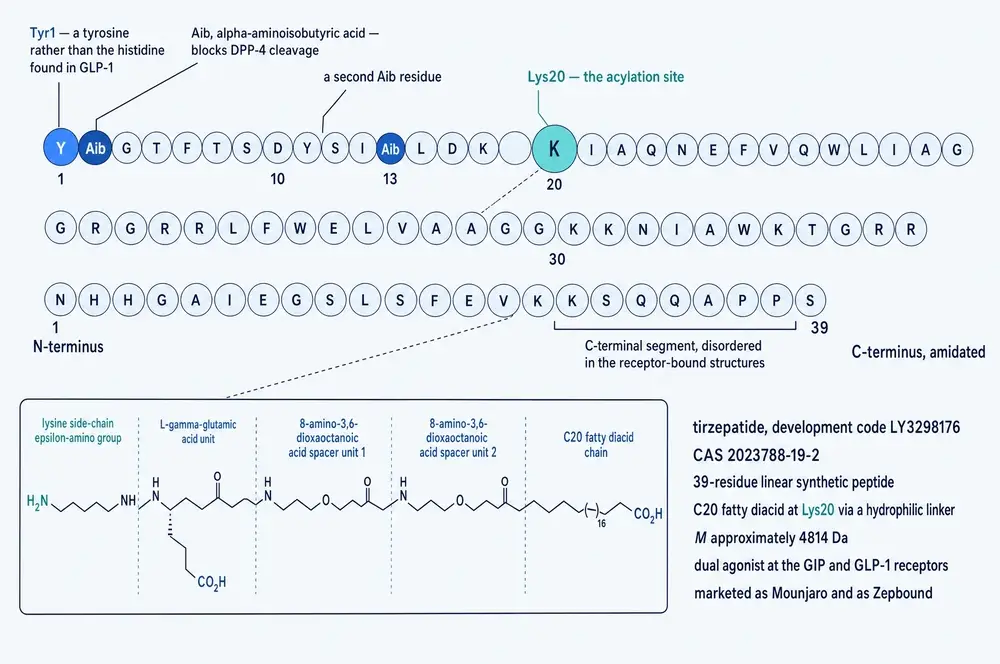
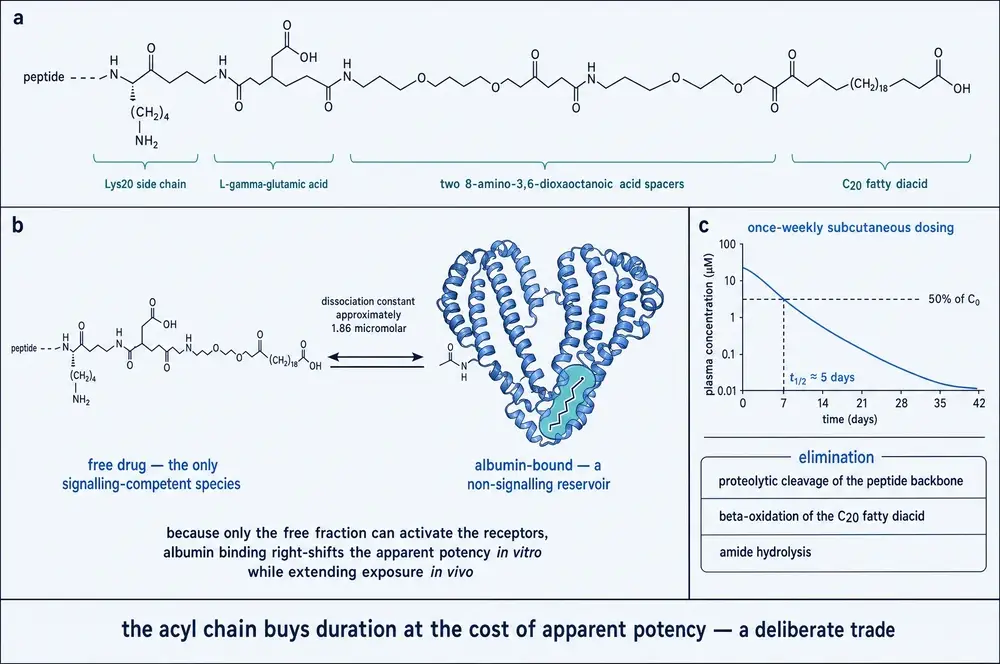
The fatty-acid trick is not original to tirzepatide — liraglutide carries palmitic acid and semaglutide a C18 diacid, and in each case the chain makes the peptide bind human serum albumin, which shields it from enzymes and slows its removal by the kidney. Tirzepatide's chain is longer, at twenty carbons. What is original is what the backbone is made of. Semaglutide is a GLP-1 analogue that had a fatty acid added to it. Tirzepatide is a GIP analogue that was made to activate the GLP-1 receptor as well.
That chain is what makes the dosing interval possible, and the mechanism is worth stating precisely because it also explains a peculiarity of the laboratory data. Roughly 99 per cent of the drug in circulation is bound to albumin at any moment, and bound drug cannot reach a receptor. The albumin pool is therefore a reservoir rather than an active species: it protects the peptide from enzymes and from the kidney, releasing it slowly, and the result is a half-life of about five days. The same binding depresses apparent potency in an assay run without albumin, which is why the numbers in section 05 are lower than a reader might expect. Duration was bought at the cost of apparent potency, deliberately.
03Where it came from
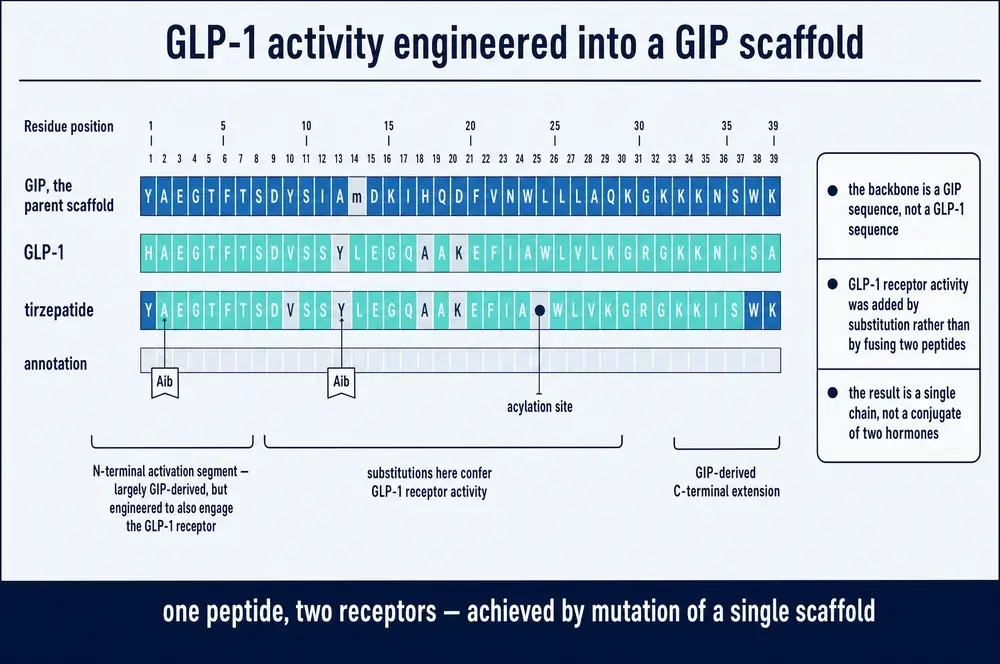
The intellectual step that made tirzepatide possible was published in 2013, five years before the compound had a name. Finan, working with DiMarchi and Tschöp, reported unimolecular dual incretins — single peptides carrying the pharmacology of two hormones at once — and showed they maximised metabolic benefit in rodents, monkeys and humans (Finan et al., 2013). The claim was not that GIP was therapeutically useful on its own. It was that a molecule engaging both receptors did more than a molecule engaging either.
Eli Lilly turned that into a development compound. Coskun, Sloop and colleagues characterised LY3298176 in cell lines expressing incretin receptors, then in mice, then in people. In mice, chronic administration cut body weight and food intake significantly more than a GLP-1 receptor agonist did — a murine result, and the first sign that the dual approach was not merely additive. The first-in-human study opened on 11 May 2016 (NCT02759107, verified against the registry): three parts, 142 participants receiving drug, placebo or dulaglutide as a positive control, running single doses in healthy volunteers, four-week repeat dosing, and finally a four-week proof of concept in patients with type 2 diabetes (Coskun et al., 2018).
That proof-of-concept study is where the compound stopped being interesting and started being important. At 10 mg and 15 mg, fasting serum glucose in the diabetic cohort fell by 49.1 and 43.2 mg/dL against placebo. Weight fell too, in healthy volunteers as well as patients. The adverse events were gastrointestinal, dose-dependent, and mild to moderate — a description that has not needed revision since.
04The question this document is built around
Everything that follows is easier to read with one result already in view, so here it is out of order.
SURPASS-CVOT (NCT04255433) randomised 13,299 people with type 2 diabetes and established atherosclerotic cardiovascular disease to tirzepatide or to dulaglutide, an older GLP-1 receptor agonist already shown to reduce cardiovascular events. It ran from 29 May 2020 to 12 June 2025 — both dates verified against the registry — and reported in the New England Journal of Medicine in November 2025. The primary endpoint, a composite of cardiovascular death, myocardial infarction or stroke, occurred in 12.2% of the tirzepatide group and 13.1% of the dulaglutide group: hazard ratio 0.92, 95.3% confidence interval 0.83 to 1.01, P = 0.003 for noninferiority and P = 0.09 for superiority (Nicholls et al., 2025).
Tirzepatide lowers HbA1c more than dulaglutide, and takes off several times as much weight. It did not prevent proportionally more cardiovascular events. That is not a scandal and it is not a failure — noninferiority to an agent with proven benefit is a real result, and the trial was not designed against placebo. But it is a genuine puzzle, and the way a reader resolves it determines what they think this drug is for. Part Four returns to it with the evidence needed to judge; Parts Two and Three are that evidence.
05Imbalanced, and biased
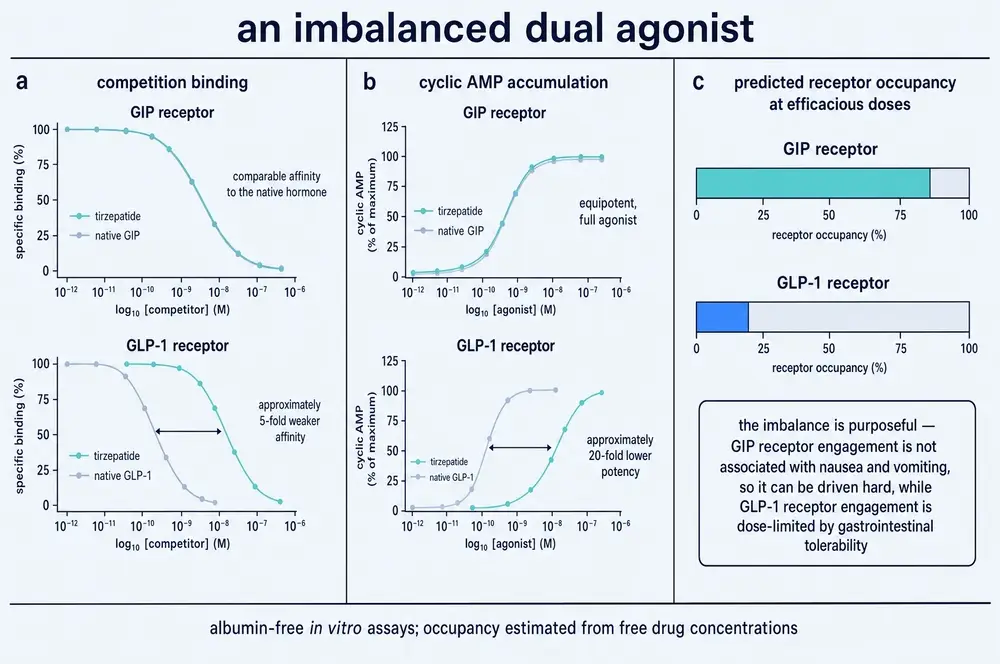
The natural assumption about a dual agonist is that it is balanced — that it hits both receptors roughly equally, and that the extra benefit comes from the sum. Tirzepatide is not balanced, and the finding that established this is one of the more surprising results in the compound's file.
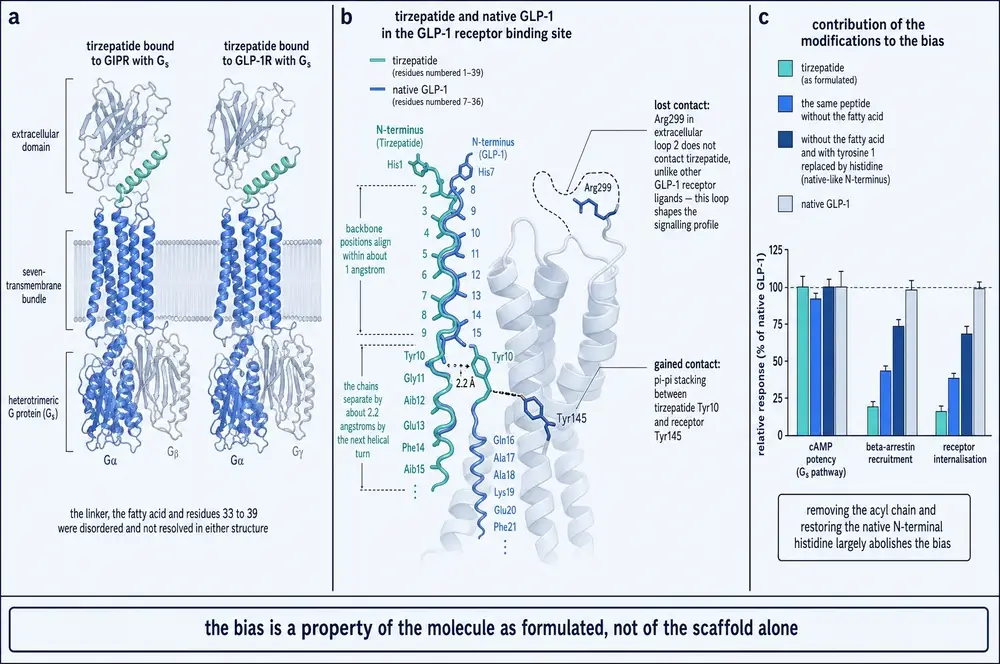
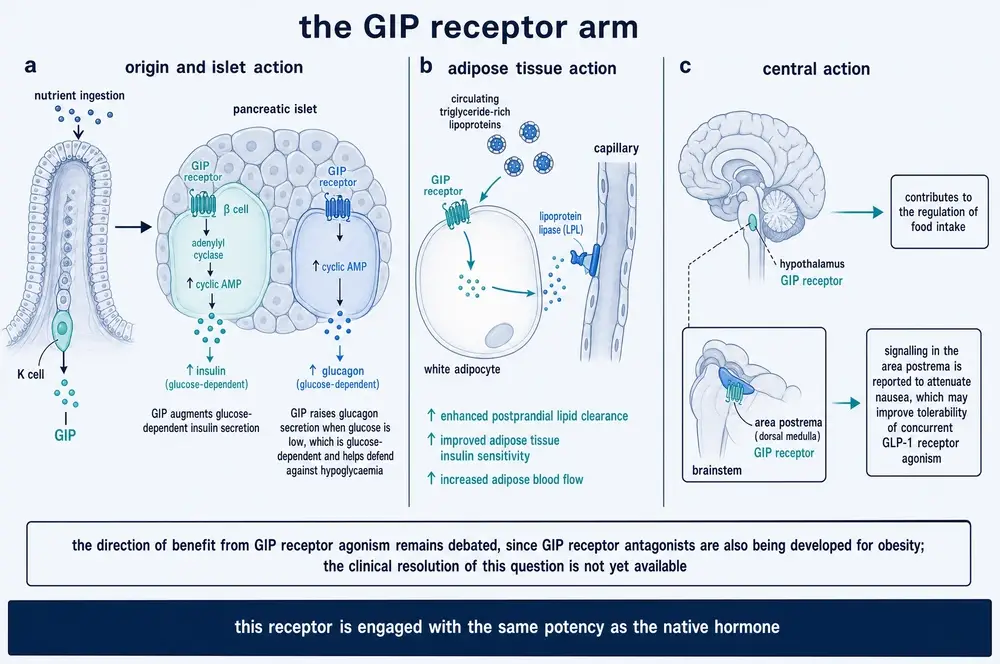
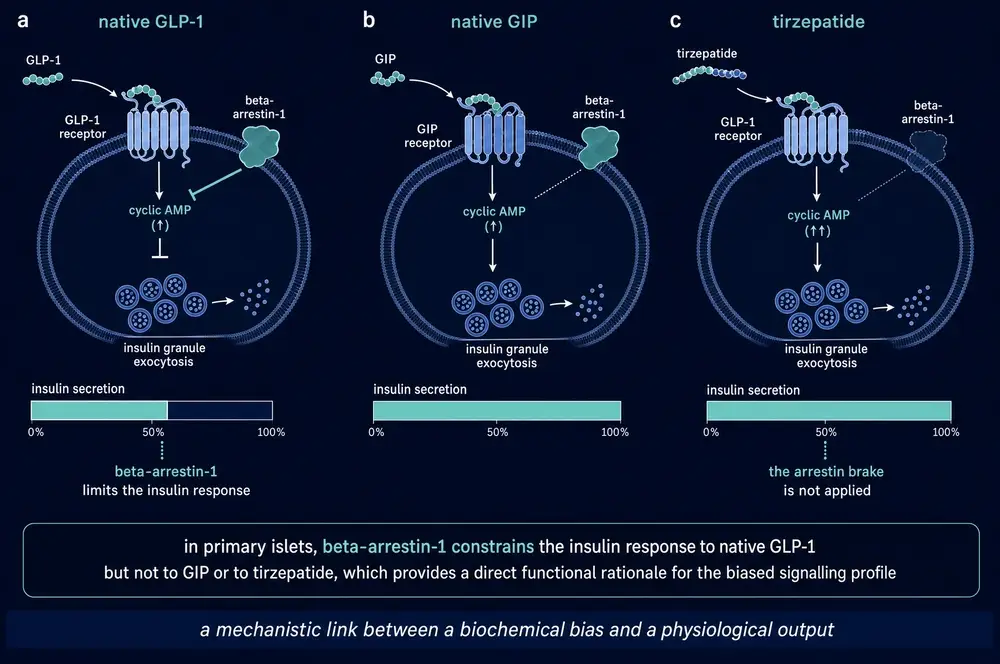
Willard and colleagues developed a method for calculating how much of each receptor is actually occupied at doses that work in patients, then measured what happens once the drug is bound. Two things came out of it (Willard et al., 2020). First, at clinically effective exposures tirzepatide engages the GIP receptor to a greater degree than the GLP-1 receptor. Second, the two engagements are qualitatively different. At the GIP receptor the drug behaves essentially like native GIP. At the GLP-1 receptor it does not: it favours cAMP generation over recruitment of β-arrestin, and it drives less receptor internalisation than GLP-1 itself does.
That second property has a name — biased agonism — and a consequence. β-arrestin normally acts as a brake: it pulls the activated receptor off the cell surface and damps the signal. In experiments on primary islets, β-arrestin1 limited the insulin response to GLP-1, but not the response to GIP or to tirzepatide. A drug that avoids the brake keeps signalling where the natural hormone would have been switched off.
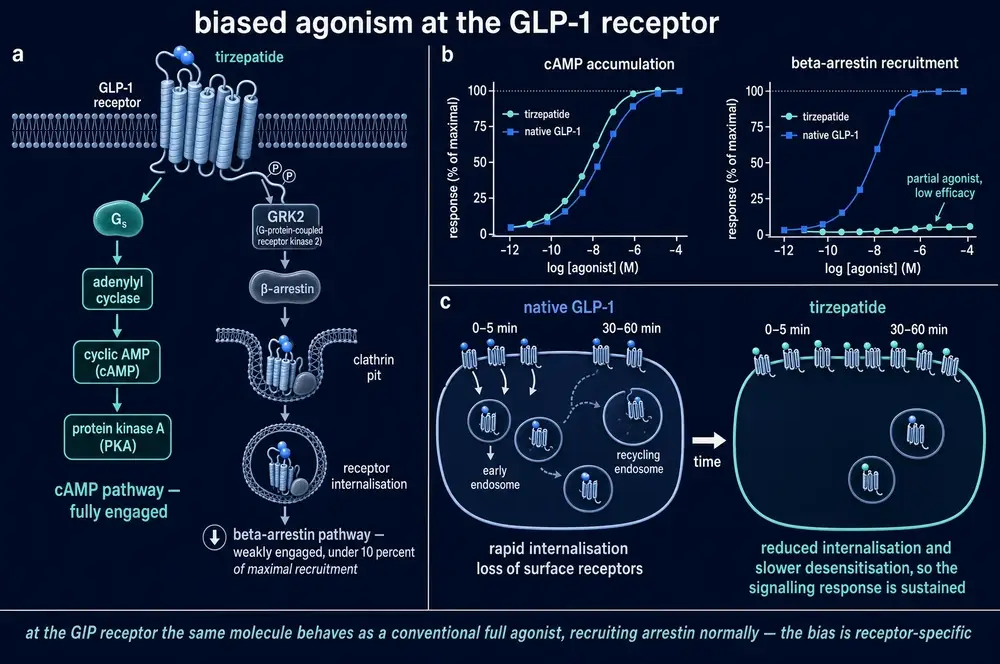
Independent pharmacological characterisation of mono-, dual- and tri-peptidic agonists at both receptors reached compatible conclusions about where tirzepatide sits in that space (Yuliantie et al., 2020), and a contemporaneous review asked the question the whole programme rests on — how GIP might enhance the therapeutic efficacy of GLP-1 rather than merely adding to it (Samms et al., 2020). It is worth being precise about the status of these findings. They are measurements in cells and in isolated islets. They are a plausible mechanism for a clinical effect. They are not a demonstration of one.
06The animal record
In mice, tirzepatide reduced body weight and food intake, and the reduction was significantly greater than that produced by a GLP-1 receptor agonist (Coskun et al., 2018). Glucose tolerance improved through action at both receptors, and insulin secretion remained glucose-dependent — that is, the drug amplified insulin release when glucose was high without forcing it when glucose was low, which is the property that keeps incretin drugs from causing hypoglycaemia on their own. Broader preclinical characterisation across models followed (Wilson et al., 2020).
These are murine results and they are reported here as murine results. Their importance is historical rather than evidential: they are the reason the compound went into people, and the human data in Parts Three and Four have long since superseded them as evidence about what the drug does.
07The GIP paradox
Here is the problem that the field has not solved.
Tirzepatide switches the GIP receptor on, and people lose weight. Maridebart cafraglutide switches the GIP receptor off — it is a GIP receptor antagonist joined to a GLP-1 agonist — and people lose weight too. Two drugs doing opposite things to the same receptor produce the same direction of effect. Both observations are from humans. At least one of the two mechanistic stories the field tells about GIP must be wrong, or incomplete, or dependent on context in a way nobody has pinned down.
A 2026 study set the two approaches against each other directly in male mice, comparing a GIP receptor agonist with a GIP receptor antagonist in lean and diet-induced obese animals (Davies et al., 2026). In lean mice neither compound changed food intake or body weight, though the agonist improved glucose tolerance. In obese mice both reduced food intake and body weight — and the antagonist produced the more sustained appetite suppression. Energy expenditure did not change in either group; weight loss matched pair-fed controls, meaning the effect ran through eating less rather than burning more. The two diverged elsewhere: the agonist improved glucose tolerance independently of weight loss, while the antagonist reduced insulin sensitivity relative to pair-fed controls and suppressed expression of lipolytic genes in adipose tissue.
That is a genuine conflict and this document does not resolve it. The authors' own conclusion is that the two strategies have distinct metabolic effects and that human studies are needed to understand the long-term consequences. Note also that these are male mice only, which is a real limit on how far the finding travels.
08How the weight actually comes off
Three human studies have gone looking for the mechanism, and between them they leave a gap they are honest about.
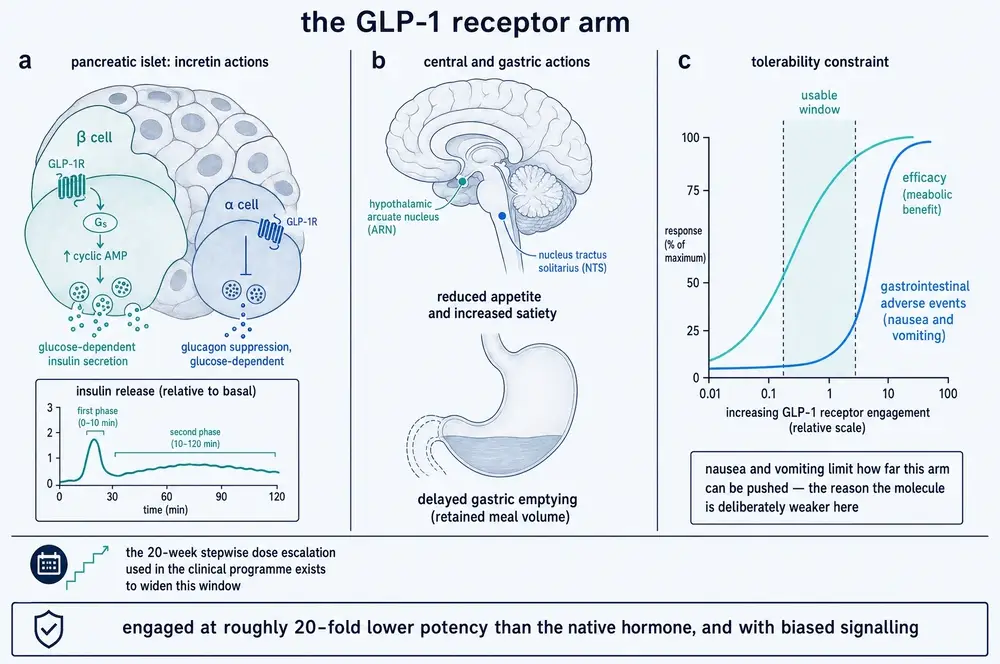
The most direct is a six-week phase 1 trial in 114 adults with overweight or obesity and without diabetes, randomised to tirzepatide, placebo, or open-label liraglutide (Martin et al., 2025). At an ad libitum lunch in week 3, participants on tirzepatide ate 524.6 kcal less than those on placebo. Overall appetite, food cravings, tendency to overeat, perceived hunger and reactivity to food in the environment all fell. What did not change was volitional restriction of intake — participants were not trying harder. Functional MRI showed no significant overall change in response to highly palatable food images, though activation to high-fat, high-sugar images fell in the medial frontal and cingulate gyri, orbitofrontal cortex and hippocampus.
The second is a phase 1 study in people with type 2 diabetes comparing tirzepatide 15 mg, semaglutide 1 mg and placebo over 28 weeks (Heise et al., 2023). Tirzepatide reduced body weight more than either comparator and produced greater loss of fat mass. Both drugs reduced appetite relative to placebo — and here is the finding that matters: appetite scores and energy-intake reductions did not differ between tirzepatide and semaglutide, and the difference in intake at an ad libitum lunch was not sufficient to explain the difference in weight outcome. Something other than measured eating is contributing, and this study could not say what.
The third looked for that something in energy expenditure (Ravussin et al., 2025). When people lose weight their metabolic rate normally falls by more than body size predicts — metabolic adaptation, the reason weight loss stalls. In calorie-restricted obese mice, tirzepatide blunted that fall and shifted the respiratory exchange ratio toward fat oxidation. In the accompanying phase 1 clinical trial the picture only half carried over: fat oxidation rose, appetite and calorie intake fell, but tirzepatide appeared to have no detectable effect on metabolic adaptation in humans. The species disagreement is stated plainly by the authors and is repeated here for the same reason: it is the clearest single instance in this file of a preclinical mechanism that did not translate.
09What happens to the pancreas
Weight is only half the story, and in type 2 diabetes it was not originally the point. A phase 1 mechanistic study randomised patients with type 2 diabetes to tirzepatide 15 mg, semaglutide 1 mg or placebo for 28 weeks, with hyperglycaemic-clamp measurement of islet function and insulin sensitivity (Heise et al., 2022). The primary endpoint was the clamp disposition index — a combined measure of how much insulin the β cell secretes and how well the body responds to it.
A later post-hoc analysis of SURMOUNT-1 asked the same question in people without diabetes: 2,539 participants with obesity or overweight and either prediabetes or normal glucose tolerance, modelled from oral glucose tolerance tests at 72 weeks (Mari et al., 2025). Both insulin sensitivity and β-cell function improved. The interesting part is the attribution: in multivariate models, the improvement in insulin sensitivity tracked mostly with weight reduction, while the improvement in β-cell function tracked mostly with tirzepatide treatment itself — partly independent of how much weight came off. That is a post-hoc modelling result and should be held as one, but it is the best available evidence that the drug is doing something to the β cell beyond making the person smaller.
10A curve that refused to flatten
Drug development usually looks for the dose at which benefit stops increasing, because beyond it you are buying only side effects. The phase 2 trial of tirzepatide did not find one.
Between May 2017 and March 2018, 318 people with poorly controlled type 2 diabetes were randomised to tirzepatide at 1, 5, 10 or 15 mg weekly, to dulaglutide 1.5 mg, or to placebo, for 26 weeks (Frias et al., 2018). Mean baseline HbA1c was 8.1%. The reductions were 1.06% at 1 mg, 1.73% at 5 mg, 1.89% at 10 mg and 1.94% at 15 mg, against 0.06% for placebo and 1.21% for dulaglutide. In the authors' words, the effect was dose-dependent and did not plateau.
That single sentence set the shape of everything after it. A dose–response still climbing at the highest dose tested means the trial has measured the limit of its own protocol rather than the limit of the drug, and it is why the phase 3 programme was built around three doses rather than one, and why 15 mg — the top of the phase 2 range — became the ceiling rather than the middle.
11SURPASS: six trials, six comparators
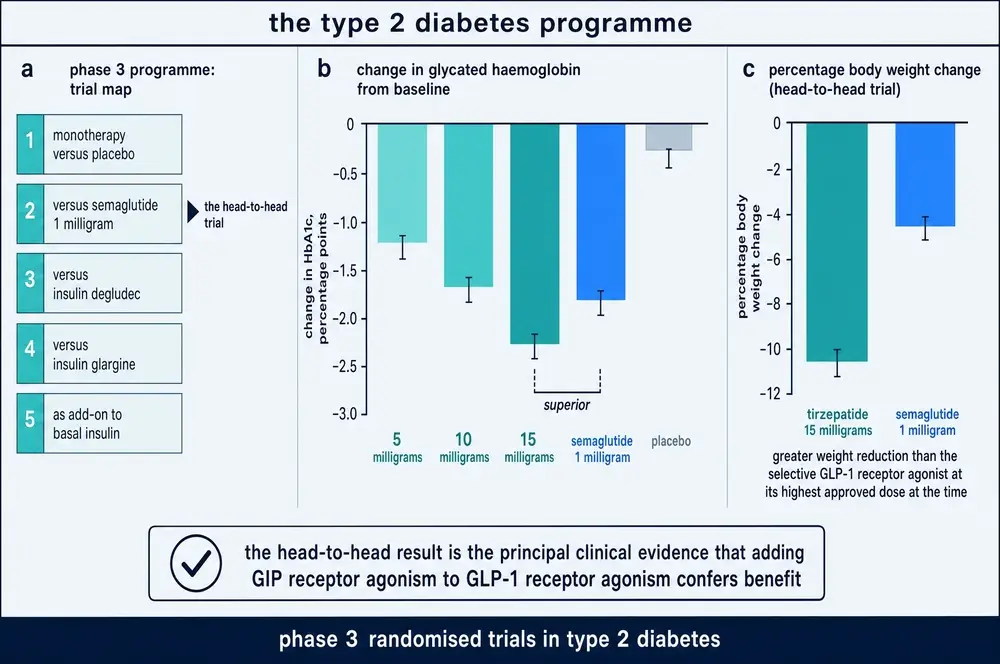
The phase 3 glycaemic programme was designed so that each trial removed a different objection. Rather than testing the drug repeatedly against placebo, it was set against, in turn, nothing, the best injectable in its own class, and three separate insulin strategies.
| Trial | Compared with | Weeks | n | HbA1c change, tirzepatide | Comparator |
|---|---|---|---|---|---|
| SURPASS-1 | Placebo, monotherapy | 40 | 478 | −1.87% to −2.07% | +0.04% |
| SURPASS-2 | Semaglutide 1 mg | 40 | 1,879 | −2.01% to −2.30% | −1.86% |
| SURPASS-3 | Insulin degludec | 52 | 1,444 | −1.93% to −2.37% | −1.34% |
| SURPASS-4 | Insulin glargine, high CV risk | 52 | 2,002 | −2.43% to −2.58% (10 and 15 mg) | −1.44% |
| SURPASS-5 | Placebo, added to glargine | 40 | 475 | −2.11% to −2.40% | −0.86% |
| SURPASS-6 | Insulin lispro, added to glargine | 52 | 1,428 | −2.1% (pooled) | −1.1% |
Two results in that table carry more weight than the rest. SURPASS-3 and SURPASS-6 both put tirzepatide against insulin, which is the therapy of last resort in type 2 diabetes and the one that reliably causes weight gain. In SURPASS-3 tirzepatide reduced body weight by 7.5 to 12.9 kg while insulin degludec increased it by 2.3 kg (Ludvik et al., 2021). That is a swing of roughly 10 to 15 kg between two treatments achieving similar or better glucose control, and it is the practical case for the drug in diabetes.
SURPASS-4 deserves separate mention because it was the first cardiovascular signal. In 2,002 people with type 2 diabetes and elevated cardiovascular risk, adjudicated MACE-4 events occurred in 109 participants, with a hazard ratio for tirzepatide versus insulin glargine of 0.74 (95% CI 0.51 to 1.08) (Del Prato et al., 2021). The trial was not powered for that endpoint and the interval crosses one, so the honest reading at the time was that tirzepatide showed no excess cardiovascular risk. It was widely read as more encouraging than that. Keep the number in mind for section 21.
Hypoglycaemia is worth noting because it is the standard cost of lowering glucose hard. It did not appear. In SURPASS-1 no clinically significant or severe hypoglycaemia was reported on tirzepatide at all; in SURPASS-4, hypoglycaemia occurred in 6–9% of the tirzepatide groups against 19% on glargine, and in participants not taking a sulfonylurea the gap was 1–3% against 16%. This is the glucose-dependence of incretin action doing what the pharmacology predicted.
12Head to head, twice
Two trials compared tirzepatide directly with semaglutide, the drug it was always going to be measured against.
SURPASS-2 was open-label, 40 weeks, 1,879 patients with type 2 diabetes randomised to tirzepatide 5, 10 or 15 mg or semaglutide 1 mg (Frías et al., 2021). HbA1c fell 2.01, 2.24 and 2.30 percentage points on tirzepatide against 1.86 on semaglutide; the differences were −0.15 (95% CI −0.28 to −0.03), −0.39 and −0.45 percentage points. All three doses were noninferior and superior. Weight differences favoured tirzepatide by 1.9, 3.6 and 5.5 kg.
SURMOUNT-5 asked the same question in obesity without diabetes, and it is the cleaner comparison because both drugs were given at their maximum tolerated dose rather than at a fixed one (Aronne et al., 2025). Over 72 weeks in 751 participants, weight fell 20.2% on tirzepatide (10 or 15 mg) against 13.7% on semaglutide (1.7 or 2.4 mg). Waist circumference fell 18.4 cm against 13.0 cm. Participants on tirzepatide were more likely to reach every threshold tested, up to 25% of body weight.
13SURMOUNT-1, and the number that changed the field
SURMOUNT-1 randomised 2,539 adults with obesity, or overweight with a weight-related complication, excluding diabetes, to tirzepatide 5, 10 or 15 mg or placebo for 72 weeks (Jastreboff et al., 2022). Mean baseline weight was 104.8 kg. Mean weight change was −15.0%, −19.5% and −20.9% against −3.1% on placebo.
The averages understate what happened. At 15 mg, 91% of participants lost at least 5% of body weight and 57% lost at least a fifth of it, against 3% on placebo. Before these drugs, a fifth of body weight was territory that belonged to bariatric surgery.
Related trials filled in the edges. SURMOUNT-2, in 938 people who had both obesity and type 2 diabetes, produced smaller reductions — 12.8% and 14.7% at 10 and 15 mg against 3.2% on placebo (Garvey et al., 2023) — which is a consistent finding across this drug class and worth flagging: people with diabetes lose less weight on these drugs than people without it. SURMOUNT-3 asked whether the drug added anything after a successful lifestyle programme, randomising only those who had already lost at least 5%; it produced a further 18.4% loss against a 2.5% regain on placebo (Wadden et al., 2023). SURMOUNT-J in Japan and SURMOUNT-CN in China reproduced the effect in East Asian populations at lower baseline body weights (Kadowaki et al., 2025; Zhao et al., 2024).
14Three years, and the diabetes that did not arrive
The most consequential long-term result concerns people who had obesity and prediabetes but not yet diabetes. Within SURMOUNT-1, 1,032 such participants continued for 176 weeks — a little over three years — followed by 17 weeks off treatment (Jastreboff et al., 2025).
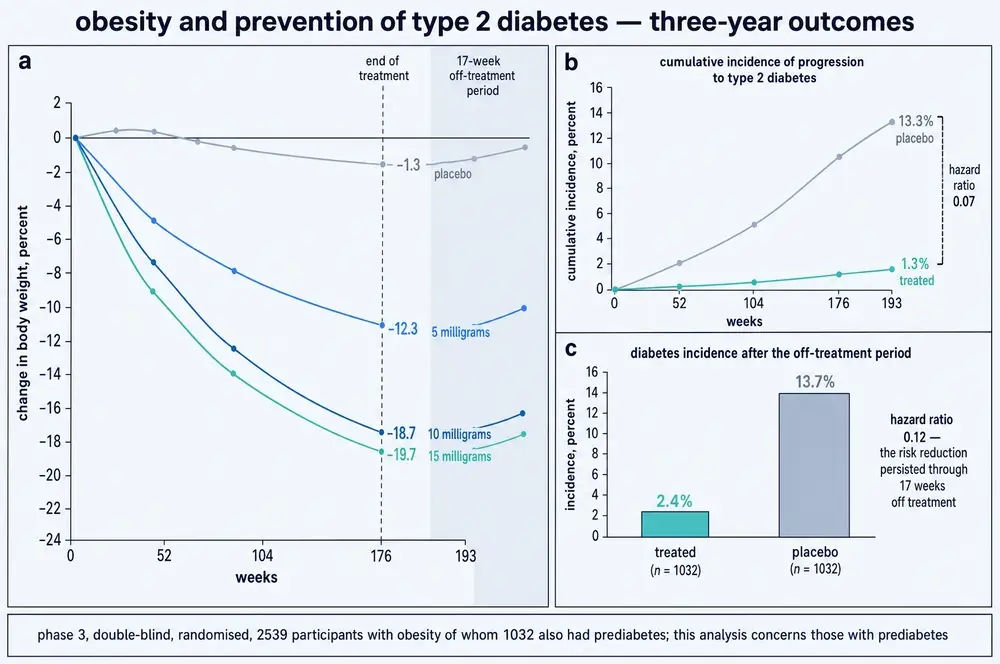
Weight change at 176 weeks was −12.3%, −18.7% and −19.7% across the three doses against −1.3% on placebo. Weight loss achieved at 72 weeks was, in other words, largely still there at three years. And type 2 diabetes was diagnosed in 1.3% of those on tirzepatide against 13.3% on placebo — a hazard ratio of 0.07 (95% CI 0.0 to 0.1). After 17 weeks off drug the figures were 2.4% and 13.7%, hazard ratio 0.12.
Two things follow. The first is that in this population the progression to diabetes was very largely prevented rather than merely postponed within the window observed. The second is the caveat the numbers themselves contain: the gap narrowed once treatment stopped, from 0.07 to 0.12, in only 17 weeks. That points directly at the next section.
15What happens when it stops
This is the single most practically important fact in the document, and it was established by a trial designed to find it.
SURMOUNT-4 gave 783 adults with obesity open-label tirzepatide at maximum tolerated dose for 36 weeks, during which they lost a mean of 20.9% of body weight. It then randomised 670 of them, blind, either to continue the drug or to switch to placebo, for a further 52 weeks (Aronne et al., 2024). From week 36 to week 88 the continuing group lost a further 5.5%. The withdrawn group regained 14.0%. The difference was 19.4 percentage points. At week 88, 89.5% of those still on treatment had kept at least four-fifths of what they had lost; among those switched to placebo, 16.6% had.
SURMOUNT-MAINTAIN, reported in 2026, refined the question by asking whether a reduced dose would hold the line (Horn et al., 2026). After a 60-week weight-loss period, 378 participants were randomised to maximum tolerated dose, to a reduction to 5 mg, or to placebo. At week 112 the changes from baseline were −21.9%, −16.6% and −9.9%. Among participants who regained at least half of what they had lost, rescue therapy was needed by 8% of the maximum-dose group, 25% of the reduced-dose group and 67% of the placebo group. A lower dose does hold much of the benefit; stopping does not.
Real-world evidence says this matters, because discontinuation is common. A 2026 review in Nature Reviews Endocrinology concludes that persistence on these drugs is often poor, with many people stopping within the first year for gastrointestinal side effects, cost, or disappointment with the result, and that weight regain and deterioration of cardiometabolic risk factors follow (Ceriello et al., 2026). The same review raises a concern that has not been settled: repeated cycles of starting and stopping produce fluctuations in weight and HbA1c, both of which are themselves risk factors, and incretin drugs are not thought to stabilise atherosclerotic plaque. A narrative review the same year found the discontinuation literature inconsistent in its definitions and largely silent on patient behaviour, and noted that discontinuation is frequently temporary rather than permanent (Heisey et al., 2026).
16Populations at the edges
Four studies extend the record into groups the main programme excluded. Each is small, and each is reported here with its size attached.
Children and adolescents. SURPASS-PEDS randomised 99 participants aged 10 to under 18 with youth-onset type 2 diabetes inadequately controlled on metformin or basal insulin, to tirzepatide 5 mg, 10 mg or placebo for 30 weeks (Hannon et al., 2025). Pooled HbA1c fell 2.23% against a 0.05% rise on placebo. Youth-onset type 2 diabetes has historically responded worse to treatment than the adult disease, which is what makes this result notable.
Type 1 diabetes. A 12-week phase 2 trial randomised 24 adults with type 1 diabetes and a BMI over 30 to tirzepatide or placebo (Snaith et al., 2026). Twenty-two completed. Weight fell 10.3 kg against 0.7 kg, a difference of 8.7 kg or 8.8% of body weight; total daily insulin fell by 24.2 units per day, 35.1% more than placebo. This is 24 people for twelve weeks and it is an investigational use. It is reported because a trial exists, not because a conclusion is available.
Genetic obesity. Among 2,291 SURMOUNT-1 participants with genetic data, 32 — 1.4% — carried pathogenic mutations in the melanocortin-4 receptor gene, the commonest single-gene cause of obesity (Bhatnagar et al., 2025). They started heavier (BMI 40 against 38) and lost essentially the same proportion: 18.3% against 19.9% over 72 weeks. A drug that works through appetite might have been expected to fail in people whose appetite pathway is broken at the receptor. It did not.
East Asian populations. SURMOUNT-J randomised 225 Japanese adults with obesity disease; treatment differences against placebo at 72 weeks were 16.1% and 21.1% at 10 and 15 mg, with 94–96% reaching at least 5% weight reduction against 20% on placebo (Kadowaki et al., 2025). SURMOUNT-CN reported comparable results in Chinese adults (Zhao et al., 2024).
17Sleep apnoea
Obstructive sleep apnoea is caused, in most people who have it, by excess tissue around the airway. It has been treated for forty years with a machine that holds the airway open by air pressure, because nothing given by mouth or needle moved the underlying problem. SURMOUNT-OSA is the first trial in which a drug did.
Two parallel phase 3 trials enrolled adults with moderate-to-severe obstructive sleep apnoea and obesity: trial 1 those not using positive airway pressure, trial 2 those who were (Malhotra et al., 2024). Participants received maximum tolerated tirzepatide, 10 or 15 mg, or placebo, for 52 weeks. The primary endpoint was change in the apnoea–hypopnoea index — the number of breathing interruptions per hour of sleep. Baseline values were severe: 51.5 events per hour in trial 1 and 49.5 in trial 2.
At 52 weeks the index fell by 25.3 events per hour in trial 1 against 5.3 on placebo, a treatment difference of 20.0 (95% CI −25.8 to −14.2); and by 29.3 against 5.5 in trial 2, a difference of 23.8. Hypoxic burden, patient-reported sleep impairment, high-sensitivity C-reactive protein and systolic blood pressure all improved. A 2026 report of the prespecified secondary cardiometabolic outcomes followed (Malhotra et al., 2026).
Roughly half the apnoea was removed. That is a large effect on a mechanically caused disease, and the mechanism is not mysterious — it is the weight. What the trial does not establish is whether removing half the apnoea removes the cardiovascular risk that severe apnoea carries; the endpoint was the index, not events.
18Heart failure with a preserved ejection fraction
HFpEF is heart failure in which the heart squeezes normally but fills badly. It is strongly associated with obesity, it accounts for about half of all heart failure, and it has been notoriously resistant to drugs.
SUMMIT randomised 731 patients with heart failure, an ejection fraction of at least 50% and a BMI of at least 30, to tirzepatide up to 15 mg or placebo, for at least 52 weeks with a median follow-up of 104 weeks (Packer et al., 2025). There were two primary endpoints. The composite of adjudicated cardiovascular death or a worsening heart-failure event occurred in 36 patients (9.9%) on tirzepatide against 56 (15.3%) on placebo, hazard ratio 0.62 (95% CI 0.41 to 0.95, P = 0.026). The Kansas City Cardiomyopathy Questionnaire clinical summary score improved by 19.5 points against 12.7, a difference of 6.9 (95% CI 3.3 to 10.6).
The composite deserves to be taken apart, because the two components did not move together. Worsening heart-failure events fell clearly: 29 (8.0%) against 52 (14.2%), hazard ratio 0.54 (0.34 to 0.85). Cardiovascular deaths went the other way in absolute count — 8 (2.2%) against 5 (1.4%), hazard ratio 1.58 with a confidence interval running from 0.52 to 4.83. Thirteen deaths is far too few to conclude anything, and the interval says so in both directions. But a reader told only that "SUMMIT reduced cardiovascular death or worsening heart failure by 38%" has been given a true statement that conceals which component carried it.
Supporting analyses of SUMMIT extended the picture rather than changing it: tirzepatide reduced left-ventricular mass and paracardiac adipose tissue on imaging (Kramer et al., 2025), improved measures of circulatory overload and end-organ damage (Borlaug et al., 2025), altered the clinical trajectory of the disease (Zile et al., 2025), and the effects were consistent across patients with and without chronic kidney disease and with and without diabetes (Packer et al., 2025).
19Liver
Metabolic dysfunction-associated steatohepatitis — MASH, formerly NASH — is fat in the liver that has progressed to inflammation and scarring. SYNERGY-NASH was a phase 2 dose-finding trial in 190 participants with biopsy-confirmed MASH and stage F2 or F3 fibrosis, randomised to tirzepatide 5, 10 or 15 mg or placebo for 52 weeks (Loomba et al., 2024).
Resolution of MASH without worsening of fibrosis occurred in 10% on placebo against 44%, 56% and 62% across the three doses. Improvement of at least one fibrosis stage without worsening of MASH occurred in 30% on placebo against 55%, 51% and 51%.
Three qualifications belong with those numbers, and the trial report states all of them. Of 190 randomised, 157 had an evaluable biopsy at 52 weeks; missing values were imputed on the assumption that they would follow the placebo pattern. The fibrosis differences have confidence intervals whose lower bounds run to 1, 1 and 5 percentage points — the effect on fibrosis is much less securely established than the effect on inflammation. And this was phase 2; the authors called explicitly for larger and longer trials. A phase 3 report appeared in the New England Journal of Medicine in 2026. A separate analysis examined how metabolic response relates to histological response (Caussy et al., 2025).
Upstream of the biopsy findings, the SURPASS-3 MRI substudy had already shown that tirzepatide reduces liver fat content and both visceral and subcutaneous abdominal adipose tissue more than insulin degludec (Gastaldelli et al., 2022).
20Kidney
The kidney signal has been consistent and is mostly about albuminuria — protein leaking into the urine, an early marker of kidney damage. A post-hoc analysis of SURPASS-4 compared tirzepatide with insulin glargine on rates of eGFR decline and urine albumin-to-creatinine ratio in people at high cardiovascular risk (Heerspink et al., 2022). A pooled post-hoc analysis across the SURPASS trials found reduced albuminuria (Apperloo et al., 2025).
The strongest test came from SURPASS-CVOT, whose prespecified exploratory kidney analysis compared tirzepatide with dulaglutide across the whole trial population and within low-to-moderate and high-risk chronic kidney disease strata, using a composite of persistent macroalbuminuria, persistent 50% eGFR decline, end-stage kidney disease or kidney death, with eGFR calculated from combined creatinine and cystatin C (Zoungas et al., 2026). A companion analysis reported cardiorenal outcomes (Nissen et al., 2026). The comparison to hold in mind is that these are tirzepatide against an active drug that itself has kidney benefit, not against placebo.
21SURPASS-CVOT
This is the result the document was built around.
SURPASS-CVOT (NCT04255433) was a double-blind, active-comparator-controlled noninferiority trial at 640 sites in 30 countries. It randomised 13,299 people with type 2 diabetes and established atherosclerotic cardiovascular disease, 1:1, to tirzepatide up to 15 mg or dulaglutide 1.5 mg weekly; 134 were later excluded, leaving 6,586 and 6,579 in the modified intention-to-treat population. Mean age was 64.1 years, 29.0% were women, mean BMI 32.6, mean HbA1c 8.4%, mean diabetes duration 14.7 years. The trial ran from 29 May 2020 to 12 June 2025, both dates verified against the registry record rather than a summary of it. The primary endpoint was cardiovascular death, myocardial infarction or stroke, with a noninferiority margin of 1.05 on the upper bound of the 95.3% confidence interval, and superiority declared only if that bound fell below 1.00 (Nicholls et al., 2025).
A primary event occurred in 801 patients (12.2%) on tirzepatide and 862 (13.1%) on dulaglutide. Hazard ratio 0.92; 95.3% confidence interval 0.83 to 1.01; P = 0.003 for noninferiority; P = 0.09 for superiority. Adverse events were broadly similar, with more gastrointestinal events on tirzepatide.
22Reading the gap
Set the effect sizes side by side. Against dulaglutide, tirzepatide lowers HbA1c by roughly an additional half a percentage point or more and produces several times the weight loss. In SURPASS-CVOT it reduced the primary cardiovascular endpoint by a relative 8%, with an interval that touches no effect at all. If glucose and weight were the levers driving macrovascular outcome in this population, the outcome difference should have been larger than it was.
Three explanations are on the table, and the published commentary argues all three (Kaul, 2026; Sun et al., 2026).
| Explanation | What it claims | What would test it |
|---|---|---|
| Comparator ceiling | Dulaglutide had already captured most of the achievable event reduction; there was little headroom left to win | A placebo-controlled trial, which will not now be run in this population for ethical reasons |
| Weak surrogates | HbA1c and body weight are poorer drivers of macrovascular events than assumed; the extra metabolic effect does not convert | Mediation analyses; consistency with other agents whose weight and glucose effects differ |
| Power and duration | The trial was sized for noninferiority; a genuine 8% relative benefit would need a larger or longer study to prove | Longer follow-up, pooled analyses across the programme |
A prespecified exploratory analysis attempted to recover the missing placebo arm arithmetically (Sattar et al., 2026). It took the hazard ratio for tirzepatide against dulaglutide from SURPASS-CVOT and multiplied it by the hazard ratio for dulaglutide against placebo from REWIND, an earlier trial, restricted to the 2,055 REWIND participants who would have been eligible for SURPASS-CVOT and adjusted by propensity score. The result: tirzepatide against imputed placebo, hazard ratio 0.72 (95% CI 0.55 to 0.94) for the primary composite, 0.70 for cardiovascular death or heart-failure events, and 0.61 (0.45 to 0.82) for all-cause death.
Those are attractive numbers and they should be handled carefully. This is an indirect comparison between two trials run in different eras with different background therapy, and the authors label it exploratory. It is evidence that tirzepatide is very probably better than nothing at preventing these events. It is not evidence of the same kind as a placebo-controlled result, and quoting 0.72 without the word "imputed" attached would misrepresent what was done.
The defensible position, on the evidence as it stands in August 2026, is this. Tirzepatide is not cardiovascularly harmful; on this point the trial is large and clear. It is very probably beneficial relative to no treatment, on indirect evidence. It has not been shown to be more beneficial than an established GLP-1 receptor agonist, despite being substantially more effective on every metabolic measure. Anyone who tells you the cardiovascular case for tirzepatide is settled — in either direction — is overreading a hazard ratio of 0.92 whose upper bound is 1.01.
23The gastrointestinal tax
Every trial in Parts Three and Four reports the same adverse-event profile, which is unusual enough to be worth stating as a finding in its own right: the side effects of this drug have not changed as the programme has grown. They are gastrointestinal — nausea, vomiting, diarrhoea, constipation, decreased appetite — mostly mild to moderate, and they cluster in the dose-escalation period rather than persisting.
The rates scale with dose and with the comparator. In SURPASS-1, against placebo, nausea ran 12–18% against 6%, diarrhoea 12–14% against 8%, vomiting 2–6% against 2% (Rosenstock et al., 2021). In SURPASS-4, against insulin glargine, nausea ran 12–23% against 2% and decreased appetite 9–11% against under 1% (Del Prato et al., 2021). Against semaglutide in SURPASS-2 the two drugs were close: nausea 17–22% against 18%, diarrhoea 13–16% against 12%, vomiting 6–10% against 8% (Frías et al., 2021).
Discontinuation is the number that matters, because a side effect people tolerate is different from one that ends treatment. In SURMOUNT-1, adverse events caused discontinuation in 4.3%, 7.1% and 6.2% across the three doses against 2.6% on placebo (Jastreboff et al., 2022). In SURPASS-5 premature discontinuation of treatment for any reason reached 18% in the 15 mg arm against 3% on placebo (Dahl et al., 2022).
Outside trials the picture is worse, and section 15 has already given the reason it matters: real-world persistence is often poor, many people stop within the first year, and weight regain follows (Ceriello et al., 2026). A trial population is selected, supported and followed; it is not a good guide to how long people actually stay on a drug they inject weekly for an indefinite period.
24What comes off besides fat
When body weight falls by a fifth, some of what leaves is lean tissue. This is true of any substantial weight loss, including surgical and dietary, and it is not specific to incretin drugs — but the magnitude of loss these drugs produce has made it a live question.
The best-characterised measurement comes from the SURPASS-3 MRI substudy, in which thigh muscle volume, a muscle-volume Z score invariant to sex, height, weight and BMI, and muscle fat infiltration were quantified before and after 52 weeks, with the results contextualised against longitudinal MRI data from UK Biobank participants (Sattar et al., 2025). The choice of a population reference is the important methodological move: it allows the question to be "is this more muscle loss than this amount of weight loss normally produces?" rather than simply "did muscle volume fall?" A 2026 commentary argues the same point — that lean-mass change during tirzepatide-induced weight loss needs interpreting beyond the quantitative number, since lean mass includes water and the tissue lost is not uniformly functional muscle (Uyanık et al., 2026).
The most direct test of whether it matters is a trial that tried to prevent it. EMBRAZE, a randomised, double-blind, placebo-controlled phase 2 study, gave 102 adults with overweight or obesity tirzepatide plus either apitegromab — a monoclonal antibody that selectively inhibits myostatin activation — or placebo (Pratley et al., 2026). At 24 weeks the apitegromab group had lost 1.9 kg less lean mass (80% CI 1.2 to 2.7, P = 0.001), a 54.9% retention of lean mass relative to placebo, with similar total weight loss in both arms. Adverse events were balanced; one serious adverse event in each arm.
That is a proof of concept in 102 people over 24 weeks, reported with an 80% confidence interval rather than the conventional 95%. It shows lean-mass loss can be pharmacologically separated from fat loss. It does not show that doing so improves strength, function, or any clinical outcome, and the authors do not claim it does.
25Gallstones, and a pancreas that was not damaged
Two adverse signals are commonly named together and the evidence for them points in opposite directions.
Biliary disease is real. A meta-analysis of 12 randomised controlled trials totalling 12,351 patients found tirzepatide associated with gallbladder or biliary disease at a risk ratio of 1.52 (95% CI 1.17 to 1.98) and with cholelithiasis specifically at 1.67 (1.14 to 2.44), with no heterogeneity between trials and no dose–response relationship (Gong et al., 2025). The mechanism is not obscure: rapid weight loss of any cause promotes gallstone formation, and incretin drugs also slow gallbladder emptying. The absence of a dose–response is consistent with the weight loss rather than the drug concentration being the driver.
Pancreatitis, on current evidence, is not. Acute pancreatitis has been a class concern for incretin drugs since the earliest GLP-1 agonists. A retrospective cohort using a population-scale federated database identified 740,370 patients with type 2 diabetes, of whom 29,423 were taking a GLP-1 receptor agonist including tirzepatide; 20,459 were propensity-matched to untreated controls, with known alternative causes of pancreatitis excluded from both arms (Nieto et al., 2026). Not only was the risk of developing acute pancreatitis not increased — among those who did develop it, the treated group had lower rates of complicated pancreatitis (HR 0.32, 95% CI 0.14 to 0.74), need for parenteral nutrition (HR 0.28) and sepsis (HR 0.71). A separate 2026 dose–response analysis examined tirzepatide specifically (Benny et al., 2026).
Observational data of this kind carry confounding by indication that no propensity model fully removes, and the finding of benefit should be treated more sceptically than the finding of no harm. The reasonable summary is that the pancreatitis signal has not materialised at the scale it was feared, while the gallstone signal has.
26Four signals, weighed
A drug taken by millions of people generates reports of everything. Sorting the signal requires asking what kind of study produced each one.
Eyes. Concern arose from two directions: the historical observation that rapid glucose lowering can transiently worsen diabetic retinopathy, and case reports of non-arteritic anterior ischaemic optic neuropathy. The largest relevant study is a propensity-matched retrospective cohort of 173,846 patients — 86,923 per arm — comparing tirzepatide initiators with matched patients receiving lifestyle intervention alone (Shah et al., 2026). At 12 months tirzepatide was associated with reduced risk across the board: incident mild non-proliferative retinopathy RR 0.864, proliferative retinopathy RR 0.705, retinopathy with macular oedema RR 0.624, vitreous haemorrhage RR 0.607, tractional retinal detachment RR 0.370, anti-VEGF injection RR 0.479, panretinal photocoagulation RR 0.610. A 2025 commentary reassessed the risk in the same direction (Zhang et al., 2025). This is observational, and the comparator — lifestyle alone — means the comparison includes the benefit of treating diabetes at all. But the direction is opposite to the concern.
Bone. A 2025 study found that tirzepatide reduced bone mass accrual in db/db mice, and traced the mechanism through the gut: the drug altered microbial diversity and depleted Lachnospiraceae, a pro-osteogenic genus, with the effect reversed by transplanting the missing bacteria back (Chen et al., 2025). Tirzepatide did not directly affect osteoblast or osteoclast differentiation in culture. This is a murine result with a mechanistic chain, and it is the kind of finding that deserves following. The available human data point the other way: a 2026 study of skeletal effects in patients at increased fracture risk (Liu et al., 2026), and cohort work reporting lower fall and femoral fracture risk with semaglutide and tirzepatide than with comparator drugs. Mouse bone and human fracture are not the same endpoint, and neither answers the other.
Thyroid. Rodent C-cell tumours drove a class warning for GLP-1 agonists. A 2026 systematic review and meta-analysis examined incretin-based therapy and thyroid cancer risk (Eisa et al., 2026), alongside a broader safety-profile evaluation (Anatriello et al., 2026). Case reports continue to appear and remain case reports.
Psychiatric. Reports of suicidal ideation prompted regulatory review internationally. A 2026 systematic review examined the association between GLP-1 receptor agonists and suicidality (Au et al., 2026). Pharmacovigilance databases are useful for generating hypotheses and poor at testing them, because reporting is driven by publicity as much as by incidence.
27A stomach that has not emptied
These drugs slow gastric emptying — that is part of how they work. The practical consequence is anaesthetic: a patient who has fasted the standard interval before a procedure may still have food in the stomach, and stomach contents under sedation can be aspirated into the lungs.
The question is how long a drug held weekly needs to be withheld. A 2026 study asked whether one week is enough by measuring residual gastric content after tirzepatide discontinuation (Hidiroglu et al., 2026); its title poses the question rather than closing it. The wider anaesthesia literature remains unsettled, with some cohort work reporting low rates of anaesthesia-related complications in practice. The honest position is that this is an active area of disagreement among the specialties that have to make the decision.
28What is sold is not always what was studied
Every number in this monograph was generated using pharmaceutical-grade tirzepatide manufactured to a regulatory specification and administered under protocol. A substantial and growing share of the tirzepatide actually reaching people is not that substance.
During the shortages of 2023–2024, compounded tirzepatide became widely available in the United States, frequently as fixed-dose combinations with vitamin B12 analogues, marketed as equivalent or "personalised" alternatives to approved product. These combinations undergo no evaluation of potency or impurity profile.
In 2026, samples of compounded tirzepatide–B12 products obtained from various sources in the United States market were tested analytically (Jordan et al., 2026). The testing identified a widespread and previously unidentified impurity, arising from a chemical reaction between tirzepatide and certain analogues of vitamin B12. It was present at substantial levels. The products continued to be mass-marketed while it was there.
Two things should be said precisely. The clinical effect of this impurity is unknown — the authors say so, and no harm has been demonstrated. And the finding is not that compounding is inherently unsafe; it is that combining two substances that were never tested together can create a third substance that nobody looked for. That is exactly the class of problem a drug-approval process exists to catch, and the reason it was not caught here is that nobody was required to look.
29What is not known
A monograph is more useful for what it declines to claim than for what it asserts. The following are open.
| Question | Status |
|---|---|
| Does tirzepatide reduce cardiovascular events against no treatment? | Never tested directly. Only an indirect, exploratory estimate exists, and no placebo-controlled outcome trial is likely to be conducted in this population |
| Why does it outperform semaglutide? | Measured appetite and energy intake do not differ enough to explain the difference in weight outcome |
| Is GIP agonism responsible? | Unresolved. Selective GIP agonism does far less; GIP antagonism also causes weight loss |
| What happens beyond about three years? | The longest randomised exposure reported is 176 weeks |
| Long-term musculoskeletal consequence of repeated large weight loss? | Lean-mass loss is measurable and can be pharmacologically reduced; whether it matters functionally is untested |
| Pregnancy and fertility? | No adequate human data. Excluded from every trial cited here |
| Effect of repeated stopping and restarting? | Raised as a concern on theoretical grounds; incidence data are not available |
| Does treating apnoea this way reduce its cardiovascular sequelae? | The trials measured a physiological index, not events |
30References
Generated from verified NCBI records rather than from recall. Author lists, journal names, volumes, pages and identifiers are taken from the PubMed record for each citation, and every entry was checked against its title before the build was allowed to run. This series has twice shipped reference lists drafted from memory in which identifiers pointed at real but unrelated papers; the build refuses to run if any identifier is unresolved.
- Anatriello A, Liguori V, Pentella C, Zinzi A, Longo M, Caruso P, et al.. Evaluation of the safety profile of glucagon-like peptide-1 receptor agonists: a focus on thyroid cancer-related adverse events by using the European pharmacovigilance database. Pharmacological reports : PR. 2026.
PMID 42207473 · doi:10.1007/s43440-026-00864-4 - Apperloo EM, Tuttle KR, Pavo I, Haupt A, Taylor R, Wiese RJ, et al.. Tirzepatide Associated With Reduced Albuminuria in Participants With Type 2 Diabetes: Pooled Post Hoc Analysis From the Randomized Active- and Placebo-Controlled SURPASS-1-5 Clinical Trials. Diabetes care. 2025;48(3):430-436.
PMID 39746157 · doi:10.2337/dc24-1773 · PMC11870291 - Aronne LJ, Sattar N, Horn DB, Bays HE, Wharton S, Lin WY, et al.. Continued Treatment With Tirzepatide for Maintenance of Weight Reduction in Adults With Obesity: The SURMOUNT-4 Randomized Clinical Trial. JAMA. 2024;331(1):38-48.
PMID 38078870 · doi:10.1001/jama.2023.24945 · PMC10714284 - Aronne LJ, Horn DB, le Roux CW, Ho W, Falcon BL, Gomez Valderas E, et al.. Tirzepatide as Compared with Semaglutide for the Treatment of Obesity. The New England journal of medicine. 2025;393(1):26-36.
PMID 40353578 · doi:10.1056/NEJMoa2416394 - Au HCT, Zheng YJ, Le GH, Wong S, Teopiz KM, Kwan ATH, et al.. Association of Glucagon-Like Peptide-1 Receptor Agonists and Suicidality: A Systematic Review. Obesity reviews : an official journal of the International Association for the Study of Obesity. 2026;27(8):e70120.
PMID 41792979 · doi:10.1111/obr.70120 · PMC13371786 - Benny O, Agarwal A, Alecock H, Subramani RG, Pawar A, Shams Z, et al.. Dose-response analysis of tirzepatide and acute pancreatitis: An international systematic review and quantitative meta-analysis of randomised trials. Pancreatology : official journal of the International Association of Pancreatology (IAP) ... [et al.]. 2026;26(4):552-565.
PMID 41927408 · doi:10.1016/j.pan.2026.03.021 - Bhatnagar P, Ahmad NN, Li X, Coghlan M, Kaplan LM, Farooqi IS. Tirzepatide leads to weight reduction in people with obesity due to MC4R deficiency. Nature medicine. 2025;31(10):3294-3296.
PMID 40858971 · doi:10.1038/s41591-025-03913-2 · PMC12532586 - Borlaug BA, Zile MR, Kramer CM, Baum SJ, Hurt K, Litwin SE, et al.. Effects of tirzepatide on circulatory overload and end-organ damage in heart failure with preserved ejection fraction and obesity: a secondary analysis of the SUMMIT trial. Nature medicine. 2025;31(2):544-551.
PMID 39551891 · doi:10.1038/s41591-024-03374-z · PMC11835708 - Caussy C, Cusi K, Rosenstock J, Bugianesi E, Thomas MK, Tang Y, et al.. Relationship Between Metabolic and Histological Responses in People With Metabolic Dysfunction- Associated Steatohepatitis With and Without Type 2 Diabetes: Participant-Level Exploratory Analysis of the SYNERGY-NASH Trial With Tirzepatide. Diabetes care. 2025;48(12):2074-2083.
PMID 41066427 · doi:10.2337/dc25-1306 · PMC12635880 - Ceriello A, Prattichizzo F, Mastan Sheik Abdullah AR, La Grotta R, Berra CC, McGowan B, et al.. Causes and consequences of discontinuation of GLP1RAs or tirzepatide. Nature reviews. Endocrinology. 2026.
PMID 42168641 · doi:10.1038/s41574-026-01258-5 - Chen N, Zhang M, Shi B, Luo X, Huang R, Luo Z, et al.. Tirzepatide, a dual GLP-1 and GIP receptor agonist, promotes bone loss in obese mice via gut microbial-related metabolites. Journal of orthopaedic translation. 2025;55:280-292.
PMID 41089557 · doi:10.1016/j.jot.2025.09.002 · PMC12516549 - Coskun T, Sloop KW, Loghin C, Alsina-Fernandez J, Urva S, Bokvist KB, et al.. LY3298176, a novel dual GIP and GLP-1 receptor agonist for the treatment of type 2 diabetes mellitus: From discovery to clinical proof of concept. Molecular metabolism. 2018;18:3-14.
PMID 30473097 · doi:10.1016/j.molmet.2018.09.009 · PMC6308032 - Dahl D, Onishi Y, Norwood P, Huh R, Bray R, Patel H, et al.. Effect of Subcutaneous Tirzepatide vs Placebo Added to Titrated Insulin Glargine on Glycemic Control in Patients With Type 2 Diabetes: The SURPASS-5 Randomized Clinical Trial. JAMA. 2022;327(6):534-545.
PMID 35133415 · doi:10.1001/jama.2022.0078 · PMC8826179 - Davies I, Turland A, Tran HD, Wong C, Cahn O, Dunsterville C, et al.. A metabolic comparison of GIPR agonism versus GIPR antagonism in male mice. Diabetes, obesity & metabolism. 2026;28(2):1160-1167.
PMID 41287212 · doi:10.1111/dom.70300 · PMC12803606 - Del Prato S, Kahn SE, Pavo I, Weerakkody GJ, Yang Z, Doupis J, et al.. Tirzepatide versus insulin glargine in type 2 diabetes and increased cardiovascular risk (SURPASS-4): a randomised, open-label, parallel-group, multicentre, phase 3 trial. Lancet (London, England). 2021;398(10313):1811-1824.
PMID 34672967 · doi:10.1016/S0140-6736(21)02188-7 - Eisa N, Barood O. Incretin-Based Therapy and Thyroid Cancer Risk: A Systematic Review and Meta-Analysis of Randomized Controlled Trials. AACE endocrinology and diabetes. 2026;13(3):400-409.
PMID 42221413 · doi:10.1016/j.aed.2026.03.003 · PMC13221932 - Finan B, Ma T, Ottaway N, Müller TD, Habegger KM, Heppner KM, et al.. Unimolecular dual incretins maximize metabolic benefits in rodents, monkeys, and humans. Sci Transl Med. 2013;5(209):209ra151.
PMID 24174327 · doi:10.1126/scitranslmed.3007218 - Frias JP, Nauck MA, Van J, Kutner ME, Cui X, Benson C, et al.. Efficacy and safety of LY3298176, a novel dual GIP and GLP-1 receptor agonist, in patients with type 2 diabetes: a randomised, placebo-controlled and active comparator-controlled phase 2 trial. Lancet (London, England). 2018;392(10160):2180-2193.
PMID 30293770 · doi:10.1016/S0140-6736(18)32260-8 - Frias JP, Nauck MA, Van J, Benson C, Bray R, Cui X, et al.. Efficacy and tolerability of tirzepatide, a dual glucose-dependent insulinotropic peptide and glucagon-like peptide-1 receptor agonist in patients with type 2 diabetes: A 12-week, randomized, double-blind, placebo-controlled study to evaluate different dose-escalation regimens. Diabetes, obesity & metabolism. 2020;22(6):938-946.
PMID 31984598 · doi:10.1111/dom.13979 · PMC7318331 - Frías JP. Tirzepatide: a glucose-dependent insulinotropic polypeptide (GIP) and glucagon-like peptide-1 (GLP-1) dual agonist in development for the treatment of type 2 diabetes. Expert review of endocrinology & metabolism. 2020;15(6):379-394.
PMID 33030356 · doi:10.1080/17446651.2020.1830759 - Frías JP, Davies MJ, Rosenstock J, Pérez Manghi FC, Fernández Landó L, Bergman BK, et al.. Tirzepatide versus Semaglutide Once Weekly in Patients with Type 2 Diabetes. The New England journal of medicine. 2021;385(6):503-515.
PMID 34170647 · doi:10.1056/NEJMoa2107519 - Garvey WT, Frias JP, Jastreboff AM, le Roux CW, Sattar N, Aizenberg D, et al.. Tirzepatide once weekly for the treatment of obesity in people with type 2 diabetes (SURMOUNT-2): a double-blind, randomised, multicentre, placebo-controlled, phase 3 trial. Lancet (London, England). 2023;402(10402):613-626.
PMID 37385275 · doi:10.1016/S0140-6736(23)01200-X - Gastaldelli A, Cusi K, Fernández Landó L, Bray R, Brouwers B, Rodríguez Á. Effect of tirzepatide versus insulin degludec on liver fat content and abdominal adipose tissue in people with type 2 diabetes (SURPASS-3 MRI): a substudy of the randomised, open-label, parallel-group, phase 3 SURPASS-3 trial. The lancet. Diabetes & endocrinology. 2022;10(6):393-406.
PMID 35468325 · doi:10.1016/S2213-8587(22)00070-5 - Gong J, Gao F, Jiang K, Xie Q, Zhao X, Lei Z. Risk of biliary diseases in patients with type 2 diabetes or obesity treated with tirzepatide: A meta-analysis. Journal of diabetes investigation. 2025;16(1):83-92.
PMID 39569606 · doi:10.1111/jdi.14340 · PMC11693576 - Hannon TS, Chao LC, Barrientos-Pérez M, Pamidipati KC, Landó LF, Lee CJ, et al.. Efficacy and safety of tirzepatide in children and adolescents with type 2 diabetes (SURPASS-PEDS): a randomised, double-blind, placebo-controlled, phase 3 trial. Lancet (London, England). 2025;406(10511):1484-1496.
PMID 40975112 · doi:10.1016/S0140-6736(25)01774-X - Heerspink HJL, Sattar N, Pavo I, Haupt A, Duffin KL, Yang Z, et al.. Effects of tirzepatide versus insulin glargine on kidney outcomes in type 2 diabetes in the SURPASS-4 trial: post-hoc analysis of an open-label, randomised, phase 3 trial. The lancet. Diabetes & endocrinology. 2022;10(11):774-785.
PMID 36152639 · doi:10.1016/S2213-8587(22)00243-1 - Heise T, Mari A, DeVries JH, Urva S, Li J, Pratt EJ, et al.. Effects of subcutaneous tirzepatide versus placebo or semaglutide on pancreatic islet function and insulin sensitivity in adults with type 2 diabetes: a multicentre, randomised, double-blind, parallel-arm, phase 1 clinical trial. The lancet. Diabetes & endocrinology. 2022;10(6):418-429.
PMID 35468322 · doi:10.1016/S2213-8587(22)00085-7 - Heise T, DeVries JH, Urva S, Li J, Pratt EJ, Thomas MK, et al.. Tirzepatide Reduces Appetite, Energy Intake, and Fat Mass in People With Type 2 Diabetes. Diabetes care. 2023;46(5):998-1004.
PMID 36857477 · doi:10.2337/dc22-1710 · PMC10154650 - Heisey HD, Gregg LP, Verrico CD, Villareal DT, Fletcher TL. Rates of, Reasons for, and Reactions to Discontinuation of GLP-1 Receptor Agonists: A Narrative Review. Diabetes, obesity & metabolism. 2026;28(8):6533-6549.
PMID 42244474 · doi:10.1111/dom.70913 · PMC13341420 - Hidiroglu EE, Altinsoy S. Residual gastric content after tirzepatide discontinuation: is one week enough?. Minerva anestesiologica. 2026.
PMID 42329593 · doi:10.23736/S0375-9393.26.20145-1 - Horn DB, Aronne LJ, Wharton S, Bays HE, le Roux CW, Srinath R, et al.. Tirzepatide for maintenance of bodyweight reduction in people with obesity in the USA (SURMOUNT-MAINTAIN): a multicentre, double-blind, randomised, placebo-controlled trial. Lancet (London, England). 2026;407(10545):2305-2318.
PMID 42119587 · doi:10.1016/S0140-6736(26)00656-2 - Jastreboff AM, Aronne LJ, Ahmad NN, Wharton S, Connery L, Alves B, et al.. Tirzepatide Once Weekly for the Treatment of Obesity. The New England journal of medicine. 2022;387(3):205-216.
PMID 35658024 · doi:10.1056/NEJMoa2206038 - Jastreboff AM, le Roux CW, Stefanski A, Aronne LJ, Halpern B, Wharton S, et al.. Tirzepatide for Obesity Treatment and Diabetes Prevention. The New England journal of medicine. 2025;392(10):958-971.
PMID 39536238 · doi:10.1056/NEJMoa2410819 - Jordan B, Arbogast L, Clemens M, Huang L, Snyder M. A novel, widespread impurity in mass-compounded tirzepatide/B12 products: potential patient safety implications. Expert opinion on drug safety. 2026;25(5):837-845.
PMID 42010938 · doi:10.1080/14740338.2026.2663185 - Kadowaki T, Kiyosue A, Shingaki T, Oura T, Yokote K. Efficacy and safety of once-weekly tirzepatide in Japanese patients with obesity disease (SURMOUNT-J): a multicentre, randomised, double-blind, placebo-controlled phase 3 trial. The lancet. Diabetes & endocrinology. 2025;13(5):384-396.
PMID 40031941 · doi:10.1016/S2213-8587(24)00377-2 - Kaul S. On the Noninferiority of Tirzepatide: Insights From SURPASS-CVOT. Journal of the American College of Cardiology. 2026;87(21):3029-3031.
PMID 42233554 · doi:10.1016/j.jacc.2026.03.085 - Kramer CM, Borlaug BA, Zile MR, Ruff D, DiMaria JM, Menon V, et al.. Tirzepatide Reduces LV Mass and Paracardiac Adipose Tissue in Obesity-Related Heart Failure: SUMMIT CMR Substudy. Journal of the American College of Cardiology. 2025;85(7):699-706.
PMID 39566869 · doi:10.1016/j.jacc.2024.11.001 - Liu Y, Walzer D, Schmitz S, Shukla AP, Ma X, Chirko D, et al.. Skeletal effect of semaglutide and tirzepatide in patients with increased risk of fractures. The Journal of clinical endocrinology and metabolism. 2026;111(7):1959-1966.
PMID 41655226 · doi:10.1210/clinem/dgag052 - Loomba R, Hartman ML, Lawitz EJ, Vuppalanchi R, Boursier J, Bugianesi E, et al.. Tirzepatide for Metabolic Dysfunction-Associated Steatohepatitis with Liver Fibrosis. The New England journal of medicine. 2024;391(4):299-310.
PMID 38856224 · doi:10.1056/NEJMoa2401943 - Ludvik B, Giorgino F, Jódar E, Frias JP, Fernández Landó L, Brown K, et al.. Once-weekly tirzepatide versus once-daily insulin degludec as add-on to metformin with or without SGLT2 inhibitors in patients with type 2 diabetes (SURPASS-3): a randomised, open-label, parallel-group, phase 3 trial. Lancet (London, England). 2021;398(10300):583-598.
PMID 34370970 · doi:10.1016/S0140-6736(21)01443-4 - Malhotra A, Grunstein RR, Fietze I, Weaver TE, Redline S, Azarbarzin A, et al.. Tirzepatide for the Treatment of Obstructive Sleep Apnea and Obesity. The New England journal of medicine. 2024;391(13):1193-1205.
PMID 38912654 · doi:10.1056/NEJMoa2404881 · PMC11598664 - Malhotra A, Grunstein R, Azarbarzin A, Sands S, Somers VK, Aronne LJ, et al.. Tirzepatide on obstructive sleep apnea-related cardiometabolic risk: secondary outcomes of the SURMOUNT-OSA randomized trial. Nature medicine. 2026;32(2):653-659.
PMID 41540105 · doi:10.1038/s41591-025-04071-1 · PMC12920140 - Mari A, Stefanski A, van Raalte DH, Ma X, LaBell ES, Fan L, et al.. Tirzepatide Treatment and Associated Changes in β-Cell Function and Insulin Sensitivity in People With Obesity or Overweight With Prediabetes or Normoglycemia: A Post Hoc Analysis From the SURMOUNT-1 Trial. Diabetes care. 2025;48(9):1622-1627.
PMID 40694530 · doi:10.2337/dc25-0763 · PMC12368374 - Martin CK, Carmichael OT, Carnell S, Considine RV, Kareken DA, Dydak U, et al.. Tirzepatide on ingestive behavior in adults with overweight or obesity: a randomized 6-week phase 1 trial. Nature medicine. 2025;31(9):3141-3150.
PMID 40555748 · doi:10.1038/s41591-025-03774-9 · PMC12443625 - Nauck MA, Heimesaat MM, Orskov C, Holst JJ, Ebert R, Creutzfeldt W. Preserved incretin activity of glucagon-like peptide 1 [7-36 amide] but not of synthetic human gastric inhibitory polypeptide in patients with type-2 diabetes mellitus. J Clin Invest. 1993;91(1):301-7.
PMID 8423228 · doi:10.1172/JCI116186 · PMC330027 - Nauck MA, Baller B, Meier JJ. Gastric inhibitory polypeptide and glucagon-like peptide-1 in the pathogenesis of type 2 diabetes. Diabetes. 2004;53 Suppl 3:S190-6.
PMID 15561910 · doi:10.2337/diabetes.53.suppl_3.s190 - Nauck MA, Meier JJ. The incretin effect in healthy individuals and those with type 2 diabetes: physiology, pathophysiology, and response to therapeutic interventions. Lancet Diabetes Endocrinol. 2016;4(6):525-36.
PMID 26876794 · doi:10.1016/S2213-8587(15)00482-9 - Nauck MA, Meier JJ. Incretin hormones: Their role in health and disease. Diabetes Obes Metab. 2018;20 Suppl 1:5-21.
PMID 29364588 · doi:10.1111/dom.13129 - Nicholls SJ, Pavo I, Bhatt DL, Buse JB, Del Prato S, Kahn SE, et al.. Cardiovascular Outcomes with Tirzepatide versus Dulaglutide in Type 2 Diabetes. The New England journal of medicine. 2025;393(24):2409-2420.
PMID 41406444 · doi:10.1056/NEJMoa2505928 - Nieto LM, Martinez J, Narvaez SI, Ko D, Kim DH, Vega KJ, et al.. Glucagon-Like Peptide-1 Receptor Agonists Use Does Not Increase the Risk for Acute Pancreatitis and Is Associated With Lower Complications in Patients With Type 2 Diabetes Who Develop Acute Pancreatitis: A Multicenter Analysis. The American journal of gastroenterology. 2026;121(2):424-431.
PMID 40358430 · doi:10.14309/ajg.0000000000003525 - Nissen SE, Wolski K, D'Alessio D, Weerakkody G, Kiljanski J, Wiese RJ, et al.. Cardiorenal Outcomes With Tirzepatide Compared With Dulaglutide in Patients With Diabetes and Cardiovascular Disease: A Post Hoc Analysis of the SURPASS-CVOT Randomized Clinical Trial. JAMA cardiology. 2026;11(6):544-552.
PMID 41903177 · doi:10.1001/jamacardio.2026.0767 · PMC13033170 - Packer M, Zile MR, Kramer CM, Baum SJ, Litwin SE, Menon V, et al.. Tirzepatide for Heart Failure with Preserved Ejection Fraction and Obesity. The New England journal of medicine. 2025;392(5):427-437.
PMID 39555826 · doi:10.1056/NEJMoa2410027 - Packer M, Zile MR, Kramer CM, Murakami M, Ou Y, Borlaug BA, et al.. Interplay of Chronic Kidney Disease and the Effects of Tirzepatide in Patients With Heart Failure, Preserved Ejection Fraction, and Obesity: The SUMMIT Trial. Journal of the American College of Cardiology. 2025;85(18):1721-1735.
PMID 40162940 · doi:10.1016/j.jacc.2025.03.009 - Packer M, Zile MR, Kramer CM, DiMaria JM, Baum SJ, Litwin SE, et al.. Influence of Type 2 Diabetes on the Effects of Tirzepatide in Patients With Heart Failure and a Preserved Ejection Fraction With Obesity: A Prespecified Stratification-Based Analysis. Journal of the American College of Cardiology. 2025;86(10):696-707.
PMID 40903131 · doi:10.1016/j.jacc.2025.06.058 - Pratley RE, Denham DS, Trivedi R, Watkins E, Connery L, Barnes J, et al.. Apitegromab for lean mass preservation during tirzepatide-induced weight loss: a randomized, double-blind, placebo-controlled phase 2 trial. Nature medicine. 2026;32(7):2673-2678.
PMID 42260100 · doi:10.1038/s41591-026-04440-4 · PMC13375528 - Ravussin E, Sanchez-Delgado G, Martin CK, Beyl RA, Greenway FL, O'Farrell LS, et al.. Tirzepatide did not impact metabolic adaptation in people with obesity, but increased fat oxidation. Cell metabolism. 2025;37(5):1060-1074.e4.
PMID 40203836 · doi:10.1016/j.cmet.2025.03.011 - Roell W, Alsina-Fernandez J, Qu H, Coskun T, Benson C, Haupt A, et al.. Long-acting GIPR agonist LY3537021 reduces body weight and fasting blood glucose in patients with T2D: Preclinical development and phase 1 randomized ascending dose studies. Molecular metabolism. 2026;103:102298.
PMID 41391569 · doi:10.1016/j.molmet.2025.102298 · PMC12808604 - Rosenstock J, Wysham C, Frías JP, Kaneko S, Lee CJ, Fernández Landó L, et al.. Efficacy and safety of a novel dual GIP and GLP-1 receptor agonist tirzepatide in patients with type 2 diabetes (SURPASS-1): a double-blind, randomised, phase 3 trial. Lancet (London, England). 2021;398(10295):143-155.
PMID 34186022 · doi:10.1016/S0140-6736(21)01324-6 - Rosenstock J, Frías JP, Rodbard HW, Tofé S, Sears E, Huh R, et al.. Tirzepatide vs Insulin Lispro Added to Basal Insulin in Type 2 Diabetes: The SURPASS-6 Randomized Clinical Trial. JAMA. 2023;330(17):1631-1640.
PMID 37786396 · doi:10.1001/jama.2023.20294 · PMC10548360 - Samms RJ, Coghlan MP, Sloop KW. How May GIP Enhance the Therapeutic Efficacy of GLP-1?. Trends in endocrinology and metabolism: TEM. 2020;31(6):410-421.
PMID 32396843 · doi:10.1016/j.tem.2020.02.006 - Sattar N, Neeland IJ, Dahlqvist Leinhard O, Fernández Landó L, Bray R, Linge J, et al.. Tirzepatide and muscle composition changes in people with type 2 diabetes (SURPASS-3 MRI): a post-hoc analysis of a randomised, open-label, parallel-group, phase 3 trial. The lancet. Diabetes & endocrinology. 2025;13(6):482-493.
PMID 40318682 · doi:10.1016/S2213-8587(25)00027-0 - Sattar N, Gerstein HC, D'Alessio D, Bhatt DL, Buse JB, Del Prato S, et al.. Estimating the True MACE Benefits From Tirzepatide in SURPASS-CVOT Using an Imputed Placebo Analysis of REWIND. Diabetes care. 2026.
PMID 41940793 · doi:10.2337/dc26-0298 - Shah J, Razavi P, Festok M, Ahmed H, Mahrous MA, Kovacs KD, et al.. Tirzepatide and Reduced Risk of Diabetic Retinopathy and Related Complications: A Multicenter US Cohort Study. Ophthalmology. 2026;133(6):728-732.
PMID 41577258 · doi:10.1016/j.ophtha.2026.01.013 - Snaith JR, Frampton R, Samocha-Bonet D, Greenfield JR. Tirzepatide in Adults With Type 1 Diabetes: A Phase 2 Randomized Placebo-Controlled Clinical Trial. Diabetes care. 2026;49(1):161-170.
PMID 41264593 · doi:10.2337/dc25-2379 · PMC12719702 - Sun Y, Lu Y, Wang N. The GLP-1 Ceiling and GIP Dividend: Unraveling the Cardio-Metabolic Paradox in SURPASS-CVOT. Journal of the American College of Cardiology. 2026;87(21):3032-3034.
PMID 42233555 · doi:10.1016/j.jacc.2026.02.5136 - Urva S, Coskun T, Loghin C, Cui X, Beebe E, O'Farrell L, et al.. The novel dual glucose-dependent insulinotropic polypeptide and glucagon-like peptide-1 (GLP-1) receptor agonist tirzepatide transiently delays gastric emptying similarly to selective long-acting GLP-1 receptor agonists. Diabetes, obesity & metabolism. 2020;22(10):1886-1891.
PMID 32519795 · doi:10.1111/dom.14110 · PMC7539915 - Uyanık T. Interpreting Lean Mass Changes During Tirzepatide-Induced Weight Loss: Beyond Quantitative Metrics. Diabetes, obesity & metabolism. 2026;28(8):7650-7651.
PMID 42115704 · doi:10.1111/dom.70874 - Wadden TA, Chao AM, Machineni S, Kushner R, Ard J, Srivastava G, et al.. Tirzepatide after intensive lifestyle intervention in adults with overweight or obesity: the SURMOUNT-3 phase 3 trial. Nature medicine. 2023;29(11):2909-2918.
PMID 37840095 · doi:10.1038/s41591-023-02597-w · PMC10667099 - Willard FS, Douros JD, Gabe MB, Showalter AD, Wainscott DB, Suter TM, et al.. Tirzepatide is an imbalanced and biased dual GIP and GLP-1 receptor agonist. JCI insight. 2020;5(17).
PMID 32730231 · doi:10.1172/jci.insight.140532 · PMC7526454 - Wilson JM, Nikooienejad A, Robins DA, Roell WC, Riesmeyer JS, Haupt A, et al.. The dual glucose-dependent insulinotropic peptide and glucagon-like peptide-1 receptor agonist, tirzepatide, improves lipoprotein biomarkers associated with insulin resistance and cardiovascular risk in patients with type 2 diabetes. Diabetes, obesity & metabolism. 2020;22(12):2451-2459.
PMID 33462955 · doi:10.1111/dom.14174 · PMC7756479 - Yuliantie E, Darbalaei S, Dai A, Zhao P, Yang D, Sexton PM, et al.. Pharmacological characterization of mono-, dual- and tri-peptidic agonists at GIP and GLP-1 receptors. Biochemical pharmacology. 2020;177:114001.
PMID 32360365 · doi:10.1016/j.bcp.2020.114001 - Zhang N, Wang W, Wan G. Reassessing retinopathy risk with tirzepatide therapy. Diabetologia. 2025;68(12):2923-2924.
PMID 41051411 · doi:10.1007/s00125-025-06566-5 - Zhao L, Cheng Z, Lu Y, Liu M, Chen H, Zhang M, et al.. Tirzepatide for Weight Reduction in Chinese Adults With Obesity: The SURMOUNT-CN Randomized Clinical Trial. JAMA. 2024;332(7):551-560.
PMID 38819983 · doi:10.1001/jama.2024.9217 · PMC11337071 - Zile MR, Borlaug BA, Kramer CM, Baum SJ, Litwin SE, Menon V, et al.. Effects of Tirzepatide on the Clinical Trajectory of Patients With Heart Failure, Preserved Ejection Fraction, and Obesity. Circulation. 2025;151(10):656-668.
PMID 39556714 · doi:10.1161/CIRCULATIONAHA.124.072679 · PMC11893002 - Zoungas S, D'Alessio D, Pavo I, Bhatt DL, Buse JB, Prato SD, et al.. A comparison of the effects of tirzepatide and dulaglutide on major kidney events in people with type 2 diabetes: pre-specified exploratory analyses of the SURPASS-CVOT trial. The lancet. Diabetes & endocrinology. 2026;14(7):544-557.
PMID 42114520 · doi:10.1016/S2213-8587(26)00032-X - [No authors listed]. Tirzepatide for Metabolic Dysfunction-Associated Steatohepatitis with Liver Fibrosis. The New England journal of medicine. 2026;394(12):1248.
PMID 41880634 · doi:10.1056/NEJMx250014
Sources without a PubMed record
Trial-registry records and this project's own corpus manifest. The registry entries were queried directly rather than read from a summary, following house-style item 8: enrolment, start and completion dates for the first-in-human study and for SURPASS-CVOT are as recorded by ClinicalTrials.gov on 2 August 2026.
- United States National Library of Medicine. ClinicalTrials.gov record NCT02759107: A Single- and Multiple-Ascending Dose Study in Healthy Subjects to Investigate the Safety, Tolerability, Pharmacokinetics and Pharmacodynamics of LY3298176. Sponsor: Eli Lilly and Company. Enrolment 142. Study start 11 May 2016; completion 26 June 2017. Queried and verified 2 August 2026.
https://clinicaltrials.gov/study/NCT02759107 - United States National Library of Medicine. ClinicalTrials.gov record NCT04255433: A Study of Tirzepatide (LY3298176) Compared With Dulaglutide on Major Cardiovascular Events in Participants With Type 2 Diabetes (SURPASS-CVOT). Sponsor: Eli Lilly and Company. Enrolment 13,299. Study start 29 May 2020; primary completion 12 June 2025. Queried and verified 2 August 2026.
https://clinicaltrials.gov/study/NCT04255433 - South Beach Longevity. Tirzepatide corpus manifest, monograph No. 12: stage 01b store sweep (46,984 files opened, 711 assets naming the compound), stage 01c library extraction from radix_library.sqlite, stage 02 PubMed harvest (2,367 identifiers), stage 02b PubMed Central full-text sweep (7,049 matches) and stage 02c fetch-target selection. Project 05, Therapeutic Peptide Research Library, 2 August 2026.
31How this document was assembled
The corpus was built by a nine-stage pipeline against project 05, the Therapeutic Peptide Research Library. Every file with a document extension in the project's document stores was opened and its extracted text searched for explicit mentions of the compound. The sweep opened 45,962 files and returned 711 assets naming tirzepatide, together running to about 15,416 printed-page equivalents.
Two separations were made before any reading began, and both change the numbers materially.
The first is between projects. 61 of those matches came from acquisition/corpus, which belongs to project 06 — the general chemistry and biology knowledgebase — not to project 05. Those files sit inside project 05's directory tree and are registered in its asset table, so they pass every superficial check for project-05 membership. They are counted and reported here and are never folded into the project-05 total, which is 650 assets, 544 after de-duplication.
The second is between kinds of source. Of the de-duplicated project-05 assets, 399 are peer-reviewed scientific full texts. The remainder are vendor catalogue material, consumer web content captured for style training, internal dossiers and working documents. The canonical library database holds a further 133 documents linked to this compound, which were extracted and read as text.
The PubMed harvest returned 2,356 indexed records, of which 2,151 survived a relevance test on title and abstract and 1,150 carried an open-access PMCID. All of those were retrieved; 1,134 yielded body text. A substantive-use screen was then applied on the far side as well — classifying each document by whether it has a real Methods section naming the compound, rather than by its title — which kept 1,041 and dropped 93.
Merging the local and fetched sets by identifier rather than by adding their totals gives the reading corpus this monograph is written from: 1,230 unique scientific full texts, roughly 14,083 printed-page equivalents, with 210 documents present in both sets and counted once. The complete 2,356-record metadata layer sits behind it, and two trial-registry records were queried directly.
| Stage | What it does | Result |
|---|---|---|
| 01b | Targeted scan of the project's document stores | 45,962 files opened |
| 01c | Extraction of linked documents from the library database | 133 documents |
| 02 | PubMed E-utilities harvest, complete publication record | 2,356 records |
| 02b | PubMed Central full-text search | 7,049 matches |
| 02c | Fetch-target selection on the indexed record | 1,150 targets |
| 03 | Open-access full-text retrieval | 1,134 with body text |
| 03c | Substantive-use screen on what was fetched | 1,041 kept, 93 dropped |
| 04 | De-duplication, classification, keyed merge | 1,230 unique |
| 05 | Reference list generation from verified records | 76 citations |
| 06 | Assembly of this document | 33 figures |
Three traps are worth recording, because each has produced a published error in this series. A PubMed article record contains reference and comment lists that are themselves full of identifier nodes belonging to other papers; parsing them without scoping each lookup to the article's own subtree silently assigns a bibliography entry's identifiers to the article being read. A merged corpus total must be keyed rather than summed, or every document held locally and fetched again is counted twice — here that would have inflated the total by 210 documents. And a raw match count is not a corpus: of 711 assets naming this compound in the local stores, 399 are scientific full texts.
32Evidence handling
Findings in this document are labelled by the kind of study that produced them. Randomised human trials, post-hoc and exploratory analyses of those trials, propensity-matched observational cohorts, pharmacovigilance disproportionality analyses, animal experiments, cell and tissue measurements and analytical assays of marketed product are different kinds of claim, and the difference is stated in the sentence that reports the result rather than left to the reader to infer. Animal and in-vitro findings are never phrased so as to imply a human outcome, and the species is named every time.
One limitation is specific to this compound and is stated rather than worked around. Several of the pivotal trials — SURPASS-2, SURMOUNT-1, SURMOUNT-5, SUMMIT, SURMOUNT-OSA, SYNERGY-NASH and SURPASS-CVOT among them — were published in journals that do not deposit open-access full text, so no PMCID exists and the full article could not be retrieved into this corpus. For those trials the numbers reported here are taken from the structured abstract of the primary report, which for a randomised trial carries the population, the design, the primary endpoint and its confidence interval, supplemented by the ClinicalTrials.gov record where a design or date detail was needed. That is a weaker evidentiary basis than a full text and it is disclosed here rather than concealed by silence. It is also why every registry claim in this document was verified against the registry itself.
Recency is weighted, but not blindly. This compound's literature is growing faster than any other in the series — 871 of its 2,356 indexed records carry a 2026 date — so a newer finding takes precedence over an older one unless a preponderance of evidence contradicts it. That rule is applied in both directions. The 2025 cardiovascular outcome trial supersedes the encouraging but underpowered event signal from SURPASS-4, and is given full weight including the part of it that is unwelcome. The 2026 indirect placebo comparison is reported and is not allowed to stand in for a placebo-controlled result, because it is an arithmetic construction across two trials rather than a measurement.
Where evidence conflicts, both sides are given and the reason one does or does not supersede the other is stated: the gallstone signal and the pancreatitis signal point in opposite directions and are presented that way; GIP-receptor agonism and antagonism both reduce weight in humans and the conflict is left open because it is open. Where an effect rests on a subgroup, a post-hoc model, an 80 per cent confidence interval or an imputed comparator, that is named in place. And where a widely repeated claim outruns the primary record — that the cardiovascular benefit of this drug is settled, or that trial evidence transfers to compounded preparations — it is named as unsupported rather than quietly omitted.
Continue exploring