
Hexarelin The growth-hormone drug that failed, and the heart receptor it found on the way down
Hexarelin worked. That is what makes it interesting. It did exactly what it had been designed to do — it released more growth hormone than the body’s own releasing hormone, it did so reproducibly in healthy volunteers, and it did so through the nose and even, faintly, through the mouth, which almost no peptide manages. It reached the second phase of clinical development. And then a study ran it twice a day for sixteen weeks and found that while the pituitary kept obediently answering the drug, nothing downstream of the pituitary noticed: no change in the growth factor through which growth hormone does its work, no change in body fat, no change in lean mass, no change in bone. The drug was real and the benefit was absent. Development stopped, and nobody published why. What survives is stranger than what was intended — on the way down, hexarelin was found to do something to the failing heart that has nothing to do with growth hormone at all, and to bind a receptor that no one had been looking for.
Findings are labelled by the kind of study that produced them, in the sentence that reports them. A result in a rat is called a result in a rat. A result in a dish of neuroblastoma cells is called that. Where a number appears, the species, the route, the dose and the number of subjects travel with it, because for this compound the difference between a strong claim and a weak one is almost always the design rather than the effect size.
Several molecules appear in these pages and they are not interchangeable. Hexarelin is the subject. GHRP-6 is hexarelin minus a single methyl group, and much of what is popularly attributed to one was measured with the other. GHRP-1, GHRP-2, ipamorelin, MK-0677 and anamorelin act at the same receptor in the same models, so the vocabulary that describes one describes them all. Ghrelin is the natural hormone this family led to. Alexamorelin is a seventh residue added to hexarelin, and it breaks down into hexarelin in the body. And EP-80317 — introduced in its own papers as “a hexarelin analogue” — blocks the receptor hexarelin activates, while owning a large part of the literature on the second receptor described in Part Three. Every finding below names the molecule that was actually studied.
Doses appear only as reported experimental parameters. Nothing in this document recommends human use of any compound, and it specifies no dose, route or schedule for any person.
01Six residues and one methyl group
Hexarelin is a chain of six amino acids with the tail end capped: histidine, a modified D-tryptophan, alanine, tryptophan, D-phenylalanine, lysine, and then an amide instead of the free acid that would normally finish a peptide. Written out it is His-D-2-methyl-Trp-Ala-Trp-D-Phe-Lys-NH2. Its formula is C47H58N12O6 and it weighs 887 daltons, which is small for a peptide and enormous for a drug you hope to swallow.
Three features of that description are load-bearing, and it is worth being slow about them because everything in this document follows from them.
The first is the D-residues. Amino acids come in mirror-image forms, and living things build proteins almost exclusively from one of them. The enzymes that chop up peptides in the gut and the bloodstream evolved against that one form and are clumsy with the other. Putting two D-residues into a six-residue chain is the peptide chemist’s standard way of making a molecule that survives contact with an animal. It is why hexarelin lasts roughly an hour in circulation where the natural hormone it mimics lasts minutes.
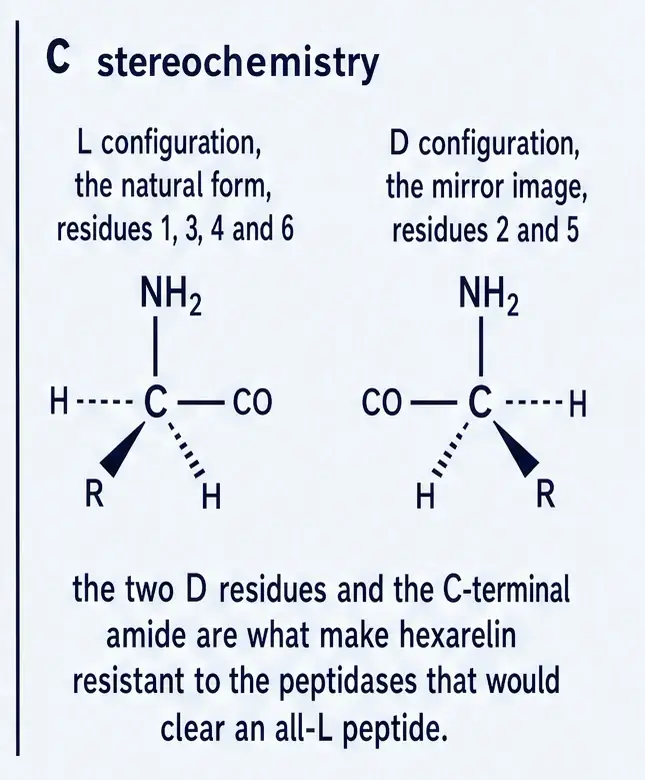
The second is the amide cap. A free carboxyl tail is a handle for carboxypeptidases. Capping it removes the handle. This matters later in an unexpected way: alexamorelin, a related compound with one extra residue on the front, is cut down into hexarelin by exactly this class of enzyme, so a doping laboratory that finds hexarelin in a urine sample cannot immediately tell which of the two was administered (Pobee et al., 2025).
The third is the methyl group on residue two, and it is the whole reason this molecule has a name of its own. Remove it and you have GHRP-6, a compound published a decade earlier by a different laboratory on a different continent. One carbon atom and two hydrogens separate them. The formulae are C47H58N12O6 against C46H56N12O6, a difference of exactly one CH2. A great deal of confusion in the popular literature about these compounds comes from treating that difference as cosmetic. It is not, but neither is it as large as the separate names suggest, and this document takes some care to say which molecule each result belongs to.
Two of the six are worth a second look for opposite reasons. The imidazole of histidine is the only ring in the molecule that carries two nitrogens, and it is the one most often drawn wrongly — if the two nitrogens sit next to each other the ring is a pyrazole and the residue is not histidine at all. The lysine chain is the only one whose length matters arithmetically: four methylenes and a terminal amine, which is what gives the molecule its single positive charge at physiological pH and, as Section 06 records, is why the anionic surfactants used to push peptides across the gut wall complex with it instead of carrying it.
It is also worth saying what the side chains are not doing. None of them is a recognition element inherited from a natural ligand, because there was no natural ligand to inherit from when this molecule was designed — ghrelin would not be found for another five years, and when it was, it turned out to share no sequence with these compounds at all. The residues here were arrived at by making a peptide, measuring how much growth hormone it released, changing one residue, and measuring again. What the drawing below records is the end point of about fifteen years of that process, not a structural argument about why it should work.
The six side chains are worth looking at once, because two of them carry the features that everything else in this document depends on. The indole ring of residue 2 is where the methyl sits; the indole of residue 4 is bare, and the difference between those two rings is the difference between the two compound names. The rest are ordinary: an imidazole, a methyl, a benzyl group and a four-carbon chain ending in an amine.
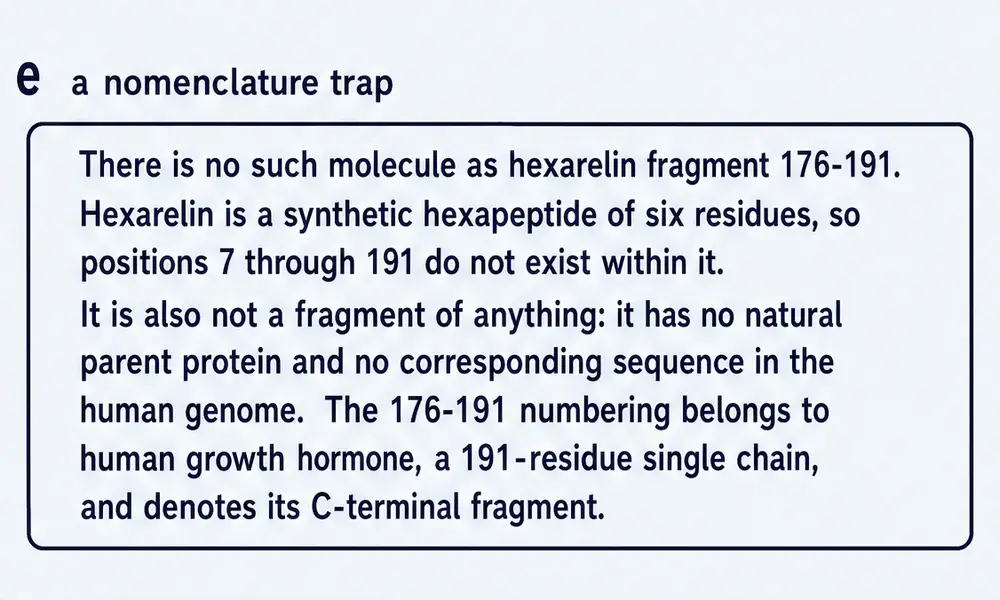
One last piece of identity, and it is a correction rather than a description. Hexarelin is sometimes described in non-specialist material as a “fragment”, and specifically as fragment 176-191. It is neither. A hexapeptide has no residue 176, and hexarelin is not a piece of any larger protein — it has no natural parent and no counterpart sequence in the human genome, which is exactly what makes the discovery story in the next two sections strange. The 176-191 numbering belongs to human growth hormone, a 191-residue chain, and names its C-terminal fragment: a different molecule with a different literature.
02The observation nobody was looking for
The story does not begin with growth hormone. It begins with opium.
In the mid-1970s the enkephalins — short peptides that act at the same receptors as morphine — were among the most exciting molecules in biology, and laboratories everywhere were making analogues of them to see what the brain would do. In 1977, working through such a series, Cyril Bowers and colleagues reported something off-topic: certain modified enkephalins caused isolated rat pituitary tissue to release growth hormone. That observation appeared as a book chapter rather than a journal article and is not indexed in PubMed, which is a small illustration of how easy it is for a founding result to become hard to find.
It was a strange finding on its face. Growth hormone release was understood to be controlled by two hypothalamic signals pushing in opposite directions, and neither of them looked anything like an opioid fragment. Worse, the effect did not seem to run through opioid receptors at all. The molecules were opening a door that was not marked on the map.
What followed was a long, patient, and now slightly old-fashioned campaign of chemistry. Bowers worked with Frank Momany, a computational chemist, in a loop that ran: calculate which shapes a candidate peptide could adopt, synthesise the ones that looked promising, test them on pituitary cells, and feed the result back into the calculation. By 1981 the series had reached Tyr-D-Trp-Ala-Trp-D-Phe-NH2, active in the low nanogram range and described in that paper as roughly a thousand times more potent than the enkephalin analogues they had started from (Momany et al., 1981). By 1984 the same loop had produced a hexapeptide, His-D-Trp-Ala-Trp-D-Phe-Lys-NH2, which released growth hormone in rats, monkeys, lambs and calves without moving the other pituitary hormones, and which the authors described as having the attributes of a hypothalamic releasing hormone (Bowers et al., 1984; Momany et al., 1984). That molecule is GHRP-6. Hexarelin is its direct descendant.
The phrase in that 1984 paper is the important one. Bowers was not claiming to have made a good drug. He was claiming that the existence of a synthetic molecule with these properties implied the existence of a natural one nobody had found — that the door his compounds were opening had to have been built for something. He said so repeatedly for the next fifteen years, and in his own later account of the field he dates the hypothesis of an unknown natural releasing peptide to that year (Bowers, 2012). He was right, and it took until 1999 to prove it.
03Backwards: the drug, then the receptor, then the hormone
Pharmacology is supposed to run in one direction. You find a hormone, you find its receptor, you make a drug that hits the receptor. This family ran the other way, and hexarelin was one of the instruments that made it possible.
The drug came first, in 1984. The receptor came twelve years later: in 1996 a large team at Merck reported a high-affinity binding site in pituitary membranes whose affinity for a structurally diverse set of these compounds tracked their potency at releasing growth hormone, and then cloned the receptor from the pituitary and hypothalamus of pigs and humans (Pong et al., 1996; Howard et al., 1996). Both papers state the implication plainly: the receptor existed, so some undiscovered natural hormone must occupy it.
The hormone came three years after that. In 1999 Masayasu Kojima and Kenji Kangawa's group in Osaka isolated it — not from the brain, where everyone had been looking, but from the lining of the stomach. It is a twenty-eight-residue peptide carrying an unusual fatty-acid modification on its third residue, without which it is inactive. They named it ghrelin, from a root meaning to grow (Kojima et al., 1999). It turned out to be a hunger hormone as much as a growth hormone, and it opened a field that is still productive today.
There is a last observation to make about that sequence before the family is set out below, and it concerns what the delay cost. Between 1984 and 1999 every paper in this field had to describe its compounds' mechanism in negative terms: not the releasing hormone's receptor, not an opioid receptor, not somatostatin. A field can make progress that way — this one plainly did — but it cannot easily tell whether two compounds differ in kind or only in potency, because it has no assay that reads anything but the final output. That is the condition in which hexarelin was made, and it is why the question Part Three asks about its second receptor took until 2002 to become answerable at all.
It is worth being precise about hexarelin's part in this, because the popular account overstates it. Hexarelin was not the tool compound used to clone the receptor; that was MK-0677, an orally active non-peptide from the same Merck programme (Müller et al., 2015). Hexarelin was one of the probes whose binding-versus-activity correlation validated the site (Pong et al., 1996), and — more durably — it became the scaffold for the radioligand that mapped where these receptors actually are. A radio-iodinated hexarelin derivative was used to demonstrate binding sites in human pituitary, hypothalamus, choroid plexus, cortex, hippocampus and medulla, with dissociation constants around 1.5 to 2.1 nanomolar (Muccioli et al., 1998). That derivative remained a workhorse of the field for years afterwards. Hexarelin's contribution to this discovery was as a ruler rather than as a key.
The term now attached to this sequence — reverse pharmacology — appears in later commentary rather than in the original papers (De Ambrogi et al., 2003), and it is worth resisting the temptation to make it sound tidier than it was. Twelve years passed between the drug and the receptor, and fifteen between the drug and the hormone. For most of that time the people making these compounds could not say what they bound to, and said so.
Those fifteen years are the reason this family is worth understanding as a family rather than as a list of compounds. Every molecule made before 1996 was made blind: there was no receptor to screen against, no binding assay to optimise, and no way to ask whether a new analogue was more selective — only whether it released more growth hormone from a piece of pituitary. Potency could be measured; specificity could not. That is why hexarelin turned out to release corticotropin and prolactin alongside growth hormone, as Part Two describes, and why nobody could have designed that out at the time. It is also why the compounds of this era tend to hit more than one target: hexarelin's second receptor, the subject of Part Three, was not identified until 2002, by which point the drug had already been given to several hundred people.
One consequence of that order runs through the rest of this document and is worth naming before the figure below. Because the receptor arrived after the compounds, the compounds were never separated from one another by mechanism — they were separated by whoever happened to make them and by what each laboratory chose to measure. GHRP-6, GHRP-1, GHRP-2, hexarelin and ipamorelin are not five answers to five different questions. They are five attempts at the same question, made over a decade, tested in overlapping models by overlapping investigators, and given different names. That is why a reader encountering a confident claim about one of them should always ask which one was actually in the syringe, and why this document repeats the molecule's name far more often than good prose style would normally tolerate.
04Romano Deghenghi, and the addition of one methyl group
Hexarelin is the work of a chemist whose career had already been unusually productive before he came anywhere near growth hormone.
Romano Deghenghi took a doctorate in chemistry at the University of Trieste in 1953 and joined Ayerst Research Laboratories in Montreal in 1960, where he spent two decades as a steroid chemist. His own publications from that period are the ordinary output of a good industrial chemist: syntheses of alkylated progesterones, a microbiological route to equilin, work on synthetic cardenolides (Deghenghi et al., 1963). He made medrogestone and actodigin, and he rose to director of research, in which role he supervised the laboratory that discovered rapamycin and etodolac. He later worked at Debiopharm in Switzerland on a long-acting formulation of triptorelin, and then moved to France and founded Europeptides, a small company in Argenteuil outside Paris, where he was chief executive and where teverelix, meterelin and hexarelin were made. Ardana Bioscience acquired Europeptides in 2002. Deghenghi died in January 2008, aged seventy-seven.
The detail worth holding on to is that the man who supervised the discovery of rapamycin — a molecule that has generated a whole field of its own — later spent his sixties making a growth hormone drug that did not work. Careers in drug discovery are not monotonic, and the difference between the two outcomes is not obviously a difference in the quality of the chemistry.
Deghenghi's own account of what he was trying to do is the clearest statement of the problem the whole field faced. The Bowers–Momany peptides were potent on pituitary cells in a dish and disappointing in living animals, because they were digested before they could act. He described the programme as a search for “impervious peptides” — molecules built to be indigestible — and named the specific modification that worked: substituting the tryptophan at position two with a chemically more stable 2-methyl-tryptophan produced a compound that was orally active (Deghenghi, 1997). The introducing paper describes the same substitution in the same terms (Deghenghi et al., 1994).
It is worth noting what is not established. The claim repeated in most secondary accounts — that the methyl group was added specifically to block enzymatic degradation — is a reasonable reading of the phrase “impervious peptides”, but no paper located for this document reports a stability measurement or names a protease. What is sourced is that the substituted compound was more chemically stable and that it was orally active where its predecessors were not. That is a narrower claim, and it is the one made here.
The introducing paper appeared in Life Sciences in 1994. It reported hexarelin in infant and adult rats, by vein and under the skin, and its finding was modest and honest: at the doses tested, hexarelin and GHRP-6 were of similar effectiveness intravenously, and hexarelin was slightly better subcutaneously (Deghenghi et al., 1994). The molecule's claim on attention was never that it was dramatically more potent than its predecessor. It was that it survived long enough, and by enough routes, to be worth giving to people. In the same year, four separate groups did.
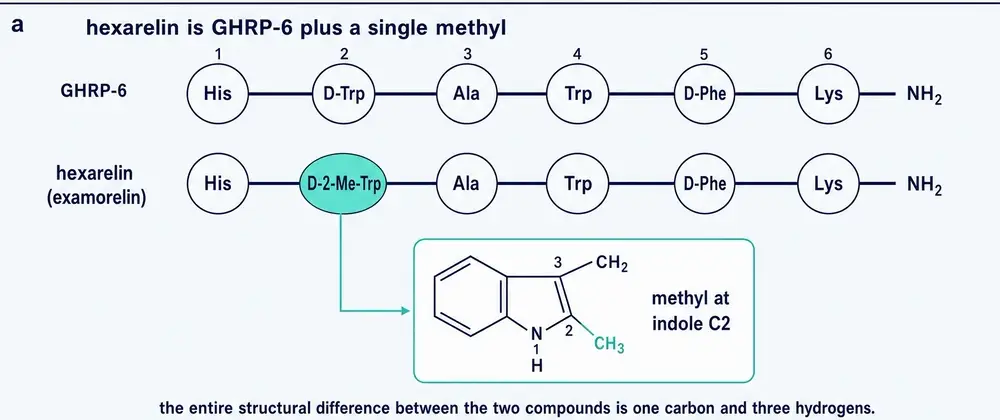
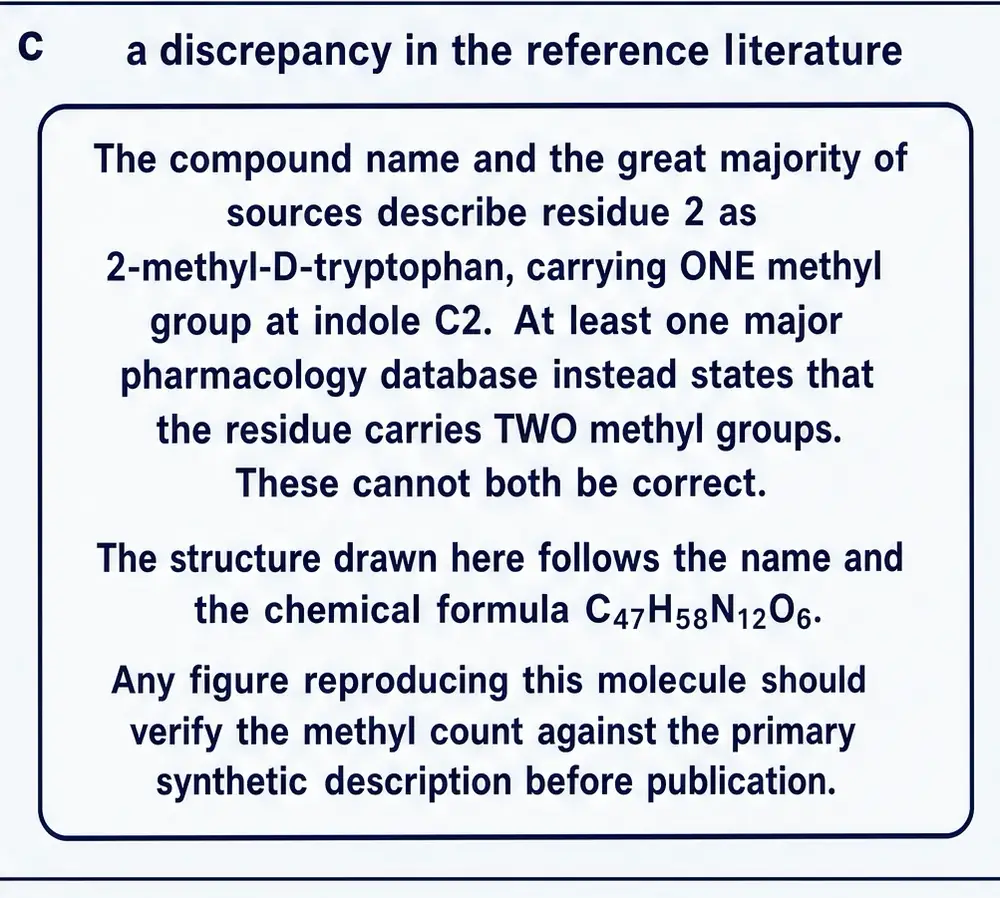
One caution belongs with that comparison, because it concerns the very feature the two names turn on. The compound's own name specifies 2-methyl-D-tryptophan — one methyl group — and most sources agree; at least one major pharmacology database states that the residue carries two. Both cannot be right, and a reader has no way to adjudicate from the names alone. The arithmetic settles it. Six residues summed and condensed give C47H58N12O6, which is what the chemical registry records, and which exceeds GHRP-6's formula by exactly one CH2. A second methyl would show up as another. This document draws one, and says why.
One more piece of housekeeping belongs here, because it explains a retrieval problem that recurs throughout this document. Hexarelin's International Nonproprietary Name is examorelin. It was put forward in the World Health Organization's Proposed INN List 72, with the period for objections closing on 30 June 1995, and adopted in Recommended INN List 35, published in 1995. Almost nobody uses it: three PubMed records carry the INN against several hundred for the trade-free name. Any attempt to assemble this compound's literature by its official name retrieves essentially nothing, which is the first of several ways in which hexarelin is harder to find than it should be.
051994, and four laboratories at once
Hexarelin entered human research in a single year, and the speed is itself informative: this was a molecule whose predecessors had already been given to people, so the safety questions were not novel and the clinical groups were waiting.
The dose-finding study came from Mediolanum Farmaceutici, the Italian company that took hexarelin into the clinic, with a first author from its own medical department. Twelve healthy adult men received placebo or intravenous hexarelin at 0.5, 1 and 2 micrograms per kilogram, double-blind. Growth hormone peaked around thirty minutes and was back to baseline within four hours. Mean peak concentrations rose from 3.9 nanograms per millilitre on placebo to 26.9, 52.3 and 55.0 across the three doses — a curve that is already flattening at the top of the range, with a half-maximal dose of about 0.5 micrograms per kilogram (Imbimbo et al., 1994). The elimination half-life was around fifty-five minutes, which for a peptide is respectable and is a direct dividend of those two D-residues.
The comparison that mattered came from Turin. Ezio Ghigo's group gave twelve healthy volunteers hexarelin and, in the same subjects, growth hormone-releasing hormone — the body's own signal for this job — at the same dose. Hexarelin released roughly twice as much growth hormone (Ghigo et al., 1994). A synthetic hexapeptide designed without a known target was outperforming the natural releasing hormone in humans, and it was doing so through a receptor that would not be identified for another two years.
A third group, in Israel, asked where the effect was being generated. Zvi Laron gave hexarelin to ten children with familial short stature and to two adults with growth hormone deficiency. The children responded; the deficient adults did not, by either route tested (Laron et al., 1994). And in sheep, a French group showed that hexarelin raised growth hormone-releasing hormone in the blood draining the hypothalamus without changing somatostatin, the opposing signal (Guillaume et al., 1994). Together these placed a substantial part of the mechanism above the pituitary rather than in it — hexarelin was not simply squeezing the gland, it was engaging the circuit that controls the gland. That distinction matters for everything in Section 08.
06Four routes, two of which should not have worked
The route study is the most quietly remarkable thing hexarelin ever did, and it is worth setting out in full because it explains both the enthusiasm and the failure.
In one crossover experiment, the same twelve volunteers received hexarelin by vein, under the skin, up the nose and by mouth (Ghigo et al., 1994). All four worked. Measured against the intravenous route, subcutaneous injection delivered 77 per cent of the biological effect, intranasal administration 4.8 per cent, and oral administration 0.3 per cent.
Read one way, this is a triumph. Peptides are not oral drugs. The gut is an organ evolved to destroy them, and the number of peptides that produce any measurable systemic effect after swallowing is small. Hexarelin produced a full pituitary response after a tablet-sized dose. Read the other way, the same numbers are the obituary: 0.3 per cent bioavailability means that 40 milligrams by mouth were needed to match 2 micrograms per kilogram by vein — something like a seven-hundred-fold dose penalty. Deghenghi himself, describing the programme, put oral absorption at rarely more than one per cent (Deghenghi, 1997). A drug can be orally active in this sense and still be commercially impossible.
The intranasal figure is the interesting middle case, and it is the one the clinical programme actually pursued. Just under five per cent sounds poor until you compare the doses: twenty micrograms per kilogram up the nose produced growth hormone release comparable to one microgram per kilogram by vein (Ghigo et al., 1994), and an independent group found intranasal and intravenous peak responses essentially equivalent in children at those doses (Laron et al., 1994). A nasal spray that avoids injections in children is a genuine clinical proposition, and that is the form in which hexarelin came closest to being a medicine.
The comparison below is worth reading twice, because the two ways of reading it point in opposite directions and both are correct. Read as pharmacology, it says hexarelin is one of a very small number of peptides that does anything at all when swallowed. Read as pharmaceutics, it says the dose penalty for doing so is roughly seven hundredfold, and that a tablet delivering a microgram-scale effect would have to carry tens of milligrams of peptide. The first reading is why the compound was interesting; the second is why it was never going to be a tablet.
One convention in the figure needs stating, because the phrase is easily misread. “Biological bioavailability” here is not the proportion of the dose that reached the bloodstream, which is what the term usually means and which nobody measured. It is the ratio of the growth hormone response by each route to the response by vein, which is a different quantity and a more forgiving one: a route that delivers little drug to a saturable receptor can still look respectable on it. Since the response saturates — Figure 8 — the true fraction absorbed by the nasal and oral routes is, if anything, lower than these numbers suggest.
Two later findings complete the delivery picture, and both are negative in an instructive way. In rat intestinal perfusion, paracellular permeation enhancers — agents that loosen the junctions between gut cells — raised hexarelin's permeability roughly four- to five-fold, though with variability so large that the standard deviations approach the means (Dahlgren et al., 2021). But transcellular enhancers, which work by disturbing the cell membrane itself, failed on hexarelin completely at every dose and pH tested, while raising a comparator drug eight- to nine-fold in the same experiments (Dahlgren et al., 2020). The authors propose that hexarelin, which carries a positive charge, forms ionic complexes with the anionic surfactants and is simply not free in solution to be absorbed. They draw the wider moral themselves: this is part of why permeation enhancers have largely failed to deliver oral peptides.
07Against the natural hormone, and a comparison nobody ran
Once ghrelin was in hand, the obvious experiment became possible: give the synthetic drug and the natural hormone to the same people and see which wins. Turin did it in 2001. Seven healthy young men received ghrelin, hexarelin and growth hormone-releasing hormone, each at one microgram per kilogram intravenously. The natural hormone came out on top, with a mean peak of 92 micrograms per litre against hexarelin's 68 and the releasing hormone's 27 (Arvat et al., 2001).
Two things follow. First, hexarelin sits where the chemistry predicts: clearly more potent than the releasing hormone that had been the clinical standard, clearly less potent than the endogenous ligand it was unknowingly imitating. Second — and this is a point that recurs in Part Three — ghrelin also raised prolactin, corticotropin and cortisol more than hexarelin did. The synthetic molecule was, on this measure, the cleaner of the two.
One methodological point carries across the three comparisons below. All three agents were given to the same seven men in the same study, which is what makes the ranking meaningful: growth hormone responses vary enormously between individuals, and between-study comparisons of peak concentrations are close to worthless in this literature. Where this document gives a potency ordering, it is because one study administered the compounds being ordered to one set of subjects. Where no such study exists — as for hexarelin against GHRP-6 — no ordering is given.
There is a gap here that deserves stating, because almost every popular account of these compounds papers over it. No published study has given hexarelin and GHRP-6 to the same human subjects. The comparisons that exist in humans are against the releasing hormone, against GHRP-2 and against ghrelin. Reviews confidently assert that hexarelin is the more potent of the two, and it may well be; the animal data that introduced hexarelin found the two similar intravenously and hexarelin slightly better subcutaneously (Deghenghi et al., 1994). But there is no human head-to-head, and a potency ratio between hexarelin and its nearest relative cannot be quoted from human data at all.
08Who responds, and who does not
A secretagogue is not a hormone. It does not supply growth hormone; it asks the pituitary for some, through a circuit that includes the hypothalamus. So the answer depends on who is being asked, and hexarelin's response profile maps that circuit with some precision.
Age is the largest single factor. Given the same two micrograms per kilogram, young men released more than twice as much growth hormone as elderly men (Arvat et al., 1994), and in a later study across three doses the gap at the lowest dose was roughly five-fold (Arvat et al., 1998). This is awkward for the compound's most obvious commercial indication. The population in whom age-related growth hormone decline might be worth treating is precisely the population in which the drug works least well. The same paper found the deficit could be partly restored by co-administering arginine or the releasing hormone, which points at altered hypothalamic control rather than a worn-out pituitary.
Puberty amplifies it. In ninety-six children, peak growth hormone after hexarelin was roughly twice as high in pubertal as in prepubertal subjects (Bellone et al., 1995) — a sex-steroid effect, and one that was reproduced deliberately: priming five boys with delayed puberty using testosterone increased the hexarelin response in every one of them (Loche et al., 1995a).
Obesity blunts it, in children, for both hexarelin and the releasing hormone (Loche et al., 1995a).
And the anatomy shows through. This is the most elegant result in the set. Among children with growth hormone deficiency, those with idiopathic deficiency responded to hexarelin about as well as short normal children, and better than they responded to the releasing hormone. Those whose deficiency was caused by an interrupted pituitary stalk — a physical disconnection between hypothalamus and pituitary — responded weakly or not at all (Loche et al., 1995b). If hexarelin acted only on the pituitary, that disconnection should not matter. It does, decisively. The drug needs the circuit intact.
09What else the pituitary let go of
Hexarelin does not release growth hormone alone. It also releases corticotropin, cortisol and prolactin, and the magnitude is not trivial. Given head-to-head against corticotropin-releasing hormone — the body's own stress signal, at the same dose in the same twelve subjects — hexarelin produced a comparable rise in both corticotropin and cortisol (Ghigo et al., 1997). A drug intended to raise growth hormone was activating the stress axis about as hard as the hormone whose job that is.
In a dose-response study, prolactin's half-maximal dose was, if anything, marginally lower than growth hormone's, which means the two cannot be separated by dose alone; cortisol behaved differently, stepping up only at higher doses (Massoud et al., 1996). That last detail left a usable window, and the same paper found it: a low dose of hexarelin combined with the releasing hormone produced a large growth hormone response with no cortisol rise at all. The selectivity problem was solvable, but only in combination.
It would be easy to stop there and file hexarelin as unacceptably dirty. That would be wrong, and the correction is one of the more interesting things in this compound's file. On sustained dosing the off-target effects do not persist. Over sixteen weeks of twice-daily subcutaneous treatment, cortisol output actually fell rather than rose, urinary free cortisol did not move, and prolactin did not change (Rahim et al., 1999). A separate study found that prior hexarelin dosing abolished the corticotropin and cortisol response to a subsequent challenge while only blunting the growth hormone response (Maccario et al., 2002). The corticotroph desensitises faster and more completely than the somatotroph.
So the honest statement has two halves. Acutely, and therefore for any diagnostic use, hexarelin's stress-hormone release is a real specificity objection. Chronically, it is not, because the effect fades. Reporting either half alone misleads, and most secondary accounts report only the first.
One further acute effect is worth recording because it is the kind of thing that does not appear in efficacy summaries. Given to seven volunteers in four doses across the evening, hexarelin reduced deep slow-wave sleep in the first half of the night and reduced delta activity across the whole night, which the authors attribute to the balance it strikes between growth hormone-releasing and corticotropin-releasing signalling (Frieboes et al., 2004). A compound that raises growth hormone while degrading the sleep during which growth hormone is normally secreted is working against itself.
10Sixteen weeks
Everything above describes what happens when hexarelin is given once. The question that decides whether a secretagogue is a medicine is what happens when it is given for months, and there is exactly one study of that in adults.
Twelve healthy elderly subjects received hexarelin subcutaneously twice a day for sixteen weeks, with the growth hormone response to a standard test dose measured at intervals (Rahim et al., 1998). The response fell — from an area under the curve of 19.1 at baseline to 13.1 after one week, 12.3 at four weeks and 10.5 at sixteen, a decline of about forty-five per cent. Four weeks after stopping, it had returned to 19.4, statistically indistinguishable from where it started.
That pattern is worth reading carefully, because it is more benign than the word “desensitisation” suggests. Most of the loss happens in the first week and then plateaus; it does not progress; and it reverses completely on withdrawal. This is adaptation, not damage. The same shape appears in children given intranasal hexarelin, where the response fell by roughly three-quarters within seven days and then held steady (Klinger et al., 1996), and shorter intermittent courses of eight to fifteen days in elderly subjects produced no attenuation at all (Ghigo et al., 1996). A drug given in pulses might well have kept working indefinitely.
None of that is why hexarelin failed. It failed because of the other half of the same study.
Over those sixteen weeks the investigators also measured what the growth hormone was supposed to be doing. Insulin-like growth factor 1 — the mediator through which growth hormone produces nearly all of its effects, and the standard biochemical marker that a growth hormone intervention is working — did not change. Neither did its binding protein. Neither did total body fat, lean body mass, or bone mineral density (Rahim et al., 1998).
What follows is the single most important measurement in this document, and it is worth being clear in advance about what makes it decisive. It is not the fall in the growth hormone response — that is real, but it is partial, it plateaus within a week and it reverses completely on withdrawal. It is the flat line beneath: the measurements of what the released hormone was supposed to be doing. A secretagogue that raises growth hormone without raising insulin-like growth factor 1 has not failed to work. It has worked, and the working has turned out not to matter.
This is the central fact about hexarelin and it deserves to be stated without hedging. The pituitary answered the drug for four months. The body did not. Whatever the pulses of growth hormone were doing, they were not summing into the sustained elevation that drives growth factor production, and without that, none of the downstream biology that would make a growth hormone secretagogue clinically valuable ever engaged. A drug can be pharmacologically active, reproducible, well tolerated and completely without benefit, and this is what that looks like.
The finding is not unique to hexarelin, which is part of why it was fatal. The same disappointment recurred across the whole secretagogue class: raising growth hormone turns out to be easy, and it turns out not to be the same thing as helping anyone.
11The children, and the only outcome anyone measured
There is one exception to the statement that hexarelin never produced a clinical result, and it is a real one, and it is much smaller than it is usually made to sound.
Zvi Laron's group in Israel gave intranasal hexarelin to eight prepubertal short children, aged four to about twelve, three times daily for periods up to eight months. Growth velocity rose from 5.3 to 8.3 centimetres per year. Insulin-like growth factor 1 rose. Skinfold thickness fell despite weight gain. No undesirable effects were reported (Laron et al., 1995). A companion study in seven children on a longer schedule found growth velocity rising from 5.3 to 7.4 centimetres per year (Klinger et al., 1996).
Set beside the sixteen-week adult study, this is a genuine puzzle and the two are usually reported as though only one existed. In adults the growth factor did not move; in children it did, and the children grew. The most likely explanation is simply that children's growth axes are more responsive than elderly ones, which the age data in Section 08 would predict.
But the design has to be stated as plainly as the result. Both studies were single-arm, uncontrolled, and conducted by one group; the larger enrolled eight children. There was no randomisation, no placebo, and no control for regression to the mean — children are referred for short stature when their growth is at its slowest, so growth velocity in such a cohort tends to rise regardless of what is done. No controlled trial of hexarelin in short children was ever published. An author search returns six hexarelin papers from that group in total, spanning 1994 to 2003.
The second study contains a detail that complicates the desensitisation story usefully. Its own title records the finding: the children's growth hormone response to a test dose fell by roughly three-quarters over the treatment period, and they kept growing anyway (Klinger et al., 1996). Whatever the pulsatile response to a bolus was measuring, it was not the thing that determined whether the treatment worked. That is a caution about surrogate endpoints in general, and it is one of the few places in this compound's record where a negative pharmacological finding turned out not to predict the clinical one.
12An effect that survives the removal of the pituitary
By the late 1990s hexarelin's growth hormone programme was running into the wall described in Part Two. In the same years, a group of Milanese pharmacologists were looking at the compound for a different reason, and found something that had not been predicted.
Growth hormone is good for the heart. That was already known, and it made any cardiac effect of a growth hormone secretagogue unremarkable on its face — the drug raises the hormone, the hormone helps the heart, nothing new. The Milan group's contribution was to take that explanation away and see whether anything remained.
The instrument for doing so is hypophysectomy: surgical removal of the pituitary gland. An animal without a pituitary cannot release growth hormone, so a drug whose only mechanism is growth hormone release must be inert in it. In hypophysectomised rats, hexarelin given under the skin for seven days still protected the heart against ischaemia and reperfusion, preventing the rise in end-diastolic pressure, the rise in coronary perfusion pressure and the release of creatine kinase, a marker of muscle damage (Locatelli et al., 1999). A related peptide with no cardiac binding did nothing in the same experiment, which is the specificity control that makes the result interpretable. A companion study in the same model found hexarelin correcting abnormal responses in aortic rings without raising body weight or circulating growth factor at all (Rossoni et al., 1999).
A second design closes the door from the other side. In aged rats, saline controls recovered about 37 per cent of their pre-ischaemic contractile pressure. Growth hormone itself recovered 55 per cent. Hexarelin recovered 90 per cent (Rossoni et al., 1998). If the drug were merely a delivery system for growth hormone, it could not outperform growth hormone. It did, substantially.
A third design substitutes the natural ligand. In hypophysectomised rats given equimolar doses, hexarelin was markedly more protective than ghrelin on every measure — end-diastolic pressure improved by 60 per cent against ghrelin's 15, creatine kinase release reduced by 55 per cent against 15 (Torsello et al., 2003).
And the fourth design is in people. Hexarelin raised ejection fraction in men with severe growth hormone deficiency whose growth hormone response to the drug was negligible — 1.9 micrograms per litre against 45.7 in controls — and it raised it by about as much in both groups (Bisi et al., 1999b).
Taken together this is a well-constructed body of work for its era, and its conclusion is secure: hexarelin's cardiac action is not growth hormone acting at one remove. It is worth being equally clear about what these experiments do not establish. Three of the four are rodent studies, the fourth is a single intravenous dose in sixteen people, and none of them says anything whatever about which receptor is responsible. That question is Section 14, and it is not resolved.
13The bypass study
The strongest human evidence hexarelin has comes from an operating theatre.
Twenty-four men undergoing coronary artery bypass grafting under general anaesthesia received, in four arms, hexarelin at two micrograms per kilogram, growth hormone-releasing hormone at the same dose, recombinant human growth hormone at ten micrograms per kilogram, or placebo. Cardiac performance was measured intraoperatively by transoesophageal echocardiography and a pulmonary artery catheter (Broglio et al., 2002).
Only hexarelin did anything. Ejection fraction, cardiac index and cardiac output all rose from ten minutes and were still elevated at ninety; wedge pressure fell. Growth hormone-releasing hormone, recombinant growth hormone and placebo produced no haemodynamic change at all.
The design is what makes this citation worth its space. Including growth hormone itself as an arm tests the obvious alternative explanation directly, in humans, rather than by inference from rats — and growth hormone did nothing. This is the human counterpart of the aged-rat experiment in the previous section, and it is more persuasive because the comparator is the thing the drug is supposed to be working through.
Now the denominator. Twenty-four patients divided four ways is about six per arm. The endpoint is an imaging measure that lasted ninety minutes, not a symptom, a hospital admission or a death. Nobody was randomised to hexarelin for a year and followed. This is a mechanism experiment that happens to be conducted in humans, and it is the largest human cardiac dataset the compound has. It was published in 2002, and nothing larger has been attempted since.
The other human cardiac studies are of the same shape and size. Seven healthy volunteers showed a rise in ejection fraction from 64 to 71 per cent after a single dose, with recombinant growth hormone again doing nothing (Bisi et al., 1999a). Patients with ischaemic cardiomyopathy showed a modest rise, from about 23 to 26 per cent (Imazio et al., 2002).
And in that last study, patients with dilated cardiomyopathy showed no rise at all, despite releasing just as much growth hormone as the patients who responded (Imazio et al., 2002; Broglio et al., 2001). That is a clean negative and it is informative rather than merely disappointing: it suggests the drug acts on myocardium that is ischaemic but viable, and has nothing to offer a ventricle whose muscle has already been replaced.
14CD36, and a number that does not fit
If the cardiac effect is not growth hormone, something in the heart must be binding the drug. Finding out what took a Montreal group most of a decade, and the answer was genuinely surprising.
Working with isolated perfused rat hearts, Huy Ong's laboratory first showed that hexarelin produced a dose-dependent rise in coronary perfusion pressure — a constriction — and used a photoreactive hexarelin derivative to label the protein responsible. It ran at about 84 kilodaltons and bound hexarelin at a single class of sites. Crucially, MK-0677 — a potent agonist at the pituitary receptor — neither displaced the label nor produced the vascular effect, which meant this was not the known receptor (Bodart et al., 1999).
The mapping that followed is worth setting out, because it is the part of this story that is genuinely well done and because the geometry carries the argument. The photoaffinity label was cleaved and the fragment carrying it sequenced, which localised the contact to a defined stretch of the extracellular domain rather than to the protein in general. That stretch overlaps the region CD36 uses to bind oxidised low-density lipoprotein, and does not overlap the region it uses to bind thrombospondin-1 — and hexarelin competes at the first and not at the second, exactly as the geometry predicts. A binding site established this way is not an inference from a displacement curve; it is a position on a chain.
Before the measurements themselves, it is worth being precise about what kind of claim a binding study can support, because this is where accounts of hexarelin most often overreach. Showing that a molecule binds a protein establishes that they interact. It does not establish that the interaction produces any particular effect, and it does not establish that the effect observed in a whole animal runs through that protein rather than through something else the molecule also touches. Those are three separate questions, and they need three separate experiments.
For the coronary constriction, all three were answered, and answered well. The binding was demonstrated by photoaffinity labelling and the protein identified by sequencing rather than inferred. The effect was measured in a perfused heart, where the pituitary is absent and no hormone can reach the tissue. And the attribution was closed by removing the receptor: the response is absent in hearts from CD36-null mice and from a rat strain that lacks CD36 by genetic accident. That is a complete argument, and it is the only complete argument in this compound's mechanistic file.
What it establishes is narrower than it is usually taken to be. It establishes that CD36 mediates a vasoconstrictor response in an isolated rat heart. It says nothing about the effect the compound is actually interesting for — the preservation of contractile function after ischaemia, the reduction in infarct size, the fall in fibrosis — because none of those endpoints was ever measured in an animal lacking CD36. The distance between those two statements is the subject of Section 15, and it is easy to lose because both are true sentences containing the word CD36.
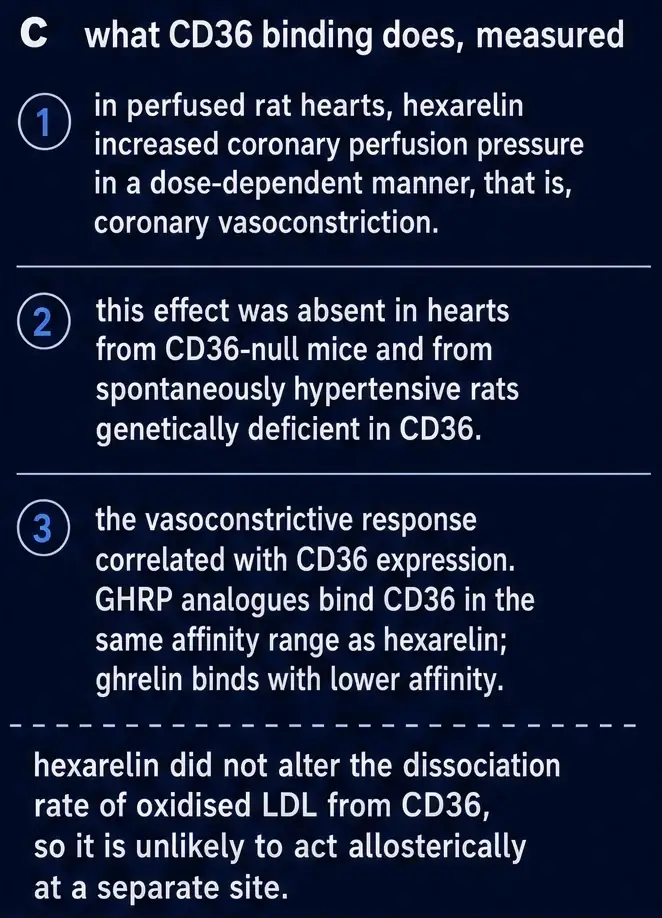
Three years later they purified it and sequenced it. It was CD36 (Bodart et al., 2002). CD36 is a scavenger receptor — a class of molecule whose day job is binding oxidised lipoproteins and long-chain fatty acids, central to atherosclerosis and to cardiac fuel selection, and about as far from a G-protein-coupled hormone receptor as a membrane protein gets. It is abundant in heart muscle and in the microvascular endothelium. The same paper reported the decisive control: hexarelin's coronary effect was absent in hearts from CD36-null mice and from a rat strain genetically deficient in CD36. Later work mapped the binding site to a defined stretch of the CD36 sequence overlapping the region that binds oxidised low-density lipoprotein (Demers et al., 2004).
This is a good discovery, honestly made. It is also the point at which the standard account of hexarelin starts outrunning its evidence, in three separate ways.
The panel below states the difficulty that follows from it, and it is worth reading before Section 16 argues the point at length.
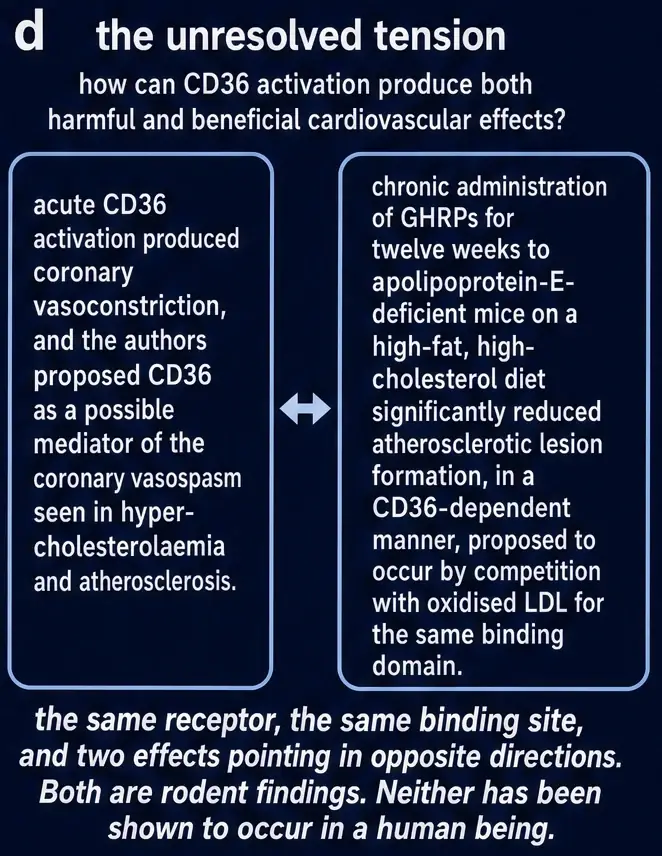
Each of the three problems below is separately survivable. Together they are the reason this document declines to say which receptor produces hexarelin's cardiac effect, and the reason Section 15 is about an experiment that was never done. It is worth noticing that they are three different kinds of problem, which is part of why the question has stayed open: one is a discrepancy between measurements, one is a disagreement about the sign of an effect, and one is a straightforward conflict between the conclusions of competent groups.
First, the affinity. Hexarelin binds the pituitary receptor at low nanomolar concentrations (Muccioli et al., 1998). Its affinity for CD36 has been measured at around 2.9 micromolar by competition binding in cardiac membranes (Bodart et al., 1999), about 2.4 micromolar in a later covalent binding study (Sabatino et al., 2011), and 22.8 micromolar by surface plasmon resonance against recombinant human CD36 — that last figure appearing incidentally, in a paper whose subject is a different compound entirely and which used hexarelin as a reference ligand (Bao et al., 2012). Those three CD36 numbers span an order of magnitude between themselves, and all three are three to four orders of magnitude weaker than the pituitary site. Review articles nonetheless describe hexarelin as a “high-affinity” CD36 ligand. None of the three measurements supports that description, and no paper reconciles them.
The numbers are also not strictly commensurable — the nanomolar figures are dissociation constants for a radio-iodinated hexarelin derivative at native membranes, the micromolar ones are for hexarelin itself at CD36, and no study has measured both in one system. That is a reason for caution in both directions, not a licence to quote the flattering number.
Second, the direction of the vascular effect is disputed. Ong's group reports that hexarelin constricts coronary vessels (Bodart et al., 1999, 2002). A more recent study using synchrotron microangiography in living rats reports the opposite — that acute hexarelin dilates coronary microvessels by twenty to forty per cent, an effect abolished by a growth hormone secretagogue receptor antagonist and therefore attributed to the other receptor entirely (Waddingham et al., 2021). Both are rat studies by competent groups. Neither has been refuted.
Third, and most importantly, several groups reach the opposite conclusion about mechanism. Hexarelin's protection of mouse cardiomyocytes after ischaemia was completely blocked by two different antagonists of the growth hormone secretagogue receptor (Ma et al., 2012). Its antifibrotic and blood-pressure-lowering effects in hypertensive rats were abolished by a selective antagonist of that same receptor (Xu et al., 2012). And a third group found that hexarelin binds and protects H9c2 cardiac cells, which do not express that receptor at all, implying a third site that is neither (Baldanzi et al., 2002).
The fair summary is that hexarelin has at least two binding sites, that both are present in the heart, and that after twenty-five years the field has not established which one produces the cardioprotection. This document reports that as unresolved because it is.
15The experiment that would settle it, and who it was done with
There is a standard way to settle a receptor question: delete the receptor and see whether the drug still works. For hexarelin and CD36 that experiment has been done once, for one endpoint, and the endpoint is not the one that matters.
The coronary constrictor response was tested in CD36-null mice and was absent (Bodart et al., 2002). Hexarelin's effect on fat tissue was tested in CD36-null mice and was lost (Rodrigue-Way et al., 2007). But hexarelin's cardioprotective effect — infarct size, recovery of contractile function, ejection fraction, the thing this compound is actually interesting for — has never been tested in an animal lacking CD36 in anything located for this document.
The cardioprotection knockout experiment in this literature exists. It was performed with EP-80317 (Bessi et al., 2012), and EP-80317 is a different molecule.
It is worth being precise about what that substitution costs, because it is not a technicality. EP-80317 was selected for CD36 and stripped of growth hormone-releasing activity, which is exactly what makes it a clean probe of CD36 — and exactly what makes it a poor stand-in for hexarelin, whose whole difficulty is that it engages both receptors at once. Showing that a CD36-selective antagonist loses its cardioprotection in a CD36-null mouse establishes that CD36 can carry a cardioprotective signal. It does not establish which of hexarelin's two receptors carries hexarelin's. The experiment that would is neither difficult nor expensive; it simply has not been done, and the twenty-four years since the last human study are the reason.
The table below is short because the literature is. Three rows record experiments that were done; the fourth records one that was not, and it is the only row a reader needs in order to judge how far the CD36 account of hexarelin's cardioprotection has actually been carried.
16What belongs to EP-80317
EP-80317 is another of Deghenghi's peptides, and separating it from hexarelin is the single most consequential piece of bookkeeping in this document.
It is derived from hexarelin and is introduced in its own papers as a hexarelin analogue. It binds CD36 selectively. It has essentially no growth hormone-releasing activity. And — this is the part that makes conflation dangerous rather than merely untidy — it is an antagonist at the growth hormone secretagogue receptor, the receptor hexarelin activates. A result transferred from one to the other is not merely misattributed; on that receptor it is inverted.
Because CD36 is what EP-80317 was designed around, it owns much of the literature a reader would naturally assume belongs to hexarelin. The anti-atherosclerotic work in apolipoprotein-E-null mice, showing lesion area reduced by up to half and the effect abolished in mice also lacking CD36, is EP-80317's (Marleau et al., 2005). So is the reverse cholesterol transport work (Bujold et al., 2013), the macrophage trafficking work (Harb et al., 2009), the hind-limb ischaemia work (Elimam et al., 2024), and the anticonvulsant work implicating PPARγ (Lucchi et al., 2017). And so is the CD36-null cardioprotection experiment that the hexarelin literature leans on (Bessi et al., 2012).
Hexarelin does have its own atherosclerosis data — plaque and neointima suppressed in a rat model, with endothelial nitric oxide synthase and CD36 expression raised (Pang et al., 2010) — and the two compounds do share some findings honestly, including the prevention of progression to status epilepticus in rats, where both were tested side by side and both worked (Biagini et al., 2011). The point is not that EP-80317's results are irrelevant. It is that they are a different molecule's results, and a claim of the form “hexarelin's cardioprotection is CD36-mediated” is an extrapolation across molecules that nobody has closed.
How much this matters is measurable. When this document's corpus was assembled, four fetched papers named hexarelin only in the phrase introducing EP-80317 and were correctly excluded; sixty-one more named hexarelin while being dominated by a relative. Under a plain search on the compound's name, all sixty-five would have entered the reading corpus, and any of them could have supplied a confident sentence about what hexarelin does.
17The compound that protects everything
After about 2003 hexarelin stops appearing in human studies and does not return. What happens instead is unusual enough to be worth describing on its own terms: a small number of laboratories, mostly in Italy, China and Australia, keep giving the compound to rodents and keep finding that it protects whatever tissue they have injured.
In the heart, mice given hexarelin daily for three weeks after coronary ligation had an infarct occupying 6.1 per cent of left ventricular volume against 15.2 per cent in vehicle controls at fourteen days, with ejection fraction preserved, interstitial collagen reduced roughly threefold and circulating troponin cut by two-thirds (McDonald et al., 2018). In skeletal muscle, rats given cisplatin lost seven per cent of body weight while those also given hexarelin gained two, with damaged muscle area reduced by sixty per cent and grip strength preserved (Conte et al., 2017). In the kidney, seven days of pre-treatment before an ischaemic insult reduced creatinine, urea and tubular injury scores, with apoptosis markers moving in the expected directions (Guan et al., 2023). In the lung, mice given hydrochloric acid into the bronchus had better compliance at twenty-four hours and less collagen at fourteen days (Zambelli et al., 2021). In the retina, hamsters whose optic nerve had been cut retained seventy-five per cent of their ganglion cells against fifty-one per cent on saline (Chow, 2026). In neurons, two neuroblastoma lines were protected against peroxide (Meanti et al., 2021, 2023). In metabolism, insulin-resistant mice improved their glucose and insulin tolerance, lost fat and gained lean mass in twelve days (Mosa et al., 2017). And mice infected with SARS-CoV-2 survived better, with four of twelve measured cytokines significantly reduced (Gauvin et al., 2024).
The consistency is real and it is the best argument the compound has. Across eight organ systems and a dozen unrelated insults, the same signature recurs: less apoptosis, less fibrosis, better mitochondrial function. That looks like a genuine biological effect rather than a series of coincidences, and the mitochondrial thread in particular is coherent — in the cachexia model hexarelin restored the whole machinery of mitochondrial biogenesis, not one marker of it (Sirago et al., 2017).
But breadth is not depth, and a list like that reads far stronger than it is. One row of it is human, and that row is four small acute studies from over twenty years ago. Everything else is rodent or cell culture. A compound that protects eight organs in mice and has never been given chronically to a human being is not a therapy. It is a hypothesis with unusually good animal support.
18What did not work
House style for this series requires adverse signals and evidence gaps to sit next to the efficacy figures rather than be gathered into a late section where they can be skipped. For hexarelin that instruction is easy to follow, because its literature is unusually forthcoming about its own failures — most of the negatives below were reported by the same groups that reported the positives, and several appear in the same papers.
Three of them deserve expanding.
Pulmonary hypertension. Rats given chronic hexarelin in a model of pulmonary hypertension showed no prevention of right ventricular hypertrophy at all — ventricular weight ratios were, if anything, marginally worse than vehicle — and the authors describe the result as unexpected (Waddingham et al., 2021). It matters because ghrelin does prevent pulmonary hypertension in comparable models. This is the clearest case in the file of hexarelin failing where the natural hormone succeeds, and it sits awkwardly beside the hypophysectomy experiments in which hexarelin outperformed ghrelin substantially.
The saline injections. In the most recent primary study of hexarelin anywhere — the 2026 retinal work — twice-daily saline alone raised ganglion cell survival from 51 to 73 per cent, which is most of the benefit that a careless reader would attribute to twice-daily hexarelin. The author states this plainly rather than burying it (Chow, 2026). It is a useful reminder that in small animal studies the handling can be the intervention.
The antagonist that did not antagonise. In the same study, the standard blocker used throughout this field to demonstrate that an effect runs through the growth hormone secretagogue receptor failed to block hexarelin — and was itself markedly protective. The author concludes that it is not known whether that receptor mediates the effect at all (Chow, 2026). Since the same antagonist completely abolished hexarelin's cardiomyocyte protection in another study (Ma et al., 2012), the two results cannot both be straightforwardly true, and the receptor question in Section 14 gets no help from either.
There are also plain internal contradictions in the recent literature. The same laboratory reported hexarelin significantly increasing Akt phosphorylation in one neuroblastoma line and significantly decreasing it in another, in adjacent papers, describing the effect as protective both times (Meanti et al., 2021, 2023); a rat cardiac study likewise found Akt signalling suppressed and called it protective, its authors noting that this runs contrary to most of the literature (Agbo et al., 2019). The signalling account is not settled, and this document does not pretend otherwise.
One error deserves flagging because it is the kind that propagates. A computational screen searching for compounds active against a viral polymerase listed examorelin among “FDA approved” drugs (Ahmad et al., 2020). Hexarelin has never been approved by any regulator anywhere. The error was repeated verbatim in a later paper. A reader working from secondary sources could easily conclude this compound is a licensed medicine, and it is not.
19Why the science stopped, and the silence about it
Hexarelin's literature has a shape that is unusual enough to plot. Nothing before 1994, because the molecule did not exist. A rapid climb to a peak of twenty papers in 1999. Then a long decline, to one or two a year for the last decade.
Curves of that shape are common in pharmacology, but the usual causes do not apply here. A compound's literature normally collapses because something disproved it, because a safety signal emerged, or because a better molecule arrived. None of those happened. No study refuted hexarelin's pharmacology; the 1994 findings have never been contradicted, and several independent groups reproduced them. No adverse event of consequence was reported in any human study located for this document. And no superior growth hormone secretagogue reached the market either — the whole class failed together. What this curve records is not a refutation but a withdrawal of interest, and the two are easy to confuse when reading a citation count.
The distinction matters for how the remaining literature should be read. A field that has been refuted leaves behind papers that later work corrects; a field that has been abandoned leaves behind papers nobody has revisited. Hexarelin's are the second kind. The cardiac claims in Part Three rest on studies from 1997 to 2002 that have not been replicated, not because replication failed but because nobody attempted it, and the same is true of the paediatric growth result in Section 11. An unreplicated finding is weaker than a replicated one whatever the reason, so this document treats them as provisional — but the reason is worth knowing, because it bears on whether they would replicate if anyone tried.
The compound reached the second phase of clinical development and stopped there. Chemical registry records list its maximum phase as two, with no approval anywhere and no withdrawal recorded. A search of ClinicalTrials.gov for hexarelin, and for examorelin, returns no registered trial of any kind, in any phase, for any indication — a result confirmed against a control query in the same session. That absence is not itself suspicious: the clinical programme ran from roughly 1993 to 2002, and mandatory trial registration only took effect in 2005. But it does mean there is no registry record to consult, and it is part of why the discontinuation is so hard to document.
No published account of the decision to stop exists. No sponsor statement, no termination report, no retrospective. Claims circulating on commercial websites — that development ceased in a particular year for strategic reasons, or that hexarelin was investigated for HIV-related wasting — trace to no primary source that could be located, and are excluded from this document accordingly.
What does exist is a two-page piece published in 2003 by Zvi Laron, the investigator who ran the paediatric programme, in a peer-reviewed endocrinology journal. Its title asks why intranasally and orally active growth hormone secretagogues, which he calls useful clinical tools, are not on the market (Laron, 2003). The full text sits behind a paywall and could not be retrieved for this document, so nothing is claimed about its argument. But the existence of the question, asked in print by the person best placed to answer it, is itself the most direct evidence available that the discontinuation was never explained.
The evidence in this document supports an account, and it should be read as inference rather than as documented fact. The sixteen-week study showed no change in the growth factor, in body composition or in bone (Rahim et al., 1998). Oral bioavailability was three parts in a thousand. The nasal route worked but required a dose twenty times the intravenous one. And the population with the most obvious commercial need — the elderly — responded least (Arvat et al., 1994, 1998). None of those is fatal alone. Together they describe a drug that would have been difficult to formulate, difficult to dose, and difficult to show a benefit for. The class as a whole reached the same destination: raising growth hormone proved easy, and proved not to be the same thing as helping anybody.
The cardiac finding, which is the genuinely interesting thing hexarelin produced, arrived in 1999 and 2002 — that is, at the point when the programme it belonged to was already ending. The last primary human cardiac study of this compound was published in 2002. Nobody has taken the hypothesis further in the twenty-four years since, and the reason appears to be simply that there was no longer a sponsor to take it.
20Where hexarelin lives now
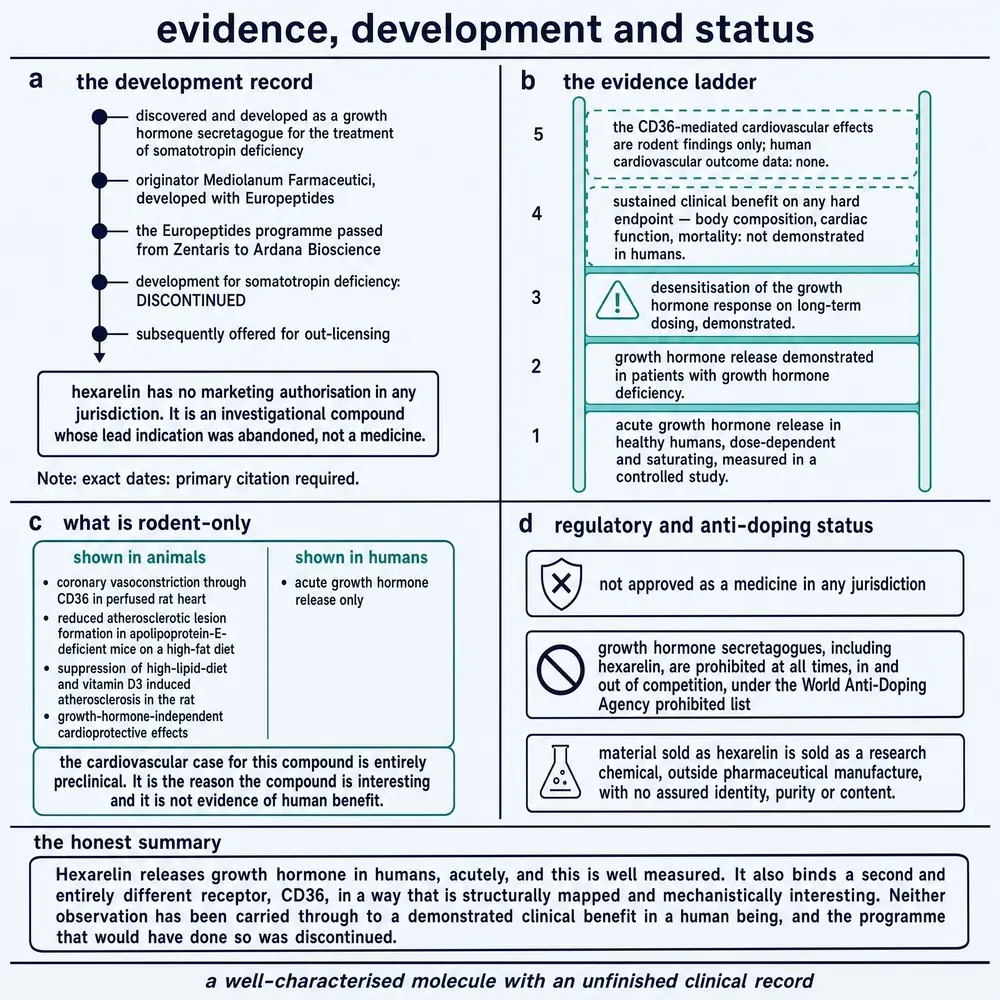
Hexarelin is not an approved medicine anywhere that could be verified for this document. It does not appear in the United States Food and Drug Administration's drug or labelling databases. Chemical and translational registries list it as investigational, maximum phase two, no approval, no withdrawal. There is no marketing authorisation to lapse, because there was never one to begin with.
It is, however, explicitly prohibited in sport. The World Anti-Doping Agency places growth hormone-releasing peptides in class S2, peptide hormones and growth factors, under the subsection covering growth hormone releasing factors, and names examorelin — with hexarelin given as the parenthetical alternative — among the examples, alongside alexamorelin and the numbered GHRP series. Class S2 is prohibited at all times, in and out of competition, and its substances are non-specified, which is the stricter category for sanctioning purposes.
A note on how that last paragraph was verified, because this series requires regulatory claims to be checked against the instrument rather than a summary of it. The Prohibited List's own text was read, and the class, the subsection and the naming of both examorelin and hexarelin were confirmed from it. But the Agency's own servers would not serve the document to automated retrieval, so the copy read was a reproduction rather than the file at its canonical address. Two independent reproductions agree verbatim on the wording quoted here. That is good evidence and it is not the instrument itself, and a reader entitled to know the difference is told it.
Between those two facts — no approval, universal prohibition in sport — sits a research-chemical market that has comfortably outlived the science. Of the local documents naming hexarelin in this project's stores, roughly three in five were vendor product pages, affiliate copy or trade material rather than scientific literature. That ratio is lower than this series has measured for some comparable compounds, which is itself informative: hexarelin is a smaller commercial phenomenon than its better-known relatives, and its remaining scientific literature, though thin, is proportionally larger than theirs.
A 2026 narrative review of performance-enhancing peptides places hexarelin in exactly this position — among agents encountered in clinical practice and online self-administration protocols, which it stratifies by evidence tier from randomised trial data down to a complete absence of human studies (Dominikowski et al., 2026). Hexarelin is an unusual case within that frame, because it is not a compound that never reached people. It reached them, was studied carefully for a decade, and was found wanting on the endpoint that mattered.
21What would have to be true
The interesting question about hexarelin is not whether the growth hormone programme should be revived. Section 10 answers that: sixteen weeks of twice-daily dosing moved no downstream measure in adults, and no argument in the subsequent literature disturbs that finding.
The interesting question is the cardiac one, and it can be stated as a list of things that would have to be established. Setting them out is more useful than a verdict, because it shows how far the claim actually is from the evidence.
First, the receptor would have to be identified. At present three groups have reached three incompatible conclusions — CD36, the growth hormone secretagogue receptor, and a third unidentified site — using different preparations, and none has been refuted (Section 14). The decisive experiment for the CD36 hypothesis is hexarelin's cardioprotection in an animal lacking CD36, and it has never been done with hexarelin (Section 15).
Second, the affinity problem would have to be resolved. Hexarelin binds CD36 somewhere between two and twenty-three micromolar depending on the method, against low nanomolar at the pituitary receptor. Concentrations in that micromolar range are not obviously reachable in a treated animal, let alone a treated person, and no paper in this literature addresses the gap.
Third, the direction of the vascular effect would have to be settled. A compound that constricts coronary vessels and a compound that dilates them are not the same therapeutic proposition, and the literature currently supports both (Section 14).
Fourth, a chronic human exposure would have to exist. Every human cardiac observation on this compound is a single intravenous dose with an imaging endpoint lasting ninety minutes. The longest human exposure of any kind is the sixteen-week study, which measured growth hormone rather than cardiac outcomes. Nobody has ever given hexarelin to a person for the purpose of improving their heart and then followed them.
And fifth, a delivery route would have to be viable for whatever indication was proposed. Three parts in a thousand by mouth, and a nasal route requiring twenty times the intravenous dose, are workable for an eight-month paediatric study and are not obviously workable for chronic cardiac therapy.
None of those five is unanswerable. Four of them are ordinary experiments that a moderately funded laboratory could do. That they remain unanswered twenty-four years after the last human study is not a statement about the science; it is a statement about who pays for it. Hexarelin's cardiac finding was made by a company's compound after the company had stopped wanting the compound, and orphaned findings do not get resolved.
What can be said with confidence is narrower and still worth saying. In several species, by several groups, over three decades, hexarelin reduces apoptosis and fibrosis in injured tissue, and it does so without needing the pituitary. That is a real and reproducible piece of biology. It is not a treatment for anything, it has never been shown to help a human being, and the distance between those two sentences is the subject of this document.
This document describes published research on hexarelin. It does not recommend human use of hexarelin or of any other compound named in it, and it specifies no dose, route or schedule for any person. Every dose, route, duration and population appearing above is a reported parameter of a study that was performed, given so that the reader can judge the evidence — not a suggestion that it be repeated.
Hexarelin is not an approved medicine in any jurisdiction identified here. It is prohibited at all times in sport under WADA class S2. The great majority of what is known about it comes from rats, mice and cell culture; the human record consists of a decade of small acute endocrine studies, one sixteen-week trial that found no downstream effect, and two uncontrolled paediatric cohorts totalling fifteen children.
22References
Generated from verified NCBI records rather than from recall. Author lists, journal names, volumes, pages and identifiers are taken from the PubMed record for each citation, and the build refuses to run if any identifier fails to resolve. A second gate reads every author–year citation back out of the finished prose and checks the surname and year against the record the identifier resolved to — six consecutive monographs in this series have shipped drafts in which a recalled surname or year was wrong, while the generated list beside it was correct.
- Agbo E, Liu D, Li M, Saahene RO, Chen L, Zhao L, et al.. Modulation of PTEN by hexarelin attenuates coronary artery ligation-induced heart failure in rats. Turk J Med Sci. 2019;49(3):945-958.
PMID 31091855 · doi:10.3906/sag-1812-49 · PMC7018219 - Ahmad J, Ikram S, Ahmad F, Rehman IU, Mushtaq M. SARS-CoV-2 RNA Dependent RNA polymerase (RdRp) - A drug repurposing study. Heliyon. 2020;6(7):e04502.
PMID 32754651 · doi:10.1016/j.heliyon.2020.e04502 · PMC7377705 - Arvat E, Maccario M, Di Vito L, Broglio F, Benso A, Gottero C, et al.. Endocrine activities of ghrelin, a natural growth hormone secretagogue (GHS), in humans: comparison and interactions with hexarelin, a nonnatural peptidyl GHS, and GH-releasing hormone. J Clin Endocrinol Metab. 2001;86(3):1169-74.
PMID 11238504 · doi:10.1210/jcem.86.3.7314 - Arvat E, Gianotti L, Grottoli S, Imbimbo BP, Lenaerts V, Deghenghi R, et al.. Arginine and growth hormone-releasing hormone restore the blunted growth hormone-releasing activity of hexarelin in elderly subjects. J Clin Endocrinol Metab. 1994;79(5):1440-3.
PMID 7962341 · doi:10.1210/jcem.79.5.7962341 - Arvat E, Ceda GP, Di Vito L, Ramunni J, Gianotti L, Broglio F, et al.. Age-related variations in the neuroendocrine control, more than impaired receptor sensitivity, cause the reduction in the GH-releasing activity of GHRPs in human aging. Pituitary. 1998;1(1):51-8.
PMID 11081183 · doi:10.1023/a:1009970909015 - Baldanzi G, Filigheddu N, Cutrupi S, Catapano F, Bonissoni S, Fubini A, et al.. Ghrelin and des-acyl ghrelin inhibit cell death in cardiomyocytes and endothelial cells through ERK1/2 and PI 3-kinase/AKT. J Cell Biol. 2002;159(6):1029-37.
PMID 12486113 · doi:10.1083/jcb.200207165 · PMC2173981 - Bao Y, Wang L, Xu Y, Yang Y, Wang L, Si S, et al.. Salvianolic acid B inhibits macrophage uptake of modified low density lipoprotein (mLDL) in a scavenger receptor CD36-dependent manner. Atherosclerosis. 2012;223(1):152-9.
PMID 22658257 · doi:10.1016/j.atherosclerosis.2012.05.006 · PMC3389144 - Bellone J, Aimaretti G, Bartolotta E, Benso L, Imbimbo BP, Lenhaerts V, et al.. Growth hormone-releasing activity of hexarelin, a new synthetic hexapeptide, before and during puberty. J Clin Endocrinol Metab. 1995;80(4):1090-4.
PMID 7714074 · doi:10.1210/jcem.80.4.7714074 - Bessi VL, Labbé SM, Huynh DN, Ménard L, Jossart C, Febbraio M, et al.. EP 80317, a selective CD36 ligand, shows cardioprotective effects against post-ischaemic myocardial damage in mice. Cardiovasc Res. 2012;96(1):99-108.
PMID 22787133 · doi:10.1093/cvr/cvs225 - Biagini G, Torsello A, Marinelli C, Gualtieri F, Vezzali R, Coco S, et al.. Beneficial effects of desacyl-ghrelin, hexarelin and EP-80317 in models of status epilepticus. Eur J Pharmacol. 2011;670(1):130-6.
PMID 21914437 · doi:10.1016/j.ejphar.2011.08.020 - Bisi G, Podio V, Valetto MR, Broglio F, Bertuccio G, Aimaretti G, et al.. Cardiac effects of hexarelin in hypopituitary adults. Eur J Pharmacol. 1999;381(1):31-8.
PMID 10528131 · doi:10.1016/s0014-2999(99)00537-3 - Bisi G, Podio V, Valetto MR, Broglio F, Bertuccio G, Del Rio G, et al.. Acute cardiovascular and hormonal effects of GH and hexarelin, a synthetic GH-releasing peptide, in humans. J Endocrinol Invest. 1999;22(4):266-72.
PMID 10342360 · doi:10.1007/BF03343555 - Bodart V, Bouchard JF, McNicoll N, Escher E, Carrière P, Ghigo E, et al.. Identification and characterization of a new growth hormone-releasing peptide receptor in the heart. Circ Res. 1999;85(9):796-802.
PMID 10532947 · doi:10.1161/01.res.85.9.796 - Bodart V, Febbraio M, Demers A, McNicoll N, Pohankova P, Perreault A, et al.. CD36 mediates the cardiovascular action of growth hormone-releasing peptides in the heart. Circ Res. 2002;90(8):844-9.
PMID 11988484 · doi:10.1161/01.res.0000016164.02525.b4 - Bowers CY, Momany F, Reynolds GA, Chang D, Hong A, Chang K. Structure-activity relationships of a synthetic pentapeptide that specifically releases growth hormone in vitro. Endocrinology. 1980;106(3):663-7.
PMID 7353536 · doi:10.1210/endo-106-3-663 - Bowers CY, Momany FA, Reynolds GA, Hong A. On the in vitro and in vivo activity of a new synthetic hexapeptide that acts on the pituitary to specifically release growth hormone. Endocrinology. 1984;114(5):1537-45.
PMID 6714155 · doi:10.1210/endo-114-5-1537 - Bowers CY. History to the discovery of ghrelin. Methods Enzymol. 2012;514:3-32.
PMID 22975043 · doi:10.1016/B978-0-12-381272-8.00001-5 - Broglio F, Guarracino F, Benso A, Gottero C, Prodam F, Granata R, et al.. Effects of acute hexarelin administration on cardiac performance in patients with coronary artery disease during by-pass surgery. Eur J Pharmacol. 2002;448(2-3):193-200.
PMID 12144941 · doi:10.1016/s0014-2999(02)01934-9 - Broglio F, Benso A, Valetto MR, Gottero C, Quaranta L, Podio V, et al.. Growth hormone-independent cardiotropic activities of growth hormone-releasing peptides in normal subjects, in patients with growth hormone deficiency, and in patients with idiopathic or ischemic dilated cardiomyopathy. Endocrine. 2001;14(1):105-8.
PMID 11322491 · doi:10.1385/ENDO:14:1:105 - Bujold K, Mellal K, Zoccal KF, Rhainds D, Brissette L, Febbraio M, et al.. EP 80317, a CD36 selective ligand, promotes reverse cholesterol transport in apolipoprotein E-deficient mice. Atherosclerosis. 2013;229(2):408-14.
PMID 23880196 · doi:10.1016/j.atherosclerosis.2013.05.031 - Chow KBS. Hexarelin promotes the survival of retinal ganglion cells after optic nerve transection. Indian J Pharmacol. 2026;58(2):126-130.
PMID 41766237 · doi:10.4103/ijp.ijp_176_24 · PMC13004568 - Conte E, Camerino GM, Mele A, De Bellis M, Pierno S, Rana F, et al.. Growth hormone secretagogues prevent dysregulation of skeletal muscle calcium homeostasis in a rat model of cisplatin-induced cachexia. J Cachexia Sarcopenia Muscle. 2017;8(3):386-404.
PMID 28294567 · doi:10.1002/jcsm.12185 · PMC5703021 - Dahlgren D, Olander T, Sjöblom M, Hedeland M, Lennernäs H. Effect of paracellular permeation enhancers on intestinal permeability of two peptide drugs, enalaprilat and hexarelin, in rats. Acta Pharm Sin B. 2021;11(6):1667-1675.
PMID 34221875 · doi:10.1016/j.apsb.2020.12.019 · PMC8245904 - Dahlgren D, Sjöblom M, Hedeland M, Lennernäs H. The In Vivo Effect of Transcellular Permeation Enhancers on the Intestinal Permeability of Two Peptide Drugs Enalaprilat and Hexarelin. Pharmaceutics. 2020;12(2).
PMID 31991924 · doi:10.3390/pharmaceutics12020099 · PMC7076382 - De Ambrogi M, Volpe S, Tamanini C. Ghrelin: central and peripheral effects of a novel peptydil hormone. Med Sci Monit. 2003;9(9):RA217-24.
PMID 12960936 - DEGHENGHI R, REVESZ C, GAUDRY R. NEW SYNTHESIS AND STRUCTURE ACTIVITY RELATIONSHIP IN THE 17-ALKYLATED PROGESTERONE SERIES. J Med Chem. 1963;6:301-4.
PMID 14185989 · doi:10.1021/jm00339a019 - Deghenghi R. The development of 'impervious peptides' as growth hormone secretagogues. Acta Paediatr Suppl. 1997;423:85-7.
PMID 9401550 · doi:10.1111/j.1651-2227.1997.tb18381.x - Deghenghi R, Cananzi MM, Torsello A, Battisti C, Muller EE, Locatelli V. GH-releasing activity of Hexarelin, a new growth hormone releasing peptide, in infant and adult rats. Life Sci. 1994;54(18):1321-8.
PMID 7910650 · doi:10.1016/0024-3205(94)00510-9 - Demers A, McNicoll N, Febbraio M, Servant M, Marleau S, Silverstein R, et al.. Identification of the growth hormone-releasing peptide binding site in CD36: a photoaffinity cross-linking study. Biochem J. 2004;382(Pt 2):417-24.
PMID 15176951 · doi:10.1042/BJ20040036 · PMC1133797 - Dominikowski A, Rękoś Z, Olejarz M, Szczepanek-Parulska E, Domin R, RuchaŁa M. The emerging landscape of performance-enhancing peptides modulating GH-IGF1 axis: bridging the gap between clinical evidence and patient self-administration. Front Endocrinol (Lausanne). 2026;17:1822475.
PMID 42395176 · doi:10.3389/fendo.2026.1822475 · PMC13322892 - Elimam H, Gauvin J, Huynh DN, Ménard L, Al-Hawat ML, Harb D, et al.. Targeting CD36 With EP 80317 Reduces Remote Inflammatory Response to Hind Limb Ischemia-Reperfusion in Mice. J Biochem Mol Toxicol. 2024;38(12):e70057.
PMID 39552437 · doi:10.1002/jbt.70057 · PMC11582942 - Frieboes RM, Antonijevic IA, Held K, Murck H, Pollmächer T, Uhr M, et al.. Hexarelin decreases slow-wave sleep and stimulates the secretion of GH, ACTH, cortisol and prolactin during sleep in healthy volunteers. Psychoneuroendocrinology. 2004;29(7):851-60.
PMID 15177700 · doi:10.1016/S0306-4530(03)00152-5 - Gauvin J, Huynh DN, Dubuc I, Lê C, Tugores R, Flamand N, et al.. Pharmacological targeting of the hyper-inflammatory response to SARS-CoV-2-infected K18-hACE2 mice using a cluster of differentiation 36 receptor modulator. Front Pharmacol. 2024;15:1303342.
PMID 38384295 · doi:10.3389/fphar.2024.1303342 · PMC10879382 - Ghigo E, Arvat E, Gianotti L, Imbimbo BP, Lenaerts V, Deghenghi R, et al.. Growth hormone-releasing activity of hexarelin, a new synthetic hexapeptide, after intravenous, subcutaneous, intranasal, and oral administration in man. J Clin Endocrinol Metab. 1994;78(3):693-8.
PMID 8126144 · doi:10.1210/jcem.78.3.8126144 - Ghigo E, Arvat E, Ramunni J, Colao A, Gianotti L, Deghenghi R, et al.. Adrenocorticotropin- and cortisol-releasing effect of hexarelin, a synthetic growth hormone-releasing peptide, in normal subjects and patients with Cushing's syndrome. J Clin Endocrinol Metab. 1997;82(8):2439-44.
PMID 9253314 · doi:10.1210/jcem.82.8.4132 - Ghigo E, Arvat E, Gianotti L, Grottoli S, Rizzi G, Ceda GP, et al.. Short-term administration of intranasal or oral Hexarelin, a synthetic hexapeptide, does not desensitize the growth hormone responsiveness in human aging. Eur J Endocrinol. 1996;135(4):407-12.
PMID 8921821 · doi:10.1530/eje.0.1350407 - Guan C, Li C, Shen X, Yang C, Liu Z, Zhang N, et al.. Hexarelin alleviates apoptosis on ischemic acute kidney injury via MDM2/p53 pathway. Eur J Med Res. 2023;28(1):344.
PMID 37710348 · doi:10.1186/s40001-023-01318-w · PMC10500723 - Guillaume V, Magnan E, Cataldi M, Dutour A, Sauze N, Renard M, et al.. Growth hormone (GH)-releasing hormone secretion is stimulated by a new GH-releasing hexapeptide in sheep. Endocrinology. 1994;135(3):1073-6.
PMID 7915227 · doi:10.1210/endo.135.3.7915227 - Harb D, Bujold K, Febbraio M, Sirois MG, Ong H, Marleau S. The role of the scavenger receptor CD36 in regulating mononuclear phagocyte trafficking to atherosclerotic lesions and vascular inflammation. Cardiovasc Res. 2009;83(1):42-51.
PMID 19264766 · doi:10.1093/cvr/cvp081 - Howard AD, Feighner SD, Cully DF, Arena JP, Liberator PA, Rosenblum CI, et al.. A receptor in pituitary and hypothalamus that functions in growth hormone release. Science. 1996;273(5277):974-7.
PMID 8688086 · doi:10.1126/science.273.5277.974 - Imazio M, Bobbio M, Broglio F, Benso A, Podio V, Valetto MR, et al.. GH-independent cardiotropic activities of hexarelin in patients with severe left ventricular dysfunction due to dilated and ischemic cardiomyopathy. Eur J Heart Fail. 2002;4(2):185-91.
PMID 11959048 · doi:10.1016/s1388-9842(01)00223-9 - Imbimbo BP, Mant T, Edwards M, Amin D, Dalton N, Boutignon F, et al.. Growth hormone-releasing activity of hexarelin in humans. A dose-response study. Eur J Clin Pharmacol. 1994;46(5):421-5.
PMID 7957536 · doi:10.1007/BF00191904 - Klinger B, Silbergeld A, Deghenghi R, Frenkel J, Laron Z. Desensitization from long-term intranasal treatment with hexarelin does not interfere with the biological effects of this growth hormone-releasing peptide in short children. Eur J Endocrinol. 1996;134(6):716-9.
PMID 8766941 · doi:10.1530/eje.0.1340716 - Kojima M, Hosoda H, Date Y, Nakazato M, Matsuo H, Kangawa K. Ghrelin is a growth-hormone-releasing acylated peptide from stomach. Nature. 1999;402(6762):656-60.
PMID 10604470 · doi:10.1038/45230 - Laron Z, Frenkel J, Gil-Ad I, Klinger B, Lubin E, Wuthrich P, et al.. Growth hormone releasing activity by intranasal administration of a synthetic hexapeptide (hexarelin). Clin Endocrinol (Oxf). 1994;41(4):539-41.
PMID 7955465 · doi:10.1111/j.1365-2265.1994.tb02589.x - Laron Z, Frenkel J, Deghenghi R, Anin S, Klinger B, Silbergeld A. Intranasal administration of the GHRP hexarelin accelerates growth in short children. Clin Endocrinol (Oxf). 1995;43(5):631-5.
PMID 8548949 · doi:10.1111/j.1365-2265.1995.tb02929.x - Laron Z. Intranasally and orally active GH secretagogues are useful clinical tools: so why are they not on the market?. J Endocrinol Invest. 2003;26(1):91-2.
PMID 12602542 · doi:10.1007/BF03345130 - Locatelli V, Rossoni G, Schweiger F, Torsello A, De Gennaro Colonna V, Bernareggi M, et al.. Growth hormone-independent cardioprotective effects of hexarelin in the rat. Endocrinology. 1999;140(9):4024-31.
PMID 10465272 · doi:10.1210/endo.140.9.6948 - Loche S, Cambiaso P, Carta D, Setzu S, Imbimbo BP, Borrelli P, et al.. The growth hormone-releasing activity of hexarelin, a new synthetic hexapeptide, in short normal and obese children and in hypopituitary subjects. J Clin Endocrinol Metab. 1995;80(2):674-8.
PMID 7852535 · doi:10.1210/jcem.80.2.7852535 - Loche S, Cambiaso P, Merola B, Colao A, Faedda A, Imbimbo BP, et al.. The effect of hexarelin on growth hormone (GH) secretion in patients with GH deficiency. J Clin Endocrinol Metab. 1995;80(9):2692-6.
PMID 7673411 · doi:10.1210/jcem.80.9.7673411 - Lucchi C, Costa AM, Giordano C, Curia G, Piat M, Leo G, et al.. Involvement of PPARγ in the Anticonvulsant Activity of EP-80317, a Ghrelin Receptor Antagonist. Front Pharmacol. 2017;8:676.
PMID 29018345 · doi:10.3389/fphar.2017.00676 · PMC5614981 - Ma Y, Zhang L, Edwards JN, Launikonis BS, Chen C. Growth hormone secretagogues protect mouse cardiomyocytes from in vitro ischemia/reperfusion injury through regulation of intracellular calcium. PLoS One. 2012;7(4):e35265.
PMID 22493744 · doi:10.1371/journal.pone.0035265 · PMC3320867 - Maccario M, Veldhuis JD, Broglio F, Vito LD, Arvat E, Deghenghi R, et al.. Impact of two or three daily subcutaneous injections of hexarelin, a synthetic growth hormone (GH) secretagogue, on 24-h GH, prolactin, adrenocorticotropin and cortisol secretion in humans. Eur J Endocrinol. 2002;146(3):310-8.
PMID 11888836 · doi:10.1530/eje.0.1460310 - Mao Y, Tokudome T, Kishimoto I. The cardiovascular action of hexarelin. J Geriatr Cardiol. 2014;11(3):253-8.
PMID 25278975 · doi:10.11909/j.issn.1671-5411.2014.03.007 · PMC4178518 - Marleau S, Harb D, Bujold K, Avallone R, Iken K, Wang Y, et al.. EP 80317, a ligand of the CD36 scavenger receptor, protects apolipoprotein E-deficient mice from developing atherosclerotic lesions. FASEB J. 2005;19(13):1869-71.
PMID 16123174 · doi:10.1096/fj.04-3253fje - Massoud AF, Hindmarsh PC, Brook CG. Hexarelin-induced growth hormone, cortisol, and prolactin release: a dose-response study. J Clin Endocrinol Metab. 1996;81(12):4338-41.
PMID 8954038 · doi:10.1210/jcem.81.12.8954038 - McDonald H, Peart J, Kurniawan N, Galloway G, Royce S, Samuel CS, et al.. Hexarelin treatment preserves myocardial function and reduces cardiac fibrosis in a mouse model of acute myocardial infarction. Physiol Rep. 2018;6(9):e13699.
PMID 29756411 · doi:10.14814/phy2.13699 · PMC5949285 - Meanti R, Rizzi L, Bresciani E, Molteni L, Locatelli V, Coco S, et al.. Hexarelin Modulation of MAPK and PI3K/Akt Pathways in Neuro-2A Cells Inhibits Hydrogen Peroxide-Induced Apoptotic Toxicity. Pharmaceuticals (Basel). 2021;14(5).
PMID 34066741 · doi:10.3390/ph14050444 · PMC8150489 - Meanti R, Licata M, Rizzi L, Bresciani E, Molteni L, Coco S, et al.. Protective Effects of Hexarelin and JMV2894 in a Human Neuroblastoma Cell Line Expressing the SOD1-G93A Mutated Protein. Int J Mol Sci. 2023;24(2).
PMID 36674509 · doi:10.3390/ijms24020993 · PMC9863688 - Momany FA, Bowers CY, Reynolds GA, Chang D, Hong A, Newlander K. Design, synthesis, and biological activity of peptides which release growth hormone in vitro. Endocrinology. 1981;108(1):31-9.
PMID 6109621 · doi:10.1210/endo-108-1-31 - Momany FA, Bowers CY, Reynolds GA, Hong A, Newlander K. Conformational energy studies and in vitro and in vivo activity data on growth hormone-releasing peptides. Endocrinology. 1984;114(5):1531-6.
PMID 6425039 · doi:10.1210/endo-114-5-1531 - Mosa R, Huang L, Wu Y, Fung C, Mallawakankanamalage O, LeRoith D, et al.. Hexarelin, a Growth Hormone Secretagogue, Improves Lipid Metabolic Aberrations in Nonobese Insulin-Resistant Male MKR Mice. Endocrinology. 2017;158(10):3174-3187.
PMID 28977588 · doi:10.1210/en.2017-00168 · PMC5659698 - Muccioli G, Ghè C, Ghigo MC, Papotti M, Arvat E, Boghen MF, et al.. Specific receptors for synthetic GH secretagogues in the human brain and pituitary gland. J Endocrinol. 1998;157(1):99-106.
PMID 9614363 · doi:10.1677/joe.0.1570099 - Müller TD, Nogueiras R, Andermann ML, Andrews ZB, Anker SD, Argente J, et al.. Ghrelin. Mol Metab. 2015;4(6):437-60.
PMID 26042199 · doi:10.1016/j.molmet.2015.03.005 · PMC4443295 - Pang J, Xu Q, Xu X, Yin H, Xu R, Guo S, et al.. Hexarelin suppresses high lipid diet and vitamin D3-induced atherosclerosis in the rat. Peptides. 2010;31(4):630-8.
PMID 19931584 · doi:10.1016/j.peptides.2009.11.007 - Pobee E, Daziani G, Gameli PS, Basile G, Carlier J, Tini A. Identification of alexamorelin consumption biomarkers using human hepatocyte incubations and high-resolution mass spectrometry. J Anal Toxicol. 2025;49(6):394-400.
PMID 40465419 · doi:10.1093/jat/bkaf038 - Pong SS, Chaung LY, Dean DC, Nargund RP, Patchett AA, Smith RG. Identification of a new G-protein-linked receptor for growth hormone secretagogues. Mol Endocrinol. 1996;10(1):57-61.
PMID 8838145 · doi:10.1210/mend.10.1.8838145 - Rahim A, O'Neill PA, Shalet SM. The effect of chronic hexarelin administration on the pituitary-adrenal axis and prolactin. Clin Endocrinol (Oxf). 1999;50(1):77-84.
PMID 10341859 · doi:10.1046/j.1365-2265.1999.00609.x - Rahim A, O'Neill PA, Shalet SM. Growth hormone status during long-term hexarelin therapy. J Clin Endocrinol Metab. 1998;83(5):1644-9.
PMID 9589671 · doi:10.1210/jcem.83.5.4812 - Rodrigue-Way A, Demers A, Ong H, Tremblay A. A growth hormone-releasing peptide promotes mitochondrial biogenesis and a fat burning-like phenotype through scavenger receptor CD36 in white adipocytes. Endocrinology. 2007;148(3):1009-18.
PMID 17138655 · doi:10.1210/en.2006-0975 - Rossoni G, Locatelli V, De Gennaro Colonna V, Torsello A, Schweiger F, Boghen M, et al.. Growth hormone and hexarelin prevent endothelial vasodilator dysfunction in aortic rings of the hypophysectomized rat. J Cardiovasc Pharmacol. 1999;34(3):454-60.
PMID 10471007 · doi:10.1097/00005344-199909000-00021 - Rossoni G, De Gennaro Colonna V, Bernareggi M, Polvani GL, Müller EE, Berti F. Protectant activity of hexarelin or growth hormone against postischemic ventricular dysfunction in hearts from aged rats. J Cardiovasc Pharmacol. 1998;32(2):260-5.
PMID 9700988 · doi:10.1097/00005344-199808000-00013 - Sabatino D, Proulx C, Pohankova P, Ong H, Lubell WD. Structure-activity relationships of GHRP-6 azapeptide ligands of the CD36 scavenger receptor by solid-phase submonomer azapeptide synthesis. J Am Chem Soc. 2011;133(32):12493-506.
PMID 21692501 · doi:10.1021/ja203007u - Sirago G, Conte E, Fracasso F, Cormio A, Fehrentz JA, Martinez J, et al.. Growth hormone secretagogues hexarelin and JMV2894 protect skeletal muscle from mitochondrial damages in a rat model of cisplatin-induced cachexia. Sci Rep. 2017;7(1):13017.
PMID 29026190 · doi:10.1038/s41598-017-13504-y · PMC5638899 - Torsello A, Bresciani E, Rossoni G, Avallone R, Tulipano G, Cocchi D, et al.. Ghrelin plays a minor role in the physiological control of cardiac function in the rat. Endocrinology. 2003;144(5):1787-92.
PMID 12697684 · doi:10.1210/en.2002-221048 - Waddingham MT, Tsuchimochi H, Sonobe T, Asano R, Jin H, Ow CPC, et al.. Using Synchrotron Radiation Imaging Techniques to Elucidate the Actions of Hexarelin in the Heart of Small Animal Models. Front Physiol. 2021;12:766818.
PMID 35126171 · doi:10.3389/fphys.2021.766818 · PMC8814524 - Xu X, Ding F, Pang J, Gao X, Xu RK, Hao W, et al.. Chronic administration of hexarelin attenuates cardiac fibrosis in the spontaneously hypertensive rat. Am J Physiol Heart Circ Physiol. 2012;303(6):H703-11.
PMID 22842067 · doi:10.1152/ajpheart.00257.2011 - Zambelli V, Rizzi L, Delvecchio P, Bresciani E, Rezoagli E, Molteni L, et al.. Hexarelin modulates lung mechanics, inflammation, and fibrosis in acute lung injury. Drug Target Insights. 2021;15:26-33.
PMID 34871336 · doi:10.33393/dti.2021.2347 · PMC8638068
Sources without a PubMed record
Regulatory instruments, chemical registries, book chapters and registry searches have no PubMed record and are listed separately, so that the generated list above remains wholly machine-verified.
- Bowers CY, Chang J, Momany FA, Folkers K. Effect of the enkephalins and enkephalin analogues on release of pituitary hormones in vitro. In: MacIntyre I, Szelke M, eds. Molecular Endocrinology. Amsterdam: Elsevier/North-Holland, 1977:287–292. The originating observation, and not indexed in PubMed. Citation taken from the reference list of Deghenghi's own 1996 chapter and not verified against the chapter itself.
https://link.springer.com/chapter/10.1007/978-1-4612-2396-2_6 - Deghenghi R. Growth Hormone Releasing Peptides. In: Bercu BB, Walker RF, eds. Growth Hormone Secretagogues. New York: Springer, 1996:85–102. doi:10.1007/978-1-4612-2396-2_6. Deghenghi's own account of the design programme; opens by crediting Momany and Bowers. Paywalled — abstract and reference list read, full text not retrieved.
https://link.springer.com/chapter/10.1007/978-1-4612-2396-2_6 - World Health Organization. Proposed International Nonproprietary Names: List 72 — examorelinum. Gives the chemical name, the formula C<sub>47</sub>H<sub>58</sub>N<sub>12</sub>O<sub>6</sub> and CAS 140703-51-1; objections due not later than 30 June 1995. The issue of WHO Drug Information in which List 72 appeared could not be established: the pre-1997 list PDFs are image scans with no text layer.
https://cdn.who.int/media/docs/default-source/international-nonproprietary-nam - World Health Organization. Recommended International Nonproprietary Names: List 35 — examorelinum. WHO Drug Information, Vol. 9, No. 3, 1995. The list in which the INN was adopted.
https://cdn.who.int/media/docs/default-source/international-nonproprietary-nam - World Anti-Doping Agency. The 2026 Prohibited List — International Standard. Class S2, growth hormone releasing factors, names examorelin (hexarelin) among the GH-releasing peptides; prohibited at all times, non-specified. <b>The text was read from a reproduction rather than from wada-ama.org, which would not serve the document to automated retrieval; two independent reproductions agree verbatim on the wording relied on here</b>.
https://www.wada-ama.org/en/prohibited-list - ChEMBL, European Bioinformatics Institute. CHEMBL108335 — EXAMORELIN. The source of this document's structural values: formula C<sub>47</sub>H<sub>58</sub>N<sub>12</sub>O<sub>6</sub>, relative molecular mass 887.06, maximum phase 2, and the synonym list carrying EP-23905 and MF-6003. Retrieved 3 August 2026.
https://www.ebi.ac.uk/chembl/compound_report_card/CHEMBL108335/ - Ainsworth SJ. Obituaries: Romano DeGhenghi. Chemical & Engineering News, 10 March 2008, Vol. 86, No. 10. The source for Deghenghi's career: Trieste 1953, Ayerst Montreal from 1960, Debiopharm, and the founding of Europeptides. Note the obituary spells the surname DeGhenghi; every scientific record spells it Deghenghi.
https://cen.acs.org/articles/86/i10/Obituaries.html - ClinicalTrials.gov. Registry search: hexarelin; examorelin. Both queries return no registered study, verified against a control query in the same session. Consistent with a clinical programme that ran before registration became mandatory in 2005. Searched 3 August 2026.
https://clinicaltrials.gov/
23How this document was assembled
The corpus was built against project 05, the Therapeutic Peptide Research Library. The interesting part of the arithmetic is how much had to be thrown away, and why.
The identity problem, in numbers. Every file with a document extension in the project's stores was opened — 45,975 of them — and its extracted text searched. 477 contained a designation of this compound. 417 were refused, and the reasons were recorded separately because they mean different things: most were dominated by GHRP-6, which differs from hexarelin by one methyl group and shares its entire research vocabulary, and the rest by other secretagogues, by the numbered siblings, or by growth hormone-releasing hormone, which is one letter from the class abbreviation and appears in the same paragraph constantly. That leaves 60 admitted.
The trap this corpus was built around. EP-80317 is a hexarelin analogue, and its papers introduce it in exactly those words. So a document about EP-80317 names hexarelin — correctly, boundaried, in the right case — while describing a molecule that blocks the receptor hexarelin activates and that owns much of the CD36 literature a reader would assume belongs to the subject. No word boundary or capitalisation rule can refuse that, because the matched string is a genuine instance of the compound's own name. The remedy is order of operations: a strip that removes the analogue designations and the adjectival construction runs in front of every other matcher, and only what survives is counted. 4 fetched documents named hexarelin only in that construction and were refused on that basis alone; a further 61 named it while being dominated by a relative. Under a plain search on the compound's name all of them would have entered the reading corpus.
The source-kind problem. Of the 60 admitted local files, 24 were peer-reviewed scientific full texts and 36 were vendor product pages, affiliate and trade copy, and this project's own earlier internal write-ups. Reporting the larger number as a corpus would be true and useless. The ratio here is roughly three to two, which is markedly lower than this series has measured for comparable grey-market compounds — hexarelin is a smaller commercial phenomenon than its relatives, and proportionally more of what is written about it is science.
The figure below sets that arithmetic out in the order it was performed. It is worth one general remark. Every row above the last is a number this project could have quoted as its corpus, and each would have been true: 45,975 files were opened, 477 named the compound, 2,481 records were retrieved, 779 documents were fetched. Only the last row describes what was actually read. A corpus figure is the one number in a document like this that a reader cannot check, so the honest thing is to publish the ones that make it checkable.
Why the refused documents are reported rather than deleted. A corpus figure is a claim about coverage, and such a claim is only checkable if the reader can see what was excluded and on what grounds. The two rejection classes above mean opposite things and are therefore never pooled: an analogue-only refusal says the identity gate did work no query could have done, while a relative-dominated refusal says the harvest deliberately reached for context and the gate handed it back. A single pooled number would credit the gate with the query's work, or the reverse, and neither figure would then mean anything.
The external harvest. A four-arm PubMed query — the compound, its two receptors, the cardiovascular literature, and the named relatives harvested deliberately so the document could say what belongs to them — returned 2,481 records, of which 2,340 survived a relevance screen. Because PubMed indexes only titles, abstracts and MeSH terms, a second route searched PubMed Central's full text and returned 250 matches, of which 184 were invisible to the first. Stage 03 fetched the union: 779 documents, roughly 6,980 printed-page equivalents of raw material.
The far-side screen. Of those, 570 never named the compound in their retrieved body at all — they had been returned because they cite a paper about it. 89 mentioned it below the substantive-use threshold, and 11 carried no retrievable body text. Merging what remained with the local set by identifier and removing the 13 documents present in both gives the reading corpus this monograph is written from: 55 unique scientific full texts, roughly 720 printed-page equivalents.
| Stage | What it does | Result |
|---|---|---|
| 00 | Break-test of the identity matcher, before any sweep | 22 constructed traps, all passed |
| 01b | Targeted scan of the project's document stores | 45,975 files opened |
| 01c | Interrogation of the curated library database | SQL prefilter, gated in Python |
| 01g | Classification of local hits by source kind | 24 of 60 are literature |
| 02 | PubMed E-utilities harvest, date-partitioned | 2,481 records |
| 02b | PubMed Central full-text search | 250 matches |
| 03 | Open-access full-text retrieval of the union | 779 documents |
| 03c | Analogue strip, identity gate, substantive-use screen | 44 retained |
| 04 | Keyed union, de-duplication, inventory | 55 unique full texts |
| 05 | Reference list from verified NCBI records | 78 citations |
| 05b | Citation map checked back against the resolved records | every surname and year |
| 05c | Authored figures rendered to fragments | 15 figures |
| 06 | Assembly of this document | 1 body fragment |
Figures
This document carries twenty-five figures: eighteen authored vector charts and seven crops of commissioned artwork, in one continuous series. Every colour resolves through the document's own design tokens so the artwork re-themes with the page, and every authored canvas is measured from the ink actually drawn on it rather than declared, so that a drawing cannot overflow its frame and print through its own caption.
Three of the generators refuse to emit at all under conditions that would otherwise fail silently. The structure figure computes hexarelin's molecular formula from its residue table and will not write the file unless the result matches the formula ChEMBL records — the drawing and the printed formula cannot disagree, because one is derived from the other. Any figure stating a total derives it from the data it is drawing. And a label too wide for the space available raises rather than being clipped, because text in a vector canvas has no line box and is cut at the frame edge without warning.
The commissioned artwork, and what was done to it
Five plates were supplied for this compound with a caption list. They were audited value by value before use, and the audit found three defective panels. The standard for this series is explicit that a structural error in supplied art is corrected rather than merely withheld: where one panel is wrong and its neighbours are sound, the plate is cropped to the sound panels and a replacement is authored for the defective one. That is what was done here, and every caption says in place which part of it is commissioned and which is authored.
| Panel | Finding | Disposition |
|---|---|---|
| Plate 1, side chains | Histidine drawn as a pyrazole — its two ring nitrogens bonded to each other, where an imidazole separates them with a carbon. Lysine drawn with three methylenes directly beneath its own annotation reading “four” | corrected — Figure 3 |
| Plate 3, CD36 domain map | Axis terminated at residue 439, a chain length no source supports; CD36 is 472 residues in both human and rat. The domain coordinates printed were correct | corrected — Figure 15 |
| Plate 4, dose–response | One axis labelled “response” carrying peak concentrations while its point labels were areas under the curve in different units, and placebo plotted at a nominal dose on a logarithmic axis on which zero cannot exist | corrected — Figure 8 |
| Plate 2, family table | Column heading “structure class” sitting over the compound-name column. The document's own lineage figure carries the same content correctly | dropped as duplicated |
| Plate 5, corporate chain | Names a company transfer that no source located for this document connects to hexarelin or to Europeptides | admitted, captioned unverified |
Two points about that table are worth drawing out. The first is that the histidine and lysine errors were each contradicted by the plate's own annotation — the label said imidazole and the drawing showed a pyrazole; the label said four methylenes and the drawing showed three. Neither needed a literature search to detect, only arithmetic and a careful look, which is the cheapest check available on any supplied figure and the one worth running first. The second is that the plate set also contained a caution that proved correct and useful: its note that the reference literature disagrees about whether residue 2 carries one methyl group or two is real, and Figure 7 reproduces it. Supplied artwork is evidence to be checked in both directions, and checking it here both removed three wrong panels and supplied one argument the document would otherwise have missed.
24Evidence handling
Findings are labelled by the kind of study that produced them, in the sentence that reports them, and the species is named every time. Animal and in-vitro results are never phrased so as to imply a human outcome.
The evidence is mostly in abstracts, and that is a finding rather than an excuse. Of 200 indexed records that name hexarelin and are not dominated by a relative, 175 — eighty-eight per cent — have no full text deposited anywhere. That is not a gap in this project's retrieval; it is a property of the compound. Hexarelin's human programme ran from 1994 to about 2003, entirely before open-access deposition existed, and it never caught up. Every human study this document relies on — the dose-response work, the route comparison, the sixteen-week study, the paediatric cohorts, the bypass study — was read as an indexed abstract, not as a full text. Where a number appears from one of those studies, it is a number the abstract states.
That has one consequence worth stating plainly, because it bears on how much weight the human sections of this document can carry. An abstract reports what its authors chose to report. It gives the direction of an effect, usually its size, and often the number of subjects; it does not give the exclusions, the handling of missing data, the pre-specification of the endpoint, or the figures from which a reader might form an independent judgement. Every human number quoted in Part Two is therefore a number reported by an author rather than one this document has checked against a table. Where two abstracts of the same programme disagree, that has been said. Where a value could not be found at all, that has been said too.
Several molecules, kept apart. Hexarelin, GHRP-6, GHRP-1, GHRP-2, ipamorelin, MK-0677, anamorelin and ghrelin share a receptor, share disease models, share journals and share investigators, and the vocabulary that identifies one identifies all of them. Two separations do real work in this document. GHRP-6 differs from hexarelin by a single methyl group, and no published study has given the two to the same human subjects, so the potency comparison everyone assumes is not sourceable. EP-80317 is a hexarelin analogue that antagonises the receptor hexarelin agonises, and the anti-atherosclerotic, reverse-cholesterol-transport, macrophage-trafficking, hind-limb-ischaemia and anticonvulsant-mechanism findings routinely attached to hexarelin are its. So, critically, is the only experiment testing cardioprotection in an animal lacking CD36.
Recency is weighted, but not blindly. A newer finding takes precedence over an older one unless a preponderance of evidence contradicts it. Applied here, the rule mostly cuts against the compound. The newest primary study of hexarelin anywhere — the 2026 retinal work — reports that its own saline arm produced most of the benefit attributed to twice-daily dosing, and that the standard receptor antagonist neither blocked hexarelin nor behaved as an inert control. The newest properly designed cardiac study is a negative one. Neither is discounted for being inconvenient, and neither is promoted above the older human work for being recent: the 2002 bypass study remains the strongest human evidence this compound has, because of its design rather than its date.
Conflicts are presented as conflicts. Five are live in this literature and none is resolved here. Which receptor mediates the cardiac effect, on which three groups give three incompatible answers. Whether hexarelin constricts or dilates coronary vessels, on which two competent rat studies disagree in sign. What its affinity for CD36 actually is, for which three published measurements span an order of magnitude while review articles call it high-affinity. Whether it raises or lowers Akt phosphorylation, on which one laboratory published both directions in adjacent papers and called each protective. And why development stopped, for which no published account exists at all.
Where a claim could not be sourced, it is named rather than omitted. Three in particular. The frequently repeated statement that the 2-methyl group was added to resist enzymatic degradation is a reasonable reading of its designer's own phrase but rests on no stability measurement located here. The assertion that hexarelin is a “high-affinity” CD36 ligand is not supported by any of the three published measurements. And the accounts circulating commercially of when and why development ceased, and of an investigation in HIV-related wasting, trace to no primary source and are excluded. Separately, one computational paper lists examorelin among “FDA approved” drugs and a later paper repeats it; hexarelin has never been approved anywhere, and the error is noted in Section 18 rather than silently ignored, because it is the kind that propagates.
And one regulatory claim is reported with its provenance attached. Section 10 of this series' house style requires every regulatory claim to be verified against the instrument rather than a summary of it. The WADA Prohibited List's own text was read and the classification confirmed from it, but wada-ama.org would not serve the document to automated retrieval, so the copy read was a reproduction. Two independent reproductions agree verbatim on the wording relied on. That is good evidence, it is not the instrument, and the distinction is stated here rather than left for a reader to discover.
Continue exploring