
GHRP-6 The hexapeptide that found a receptor nobody was looking for, and the hormone that was missing
In 1984 a laboratory in New Orleans published a molecule that should not have worked. It was six amino acids long, it had been designed without a target, and it released growth hormone through a door that was not on any map — not the known releasing hormone’s door, not the opioid doors it had been derived from. For twelve years nobody could say what it was binding to. When the answer finally came, in 1996, it came with a stranger implication attached: if this receptor existed, some natural hormone must exist to occupy it. Three years later that hormone was found, in the lining of the stomach, and it turned out to govern hunger. GHRP-6 is the key that was cut before anyone knew there was a lock, and the lock opened a room nobody knew was in the building. It has never been approved as a medicine anywhere on earth.
Findings are labelled by the kind of study that produced them, in the sentence that reports them. A result in a pig is called a result in a pig. A result in a dish of pituitary cells is called that. Where a number appears, the species, the route and the duration travel with it.
Several molecules appear in these pages and they are not interchangeable. GHRP-6 is the subject. Hexarelin is GHRP-6 with one extra methyl group, and a great deal of what is popularly attributed to GHRP-6 was in fact measured with hexarelin. GHRP-1, GHRP-2, ipamorelin, MK-0677, anamorelin and macimorelin all act at the same receptor and are studied in the same models, so the vocabulary that describes one describes them all. Ghrelin is the natural hormone this compound led to. And D-[Lys3]-GHRP-6 — whose name contains this compound’s name in full — is a blocker of the receptor GHRP-6 activates, used throughout the literature as a control. Every finding below names the molecule that was actually studied.
Doses appear only as reported experimental parameters. Nothing in this document recommends human use of any compound, and it specifies no dose, route or schedule for any person.
01Six residues, two of them mirror images
GHRP-6 is six amino acids in a row: histidine, tryptophan, alanine, tryptophan, phenylalanine, lysine. Written out, His-D-Trp-Ala-Trp-D-Phe-Lys-NH2. It is small — under a third the length of insulin’s shorter chain — and it contains nothing exotic. No sulphur bridge, no sugar, no metal, no ring closure. On paper it looks like a fragment of something rather than a thing in itself.
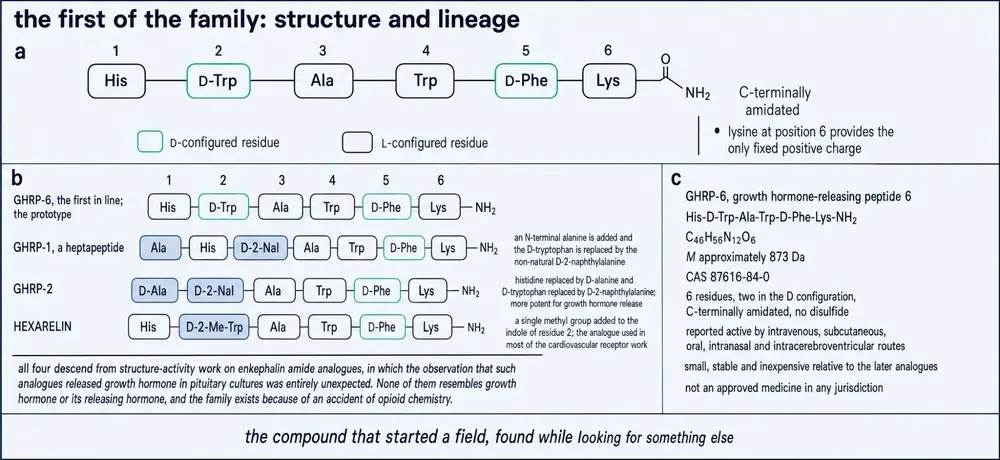
Two details in that sequence are doing real work, and both are about survival rather than about activity. The tryptophan at position two and the phenylalanine at position five are written with a capital D, which means they are the mirror images of the forms living things build proteins from. Life is overwhelmingly left-handed in its amino acids, and the enzymes that chop peptides apart are shaped to recognise left-handed residues. Insert a right-handed one and the scissors no longer fit. The amide cap on the far end — the NH2 — does the same job at the other terminus, removing the free acid group that a whole family of trimming enzymes reaches for first. Neither change alters what the molecule does. Both change how long it lasts long enough to do it.
What the sequence conspicuously does not do is imitate anything. Most peptide drugs are recognisable as copies, fragments or elaborations of a natural hormone; the fragment notation in their names usually says so outright. GHRP-6 resembles no hormone that was known in 1984, because the hormone it turned out to resemble had not been discovered. That is the first strange thing about it, and everything else in this document follows from it.
02The wrong molecule, in the wrong laboratory
The programme that produced GHRP-6 did not set out to release growth hormone. It set out to study opioids.
In the mid-1970s Cyril Y. Bowers, an endocrinologist at Tulane University in New Orleans, was working with analogues of met-enkephalin — one of the brain’s own opioid peptides, then newly discovered and intensely fashionable. Enkephalins were interesting because they were the body’s morphine. Bowers and his colleagues put a series of enkephalin analogues onto cultured pituitary cells and noticed something nobody had asked for: some of them released growth hormone (Bowers et al., 1977). Not because they were opioids. Something else was happening.
It is worth pausing on how easy that observation would have been to ignore. Growth hormone was already understood to be under hypothalamic control, and by the early 1980s the hormone that did the controlling — growth hormone-releasing hormone — had been isolated and sequenced. The field had its answer. An odd side effect of some opioid analogues in a dish looked like an artefact, or at best a curiosity. Bowers treated it as a lead.
The chemistry that followed was unusual, and it is the part of the story most often told wrongly. Bowers’ collaborator was Frank A. Momany, a computational chemist working on conformational energy calculations — mathematical modelling of the shapes a flexible peptide can adopt and the energy cost of each. Momany had applied the method to enkephalins, to luteinising-hormone-releasing hormone, and to somatostatin analogues. He now applied it here, and the loop he describes in the primary paper is explicit: compute the low-energy shapes, compare the shapes of the analogues that work against the shapes of the ones that do not, predict a new sequence, have it made, test it, and go round again (Momany et al., 1981).
This is not screening, and it is not what would now be called structure-based design. Structure-based design needs a structure of the target, and there was no target — not a purified receptor, not a gene, not even confident evidence that a distinct receptor existed. Momany was optimising the shape of a ligand against a binding site that was, in the most literal sense, imaginary. The right description is rationally guided optimisation of a serendipitous lead, in the complete absence of a molecular target, and it is a genuinely rare thing to have succeeded.
It also took a long time. The published record shows the first strongly active compound in 1981 — a five-residue peptide, Tyr-D-Trp-Ala-Trp-D-Phe-NH2, roughly a thousand times more potent than the enkephalin-derived starting points (Momany et al., 1981). GHRP-6 itself appears first not in a journal but in a patent, filed in December 1981 with Momany as sole inventor and granted in 1983. The interval from the enkephalin observation to the hexapeptide was about seven years. A widely cited 2019 review compresses it to “a few months” (Bresciani et al., 2019); the primary record does not support that, and the seven years are the more interesting fact, because they are what patient, unfashionable work actually looks like.
031984, and a peptide with the attributes of a hormone
In May 1984 Bowers, Momany, Reynolds and Hong published the compound in Endocrinology. The paper does not call it GHRP-6. It calls it [His1,Lys6] GHRP, naming it by the two substitutions that distinguished it from its predecessors — and the histidine at position one was worth naming, because it bought roughly a thirty-fold gain in potency over the tyrosine it replaced.
The results were unusually clean for a first paper. In cultured pituitary tissue the peptide was active from one nanogram per millilitre and maximal by ten. Given intravenously to a rat, growth hormone was measurably rising within two minutes, peaked between ten and twenty, and had usually returned to baseline by two hours. It worked given into a vein, under the skin, or into the abdomen. It worked in rats, in rhesus monkeys, in lambs and in calves, and in chicks under particular conditions — five species across three vertebrate classes, which told the authors they were pulling a lever that vertebrates had had for a long time.
Two further findings mattered more than they looked. The first was selectivity: growth hormone went up and luteinising hormone, follicle-stimulating hormone, thyroid-stimulating hormone and prolactin did not, nor — in the limited experiments done — did insulin or glucagon. The second was that the effect did not exhaust itself. Immature rats given the peptide once or twice daily for nine or twenty-five days grew faster than controls, and at the end of that their pituitaries were still fully responsive. Whatever the compound was doing, it was not simply squeezing a fixed reservoir dry.
The authors drew the conclusion that shaped the next fifteen years. This small peptide, they wrote, had the attributes of a hypophysiotropic hormone — a hormone of the kind the hypothalamus uses to command the pituitary. They were describing a synthetic molecule as though it were a natural one. As it turned out, that was the correct instinct, and it would take until 1999 to prove.
04What the name hides, and why nobody can explain it
GHRP-6 acquired its familiar name later, from other hands. It appears in the periodical literature from at least 1988. And here the document runs into a small, genuinely unresolved problem that is worth stating plainly rather than papering over.
Nothing in the primary record explains what the “6” denotes. The usual explanation, repeated on essentially every commercial page that sells the compound, is that it marks the six amino acids. That reading fails against the series’ own naming: GHRP-2 is also a hexapeptide, and GHRP-1 has seven residues, so chain length cannot be the rule. The alternative reading — that it is a contraction of the Lys6 in the original [His1,Lys6] designation — fits the 1984 nomenclature neatly but appears in no source at all. There is even a tempting coincidence in the patent, where the hexapeptide is Example 6 of twenty; but GHRP-1 is not Example 1, and does not appear in that patent at all, so the coincidence does not generalise. This monograph therefore reports the origin of the “6” as unresolved. It is a small thing, but a compound whose name cannot be explained is a useful reminder of how much of what circulates about this family is assertion rather than record.
The siblings are not a small thing. Within a decade of the 1984 paper the laboratory and its successors had produced a series, and the series is the single greatest source of error in writing about this compound. Hexarelin is GHRP-6 with one methyl group added to the second residue — one carbon and two hydrogens, on a molecule of forty-odd heavy atoms. GHRP-2 differs at two positions. GHRP-1 is a heptapeptide. All of them release growth hormone, all of them act at the same receptor, all of them were tested in the same models by overlapping groups of investigators, and all of them are routinely discussed in the same paragraph.
There is one further trap, and it is the sharpest. Substituting a right-handed lysine at position three converts the molecule from an activator into a blocker. The result, D-[Lys3]-GHRP-6, is the standard antagonist used across the whole ghrelin field to switch the receptor off — and its name contains this compound’s name in its entirety. In assembling the corpus for this monograph, one hundred and eleven scientific articles were found in which that antagonist dominated the text and, in ninety of them, the actual agonist was never mentioned at all. Papers on alcohol craving, on blood pressure during hibernation, on pregnancy complications, would all have entered a corpus assembled by searching for the string “GHRP-6”. Any of them could have supplied a confident sentence about what GHRP-6 does, describing an experiment in which the receptor was being blocked.
A result belongs to the molecule that was actually put into the animal. Hexarelin’s cardiac binding studies are hexarelin’s. GHRP-2’s appetite trials are GHRP-2’s. The Cuban stroke trials tested GHRP-6 together with a second drug and belong to the combination. Where this document reports a number for GHRP-6, the peptide named in the sentence is the peptide that was administered.
05Eliminating the doors that were already on the map
By the late 1980s the puzzle had sharpened into a question that could be attacked directly. GHRP-6 released growth hormone. There were two known ways to make a pituitary do that, and a third that had been proposed. It was not doing any of them.
The first candidate was the obvious one. Growth hormone-releasing hormone had its own receptor on the somatotroph, and if GHRP-6 were simply a small, tough mimic of that hormone the story would end there. It is not. Blocking the releasing hormone’s receptor with a purpose-built antagonist shifts that hormone’s dose-response curve to the right, exactly as it should — and leaves GHRP-6’s response untouched (Cheng et al., 1989). The two can also be desensitised independently: exhausting cultured pituitary cells with one leaves them immediately responsive to the other, in both directions (Blake & Smith, 1991).
The second candidate was the family the molecule had come from. GHRP-6 was derived from opioid peptides, so perhaps it was still, in some attenuated way, an opioid. Naloxone — the drug that reverses a heroin overdose — does not touch the growth-hormone response (Cheng et al., 1989). More tellingly, when the whole analogue series was measured for both properties at once, opioid binding strength and growth-hormone-releasing strength ran in opposite directions: the better a compound was at the one, the worse it was at the other (Codd et al., 1989). Momany’s optimisation had walked the series away from its own ancestry.
The third possibility was subtler and turned out to be half right. The pituitary is held in check by somatostatin, and a drug could release growth hormone simply by lifting that brake. Certain opioids do exactly this. GHRP-6 does not: when opioids and GHRP-6 were compared directly, the opioids suppressed somatostatin release and GHRP-6 did not, and giving the two together released growth hormone synergistically — the signature of two independent mechanisms rather than one shared one (Bowers et al., 1991).
What remained was a positive result rather than an absence. Tritiated and iodinated versions of the peptide bound to membranes prepared from rat pituitary and from hypothalamus, saturably and reversibly, and — the detail that mattered — how tightly each member of the analogue series bound predicted how much growth hormone it released (Codd et al., 1989; Sethumadhavan et al., 1991). Something specific was there. Nobody could say what.
06Two levers on one cell
The mechanism, worked out through the early 1990s, explains why the compound behaves as it does and why it was so hard to place.
Growth hormone-releasing hormone acts through the classical route: its receptor couples to a G protein that switches on adenylate cyclase, cyclic AMP rises, protein kinase A does the rest. GHRP-6 raises cyclic AMP not at all (Cheng et al., 1989). It works through the other great signalling arm of the cell — phospholipase C, inositol trisphosphate, diacylglycerol, protein kinase C, and calcium.
The evidence for that is unusually complete. Down-regulating protein kinase C by prolonged exposure to a phorbol ester blunts the GHRP-6 response and leaves the releasing hormone’s response intact (Cheng et al., 1991). Adding phospholipase C from outside the cell mimics the effect. And patch-clamp recordings from single somatotrophs resolve the calcium signal into two distinct phases: a first transient released from internal stores, half-maximal at forty-nine nanomolar peptide and independent of calcium in the surrounding fluid; then a sustained phase that requires calcium entry through voltage-gated channels opened by a lasting depolarisation (Herrington & Hille, 1994). The same pathway was later confirmed in human tissue: in cultured cells from human pituitary tumours, GHRP-6 stimulated phosphatidylinositol turnover in eight tumours out of eight (Lei et al., 1995).
Two receptors, two G proteins, two second messengers, one cell. This is the mechanical reason the two hormones synergise instead of merely adding, and the synergy is not a laboratory curiosity: in healthy men, growth-hormone output over two hours was 973 units for GHRP-6 alone and 821 for the releasing hormone alone, but 4,412 when both were given — roughly two and a half times what addition predicts (Peñalva et al., 1993).
Bowers drew the inference explicitly in 1990, and it is the sentence the rest of this part exists to vindicate: because the two act independently, the growth-hormone-releasing activity of GHRP-6 must reflect a physiological system that had not yet been characterised (Bowers et al., 1990).
07Where the lever actually sits
One complication belongs here, because it is unresolved and because tidy accounts of this compound tend to suppress it.
GHRP-6 acts at the pituitary directly — that much is settled by the cell-culture work. But it also acts on the hypothalamus above it. Systemic peptide switches on immediate-early genes in a subpopulation of hypothalamic neurons, and electrode recordings show it driving the firing of the very neurons that make growth hormone-releasing hormone (Dickson et al., 1993). Injected directly into the brain of a guinea pig, it works at less than a twentieth of the systemic dose (Fairhall et al., 1995).
How much of the effect in an intact animal is pituitary and how much is hypothalamic has been tested three times in humans and answered three different ways. One study found the response survives when the pituitary has been desensitised to the releasing hormone, arguing for independence (Robinson et al., 1992). A second found the response essentially abolished in patients whose pituitary is anatomically disconnected from the hypothalamus, arguing that the main action is upstairs (Popovic et al., 1995). A third found that blocking the releasing hormone’s receptor removes most of the response — the peak falling from about 34 to about 6 micrograms per litre — arguing for dependence (Pandya et al., 1998). None has been retracted. All three are small. This document reports the disagreement rather than adjudicating it.
081996: finding a lock by its key
The receptor was cloned at Merck, and the route by which it was cloned is the reason GHRP-6 matters.
Merck had spent the early 1990s building non-peptide molecules that copied what GHRP-6 did — first L-692,429, described in its own paper as a mimic of the growth hormone-releasing hexapeptide, then MK-0677, an orally active compound explicitly characterised as mechanistically indistinguishable from GHRP-6 and clearly distinguishable from the releasing hormone (Smith et al., 1993; Patchett et al., 1995). Before the receptor existed as a gene, the group had already established the crucial property of the binding site it was hunting: across chemically unrelated compounds — MK-0677, L-692,429, GHRP-6, hexarelin — how tightly each bound predicted how much growth hormone it released, and the site was displaced by none of the known pituitary hormones (Pong et al., 1996).
In August 1996, Howard and twenty-nine colleagues reported the receptor (Howard et al., 1996). It was a G-protein-coupled receptor, found in the pituitary and in the arcuate and infundibular hypothalamus of pigs and humans, and it was the target of the secretagogues. The cloning was done by expression screening — putting candidate genes into cells engineered to light up when internal calcium rises, then looking for the cells that responded to the drug. The receptor was named the growth hormone secretagogue receptor. Its full-length form, type 1a, is 366 amino acids; a second transcript, type 1b, stops short at the end of the third intracellular loop and does not respond to the drugs at all (Feighner et al., 1998).
And then the paper said the thing that makes it famous. On the basis of what they had found, the authors concluded that this receptor defines a pathway for the control of growth hormone release, and that the secretagogues appear to be mimicking a hormone that had not been discovered.
They had cloned a receptor with no known ligand. In pharmacology this is called an orphan, and the usual response is to go looking for its parent.
091999: the hormone, and it was in the stomach
Three years later, a group at the National Cardiovascular Center in Osaka found it. Kojima, Hosoda, Date, Nakazato, Matsuo and Kangawa took cells expressing the orphan receptor, used them as a detector, and went fishing through tissue extracts for anything that would switch the receptor on (Kojima et al., 1999). This is reverse pharmacology: instead of hormone, then receptor, then drug, you run the sequence backwards.
What they pulled out was not from the brain. It was from the stomach. A peptide twenty-eight amino acids long, carrying a fatty acid — an eight-carbon octanoyl chain — esterified onto the serine at position three. The acyl chain is not decoration: strip it off and the activity goes with it. They named the peptide ghrelin, from the Proto-Indo-European root ghre, to grow.
Consider what the 1984 prediction had actually claimed and what 1999 delivered. Bowers had argued from a synthetic hexapeptide’s behaviour that there must exist an unknown natural hormone controlling growth hormone release, distinct from the one everybody knew. He was right. He was also wrong about where it lived — he had assumed hypothalamus, and the main source turned out to be the stomach lining, which no one had proposed. In 2001 he titled a commentary on the discovery Unnatural growth hormone-releasing peptide begets natural ghrelin (Bowers, 2001), which is as neat a summary of a fifteen-year argument as the literature contains.
10What the missing hormone turned out to be for
Ghrelin did not stay a growth-hormone story for long. Within a few years it was clear that the hormone GHRP-6 had led everyone to was principally about hunger. It rises before meals and falls after them; it is suppressed by glucose; it acts on the hypothalamic circuits that govern appetite and energy balance; and its receptor turns up in the reward pathways of the midbrain, the hippocampus, the vagal system and the gut.
That receptor also proved to be an unusual piece of machinery in its own right — among other things it signals substantially even with no ligand bound at all, a property that has made it a target of interest for reasons having nothing to do with growth. And the family it belongs to kept giving: the same laboratory used the same approach to identify the motilin receptor, which is fifty-two per cent identical to it (Feighner et al., 1999), and the ligand-activation machinery turned out to be conserved from pufferfish to human across roughly four hundred million years, with the fish orthologue answering to GHRP-6 itself (Palyha et al., 2000).
By the end of 1999 GHRP-6 had produced: a receptor, a hormone, an entire field of appetite and energy-balance biology, and a drug class. What it had not produced, fifteen years after its synthesis, was a medicine. It still has not.
11A small, old, honest record
GHRP-6 has been given to human beings in published studies, and the record is worth reading for what it is: a body of careful physiological work, mostly between 1990 and 2000, mostly in groups of five to eighteen healthy young men, designed to answer questions about how the pituitary is controlled rather than whether anyone gets better. Almost none of it was intended as drug development. Reading it as if it were is the commonest error made about this compound.
A vocabulary warning is needed first. Because GHRP-6 was the first of its series, the founding human papers had nothing to distinguish it from, and so they simply call it GHRP, or the synthetic hexapeptide, or by the SmithKline Beecham development code SK&F 110679. The string “GHRP-6” does not appear in them. A search for the modern name misses the founding literature entirely.
12The dose-response, and where selectivity breaks
The first proper human dose-response came from Bowers with Thorner’s group at Virginia: eighteen normal men, single intravenous doses (Bowers et al., 1990). Peak growth hormone rose from 1.2 micrograms per litre on placebo to 7.6, 16.5 and 68.7 across three ascending doses. The response is steep and it is unambiguous. No adverse clinical effects or laboratory abnormalities were observed.
The same paper is where the 1984 selectivity claim starts to come apart. At the highest dose, prolactin and cortisol each roughly doubled. Luteinising hormone and thyroid-stimulating hormone did not move. A later study measuring corticotrophin directly found that overnight intravenous doses raised growth hormone, corticotrophin and cortisol together (Frieboes et al., 1995).
This matters more than a footnote, for two reasons. First, the direction is opposite to the natural releasing hormone, which if anything blunts cortisol — so the effect is a property of this molecule rather than of growth-hormone release as such. Second, the class contains a molecule that proves the two can be separated: in pigs, GHRP-6 and GHRP-2 both raised corticotrophin and cortisol, while ipamorelin raised neither, even at more than two hundred times the dose needed for its full growth-hormone effect (Raun et al., 1998). The corticotropic effect is not the price of the mechanism. It is the price of this particular molecule.
The 1984 specificity claim should therefore be read as an animal finding that human work qualified. GHRP-6 is selective for growth hormone against the gonadotrophins and thyroid-stimulating hormone. It is not selective with respect to the adrenal axis.
13Getting it into the body
GHRP-6 is a peptide, and peptides are eaten by the gut. The founding laboratory nonetheless reported oral activity, and the numbers are worth having because they are so often quoted loosely.
In five normal men, three hundred micrograms per kilogram by mouth produced peak growth hormone about two hundred times baseline, beginning at thirty minutes and over by three hours (Bowers et al., 1992). Because that dose produced about as much growth hormone as one microgram per kilogram given intravenously, the authors calculated that oral GHRP-6 has roughly 0.3 per cent of the activity of the intravenous route. That figure is widely repeated as an oral bioavailability, and it is not one: it is a ratio of biological effect, not a measured fraction of drug reaching the circulation.
The same paper is the source of the compound’s human pharmacokinetics — a serum half-life of about twenty minutes and a volume of distribution of about 2.5 litres, by both routes. A second, much later human study, run at higher intravenous doses with a different assay, resolved the disposition into two phases and reported a distribution half-life of 7.6 minutes and an elimination half-life of 2.5 hours (Cabrales et al., 2013). These two results are usually presented as if one must be wrong. They are better read as two different measurements: a rapid distribution phase that the earlier assay captured, and a slower terminal phase it did not.
The awkward finding in this section is that the oral result did not replicate. A later group gave normal young men the identical three hundred micrograms per kilogram, enteric-coated, and found growth hormone, corticotrophin and cortisol all unchanged — no response at all (Frieboes et al., 1999). The same study found intranasal dosing did work. Two competent groups, the same compound, the same oral dose, opposite results.
14The response that fades, and the one that rises
The most informative human experiments on this compound are about what happens when you keep giving it.
Six healthy subjects received six-hour infusions at three dose levels, each followed by a bolus (DeBell et al., 1991). Growth-hormone secretion during the infusion rose with dose, as expected. The response to the bolus fell with dose — the higher the preceding infusion, the smaller the further response. Total growth hormone secreted across infusion and bolus together was not different between doses. The pituitary was not producing more or less; the peptide was rearranging when it came out.
The decisive experiment came two years later. Eight normal young men received a full twenty-four-hour infusion, twice each, against saline twice each (Huhn et al., 1993). Growth-hormone secretion rose about eightfold and — the point of the study — remained pulsatile rather than flattening into a plateau. Pulse number, height, amplitude and area all increased. Insulin-like growth factor 1, the marker that shows whether the axis downstream is genuinely engaged, rose by 12 and 22 per cent on the infusion days while falling by 18 and 20 per cent on the saline days.
Then they tested the desensitisation properly, and this is the finding that repays attention. After the twenty-four-hour infusion, a further dose of GHRP-6 produced a peak of 7.9 micrograms per litre against 25 after saline — about a third. But a dose of growth hormone-releasing hormone at the same point produced 24 micrograms per litre against 11 after saline — more than double.
If the gland had simply been emptied, both responses would have fallen. One fell and the other rose. Whatever adapts under continuous exposure is specific to this compound’s own receptor, and the pituitary’s capacity to release growth hormone was, if anything, enhanced. A separate 34-hour infusion study found the same asymmetry (Jaffe et al., 1993), and the effect appears to be a property of continuous exposure rather than of the drug: seven intranasal doses at eight-hour intervals produced no attenuation at all, and raised insulin-like growth factor 1 from 94.5 to 125.8 micrograms per litre (Hayashi et al., 1991).
15Appetite, and a gap that should be stated plainly
The receptor GHRP-6 acts on is the receptor for ghrelin, and ghrelin is a hunger hormone. The expectation that GHRP-6 makes people hungry is therefore entirely reasonable, and in animals it is demonstrated: injected into the brain of a sated rat it produces a dose-related increase in eating, and the eating is not explained by growth hormone, which did not track the dose (Locke et al., 1995).
There is no human food-intake study of GHRP-6. The human appetite data in this family belong to GHRP-2 — where subcutaneous infusion increased ad-libitum intake by about 36 per cent in lean men, and by 10 and 34 per cent at two dose levels in a mixed lean and obese group (Laferrère et al., 2005; 2006) — and to MK-0677, where increased appetite was the commonest side effect in a two-year trial. Those are different molecules. The gap is a gap.
The same applies to the triad of “hunger, sweating and drowsiness” that circulates as GHRP-6’s side-effect profile. No primary human study of this compound reports it. What the human studies do report is a change in sleep architecture — more stage 2 sleep after overnight intravenous dosing — which is, interestingly, the opposite of what growth hormone-releasing hormone does (Frieboes et al., 1995). One further correction belongs here: the facial flushing frequently attributed to GHRP-6, at sixteen subjects out of eighteen, is in the 1990 paper a finding about growth hormone-releasing hormone, which the same subjects also received.
16What the siblings did instead
Read the class as a whole and a pattern emerges that no single compound shows.
GHRP-6 itself came closest to a defined use as a test rather than a treatment. Given with growth hormone-releasing hormone, it forms a pituitary-stimulation test that was validated in a 250-subject multicentre study against the insulin tolerance test, separating patients with organic pituitary disease from healthy controls better than the older test did, and unaffected by age, sex, body fat or assay (Popovic et al., 2000). It entered European clinical practice. No product containing it was ever licensed.
Two members of the class did reach a market, and both did so as diagnostics: GHRP-2, as pralmorelin, approved in Japan for assessing growth hormone deficiency; and macimorelin, an orally active non-peptide, approved by the United States Food and Drug Administration in December 2017 for the same purpose in adults. The class turned out to be very good at asking the pituitary a question.
The one member taken furthest as a therapy is the most instructive failure in this document. MK-0677 — ibutamoren — is orally active, well absorbed and unambiguously effective at what it was designed to do. In 65 healthy adults aged 60 to 81 given it for two years, fat-free mass rose by 1.1 kilograms against a 0.5-kilogram fall on placebo. The authors’ own summary of what that bought: the increased fat-free mass did not result in changes in strength or function (Nass et al., 2008). In 563 patients with Alzheimer disease, twelve months of treatment raised insulin-like growth factor 1 by 73 per cent and changed no cognitive or functional endpoint (Sevigny et al., 2008). In 123 elderly patients recovering from hip fracture, the trial was stopped early because of a congestive heart failure signal, and the authors concluded the drug had an unfavourable safety profile in that population (Adunsky et al., 2011).
Three large trials, three demonstrations that the drug did exactly what it was supposed to biochemically, and no functional benefit in any of them. That is the honest summary of the growth-hormone secretagogue class as a therapeutic proposition: raising insulin-like growth factor 1 is easy, and it is not the same thing as helping anybody. Anamorelin, approved in Japan for cancer cachexia and refused twice by the European regulator on the grounds that its effect on lean mass was not matched by any effect on grip strength or quality of life, is the same lesson in a different jurisdiction.
17A second receptor, and what it is not
The endocrine story of GHRP-6 was effectively finished by 2000. The story that has occupied the last twenty-five years has almost nothing to do with growth hormone.
In 1999 a group in Montreal, hunting for the cardiac binding site that several laboratories had reported, used a photoreactive tracer built from hexarelin to label a protein of about 84,000 daltons in rat heart membranes. Three years later they identified it: it was CD36, a scavenger receptor with no relationship whatever to the growth-hormone axis, best known for taking up oxidised low-density lipoprotein and long-chain fatty acids. The identification was clean, and it was made the way such things should be — the response was absent in mice engineered to lack CD36, and absent in a rat strain that lacks it naturally (Bodart et al., 2002).
One thing about that paper deserves stating, because it is routinely cited backwards. The effect it demonstrated was coronary vasoconstriction, and the authors’ own closing suggestion was that CD36 might mediate the coronary vasospasm seen in atherosclerosis. The paper established CD36 as the receptor. It did not establish that engaging CD36 is good for you.
The downstream biology attributed to this second receptor is nonetheless substantial: survival signalling through phosphoinositide 3-kinase and AKT, suppression of reactive-oxygen production, and a peroxisome proliferator-activated receptor gamma programme that turns down transforming growth factor beta and connective tissue growth factor — the two central drivers of fibrosis.
Two qualifications must travel with all of it. The first is that GHRP-6 does bind CD36 — this has been measured directly, not inferred — but it binds it at about 1.8 micromolar against 6.1 nanomolar at the growth-hormone secretagogue receptor (Proulx et al., 2020). That is roughly a three-hundred-fold difference. There is no dose at which GHRP-6 is a selective CD36 agent; the entire azapeptide medicinal-chemistry programme that grew out of this work exists precisely because GHRP-6 is not one.
The second is about attribution. The experiments that prove these effects require CD36 — the ones done in animals lacking the receptor — were carried out with hexarelin and with EP 80317, a purpose-built derivative. GHRP-6 has never been tested in a CD36-deficient animal. The receptor binding transfers; the demonstration of receptor dependence does not.
18The animal record, which is genuinely strong
Set the mechanism aside and look at outcomes in animals, and the cardioprotective results are the most impressive findings in this compound’s history.
The largest is a pig study. Cuban Creole pigs underwent an hour of coronary occlusion followed by seventy-two hours of reperfusion. GHRP-6, given alone, reduced infarct mass by 78 per cent and infarct thickness by half; more than half the treated animals showed no pathological Q waves in any lead; enzymatic and inflammatory markers of necrosis fell correspondingly (Berlanga et al., 2007).
The most striking is a dog study from Merck. Dogs with pacing-induced dilated cardiomyopathy were subjected to acute coronary occlusion. Every one of the eight animals given GHRP-6 survived; roughly half of the vehicle-treated and growth-hormone-treated animals did not. The authors were explicit that the effect was independent of the growth hormone and insulin-like growth factor pathway (Shen et al., 2003).
Beyond the heart the pattern repeats. In rats given doxorubicin — a chemotherapy drug that reliably wrecks the heart — concurrent GHRP-6 preserved ventricular function and lifted survival from 42 to 84 per cent (Berlanga-Acosta et al., 2024). In liver ischaemia and reperfusion, GHRP-6 alone cut markers of hepatic and intestinal damage by 50 to 85 per cent and protected lung and kidney as well (Cibrián et al., 2006). In full-thickness skin wounds, topical peptide accelerated closure while, unusually for an anti-fibrotic agent, leaving blood-vessel growth intact.
The most recent study is also the one that most requires care. A 2026 paper used permanent coronary ligation in rats — no reperfusion, the harder model — and reported ejection fraction of 68 per cent in treated animals against 48 per cent in controls after seven days, with corresponding gains in stroke volume and ventricular dimensions (Wang et al., 2026). But no infarct size was measured; the reduction in scarring, at 27.6 per cent, did not reach statistical significance; and the mortality difference — 10 per cent against 40 per cent — did not either. The paper’s own abstract names 0.4 mg/kg the minimum effective dose, while its data show the dose below it already improving ejection fraction and fractional shortening; 0.4 was simply the lowest dose that moved every contractility variable at once.
The anti-fibrotic claim needs a similar correction. GHRP-6 is reported to have cleared established liver fibrosis in rats, and that is the single most repeated claim about the compound — but it rests on one paper, in a Cuban journal that is not indexed in PubMed and carries no digital object identifier, from the originating group, never replicated. Against it stands a clean and reproducible asymmetry in skin: in two independent rabbit studies, GHRP-6 prevented hypertrophic scars from forming and repeatedly failed to reverse ones that had already formed. A blanket description of this compound as anti-fibrotic has to carry that asymmetry.
19Havana
Almost all of the work in the previous section comes from one institution. The Center for Genetic Engineering and Biotechnology in Havana — CIGB — adopted GHRP-6 as a platform in the early 2000s and has pursued it ever since, under the development code CIGB-500. It is an unusual research biography: a molecule abandoned by a large Western pharmaceutical company as a growth-hormone drug, picked up by a state institute in a country under embargo, and redirected at tissue protection.
The programme has the components a serious development effort requires. There is a phase I dose-escalation study of the peptide alone in healthy volunteers, and a pharmacokinetic study in nine men across a fourfold dose range (Cabrales et al., 2013). There is an interaction study against a beta-blocker. There is regulatory toxicology to modern standards: 28 days of daily intravenous dosing in beagle dogs, run at a contract laboratory in Montreal, with transient and non-adverse findings and a no-observed-adverse-effect level at the top dose tested, 2000 micrograms per kilogram per day (Castro et al., 2025). There is a granted United States patent covering the compound’s use as a late cardioprotective agent — explicitly for administration thirteen to ninety-six hours after the onset of ischaemia, outside the conventional reperfusion window, aimed at muscle that is stunned rather than dead.
There is also a gap. A trial of CIGB-500 alone in acute myocardial infarction after angioplasty was registered in 2014 for twenty patients. Its registry status remains pending and no result has ever been published. It is the one study that would test the cardioprotection story — the strongest part of this compound’s animal record — in human beings, and it appears never to have reported.
20COURAGE, and an honest failure
Where the programme did reach a definitive human answer is stroke, and the answer is negative.
The rationale is combination therapy. GHRP-6 was paired with epidermal growth factor on the argument that the two act on different nodes of the injury cascade, and the preclinical work supports the pairing: in gerbils subjected to fifteen minutes of bilateral carotid occlusion, the combination — but not reliably either agent alone — improved survival, neurological outcome and infarct volume when given up to four hours after the insult, and not beyond (Subirós et al., 2016).
This is the point at which every result in this section stops being about GHRP-6 by itself. In every stroke study, preclinical and clinical, the peptide was given with epidermal growth factor. Nothing that follows can be attributed to GHRP-6 alone.
The phase I/II trial ran in Cuba from 2017 to 2018: thirty-six patients with computed-tomography-confirmed ischaemic stroke, treated within twelve hours, randomised open-label to one of two dose levels of the combination or to standard care (Hernández-Bernal et al., 2024). Its primary endpoint was safety, and it met it: serious adverse events occurred in 20 and 30 per cent of treated patients against 56 per cent of controls, and only two events in one patient were attributed to treatment. Seven of sixteen control patients died; two of ten and none of ten in the treated groups. Neurological and functional measures favoured treatment at ninety and one hundred and eighty days.
That was enough to justify a phase III, and the phase III reported in July 2026.
COURAGE-2 randomised 188 patients, ninety-five to the combination and ninety-three to standard care, with the same twelve-hour window and the same seven-day regimen, powered for a 20 per cent greater disability improvement at six months (Hernández-Bernal et al., 2026). In the intention-to-treat population there was no difference in the modified Rankin scale, no difference in the Barthel index, and no difference in survival. The authors state in their own conclusion that the study missed its primary endpoint.
Two further details belong with that. Serious adverse events, which had been less frequent on treatment in phase I/II, were numerically more frequent in phase III — thirty of ninety-five against eighteen of ninety-three, an odds ratio of 1.92 whose confidence interval just touches one. None was attributed to treatment, and the difference is not statistically significant, but the point estimate no longer favours the intervention.
And there is a subgroup. Among the twenty-seven patients with the most severe strokes, disability at six months was lower on treatment — a modified Rankin score of 2.6 against 4.7 — and the hazard ratio for death was 0.18. In the middle cerebral artery territory, treated patients showed greater infarct volume reduction at thirty days.
How much that subgroup is worth is a question the reader should be equipped to answer rather than told. Twenty-seven patients across two arms is roughly thirteen or fourteen each. The trial was open-label, so neither patients nor treating physicians were blinded to allocation. The confidence intervals on the disability scores overlap substantially, and the upper bound of the mortality hazard ratio is 0.96 — just inside significance. The subgroup was examined after a failed primary analysis. The investigators’ own language is that the finding suggests potential benefit warranting further studies, and that is the ceiling. It is a hypothesis, and it is reported here after the result it qualifies rather than in place of it.
A subgroup that survives a failed trial is the single most seductive object in clinical research, because it lets a negative result be read as a positive one. The discipline is to notice that an error which flatters the hypothesis is the error most likely to survive review. The phase III result for this combination is that it did not work in the population it was tested in. That is the finding.
21The regulatory position, stated exactly
GHRP-6 is not an approved medicine in any jurisdiction, for any indication, therapeutic or diagnostic. Forty-two years after its synthesis it has no marketing authorisation anywhere that could be located, and it is not listed in the United States regulatory registers of approved products.
It also has no record in ClinicalTrials.gov. Searching that registry for GHRP-6 as an intervention returns nothing; searching for CIGB-500 returns nothing. This is not a claim that no trials exist — the trials in Part Four plainly do — but that they are registered elsewhere, in the Cuban national registry, which is a World Health Organization primary registry and is mirrored through its international platform. Anyone assessing this compound by the registry most of the world uses will conclude, wrongly, that it has never been tested in humans at all.
Several regulatory facts do attach to it, and they are worth stating precisely because they are commonly reported loosely — and because the pattern they form is unusual. This is a substance that is controlled in several countries and approved in none of them.
The first is anti-doping. GHRP-6 is named explicitly in the World Anti-Doping Agency’s prohibited list, under section S2 — peptide hormones, growth factors, related substances and mimetics — in the subsection covering growth hormone-releasing factors. Substances in class S2 are prohibited at all times, in competition and out of it, and are non-specified substances, which carries the heavier default sanction. The same entry lists hexarelin separately, confirming that the anti-doping authorities treat the two as the distinct molecules they are.
The second concerns pharmacy compounding in the United States, and the detail matters. The Food and Drug Administration maintains two separate lists of bulk drug substances nominated for compounding use, one for outsourcing facilities and one for traditional pharmacies. GHRP-6 appears on both, in different categories. On the outsourcing-facility list it sits in the category for substances that raise significant safety risks, alongside GHRP-2, ibutamoren and ipamorelin. On the traditional-pharmacy list it sits in the category for substances nominated without adequate support. Saying “category 2” without naming the list is wrong for one of them.
Australia goes further than either. The Poisons Standard names GHRP-6 individually — not merely by class — as a Schedule 4 substance and places it in Appendix D, clause 5, the list of poisons for which possession without authority is illegal. It is item 20 in that table, alongside hexarelin, ibutamoren, pralmorelin and somatropin. It is not in Schedule 8 or 9, so this is a prescription-control provision rather than a narcotics one, but the practical position is that holding the substance without a prescription is an offence.
The United States restricts it at the border and has acted against it domestically. GHRP-6 is named on FDA Import Alert 66-41, which permits detention without physical examination of unapproved new drugs promoted in the United States; the listed consignor is a Beijing supplier, red-listed in 2012 for GHRP-6 alongside GHRP-2, ipamorelin and melanotan II. Domestically the agency has issued warning letters to at least seven compounding pharmacies for preparing products with it, on the consistent ground that the substance has no pharmacopoeial monograph, is not a component of any approved drug, and is not on the permitted bulk-substances list. One of those letters records something worth carrying into the next section: a voluntary recall in August 2016 of a compounded sermorelin and GHRP-6 injection, for sterility failure. Health Canada, for its part, named GHRP-6 explicitly among the products seized in a 2025 advisory about unauthorised injectable peptides.
Europe is the quiet case, and it contains a trap. The European Medicines Agency has no authorisation, no orphan designation and no paediatric plan for GHRP-6, and a search of its site returns exactly one document mentioning the compound at all: the refusal assessment report for anamorelin, in which GHRP-6 appears only as a comparator in a receptor-binding assay. The single European regulatory document naming this molecule is a rejection of a different one.
22The market that exists regardless
None of that has prevented GHRP-6 from being widely available. It is sold as a research chemical, generally in lyophilised vials, generally with a research-use-only label that has no bearing on what buyers do with it, and it appears throughout the online literature of physique and performance self-administration.
The peer-reviewed literature has begun to address this directly. A 2026 narrative review in Frontiers in Endocrinology catalogues the peptides marketed as research compounds for modulating the growth hormone axis — the releasing-hormone analogues, the secretagogues including GHRP-6, the growth hormone fragment and the insulin-like growth factor analogues — and stratifies them into evidence tiers running from regulatory-grade randomised trial data down to a complete absence of human studies. Its purpose is not to endorse anything; it is to give clinicians a framework for interpreting symptoms and laboratory abnormalities in patients who are already using these compounds, and it is candid that the composition, dose and purity of what is actually supplied are unknown quantities (Dominikowski et al., 2026).
The harms literature is correspondingly thin, and the honest description of it is that absence of evidence is doing most of the work. There is a 2026 case report of a long-term user of growth hormone and secretagogues, including a sermorelin and GHRP-6 combination, who presented with swallowing difficulty from cervical spinal osteophytes. The report is careful about its own limits: the exposure is patient-reported over roughly twenty years, there was remote neck trauma, no objective swallowing evaluation was performed, and the authors offer the growth-hormone-axis contribution as a hypothesis rather than a finding (Perez et al., 2026). It is one patient. It establishes nothing about causation. It is also very nearly the whole published harms record for this compound in non-trial use, which is itself the point.
What is actually in the vials has been examined, though on a scale far too small to describe a market. The one purity dataset for this compound is three vials from three vendors, chosen because they had good reputations on bodybuilding forums; all three contained GHRP-6 at 97 to 99.6 per cent chromatographic purity, and the authors are explicit that a sample selected that way is a best case rather than an average (Janvier et al., 2018). Across the wider set of illicit peptides in that study, arsenic above the parenteral limit turned up in six of twenty-seven preparations, and two vials of one product from one vendor differed fourteenfold in the amount of powder they held. No published study has measured how much GHRP-6 a vial contains against what its label claims, and none has assessed sterility or endotoxin in a product sold under this name.
The most striking analytical finding is an identity problem rather than a purity one. In 2018 two laboratories working independently — one on Danish customs seizures, one on German and Norwegian material — reported that product in this channel contained Gly-GHRP-6, a version of the molecule carrying an extra glycine on its front end (Krug et al., 2018; Gajda et al., 2019). The same modification turned up on GHRP-2 and on ipamorelin. An added residue changes the mass, and changing the mass is how a compound slips past a test looking for a specific one. Somebody had gone to the trouble of making a deliberately altered analogue and selling it under the ordinary name. A buyer would have no way of knowing, and neither would a laboratory that assumed the label was true.
The theoretical concern that hangs over the entire class is mitogenic. These compounds raise insulin-like growth factor 1, and insulin-like growth factor 1 is a growth signal for cells generally, including ones that should not be growing. What the literature actually supports is that the signal is raised. It does not contain long-term human cancer-incidence data for GHRP-6, because no such study has been done. Both halves of that sentence are load-bearing.
23Reading this evidence base honestly
It is worth setting out the shape of what exists, because the shape is unusual.
The corpus behind this document is 174 scientific full texts that engage the compound substantively, drawn from a surface of 1,229 records that merely name the class. The human data is old: the core physiological studies were done between 1990 and 2000, in groups of five to eighteen healthy young men, to answer questions about pituitary control. They were not designed to find out whether anyone gets better, and they did not. The newest human data is a phase III trial of a combination product that failed its primary endpoint. In between lies twenty-five years of animal work that is genuinely impressive and has never been tested in a person.
Read the evidence map by column rather than by row and the situation is plain. In cell culture and in animals, GHRP-6 does a great deal. In humans, it reliably releases growth hormone and raises insulin-like growth factor 1 — which is not in dispute and never has been. There is no row in which this compound has been shown to improve a clinical outcome in a human being, because no trial of GHRP-6 alone against any clinical endpoint has ever been completed and published.
That is a different statement from “it does not work”. It is a statement that the question has not been asked. The distinction matters in both directions: it is not evidence of failure, and it is not something the animal data can be borrowed to cover.
24What would settle it
The compound’s open questions are unusually well defined, which is what happens when a molecule is studied for four decades without ever being developed.
The cardioprotection question is the sharpest. A pig loses 78 per cent less infarct mass and every treated dog survives; a trial in twenty patients after angioplasty was registered in 2014 and never reported. Whether the animal result translates is answerable, the trial to answer it was designed, and the answer does not exist.
The combination question is next. COURAGE-2 tested GHRP-6 with epidermal growth factor and found nothing in an unselected stroke population. Its severe-stroke subgroup is a hypothesis that a properly powered, blinded trial enrolling only that population would resolve in either direction. Nobody has run it.
The monotherapy question underlies both. Every clinical result attributed to this peptide in the last decade belongs to a two-drug combination. What GHRP-6 alone does to a clinical endpoint in a human being is simply unknown.
Three smaller questions are cheap to answer and remain open: whether the compound is orally active in humans at all, on which two competent groups using the identical dose reported opposite results; whether the CD36 mechanism that carries the entire cytoprotection narrative applies to GHRP-6 itself, which one experiment in a CD36-deficient animal would settle; and how much GHRP-6 a vial sold under that name actually contains, which has never been measured against any label claim and is an analytical question rather than a clinical one.
This document describes published research. It does not recommend human use of GHRP-6 or of any other compound named in it, and it specifies no dose, route or schedule for any person. Doses appear only as parameters of studies that have been published, always with the species, the population and the duration attached. GHRP-6 has no approved therapeutic or diagnostic indication in any jurisdiction. It is sold for research use only, and no part of this document should be read as advice to obtain or administer it.
25References
Generated from verified NCBI records rather than from recall. Author lists, journal names, volumes, pages and identifiers are taken from the PubMed record for each citation, and the build refuses to run if any identifier fails to resolve. This series has twice shipped reference lists drafted from memory in which identifiers pointed at real but unrelated papers.
- Adunsky A, Chandler J, Heyden N, Lutkiewicz J, Scott BB, Berd Y, et al.. MK-0677 (ibutamoren mesylate) for the treatment of patients recovering from hip fracture: a multicenter, randomized, placebo-controlled phase IIb study. Arch Gerontol Geriatr. 2011;53(2):183-9.
PMID 21067829 · doi:10.1016/j.archger.2010.10.004 - Bercu BB, Weideman CA, Walker RF. Sex differences in growth hormone (GH) secretion by rats administered GH-releasing hexapeptide. Endocrinology. 1991;129(5):2592-8.
PMID 1935789 · doi:10.1210/endo-129-5-2592 - Berlanga J, Cibrian D, Guevara L, Dominguez H, Alba JS, Seralena A, et al.. Growth-hormone-releasing peptide 6 (GHRP6) prevents oxidant cytotoxicity and reduces myocardial necrosis in a model of acute myocardial infarction. Clin Sci (Lond). 2007;112(4):241-50.
PMID 16989643 · doi:10.1042/CS20060103 - Berlanga-Acosta J, Cibrian D, Valiente-Mustelier J, Suárez-Alba J, García-Ojalvo A, Falcón-Cama V, et al.. Growth hormone releasing peptide-6 (GHRP-6) prevents doxorubicin-induced myocardial and extra-myocardial damages by activating prosurvival mechanisms. Front Pharmacol. 2024;15:1402138.
PMID 38873418 · doi:10.3389/fphar.2024.1402138 · PMC11169835 - Berlanga-Acosta J, Abreu-Cruz A, Herrera DGB, Mendoza-Marí Y, Rodríguez-Ulloa A, García-Ojalvo A, et al.. Synthetic Growth Hormone-Releasing Peptides (GHRPs): A Historical Appraisal of the Evidences Supporting Their Cytoprotective Effects. Clin Med Insights Cardiol. 2017;11:1179546817694558.
PMID 28469491 · doi:10.1177/1179546817694558 · PMC5392015 - Bessi VL, Labbé SM, Huynh DN, Ménard L, Jossart C, Febbraio M, et al.. EP 80317, a selective CD36 ligand, shows cardioprotective effects against post-ischaemic myocardial damage in mice. Cardiovasc Res. 2012;96(1):99-108.
PMID 22787133 · doi:10.1093/cvr/cvs225 - Blake AD, Smith RG. Desensitization studies using perifused rat pituitary cells show that growth hormone-releasing hormone and His-D-Trp-Ala-Trp-D-Phe-Lys-NH2 stimulate growth hormone release through distinct receptor sites. J Endocrinol. 1991;129(1):11-9.
PMID 1674284 · doi:10.1677/joe.0.1290011 - Bodart V, Bouchard JF, McNicoll N, Escher E, Carrière P, Ghigo E, et al.. Identification and characterization of a new growth hormone-releasing peptide receptor in the heart. Circ Res. 1999;85(9):796-802.
PMID 10532947 · doi:10.1161/01.res.85.9.796 - Bodart V, Febbraio M, Demers A, McNicoll N, Pohankova P, Perreault A, et al.. CD36 mediates the cardiovascular action of growth hormone-releasing peptides in the heart. Circ Res. 2002;90(8):844-9.
PMID 11988484 · doi:10.1161/01.res.0000016164.02525.b4 - Bowers CY, Momany F, Reynolds GA, Chang D, Hong A, Chang K. Structure-activity relationships of a synthetic pentapeptide that specifically releases growth hormone in vitro. Endocrinology. 1980;106(3):663-7.
PMID 7353536 · doi:10.1210/endo-106-3-663 - Bowers CY, Momany FA, Reynolds GA, Hong A. On the in vitro and in vivo activity of a new synthetic hexapeptide that acts on the pituitary to specifically release growth hormone. Endocrinology. 1984;114(5):1537-45.
PMID 6714155 · doi:10.1210/endo-114-5-1537 - Bowers CY, Sartor AO, Reynolds GA, Badger TM. On the actions of the growth hormone-releasing hexapeptide, GHRP. Endocrinology. 1991;128(4):2027-35.
PMID 2004615 · doi:10.1210/endo-128-4-2027 - Bowers CY, Reynolds GA, Durham D, Barrera CM, Pezzoli SS, Thorner MO. Growth hormone (GH)-releasing peptide stimulates GH release in normal men and acts synergistically with GH-releasing hormone. J Clin Endocrinol Metab. 1990;70(4):975-82.
PMID 2108187 · doi:10.1210/jcem-70-4-975 - Bowers CY. Unnatural growth hormone-releasing peptide begets natural ghrelin. J Clin Endocrinol Metab. 2001;86(4):1464-9.
PMID 11297568 · doi:10.1210/jcem.86.4.7431 - Bowers CY. Growth hormone-releasing peptide (GHRP). Cell Mol Life Sci. 1998;54(12):1316-29.
PMID 9893708 · doi:10.1007/s000180050257 · PMC11147263 - Bowers CY, Alster DK, Frentz JM. The growth hormone-releasing activity of a synthetic hexapeptide in normal men and short statured children after oral administration. J Clin Endocrinol Metab. 1992;74(2):292-8.
PMID 1730807 · doi:10.1210/jcem.74.2.1730807 - Bresciani E, Rizzi L, Coco S, Molteni L, Meanti R, Locatelli V, et al.. Growth Hormone Secretagogues and the Regulation of Calcium Signaling in Muscle. Int J Mol Sci. 2019;20(18).
PMID 31491959 · doi:10.3390/ijms20184361 · PMC6769538 - Cabrales A, Gil J, Fernández E, Valenzuela C, Hernández F, García I, et al.. Pharmacokinetic study of Growth Hormone-Releasing Peptide 6 (GHRP-6) in nine male healthy volunteers. Eur J Pharm Sci. 2013;48(1-2):40-6.
PMID 23099431 · doi:10.1016/j.ejps.2012.10.006 - Castro J, Shaikh I, Silo S, Hum C, Carrier M, DiFruscia R, et al.. Subchronic safety assessment of CIGB-500 in beagle dog after repeated daily dose administration over 28 days. Regul Toxicol Pharmacol. 2025;158:105798.
PMID 40024561 · doi:10.1016/j.yrtph.2025.105798 - Chao CC, Hoeffler JP, Frawley LS. A cellular basis for functionally releasable pools in somatotropes. Life Sci. 1988;42(6):701-6.
PMID 3123835 · doi:10.1016/0024-3205(88)90462-6 - Cheng K, Chan WW, Barreto A, Convey EM, Smith RG. The synergistic effects of His-D-Trp-Ala-Trp-D-Phe-Lys-NH2 on growth hormone (GH)-releasing factor-stimulated GH release and intracellular adenosine 3',5'-monophosphate accumulation in rat primary pituitary cell culture. Endocrinology. 1989;124(6):2791-8.
PMID 2541999 · doi:10.1210/endo-124-6-2791 - Cheng K, Chan WW, Butler B, Barreto A, Smith RG. Evidence for a role of protein kinase-C in His-D-Trp-Ala-Trp-D-Phe-Lys-NH2-induced growth hormone release from rat primary pituitary cells. Endocrinology. 1991;129(6):3337-42.
PMID 1659529 · doi:10.1210/endo-129-6-3337 - Cibrián D, Ajamieh H, Berlanga J, León OS, Alba JS, Kim MJ, et al.. Use of growth-hormone-releasing peptide-6 (GHRP-6) for the prevention of multiple organ failure. Clin Sci (Lond). 2006;110(5):563-73.
PMID 16417467 · doi:10.1042/CS20050374 - Codd EE, Shu AY, Walker RF. Binding of a growth hormone releasing hexapeptide to specific hypothalamic and pituitary binding sites. Neuropharmacology. 1989;28(10):1139-44.
PMID 2812284 · doi:10.1016/0028-3908(89)90129-9 - Codd EE, Aloyo VJ, Walker RF. A non-opioid pattern characterizes inhibition of growth hormone releasing peptide binding by dynorphin-related peptides. Neuropeptides. 1990;15(3):133-7.
PMID 1979153 · doi:10.1016/0143-4179(90)90144-n - Cordido F, Peñalva A, Dieguez C, Casanueva FF. Massive growth hormone (GH) discharge in obese subjects after the combined administration of GH-releasing hormone and GHRP-6: evidence for a marked somatotroph secretory capability in obesity. J Clin Endocrinol Metab. 1993;76(4):819-23.
PMID 8473389 · doi:10.1210/jcem.76.4.8473389 - Cox HD, Hughes CM, Eichner D. Detection of GHRP-2 and GHRP-6 in urine samples from athletes. Drug Test Anal. 2015;7(5):439-44.
PMID 25809000 · doi:10.1002/dta.1791 - DeBell WK, Pezzoli SS, Thorner MO. Growth hormone (GH) secretion during continuous infusion of GH-releasing peptide: partial response attenuation. J Clin Endocrinol Metab. 1991;72(6):1312-6.
PMID 2026752 · doi:10.1210/jcem-72-6-1312 - Demers A, McNicoll N, Febbraio M, Servant M, Marleau S, Silverstein R, et al.. Identification of the growth hormone-releasing peptide binding site in CD36: a photoaffinity cross-linking study. Biochem J. 2004;382(Pt 2):417-24.
PMID 15176951 · doi:10.1042/BJ20040036 · PMC1133797 - Dickson SL, Leng G, Robinson IC. Systemic administration of growth hormone-releasing peptide activates hypothalamic arcuate neurons. Neuroscience. 1993;53(2):303-6.
PMID 8492908 · doi:10.1016/0306-4522(93)90197-n - Dominikowski A, Rękoś Z, Olejarz M, Szczepanek-Parulska E, Domin R, RuchaŁa M. The emerging landscape of performance-enhancing peptides modulating GH-IGF1 axis: bridging the gap between clinical evidence and patient self-administration. Front Endocrinol (Lausanne). 2026;17:1822475.
PMID 42395176 · doi:10.3389/fendo.2026.1822475 · PMC13322892 - Fairhall KM, Mynett A, Robinson IC. Central effects of growth hormone-releasing hexapeptide (GHRP-6) on growth hormone release are inhibited by central somatostatin action. J Endocrinol. 1995;144(3):555-60.
PMID 7738479 · doi:10.1677/joe.0.1440555 - Feighner SD, Howard AD, Prendergast K, Palyha OC, Hreniuk DL, Nargund R, et al.. Structural requirements for the activation of the human growth hormone secretagogue receptor by peptide and nonpeptide secretagogues. Mol Endocrinol. 1998;12(1):137-45.
PMID 9440817 · doi:10.1210/mend.12.1.0051 - Feighner SD, Tan CP, McKee KK, Palyha OC, Hreniuk DL, Pong SS, et al.. Receptor for motilin identified in the human gastrointestinal system. Science. 1999;284(5423):2184-8.
PMID 10381885 · doi:10.1126/science.284.5423.2184 - Fernández-Mayola M, Betancourt L, Molina-Kautzman A, Palomares S, Mendoza-Marí Y, Ugarte-Moreno D, et al.. Growth hormone-releasing peptide 6 prevents cutaneous hypertrophic scarring: early mechanistic data from a proteome study. Int Wound J. 2018;15(4):538-546.
PMID 29464859 · doi:10.1111/iwj.12895 · PMC7949743 - Frieboes RM, Murck H, Maier P, Schier T, Holsboer F, Steiger A. Growth hormone-releasing peptide-6 stimulates sleep, growth hormone, ACTH and cortisol release in normal man. Neuroendocrinology. 1995;61(5):584-9.
PMID 7617137 · doi:10.1159/000126883 - Frieboes RM, Murck H, Antonijevic IA, Steiger A. Effects of growth hormone-releasing peptide-6 on the nocturnal secretion of GH, ACTH and cortisol and on the sleep EEG in man: role of routes of administration. J Neuroendocrinol. 1999;11(6):473-8.
PMID 10336729 · doi:10.1046/j.1365-2826.1999.00364.x - Gajda PM, Holm NB, Hoej LJ, Rasmussen BS, Dalsgaard PW, Reitzel LA, et al.. Glycine-modified growth hormone secretagogues identified in seized doping material. Drug Test Anal. 2019;11(2):350-354.
PMID 30136411 · doi:10.1002/dta.2489 - García Del Barco-Herrera D, Martínez NS, Coro-Antich RM, Machado JM, Alba JS, Salgueiro SR, et al.. Epidermal growth factor and growth hormone-releasing peptide-6: combined therapeutic approach in experimental stroke. Restor Neurol Neurosci. 2013;31(2):213-23.
PMID 23314006 · doi:10.3233/RNN-120262 - Guo S, Gao Q, Jiao Q, Hao W, Gao X, Cao JM. Gastric mucosal damage in water immersion stress: mechanism and prevention with GHRP-6. World J Gastroenterol. 2012;18(24):3145-55.
PMID 22791951 · doi:10.3748/wjg.v18.i24.3145 · PMC3386329 - Gómez-Guerrero NA, González-López NM, Zapata-Velásquez JD, Martínez-Ramírez JA, Rivera-Monroy ZJ, García-Castañeda JE. Synthetic Peptides in Doping Control: A Powerful Tool for an Analytical Challenge. ACS Omega. 2022;7(43):38193-38206.
PMID 36340120 · doi:10.1021/acsomega.2c05296 · PMC9631397 - Hayashi S, Okimura Y, Yagi H, Uchiyama T, Takeshima Y, Shakutsui S, et al.. Intranasal administration of His-D-Trp-Ala-Trp-D-Phe-LysNH2 (growth hormone releasing peptide) increased plasma growth hormone and insulin-like growth factor-I levels in normal men. Endocrinol Jpn. 1991;38(1):15-21.
PMID 1915110 · doi:10.1507/endocrj1954.38.15 - Hernández-Bernal F, Estenoz-García D, Gutiérrez-Ronquillo JH, Martín-Bauta Y, Catasús-Álvarez K, Gutiérrez-Castillo M, et al.. Combination therapy of Epidermal Growth Factor and Growth Hormone-Releasing Hexapeptide in acute ischemic stroke: a phase I/II non-blinded, randomized clinical trial. Front Neurol. 2024;15:1303402.
PMID 38638315 · doi:10.3389/fneur.2024.1303402 · PMC11024445 - Hernández-Bernal F, Subirós-Martínez N, Gutiérrez-Ronquillo JH, Colina-Ávila E, Guevara-Rodríguez M, Estenoz-García D, et al.. Phase III Open-Label, Randomized Clinical Trial of Epidermal Growth Factor and Growth Hormone Releasing Hexapeptide in Acute Ischemic Stroke. J Clin Neurosci. 2026;152:112195.
PMID 42462342 · doi:10.1016/j.jocn.2026.112195 - Herrington J, Hille B. Growth hormone-releasing hexapeptide elevates intracellular calcium in rat somatotropes by two mechanisms. Endocrinology. 1994;135(3):1100-8.
PMID 8070352 · doi:10.1210/endo.135.3.8070352 - Holst B, Cygankiewicz A, Jensen TH, Ankersen M, Schwartz TW. High constitutive signaling of the ghrelin receptor--identification of a potent inverse agonist. Mol Endocrinol. 2003;17(11):2201-10.
PMID 12907757 · doi:10.1210/me.2003-0069 - Hosoda H, Kojima M, Matsuo H, Kangawa K. Ghrelin and des-acyl ghrelin: two major forms of rat ghrelin peptide in gastrointestinal tissue. Biochem Biophys Res Commun. 2000;279(3):909-13.
PMID 11162448 · doi:10.1006/bbrc.2000.4039 - Howard AD, Feighner SD, Cully DF, Arena JP, Liberator PA, Rosenblum CI, et al.. A receptor in pituitary and hypothalamus that functions in growth hormone release. Science. 1996;273(5277):974-7.
PMID 8688086 · doi:10.1126/science.273.5277.974 - Huhn WC, Hartman ML, Pezzoli SS, Thorner MO. Twenty-four-hour growth hormone (GH)-releasing peptide (GHRP) infusion enhances pulsatile GH secretion and specifically attenuates the response to a subsequent GHRP bolus. J Clin Endocrinol Metab. 1993;76(5):1202-8.
PMID 8496311 · doi:10.1210/jcem.76.5.8496311 - Jaffe CA, Ho PJ, Demott-Friberg R, Bowers CY, Barkan AL. Effects of a prolonged growth hormone (GH)-releasing peptide infusion on pulsatile GH secretion in normal men. J Clin Endocrinol Metab. 1993;77(6):1641-7.
PMID 7903313 · doi:10.1210/jcem.77.6.7903313 - Janvier S, Cheyns K, Canfyn M, Goscinny S, De Spiegeleer B, Vanhee C, et al.. Impurity profiling of the most frequently encountered falsified polypeptide drugs on the Belgian market. Talanta. 2018;188:795-807.
PMID 30029448 · doi:10.1016/j.talanta.2018.06.023 - Kojima M, Hosoda H, Date Y, Nakazato M, Matsuo H, Kangawa K. Ghrelin is a growth-hormone-releasing acylated peptide from stomach. Nature. 1999;402(6762):656-60.
PMID 10604470 · doi:10.1038/45230 - Kojima M, Kangawa K. Ghrelin: structure and function. Physiol Rev. 2005;85(2):495-522.
PMID 15788704 · doi:10.1152/physrev.00012.2004 - Krug O, Thomas A, Malerød-Fjeld H, Dehnes Y, Laussmann T, Feldmann I, et al.. Analysis of new growth promoting black market products. Growth Horm IGF Res. 2018;41:1-6.
PMID 29864719 · doi:10.1016/j.ghir.2018.05.001 - Laferrère B, Abraham C, Russell CD, Bowers CY. Growth hormone releasing peptide-2 (GHRP-2), like ghrelin, increases food intake in healthy men. J Clin Endocrinol Metab. 2005;90(2):611-4.
PMID 15699539 · doi:10.1210/jc.2004-1719 · PMC2824650 - Laferrère B, Hart AB, Bowers CY. Obese subjects respond to the stimulatory effect of the ghrelin agonist growth hormone-releasing peptide-2 on food intake. Obesity (Silver Spring). 2006;14(6):1056-63.
PMID 16861611 · doi:10.1038/oby.2006.121 · PMC2824649 - Lange T, Thomas A, Walpurgis K, Thevis M. Fully automated dried blood spot sample preparation enables the detection of lower molecular mass peptide and non-peptide doping agents by means of LC-HRMS. Anal Bioanal Chem. 2020;412(15):3765-3777.
PMID 32300840 · doi:10.1007/s00216-020-02634-4 · PMC7220872 - Lei T, Buchfelder M, Fahlbusch R, Adams EF. Growth hormone releasing peptide (GHRP-6) stimulates phosphatidylinositol (PI) turnover in human pituitary somatotroph cells. J Mol Endocrinol. 1995;14(1):135-8.
PMID 7772238 · doi:10.1677/jme.0.0140135 - Locke W, Kirgis HD, Bowers CY, Abdoh AA. Intracerebroventricular growth-hormone-releasing peptide-6 stimulates eating without affecting plasma growth hormone responses in rats. Life Sci. 1995;56(16):1347-52.
PMID 8614257 · doi:10.1016/0024-3205(95)00087-9 - Marleau S, Harb D, Bujold K, Avallone R, Iken K, Wang Y, et al.. EP 80317, a ligand of the CD36 scavenger receptor, protects apolipoprotein E-deficient mice from developing atherosclerotic lesions. FASEB J. 2005;19(13):1869-71.
PMID 16123174 · doi:10.1096/fj.04-3253fje - McKee KK, Palyha OC, Feighner SD, Hreniuk DL, Tan CP, Phillips MS, et al.. Molecular analysis of rat pituitary and hypothalamic growth hormone secretagogue receptors. Mol Endocrinol. 1997;11(4):415-23.
PMID 9092793 · doi:10.1210/mend.11.4.9908 - Mendoza Marí Y, Fernández Mayola M, Aguilera Barreto A, García Ojalvo A, Bermúdez Alvarez Y, Mir Benítez AJ, et al.. Growth Hormone-Releasing Peptide 6 Enhances the Healing Process and Improves the Esthetic Outcome of the Wounds. Plast Surg Int. 2016;2016:4361702.
PMID 27200188 · doi:10.1155/2016/4361702 · PMC4854984 - Micic D, Popovic V, Doknic M, Macut D, Dieguez C, Casanueva FF. Preserved growth hormone (GH) secretion in aged and very old subjects after testing with the combined stimulus GH-releasing hormone plus GH-releasing hexapeptide-6. J Clin Endocrinol Metab. 1998;83(7):2569-72.
PMID 9661645 · doi:10.1210/jcem.83.7.4957 - Momany FA, Bowers CY, Reynolds GA, Chang D, Hong A, Newlander K. Design, synthesis, and biological activity of peptides which release growth hormone in vitro. Endocrinology. 1981;108(1):31-9.
PMID 6109621 · doi:10.1210/endo-108-1-31 - Momany FA, Bowers CY, Reynolds GA, Hong A, Newlander K. Conformational energy studies and in vitro and in vivo activity data on growth hormone-releasing peptides. Endocrinology. 1984;114(5):1531-6.
PMID 6425039 · doi:10.1210/endo-114-5-1531 - Nass R, Pezzoli SS, Oliveri MC, Patrie JT, Harrell FE, Clasey JL, et al.. Effects of an oral ghrelin mimetic on body composition and clinical outcomes in healthy older adults: a randomized trial. Ann Intern Med. 2008;149(9):601-11.
PMID 18981485 · doi:10.7326/0003-4819-149-9-200811040-00003 · PMC2757071 - Nelson AH, Walker RF, Codd EE, Barone FC. Intranasal activity of the growth hormone releasing peptide His-D-Trp-Ala-Trp-D-Phe-Lys-NH2 in conscious dogs. Life Sci. 1991;48(23):2283-8.
PMID 2046459 · doi:10.1016/0024-3205(91)90344-b - Palyha OC, Feighner SD, Tan CP, McKee KK, Hreniuk DL, Gao YD, et al.. Ligand activation domain of human orphan growth hormone (GH) secretagogue receptor (GHS-R) conserved from Pufferfish to humans. Mol Endocrinol. 2000;14(1):160-9.
PMID 10628755 · doi:10.1210/mend.14.1.0412 - Pandya N, DeMott-Friberg R, Bowers CY, Barkan AL, Jaffe CA. Growth hormone (GH)-releasing peptide-6 requires endogenous hypothalamic GH-releasing hormone for maximal GH stimulation. J Clin Endocrinol Metab. 1998;83(4):1186-9.
PMID 9543138 · doi:10.1210/jcem.83.4.4711 - Patchett AA, Nargund RP, Tata JR, Chen MH, Barakat KJ, Johnston DB, et al.. Design and biological activities of L-163,191 (MK-0677): a potent, orally active growth hormone secretagogue. Proc Natl Acad Sci U S A. 1995;92(15):7001-5.
PMID 7624358 · doi:10.1073/pnas.92.15.7001 · PMC41459 - Perez SL, Martinez L, Rosselli M, Nair RR. Anterior cervical osteophyte-related dysphagia in a long-term growth hormone user: a case report. Front Surg. 2026;13:1859548.
PMID 42465868 · doi:10.3389/fsurg.2026.1859548 · PMC13375183 - Peñalva A, Carballo A, Pombo M, Casanueva FF, Dieguez C. Effect of growth hormone (GH)-releasing hormone (GHRH), atropine, pyridostigmine, or hypoglycemia on GHRP-6-induced GH secretion in man. J Clin Endocrinol Metab. 1993;76(1):168-71.
PMID 8421084 · doi:10.1210/jcem.76.1.8421084 - Pihoker C, Middleton R, Reynolds GA, Bowers CY, Badger TM. Diagnostic studies with intravenous and intranasal growth hormone-releasing peptide-2 in children of short stature. J Clin Endocrinol Metab. 1995;80(10):2987-92.
PMID 7559885 · doi:10.1210/jcem.80.10.7559885 - Pong SS, Chaung LY, Dean DC, Nargund RP, Patchett AA, Smith RG. Identification of a new G-protein-linked receptor for growth hormone secretagogues. Mol Endocrinol. 1996;10(1):57-61.
PMID 8838145 · doi:10.1210/mend.10.1.8838145 - Popovic V, Damjanovic S, Micic D, Djurovic M, Dieguez C, Casanueva FF. Blocked growth hormone-releasing peptide (GHRP-6)-induced GH secretion and absence of the synergic action of GHRP-6 plus GH-releasing hormone in patients with hypothalamopituitary disconnection: evidence that GHRP-6 main action is exerted at the hypothalamic level. J Clin Endocrinol Metab. 1995;80(3):942-7.
PMID 7883854 · doi:10.1210/jcem.80.3.7883854 - Popovic V, Leal A, Micic D, Koppeschaar HP, Torres E, Paramo C, et al.. GH-releasing hormone and GH-releasing peptide-6 for diagnostic testing in GH-deficient adults. Lancet. 2000;356(9236):1137-42.
PMID 11030292 · doi:10.1016/S0140-6736(00)02755-0 - Popovic V, Pekic S, Doknic M, Micic D, Damjanovic S, Zarkovic M, et al.. The effectiveness of arginine + GHRH test compared with GHRH + GHRP-6 test in diagnosing growth hormone deficiency in adults. Clin Endocrinol (Oxf). 2003;59(2):251-7.
PMID 12864804 · doi:10.1046/j.1365-2265.2003.01835.x - Proulx C, Zhang J, Sabatino D, Chemtob S, Ong H, Lubell WD. Synthesis and Biomedical Potential of Azapeptide Modulators of the Cluster of Differentiation 36 Receptor (CD36). Biomedicines. 2020;8(8).
PMID 32717955 · doi:10.3390/biomedicines8080241 · PMC7459725 - Proulx C, Picard É, Boeglin D, Pohankova P, Chemtob S, Ong H, et al.. Azapeptide analogues of the growth hormone releasing peptide 6 as cluster of differentiation 36 receptor ligands with reduced affinity for the growth hormone secretagogue receptor 1a. J Med Chem. 2012;55(14):6502-11.
PMID 22712585 · doi:10.1021/jm300557t - Raun K, Hansen BS, Johansen NL, Thøgersen H, Madsen K, Ankersen M, et al.. Ipamorelin, the first selective growth hormone secretagogue. Eur J Endocrinol. 1998;139(5):552-61.
PMID 9849822 · doi:10.1530/eje.0.1390552 - Robinson BM, Friberg RD, Bowers CY, Barkan AL. Acute growth hormone (GH) response to GH-releasing hexapeptide in humans is independent of endogenous GH-releasing hormone. J Clin Endocrinol Metab. 1992;75(4):1121-4.
PMID 1400881 · doi:10.1210/jcem.75.4.1400881 - Rodríguez-Ulloa A, Subirós-Martínez N, González LJ, Risco-Acevedo D, Guillén-Nieto GE, Besada V, et al.. A discovery-based proteomic approach of epidermal growth factor and growth hormone-releasing peptide-6 in a model of acute ischemic stroke. Pharmacol Rep. 2026.
PMID 42258095 · doi:10.1007/s43440-026-00872-4 - Sabatino D, Proulx C, Pohankova P, Ong H, Lubell WD. Structure-activity relationships of GHRP-6 azapeptide ligands of the CD36 scavenger receptor by solid-phase submonomer azapeptide synthesis. J Am Chem Soc. 2011;133(32):12493-506.
PMID 21692501 · doi:10.1021/ja203007u - Samanen J, Wilson G, Smith PL, Lee CP, Bondinell W, Ku T, et al.. Chemical approaches to improve the oral bioavailability of peptidergic molecules. J Pharm Pharmacol. 1996;48(2):119-35.
PMID 8935160 · doi:10.1111/j.2042-7158.1996.tb07111.x - Semenistaya E, Zvereva I, Thomas A, Thevis M, Krotov G, Rodchenkov G. Determination of growth hormone releasing peptides metabolites in human urine after nasal administration of GHRP-1, GHRP-2, GHRP-6, Hexarelin, and Ipamorelin. Drug Test Anal. 2015;7(10):919-25.
PMID 25869809 · doi:10.1002/dta.1787 - Sethumadhavan K, Veeraragavan K, Bowers CY. Demonstration and characterization of the specific binding of growth hormone-releasing peptide to rat anterior pituitary and hypothalamic membranes. Biochem Biophys Res Commun. 1991;178(1):31-7.
PMID 1712588 · doi:10.1016/0006-291x(91)91775-8 - Sevigny JJ, Ryan JM, van Dyck CH, Peng Y, Lines CR, Nessly ML, et al.. Growth hormone secretagogue MK-677: no clinical effect on AD progression in a randomized trial. Neurology. 2008;71(21):1702-8.
PMID 19015485 · doi:10.1212/01.wnl.0000335163.88054.e7 - Shen YT, Lynch JJ, Hargreaves RJ, Gould RJ. A growth hormone secretagogue prevents ischemic-induced mortality independently of the growth hormone pathway in dogs with chronic dilated cardiomyopathy. J Pharmacol Exp Ther. 2003;306(2):815-20.
PMID 12750438 · doi:10.1124/jpet.103.050997 - Sigalos JT, Pastuszak AW. The Safety and Efficacy of Growth Hormone Secretagogues. Sex Med Rev. 2018;6(1):45-53.
PMID 28400207 · doi:10.1016/j.sxmr.2017.02.004 · PMC5632578 - Smith RG, Cheng K, Schoen WR, Pong SS, Hickey G, Jacks T, et al.. A nonpeptidyl growth hormone secretagogue. Science. 1993;260(5114):1640-3.
PMID 8503009 · doi:10.1126/science.8503009 - Subirós N, Pérez-Saad HM, Berlanga JA, Aldana L, García-Illera G, Gibson CL, et al.. Assessment of dose-effect and therapeutic time window in preclinical studies of rhEGF and GHRP-6 coadministration for stroke therapy. Neurol Res. 2016;38(3):187-95.
PMID 26311576 · doi:10.1179/1743132815Y.0000000089 - Subirós N, Pérez-Saad H, Aldana L, Gibson CL, Borgnakke WS, Garcia-Del-Barco D. Neuroprotective effect of epidermal growth factor plus growth hormone-releasing peptide-6 resembles hypothermia in experimental stroke. Neurol Res. 2016;38(11):950-958.
PMID 27665924 · doi:10.1080/01616412.2016.1235249 - Svensson J, Lönn L, Jansson JO, Murphy G, Wyss D, Krupa D, et al.. Two-month treatment of obese subjects with the oral growth hormone (GH) secretagogue MK-677 increases GH secretion, fat-free mass, and energy expenditure. J Clin Endocrinol Metab. 1998;83(2):362-9.
PMID 9467542 · doi:10.1210/jcem.83.2.4539 - Walker RF, Codd EE, Barone FC, Nelson AH, Goodwin T, Campbell SA. Oral activity of the growth hormone releasing peptide His-D-Trp-Ala-Trp-D-Phe-Lys-NH2 in rats, dogs and monkeys. Life Sci. 1990;47(1):29-36.
PMID 2117689 · doi:10.1016/0024-3205(90)90563-7 - Wang L, Rodriguez-Ulloa A, Berlanga-Acosta J, García-Ojalvo A, Abreu-Cruz A, Gonzalez-López LJ, et al.. Growth Hormone-Releasing Peptide-6 (GHRP-6) Ameliorates Post-Infarct Ventricular Remodeling and Systolic Dysfunction in a Model of Permanent Coronary Ligation. Pharmaceuticals (Basel). 2026;19(3).
PMID 41901314 · doi:10.3390/ph19030468 · PMC13029777 - Zhao X, Pan K, Li R, Liu M, Li D, Jia P, et al.. Growth hormone-releasing peptide 6 (GHRP-6) hydrogel for acute kidney injury therapy via metabolic regulation. J Nanobiotechnology. 2025;24(1):15.
PMID 41327290 · doi:10.1186/s12951-025-03888-9 · PMC12777158
Sources without a PubMed record
Regulatory instruments, patents and registry searches have no PubMed record and are therefore listed separately, so that the generated list above remains wholly machine-verified.
- Momany FA. Synthetic peptides having pituitary growth hormone releasing activity. United States Patent 4,411,890. Filed 28 December 1981, granted 25 October 1983. GHRP-6 is Example 6 of twenty.
https://patents.google.com/patent/US4411890A/en - Bowers CY, Chang J, Momany FA, Folkers K. Effects of the enkephalins and enkephalin analogues on release of pituitary hormones in vitro. In: MacIntyre I, ed. Molecular Endocrinology. Amsterdam: Elsevier/North-Holland, 1977:287–292. The originating observation. Not indexed in PubMed; citation details taken from later bibliographies and not verified against the chapter itself.
https://pubmed.ncbi.nlm.nih.gov/20798846/ - Berlanga-Acosta J, Guillen-Nieto G, Garcia-Del-Barco-Herrera D, et al.. Use of GHRP-6 as late cardioprotective and cardiac restoration medicament. United States Patent 11,564,975 B2. Assignee: Center for Genetic Engineering and Biotechnology, Havana. Filed 19 August 2019, granted 31 January 2023. Claims administration 13–96 hours after onset of ischaemia.
https://patents.google.com/patent/US11564975B2/en - World Anti-Doping Agency. The 2026 Prohibited List — International Standard. Section S2.2.4, growth hormone releasing factors. GHRP-6 named explicitly; hexarelin listed separately. Class S2 is prohibited at all times and comprises non-specified substances.
https://www.wada-ama.org/en/prohibited-list - United States Food and Drug Administration. Bulk Drug Substances Nominated for Use in Compounding Under Sections 503A and 503B of the Federal Food, Drug, and Cosmetic Act. GHRP-6 appears on both lists in different categories: 503B category 2, substances raising significant safety risks; 503A category 3, nominated without adequate support.
https://www.fda.gov/drugs/human-drug-compounding/bulk-drug-substances-nominate - Registro Público Cubano de Ensayos Clínicos. COURAGE (RPCEC00000214) and COURAGE-2 (RPCEC00000300); CIGB-500 dose escalation (RPCEC00000017); AMIGOS (RPCEC00000177). The Cuban national registry is a WHO primary registry and is mirrored through the International Clinical Trials Registry Platform, through which these records were read. AMIGOS — the only registered trial of GHRP-6 alone in myocardial infarction — remains pending with no published result.
https://trialsearch.who.int/ - Australian Government Department of Health. Therapeutic Goods (Poisons Standard—June 2026) Instrument 2026. GHRP-6 is named individually as a Schedule 4 substance and listed at item 20 of Appendix D, clause 5 — poisons for which possession without authority is illegal. Read from the instrument, not from a summary.
https://www.legislation.gov.au/F2026L00633/asmade - United States Food and Drug Administration. Import Alert 66-41: Detention Without Physical Examination of Unapproved New Drugs Promoted in the U.S.. GHRP-6 appears on the red list against a Beijing consignor, published 7 August 2012.
https://www.accessdata.fda.gov/cms_ia/importalert_190.html - United States Food and Drug Administration. Warning letters citing compounding with GHRP-6, including Town & Country Compounding and Consultation Services (WL 518371, 17 October 2017) and United Pharmacy (WL 553916, 11 February 2019). The 2017 letter records a voluntary recall of a compounded sermorelin / GHRP-6 injection on 1 August 2016 for sterility failure.
https://www.fda.gov/inspections-compliance-enforcement-and-criminal-investigat - Health Canada. Unauthorized injectable peptide drugs seized and sold by Canada Peptide may pose serious health risks (advisory RA-77807). Published 1 August 2025. GHRP-6 is named among the seized products. Health Canada holds no Drug Product Database entry for GHRP-6.
https://recalls-rappels.canada.ca/en/alert-recall/unauthorized-injectable-pept - European Medicines Agency. Adlumiz (anamorelin) — refusal of marketing authorisation, public assessment report. The only document on the agency's site mentioning GHRP-6, which appears there solely as an in-vitro comparator in a receptor-binding assay for a different compound. No EMA authorisation, orphan designation or paediatric investigation plan exists for GHRP-6.
https://www.ema.europa.eu/en/documents/assessment-report/adlumiz-epar-refusal- - United States National Library of Medicine. ClinicalTrials.gov — searched for GHRP-6, growth hormone-releasing peptide-6 and CIGB-500 as interventions. Searched 2 August 2026. No interventional study of GHRP-6 is registered. This is a finding about the registry, not about the compound: the trials exist and are registered elsewhere.
https://clinicaltrials.gov/
26How this document was assembled
The corpus was built against project 05, the Therapeutic Peptide Research Library, and the interesting part of the arithmetic is how much had to be thrown away.
The identity problem, in numbers. Every file with a document extension in the project's stores was opened — 45,975 of them — and its extracted text searched. 529 files contained a designation. 58 were refused, and the reasons were recorded separately because they mean different things. Sixteen named only D-[Lys3]-GHRP-6, the receptor antagonist, whose designation contains this compound's designation in full. Eleven were dominated by hexarelin, twelve by other secretagogues, seven by the numbered siblings and ten by growth hormone-releasing hormone — which is one letter away from this compound's abbreviation and appears in the same paragraph as it constantly. That leaves 471 admitted.
The antagonist was the serious one, and it was found by reading rather than by any gate. Across the fetched literature, 111 articles were dominated by D-[Lys3]-GHRP-6 and 90 of those never named the agonist at all. Papers on alcohol craving, on blood pressure during hibernation, and on pregnancy complications had all entered the corpus, and any of them could have supplied a confident sentence about what GHRP-6 does — describing an experiment in which the receptor was being switched off. Correcting the matcher and re-running every stage took the reading corpus from 229 documents to 174. That is not a small correction, and no gate in this pipeline would have caught it.
The source-kind problem, in numbers. Of those 471 admitted local files, only 65 were peer-reviewed scientific full texts. The other 405 were vendor product pages captured repeatedly over several years, affiliate and trade blog copy collected as writing samples, and this project's own earlier internal write-ups. Reporting the larger number as a corpus would be true and useless; for a compound with a large research-chemical market the split is itself a finding.
The external harvest. A scoped PubMed query returned 3055 records, of which 2839 survived a relevance screen. The wider class surface — 1,229 records naming the bare term GHRP or the spelled-out class — was counted and deliberately not read, because most of it is about the siblings and about ghrelin rather than about this molecule. Because PubMed indexes only titles, abstracts and MeSH terms, a second route searched PubMed Central's full text and returned 527 matches, of which 301 were invisible to the first route. Stage 03 fetched the union: 1045 documents.
The far-side screen. Of those 1045 fetched documents, 709 never named the compound in their retrieved body at all — they had been returned because they cite a paper about it. A further 29 named something else by the same string. 139 mentioned it in passing, below the substantive-use threshold, and 35 carried no retrievable body text. That leaves 133 articles that actually discuss the compound.
Merging the local and fetched sets by PMCID and removing the 24 documents present in both gives the reading corpus this monograph is written from: 174 unique scientific full texts, roughly 2,357 printed-page equivalents, together with the complete 2839-record metadata layer.
| Stage | What it does | Result |
|---|---|---|
| 01b | Targeted scan of the project's document stores | 45,975 files opened |
| 01c | Interrogation of the curated library database | SQL prefilter, gated in Python |
| 01g | Classification of local hits by source kind | 65 of 471 are literature |
| 02 | PubMed E-utilities harvest, date-partitioned | 3055 records |
| 02b | PubMed Central full-text search | 527 matches |
| 03 | Open-access full-text retrieval of the union | 1045 documents |
| 03c | Identity gate and substantive-use screen | 133 retained |
| 04 | Keyed union, de-duplication, inventory | 174 unique full texts |
| 05 | Reference list from verified NCBI records | 96 citations |
| 06 | Assembly of this document | 1 deliverable |
Figures
Fourteen of the fifteen figures are authored vector charts generated from values traceable to the evidence dossier, and every colour in them resolves through the document's own design tokens so that the artwork re-themes with the page. Where a figure is schematic rather than plotted — the design lineage, the 1984 time course, the signalling diagram — its caption says so and names what is not being asserted.
Figure 1 is supplied artwork, and it was checked before it was used. Its four residue sequences were verified against ChEMBL structure records rather than against review text; its molecular formula and mass were verified against PubChem and independently recomputed from the residue composition; and its CAS registry number was checked. All agreed. One region of the supplied image was withheld. It carried three skeletal side-chain drawings, and the histidine one was defective in three independent ways: the side chain was attached to a ring nitrogen rather than a ring carbon, the ring was drawn with six vertices where imidazole has five, and the ring atoms were numbered incoherently. The tryptophan and phenylalanine drawings beside it were correct in their skeletons but drew a free carboxylic acid on residues that sit inside a chain. A defective structure cannot be repaired by a caption, because a reader reads the bonds; the band containing all three was therefore cropped out rather than reproduced, and the caption to Figure 1 says so. The supplied original, the admitted crop and a record of every value checked are in the project's artwork mapping file.
27Evidence handling
Findings are labelled by the kind of study that produced them, in the sentence that reports them, and the species is named every time. Animal and in-vitro results are never phrased so as to imply a human outcome. On this compound the discipline has a specific job: there is substantial human evidence, and it is entirely endocrine. GHRP-6 unquestionably releases growth hormone in people and unquestionably raises insulin-like growth factor 1. The protective effects that the last twenty-five years of work rest on have been shown only in animals. Conflating the two would be the easiest available error and the most misleading.
Several molecules, kept apart. GHRP-6, hexarelin, GHRP-1, GHRP-2, ipamorelin, MK-0677, anamorelin, macimorelin and ghrelin share a receptor, share disease models, share journals and share investigators, and the vocabulary that identifies one identifies all of them. Hexarelin differs from this compound by a single methyl group. Every finding in this document names the molecule that was actually administered, and the consequences of not doing so would be material in both directions: the human cardiac inotropic studies are hexarelin's, the human appetite trials are GHRP-2's, the failed frailty and Alzheimer programmes are MK-0677's, and the two regulatory approvals in the class belong to GHRP-2 and macimorelin. None of that is GHRP-6's record.
The combination problem. Every clinical result reported in Part Four belongs to GHRP-6 given together with epidermal growth factor. GHRP-6 alone has never been tested against a clinical endpoint in a published trial. Wherever a stroke result appears in this document, the combination is named.
Gaps in the corpus, stated plainly. Three matter. The founding observation of the whole programme is a 1977 book chapter that is not indexed anywhere and could not be read; it is cited from later bibliographies and flagged as unverified. The most-repeated anti-fibrotic claim about this compound — reversal of established liver fibrosis — rests on a paper in a Cuban journal with no PubMed record and no digital object identifier, from the originating group, never replicated. And a binding constant for GHRP-6 at its own receptor could not be obtained from a primary source in this pass, because the values sit in paywalled tables; rather than quote a review's figure, this document does not print one.
Recency is weighted, but not blindly. A newer finding takes precedence over an older one unless a preponderance of evidence contradicts it. Applied here, that rule cuts against the compound: the newest human evidence is a phase III trial reported in July 2026 that missed its primary endpoint, and it supersedes the encouraging phase I/II result that preceded it. The newest animal study, from 2026, is reported with its own limits — it measured no infarct size, and neither its fibrosis nor its mortality difference reached significance — rather than as the strongest result because it is the latest.
Conflicts are presented as conflicts. Five are live in this literature and none is resolved here: whether GHRP-6's effect requires endogenous growth hormone-releasing hormone, on which three human studies give three incompatible answers; whether the compound is orally active in humans, on which two groups using the identical dose reported a large response and no response; whether the human plasma half-life is twenty minutes or two and a half hours, which this document treats as two different measurements rather than a contradiction; whether the CD36 mechanism demonstrated for related compounds applies to this one, which has never been tested; and what the “6” in the compound's name denotes, for which no primary source could be found at all. Where a widely repeated claim is not supported by the primary record — the facial flushing that belongs to a different drug in the same experiment, the oral bioavailability figure that is really a ratio of biological activity — it is named as unsupported rather than quietly omitted.
Continue exploring