
GHRP-2 A hunger signal found before the hunger hormone, and the diagnostic that outlived the drug
In the middle of the 1970s a laboratory in New Orleans noticed that a fragment of an opioid peptide made pituitary cells release growth hormone. The effect was small, it had nothing to do with opioid receptors, and the field had just found the hormone it thought was responsible for that job. It took twenty years of chemistry to turn the observation into a six-amino-acid drug, and another three years to discover that the drug was acting on a receptor nobody had described — and three years after that, to find the natural hormone the receptor had been waiting for. The peptide came first. The receptor came second. The hormone came last. Almost nothing in pharmacology runs in that order. What makes GHRP-2 worth a monograph is that after all of it, the molecule was never approved to treat anyone, anywhere. It is licensed in exactly one country to ask a question rather than to answer one, and it is banned at all times in every sport.
Findings are labelled by the kind of study that produced them, in the sentence that reports them. A result in a rat is called a result in a rat. A result in cultured pituitary cells is called that. Where a number appears, the species, the route, the number of subjects and the duration travel with it. Reported study parameters are descriptions of what an investigator did, never suggestions about what anyone should do.
Several molecules appear in these pages and they are not interchangeable. GHRP-2 is the subject. GHRP-1 and GHRP-6 are different molecules from the same laboratory and the same decade; hexarelin and ipamorelin belong to the same research programme; MK-677 and macimorelin are non-peptide compounds that act on the same receptor. All of them are growth hormone secretagogues, and the shared name is a trap: the letters GHRP denote a class, and only the numeral separates one member from another. Worse, GHRH — growth hormone-releasing hormone, and its analogues sermorelin, tesamorelin and CJC-1295 — differs from GHRP by a single letter and acts on an entirely different receptor by an entirely different mechanism. Evidence for any of these is not evidence for GHRP-2, and this document says which molecule was actually studied every time it reports a result.
Doses appear only as reported experimental parameters, or as the content of an approved label quoted as a fact about that label. Nothing here recommends human use of any compound, and nothing specifies a dose, route or schedule for any person.
01A peptide that should not have worked
By the mid-1970s the question of how the pituitary gland is told to release growth hormone looked like a race with a known finish line. Everyone expected a releasing hormone from the hypothalamus, on the model already established for thyroid and adrenal control, and several laboratories were hunting it. Cyril Y. Bowers, at Tulane University in New Orleans, was doing something that looked like a detour. He was testing opioid peptides.
Enkephalins had been described in 1975 and were interesting for reasons that had nothing to do with growth. But when Bowers and his colleagues put methionine-enkephalin and its synthetic analogues onto rat pituitary tissue, growth hormone came out. The finding was first reported in 1977, in a chapter of a conference volume rather than a journal — a detail worth keeping, because it means the founding observation of this entire drug class is not indexed in any biomedical database and cannot be retrieved by the ordinary means. The first peer-reviewed paper followed in 1980 (Bowers et al., 1980), and the paper that states the lead explicitly came a year later (Momany et al., 1981).
Two things about the observation were immediately awkward. The first is that the effect was not opioid. Blocking opioid receptors did not abolish it, so whatever the enkephalin analogues were doing, they were doing it somewhere else. The second is that they were feeble. The 1981 paper is candid about this: the two starting compounds, [D-Trp2]- and [D-Phe2]-methionine enkephalin amide, were described as weakly active. A weak effect through an unknown mechanism, in a field about to be handed a clean answer by somebody else, is normally where a research programme ends.
It did not end, and the reason is the part of this story that is about a person rather than a molecule. Bowers treated the weakness as a chemistry problem rather than a verdict. If the enkephalin backbone released growth hormone at all, then the backbone was a starting point, and the job was to optimise it. That is a twenty-year commitment made on the strength of an effect most people would have discarded, and it was made before there was any receptor to point at, any hormone to invoke, or any clinical rationale to defend it with. The growth hormone-releasing hormone everyone was racing for was in fact isolated in 1982, by other groups, from pancreatic tumours. It did not stop Bowers, because his peptides plainly were not working through it.
02From a pentapeptide to a numbered series
The optimisation was a collaboration between Bowers and Frank A. Momany, a computational chemist. Momany's contribution was conformational: rather than making analogues at random, the programme calculated which shapes a candidate peptide could adopt and designed toward the ones that looked productive. The 1981 and 1984 papers Momany first-authored are explicitly design papers, and each says that the biology is reported in a companion paper by Bowers. It is an unusually clean division of labour and it is visible in the publication record.
The first real success was the pentapeptide Tyr-D-Trp-Ala-Trp-D-Phe-NH2, reported in 1981 as roughly a thousand times more active than the enkephalin analogues it came from. Three years later the programme produced a hexapeptide, His-D-Trp-Ala-Trp-D-Phe-Lys-NH2 (Momany et al., 1984; Bowers et al., 1984). This is the compound the world now calls GHRP-6 — but neither 1984 paper uses that name. Both call it [His1,Lys6]GHRP. The numbered nomenclature appears the following year (Sartor et al., 1985), and the distinction matters for anyone reading the primary literature: a search for “GHRP-6” does not return the papers that introduced it.
What came next is the point at which this document has to be careful. GHRP-1 was described as a second-generation compound in 1993 (Akman et al., 1993). GHRP-2 is a third. And there is no paper that introduces it. Exhaustive searching of the indexed literature returns nothing naming GHRP-2 before 1993, when it appears in a review by Bowers on the structure and kinetics of the class (Bowers, 1993), which reports that GHRP-6, GHRP-1 and GHRP-2 had all been given to humans, were “increasingly more effective,” and were all orally active — but does not print the sequence. The sequence and the Japanese development code reach the literature the following year, in work from other laboratories entirely (Sawada et al., 1994; Wu et al., 1994).
The same caution applies to the origin date. Bowers, writing his own history decades later, dates the founding observation to 1976; other accounts say 1977, which matches the book chapter. Both are laboratory-discovery dates rather than publication dates, and neither can be checked against a paper. This document uses 1977 and says why.
03What GHRP-2 actually is
GHRP-2 is a hexapeptide: D-Ala-D-2-Nal-Ala-Trp-D-Phe-Lys-NH2. Its international non-proprietary name is pralmorelin; its development codes are KP-102, from Kaken Pharmaceutical in Japan, and GPA-748. The molecular formula is C45H55N9O6 and the free-base mass 817.99 Da; the CAS registry number is 158861-67-7 (Furuta et al., 2004).
Three features of that short sequence explain why it survives in the body long enough to do anything. Three of the six residues are in the D configuration — positions 1, 2 and 5 — which is the mirror image of the form proteases are built to cut. The C-terminus is an amide rather than a free acid, which removes another handle for degradation. And residue 2 is not a standard amino acid at all: it is 3-(2-naphthyl)-D-alanine, a bulky aromatic side chain roughly twice the size of phenylalanine. That residue is what most clearly separates GHRP-2 from GHRP-6, which carries tryptophan in the equivalent position.
The naming convention records something real about the molecule's ancestry. The USAN stem -relin designates a hormone-release stimulating peptide and the substem -morelin designates the growth hormone releasers specifically; pralmorelin received it in 1997, which is to say the molecule was named for what it does about fourteen years after it was first made and one year after its receptor was found.
One further practical detail belongs with the identity, because it is a common source of confusion in supplier documentation. The substance that was developed and approved is not the free base but the dihydrochloride salt, which is what the Japanese product contains and what the pharmacology papers describe. Masses quoted for GHRP-2 therefore differ depending on which form is meant, and a figure given without the form attached cannot be checked. This document uses the free-base mass throughout and says so.
Because everything that follows depends on keeping this molecule apart from its relatives, it is worth setting the family down explicitly and once. Every compound in the table below acts on the same receptor, was studied in the same assays, and appears in the same reviews. Several came from the same laboratory in the same decade. None of them is GHRP-2.
The practical consequence for a reader is that the phrase “GHRPs have been shown to…” carries almost no information, and a surprising amount of the secondary literature on this compound is built out of exactly that phrase. The consequence for this document is described in the Apparatus: the identity gate that assembled the corpus refuses any source in which a sibling molecule is named at least as often as GHRP-2 itself, and it refused rather a lot of them.
04Working through something that had no name
By the start of the 1990s the growth hormone-releasing peptides had an embarrassing property: they clearly worked, and nobody could say on what. The hypothalamic releasing hormone, GHRH, had been isolated in 1982 and its receptor was known. The peptides Bowers had built were not acting on it, and the evidence for that was accumulating from several directions at once.
The cleanest early argument was pharmacological. GHRH raises cyclic AMP in pituitary somatotrophs through a classical Gs-coupled receptor. The GHRPs produced a response with a different profile, they synergised with GHRH rather than merely adding to it, and their effect survived manoeuvres that should have abolished it if the two shared a receptor. There were also anatomical hints that some of the action was above the pituitary: intracerebroventricular administration of KP-102 in rats produced effects that peripheral dosing did not (Okada et al., 1996), and the peptide induced c-fos expression in the arcuate nucleus of the hypothalamus (Kamegai et al., 1996) — a marker of neuronal activation in exactly the region that governs growth hormone pulses.
The search for the target produced some memorable wrong turns, and one of them is worth reporting because it shows how thin the ground was. A 1995 paper found that neurokinin receptor antagonists inhibited GHRP binding (Tai et al., 1995), briefly implicating the substance P system. A 1994 study of KP-102 in cultured pituitary cells concluded that GHRP-2 must act through a different receptor from GHRP-6 and GHRP-1, because a GRF-receptor antagonist abolished its effect (Wu et al., 1994). That conclusion is now known to be wrong — all three act on the same receptor — and this document cites it only as history. It is a useful reminder that a receptor inferred from blockade experiments is a hypothesis, not a finding.
05The receptor, 1996
The receptor was found not by Bowers but by Merck. Through the late 1980s and early 1990s a group there had been building non-peptide compounds that reproduced the GHRP effect — first the benzolactam L-692,429 (Smith et al., 1993), then the spiroindoline MK-0677 (Patchett et al., 1995), each explicitly designed as a mimic of GHRP-6. Having a high-affinity small molecule made it possible to build a radioligand (Dean et al., 1996) and then to identify the binding site (Pong et al., 1996). In August 1996 the cloning was published: a seven-transmembrane G-protein-coupled receptor, expressed in pituitary and in the arcuate and ventromedial hypothalamus, which was the target of the growth hormone secretagogues (Howard et al., 1996).
The paper's own conclusion is the sentence this whole story turns on. The existence of the receptor, the authors wrote, supports the notion that the secretagogues mimic an undiscovered hormone. They had found a receptor that plainly was not built for a drug invented in New Orleans, and said so.
06The hormone, 1999
An orphan receptor is an invitation. Masayasu Kojima and Kenji Kangawa, in Japan, took it up by building a cell line expressing the cloned receptor and then screening tissue extracts for anything that activated it — using GHRP-6, hexarelin and MK-0677 as the positive controls that made the assay possible. The expectation was that the ligand would be in the brain, since that is where releasing factors live. It was not. In 1999 they reported purifying it from stomach: a 28-residue peptide carrying an unusual n-octanoyl group on serine 3, without which it was inactive (Kojima et al., 1999). They named it ghrelin.
The order of events is the substance of this Part. A synthetic peptide was made in 1980. Its receptor was described in 1996. The natural hormone that receptor exists to receive was isolated in 1999 — nineteen years after the first drug that acted on it. Kojima and Kangawa later named the method explicitly as reverse pharmacology (Kojima & Kangawa, 2005), and Bowers titled a 2001 paper with the plainest possible statement of what had happened: an unnatural growth hormone-releasing peptide begets natural ghrelin (Bowers, 2001).
Two consequences follow, and both shape how the rest of this document reads. The first is that everything written about GHRP-2 before 1999 describes a drug whose mechanism was unknown to its authors, and everything after describes a ghrelin-receptor agonist. The literature does not announce the change; the vocabulary simply shifts. The second is that the discovery of ghrelin opened an enormous field — appetite, gastric motility, energy balance, reward — in which the original peptides were rapidly overtaken. GHRP-2's own literature peaks shortly after ghrelin is found and then declines steadily, a pattern visible in this document's own harvest.
07What the receptor does when GHRP-2 binds it
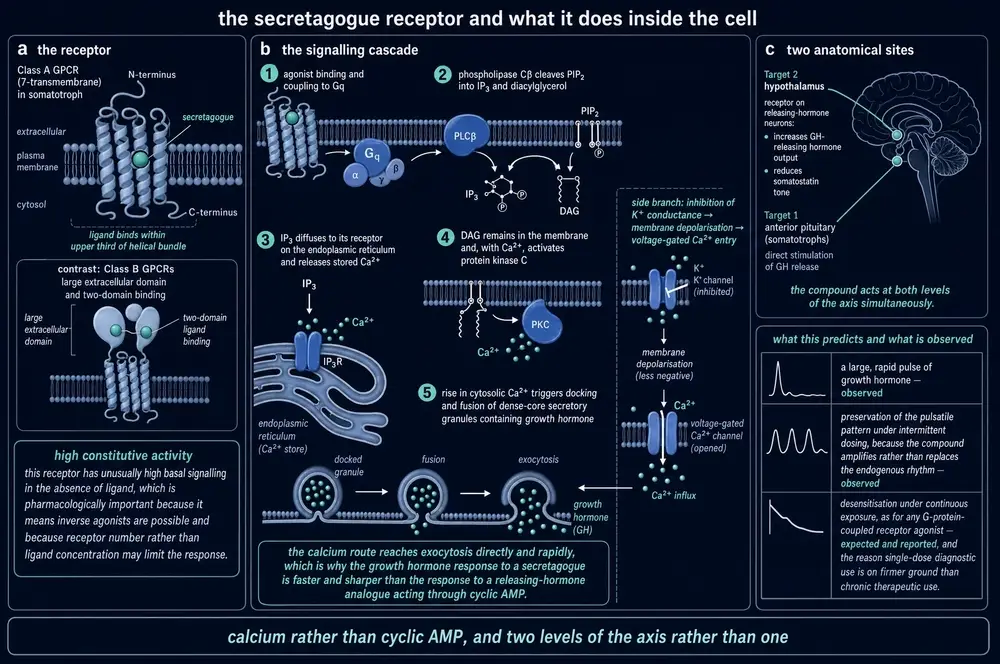
The received account of GHRP action, repeated in many reviews, is that the secretagogue receptor signals through phospholipase C, inositol trisphosphate, protein kinase C and calcium — in explicit contrast to GHRH's cyclic-AMP pathway. The corpus assembled for this document does not support that as a statement about GHRP-2 specifically, and the most direct experiment in it points the other way.
In primary cultured ovine somatotrophs studied with perforated-patch recording, GHRP-2 at 100 nM reversibly reduced the inward-rectifying potassium current — the change that depolarises the cell and lets calcium in. The effect was abolished by three independent blockers of protein kinase A signalling. Blocking protein kinase C did nothing to it (Chen et al., 2002). That is an in-vitro result in sheep cells, and it is stated here as such; but it is the only compound-specific measurement of the question in this corpus, and it says that GHRP-2's somatotroph action is PKA- and cAMP-dependent and PKC-independent. Where a review asserts the PKC pathway for this molecule, it is asserting the class's textbook mechanism rather than a measurement of GHRP-2. Readers should treat the pathway as less settled than it is usually printed.
That GHRP-2 acts through the ghrelin receptor itself, rather than through some residual affinity elsewhere, is established more cleanly. In a human granulosa cell line the receptor's signalling isoform GHS-R1a is expressed constitutively while the truncated GHS-R1b is not detectable, and a selective GHS-R1a antagonist fully reversed GHRP-2's effect (2016, human cells, in vitro). In rats, a GHS-R1a antagonist reversed the corresponding response to the endogenous ligand (Zhang et al., 2014, rat, in vivo).
It is worth setting the two axes side by side, because the confusion between them is the single most common error made about this compound. The releasing hormone and the releasing peptide converge on the same cell and produce the same output, and almost nothing else about them is shared. They bind different receptors of different structural classes, recruit different G proteins, raise different second messengers, and act at different anatomical levels — and one of them makes people hungry while the other does not. That the two abbreviations differ by a single letter is an accident of nomenclature that has outlived its usefulness.
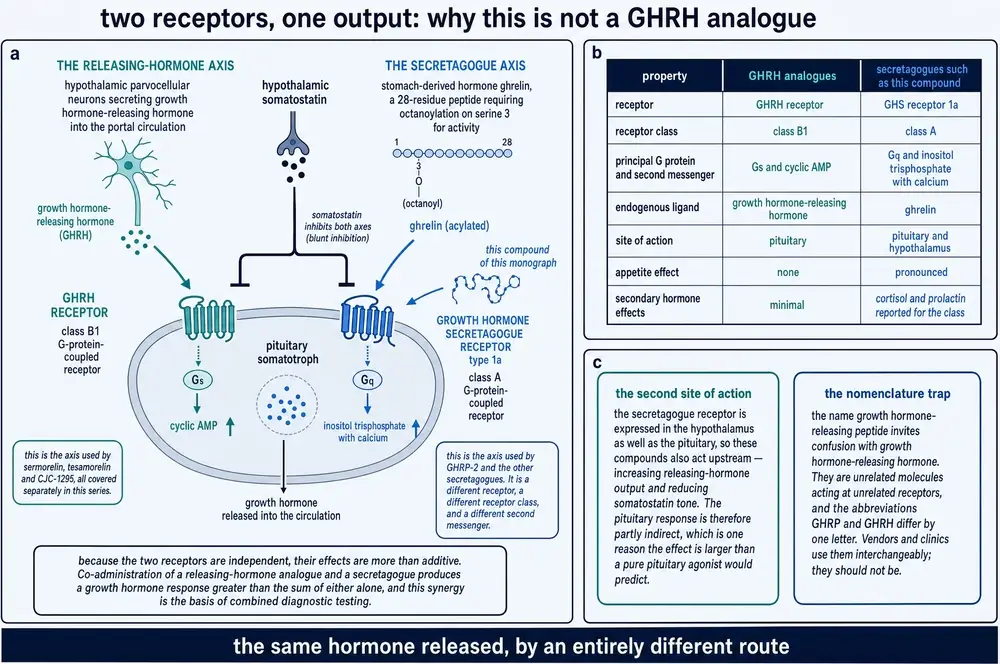
Inside the cell, the consequence of that difference is a matter of route rather than destination. A releasing-hormone analogue raises cyclic AMP; a secretagogue, on the class account, mobilises calcium. Calcium is what actually triggers a secretory granule to fuse with the membrane, so a stimulus that raises it directly reaches the exit faster than one that has to work through a kinase cascade first. That is the textbook explanation for why the growth hormone pulse after a secretagogue is sharper and earlier than the pulse after GHRH, and it is drawn below. The caution from the previous figure applies here too, and with more force: the cascade shown is established for the receptor class, not measured for this molecule.
How much of the effect needs GHRH?
The most elegant experiment on the site of action uses a natural mutant. The lit/lit mouse carries an inactivating Asp60Gly mutation in the GHRH receptor, so any response it makes to a secretagogue cannot be running through GHRH. Given 10 µg of GHRP-2 intraperitoneally, wild-type mice reached a peak growth hormone of 163 ± 46 ng/mL and lit/lit mice reached 9.3 ± 1.5 ng/mL against a saline baseline of 1.04 ± 1.15 — a response roughly eighteen times smaller than wild-type, but unambiguously present and statistically significant (Fernandez et al., 2012, mouse, in vivo).
The reading is that GHRP-2's effect on growth hormone is mostly but not entirely dependent on an intact GHRH system: a minority component acts directly at the pituitary through GHS-R1a, and the large remainder requires GHRH. The same paper reports the contrary evidence in its own discussion — GHRH-knockout mice have been reported to show no growth hormone response to GHRP-2 at all — and attributes the difference to knockout versus point mutation, assay sensitivity, and route. The conflict is unresolved and is presented here as unresolved.
One further result from that study deserves its place beside the acute one, because it is the first appearance of a pattern that recurs throughout Part Four. Given 10 µg daily for two weeks, the same mice gained weight and raised leptin — and their growth hormone and IGF-I did not rise significantly. An acute secretagogue effect and a chronic endocrine effect are different things, and in this molecule they come apart early.
08A peptide that survives being swallowed
The property that made GHRP-2 worth developing is unusual for a peptide: it works by more than one route. Bowers' 1993 review reports GHRP-6, GHRP-1 and GHRP-2 all given to humans and all orally active (Bowers, 1993), and the subsequent clinical literature uses intravenous, intranasal and oral administration in different studies. Most peptides are digested; the three D-residues and the C-terminal amide described in Section 03 are the reason this one is not, or not entirely.
“Orally active” should not be read as “efficiently absorbed.” The most direct measurement in this corpus is indirect and comes from anti-doping chemistry: after a single 10 mg oral dose, the characteristic urinary metabolite was detectable for more than twenty hours while the intact peptide was not observed at all (Thomas et al., 2011). A 10 mg oral dose against a 100 µg intravenous one is a hundredfold difference in the amount administered, which is the practical measure of how much of an oral dose survives.
The circulating half-life is short. A 2026 review gives approximately 0.55 ± 0.14 hours with the growth hormone peak around sixty minutes after dosing. A caution belongs here, because it is the kind of error this compound invites: a widely available dried-blood-spot paper prints a half-life of 2.5 ± 1.1 hours in a sentence that names both GHRP-2 and GHRP-6, and that value belongs to GHRP-6. The paper's only post-administration sample came from a single subject given 666 µg of GHRP-2 and 200 µg of GHRP-6 in one injection; there is no GHRP-2-alone pharmacokinetic study in this corpus at all. The roughly fourfold discrepancy between the two figures is not a controversy. It is two molecules.
09How much growth hormone, and in what shape
In people with an intact pituitary, GHRP-2 is a strong stimulus. Twelve patients with pituitary adenoma but normal somatotroph function, given 100 µg intravenously, had a median peak growth hormone of 17.7 ng/mL (range 13.5–39). Reported peaks elsewhere run considerably higher — a mean of 68.7 ± 15.5 ng/mL in eight adult men — and the spread across studies is itself informative: the response depends heavily on who is being tested, in ways Section 10 sets out.
More interesting than the peak is what the peptide does to the shape of growth hormone secretion. Growth hormone is not released steadily; it comes in bursts, and the pattern carries biological information that a single peak value discards. In twenty-two healthy young men studied with ten-minute sampling and maximum-likelihood deconvolution, the pulsatile secretion rate rose 54-fold under combined GHRH and GHRP-2 infusion, 47-fold under L-arginine plus GHRP-2, and 20-fold under L-arginine plus GHRH (Veldhuis et al., 2008, human, in vivo). The two GHRP-2-containing pairs each exceeded the GHRH pair (P < 0.01) and did not differ from one another.
The bursts also changed shape. The time from the onset of a burst to its maximum fell from 19.2 ± 0.69 minutes under saline to 10.4 ± 3.0 minutes under combined GHRH and GHRP-2, a median reduction of 43 per cent — the peptide makes each pulse rise faster. What it did not change is how often bursts occur: pulse number and the variability of the intervals between pulses were unaffected. Nor did it alter basal, non-pulsatile secretion, which in the same subjects tracked sex-steroid status rather than secretagogue. GHRP-2 amplifies pulses that the body is already deciding to have.
That last distinction is worth holding on to, because it is what separates a secretagogue from a hormone. Injecting growth hormone imposes a concentration on the body regardless of what the body was going to do. GHRP-2 does not: it makes the pulses larger and sharper, and leaves their number and their timing to the hypothalamus. That is an attractive property in a probe, since the readout still reflects the state of the axis being probed. It is a limiting property in a therapy, for the same reason, and Part Four is largely the story of that limitation being discovered the expensive way.
The synergy with GHRH is the most reproducible finding in the human literature and it is genuinely more than additive. In twenty-four postmenopausal women given GHRH pulses with or without continuous GHRP-2, the amplifying interaction on ten-hour pulsatile secretion was significant at P < 0.0001, and it did not depend on oestrogen availability (Veldhuis et al., 2013, human, in vivo). A working model set out in that paper divides the labour: somatostatin sets the timing and size of bursts, GHRH drives both synthesis and release, and GHRP does not augment synthesis at all — it potentiates the release of what GHRH has made.
The synergy degrades with exposure
In the same study, after thirteen hours of combined GHRH pulses and continuous GHRP-2, GHRH's ability to potentiate a subsequent maximal stimulus was suppressed by more than half (P < 0.0001). The authors offer homologous desensitisation of the GHRP receptor and heterologous downregulation of the GHRH receptor as candidate explanations, note that heterologous upregulation has also been reported, and explicitly leave the direction unresolved. Thirteen hours is not a long exposure. Section 13 shows what forty-eight weeks does.
10Who responds, and who does not
The growth hormone response to GHRP-2 varies enormously between people, and the variables that predict it are consistent enough to be clinically useful and inconsistent enough to be worth stating carefully.
Body fat is the dominant negative predictor. In 104 patients with non-functioning pituitary tumours tested with 100 µg intravenously, peak growth hormone was 3.40 ng/mL in the overweight (BMI ≥ 25, n = 29) against 15.39 ng/mL in the rest (n = 75, P = 0.001). On multiple regression, body mass index was a significant negative predictor of log peak growth hormone (β = −0.210, P = 0.007), and being overweight carried an adjusted odds ratio of 3.86 (95% CI 1.02–14.66, P = 0.047) for being classified as severely growth hormone deficient (Seki et al., 2022, human). Age, in that cohort, did not predict the response at all.
The clinical consequence is uncomfortable and the authors draw it: after surgery, every one of the fifteen patients who had been overweight preoperatively was classified as severely deficient, against 48 per cent of the non-overweight (P < 0.001). A test whose result depends this strongly on body composition will diagnose deficiency in heavy people who do not have it. Independent support that the effect is adiposity rather than disease comes from bariatric surgery: in obese patients the response to the GHRP-2 test improved markedly after weight loss following sleeve gastrectomy (Ohara et al., 2017, human, n = 28).
Whether GHRP-2 is less sensitive to abdominal fat than GHRH is a question this corpus answers inconsistently, and the studies come from one research group using overlapping designs. In twenty-four young men under a hormonal clamp, GHRH's efficacy fell sharply with abdominal visceral fat (R² = 0.35, P = 0.0024) while GHRP-2's was not influenced by fat or age at all.
Three other cohorts from the same programme found the opposite: visceral fat was a significant negative predictor of GHRP-2 efficacy as well (R² = 0.38, P = 0.005 in one; R² = 0.29 in another), and in a fourth, body mass index explained 65 per cent of the variability in the GHRP-2 response against 38 per cent for GHRH — making GHRP-2 the more fat-sensitive of the two. Any claim that GHRP-2 is robust to adiposity rests on a single cohort and is contradicted by three. It is presented here as unsettled.
Sex steroids matter, and oestrogen matters more than testosterone. Short-term suppression of testosterone and oestradiol in young men left the stimulated growth hormone response essentially unchanged while reducing basal secretion, which testosterone add-back reversed. In a mixed group of men and women, oestradiol positively predicted the GHRP-2 response (r² = 0.49, P = 0.005) while testosterone negatively predicted the GHRH response. Fasting pulsatile secretion was 7.6 times higher in women than in men — and combined GHRH plus GHRP-2 abolished the sex difference entirely.
Age reduces the response, at least under some conditions: older men (57 years) reached maximal responses roughly half those of young men (23 years) under sex-steroid deprivation (P = 0.022). In the patient cohort above, age was not a predictor. The reconciliation is probably that age acts largely through body composition and gonadal status rather than independently.
11The parts of the pituitary it was not aimed at
GHRP-2 is described in the older literature as a specific growth hormone releaser. It is not specific, and the clearest human measurement concerns cortisol. In forty-two healthy men studied with ten-minute sampling over five hours, a 3.0 µg/kg intravenous bolus of GHRP-2 raised peak cortisol to 616 ± 42 nmol/L against a grand mean of 420 ± 21 for saline, GHRH and somatostatin combined; a triple stimulus reached 868 ± 27 nmol/L (Iranmanesh et al., 2010, human, in vivo). The comparison that matters is with GHRH, which had no discernible acute effect on cortisol at all. The corticotropic action belongs to the secretagogue arm specifically.
That study could not measure ACTH — plasma was unavailable — so its account of the pathway is inferential. Direct ACTH data come from patients: in thirty-six people with hypothalamic-pituitary disease, the ACTH response to 100 µg of GHRP-2 was significantly lower in those with pituitary-origin adrenal insufficiency, and a threshold of a 1.55-fold rise separated them with 83 per cent sensitivity and 88 per cent specificity (Suzuki et al., 2022, human). Whether that ACTH release is mediated by CRH or by a distinct mechanism is disputed in the literature, and the same paper's observation of a preserved ACTH response in hypothalamic disease is offered as evidence for the latter.
Prolactin is a gap, and it is worth naming as one. Reviews routinely list prolactin among the hormones the GHRPs release, and one class review in this corpus tabulates a “variable” prolactin rise for GHRP-2 while describing its own descriptors as not a formal grading scheme. Another paper in the same corpus asserts, citing Bowers, that the GHRPs release growth hormone without affecting other pituitary hormones — which contradicts both the prolactin claim and the cortisol measurement above. No primary measurement of prolactin after GHRP-2, in any species, appears anywhere in the 94 documents read for this monograph. The honest statement is that the question has not been answered here rather than that the answer is known.
12Children who were not growing
The obvious use for a growth hormone secretagogue that works without a needle is a child who is short. Growth hormone itself works, but it is a daily injection through years of childhood, and in the 1990s a nasal spray that made a child's own pituitary do the same job was an attractive proposition.
The first results were encouraging. Catherine Pihoker and colleagues showed that GHRP-2 given intravenously or intranasally produced growth hormone responses in children being evaluated for deficiency that were as reliable a guide to pituitary reserve as GHRH (Pihoker et al., 1995, human, n = 24). Two years later the same group reported treatment rather than testing: fifteen children with short stature, given intranasal GHRP-2 twice daily for three months and then three times daily, with six continuing for eighteen to twenty-four months (Pihoker et al., 1997, human, open label, n = 15). Every child in the study had a growth hormone response above 10 µg/L to the nasal spray.
That study is open-label, uncontrolled and small, and it is the one the secondary literature quotes. A paper published seventeen years later in this corpus states that intranasal GHRP-2 “restored normal growth rates” in it. The definitive test tells a different story.
A double-blind, placebo-controlled study across eighty-four Japanese centres randomised 126 prepubertal children with growth hormone deficiency to placebo, low-dose or high-dose intranasal GHRP-2 twice daily for 48 weeks (Tanaka et al., 2014). One detail of the design does more work than any of the results: to enter, a child had to produce a growth hormone rise of at least 9 ng/mL in response to a preliminary trial of the spray. The cohort was pre-selected for responsiveness to the drug being tested. Growth velocity was 5.4, 5.2 and 5.1 cm per year in the placebo, low-dose and high-dose groups — not significantly different. The change in height standard-deviation score was 0.07, 0.03 and 0.02. IGF-I did not change.
The drug was doing something: peak growth hormone in the high-dose group was 26.4 ng/mL at baseline. But it fell to 17.8 ng/mL at 24 weeks and 14.6 ng/mL at 48 weeks, by which point the high and low doses no longer differed from each other. And the quantity that matters for growth is not the peak but the area under the curve, where the comparison is stark: 16.3 ± 10.0 ng/mL·h for high-dose intranasal GHRP-2 against 230 ± 7.0 for a subcutaneous dose of growth hormone itself — from almost identical peaks of about 25 ng/mL. A fourteenfold difference in total exposure, hidden behind matching peak values.
Adverse events were reported in 76 of the 126 children (60.3 per cent), almost all incidental childhood illness; those the investigators judged possibly or probably related were borborygmus in three children, and epistaxis, reduced blood pressure and eosinophilia in one. They are not broken down by treatment arm, so a placebo-adjusted rate cannot be derived from the published report. This remains the only exposure of a human cohort to repeated-dose GHRP-2 with formal adverse-event collection anywhere in this corpus.
Two lessons sit inside that result and both generalise beyond this compound. The first is tachyphylaxis: a secretagogue that provokes a burst provokes a smaller burst each time, and by a year the dose-response had flattened. The second is that peak growth hormone is a poor proxy for delivered growth hormone. A sharp, brief, self-limiting pulse and a sustained exogenous exposure can share a maximum and differ by more than an order of magnitude in everything that follows from it. The pulsatile physiology that makes GHRP-2 an elegant probe of the axis is precisely what makes it a weak way to grow a child.
13The intensive care unit
The most physiologically serious clinical programme GHRP-2 ever had was not about growth at all. Greet Van den Berghe and colleagues in Leuven studied the somatotropic axis in prolonged critical illness — a state characterised by relentless protein breakdown, preserved fat, blunted growth hormone secretion and low IGF-I. In that setting the pituitary is not exhausted but suppressed: it releases growth hormone readily to a bolus of GHRH or GHRP-2, and paradoxically even to TRH.
The Leuven group gave twenty-six critically ill adults (mean age 63 years) twenty-one-hour infusions of GHRH, GHRP-2, or both, in a randomised crossover design against placebo, with growth hormone measured every twenty minutes (Van den Berghe et al., 1997, human, in vivo). The placebo profiles showed the signature of the illness: frequent pulses of very low amplitude. GHRP-2 restored burst amplitude far more effectively than GHRH did, and the combination more than either; secondary accounts in this corpus describe roughly six-fold and ten-fold increases in pulse amplitude for GHRP-2 alone and the combination respectively, while GHRH alone did not restore the pulsatile pattern.
This is the clearest demonstration that GHRP-2 does something GHRH cannot, in a population where it might have mattered. It did not become a treatment. Restoring a hormonal profile is not the same as changing an outcome, and the wider experience of growth hormone in critical illness during exactly this period was not encouraging — the definitive trials of growth hormone itself in critically ill adults found increased mortality. A signal in a surrogate is where this programme stopped.
14Wasting, appetite and muscle
Once ghrelin was known to be an appetite hormone, its synthetic mimics became candidates for the wasting syndromes. GHRP-2's evidence here is mostly animal and mostly small.
In rats with thermal injury — a model of hypermetabolic muscle wasting — GHRP-2 delivered by minipump over twenty-four hours reduced the burn-induced rise in interleukin-6 and in the two ubiquitin ligases that execute muscle protein breakdown, MuRF-1 and MAFbx (Sheriff et al., 2009, rat, in vivo). That is a mechanistically coherent result in an animal, and it is stated here as an animal result; no human study of GHRP-2 in burn injury or cachexia appears in this corpus. A mouse study in tumour-bearing animals found a survival difference of 18 against 15.5 days that was not statistically significant.
The best controlled human evidence about GHRP-2 that this corpus contains is about appetite, and it is short-term. Seven lean healthy men received a subcutaneous infusion of 1 µg/kg/h for 270 minutes or saline in crossover, then ate freely from a buffet: food intake rose by 35.9 ± 10.9 per cent (P = 0.008), and every subject ate more (Laferrère et al., 2005, human, n = 7). A double-blind randomised follow-up in nineteen people — ten lean, nine obese — found the effect dose-dependent: food intake rose 10.2 ± 3.9 per cent at 0.1 µg/kg/h (P = 0.011) and 33.5 ± 5.8 per cent at 1 µg/kg/h (P = 0.000), and obesity did not blunt it (Laferrère et al., 2006, human, n = 19). Macronutrient choice did not change; people ate more of the same food.
These are single-meal studies of a hormonal mimic in healthy volunteers, and they establish that GHRP-2 does in people what ghrelin biology predicts. They do not establish that it treats anything — no study in this corpus followed the appetite effect into weight gain in a patient population under controlled conditions.
The human evidence for a therapeutic appetite effect is a single patient. A woman with a twenty-year history of anorexia nervosa, severely emaciated, with delayed gastric emptying, intractable constipation and hypoglycaemia, was given intranasal GHRP-2 before every meal for one year (Haruta et al., 2015, human, n = 1, case report). Hunger and food intake increased, and body weight and hypoglycaemia improved. The paper is careful about what it is; this document should be too. A one-person case report published in a journal of cachexia is a hypothesis, and it is the only human therapeutic result for appetite that this corpus contains.
A retrospective case series is sometimes cited as human evidence for body composition. It should not be. Fourteen hypogonadal men on testosterone therapy, selected from 105 records, received GHRP-6 and GHRP-2 and sermorelin together, three times daily; IGF-I rose from 159.5 to 239.0 ng/mL. Three compounds acting on two different receptors were given simultaneously against a background of testosterone treatment, with no control group. Nothing in that result can be attributed to GHRP-2.
15Why none of it converted
A 2016 review of ghrelin-receptor ligands that reached clinical trials supplies the class's own epitaph: numerous agonists were tested in animals, several in humans, and a handful progressed to trials for growth hormone release, gastric emptying and cachexia — and with the exception of GHRP-2's approval for diagnostic purposes in Japan, none was successfully introduced to the market (Vodnik et al., 2016). By then the field's attention had moved to antagonists and inverse agonists of the same receptor, for obesity. The molecule's own research community had turned around and started walking the other way.
Three reasons for the failure are visible in the evidence above, and they compound. Tachyphylaxis means the effect shrinks with the repeated dosing any chronic therapy requires. Pulse amplification is not exposure: the fourteenfold area-under-curve gap in the paediatric trial is the whole problem in one number, and it is intrinsic to the mechanism rather than a formulation failure. And an intact axis is required — a secretagogue needs a pituitary that can respond and a hypothalamus that will let it, which is precisely what the patients most in need of growth hormone do not have. That is why the compound works best as a test of whether the axis is intact, and it is the hinge on which Part Five turns.
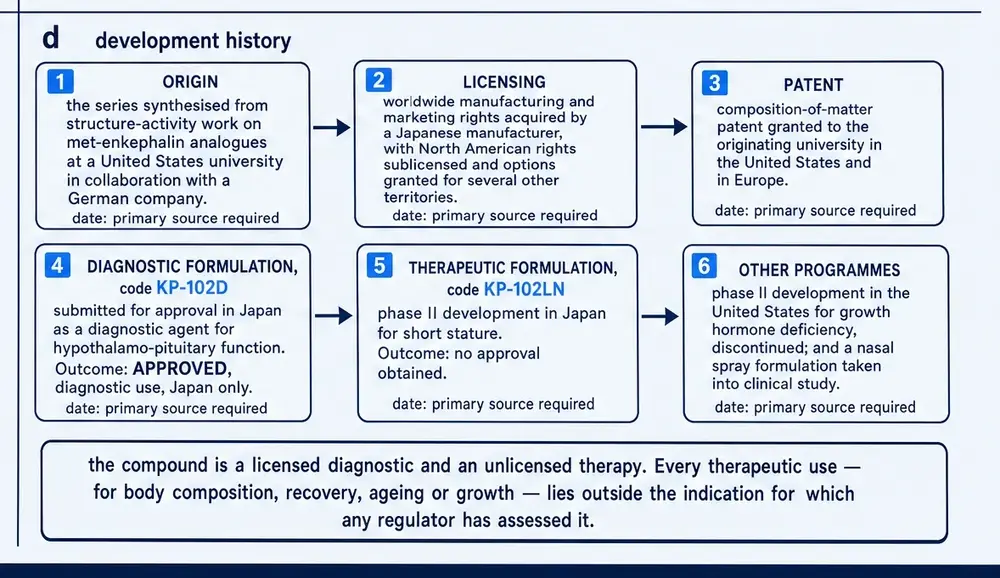
A fourth reason is commercial rather than biological. The non-peptide secretagogues that Merck built to find the receptor were orally active small molecules with far better drug-like properties, and the pharmaceutical effort followed them — to MK-677, and eventually to macimorelin, which took the diagnostic indication in the United States and Europe that GHRP-2 holds in Japan. The peptides were the tools that opened the field and then were displaced within it.
16A licence to ask a question
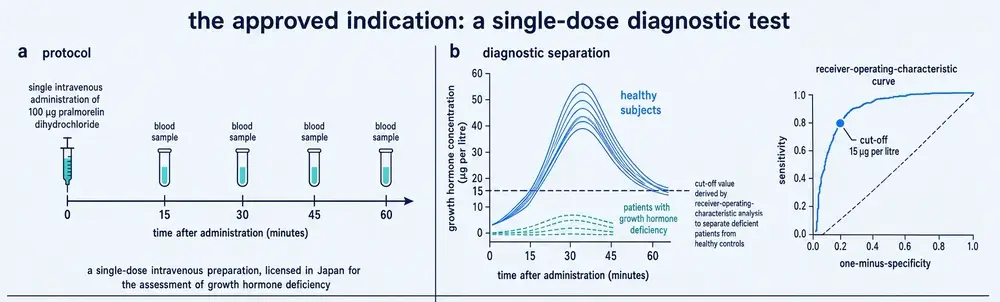
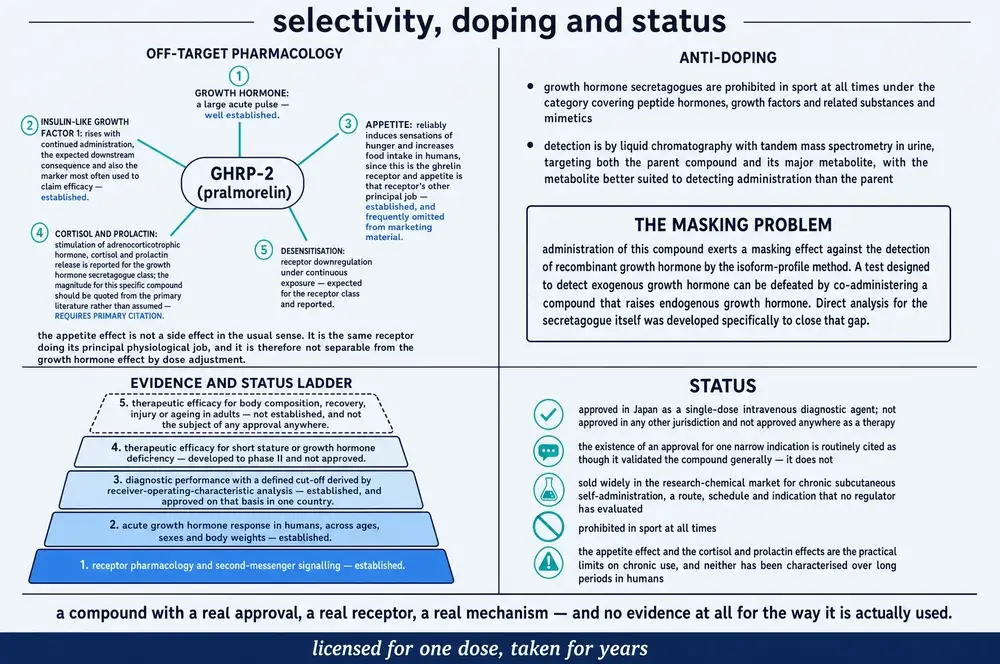
On 22 October 2004, Japan's regulator approved pralmorelin hydrochloride, marketed by Kaken Pharmaceutical as GHRP KAKEN Injection 100 under approval number 21600AMZ00573000. The approved indication is a single clause: the diagnosis of growth hormone deficiency. There is no therapeutic indication. The product was listed for reimbursement in December 2004 and launched in February 2005, and it is still marketed; the manufacturer's own documentation records that it is sold in no other country.
The approved procedure is a single slow intravenous injection in the fasted state, with blood sampled at intervals over the following hour. The stated quantity differs by age: 100 µg for those aged eighteen and over, and 2 µg per kilogram for ages four to under eighteen, capped at 100 µg above fifty kilograms. It is not studied below age four and is contraindicated in pregnancy. These are facts about a label, reported as such.
The operative Japanese scheme is three-tier rather than binary: a peak above 16 ng/mL is not deficient, 9 to 16 is moderate deficiency, and 9 or below is severe. Paediatric practice uses a single figure of 16 ng/mL, against 6 ng/mL for the conventional tests — the GHRP-2 threshold sits higher than every comparator's because the stimulus is stronger than every comparator's.
The reason Japan adopted this test is that the alternative is unpleasant. The international reference standard for diagnosing adult deficiency is the insulin tolerance test, which works by deliberately inducing hypoglycaemia — effective, and contraindicated in exactly the older and cardiovascularly frail patients most likely to need it. A single intravenous injection with sampling over an hour is a materially safer procedure, and reviews of Japanese practice describe it as convenient and safe (Fukuda et al., 2014).
The test has been in routine use long enough to generate real clinical literature, and that literature is mostly about its limits. Section 10 covered the largest: the response falls with body fat strongly enough that overweight patients carry nearly a fourfold adjusted odds of being classified severely deficient. A 2024 report from the other end of the age range adds a second limit. Among twenty-three adolescents past the onset of puberty, median peak growth hormone was 3.4 ng/mL in those with organic or genetic deficiency but 88.9 and 90.1 ng/mL in those with idiopathic deficiency and with short stature respectively — and two patients exceeded the GHRP-2 threshold while falling below the thresholds of other provocative tests. The authors' conclusion is that the cut-off may miss cases and needs revisiting (Onuki et al., 2024, human, n = 23).
17The adrenal question, answered twice
Because GHRP-2 releases cortisol as well as growth hormone (Section 11), it was natural to ask whether one injection could assess two axes at once — replacing the insulin tolerance test for adrenal insufficiency as well. This corpus answers that question twice, in opposite directions, and the disagreement is instructive enough to present in full rather than to resolve.
| 2016, Endocrine Journal | 2018, Journal of the Endocrine Society | |
|---|---|---|
| Patients | 47 with suspected hypothalamic-pituitary disorder | 254 admitted for evaluation of hypopituitarism |
| Comparator | Insulin tolerance test and CRH test | Insulin tolerance test, both within four days |
| Headline | Peak cortisol cut-off 11.6 µg/dL gave 89.7% sensitivity, 88.9% specificity | Correlation of peak cortisol between tests r = 0.777, but overall 64% sensitivity, 79% specificity |
| Conclusion | Does not have the predictive value of the insulin tolerance test, but similar diagnostic potential to the CRH test | “Not suitable for clinical use” overall — but usable in men without a functioning adenoma |
Read carefully, the two are less opposed than their headline numbers suggest, and the reason is that the earlier study never claimed what it is usually quoted as claiming. Its own conclusion declines to offer the test as a replacement for the insulin tolerance test and positions it beside the CRH test instead. The later study's authors read it the same way. What is genuinely in dispute is narrower: whether a cortisol threshold on this test is dependable enough to act on.
The later and much larger study does not merely disagree; it explains the disagreement. Its overall figures conceal a strong dependence on who is being tested. In men without a functioning adenoma the correlation with the insulin tolerance test was r = 0.879 with 95 per cent sensitivity and 85 per cent specificity — a usable test. In women it was r = 0.692, with age and menstrual status as significant modifiers. And in the thirty patients with prolactinoma the correlation was r = 0.020, which is to say none at all (Hayakawa et al., 2018, human). A test that performs well in one sex and not another, and fails completely in a common tumour type, will produce respectable aggregate statistics in a cohort with the right mix and poor ones in a cohort without.
Weighing them: this document gives more weight to the 2018 study. It is five times larger, it is more recent, it compared every patient against the reference standard directly, and — the decisive point — it accounts for the earlier result rather than contradicting it blindly. A separate 2022 study takes a third position worth recording, finding that the ACTH response rather than the cortisol response carries the signal, with a 1.55-fold rise giving 83 per cent sensitivity and 88 per cent specificity for pituitary-origin adrenal insufficiency, and 100 per cent specificity when combined with peak cortisol (Suzuki et al., 2022). The question is open.
18First, but not only
It is repeated across the secondary literature that GHRP-2 is the first and only growth hormone secretagogue ever approved by a regulator. The first half is defensible. The second is false.
Macimorelin — an orally active peptidomimetic agonist of the same receptor — was approved by the United States Food and Drug Administration on 20 December 2017 as Macrilen, for the diagnosis of adult growth hormone deficiency, and authorised in the European Union on 11 January 2019. It carries the ATC code V04CD06, in the diagnostic agents class. Like pralmorelin it is a diagnostic and not a therapy; unlike pralmorelin it is swallowed rather than injected, and it is approved in the two largest regulated markets rather than in one.
The accurate statement is therefore narrower and more interesting than the one usually made: pralmorelin's 2004 Japanese approval appears to be the first granted to any growth hormone secretagogue, by thirteen years; it remains the only approval that molecule has anywhere; and the indication it pioneered is now held elsewhere by a different compound. The class produced two approved drugs in forty years, both of them tests.
19Prohibited at all times
Outside Japan, the context in which GHRP-2 is most often named is anti-doping. The 2026 World Anti-Doping Code Prohibited List, in force from 1 January 2026, names it explicitly at section S2.2.4, growth hormone releasing factors, in a bullet reading “GH-releasing peptides (GHRPs) [e.g. alexamorelin, examorelin (hexarelin), GHRP-1, GHRP-2 (pralmorelin), GHRP-3, GHRP-4, GHRP-5 and GHRP-6]”. Class S2 is prohibited at all times, in and out of competition, and its substances are non-Specified, which carries the more severe default sanction.
The date at which it became prohibited and the date at which it was named are different, and the distinction is often got wrong. GHRP-2 was already covered before 2015 by the general prohibition on growth hormone releasing factors and by the catch-all for substances of similar structure or effect. It first appears by name on the face of the List in the 2015 edition. Saying it has been banned since 2015 understates the position.
Growth hormone doping is detected by an isoform ratio. Injected recombinant growth hormone is a single 22 kDa form, and it suppresses the pituitary's own mixture of forms by negative feedback, so the ratio of recombinant-type to pituitary-type rises. GHRP-2 defeats this. Because it makes the pituitary release both forms, it raises numerator and denominator together and the ratio does not move.
In Japanese male subjects — a reference population of 100, with recombinant growth hormone alone (n = 5), GHRP-2 100 µg intravenously alone (n = 10) and the two combined (n = 10) — a low dose of recombinant growth hormone raised the ratio as expected (P < 0.001), GHRP-2 alone produced no significant change in it, and in the combined arm GHRP-2 pulled the ratio back down to 39.9–43.9 per cent of the value the recombinant hormone had produced (Okano et al., 2010, human). A drug that raises growth hormone is also a drug that hides growth hormone.
What saves the test is that GHRP-2 is itself detectable. The same work established a urinary assay for the intact peptide and for its specific metabolite AA-3, and both remain measurable during exactly the window in which the isoform ratio is being masked.
The detection chemistry is mature. Assays cover the intact peptide and its metabolite at nanogram-per-millilitre concentrations; after an oral dose the metabolite is detectable for over twenty hours where the parent is not (Thomas et al., 2011); and GHRP-2 has been found in urine samples from athletes (Cox et al., 2015). This document could not locate any publicly documented adverse analytical finding, sanction decision or case naming GHRP-2 specifically. That absence is reported as an absence: the methods are validated on real excretion-study samples, and what happened to them in practice is not in the public record this corpus can reach.
20The market that the science did not build
GHRP-2 is bought and sold. It is not approved anywhere outside Japan, it has no therapeutic indication anywhere at all, and it is nonetheless a fixture of the research-chemical trade — and the shape of this document's own corpus is the plainest evidence of it. A sweep of 45,975 local documents admitted 142 that are genuinely about GHRP-2. Of those, twenty-one are peer-reviewed full texts and 116 are dated vendor catalogue snapshots and product PDFs: a ratio of about six to one, non-literature to literature. For a compound with a small historical science and a large consumer market, that split is itself a finding, and it is reported rather than quietly discarded.
The doping-control literature supplies the harder evidence, because it analyses what is actually in the products. GHRP-2 has been identified as an ingredient of an over-the-counter “nutritional supplement” (Thomas et al., 2010); it has been found among confiscated black-market products and supplements analysed by a doping-control laboratory, alongside growth-hormone-labelled vials containing no active ingredient at all (Kohler et al., 2010); and it has turned up as an undeclared constituent of a black-market product sold as something else entirely (Reichel et al., 2019). The last of these is the one worth dwelling on: a purchaser of that product was not choosing to take GHRP-2.
The United States has never approved GHRP-2 for anything. In March 2019 the Food and Drug Administration issued a warning letter to a compounding pharmacy that had been making preparations with it, stating that products compounded with GHRP-2 are unapproved new drugs and misbranded. In September 2023 the agency placed GHRP-2, for injectable and nasal routes, in the category of bulk drug substances that may present significant safety risks — citing potential immunogenicity from aggregation and peptide impurities, the analytical difficulty created by its unnatural amino acid, and reports of serious adverse events, while stating that causality has not been established.
21What is not known
The evidence gaps on this compound are large, specific, and mostly a consequence of the fact that its science stopped. This document's own harvest shows the shape: of 204 indexed records about GHRP-2, 44 appeared in 1995–1999, 47 in 2000–2004 and 45 in 2005–2009, falling to 35, then 16, then 10, with four in the current partial bucket.
Named plainly, the gaps are these.
- The study the Japanese label rests on is not in this corpus. Every claim about the test's diagnostic performance — high sensitivity and specificity, separation from healthy controls without overlap, a correlation of r = 0.87 against the insulin tolerance test — traces to a single validation study that appears here only as a citation in other people's papers. This document therefore reports those figures as what other authors attribute to it, not as measurements it has seen.
- There are no registered therapeutic trials. Two registry identifiers appear across the 94 documents, both Japanese observational studies in which the GHRP-2 test is the diagnostic instrument rather than the intervention. The paediatric randomised trial, the appetite infusions and the intensive-care studies carry no registration in anything read here.
- There is no modern safety literature. The only systematically collected adverse-event dataset is the 48-week paediatric trial, and it is not broken down by treatment arm. The largest safety observation at the diagnostic dose is a statement that no adverse reactions occurred in 254 patients who each underwent the test. There is no controlled long-term human safety study of the compound at all.
- There is no pharmacokinetic study of GHRP-2 given alone. The half-life figures in circulation come from a review and from a co-administration with GHRP-6, and they differ from one another roughly fourfold for that reason.
- There is no published receptor-binding constant for GHRP-2 — no affinity, EC50 or Ki at GHS-R1a — anywhere in the 94 documents read. Nor is there a human dose-response curve: every human study uses a dose asserted to be maximally stimulating, with potency unquantified.
- Prolactin has never been measured after GHRP-2 in any species in this corpus, despite reviews routinely listing it among the hormones released.
- The cardiac literature stopped around 2010, and the second molecular target reported for this compound — the scavenger receptor CD36 — has been pursued mainly in abstracts.
- The direction of the desensitisation seen with combined GHRH exposure is explicitly unresolved by the authors who reported it, and no study has resolved it since.
What is left, forty-nine years after an opioid fragment released growth hormone from a piece of rat pituitary, is a molecule that is thoroughly characterised as a stimulus and barely characterised as a drug. It answers one question well enough that one country licensed it to ask that question. The larger ambition — that a peptide could persuade the body to make its own growth hormone in a way that changed how a person grows, heals or ages — was tested, and the most rigorous test of it returned a growth velocity of 5.1 centimetres a year against a placebo's 5.4.
Nothing in this document recommends human use of GHRP-2 or of any other compound, and it specifies no dose, route or schedule for any person. Every quantity reported above is either a parameter of a cited study, described as what those investigators did, or the content of an approved regulatory label, described as a fact about that label.
GHRP-2 is not approved for therapeutic use in any jurisdiction. It is prohibited in sport at all times, and it is classified by the United States Food and Drug Administration among bulk drug substances that may present significant safety risks. The single approval it holds authorises one intravenous dose, given once, to answer a diagnostic question.
22References
Generated from verified NCBI records rather than from recall. Author lists, journal titles, years and identifiers were read back from the resolved records before printing. This is not a formality: on this build four identifiers were first attached to the wrong papers, and reading the resolved lines is what caught them. Sources without a PubMed identifier — regulatory instruments, the anti-doping list, a database entry and one un-indexed book chapter — are listed separately and were each read directly.
{REFERENCES}23How this document was assembled
The corpus was built in two halves that were then merged by identifier rather than added together. A local sweep read every document in the project-05 stores; an external harvest queried PubMed and PubMed Central. Both halves used one shared matcher, so the discovery scan and the harvest cannot drift apart.
The identity gate, and what it refused
GHRP-2's name is a class noun with a numeral attached. GHRP-1, GHRP-6, hexarelin and ipamorelin share its receptor, its assays, its authors and its vocabulary, so subject-matter corroboration — the technique this series uses for compounds whose names collide with unrelated fields — cannot separate them, because the subject matter is shared by construction. Separation is therefore by designator: the numeral must be present and bounded, and a document admitted on the designator alone is refused when any sibling is named at least as often as GHRP-2 itself.
Three further constraints are load-bearing. The matcher refuses GHRP followed by H, because growth hormone-releasing hormone is a different molecule acting on a different receptor and the two are routinely named in the same sentence. The bare stem GHRP never admits, since a document about “the GHRPs” is class-level context. And the development codes KP-102 and GPA-748 never confirm alone, because a development code should be assumed to be shared until shown otherwise.
The gate was tested against eighteen constructed traps before it was run, including the one-letter GHRH separation, each sibling in isolation, a sibling-dominant comparison, the bare class stem, and the KP-102 collision with a bacterial strain designation. It passed all eighteen. A gate that has never been shown to fail has not been shown to work.
| Stage | What it does | Result |
|---|---|---|
| 01b | Local sweep of the project-05 full-text stores | 45,975 files opened |
| 01c | Curated library database, SQL prefilter gated in Python | 1,775 chunks proposed, 40 admitted |
| Proposed by string match, then gated | 393 proposed → 142 admitted | |
| 02 | PubMed harvest, four named arms, date-partitioned | 3,019 records, 2,768 kept |
| 02b | PubMed Central body-text sweep | 285 matches, 215 new |
| 03 | Full-text retrieval | 860 documents, ~7,558 pages |
| 03c | Substantive-use screen | 85 retained |
| Reading corpus, merged by identifier | 94 full texts · ~612 pages |
Why the local sweep is mostly not literature
The local sweep admitted 142 assets as genuinely about GHRP-2. Only 21 of them are peer-reviewed full texts. The rest are 89 dated vendor web snapshots, 27 vendor and catalogue PDFs, 4 of the project's own earlier write-ups and 1 regulatory instrument — a ratio of about 6 to 1, non-literature to literature. Quoting 142 as a corpus would have described a market while appearing to describe a science. For a compound with a large consumer trade and a small historical literature, that split is itself a finding, and it is reported in Section 20 rather than discarded.
One of the project's own prior write-ups was excluded for a reason worth recording. A generated internal dossier for this compound reported 34 cited claims and zero thin flags — and every one of its citations resolved to a single paper about growth performance in yaks, labelled throughout as “human-in-vivo, controlled-human-trial.” The identification of the compound was correct and the evidence tier was systematically wrong. It is not a source for this document.
What the external screen refused, and why the two reasons differ
Of 860 retrieved full texts, 49 were substantive and 36 used GHRP-2 as an experimental tool; both classes were read. The rejections are reported by cause rather than pooled, because they mean opposite things.
| Class | Documents | What it means |
|---|---|---|
| substantive | 49 | read |
| tool use | 36 | read — GHRP-2 as the stimulus in an experiment about something else |
| passing mention | 91 | named once or twice; evidence of the field's attention, not about the compound |
| sibling only | 37 | the identity gate working — a relative's paper |
| identity refused | 3 | the identity gate working |
| not this compound | 643 | the query being wide — the deliberate ghrelin and receptor context arms |
The large final row is not a failure of the gate. Two of the four harvest arms were context arms, added deliberately because a compound with a small literature cannot be understood without the receptor and ligand biology that surrounds it; they returned exactly what they were asked for and most of it is not about GHRP-2. Pooling those documents with the sibling rejections would have credited the gate with work the query did badly. Audited afterwards, no document naming GHRP-2 three or more times was refused as “not this compound.”
The local and external halves were merged by PMCID and counted once. Twelve documents were present in both stores; adding the two figures rather than keying them would have overstated the corpus by that many.
24Evidence handling
Study type is named in the sentence that reports the finding. Species, route, population, number of subjects and duration travel with every number. A result in sheep somatotrophs, a result in lit/lit mice and a result in 254 patients are not interchangeable and are never phrased as though they were.
Conflicting evidence is presented as conflict. Three disagreements in this document are left open rather than resolved: whether the growth hormone response to GHRP-2 is sensitive to abdominal fat, where one cohort says no and three say yes; whether the test can assess the adrenal axis, where a small study and a five-times-larger one reach different practical conclusions; and the direction of the desensitisation seen under combined exposure, which the authors who reported it declined to settle. Where this document does weigh a conflict — as in Section 17 — it says which study it prefers and why.
Sibling contamination is called out in place. Several primary papers in the reading corpus attribute a number to GHRP-2 that belongs to a relative. One prints a half-life for GHRP-6 in a sentence naming both compounds. One administers GHRP-2, GHRP-6 and sermorelin simultaneously and reports the result. One, in cynomolgus monkeys, calls pralmorelin “GHRH” throughout its title, abstract and figure legends. Where such a value would otherwise have been printed here, it is either attributed correctly or not printed at all.
Gaps are named where they fall. Section 21 lists them together, but they also appear in the sections that would otherwise imply the evidence exists — the absent prolactin measurement in Section 11, the absent pharmacokinetic study in Section 08, and the validation study underpinning the approved label that this corpus never contained.
No human use is recommended. Every quantity in this document is a reported study parameter or the content of an approved label. Nothing here recommends that any person take this compound, and nothing specifies a dose, route or schedule for anyone.
Continue exploring