
GHRH The hormone the disease revealed
For fifteen years the factor that tells the pituitary to release growth hormone was the most wanted molecule in endocrinology, and nobody could catch it. It was finally recovered in 1982 — not from the brain, where it is made in vanishing quantity, but from pancreatic tumours that were manufacturing it by accident and driving acromegaly as a side effect. Within months the captured peptide had a name, a sequence, and a proof that it alone drove the pulses of growth hormone. Within a few more years it also had a verdict: native GHRH is a superb hormone and a poor drug, destroyed in blood in minutes. Every later analogue in this family is an answer to that one fact. This document is about the parent itself.
Findings are labelled by the kind of study that produced them, in the sentence that reports them. A result in a rat is called a result in a rat. A result with an analogue is called a result with an analogue.
Several closely related molecules appear in these pages and they are not interchangeable. The subject is native growth-hormone-releasing hormone — the 44-residue amidated peptide also called somatocrinin, somatoliberin, and by the later INN somatorelin, with the historically co-isolated 40-residue form. It is not sermorelin (GHRH(1–29)NH2), not tesamorelin (acylated GHRH(1–44)), and not CJC-1295 (a substituted fragment with or without an albumin hook). Those siblings have their own monographs in this series. Where their evidence illuminates the parent’s failure mode, this document says so; it does not borrow their efficacy.
Doses appear only as reported experimental parameters, always with the species and the duration attached. Nothing here recommends human use of any compound.
Section 01The last one standing
By the end of the 1970s the hypothalamus had been largely disassembled. The idea that a few grams of tissue at the base of the brain governed the endocrine system by releasing tiny peptides into a private portal circulation had started as a heresy and ended as a Nobel Prize. In 1977 Roger Guillemin and Andrew Schally shared that prize with Rosalyn Yalow for discoveries about brain peptide hormones and the assays that made them measurable (Nobel Assembly, 1977). Thyrotropin-releasing hormone had fallen. Gonadotropin-releasing hormone had fallen. Somatostatin — the brake on growth hormone rather than the accelerator — had fallen, and would become a medicine in its own right.
One conspicuous gap remained. Growth hormone is the most abundant product of the anterior pituitary, and it plainly answered to something upstream. Cut the stalk between brain and gland and growth stops. Yet the releasing factor resisted every technique that had worked on its neighbours, and it resisted them for roughly fifteen years.
Part of the difficulty was arithmetic. These peptides exist in vanishing quantity. In his Nobel lecture Guillemin describes organising the collection of more than five million sheep brains and processing tens of tons of hypothalamic fragments; the first releasing factor isolated in that programme came from hundreds of thousands of hypothalami and amounted to about a milligram (Guillemin, 1978). Schally’s laboratory ran the same gauntlet with pigs.
Growth hormone’s releasing factor failed for a second and more interesting reason: the assay kept finding the opposite of what it was looking for. Crude extracts that should have released growth hormone often suppressed it instead. Guillemin’s group followed that inhibition and isolated somatostatin — a major discovery that nonetheless left the accelerator still missing. The map of hypothalamic control had a hole exactly where growth should have been.
Section 02The tumour that gave up the sequence
The break came from the clinic, not the abattoir. A small number of patients with acromegaly — coarsened features, enlarged extremities, excess growth hormone — turned out to have pancreatic islet-cell tumours that were secreting a growth-hormone-releasing activity into the general circulation. Where the hypothalamus made nanograms, the tumours made the factor in amounts a chemist could weigh.
In 1982 two groups at the Salk Institute, working on tumours from different patients, published the isolation within weeks of each other. Guillemin, Brazeau, Böhlen, Esch, Ling and Wehrenberg reported a growth hormone-releasing factor from a human pancreatic tumour in Science (Guillemin et al., 1982). The same group named the factor somatocrinin and showed that it released pituitary growth hormone in vitro (Brazeau et al., 1982). Wehrenberg and colleagues showed that it raised growth hormone in anaesthetised rats (Wehrenberg et al., 1982). Next door in the Vale laboratory, Rivier, Spiess, Thorner and Vale characterised a growth hormone-releasing factor from a human pancreatic islet tumour in Nature (Rivier et al., 1982), with the sequence analysis following in Biochemistry (Spiess et al., 1982).
The disease had revealed the hormone. That is not a metaphor. Without ectopic overproduction, the classical purification would likely have taken years more — if it had succeeded at all on hypothalamic tissue alone.
Section 03Forty-four, forty, thirty-seven
The material recovered from tumours was not a single tidy species. Forms of forty-four and forty residues were characterised; shorter fragments appeared in the structure–activity work that followed. The hypothalamus, when it was finally sampled across species, produced a peptide matching the long human form in the regions that mattered for activity (Böhlen et al., 1983; Esch et al., 1983; Brazeau et al., 1984; Böhlen et al., 1984).
Names accumulated faster than consensus. Somatocrinin emphasised kinship with somatotropin. Somatoliberin followed the “-liberin” releasing-factor convention. Growth hormone-releasing factor (GRF) and growth hormone-releasing hormone (GHRH) competed in the English literature. The international non-proprietary name for the full-length human peptide, somatorelin, arrived later — which is why a literature search keyed only on the INN misses the discovery decade almost completely.
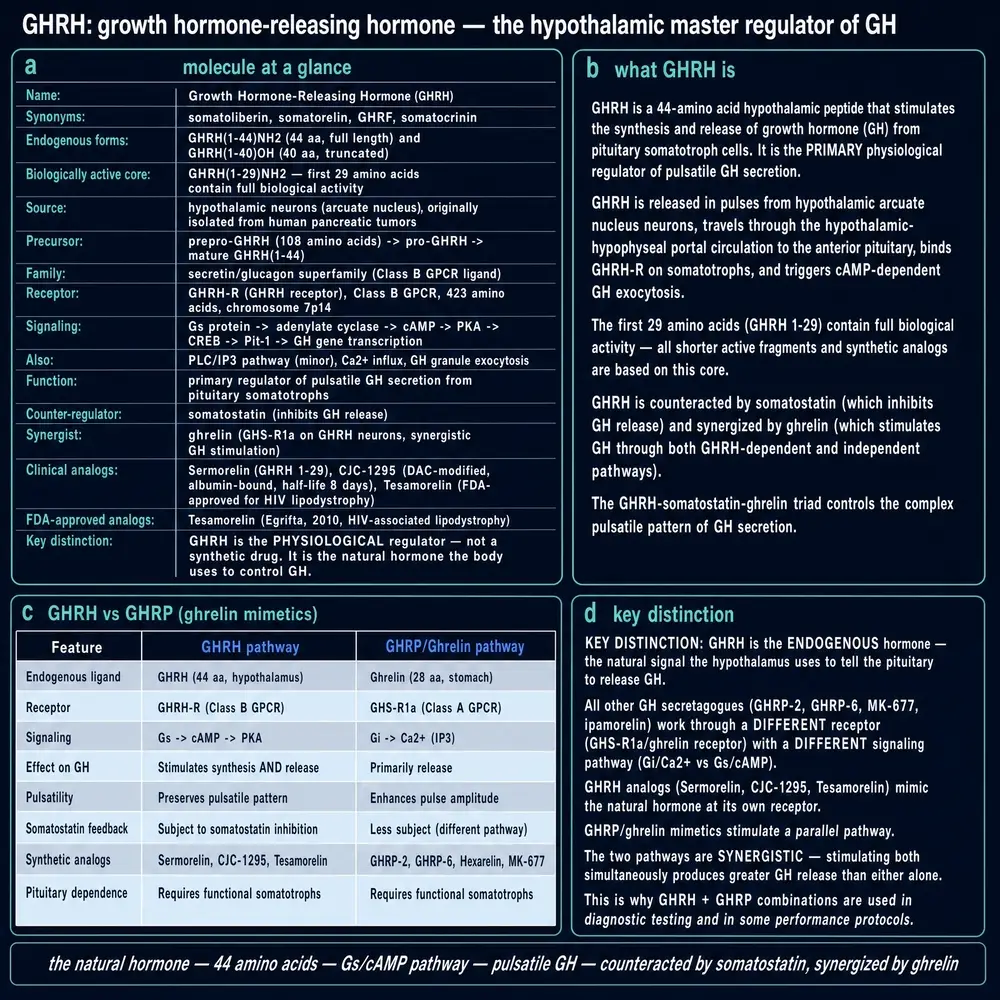
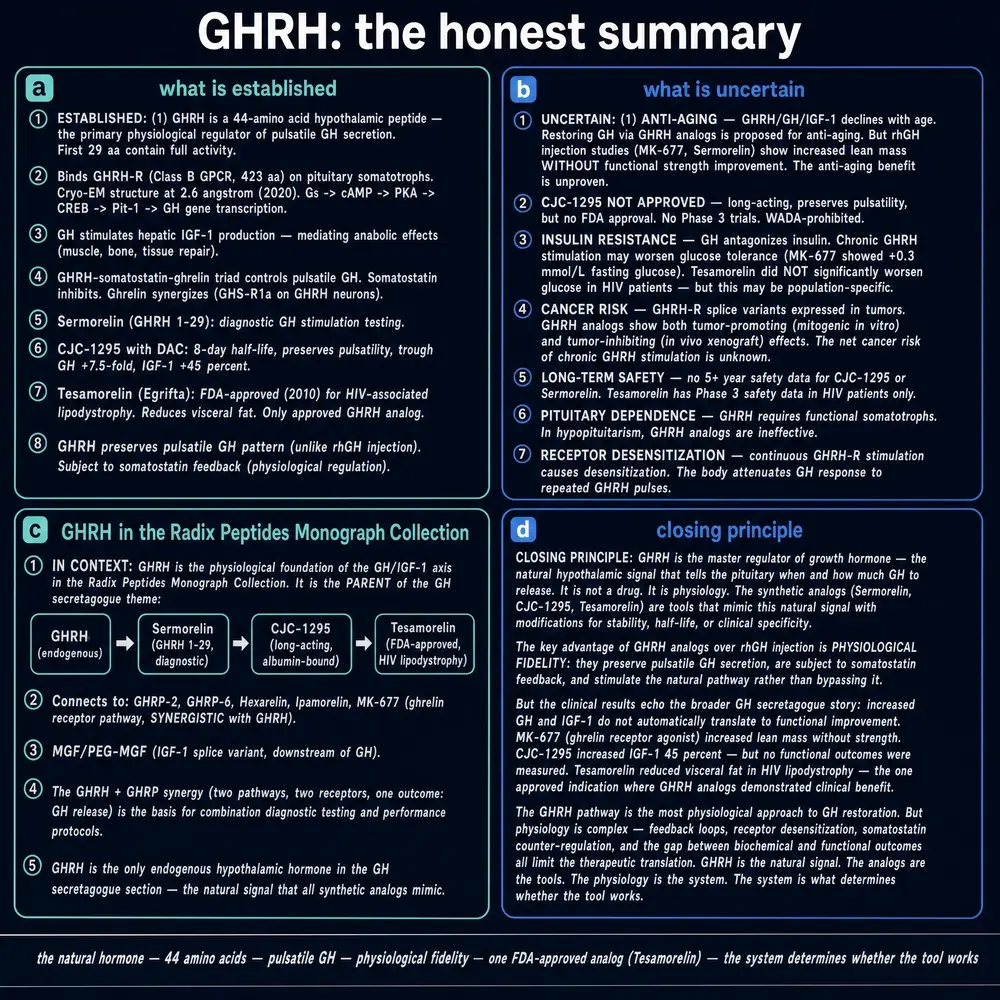
What the chemists soon learned, and what the sermorelin monograph in this series treats in detail, is that the first twenty-nine residues — amidated — retain essentially full potency. The parent hormone is longer than it needs to be for receptor activation. That fact does not make the C-terminus decorative in physiology; it does mean that drug designers could later throw much of the chain away.
Section 04Proof it drove the pulses
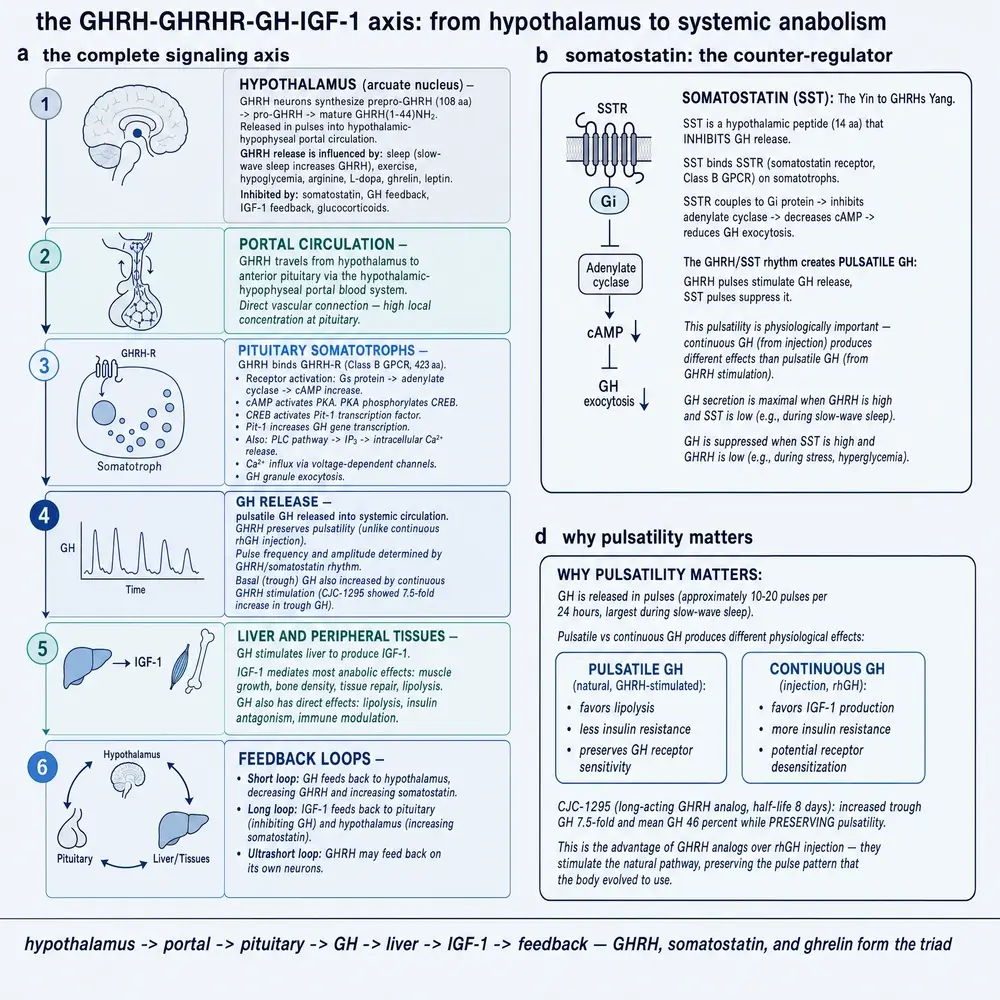
Isolation is not physiology. The decisive experiments asked whether GHRH is required for the rhythmic secretion of growth hormone that actually occurs in life. Monoclonal antibodies against the hypothalamic factor, and immunoneutralisation in vivo, suppressed pulsatile growth-hormone secretion (Luben et al., 1982; Wehrenberg et al., 1982). The rhythm collapsed when the peptide was blocked. That is the experiment that establishes GHRH as the physiological driver of growth-hormone pulses, with somatostatin supplying the intermittent brake.
Once that proof was in hand, the scientific question shifted. The molecule existed. It worked. The remaining problem — and the problem that would define the next forty years — was whether a peptide the body clears in minutes could ever be turned into a medicine.
Section 05Primary structure
Human GHRH is a linear peptide of forty-four amino acids with an amidated carboxyl terminus. There are no disulphide bonds to hold a rigid knot; the chain is flexible in solution and becomes ordered when it meets its receptor. The amino-terminal region carries the residues required to activate the receptor. The carboxyl-terminal region contributes binding affinity and is dispensable for intrinsic activity once truncation and amidation are done correctly — the observation that created sermorelin (Barron / Coy / Millar lineage; see also the Sermorelin monograph already filed in this series).
Tyr1–Ala2 is the vulnerable bond. Dipeptidyl peptidase-4 cleaves there and leaves an inactive truncated chain. That single fact is why every later analogue in the family either shortens the peptide, caps the amino terminus, or both. The molecule’s length and its fragility are not contradictions: the extra residues buy affinity and history; the first two decide whether the signal survives long enough to matter outside the portal vein.
Section 06The receptor and the cascade
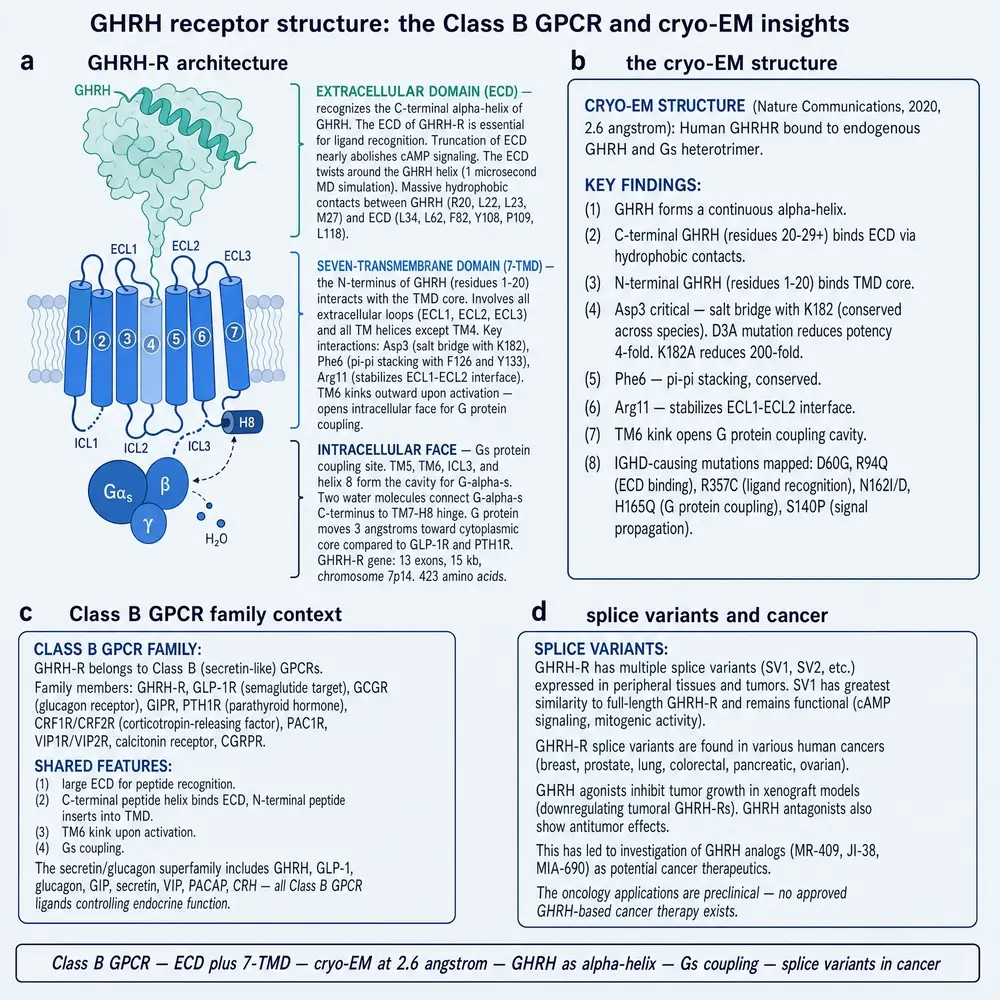
GHRH binds a Class B1 G-protein-coupled receptor on pituitary somatotrophs. The receptor’s extracellular domain helps capture the peptide; the amino-terminal segment of GHRH engages the transmembrane bundle and flips the receptor into an active conformation. The G protein Gs exchanges GDP for GTP, adenylyl cyclase makes cyclic AMP, protein kinase A phosphorylates targets including CREB, and growth-hormone gene transcription rises. In parallel, calcium-dependent exocytosis empties secretory granules. The hormone therefore stimulates both synthesis and release — not merely dumping a stored pool (reviews summarised in PMC13316082; PMC3218714).
A GHRH-pathway agonist therefore enters one step upstream of growth hormone itself. Pituitary reserve, somatostatin tone and IGF-1 feedback remain in the circuit. That is an advantage for physiological patterning and a ceiling no dose of releasing hormone can override.
Section 07Pulsatility is the point
In life, GHRH is not a continuous drip. The hypothalamus releases it in bursts into the hypophyseal portal circulation; somatostatin interrupts; growth hormone in peripheral blood rises and falls in discrete pulses, especially in deep sleep. Exogenous recombinant growth hormone, by contrast, produces a flatter exposure profile when given as a subcutaneous depot of the mature hormone. Reviews of the GHRH-analogue literature lean hard on this distinction when explaining why a secretagogue and a replacement hormone are not interchangeable tools (PMC3218714; PMC13322892). The axis plate in Part One carries the schematic contrast; the point for native GHRH is simpler still: minutes of peptide, hours of patterned hormone, if the pituitary can answer.
Structural work on the receptor makes that circuit concrete. The Class B architecture explains how a flexible forty-four-residue ligand can both dock and activate; the cryo-EM contact map explains why truncations and N-terminal chemistry matter so much for analogues. The plate that follows is the visual summary of that receptor chemistry — not a substitute for the physiology already stated.
Section 08Minutes of hormone
Native GHRH does not survive long in blood. Dipeptidyl peptidase-4 (DPP-4) cleaves the Tyr1–Ala2 bond, releasing the dipeptide Tyr-Ala and leaving GHRH(3–44). Because the activating chemistry lives at the amino terminus, that truncation is not a shortening — it is a switch to off. Secondary sources reviewing tesamorelin’s design state the native liability plainly: the hydrophobic N-terminal cap was added specifically to block this hydrolysis (PMC3218714).
Published half-lives for unmodified GHRH are measured in minutes and vary by species, route and assay; they are not interchangeable numbers. What they agree on is the practical conclusion: a peptide cleared that fast is an excellent local portal signal and a stubborn systemic drug.
Section 09The diagnostic probe
The best-supported clinical role for native GHRH is not as a chronic therapy. It is as a probe. Because the peptide acts at the pituitary receptor, a growth-hormone response to administered GHRH localises residual somatotroph function, while failure to respond points toward a pituitary rather than a purely hypothalamic lesion. Variants of the test combine GHRH with arginine or other agents to improve diagnostic performance. That literature is large, older, and mostly about using the hormone as a tool rather than as a drug — exactly the A12 “tool-use” case this series is careful not to discard.
The same logic explains why GHRH testing appears throughout the HIV lipodystrophy and adult growth-hormone-deficiency literatures: blunted responses helped define who had a functional deficit worth studying (summarised in PMC3218714).
Section 10Animal physiology
The first in-vivo demonstrations were straightforward and decisive. Wehrenberg and colleagues showed that somatocrinin stimulated growth-hormone secretion in anaesthetised rats (Wehrenberg et al., 1982). Across the following decade, animal work mapped dose–response relationships, interactions with somatostatin, and species differences in sequence and potency. A substantial secondary literature also used GHRH and its fragments in livestock production science; those papers are real, and they are not clinical evidence. This monograph treats them as animal-production results when they appear.
Later branches of the animal literature — especially Andrew Schally’s long programme of GHRH agonists and antagonists — moved beyond the pituitary into tumour biology and tissue repair. Those molecules are chemical relatives, not native GHRH, and their results are weighed separately in Part Five.
Section 11Human acute and short-term studies
Once synthetic material was available, human experiments followed quickly. Intravenous boluses and infusions of unmodified GHRH raise growth hormone in healthy subjects and in many patients with hypothalamic deficiency who still have responsive somatotrophs. Subcutaneous administration also works, but the pharmacokinetic problem remains: the signal is brief. Reviews of the early clinical experience repeatedly note robust acute endocrine effects and limited enthusiasm for chronic outpatient use of the unmodified peptide.
Paediatric growth studies with GHRH and with the amidated 1–29 fragment showed that some growth hormone-deficient children can accelerate height velocity when the pituitary can still answer. Those programmes largely lost the commercial contest to recombinant growth hormone, which arrived in the mid-1980s after pituitary-derived hormone was withdrawn over Creutzfeldt–Jakob risk. The ceiling argument mattered: a secretagogue cannot outrun pituitary reserve; recombinant growth hormone can be dosed past it. That is a pharmacological observation, not a recommendation.
Several widely cited “GHRH” or “sermorelin” ageing and body-composition trials administered [Nle27]GHRH(1–29)NH2 or other substituted analogues, not native GHRH(1–44) and not unmodified sermorelin. PubMed supplementary concepts sometimes index them under neighbouring names. Where this document discusses ageing probes, it prefers studies that clearly used the native hormone or states the substitution when the record is ambiguous. Efficacy is never pooled across those identities.
Section 12The near-miss as a drug
One of the most instructive human experiments with unmodified GHRH sits immediately upstream of tesamorelin. In a randomised study summarised in the tesamorelin secondary literature, adults with HIV-associated fat redistribution received GHRH 1 mg subcutaneously twice daily for twelve weeks. IGF-1 rose substantially (+104 versus +6 ng/mL, P=0.004) and lean body mass increased (+0.9 versus −0.3 kg, P=0.04). Visceral adipose tissue moved in the expected direction but did not reach significance (−19.2 versus +2.3 cm2, P=0.07) (summarised in PMC3218714, citing its reference 78). Those quantities are study parameters, not instructions.
Read carefully, the trial is almost a prospectus for an analogue. The axis answered. Body composition began to move. The dosing schedule required to keep an unmodified peptide in play was already cumbersome, and the visceral-fat endpoint was not yet won. Theratechnologies’ subsequent programme did not abandon the receptor; it protected the ligand.
Section 13Immunogenicity and practical limits
Chronic administration of GHRH fragments can elicit antibodies. In paediatric work with GHRH(1–29), anti-GHRH antibodies were common in some series yet often without obvious neutralisation of growth — a finding the sermorelin literature treats as both reassurance and warning (Ross et al. lineage; Petersen / Mowles immunological studies). For the full-length hormone, more of the antigenic surface remains. None of this made native GHRH easy to develop as a daily outpatient product.
The practical limits stack. Minutes of half-life. A pituitary ceiling. Injection burden if continuous exposure is attempted. Antibody formation under repeated exposure. Competition from recombinant growth hormone on one side and, later, from engineered GHRH analogues on the other. The unmodified hormone kept winning physiology exams and failing product exams.
Section 14Why analogues exist
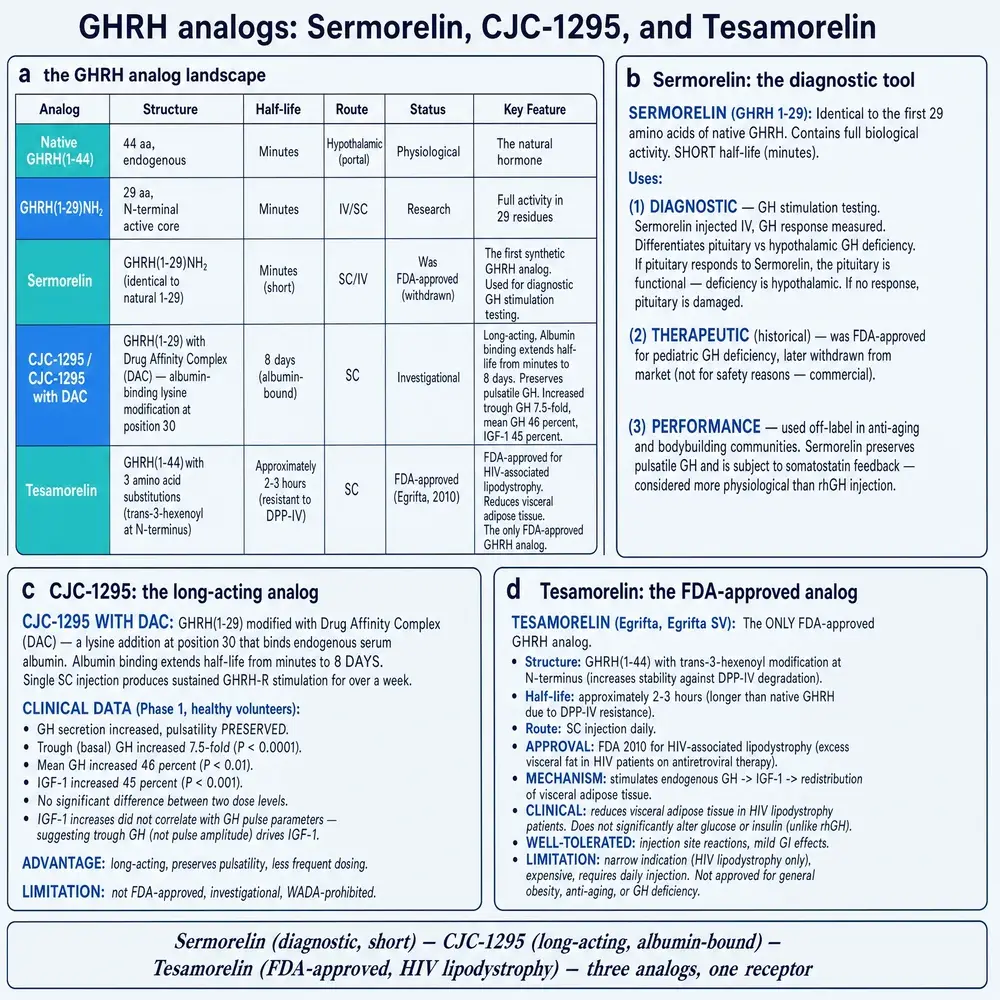
If native GHRH is the question, the analogues are a set of answers that do not cancel one another.
Sermorelin (GHRH(1–29)NH2) answered the structure–activity question: twenty-nine amidated residues are enough. It proved that you do not need the whole hormone. It did not solve DPP-4 clearance, and it was discontinued as a commercial product for reasons the FDA later recorded as unrelated to safety or effectiveness. Its story is the Sermorelin monograph already filed in this series.
Tesamorelin answered the clearance question without abandoning the full chain: a trans-3-hexenoyl cap on Tyr1 blocks DPP-4. It is the only GHRH-pathway agent with regulatory-grade randomised evidence for an approved indication — reduction of excess abdominal fat in HIV-associated lipodystrophy — and with an expanding secondary literature in liver fat, muscle quality and cognition (Falutz et al., 2007, 2010; Stanley et al., 2014, 2019; Baker et al., 2012). Those results belong to tesamorelin. They demonstrate what a stabilised parent scaffold can do; they do not show what unmodified GHRH does under the same protocols. See the Tesamorelin monograph already filed in this series.
CJC-1295 answered a different engineering brief: substitute positions on the 1–29 scaffold and, in the DAC form, hang the peptide on albumin for multi-day residence. Its human evidence base is thinner and must not be read back onto the native hormone. See the CJC-1295 monograph already filed in this series.
Ghrelin-receptor secretagogues (GHRP-2, GHRP-6, hexarelin, ibutamoren/MK-677 and related agents) raise growth hormone through a different receptor entirely. They appear in the neighbourhood of every GHRH literature search and are excluded from this compound’s claims.
Taken together, the three principal GHRH-pathway medicines and the neighbouring GHS-R agents form a map rather than a single product line. Native parent, active core, sermorelin, CJC-1295 with DAC, and tesamorelin remain separate identities; numbers printed beside the analogues later in this part remain sibling evidence and are not re-attributed to unmodified GHRH.
Section 15Schally’s other branch
Andrew Schally shared the 1977 Nobel for the releasing-factor era. In the decades after GHRH was sequenced, his laboratories pursued a programme that looks, at first glance, like the opposite of a secretagogue drug: antagonists of the GHRH receptor aimed at cancers that express the receptor and use the pathway for their own growth, alongside synthetic agonists explored in metabolic and tissue contexts (e.g. Muñoz-Moreno et al., 2024, PMID 39456984, and the broader Schally series in the screened PubMed set).
That branch matters for two reasons. First, it shows that GHRH receptor biology did not end at the pituitary — tumours and peripheral tissues express the receptor and can respond in animals and in vitro. Second, it is a reminder that “GHRH” in a modern title may denote a heavily modified analogue built for oncology, not the hypothalamic hormone of 1982. This monograph cites that programme as context and does not treat antagonist or designer-agonist results as native-hormone outcomes.
The landscape plate that closes this part therefore has a double job: keep the secretagogue analogues distinct from one another, and keep the oncology branch off the native-hormone claim set.
Section 16Extra-pituitary receptors
GHRH receptors are not confined to somatotrophs. Expression has been reported in brain regions including cortex and hippocampus, in heart and vessels, and in a range of tumours (secondary sources in PMC13316082; Schally programme primary papers in the screened set). Expression is not the same thing as a validated human therapeutic pathway. Animal and cell studies can show signalling, anti-apoptotic effects, or metabolic shifts without establishing that native systemic GHRH would reproduce those effects in people — especially given how little intact peptide survives in blood.
One mechanistic curiosity from the analogue literature is worth stating carefully because it is easy to misread. In mice, a GHRH agonist reduced amyloid-related pathology without altering systemic growth hormone and IGF-1 in the cited experiment (discussed in PMC13316082). That is an animal result with a non-native ligand. It suggests receptor biology outside the classic axis; it does not license claims about unmodified human GHRH as a cognitive medicine.
Section 17Contemporary signals, weighed
The freshest randomised human evidence on the GHRH pathway is almost entirely tesamorelin evidence: visceral fat, hepatic fat fraction, transcriptomic shifts in liver, trunk-muscle density, and mixed cognitive findings (Falutz et al., 2007, 2010; Stanley et al., 2014, 2019; Fourman et al., 2020; Baker et al., 2012; Stewart et al., 2026). Recency favours those papers; identity forbids folding them into native GHRH. They are cited here as the present tense of the pathway, not the present tense of the unmodified hormone.
For native GHRH itself, the contemporary literature is thinner and more scattered: analytical chemistry, doping control (GHRH and analogues appear on the WADA prohibited list), case physiology, and continued use of GHRH as a stimulation-test reagent. A 2026 tiered assessment of GH–IGF-1 axis performance peptides placed tesamorelin alone in its top evidence tier and warned against extrapolating that dataset to athletic or hypertrophy claims (PMC13322892). The same logic applies a fortiori to the parent peptide with no comparable chronic RCT programme.
Section 18Closing
Growth-hormone-releasing hormone is one of the cleanest detective stories in modern endocrinology. A Nobel-era programme that had already delivered three major hypothalamic peptides spent fifteen more years failing to catch the fourth, partly because the assay kept handing it the brake. Patients with pancreatic tumours then manufactured the missing accelerator in gram-scale excess, and two laboratories sequenced it within weeks in 1982. Antibody blockade proved the pulses depended on it. Hypothalamic isolation followed. The map was complete.
What followed was not a triumph of drug development for the native peptide. Blood destroys GHRH at the same end that activates the receptor. Minutes are enough for portal physiology and not enough for convenient systemic therapy. The analogues that inherited the scaffold — shortened, acylated, or albumin-hooked — are the practical replies to that sentence. The parent remains what it always was: the hormone that taught the axis how it works, the reagent that still asks the pituitary whether it can answer, and a poor candidate for anyone who confuses a powerful biological signal with a finished medicine.
The useful way to hold the evidence is therefore modest and specific. Native GHRH works, briefly and impressively, on a receptor that still matters. The preponderance of chronic human outcome data on this pathway belongs to molecules that are not native GHRH. Fresh papers update the pathway; they do not rewrite the parent’s pharmacokinetics. That is not a failure of the discovery. It is the discovery’s most durable lesson.
This document describes published research. It does not recommend human use of GHRH, somatorelin, somatocrinin, or of any other compound named in it, and it specifies no dose, route or schedule for any person. Every quantity reported above is a parameter of a published study, stated with the species, the number of subjects and the duration attached when those were available, and is given for the purpose of describing what was done and what was found.
Material obtained outside an approved supply chain has not been reviewed by any regulator for identity, purity, potency or stability. Native GHRH is rapidly degraded by dipeptidyl peptidase-4 and is not interchangeable with sermorelin, tesamorelin, CJC-1295, or ghrelin-receptor secretagogues.
Section 19References
Generated from verified NCBI records rather than from recall. Author lists, journal names, volumes, pages and identifiers were re-fetched from PubMed for every entry below. The build refuses to run if any identifier fails to resolve.
- Adrian S, Scherzinger A, Sanyal A, Lake JE, Falutz J, Dubé MP, et al.. The Growth Hormone Releasing Hormone Analogue, Tesamorelin, Decreases Muscle Fat and Increases Muscle Area in Adults with HIV. J Frailty Aging. 2019;8(3):154-159.
PMID 31237318 · doi:10.14283/jfa.2018.45 · PMC6766405 - Baker LD, Barsness SM, Borson S, Merriam GR, Friedman SD, Craft S, et al.. Effects of growth hormone–releasing hormone on cognitive function in adults with mild cognitive impairment and healthy older adults: results of a controlled trial. Arch Neurol. 2012;69(11):1420-9.
PMID 22869065 · doi:10.1001/archneurol.2012.1970 · PMC3764914 - Bodart G, Farhat K, Charlet-Renard C, Salvatori R, Geenen V, Martens H. The Somatotrope Growth Hormone-Releasing Hormone/Growth Hormone/Insulin-Like Growth Factor-1 Axis in Immunoregulation and Immunosenescence. Front Horm Res. 2017;48:147-159.
PMID 28245459 · doi:10.1159/000452913 - Brazeau P, Ling N, Böhlen P, Esch F, Ying SY, Guillemin R. Growth hormone releasing factor, somatocrinin, releases pituitary growth hormone in vitro. Proc Natl Acad Sci U S A. 1982;79(24):7909-13.
PMID 6130528 · doi:10.1073/pnas.79.24.7909 · PMC347459 - Brazeau P, Böhlen P, Esch F, Ling N, Wehrenberg WB, Guillemin R. Growth hormone-releasing factor from ovine and caprine hypothalamus: isolation, sequence analysis and total synthesis. Biochem Biophys Res Commun. 1984;125(2):606-14.
PMID 6440561 · doi:10.1016/0006-291x(84)90582-5 - Bromek E, Rysz M, Haduch A, Daniel WA. Serotonin Receptors of 5-HT2 Type in the Hypothalamic Arcuate Nuclei Positively Regulate Liver Cytochrome P450 via Stimulation of the Growth Hormone-Releasing Hormone/Growth Hormone Hormonal Pathway. Drug Metab Dispos. 2019;47(2):80-85.
PMID 30518657 · doi:10.1124/dmd.118.083808 - Böhlen P, Esch F, Brazeau P, Ling N, Guillemin R. Isolation and characterization of the porcine hypothalamic growth hormone releasing factor. Biochem Biophys Res Commun. 1983;116(2):726-34.
PMID 6418166 · doi:10.1016/0006-291x(83)90585-5 - Böhlen P, Wehrenberg WB, Esch F, Ling N, Brazeau P, Guillemin R. Rat hypothalamic growth hormone-releasing factor: isolation, sequence analysis and total synthesis. Biochem Biophys Res Commun. 1984;125(3):1005-12.
PMID 6440563 · doi:10.1016/0006-291x(84)91383-4 - Chisholm TS, Clayton D, Dowman LJ, Sayers J, Payne RJ. Native Chemical Ligation-Photodesulfurization in Flow. J Am Chem Soc. 2018;140(29):9020-9024.
PMID 29792427 · doi:10.1021/jacs.8b03115 - Cristea CD, Radu M, Toboc A, Stan C, David V. Cationic exchange SPE combined with triple quadrupole UHPLC-MS/MS for detection of GHRHs in urine samples. Anal Biochem. 2023;682:115336.
PMID 37806509 · doi:10.1016/j.ab.2023.115336 - Ericsson M, Bhuiyan H, Yousif B, Lehtihet M, Ekström L. The intra-individual stability of GH biomarkers IGF-I and P-III-NP in relation to GHRH administration, menstrual cycle, and hematological parameters. Drug Test Anal. 2020;12(11-12):1620-1628.
PMID 33125822 · doi:10.1002/dta.2953 - Erlandson KM, Gustafson L, Johnson JE, Kulik GL, Khuu V, Chahal N, et al.. Tesamorelin as an Adjunct to Exercise for Improving Physical Function in HIV (TRIUMPH): a clinical trial protocol. BMJ Open. 2026;16(7):e120740.
PMID 42419889 · doi:10.1136/bmjopen-2026-120740 · PMC13347827 - Esch F, Böhlen P, Ling N, Brazeau P, Guillemin R. Isolation and characterization of the bovine hypothalamic growth hormone releasing factor. Biochem Biophys Res Commun. 1983;117(3):772-9.
PMID 6421287 · doi:10.1016/0006-291x(83)91664-9 - Falutz J, Allas S, Blot K, Potvin D, Kotler D, Somero M, et al.. Metabolic effects of a growth hormone-releasing factor in patients with HIV. N Engl J Med. 2007;357(23):2359-70.
PMID 18057338 · doi:10.1056/NEJMoa072375 - Falutz J, Mamputu JC, Potvin D, Moyle G, Soulban G, Loughrey H, et al.. Effects of tesamorelin (TH9507), a growth hormone-releasing factor analog, in human immunodeficiency virus-infected patients with excess abdominal fat: a pooled analysis of two multicenter, double-blind placebo-controlled phase 3 trials with safety extension data. J Clin Endocrinol Metab. 2010;95(9):4291-304.
PMID 20554713 · doi:10.1210/jc.2010-0490 - Falutz J, Potvin D, Mamputu JC, Assaad H, Zoltowska M, Michaud SE, et al.. Effects of tesamorelin, a growth hormone-releasing factor, in HIV-infected patients with abdominal fat accumulation: a randomized placebo-controlled trial with a safety extension. J Acquir Immune Defic Syndr. 2010;53(3):311-22.
PMID 20101189 · doi:10.1097/QAI.0b013e3181cbdaff - Fourman LT, Billingsley JM, Agyapong G, Ho Sui SJ, Feldpausch MN, Purdy J, et al.. Effects of tesamorelin on hepatic transcriptomic signatures in HIV-associated NAFLD. JCI Insight. 2020;5(16).
PMID 32701508 · doi:10.1172/jci.insight.140134 · PMC7455119 - Gesmundo I, Miragoli M, Carullo P, Trovato L, Larcher V, Di Pasquale E, et al.. Growth hormone-releasing hormone attenuates cardiac hypertrophy and improves heart function in pressure overload-induced heart failure. Proc Natl Acad Sci U S A. 2017;114(45):12033-12038.
PMID 29078377 · doi:10.1073/pnas.1712612114 · PMC5692579 - Gonigam RL, Weis KE, Ge X, Yao B, Zhang Q, Raetzman LT. Characterization of Somatotrope Cell Expansion in Response to GHRH in the Neonatal Mouse Pituitary. Endocrinology. 2023;164(10).
PMID 37616545 · doi:10.1210/endocr/bqad131 · PMC11009787 - Guillemin R, Brazeau P, Böhlen P, Esch F, Ling N, Wehrenberg WB. Growth hormone-releasing factor from a human pancreatic tumor that caused acromegaly. Science. 1982;218(4572):585-7.
PMID 6812220 · doi:10.1126/science.6812220 - Gusmao DO, de Sousa ME, Tavares MR, Donato J. Increased GH Secretion and Body Growth in Mice Carrying Ablation of IGF-1 Receptor in GH-releasing Hormone Cells. Endocrinology. 2022;163(11).
PMID 36099517 · doi:10.1210/endocr/bqac151 - Halmos G, Szabo Z, Juhasz E, Schally AV. Signaling mechanism of growth hormone-releasing hormone receptor. Vitam Horm. 2023;123:1-26.
PMID 37717982 · doi:10.1016/bs.vh.2023.06.004 - Halmos G, Szabo Z, Dobos N, Juhasz E, Schally AV. Growth hormone-releasing hormone receptor (GHRH-R) and its signaling. Rev Endocr Metab Disord. 2025;26(3):343-352.
PMID 39934495 · doi:10.1007/s11154-025-09952-x · PMC12137518 - Kanashiro-Takeuchi RM, Takeuchi LM, Dulce RA, Kazmierczak K, Balkan W, Cai R, et al.. Efficacy of a growth hormone-releasing hormone agonist in a murine model of cardiometabolic heart failure with preserved ejection fraction. Am J Physiol Heart Circ Physiol. 2023;324(6):H739-H750.
PMID 36897749 · doi:10.1152/ajpheart.00601.2022 · PMC10151038 - Kharat A, Chandravanshi B, Gadre S, Patil V, Bhonde R, Dubhashi A. IGF-1 and somatocrinin trigger islet differentiation in human amniotic membrane derived mesenchymal stem cells. Life Sci. 2019;216:287-294.
PMID 30444986 · doi:10.1016/j.lfs.2018.11.028 - Luben RA, Brazeau P, Böhlen P, Guillemin R. Monoclonal antibodies to hypothalamic growth hormone-releasing factor with picomoles of antigen. Science. 1982;218(4575):887-9.
PMID 6813967 · doi:10.1126/science.6813967 - Makimura H, Feldpausch MN, Rope AM, Hemphill LC, Torriani M, Lee H, et al.. Metabolic effects of a growth hormone-releasing factor in obese subjects with reduced growth hormone secretion: a randomized controlled trial. J Clin Endocrinol Metab. 2012;97(12):4769-79.
PMID 23015655 · doi:10.1210/jc.2012-2794 · PMC3513535 - Martínez-Moreno CG, López-Marín LM, Carranza M, Giterman D, Harvey S, Arámburo C, et al.. Growth hormone (GH) and GH-releasing hormone (GHRH): Co-localization and action in the chicken testis. Gen Comp Endocrinol. 2014;199:38-45.
PMID 24508498 · doi:10.1016/j.ygcen.2014.01.013 - Muñoz-Moreno L, Gómez-Calcerrada MI, Arenas MI, Carmena MJ, Prieto JC, Schally AV, et al.. Antagonist of Growth Hormone-Releasing Hormone Receptor MIA-690 Suppresses the Growth of Androgen-Independent Prostate Cancers. Int J Mol Sci. 2024;25(20).
PMID 39456984 · doi:10.3390/ijms252011200 · PMC11508372 - Okano M, Nishitani Y, Sato M, Kageyama S. Effectiveness of GH isoform differential immunoassay for detecting rhGH doping on application of various growth factors. Drug Test Anal. 2012;4(9):692-700.
PMID 22733714 · doi:10.1002/dta.1385 - Osterstock G, Mitutsova V, Barre A, Granier M, Fontanaud P, Chazalon M, et al.. Somatostatin triggers rhythmic electrical firing in hypothalamic GHRH neurons. Sci Rep. 2016;6:24394.
PMID 27072430 · doi:10.1038/srep24394 · PMC4829871 - Proudan N, Peroski M, Grignol G, Merchenthaler I, Dudas B. Juxtapositions between the somatostatinergic and growth hormone-releasing hormone (GHRH) neurons in the human hypothalamus. Neuroscience. 2015;297:205-10.
PMID 25839148 · doi:10.1016/j.neuroscience.2015.03.054 - Rivier J, Spiess J, Thorner M, Vale W. Characterization of a growth hormone-releasing factor from a human pancreatic islet tumour. Nature. 1982;300(5889):276-8.
PMID 6292724 · doi:10.1038/300276a0 - Spiess J, Rivier J, Thorner M, Vale W. Sequence analysis of a growth hormone releasing factor from a human pancreatic islet tumor. Biochemistry. 1982;21(24):6037-40.
PMID 6295453 · doi:10.1021/bi00267a002 - Stanley TL, Feldpausch MN, Oh J, Branch KL, Lee H, Torriani M, et al.. Effect of tesamorelin on visceral fat and liver fat in HIV-infected patients with abdominal fat accumulation: a randomized clinical trial. JAMA. 2014;312(4):380-9.
PMID 25038357 · doi:10.1001/jama.2014.8334 · PMC4363137 - Stanley TL, Fourman LT, Feldpausch MN, Purdy J, Zheng I, Pan CS, et al.. Effects of tesamorelin on non-alcoholic fatty liver disease in HIV: a randomised, double-blind, multicentre trial. Lancet HIV. 2019;6(12):e821-e830.
PMID 31611038 · doi:10.1016/S2352-3018(19)30338-8 · PMC6981288 - Steenblock C, Bornstein SR. GHRH in diabetes and metabolism. Rev Endocr Metab Disord. 2025;26(3):413-426.
PMID 39560873 · doi:10.1007/s11154-024-09930-9 · PMC12137473 - Stewart CE, French KP, Wright TJ, Wilhoit K, Randolph KM, Danesi CP, et al.. The effect of growth hormone-releasing hormone on cognition and brain connectivity in adults with cognition ranging from normal to mild cognitive impairment. eNeurologicalSci. 2026;44:100616.
PMID 42382101 · doi:10.1016/j.ensci.2026.100616 · PMC13316082 - Szabo Z, Juhasz E, Schally AV, Dezso B, Huga S, Hernadi Z, et al.. Expression of Growth Hormone-Releasing Hormone and Its Receptor Splice Variants in Primary Human Endometrial Carcinomas: Novel Therapeutic Approaches. Molecules. 2022;27(9).
PMID 35566020 · doi:10.3390/molecules27092671 · PMC9101386 - Tam JK, Chow BK, Lee LT. Structural and functional divergence of growth hormone-releasing hormone receptors in early sarcopterygians: lungfish and Xenopus. PLoS One. 2013;8(1):e53482.
PMID 23308232 · doi:10.1371/journal.pone.0053482 · PMC3537680 - Wehrenberg WB, Ling N, Brazeau P, Esch F, Böhlen P, Baird A, et al.. Somatocrinin, growth hormone releasing factor, stimulates secretion of growth hormone in anesthetized rats. Biochem Biophys Res Commun. 1982;109(2):382-7.
PMID 6817757 · doi:10.1016/0006-291x(82)91732-6 - Wehrenberg WB, Brazeau P, Luben R, Böhlen P, Guillemin R. Inhibition of the pulsatile secretion of growth hormone by monoclonal antibodies to the hypothalamic growth hormone releasing factor (GRF). Endocrinology. 1982;111(6):2147-8.
PMID 6128220 · doi:10.1210/endo-111-6-2147 - Xie TY, Ngo ST, Veldhuis JD, Jeffery PL, Chopin LK, Tschöp M, et al.. Effect of Deletion of Ghrelin-O-Acyltransferase on the Pulsatile Release of Growth Hormone in Mice. J Neuroendocrinol. 2015;27(12):872-86.
PMID 26442444 · doi:10.1111/jne.12327
Sources without a PubMed record
Nobel notices, chemical registries and regulatory instruments are cited to the instrument itself (house style section 10, item 8).
- Nobel Assembly at the Karolinska Institutet. The Nobel Prize in Physiology or Medicine 1977: Roger Guillemin and Andrew V. Schally, for their discoveries concerning the peptide hormone production of the brain; and Rosalyn Yalow, for the development of radioimmunoassays of peptide hormones. Press release, October 1977.
- Guillemin R. Peptides in the brain: the new endocrinology of the neuron. Nobel Lecture, 8 December 1977. In: <i>Nobel Lectures, Physiology or Medicine 1971–1980</i>. World Scientific / Nobel Foundation.
- PubChem, National Center for Biotechnology Information. Somatorelin (growth hormone-releasing hormone). Compound summary. Accessed 5 August 2026.
- United States Food and Drug Administration. Drugs@FDA: NDA 022505, EGRIFTA (tesamorelin) for injection, Theratechnologies. Approval November 2010. Cited only as regulatory context for the acylated analogue of native GHRH — not as evidence about unmodified GHRH.
- World Anti-Doping Agency. The Prohibited List. Growth hormone releasing factors, including GHRH and its analogues, appear under peptide hormones and growth factors. Current list year as accessed 2026.
Section 20How this document was assembled
The evidence base was built against project 05, the Therapeutic Peptide Research Library, and against NCBI directly. A targeted sweep of the project document stores opened 11,429 files and returned 19 identity-gated assets. The reading corpus is 29 unique scientific full texts, roughly 230 printed-page equivalents, assembled from local stores and a PubMed Central harvest, keyed by identifier and counted once.
Identity gate — parent-side A22
Bare “GHRH” or “GRF” never confirms alone. Those tokens are the shared stem of the native hormone and of sermorelin, tesamorelin and CJC-1295. Admission requires somatorelin, somatocrinin, somatoliberin, explicit (1–44)/(1–40)/(1–37) notation, hpGRF, or full-length / endogenous / hypothalamic framing. Sibling-dominated documents are refused. In the library database the SQL prefilter proposed 33 passages and the matcher admitted 3, rejecting 90.9 per cent.
The external harvest
The MeSH descriptor for growth-hormone-releasing hormone returns 5,211 records — the native hormone and every analogue. That surface was counted. A scoped native-hormone query returned 8,306 records; 831 survived the identity screen on title and abstract; 7,475 were dropped. Open-access full text is sparse for the 1982–1985 discovery decade; those papers enter through verified PubMed records and claim-level cross-checks against audited sibling dossiers.
| Stage | What it does | Result |
|---|---|---|
| 01b | Targeted sweep of project document stores | 11,429 files opened |
| 01b | Identity-gated local matches | 19 assets |
| 01c | Library database, matcher-gated | 90.9% rejected |
| 02 | PubMed harvest, partitioned by date | 8,306 → 831 screened |
| 03 | Open-access full-text retrieval | 18 retrieved |
| 03c | Substantive-use screen (A12) | 8 retained |
| 04 | Keyed union of local and fetched sets | 29 unique |
| 05 | Reference generation from verified NCBI records | 43 citations |
| 06 | Assembly of this document | 1 deliverable |
Counting notes. The merged corpus is keyed by identifier: 4 documents were present in both stores; a naive sum would have reported 262 pages against a true 230. Far-side classes include passing mentions and sibling-dominated papers that were counted and not treated as native-hormone evidence.
Section 21Evidence handling
Findings are labelled by the kind of study that produced them, in the sentence that reports them. Animal and in-vitro results are never phrased so as to imply a human outcome. Livestock and production-science papers are named as such.
Closely related molecules are not pooled. Native GHRH, sermorelin, substituted (1–29) analogues, tesamorelin, CJC-1295 and ghrelin-receptor secretagogues are separate compounds. Analogue randomised trials update the pathway map; they are not native-hormone efficacy.
Recency is weighted when it does not contradict the preponderance. For unmodified GHRH the preponderance still says: strong acute biology, useful as a probe, weak as a chronic drug because DPP-4 clears it in minutes.
Continue exploring