
CJC-1295 A growth-hormone-releasing peptide that solved its engineering problem, lost its clinical programme, and now sells in two forms only one of which was ever tested in people
Four substitutions and one reactive arm turned a peptide with a fifty-minute half-life into one that lasts a week, and the human trials confirmed it. Then a phase 2 study stopped, the programme ended — and what is sold today under the name CJC-1295 is usually not the molecule those trials studied.
01The woman whose pancreas made her grow
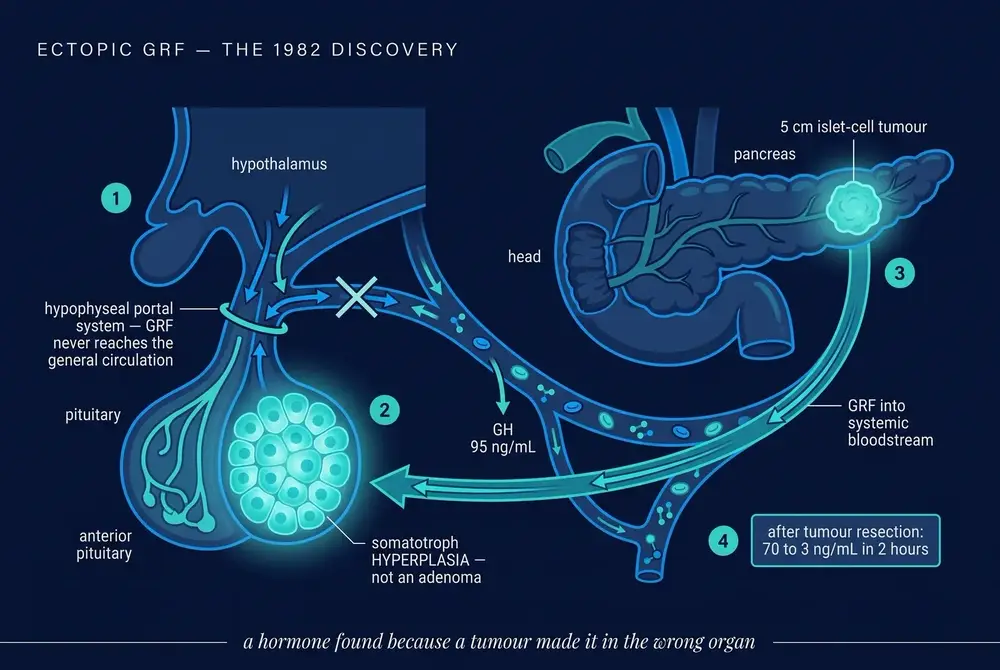
In 1982 a twenty-one-year-old woman with Turner's syndrome arrived at the University of Virginia with the coarsened features, enlarged hands and metabolic signature of acromegaly. Her growth hormone was roughly ninety-five nanograms per millilitre against a normal fasting value near one. Her somatomedin C was high. Her pituitary fossa was enlarged. Everything pointed at a pituitary tumour, which is what acromegaly almost always is, so surgeons went in through the sphenoid sinus and took tissue.
The pathology came back wrong. There was no discrete adenoma. There was somatotroph hyperplasia — not a tumour of growth-hormone cells but a whole population of normal growth-hormone cells that had been told, over and over, to multiply and secrete. Something was shouting at her pituitary from outside it. After surgery she was still acromegalic and her hormones were still high (Thorner et al., 1982).
So her physicians went looking for the source, and a computed-tomography scan found a five-centimetre mass in the tail of her pancreas. They removed it. Within two hours her serum growth hormone fell from seventy nanograms per millilitre to three, and it stayed down for the five months they followed her. Her somatomedin C normalised within six weeks. The paradoxical hormone responses that had confused her workup — growth hormone rising after glucose instead of falling, rising after thyrotropin-releasing hormone instead of holding steady — all disappeared. Medium that had held the tumour cells during surgery, and extracts of the tumour itself, contained a peptide that made pituitary cells release growth hormone.
This is why the compound in this monograph exists. Endocrinologists had been hunting the hypothalamic growth-hormone-releasing factor since the mid-1960s and failing, because the hypothalamus contains vanishingly little of it and releases it into a private portal circulation a few millimetres long. Roger Guillemin had already won a Nobel Prize for isolating other hypothalamic factors and had been beaten by this one for years. Then a handful of patients turned up whose tumours, sitting in the pancreas, were manufacturing the missing peptide in gram quantities and dumping it into the bloodstream. The disease supplied the reagent.
02Two laboratories, one sequence, and a new name
Two groups got there in the same year, and both were at the Salk Institute in La Jolla. Guillemin's laboratory worked on tumour material from one patient and published in Science in November 1982 a forty-four-residue peptide with the complete primary structure written out, together with a synthetic replicate that reproduced the biological activity in full (Guillemin et al., 1982). Wylie Vale's laboratory, with Jean Rivier and Joachim Spiess, worked on material from Thorner's patient and published in Nature and in Biochemistry in the same weeks (Rivier et al., 1982; Spiess et al., 1982). Spiess ran roughly one nanomole of peptide through a spinning-cup sequencer — an amount you cannot see — and established thirty-nine residues by Edman degradation.
The pharmacology paper is the one that conveys what they had found. In primary cultures of rat pituitary cells the tumour peptide released growth hormone with a median effective dose of fifteen picomolar. The effect appeared in thirty seconds or less in a perifusion system. It was specific: no other pituitary hormone moved. And somatostatin, the hypothalamus's brake on growth hormone, blocked it in classic non-competitive fashion. Guillemin's group proposed replacing the clumsy acronym GRF with a real name, somatocrinin (Brazeau et al., 1982). The name did not stick; the acronym did, and the field settled on growth-hormone-releasing hormone, GHRH.
Two loose ends closed quickly. Mayo and colleagues cloned the complementary DNA and showed that a single human gene encodes both the hypothalamic and the pancreatic-tumour peptide (Mayo et al., 1983). Then Ling and colleagues did the hard thing directly, extracting the peptide from human hypothalamic tissue and sequencing it: identical to the tumour peptide (Ling et al., 1984). The tumours had not been making a curiosity. They had been making the real hormone. The same laboratory had by then pulled the equivalent peptide out of five hundred bovine hypothalami (Esch et al., 1983), and the human sequence turned out to be 86 to 93 per cent identical to the porcine, bovine, caprine and ovine versions — a molecule conserved enough across mammals to suggest it had been doing the same job for a very long time.
03The first twenty-nine
Buried in the Spiess sequencing paper is the sentence that created an industry. Having established the structure, the group synthesised several versions and compared them: the full-length forty-residue acid, the forty-residue amide, and a truncated twenty-nine-residue amide. All three had equivalent activity on rat pituitary in vitro. The carboxy-terminal tail, more than a third of the molecule, contributed essentially nothing to potency (Spiess et al., 1982). A recent review states the same conclusion flatly: the first twenty-nine amino acids recapitulate full biological activity (Dieguez et al., 2025).
Every GHRH-derived drug since has been built on that fragment. Sermorelin is GHRH(1–29) unmodified. CJC-1295 is GHRH(1–29) with four substitutions and, in one of its forms, an extra arm. The compounds sold as "modified GRF (1–29)" are that same twenty-nine-residue scaffold. When you see the number 29 attached to a peptide in this class, you are looking at a decision made in 1982 on the basis of an in-vitro potency comparison.
Mechanically, the receptor those twenty-nine residues bind is a class B G-protein-coupled receptor, expressed most heavily outside the brain on pituitary somatotrophs. Occupancy raises cyclic AMP, activates protein kinase A and mitogen-activated protein kinase signalling, increases the pituitary transcription factor Pit-1, and thereby drives both the release of stored growth hormone and the transcription of more of it (Dieguez et al., 2025). This matters later: a GHRH agonist does not merely empty the somatotroph, it also tells the somatotroph to grow and refill. In Alba's knockout mice, CJC-1295 increased pituitary growth-hormone messenger RNA and expanded the somatotroph population outright (Alba et al., 2006).
04Fifty-two minutes
Within two years of the sequence being published, the peptide had been given to volunteers, to children with short stature, to acromegalic patients, to cattle, to chickens and to goldfish. It plainly worked. And it was plainly unusable as a drug, for a reason established with unusual precision in 1984.
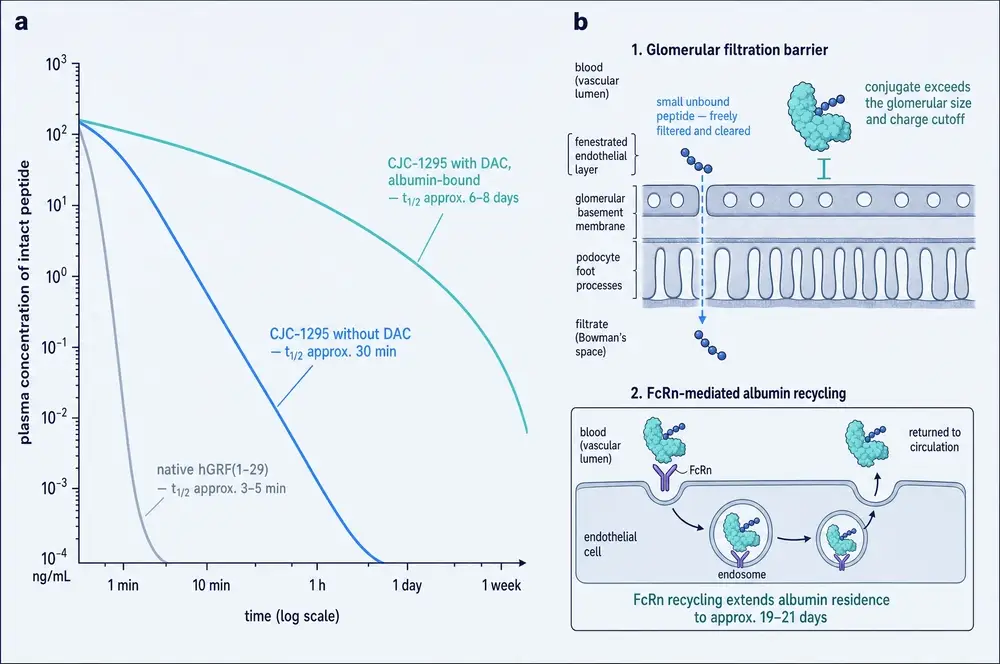
Frohman and colleagues measured the pharmacokinetics directly in healthy adult men, by both single injection and constant infusion (Frohman et al., 1984). The metabolic clearance rate was about 194–202 litres per square metre per day by either method. Plasma disappearance after a single injection resolved into a rapid equilibration phase of 7.6 ± 1.2 minutes and an elimination phase of 51.8 ± 5.4 minutes; after stopping an infusion the figure was 41.3 ± 3.0 minutes.
Call it an hour. A hormone that the body renews continuously can afford an hour. A drug that a patient injects cannot: sustaining any effect would demand either an implanted pump or injections through the night. Chemically the vulnerability was specific and well understood. Dipeptidyl peptidase-4, an enzyme abundant on endothelium and in plasma, clips two residues off the amino terminus of peptides with the right pattern at positions one and two, and GHRH(1–29) has exactly that pattern. Removing residues 1 and 2 destroys activity. The doping-control literature later confirmed the mechanism from the other direction: after subcutaneous administration of sermorelin in humans, what circulates is not sermorelin but its GRF(3–29) metabolite (Knoop et al., 2016).
05Four substitutions
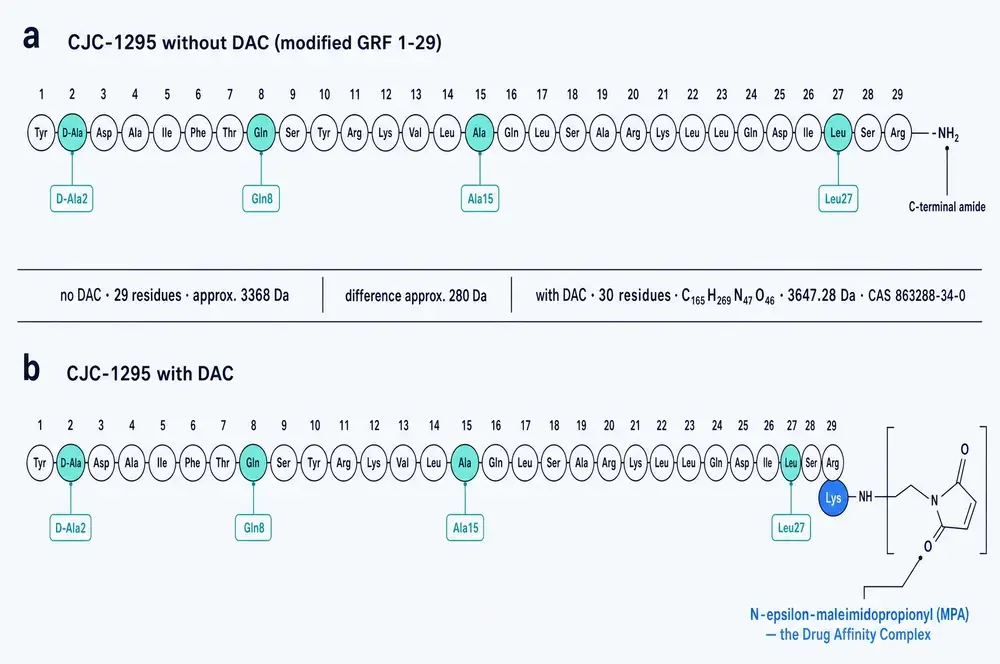
The first move was to make the peptide harder to destroy without making it harder to recognise. The analytical-chemistry literature, which needed exact identities in order to build reference standards, records the result plainly: CJC-1295 is [D-Ala², Gln⁸, Ala¹⁵, Leu²⁷]-GRF amide, and its sibling compound CJC-1293 is simply [D-Ala²]-GRF amide (Knoop et al., 2016; Thomas et al., 2022). Four positions changed out of twenty-nine.
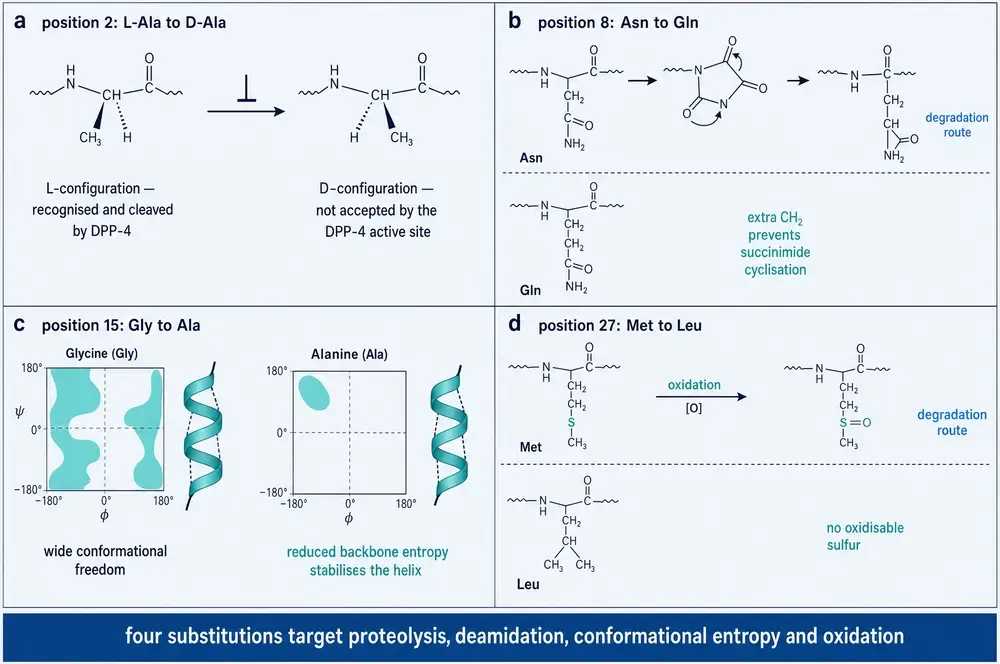
Only one of the four has a mechanism the corpus documents directly, and it is the important one. Substituting D-alanine for L-alanine at position two inverts the stereochemistry at exactly the bond dipeptidyl peptidase-4 cleaves, and the enzyme cannot process it. The evidence for this is not a chemist's argument but an observation in humans: after subcutaneous administration, sermorelin — which retains L-Ala² — is recovered from plasma as its GRF(3–29) cleavage product rather than as the parent, whereas CJC-1293 and CJC-1295, which carry D-Ala², are recovered intact and remain detectable to the last sampling point (Knoop et al., 2016). Substituting one residue removed the principal route of destruction.
The other three substitutions answer failure modes that have nothing to do with enzymes. Asparagine at position 8 is a deamidation site: its side-chain amide attacks the backbone to form a five-membered succinimide, which then opens to a mixture including an iso-aspartyl backbone the receptor no longer recognises. Glutamine differs by a single methylene, and that extra carbon makes the ring strained enough to suppress the reaction. Glycine at position 15 has no side chain and therefore an unusually wide range of accessible backbone angles, which costs the helix entropy every time it folds; alanine narrows that range. Methionine at position 27 carries the only oxidisable sulfur in the sequence, and leucine is its near-isosteric replacement without one. These are the standard degradation chemistries of peptide formulation rather than findings specific to this compound — no structure–activity study of CJC-1295 appears in the corpus assembled here, and none is claimed.
What is documented is the outcome: all three albumin conjugates built on modified backbones showed enhanced in-vitro stability against dipeptidyl peptidase-4 and remained bioactive in a growth-hormone secretion assay in cultured rat anterior pituitary cells (Jetté et al., 2005).
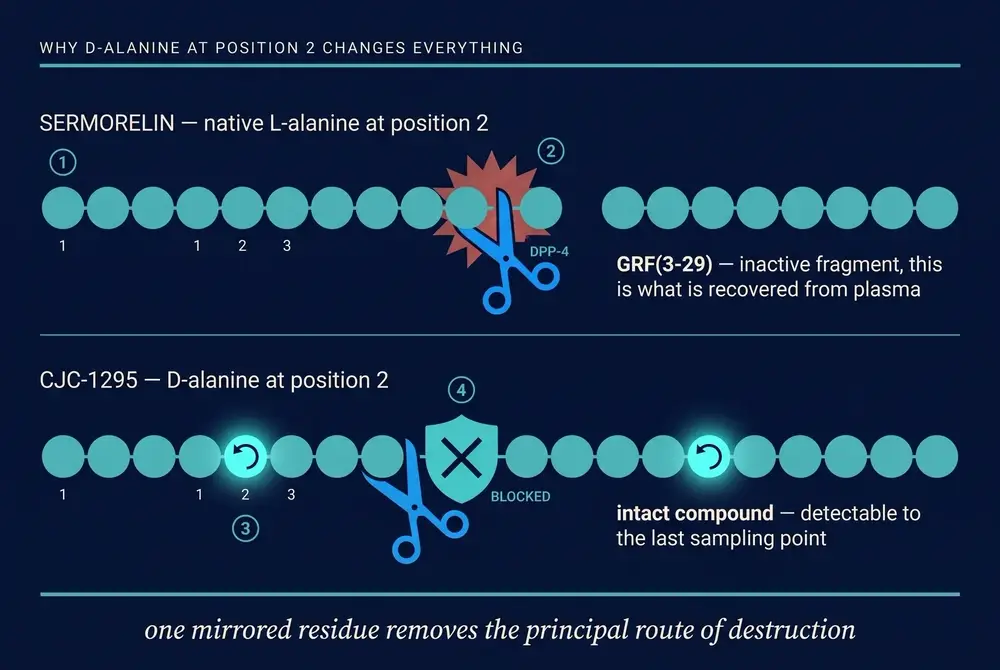
Substitution alone was not enough. A peptide protected from dipeptidyl peptidase-4 is still a small molecule that the kidney filters. The tetrasubstituted backbone on its own is generally described as having a plasma half-life on the order of half an hour — an improvement on native GRF, but nothing like a dosing interval. Something else was needed.
06The Drug Affinity Complex
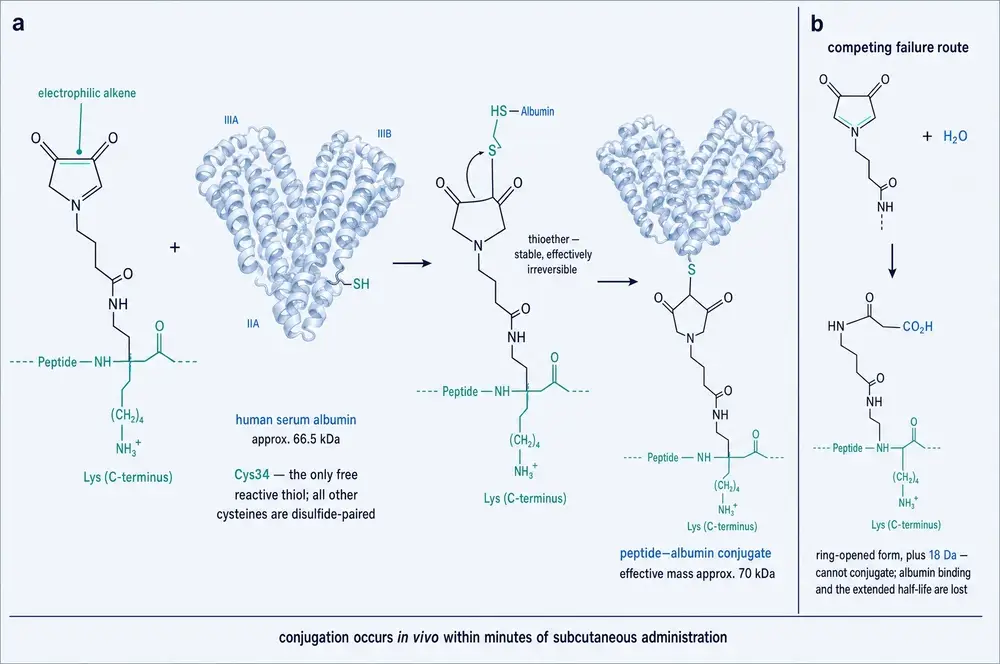
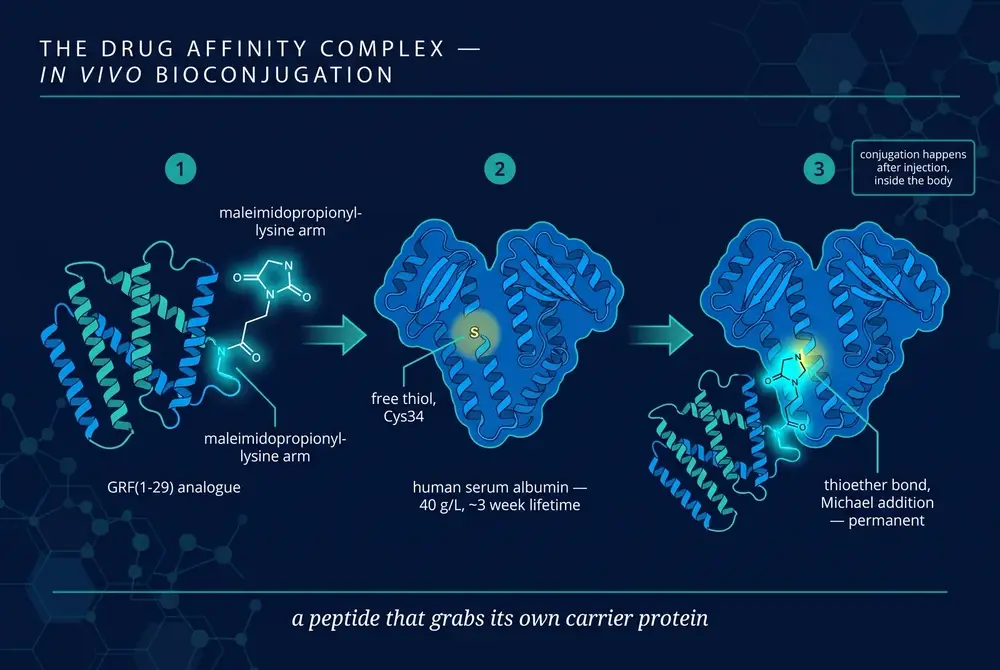
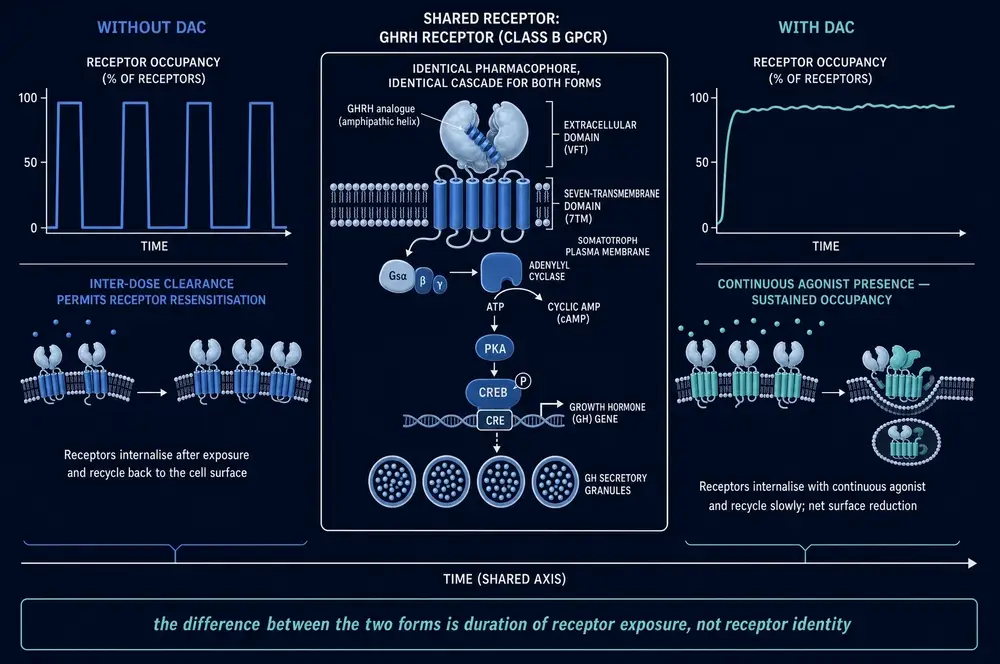
The second move is the elegant one, and it is the reason the compound has a name at all. Human serum albumin circulates at roughly forty grams per litre, persists for about three weeks, and carries a single free cysteine thiol at position 34 — an unusually reactive, unusually accessible chemical handle sitting on the most abundant protein in blood. ConjuChem, a Montreal biotechnology company, built a platform around it: attach a maleimide group to a peptide, inject the peptide, and let it find Cys34 by itself. Maleimides react with thiols by Michael addition, quickly and specifically. The conjugation happens in vivo, after the injection, without any manufacturing step. The company called the resulting attachment a Drug Affinity Complex, and the acronym DAC is what the market still uses.
Jetté and colleagues reported the growth-hormone application in Endocrinology in 2005 (Jetté et al., 2005). Three maleimido derivatives of human GRF(1–29) were synthesised and conjugated to human serum albumin ex vivo; all three resisted dipeptidyl peptidase-4 and all three released growth hormone from cultured rat pituitary cells. Given subcutaneously to normal male Sprague-Dawley rats, all produced an acute burst of growth hormone. The best of them produced a fourfold larger growth-hormone area-under-the-curve over two hours than unmodified hGRF(1–29), and it was still present in plasma beyond seventy-two hours. That compound — the tetrasubstituted GRF(1–29) carrying an added Nε-3-maleimidopropionamide derivative of lysine at the carboxy terminus — was named CJC-1295.
The paper also shows the mechanism directly rather than inferring it. A Western blot of plasma from an injected rat found the CJC-1295 immunoreactive signal sitting on the band corresponding to serum albumin: present from fifteen minutes, still there beyond twenty-four hours. The drug was not merely long-lived. It was riding on a carrier protein it had grabbed for itself.
07One name, two molecules
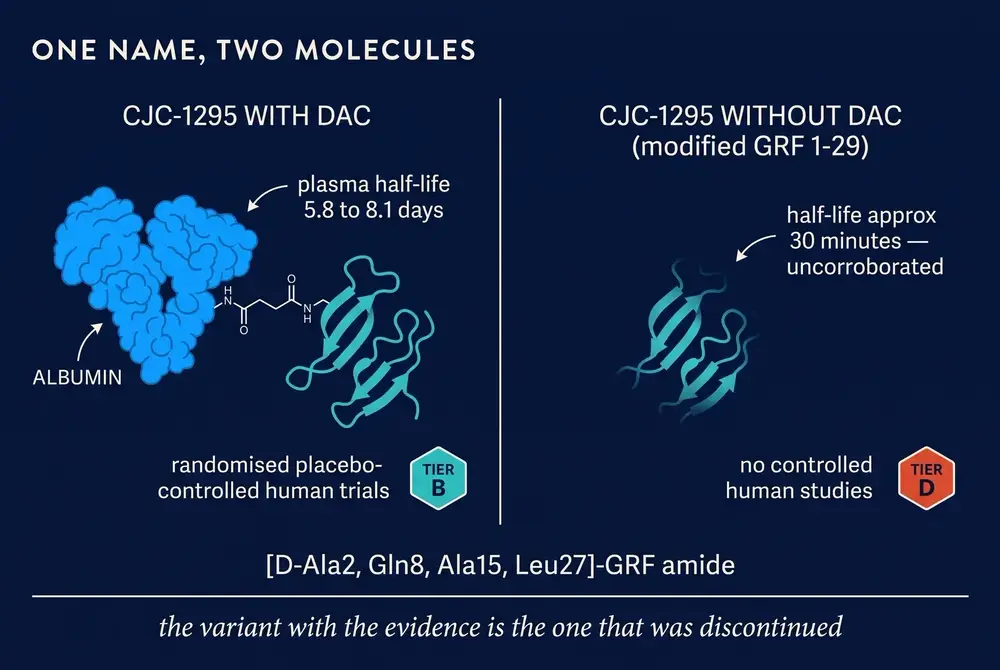
Here the story acquires the problem that governs everything after it. Two different chemical entities are sold, discussed and studied under the single name CJC-1295, and the difference between them is not a detail.
Jetté's definition is unambiguous: CJC-1295 is the tetrasubstituted peptide plus the maleimidopropionamide-lysine arm. That is the molecule with the week-long half-life. But the doping-control literature, which needed to synthesise reference standards for mass spectrometry, uses the name CJC-1295 for the tetrasubstituted peptide alone — [D-Ala², Gln⁸, Ala¹⁵, Leu²⁷]-GRF amide, no arm (Knoop et al., 2016; Thomas et al., 2022). And the commercial market, which sells both, distinguishes them as "CJC-1295 with DAC" and "CJC-1295 without DAC", the latter also marketed as "modified GRF (1–29)" or "mod GRF 1–29" (Dominikowski et al., 2026; Rahman et al., 2026).
08Rats, mice, and a knockout that grew
The preclinical case for CJC-1295 was made in three animal studies over four years, and it is unusually clean because the models were chosen to answer specific questions rather than to generate a favourable number.
The first was the identification study itself (Jetté et al., 2005): rat pituitary cells in culture, then subcutaneous dosing in normal male rats, with the fourfold growth-hormone area-under-the-curve advantage and the seventy-two-hour plasma persistence described in Part Two. This is an animal pharmacokinetic and pharmacodynamic result.
The second is the most informative. Alba and colleagues used mice in which the GHRH gene itself has been ablated — animals that cannot make the natural hormone at all and grow poorly as a result. Previous work had shown that even twice-daily injections of a short-acting GHRH analogue failed to normalise their growth. Three groups of one-week-old knockout mice were given two micrograms of CJC-1295 at intervals of twenty-four, forty-eight or seventy-two hours for five weeks. The twenty-four-hour group reached normal body weight and body length. The forty-eight- and seventy-two-hour groups grew better than placebo but were not fully normalised. Femur and tibia length stayed normal in the twenty-four- and forty-eight-hour groups. Lean mass and subcutaneous fat mass were normal in all treated groups. And the pituitaries had changed: total RNA and growth-hormone messenger RNA both rose, with immunohistochemistry confirming that the somatotroph population had proliferated (Alba et al., 2006). This is a mouse experiment in an engineered genetic deficiency state. It demonstrates that the molecule can substitute for a missing hormone; it does not demonstrate anything about people whose own GHRH is intact.
The third study is a bonus result from an unrelated question. Gautam and colleagues found that mice lacking the M3 muscarinic acetylcholine receptor in brain neurons are dwarfed, with a hypoplastic anterior pituitary and low growth hormone. Treating them with CJC-1295 restored normal pituitary size and normal serum growth hormone and IGF-1, rescuing the growth deficit (Gautam et al., 2009). The finding tells us something about cholinergic control of GHRH neurons; incidentally, it also confirms that the compound reaches and drives the pituitary in a second independent model. A companion study of the same receptor used CJC-1295 the same way, giving M3-receptor-null mice two micrograms once daily for eight weeks while investigating parasympathetic control of bone mass (Shi et al., 2010).
It is worth noticing what those two papers are. Neither was a study of CJC-1295. In both, the compound is a reagent — a reliable way to raise growth hormone in a mouse for eight weeks without an infusion pump. That is a real endorsement of the engineering, and it is also the clearest signal of what happened to the molecule: after 2006 it survives in the literature as a laboratory tool and as an analyte, but not as a drug under investigation.
09Eight days of growth hormone
The pivotal human work is a single paper reporting two trials (Teichman et al., 2006). Both were randomised, placebo-controlled, double-blind ascending-dose studies, one running twenty-eight days and one forty-nine, conducted at two investigational sites in healthy subjects aged twenty-one to sixty-one. The first study gave one of four ascending single subcutaneous doses; the second gave two or three doses weekly or fortnightly.
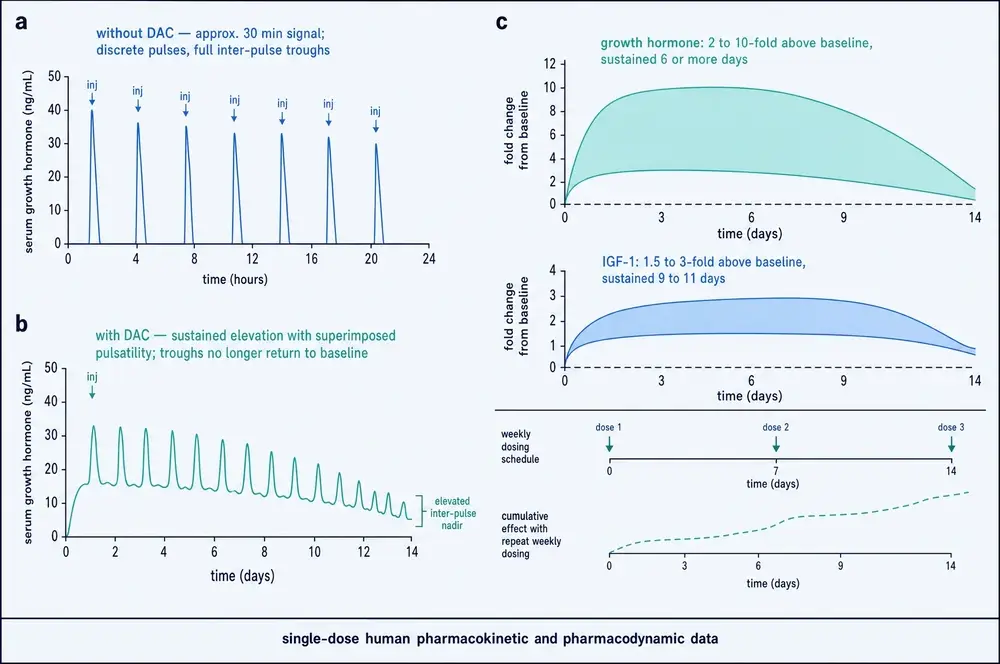
The results are the numbers everything else in the CJC-1295 literature points back to. After a single injection, mean plasma growth hormone rose two- to tenfold in a dose-dependent way and stayed elevated for six days or more. Mean plasma IGF-1 rose 1.5- to threefold and stayed elevated for nine to eleven days. The estimated half-life of the compound was 5.8 to 8.1 days. After multiple doses, mean IGF-1 remained above baseline for up to twenty-eight days, and there was evidence of accumulation across doses. No serious adverse reactions were reported, and the authors described tolerability as generally favourable, noting the 30 and 60 microgram-per-kilogram doses in particular.
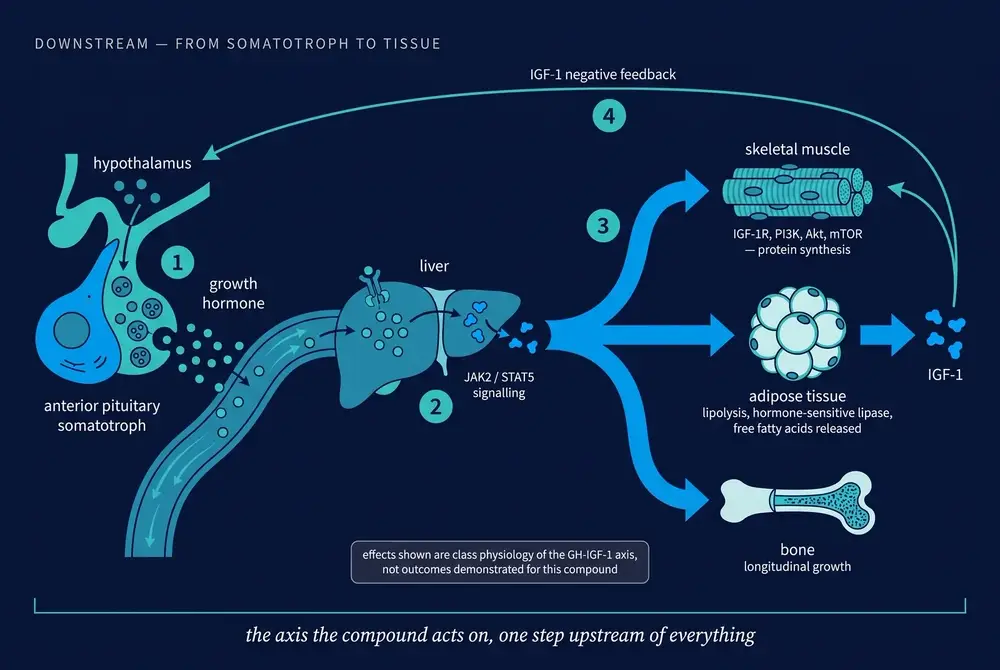
A follow-on study looked for downstream biological signatures rather than hormone levels. Sackmann-Sala and colleagues took serum from eleven healthy young men before and one week after a CJC-1295 injection and ran two-dimensional gel electrophoresis with mass-spectrometric identification. Two protein spots fell — an apolipoprotein A1 isoform and a transthyretin isoform — and three rose, including beta-haemoglobin and albumin fragments (Sackmann-Sala et al., 2009). The authors framed these as candidate biomarkers of growth-hormone action, useful partly for detecting growth-hormone abuse. The study is small, exploratory and uncontrolled for multiple comparisons, and the mechanisms linking those proteins to growth-hormone biology were not established. It is included here because it is one of only a handful of human CJC-1295 datasets in existence.
10Does the rhythm survive?
Growth hormone is not secreted steadily. It comes in bursts, mostly at night, with long quiet troughs between them, and by the 1980s there was substantial evidence that the pattern mattered to what the hormone did. A drug that raises growth hormone for eight continuous days is, on the face of it, exactly the wrong shape. If constant GHRH stimulation flattened the rhythm into a plateau, CJC-1295 would be delivering something closer to continuous recombinant growth hormone than to physiology.
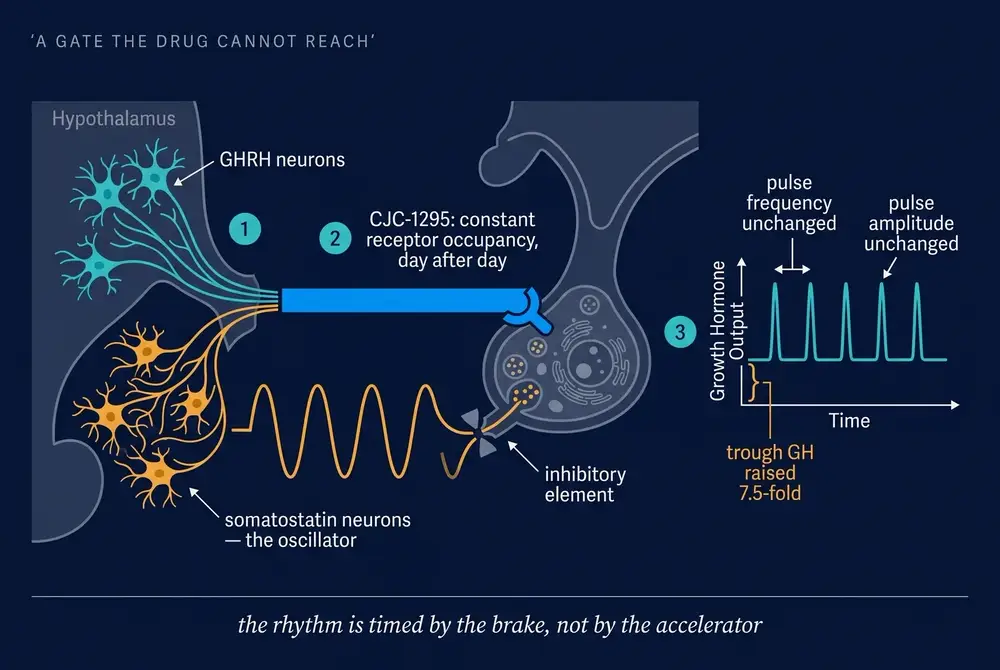
Ionescu and Frohman tested it. Healthy men aged twenty to forty had blood drawn every twenty minutes across a twelve-hour overnight window, before and one week after a single injection of CJC-1295. The result was not what the worry predicted. Pulse frequency was unchanged. Pulse magnitude was unchanged. What changed was the floor: basal, between-pulse trough growth hormone rose 7.5-fold. Mean growth hormone across the window rose 46 per cent, and IGF-1 rose 45 per cent (Ionescu & Frohman, 2006). The oscillation had survived intact and had been lifted bodily onto a higher baseline.
Why does a constant stimulus produce a pulsatile output? The answer was worked out twenty-two years earlier, in the same decade the hormone was sequenced. Tannenbaum and Ling gave rats identical doses of GRF at the peak and at the trough of their natural growth-hormone rhythm and got markedly different responses — large at peak, weak at trough. Immunoneutralising somatostatin with an antiserum abolished the difference and unleashed a full response at the trough (Tannenbaum & Ling, 1984). The rhythm is not generated by GRF pulses arriving at the pituitary; it is generated by somatostatin periodically closing the gate. GRF sets how loud the signal can be. Somatostatin decides when it gets through.
That is the mechanism CJC-1295 exploits without touching. Saturating the GHRH receptor continuously cannot flatten a rhythm whose oscillator lives upstream in somatostatin neurons the drug does not reach. The 1984 rat experiment predicts the 2006 human result exactly. It is also consistent with the puzzle that the same generation of physiologists had found from the other direction: infusing GRF continuously in humans produced growth-hormone responses that attenuated over hours while episodic secretion persisted underneath (Webb et al., 1984).
11The pulsatility argument is weaker than it sounds
Preserved pulsatility is the single most-repeated selling point for this class of compound. It is presented as the reason a GHRH analogue is more physiological, and therefore safer and better, than injecting recombinant growth hormone. The 2026 gerontology literature repeats it in exactly those terms: unlike exogenous growth hormone, which suppresses endogenous production and eliminates pulsatility, CJC-1295 preserves pulsatile release while raising amplitude and troughs (Mavrych et al., 2026).
The first half of that claim is well supported: Ionescu and Frohman measured it. The second half — that preserving pulsatility delivers better or safer outcomes — is where the evidence thins, and it is worth being precise about how it thins, because two good human studies address it directly and neither supports the simple version.
Jaffe and colleagues gave nine growth-hormone-deficient adults the same total daily intravenous dose of growth hormone for eight days in four different patterns: none, a large night-time pulse with two small daytime pulses, eight equal boluses every three hours, and continuous infusion. Then they measured what each pattern did. The result splits. Continuous infusion and frequent boluses were the most effective at raising IGF-1 and IGF-binding protein 3. The pulsatile patterns did more for markers of bone formation and resorption. All patterns lowered hepatic CYP1A2 activity, most strongly the pulsatile ones — and pulsatile growth hormone decreased CYP3A4 activity while continuous infusion increased it (Jaffe et al., 2002). Pattern is a real and independent variable. It is not a variable with a good direction.
Laursen and colleagues ran the longer version. Fourteen growth-hormone-deficient adults on stable treatment were switched, for six months, either to continuous subcutaneous infusion by portable pump or kept on daily evening injections, at an unchanged dose. At six months there was no significant difference between the regimens in IGF-1, IGF-2, IGF-binding proteins, insulin sensitivity, glucose effectiveness, lipoproteins, bone metabolism or body composition. The one difference that reached significance was a 16 per cent fall in free fatty acids in the continuously infused group (Laursen et al., 2001).
Put the three findings together and the honest position is this. CJC-1295 does preserve the growth-hormone rhythm, and that is a genuine and measured pharmacological difference from injecting recombinant growth hormone. Whether that difference produces better clinical outcomes is unknown, because the only human experiments that isolated pattern from dose found that pattern matters differently for different endpoints, and that over six months it mostly did not matter at all. Preserved pulsatility is a mechanism. It has not been shown to be a benefit.
12The partner compound
In practice CJC-1295 is rarely discussed alone. The pairing with ipamorelin is so standard in off-label use that the two names travel together, and the rationale is genuinely sound in outline: the two compounds drive growth-hormone release through different receptors, so their effects should combine rather than compete.
Ipamorelin is a pentapeptide, Aib-His-D-2-Nal-D-Phe-Lys-NH₂, developed at Novo Nordisk and reported in 1998. It works through the growth-hormone-secretagogue receptor — the ghrelin receptor — not the GHRH receptor, releasing growth hormone from rat pituitary cells with potency and efficacy close to GHRP-6. Its distinguishing property, and the reason it displaced its predecessors, is selectivity: where GHRP-6 and GHRP-2 raise ACTH and cortisol, ipamorelin did not raise either at doses far above those needed for maximal growth-hormone release. Its authors called it the first selective growth-hormone secretagogue (Raun et al., 1998). In rats it produced dose-dependent increases in longitudinal bone growth and body-weight gain over fifteen days, without changing total IGF-1 (Johansen et al., 1999).
Does the combination do more than either alone in humans? The closest direct evidence does not involve either CJC-1295 or ipamorelin. Bowers and colleagues tested GHRP-2 with GHRH in healthy older adults and found real synergy: acute two-peptide synergy was threefold greater in young than older volunteers and 2.3-fold higher in elderly women than men, and twenty-four-hour co-infusion drove growth-hormone secretion more than either agonist alone. Thirty days of continuous GHRP-2 sustained pulsatile growth-hormone secretion and a stable IGF-1 plateau, with normal safety screening (Bowers et al., 2004). That establishes the class principle in people. It does not establish it for this particular pair, at any particular ratio, for any particular outcome. The 2026 clinical reviews are explicit that the CJC-1295–ipamorelin combination rests on anecdotal rationale, with controlled evidence for synergy or body-composition benefit in healthy people remaining limited (Dominikowski et al., 2026).
13Phase 2, and a population that needed it
By late 2005 ConjuChem had a compound with a week-long half-life, a demonstrated growth-hormone and IGF-1 response in healthy adults, and a plausible indication. HIV-associated visceral obesity — the accumulation of deep abdominal fat that afflicted many patients on early antiretroviral regimens — was a real unmet need, it was associated with reduced growth-hormone secretion, and it had a measurable endpoint in visceral adipose tissue on imaging.
The trial is on the public registry. NCT00267527: a multicentre, randomised, placebo-controlled, double-blind phase 2 study of CJC-1295 given for twelve weeks with a six-week follow-up, in HIV-infected patients aged eighteen to sixty-five with HIV-associated visceral obesity and a body-mass index between 24 and 30. Patients were randomised to low-dose CJC-1295, high-dose CJC-1295 or placebo. Diabetes was an exclusion, as was concurrent growth hormone or any other growth-hormone secretagogue. The study started in December 2005 with sites across North and South America.
The registry lists its status as TERMINATED, a completion date of September 2006, and no posted results.
14July 2006
On 17 July 2006 ConjuChem halted the study, following the death of a participant at a site in Argentina. Contemporaneous reporting described the trial as having enrolled 192 patients by that point, randomised to a low-dose escalation arm (60, 90 then 120 micrograms per kilogram weekly), a high-dose escalation arm (60, 120 then 240 micrograms per kilogram weekly), or placebo, with the escalation over three weeks followed by nine further weeks of treatment. The registry's enrolment figure is 120. The two numbers are not reconciled anywhere in the record consulted for this monograph, and this document does not attempt to reconcile them; the registry figure is the one that carries an institutional provenance.
What should be said plainly is what is not in the record. There is no peer-reviewed publication of this trial. There are no results posted to ClinicalTrials.gov. There is no published adjudication of the death, no published autopsy finding, and no published causality assessment. Several secondary sources state that the event was judged unrelated to the study drug — attributed variously to underlying coronary disease — but the searches conducted for this monograph could not trace that attribution to a primary document, and it is therefore recorded here as an unsourced claim rather than repeated as a finding.
Two things are true at once here, and holding both is the honest position. A death in a trial of a hundred-odd immunocompromised adults is not by itself evidence that a drug is dangerous; base rates in that population are not zero, and no causal link was ever established in public. And a development programme that stops without publishing its safety data leaves a permanent hole where evidence should be. CJC-1295 was not withdrawn for a demonstrated harm. It was also never cleared of one, because the study that would have done so was never completed or reported.
15The platform outlived the molecule
It would be easy to read the 2006 halt as a verdict on the technology. It was not. The Drug Affinity Complex chemistry — the maleimide arm, the Cys34 target, the in-vivo conjugation — went on to a long and largely successful second life attached to a different peptide.
CJC-1134-PC is the same conjugation strategy applied to exendin-4, the glucagon-like peptide-1 agonist scaffold. ConjuChem ran it through phase 2 trials in type 2 diabetes in 2008 and again in 2011–2012. Then, under Changshan ConjuChem in China, it went considerably further: two phase 3 trials, one in treatment-naive patients with 474 participants and one in patients inadequately controlled on metformin with 464 participants, both with primary completion in February 2023, both listed as completed.
So the engineering question — can you glue a short-lived peptide to albumin in vivo and get a weekly drug? — was answered yes, and stayed answered. What failed was not the platform. What failed was one molecule's clinical programme, in one indication, in one company, in one year.
16The comparator that finished the race
The strongest evidence that the class was drug-able is that a sibling compound crossed the line. Tesamorelin is a GHRH analogue — a full-length (1–44) peptide with a hexenoyl modification rather than a truncated (1–29) scaffold, and therefore not a descendant of the truncation decision described in Part One — developed by a different Canadian company for the same population in the same years. It completed phase 3 and was approved for HIV-associated lipodystrophy. It remains in clinical research: a 2026 report describes a randomised trial of tesamorelin as an adjunct to exercise for physical function in people with HIV (Erlandson et al., 2026).
The contrast is the useful part. Two GHRH-axis compounds, the same indication, the same decade. One completed its trials, published its results, was approved, and is still generating clinical data twenty years later. The other stopped in phase 2, published nothing further, and now exists mainly as a catalogue item. The difference in their present evidentiary status is not a difference in pharmacology. It is a difference in whether the studies were finished.
17From clinic to catalogue
Ordinarily a compound abandoned in phase 2 disappears. CJC-1295 did the opposite, and the moment it re-enters the literature is precisely documented.
In 2009, Norwegian police and customs authorities sent an unidentified pharmaceutical preparation to a laboratory for analysis. Liquid chromatography with high-resolution tandem mass spectrometry found a twenty-nine-amino-acid peptide with a C-terminal amide function, and the sequence deduced from the fragmentation data matched a peptide then being marketed under the name CJC-1295. The authors noted that as a growth-hormone releasing factor it fell under section S2 of the World Anti-Doping Agency prohibited list, that it was readily available, and that there was reason to believe it was in use in the bodybuilding community (Henninge et al., 2010).
The compound had gone from a terminated corporate trial to an anonymous vial in a customs seizure in roughly three years. By 2016 it was appearing in market-intelligence research: a study that scraped a million discussion topics from thirteen internet forums to map the online doping market found anabolic steroids dominant but identified peptides, with CJC-1295 named as the example, as an emerging product category, alongside 327 identified suppliers (Pineau et al., 2016). The same year brought a netnographic study of women's use of the compound specifically (Van Hout & Hearne, 2016). By 2026 it appears in review after review as one of the peptides clinicians most often encounter in patients who acquired it without a prescription (Dominikowski et al., 2026; Renke et al., 2026; Rahman et al., 2026; Mendias et al., 2026; Villegas Meza et al., 2026).
The corpus assembled for this monograph registers that shift with unusual clarity. Scanning 45,820 documents across the research library returned 602 files naming CJC-1295, which reduced to 401 distinct documents. Of those, five were peer-reviewed scientific full texts. Two hundred and ninety-three were vendor catalogue and product-page material. Ninety-eight were consumer web content. For this compound, in this library, commercial writing outnumbers scientific writing roughly seventy-eight to one.
18Chemists chasing an unapproved drug
There is a substantial CJC-1295 literature after 2010. Almost none of it is clinical. It is analytical chemistry, written by anti-doping laboratories whose job is to detect a compound nobody is formally studying.
The problem is genuinely hard. These peptides circulate at picograms per millilitre, far below what mass spectrometry can see without enrichment, so the methods are elaborate: immunoaffinity purification with anti-GHRH antibodies followed by nano-scale liquid chromatography and high-resolution mass spectrometry (Thomas et al., 2012; Knoop et al., 2016), immuno-polymerase-chain-reaction screening (Timms et al., 2019), confirmation methods for equine plasma (Timms et al., 2019b), dried blood spots, ultrafiltration-based antibody-free assays, and whole-blood approaches (Thomas et al., 2022). The field reviews its own progress annually, and CJC-1295 has appeared in those reviews continuously for well over a decade — still listed among the GHRH analogues requiring routine detection in the eighteenth edition, covering literature to September 2025 (Memdouh et al., 2021; Thevis et al., 2025; Thevis et al., 2026). The same laboratories also characterise what is actually inside seized material, which is not always what the label says — glycine-modified secretagogues turning up in confiscated doping products, for instance (Gajda et al., 2019).
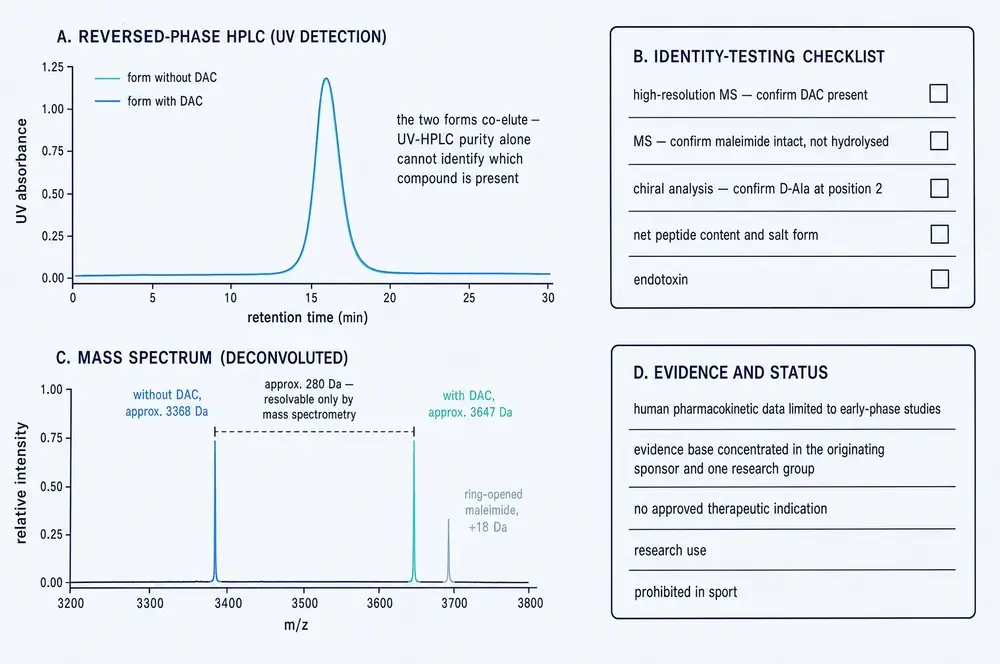
Out of that work comes a small, elegant finding that closes a loop opened in Part Two. Because CJC-1295 and CJC-1293 carry D-alanine at position two, they are not cleaved by dipeptidyl peptidase-4, and no truncated metabolites appear. Sermorelin, which retains the natural L-alanine, is recovered from plasma as GRF(3–29) rather than as itself. The consequence for detection is counter-intuitive: the drugs engineered to last longer are the easy ones to catch, because the intact molecule is still there at the last sampling point (Knoop et al., 2016). The modification that made the compound useful is the same modification that makes it visible.
19The evidence gradient
The most useful recent framing of this whole class comes from a 2026 narrative review that set out to help clinicians interpret patients who arrive having bought peptides online. Rather than treating the compounds as a homogeneous group, it sorts them into four evidentiary tiers, and the ordering is the single most important fact a reader of this monograph should carry away (Dominikowski et al., 2026).
Tesamorelin sits at tier A: randomised controlled trials within an FDA-approved indication. Most GHRH analogues and ghrelin-mimetic secretagogues — including CJC-1295 with DAC — occupy tier B: phase 1 or 2 human studies exist, but they do not address performance or body-composition endpoints. AOD9604 straddles tier B and C. And at tier D, defined as having no peer-reviewed human studies at all and supported only by preclinical extrapolation and grey-literature user narratives, sit PEG-MGF, IGF-1 LR3, and CJC-1295 without DAC.
20What is known about harm
Because the phase 2 safety data were never published, almost everything that can be said about the risks of this compound is either class-level or inferential. That is itself the most important safety finding, and it should not be softened.
What the human CJC-1295 record contains is the tolerability statement from the healthy-volunteer trials: no serious adverse reactions reported, with tolerability described as generally favourable in the tested dose range (Teichman et al., 2006). Those trials ran twenty-eight and forty-nine days in a small number of healthy adults. They are not a long-term safety dataset and were never intended as one.
At class level, the 2026 clinical reviews describe a consistent pattern of reported effects across GH–IGF-1-axis peptides: endocrine and metabolic disturbance including dysglycaemia, fluid-retention syndromes, musculoskeletal symptoms such as arthralgia and myalgia, and injection-site reactions (Dominikowski et al., 2026). Prolactin and cortisol elevation belong mainly to the earlier ghrelin-mimetic secretagogues rather than to the GHRH analogues, with ipamorelin specifically noted as sparing them (Raun et al., 1998). The same review reports that the United States Food and Drug Administration placed CJC-1295 on Category 2 of its bulk drug substances list, citing reports of vasodilatory reactions and tachycardia — a regulatory determination that the substance presents significant safety risk for use in compounded preparations.
The mitogenic question deserves care in both directions. Sustained IGF-1 elevation is a biologically plausible cancer concern; IGF-1 signalling is anti-apoptotic and pro-proliferative, and states of chronic growth-hormone excess are associated with increased neoplasia. There is also direct experimental evidence that GHRH signalling itself can transform cells: GHRH induced tumorigenic transformation of the human prostatic epithelial line RWPE-1 in vitro (Muñoz-Moreno et al., 2022). But that is a cell-line experiment, not an observation in people, and no human study has associated CJC-1295 exposure with cancer incidence — because no study of sufficient size or duration has ever been done. The honest formulation is the one the reviews use: biologically plausible, mechanistically supported in non-human systems, and unproven in humans (Dominikowski et al., 2026).
Finally there is the risk that has nothing to do with pharmacology. Every recent review that touches this compound makes the same point: material bought outside a regulated supply chain carries uncertainty about identity, purity, sterility and dose consistency, and long-term safety surveillance for these agents does not exist (Renke et al., 2026; Mendias et al., 2026). The seizure literature demonstrates the concern empirically rather than hypothetically: unidentified preparations required mass spectrometry to establish what they contained (Henninge et al., 2010), and confiscated doping material has been found to contain modified secretagogues that were not the labelled compound (Gajda et al., 2019).
The sharpest single illustration comes from a laboratory that was not even looking for this compound. Belgian regulatory scientists developing a method to identify illegal insulins analysed a set of seized products; one sample, purchased as CJC-1295, was found to contain porcine insulin (Vanhee et al., 2016). The two substances are not interchangeable in any sense that matters. A person injecting what they believe to be a growth-hormone-releasing peptide, on the schedule appropriate to a compound with a multi-day half-life, and receiving instead an animal insulin, is exposed to hypoglycaemia of a kind that has killed people. Nothing about the pharmacology of CJC-1295 produces that risk. The supply chain does.
21What would settle it
It is worth being concrete about what is missing, because the gaps are specific and none of them is exotic.
| Open question | What would answer it | Why it does not exist |
|---|---|---|
| What are the pharmacokinetics of CJC-1295 without DAC in humans? | A single-dose PK study with serial sampling. Days of work with existing assays. | No commercial sponsor: the form is unpatentable and already sold. |
| Does the non-DAC form do anything measurable in people? | Any controlled trial with a growth-hormone or IGF-1 endpoint. | Tier D exists because this has never been run. |
| What happened in the phase 2 trial? | Publication or registry posting of NCT00267527 results, twenty years on. | Sponsor discontinued the programme; no posting obligation was met. |
| Does the CJC-1295 + ipamorelin pairing beat either alone? | A three-arm randomised trial. The class principle is already established for GHRH + GHRP-2. | Neither compound has a sponsor with an incentive to find out. |
| Does preserved pulsatility produce better outcomes? | A pattern-controlled trial with clinical rather than biochemical endpoints. | The two studies that isolated pattern used recombinant GH, and disagreed. |
| Is sustained IGF-1 elevation from a secretagogue oncogenic? | Long-term cohort follow-up of exposed users. | Exposure is unrecorded because it happens outside medicine. |
Read down the third column and a pattern emerges that has nothing to do with biology. Every one of these questions is answerable with ordinary clinical research. None of them will be answered, because the compound occupies a position no research system is built for: too unpatentable to attract a sponsor, too available to disappear, too widely used to be ignored, and too unstudied to be assessed. CJC-1295 is not an unanswered scientific question. It is an unasked one.
22Forty-four years in one view
23References
Generated from verified NCBI records rather than from recall. Author lists, journal names, volumes, pages and identifiers are taken from the PubMed record for each citation. This is not a formality: two attributions in the first draft of Part One were written from memory and both were wrong — a 2025 review of hypothalamic GHRH was credited to the wrong first author, as was a 2016 analytical paper. Both were caught by reading the author line the generator prints. Every author–year citation in the body of this document is checked against this list at build time, and the build fails if one does not resolve.
- Alba M, Fintini D, Sagazio A, Lawrence B, Castaigne JP, Frohman LA, et al.. Once-daily administration of CJC-1295, a long-acting growth hormone-releasing hormone (GHRH) analog, normalizes growth in the GHRH knockout mouse. Am J Physiol Endocrinol Metab. 2006;291(6):E1290-4.
PMID 16822960 · doi:10.1152/ajpendo.00201.2006 - Bowers CY, Granda R, Mohan S, Kuipers J, Baylink D, Veldhuis JD. Sustained elevation of pulsatile growth hormone (GH) secretion and insulin-like growth factor I (IGF-I), IGF-binding protein-3 (IGFBP-3), and IGFBP-5 concentrations during 30-day continuous subcutaneous infusion of GH-releasing peptide-2 in older men and women. J Clin Endocrinol Metab. 2004;89(5):2290-300.
PMID 15126555 · doi:10.1210/jc.2003-031799 - Brazeau P, Ling N, Böhlen P, Esch F, Ying SY, Guillemin R. Growth hormone releasing factor, somatocrinin, releases pituitary growth hormone in vitro. Proc Natl Acad Sci U S A. 1982;79(24):7909-13.
PMID 6130528 · doi:10.1073/pnas.79.24.7909 · PMC347459 - Dieguez C, López M, Casanueva F. Hypothalamic GHRH. Rev Endocr Metab Disord. 2025;26(3):297-303.
PMID 39913072 · doi:10.1007/s11154-025-09951-y · PMC12137398 - Dominikowski A, Rękoś Z, Olejarz M, Szczepanek-Parulska E, Domin R, RuchaŁa M. The emerging landscape of performance-enhancing peptides modulating GH-IGF1 axis: bridging the gap between clinical evidence and patient self-administration. Front Endocrinol (Lausanne). 2026;17:1822475.
PMID 42395176 · doi:10.3389/fendo.2026.1822475 · PMC13322892 - Erlandson KM, Gustafson L, Johnson JE, Kulik GL, Khuu V, Chahal N, et al.. Tesamorelin as an Adjunct to Exercise for Improving Physical Function in HIV (TRIUMPH): a clinical trial protocol. BMJ Open. 2026;16(7):e120740.
PMID 42419889 · doi:10.1136/bmjopen-2026-120740 · PMC13347827 - Esch F, Böhlen P, Ling N, Brazeau P, Guillemin R. Isolation and characterization of the bovine hypothalamic growth hormone releasing factor. Biochem Biophys Res Commun. 1983;117(3):772-9.
PMID 6421287 · doi:10.1016/0006-291x(83)91664-9 - Frohman LA, Thominet JL, Webb CB, Vance ML, Uderman H, Rivier J, et al.. Metabolic clearance and plasma disappearance rates of human pancreatic tumor growth hormone releasing factor in man. J Clin Invest. 1984;73(5):1304-11.
PMID 6425363 · doi:10.1172/JCI111333 · PMC425152 - Gajda PM, Holm NB, Hoej LJ, Rasmussen BS, Dalsgaard PW, Reitzel LA, et al.. Glycine-modified growth hormone secretagogues identified in seized doping material. Drug Test Anal. 2019;11(2):350-354.
PMID 30136411 · doi:10.1002/dta.2489 - Gautam D, Jeon J, Starost MF, Han SJ, Hamdan FF, Cui Y, et al.. Neuronal M3 muscarinic acetylcholine receptors are essential for somatotroph proliferation and normal somatic growth. Proc Natl Acad Sci U S A. 2009;106(15):6398-403.
PMID 19332789 · doi:10.1073/pnas.0900977106 · PMC2662962 - Guillemin R, Brazeau P, Böhlen P, Esch F, Ling N, Wehrenberg WB. Growth hormone-releasing factor from a human pancreatic tumor that caused acromegaly. Science. 1982;218(4572):585-7.
PMID 6812220 · doi:10.1126/science.6812220 - Henninge J, Pepaj M, Hullstein I, Hemmersbach P. Identification of CJC-1295, a growth-hormone-releasing peptide, in an unknown pharmaceutical preparation. Drug Test Anal. 2010;2(11-12):647-50.
PMID 21204297 · doi:10.1002/dta.233 - Ionescu M, Frohman LA. Pulsatile secretion of growth hormone (GH) persists during continuous stimulation by CJC-1295, a long-acting GH-releasing hormone analog. J Clin Endocrinol Metab. 2006;91(12):4792-7.
PMID 17018654 · doi:10.1210/jc.2006-1702 - Jaffe CA, Turgeon DK, Lown K, Demott-Friberg R, Watkins PB. Growth hormone secretion pattern is an independent regulator of growth hormone actions in humans. Am J Physiol Endocrinol Metab. 2002;283(5):E1008-15.
PMID 12376329 · doi:10.1152/ajpendo.00513.2001 - Jetté L, Léger R, Thibaudeau K, Benquet C, Robitaille M, Pellerin I, et al.. Human growth hormone-releasing factor (hGRF)1-29-albumin bioconjugates activate the GRF receptor on the anterior pituitary in rats: identification of CJC-1295 as a long-lasting GRF analog. Endocrinology. 2005;146(7):3052-8.
PMID 15817669 · doi:10.1210/en.2004-1286 - Johansen PB, Nowak J, Skjaerbaek C, Flyvbjerg A, Andreassen TT, Wilken M, et al.. Ipamorelin, a new growth-hormone-releasing peptide, induces longitudinal bone growth in rats. Growth Horm IGF Res. 1999;9(2):106-13.
PMID 10373343 · doi:10.1054/ghir.1999.9998 - Knoop A, Thomas A, Fichant E, Delahaut P, Schänzer W, Thevis M. Qualitative identification of growth hormone-releasing hormones in human plasma by means of immunoaffinity purification and LC-HRMS/MS. Anal Bioanal Chem. 2016;408(12):3145-53.
PMID 26879649 · doi:10.1007/s00216-016-9377-3 · PMC4830873 - Laursen T, Gravholt CH, Heickendorff L, Drustrup J, Kappelgaard AM, Jørgensen JO, et al.. Long-term effects of continuous subcutaneous infusion versus daily subcutaneous injections of growth hormone (GH) on the insulin-like growth factor system, insulin sensitivity, body composition, and bone and lipoprotein metabolism in GH-deficient adults. J Clin Endocrinol Metab. 2001;86(3):1222-8.
PMID 11238512 · doi:10.1210/jcem.86.3.7323 - Ling N, Esch F, Böhlen P, Brazeau P, Wehrenberg WB, Guillemin R. Isolation, primary structure, and synthesis of human hypothalamic somatocrinin: growth hormone-releasing factor. Proc Natl Acad Sci U S A. 1984;81(14):4302-6.
PMID 6431406 · doi:10.1073/pnas.81.14.4302 · PMC345576 - Mavrych V, Shypilova I, Bolgova O. Therapeutic peptides in gerontology: mechanisms and applications for healthy aging. Front Aging. 2026;7:1790247.
PMID 42021992 · doi:10.3389/fragi.2026.1790247 · PMC13095733 - Mayo KE, Vale W, Rivier J, Rosenfeld MG, Evans RM. Expression-cloning and sequence of a cDNA encoding human growth hormone-releasing factor. Nature. 1983;306(5938):86-8.
PMID 6415488 · doi:10.1038/306086a0 - Memdouh S, Gavrilović I, Ng K, Cowan D, Abbate V. Advances in the detection of growth hormone releasing hormone synthetic analogs. Drug Test Anal. 2021;13(11-12):1871-1887.
PMID 34665524 · doi:10.1002/dta.3183 - Mendias CL, Awan TM. Safety and Efficacy of Approved and Unapproved Peptide Therapies for Musculoskeletal Injuries and Athletic Performance. Sports Med. 2026.
PMID 41966639 · doi:10.1007/s40279-026-02437-0 - Muñoz-Moreno L, Carmena MJ, Prieto JC, Schally AV, Bajo AM. Tumorigenic transformation of human prostatic epithelial cell line RWPE-1 by growth hormone-releasing hormone (GHRH). Prostate. 2022;82(8):933-941.
PMID 35322894 · doi:10.1002/pros.24339 · PMC9310601 - Pineau T, Schopfer A, Grossrieder L, Broséus J, Esseiva P, Rossy Q. The study of doping market: How to produce intelligence from Internet forums. Forensic Sci Int. 2016;268:103-115.
PMID 27710891 · doi:10.1016/j.forsciint.2016.09.017 - Rahman OF, Lee SJ, Seeds WA. Therapeutic Peptides in Orthopaedics: Applications, Challenges, and Future Directions. J Am Acad Orthop Surg Glob Res Rev. 2026;10(1).
PMID 41490200 · doi:10.5435/JAAOSGlobal-D-25-00236 · PMC12753158 - Raun K, Hansen BS, Johansen NL, Thøgersen H, Madsen K, Ankersen M, et al.. Ipamorelin, the first selective growth hormone secretagogue. Eur J Endocrinol. 1998;139(5):552-61.
PMID 9849822 · doi:10.1530/eje.0.1390552 - Renke G, Chinellato L. Therapeutic Peptides in Aesthetic, Metabolic and Endocrine Conditions: Effects, Safety, Clinical Applications, and Future Perspectives. Int J Mol Sci. 2026;27(9).
PMID 42123471 · doi:10.3390/ijms27093890 · PMC13164565 - Rivier J, Spiess J, Thorner M, Vale W. Characterization of a growth hormone-releasing factor from a human pancreatic islet tumour. Nature. 1982;300(5889):276-8.
PMID 6292724 · doi:10.1038/300276a0 - Sackmann-Sala L, Ding J, Frohman LA, Kopchick JJ. Activation of the GH/IGF-1 axis by CJC-1295, a long-acting GHRH analog, results in serum protein profile changes in normal adult subjects. Growth Horm IGF Res. 2009;19(6):471-7.
PMID 19386527 · doi:10.1016/j.ghir.2009.03.001 · PMC2787983 - Shi Y, Oury F, Yadav VK, Wess J, Liu XS, Guo XE, et al.. Signaling through the M(3) muscarinic receptor favors bone mass accrual by decreasing sympathetic activity. Cell Metab. 2010;11(3):231-8.
PMID 20197056 · doi:10.1016/j.cmet.2010.01.005 · PMC2832931 - Spiess J, Rivier J, Thorner M, Vale W. Sequence analysis of a growth hormone releasing factor from a human pancreatic islet tumor. Biochemistry. 1982;21(24):6037-40.
PMID 6295453 · doi:10.1021/bi00267a002 - Tannenbaum GS, Ling N. The interrelationship of growth hormone (GH)-releasing factor and somatostatin in generation of the ultradian rhythm of GH secretion. Endocrinology. 1984;115(5):1952-7.
PMID 6149116 · doi:10.1210/endo-115-5-1952 - Teichman SL, Neale A, Lawrence B, Gagnon C, Castaigne JP, Frohman LA. Prolonged stimulation of growth hormone (GH) and insulin-like growth factor I secretion by CJC-1295, a long-acting analog of GH-releasing hormone, in healthy adults. J Clin Endocrinol Metab. 2006;91(3):799-805.
PMID 16352683 · doi:10.1210/jc.2005-1536 - Thevis M, Kuuranne T, Geyer H. Annual Banned-Substance Review 17th Edition-Analytical Approaches in Human Sports Drug Testing 2023/2024. Drug Test Anal. 2025;17(8):1417-1442.
PMID 39731401 · doi:10.1002/dta.3835 · PMC12319490 - Thevis M, Kuuranne T, Geyer H. Annual Banned-Substance Review 18th Edition-Analytical Approaches in Human Sports Drug Testing 2024/2025. Drug Test Anal. 2026;18(4):458-482.
PMID 41702393 · doi:10.1002/dta.70033 · PMC13040425 - Thomas A, Thilmany S, Hofmann A, Thevis M. Probing for peptidic drugs (2-10 kDa) in doping control blood samples. Anal Sci Adv. 2022;3(7-8):235-243.
PMID 38716080 · doi:10.1002/ansa.202200027 · PMC10989627 - Thomas A, Schänzer W, Delahaut P, Thevis M. Immunoaffinity purification of peptide hormones prior to liquid chromatography-mass spectrometry in doping controls. Methods. 2012;56(2):230-5.
PMID 21871962 · doi:10.1016/j.ymeth.2011.08.009 - Thorner MO, Perryman RL, Cronin MJ, Rogol AD, Draznin M, Johanson A, et al.. Somatotroph hyperplasia. Successful treatment of acromegaly by removal of a pancreatic islet tumor secreting a growth hormone-releasing factor. J Clin Invest. 1982;70(5):965-77.
PMID 6290540 · doi:10.1172/jci110708 · PMC370309 - Timms M, Ganio K, Forbes G, Bailey S, Steel R. An immuno polymerase chain reaction screen for the detection of CJC-1295 and other growth-hormone-releasing hormone analogs in equine plasma. Drug Test Anal. 2019;11(6):804-812.
PMID 30489688 · doi:10.1002/dta.2554 - Timms M, Ganio K, Steel R. A method for confirming CJC-1295 abuse in equine plasma samples by LC-MS/MS. Drug Test Anal. 2019;11(8):1248-1257.
PMID 30938069 · doi:10.1002/dta.2599 - Van Hout MC, Hearne E. Netnography of Female Use of the Synthetic Growth Hormone CJC-1295: Pulses and Potions. Subst Use Misuse. 2016;51(1):73-84.
PMID 26771670 · doi:10.3109/10826084.2015.1082595 - Vanhee C, Janvier S, Moens G, Deconinck E, Courselle P. A simple dilute and shoot methodology for the identification and quantification of illegal insulin. J Pharm Anal. 2016;6(5):326-334.
PMID 29404000 · doi:10.1016/j.jpha.2016.04.006 · PMC5762622 - Villegas Meza AD, Nocek M, Mitchell BC, Lizarraga M, DeFoor MT, Ruzbarsky JJ, et al.. Injectable Peptides in Sports Medicine: A Structured Narrative Review of Evidence, Safety, and Antidoping Implications. JBJS Rev. 2026;14(5).
PMID 42160466 · doi:10.2106/JBJS.RVW.26.00027 - Webb CB, Vance ML, Thorner MO, Perisutti G, Thominet J, Rivier J, et al.. Plasma growth hormone responses to constant infusions of human pancreatic growth hormone releasing factor. Intermittent secretion or response attenuation. J Clin Invest. 1984;74(1):96-103.
PMID 6429198 · doi:10.1172/JCI111424 · PMC425189
24How this document was assembled
The corpus was built by a six-stage pipeline against project 05, the Therapeutic Peptide Research Library. Every file with a document extension in the project's document stores was opened and its extracted text searched for explicit mentions of the CJC-1295 family — the compound names, DAC:GRF, modified GRF (1–29), or a drug-affinity-complex construction on GRF. Generic matches on GHRH, sermorelin, tesamorelin or ipamorelin were recorded but never counted on their own. That sweep opened 45,820 files and returned 602 raw matches, which collapsed to 401 after de-duplication.
Classifying those by kind of source is the step that matters, and for this compound it matters more than for any previous monograph in the series. Only 5 of the 401 de-duplicated local assets were peer-reviewed scientific full texts. 293 were vendor catalogue and product-page material and 98 were consumer web content. In this library, for this compound, commercial writing outnumbers scientific writing by roughly seventy-eight to one — which is a measurement of the subject as much as of the library.
manifest/04_inventory.json.Because the local snapshot carried almost no science, the pipeline queried PubMed directly across seven named queries — the compound family, the 1982–85 discovery series, the GHRH-analogue and long-acting-conjugate literature, the GRF(1–29) comparators, the secretagogue-combination literature, doping-control analysis, and growth-hormone pulsatility — retrieving 2,291 indexed records. Because PubMed indexes only titles, abstracts and MeSH terms, a second search was run directly against the PubMed Central full-text corpus, which reaches papers that report CJC-1295 data inside their Results without naming it in the abstract. That found six further papers invisible to the first route — among them the analysis of seized products that identified porcine insulin in a sample sold as CJC-1295. In total 130 open-access full texts were fetched from PubMed Central. Merging the local and fetched sets and removing the 4 documents present in both gives the reading corpus this monograph is written from: 131 unique scientific full texts, roughly 960 printed-page equivalents. Two record sets outside PubMed were also consulted directly: the ClinicalTrials.gov entries for NCT00267527 and for the CJC-1134-PC programme, and contemporaneous news reporting of the July 2006 trial halt.
| Stage | What it does | Result |
|---|---|---|
| 01b | Targeted scan of the project's document stores, one subprocess per store | 45,820 files opened |
| 02 | PubMed E-utilities harvest across seven named queries | 2,291 records |
| 02b | PubMed Central full-text search, merged with 02 | 6 papers 02 could not see |
| 03 | Relevance-scored PubMed Central full-text retrieval | 130 full texts |
| 04 | De-duplication, classification, inventory report | 131 unique |
| 05 | Reference list generation from verified records | 45 citations |
| 06 | Assembly, citation validation, this document | 1 deliverable |
Two traps were hit during this build and are recorded so the next one avoids them. First, a PubMed article record contains reference and comment lists that are themselves full of identifier nodes belonging to other papers; parsing those without scoping each lookup to the article's own subtree silently assigns a bibliography entry's PMID and DOI to the article being read. Every lookup in stage 02 is scoped for this reason. Second, the document scanner was originally a single process, and a malformed PDF took the interpreter down mid-sweep, losing the run. Stage 01b now runs each store in its own subprocess and checkpoints the result, so a hard crash costs one store rather than the whole scan.
25Evidence handling
Findings in this document are labelled by the kind of study that produced them, in the sentence that reports them. Randomised human trials, uncontrolled human studies, genetic-knockout animal experiments, cell-line experiments, analytical-chemistry validations and narrative reviews are different kinds of claim, and the difference is stated rather than left to the reader. Animal and in-vitro findings are never phrased so as to imply a human outcome: the mouse that grew to normal size lacked its own GHRH gene, and that is said where the result is given.
Where evidence conflicts, both sides are given. The claim that preserved growth-hormone pulsatility is beneficial is presented alongside the two human studies that isolated secretion pattern from dose and did not support it, with the reasons those studies are and are not decisive. Where a figure is a schematic rather than a data plot — the pulse traces in Figure 16, the direction-only bars in Figure 18 — the caption says so explicitly and names what in the figure is quantitative. The six illustration plates are original renders made for this monograph; every number printed on their faces was checked against the evidence dossier, and where a plate carries a value the evidence base does not support — the half-life of the non-DAC form — the plate itself labels it uncorroborated.
Where the record is silent, silence is reported as silence. The phase 2 trial's outcome, the causality assessment of the death that ended it, and the human pharmacokinetics of the non-DAC form are all absent from the peer-reviewed literature, and this document says they are absent rather than filling the gap from secondary sources. One widely repeated claim traced to a peer-reviewed review was found to carry a citation that does not support it, and one animal finding repeated in secondary sources could not be traced to a primary study; both are flagged in place.
Continue exploring