
Ultratrutide An advanced quad-agonist metabolic peptide (GLP-1 / GIP / glucagon / ghrelin) — claimed design, receptor biology, and the evidence gap
Ultratrutide™ is marketed as an advanced quad-agonist metabolic peptide claimed to engage GLP-1, GIP, glucagon and ghrelin receptor systems in one molecule. This monograph separates that claimed design from the peer-reviewed biology of each receptor arm, traces the multi-agonist idea that made four arms thinkable, and states plainly where Ultratrutide-specific evidence is still missing.
Ultratrutide™ is treated here as a claimed quad-agonist research construct, not as an approved drug and not as a synonym for retatrutide. Peer-reviewed findings below are labelled by study type and, where they concern other named compounds, by those names. Vendor pages are labelled as marketing. No human use, dose, route or schedule is recommended anywhere in this document.
01What Ultratrutide™ is claimed to be
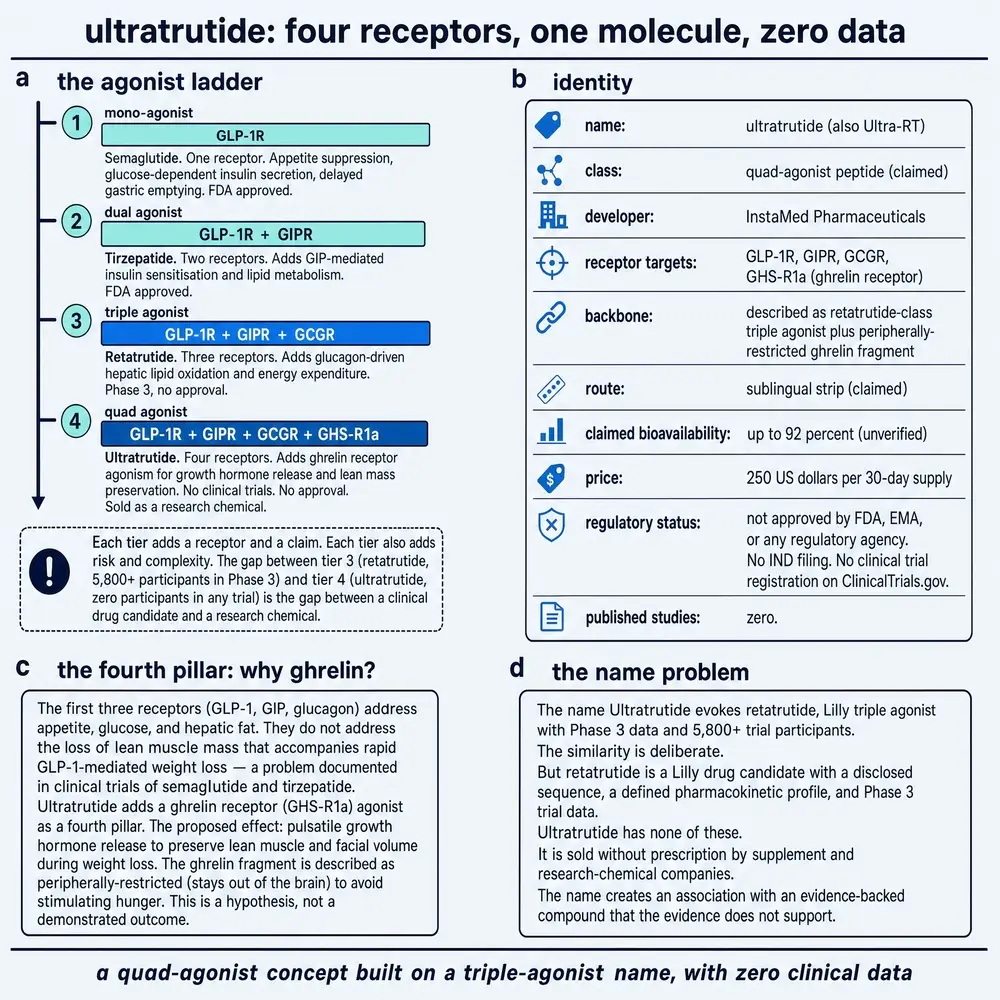
Ultratrutide™ is marketed in the research-chemical trade as an advanced quad-agonist metabolic peptide: one engineered molecule said to engage four distinct receptor systems at once — the receptors for glucagon-like peptide-1 (GLP-1), glucose-dependent insulinotropic polypeptide (GIP), glucagon (GCG), and ghrelin (the growth-hormone secretagogue receptor GHS-R1a). In the language of the vendors who sell it, that four-way design is meant to support comprehensive metabolic investigation, body-composition work, and lean-tissue preservation in laboratory models.
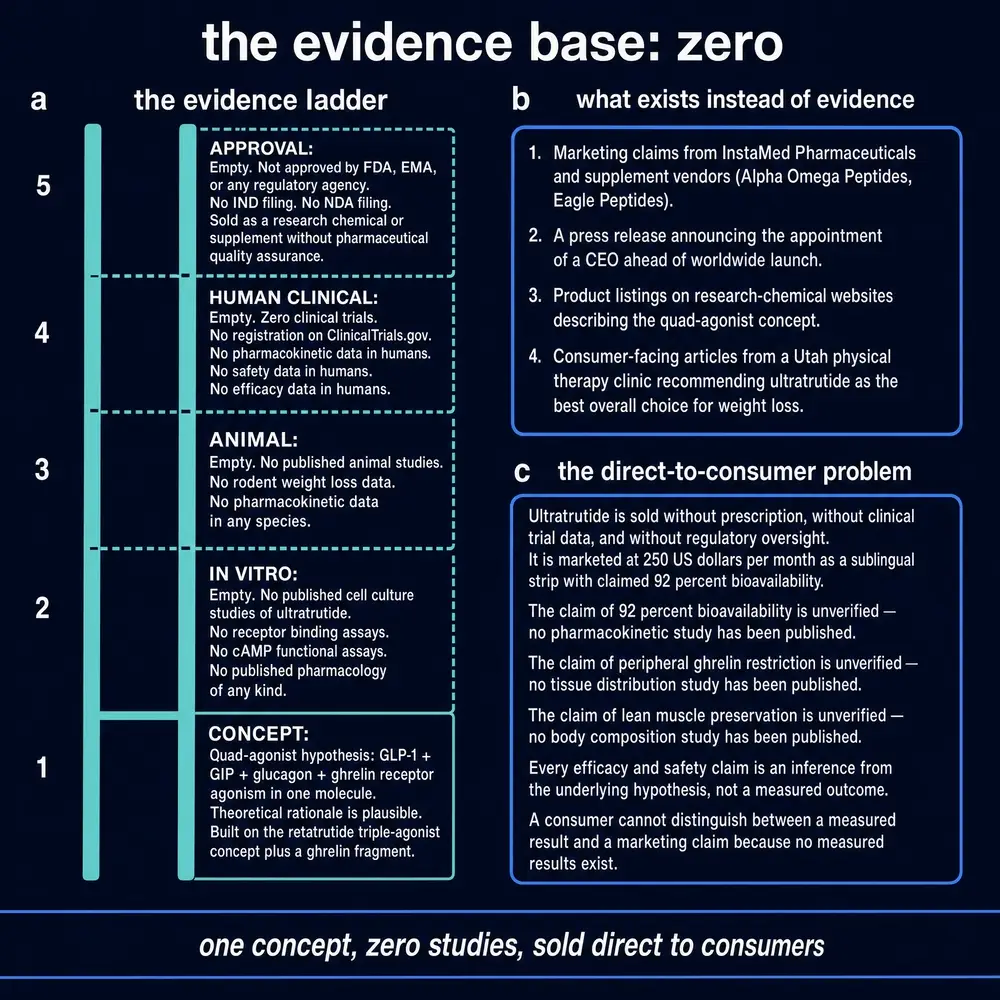
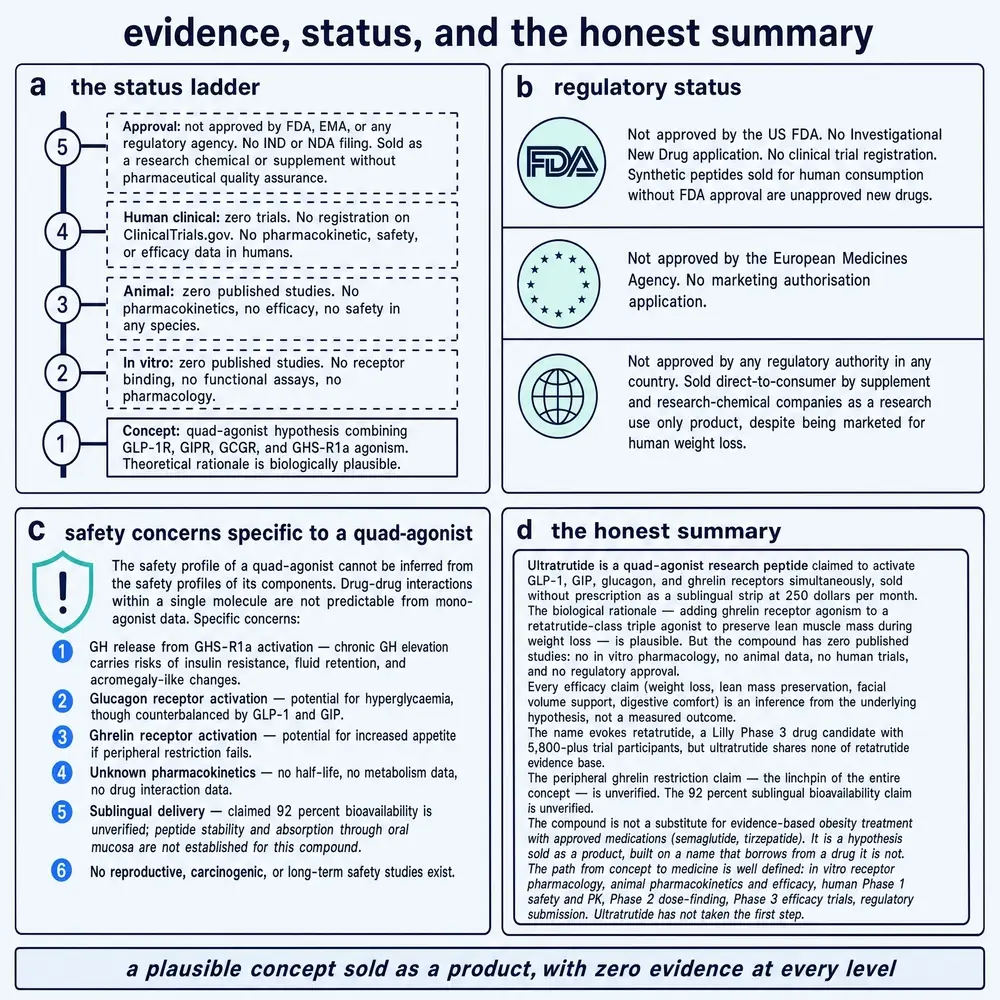
That sentence already contains two things that must be kept apart. The first is a pharmacological idea — that combining incretin, glucagon and ghrelin signalling in one peptide might produce a different quality of weight change than incretin drugs alone. The second is a named commercial object sold under a trademark. The idea has a rich peer-reviewed neighbourhood. The named object, as of this compilation, does not. No PubMed or PubMed Central full text under the word Ultratrutide was found; no CAS registry number, amino-acid sequence, International Nonproprietary Name, or ClinicalTrials.gov record under that name surfaced in the therapeutic-peptide corpus or in a public search performed for this monograph. The compound therefore enters this series not as a late-stage pharmaceutical with a discoverer’s paper trail, but as a research-market construct whose claimed design must be explained, contextualised, and weighed against the biology of its four arms.
The commissioned overview restates the same identity problem as a four-panel plate: the agonist ladder that ends in a research chemical, an identity card that names InstaMed Pharmaceuticals and a claimed sublingual strip, the ghrelin “fourth pillar” as hypothesis, and the deliberate echo of retatrutide in the trademark.
02Why the marketplace does not agree with itself
If you buy Ultratrutide by following different shopfronts, you do not always buy the same story. Eagle Peptides describes a four-receptor peptide that adds ghrelin/GHS-R1a agonism to a “triple-G” incretin-and-glucagon stack, and frames the fourth arm as anabolic support through growth-hormone signalling. Alpha and Omega Peptides, selling Ultra-RT Ultratrutide™, still titles and explains the same brand family as a triple-agonist peptide — GLP-1, GIP and glucagon only — with no ghrelin in the mechanism copy. A clinic marketing page goes further still, claiming a peripherally restricted ghrelin fragment meant to normalise gastric motility and support lean mass without central hunger.
The owner instruction for this monograph, and the Eagle Peptides product narrative, define Ultratrutide™ as a quad-agonist including ghrelin. At least one major Ultra-RT listing still advertises a triple-agonist without ghrelin. Until a peer-reviewed structure or a batch-linked sequence is published, that disagreement is not a footnote — it is part of what the name currently means in the wild.
03The evidence gap, stated before the story
A fair monograph about a thinly documented compound does not pretend the library is full. For Ultratrutide™ the honest opening move is a negative: there is, at compilation, no peer-reviewed discovery paper, no dose–finding trial, no animal efficacy study under that name, and no public sequence that would let an independent laboratory confirm that two vials from two shops contain the same molecule. What does exist is a dense scientific literature on each of the four receptors the name invokes, and a decade-long academic and industrial project that made unimolecular multi-agonism thinkable in the first place. The rest of this document is built from that neighbourhood — always labelled as neighbourhood — and from the design argument the vendors are selling.
04From one hormone to many
Ultratrutide™ did not invent multi-receptor thinking. The intellectual line that made a four-arm peptide sound like a research product rather than a joke runs through university chemistry benches and industrial centres that have already been traced in this series for other compounds. In 2009, Day and colleagues at Indiana University reported a peptide that activated both the glucagon and GLP-1 receptors and, in diet-induced obese mice, drove large losses of fat mass with improved glucose tolerance (Day et al., 2009). Four years later Finan and colleagues described a unimolecular dual incretin — GLP-1 plus GIP — that became the conceptual ancestor of tirzepatide (Finan et al., 2013). In 2015 the same collaboration published a monomeric triagonist with activity at GLP-1, GIP and glucagon receptors, and dissected which arm did what in rodents (Finan et al., 2015). The industrial molecule that carried the triple-agonist idea into large human trials was Eli Lilly’s LY3437943, retatrutide, described from discovery through clinical proof of concept by Coskun and colleagues (Coskun et al., 2022) and later in a phase 2 obesity trial that made the class famous (Jastreboff et al., 2023).
None of those papers is about Ultratrutide™. They are the reason a vendor can say “triple-G plus one more” and be understood. Richard DiMarchi and Matthias Tschöp appear repeatedly on the academic path; Tamer Coskun and colleagues appear on the Lilly clinical path. Ultratrutide has no equivalent named discoverer in the peer-reviewed record. Its origin story, so far as the public literature allows, is a trademarked extension of that design language into the research-chemical market.
05Why anyone would add ghrelin
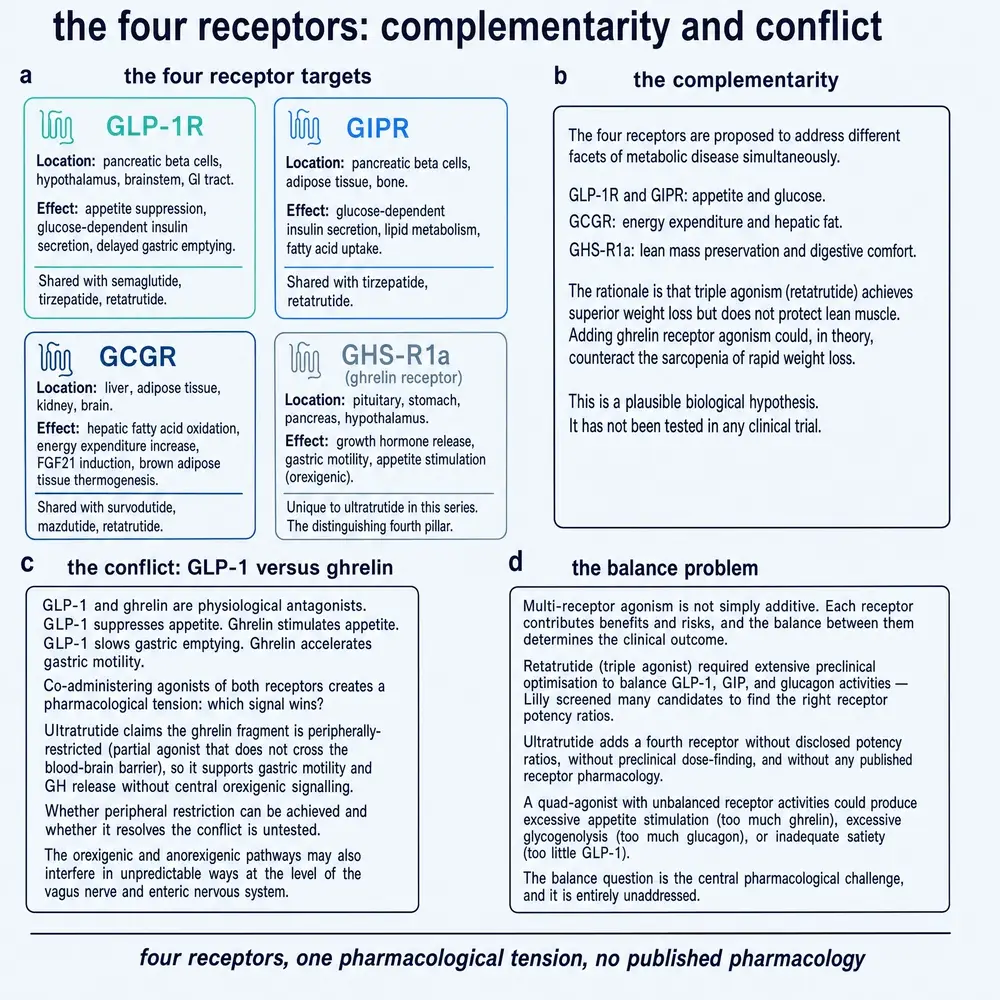
Ghrelin is an odd guest at a weight-loss table. Discovered in 1999 as the endogenous ligand of the growth-hormone secretagogue receptor, it is an acylated stomach peptide that raises growth-hormone release, increases appetite, and speeds gastric emptying (Kojima et al., 1999). GLP-1 receptor agonists do something close to the opposite on two of those axes: they reduce appetite and slow gastric emptying. So why stitch ghrelin signalling into a molecule whose other three arms are borrowed from the obesity pharmacotherapy boom?
Vendor narratives offer two overlapping answers. The first is anabolic: GHS-R1a agonism is said to support pulsatile growth-hormone tone and thereby help investigators study lean-mass preservation while fat mass falls — the “quality of weight loss” problem that has become acute as GLP-1-class drugs remove tens of kilograms (Cigrovski Berkovic et al., 2025). The second is prokinetic: because ghrelin accelerates gastric emptying, a partial agonist at GHS-R1a is advertised on some clinic pages as a counterweight to GLP-1-induced nausea and delayed emptying. Those are different bets. One treats muscle; the other treats tolerability. Neither has been tested, under the Ultratrutide name, in a peer-reviewed trial.
06The pharmacologic paradox
Hold the four arms in one hand and the contradictions become the story. GLP-1 and GIP pull toward satiety and glucose-dependent insulin secretion. Glucagon pulls toward energy expenditure and hepatic fuel mobilisation, at the cost of a glucose-raising tendency that the incretin arms are supposed to cover (Müller et al., 2017). Ghrelin pulls toward hunger, growth hormone, and faster gastric emptying. A successful quad-agonist would have to tune those forces so that appetite still falls, glucose still improves, energy expenditure still rises, and whatever the ghrelin arm is for — muscle, motility, or both — actually appears in the data. On paper that is a beautiful engineering problem. In a vial without a published structure, it is still only a claim.
07Parallel science that is not Ultratrutide
Two neighbouring developments deserve names so they are not mistaken for this compound. In 2025, a Journal of the American Chemical Society paper reported first-in-class unimolecular tetra-agonists with high potency at GLP-1R, GIPR, GcgR and the neuropeptide Y2 receptor — a PYY axis, not ghrelin (Kumar et al., 2025; PMC12560177). That work proves a four-receptor peptide across class B and class A GPCRs can be chemically built; it does not authenticate any research-chemical SKU. Separately, a vendor product called Simplex3 advertises a retatrutide-like backbone with a ghrelin fragment appended by a PEG4 spacer. That is a marketplace cousin of the Ultratrutide pitch, not a synonym and not a clinical package insert.
08GLP-1 and GIP — the dual-incretin lesson
GLP-1 receptor agonism is the backbone of the modern obesity pharmacotherapy boom. In the STEP-1 trial, once-weekly semaglutide produced a mean weight reduction of 14.9 per cent over 68 weeks in adults with overweight or obesity without diabetes, against 2.4 per cent on placebo (Wilding et al., 2021). Adding GIP receptor agonism in tirzepatide pushed the mean further: in SURMOUNT-1, tirzepatide 15 mg produced a 20.9 per cent mean reduction at 72 weeks (Jastreboff et al., 2022). Those are human, phase 3 / phase 3-equivalent results for other named drugs. They establish why any quad-agonist story begins with an incretin pair: the appetite and glycaemic machinery is already proven at industrial scale.
Mechanistically, GLP-1 slows gastric emptying, amplifies glucose-dependent insulin secretion, and signals satiety in the brain. GIP, long dismissed as a weak cousin, turned out — in dual-agonist chemistry — to add metabolic effects that pure GLP-1 agonists did not fully capture, including effects on adipose tissue insulin sensitivity discussed across the dual-agonist literature. For Ultratrutide™, the only legitimate use of these data is as a floor: if the vial truly contains GLP-1R and GIPR activity, one would expect satiety and glycaemic signals in a competent research model. Expectation is not evidence that any particular batch does so.
09Glucagon — the energy-expenditure arm
Glucagon is the design risk that made triple agonists interesting. Its textbook job is to raise blood glucose. Its second life, summarised by Müller and colleagues in a 2017 Physiological Reviews article, includes raising energy expenditure and driving hepatic fat oxidation (Müller et al., 2017). Retatrutide’s clinical and structural programme is the clearest published example of a peptide that tries to keep those benefits while covering the glycaemic cost with GLP-1 and GIP (Coskun et al., 2022; Li et al., 2024; Jastreboff et al., 2023). In that programme, glycated haemoglobin fell rather than rose — the bargain paid, in those trials, for that molecule. Ultratrutide vendors import the bargain by advertising a glucagon arm. They have not published the receipt.
10Ghrelin / GHS-R1a — hunger, GH, motility
Ghrelin physiology is not speculative. The peptide is produced mainly in the stomach, requires octanoylation for full activity at GHS-R1a, and acts on the pituitary, hypothalamus, vagal afferents and gut. In humans and animals it increases food intake and growth-hormone secretion; it also accelerates gastric motility — the property that makes GHS-R agonists interesting as prokinetic agents in other disease contexts. A 2026 review corpus on ghrelin signalling (represented locally by PMC13260137 among others) underscores how broad that receptor’s footprint is: energy homeostasis, glucose handling, and gastrointestinal transit all sit on the same receptor.
In vitro work on GHS-R ligands maps potency, biased signalling and desensitisation — none of it under the Ultratrutide name. In vivo animal studies show that ghrelin agonism can increase body weight when given alone, which is precisely why grafting it onto a weight-loss scaffold is non-obvious. Human physiology studies and limited prokinetic trials of ghrelin mimetics exist in other indications; they are not Ultratrutide trials. The leap from “ghrelin does X” to “Ultratrutide will do X in a balanced way” is exactly the leap this monograph refuses to make.
11Putting four together on paper
A working quad-agonist of the Ultratrutide type would need, at minimum: (1) measurable potency at all four receptors; (2) a balance that does not let ghrelin-driven hunger cancel GLP-1-driven satiety; (3) a glucagon contribution that shows up as energy expenditure or hepatic fat change without undoing glycaemic control; (4) pharmacokinetics compatible with whatever dosing interval a research protocol uses; and (5) a disclosed sequence so batches can be authenticated. Peer-reviewed chemistry has solved analogous problems for other fourth arms — notably Y2R in the 2025 JACS tetra-agonists (Kumar et al., 2025). The research-chemical marketplace has not, in public, solved them for Ultratrutide.
12What published multi-agonists show about fat and lean mass
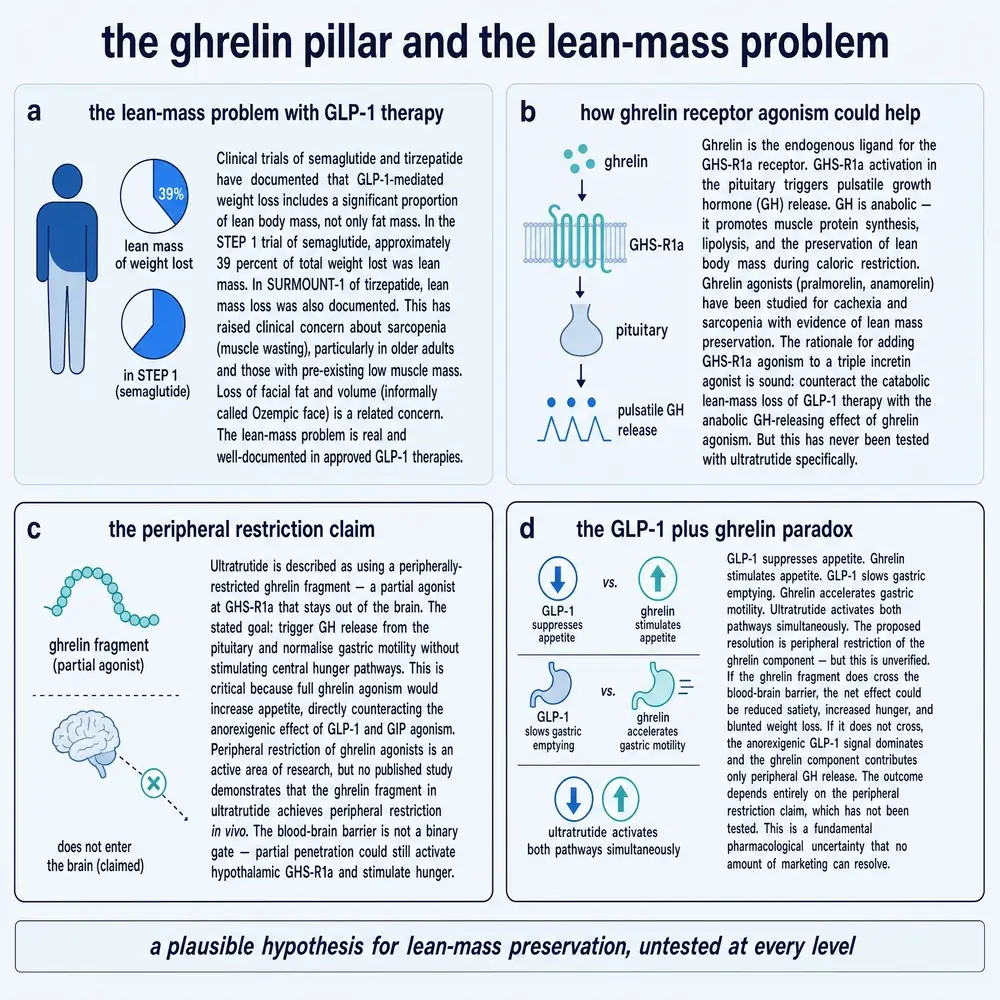
The marketing phrase that travels with Ultratrutide™ — “lean tissue preservation” — is answering a real problem in a neighbouring literature. Large GLP-1-class weight reductions remove fat, but they also remove lean mass. How much lean mass, and whether that loss is clinically costly, is actively debated. A body-composition substudy of retatrutide in people with type 2 diabetes quantified fat-mass and lean-mass change under that triple agonist (Coskun et al., 2025). Reviews aimed at clinicians now treat “saving muscle while losing weight” as a strategic problem for the whole drug class (Cigrovski Berkovic et al., 2025). Those papers are about other compounds. They explain why a fourth arm sold as anabolic support finds buyers. They do not show that Ultratrutide preserves muscle.
13Sarcopenia risk during rapid weight loss
Sarcopenia — accelerated loss of skeletal muscle mass and function — is usually discussed as a geriatric syndrome, but rapid pharmacologically induced weight loss can produce a related concern in mid-life adults: enough lean mass leaves with the fat that strength, resting energy expenditure, and facial soft tissue change in ways patients notice. That is the human story behind Eagle Peptides’ line about studying mitigation of muscle wasting that accompanies rapid metabolic shifts. It is a legitimate research question. It is also, today, a question without an Ultratrutide answer sheet.
Animal models of diet-induced obesity and of cancer- or age-associated cachexia are where one would first look for a four-arm peptide’s effect on myofibre size, grip strength, or lean mass by NMR. No such Ultratrutide study appears in the open literature harvested for this monograph. Until it does, lean-tissue preservation remains a design aspiration attached to a trademark, not a finding.
14Two stories about the same fourth arm
Return to the ghrelin arm with body composition in mind. Story A, the anabolic story, wants GHS-R1a tone high enough to support growth-hormone pulsatility and muscle retention while the incretin–glucagon stack removes fat. Story B, the prokinetic story, wants just enough peripheral GHS-R1a activity to speed the stomach that GLP-1 has slowed, easing nausea without flooding the brain’s hunger circuits. Story A fears sarcopenia. Story B fears dropout. Both can be true of ghrelin biology in the abstract; both can be false of a particular proprietary conjugate; and both can be marketing overlays on vials that still contain, in some shops, a triple-agonist narrative with no ghrelin at all.
Recency and freshness matter when the literature moves fast — the 2025–2026 reviews on muscle preservation and multi-receptor obesity drugs are given weight here. They are not allowed to outrun a preponderance of evidence, and they are never allowed to stand in for Ultratrutide-specific data that do not exist. Where vendor pages conflict, the conflict is the finding.
15Analytical identity: purity claims versus a missing sequence
Research-peptide shopfronts routinely advertise HPLC purity above 99 per cent and mass-spectrometric confirmation. Those certificates, when real, answer a narrow question: is the dominant peak in this vial a single mass consistent with whatever sequence the seller thinks they made? They do not publish that sequence into the peer-reviewed record, and they do not resolve the triple-versus-quad conflict between shopfronts. An independent laboratory that wished to study Ultratrutide™ as a defined chemical entity would need a disclosed primary structure, a validated assay for each of the four claimed receptor activities, and lot traceability. None of that is present in the scientific full-text freeze used here.
16Safety signals that belong to the class
Gastrointestinal adverse effects — nausea, vomiting, diarrhoea, constipation — dominate the tolerability story of GLP-1 receptor agonists and their dual- and triple-agonist descendants. Heart-rate increases appear across several multi-agonists. Gallbladder events and lean-mass loss are active surveillance themes. Those patterns are documented for named, trialled drugs. They are listed here only as class context: anything that truly activated GLP-1R at meaningful potency would be expected to carry gastrointestinal risk into a research model. They are not adverse-event tables from Ultratrutide trials, because those trials were not found.
17Regulatory and marketplace status
Ultratrutide™ is not approved by the FDA, EMA or NMPA for any indication. Vendor pages that discuss it typically carry research-use-only disclaimers and state that the material is not for human or veterinary use. Wholesale cross-reference work inside this workspace previously deferred Ultra-RT Ultratrutide as a trademarked / proprietary GLP variant outside the Radix catalog. Clinic pages that compare Ultratrutide to semaglutide, tirzepatide and retatrutide as if it were a consumer weight-loss option are marketing, not regulatory labelling, and are treated here as T0 sources only.
18Open questions before the name means a molecule
A laboratory that took the Ultratrutide claim seriously would ask, in order: What is the primary sequence and lipidation pattern? What are the EC50 or Ki values at GLP-1R, GIPR, GCGR and GHS-R1a in the same assay panel? Is the ghrelin fragment a full agonist, partial agonist, or biased ligand? Does co-activation reduce food intake in diet-induced obese rodents, or does the ghrelin arm cancel the incretin arm? Does lean mass by NMR diverge from a matched triple-agonist control? Does gastric emptying recover relative to a GLP-1-only control? Are two commercial sources analytically identical? Until those questions have peer-reviewed answers, Ultratrutide™ remains what this monograph has described: a vivid design argument attached to a trademark, standing on four well-studied receptors and on zero Ultratrutide trials.
This document does not recommend that any person use Ultratrutide™, does not describe a human dose or schedule, and does not treat vendor purity claims as clinical safety evidence. Research use only.
Apparatus 1References
Generated from verified NCBI records rather than from recall. Author lists, journal names, volumes, pages and identifiers are taken from the PubMed record for each citation. Vendor and clinic pages that discuss Ultratrutide™ by name are listed separately in REFERENCES.md as T0 sources and are not mixed into this NCBI list.
- Cigrovski Berkovic M, Ruzic L, Cigrovski V, Strollo F. Saving muscle while losing weight: A vital strategy for sustainable results while on glucagon-like peptide-1 related drugs. World journal of diabetes. 2025;16(9):109123.
PMID 40980310 · doi:10.4239/wjd.v16.i9.109123 · PMC12444289 - Coskun T, Urva S, Roell WC, Qu H, Loghin C, Moyers JS. LY3437943, a novel triple glucagon, GIP, and GLP-1 receptor agonist for glycemic control and weight loss: From discovery to clinical proof of concept. Cell metabolism. 2022;34(9):1234-1247.e9.
PMID 35985340 · doi:10.1016/j.cmet.2022.07.013 - Coskun T, Wu Q, Schloot NC, Haupt A, Milicevic Z, Khouli C. Effects of retatrutide on body composition in people with type 2 diabetes: a substudy of a phase 2, double-blind, parallel-group, placebo-controlled, randomised trial. The lancet. Diabetes & endocrinology. 2025;13(8):674-684.
PMID 40609566 · doi:10.1016/S2213-8587(25)00092-0 - Day JW, Ottaway N, Patterson JT, Gelfanov V, Smiley D, Gidda J. A new glucagon and GLP-1 co-agonist eliminates obesity in rodents. Nature chemical biology. 2009;5(10):749-757.
PMID 19597507 · doi:10.1038/nchembio.209 - Finan B, Ma T, Ottaway N, Muller TD, Habegger KM, Heppner KM. Unimolecular dual incretins maximize metabolic benefits in rodents, monkeys, and humans. Science translational medicine. 2013;5(209):209ra151.
PMID 24174327 · doi:10.1126/scitranslmed.3007218 - Finan B, Yang B, Ottaway N, Smiley DL, Ma T, Clemmensen C. A rationally designed monomeric peptide triagonist corrects obesity and diabetes in rodents. Nature medicine. 2015;21(1):27-36.
PMID 25485909 · doi:10.1038/nm.3761 - Goldney J, Hamza M, Surti F, Davies MJ, Papamargaritis D. Triple Agonism Based Therapies for Obesity. Current cardiovascular risk reports. 2025;19(1):18.
PMID 40741227 · doi:10.1007/s12170-025-00770-z · PMC12304053 - Jastreboff AM, Kaplan LM, Frias JP, Wu Q, Du Y, Gurbuz S. Triple-Hormone-Receptor Agonist Retatrutide for Obesity - A Phase 2 Trial. The New England journal of medicine. 2023;389(6):514-526.
PMID 37366315 · doi:10.1056/NEJMoa2301972 - Jastreboff AM, Aronne LJ, Ahmad NN, Wharton S, Connery L, Alves B. Tirzepatide Once Weekly for the Treatment of Obesity. The New England journal of medicine. 2022;387(3):205-216.
PMID 35658024 · doi:10.1056/NEJMoa2206038 - Knerr PJ, Mowery SA, Finan B, Perez-Tilve D, Tschop MH, DiMarchi RD. Selection and progression of unimolecular agonists at the GIP, GLP-1, and glucagon receptors as drug candidates. Peptides. 2020;125:170225.
PMID 31786282 · doi:10.1016/j.peptides.2019.170225 - Kojima M, Hosoda H, Date Y, Nakazato M, Matsuo H, Kangawa K. Ghrelin is a growth-hormone-releasing acylated peptide from stomach. Nature. 1999;402(6762):656-660.
PMID 10481151 · doi:10.1038/45230 - Kumar K. Molecular Design of Unimolecular Tetra-Receptor Agonists. Journal of the American Chemical Society. 2025.
PMID 40461942 · doi:10.1021/jacs.5c04095 · PMC12560177 - Lempesis IG, Dalamaga M. Obesity pharmacotherapy reimagined: The era of multi-receptor agonists and next-generation metabolic modulators, perspectives and controversies. Metabolism open. 2026;30:100463.
PMID 41948476 · doi:10.1016/j.metop.2026.100463 · PMC13051938 - Li W, Zhou Q, Cong Z, Yuan Q, Li W, Zhao F. Structural insights into the triple agonism at GLP-1R, GIPR and GCGR manifested by retatrutide. Cell discovery. 2024;10(1):77.
PMID 39019866 · doi:10.1038/s41421-024-00700-0 · PMC11255275 - Muller TD, Finan B, Clemmensen C, DiMarchi RD, Tschop MH. The New Biology and Pharmacology of Glucagon. Physiological reviews. 2017;97(2):721-766.
PMID 28151403 · doi:10.1152/physrev.00013.2016 - Wilding JPH, Batterham RL, Calanna S, Davies M, Van Gaal LF, Lingvay I. Once-Weekly Semaglutide in Adults with Overweight or Obesity. The New England journal of medicine. 2021;384(11):989-1002.
PMID 33655790 · doi:10.1056/NEJMoa2032183
Apparatus 2How this document was assembled
The library was swept for every open-access scientific full text that mentions Ultratrutide or Ultra-RT by name. That sweep returned zero peer-reviewed full texts. Twenty contextual open-access papers on the four receptor arms and on multi-/tetra-agonist design (≈370 page-equivalents) were frozen into this project. Five commissioned Higgsfield plates from Desktop/MONOGRAPH FIGJRES HIGGSFIELD/ULTRATRUTIDE/ were encoded as WebP data URIs (1900 px, quality 88), A8-audited in assets/higgsfield/MAPPING.md, and interleaved with authored SVG charts in one continuous Figure series.
| Step | What it does | Result |
|---|---|---|
| Name sweep | Ultratrutide / Ultra-RT in scientific full text | 0 papers |
| Contextual freeze | Receptor + multi-agonist OA full texts | 20 texts |
| Extent | Contextual word count ÷ 500 | ≈370 pages |
| Plates | Commissioned Higgsfield art, A8-audited | 5 plates |
| References | Verified NCBI records (context compounds) | 16 citations |
Apparatus 3Evidence handling
Findings are labelled by the kind of study that produced them. Animal and in-vitro findings are named as such and are never phrased so as to imply a human outcome. Results belonging to retatrutide, tirzepatide, semaglutide or the 2025 JACS tetra-agonists are named as those compounds. Vendor claims about Ultratrutide™ are never promoted to the same tier. Where shopfronts disagree on triple versus quad agonism, the disagreement is reported.
The largest single limitation of this document is structural: Ultratrutide™ has no peer-reviewed discovery paper, sequence, or controlled trial under that name at compilation.
Continue exploring