
Mazdutide The drug that put the second hormone back in — a GLP-1/glucagon dual agonist, and the first of its kind approved anywhere
For fifteen years the obesity field chased a single gut hormone. Mazdutide is a manufactured copy of a different one — oxyntomodulin, which the body had already built as a two-receptor molecule — re-engineered to last a week. Adding the glucagon receptor did the counterintuitive thing: a hormone that raises blood sugar was associated with more weight lost and, more strikingly, with fat draining out of the liver. In June 2025 it became the first GLP-1/glucagon dual agonist approved anywhere in the world. Its story is also a record of how a Western molecule became a Chinese medicine.
Every finding here is labelled by the kind of study that produced it, in the sentence that reports it. A result in mice is called a result in mice; a cell-free binding measurement is called that; a conference abstract, a case report of one patient and a peer-reviewed phase 3 trial are not given the same weight, and the difference is stated rather than implied. Amounts and durations appear only as parameters of the trials in which they were tested, always with the population studied.
Nothing in this document is a recommendation. Mazdutide is a prescription medicine in the one jurisdiction that has approved it, and the approval is narrower than the research literature around it. Where the evidence is thin, conflicting or absent, the monograph says so instead of rounding up.
01The co-agonist the body built first
Somewhere in the wall of the small intestine, within minutes of a meal arriving, an enteroendocrine L-cell cuts up a large precursor protein called proglucagon and releases the pieces into the blood. One of those pieces is glucagon-like peptide-1, the molecule that has dominated metabolic medicine for a decade. Another is oxyntomodulin, which almost nobody outside the field can name.
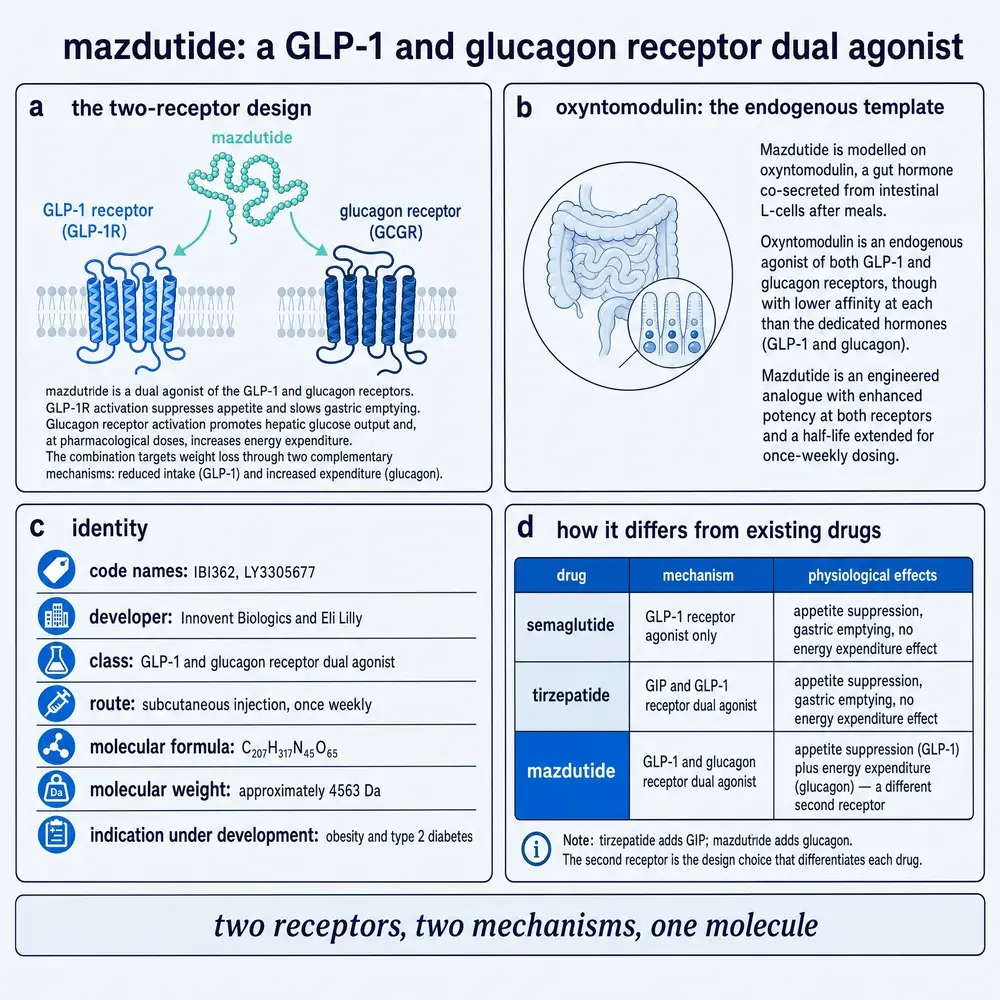
Oxyntomodulin is the more interesting of the two, for a structural reason. Where GLP-1 speaks to a single receptor, oxyntomodulin carries the entire glucagon sequence inside it, extended at one end, and it activates both the GLP-1 receptor and the glucagon receptor at once (Hope et al., 2021). It is, natively, a dual agonist. The two arms of that activity pull in different directions and, in the intact animal, the sum is not what either arm predicts: the GLP-1 arm suppresses appetite and slows the stomach, while the glucagon arm mobilises hepatic fuel and raises energy expenditure. The gut had assembled a two-receptor weight-regulating signal long before any laboratory tried to design one.
The reason it never became a drug is prosaic. Native oxyntomodulin is destroyed within minutes. Dipeptidyl peptidase-4, an enzyme that clips two residues from the front of peptides in this family, dismantles it almost as fast as the intestine can make it, so its physiological signal is a pulse rather than a state. To turn that pulse into a therapy required not new biology but new chemistry — and that is very nearly the whole of mazdutide's design story.
The other reason is conceptual, and less obvious. For most of the period in which GLP-1 was becoming a drug target, glucagon was the enemy. It is the hormone of the fasting state; it raises blood glucose; in type 2 diabetes it is inappropriately high. An entire parallel research programme was devoted to blocking the glucagon receptor. Proposing to activate it, in the same patients, to treat the same disease, required an argument that the field did not initially have.
02Why one receptor was never going to be enough
The argument arrived from human physiology, in 2006. Katherine Wynne and colleagues at Hammersmith Hospital gave subcutaneous oxyntomodulin to overweight and obese volunteers in a randomised controlled trial and measured not only what they ate but what they burned. Oxyntomodulin increased energy expenditure in addition to decreasing energy intake (Wynne et al., 2006). That is a small human trial of a short-acting native peptide, and it should not be read as evidence about any modern drug. What it established was narrower and more durable: in people, the second arm did something the first arm does not.
Why that matters requires understanding the ceiling that appetite suppression runs into. Reduce intake and the body reduces expenditure to match. Resting metabolic rate falls as mass is lost, and it falls further than the loss of tissue alone would predict. Weight loss curves flatten, then reverse. A drug that only closes the intake side of the ledger is working against an adaptation that opens on the other side. A molecule that suppresses appetite and raises expenditure is, in principle, attacking both terms — which is why the co-agonist idea has sometimes been described as pharmacologically imitating diet plus exercise rather than diet alone (Hope et al., 2021).
The catch is the one the field started with. Glucagon raises blood glucose through hepatic glycogenolysis and gluconeogenesis. Give too much glucagon agonism relative to GLP-1 agonism and the drug will worsen the disease it is meant to treat; give too little and the metabolic bonus disappears and one is left with an ordinary GLP-1 agonist carrying an extra liability. The whole of co-agonist pharmacology lives inside that ratio, which is why the design objective is usually stated as balance rather than potency (Sánchez-Garrido et al., 2017; Hope et al., 2021).
03One peptide, two activities: the unimolecular idea
Two routes lead to dual receptor activation. The obvious one is to give two drugs. The other is to build a single molecule whose sequence satisfies both receptors at a chosen ratio — a unimolecular co-agonist — so that both activities share one pharmacokinetic profile, one distribution and one injection. The second route is harder chemistry and much better pharmacology, because a ratio designed into a molecule cannot drift the way a ratio between two co-administered drugs can.
The animal proof came in 2009. Alessandro Pocai and colleagues at Merck showed that dual GLP-1/glucagon receptor agonism reversed obesity in mice, and that the glucagon component was contributing rather than merely being tolerated (Pocai et al., 2009). That is a rodent result, and it settled a question of principle rather than of practice: the combination was not simply GLP-1 with a handicap.
The engineering programme that made the principle usable ran largely through Richard DiMarchi's laboratory at Indiana University in collaboration with Matthias Tschöp, Brian Finan and colleagues. Their method was to take the shared backbone of the glucagon-family peptides and tune it deliberately — substituting residues to raise one receptor's affinity or damp another's, adding non-natural amino acids to defeat degrading enzymes, and hanging a fatty acyl chain on the peptide so that it binds circulating albumin and is released slowly. In 2013 the group reported unimolecular dual incretins that maximised metabolic benefit across rodents, monkeys and humans (Finan et al., 2013). In 2015 they published a rationally designed monomeric peptide triagonist — a single chain balancing GLP-1, GIP and glucagon activity — that corrected obesity and diabetes in rodents (Finan et al., 2015). Both are animal-and-early-human reports; their importance is that they established peptide multi-agonism as a design discipline with named levers rather than a lucky find. The catalogue of those levers, and of the candidates that came out of them at the GIP, GLP-1 and glucagon receptors, was set out by Knerr and colleagues (Knerr et al., 2020).
Mazdutide belongs to this lineage without being any of its published exemplars. It is an oxyntomodulin-based dual agonist that originated inside Eli Lilly, in a company that had spent a decade building exactly this competence, and it inherits the lineage's central commitment: not the strongest signal at either receptor, but a chosen ratio between them.
04Three edits to a gut hormone
Stated at the level a non-chemist can hold, mazdutide is an oxyntomodulin backbone with three modifications, each solving one problem.
The first problem is the enzyme. Dipeptidyl peptidase-4 attacks near the peptide's N-terminus, and the standard countermeasure is to replace the second residue with α-aminoisobutyric acid, a non-natural amino acid whose extra methyl group makes the site unrecognisable to the enzyme without abolishing receptor binding. The second problem is clearance. A fatty diacid chain is attached to a lysine side chain through a short spacer; the chain binds albumin, the most abundant protein in plasma, and the peptide travels the circulation as a reversible passenger rather than as free drug, which slows both filtration and degradation. The third is stability of the C-terminal end, protected by amidation. Nothing here is exotic; it is the same toolkit used across the modern long-acting peptides. What is unusual is the target of the tuning: a sequence chosen to hit two receptors at a set ratio rather than one receptor as hard as possible.
The trial reports describe mazdutide simply as an oxyntomodulin analogue carrying a fatty-acyl moiety to extend its half-life (Ji et al., 2021). The residue-level details in the table below — the position of the Aib substitution, the C20 diacid, the linker chemistry, the molecular formula and mass — come from chemical-supplier and database records rather than from a primary structural publication, and are marked as such. They are consistent with the published description but they carry a different evidential weight, and a reader should treat the identity block as characterisation rather than as a peer-reviewed structural determination.
| Identity field | Value | Source class |
|---|---|---|
| International non-proprietary name | Mazdutide | Peer-reviewed trial reports |
| Development codes | IBI362 (Innovent); LY3305677 (Eli Lilly) | Peer-reviewed trial reports |
| Class | GLP-1 receptor / glucagon receptor dual agonist; oxyntomodulin analogue | Peer-reviewed trial reports |
| Backbone | Oxyntomodulin-based peptide, approximately 33–34 residues | Supplier / database record |
| Enzyme-resistance edit | α-aminoisobutyric acid at position 2 | Supplier / database record |
| Half-life extension | C20 fatty diacid at Lys-20 via an AEEA–AEEA–γGlu linker; albumin binding | Supplier / database record, consistent with Ji et al. (2021) |
| C-terminus | Amidated | Supplier / database record |
| Molecular formula | C210H322N46O67 | Supplier / database record |
| Molecular mass | ≈ 4,563 Da | Supplier / database record |
| CAS registry number | 2259884-03-0 | Supplier / database record |
| Administration in trials | Subcutaneous, once weekly | Peer-reviewed trial reports |
What the tuning achieved can be read off cell-based measurements. In in-vitro assays reported by Lilly at the American Diabetes Association's 2021 meeting, the compound bound the human glucagon receptor with an inhibition constant of about 17.7 nM and the human GLP-1 receptor at about 28.6 nM, with corresponding mouse values of 15.9 and 25.1 nM; it stimulated insulin secretion from isolated mouse islets with a half-maximal effective concentration near 5.2 nM (Chen et al., 2021). Those are cell-free and isolated-tissue numbers from a conference abstract, not clinical measurements, and the ratio between them matters more than either value: the two affinities are within a factor of two of each other, which is what "balanced" means in this context. The practical consequence is that the GLP-1 arm's glucose-lowering is expected to offset the glucagon arm's tendency to raise glucose — a design assumption that only human trials could test.
05What the mice showed, and then the first humans
The preclinical package for LY3305677 was reported by Lilly at the 2021 American Diabetes Association meeting, and it is the most quotable set of results in the compound's history — which is a reason to state its limits first. It is an abstract, not a full paper; the experiments were in mice; and the comparator's dose selection in such experiments determines much of the headline. With that stated: in diet-induced obese mice, the compound reduced body weight by roughly 33 per cent against roughly 12 per cent for semaglutide, lowered liver triglycerides by more than 70 per cent, raised fibroblast growth factor 21 and serum ketones, and increased energy expenditure — which semaglutide, in the same experiments, did not (Chen et al., 2021).
The most informative part of that abstract is not the weight number but a genetic control. The compound retained weight-lowering activity in mice lacking the glucagon receptor and in mice lacking the GLP-1 receptor (Chen et al., 2021). Knock out either arm and the drug still works through the other. That is the cleanest available demonstration that both receptors are contributing, rather than the glucagon component being pharmacological decoration on a GLP-1 agonist. It is also, again, a mouse experiment; nothing about it establishes the same partition of effect in people.
Human exposure began with a single-ascending-dose study in healthy volunteers, reported by Tham and colleagues: 48 participants across a range from 0.03 to 5 mg, with gastrointestinal adverse events that rose with dose and were mostly mild, a transient rise in heart rate, and a half-life of 7.5 to 9.8 days that made weekly administration plausible. Body weight fell 2.4 kg at the highest dose tested against 0.5 kg on placebo by day 8, and the separation persisted to day 29 (Tham et al., 2021). These are conference-abstract data in healthy volunteers, and single-dose weight change in healthy people is a pharmacodynamic signal rather than a clinical outcome.
A multiple-ascending-dose study in healthy participants and people with type 2 diabetes followed, reported by Benson and colleagues in abstract form. In the diabetes cohorts, glycated haemoglobin fell by 1.56 to 2.16 percentage points against 0.43 to 0.70 on placebo, with weight changes of 2.30 to 11.24 kg over twelve to sixteen weeks (Benson et al., 2022). The width of that weight range across cohorts is worth noticing: it is the first hint that the compound's effect on weight was strongly dose-dependent, and it is the reason the subsequent Chinese programme was built as a dose ladder rather than a single-dose confirmation.
06How a Western molecule became a Chinese medicine
In 2019 Eli Lilly licensed the molecule to Innovent Biologics for development and commercialisation in Greater China — mainland China, Hong Kong, Macau and Taiwan — retaining rights elsewhere. Under Innovent it was designated IBI362 and later received the international non-proprietary name mazdutide. Lilly has continued its own work outside China (Shirley, 2025).
The consequence is that essentially the entire clinical evidence base for this drug was generated in Chinese participants, at Chinese centres, under one principal investigator: Linong Ji of Peking University People's Hospital, whose name is on the phase 1b studies, the phase 2 trial and the phase 3 registration trial. That is unusual for a molecule of Western origin, and it has two consequences that run in opposite directions.
The first is scientific fit. Obesity in China is diagnosed at lower thresholds than the World Health Organization's, because at any given body mass index Chinese populations tend to carry more body fat and more cardiovascular risk than white populations; the national cut-offs are 24 kg/m² for overweight and 28 kg/m² for obesity (Ji et al., 2023). A programme designed around those thresholds is answering a question about the population it enrolled, and the prevalence of general obesity in China roughly tripled between 2004 and 2014 (Ji et al., 2021). The drug was developed where the epidemiological need was rising fastest.
The second consequence is the limitation that follows from the same fact, and it is raised again in Part Five: a coherent, well-run programme in one population is not evidence about other populations, and no amount of internal consistency substitutes for external replication.
07Climbing the dose ladder
The Chinese programme was built in the orderly way, and the orderliness is the point: each study asked one question, and each answer set the dose range for the next.
The first was a multiple-ascending-dose phase 1b trial in 36 adults with overweight or obesity, randomised to cohorts receiving 3, 4.5 or 6 mg weekly, or placebo, for twelve weeks (NCT04440345). Mean body weight fell 4.81, 6.40 and 6.05 per cent across the three cohorts against a 0.60 per cent gain on placebo; 54.2 per cent of treated participants lost at least five per cent of their body weight, against none on placebo. Uric acid, lipids, liver transaminases and blood pressure all fell. There were no serious adverse events and no discontinuations for safety; the cardiac adverse events recorded were mild, asymptomatic and detected on electrocardiography rather than clinically (Ji et al., 2021). A 36-person study cannot establish efficacy, and the investigators did not plan formal hypothesis testing between cohorts. What it established was that the balance held: a glucagon receptor agonist given to people with obesity had not raised their glucose.
The diabetes question was asked directly in a parallel phase 1b trial of 43 patients with type 2 diabetes, comparing the same three doses against placebo and against open-label dulaglutide, a conventional weekly GLP-1 receptor agonist, over twelve weeks (NCT04466904). Glycated haemoglobin, fasting plasma glucose and post-meal glucose all fell with mazdutide, and gastrointestinal adverse events were comparable to those with dulaglutide (Jiang et al., 2022). The comparison was open-label and the study was not powered for superiority, so it is best read as a tolerability and proof-of-concept result rather than a competitive one.
Then the ceiling was probed. A further phase 1b study took 24 adults to 9 mg over twelve weeks and 10 mg over sixteen weeks. Twelve-week weight loss reached approximately 11.7 per cent at 9 mg; all treatment-emergent adverse events were mild or moderate and none was serious (Ji et al., 2022). This is the study that opened the higher-dose development track for moderate-to-severe obesity, and it is worth noting how small it is — 24 people — against how frequently its headline number is quoted.
The phase 2 trial is where the compound became a serious candidate. Two hundred and forty-eight Chinese adults with overweight or obesity were randomised to 3, 4.5 or 6 mg weekly or placebo for 24 weeks (NCT04904913). Weight fell 6.7, 10.4 and 11.3 per cent respectively against a 1.0 per cent gain on placebo, with treatment differences from −7.7 to −12.3 percentage points and p < 0.0001 throughout. At 24 weeks, 58.1, 82.5 and 80.3 per cent of participants had lost at least five per cent of body weight against 4.8 per cent on placebo, and 19.4, 49.2 and 50.8 per cent had lost at least ten per cent against none on placebo (Ji et al., 2023).
Around the weight numbers, a broad set of measures moved together: waist circumference, systolic and diastolic blood pressure, high-sensitivity C-reactive protein, glycated haemoglobin, fasting plasma glucose, insulin resistance measured by the homeostasis model, lipids, alanine aminotransferase, and serum uric acid. A subset scanned by dual-energy X-ray absorptiometry lost more fat mass than lean mass and reduced visceral fat (Ji et al., 2023). Three findings in the same trial cut the other way and are reported here rather than later: heart rate rose by 5.82 to 8.75 beats per minute; anti-drug antibodies appeared in 22.6 to 32.8 per cent of participants in a dose-related pattern; and weight, blood pressure and waist circumference partially rebounded by week 36, twelve weeks after treatment stopped.
08GLORY-1
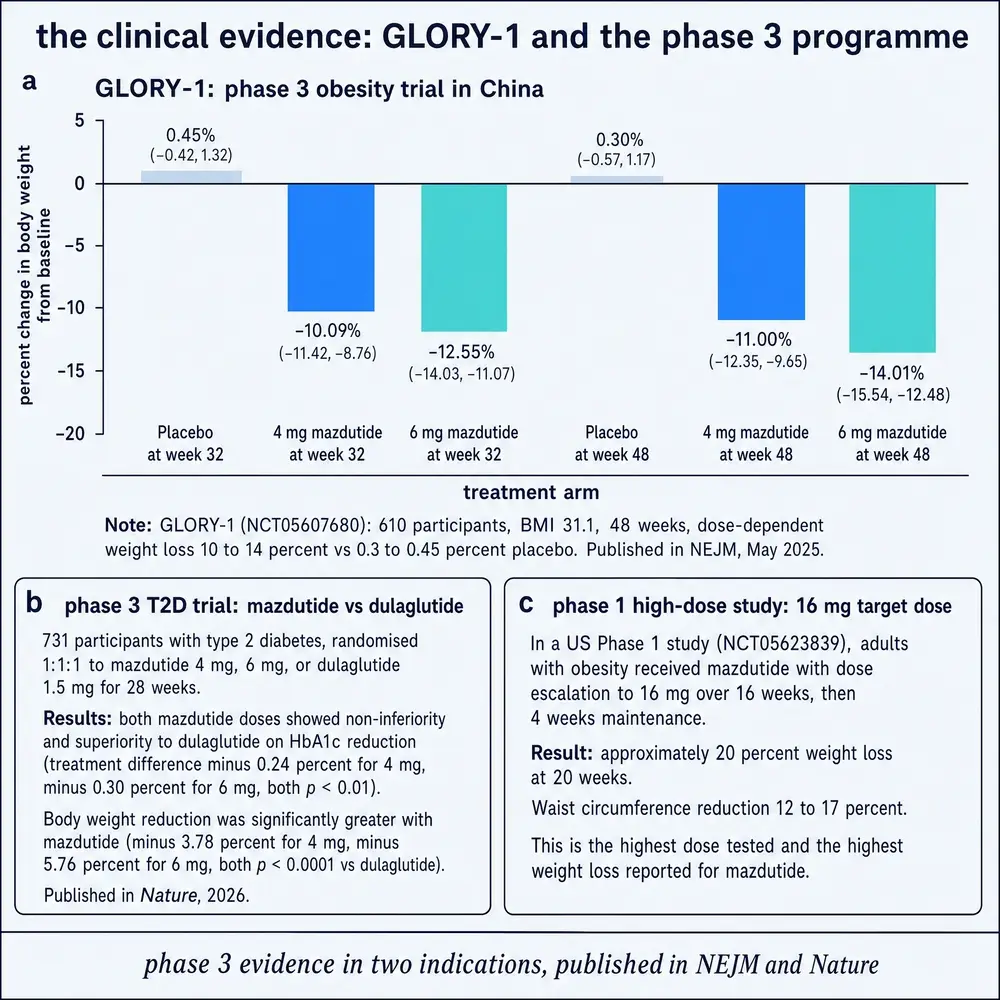
The registration trial reported in the New England Journal of Medicine in 2025 enrolled 610 Chinese adults with a body mass index of at least 28, or between 24 and 28 with at least one weight-related comorbidity, randomised to 4 mg, 6 mg or placebo for 48 weeks. Mean baseline weight was 87.2 kg at a mean body mass index of 31.1 (Ji et al., 2025).
At week 32, the primary time point, weight fell 10.09 per cent on 4 mg and 12.55 per cent on 6 mg, against a 0.45 per cent gain on placebo; 73.9 and 82.0 per cent of the two treatment groups had lost at least five per cent of their body weight, against 10.5 per cent on placebo. By week 48 the curves had continued to separate: 11.00 and 14.01 per cent weight loss against a 0.30 per cent gain, with 35.7 and 49.5 per cent of participants losing at least fifteen per cent of body weight against 2.0 per cent on placebo, all comparisons at p < 0.001. Waist circumference fell 9.48 and 10.96 cm against 1.48 cm. Every prespecified cardiometabolic measure moved in the beneficial direction (Ji et al., 2025).
The number that deserves as much attention as the weight figures is the discontinuation rate. Treatment was stopped for adverse events in 1.5 per cent of the 4 mg group, 0.5 per cent of the 6 mg group and 1.0 per cent of the placebo group (Ji et al., 2025). Gastrointestinal events were the most common adverse effects and were concentrated during dose escalation, but almost nobody left the trial because of them, and fewer people left the higher-dose group than left placebo. In a drug class where tolerability determines whether a prescription becomes a course of treatment, a discontinuation rate below one per cent at the effective dose is a substantive result rather than a footnote. It is also a 48-week result in a trial population, which is not the same as persistence in ordinary care.
| GLORY-1 endpoint | 4 mg | 6 mg | Placebo |
|---|---|---|---|
| Body weight, week 32 (% change) | −10.09 | −12.55 | +0.45 |
| Body weight, week 48 (% change) | −11.00 | −14.01 | +0.30 |
| Lost ≥5% of body weight, week 32 (%) | 73.9 | 82.0 | 10.5 |
| Lost ≥15% of body weight, week 48 (%) | 35.7 | 49.5 | 2.0 |
| Waist circumference, week 48 (cm) | −9.48 | −10.96 | −1.48 |
| Discontinued for adverse events (%) | 1.5 | 0.5 | 1.0 |
09The liver result
Among GLORY-1 participants who entered the trial with elevated liver fat, an exploratory analysis reported that liver-fat content fell 80.2 per cent on 6 mg against 5.3 per cent on placebo (Ji et al., 2024). Two qualifications belong in the same breath as the number. It is an exploratory analysis of a subgroup defined after the fact of enrolment, reported at a conference rather than in the trial's primary publication, and liver fat is an imaging measurement rather than a clinical outcome: nothing here demonstrates a change in steatohepatitis, fibrosis, cirrhosis or any event a patient would notice.
With those stated, the finding is not a surprise, and that is the interesting part. The glucagon receptor is expressed densely on hepatocytes, where glucagon signalling drives fatty-acid oxidation and lipid export. A drug that deliberately activates that receptor should drain hepatic fat, and in the animal work it did: liver triglycerides fell by more than 70 per cent in obese mice (Chen et al., 2021), and a related GLP-1/glucagon dual agonist reduced disease features in a mouse model of steatohepatitis (Nestor et al., 2022). Effects of this size on liver fat are the one place where the co-agonist mechanism makes a prediction that a pure GLP-1 agonist does not, and where the human data, exploratory as they are, point the way the mechanism said they would. Innovent has stated that metabolic dysfunction-associated steatotic liver disease is among the indications under study (Shirley, 2025); until those trials report, the liver story is a strong mechanistic hypothesis with one supportive imaging analysis behind it.
10The uric-acid signal, and the pooled picture
One result recurs across the programme in a way that is unusual for this drug class. Serum uric acid fell in the first phase 1b trial, where the comparison was prespecified as a post-hoc analysis (Ji et al., 2021), and again in the phase 2 trial as a secondary endpoint (Ji et al., 2023). Uric acid is not a routine incretin endpoint, and its consistent movement here has been treated as one of mazdutide's distinguishing signals. It should be read carefully: falling uric acid accompanies weight loss generally, and none of these trials was designed to determine whether the effect exceeds what the weight loss alone would produce, or whether it translates into fewer episodes of gout. What can be said is that the signal is consistent across studies and was large enough to be measured.
Pooling gives the broader shape. A systematic review and meta-analysis of seven randomised controlled trials totalling 680 participants found a mean body-weight difference of −6.22 per cent (95% confidence interval −8.02 to −4.41), with systolic blood pressure down 7.57 mmHg, diastolic down 2.98 mmHg, total cholesterol down 16.82 per cent, triglycerides down 43.29 per cent, low-density lipoprotein cholesterol down 17.07 per cent and high-density lipoprotein cholesterol down 7.54 per cent; glycated haemoglobin and fasting plasma glucose fell in participants with type 2 diabetes. Weight loss was greater in participants without diabetes and with longer, 24-week treatment, and transient mild-to-moderate gastrointestinal effects were more frequent than on placebo (Nalisa et al., 2024).
Two features of that pooled estimate deserve comment. The mean weight difference of 6.22 per cent is smaller than any single headline number quoted earlier in this document, because the pool is dominated by short trials at low doses; a meta-analysis of a dose-ranging programme averages across the ladder rather than reporting its top rung. And the fall in high-density lipoprotein cholesterol runs in the direction usually described as unfavourable, sitting inside a lipid panel that otherwise improves — an inconsistency the pooled analysis reports without resolving. Both are reasons to treat the meta-analysis as a description of the early evidence base rather than as a summary of what the drug does at the doses that were subsequently approved.
A separate feature of the programme belongs here rather than in a later section, because it bears on how these numbers should be read. Innovent reports seven phase 3 trials. GLORY-2 (NCT06164873) is testing 9 mg in adults with a body mass index of at least 30, in roughly 450 participants with a week-60 primary endpoint; DREAMS-2 compares mazdutide against dulaglutide in type 2 diabetes, with greater reductions in glycated haemoglobin and weight reported; DREAMS-3 (NCT06184568) compares it against semaglutide in obesity with early type 2 diabetes. Additional indications under study include metabolic dysfunction-associated fatty liver disease, obstructive sleep apnoea and alcohol use disorder (Shirley, 2025). Registration of a trial is not a result, and none of these has been published in full at the time of writing. They are listed because the comparative questions that the existing evidence cannot answer — how mazdutide performs against the drugs it will actually be prescribed alongside — are the questions these trials were designed to settle.
11Energy expenditure, honestly bounded
The distinctive claim about mazdutide is not that it produces weight loss. Several drugs do that, and two of them do it in more people, in more countries, with longer records. The distinctive claim is about how.
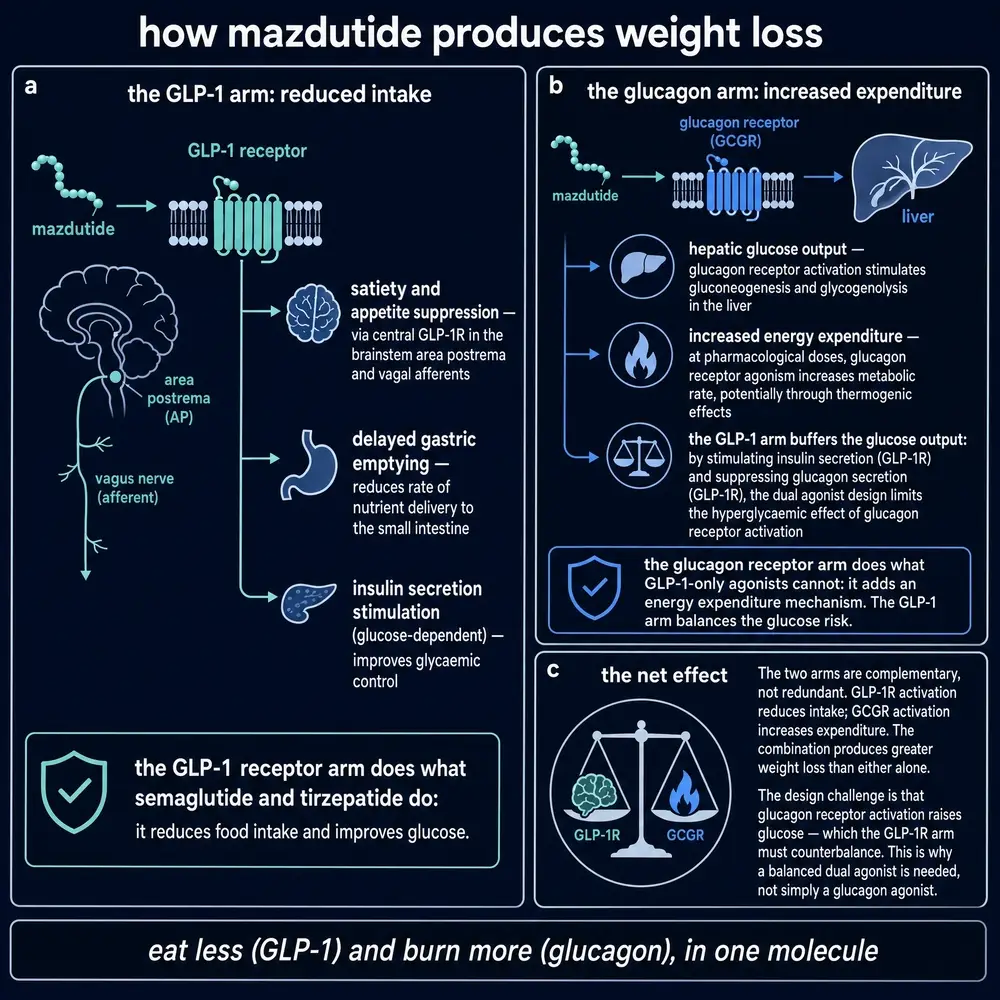
Set out at full strength, the mechanistic case runs like this. The GLP-1 arm reduces appetite, slows gastric emptying and augments glucose-dependent insulin secretion. The glucagon arm increases hepatic lipid oxidation, induces fibroblast growth factor 21 and raises energy expenditure. Together they act on both sides of the energy balance equation instead of one, which is why the combination is sometimes described as pharmacologically imitating diet and exercise rather than diet alone (Ji et al., 2021; Hope et al., 2021).
Now set out what supports each part of it. The appetite side is supported by a phase 3 trial with 610 participants and a regulatory approval. The expenditure side is supported by indirect calorimetry in mice, in a conference abstract (Chen et al., 2021), and by a randomised human trial of native oxyntomodulin from 2006 that tested a different molecule with a duration of minutes rather than days (Wynne et al., 2006). No published human study of mazdutide has measured energy expenditure directly. The knockout experiments establish that both receptors contribute to weight loss in mice; they do not establish that the glucagon arm's contribution in people is made through expenditure rather than through some further effect on appetite, hepatic substrate flux or nausea.
The honest position is therefore asymmetric, and it is worth stating in full because the asymmetry is easy to lose. The existence of a second receptor arm is well-supported, in animals genetically and in humans by the clinical signals that track glucagon biology — the hepatic fat reduction, the rise in heart rate, the ketone and fibroblast growth factor 21 changes in mice. The mechanism by which that arm produces additional weight loss in humans is inferred, not measured. Both statements can be true at once, and a monograph that reported only the first would be selling the compound rather than describing it.
12The brain, in mice
The largest single study of mazdutide in the reading corpus is not a trial. It is a 2025 preclinical paper in eBioMedicine that asked whether the dual agonist does anything for the cognitive decline that accompanies type 2 diabetes, using male db/db mice — a leptin-receptor-deficient strain that develops obesity, hyperglycaemia and measurable cognitive deficits — with dulaglutide as an active comparator (Dong et al., 2025).
Everything in this section is a result in male mice. The authors say so explicitly: females were excluded because hormonal variation affects behavioural testing, so the findings apply to male animals only. There is no human cognitive data for this compound at all.
With that fixed: mazdutide-treated animals performed better than dulaglutide-treated animals across behavioural tests of spatial learning and memory, including the Morris water maze and its reversal variant, and lost more weight in the process — 18.3 per cent against 10.8 per cent. Histology showed better-preserved neuronal structure, more Nissl bodies and NEUN-positive cells, less demyelination, and greater hippocampal dendritic spine density. Then the study went looking for a reason, integrating transcriptomics, proteomics and metabolomics from brain tissue, and converged on glutamatergic signalling: the vesicular glutamate transporter VGlut2, encoded by Slc17a6, was implicated in the deficit, and mazdutide was associated with restoring the balance between excitatory and inhibitory neurotransmission through VGlut2 downregulation and altered NMDA and GABA receptor signalling. The pathways that separated mazdutide from dulaglutide were those of neurotransmission, oxidative stress and neuroinflammation, which the authors attribute to the glucagon receptor arm (Dong et al., 2025).
What to make of it. Multi-omics studies generate hypotheses efficiently and confirm them poorly; pathway enrichment across three data layers in three animals per group is a direction, not a demonstration. The authors themselves note that whether mazdutide crosses the blood-brain barrier remains to be established, which is a substantial gap in a mechanistic story about central neurotransmission. And a comparison in which the better-performing drug also produced substantially more weight loss cannot separate a direct neural effect from the consequences of better metabolic control. The paper is included here because it is a real and substantial piece of work that names a specific molecular target, and because the reason it is interesting — that adding the glucagon receptor might do something in the brain that GLP-1 agonism alone does not — is exactly the kind of claim that gets repeated without its species label attached.
13Two edges of the evidence
The first edge is an individual. In 2025 a group in Luoyang published a single case: a 15-year-old boy with obesity at a body mass index of 30.64, type 2 diabetes with a glycated haemoglobin of 9.60 per cent, and hyperuricaemia, treated with escalating mazdutide alongside metformin and insulin for 36 weeks. Over that period he lost 16.8 kg, an 18.89 per cent reduction in body mass index; uric acid fell 37.0 per cent, glycated haemoglobin 21.88 per cent and triglycerides 69.02 per cent, and hepatic steatosis had resolved on imaging by week 14, with no hypoglycaemia and no adverse events reported (Cheng et al., 2025).
It is one patient. A case report cannot support any inference about how often that outcome occurs, in whom, or whether the drug caused it; the patient was receiving two other glucose-lowering agents concurrently, and adolescents were not enrolled in any of the trials described in this document. The 2026 Chinese comparative evaluation notes that among long-acting agents in this class only dulaglutide carries formal approval for use in adolescents, and that the others lack adequate data below the age of 18 (Chen et al., 2026). The case is included precisely because of how far the evidence does not reach: a striking single result in a population the trials excluded is the shape that premature enthusiasm usually takes.
The second edge is time. In the phase 2 trial, participants were followed for twelve weeks after treatment stopped, and weight, blood pressure and waist circumference all partially rebounded by week 36 (Ji et al., 2023). Nothing about that is peculiar to mazdutide — it is the standard finding across the incretin class, and it follows from what these drugs do, which is to alter a signal rather than to reset a set point. But it converts every efficacy figure in this document into a conditional one. The 14.01 per cent at 48 weeks in GLORY-1 is the weight loss of people who were still taking the drug at 48 weeks. What happens after that, over the years across which obesity is actually a chronic condition, has not been measured for this compound: the longest completed study runs 48 weeks, and durability beyond that is unknown rather than reassuring.
14Safety, at the same volume as efficacy
The summary sentence for this compound is that it was generally well tolerated, with predominantly mild-to-moderate adverse effects. That sentence is accurate and it conceals four things worth knowing.
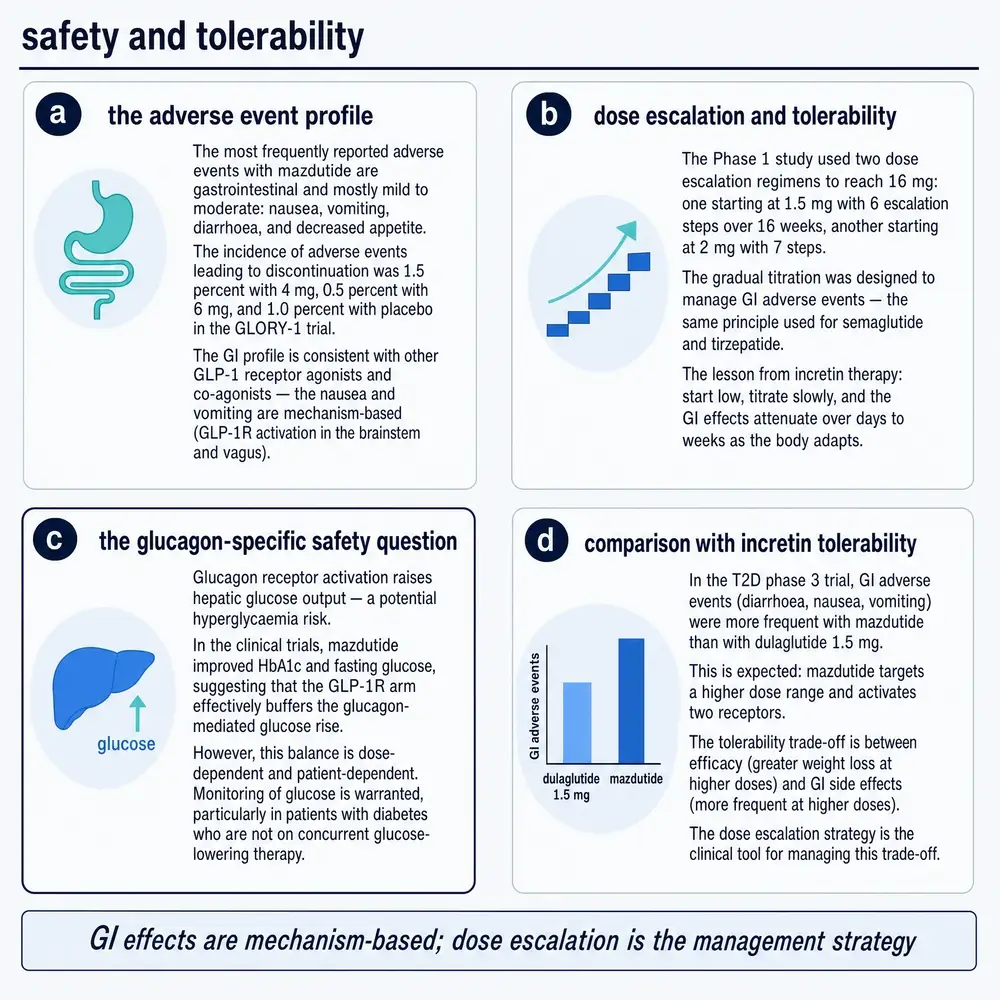
The first is gastrointestinal, and it is the class signature. Nausea, diarrhoea, vomiting and decreased appetite dominate the adverse-event tables, rise with dose, cluster during the escalation period and fade during maintenance (Ji et al., 2023; Ji et al., 2025). Two numbers frame how much this matters. In GLORY-1, discontinuation for adverse events was 0.5 to 1.5 per cent across groups, which is very low (Ji et al., 2025). But in the 2026 Chinese comparative evaluation of five long-acting agents, mazdutide had the highest overall incidence of gastrointestinal events of the five, at 63 per cent (Chen et al., 2026). Both are true: a great many people experience these effects, and almost none of them stop treatment because of it.
The second is the heart rate, and it is the price of the mechanism. Glucagon-receptor agonism raises heart rate; the increase is a class-wide phenomenon among incretin drugs at roughly 5 to 15 beats per minute, and in the phase 2 trial mazdutide raised it by 5.82 to 8.75 beats per minute, transiently and reversibly (Ji et al., 2023). In GLORY-1 the change was minimal and no cardiovascular risk signal emerged over 48 weeks (Ji et al., 2025). The correct reading of that is careful. A sustained elevation in resting heart rate is a recognised cardiovascular risk marker in epidemiology; a 48-week trial of 610 people is not designed to detect cardiovascular events, and no cardiovascular outcomes trial of mazdutide has completed. The absence of a signal in a study that could not have found one is not evidence of safety. It is absence of evidence, and the distinction is load-bearing for a drug whose mechanism deliberately activates a receptor that increases cardiac work.
The third is immunogenicity. Anti-drug antibodies were detected in 22.6 to 32.8 per cent of phase 2 participants, in a dose-related pattern, with no clear effect on efficacy or safety reported (Ji et al., 2023). That is a high proportion in absolute terms and an unremarkable one for a modified peptide; what matters is that neutralising activity and long-term consequences have not been characterised over the horizons at which they would appear.
The fourth is the set of signals that have not appeared. No pancreatitis, thyroid C-cell tumour or calcitonin signal has emerged in the trials to date (Ji et al., 2021; Jiang et al., 2022). The class-wide caveat still applies: rodent studies across this drug class have shown increased thyroid C-cell tumour incidence, and the relevance of that to humans remains uncertain (Chen et al., 2026). Nor has the theoretical hazard of the glucagon arm materialised. Because glucagon drives glycogenolysis and gluconeogenesis, an unbalanced ratio would be expected to raise glucose; in the trials, glucose fell (Jiang et al., 2022). The design assumption held. It held at the doses tested, in the populations tested, for the durations tested, which is the only sense in which a ratio can be shown to hold.
15Where it sits among its rivals
On 27 June 2025 China's National Medical Products Administration approved mazdutide for chronic weight management in adults with an initial body mass index of at least 28, or at least 24 with at least one weight-related comorbidity, as an adjunct to a reduced-calorie diet and increased physical activity. It was marketed as Xinermei (信尔美), and it was the first glucagon/GLP-1 receptor dual agonist approved anywhere in the world for weight loss. A second approval followed in September 2025, for glycaemic control in adults with type 2 diabetes (Shirley, 2025; Innovent Biologics, 2025).
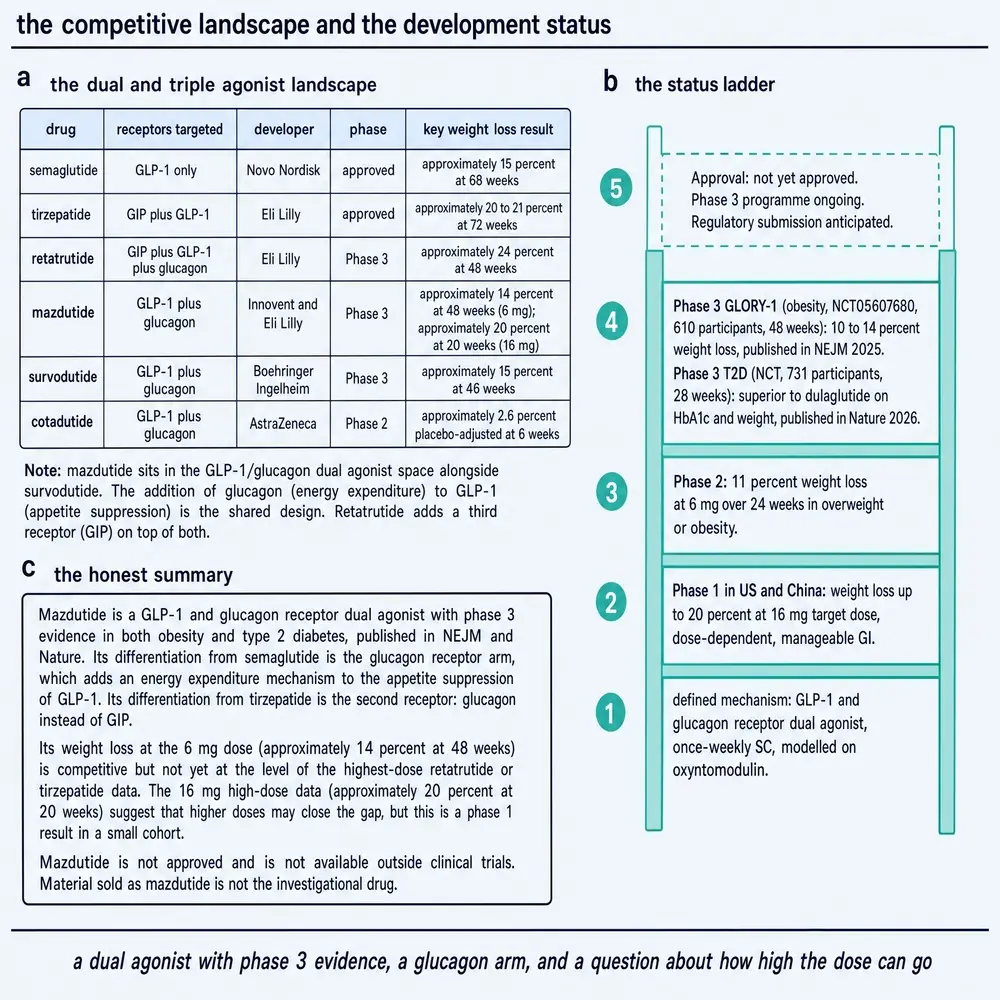
First-in-class is a claim about chronology, not about performance, and the honest comparison is with the other molecules in the same chemical argument. Survodutide, a GLP-1/glucagon dual agonist, produced about 14.9 per cent weight loss at 4.8 mg over 46 weeks in a phase 2 dose-finding trial (le Roux et al., 2024). Pemvidutide, another dual agonist, produced about 15.6 per cent at 2.4 mg over 48 weeks in the phase 2 MOMENTUM trial (Aronne et al., 2024). Mazdutide's 14.01 per cent at 6 mg over 48 weeks sits among them rather than above them. And the triple agonist retatrutide, which adds the GIP receptor to the same two, reached 24.2 per cent at 12 mg over 48 weeks in its phase 2 trial (Jastreboff et al., 2023) — a substantially larger effect than any dual agonist has reported.
Every one of those comparisons is across trials, not within one. The populations differ in ethnicity, baseline body mass index and comorbidity; the trials differ in phase, duration, escalation schedule and endpoint definition; and cross-trial contrasts in this field have repeatedly been overturned by head-to-head studies. The ladder below should be read as a map of the landscape, not as a ranking.
16The counterpoint: newest is not best-established
This document has given weight to recency, because in a field moving this fast the 2025 phase 3 publication and the 2025 approvals genuinely supersede the earlier dose-ranging picture. Recency cuts both ways, and the most recent substantial document in the corpus is not favourable.
In 2026, a Chinese pharmacy group published a comprehensive clinical evaluation of the five long-acting GLP-1 receptor agonists available in that market, scored on efficacy, safety, economy, innovation, suitability and accessibility, with indicator weights set by a Delphi expert consultation. Mazdutide finished last of the five, at 55.1 points out of 100, against semaglutide at 76.6, dulaglutide at 72.6, polyethylene-glycol loxenatide at 64.8 and tirzepatide at 62.9. Semaglutide and dulaglutide were rated Strong Recommendations; tirzepatide and loxenatide were Conditionally Recommended; mazdutide was rated Not Recommended currently, on the grounds of insufficient comparative evidence, absence from the national reimbursement drug list, and cost (Chen et al., 2026).
The reasoning behind that verdict is more informative than the score. Two of the three grounds are not statements about the molecule at all. At Chinese procurement prices in September 2025, a week of mazdutide cost 730 yuan against 123.35 for dulaglutide and 179.00 for semaglutide, the difference driven almost entirely by reimbursement status: the three listed agents had been through national price negotiation and mazdutide had not. Measured against 2024 national disposable income per capita, a year of mazdutide paid out of pocket amounts to about 92 per cent of average annual income (Chen et al., 2026). That is an argument about a pricing timetable, and it will change when negotiation happens.
The third ground is substantive and does not expire on a schedule. The evaluation's efficacy and safety dimensions reward cardiovascular and renal outcome evidence, and mazdutide has none: dulaglutide and semaglutide carry completed cardiovascular outcome trials, tirzepatide has met a non-inferiority endpoint against dulaglutide, and mazdutide's comparative programme is still running (Chen et al., 2026). The same document notes that mazdutide's phase 2 data suggest advantages over semaglutide in both glycaemic control and weight, and that formal guideline inclusion awaits the peer-reviewed publication of the head-to-head DREAMS-3 trial. Read carefully, then, the evaluation is not a finding that mazdutide works less well. It is a finding that less is known about it, and that what is known costs more — which is exactly what one should expect of the newest agent in a class, and exactly why first-in-class approval and best-established are different properties.
17The second hormone, and what it bought
Return to the opening image. The gut makes a peptide that speaks to two receptors at once, and it lasts minutes. Mazdutide is that peptide with three chemical edits, and it lasts a week. Almost everything interesting about the compound follows from the receptor the copy kept.
What the second receptor bought is now reasonably clear at one end and speculative at the other. At the clinical end, it bought a drug that reduces weight substantially over 48 weeks in Chinese adults, moves the cardiometabolic panel in concert, and is tolerated well enough that fewer people left the higher-dose arm of its pivotal trial than left placebo. At the mechanistic end, it bought a hepatic signal that no pure GLP-1 agonist predicts, a consistent fall in serum uric acid, and a plausible but unmeasured claim on energy expenditure. What it also bought is a faster heart, an unresolved cardiovascular question, and a regulatory and evidentiary position that is narrower than the enthusiasm around the molecule.
There is a broader lesson in the sequence, and it is not really about mazdutide. For fifteen years the field optimised one receptor because one receptor was tractable, and the ceiling it hit was not a chemistry problem but a physiology problem: the body defends its mass on both sides of the ledger. The response was not a better GLP-1 agonist but a return to a hormone that had been sitting in the intestinal wall the whole time, doing both jobs at once. Whether the return pays off in outcomes that patients experience — fewer cardiovascular events, less liver disease, weight held over years rather than months — is the question the next decade of trials will answer, and it is genuinely open.
18References
Generated from verified records rather than from recall. Author lists, journal names, volumes, pages and identifiers were derived from PubMed Central front matter for the 86 full-text XML files held in this project, and, for works outside that set, from scoped reference nodes inside those same files, cross-checked across at least two independent citing articles wherever the record was not held locally. Entries without a PMID are conference abstracts or a company announcement, and carry only the identifiers that could be verified.
- Aronne L, Harris MS, Roberts MS, Suschak JJ, Tomah S, Kasper J, et al. 262-OR: Pemvidutide, a GLP-1/glucagon dual receptor agonist, in subjects with overweight or obesity—a 48-week, placebo-controlled, phase 2 (MOMENTUM) trial. Diabetes. 2024;73(Suppl 1):262-OR.
doi:10.2337/db24-262-OR
— Conference abstract - Benson C, Tham L, Du Y, Gurbuz S, Mather K, Tang C. Oxyntomodulin analog LY3305677 (LY) improves glycaemic control and weight loss in healthy volunteers and subjects with type 2 diabetes. Diabetologia. 2022;65(Suppl 1):S303.
doi:10.1007/s00125-022-05755-w
— Conference abstract - Chen Y, Mezo A, Coskun T, Song M, Roell WC, Bokvist KB, et al. 682-P: Novel dual glucagon and glucagon-like peptide-1 receptor agonist LY3305677 improves glucose control, reduces body weight, and increases energy expenditure in mice. Diabetes. 2021;70(Suppl 1):682-P.
doi:10.2337/db21-682-P
— Conference abstract, animal study - Chen Q, Chen T, Lin W, Chen X. A clinical comprehensive evaluation of long-acting GLP-1 receptor agonists in type 2 diabetes management. Diabetes Metab Syndr Obes. 2026;19.
PMID 41710707 · doi:10.2147/DMSO.S585436 · PMC12912087
— Comparative drug evaluation - Cheng W, Chen Z, Li P, Zhang Y, Ma Y, Liu P, et al. Case report: Efficacy and safety of dose-escalated mazdutide, a GLP-1/GCGR dual agonist, in an adolescent with obesity, type 2 diabetes, and hyperuricemia. Front Endocrinol (Lausanne). 2025;16:1654506.
PMID 41030857 · doi:10.3389/fendo.2025.1654506 · PMC12477040
— Case report, n=1 - Dong W, Bai J, Yuan Q, Zhang Y, Zhang Y, Zhang Z, et al. Mazdutide, a dual agonist targeting GLP-1R and GCGR, mitigates diabetes-associated cognitive dysfunction: mechanistic insights from multi-omics analysis. EBioMedicine. 2025;117:105791.
PMID 40479843 · doi:10.1016/j.ebiom.2025.105791 · PMC12205698
— Animal study, male db/db mice - Finan B, Ma T, Ottaway N, Müller TD, Habegger KM, Heppner KM, et al. Unimolecular dual incretins maximize metabolic benefits in rodents, monkeys, and humans. Sci Transl Med. 2013;5(209):209ra151.
PMID 24174327 · doi:10.1126/scitranslmed.3007218
— Preclinical and early clinical - Finan B, Yang B, Ottaway N, Smiley DL, Ma T, Clemmensen C, et al. A rationally designed monomeric peptide triagonist corrects obesity and diabetes in rodents. Nat Med. 2015;21(1):27-36.
PMID 25485909 · doi:10.1038/nm.3761
— Animal study - Hope DCD, Vincent ML, Tan TMM. Striking the balance: GLP-1/glucagon co-agonism as a treatment strategy for obesity. Front Endocrinol (Lausanne). 2021;12:735019.
PMID 34566894 · doi:10.3389/fendo.2021.735019 · PMC8457634
— Narrative review - Innovent Biologics, Inc. Approval of mazdutide (Xinermei) by the National Medical Products Administration of China for chronic weight management in adults [company announcement, 27 June 2025]. 2025.
— Company announcement; regulatory action independently reported by Shirley (2025) - Jastreboff AM, Kaplan LM, Frías JP, Wu Q, Du Y, Gurbuz S, et al. Triple-hormone-receptor agonist retatrutide for obesity — a phase 2 trial. N Engl J Med. 2023;389(6):514-526.
PMID 37366315 · doi:10.1056/NEJMoa2301972
— Phase 2 randomised trial - Ji L, Jiang H, An P, Deng H, Liu M, Li L, et al. IBI362 (LY3305677), a weekly-dose GLP-1 and glucagon receptor dual agonist, in Chinese adults with overweight or obesity: a randomised, placebo-controlled, multiple ascending dose phase 1b study. EClinicalMedicine. 2021;39:101088.
PMID 34430840 · doi:10.1016/j.eclinm.2021.101088 · PMC8374649
— Phase 1b randomised trial - Ji L, Gao L, Jiang H, Yang J, Yu L, Wen J, et al. Safety and efficacy of a GLP-1 and glucagon receptor dual agonist mazdutide (IBI362) 9 mg and 10 mg in Chinese adults with overweight or obesity: a randomised, placebo-controlled, multiple-ascending-dose phase 1b trial. EClinicalMedicine. 2022;54:101691.
PMID 36247927 · doi:10.1016/j.eclinm.2022.101691 · PMC9561728
— Phase 1b randomised trial - Ji L, Jiang H, Cheng Z, Qiu W, Liao L, Zhang Y, et al. A phase 2 randomised controlled trial of mazdutide in Chinese overweight adults or adults with obesity. Nat Commun. 2023;14:8289.
PMID 38092790 · doi:10.1038/s41467-023-44067-4 · PMC10719339
— Phase 2 randomised trial - Ji L, Jiang H, Zhang Y, Lv L, Gu J, Liu Z, et al. 1857-LB: Improvement of liver steatosis by mazdutide in Chinese participants with overweight or obesity — an exploratory analysis of GLORY-1. Diabetes. 2024;73(Suppl 1):1857-LB.
doi:10.2337/db24-1857-LB
— Conference abstract, exploratory analysis - Ji L, Jiang H, Bi Y, Li H, Tian J, Liu D, et al. Once-weekly mazdutide in Chinese adults with obesity or overweight. N Engl J Med. 2025;392(22):2215-2225.
PMID 40421736 · doi:10.1056/NEJMoa2411528
— Phase 3 randomised trial (GLORY-1) - Jiang H, Pang S, Zhang Y, Yu T, Liu M, Deng H, et al. A phase 1b randomised controlled trial of a glucagon-like peptide-1 and glucagon receptor dual agonist IBI362 (LY3305677) in Chinese patients with type 2 diabetes. Nat Commun. 2022;13:3613.
PMID 35750681 · doi:10.1038/s41467-022-31328-x · PMC9232612
— Phase 1b randomised trial - Knerr PJ, Mowery SA, Finan B, Perez-Tilve D, Tschöp MH, DiMarchi RD. Selection and progression of unimolecular agonists at the GIP, GLP-1, and glucagon receptors as drug candidates. Peptides. 2020;125:170225.
PMID 31786282 · doi:10.1016/j.peptides.2019.170225
— Review of peptide engineering - le Roux CW, Steen O, Lucas KJ, Startseva E, Unseld A, Hennige AM. Glucagon and GLP-1 receptor dual agonist survodutide for obesity: a randomised, double-blind, placebo-controlled, dose-finding phase 2 trial. Lancet Diabetes Endocrinol. 2024;12(3):162-173.
PMID 38330987 · doi:10.1016/S2213-8587(23)00356-X
— Phase 2 randomised trial - Nalisa DL, Cuboia N, Dyab E, Jackson IL, Felix HJ, Shoki P, et al. Efficacy and safety of mazdutide on weight loss among diabetic and non-diabetic patients: a systematic review and meta-analysis of randomized controlled trials. Front Endocrinol (Lausanne). 2024;15:1309118.
PMID 38440786 · doi:10.3389/fendo.2024.1309118 · PMC10911117
— Systematic review and meta-analysis - Nestor JJ, Parkes D, Feigh M, Suschak JJ, Harris MS. Effects of ALT-801, a GLP-1 and glucagon receptor dual agonist, in a translational mouse model of non-alcoholic steatohepatitis. Sci Rep. 2022;12:6666.
PMID 35461369 · doi:10.1038/s41598-022-10577-2 · PMC9035150
— Animal study - Pocai A, Carrington PE, Adams JR, Wright M, Eiermann G, Zhu L, et al. Glucagon-like peptide 1/glucagon receptor dual agonism reverses obesity in mice. Diabetes. 2009;58(10):2258-2266.
PMID 19602537 · doi:10.2337/db09-0278 · PMC2750209
— Animal study - Sánchez-Garrido MA, Brandt SJ, Clemmensen C, Müller TD, DiMarchi RD, Tschöp MH. GLP-1/glucagon receptor co-agonism for treatment of obesity. Diabetologia. 2017;60(10):1851-1861.
doi:10.1007/s00125-017-4354-8
— Review - Shirley M. Mazdutide: first approval. Drugs. 2025;85(12):1621-1627.
PMID 41028652 · doi:10.1007/s40265-025-02249-y
— Regulatory and development review - Tham LS, et al. A first-in-human single ascending dose study of oxyntomodulin analog LY3305677 in healthy subjects. Diabetes. 2021;70(Suppl 1):106-OR.
doi:10.2337/db21-106-OR
— Conference abstract, first-in-human - Wynne K, Park AJ, Small CJ, Meeran K, Ghatei MA, Frost GS, et al. Oxyntomodulin increases energy expenditure in addition to decreasing energy intake in overweight and obese humans: a randomised controlled trial. Int J Obes (Lond). 2006;30(12):1729-1736.
PMID 16619056 · doi:10.1038/sj.ijo.0803344
— Randomised human trial, native oxyntomodulin
19How this document was assembled
The corpus was built against project 05, the Therapeutic Peptide Research Library. Every full-text file in the project's document stores was opened and searched for explicit mentions of mazdutide, IBI362 or LY3305677; matches on GLP-1 or glucagon alone were never counted. That sweep opened 234,789 files. Because the same PubMed Central article is copied into many sibling monograph projects, the raw hit list ran past six hundred paths and collapsed to 177 unique documents once de-duplicated by identifier and content, of which 98 mention the compound substantively rather than in passing.
Eight of those documents are about mazdutide rather than merely naming it, and they are the spine of this monograph: the two phase 1b trials, the high-dose escalation study, the phase 2 trial, the meta-analysis, the multi-omics animal study, the adolescent case report and the 2026 comparative drug evaluation. All eight were extracted to clean reading text and read in full. The local corpus predates the two pivotal events of 2025, so the phase 3 publication, the regulatory actions and the first-approval review were added to the evidence base and verified against records outside it.
| Stage | What it does | Result |
|---|---|---|
| 01b | Targeted sweep of the project's full-text stores | 234,789 files opened |
| 04 | De-duplication, mention-density classification, inventory | 177 unique · 98 substantive |
| 05 | Reference metadata from PMC front matter and scoped reference nodes | 26 citations |
| 09 | Encode commissioned Higgsfield plates as WebP data URIs | 5 plates |
| 09b | Insert plates at prose anchors with A8 caption riders | 5 inserted |
| 06 | Assembly, plate injection, figure numbering, fragment | 1 deliverable |
| 07 | Light, dark and print editions; PDF render | 5 files |
One trap is worth naming because it is easy to fall into here. A PubMed Central article record contains reference nodes belonging to other papers, and an unscoped identifier lookup will happily assign a bibliography entry's PMID and DOI to the article being read. Every lookup in this build is scoped to its own subtree, and every identifier derived from a reference node rather than from front matter was required to agree across at least two independent citing articles before it was used.
20Evidence handling
Findings are labelled by the kind of study that produced them, in the sentence that reports them. Randomised human trials, conference abstracts, animal experiments, cell-based binding assays, exploratory subgroup analyses and a single case report appear in this document, and they are not interchangeable. Animal and in-vitro results are never phrased so as to imply a human outcome; where an effect exists only in mice, the sentence says mice.
Recency is weighted, but not automatically. The 2025 phase 3 publication and the 2025 approvals do supersede the earlier dose-ranging picture, because they test the same question in a larger, longer, properly powered design. The 2026 comparative evaluation that ranked the compound last of five is given its due in the body rather than buried, and its three grounds are separated according to whether they concern the molecule or its price. Where an effect reverses on withdrawal, that appears beside the effect. Where the evidence for a mechanism is thinner than the evidence for the effect it is meant to explain, the asymmetry is stated rather than smoothed over.

Continue exploring