
hGH Fragment 176–191 The piece of a hormone that was supposed to burn fat without being a hormone
Growth hormone does two things that pull against each other: it strips fat, and it makes people resistant to insulin. For thirty years a laboratory in Melbourne pursued the idea that those two actions live in different parts of the molecule and that the useful one could be cut out and given on its own. Out of that programme came a sixteen-residue tail-end of the hormone, and out of the marketplace came a name for it: HGH Fragment 176–191. It is sold worldwide. It is banned by name in sport. And almost nothing that is said about it was ever measured on it — not the fat oxidation, not the weight loss, not the safety record. Those belong to its neighbours, one of which differs from it by a single atom of oxygen. The one time anyone did make this exact peptide and give it to an animal, in 1978, it raised blood glucose and made the animal less sensitive to insulin.
Findings are labelled by the kind of study that produced them, in the sentence that reports them. A result in a mouse is called a result in a mouse. A result in a dish of fat cells is called that. Where a number appears, the species, the route and the duration travel with it.
Four molecules appear in these pages and they are not interchangeable. hGH 176–191 is the subject: sixteen residues, sequence FLRIVQCRSVEGSCGF. hGH 177–191, coded AOD9401, is the same peptide with the first residue removed — fifteen residues — and it is what the founding laboratory actually worked on. AOD-9604, later relicensed as LAT8881, is the subject with phenylalanine replaced by tyrosine at position one: one oxygen atom different, and the molecule that carries essentially all of the modern evidence. It has its own record as Monograph No. 25 in this series. And growth hormone itself is the parent protein, 191 residues, from which all of them are cut. Every finding below names the molecule that was actually studied.
Doses appear only as reported experimental parameters. Nothing in this document recommends human use of any compound, and it specifies no dose, route or schedule for any person.
01Sixteen residues off the end of a hormone
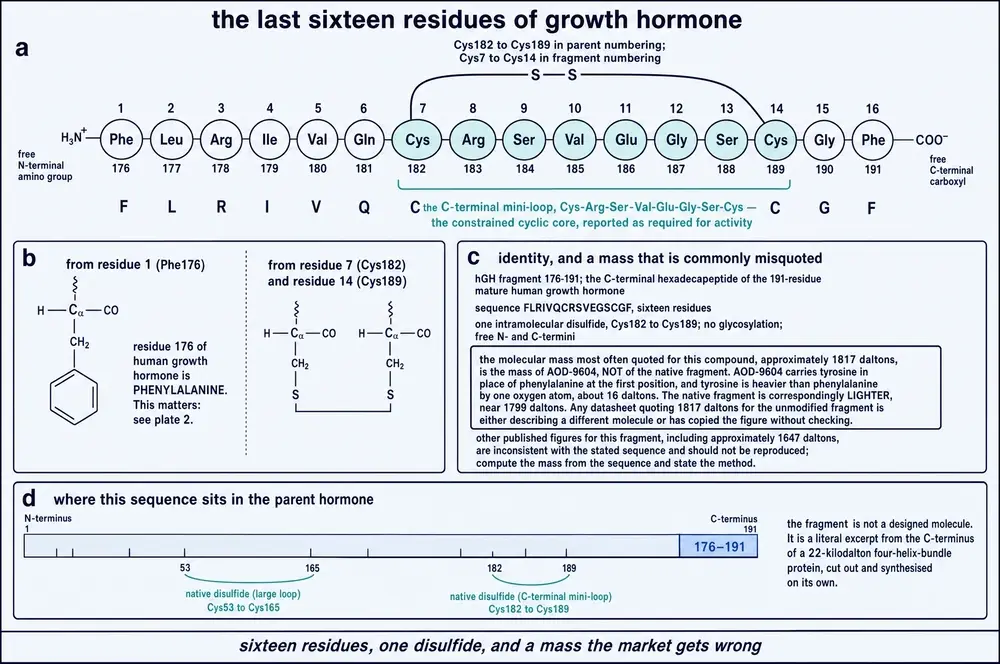
Human growth hormone is a protein of 191 amino acids folded into four long helices. It is made in the pituitary, it governs how children grow, and in adults it spends most of its time managing where the body keeps its energy. The last sixteen residues of that chain — positions 176 to 191, reading FLRIVQCRSVEGSCGF — are the subject of this document.
Those sixteen residues are not a self-contained module. The cut at 176 falls in the middle of the fourth helix, which runs from residue 156 to residue 183, so roughly half the fragment is the tail of a helix that has been severed from the rest of itself and half is the hormone’s flexible C-terminal tail. What the fragment does keep is a bridge: the second of the hormone’s two disulfide bonds, joining cysteine 182 to cysteine 189, falls entirely inside the fragment, so the isolated peptide still closes a small loop near its own C-terminus. Helix boundaries and both disulfide positions here are taken from the reference sequence record rather than from any review.
Here is a small thing that turns out to matter. The molecular mass printed on most datasheets for this compound is about 1,817 daltons. That is not this molecule's mass. It is the mass of the analogue, which carries an extra oxygen atom, and the native fragment is correspondingly lighter — near 1,799. The number has been copied from one supplier to the next for years without anyone deriving it, which is a small instance of the larger pattern this document is about, and it is checkable in an afternoon.
The molecular formula is C₃₈H₁₂₃N₂₃O₂₂S₂ and the average mass is 1,799.08 daltons. Both are derived here from the residue composition rather than quoted, because a formula is one of the few things about a peptide that can be checked with arithmetic instead of trust: the same calculation reproduces oxytocin’s published formula and mass exactly, which is what makes the result worth printing.
02Four molecules and one product name
The trouble begins with the name. “176–191” is a description of where a piece was cut from, not a name for the piece, and at least three different peptides in this story can be described using those numbers or numbers adjacent to them.
The first is the subject: residues 176 to 191 exactly, sixteen amino acids beginning with phenylalanine. The second is residues 177 to 191, fifteen amino acids beginning with leucine, which the Melbourne laboratory coded AOD9401 and which is the construct almost all of its later work used. The third is the second one with a tyrosine stuck on the front, which restores the count to sixteen and which was developed commercially as AOD-9604.
Here is the part that makes the confusion almost inevitable. Adding a tyrosine to the front of residues 177–191 gives exactly the same molecule as taking residues 176–191 and swapping the phenylalanine at the front for a tyrosine. So AOD-9604 can be written, correctly, either as Tyr-hGH(177-191) or as hGH[176-191] F176Y. The second of those contains this document’s subject as a literal substring. Tyrosine and phenylalanine are the same amino acid but for one hydroxyl group, so the whole chemical difference between the compound this document is about and the compound that carries its evidence is a single oxygen atom — 15.9994 daltons on a molecule of 1,799.
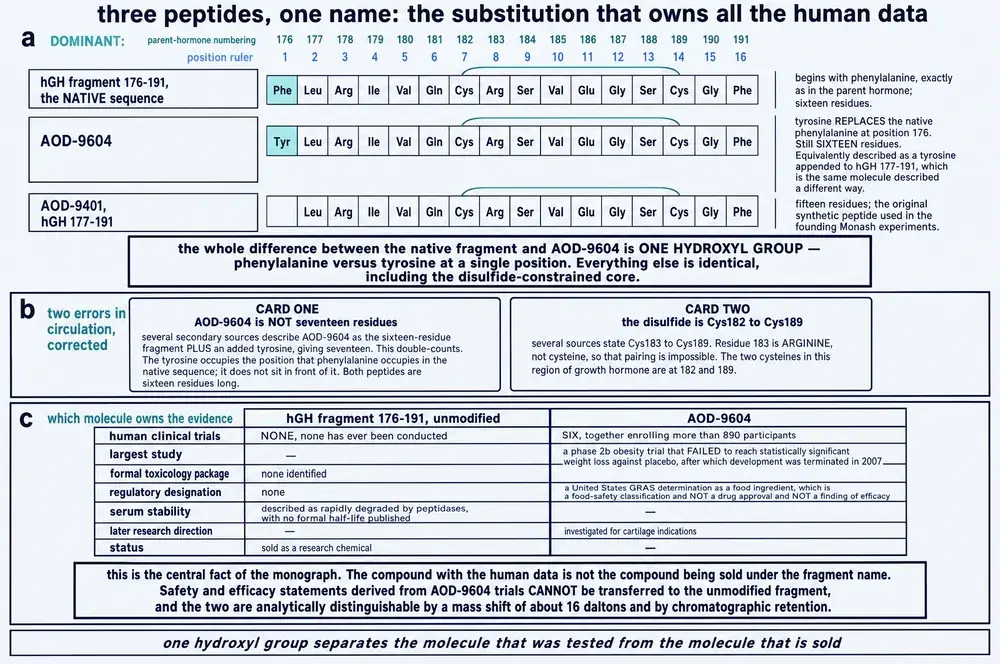
Why add the tyrosine at all? A tyrosine is a handle. It is the residue that takes a radioactive iodine label cleanly, so a peptide with one on the end can be tracked through an animal in a way that the same peptide without one cannot. It is a chemist’s convenience, and it is the reason the molecule that got developed as a drug is not quite the molecule the market later named itself after.
03How much literature there is
Before using an evidence base it is worth saying how big it is. For this compound the honest answer is startling, and it is easier to state as a measurement than as an impression.
Searching the whole of PubMed for the fragment’s designation — in every bracket form, with the hormone attached, and by its literal sequence — returns four records. One is from 1978. One is from 2022. Two are from 2026 and are surveys of what people buy on the internet. For comparison, the one-oxygen analogue returns twenty-three records under its development code and four more under its later licensee code, the fifteen-residue version returns ten, and the parent hormone returns more than fifty-eight thousand.
A digression that is not really a digression: the string “176-191” on its own appears in 213 PubMed records, and 209 of them have nothing to do with this molecule. They are journal page ranges — an article running from page 176 to page 191 — and residue ranges in unrelated proteins. A compound whose name is a pair of numbers cannot be found by searching for its name, which is a small practical fact with a large consequence: it makes the literature on this fragment unusually easy to misattribute, because anyone assembling it by search will collect the wrong things and miss the right ones.
The local picture is stranger still. A sweep of 382 documents in this project’s libraries that genuinely name the fragment or its analogue programme — about 2,539 printed pages — contains 3 peer-reviewed full texts. The rest are vendor catalogue pages, archived product listings and this project’s own earlier write-ups.
That ratio is not a filtering nuisance to be tidied away before quoting a corpus. It is a measurement of where this molecule now lives. There is a substance with a global market and a body of promotional writing running to well over a thousand pages, resting on a scientific literature that can be read in an afternoon.
04The double action the whole programme existed to separate
To see why anyone would want a piece of growth hormone rather than the hormone, it helps to know what the hormone does to metabolism, because it does two things at once and they are not both welcome.
The first is that it mobilises fat. Growth hormone drives lipolysis — the breakdown of stored triglyceride into fatty acids that can be burned — and people given it lose fat mass and gain lean mass. The second is that it antagonises insulin. The same hormone, over the same hours, makes muscle and liver less responsive to insulin, raises blood glucose, and in susceptible people produces frank glucose intolerance. Controlled human work has since shown these two are not merely coincident but mechanistically linked: block the fatty-acid flux that growth hormone releases and the insulin resistance goes with it (Høgild et al., 2023; Hjelholt et al., 2020). The fat mobilisation is, at least in part, the cause of the insulin resistance.
The idea of cutting a hormone into functional pieces was not eccentric in 1969. It was the obvious next move in a field that had just watched it work. Insulin had been shown to be cut out of a larger precursor; adrenocorticotropic hormone was known to carry its activity in a short stretch near one end, so that a synthetic fragment of it behaved like the whole molecule. Against that background, a 191-residue protein with two apparently contradictory metabolic actions looked less like a puzzle than like an invitation. If the pieces of other hormones carried separable activities, why not this one?
That is an awkward fact for anyone hoping to build a slimming agent out of growth hormone, and it was the animating problem of the entire Melbourne programme. If the two actions are inseparable in principle, there is nothing to be done. If they live in different regions of the molecule, they can be prised apart. Everything in Part Two is an attempt to find out which.
051969: growth hormone as a container
In May 1969 the British Medical Journal published two short papers from a group at Monash University in Melbourne. The first reported that a polypeptide isolated from the pituitary increased the sensitivity of fasting healthy volunteers to injected insulin. The second reported that a related pituitary polypeptide had a hypoglycaemic action in people with diabetes (Bornstein et al., 1969; Armstrong et al., 1969). Two years later the same group described an insulin antagonist of pituitary origin circulating in the plasma of normal and diabetic subjects (Zimmet et al., 1971).
The claim underneath these papers was larger than any of them. Joseph Bornstein and his colleagues were proposing that growth hormone is not simply a hormone but a pro-hormone — a container carrying several separable activities in different stretches of its chain, which the body liberates by cutting. On that reading, the hormone’s contradictory effects on metabolism are not a paradox to be explained but an artefact of studying the intact molecule when the real actors are its pieces.
It is worth pausing on the register of this work, because it is unlike what follows. These were human experiments, in patients, published in a general medical journal, decades before any of the compounds in this document existed. The hypothesis came first and the chemistry was assembled afterwards to test it.
06An enzyme that cuts it
A pro-hormone hypothesis needs a knife. In 1973 the group reported one: a peptidase isolated from the pituitary which, acting on growth hormone, specifically released a peptide with insulin-antagonistic activity in vitro (Driver et al., 1973). This is the mechanistic anchor for everything that follows, and it is also the origin of a habit of thought that outlasts its evidence. If the body itself cuts the hormone into active fragments, then a synthetic fragment is not an artificial construct but a reproduction of something physiological. That framing survives into the present: a 2023 paper still describes the analogue as “a synthetic form of the naturally occurring C-terminal fragment of human growth hormone” (Harpur et al., 2023).
07The other end of the molecule
The programme’s method was simple and it was applied for twenty-five years: synthesise a stretch of the hormone, give it to an animal, measure something, then shorten the peptide and do it again. Where the activity disappears, the boundary of the functional region has been found.
Most of the early work was on the other end — the amino terminus. Peptides corresponding to residues 4–15, 6–13 and 7–13 potentiated insulin and lowered blood glucose (Ng et al., 1974; Ng et al., 1980). Those fragments are not the subject of this document, but they matter to it in two ways. They established that the pro-hormone idea could produce a positive result, and they set the expectation that a short synthetic piece of a large protein could carry a clean, separable action.
081978: the only synthesis of hGH 176–191
Attention then moved to the carboxyl end. In 1977 the group synthesised residues 172–191 and reported that it was hyperglycaemic (Wade et al., 1977). The following year Frank Ng and Joseph Bornstein published the experiment that is the entire in-vivo record of this document’s subject compound.
They made six peptides — hGH 172–191, 176–191, 177–191, 178–191, 179–191 and 180–191 — and gave them to normal rats. Four were active and two were inert. The active four produced a short-lived rise in blood glucose and a more sustained rise in plasma insulin, and at a single dose of 5 nmol per kilogram the peptides containing the sequence 178–191 significantly reduced the animals’ insulin sensitivity on an intravenous insulin tolerance test (Ng & Bornstein, 1978).
Read that result carefully, because it is the only one there is. The compound now sold as a fat-loss agent was, on the single occasion it was synthesised and administered, characterised as diabetogenic. It raised glucose. It raised insulin. It made the animal less sensitive to insulin. And the study measured no endpoint relating to fat at all — not body weight, not adipose mass, not lipolysis — because that was not the question being asked.
Corroborating work from the same laboratory in the same period fills in what the C-terminal region was understood to be doing. The fragment potentiated glucose-stimulated insulin release from isolated rat islets while causing no release on its own (Weerasinghe & Bornstein, 1978); it suppressed hepatic glycogen synthase within five minutes of injection (Newman et al., 1978); it inactivated glycogen synthase phosphatase in skeletal muscle (Macaulay et al., 1983). None of this is fat metabolism. It is a coherent account of a peptide that opposes insulin.
09Narrowing, and dropping 176
The next paper is titled, without ambiguity, Diabetogenic action of human growth hormone. Wade, Ng and Bornstein synthesised three peptides — 177–191, 178–191 and 179–191 — and reported that extending 179–191 at its amino terminus is required for activity in vivo. They also showed that reducing and blocking the disulfide bridge did not abolish activity, so the loop is not required for what they were measuring (Wade et al., 1979).
Four years later they shortened from the other end. Six C-terminally truncated versions of the disulfide-blocked 177–191 peptide were assayed; the truncated ones were inactive even at a hundred times the dose, placing the insulin-antagonistic core within residues 178 to 190 inclusive (Wade et al., 1982). A parallel line established that the hyperglycaemic action of these peptides did not run through cyclic AMP (Ma et al., 1982), and that hGH 172–191 inhibited acetyl-CoA carboxylase through a released non-polar mediator (Bornstein et al., 1983) — the first time anything in this series of peptides was connected to the machinery of fat synthesis.
The quiet event in this section is a choice of construct. From 1979 onwards, every peptide the laboratory made in this region began at residue 177. hGH 176–191 was synthesised in 1978, reported once, and never returned to. Whatever the compound sold today is named after, it is not a molecule this programme continued to study.
10Antilipogenic, and explicitly not lipolytic
In 1993, fifteen years after the fragment was first made, the same laboratory published a reinterpretation of what its C-terminal peptide does. Wu and Ng reported that hGH 177–191 has antilipogenic activity identical with that of the intact hormone in rat epididymal fat pads, and concluded that the functional domain responsible for the antilipogenic action of growth hormone resides in the C-terminal region (Wu & Ng, 1993).
That is a genuine and interesting finding. It is also not the finding the compound is sold on, and the same abstract says so in its second sentence: no significant lipolytic effect of hGH 177–191 was found, as determined by the rate of glycerol release from the fat pads of treated rats.
The measurement matters as much as the result. Lipolysis is assayed by catching what comes out of a fat cell when stored triglyceride is broken up: glycerol. Each triglyceride molecule releases one glycerol backbone, and unlike the fatty acids that come with it, glycerol is not readily taken back up by fat tissue, so the amount appearing in the medium is a direct running total of how much fat has been dismantled. It is the standard assay for the effect this compound is now sold for, it was the assay used, and it returned nothing.
The distinction being drawn there is the whole commercial proposition of this compound, and it is worth being plain about it. Lipogenesis is the building of fat. Lipolysis is the breaking of it down. A substance that inhibits the first stops new fat being laid in; a substance that drives the second releases what is already stored. They are different processes with different enzymes, and a compound can do one without doing the other. The founding paper on this region reported the first and, in the same breath, reported that it looked for the second and did not find it.
The phrase “lipolytic domain” enters the literature seven years later, in the titles of the papers that turned the peptide into a drug candidate (Ng et al., 2000a; Ng et al., 2000b). Those later papers do report lipolytic activity, in different preparations and with different methods, and this document does not claim they are wrong. It records that the change of description happened, that it happened in the direction favourable to development, and that the earlier negative result was never retracted or explained.
11Glucose transport falls
A companion paper the same year measured what the fragment does to sugar uptake by fat cells. In adipocytes isolated from genetically obese Zucker rats, hGH 177–191 reduced both basal and insulin-stimulated deoxyglucose uptake — and at equimolar concentration it was more potent than the intact hormone (Wijaya & Ng, 1993).
Two things follow. The first is that the fragment is not a diluted version of the hormone; on this endpoint it out-performs it, which is what one would expect if the relevant activity really is concentrated in this region. The second is more awkward. Reducing insulin-stimulated glucose uptake in fat is what insulin resistance looks like at the level of a fat cell. The 1993 papers present this as a mechanism for the antilipogenic effect — less sugar into the cell means less substrate for making fat — and that reading is reasonable. It is also the same measurement the 1978 work would have called insulin antagonism.
12The first weight result
In 1994 the laboratory gave the fragment to obese mice for the first time. Chronic treatment of C57BL/6J ob/ob mice with synthetic hGH 177–191 reduced cumulative body-weight gain and decreased adipose tissue mass, with lipogenesis in the adipose tissue significantly inhibited (Natera et al., 1994). The authors concluded that the peptide had the potential to be an effective compound for the treatment of human obesity and for the improvement of meat qualities in farm animals.
This is the first result in the whole story that looks like the claim now made for the compound, and it arrives sixteen years after the fragment was first synthesised. It was obtained with fifteen residues, not sixteen.
13A sequence printed wrong, in both 1993 papers
Both 1993 papers spell the peptide out in three-letter code, and both print it the same way: Leu-Arg-Ile-Val-Gln-Cys-Arg-Val-Ser-Glu-Gly-Ser-Cys-Gly-Phe. The reference sequence gives Arg-Ser-Val at those positions. Residues 184 and 185 are transposed.
This is a typographical fault rather than a scientific dispute, and it would not be worth a section except that it propagates. A reader building the peptide from the printed sequence would make a different molecule. It is also independently checkable from an unexpected direction: the stable metabolite that anti-doping chemists use to detect the analogue in serum is CRSVEGSCG, which carries serine before valine (Cox et al., 2015). That metabolite could not exist if the printed order were the real one. A third line of evidence comes from the laboratory itself: when the same group published a solution structure of the peptide in 2000 they wrote it as cyclo(6,13)-H₂N-Leu-Arg-Ile-Val-Gln-Cys-Arg-Ser-Val-Glu-Gly-Ser-Cys-Gly-Phe-OH — serine before valine, and the disulfide between the sixth and thirteenth residues of the fifteen-mer, which is Cys182 to Cys189 in the hormone's numbering (Ogru et al., 2000).
The general lesson is one this series keeps meeting from different directions. A sequence is one of the few claims in a peptide paper that can be verified against an independent record in a few minutes, and it is worth the few minutes, because everything downstream inherits it.
14The tyrosine, and what it was for
By the late 1990s the Melbourne work had been taken up commercially, and the peptide acquired development codes. AOD9401 is hGH 177–191 itself. AOD-9604 is that peptide with a tyrosine added at the amino terminus. The letters stand for anti-obesity drug; they are not a chemical abbreviation.
The distinction between the two codes is not cosmetic and it is routinely lost. A great deal of what is cited as AOD-9604’s animal evidence was obtained with AOD9401 — including the most-quoted oral study, which names AOD-9401 in its own abstract throughout (Heffernan et al., 2000). Any account of this compound that does not keep the two apart is pooling results from two different molecules, and any account that treats either of them as the subject of this document is pooling a third.
15The animal package, attributed correctly
The animal work from 1999 to 2001 is the evidentiary heart of the entire family, and it is worth setting out with the molecules named.
In obese Zucker rats given AOD-9604 by mouth at 500 µg per kilogram daily for nineteen days, body-weight gain was reduced by more than half — 15.8 g against 35.6 g in controls — with increased lipolytic activity in adipose tissue and, on euglycaemic clamp, no adverse effect on insulin sensitivity (Ng et al., 2000b). In a parallel study, AOD9401 stimulated hormone-sensitive lipase and inhibited acetyl-CoA carboxylase in isolated rat adipose tissue, and after twenty days of treatment the average adipocyte diameter in obese Zucker rats fell from 110 to 80 µm (Ng et al., 2000a). In ob/ob mice treated for fourteen days, both growth hormone and AOD-9604 reduced body-weight gain, increased fat oxidation and raised plasma glycerol, and — unlike the hormone — AOD-9604 did not induce hyperglycaemia or suppress insulin secretion (Heffernan et al., 2001a).
This is a respectable preclinical package, and if it were the record of the compound this document is about, that compound would have a genuine case to answer. It is not. Every study named in the preceding paragraph used AOD-9604 or AOD9401.
16No receptor, then and now
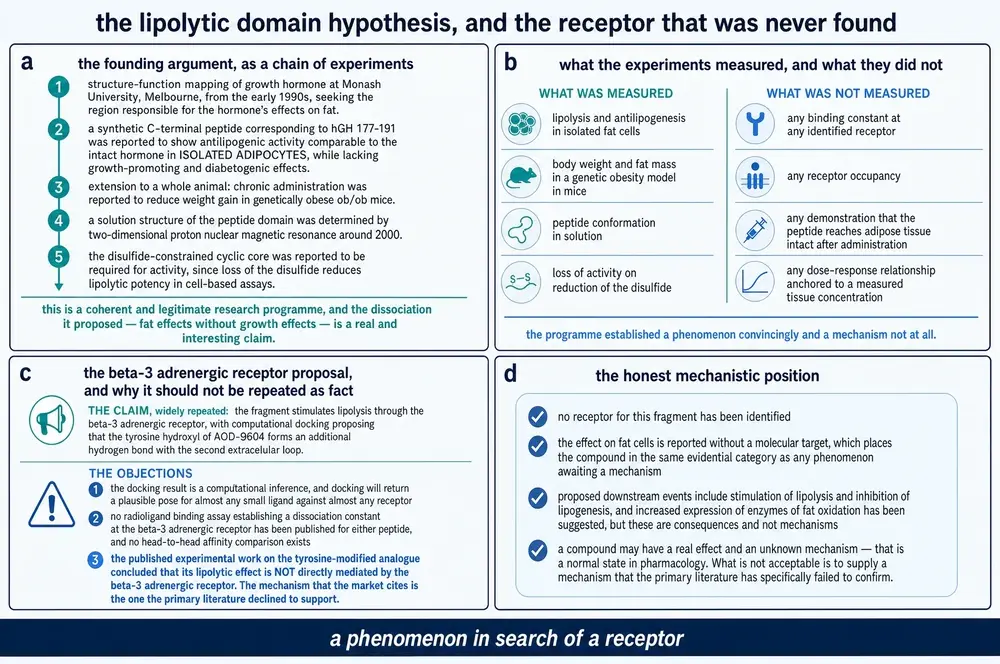
The most interesting thing about this family is what has never been found. Growth hormone works through the growth hormone receptor. The fragment does not: in cells transfected with that receptor, AOD-9604 neither competed for binding nor induced proliferation (Heffernan et al., 2001a). Whatever it is doing, it is not doing it as a small imitation of its parent.
The second candidate was the β3-adrenoceptor, the principal lipolytic receptor on a fat cell. Growth hormone and AOD-9604 both raise its messenger RNA in obese mice, restoring it towards the levels seen in lean animals. But in mice lacking the receptor altogether, fourteen days of either compound failed to produce the weight change or the increase in lipolysis seen in wild-type animals — while, in an acute experiment in the same knockout animals, AOD-9604 still raised energy expenditure and fat oxidation (Heffernan et al., 2001b). The authors’ conclusion is the careful one: the chronic effect requires an intact β3-adrenoceptor, and the compound does not act through it directly.
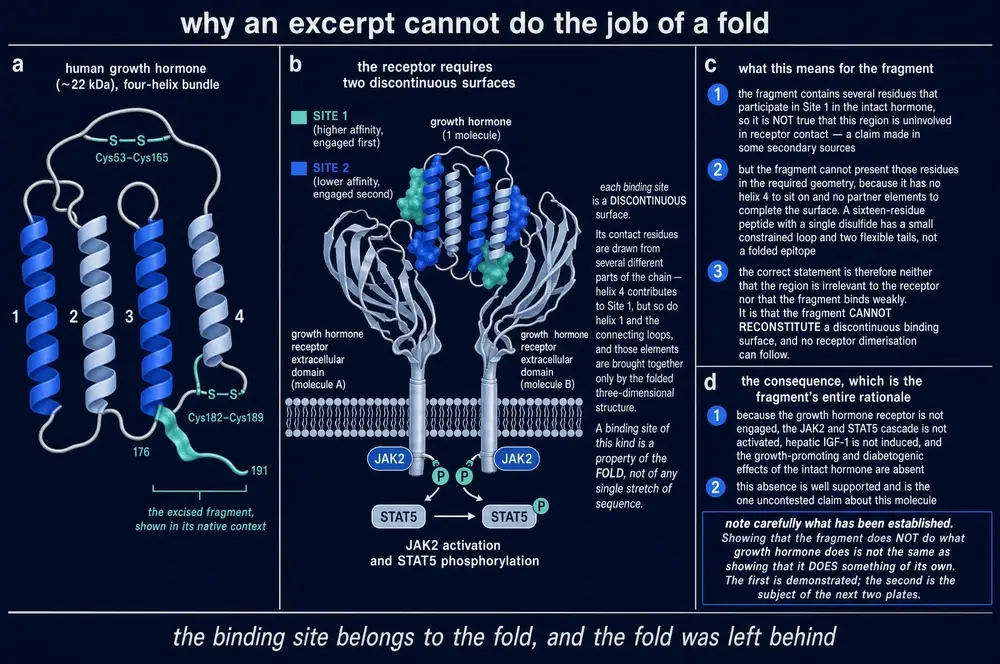
It is worth being clear about what “no receptor identified” means, because it is a stronger statement than it sounds. Establishing that a compound acts through a receptor normally requires three things that can be done in any competent pharmacology laboratory: a binding experiment showing the compound occupies the receptor and at what concentration; a blocking experiment showing that an antagonist or a knockout abolishes the effect; and a dose–response relationship in which the concentration that occupies the receptor is the concentration that produces the effect. For this family the first has never been published at all, the second was done and came back negative for the obvious candidate, and the third has no anchor because nobody has measured what concentration reaches a fat cell.
None of that means the effect is not real. It means the effect is, in the strict sense, unexplained — which is a normal and respectable state for a compound to be in early, and an unusual one to still be in twenty-five years later while the compound is being sold.
For twenty-five years that was where the mechanism stopped. Then, in 2026, a group including investigators at the same university reported the first target identified by direct capture rather than inference. Using a photoaffinity-labelled version of the active metabolite, they pulled lanthionine synthetase C-like protein 1 out of rat spinal cord, and knocking that protein down in the dorsal root ganglion abolished the peptide’s activity (Spanswick et al., 2026). The finding belongs to LAT8881, which is AOD-9604 under its licensee’s code, and it is a finding about nerve pain rather than about fat.
17The human record, and the hole in it
Two programmes have taken a molecule from this family into people, and both used the analogue.
A failed trial is a particular kind of evidence and it is easy to misread in either direction. It does not show that a compound does nothing; a trial can fail because the dose was wrong, the population was wrong, the endpoint was insensitive, or the effect is real but too small to matter. What an adequately sized negative trial does establish is an upper bound — if there were an effect of the size the programme was designed to detect, this trial would probably have detected it. That bound is the most informative number the whole family possesses.
It also belongs to the analogue, and the direction of that inheritance is worth stating plainly. When a compound is sold on the strength of a neighbour’s safety record, the neighbour’s failure comes with it. The trials that are cited to show this class is well tolerated are the same trials that showed it did not work.
The first was for obesity, run by the Australian company that licensed the Monash work; its detail belongs to Monograph No. 25 in this series, which is AOD-9604’s own record. The short version is that development for obesity ended. The second was for post-herpetic neuralgia — the persistent nerve pain that can follow shingles — registered as NCT03865953 and conducted with LAT8881. A systematic review of phase II to IV trials in that indication tabulates its outcome plainly: no statistical difference from placebo was found in any of the evaluated outcomes, with adverse events, chiefly upper respiratory tract infection and headache, occurring equally in both arms (Huerta et al., 2023).
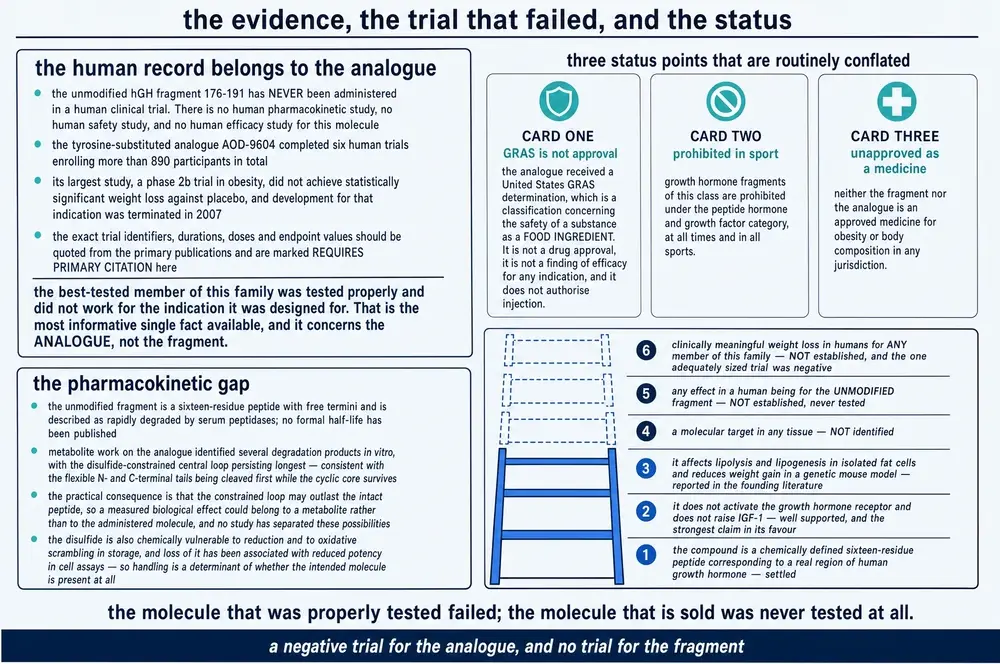
There is no human study of hGH 176–191. Not a trial, not a pharmacokinetic study, not a single-dose tolerability report. The compound has been available to buy for years and has never been given to a person under observation in a way that produced a published record.
18The 2022 paper, and what it actually used
One modern primary paper has been published under the fragment’s own name. In 2022 a group reported that a human growth hormone fragment 176–191 peptide enhances the toxicity of doxorubicin-loaded chitosan nanoparticles against a breast cancer cell line, combining molecular docking with a cell-viability assay (Habibullah et al., 2022).
The paper states the sequence it modelled and assayed. It is YLRIVQCRSVEGSCGF. That is AOD-9604.
The same paper describes the relationship between the two molecules as “a tyrosine to phenylalanine substitution at the last position”. The substitution runs the other way — phenylalanine to tyrosine — and it is at the first position, not the last. At the last position it would change nothing at all, because both molecules carry phenylalanine there. A stated substitution can be checked against the sequence in one step, and a swap between two identical residues is a free contradiction.
This is not offered as an indictment of one paper. It is offered because it is the cleanest available demonstration of the problem this document exists to describe. If a peer-reviewed primary study, writing the compound’s name in its title, uses the other molecule’s sequence and misstates the difference in both direction and position, then the confusion is not confined to the marketplace.
19Banned by its own name
The World Anti-Doping Agency’s Prohibited List for 2026, in force from 1 January of that year, prohibits growth hormone, its analogues and its fragments under section S2.2.3, and gives two examples: AOD-9604 and hGH 176-191. The list was read directly for this document rather than through a summary of it.
Two things in that sentence are worth drawing out. The first is practical: the fragment is named in its own right, class S2 is prohibited at all times rather than only in competition, and it is a non-specified substance, which carries the heavier default sanction. An athlete found with it does not get to argue about which of the two peptides was in the vial.
The second is that an anti-doping regulator is being more careful about this distinction than much of the scientific literature. The list gives the two as separate examples and indexes them separately. A 2026 narrative review in an endocrinology journal, by contrast, writes the pairing as “AOD9604 (hGH 176-191)” — with the parenthesis doing the work of an equals sign (Dominikowski et al., 2026). Both documents were published in the same year.
No medicines regulator has approved the fragment for any indication, in any country. There is no marketing authorisation to describe.
20Detectable, and what is in the vial
Because it is banned, it has to be findable, and the analytical chemistry is one of the few parts of this story where the work is thorough and recent.
The first problem was that the fragment is invisible to the test already in use. Anti-doping laboratories screen for growth hormone itself with an assay that compares the relative abundance of the hormone’s isoforms; the fragment does not disturb it (Orlovius et al., 2013). A dedicated method was therefore needed, and one was validated in urine with a limit of detection of 50 pg/mL and a recovery of 62 per cent. Incubating the peptide in serum and urine identified six metabolites, of which one — the nine-residue CRSVEGSCG — is markedly more stable than either the other fragments or the parent peptide, and screening for it extends the window in which use can be detected (Cox et al., 2015).
The second problem is what is actually in the products. Preparations seized by national authorities have been characterised analytically (Vanhee et al., 2014), and the compound now appears routinely in the scope of screening methods designed for peptides under two kilodaltons (Thomas et al., 2016; Mazzarino et al., 2026). A 2025 analysis of illegal and falsified medicines self-administered outside approved use lists AOD-9604 and hGH 176-191 among the substances encountered — again, as two entries.
21Three new lives, none of them fat loss
The most striking feature of the recent literature is that it has almost nothing to do with obesity.
In a rabbit model of knee osteoarthritis induced with collagenase, ultrasound-guided intra-articular injections of AOD-9604, with and without hyaluronic acid, were compared against saline over four to seven weeks. Both active treatments outperformed saline on gross and histopathological scoring, and the combination outperformed either alone; lameness resolved fastest in the combination group (Kwon & Park, 2015). This is a single study, in one species, with thirty-two animals and no human follow-up.
In severe influenza A infection in mice, LAT8881 and its metabolite LAT9991F reduced viral replication, limited local inflammation and improved survival, acting independently of the growth hormone receptor (Harpur et al., 2023; West et al., 2024). And in neuropathic pain, the 2026 work already described identified LanCL1 as the binding target and showed reversal of mechanical allodynia across several rodent nerve-injury models (Spanswick et al., 2026).
These are serious studies and the LanCL1 result in particular is the most substantial mechanistic advance the family has seen. They are also, every one of them, studies of the analogue. The molecule with the tyrosine has acquired a plausible second career in inflammation and nerve injury while the molecule without it has acquired a market in fat loss, and the evidence has flowed in the wrong direction between them.
22The claim ledger
Two reviews published in 2026 place the fragment where it now sits. One surveys peptides modulating the growth hormone axis that are marketed as research compounds and self-administered outside clinical supervision, and stratifies them into evidence tiers running from regulatory-grade randomised data down to a complete absence of human studies (Dominikowski et al., 2026). The other, in sports medicine, sets the approved peptides against the parallel grey market and notes that many unapproved peptides show favourable outcomes in animal models while rigorous human safety data are scarce (Mendias et al., 2026). Both name this family. Neither can cite a human study of the fragment itself, because there is not one.
The honest ledger for hGH 176–191, then, reads as follows. Effects demonstrated in humans: none reported. Effects demonstrated in animals for this exact molecule: a rise in blood glucose, a rise in plasma insulin and a fall in insulin sensitivity, in rats, in 1978. Effects demonstrated in animals for molecules differing from it by one residue or one atom: reduced weight gain, reduced adipose mass, increased fat oxidation, cartilage repair, antiviral protection and reversal of neuropathic pain. Receptor: unidentified for this molecule; LanCL1 proposed for the analogue in 2026.
23What it would take to know
It is easy to read the preceding twenty-two sections as a debunking, and that would be the wrong conclusion. Nothing here shows that hGH 176–191 does not work. It shows that nobody has looked.
The experiment that would settle the most is also the cheapest: run FLRIVQCRSVEGSCGF and YLRIVQCRSVEGSCGF side by side, in the same assay, in the same animals, at the same molar dose. Nobody has published that comparison. It is entirely possible that the single oxygen makes no biological difference whatever, in which case the analogue’s substantial evidence base transfers and this document’s central complaint dissolves into a labelling problem. It is also possible that it matters, since the whole reason the tyrosine was added was that it changes how the molecule behaves in an assay. Between those two possibilities the literature is silent, and it has been silent for twenty-six years.
Three further gaps are worth naming because they are unusual for a compound with this much commercial reach. There is no published pharmacokinetic study of the unmodified fragment in any species. There is no binding, displacement or knockdown experiment using it. And there is no human exposure of any kind on record — which means the safety profile widely quoted for “HGH Fragment 176-191” is the analogue’s, obtained in trials that this molecule was not in.
The 1978 result deserves the last word, not because it is the strongest evidence but because it is the only evidence, and because its direction is the opposite of the compound’s reputation. A peptide that raised blood glucose and blunted insulin action in rats has become a peptide sold to improve body composition, on the strength of experiments done with different molecules. Whether the reputation or the experiment is the better guide is not something the published literature currently allows anyone to say.
There is a broader lesson in this compound that outlives it, and it is about how evidence migrates. Nothing in this story required anyone to lie. A laboratory studied a region of a hormone and reported what it found. A company made a close analogue and tested it properly. Regulators wrote both names down carefully. What happened between those points is that a molecule acquired a designation derived from its neighbour's chemistry, and the designation travelled better than the data did — because a name is easy to copy and a methods section is not. The compound sold today is real, its sequence is well defined, and it is entirely plausible that it behaves much as its analogue does. That possibility is not the same thing as a finding, and the distance between them is this document's subject.
This document describes published research. It does not recommend human use of any compound and specifies no dose, route or schedule for any person. Doses, routes and durations appear only where they are reported parameters of a study, and always with the species and the duration attached.
24References
Generated from verified NCBI records rather than from recall. Author lists, journal names, volumes, pages and identifiers are taken from the PubMed record for each citation, and the build refuses to run if any identifier fails to resolve. A second check runs in the opposite direction: every author–year citation in the prose is parsed back out of the assembled document and asserted against the record its identifier resolved to, so a citation naming the wrong surname or the wrong year fails the build rather than reaching a reader. Both arms of that check were deliberately broken and confirmed to fail before this document was released.
- Armstrong JM, Bornstein J, Ng FM, Taft HP. Pituitary polypeptide with hypoglycaemic action in diabetes mellitus. Br Med J. 1969;2(5650):157-8.
PMID 5778938 · doi:10.1136/bmj.2.5650.157 · PMC1982955 - Berryman DE, List EO, Sackmann-Sala L, Lubbers E, Munn R, Kopchick JJ. Growth hormone and adipose tissue: beyond the adipocyte. Growth Horm IGF Res. 2011;21(3):113-23.
PMID 21470887 · doi:10.1016/j.ghir.2011.03.002 · PMC3112270 - Bornstein J, Armstrong JM, Ng FM, Taft HP. Potentiation of insulin action in normal subjects by a pituitary polypeptide. Br Med J. 1969;3(5668):451-2.
PMID 5811655 · doi:10.1136/bmj.3.5668.451 · PMC1984216 - Bornstein J, Ng FM, Heng D, Wong KP. Metabolic actions of pituitary growth hormone. I. Inhibition of acetyl CoA carboxylase by human growth hormone and a carboxyl terminal part sequence acting through a second messenger. Acta Endocrinol (Copenh). 1983;103(4):479-86.
PMID 6137122 - Cox HD, Smeal SJ, Hughes CM, Cox JE, Eichner D. Detection and in vitro metabolism of AOD9604. Drug Test Anal. 2015;7(1):31-8.
PMID 25208511 · doi:10.1002/dta.1715 - Dominikowski A, Rękoś Z, Olejarz M, Szczepanek-Parulska E, Domin R, RuchaŁa M. The emerging landscape of performance-enhancing peptides modulating GH-IGF1 axis: bridging the gap between clinical evidence and patient self-administration. Front Endocrinol (Lausanne). 2026;17:1822475.
PMID 42395176 · doi:10.3389/fendo.2026.1822475 · PMC13322892 - Driver CJ, Armstrong JM, Bornstein J, Ng FM. Isolation and characterization of a pituitary peptidase specifically releasing, from growth hormone, a peptide (somantin) with antagonistic activity to insulin in vitro. J Endocrinol. 1973;59(2):261-74.
PMID 4759592 · doi:10.1677/joe.0.0590261 - Habibullah MM, Mohan S, Syed NK, Makeen HA, Jamal QMS, Alothaid H, et al.. Human Growth Hormone Fragment 176-191 Peptide Enhances the Toxicity of Doxorubicin-Loaded Chitosan Nanoparticles Against MCF-7 Breast Cancer Cells. Drug Des Devel Ther. 2022;16:1963-1974.
PMID 35783198 · doi:10.2147/DDDT.S367586 · PMC9249349 - Halford JC. Obesity drugs in clinical development. Curr Opin Investig Drugs. 2006;7(4):312-8.
PMID 16625817 - Harpur CM, West AC, Le Page MA, Lam M, Hodges C, Oseghale O, et al.. Naturally derived cytokine peptides limit virus replication and severe disease during influenza A virus infection. Clin Transl Immunology. 2023;12(3):e1443.
PMID 36969366 · doi:10.1002/cti2.1443 · PMC10034483 - Heffernan M, Summers RJ, Thorburn A, Ogru E, Gianello R, Jiang WJ, et al.. The effects of human GH and its lipolytic fragment (AOD9604) on lipid metabolism following chronic treatment in obese mice and beta(3)-AR knock-out mice. Endocrinology. 2001;142(12):5182-9.
PMID 11713213 · doi:10.1210/endo.142.12.8522 - Heffernan MA, Jiang WJ, Thorburn AW, Ng FM. Effects of oral administration of a synthetic fragment of human growth hormone on lipid metabolism. Am J Physiol Endocrinol Metab. 2000;279(3):E501-7.
PMID 10950816 · doi:10.1152/ajpendo.2000.279.3.E501 - Heffernan MA, Thorburn AW, Fam B, Summers R, Conway-Campbell B, Waters MJ, et al.. Increase of fat oxidation and weight loss in obese mice caused by chronic treatment with human growth hormone or a modified C-terminal fragment. Int J Obes Relat Metab Disord. 2001;25(10):1442-9.
PMID 11673763 · doi:10.1038/sj.ijo.0801740 - Hjelholt AJ, Charidemou E, Griffin JL, Pedersen SB, Gudiksen A, Pilegaard H, et al.. Insulin resistance induced by growth hormone is linked to lipolysis and associated with suppressed pyruvate dehydrogenase activity in skeletal muscle: a 2 × 2 factorial, randomised, crossover study in human individuals. Diabetologia. 2020;63(12):2641-2653.
PMID 32945898 · doi:10.1007/s00125-020-05262-w - Huerta MÁ, Garcia MM, García-Parra B, Serrano-Afonso A, Paniagua N. Investigational Drugs for the Treatment of Postherpetic Neuralgia: Systematic Review of Randomized Controlled Trials. Int J Mol Sci. 2023;24(16).
PMID 37629168 · doi:10.3390/ijms241612987 · PMC10455720 - Høgild ML, Hjelholt AJ, Hansen J, Pedersen SB, Møller N, Wojtaszewski JFP, et al.. Ketone Body Infusion Abrogates Growth Hormone-Induced Lipolysis and Insulin Resistance. J Clin Endocrinol Metab. 2023;108(3):653-664.
PMID 36240323 · doi:10.1210/clinem/dgac595 - Khan A, Raza S, Khan Y, Aksoy T, Khan M, Weinberger Y, et al.. Current updates in the medical management of obesity. Recent Pat Endocr Metab Immune Drug Discov. 2012;6(2):117-28.
PMID 22435392 · doi:10.2174/187221412800604644 - Kwon DR, Park GY. Effect of Intra-articular Injection of AOD9604 with or without Hyaluronic Acid in Rabbit Osteoarthritis Model. Ann Clin Lab Sci. 2015;45(4):426-32.
PMID 26275694 - Leung KC, Howe C, Gui LY, Trout G, Veldhuis JD, Ho KK. Physiological and pharmacological regulation of 20-kDa growth hormone. Am J Physiol Endocrinol Metab. 2002;283(4):E836-43.
PMID 12217902 · doi:10.1152/ajpendo.00122.2002 - Ma GY, Macaulay SL, Maggs JA, Armstrong JM, Bornstein J. The mechanism of the hyperglycaemic action of synthetic peptides related to the C-terminal sequence of human growth hormone. Biochim Biophys Acta. 1982;716(3):400-9.
PMID 6810951 · doi:10.1016/0304-4165(82)90033-2 - Macaulay SL, Armstrong JM, Bornstein J. Regulation of glycogen synthase activity in muscle by a C-terminal part sequence of human growth hormone. Arch Biochem Biophys. 1983;224(1):365-71.
PMID 6307153 · doi:10.1016/0003-9861(83)90221-7 - Mazzarino M, Colpaert T, Deventer K, Van Eenoo P. Rapid and harmonized analytical workflow for the determination of peptidic and non-peptidic doping agents in dried and liquid blood matrices. Analyst. 2026;151(15):4398-4413.
PMID 42328738 · doi:10.1039/d6an00455e - Mendias CL, Awan TM. Safety and Efficacy of Approved and Unapproved Peptide Therapies for Musculoskeletal Injuries and Athletic Performance. Sports Med. 2026.
PMID 41966639 · doi:10.1007/s40279-026-02437-0 - Natera SH, Jiang WJ, Ng FM. Reduction of cumulative body weight gain and adipose tissue mass in obese mice: response to chronic treatment with synthetic hGH 177-191 peptide. Biochem Mol Biol Int. 1994;33(5):1011-21.
PMID 7987248 - Newman JD, Armstrong JM, Bornstein J. Effects of part sequences of human growth hormone on in vivo hepatic glycogen metabolism in the rat. Biochim Biophys Acta. 1978;544(2):234-44.
PMID 214153 · doi:10.1016/0304-4165(78)90093-4 - Ng FM, Bornstein J, Welker C, Zimmet PZ, Taft P. Insulin potentiating action of synthetic peptides relating to the amino terminal sequence of human growth hormone. Diabetes. 1974;23(12):943-9.
PMID 4435308 · doi:10.2337/diab.23.12.943 - Ng FM, Bornstein J, Pullin CE, Bromley JO, Macaulay SL. The minimal amino acid sequence of the insulin-potentiating fragments of human growth hormone: its mechanism of action. Diabetes. 1980;29(10):782-7.
PMID 6777219 · doi:10.2337/diacare.20.10.782 - Ng FM, Bornstein J. Hyperglycemic action of synthetic C-terminal fragments of human growth hormone. Am J Physiol. 1978;234(5):E521-6.
PMID 645904 · doi:10.1152/ajpendo.1978.234.5.E521 - Ng FM, Adamafio NA, Graystone JE. Effects of exogenous growth hormone on lipid metabolism in the isolated epididymal fat pad of the growth hormone-deficient little mouse. J Mol Endocrinol. 1990;4(1):43-9.
PMID 1969738 · doi:10.1677/jme.0.0040043 - Ng FM, Jiang WJ, Gianello R, Pitt S, Roupas P. Molecular and cellular actions of a structural domain of human growth hormone (AOD9401) on lipid metabolism in Zucker fatty rats. J Mol Endocrinol. 2000;25(3):287-98.
PMID 11116208 · doi:10.1677/jme.0.0250287 - Ng FM, Sun J, Sharma L, Libinaka R, Jiang WJ, Gianello R. Metabolic studies of a synthetic lipolytic domain (AOD9604) of human growth hormone. Horm Res. 2000;53(6):274-8.
PMID 11146367 · doi:10.1159/000053183 - Ogru E, Wilson JC, Heffernan M, Jiang WJ, Chalmers DK, Libinaki R, et al.. The conformational and biological analysis of a cyclic anti-obesity peptide from the C-terminal domain of human growth hormone. J Pept Res. 2000;56(6):388-97.
PMID 11152298 · doi:10.1034/j.1399-3011.2000.00771.x - Orlovius AK, Thomas A, Schänzer W, Thevis M. AOD-9604 does not influence the WADA hGH isoform immunoassay. Drug Test Anal. 2013;5(11-12):850-2.
PMID 24124033 · doi:10.1002/dta.1557 - Rahman OF, Lee SJ, Seeds WA. Therapeutic Peptides in Orthopaedics: Applications, Challenges, and Future Directions. J Am Acad Orthop Surg Glob Res Rev. 2026;10(1).
PMID 41490200 · doi:10.5435/JAAOSGlobal-D-25-00236 · PMC12753158 - Spanswick DC, Wei H, Zhao FY, Caldeira Borges da Cruz MP, Whyment AD, Campbell-Galland A, et al.. Lanthionine synthetase C-like protein 1 (LanCL1): a therapeutic target for neuropathic pain. Pain. 2026;167(8):1850-1868.
PMID 42263267 · doi:10.1097/j.pain.0000000000004014 · PMC13382871 - Thevis M, Thomas A, Schänzer W. Detecting peptidic drugs, drug candidates and analogs in sports doping: current status and future directions. Expert Rev Proteomics. 2014;11(6):663-73.
PMID 25382550 · doi:10.1586/14789450.2014.965159 - Thevis M, Schänzer W. Analytical approaches for the detection of emerging therapeutics and non-approved drugs in human doping controls. J Pharm Biomed Anal. 2014;101:66-83.
PMID 24906629 · doi:10.1016/j.jpba.2014.05.020 - Thomas A, Görgens C, Guddat S, Thieme D, Dellanna F, Schänzer W, et al.. Simplifying and expanding the screening for peptides <2 kDa by direct urine injection, liquid chromatography, and ion mobility mass spectrometry. J Sep Sci. 2016;39(2):333-41.
PMID 26578461 · doi:10.1002/jssc.201501060 - Troike KM, Henry BE, Jensen EA, Young JA, List EO, Kopchick JJ, et al.. Impact of Growth Hormone on Regulation of Adipose Tissue. Compr Physiol. 2017;7(3):819-840.
PMID 28640444 · doi:10.1002/cphy.c160027 - Vanhee C, Moens G, Deconinck E, De Beer JO. Identification and characterization of peptide drugs in unknown pharmaceutical preparations seized by the Belgian authorities: case report on AOD9604. Drug Test Anal. 2014;6(9):964-8.
PMID 24976118 · doi:10.1002/dta.1687 - Vijayakumar A, Novosyadlyy R, Wu Y, Yakar S, LeRoith D. Biological effects of growth hormone on carbohydrate and lipid metabolism. Growth Horm IGF Res. 2010;20(1):1-7.
PMID 19800274 · doi:10.1016/j.ghir.2009.09.002 · PMC2815161 - Wade JD, Pullin CO, Ng FM, Bornstein J. The synthesis and hyperglycaemic activity of the amino acid sequence 172-191 of human growth hormone. Biochem Biophys Res Commun. 1977;78(2):827-32.
PMID 907713 · doi:10.1016/0006-291x(77)90254-6 - Wade JD, Ng FM, Bornstein J. Diabetogenic action of human growth hormone. Synthesis and activity of C-terminal fragments. Int J Pept Protein Res. 1979;13(2):195-200.
PMID 429095 · doi:10.1111/j.1399-3011.1979.tb01868.x - Wade JD, Ng FM, Bornstein J, Pullin CO, Pearce JS. Effect of C-terminal chain shortening on the insulin-antagonistic activity of human growth hormone 177--191. Acta Endocrinol (Copenh). 1982;101(1):10-4.
PMID 6751009 · doi:10.1530/acta.0.1010010 - Weerasinghe C, Bornstein J. Effect of synthetic C-terminal fragments of hGH on insulin release by isolated islets. Am J Physiol. 1978;234(5):E527-31.
PMID 206156 · doi:10.1152/ajpendo.1978.234.5.E527 - West AC, Harpur CM, Le Page MA, Lam M, Hodges C, Ely LK, et al.. Harnessing Endogenous Peptide Compounds as Potential Therapeutics for Severe Influenza. J Infect Dis. 2024;230(2):e384-e394.
PMID 38060822 · doi:10.1093/infdis/jiad566 · PMC11326819 - Wijaya E, Ng FM. Effect of an antilipogenic fragment of human growth hormone on glucose transport in rat adipocytes. Biochem Mol Biol Int. 1993;31(3):543-52.
PMID 8118430 - Wilding J. AOD-9604 Metabolic. Curr Opin Investig Drugs. 2004;5(4):436-40.
PMID 15134286 - Wu Z, Ng FM. Antilipogenic action of synthetic C-terminal sequence 177-191 of human growth hormone. Biochem Mol Biol Int. 1993;30(1):187-96.
PMID 8358331 - Zimmet P, Ng FM, Bornstein J, Armstrong JM, Taft HP. Insulin antagonist of pituitary origin in plasma of normal and diabetic subjects. Br Med J. 1971;1(5742):203-4.
PMID 5541231 · doi:10.1136/bmj.1.5742.203 · PMC1794829
Sources without a PubMed record
Regulatory instruments, sequence databases and registry records have no PubMed record and are therefore listed separately, so that the generated list above remains wholly machine-verified.
- World Anti-Doping Agency. The 2026 Prohibited List — International Standard. In effect 1 January 2026. Section <b>S2.2.3</b>, growth hormone, its analogues and fragments, reads in full: “growth hormone fragments, e.g. AOD-9604 and hGH 176-191”. The two are given as SEPARATE examples and are indexed separately. Verified against the instrument itself on 3 August 2026, not against a summary of it (house style section 10, item 8).
https://www.wada-ama.org/en/prohibited-list - UniProt Consortium. P01241 (SOMA_HUMAN) — Somatotropin, Homo sapiens. The reference sequence. Precursor 217 residues; signal peptide 1–26; mature chain 27–217 numbered 1–191. Mature residues 176–191 are therefore precursor 202–217 and read FLRIVQCRSVEGSCGF. Used here to verify the sequence and to establish the residue 184/185 transposition in two 1993 papers.
https://rest.uniprot.org/uniprotkb/P01241 - US National Library of Medicine. NCT03865953 — A study of LAT8881 in post-herpetic neuralgia. ClinicalTrials.gov registry record. Cited for the existence, design and sponsor of the trial. The outcome reported here is taken from the peer-reviewed systematic review that tabulates it, and the registry record is given so a reader can check the design independently.
https://clinicaltrials.gov/study/NCT03865953
25How this document was assembled
The corpus was built against project 05, the Therapeutic Peptide Research Library, and on this compound the arithmetic is unusually informative, because almost everything the search returns is about something else.
The identity problem, in numbers. This compound’s designation is a pair of numbers, and a pair of numbers separated by a dash is also how journals print page ranges. The string 176-191 occurs in 213 PubMed records; four of them are about this molecule. Every matcher in this build therefore refuses a bare range outright and admits it only when a growth-hormone designation sits immediately beside it, when the range is written in the reverse construction, when the literal sequence appears, or when the range sits inside an anchored run of other residue ranges.
That last clause was added after a failure, and it matters. The first version of the matcher required the hormone name to be adjacent, which is correct for defeating page ranges and which silently deleted the single most important paper in this document. Ng & Bornstein 1978 introduces its constructs as a list — “the synthetic peptides corresponding to amino acids 172-191, 176-191, 177-191, 178-191, 179-191, and 180-191 of human growth hormone” — so the hormone name is carried by the first item and by the trailing phrase, and the subject’s own range sits in the middle of the run with no anchor near it. The analysis that followed reported that the compound had no primary literature before 2022, and that conclusion was wrong. A compound whose designation is a residue range will be introduced in a list of sibling ranges, and an adjacency test sees only the first member.
The matcher was break-tested before the first sweep, not after. Thirty constructed cases were run through it: every bracket and dash form of the subject’s designation including the doubled ASCII hyphen that legacy records use for an en dash, the analogue under all four of its names, the literal sequences, a bibliography, a page range beside an unrelated residue range, the parent hormone alone, and each of the other mapped fragments. All thirty pass. Two genuine defects were found this way and fixed before any document was read.
The local sweep. Every file with a document extension in the project’s stores was opened — 45,975 of them — and 383 proposed a match. 382 were admitted. Classifying those by the store they came from rather than by a path substring gives the shape of the holding, and the shape is the finding:
| Source kind | Documents | Page equivalents |
|---|---|---|
| Vendor page snapshots | 282 | 1,258 |
| Trade and affiliate copy | 78 | 608 |
| Vendor product pages | 9 | 9 |
| This project’s own earlier write-ups | 7 | 87 |
| Peer-reviewed full texts | 3 | 51 |
| Unclassified | 3 | 27 |
Three peer-reviewed full texts against several hundred vendor pages and prior write-ups is the most extreme ratio this series has measured. For a compound with a global consumer market and a scientific literature that can be read in an afternoon, that imbalance is not an inconvenience to be filtered away before quoting a corpus. It is one of the most informative measurements available about where this molecule now lives, and it belongs in the body of the document rather than only here.
The external harvest. A scoped PubMed query in five named arms — the fragment, the analogue programme, the founding Melbourne literature, the parent hormone’s metabolic actions, and the anti-doping literature — returned 1,190 records, of which 892 passed a record-level relevance screen. The founding arm was added after the first harvest returned 878 records and missed four of the papers this document is built on, including the only synthesis of the subject compound: that literature predates the compound’s modern designation, never uses the word “lipolytic”, and was invisible to every other arm. A PubMed Central body-text sweep added 20 further documents, and 150 full texts were retrieved.
The far-side screen, and why the reading corpus is small. Of those 150 retrieved full texts, 123 do not name this compound or its analogue programme at all — they were returned by the parent-hormone arm and are context rather than corpus. 6 name it only in passing. That leaves 18 unique scientific full texts, about 260 printed-page equivalents, after keying the local and external sets against each other and counting the overlap once rather than summing.
Read that number alongside the metadata layer, not beneath it. Eighteen full texts is a small corpus, and it is small for a reason that is itself a finding: this compound’s substantive literature is four decades old and predates open-access deposition, so the founding papers exist as indexed abstracts and nothing more. The 892 screened records are therefore doing real evidentiary work here, and every claim in Parts Two and Three that rests on an abstract rather than a full text is one this document could not verify against a methods section. Where that is so, the sentence says what the abstract says and no more.
26Evidence handling
Findings are labelled by the kind of study that produced them, in the sentence that reports them, and the species is named every time. Animal and in-vitro results are never phrased so as to imply a human outcome.
Four molecules, kept apart. On this compound that discipline is not a refinement, it is the entire method. hGH 176–191 is the subject. hGH 177–191, coded AOD9401, is one residue shorter. AOD-9604, later LAT8881, is the subject with one oxygen atom added. Growth hormone is the 191-residue parent. Every quantitative claim in this document carries the name of the molecule the underlying study actually used, and where that molecule is not the subject, the sentence says so. The reference list itself records the attribution: each cited identifier is annotated in the build with the molecule its study used, so the mapping can be audited without re-reading the papers.
What this document deliberately does not do. It does not repeat Monograph No. 25, which is AOD-9604’s own record in this series and which carries that molecule’s trial history, toxicology and regulatory claims in detail. Where a result belongs to AOD-9604 it is cited, labelled and left there.
Conflicts are presented as conflicts. Four are left open because the literature does not resolve them. The same residues were called diabetogenic from 1978 to 1983, antilipogenic in 1993 and lipolytic from 2000, and no paper in the corpus explains the second transition. The 1993 report of no significant lipolytic effect stands unretracted beside twenty-five years of “lipolytic domain” framing. An anti-doping regulator lists the subject and its analogue as two separate substances while a peer-reviewed 2026 review writes them as one. And whether the single oxygen atom matters biologically is unknown, because the side-by-side experiment has never been published.
Recency was weighted, but not blindly. The most recent primary work in this family — the 2026 identification of a binding protein — is given full weight and is attributed to the analogue it was done with. The 2022 paper published under the subject’s own name is the newest primary study carrying that name and is given no weight as evidence about the subject, because its own methods section records that it used a different peptide. Recency does not override identity.
Absence of evidence is reported as absence of evidence. Nothing in this document shows that hGH 176–191 fails to do what is claimed for it. It shows that the experiments have not been done. Those are different statements and the difference is stated wherever it arises.
Continue exploring