
Ipamorelin The first selective growth hormone secretagogue, and what selectivity turned out to be worth
Ipamorelin was built to solve one problem, and it solved it. Earlier growth hormone–releasing peptides raised growth hormone but dragged cortisol and ACTH up with them. A chemistry programme in Copenhagen stripped the molecule down until the collateral hormones fell away, and the compound was named for the achievement. Then it failed anyway — shelved by the company that made it, and missed on its only controlled efficacy trial in humans. This monograph is about the distance between a property and a benefit.
Every finding below is labelled by the kind of study that produced it, in the sentence that reports it. Human trial, animal study with the species named, cell or tissue experiment, seized-material analysis and narrative review are different kinds of claim, and the difference is never left for you to infer. Where the evidence conflicts, both sides appear together with the reason one does or does not supersede the other. Where a widely repeated claim is not supported by the primary record, it is named as unsupported rather than quietly dropped.
Study parameters — doses, routes, durations — are reported because they are part of what was done. They are descriptions of experiments, not instructions. Nothing in this document recommends that any person take this compound, in any amount, by any route, for any reason.
01A hormone you cannot simply hand out
Growth hormone is not released in a steady trickle. The pituitary fires it in bursts, mostly at night, with long quiet stretches in between, and the pattern of those bursts carries information — the liver and the growth plate respond differently to a pulse than to a plateau. This is the central awkwardness of giving growth hormone as a drug. An injection produces a concentration curve that the body would never produce on its own, and it does so by bypassing every control the pituitary normally exercises.
That awkwardness is what created an entire field of chemistry. If you could persuade the pituitary to release its own growth hormone on demand, you would keep the feedback loops intact: somatostatin could still put the brakes on, the gland could still refuse, and the resulting rise would look more like physiology and less like plumbing. A compound that does this is called a secretagogue — literally something that leads secretion out.
Two families emerged. One copied the hypothalamic hormone that normally tells the pituitary to release growth hormone, growth hormone–releasing hormone, and produced the analogues sermorelin and tesamorelin. The other family is stranger, and ipamorelin belongs to it.
02The accident in the enkephalin series
In the late 1970s Cyril Bowers was working on opioid peptides — analogues of met-enkephalin, a small molecule involved in pain signalling. Some of them released growth hormone from pituitary tissue. That should not have happened; nothing about the opioid system predicted it, and the effect did not run through the known growth hormone–releasing hormone pathway. Bowers and colleagues followed the anomaly rather than discarding it, and by the mid-1980s had characterised a hexapeptide with no opioid activity and strong growth hormone–releasing activity: His-D-Trp-Ala-Trp-D-Phe-Lys-NH2, later called GHRP-6 (Momany et al., 1984; Sartor et al., 1985). It worked in people (Bowers et al., 1990).
A family grew around it. Each member is short, each contains unnatural amino acids — D-isomers, which the body's proteases handle badly and which therefore survive longer — and each ends in an amide cap rather than a free acid, for the same reason.
The family had a persistent flaw. These peptides did not release growth hormone alone. They also raised ACTH and cortisol — the stress-axis hormones — and in some cases prolactin. For an acute diagnostic test that hardly matters. For a drug someone might take for months to build bone or recover from surgery, a chronic cortisol elevation is close to disqualifying, because sustained cortisol does the opposite of what these compounds were supposed to achieve: it breaks down muscle and thins bone.
So the field had a well-defined chemistry problem. Keep the growth hormone release. Lose the cortisol.
03A drug for a receptor with no known hormone
There is a detail in this history that is easy to read past, and it is worth slowing down for, because it inverts the usual order of drug discovery.
The normal sequence is: a hormone is discovered, its receptor is found, and chemists then design molecules that mimic or block the hormone. Here it ran backwards. The growth hormone–releasing peptides were discovered first, as an accident in an unrelated series. It then became clear they were acting through some receptor that was not the growth hormone–releasing hormone receptor, and in 1996 that receptor was cloned and named for the compounds that had found it — the growth hormone secretagogue receptor (Howard et al., 1996). It was an orphan: a receptor with a known synthetic activator and no known natural one.
Ipamorelin was designed, synthesised, characterised and published into that gap. Raun and colleagues could say only that it acted through “a GHRP-like receptor” (Raun et al., 1998), because in November 1998 nobody knew what normally switched that receptor on. The answer arrived thirteen months later, when Kojima and colleagues isolated ghrelin from stomach tissue and showed that the receptor's natural ligand was a gut hormone tied to hunger (Kojima et al., 1999).
This matters for reading everything that follows. Ipamorelin was optimised against a functional assay — does growth hormone come out of pituitary cells, and does anything else come out with it — not against a model of what the receptor was for. Nobody designing it knew they were building a drug that engaged a hunger-signalling system. That fact will return in section 14, where the compound does something to body composition that a growth hormone story cannot explain.
04Copenhagen, 1998: subtraction as a design strategy
The work was done at Novo Nordisk, and the founding paper is Raun, Hansen, Johansen, Thøgersen, Madsen, Ankersen and Andersen, published in the European Journal of Endocrinology in November 1998 under a title that states the claim outright: Ipamorelin, the first selective growth hormone secretagogue.
The design move was subtraction. Starting from GHRP-1, the chemists removed the central Ala-Trp dipeptide — two of its seven residues — and replaced the alanine at position one with 2-aminoisobutyric acid, a synthetic amino acid with an extra methyl group that stiffens the backbone and resists enzymes. What remained was a pentapeptide.
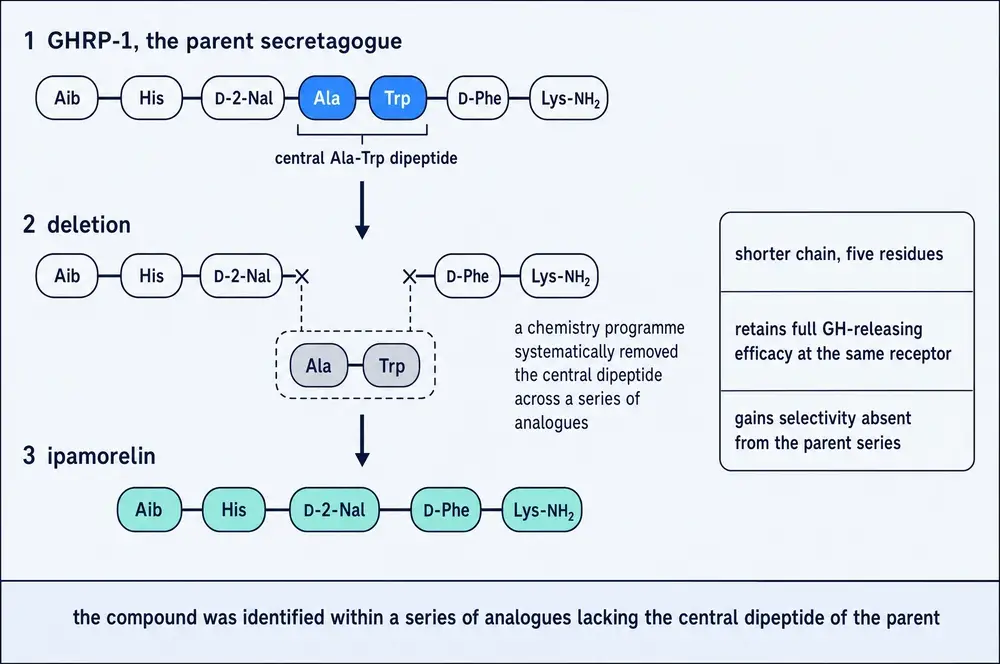
Two things about that molecule are worth understanding, because they explain most of its behaviour later.
The first is that it is small. Five residues, a molecular mass of 711.9 g/mol (Králik et al., 2026) — about a third the size of a small protein, and only a few times larger than aspirin. Small enough to cross the nasal epithelium reasonably well, which matters later for both how it is detected and how it is taken.
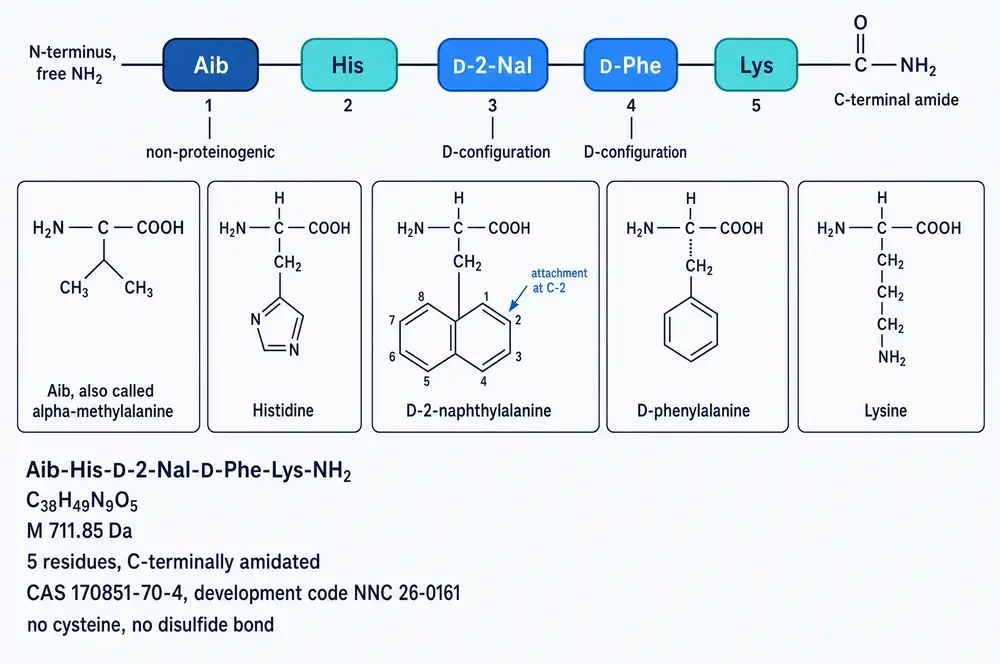
The second is that almost every residue is unnatural or in the wrong mirror image. Aminoisobutyric acid does not appear in human proteins. Two of the five residues are D-isomers, the mirror forms of the amino acids the body builds with. The C-terminus is amidated rather than left as a free acid. None of this is decoration. Ordinary peptides made of ordinary L-amino acids are dismantled in minutes by proteases that have spent evolutionary time learning their shapes; every unnatural feature is there to make the molecule harder to recognise and slower to destroy.
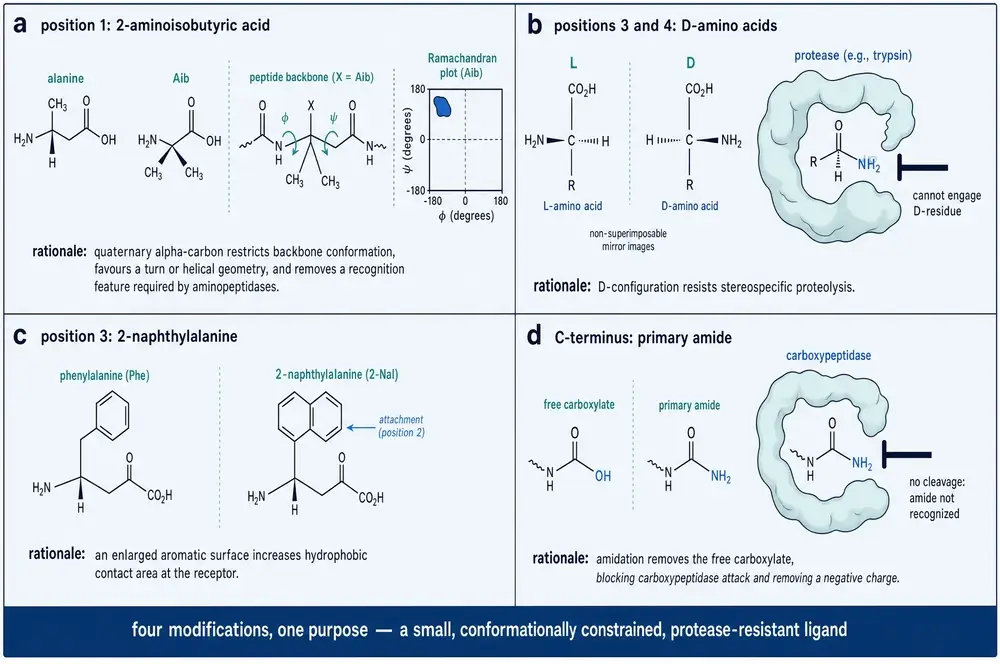
The consequence is a compound that lasts long enough to do something — and, as section 22 shows, one that leaves a distinctive signature when investigators go looking for it.
The name follows a convention. The suffix -relin marks a releasing peptide, which is why the family reads as a set: sermorelin, tesamorelin, hexarelin, anamorelin, macimorelin, ipamorelin. The stem is Novo Nordisk's own; in the internal compound registry it was NNC 26-0161, and that identifier still appears in the early pharmacokinetic papers (Johansen et al., 1998).
What the company had, at the end of 1998, was a clean pentapeptide that released growth hormone as strongly as anything in the class and left the stress axis alone. The next section is about how well that second claim holds up.
05The receptor and the switch
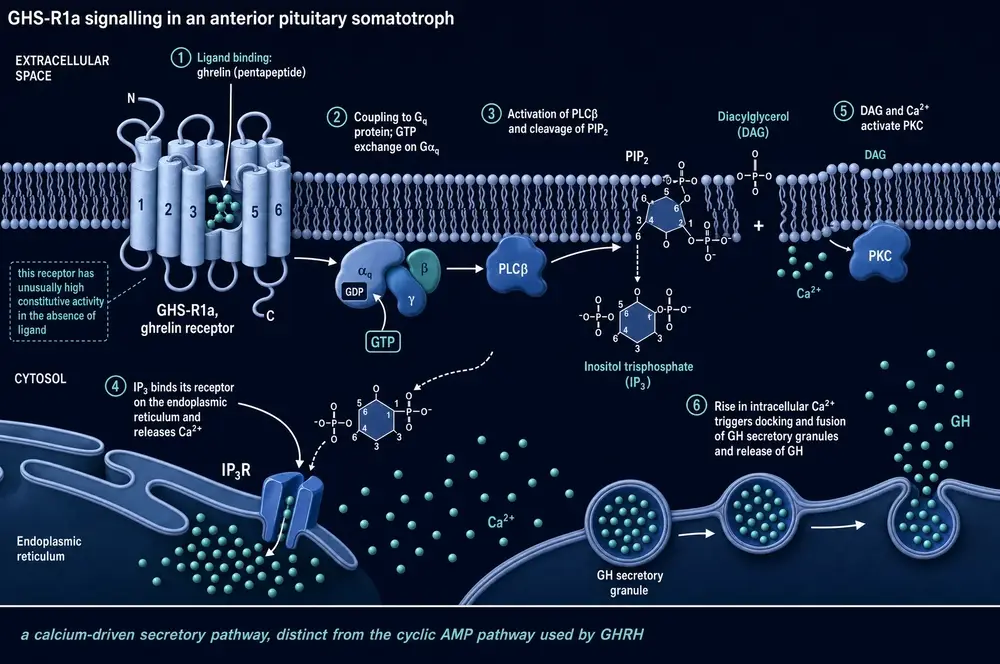
The target is a G-protein-coupled receptor called GHS-R1a — 366 amino acids, seven passes through the cell membrane, sitting on the surface of the pituitary's growth hormone–producing cells and on neurons in the hypothalamus. There is a second, shorter version, GHS-R1b, at 289 residues; it is identical up to a point and then diverges, and it binds neither ghrelin nor any growth hormone secretagogue (as summarised in the imaging-probe literature, Childs et al., 2020). Only the 1a form does anything.
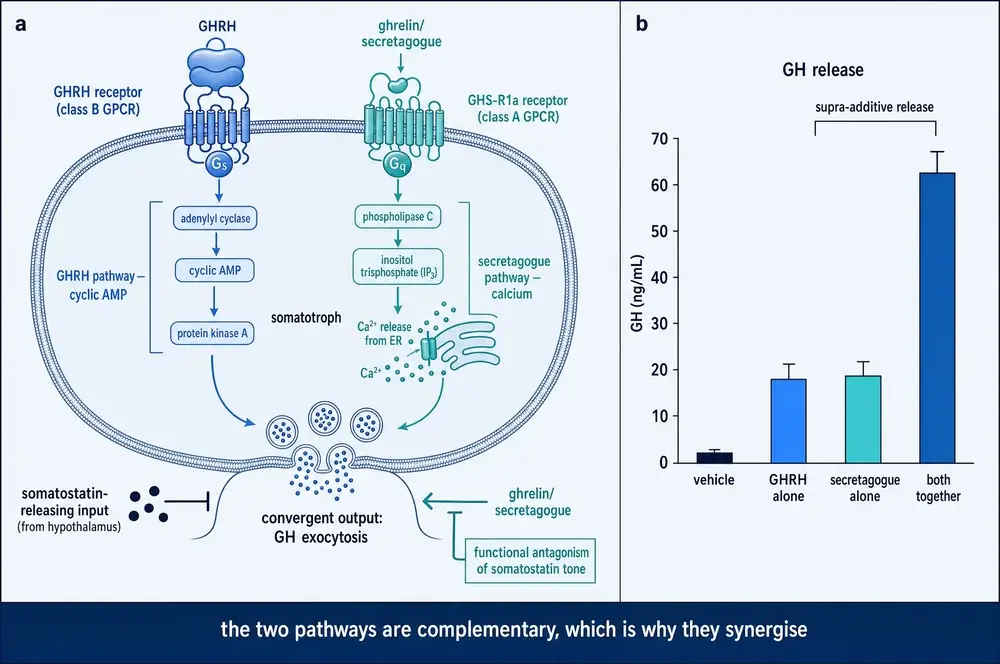
When ipamorelin binds, the receptor couples through Gq to phospholipase C, which generates inositol trisphosphate and diacylglycerol and releases calcium from internal stores. Calcium is the trigger for exocytosis: vesicles already loaded with growth hormone fuse with the membrane and dump their contents into the blood. Ipamorelin is named in the ghrelin-system literature among the congeners that produce exactly this sequence (Veldhuis et al., 2010).
Two features of this receptor matter for the rest of the story. It is not confined to the pituitary — it is expressed in the pancreas, thyroid, adrenal, spleen, gut, heart and adipose tissue (Childs et al., 2020; Dominikowski et al., 2026). And it has remarkable constitutive activity, running at roughly half its maximal output with nothing bound to it at all (Wang et al., 2021; Veldhuis et al., 2010). That is why a second endogenous ligand, LEAP2, works as an inverse agonist rather than a simple blocker (Childs et al., 2020), and it means a drug that switches this receptor on is neither doing one thing nor doing it in one place.
Why a synthetic peptide needs no fatty acid
There is a genuine puzzle in ipamorelin's existence, and it was only solved structurally in 2021. Ghrelin, the natural ligand, does not work unless a fatty-acid chain — usually octanoyl — is attached to its third amino acid. Strip that chain off and affinity collapses by four orders of magnitude (Veldhuis et al., 2010). Yet ipamorelin has no fatty acid anywhere on it, and activates the same receptor.
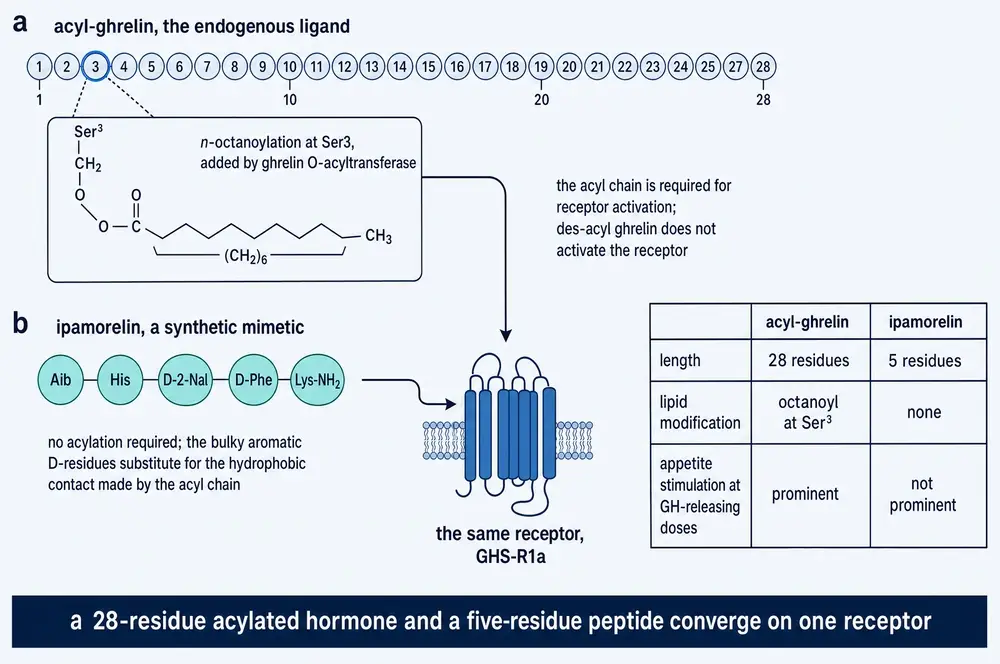
Cryo-electron microscopy of the activated human receptor, solved with ghrelin bound at 2.9 Ångström resolution and with GHRP-6 bound at 3.2 Ångström, showed why (Wang et al., 2021). The binding pocket is split in two by a salt bridge, and the second chamber is where ghrelin's octanoyl chain sits. GHRP-6 — which shares no sequence homology with ghrelin at all — binds the pocket upside down, inserting its C-terminus where ghrelin inserts its N-terminus, and fills that same fatty-acid chamber with an aromatic ring: the side chain of its D-phenylalanine. An aromatic ring substitutes for a lipid tail. The same study notes that replacing ghrelin's own third residue with aromatic amino acids — tryptophan, or 2-naphthylalanine — preserves activity, where charged or small hydrophobic replacements destroy it.
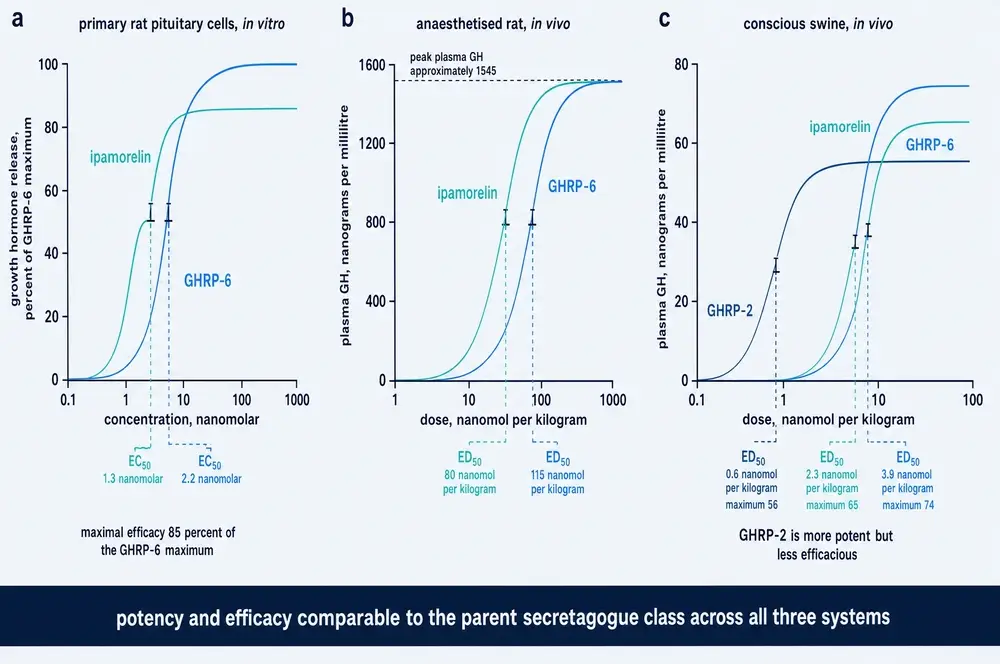
How hard does ipamorelin push this switch? In cultured rat pituitary cells, it released growth hormone with a half-maximal concentration of 1.3 nmol/l and a maximum effect 85% of the reference compound's, against GHRP-6's 2.2 nmol/l and 100% (Raun et al., 1998). In anaesthetised rats the half-maximal dose was 80 nmol/kg against GHRP-6's 115. In conscious swine — the most relevant model in that paper, because the animals were awake and the hormone panel was broad — the half-maximal dose was 2.3 nmol/kg against GHRP-6's 3.9. On potency, ipamorelin and GHRP-6 are near neighbours. Nothing in the subtraction cost the molecule its main activity.
06The hormones that did not move
Here is the finding the compound is named for.
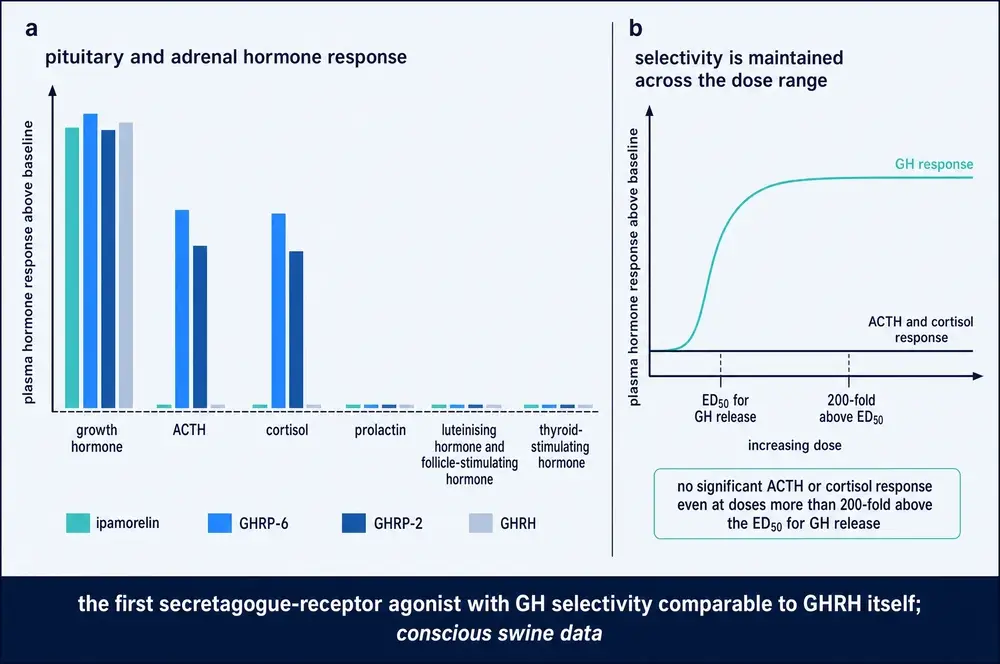
In the conscious swine experiments, Raun and colleagues measured not just growth hormone but follicle-stimulating hormone, luteinising hormone, prolactin, thyroid-stimulating hormone, ACTH and cortisol. None of the secretagogues tested moved FSH, LH, prolactin or TSH. But GHRP-6 and GHRP-2 both raised ACTH and cortisol. Ipamorelin did not — and it kept not doing so at doses more than two hundred times the dose that half-maximally released growth hormone. The paper's summary is that ipamorelin is the first GHRP-receptor agonist whose selectivity for growth hormone matches that of growth hormone–releasing hormone itself.
This result is real, it was reported carefully, and it is the single most defensible thing anyone says about ipamorelin. It also explains why the compound has had such a long afterlife: selectivity is an unusually clean, unusually repeatable story, and it survives being retold.
07What the selectivity claim does not cover
Because that claim now does a great deal of commercial work, it is worth saying precisely what it is and is not.
The human corroboration that exists is thinner than the animal work and points the same direction as far as it goes: in a phase I setting ipamorelin produced a clear growth hormone response with no significant effect on other pituitary or adrenal hormones (Dominikowski et al., 2026). That is a single-administration finding. The most recent cross-class review scores ipamorelin as sparing for both ACTH/cortisol activation and prolactin elevation — where GHRP-2, GHRP-6 and hexarelin are scored as documented or variable elevators — while defining sparing as "absence of effect documented" and noting in the same table that no long-term safety data exist for the compound at all (Dominikowski et al., 2026).
Nobody knows why it works
There is a further, stranger gap. No source in this corpus offers a receptor-level explanation for the selectivity — no conformational account, no biased-signalling measurement, no structural mechanism. Four separate reviews assert the empirical pattern; none explains it.
The best available account is not about the receptor at all. It is about anatomy and dose. Growth hormone release happens at the pituitary. The rise in ACTH and cortisol appears to be indirect, driven by these compounds prompting the hypothalamus to release corticotropin-releasing hormone and vasopressin — and that indirect pathway needs higher exposures and fades with repetition. Doubling or tripling ghrelin concentrations in humans releases growth hormone without measurably shifting ACTH, prolactin or insulin. On this reading, ipamorelin's "selectivity" is an unusually wide dose window between two effects that all these compounds have, rather than evidence of a different receptor or a different signal.
The review that lays this out is candid about the limits of the explanation. Why the corticotropic response, but not the growth hormone response, shows this dose separation and this tachyphylaxis is, in its words, not yet evident; why ageing and obesity blunt secretagogue-induced growth hormone but not ACTH and prolactin is not known; and how these compounds release prolactin at all is not clear (Veldhuis et al., 2010).
So: selectivity, yes, empirically, and better established than most claims in this field. Mechanism, unknown. Duration under chronic use, unknown. Consequences for any clinical outcome, addressed in Part Four.
08Where it goes and how long it lasts
Ipamorelin was profiled pharmacokinetically almost immediately, alongside its stablemates, in rats (Johansen et al., 1998). Two results stand out. Its plasma clearance was about five times lower than GHRP-6's — it lingers. And it left the body by a different door: ipamorelin was excreted mainly in the urine, where GHRP-6 went predominantly into bile. Between 60 and 80% of the administered dose was recovered as intact peptide, meaning the unnatural residues were doing their job. Given intranasally, bioavailability was around 20%.
The human numbers come from a dose-escalation study in healthy men (Gobburu et al., 1999): five infusion rates from 4.21 to 140.45 nmol/kg delivered over fifteen minutes, eight subjects at each level. Kinetics were dose-proportional. Terminal half-life was about two hours, clearance 0.078 l/h/kg, volume of distribution at steady state 0.22 l/kg — a small number, indicating a compound that stays largely in the circulation rather than distributing widely into tissue.
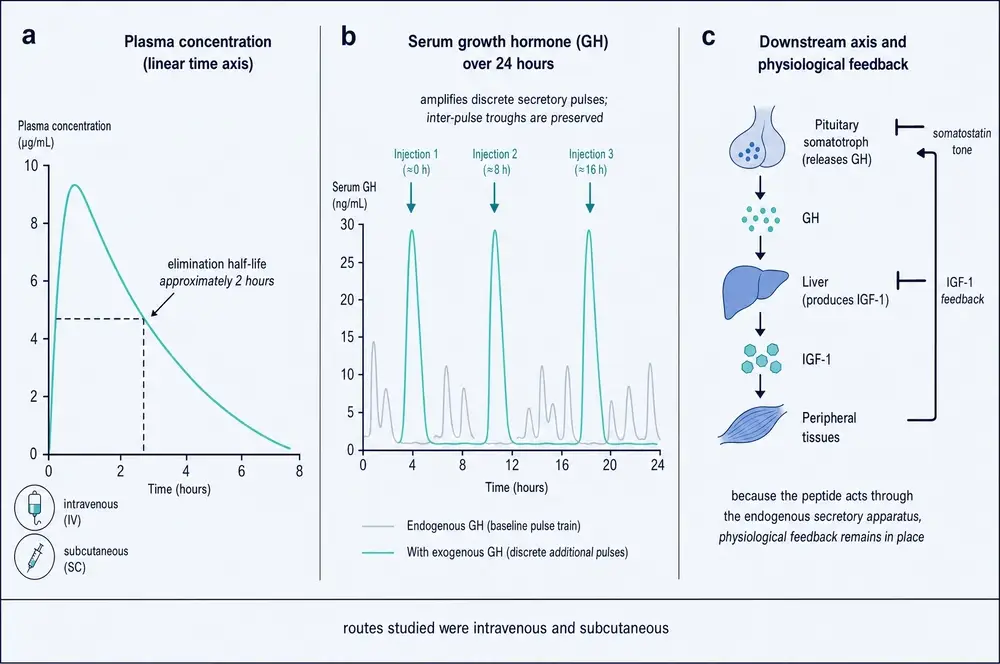
The pharmacodynamics are the interesting half. At every dose, ipamorelin produced a single episode of growth hormone release, peaking at around forty minutes and then declining exponentially to negligible concentrations. Not a sustained elevation. One pulse, then over. The concentration producing half-maximal stimulation was 214 nmol/l.
Two hours is short. Compare it with semaglutide's 165 hours, achieved by bolting on a fatty-acid chain that binds albumin (Ma et al., 2025). Ipamorelin has no such trick; its unnatural residues buy resistance to enzymes, not residence in the bloodstream. Anything a user wants from it has to be produced by a pulse that is over within a few hours — which is precisely why gray-market protocols call for injecting two or three times a day. That is not a coincidence; it is arithmetic.
09Ghrelin's shadow
One complication deserves its own section, because it undercuts the tidy picture of a drug acting directly on the pituitary.
When researchers tracked radiolabelled growth hormone–releasing peptides through the rat body, a substantial amount accumulated not in the brain but in the glandular part of the stomach — which is where ghrelin is made. When they then removed sections of the gastrointestinal tract and re-tested, the growth hormone response to GHRP-6 fell by 60 to 70%, while the response to growth hormone–releasing hormone was unaffected (Ahnfelt-Rønne et al., 2001). The authors' conclusion was that a meaningful fraction of what these compounds do runs through endogenous ghrelin rather than around it.
That work was done on GHRP-6, not ipamorelin, and should not be transferred wholesale. But it reframes the class: these are not simple pituitary stimulants. They engage a gut–brain hormone system with its own logic.
There is a second, sharper constraint. In rat work using ipamorelin specifically, the compound is described as peripherally restricted — not orally bioavailable, and not able to cross the blood–brain barrier, which is why it was given intravenously through an indwelling catheter and why it was chosen as the peripheral comparator against a brain-penetrant agonist (Mohammadi et al., 2020).
Which brings us to what ipamorelin actually did when it was given to animals for weeks at a time — where the results were both more encouraging and more awkward than the selectivity story suggests.
10Bones got longer
Between 1999 and 2004 ipamorelin was worked over thoroughly in animals, mostly rats, mostly by the group that made it. The first substantial question was whether a compound that releases growth hormone would do what growth hormone does to a skeleton.
Adult female rats received ipamorelin subcutaneously three times daily for fifteen days, at 18, 90 or 450 µg per day, against vehicle. Growth was measured directly: the animals were given fluorescent tetracycline labels on days 0, 6 and 13, and the distance between the resulting bands in the tibia gave a longitudinal growth rate. It rose dose-dependently, from 42 µm per day in vehicle animals to 44, 50 and 52 µm per day (Johansen et al., 1999). Body-weight gain rose dose-dependently too.
The panel on the right of that figure is the part worth dwelling on. In the same animals, over the same fifteen days, total IGF-I did not change. Neither did the IGF binding proteins, nor the serum markers of bone formation and resorption, nor the number of osteoclast-like cells in the tibial metaphysis. And when the pituitary was challenged again at the end, the growth hormone response to ipamorelin was marginally reduced compared with the start (P < 0.03), while the response to growth hormone–releasing hormone was unchanged.
That last detail is the first hint of a theme that recurs throughout this compound's record: the pituitary was already becoming a little less responsive to ipamorelin after two weeks.
11Bigger bones, not denser bones
A year later a different group ran a longer experiment and produced a result that is routinely misread.
Thirteen-week-old female rats received ipamorelin at 0.5 mg/kg per day, GHRP-6 at the same dose, growth hormone at 3.5 mg/kg per day, or vehicle — delivered continuously by implanted osmotic minipump for twelve weeks, with bone scans every four weeks (Svensson et al., 2000). The headline is straightforward: all treatments increased body weight and increased total tibial and vertebral bone mineral content.
Then the authors did something careful. They corrected bone mineral content for the increase in body weight — and the effect disappeared. They measured volumetric bone density by quantitative computed tomography at the mid-shaft of the femur, and it was unchanged; the rise in cortical mineral content came entirely from an increased cross-sectional bone area. They measured the femur and sixth lumbar vertebra by displacement and by ash weight: volumes increased, volumetric densities did not, ash weight increased, mineral concentration did not.
This is a worked example of how a true statement carries a false implication. "Ipamorelin increased bone mineral content in rats" is accurate. The reason people care about bone mineral content is fracture risk, and fracture risk tracks density. What actually happened is that the animals grew — bigger bodies, bigger bones, proportionally the same amount of mineral packed into them. When a contemporary review states that growth hormone secretagogues "modestly increase lean mass and bone density" (Renke et al., 2026), this is the underlying literature, and the word doing the illegitimate work is density.
12Against the catabolic tide
The most coherent therapeutic signal in the whole animal record is not growth. It is protection against wasting.
Eight-month-old female rats were given the synthetic glucocorticoid methylprednisolone for three months — a reliable way to strip muscle and suppress bone formation — either alone, or together with ipamorelin at 100 µg/kg three times daily (Andersen et al., 2001). Animals receiving both had significantly greater maximum tetanic tension in the calf muscles than animals receiving the steroid alone, and their periosteal bone formation rate was four times higher.
Two further studies point the same way. In rats given methylprednisolone, ipamorelin reduced the body-weight loss the steroid caused, from 13.6 g down to 1.6–2.3 g depending on dose, and here IGF-I did rise (Malmlöf et al., 1999). In prednisolone-treated rats, ipamorelin at 0.5 mg/kg per day for seven days cut the liver's capacity for urea-nitrogen synthesis by 20%, reduced expression of urea-cycle genes and neutralised the negative nitrogen balance — less potently than growth hormone itself, which cut urea synthesis by 33% and improved nitrogen balance 2.5-fold, but in the same direction (Aagaard et al., 2009).
If ipamorelin has a plausible clinical niche anywhere in this literature, this is it: not making healthy animals bigger, but partially offsetting steroid-induced catabolism. It is also, notably, the niche nobody took into a trial.
13The IGF-I question
Growth hormone's effects on tissue are largely mediated by IGF-I, which the liver makes in response to it. So whether ipamorelin raises IGF-I is close to the whole question of whether it can do what growth hormone does.
The record conflicts. Johansen and colleagues found no change in total IGF-I over fifteen days in normal adult rats. Malmlöf and colleagues found IGF-I rose in steroid-treated rats over ten days. These are usually cited as if one settles the matter. Neither does, and the reason is in the protocols.
| Study | Animals | Dose | Route & schedule | IGF-I |
|---|---|---|---|---|
| Johansen et al., 1999 | Normal adult female rats | 18–450 µg/day | Subcutaneous, 3×/day, 15 days | No change |
| Malmlöf et al., 1999 | Methylprednisolone-treated rats | 0.4–1.6 mg/kg/day | Intravenous, 4×/day, 10 days | Increased |
The doses differ by roughly an order of magnitude once body weight is taken into account, the route differs, and the physiological starting point differs — one set of animals was healthy, the other was being actively catabolised by a steroid. The honest reading is that ipamorelin's effect on IGF-I is dose- and context-dependent, detectable at higher exposures and in animals whose axis has been suppressed, and absent at the low end in healthy animals. It is not a compound that reliably drives IGF-I the way daily growth hormone does.
14The fat paradox
Now the finding that sits most awkwardly against how ipamorelin is sold.
Female mice — both growth hormone–deficient and growth hormone–intact — were injected twice daily for nine weeks with ipamorelin at 250 µg/kg, human growth hormone at 1.75 mg/kg, or saline. Ipamorelin increased body weight in both genotypes, by 15.3% in the deficient animals and 16.9% in the intact ones. That is the first result: it works without growth hormone, so whatever it is doing is not simply growth hormone's doing.
The second result is the awkward one. Ipamorelin increased the summed relative weight of the fat pads compared with saline. Growth hormone decreased it. On whole-body scanning in the growth hormone–intact mice, ipamorelin increased total body fat percentage; growth hormone had no effect. Serum leptin rose at two weeks. Cumulative food intake rose in the first week. The review reporting these figures draws the conclusion itself: ipamorelin "has significant adipogenic effects" (Lall et al., as tabulated in Sinha et al., 2020).
A second, independent line points the same way: in growth hormone–deficient mice, high basal leptin and a further rise after prolonged secretagogue administration have been observed with ipamorelin, and are interpreted as reflecting an adipogenic effect (Peroni et al., 2012).
None of this means ipamorelin makes people fat; no human body-composition study of this compound exists. It means the animal evidence points the opposite way from the sales pitch, and that anyone asserting fat loss is not citing the record.
15Pancreas, pituitary, and the edges of the record
The remaining animal work fills in the picture and marks its boundaries.
Pancreas. Applied directly to pancreatic tissue fragments from normal and diabetic rats across concentrations from 10−12 to 10−6 M, ipamorelin evoked significant insulin release (Adeghate & Ponery, 2004). Blocking calcium channels or adrenergic receptors suppressed the effect; blocking muscarinic receptors suppressed it in diabetic but not normal tissue. The route runs through calcium channels and adrenergic signalling rather than a simple direct secretory action.
Pituitary. Three weeks of ipamorelin in young female rats left somatotroph ultrastructure intact but increased the volume density of secretory granules, and lowered basal intracellular growth hormone content (Jiménez-Reina et al., 2002). The gland adapts to being repeatedly asked.
Diabetes. In streptozotocin-diabetic mice, an intravenous dose produced far higher growth hormone than in non-diabetic animals — 150 µg/l against 62 — while IGF-I rose after stimulation only in the non-diabetic animals, and the hepatic machinery that converts growth hormone into IGF-I stayed unresponsive in the diabetic ones (Johansen et al., 2003). More signal, no downstream effect: a clean illustration that releasing growth hormone and producing growth hormone's effects are different achievements.
The far edge. Ipamorelin has also been used in fish. It releases growth hormone from seabream pituitary cells without changing growth hormone gene transcription (Chan et al., 2004), and in tilapia given 5 or 30 µg for 21 days it increased food intake, advanced spermatogenesis, and raised luteinising hormone and 11-ketotestosterone (Gouda & Ganesh, 2024). That last result is interesting precisely because it conflicts with the mammalian selectivity story, where luteinising hormone did not move. It is also a cichlid. These findings belong in a comparative-endocrinology discussion and carry no implication whatsoever for humans; they are recorded here for completeness and bounded on the spot.
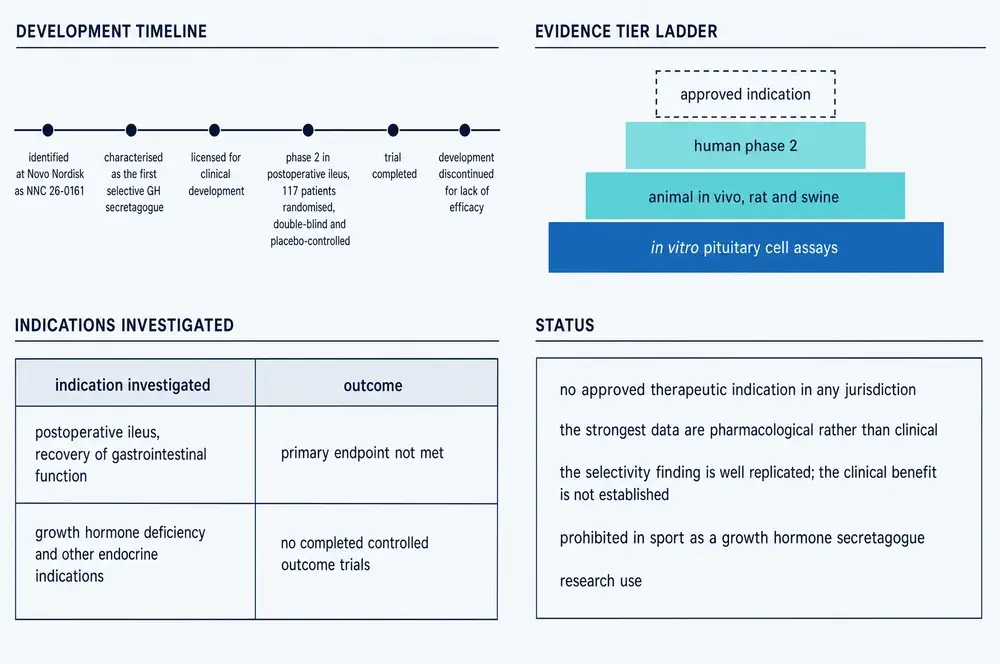
By about 2004 the animal programme was essentially complete. The compound released growth hormone cleanly, grew rat bones, partly offset steroid catabolism, made mice fatter, and did not reliably move IGF-I. What happened next was decided not by any of that, but by what the company did with the molecule.
16Forty men and a dose escalation
The first time ipamorelin was given to people, the question was not whether it helped anyone. It was simply: what does it do, and how long does it last.
Forty healthy men, five infusion rates from 4.21 to 140.45 nmol/kg delivered over fifteen minutes, eight subjects at each level, randomised (Gobburu et al., 1999). The results are in section 08: dose-proportional kinetics, a two-hour half-life, and one clean pulse of growth hormone peaking at about forty minutes. It worked. It was orderly. It was, as a piece of pharmacology, a success.
It is important to be exact about what this study did not do. It enrolled healthy volunteers, gave a single infusion, and measured hormone concentrations. It measured no clinical outcome of any kind — not muscle, not fat, not bone, not strength, not recovery, not sleep. It is a pharmacokinetic and pharmacodynamic characterisation, and it remains, more than twenty-five years later, the entirety of the published human endocrine evidence for this compound.
17The successor that traded the selectivity away
Ipamorelin is usually described as a drug that was abandoned. That is not quite what happened, and the real version is more interesting.
Ipamorelin was never the destination. It was a lead. Read the chemistry papers from the same laboratory in the same years and the programme's actual objective is stated plainly in their titles and abstracts: oral bioavailability. A peptide that has to be injected is a commercially awkward product, and the Copenhagen group spent the years after 1998 systematically dismantling their own compound to get a pill — shrinking it, methylating its backbone, replacing amide bonds with isosteres, testing the fragments in pigs and dogs (Hansen et al., 1998; Ankersen et al., 1998; Peschke et al., 2002; Hansen et al., 2001).
It worked. Oral bioavailabilities in the 10–55% range were achieved, and one compound emerged as the clinical candidate: NN703, described as derived from GHRP-1 via ipamorelin, and confirmed in 2001 as having entered phase II trials (Ahnfelt-Rønne et al., 2001).
And here is the irony at the centre of this monograph. NN703 was characterised in swine, exactly as ipamorelin had been. Its growth hormone release was solid. And: a 50% increase of cortisol above basal was observed at every dose tested (Hansen et al., 1999).
18Second life: the gut
Ipamorelin resurfaced about five years later, aimed at a completely different problem, on a logic that was sound.
Postoperative ileus is the gut's tendency to stop working after abdominal surgery. It affects up to 40% of patients after colorectal surgery, costs the United States over a billion dollars a year, and — excepting epidural anaesthesia — has neither an established prophylaxis nor an evidence-based therapy (Vilz et al., 2016). The only approved drug for it carries a boxed warning for myocardial infarction and is distributed under restriction (Camilleri et al., 2015). It is a real unmet need.
Ghrelin-receptor agonism is prokinetic. So a selective, well-tolerated ghrelin-receptor agonist that had already been through humans was a reasonable candidate, and the rodent data were encouraging. In a rat model, repeated intravenous ipamorelin at 0.1 or 1 mg/kg significantly increased cumulative faecal pellet output, food intake and body-weight gain, and single doses shortened the time to first bowel movement (Venkova et al., 2009). In a second study, a single intravenous dose of 0.014 µmol/kg improved gastric emptying markedly: fifteen minutes after a test meal, 52% of it remained in the stomach against 78% in untreated ileus animals, with non-surgical controls at 44% (Greenwood-Van Meerveld et al., 2012). Isolated strips of stomach muscle from ileus animals had lost their responses to acetylcholine and to electrical stimulation, and both were restored by ipamorelin — and by ghrelin — at 1 µM. The response was abolished by atropine and by tetrodotoxin, placing the mechanism on cholinergic nerves rather than on muscle directly.
Ipamorelin was also shown, in rats, to reduce both visceral and somatic pain responses, an effect blocked by a ghrelin-receptor antagonist — confirming it was acting through the intended receptor (Mohammadi et al., 2020).
That is a coherent preclinical package. Helsinn took it into a phase 2 trial.
19The trial that did not work
The study was multicentre, double-blind and placebo-controlled. It enrolled 117 adults undergoing small or large bowel resection, open or laparoscopic; 114 formed the safety and modified intention-to-treat populations, 56 assigned to ipamorelin and 58 to placebo (Beck et al., 2014; group sizes from Sinha et al., 2020). Dosing was 0.03 mg/kg intravenously twice daily, from the first postoperative day until day seven or discharge. The key efficacy endpoint was the time from first dose to tolerating a standardised solid meal.
Median time to first tolerated meal was 25.3 hours on ipamorelin and 32.6 hours on placebo — a difference of about seven hours, in the right direction, with a p-value of 0.15. The authors report no significant differences between groups in the key or the secondary efficacy analyses. The drug was well tolerated; the commonest adverse events were nausea, vomiting and dyspepsia, which are also what happens to people who have just had their bowel resected, and the overall adverse-event rate was lower on ipamorelin than on placebo.
The authors state the study's limits themselves: it was small, it was proof-of-concept, and it enrolled patients with a broad range of underlying conditions. Those caveats are legitimate. They also have to be held in proportion, and there are four ways of reading this trial that the literature actually contains.
The first is that the endpoint was wrong. A later protocol paper points out that this trial defined the end of ileus as tolerance of a standardised solid meal, which measures upper gastrointestinal recovery and ignores the lower tract entirely; it also notes that five recent postoperative-ileus trials used five different primary endpoints, and that a Cochrane review found no evidence supporting broad prokinetic use after surgery (Vilz et al., 2016). On this reading the drug may have worked and the ruler was wrong.
The second is that the dose was too low. Rodent work on this exact question concluded that only pharmacological rather than physiological doses of ghrelin mimetics prevent surgery-induced delay in gastrointestinal passage, "whereas lower doses able to stimulate growth hormone release do not modulate gastric emptying" (Stengel et al., 2011). Ipamorelin's trial dose was in the range that releases growth hormone. Nobody in this corpus performs the allometric scaling that would settle whether the human exposure reached the prokinetic window.
The third is the plain one: it did not work. The most recent review to discuss the programme says the findings "suggested limited clinical efficacy in this setting and tempered further clinical investigation of ipamorelin for the management of postoperative ileus" (Dominikowski et al., 2026).
There is a fourth reading, and it is the one with the most evidence behind it. The animal model may not have been a model of the human problem at all.
Gut motility between meals is driven by a travelling wave of contraction. In humans and dogs, the dominant hormonal signal for that wave is motilin. Rats and mice do not have a functional motilin system — which means the mechanism of these contractions in rodents is, as one review puts it, very different from that in humans and dogs, and the translational value of rodent motility studies must be treated with caution (Sanger et al., 2010). In rodents, ghrelin appears to be the endogenous signal for that wave. In dogs, which have both systems, ghrelin has no effect on it (Sallam et al., 2010). Intravenous ghrelin in dogs did not stimulate gut motor activity in either the fasted or the fed state, and did not accelerate gastric emptying, despite the same preparation demonstrably releasing growth hormone (Rhodes et al., 2018). In humans, infused ghrelin can trigger premature contractions — but circulating ghrelin does not fluctuate with the contraction cycle the way motilin does, which suggests motilin remains the hormone actually governing interdigestive motility in people (Sallam et al., 2010; Sanger et al., 2010).
Ipamorelin's prokinetic evidence is entirely rat. It was tested in a species where the ghrelin system runs the machinery, and then given to a species where a different hormone does. The compound may have been asked to pull a lever that is not connected to very much in humans.
20Was it the compound, or the class?
A fair reading requires knowing whether ipamorelin failed where its relatives succeeded. Mostly, it did not.
No ghrelin-receptor agonist has been approved for any human gastrointestinal indication (Müller et al., 2015). The clearest regulatory success in the entire class is capromorelin — approved by the FDA as an appetite stimulant for dogs; its human programme in elderly frailty reached phase 2 and was discontinued (Rhodes et al., 2018), and its constipation programme appears abandoned, with no registered ongoing studies (Mosińska et al., 2017). Anamorelin ran two large phase 3 trials in cancer cachexia and hit one co-primary endpoint while missing the other: lean body mass improved significantly in both trials, and hand-grip strength failed in both (Zhang et al., 2015). Ulimorelin improved gastrointestinal recovery after abdominal surgery but showed no effect on postprandial symptoms in diabetic gastroparesis (Sallam et al., 2010). Macimorelin found a niche not as a therapy at all, but as a diagnostic agent for growth hormone deficiency (Müller et al., 2015).
The receptor biologists have a general explanation. The ghrelin receptor is expressed almost everywhere, it internalises rapidly on activation, and it signals to some degree even unbound — so systemic dosing hits many tissues at once, tolerance develops, and the intended effect is diluted by off-target activation elsewhere. As one review puts it, nearly two decades after ghrelin's discovery there is still no ghrelin-targeting drug on the market for appetite or cachexia, despite an enormous literature (Howick et al., 2017).
There is one datum on the other side, and honesty requires it. In a head-to-head rat comparison in a model of ileus aggravated by morphine, relamorelin outperformed ipamorelin, anamorelin and ibutamoren on gastric emptying (Camilleri et al., 2015). That is a single preclinical comparison, but it means the class-wide explanation cannot carry all the weight: potency and exposure may genuinely have been part of ipamorelin's problem.
Either way, by the mid-2010s the compound had no clinical future. What it had instead was a second population of interested parties, who had never required a trial to be convinced.
21Becoming an analyte
From about 2011 onward, ipamorelin stops appearing in the pharmacology literature and starts appearing in a different one entirely. It is no longer a candidate drug being characterised. It is a substance being looked for.
Growth hormone–releasing factors, including the secretagogues, were placed on the World Anti-Doping Agency's prohibited list under section S2 in 2013 (Lange et al., 2020). In the current list, ipamorelin is named individually, in section S2.2.4, among "growth hormone secretagogues (GHS) and their mimetics," alongside anamorelin, capromorelin, ibutamoren, ghrelin itself, macimorelin and tabimorelin. Section S2 is prohibited at all times — in and out of competition — and every substance in the class is a non-Specified Substance, the category that attracts the least flexibility in sanctioning (WADA 2026 Prohibited List, S2.2.4 and index).
The reason these compounds attract attention is specific and slightly elegant: they raise the athlete's own growth hormone. The established test for exogenous growth hormone looks for the recombinant protein, or for the distortion it causes in the balance of naturally occurring isoforms. A secretagogue produces the real thing, in the right proportions, from the right gland. As one method paper puts it, the established test for growth hormone fails, and the misuse goes unrecognised — so the only way to catch it is to find the small peptide itself (Thomas et al., 2011).
22How it is found
Ipamorelin turns out to be a relatively cooperative analyte. It is small, water-soluble, and it carries that naphthalene ring, which gives it a distinctive behaviour in a mass spectrometer.
The workflow is essentially the same everywhere. Urine or a dried blood spot is cleaned up on a weak cation-exchange cartridge, separated by liquid chromatography, and read by high-resolution mass spectrometry. Ipamorelin is detected as a doubly charged ion at mass-to-charge 356.7001, with the naturally occurring isotope at 357.2016 serving as the confirming ion, eluting at 5.77 minutes on the reference method. In dried blood spots the limit of detection is 0.5 ng/ml; in urine, screening methods reach 0.05 to 0.5 ng/ml, comfortably below the 2 ng/ml minimum required performance level that anti-doping laboratories must meet (Lange et al., 2020; Gómez-Guerrero et al., 2022).
The more interesting part is what the body does to the molecule. When ipamorelin was given intranasally to volunteers and their urine followed for two days, it was found to be extensively metabolised and excreted as a mixture of parent compound and fragments — and one fragment, ipamorelin (1–4) free acid, was still detectable after the parent compound had disappeared entirely (Semenistaya et al., 2015). That fragment is the pentapeptide with its terminal lysine clipped off and its amide cap converted to a free acid: Aib-His-D-Nal-D-Phe-OH. It is now a routine screening target in its own right, and it extends the window in which use can be detected.
23An extra glycine
In 2018 and 2019, laboratories analysing seized material found something that had not come from any pharmaceutical company.
Danish customs authorities submitted a batch of unidentified powders for analysis. The contents were identified as analogues of GHRP-2, GHRP-6, ipamorelin and modified GRF (1-29) — and in every case the modification was the same: one additional glycine residue on the N-terminus (Gajda et al., 2019). A parallel investigation of black-market growth-promoting products found Gly-GHRP-6, Gly-GHRP-2 and Gly-ipamorelin, and confirmed the structures of two of them by synthesising reference standards from scratch (Krug et al., 2018).
Adding a single glycine changes the molecule's mass. It therefore changes the mass-to-charge ratio the instrument is watching for, and a screening method looking for 356.7001 will not see 385.2108. The paper describing the seizure states the consequence flatly: analytical methods targeting growth hormone secretagogues should be updated accordingly. Another describes such analogues as "arguably designed to undermine current anti-doping testing approaches" (Lange et al., 2020). The laboratories added Gly-ipamorelin to their screening panels, which is why it appears in Figure 18.
There is a quiet point buried in this. The N-terminus of a ghrelin-receptor ligand is not decorative; the imaging-chemistry literature notes that blocking it abolishes receptor binding entirely (Childs et al., 2020). Whether Gly-ipamorelin retains any activity at all is not established in this corpus. It may be a compound that evades the test and does nothing.
24What is actually in the vial
The commercial reality of ipamorelin is worth stating with the same precision as its pharmacology, because it is the part most likely to affect anyone.
The best single piece of evidence is incidental, and all the more telling for it. Researchers bought fourteen products sold as ACE-031, an entirely different class of compound, from internet suppliers in the United Kingdom, Europe, China and the United States. All fourteen were labelled "not for human consumption" or "for research purposes only." None of the fourteen contained ACE-031. Twelve contained a related but different protein, apparently produced in bacteria and accompanied by many other proteins. One contained a different peptide altogether. And one — product BM14 — contained no protein at all: what mass spectrometry found in it was ipamorelin (Reichel et al., 2025).
Nobody was buying ipamorelin. It was what turned up.
Ipamorelin also appears in national seizure data. Of 601 samples seized by Polish authorities between 2020 and 2024 from illegal distribution sites, online stores, postal shipments and prisons, ipamorelin is named among the "other performance-enhancing drugs" group; that group's share of seizures rose from 7.5% in 2020 to 32.9% in 2023 (Blazewicz et al., 2025). The same study's quality analysis — conducted on a different subset, post-cycle-therapy drugs rather than peptides — found that roughly 41% of products were incorrectly labelled, with 20.6% containing no active ingredient whatsoever and 14.3% containing a different, undeclared drug. Some carried scratch-off "anti-counterfeit" holograms with verification websites that obligingly confirmed the product was genuine.
Products of this kind are sold with disclaimers stating they are not for human consumption, while being discussed in consumer forums as substances for personal use. A 2026 review of the phenomenon observes that such labels "may function more as legal disclaimers than meaningful safety warnings," particularly when paired with purity claims and dosing discussions, and that certificates of analysis "may not reliably indicate pharmaceutical-grade quality, sterility, endotoxin burden, degradation, storage conditions, batch consistency, or whether the delivered product matches what was tested" (Hailu et al., 2026).
No study anywhere in this corpus has tested products sold as ipamorelin for identity, potency, sterility or endotoxin content. The failure rates quoted above are for other compound classes. What is in a vial labelled ipamorelin is, on the published record, simply unknown.
As for how much is actually used: in WADA's 2022 testing figures, among 115 adverse analytical findings for peptide hormones and growth factors, ipamorelin accounts for one (Marino et al., 2024). GHRP-2 accounted for eleven and GHRP-6 for eight. Whether that reflects genuinely rare use, or a compound whose short half-life and unquantified detection window make it hard to catch, cannot be determined from these data.
25The 2026 consensus, and how to read it
Something changed recently. After two decades in which ipamorelin was discussed mainly by analytical chemists, a cluster of reviews appeared in 2026 — in endocrinology, sports medicine, orthopaedics, gerontology and aesthetic medicine — all discussing it as a compound that clinicians now encounter in practice.
This monograph weights recent evidence heavily. But recency of publication is not recency of evidence, and these reviews are a case study in the difference. Their pharmacological claims trace back, almost without exception, to primary studies from 1998 to 2004. What is genuinely new in them is not data about the compound. It is data about its use.
On that, they are consistent and worth taking seriously. Ipamorelin holds no regulatory approval in any jurisdiction for any indication. Long-term safety data do not exist. The most rigorous of the group assigns it evidence tier B — phase I human studies and postoperative-ileus development, with "no efficacy data in GH-related metabolic indications" — and lists two distinct problems clinicians face: an evidence gap and an identity gap, the latter meaning that nobody knows what is in the product (Dominikowski et al., 2026).
Where these reviews are less reliable is where they restate efficacy. Three patterns recur, and all three are worth naming because they are how a thin evidence base comes to look thick.
The first is losing the species. The 200-fold selectivity margin is a swine and rat finding. At least one 2026 review reproduces it without saying so, converting an animal measurement into a general property of the drug (Mavrych et al., 2026).
The second is inheriting the conclusion instead of the data. A 2020 review's abstract asserts that ipamorelin improves body composition and ameliorates fat gain; the mouse data inside that same review show it increasing fat (Sinha et al., 2020). A 2026 review then lists "fat loss" among ipamorelin's clinical applications, in a table cell carrying no citation at all, whose row references support only the selectivity result and a mouse muscle-tension finding (Mavrych et al., 2026).
The third is borrowing a safety record. An orthopaedic review argues that "the established safety profiles of these GH secretagogues in defined populations make them particularly attractive candidates for off-label use" (Rahman et al., 2026). Two members of that class hold or held regulatory approvals in defined populations. Ipamorelin never has, anywhere, and its single controlled trial was negative. The sentence transfers a record the compound does not have.
The same review also states that ipamorelin promotes growth hormone release "by inhibiting somatostatin," which conflicts with every other source in the corpus, all of which describe direct agonism at the ghrelin receptor. It should be treated as an error.
26What is known, what is claimed, and the gap between
Set out plainly, the ledger looks like this.
What should be made of a compound like this?
The temptation is to treat ipamorelin as a cautionary tale about hype, and it partly is. But that reading misses what is genuinely unusual about it. Most compounds circulating on the gray market never got far enough to be tested properly, so their advocates can always claim the evidence simply does not exist yet. Ipamorelin is not in that position. It was made by a competent pharmaceutical company, characterised carefully, published in good journals, given to humans twice, and taken into a randomised controlled trial by a second company a decade later. The evidence exists. It is just not the evidence anyone wanted.
And the property it is famous for turns out to be a strange thing to sell. Selectivity was a solution to a specific development problem: the earlier peptides raised cortisol, and chronic cortisol elevation would have made them unusable as medicines. Ipamorelin solved that. But solving it only mattered if something downstream was going to work — and downstream, the growth hormone pulse it produces is brief, IGF-1 does not reliably follow, the pituitary starts responding a little less within two weeks, and the one clinical endpoint anyone measured did not move.
Ipamorelin is a clean answer to a question that stopped being the important one. That is not a scandal. It is an ordinary thing that happens in drug development, and the only unusual part of this story is that the compound outlived the programme — surviving not on its results but on the memory of its most quotable finding, sold to people who will never see a hormone panel.
27References
Generated from verified NCBI records rather than from recall. Author lists, journal names, volumes, pages and identifiers are taken from the PubMed record for each citation. This series has twice shipped reference lists drafted from memory in which identifiers pointed at real but unrelated papers; every entry below was re-derived from the harvest and checked against its title before the build was allowed to run.
- Aagaard NK, Grøfte T, Greisen J, Malmlöf K, Johansen PB, Grønbaek H, et al.. Growth hormone and growth hormone secretagogue effects on nitrogen balance and urea synthesis in steroid treated rats. Growth hormone & IGF research : official journal of the Growth Hormone Research Society and the International IGF Research Society. 2009;19(5):426-31.
PMID 19231263 · doi:10.1016/j.ghir.2009.01.001 - Adeghate E, Ponery AS. Mechanism of ipamorelin-evoked insulin release from the pancreas of normal and diabetic rats. Neuro endocrinology letters. 2004;25(6):403-6.
PMID 15665799 - Ahnfelt-Rønne I, Nowak J, Olsen UB. Do growth hormone-releasing peptides act as ghrelin secretagogues?. Endocrine. 2001;14(1):133-5.
PMID 11322495 · doi:10.1385/ENDO:14:1:133 - Andersen NB, Malmlöf K, Johansen PB, Andreassen TT, Ørtoft G, Oxlund H. The growth hormone secretagogue ipamorelin counteracts glucocorticoid-induced decrease in bone formation of adult rats. Growth hormone & IGF research : official journal of the Growth Hormone Research Society and the International IGF Research Society. 2001;11(5):266-72.
PMID 11735244 · doi:10.1054/ghir.2001.0239 - Ankersen M, Johansen NL, Madsen K, Hansen BS, Raun K, Nielsen KK, et al.. A new series of highly potent growth hormone-releasing peptides derived from ipamorelin. Journal of medicinal chemistry. 1998;41(19):3699-704.
PMID 9733495 · doi:10.1021/jm9801962 - Beck DE, Sweeney WB, McCarter MD, Ipamorelin 201 Study Group. Prospective, randomized, controlled, proof-of-concept study of the Ghrelin mimetic ipamorelin for the management of postoperative ileus in bowel resection patients. International journal of colorectal disease. 2014;29(12):1527-34.
PMID 25331030 · doi:10.1007/s00384-014-2030-8 - Blazewicz A, Poplawska M, Daniszewska B, Piorunska K, Karynski M. Illegal and falsified medicines self-administrated in not approved post-cycle therapy after the cessation of anabolic-androgenic steroids - qualitative analysis. Front Chem. 2025;13:1536858.
PMID 40177353 · doi:10.3389/fchem.2025.1536858 · PMC11962791 - Bowers CY, Reynolds GA, Durham D, Barrera CM, Pezzoli SS, Thorner MO. Growth hormone (GH)-releasing peptide stimulates GH release in normal men and acts synergistically with GH-releasing hormone. J Clin Endocrinol Metab. 1990;70(4):975-82.
PMID 2108187 · doi:10.1210/jcem-70-4-975 - Camilleri M, Acosta A. Emerging treatments in Neurogastroenterology: relamorelin: a novel gastrocolokinetic synthetic ghrelin agonist. Neurogastroenterol Motil. 2015;27(3):324-32.
PMID 25545036 · doi:10.1111/nmo.12490 · PMC4424792 - Chan CB, Fung CK, Fung W, Tse MC, Cheng CH. Stimulation of growth hormone secretion from seabream pituitary cells in primary culture by growth hormone secretagogues is independent of growth hormone transcription. Comparative biochemistry and physiology. Toxicology & pharmacology : CBP. 2004;139(1-3):77-85.
PMID 15556068 · doi:10.1016/j.cca.2004.09.008 - Childs MD, Luyt LG. A Decade's Progress in the Development of Molecular Imaging Agents Targeting the Growth Hormone Secretagogue Receptor. Mol Imaging. 2020;19:1536012120952623.
PMID 33104445 · doi:10.1177/1536012120952623 · PMC8865914 - Dominikowski A, Rękoś Z, Olejarz M, Szczepanek-Parulska E, Domin R, RuchaŁa M. The emerging landscape of performance-enhancing peptides modulating GH-IGF1 axis: bridging the gap between clinical evidence and patient self-administration. Frontiers in endocrinology. 2026;17:1822475.
PMID 42395176 · doi:10.3389/fendo.2026.1822475 · PMC13322892 - Egboh SC, Abere S. Gastroparesis: A Multidisciplinary Approach to Management. Cureus. 2022;14(1):e21295.
PMID 35186557 · doi:10.7759/cureus.21295 · PMC8846567 - Ferro P, Krotov G, Zvereva I, Rodchenkov G, Segura J. Structure-activity relationship for peptídic growth hormone secretagogues. Drug testing and analysis. 2017;9(1):87-95.
PMID 26811125 · doi:10.1002/dta.1947 - Gajda PM, Holm NB, Hoej LJ, Rasmussen BS, Dalsgaard PW, Reitzel LA, et al.. Glycine-modified growth hormone secretagogues identified in seized doping material. Drug testing and analysis. 2019;11(2):350-354.
PMID 30136411 · doi:10.1002/dta.2489 - Gameli PS, Taoussi O, Basile G, Carlier J, Busardò FP. Metabolism Study of Anamorelin, a GHSR1a Receptor Agonist Potentially Misused in Sport, with Human Hepatocytes and LC-HRMS/MS. Metabolites. 2023;13(8).
PMID 37623892 · doi:10.3390/metabo13080949 · PMC10456928 - Gobburu JV, Agersø H, Jusko WJ, Ynddal L. Pharmacokinetic-pharmacodynamic modeling of ipamorelin, a growth hormone releasing peptide, in human volunteers. Pharmaceutical research. 1999;16(9):1412-6.
PMID 10496658 · doi:10.1023/a:1018955126402 - Gouda M, Ganesh CB. The influence of ghrelin agonist ipamorelin acetate on the hypothalamic-pituitary-testicular axis in a cichlid fish, Oreochromis mossambicus. Animal reproduction science. 2024;268:107550.
PMID 38996787 · doi:10.1016/j.anireprosci.2024.107550 - Greenwood-Van Meerveld B, Tyler K, Mohammadi E, Pietra C. Efficacy of ipamorelin, a ghrelin mimetic, on gastric dysmotility in a rodent model of postoperative ileus. Journal of experimental pharmacology. 2012;4:149-55.
PMID 27186127 · doi:10.2147/JEP.S35396 · PMC4863553 - Gómez-Guerrero NA, González-López NM, Zapata-Velásquez JD, Martínez-Ramírez JA, Rivera-Monroy ZJ, García-Castañeda JE. Synthetic Peptides in Doping Control: A Powerful Tool for an Analytical Challenge. ACS Omega. 2022;7(43):38193-38206.
PMID 36340120 · doi:10.1021/acsomega.2c05296 · PMC9631397 - Hailu KT, Abriha FN, Duguma YM, Haddad RR, Liyew T, Kasagga A. Unregulated Peptide Use in the Age of Biohacking: Digital Promotion, Gray-Market Access, and Emerging Public Health Risks. Cureus. 2026;18(6):e110657.
PMID 42437212 · doi:10.7759/cureus.110657 · PMC13355462 - Hansen BS, Raun K, Nielsen KK, Johansen PB, Hansen TK, Peschke B, et al.. Pharmacological characterisation of a new oral GH secretagogue, NN703. European journal of endocrinology. 1999;141(2):180-9.
PMID 10427162 · doi:10.1530/eje.0.1410180 - Hansen TK, Ankersen M, Hansen BS, Raun K, Nielsen KK, Lau J, et al.. Novel orally active growth hormone secretagogues. Journal of medicinal chemistry. 1998;41(19):3705-14.
PMID 9733496 · doi:10.1021/jm980197u - Hansen TK, Ankersen M, Raun K, Hansen BS. Highly potent growth hormone secretagogues: hybrids of NN703 and ipamorelin. Bioorganic & medicinal chemistry letters. 2001;11(14):1915-8.
PMID 11459660 · doi:10.1016/s0960-894x(01)00345-6 - Howard AD, Feighner SD, Cully DF, Arena JP, Liberator PA, Rosenblum CI, et al.. A receptor in pituitary and hypothalamus that functions in growth hormone release. Science. 1996;273(5277):974-7.
PMID 8688086 · doi:10.1126/science.273.5277.974 - Howick K, Griffin BT, Cryan JF, Schellekens H. From Belly to Brain: Targeting the Ghrelin Receptor in Appetite and Food Intake Regulation. Int J Mol Sci. 2017;18(2).
PMID 28134808 · doi:10.3390/ijms18020273 · PMC5343809 - Jiménez-Reina L, Cañete R, de la Torre MJ, Bernal G. Influence of chronic treatment with the growth hormone secretagogue Ipamorelin, in young female rats: somatotroph response in vitro. Histology and histopathology. 2002;17(3):707-14.
PMID 12168778 · doi:10.14670/HH-17.707 - Johansen PB, Hansen KT, Andersen JV, Johansen NL. Pharmacokinetic evaluation of ipamorelin and other peptidyl growth hormone secretagogues with emphasis on nasal absorption. Xenobiotica; the fate of foreign compounds in biological systems. 1998;28(11):1083-92.
PMID 9879640 · doi:10.1080/004982598238976 - Johansen PB, Nowak J, Skjaerbaek C, Flyvbjerg A, Andreassen TT, Wilken M, et al.. Ipamorelin, a new growth-hormone-releasing peptide, induces longitudinal bone growth in rats. Growth hormone & IGF research : official journal of the Growth Hormone Research Society and the International IGF Research Society. 1999;9(2):106-13.
PMID 10373343 · doi:10.1054/ghir.1999.9998 - Johansen PB, Segev Y, Landau D, Phillip M, Flyvbjerg A. Growth hormone (GH) hypersecretion and GH receptor resistance in streptozotocin diabetic mice in response to a GH secretagogue. Experimental diabesity research. 2003;4(2):73-81.
PMID 14630569 · doi:10.1155/EDR.2003.73 · PMC2478601 - Khatib MN, Shankar AH, Kirubakaran R, Gaidhane A, Gaidhane S, Simkhada P, et al.. Ghrelin for the management of cachexia associated with cancer. Cochrane Database Syst Rev. 2018;2(2):CD012229.
PMID 29489032 · doi:10.1002/14651858.CD012229.pub2 · PMC6491219 - Kojima M, Hosoda H, Date Y, Nakazato M, Matsuo H, Kangawa K. Ghrelin is a growth-hormone-releasing acylated peptide from stomach. Nature. 1999;402(6762):656-60.
PMID 10604470 · doi:10.1038/45230 - Krug O, Thomas A, Malerød-Fjeld H, Dehnes Y, Laussmann T, Feldmann I, et al.. Analysis of new growth promoting black market products. Growth hormone & IGF research : official journal of the Growth Hormone Research Society and the International IGF Research Society. 2018;41:1-6.
PMID 29864719 · doi:10.1016/j.ghir.2018.05.001 - Králík F, Kvíčalová A, Salaďáková A, Kuchař M, Setnička V. Growth Hormone-Releasing Peptides: Investigation of Their Secondary Structure, Thermal Stability, and Model Membrane Interactions. Chirality. 2026;38(2):e70083.
PMID 41555539 · doi:10.1002/chir.70083 · PMC12869127 - Lall S, Tung LY, Ohlsson C, Jansson JO, Dickson SL. Growth hormone (GH)-independent stimulation of adiposity by GH secretagogues. Biochemical and biophysical research communications. 2001;280(1):132-8.
PMID 11162489 · doi:10.1006/bbrc.2000.4065 - Lange T, Thomas A, Walpurgis K, Thevis M. Fully automated dried blood spot sample preparation enables the detection of lower molecular mass peptide and non-peptide doping agents by means of LC-HRMS. Anal Bioanal Chem. 2020;412(15):3765-3777.
PMID 32300840 · doi:10.1007/s00216-020-02634-4 · PMC7220872 - Lu Z, Ngan MP, Liu JYH, Yang L, Tu L, Chan SW, et al.. The growth hormone secretagogue receptor 1a agonists, anamorelin and ipamorelin, inhibit cisplatin-induced weight loss in ferrets: Anamorelin also exhibits anti-emetic effects via a central mechanism. Physiology & behavior. 2024;284:114644.
PMID 39043357 · doi:10.1016/j.physbeh.2024.114644 - Ma J, Wang X, Hu Y, Ma J, Ma Y, Chen H, et al.. Recent Advances in Augmenting the Therapeutic Efficacy of Peptide-Drug Conjugates. J Med Chem. 2025;68(9):9037-9056.
PMID 40267310 · doi:10.1021/acs.jmedchem.5c00007 · PMC12067445 - Malmlöf K, Johansen PB, Haahr PM, Wilken M, Oxlund H. Methylprednisolone does not inhibit the release of growth hormone after intravenous injection of a novel growth hormone secretagogue in rats. Growth hormone & IGF research : official journal of the Growth Hormone Research Society and the International IGF Research Society. 1999;9(6):445-50.
PMID 10629165 · doi:10.1054/ghir.1999.0128 - Marino D, Stilo P. An evolutionary game to describe doping dynamics. Heliyon. 2024;10(10):e31089.
PMID 38826708 · doi:10.1016/j.heliyon.2024.e31089 · PMC11141358 - Mavrych V, Shypilova I, Bolgova O. Therapeutic peptides in gerontology: mechanisms and applications for healthy aging. Frontiers in aging. 2026;7:1790247.
PMID 42021992 · doi:10.3389/fragi.2026.1790247 · PMC13095733 - Momany FA, Bowers CY, Reynolds GA, Hong A, Newlander K. Conformational energy studies and in vitro and in vivo activity data on growth hormone-releasing peptides. Endocrinology. 1984;114(5):1531-6.
PMID 6425039 · doi:10.1210/endo-114-5-1531 - Mosińska P, Zatorski H, Storr M, Fichna J. Future Treatment of Constipation-associated Disorders: Role of Relamorelin and Other Ghrelin Receptor Agonists. J Neurogastroenterol Motil. 2017;23(2):171-179.
PMID 28238253 · doi:10.5056/jnm16183 · PMC5383112 - Müller TD, Nogueiras R, Andermann ML, Andrews ZB, Anker SD, Argente J, et al.. Ghrelin. Mol Metab. 2015;4(6):437-60.
PMID 26042199 · doi:10.1016/j.molmet.2015.03.005 · PMC4443295 - N Mohammadi E, Louwies T, Pietra C, Northrup SR, Greenwood-Van Meerveld B. Attenuation of Visceral and Somatic Nociception by Ghrelin Mimetics. Journal of experimental pharmacology. 2020;12:267-274.
PMID 32801950 · doi:10.2147/JEP.S249747 · PMC7415447 - Peroni CN, Hayashida CY, Nascimento N, Longuini VC, Toledo RA, Bartolini P, et al.. Growth hormone response to growth hormone-releasing peptide-2 in growth hormone-deficient little mice. Clinics (Sao Paulo). 2012;67(3):265-72.
PMID 22473409 · doi:10.6061/clinics/2012(03)11 · PMC3297037 - Peschke B, Ankersen M, Bauer M, Hansen TK, Hansen BS, Nielsen KK, et al.. The influence of conformational restriction in the C-terminus of growth hormone secretagogues on their potency. European journal of medicinal chemistry. 2002;37(6):487-501.
PMID 12204475 · doi:10.1016/s0223-5234(02)01370-3 - Rahman OF, Lee SJ, Seeds WA. Therapeutic Peptides in Orthopaedics: Applications, Challenges, and Future Directions. Journal of the American Academy of Orthopaedic Surgeons. Global research & reviews. 2026;10(1).
PMID 41490200 · doi:10.5435/JAAOSGlobal-D-25-00236 · PMC12753158 - Raun K, Hansen BS, Johansen NL, Thøgersen H, Madsen K, Ankersen M, et al.. Ipamorelin, the first selective growth hormone secretagogue. European journal of endocrinology. 1998;139(5):552-61.
PMID 9849822 · doi:10.1530/eje.0.1390552 - Reichel C, Filip T, Gmeiner G, Thevis M. Gel Electrophoretic Detection of Black Market ACE-031. Drug Test Anal. 2025;17(10):1934-1946.
PMID 40312924 · doi:10.1002/dta.3898 · PMC12489275 - Renke G, Chinellato L. Therapeutic Peptides in Aesthetic, Metabolic and Endocrine Conditions: Effects, Safety, Clinical Applications, and Future Perspectives. International journal of molecular sciences. 2026;27(9).
PMID 42123471 · doi:10.3390/ijms27093890 · PMC13164565 - Rhodes L, Zollers B, Wofford JA, Heinen E. Capromorelin: a ghrelin receptor agonist and novel therapy for stimulation of appetite in dogs. Vet Med Sci. 2018;4(1):3-16.
PMID 29468076 · doi:10.1002/vms3.83 · PMC5813110 - Sallam HS, Chen JD. The prokinetic face of ghrelin. Int J Pept. 2010;2010.
PMID 20721347 · doi:10.1155/2010/493614 · PMC2915793 - Sanger GJ, Hellström PM, Näslund E. The hungry stomach: physiology, disease, and drug development opportunities. Front Pharmacol. 2010;1:145.
PMID 21927604 · doi:10.3389/fphar.2010.00145 · PMC3174087 - Sartor O, Bowers CY, Chang D. Parallel studies of His-DTrp-Ala-Trp-DPhe-Lys-NH2 and human pancreatic growth hormone-releasing factor-44-NH2 in rat primary pituitary cell monolayer culture. Endocrinology. 1985;116(3):952-7.
PMID 3918849 · doi:10.1210/endo-116-3-952 - Semenistaya E, Zvereva I, Thomas A, Thevis M, Krotov G, Rodchenkov G. Determination of growth hormone releasing peptides metabolites in human urine after nasal administration of GHRP-1, GHRP-2, GHRP-6, Hexarelin, and Ipamorelin. Drug testing and analysis. 2015;7(10):919-25.
PMID 25869809 · doi:10.1002/dta.1787 - Sinha DK, Balasubramanian A, Tatem AJ, Rivera-Mirabal J, Yu J, Kovac J, et al.. Beyond the androgen receptor: the role of growth hormone secretagogues in the modern management of body composition in hypogonadal males. Translational andrology and urology. 2020;9(Suppl 2):S149-S159.
PMID 32257855 · doi:10.21037/tau.2019.11.30 · PMC7108996 - Stengel A, Goebel-Stengel M, Wang L, Luckey A, Hu E, Rivier J, et al.. Central administration of pan-somatostatin agonist ODT8-SST prevents abdominal surgery-induced inhibition of circulating ghrelin, food intake and gastric emptying in rats. Neurogastroenterol Motil. 2011;23(7):e294-308.
PMID 21569179 · doi:10.1111/j.1365-2982.2011.01721.x · PMC3117963 - Su J, Geng J, Bao J, Tang Y, Liu M, Yu H, et al.. Two ghrelin receptor agonists for adults with malnutrition: a systematic review and meta-analysis. Nutr J. 2016;15(1):97.
PMID 27852245 · doi:10.1186/s12937-016-0214-5 · PMC5112740 - Svensson J, Lall S, Dickson SL, Bengtsson BA, Rømer J, Ahnfelt-Rønne I, et al.. The GH secretagogues ipamorelin and GH-releasing peptide-6 increase bone mineral content in adult female rats. The Journal of endocrinology. 2000;165(3):569-77.
PMID 10828840 · doi:10.1677/joe.0.1650569 - Thomas A, Höppner S, Geyer H, Schänzer W, Petrou M, Kwiatkowska D, et al.. Determination of growth hormone releasing peptides (GHRP) and their major metabolites in human urine for doping controls by means of liquid chromatography mass spectrometry. Analytical and bioanalytical chemistry. 2011;401(2):507-16.
PMID 21298258 · doi:10.1007/s00216-011-4702-3 - Thomas A, Delahaut P, Krug O, Schänzer W, Thevis M. Metabolism of growth hormone releasing peptides. Analytical chemistry. 2012;84(23):10252-9.
PMID 23101768 · doi:10.1021/ac302034w - Veldhuis JD, Bowers CY. Integrating GHS into the Ghrelin System. Int J Pept. 2010;2010.
PMID 20798846 · doi:10.1155/2010/879503 · PMC2925380 - Venkova K, Mann W, Nelson R, Greenwood-Van Meerveld B. Efficacy of ipamorelin, a novel ghrelin mimetic, in a rodent model of postoperative ileus. The Journal of pharmacology and experimental therapeutics. 2009;329(3):1110-6.
PMID 19289567 · doi:10.1124/jpet.108.149211 - Vilz TO, Pantelis D, Lingohr P, Fimmers R, Esmann A, Randau T, et al.. SmartPill® as an objective parameter for determination of severity and duration of postoperative ileus: study protocol of a prospective, two-arm, open-label trial (the PIDuSA study). BMJ Open. 2016;6(7):e011014.
PMID 27401360 · doi:10.1136/bmjopen-2015-011014 · PMC4947765 - Wang Y, Guo S, Zhuang Y, Yun Y, Xu P, He X, et al.. Molecular recognition of an acyl-peptide hormone and activation of ghrelin receptor. Nat Commun. 2021;12(1):5064.
PMID 34417468 · doi:10.1038/s41467-021-25364-2 · PMC8379176 - Zhang H, Garcia JM. Anamorelin hydrochloride for the treatment of cancer-anorexia-cachexia in NSCLC. Expert Opin Pharmacother. 2015;16(8):1245-53.
PMID 25945893 · doi:10.1517/14656566.2015.1041500 · PMC4677053
28How this document was assembled
The corpus was built by a seven-stage pipeline against project 05, the Therapeutic Peptide Research Library. Every file with a document extension in the project's document stores was opened and its extracted text searched for explicit mentions of ipamorelin or NNC 26-0161. Matches on ghrelin, growth hormone secretagogue, GHS-R or the other growth hormone–releasing peptides were recorded but never counted on their own, because the great majority of such documents concern the hormone class rather than this compound. That sweep opened 45,807 files and returned 622 raw matches, which collapsed to 421 after de-duplication.
Classifying those by kind of source is the step that matters. Only 8 were peer-reviewed scientific full texts. The remainder were vendor catalogue material, consumer web content captured for style training, bulk acquisition files and internal working documents — none of which is evidence about the compound. That ratio, roughly fifty to one, is itself a finding about how this compound is documented.
Because the local snapshot held almost no primary science, the pipeline queried NCBI directly by two routes. A PubMed harvest returned 53 indexed records spanning 1998 to 2026. PubMed indexes titles, abstracts and MeSH terms only, so a second stage was added for this compound: searching PubMed Central's full text returned 69 matches, of which 61 were invisible to the first route because they discuss ipamorelin inside their Results without naming it in the abstract. Stage 03 fetched the union: 67 open-access full texts. Merging local and fetched sets and removing the 8 documents present in both gives the reading corpus this monograph is written from: 67 unique scientific full texts, roughly 697 printed-page equivalents, together with the complete 53-record metadata layer.
| Stage | What it does | Result |
|---|---|---|
| 01b | Targeted scan of the project's document stores | 45,807 files opened |
| 02 | PubMed E-utilities harvest, complete publication record | 53 records |
| 02b | PubMed Central full-text search, added for this compound | 69 matches |
| 03 | Open-access full-text retrieval of the union | 67 full texts |
| 04 | De-duplication, classification, inventory report | 67 unique |
| 05 | Reference list generation from verified records | 67 citations |
| 06 | Assembly of this document | 1 deliverable |
Two traps are worth recording, because both have produced published errors in this series. First, a PubMed article record contains reference and comment lists that are themselves full of identifier nodes belonging to other papers; parsing them without scoping each lookup to the article's own subtree silently assigns a bibliography entry's PMID and DOI to the article being read. Second, raw match counts flatter a corpus badly — here they overstated the scientific evidence base by a factor of about fifty. Both are guarded against in the pipeline rather than in review.
29Evidence handling
Findings in this document are labelled by the kind of study that produced them. Randomised human trials, single-arm human studies, animal experiments, cell and tissue measurements, seized-material analyses and narrative reviews are different kinds of claim, and the difference is stated in the sentence that reports the result rather than left to the reader to infer. Animal and in-vitro findings are never phrased so as to imply a human outcome, and the species is named every time.
Recency is weighted, but not blindly. A newer finding is given precedence over an older one unless a preponderance of evidence contradicts it. That rule cuts both ways here: the 2026 review layer is the most recent literature on ipamorelin and is treated as current on regulatory status and on patterns of use, while its pharmacological claims are traced back to the primary studies they rest on — which are, in almost every case, from 1998 to 2004. Recency of publication is not recency of evidence.
Where evidence conflicts, both sides are given, and the reason one does or does not supersede the other is stated. Where an effect appears only at higher doses or longer durations, that boundary is reported with the effect. Where a widely repeated claim is not supported by the primary record, it is named as unsupported rather than quietly omitted.
Continue exploring