
BAM-15 A drug with no receptor, and the poison it was built to replace
Almost every compound in this series works by fitting into something. A hormone finds its receptor, a receptor changes shape, and a signal travels. BAM-15 does nothing of the kind. It has no receptor, no binding pocket and no signalling cascade. It is a small, greasy, weakly acidic molecule that picks up a proton on one side of a membrane, drifts across, and drops it on the other — and in doing so it short-circuits the electrical gradient that every cell in the body uses to turn food into usable energy. Nutrients keep burning; the energy comes out as heat instead of as ATP. This is not a new idea. It is the mechanism of 2,4‑dinitrophenol, the weight-loss drug of the 1930s, which worked exactly as advertised and killed people, was banned in 1938, never went away, and still has a case fatality around one in eight among those who reach a poisons centre. The question that produced BAM-15 was therefore narrow and technical: could a molecule be found that does this to mitochondria and to nothing else? The answer, in 2013, was yes. What has happened since is a more complicated story.
Findings are labelled by the kind of study that produced them, in the sentence that reports them. A result in a cell line is called a result in a cell line. For this compound that label carries unusual weight, because the same molecule at three different concentrations is three different things in the literature: an anti-obesity agent in a mouse, a cytotoxin in a tumour cell, and a bench reagent whose entire purpose is to collapse a membrane potential so that an experimenter can see what happens next. All three uses are in the reading corpus.
A note on amounts. Concentrations and doses appear here only as parameters of published experiments, always with the species, the preparation and the duration attached. They are facts about research. This document recommends nothing, and no amount in it is offered for use by any person.
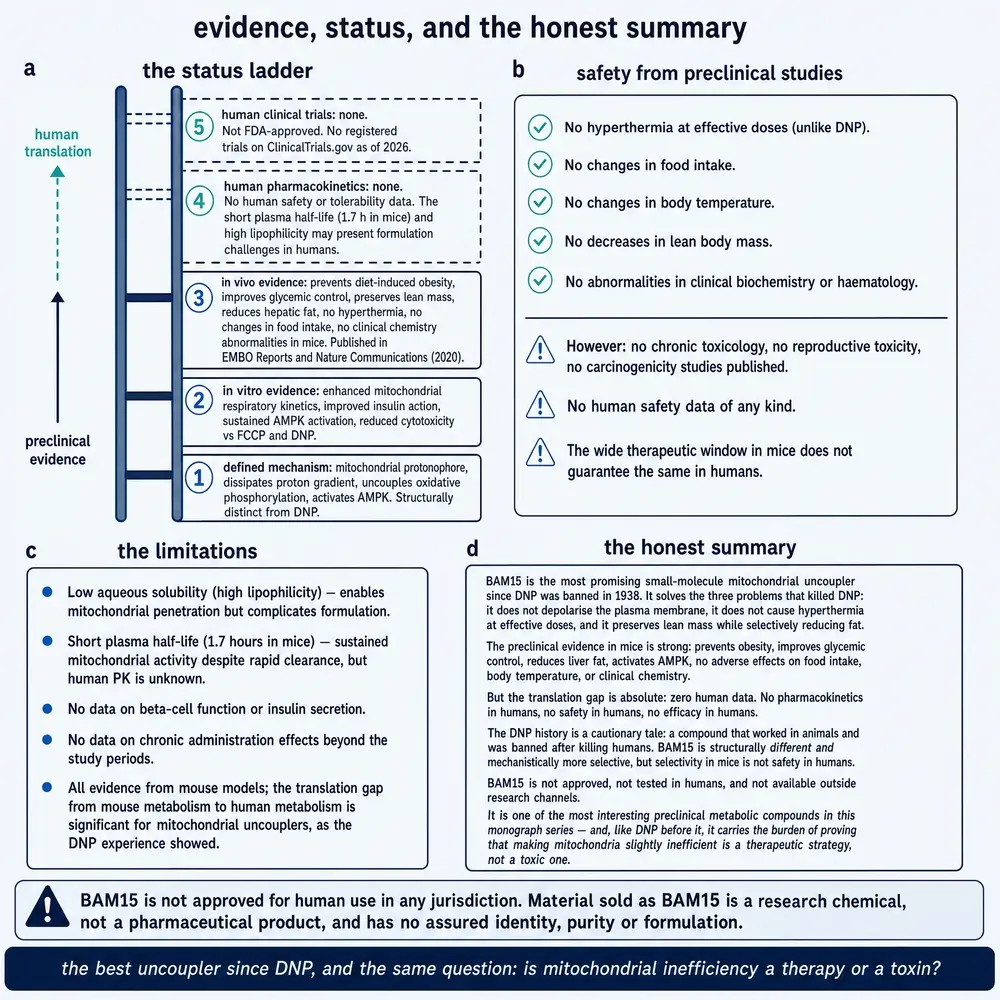
A note on what is missing. BAM-15 has never been administered to a human being in a registered clinical trial. That statement was tested rather than assumed — the queries and their zero results are recorded in Section 16 and in this project's manifest. Everything in Parts Three and Four is animal or cell evidence, and is said to be.
01The drug that worked, and killed people
Start with the uncomfortable part. Dinitrophenol was not a fraud, and it was not a placebo dressed up as medicine. It was an industrial chemical — a munitions intermediate, a dye precursor — that turned out to make people lose weight rapidly and reliably, without their eating less. Clinicians in the early 1930s prescribed it widely on that basis. The pharmacology was correct. The problem was the margin.
It has never really stopped. Between 2010 and 2020 poisons centres in thirty-eight countries, surveyed in collaboration with the World Health Organization, recorded 456 separate cases of systemic human exposure to dinitrophenol; annual case numbers rose from four in 2010 to seventy-one in 2015 before easing back. Where outcome data were available, the case fatality was 11.9 per cent, with a confidence interval running from 9.0 to 15.4 and no significant difference between men and women (Gziut and Thomas, 2022). A separate analysis of 204 cases reported to poisons centres in the United States and the United Kingdom between 2007 and 2018 found the same picture from a different angle: 86 per cent of those affected were under forty, 71 per cent were male, and the case fatality was 11.6 per cent in the United States and 16.9 per cent in the United Kingdom (Potts et al., 2021).
Those two studies are the human evidence base for what this class of molecule does when it goes wrong, and they are worth holding onto, because they are also the only large body of human data anywhere near this compound. Both were read here as structured abstracts rather than as full texts; neither is open access.
The clinical signature is specific enough that the second study could identify which features predicted death. After adjustment, four survived as independent predictors: metabolic acidosis, tachycardia, agitation or confusion, and hyperpyrexia — a body temperature driven upward by the drug itself (Potts et al., 2021). That list is not a random collection of severe-illness markers. It is a description of a metabolism running at full throttle with the brakes disconnected, and it tells you precisely what the molecule is doing.
02What uncoupling actually is
One piece of physical chemistry has to be understood properly here, and then everything else in this document follows from it.
Mitochondria make ATP indirectly. The electron transport chain does not build ATP; it builds a battery. As electrons from food move down a series of protein complexes in the inner mitochondrial membrane, those complexes pump protons out of the innermost compartment — the matrix — into the space between the two mitochondrial membranes. The result is a proton gradient with a voltage across it, typically around 150 to 180 millivolts, matrix side negative. This is the proton-motive force, and it is the cell's main energy currency before ATP ever appears.
ATP synthase is the turbine that cashes it in. Protons flow back into the matrix through a channel in that enzyme, the flow spins a rotor, and the rotation drives the chemistry that joins ADP to phosphate. Electron transport and ATP synthesis are therefore not directly connected; they are coupled, through the gradient, the way a hydroelectric dam couples rainfall to electricity.
A protonophore drills a hole in the dam. It is a molecule lipophilic enough to dissolve in the membrane and weakly acidic enough to carry a proton on one side and release it on the other. Protons return to the matrix without passing through the turbine. The gradient falls, the electron transport chain speeds up to try to rebuild it, oxygen consumption rises, nutrients are consumed faster — and the energy that would have become ATP comes out as heat instead (Kenwood et al., 2014; Demine et al., 2019).
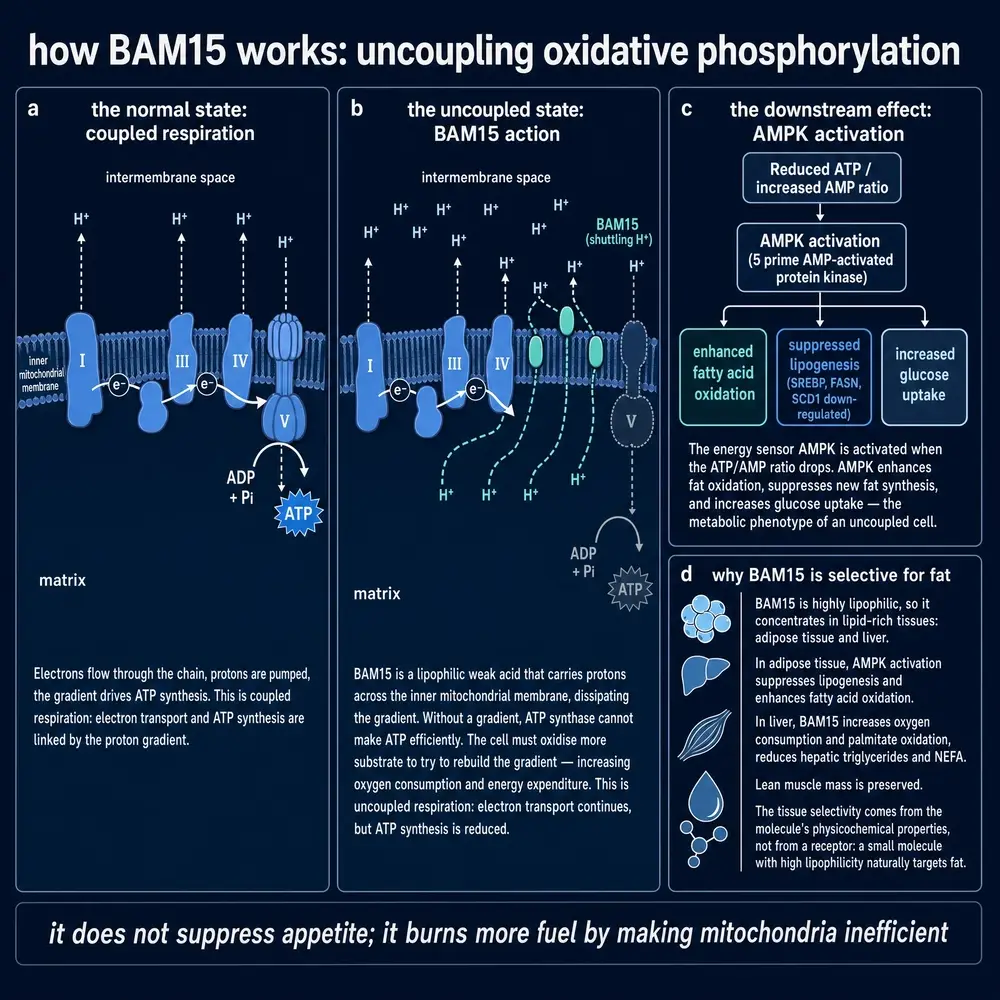
Two consequences matter for the rest of this document. The first is that uncoupling makes an animal burn more food for the same amount of useful work, which is why it produces weight loss without requiring anyone to eat less. The second is subtler and pulls the opposite way from intuition: because mitochondrial superoxide production rises steeply with the membrane potential, mild uncoupling lowers the output of reactive oxygen species rather than raising it (Demine et al., 2019; Dos Santos et al., 2024, abstract only). A drug that makes metabolism less efficient can, at the right intensity, also make it cleaner. That paradox is the source of most of BAM-15's non-metabolic literature, and also of the sharpest contradiction in it, which Section 12 takes up.
The body does this deliberately, incidentally. Brown adipose tissue carries uncoupling protein 1, a regulated proton leak whose entire purpose is to generate heat, and mild proton leak through the inner membrane is a normal feature of every mitochondrion. A chemical uncoupler is not doing something foreign to physiology. It is doing something physiological, everywhere, without being asked.
03Why the window was so narrow
If uncoupling were the whole story, dinitrophenol would have been a manageable drug with a dose ceiling, like many others. It was not, and the reason is that dinitrophenol does not confine itself to the inner mitochondrial membrane.
A lipophilic weak acid will shuttle protons across any membrane whose physical chemistry suits it. The plasma membrane of the cell has its own electrical potential and its own pH gradient, and dinitrophenol — and its laboratory successor FCCP, and the related CCCP — act there too. The consequences are not subtle: the cytosol acidifies, the cell's resting potential collapses, and above a certain concentration the cell simply fails. The discovery paper for BAM-15 puts the clinical corollary directly: this off-target activity at other membranes produces plasma-membrane depolarisation, mitochondrial inhibition and cytotoxicity, and it is what gives the older uncouplers a therapeutic index too narrow for use (Kenwood et al., 2014).
There is a second, purely practical cost that mattered enormously to the scientists involved even before anyone thought about patients. FCCP has been the standard laboratory reagent for measuring maximal mitochondrial capacity for more than half a century: you add it to cells, the mitochondria run flat out, and you read the ceiling. But if FCCP also kills the cell at the concentrations needed to reach that ceiling, the ceiling you measure is too low. The discovery paper says so in as many words, and it is a striking thing for a paper to say — that the field's standard tool has been systematically underestimating the quantity it was invented to measure (Kenwood et al., 2014).
So the specification for a better molecule was unusually precise. It had to carry protons across the inner mitochondrial membrane efficiently, across a wide range of concentrations, without carrying them across the plasma membrane, and without raising reactive oxygen species. Nobody knew whether such a molecule could exist, because nobody had a theory explaining why one membrane should be treatable differently from another by a molecule with no protein target at all.
04Twenty years of workarounds, and what each one cost
Before the screen that found BAM-15, the field spent two decades trying to solve the problem from the other end — not by finding a cleaner uncoupler, but by controlling where an old one could reach. Three strategies were tried, and the pattern of their results is the single most useful piece of context for judging BAM-15.
| Strategy | What it did | What it cost |
|---|---|---|
| Tether dinitrophenol to a lipophilic cation so it accumulates in mitochondria | Concentrated the drug where it was wanted | Failed outright: the tethered molecule could not recycle back across the inner membrane, so it uncoupled once and stopped |
| Liver-targeted prodrugs and controlled-release formulations | Improved safety substantially; reversed hypertriglyceridaemia, fatty liver and insulin resistance in rodents (Perry et al., 2013; Perry et al., 2015) | Lost the anti-obesity effect entirely |
| Repurpose an approved anthelmintic with mild uncoupling activity — niclosamide ethanolamine | Improved diabetes and fatty liver in mice (Tao et al., 2014) | Modest weight effect that appeared secondary to metabolic improvement; increased body weight in db/db mice |
| Design a liver-localised uncoupler from scratch — OPC-163493 | Strong antidiabetic and cardiovascular effects across several rodent models (Kanemoto et al., 2019, abstract only) | No effect on adiposity |
Read down the right-hand column and the shape is unmistakable. Every intervention that made uncoupling safe by restricting it to the liver succeeded at the liver's diseases and failed at obesity. That is not a coincidence or a series of unlucky formulations. Whole-body weight loss from uncoupling requires whole-body metabolic inefficiency, and confining the drug to one organ confines the inefficiency to that organ. The safety fix and the efficacy were, in these designs, the same variable.
There is one more piece of preparatory evidence, and it is the most methodologically consequential item in this entire document. In 2014, Goldgof and colleagues gave dinitrophenol to mice in drinking water at 800 mg/L — but housed them at 30 °C, which is thermoneutral for a mouse, rather than at the 22 °C of an ordinary animal facility. At thermoneutrality, energy expenditure rose about 17 per cent, food intake did not change, and the animals weighed 26 per cent less than controls after two months, having lost fat and not lean mass, with better glucose tolerance and less hepatic steatosis. At 22 °C the identical treatment did nothing at all — no effect on body weight, adiposity or glucose homeostasis (Goldgof et al., 2014, mouse, abstract only).
A mouse at 22 °C is cold. It is already burning fuel to stay warm through brown adipose tissue, and Goldgof and colleagues showed that a chemical uncoupler's heat simply substitutes for that thermogenesis — circulating thyroid hormones fell, Ucp1 expression fell, and brown fat activity fell. The animal ends up no worse off energetically, so nothing happens to its weight. Warm the animal to thermoneutrality, remove the substitution, and the drug's effect appears.
Every BAM-15 rodent study in this reading corpus was run at ordinary vivarium temperature. BAM-15 did produce weight loss under those conditions, which is a real and favourable difference from dinitrophenol and not a small one. But no thermoneutral BAM-15 experiment appears anywhere in the material read for this document, so the size of its effect in a thermally neutral animal — the condition that better resembles a clothed adult human in a heated room — is unmeasured. This is recorded as a gap, not as a criticism of any individual study.
So this was the state of the problem around 2011. Uncoupling worked. Every attempt to make it safe had made it useless for the indication that mattered most. The pharmacological obstacle had been correctly identified as promiscuity between membranes rather than the mechanism itself. And nobody had a molecule.
05The screen
The work was done in Kyle Hoehn's laboratory in the Department of Pharmacology at the University of Virginia, with collaborators across the university's medicine, immunology, biomedical engineering and chemistry departments, at the University of California San Diego, at Seahorse Bioscience, at the University of Tokyo, and with Webster Santos's medicinal chemistry group at the Virginia Tech Center for Drug Discovery. Brandon Kenwood was first author. The paper appeared online in November 2013 and in the April 2014 issue of Molecular Metabolism, and its title states the entire achievement: identification of a novel mitochondrial uncoupler that does not depolarize the plasma membrane (Kenwood et al., 2014).
The design of the screen deserves attention, because it is what determined what came out of it.
The library was ApexScreen 5040 from TimTec — 5,040 compounds, a commercial diversity collection, not a set of uncoupler analogues. Everything was tested at a single concentration of 5 µg/mL. The primary readout was cellular oxygen consumption in rat L6 myoblasts, chosen because they grow quickly, are rich in mitochondria and have spare respiratory capacity to reveal. The measurement was deliberately crude: cells were seeded onto plates with an oxygen-sensitive ruthenium fluorophore embedded in silicone at the base of each well, quenched by oxygen, so that fluorescence rises as oxygen is consumed. Five hundred thousand cells per well gave a reliable two-fold signal over background across roughly fifty minutes. FCCP was the positive control. The top twenty-five compounds that raised oxygen consumption above vehicle went forward (Kenwood et al., 2014).
Then came the two filters that shaped the answer.
The secondary screen measured reactive oxygen species in the same cell line, and any compound that raised them by more than twenty per cent was eliminated. This is a strong criterion, applied early, and it encodes a theory: that the therapeutic value of uncoupling lies in the regime where the membrane potential falls enough to reduce superoxide production, not in the regime where the mitochondrion is failing. The third filter kept only compounds that were structurally unrelated to known uncouplers and that showed activity across a broad range from 10 nM to 10 µM on a Seahorse analyser. A programme optimising dinitrophenol analogues would never have applied that filter; it is the filter of a group that had concluded the problem was the chemotype itself (Kenwood et al., 2014).
One compound came through: a furazanopyrazine bearing two 2‑fluoroaniline arms, which the paper named BAM15. It matched FCCP for potency at stimulating oxygen consumption. Between roughly 100 nM and 1 µM the two behaved alike. Above 1 µM they parted company, and this is the part that mattered: as the concentration rose toward 50 µM, BAM15 held respiration at a high rate while FCCP's collapsed. The same divergence appeared in rat L6 myoblasts, primary rat neonatal ventricular cardiomyocytes, mouse C2C12 myoblasts, normal murine liver cells, and human primary fibroblasts — the first human cells this compound ever met, and a result in cell culture rather than in a person (Kenwood et al., 2014).
06Proving that it is a protonophore
Showing that a molecule increases oxygen consumption is easy. Showing that it does so by carrying protons, rather than by damaging a complex, inhibiting the ATP synthase, feeding electrons into the chain or hijacking a transporter, is not. The discovery paper does it six ways, and the sequence is worth following because it is a small masterclass in eliminating alternatives.
| Experiment | Alternative it rules out |
|---|---|
| Full stimulation of respiration in the presence of oligomycin at 1 µM, across a wider concentration range than FCCP | That the effect requires ATP synthase |
| TMRM fluorescence in loaded L6 cells: depolarisation similar to FCCP at 1 and 10 µM | That respiration rises without the gradient actually falling |
| Isolated mouse liver mitochondria, 1–64 µM, comparable stimulation on pyruvate/malate and on succinate/rotenone | That the effect needs an intact cell, or acts at one particular entry point |
| Electron-flow assay with sequential rotenone, succinate, antimycin A and TMPD/ascorbate | That the compound is donating electrons to the chain itself |
| Swelling of isolated mitochondria in isotonic potassium acetate with valinomycin | Everything except proton transport — this is the direct demonstration |
| Permeabilised C2C12 cells with carboxyatractyloside blocking the adenine nucleotide translocase | That protons return through the ANT rather than through the compound |
All six were done against FCCP as a matched comparator, and on every one of them the two molecules behaved the same way. Whatever distinguishes BAM15 from FCCP, it is not the mechanism of uncoupling. It is where the uncoupling happens.
07The patch clamp, and what the molecule is
The defining experiment of this compound's history is a single figure in the 2014 paper, and it is an electrophysiological one.
Whole-cell patch clamp on L6 myoblasts. Under voltage clamp, a holding potential of −70 mV with a 750 millisecond ramp from −150 to +80 mV every ten seconds. FCCP produced a dose-dependent inward current with a rise in membrane conductance — the electrical signature of protons crossing the plasma membrane. Under current clamp it depolarised the cell reversibly and repeatably. BAM15, applied to the same cells at 1 µM and at 10 µM, produced no appreciable change in current at all, and the result held regardless of the order in which the two compounds were applied. Seven to nine cells per condition (Kenwood et al., 2014, rat myoblast cell line).
That is the whole claim, and it is narrow. It does not say that BAM15 is safe, or that it is selective for any tissue, or that it will work in an animal. It says one thing, measured directly rather than inferred: this molecule crosses into mitochondria and moves protons there, and it does not do the same at the cell's outer boundary. Everything that follows in this document rests on it.
The associated viability data make the practical consequence visible. Across a broad range up to 50 µM, at forty-eight hours, BAM15-treated cells were more viable than FCCP-treated cells — measured in liver cells, both myoblast lines and primary rat left-ventricular cardiomyocytes (Kenwood et al., 2014, cell culture).
What the molecule is
BAM-15 is a small synthetic heterocycle: two 2‑fluoroaniline groups attached to a fused bicyclic core of a furazan ring and a pyrazine ring. It carries two ionisable N–H protons on the aniline nitrogens, which is what makes it a weak acid, and it is markedly lipophilic, which is what lets it dissolve into a membrane. Neither property is unusual. The combination, at the particular values this molecule has, is what appears to confine it to one membrane — and nobody has demonstrated why.
A live inconsistency in the primary literature. The discovery paper names the ring system (1,2,5‑oxadiazolo[3,4‑e]pyrazin‑5‑yl); every subsequent paper from the same collaboration, including the 2020 Nature Communications report, writes it [1,2,5]oxadiazolo[3,4‑b]pyrazine, and much of the pharmacology literature simply calls the class furazano[3,4‑b]pyrazines. These are not different compounds — the formula, mass and registry number are the same throughout — but the locants disagree in peer-reviewed print, sometimes in neighbouring papers by shared authors. This document reports the disagreement rather than choosing a side, and uses the later form when a single name is needed.
08The thing nobody can explain
The discovery paper is unusually candid about its own central gap, and the candour has aged into a standing problem. In the discussion, the authors state plainly that the mechanism by which BAM15 prefers protonophore activity at mitochondria but not at the plasma membrane is unclear, and they offer three candidate explanations: that the pKa of its ionisable protons is such that it can only release them in the alkaline environment of the mitochondrial matrix; that it has a structural preference for the particular lipid composition of the inner mitochondrial membrane, which is rich in cardiolipin and unlike any other membrane in the cell; or that one of its two protonation states is simply unable to cross the plasma membrane. Future organic chemistry and structure–activity work, they wrote, would be required to identify the precise pharmacophore mechanism (Kenwood et al., 2014).
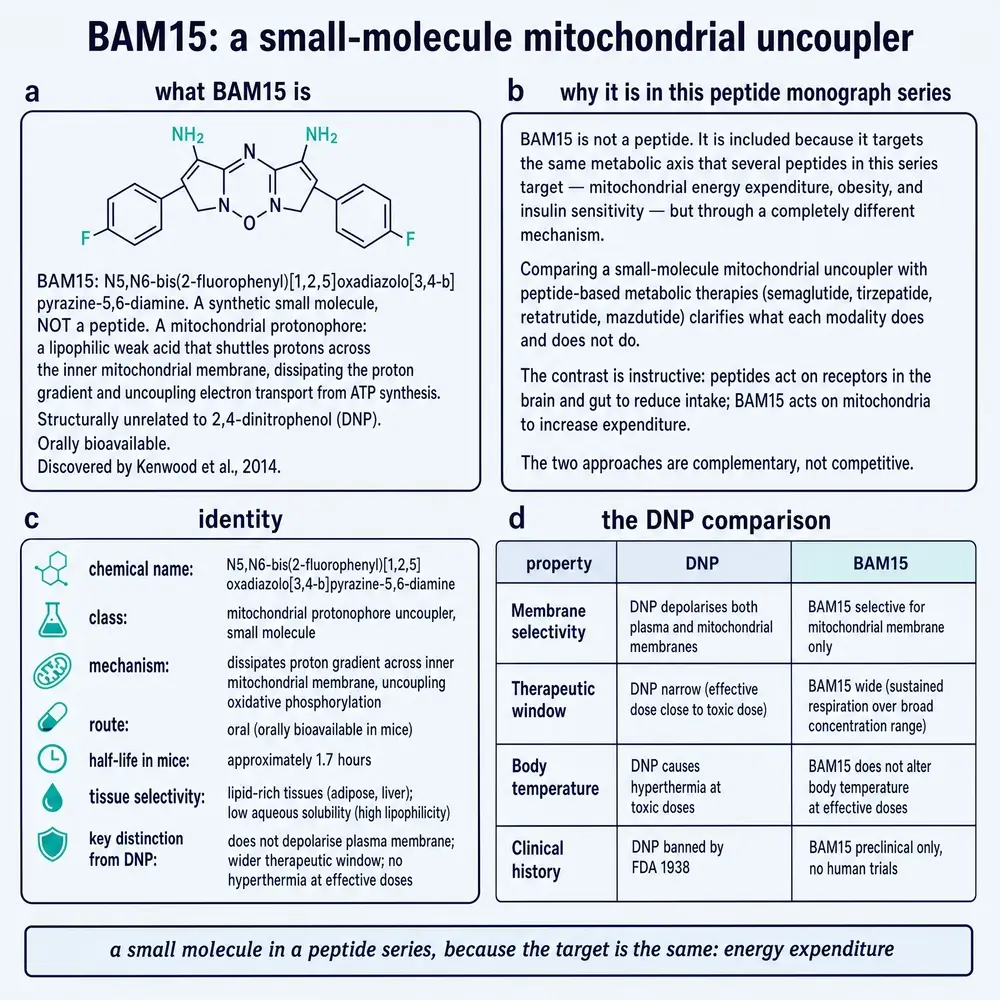
Twelve years later, no paper in this reading corpus has settled it. The structure–activity series was done (Kenwood et al., 2015) and the scaffold has been iterated repeatedly since — Section 21 follows that line — but the iterations optimised potency, pharmacokinetics and tissue distribution rather than answering the question of why the original molecule behaves as it does. A 2024 comparative study of protonophore action across a wide range of chemotypes and a 2026 review of the molecular mechanisms of uncoupling both treat the physical determinants of protonophore selectivity as an open area (Khailova et al., 2024; Pohl et al., 2026; both abstract only).
This matters more than it might appear. A compound whose selectivity is understood can be improved deliberately and its failure modes anticipated. A compound whose selectivity is empirical has to be re-tested in every new context, because there is no theory saying which contexts should be safe. Much of the unevenness in the literature that follows — the same molecule producing an antioxidant signature in one tissue and oxidative damage in another — is what an unexplained selectivity looks like from the outside.
09Kidneys, 2013
The discovery paper does not end in a dish. Its final figure takes the compound into an animal, and the model chosen was acute kidney injury from ischaemia and reperfusion — a condition in which mitochondrial reactive oxygen species, produced in a burst when blood flow returns to starved tissue, are believed to do much of the damage. Mild uncoupling is a plausible intervention precisely because it lowers the membrane potential that drives that burst.
Male C57BL/6 mice, eight weeks old, received a single intraperitoneal bolus of BAM15 at 1 or 5 mg/kg one hour before twenty-six minutes of bilateral renal ischaemia, followed by twenty-four or forty-eight hours of reperfusion. Pretreatment protected the animals dose-dependently: plasma creatinine was lower at both time points, acute tubular necrosis was reduced, there was less loss of brush-border villi and less obstruction of the proximal tubules, and flow cytometry of kidney tissue showed less immune-cell infiltration. Three to six mice per group (Kenwood et al., 2014, mouse).
It is a small experiment and a preventive one — the drug was given before the injury, which no clinical situation permits. Its importance is that it established the compound as bioactive in a whole animal at doses far below anything toxic, and it planted a question that took another decade to be answered properly. If uncoupling protects a kidney from a reperfusion injury, what does it do to a kidney failing in sepsis? Section 17 returns to that.
The 2014 paper closes on a note that turned out to be prophetic in an unhelpful way. Future pharmacokinetic analysis, the authors wrote, would be needed to determine whether BAM15 is suitable for long-term treatment of conditions requiring constant exposure. That analysis arrived six years later, and its answer forms the opening of Part Three.
10Getting it into a mouse
In 2020 two groups published full metabolic characterisations of BAM-15 in diet-induced obese mice within four months of each other. Alexopoulos and colleagues, working with Hoehn and the original Virginia–Virginia Tech collaboration and with Nigel Turner's laboratory in Sydney, published in Nature Communications in May. Axelrod and colleagues, from John Kirwan's group at Pennington Biomedical Research Center, published in EMBO Molecular Medicine in July. Both are substantial, well-controlled papers. They agree about the headline and disagree about the mechanism, and Section 13 is devoted to the disagreement.
Start with what they agree on, which is that the compound is orally available and short-lived.
Alexopoulos and colleagues measured oral against intravenous exposure in C57BL/6J mice and calculated 67 per cent oral bioavailability, with an average peak plasma concentration of 8.2 µM and a half-life of 1.7 hours. Axelrod and colleagues, dosing chronically in food, reported a peak serum concentration around 5 µM and a half-life around three hours (both mouse). Neither figure is comfortable for a drug intended for continuous exposure. Every long study in this literature therefore admixes the compound in the diet rather than dosing it, which produces a plasma concentration that tracks the animal's feeding cycle: at 0.1 per cent by weight in a western diet, Alexopoulos and colleagues measured plasma between 5 and 10 µM across the entire twelve-hour dark period, and much lower outside it.
There is a second practical ceiling. BAM-15 is poorly soluble in water. Preparations up to 100 mg/kg formed a fine suspension in methylcellulose; at 150 and 200 mg/kg the preparation thickened into a paste, and dosing was not escalated further because the delivery, not the drug, had become the limiting factor (Alexopoulos et al., 2020, mouse). Low aqueous solubility is not incidental to how the molecule works — a compound has to be greasy to live in a membrane — but it means that the usual route to a higher exposure is closed.
Against DNP, the potency comparison is favourable and the working range is the more important half of it. In normal murine liver cells, BAM15 had an EC50 of 1.4 µM for stimulating oxygen consumption against 10.1 µM for dinitrophenol — about sevenfold more potent. But DNP began inhibiting respiration above 30 µM, while BAM15 sustained it to 100 µM (Alexopoulos et al., 2020, mouse liver cell line). In an animal, that difference showed up as a wide separation in tolerability: oral doses of BAM15 up to 200 mg/kg produced no change in core body temperature, whereas dinitrophenol's no-observed-adverse-effect level in the same hands was 25 mg/kg.
11Preventing obesity
The pharmacodynamic signal is immediate and unsubtle. Given by gavage to mice, 50 and 100 mg/kg raised whole-animal oxygen consumption in the first hour by 30 per cent and 50 per cent over baseline respectively; at 100 mg/kg the elevation persisted at 48 per cent into the second hour and returned to baseline by about three hours — a time course matching the plasma half-life almost exactly. Ten milligrams per kilogram did nothing measurable (Alexopoulos et al., 2020, mouse).
Fed continuously at 0.1 per cent by weight in a western diet (45 per cent of calories as fat, 16 per cent as sucrose), the same animals showed a 15 per cent average increase in dark-phase oxygen consumption, with no change in locomotor activity, and a fall in respiratory exchange ratio from 0.86 to 0.82 — the signature of a shift toward burning fat.
The prevention experiment ran eight days, with mice singly housed so food intake could be measured accurately, at three concentrations. The dose response on fat mass was clean: 0.05 per cent prevented more than half of the diet-induced fat gain, and 0.10 to 0.15 per cent prevented it completely — while fat-free lean mass and food intake were unaffected at every dose. Serial whole-body imaging was confirmed by daily weights and by dissection of four separate fat depots at the end. Glucose tolerance testing on day 7 showed that a week of western diet had made the controls glucose intolerant and that all three treated groups were protected, with a dose-dependent fall in fasting glucose and lower fed insulin (Alexopoulos et al., 2020, mouse).
Axelrod and colleagues ran the parallel experiment on a more aggressive diet — 60 per cent of calories from fat — in already-obese ten-week-old males, at the same 0.1 per cent in diet, corresponding to roughly 85 mg/kg/day of intake. Body weight separated from controls by day nine and stayed separated; food intake was unchanged until day twenty, by which point the groups differed by 7.5 g. Treated animals lost fat with no change in lean mass, and every white and brown adipose depot measured was smaller, while the gastrocnemius and the heart were not. Neither an acute intraperitoneal injection nor chronic oral administration changed body temperature, and tail heat dissipation was unaltered (Axelrod et al., 2020, mouse).
The absence of hyperthermia is worth pausing on, because hyperthermia is the mechanism by which dinitrophenol kills. Both 2020 papers looked for it specifically, with different methods, at doses well above those used chronically, and neither found it.
12Reversing it, and what happens in the liver
Preventing obesity in an animal that has not yet become obese is the easier experiment. The reversal study conditioned mice on a western diet for four weeks — by which point body mass had risen more than 20 per cent and fat mass had tripled — then stratified and randomised them to a further five weeks with or without 0.1 per cent BAM-15. At the end of the nine weeks, the treated group had eaten the same number of calories as controls and weighed 15 per cent less, a difference that was almost entirely fat, with no difference in fat-free lean mass. Faecal triglyceride, non-esterified fatty acid and cholesterol content did not differ between groups, which rules out malabsorption as the explanation (Alexopoulos et al., 2020, mouse).
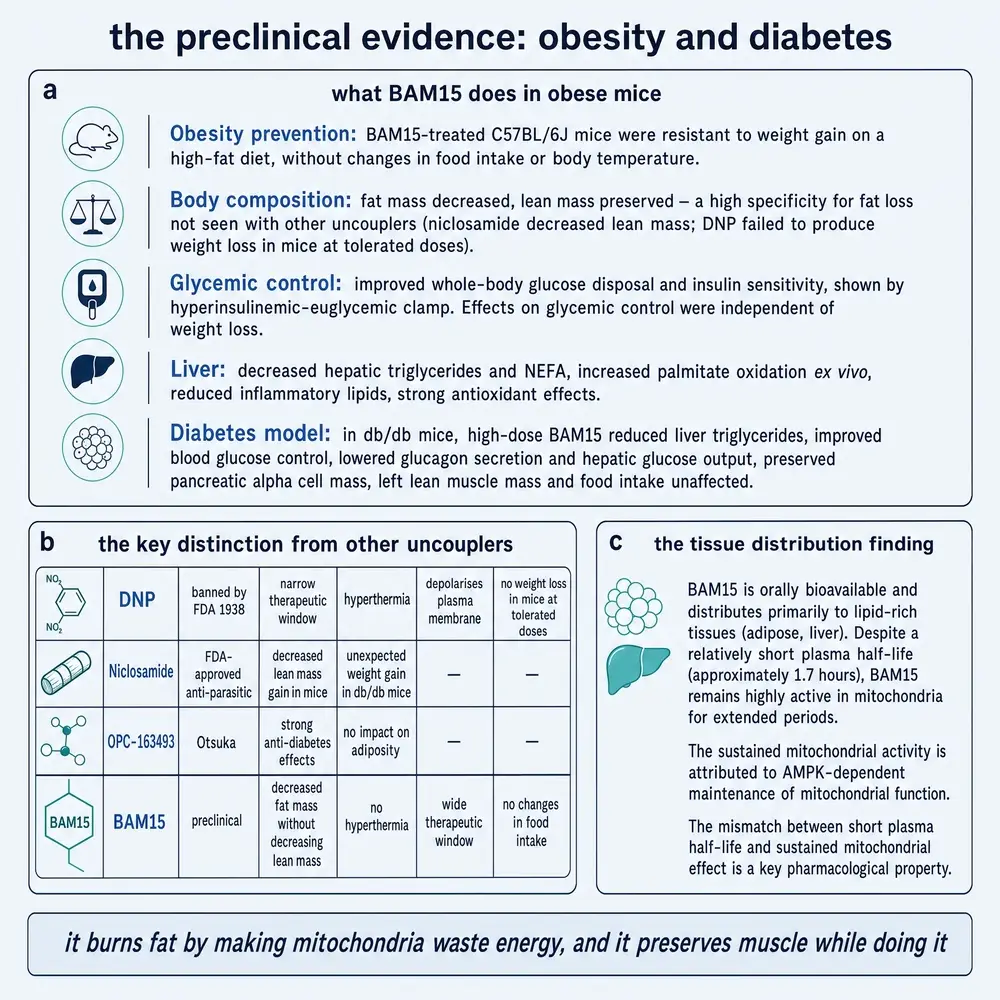
Insulin at the study midpoint was half that of controls and no different from chow-fed animals. A hyperinsulinaemic–euglycaemic clamp at six weeks — the reference method for locating insulin resistance by tissue — showed the glucose infusion rate restored to chow levels, greater insulin-stimulated glucose uptake in mixed-fibre skeletal muscle and in epididymal fat, and greater suppression of adipose fatty-acid release. Suppression of hepatic glucose output was intermediate: statistically indistinguishable from either the obese controls or the lean controls, which is an honest way of reporting an equivocal result. Cardiac glucose uptake was unchanged.
The safety chemistry from the same animals belongs here, not in a later section. Plasma triglyceride fell 29 per cent. There was no ketosis: β‑hydroxybutyrate matched controls despite the increase in fat oxidation. Markers of liver, muscle and cardiac injury — ALT, AST, glutamate dehydrogenase and creatine kinase — were unaffected, and creatinine was normal. Blood urea nitrogen rose 22 per cent, which the authors report and then contextualise: the treated mean of 35 mg/dL sits within the normal physiological range for male C57BL/6 mice, creatinine was normal, and an acute gavage did not move it. That is a finding stated with its qualification rather than either buried or inflated.
The liver metabolome
Because Alexopoulos and colleagues found the compound distributing primarily to liver, they profiled liver metabolites after twenty days of treatment. The global result is reassuring in a specific way: of 770 metabolites, only 22 changed more than twofold and only one changed more than fourfold. A drug that collapsed hepatic bioenergetics would not look like that.
What did change pointed one direction. γ‑Glutamylcysteine, the committed precursor of glutathione, rose 4.6‑fold. Reduced glutathione rose 2.3‑fold while oxidised glutathione was unchanged, so the ratio moved sharply toward the reduced form. 4‑Hydroxynonenal, a standard marker of lipid peroxidation, fell 49 per cent, and a set of pro-inflammatory eicosanoids and docosanoids fell with it. Amino-acid metabolism shifted in a way consistent with increased anaplerosis into the citric acid cycle, and liver urea rose 30 per cent, which is the likeliest explanation for the blood urea nitrogen observation above. Liver ATP was unchanged (Alexopoulos et al., 2020, mouse).
Functionally, oxidation of radiolabelled palmitate in liver homogenate rose 51 per cent one hour after a 100 mg/kg gavage, and after five weeks of treatment liver triglyceride was restored completely to chow-fed levels with hepatic non-esterified fatty acids down 42 per cent. Oil Red O staining showed the same thing histologically.
The antioxidant result is not general, and this document does not present it as though it were. It is a measurement in mouse liver at a plasma exposure of 5–10 µM during the feeding period. Sections 18 and 19 report the opposite finding — increased reactive oxygen species — in vascular smooth muscle, in breast cancer cells and in a parasite. Those are not contradictions of this result so much as measurements at a different point on the same curve, and Section 19 sets out why.
13Two papers, four months apart, that disagree
The two 2020 studies reach the same conclusion about what BAM-15 does and incompatible conclusions about how. Both used male C57BL/6J mice. Both dosed at 0.1 per cent by weight in diet. Both are well powered and carefully controlled. This section states the disagreements rather than resolving them by preference, and identifies where the methods differ enough to explain a result.
Where the drug goes
Alexopoulos and colleagues gave 50 mg/kg orally, killed animals at 0.5, 1, 2 and 4 hours and measured the compound in tissue extracts. They report primary distribution to the liver, with gradual clearance from tissues over four hours. Axelrod and colleagues, sampling after chronic dietary administration, report primary distribution into adipose tissue depots and, to a lesser extent, liver, heart and kidney. Zunica and colleagues, using mass spectrometry on plasma and tissue from tumour-bearing mice, found the compound in adipose, liver and tumour, with low abundance in skeletal muscle (Zunica et al., 2021, mouse).
The plausible reconciliation is methodological rather than substantive: an acute oral bolus samples first-pass hepatic exposure, and a lipophilic weak acid will be caught by the liver on its first passage through the portal system; chronic dosing to steady state samples where a lipophilic compound eventually partitions, which is fat. Axelrod and colleagues make essentially this argument themselves. It is a good argument, and it remains an argument — no experiment in this corpus tests it directly by measuring both regimens in the same animals.
Which way circulating fatty acids move
This one does not reconcile. Alexopoulos and colleagues report plasma non-esterified fatty acids elevated by 40 per cent in the fed state, a value they note falls within the normal physiological range seen during fasting, and they build a mechanism on it: adipose-derived fatty acids released into the circulation to fuel oxidation elsewhere. Axelrod and colleagues report circulating non-esterified fatty acids markedly reduced, together with lower leptin, GDF15 and FGF21, and build the opposite mechanism on that: AMPK-mediated suppression of lipogenesis in white fat, with nutrients diverted to skeletal muscle.
Both cannot be a general property of the compound. The candidate explanations are the diet (45 against 60 per cent of calories from fat), the duration (five to nine weeks against three), and the feeding state at the moment of sampling, which governs circulating fatty acids more than almost any other variable. Notably, Axelrod and colleagues measured lipolytic rates directly in both inguinal and gonadal fat and found no change, which means the fall they observed is not explained by suppressed lipolysis and is harder to account for than it first appears. This document reports the conflict and does not average it.
Whether AMPK is involved
Here the disagreement is partly resolvable, and the resolution is more informative than either claim on its own.
Axelrod and colleagues made AMPK central. In C2C12 myotubes, transcriptomic profiling after sixteen hours produced an upstream regulator signature dominated by the insulin receptor, AMPK, AKT and GLUT4; the compound raised phosphorylation of AMPK at threonine 172 and of AS160, and increased GLUT4 at the plasma membrane. The load-bearing experiment was a knockdown: cells carrying an shRNA against AMPK lost the insulin-independent glucose-uptake effect entirely and showed reduced maximal uncoupled respiration, while the proton leak itself was unaffected. The authors' reading is that AMPK activation sits downstream of the leak but is required to sustain the cell's response to it (Axelrod et al., 2020, mouse cell line). In the animal, they found phospho-AMPK strongly increased in inguinal white fat, modestly in gastrocnemius, and unchanged in liver and heart, with acetyl-CoA carboxylase phosphorylation following, and a collapse in lipogenic gene expression in white fat — Scd1 down 898‑fold, Srebf1 490‑fold, Mlxipl 99‑fold, Fasn 89‑fold.
Alexopoulos and colleagues report no change in AMPK phosphorylation, and no change in its activity toward acetyl-CoA carboxylase, together with unchanged ATP — and conclude that nutrient flux through the liver was sufficient to maintain normal physiology without energetic stress. But they measured liver, and only liver. Axelrod and colleagues also found liver AMPK unchanged. On the tissue both papers examined, they agree.
Two further sources bear on this. Tai and colleagues, working independently on rat vascular smooth muscle, found BAM-15 to be a strikingly potent AMPK activator in the A10 cell line — more effective than CCCP, niclosamide, metformin or AICAR (Tai et al., 2018, rat cell line). And a 2026 study attributes BAM-15's hepatic lipid effects specifically to AMPK activation and mitophagy in high-fat-fed mice (Liu et al., 2026, mouse; abstract only). That last claim is the one that does not fit, and it is also the weakest of the four: it was read here as an abstract, its comparison is with DNP and FCCP rather than with an AMPK-null control, and it contradicts two 2020 papers that measured hepatic AMPK directly and agreed with each other. Recency does not settle this. The weight of evidence supports AMPK activation in adipose tissue, skeletal muscle and vascular smooth muscle, and no AMPK activation in liver.
14Against calorie restriction, and against semaglutide
Between 2023 and 2025 the Sydney and Virginia groups ran the comparisons that place the compound against the interventions it would have to beat. These are the most decision-relevant animal experiments in the corpus, and they are all in mice.
In male db/db mice — leptin-receptor-deficient animals with severe hyperglycaemia, obesity, hypertriglyceridaemia and fatty liver — 0.2 per cent BAM-15 in diet and roughly 50 per cent calorie restriction lowered body weight to a similar extent over four weeks. On glucose control they were not similar at all: the treated animals had fasting glucose and glucose tolerance normalised to the level of lean db/+ littermates, which calorie restriction did not achieve. Both interventions improved hyperglucagonaemia and liver and serum triglycerides, and combining 0.2 per cent BAM-15 with time-restricted feeding produced the phenotype closest to lean controls of anything tested (Chen et al., 2023, mouse).
The most interesting result in that paper is the low-dose arm. 0.1 per cent BAM-15 did not change body mass at all, and still improved glucose tolerance — to roughly the degree achieved by halving the animals' food intake. Whatever uncoupling is doing to glucose handling, it is not doing it only by making the animal thinner.
The five-way head-to-head came next, in female db/db mice — a welcome exception in a literature that is otherwise almost entirely male. Calorie restriction, semaglutide, rosiglitazone, BAM-15 and niclosamide ethanolamine were compared directly. BAM-15 and calorie restriction produced better body weight and liver steatosis outcomes than semaglutide, niclosamide or rosiglitazone. BAM-15, semaglutide and rosiglitazone improved glucose tolerance more than calorie restriction or niclosamide. Four of the five — all but niclosamide — worked on hypertriglyceridaemia (Chen et al., 2024, mouse).
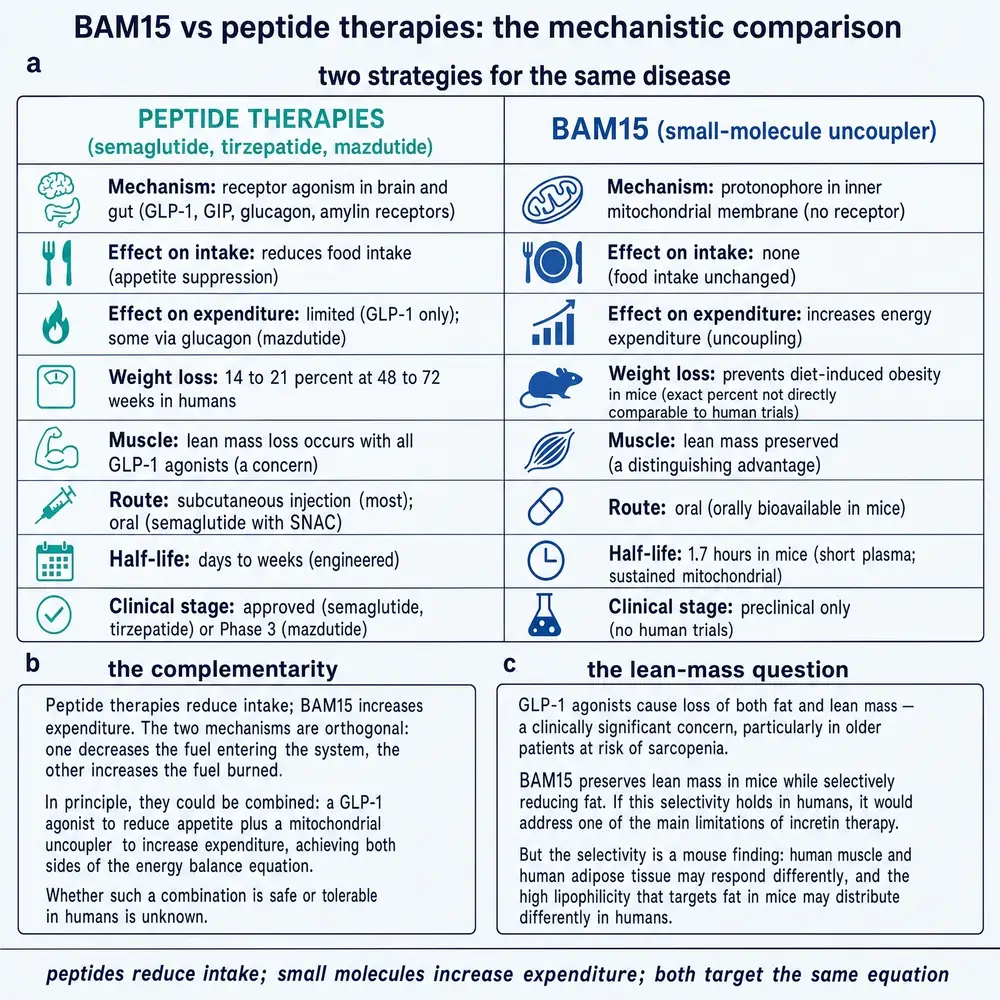
The obvious follow-up was to combine rather than compare. In diet-induced obese mice, adding BAM-15 to either a low or a high dose of semaglutide reduced body fat and liver triglyceride in a way that neither drug achieved alone, and high-dose semaglutide with BAM-15 gave the best glucose homeostasis of any arm. The rationale the authors give is worth stating precisely, because it is the clearest articulation of what an uncoupler is for: semaglutide reduces energy intake, the body responds to sustained energy deficit by becoming more metabolically efficient, and an uncoupler attacks efficiency directly. The two mechanisms are not redundant (Chen et al., 2024, mouse). The same logic drove a separate combination with the thyroid hormone receptor-β agonist resmetirom in a mouse model of steatohepatitis, where the combination beat either monotherapy on energy expenditure, liver fat, glucose control and disease activity score — and where no treatment moved fibrosis at all (Zhou et al., 2024, mouse; abstract only).
Finally, the discipline check. In 2025 the same collaboration compared fifteen structurally unrelated mitochondrial uncouplers side by side in CHO‑K1 cells, then took the best five into male db/db mice against 35 per cent calorie restriction and lean controls. The in vitro result is the one to remember: eleven of the fifteen impaired maximal mitochondrial capacity. Only BAM-15 and ES9 had a wide dose-tolerance range. In the animals, 0.2 per cent BAM-15 significantly improved body weight, fat-pad weight, glucose tolerance, blood glucose, HbA1c, liver weight and liver triglyceride content; the next-best compound, ES9, improved glycaemia but increased body weight, liver size and steatosis (Shah et al., 2025, hamster cell line and mouse). The authors' stated conclusion is that uncouplers should not be generalised and each molecule must be evaluated on its own — which is, in effect, the price of not understanding the selectivity mechanism.
15What the safety record contains, and what it does not
The animal safety picture is genuinely good within the boundaries of the experiments that were done, and those boundaries are narrow. Both halves belong in the same section.
What was looked for and not found. No hyperthermia at oral doses to 200 mg/kg, measured by rectal probe, and no change in tail heat dissipation. No loss of lean mass in any diet-induced obesity study. No change in ALT, AST, glutamate dehydrogenase, creatine kinase or creatinine after five weeks of dietary exposure. No ketosis. No fibrosis on trichrome staining. On necropsy after three weeks, nothing remarkable in brain, reproductive organs, gastrointestinal or respiratory tract, heart, spleen, oral cavity or rectum; skeletal muscle showed no difference in nucleation, cross-sectional area or fibre type, and electron microscopy found mitochondrial number, distribution and morphology unchanged (Alexopoulos et al., 2020; Axelrod et al., 2020, mouse). Two histological findings went the favourable way: hepatic vacuolation and renal proximal-tubule vacuolation were both present in obese controls and reduced or absent in treated animals.
What was found. Blood urea nitrogen rose 22 per cent, within the strain reference range, with normal creatinine and a plausible explanation in the raised hepatic urea. Reduced islet hypertrophy, insulin content and β‑cell mass — reported as consistent with the improved glycaemic state rather than as toxicity, which is a reasonable reading and is an interpretation rather than a measurement. In older animals, ten weeks of 0.1 per cent BAM-15 given to eighty-week-old obese male mice increased muscle mass, grip strength and locomotor activity while lowering body weight from 54.0 to 42.3 g (Dantas et al., 2022, mouse; abstract only). In fruit flies, lifespan increased 9 per cent on a normal diet and 25 per cent on a high-fat diet (Taylor et al., 2024, Drosophila; abstract only).
In 2023, Skinner and colleagues treated human spermatozoa with two small-molecule uncouplers to test whether disabling sperm mitochondria could form the basis of a contraceptive. BAM-15 specifically uncoupled the sperm mitochondria without inducing proton current in the plasma membrane — an independent confirmation, in a human cell, of the selectivity the discovery paper demonstrated in a rat myoblast. It also significantly decreased progressive motility, while leaving ATP content unchanged, because human sperm can fall back on glycolysis (Skinner et al., 2023, human cells in vitro; abstract only).
That paper was designed to find a contraceptive effect and treats the result as promising. Read as safety pharmacology, it says something else: a human cell type with high mitochondrial dependence and a specialised function lost that function at concentrations that did not deplete its ATP. No reproductive or developmental toxicology study of BAM-15 appears anywhere in the material read for this document.
What is missing. The gaps are structural rather than incidental. There is no thermoneutral rodent study, for the reason set out in Section 04. The longest exposure anywhere in this corpus is ten weeks. There is no carcinogenicity study, no reproductive or developmental study, and no formal toxicology package — what exists is study-length clinical chemistry and histology from efficacy experiments, which is not the same thing and should not be read as though it were. And there is no formulation work addressing the one-to-three-hour half-life, so every chronic result in this literature was obtained under an exposure profile that rises and falls with a mouse's nocturnal feeding and that no clinical regimen would reproduce.
16The absence at the centre
The most important sentence in this document is a negative one, so it was tested rather than assumed.
On the compilation date, the expression ("BAM15"[All Fields] OR "BAM-15"[All Fields]) combined with PubMed's clinical-trial publication-type filter returned zero records. The same expression with the randomised-controlled-trial filter returned zero records. A search of the public trial registry returns no interventional study of this compound. Twenty-four records survive a humans[MeSH] filter, and every one of them is work in human cells — fibroblasts, sperm, retinal pigment epithelium, macrophage lines, breast cancer and melanoma lines, engineered T cells. The queries and their results are recorded in this project's manifest.
Twelve years after the discovery paper, no human being has received BAM-15 in a registered study. Nothing in Parts Three or Four should be read as evidence about people.
The human evidence that does exist, in cells
It is a real body of work and it is worth setting out, because it is the only place where this compound and human tissue have met. Human primary fibroblasts sustained uncoupled respiration across the compound's broad working range (Kenwood et al., 2014). Human triple-negative breast cancer cells and BRAF‑mutant melanoma cells respond as described in Section 18. Human iPSC-derived retinal tissue was protected during five days of shipment (Tang et al., 2019). Human THP‑1 macrophage-derived cells showed NLRP3 inflammasome inhibition (Hu et al., 2021, abstract only). CD7-directed CAR‑T cells manufactured from human peripheral blood killed target cells more effectively at low effector-to-target ratios in the presence of 0.5 to 2.5 µM BAM-15, while releasing less interleukin‑6 and tumour necrosis factor‑α (Ma et al., 2025, Int Immunopharmacol, human cells and mouse xenograft; abstract only). And human sperm lost progressive motility, as Section 15 records.
The human record for the class, which is a different thing
Mitochondrial uncoupling as a therapeutic strategy has reached controlled human trials — using a different molecule, by a different route, for different endpoints. The comparison is instructive precisely because it is not about BAM-15.
HU6 is a controlled metabolic accelerator: a compound metabolised in the liver to dinitrophenol, which is to say a way of delivering the original poison to one organ in a controlled fashion. In a phase 2a randomised, double-blind, placebo-controlled trial registered as NCT04874233, 80 adults with non-alcoholic fatty liver disease and a body mass index of 28–45 received once-daily HU6 or placebo for sixty-one days. Relative liver fat, measured by MRI proton density fat fraction, fell by 26.8 per cent, 35.6 per cent and 33.0 per cent across three dose groups against a 5.4 per cent rise on placebo. The most frequent treatment-emergent adverse events on drug were flushing in 32 per cent, diarrhoea in 25 per cent and palpitations in 12 per cent, against 10, 0 and 5 per cent on placebo. No serious events and no deaths were reported (Noureddin et al., 2023, human randomised trial; abstract only).
The same compound was then taken into obesity-related heart failure with preserved ejection fraction, on an explicit rationale: existing weight-loss strategies work by reducing intake and cost skeletal muscle, which is particularly unwelcome in a population that is already sarcopenic and frail (Kitzman et al., 2024). In HuMAIN‑HFpEF, registered as NCT05284617, 66 patients were randomised for nineteen weeks. Against placebo, HU6 reduced body weight by 2.86 kg (95 per cent confidence interval −4.68 to −1.04), total fat mass by 2.96 kg (−4.50 to −1.42) and percentage visceral fat by 1.3 points (−2.1 to −0.5), with no significant loss of muscle mass — the class's central claim, confirmed in people.
And it changed nothing else. There was no statistically significant change in peak oxygen consumption, six-minute walk distance, Kansas City Cardiomyopathy Questionnaire score, high-sensitivity C‑reactive protein, NT‑proBNP or diastolic function. Serious adverse events occurred in five participants, four on drug, including one death, all adjudicated unrelated to treatment (Pandey et al., 2025, human randomised trial; abstract only).
This is the most useful calibration available for the whole field, and it cuts both ways. It shows that a mitochondrial uncoupler can be given to sick people for nineteen weeks with tolerable adverse events, and that it produces the fat-specific, muscle-sparing weight loss the preclinical literature predicts. It also shows a modest effect size and a set of null results on the functional endpoints that would have to move for the approach to matter clinically in that population. None of it is evidence about BAM-15, which is a structurally unrelated molecule that has never been given to a person.
17Sepsis, and a companion diagnostic
The kidney experiment that closed the discovery paper was preventive and small. Ten years later, Tsuji and colleagues published in the Journal of Clinical Investigation the study it implied, and it is the most clinically shaped piece of work in this literature.
The model was caecal ligation and puncture in mice — polymicrobial sepsis — with fluids and antibiotics, so that the drug was added to standard care rather than compared against nothing. BAM-15 was injected at zero, six or twelve hours after the insult, by which point the animals were visibly ill. Mortality fell, kidney damage fell and splenic apoptosis fell, at all three timings (Tsuji et al., 2023, mouse).
The mechanistic argument is what makes the paper unusual. Plasma and urinary mitochondrial DNA rose after the insult and fell after BAM-15 given at zero or six hours. In culture, septic serum increased mitochondrial reactive oxygen species and mitochondrial DNA release from kidney tubule cells in proportion to each other, and BAM-15 prevented both. Two further experiments close the loop: depleting neutrophils abolished the benefit, and injecting mitochondrial DNA into healthy animals reproduced the inflammation and kidney injury, which BAM-15 then prevented — while a large enough dose of exogenous mitochondrial DNA overwhelmed the protection entirely.
That last experiment is the one that matters, because it converts a correlation into a mechanism with a direction. If mitochondrial DNA release is the mediator, then flooding the system with it should defeat a drug that works by reducing it, and it does. The authors go on to propose the pairing as a drug–diagnostic combination: measure circulating mitochondrial DNA, identify the patients whose sepsis is being driven by it, and treat those. Sepsis trials have failed repeatedly for want of exactly that kind of stratification. It remains a proposal, in mice.
18Tumours, at two doses that behave like two drugs
Cancer cells are unusually dependent on the flexible generation of ATP and on the carbon skeletons that intermediary metabolism supplies, which makes an uncoupler an obvious thing to try. Two studies did try it, at concentrations three orders of magnitude apart, and got results so different that they are better read as separate pharmacologies than as one dose response.
Zunica and colleagues worked at cytotoxic concentrations. In human triple-negative MDA‑MB‑231 cells and mouse EO771 cells, BAM-15 increased proton leak and, over time, reduced proliferation, migration and ATP production, lowered mitochondrial membrane potential, and induced apoptosis and reactive oxygen species accumulation. Transcriptomic profiling showed inhibition of signatures for cell survival and energy production. In an orthotopic allograft, the compound slowed tumour progression in lean mice and — the more informative comparison — reduced tumour growth in high-fat-fed mice relative both to vehicle and to weight-matched calorie-restricted controls, so the anti-tumour effect is not simply a consequence of the animals being thinner (Zunica et al., 2021, human and mouse cell lines, and mouse).
Jiang and colleagues worked four orders of magnitude lower. At 50 ng/mL — roughly 150 nM — BAM-15 raised AMPK and AKT signalling and citric-acid-cycle flux without changing proliferation and without killing anything, which the authors interpret as an increase in futile cycling. Injected into tumours, it reshaped the tumour metabolome, and the reshaped metabolome enhanced killing by T cells. Loaded into delivery vehicles to improve retention, it significantly increased CD8‑positive T-cell counts and granzyme B (Jiang et al., 2025, mouse and cell lines).
One dose kills the cancer cell directly through oxidative damage. The other leaves it alive and changes the metabolic environment enough that the immune system kills it. No study in this corpus bridges the two, and describing them as a single dose–response relationship would be an inference the evidence does not support.
A third oncology result is conditional in an instructive way. In BRAF V600E‑mutant melanoma cells, inhibiting the MAPK pathway with vemurafenib or trametinib eliminates glycolysis and pushes the cell onto mitochondrial respiration, where it becomes harder to kill. Serasinghe and colleagues showed that BAM-15 promotes mitochondrial apoptosis in those cells only when oncogenic MAPK signalling is already inhibited — and that adding a BH3-mimetic to block the anti-apoptotic proteins of the outer mitochondrial membrane as well produced fulminant apoptosis and eliminated clonogenic survival (Serasinghe et al., 2018, human cell lines). As monotherapy it does little there. The compound's value in that setting is as one arm of a combination that closes an escape route.
19Vessels, plaque and parasites — and the reactive oxygen problem
Tai and colleagues tested BAM-15 on isolated rat mesenteric arteries. It relaxed vessels pre-constricted with phenylephrine, with and without an intact endothelium, and pretreatment blunted constriction; the half-maximal concentration was comparable to CCCP and niclosamide, and it was less cytotoxic than either in the A10 vascular smooth-muscle line. It activated AMPK in those cells more strongly than CCCP, niclosamide, metformin or AICAR. It also increased mitochondrial reactive oxygen species production and induced mitochondrial fission (Tai et al., 2018, rat tissue and rat cell line).
That last observation is squarely at odds with the screening criterion that selected the compound and with the antioxidant signature Alexopoulos and colleagues found in mouse liver. It is not alone: Zunica and colleagues report reactive oxygen species accumulation in breast cancer cells, and Liu and colleagues report increased reactive oxygen species in Toxoplasma gondii.
The reconciliation this corpus supports, offered as inference rather than measurement. Superoxide production by the electron transport chain rises steeply with the proton-motive force, so a small fall in membrane potential reduces it — the antioxidant regime. A large fall does something else: a cell whose membrane potential has collapsed and which cannot compensate metabolically begins to fail, and a failing cell generates oxidative damage as a consequence of dying rather than as a pharmacological effect. The liver measurement was taken at 5–10 µM in an animal with abundant substrate; the cancer and parasite measurements were taken at concentrations chosen to kill. The vascular result sits between and is the hardest to place. No experiment in this corpus measures reactive oxygen species across a full concentration range in a single preparation, which is the study that would settle it.
The atherosclerosis work extends the vascular story into a disease model with a specific mechanism. In ApoE‑deficient mice on a western diet, subcutaneous BAM-15 at 5 mg/kg/day reduced plaque formation, lipid deposition and circulating interleukin‑1β and interleukin‑18, and lowered mitochondrial reactive oxygen species and oxidised mitochondrial DNA. In mouse aortic endothelial cells challenged with oxidised LDL, it suppressed the NLRP3/ASC/caspase‑1 pathway and the resulting pyroptosis; activating NLRP3 with nigericin partly reversed the protection, which is the experiment that makes the pathway load-bearing rather than merely correlated (Zhong et al., 2025, mouse and mouse cells; abstract only). A separate group reported that oral BAM-15 suppressed atherosclerosis and hyperlipidaemia in the same strain and lowered the raised serum ALT and AST seen in untreated animals; that paper's proposed molecular targets come from RNA sequencing and molecular docking, and docking scores are computational predictions rather than binding measurements (Ma et al., 2025, Sci Rep, mouse and in silico).
One caution attaches to the inflammasome result, and it is the kind that is easy to omit. Niclosamide, CCCP and BAM-15 all inhibit NLRP3 inflammasome activation, through inhibition of NF‑κB nuclear translocation, in both mouse and human macrophage lines (Hu et al., 2021, cell lines; abstract only). This is a property of chemical uncouplers as a class, not a distinguishing feature of BAM-15.
In parasitology the compound behaves as a selective toxin, with a measured window. Against Toxoplasma gondii RH and Prugniaud strains the half-maximal effective concentration was 1.25 µM, while the half-maximal inhibitory concentration in the Vero host cell line was 27.07 µM — roughly a twenty-two-fold separation. Electron microscopy showed parasite mitochondrial vacuolation and autolysis, with falling membrane potential and ATP and rising reactive oxygen species (Liu et al., 2024, cell culture and mouse). A twenty-two-fold window is respectable for an antiparasitic and is the only quantified selectivity margin of its kind in this corpus.
20The compound as a reagent, and what that reveals
A large part of the BAM-15 literature is not about BAM-15. It is about other things, studied by collapsing a membrane potential and observing the consequences — the role FCCP played for fifty years. Those papers are the reason a substantial fraction of this reading corpus exists, and they are labelled as reagent papers rather than counted as pharmacology. But two of them report something the pharmacology papers do not.
Karger and colleagues incubated cultured primary rat astrocytes in glucose-free buffer with BAM-15 for sixty minutes. Cellular ATP fell by about 70 per cent, the total pool of adenosine phosphates by about 50 per cent, and the adenylate energy charge — the standard measure of a cell's energetic state — from 0.9 to 0.6. Restoration required both glucose as substrate and adenosine as an AMP precursor; glucose alone recovered about 80 per cent of the initial ATP over six hours (Karger et al., 2024, rat primary cells).
This is the clearest statement anywhere in the corpus of what BAM-15 does to a cell that cannot compensate. Remove the glycolytic substrate, and uncoupling is not mild, not antioxidant and not therapeutic: it is energetic collapse. The metabolic studies in Part Three were all performed in well-fed animals with abundant circulating fuel, and the benign clinical chemistry they report should be read against that condition rather than as a general property. It is also the mechanistic complement to the human sperm result: those cells kept their ATP because they could switch to glycolysis, and astrocytes without glucose could not.
The second reagent finding runs the other way. Ogando and colleagues used BAM-15 as the reference uncoupler in establishing that the corneal endothelial transporter SLC4A11 acts as an endogenous, ammonia-sensitive mitochondrial uncoupler in its own right (Ogando et al., 2019, cell culture). The compound's usefulness as a tool depends entirely on the property that makes it interesting as a drug: if it depolarised the plasma membrane as well, no conclusion drawn with it would be attributable to mitochondria.
The tissue-preservation work occupies a middle ground between reagent and therapeutic. Adding BAM-15 during five days of shipping human iPSC-derived retinal tissue reduced cleaved caspase‑3, p53, NF‑κB and tumour necrosis factor‑α, preserved neuronal architecture on neurofilament staining, and raised viability, without altering where the various retinal cell types sat in the tissue (Tang et al., 2019, human cells in vitro). Transplantable tissue in transit is a setting where a short-acting compound applied ex vivo has no systemic exposure at all, which removes most of what makes this drug class difficult.
21The chemistry that came after
A compound discovered by phenotypic screening leaves a scaffold behind, and Webster Santos's group at Virginia Tech has been working that scaffold ever since. The structure–activity series on the furazano[3,4‑b]pyrazines was published the year after the discovery (Kenwood et al., 2015), and two more recent series have carried the chemistry into new ring systems.
SHO1122147, an [1,2,5]oxadiazolo[3,4‑b]pyridin‑7‑ol, has a half-maximal effective concentration of 3.6 µM in rat L6 myoblasts, a two-hour half-life and a peak concentration of 35 µM in mice, with no observed adverse effects at 1,000 mg/kg. At 200 mg/kg per day in a mouse model of steatohepatitis it lowered body weight and liver triglyceride without changing body temperature (Foutz et al., 2024, mouse; abstract only). SHS206, an imidazo[4,5‑b]pyridine from the same laboratory, is more potent still at 830 nM and showed no cytotoxicity and no adverse effects to 1,000 mg/kg — but in the same MASH model it lowered liver triglyceride while body weight, temperature, organ weights and cholesterol were all unaltered (Salamoun et al., 2024, mouse; abstract only). A liver-selective imidazolopyrazine from a related programme, SHD865, reverses metabolic disease in mice on the same design principle (Beretta et al., 2024, mouse; abstract only).
The pattern in that paragraph is the pattern of Section 04, repeating in a new chemotype. Increasing potency and confining the compound to the liver produces excellent hepatic results and no weight effect. It is a legitimate design goal — metabolic liver disease is a large unmet need and the regulatory path is clearer — but it is a different drug for a different indication, and it does not inherit BAM-15's distinguishing property. What made BAM-15 unusual was systemic uncoupling without systemic toxicity, and the scaffold's descendants have so far been optimised away from it rather than toward it.
One curiosity is worth a sentence for what it says about the chemistry rather than the pharmacology. Bisanilino compounds built on the same [1,2,5]oxadiazolo[3,4‑b]pyrazine core — structurally very close to BAM-15 — re-sensitise multidrug-resistant Gram-negative bacteria to colistin, with low mammalian toxicity (Harris et al., 2025, bacterial and mammalian cell assays; abstract only). That work is not about uncoupling and is cited here for that fact alone. It is a reminder that this ring system does several things, and that a scaffold is not a mechanism.
22Known, likely, unknown
The following assignment is explicit rather than implied, and each row names the strongest evidence tier that supports it. Nothing in the first column rests on human evidence, because there is none for this compound.
| Claim | Status | Strongest evidence |
|---|---|---|
| BAM-15 is a protonophore that uncouples oxidative phosphorylation | Established | Six independent experiments including proton-dependent swelling of isolated mitochondria |
| It does not depolarise the plasma membrane at 1–10 µM | Established | Whole-cell patch clamp, rat myoblasts; independently reproduced in human sperm |
| It sustains uncoupled respiration over a far wider concentration range than FCCP or DNP | Established | Multiple cell types including human fibroblasts; isolated mitochondria |
| It reduces fat mass in obese mice without reducing food intake or lean mass | Established in mice | Two independent laboratories, prevention and reversal designs, four diets |
| It improves glucose control in mice partly independently of weight loss | Established in mice | 0.1 per cent db/db arm with no weight change; hyperinsulinaemic clamp |
| It does not cause hyperthermia at doses many times the effective one | Established in mice | Rectal probe to 200 mg/kg; tail heat dissipation; two laboratories |
| Mild uncoupling lowers reactive oxygen species; heavy uncoupling raises them | Likely | Consistent with the liver metabolome and with the cancer and parasite results, but no single-preparation dose range exists |
| It activates AMPK in adipose and muscle but not in liver | Likely | Direct measurement in both 2020 papers, agreeing on liver; one 2026 abstract dissents |
| Its metabolic benefit would survive thermoneutral housing | Unknown | No thermoneutral study exists; the comparator compound's entire effect reversed with housing temperature |
| Why it is selective for the inner mitochondrial membrane | Unknown | Three hypotheses stated in 2014; none tested in this corpus |
| Whether it is safe in repeated exposure beyond ten weeks | Unknown | No chronic toxicology, carcinogenicity, reproductive or developmental study exists |
| What it does in a human being | Unknown | No registered trial; zero records under both clinical-trial filters |
23What would have to be measured
Five studies are absent from this record, and each would settle something that currently cannot be settled by argument.
A thermoneutral efficacy study. The same design as the existing diet-induced obesity experiments, run at 30 °C alongside a 22 °C arm. Goldgof and colleagues showed that for dinitrophenol this single variable determined whether the drug worked at all, in the direction opposite to intuition. BAM-15 works at 22 °C where dinitrophenol did not, which is genuinely different, but the size of its effect in a thermally neutral animal is unmeasured and every efficacy figure in Part Three is conditional on it.
A dose–response for reactive oxygen species in one preparation. From the low nanomolar concentrations at which the tumour immunology work operates to the tens of micromolar at which cells die, measured in a single cell type with a single method. This is a modest experiment and it would convert the most-repeated inference in this document into a measurement.
A formulation or analogue that fixes the exposure. A one-to-three-hour half-life and a solubility ceiling around 100 mg/kg mean that every chronic result in this literature was obtained by admixing the compound in food, giving an exposure that rises and falls with a mouse's nocturnal feeding. No clinical regimen reproduces that profile, and no paper in this corpus attempts to solve it. Until it is solved, the question of what a controlled steady-state exposure does is unasked rather than unanswered.
A conventional toxicology package. Repeat-dose studies longer than ten weeks, in two species, with histopathology; and reproductive and developmental work, which the human sperm finding makes specific rather than routine. What exists at present is clinical chemistry and necropsy from efficacy experiments — useful, reassuring within its limits, and not a substitute.
An experiment that explains the selectivity. The three hypotheses in the discovery paper are testable. Measuring the pKa values of the ionisable protons and comparing proton transport in liposomes of defined lipid composition — cardiolipin-rich against plasma-membrane-like — would distinguish the first two. This is physical chemistry rather than pharmacology, and it is the piece whose absence forces every new context to be tested empirically.
What the record actually supports
BAM-15 solved a real and specific problem that had defeated the field for eighty years. The demonstration is narrow, it is direct, and it has held: this molecule moves protons across the inner mitochondrial membrane and not across the plasma membrane, and the difference is measurable by electrophysiology rather than inferred from a viability curve. The rodent metabolic record built on that fact is better than the class has managed before, and contains two findings that are rare anywhere in obesity pharmacology — fat loss without lean loss, and glycaemic improvement without weight loss.
Set against that, twelve years have produced no human study, no explanation of the selectivity, no formulation, and no toxicology package. The chemistry that descended from the scaffold has been optimised toward liver selectivity, which historically is the direction in which the anti-obesity effect disappears. The one uncoupler chemotype that has reached controlled human trials is a different molecule and produced a modest, muscle-sparing weight loss with null results on the functional endpoints that were tested.
The honest summary is that BAM-15 is a well-characterised pharmacological tool and a plausible but unproven therapeutic lead, whose most important outstanding questions are not about whether uncoupling works — that was answered in 1933 — but about whether this particular answer to the toxicity problem survives contact with a human being. Nothing in the record read here indicates that it would not. Nothing in it demonstrates that it would.
Section 24References
Every entry below was resolved against the National Library of Medicine's records during this build and read back against its author, journal, year and title line. None was written from recall. The build refuses to run if any identifier fails to resolve. Twenty-five of the papers cited here were read as structured abstracts rather than as full texts, because they are not in the open-access package; each is marked as abstract-only at the point where it is used, and no claim in this document goes beyond what such an abstract states.
- Alexopoulos SJ, Chen SY, Brandon AE, Salamoun JM, Byrne FL, Garcia CJ, et al.. Mitochondrial uncoupler BAM15 reverses diet-induced obesity and insulin resistance in mice. Nat Commun. 2020;11(1):2397.
PMID 32409697 · doi:10.1038/s41467-020-16298-2 · PMC7224297 - Alpert NM, Pelletier-Galarneau M, Kim SJW, Petibon Y, Sun T, Ramos-Torres KM, et al.. In-vivo Imaging of Mitochondrial Depolarization of Myocardium With Positron Emission Tomography and a Proton Gradient Uncoupler. Front Physiol. 2020;11:491.
PMID 32499721 · doi:10.3389/fphys.2020.00491 · PMC7243673 - Axelrod CL, King WT, Davuluri G, Noland RC, Hall J, Hull M, et al.. BAM15-mediated mitochondrial uncoupling protects against obesity and improves glycemic control. EMBO Mol Med. 2020;12(7):e12088.
PMID 32519812 · doi:10.15252/emmm.202012088 · PMC7338798 - Beretta M, Dai Y, Olzomer EM, Vancuylenburg CS, Santiago-Rivera JA, Philp AM, et al.. Liver-Selective Imidazolopyrazine Mitochondrial Uncoupler SHD865 Reverses Adiposity and Glucose Intolerance in Mice. Diabetes. 2024;73(3):374-384.
PMID 37870907 · doi:10.2337/db23-0233 · PMC10882157 - Chen SY, Beretta M, Olzomer EM, Shah DP, Wong DYH, Alexopoulos SJ, et al.. Targeting negative energy balance with calorie restriction and mitochondrial uncoupling in db/db mice. Mol Metab. 2023;69:101684.
PMID 36731653 · doi:10.1016/j.molmet.2023.101684 · PMC9932728 - Chen SY, Beretta M, Olzomer EM, Alexopoulos SJ, Shah DP, Byrne FL, et al.. Head-to-head comparison of BAM15, semaglutide, rosiglitazone, NEN, and calorie restriction on metabolic physiology in female db/db mice. Biochim Biophys Acta Mol Basis Dis. 2024;1870(1):166908.
PMID 37793464 · doi:10.1016/j.bbadis.2023.166908 · PMC10908303 - Chen SY, Telfser AJ, Olzomer EM, Vancuylenberg CS, Zhou M, Beretta M, et al.. Beneficial effects of simultaneously targeting calorie intake and calorie efficiency in diet-induced obese mice. Clin Sci (Lond). 2024;138(4):173-187.
PMID 38315575 · doi:10.1042/CS20231016 · PMC10876416 - Dantas WS, Zunica ERM, Heintz EC, Vandanmagsar B, Floyd ZE, Yu Y, et al.. Mitochondrial uncoupling attenuates sarcopenic obesity by enhancing skeletal muscle mitophagy and quality control. J Cachexia Sarcopenia Muscle. 2022;13(3):1821-1836.
PMID 35304976 · doi:10.1002/jcsm.12982 · PMC9178352 - Demine S, Renard P, Arnould T. Mitochondrial Uncoupling: A Key Controller of Biological Processes in Physiology and Diseases. Cells. 2019;8(8).
PMID 31366145 · doi:10.3390/cells8080795 · PMC6721602 - Dos Santos BG, Brisnovali NF, Goedeke L. Biochemical basis and therapeutic potential of mitochondrial uncoupling in cardiometabolic syndrome. Biochem J. 2024;481(23):1831-1854.
PMID 39630236 · doi:10.1042/BCJ20240005 - Foutz MA, Krinos EL, Beretta M, Hargett SR, Shrestha R, Murray JH, et al.. Design, Synthesis, and Biological Evaluation of [1,2,5]Oxadiazolo[3,4-b]pyridin-7-ol as Mitochondrial Uncouplers for the Treatment of Obesity and Metabolic Dysfunction-Associated Steatohepatitis. J Med Chem. 2024;67(23):21486-21504.
PMID 39614818 · doi:10.1021/acs.jmedchem.4c02366 · PMC11647902 - Goldgof M, Xiao C, Chanturiya T, Jou W, Gavrilova O, Reitman ML. The chemical uncoupler 2,4-dinitrophenol (DNP) protects against diet-induced obesity and improves energy homeostasis in mice at thermoneutrality. J Biol Chem. 2014;289(28):19341-50.
PMID 24872412 · doi:10.1074/jbc.M114.568204 · PMC4094046 - Gziut T, Thomas SHL. International trends in systemic human exposures to 2,4 dinitrophenol reported to poisons centres. Clin Toxicol (Phila). 2022;60(5):628-631.
PMID 34812657 · doi:10.1080/15563650.2021.2005797 - Harris SL, Dutta S, Liu N, Wollenberg T, Wang X. Extended structure-activity relationship studies of the [1,2,5]oxadiazolo[3,4-b]pyrazine-containing colistin adjuvants. Bioorg Med Chem Lett. 2025;115:130008.
PMID 39481690 · doi:10.1016/j.bmcl.2024.130008 - Hu N, Fu Y, Li WF, Yang XR, Cao M, Li FF, et al.. Chemical mitochondrial uncouplers share common inhibitory effect on NLRP3 inflammasome activation through inhibiting NFκB nuclear translocation. Toxicol Appl Pharmacol. 2021;414:115426.
PMID 33524445 · doi:10.1016/j.taap.2021.115426 - Jiang X, Fan Z, Zhang Z, Zeng F, Sun T, Li Y, et al.. Tumor metabolome remolded by low dose mitochondrial uncoupler elicites robust CD8+ T cell response. Cell Death Discov. 2025;11(1):291.
PMID 40595481 · doi:10.1038/s41420-025-02584-9 · PMC12215621 - Kanemoto N, Okamoto T, Tanabe K, Shimada T, Minoshima H, Hidoh Y, et al.. Antidiabetic and cardiovascular beneficial effects of a liver-localized mitochondrial uncoupler. Nat Commun. 2019;10(1):2172.
PMID 31092829 · doi:10.1038/s41467-019-09911-6 · PMC6520346 - Karger G, Willker JE, Harders AR, Watermann P, Dringen R. ATP Restoration by ATP-Deprived Cultured Primary Astrocytes. Neurochem Res. 2024;50(1):13.
PMID 39549173 · doi:10.1007/s11064-024-04276-9 · PMC11569012 - Kenwood BM, Weaver JL, Bajwa A, Poon IK, Byrne FL, Murrow BA, et al.. Identification of a novel mitochondrial uncoupler that does not depolarize the plasma membrane. Mol Metab. 2014;3(2):114-23.
PMID 24634817 · doi:10.1016/j.molmet.2013.11.005 · PMC3953706 - Kenwood BM, Calderone JA, Taddeo EP, Hoehn KL, Santos WL. Structure-activity relationships of furazano[3,4-b]pyrazines as mitochondrial uncouplers. Bioorg Med Chem Lett. 2015;25(21):4858-4861.
PMID 26119501 · doi:10.1016/j.bmcl.2015.06.040 · PMC6734931 - Khailova LS, Kirsanov RS, Rokitskaya TI, Krasnov VS, Korshunova GA, Kotova EA, et al.. Mitochondrial uncoupling caused by a wide variety of protonophores is differently sensitive to carboxyatractyloside in rat heart and liver mitochondria. Biochim Biophys Acta Bioenerg. 2024;1865(4):149506.
PMID 39168228 · doi:10.1016/j.bbabio.2024.149506 - Kitzman DW, Lewis GD, Pandey A, Borlaug BA, Sauer AJ, Litwin SE, et al.. A novel controlled metabolic accelerator for the treatment of obesity-related heart failure with preserved ejection fraction: Rationale and design of the Phase 2a HuMAIN trial. Eur J Heart Fail. 2024;26(9):2013-2024.
PMID 38924328 · doi:10.1002/ejhf.3305 · PMC11704968 - Liu Z, Wang W, Wang S, Lv R, Li C, Sun C. Mitochondrial uncoupler BAM15 ameliorates liver lipid metabolism disorders by activating the AMPK pathway. FEBS J. 2026;293(10):2999-3014.
PMID 41527408 · doi:10.1111/febs.70400 - Liu Z, Mo J, Li Y, Liu S, Zeng Q, Zhang J. Effect of the mitochondrial uncoupling agent BAM15 against the Toxoplasma gondii RH strain and Prugniaud strain. Parasit Vectors. 2024;17(1):96.
PMID 38424591 · doi:10.1186/s13071-024-06187-8 · PMC10905885 - Ma M, Zhong J, Tai Y, Xu S, Pei Z, Wang X. Combining RNA-seq, molecular docking and experimental verification to explore the mechanism of BAM15 as a potential drug for atherosclerosis. Sci Rep. 2025;15(1):13347.
PMID 40247008 · doi:10.1038/s41598-025-98209-3 · PMC12006321 - Ma Y, Zhang H, Dou L, Sun H, Jing Y, Gu Z, et al.. Mitochondrial uncoupler BAM15 enhances the function of CD7CAR-TCD7- cells and reduces the release of cytokines for the therapy of T-cell malignancies. Int Immunopharmacol. 2025;155:114577.
PMID 40215779 · doi:10.1016/j.intimp.2025.114577 - Noureddin M, Khan S, Portell F, Jorkasky D, Dennis J, Khan O, et al.. Safety and efficacy of once-daily HU6 versus placebo in people with non-alcoholic fatty liver disease and high BMI: a randomised, double-blind, placebo-controlled, phase 2a trial. Lancet Gastroenterol Hepatol. 2023;8(12):1094-1105.
PMID 37806314 · doi:10.1016/S2468-1253(23)00198-X - Ogando DG, Choi M, Shyam R, Li S, Bonanno JA. Ammonia sensitive SLC4A11 mitochondrial uncoupling reduces glutamine induced oxidative stress. Redox Biol. 2019;26:101260.
PMID 31254733 · doi:10.1016/j.redox.2019.101260 · PMC6604051 - Pandey A, Lewis GD, Borlaug BA, Shah SJ, Sauer AJ, Litwin S, et al.. Novel Controlled Metabolic Accelerator for Obesity-Related HFpEF: The HuMAIN-HFpEF Randomized Clinical Trial. JAMA Cardiol. 2025;10(6):609-616.
PMID 40072462 · doi:10.1001/jamacardio.2025.0103 · PMC11904796 - Perry RJ, Kim T, Zhang XM, Lee HY, Pesta D, Popov VB, et al.. Reversal of hypertriglyceridemia, fatty liver disease, and insulin resistance by a liver-targeted mitochondrial uncoupler. Cell Metab. 2013;18(5):740-8.
PMID 24206666 · doi:10.1016/j.cmet.2013.10.004 · PMC4104686 - Perry RJ, Zhang D, Zhang XM, Boyer JL, Shulman GI. Controlled-release mitochondrial protonophore reverses diabetes and steatohepatitis in rats. Science. 2015;347(6227):1253-6.
PMID 25721504 · doi:10.1126/science.aaa0672 · PMC4495920 - Pohl EE, Jovanović O. Molecular mechanisms of mitochondrial uncoupling: focus on 2,4-dinitrophenol. Eur Biophys J. 2026.
PMID 41838137 · doi:10.1007/s00249-026-01827-6 - Potts AJ, Bowman NJ, Seger DL, Thomas SHL. Toxicoepidemiology and predictors of death in 2,4-dinitrophenol (DNP) toxicity. Clin Toxicol (Phila). 2021;59(6):515-520.
PMID 33021407 · doi:10.1080/15563650.2020.1826505 - Salamoun JM, Krinos EL, Foutz MA, Hargett SR, Beretta M, Shrestha R, et al.. Design, synthesis, and biological evaluation of imidazo[4,5-b]pyridine mitochondrial uncouplers for the treatment of metabolic dysfunction-associated steatohepatitis (MASH). Eur J Med Chem. 2024;280:116916.
PMID 39406121 · doi:10.1016/j.ejmech.2024.116916 · PMC11585420 - Serasinghe MN, Gelles JD, Li K, Zhao L, Abbate F, Syku M, et al.. Dual suppression of inner and outer mitochondrial membrane functions augments apoptotic responses to oncogenic MAPK inhibition. Cell Death Dis. 2018;9(2):29.
PMID 29348439 · doi:10.1038/s41419-017-0044-1 · PMC5833689 - Shah DP, Vancuylenburg CS, Olzomer EM, Chen SY, Grams RJ, Beretta M, et al.. Diverse actions of 15 structurally unrelated mitochondrial uncouplers in cells and mice. Mol Metab. 2025;99:102204.
PMID 40639664 · doi:10.1016/j.molmet.2025.102204 · PMC12303080 - Skinner WM, Petersen NT, Unger B, Tang S, Tabarsi E, Lamm J, et al.. Mitochondrial uncouplers impair human sperm motility without altering ATP content†. Biol Reprod. 2023;109(2):192-203.
PMID 37294625 · doi:10.1093/biolre/ioad064 · PMC10427809 - Tai Y, Li L, Peng X, Zhu J, Mao X, Qin N, et al.. Mitochondrial uncoupler BAM15 inhibits artery constriction and potently activates AMPK in vascular smooth muscle cells. Acta Pharm Sin B. 2018;8(6):909-918.
PMID 30505660 · doi:10.1016/j.apsb.2018.07.010 · PMC6251816 - Tang M, Luo Z, Wu Y, Zhuang J, Li K, Hu D, et al.. BAM15 attenuates transportation-induced apoptosis in iPS-differentiated retinal tissue. Stem Cell Res Ther. 2019;10(1):64.
PMID 30795805 · doi:10.1186/s13287-019-1151-y · PMC6387563 - Tao H, Zhang Y, Zeng X, Shulman GI, Jin S. Niclosamide ethanolamine-induced mild mitochondrial uncoupling improves diabetic symptoms in mice. Nat Med. 2014;20(11):1263-9.
PMID 25282357 · doi:10.1038/nm.3699 · PMC4299950 - Taylor AL, Dubuisson O, Pandey P, Zunica ERM, Vandanmagsar B, Dantas WS, et al.. Restricting bioenergetic efficiency enhances longevity and mitochondrial redox capacity in Drosophila melanogaster. Aging Cell. 2024;23(5):e14107.
PMID 38343281 · doi:10.1111/acel.14107 · PMC11113268 - Tsuji N, Tsuji T, Yamashita T, Hayase N, Hu X, Yuen PS, et al.. BAM15 treats mouse sepsis and kidney injury, linking mortality, mitochondrial DNA, tubule damage, and neutrophils. J Clin Invest. 2023;133(7).
PMID 36757801 · doi:10.1172/JCI152401 · PMC10065071 - Xiong G, Zhang K, Ma Y, Song Y, Zhang W, Qi T, et al.. BAM15 as a mitochondrial uncoupler: a promising therapeutic agent for diverse diseases. Front Endocrinol (Lausanne). 2023;14:1252141.
PMID 37900126 · doi:10.3389/fendo.2023.1252141 · PMC10600450 - Zhong S, Shen H, Dai X, Liao L, Huang C. BAM15 inhibits endothelial pyroptosis via the NLRP3/ASC/caspase-1 pathway to alleviate atherosclerosis. Atherosclerosis. 2025;406:119226.
PMID 40393254 · doi:10.1016/j.atherosclerosis.2025.119226 - Zhou M, Li C, Byrne FL, Vancuylenburg CS, Olzomer EM, Hargreaves A, et al.. Beneficial effects of MGL-3196 and BAM15 combination in a mouse model of fatty liver disease. Acta Physiol (Oxf). 2024;240(10):e14217.
PMID 39152636 · doi:10.1111/apha.14217 · PMC11421973 - Zunica ERM, Axelrod CL, Cho E, Spielmann G, Davuluri G, Alexopoulos SJ, et al.. Breast cancer growth and proliferation is suppressed by the mitochondrial targeted furazano[3,4-b]pyrazine BAM15. Cancer Metab. 2021;9(1):36.
PMID 34627389 · doi:10.1186/s40170-021-00274-5 · PMC8502397
Sources with no PubMed record. Structural, chemical and registry material is listed separately so that the numbered list above stays wholly machine-verified.
- PubChem, National Library of Medicine. BAM15, compound summary, CID 2851542. Molecular formula C16H10F2N6O, molecular weight 340.3, the InChIKey and the synonym list quoted in Section 07 were retrieved from this record during the preparation of this document. PubChem also carries the CAS number 852169-07-4. Computed physicochemical values are labelled as computed where they are used..
https://pubchem.ncbi.nlm.nih.gov/compound/2851542 - United States National Library of Medicine. ClinicalTrials.gov registry. Searched for BAM15 and for its synonyms during the preparation of this document. The registry returns no interventional study of this compound in humans. That absence is reported in Section 16 as a finding and is the reason no human evidence tier appears for the subject..
https://clinicaltrials.gov/ - United States National Library of Medicine, PubMed. Publication-type filtered searches establishing the absence of a human trial. The queries were ("BAM15"[All Fields] OR "BAM-15"[All Fields]) AND (clinicaltrial[Filter]) and the same expression with randomizedcontrolledtrial [Filter]. Both returned zero records on the compilation date. The full query text and its result are recorded in manifest/04c_human_probe.json..
https://pubmed.ncbi.nlm.nih.gov/ - TimTec LLC. ApexScreen diversity library. The 5,040-compound commercial screening collection from which BAM15 was drawn, named in the discovery paper together with the supplier of the resupplied solid. Cited in Section 05 for that fact alone..
https://www.timtec.net/ - United States Food and Drug Administration. Dinitrophenol; regulatory action under the Federal Food, Drug, and Cosmetic Act of 1938. The statement in Section 03 that dinitrophenol was removed from human use in the United States in 1938 is the standard account given in the toxicology literature cited alongside it. The primary regulatory instrument was not read for this document and the claim is attributed to the secondary sources that state it..
https://www.fda.gov/
Section 25How this document was assembled
The corpus was built against project 05, the Therapeutic Peptide Research Library, and against PubMed and PubMed Central. As with every compound in this series the interesting arithmetic is not what was collected but what had to be refused — and for this molecule the refusals take a shape the series has not met before.
The identity problem is a role problem
Three letters and two digits look like an invitation to a name collision, and there is one waiting: BAM is also the prefix of the bovine adrenal medulla opioid peptides, and BAM8‑22, BAM12P and BAM22P together carry 120 PubMed records. They are not this compound and share nothing with it beyond three characters. But the collision never actually bites, because the token that matters is BAM15, and no opioid peptide is numbered fifteen. Of 72 records carrying the name in any spelling, 71 carry it in the title or abstract. The disqualify list that has done the heavy lifting in this pipeline since No. 22 refused 0 titles here, and writing a longer one would have been decoration.
The problem for this compound is not which molecule a paper is about. It is what the molecule is doing in the paper. BAM-15 is sold as a laboratory reagent and used as one: a large part of its literature collapses a membrane potential in order to study something else entirely, in the role FCCP occupied for half a century. A corpus that counted those as pharmacology would overstate the evidence base for the drug by a wide margin while every individual document in it was genuinely about BAM-15.
So the reading corpus was partitioned by role rather than by identity, and the partition was made by reading each document rather than by matching strings:
| Role | Documents | How it is used here |
|---|---|---|
| Tier A — the compound is the experimental subject | 19 | read in full; the source of every primary number |
| Tier B — substantive supporting discussion | 7 | read in full; context, mechanism, class comparison |
| Tier C — used as a reagent, or mentioned in passing | 9 | skimmed; cited only where the reagent use is itself informative |
| Local full texts held under a content hash rather than a PMC identifier | 8 | read, but outside the identifier-keyed tiering |
Those four rows sum to the corpus, which is the point of printing the last one. Three of the reagent-tier papers are cited in Part Four anyway — the astrocyte energy-charge measurement, the corneal-endothelium work and the retinal-tissue shipping study — because what a compound does to a cell that cannot compensate is a fact about the compound, whoever was measuring it and for whatever reason.
The external harvest
The PubMed query ran in four arms: the compound by name in every spelling; the chemotype, so that structure–activity work descended from the scaffold could not hide behind a code name; the therapeutic question, which is mitochondrial uncoupling as a treatment for metabolic disease; and the history, which is 2,4‑dinitrophenol. The fourth arm exists because this compound cannot be described without it. Those arms returned 1,200 records, of which 1,108 passed record-level relevance. A separate full-text sweep of PubMed Central for the compound name in the body of the paper returned 426 documents.
Of the 1,108 indexed records, only 26 name the subject in the title; the remaining 1,082 were harvested by the field and history arms and are about uncoupling, not about BAM-15. That is a deliberately wide net and the number is reported rather than hidden, because it is the ratio that explains why the reading corpus is 43 documents and not eleven hundred.
51 full texts were retrieved on this build and screened on the far side, where nothing is counted without being read. 18 had no retrievable open-access body text and were dropped from the reading corpus rather than counted as read.
| Far-side screen | Documents | Enters the reading corpus |
|---|---|---|
| Substantive discussion of the compound | 26 | yes |
| Reagent use or passing mention | 9 | yes, as Tier C |
| Not about this compound | 0 | no |
| Refused by the identity gate | 0 | no |
| No retrievable body text | 18 | no |
The reading corpus is 43 unique scientific full texts, about 707 printed-page equivalents. That figure is a keyed union of the local store and the external harvest, not a sum of the two. Summing them would have claimed 71 documents that are reachable by both routes twice over.
The two gaps this build had to close by hand
The discovery paper was not in the local store. A monograph about this compound that could not read Kenwood and colleagues 2014 would have had to take the screen, the patch clamp and the six protonophore proofs from secondary descriptions, which is precisely the failure mode section 5 exists to prevent. It is free to read on PubMed Central but is not in the open-access package, so it was retrieved separately and parsed, and every statement in Part Two comes from that text.
Twenty-five papers had to be read as abstracts. The entire dinitrophenol toxicology record, the whole human trial record for the class, the medicinal chemistry that descended from the scaffold, and several recent BAM-15 papers are behind subscription. Their abstracts were fetched from NCBI and stored, and each is labelled abstract only in the sentence that uses it. A claim drawn from one of them stays inside what the abstract states; where an abstract-only paper disagrees with a full text that was read, the full text carries more weight and Section 13 says so explicitly rather than averaging them.
The negative finding, and how it was established
The load-bearing claim in this document is that BAM-15 has never been given to a human being in a registered trial. A negative claim asserted from a failure to remember seeing something is not evidence, so it was queried. Both filters returned zero.
| Query | Records |
|---|---|
| bam15 + clinical trial pubtype | 0 |
| bam15 + randomized controlled trial | 0 |
The twenty-four records that survive a humans[MeSH] filter are all work in human cells, and every one of them is labelled as such where it appears. Section 16 reports the absence as a finding rather than leaving it to be inferred from a thin section.
| Stage | What it did | Result |
|---|---|---|
| 02 – 02b | PubMed and PubMed Central surfaces, measured arm by arm | 1,200 and 426 |
| 03 – 03b | fetch full texts; retrieve the discovery paper by hand | 51 fetched |
| 04 – 04b | join the reading corpus from PMCID to PMID against the harvest | 43 documents, tiered by role |
| 04c – 04e | probe the human record; fetch the abstract-only supplement | 26 abstracts stored |
| 05 – 05c | resolve every reference against NCBI; check every citation in the prose against its record; inject figures and captions | 46 references, 24 figures |
| 06 – 07c | assemble, number figures, render both editions, stamp running furniture | 24 figures |
| 11 – 15 | density, margins, artwork, contrast and format gates | run against both editions |
What this build found in its own pipeline
This series records, repeatedly, that a fix written into its standard is not the same as a fix present in the code. Two defects were found in the inherited stages on this build, and both would have passed silently rather than crashing.
The citation-map gate — the stage whose entire purpose is to catch a recalled author surname before it reaches print — required the closing parenthesis to follow the year immediately. Every citation in this document carries a study-type label after the year, because the assignment requires the kind of study to be named in the sentence that reports it. The gate parsed twenty citations out of seventy and printed PASS. It now parses all seventy. The second was this Apparatus, which arrived carrying the previous compound's narrative around this compound's numbers.
Section 26Evidence handling
Study type is named in the sentence that reports the finding. A result in a cell line is called a result in a cell line. For this compound the label carries unusual weight, because the same molecule at three different concentrations is three different things in this literature: an anti-obesity agent in a mouse, a cytotoxin in a tumour cell, and a bench reagent whose purpose is to collapse a membrane potential so that an experimenter can see what happens next.
No human use is recommended anywhere, and no amount in this document is offered for use by any person. Concentrations and doses appear only as parameters of published experiments, always with the species, the preparation and the duration attached.
Conflicting evidence is presented as conflict. Three cases are load-bearing and none is resolved by preference. The two 2020 metabolic papers disagree about tissue distribution and about the direction in which circulating fatty acids move; Section 13 states both, identifies the methodological differences that could account for one of them, and declines to average the other. The discovery paper's screening criterion eliminated compounds that raised reactive oxygen species, and three later papers report BAM-15 raising them; Section 19 sets out the concentration-dependent reconciliation the corpus supports and labels it as inference rather than measurement. And a 2026 abstract attributes hepatic effects to AMPK activation, against two 2020 papers that measured hepatic AMPK directly and agreed with each other; Section 13 weighs them rather than letting recency decide.
A methodological confound is treated as governing rather than as a footnote. Every rodent study in this corpus was run at ordinary vivarium temperature. For dinitrophenol, housing temperature determined whether the drug worked at all. Section 04 sets this out before any efficacy figure is reported, and Section 22 records the absence of a thermoneutral BAM-15 experiment as an open question rather than as a criticism of any individual study.
Adverse findings sit beside the efficacy figures. The human sperm result is in Section 15 with the rest of the safety record, not in an appendix. The raised blood urea nitrogen is reported in the same paragraph as the clinical chemistry that was normal. The null endpoints of the class's human trials are printed in the same figure as its positive ones.
Absence is reported as a finding. Where a claim is widely repeated and this corpus contains no evidence for it, this document says so. Section 08 records that the compound's defining selectivity has never been explained, twelve years after its authors named three candidate mechanisms and called for the work. Section 23 lists the five studies whose absence currently prevents several questions in this document from being settled by anything other than argument.
Continue exploring