
L-Carnitine The muscle extract that became a vitamin, then a shuttle, then a suspect
Almost every compound in this series is a candidate — a molecule waiting for the trial that will decide it. L-carnitine is not. It was settled four separate times. It is a genuine vitamin, for a beetle. It is a genuine approved medicine, for a rare inherited transport defect. It is a genuine constituent of the human diet, concentrated in red meat. And it is a mass-market supplement whose largest promises have been shrinking for thirty years. The four identities do not sit comfortably together, and the tension between them is the whole story. There is one more thing. The molecule is named for flesh — carnis, the Latin word, chosen in 1905 because it was pulled out of boiled muscle. The most serious modern charge against it is that flesh is exactly the problem.
Findings are labelled by the kind of study that produced them, in the sentence that reports them. A result in a rat is called a result in a rat. A result in a dish of corneal cells is called that. Where a number appears, the species, the population and the duration travel with it.
Four molecules appear in these pages under names that all contain the words “L-carnitine”, and they are not interchangeable. L-carnitine itself is the subject. Acetyl-L-carnitine and propionyl-L-carnitine are separately developed therapeutic agents whose names contain the subject’s name in full — and a great deal of what is popularly attributed to L-carnitine was in fact measured with one of them. The single largest clinical effect anywhere in this literature, a fifty-metre gain in walking distance in peripheral arterial disease, belongs to propionyl-L-carnitine. Nearly all the work on memory, mood and nerve damage belongs to acetyl-L-carnitine. D-carnitine is the mirror image, and it is not inert — it is an inhibitor. And the acylcarnitines, a whole family of species measured in newborn screening, are what carnitine becomes rather than what it is. Section 09 explains how these were kept apart, and how often they were not.
Doses appear only as reported experimental parameters. Nothing in this document recommends human use of any compound, and it specifies no dose, route or schedule for any person.
01A small, permanently charged molecule that cannot go anywhere by itself
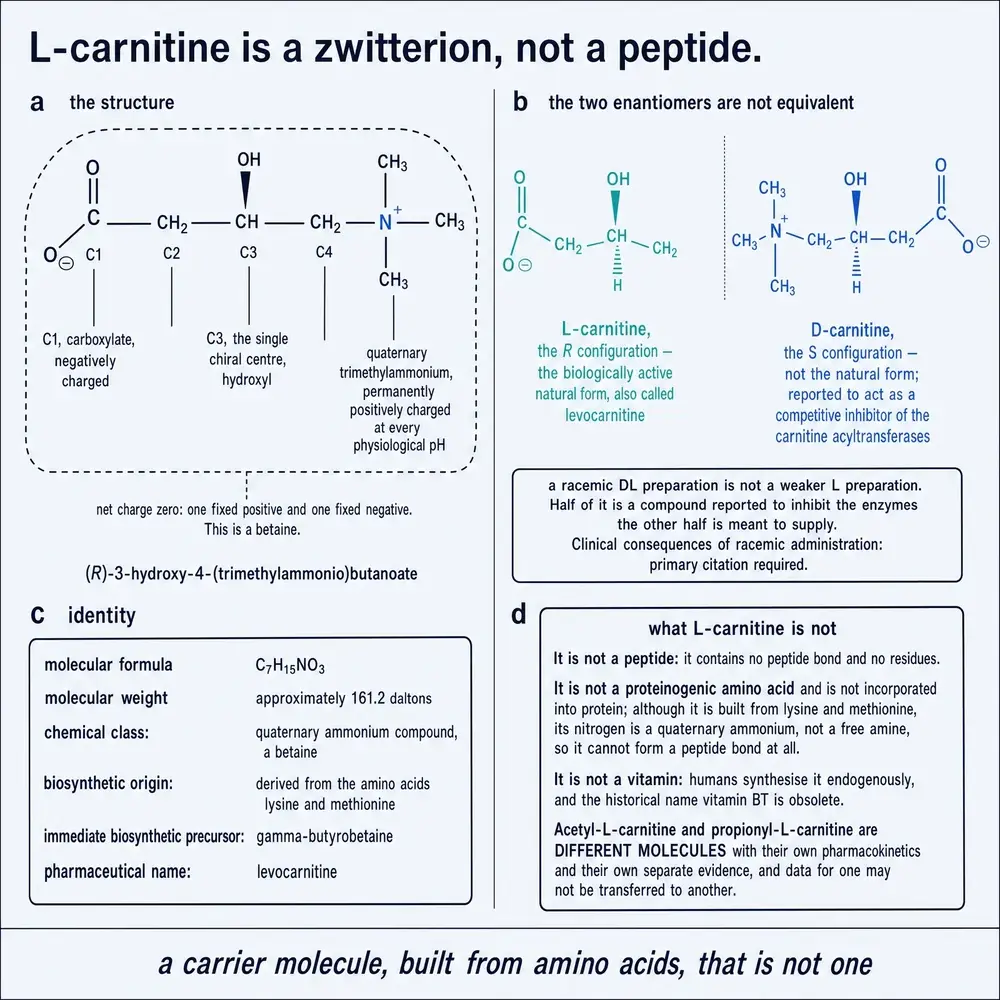
L-carnitine is not a peptide. It is a very small organic molecule — seven carbons, one nitrogen, three oxygens, a molecular weight of 161.20 — and by the standards of this series it is almost absurdly simple. The US Food and Drug Administration’s label for the prescription form calls it 3-carboxy-2(R)-hydroxy-N,N,N-trimethyl-1-propanaminium, inner salt. A white crystalline powder, so hygroscopic it pulls water out of the air, freely soluble in water, insoluble in acetone.
The phrase “inner salt” is the part that matters, and it is worth slowing down for, because everything else in this document follows from it. At one end of the molecule sits a quaternary ammonium group: a nitrogen with three methyl groups attached, carrying a permanent positive charge. Not a conditional charge, not one that appears and disappears with the pH of the surrounding fluid — a permanent one, built into the bonding. At the other end sits a carboxylate, carrying a negative charge across the entire physiological range. The molecule is therefore a betaine: electrically neutral overall, but only because it is carrying a full positive and a full negative charge at the same time, at opposite ends.
A molecule like that cannot drift through a cell membrane. Membranes are oily, and oil does not admit permanent charge. Everywhere L-carnitine goes in the body, something has to carry it — into the gut wall, into the bloodstream, out of the kidney’s filtrate and back into circulation, into muscle, into the mitochondrion. Every one of those steps is a protein doing work. This is why a molecule that sounds like it should behave like a simple nutrient behaves instead like a drug with a distribution problem, and it is why the most instructive experiment in the entire field, which appears in Section 16, is one where researchers had to work extraordinarily hard to get carnitine into the one tissue that holds almost all of it.
The same two charges cause a smaller problem that is worth knowing about, because it explains something a reader will meet on a supplement label. Free L-carnitine is hygroscopic — the FDA description quoted above says so — and a substance that pulls water out of the air is difficult to handle as a powder: it cakes, it clumps, and it does not fill a capsule reliably. The usual answer is to pair it with an acid to form a stable salt. That is what L-carnitine-L-tartrate is, and it is why that name, rather than plain L-carnitine, appears in the largest loading study in this document. The tartrate is a handling convenience. It contributes roughly a third of the weight of the salt and nothing to the pharmacology, which is one reason milligram figures quoted for different preparations are not always comparable.
One more piece of housekeeping, because three names for this substance appear in the pages that follow and they are not quite synonyms. L-carnitine is the chemical name of the molecule. Levocarnitine is its International Nonproprietary Name — the name it carries as a prescription medicine, and the name on the regulatory documents quoted in Part Three. Plain carnitine, unqualified, is what the older literature calls it, and in biological writing it almost always means the L-form, because the D-form does not occur in living tissue. This document uses whichever name its source used, and says so when the distinction carries weight.
Because so much of what follows turns on the charge problem, it is worth having the whole identity of the molecule in one place — the atom-by-atom structure, the two mirror images and why they are not interchangeable, the formula and mass, and an explicit list of the things this compound is routinely mistaken for and is not.
02Moscow, 1905
The nineteenth century had a productive obsession with meat extract. Boiling muscle down to a concentrated broth was industrial chemistry, dietetics and commerce at once, and the residue was a rich hunting ground for anyone looking for new nitrogen-containing compounds. It had already yielded creatine. In 1905, working in Moscow, Vladimir Gulewitsch and Rudolf Krimberg pulled another one out and named it after where it came from: carnis, the Latin for flesh. Friedrich Kutscher reported the same substance independently in the same year.
They had a compound, an elemental analysis and a name. They did not have a structure, and they had no idea whatsoever what it was for. That second gap would stay open for half a century, which is a long time even by the standards of early biochemistry, and it is worth asking why. Carnitine is abundant. It is not a trace factor present in vanishing quantities; it is one of the more plentiful small molecules in muscle tissue, which is precisely why boiling muscle produced enough of it to find. The problem was not that it was hard to detect. The problem was that abundance in a tissue tells you nothing about function, and there was no technique in 1905 capable of asking what a small molecule was doing.
The structure came in 1927, when Tomita and Sendju established the constitution. Twenty-two years to get from having the substance to knowing its shape — and still nobody could say what it did.
03The beetle that made it a vitamin
The answer, when it started to arrive, came from an entirely unexpected direction: not from human physiology, not from clinical medicine, but from a laboratory feeding mealworms.
In 1948 the entomologist Gottfried Fraenkel and his colleagues were working out the nutritional requirements of the larvae of Tenebrio molitor, the yellow mealworm. They had a diet that ought to have worked — casein, glucose, cholesterol, a salt mixture and the nine B vitamins then known, plus folic acid. The larvae failed on it. They grew properly only when the diet was supplemented with certain preparations of brewer’s yeast or liver extract, which meant those preparations contained something essential that was not on the list. Following the naming conventions of the era, and believing it belonged among the B vitamins, they called the missing factor vitamin BT — the subscript T for Tenebrio.
In 1952 Carter, Bhattacharyya, Weidman and Fraenkel finished the chemistry and reported what vitamin BT actually was. It was carnitine: the compound that had been sitting in the literature since 1905, unemployed (Wolf, 2006).
This is a genuinely satisfying result and it is also the source of a misunderstanding that has never fully cleared. Vitamin BT is a real vitamin, in the strict sense: a compound an organism requires from its diet because it cannot make enough itself. But it is a vitamin for the mealworm. Humans synthesise their own carnitine, from amino acids we eat anyway, by a pathway described in Section 07. For us it is not a vitamin at all — it is a dietary contributor to a pool we also manufacture. The distinction is not pedantic. A vitamin, by definition, produces a deficiency disease when it is absent from the diet, and that logic is the implicit argument behind a great deal of supplement marketing. It does not apply here, except in the specific inherited and acquired states described in Part Three, where the problem is never dietary shortage.
There is a small piece of physical evidence that the confusion was never entirely resolved, and it is visible today. The papers that established what carnitine actually does — six of them, published between 1957 and 1964, which are the subject of the next Part — are indexed in PubMed under the Medical Subject Heading “Vitamin B Complex”. Several also carry “Folic Acid”. Those tags were applied in the era when BT was still a live designation, and they are still attached. The discovery that carnitine is not a human vitamin never propagated back into its own catalogue entry.
04Fritz, and a discovery made while looking at something else
In 1957 Irving B. Fritz published a paper in the American Journal of Physiology with a title that gives away nothing: “Effects of choline deficiency and carnitine on palmitic acid oxidation by rat liver homogenates” (Fritz, 1957). He was studying choline. Carnitine was in the experiment as one of several substances being tested, and it did something the others did not: it made liver preparations burn a long-chain fatty acid faster.
What followed is one of the tidiest sequences in mid-century biochemistry. In 1959, with McEwen, Fritz showed the same effect in muscle, in Science (Fritz et al., 1959). Later that year he showed it again in liver, in more detail (Fritz, 1959). In 1962, with Kaplan and Yue, he established that the effect was specific — that this was carnitine doing something particular rather than a general stimulation — in heart muscle (Fritz et al., 1962). And in 1963, with Yue, he identified the machinery: long-chain carnitine acyltransferase, and the role of the acylcarnitine derivatives it produces (Fritz et al., 1963; Fritz et al., 1964).
Fifty-eight years after a Moscow laboratory pulled it out of meat broth, carnitine had a job.
05What the shuttle is, and why a cell has to have one
Fat is the body’s dense fuel, and burning it happens inside mitochondria, in the innermost compartment — the matrix. To get there a fatty acid has to cross two membranes. That is the whole problem, and the carnitine shuttle is the whole solution.
A long-chain fatty acid is first activated by attaching it to coenzyme A, producing a long-chain acyl-CoA. This happens on the outer face of the mitochondrion, and it is where the traffic stops: the inner mitochondrial membrane will not pass acyl-CoA. It is a tightly controlled barrier, and coenzyme A esters are not on the list of things that cross it.
So the cargo is transferred to a different carrier. Carnitine palmitoyltransferase 1, sitting in the outer membrane, swaps the CoA for carnitine, producing an acylcarnitine. A dedicated exchanger in the inner membrane, carnitine-acylcarnitine translocase, then moves that acylcarnitine inward — and, in the same motion, moves a molecule of free carnitine outward. It is strictly an exchange: one in, one out. On the matrix side, carnitine palmitoyltransferase 2 reverses the first reaction, handing the fatty acid back to a coenzyme A molecule waiting inside and releasing the carnitine, which is then available to be exported and used again.
Two features of this arrangement are worth holding on to, because they explain most of what follows.
Carnitine is not consumed. It is a ferry, not a fuel. A single molecule can make the crossing indefinitely. This is why the body needs a substantial standing pool rather than a continuous supply, and it is why the question “does more carnitine help?” is genuinely harder than it sounds: adding ferries only speeds up a crossing if ferries were the thing in short supply.
The first step is the control point. Carnitine palmitoyltransferase 1 is inhibited by malonyl-CoA, the committed intermediate of fatty-acid synthesis. That single piece of wiring means a cell cannot burn and build fat at the same time: the act of starting to build switches off the door to burning. The shuttle is not merely a transport system. It is the point at which the body decides which way its fat traffic is flowing.
Carnitine has two further jobs that follow from the same chemistry. It carries partially degraded fatty acids out of the peroxisome, and it acts as a buffer for the ratio of acyl-CoA to free coenzyme A (Burelle et al., 2015) — soaking up acyl groups when they accumulate and releasing them when they do not. That buffering role is why carnitine is given in some metabolic crises that have nothing to do with fat transport, and it is the mechanism behind the valproate story in Section 13.
06Where the body gets it
Two sources, in roughly a three-to-one ratio.
Diet supplies about three-quarters of it in a person eating an omnivorous diet, and the distribution across foods is extremely lopsided. Red meat is the dominant source — unsurprisingly, since that is where the molecule was found. Dairy contributes moderately. Plant foods contribute very little; grains, fruits and vegetables are close to negligible. A vegan diet supplies almost none. That single fact will return with considerable force in Part Five.
The remainder is synthesised, and the pathway is a good example of the body making something valuable out of ordinary parts. It begins with lysine residues that have already been methylated inside proteins; when those proteins are broken down, free trimethyllysine is released. Trimethyllysine is converted through several steps to γ-butyrobetaine, and the final reaction — γ-butyrobetaine to L-carnitine — is catalysed by γ-butyrobetaine dioxygenase, the product of the BBOX1 gene. The methyl groups that give carnitine its permanent positive charge originally came from methionine.
Synthesis is therefore downstream of protein turnover, which is a more elegant piece of design than it first appears: the body makes its fat-transport carrier out of the wreckage of its own protein recycling. A 2025 paper in Cell Metabolism supplied the missing link in that chain, identifying SLC25A45 as the mitochondrial transporter that imports trimethyllysine — and showing that losing it impairs carnitine synthesis and blunts the rise in carnitine-containing metabolites during fasting (Khan et al., 2025). It is the most recent mechanistic addition in this entire corpus, and it connects protein catabolism to fat oxidation through a single carrier.
One property of this pathway matters more than any other, and it was established not by a biochemistry experiment but by three patients. Carnitine synthesis is not regulated by its end product. Section 12 describes the family in whom the final enzyme is broken; when they were given carnitine, their carnitine normalised, and their γ-butyrobetaine — the substrate piling up behind the block — stayed high (Li et al., 2025). A pathway with end-product feedback would have shut itself down. This one does not have a brake.
07Where it goes, and why the kidney is the reason it stays
Roughly 95 per cent of the body’s carnitine sits in skeletal muscle, at a concentration far above that of the blood delivering it. This is not passive accumulation. It is a transporter, OCTN2, the product of the gene SLC22A5, working continuously against a steep gradient, using the sodium gradient to do it. Cardiac muscle holds a smaller but similarly concentrated pool. Plasma carries a very small fraction of the total — which is worth remembering whenever a study reports that supplementation “raised carnitine levels,” because the level that is easy to measure is not the pool that does the work.
The same transporter does a second job that is arguably more important. The kidney filters carnitine freely at the glomerulus and then reabsorbs the great majority of it, again through OCTN2. Reabsorptive efficiency is high, which is why plasma carnitine is so stable across a wide range of intakes: eat more and the kidney simply lets more go. This is the principal reason oral supplementation raises plasma carnitine far less than the dose would suggest, and it is the mechanism behind the pharmacokinetic ceiling that frustrates the field.
It is also why dialysis is a special case. Carnitine is small, water-soluble and poorly protein-bound — a nearly ideal profile for removal by a dialysis membrane. Patients with end-stage renal disease lose it directly into the dialysate, while simultaneously eating less meat and synthesising less. That convergence is the reason theirs is one of only two approved indications, and the reason the cleanest human evidence in this entire document comes from dialysis units rather than from gyms.
The transporter’s efficiency also gives clinicians a free diagnostic test, which Section 11 uses: if free carnitine is low, ask whether the kidney is throwing it away. If the fractional excretion is high, the transporter is broken. If free carnitine is low and the fractional excretion is normal, the transporter is fine and the problem is upstream, in synthesis.
08The enzymes named after it are not it
This section would be unnecessary in most monographs. It is necessary here because of a fact that shaped the construction of this document more than any other: an entire enzymology is named after this molecule, and papers about those proteins say the word “carnitine” on every page while having nothing to say about the compound.
Carnitine palmitoyltransferase 1 and 2, carnitine-acylcarnitine translocase, carnitine O-acetyltransferase, carnitine octanoyltransferase, and the organic cation/carnitine transporter OCTN2 are all named after their substrate. A paper on carnitine palmitoyltransferase 2 deficiency — a real disease, presenting with rhabdomyolysis after exertion or fasting — is about an enzyme. Its numbers are enzyme activities. It is not evidence about giving anyone carnitine.
When this project swept 45,975 documents for material, 1,050 carried a matching string and only 477 were admitted. The single largest cause of refusal, accounting for 232 documents, was exactly this: the document named an enzyme named after the molecule and never named the free compound at all. Nearly one document in four that mentions carnitine is about a protein.
A second, harder problem sits alongside it. Acetyl-L-carnitine contains the string “L-carnitine” in full, and so does propionyl-L-carnitine. Those are not lookalikes; they positively assert the subject’s name, often several dozen times, in their own agent’s title and abstract. A further 146 documents were refused as belonging to one of those two agents — 137 to acetyl-L-carnitine and 9 to propionyl-L-carnitine — and 36 of them were caught only after they had already passed, by a test written specifically for this build to take back an apparently unambiguous identification. Section 22 sets out which findings belong to which molecule, and the answer is not tidy.
09What it looks like when there is not enough
Everything in Part Two describes a system working. The clinical importance of carnitine was established the way such things usually are — by finding people in whom it was not.
The picture is consistent, and it follows directly from the mechanism. If long-chain fatty acids cannot get into mitochondria, then the tissues that depend most heavily on fat oxidation fail first, and they fail hardest when glucose runs out. So the presentations cluster into three:
Cardiomyopathy. The heart runs predominantly on fat. Deprived of the shuttle, it enlarges and weakens. In a recent series of paediatric cardiomyopathy, carnitine deficiency accounted for 5 per cent of dilated cardiomyopathy cases (Setouani et al., 2026) — a small fraction, but one that belongs to the short list of causes that are actually treatable, against a mean ejection fraction of 34.6 per cent and 20 per cent mortality across the whole series.
Hypoketotic hypoglycaemia. This one is diagnostically elegant. During fasting the liver normally switches to burning fat and produces ketone bodies as a by-product. A child who cannot do that runs out of glucose and fails to produce the ketones that should accompany it. Low blood sugar with inappropriately low ketones is a specific signature of a fatty-acid oxidation problem, and it is the reason these disorders present as crises during minor illnesses, when a child stops eating.
Muscle weakness. Hypotonia, exercise intolerance, failure to thrive.
The FDA label for the prescription form describes exactly this triad, listing “recurrent episodes of Reye-like encephalopathy, hypoketotic hypoglycemia, and/or cardiomyopathy” alongside “hypotonia, muscle weakness and failure to thrive.”
10Primary carnitine deficiency, and a free diagnostic test
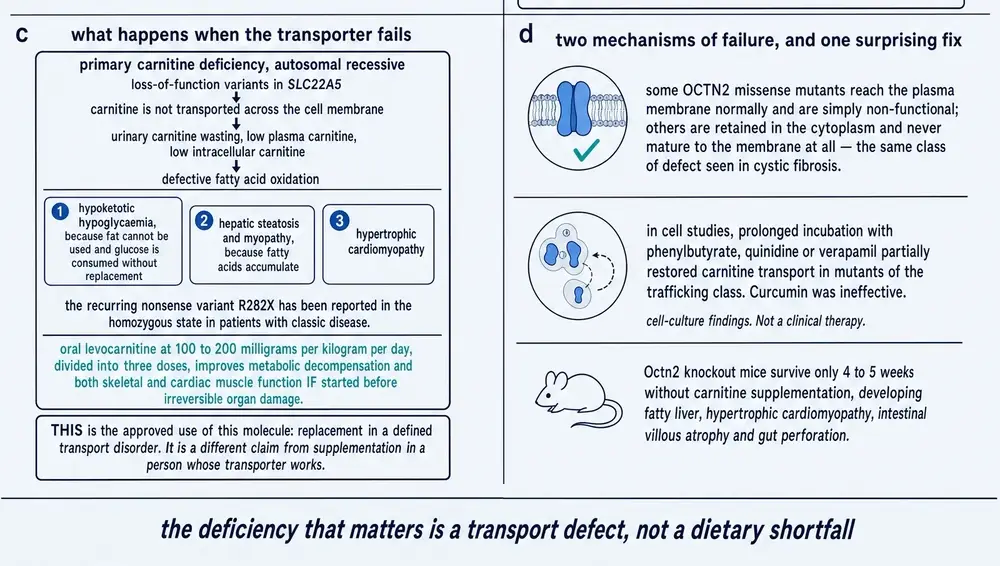
The commonest inherited cause is loss of function in OCTN2, encoded by SLC22A5 — the transporter from Section 07. Because that single protein does both cellular uptake and renal reabsorption, breaking it produces a characteristic double failure: tissues cannot take carnitine up, and the kidney cannot hold on to what is there. Plasma free carnitine falls very low, and it falls low while the kidney is actively wasting it.
That last detail is the diagnostic lever, and it costs nothing to use. Measure the fractional excretion of carnitine. If free carnitine is low and fractional excretion is high, the kidney is the leak and the transporter is the suspect. If free carnitine is low and fractional excretion is normal, the transporter is working and the problem must lie upstream, in production. For decades that second box was mostly empty.
The transporter defect itself repays a closer look, because it fails in two mechanically different ways — and because the distinction turned out to matter for whether anything could be done about it.
11The defect that filled the empty box
In 2025 a case series and accompanying worm model reported the first patients with biallelic variants in BBOX1 — the gene for γ-butyrobetaine dioxygenase, the terminal enzyme of carnitine synthesis described in Section 06 (Li et al., 2025). Three probands from two families, presenting with myopathy, exercise intolerance, neurodevelopmental difficulties and, in one case, late-onset psychiatric features.
Their biochemistry is the mirror image of transporter disease and confirms the logic exactly. Free carnitine was low. Fractional renal excretion was normal — the transporter was fine. And γ-butyrobetaine, the immediate substrate of the missing enzyme, was elevated in both plasma and urine, backed up behind the block like water above a closed sluice.
Supplementation at a reported 100 mg per kilogram corrected the carnitine and improved weakness and fatigability in one patient. And the γ-butyrobetaine stayed elevated. This is the observation quoted in Section 06: a biosynthetic pathway with end-product feedback would have shut down once its product was restored from outside. This one carried on, piling up an intermediate that was itself toxic to the worm model. It is a small result from three patients, and it settles a question about human metabolic regulation that no amount of supplementation research had answered.
12Secondary deficiency: dialysis, valproate, and a drug that steals carnitine
Far more people acquire carnitine deficiency than inherit it, and the mechanisms are worth separating because they are not the same problem.
Haemodialysis removes it directly, as Section 07 described, in patients who are simultaneously eating less meat and synthesising less. This is the population in which the strongest controlled evidence in the entire document was generated, and it is covered in Section 17.
Valproate is the most instructive case. The antiepileptic is metabolised in part by conjugation to carnitine, forming valproylcarnitine which is then excreted — so the drug physically carries carnitine out of the body. It also appears to suppress endogenous synthesis and to interfere with membrane carnitine transport. The resulting depletion impairs fatty-acid oxidation and, through the acyl-CoA buffering role from Section 05, compromises the urea cycle’s handling of ammonia. Hyperammonaemic encephalopathy follows.
This mechanism is well enough established that levocarnitine is a standard part of managing valproate toxicity, and the corpus contains several documented responses: an 87-year-old with an ammonia of 518 µmol/L given 1,500 mg daily orally with normalisation by day five and discharge on day ten (Kaneko et al., 2024); a patient managed with intravenous levocarnitine and continuous renal replacement therapy after a 60 g extended-release overdose (Alrazooqi et al., 2025).
Two cautions belong here, and both come from the same corpus. The first is that the mechanism is not universal: one report describes valproate encephalopathy with an entirely normal ammonia and a normal carnitine, resolving on withdrawal of the drug alone (Uemura et al., 2025). The second is that biochemical correction and clinical recovery are not the same event — in one case encephalopathy persisted after both ammonia and valproate concentrations had returned to range (Ban et al., 2026). A normal number is not a well patient.
Other secondary causes recur: pivalate-generating antibiotics, which conjugate carnitine and excrete it by the same logic as valproate; zidovudine; and the organic acidaemias, where carnitine is consumed buffering accumulated acyl groups. In one reported case of isovaleric acidaemia, isovaleryl-carnitine was measurable at 9.74 µmol/L (Zhou et al., 2025) — the carnitine pool visibly doing its buffering job and being carried out of the body in the process.
131985, and the line this document draws
Levocarnitine received US marketing approval under NDA 018948 on 27 December 1985, with orphan-drug designation for primary carnitine deficiency of genetic origin, and subsequently for secondary carnitine deficiency. The indication for patients on dialysis followed in 1992 (Buist, 2016).
The approved indications, taken verbatim from the current labels, are narrow and specific:
Tablet: “Levocarnitine is indicated in the treatment of primary systemic carnitine deficiency.” “Levocarnitine is also indicated for acute and chronic treatment of patients with an inborn error of metabolism which results in a secondary carnitine deficiency.”
Injection: “For the acute and chronic treatment of patients with an inborn error of metabolism which results in secondary carnitine deficiency.” “For the prevention and treatment of carnitine deficiency in patients with end stage renal disease who are undergoing dialysis.”
Every word of that is about deficiency. And this is where the document draws its sharpest line, because the inference that gets made in the space between these two facts is the central error in the popular understanding of this molecule:
An approved treatment for a deficiency state is not evidence for supplementation in people who are replete. Insulin is a life-saving drug for type 1 diabetes and tells you nothing about giving insulin to people whose pancreas works. Thyroxine corrects hypothyroidism and is not a metabolism enhancer for the euthyroid. Carnitine repairs a broken shuttle. Whether it does anything measurable for an intact one is a completely separate question, with its own evidence, and Part Four is that evidence.
14Why the “L” is load-bearing
Chemical names carry a lot of prefixes that a general reader can safely ignore. This is not one of them.
Carnitine has a chiral centre. Two mirror-image forms exist, and only the L-enantiomer — the one the body makes and the one in meat — is biologically correct. The instinct is to assume the D-form is simply inactive, a harmless passenger. It is not.
D-carnitine is a competitive inhibitor. It occupies the transporter that should be carrying L-carnitine and it interferes with the acyltransferases that should be handling it. Giving the racemic mixture is therefore not the same as giving a half-strength dose of the active form; it is giving the active form together with something that obstructs it.
This was learned clinically, in the population least able to absorb the error. Racemic DL-carnitine given to patients on dialysis in the late 1970s and early 1980s produced a myasthenia-like syndrome — muscle weakness in precisely the patients being treated for muscle weakness. The signal is durable enough that it survives in the regulatory record: the current FDA label for the prescription product still notes mild myasthenia observed in uraemic patients receiving D,L-carnitine.
That is the reason the approved drug is levocarnitine and not carnitine, and the reason the “L” on a label is a safety statement rather than a piece of chemical pedantry. It is also, incidentally, a small vindication of the identity discipline described in Section 08: two documents in this project’s corpus were refused precisely because they were about the D-form or the racemate.
15The loading problem, and the cleanest experiment in the field
Start with the question that ought to have been settled before any efficacy trial was run, and was not: does swallowing carnitine put carnitine into muscle?
It matters because of Section 07. Ninety-five per cent of the body pool is in skeletal muscle, held there against a steep gradient by a transporter, and the kidney is simultaneously configured to discard any excess. A supplement that raises plasma concentration transiently and is then excreted has not touched the compartment that does the work. For years this was assumed rather than demonstrated, and trials were designed on the assumption.
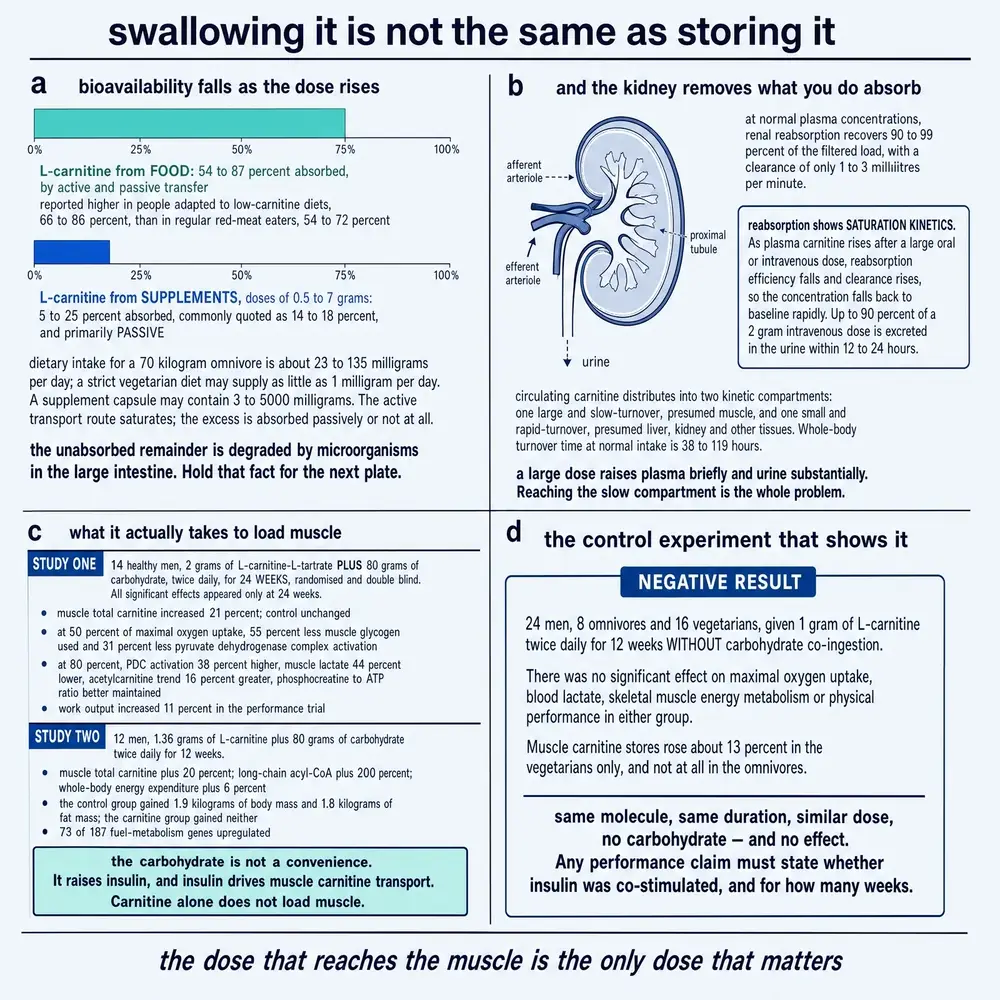
In 2011 a group at Nottingham and Maastricht answered it properly, in a randomised, double-blind study published in the Journal of Physiology (Wall et al., 2011). Fourteen healthy men, studied three times at twelve-week intervals with muscle biopsies at rest and after exercise. The reported regimen was 2 g of L-carnitine-L-tartrate together with 80 g of carbohydrate, twice daily, for 24 weeks; the control group received the carbohydrate alone. The carbohydrate was not incidental — it was there to raise insulin, which the same group had previously shown was necessary to drive carnitine into muscle.
The results, and the caveat that makes them important:
- Muscle total carnitine rose 21 per cent in the carnitine group (P < 0.05) and did not change in the control group.
- At low exercise intensity (50 per cent of maximal oxygen uptake) the carnitine group used 55 per cent less muscle glycogen than control — consistent with burning more fat and sparing carbohydrate.
- At high intensity (80 per cent) the picture inverted, as it should: pyruvate dehydrogenase complex activation was 38 per cent higher, muscle lactate 44 per cent lower, and the phosphocreatine-to-ATP ratio better maintained.
- Work output in the performance trial rose 11 per cent from baseline; the control group did not change.
- Every significant effect appeared only after 24 weeks.
The authors described this as the first demonstration that human muscle carnitine content can be raised by dietary means at all. Read carefully, that sentence is as much a warning as an achievement. It took six months, two grams twice a day, and eighty grams of carbohydrate alongside each dose — roughly 1,300 kilocalories a day of added sugar in the service of getting a 21 per cent rise in one tissue. Any trial shorter than that, or without the insulin stimulus, was probably testing a plasma excursion rather than a change in muscle carnitine. That is a large fraction of the literature in the rest of this Part.
The loading study is the end of a chain that starts much earlier, at the gut wall. Absorption, renal handling and muscle uptake each remove a large fraction of an oral dose, and the two positive loading trials only make sense alongside the one that omitted the carbohydrate and found nothing at all.
16Cardiovascular: the field’s largest claim, and its argument
The most-quoted result in the whole of the carnitine literature is a 2013 systematic review and meta-analysis in Mayo Clinic Proceedings (DiNicolantonio et al., 2013) pooling 13 controlled trials and 3,629 patients given L-carnitine after acute myocardial infarction. Against placebo or control it reported:
- all-cause mortality reduced 27 per cent — odds ratio 0.73 (95% CI 0.54–0.99), P = .05;
- ventricular arrhythmias reduced 65 per cent — risk ratio 0.35 (0.21–0.58), P < .0001;
- angina reduced 40 per cent — risk ratio 0.60 (0.50–0.72), P < .00001;
- no reduction in heart failure — 0.85 (0.67–1.09), P = .21;
- no reduction in reinfarction — 0.78 (0.41–1.48), P = .45.
Those are large numbers on a hard endpoint, and they are usually quoted without what follows. Three things have to be said alongside them.
The mortality result is at the edge of significance, not in the middle of it. The confidence interval runs to 0.99 on the odds ratio and touches 1.00 on the risk ratio, with P equal to .05 exactly. That is a finding that would disappear with one more neutral trial, and it should be reported as a signal rather than a settled effect.
The trials are old. They largely pre-date routine primary percutaneous coronary intervention, high-intensity statins and modern antiplatelet therapy. A treatment that reduces mortality on top of 1980s post-infarction care may add nothing on top of 2026 care, because the mechanism it supplies may already be covered. This is not a criticism of the meta-analysis; its own authors call explicitly for large modern randomised trials.
A competing meta-analysis found nothing. Pooling a different trial set, Shang and colleagues reported no significant effect on all-cause mortality or on major cardiac events, as recorded in two independent reviews of this literature (Werida et al., 2026; Elantary et al., 2024). Both analyses exist; the disagreement is real and is usually attributed to differences in population — medically managed infarction against percutaneous intervention against coronary bypass.
The trial-level detail underneath is correspondingly mixed. In anterior ST-elevation infarction, Tarantini found a significant reduction in five-day mortality as a secondary endpoint, with mortality from day seven to day 180 comparable between groups. Around coronary bypass surgery, Dastan found no effect on creatine kinase-MB or troponin T, contradicting two other groups that did. Da Silva Guimarães reported an improvement in ejection fraction within the treated group whose between-group comparison was not significant — a distinction that vanishes in secondary citation and is the difference between a finding and an artefact of time (Werida et al., 2026).
17Dialysis: where the human evidence is cleanest
The best-conducted evidence about giving carnitine to people is not about athletes or hearts. It is about the population from Section 12 who demonstrably lose it — and that is not a coincidence, it is the point.
A 2022 systematic review and meta-analysis with trial sequential analysis (Chewcharat et al., 2022) pooled 8 randomised trials and 224 participants on maintenance haemodialysis, with follow-up of six to twenty-four weeks. Levocarnitine reduced dialysis-related hypotension with an odds ratio of 0.26 (95% CI 0.10–0.72, P = 0.01), though with substantial heterogeneity (I² = 76 per cent).
The subgroups are where this becomes interesting, because they do not divide the way a reader expects:
- Oral administration: OR 0.03 (0.001–0.96), P = 0.04.
- Intravenous administration: OR 0.51 (0.25–1.06), P = 0.07 — null.
- Weekly dose above 4,200 mg: OR 0.03 (0.001–0.58), P = 0.02.
- Weekly dose at or below 4,200 mg: OR 0.78 (0.39–1.57), P = 0.48 — null.
- Duration of twelve weeks or more: OR 0.37 (0.14–0.98), P = 0.04.
An oral route outperforming an intravenous one for the same molecule is counterintuitive to the point of suspicion, and the authors do not leave it standing. They argue it is almost certainly a dose effect wearing a route disguise: the oral arms in these trials happened to deliver more drug per week than the intravenous arms. That reading is consistent with the dose subgroups, which split at exactly the same place.
Two further honesties from the same paper. Muscle cramps also improved — OR 0.22 (0.06–0.81) — but the trial sequential analysis required 200 participants to confirm it and the evidence base contained 147, so that result is formally unconfirmed rather than positive. And excluding a single pre-1990 trial attenuated the primary result to OR 0.42 (0.20–0.90): still significant, but half the effect. An analysis that reports what happens when you remove its oldest study is an analysis behaving well.
18Cardiometabolic: precise numbers, weak confidence
A 2024 dose-response meta-analysis (Gheysari et al., 2024) pooled 21 randomised trials and 2,900 adults with type 2 diabetes, prediabetes or impaired glucose tolerance. It is the largest coherent body of controlled human evidence for supplementation in a non-deficient population, and it is a useful test of how to read this literature honestly, because it reports significant effects and null effects in roughly equal measure and then grades its own confidence in both.
Significant, as weighted mean differences against control: glycated haemoglobin −0.37 per cent; fasting glucose −6.24 mg/dL; HOMA-IR −0.72; LDL cholesterol −12.66 mg/dL; triglycerides −13.50 mg/dL; body weight −1.58 kg; body fat −1.83 per cent; C-reactive protein and tumour necrosis factor alpha both modestly reduced.
Null: total cholesterol, HDL cholesterol, fasting insulin, systolic blood pressure, diastolic blood pressure, apolipoprotein A and apolipoprotein B. Seven endpoints, all flat.
Then the part that matters most and is quoted least. The authors applied GRADE, the standard framework for rating certainty in evidence, and returned very low certainty for glycated haemoglobin, HOMA-IR, C-reactive protein, tumour necrosis factor alpha and both blood pressures, and low certainty for triglycerides, LDL, fasting glucose and insulin. Not one endpoint reached moderate.
This combination — numerically precise, statistically significant, and rated at the bottom of the certainty scale — is the characteristic signature of the carnitine supplementation literature, and it is not a paradox. It is what happens when many small, short, heterogeneous, often unblinded trials are pooled: the arithmetic gets tighter as studies accumulate while the underlying quality does not improve. A confidence interval describes uncertainty about a number given the studies; GRADE describes whether to believe the studies. Both belong in the sentence.
A 2026 network meta-analysis of 68 randomised studies in overweight and obesity (Zuccotti et al., 2026) ranked L-carnitine as the most effective of the nutraceuticals it compared for anthropometric outcomes — weight −5.12 kg, body mass index −1.20 kg/m², waist circumference −4.30 cm — and simultaneously reported that HOMA-IR never reached its target, LDL managed only −0.32 at 1,000 mg daily, C-reactive protein only −0.19, and no supplement in the network, carnitine included, improved blood pressure. It also notes that no paediatric L-carnitine studies exist at all, and that none of its modelled dose-response relationships reached statistical significance.
The two analyses disagree about lipids, and the disagreement should be printed rather than averaged. The 2024 review finds LDL strongly reduced and HDL null; the 2026 network finds LDL failing to reach threshold and HDL the one lipid target that is met. Different populations, different comparators, different metrics. Neither is obviously wrong, and a reader is better served knowing they conflict than being given a midpoint that nobody measured.
19Fertility: two studies at the same dose, pointing opposite ways
This pair is worth setting out in full, because it is a compact lesson in how much study design determines answer.
The positive study. A cohort of 515 women in a second cycle of in-vitro fertilisation, 153 supplemented and 362 not, with 140 matched pairs after propensity-score matching. Reported regimen: 3,000 mg daily for a mean of 44 days until oocyte retrieval. Cumulative clinical pregnancy was 68.4 per cent against 59.8 per cent, P = 0.004 (Zhao et al., 2024), with self-controlled comparisons showing large gains in oocyte maturation, fertilisation and blastocyst formation.
The negative study. A double-blind, placebo-controlled randomised trial in women with polycystic ovary syndrome undergoing the same procedures, at the same 3,000 mg daily dose, 45 against 47 analysed (Hafezi et al., 2024). It found nothing: no difference in its primary endpoint of oocyte maturity, and none in oocyte recovery, fertilisation rate, embryo number or quality, implantation, or chemical or clinical pregnancy.
The two can be reconciled by population — unselected repeat-IVF failure against polycystic ovary syndrome — or by duration, and either may be right. But there is an asymmetry that should decide how a careful reader weights them. The positive study is a non-randomised cohort in which participants chose to supplement, and, by the authors’ own report, the control group also improved significantly without any supplement at all, which they attribute to protocol adjustment and lifestyle change. That single observation undermines the self-controlled comparison the study leans on hardest. The negative study is randomised, blinded and placebo-controlled.
The better-controlled study is the one that found nothing. That does not close the question, but it determines which way the burden of proof now points.
20How much evidence is enough: a worked example
A 2025 meta-analysis of 13 randomised trials and 786 cardiac-surgery patients (Shalabi et al., 2025) used trial sequential analysis, a technique that asks not only whether a result is statistically significant but whether enough patients have been studied for that significance to mean anything. It is rarely shown to general readers and it is unusually clarifying here, because it sorted the paper’s own findings into four different categories:
- True positive — cardiac index at six hours, mean difference 0.14 (0.07–0.20), and left ventricular ejection fraction. Both crossed the required information size. Believe them.
- False positive — postoperative atrial fibrillation. Statistically significant by conventional testing, but the analysis required 1,025 patients and the evidence base had 786. The significance is premature.
- True negative — cardiac index at twelve hours, which crossed the futility boundary. The effect is genuinely absent.
- Unresolved — in-hospital mortality and stroke, which would need 4,229 patients to settle. Nothing can be said in either direction.
Anyone citing this paper for “carnitine reduces postoperative atrial fibrillation” is quoting a result the authors themselves classified as insufficient. The technique deserves to be better known, and the four-way split is a fair summary of the carnitine literature as a whole: a few things established, several things prematurely announced, a few things genuinely absent, and the largest questions unanswered because nobody has run a trial big enough.
21What belongs to the other two molecules
This is the section the callout at the front of the document promised, and it is the one most likely to contradict something a reader has previously been told.
Peripheral arterial disease belongs to propionyl-L-carnitine. The largest clinical effect anywhere in this field is a gain in maximal walking distance of 50.86 metres (95% CI 50.34–51.38), a 26 per cent relative improvement, pooled across 9 studies and 1,121 patients, with pain-free walking distance up 32.98 metres and ankle-brachial index up 0.09 (Elantary et al., 2024; Tama et al., 2021). Every one of those numbers is propionyl-L-carnitine’s. They are frequently reproduced as L-carnitine’s.
The only head-to-head comparison between propionyl-L-carnitine and free L-carnitine is a single cross-over study in fourteen people. It favoured the derivative by 20.00 metres (0.47–39.53) on maximal walking distance, and found no difference at all on pain-free walking — 4.00 metres (−9.86 to 17.86). The review that reports it rates that comparison at low certainty. Free L-carnitine has essentially no independent evidence base in peripheral arterial disease.
The brain belongs to acetyl-L-carnitine. Cognition and Alzheimer’s disease, diabetic and chemotherapy-induced peripheral neuropathy, major depression — that literature is acetyl-L-carnitine’s (Lee et al., 2022), and it is substantial. It is also mechanistically plausible that the acetyl ester behaves differently: it crosses into the brain more readily and donates an acetyl group as well as delivering carnitine. None of that transfers to the free molecule.
Three further attribution errors recur in the secondary literature and are worth naming individually, because each was found inside a document that had already passed this project’s identity gate:
- A widely cited fertility meta-analysis of 7 studies and 621 patients pools L-carnitine and acetyl-L-carnitine together (Kooshesh et al., 2023). It is not an estimate for either one.
- In one cardiology review, figures for lactate clearance and stroke volume are propionyl-L-carnitine’s, and the atherosclerotic-rat lipid and antioxidant data are acetyl-L-carnitine’s — identifiable only by going to that review’s own reference list.
- A study reporting bone loss is about TMAO, the metabolite of Part Five, not about carnitine (Lin et al., 2024).
Finally, three trials in this corpus cannot speak about L-carnitine at all, by construction rather than by error. A migraine trial gave L-carnitine with alpha-linolenic acid and its authors state they could not ethically test either alone (Golpour-Hamedani et al., 2025). An obesity trial gave L-carnitine to both arms and therefore measured the added effect of a synbiotic (Fallah et al., 2023). A poultry trial credits its headline gains to a glutamine combination. Each is a competent study. None is evidence about this molecule on its own.
222013, and the sentence that changed the subject
In April 2013 a group at the Cleveland Clinic published a paper in Nature Medicine whose title did the work of an entire argument: “Intestinal microbiota metabolism of L-carnitine, a nutrient in red meat, promotes atherosclerosis” (Koeth et al., 2013).
The chain they described is short. Bacteria in the gut cleave the trimethylamine group off dietary L-carnitine, releasing trimethylamine. Trimethylamine is absorbed and carried to the liver, where the enzyme FMO3 oxidises it to trimethylamine N-oxide, or TMAO — a metabolite the same laboratory had already linked to atherosclerosis through a different dietary precursor, choline.
The paper assembled the case from several directions at once. In mice, chronic dietary L-carnitine altered the composition of the caecal microbiota, markedly increased TMA and TMAO production, and increased atherosclerosis. In humans, omnivores produced substantially more TMAO than vegans and vegetarians after ingesting the same L-carnitine. Specific bacterial taxa in faeces tracked both plasma TMAO and dietary pattern. And in mice with intact microbiota, supplementing with TMAO, carnitine or choline each reduced reverse cholesterol transport — the process by which cholesterol is carried back out of the arterial wall.
The controlling experiment is the one that makes it an argument rather than a correlation: none of it happened if the gut microbiota were suppressed. The molecule was not doing this. The molecule plus a particular set of bacteria was doing this.
The irony is complete, and it is not decoration. Carnitine was named in 1905 for the flesh it was extracted from. In 2013 the same nutrient, in the same flesh, was implicated in cardiovascular disease by a mechanism that runs through the bacteria of people who habitually eat it.
23The conditional that almost everyone drops
The same 2013 paper contained a human observational dataset of 2,595 patients undergoing cardiac evaluation, and it is the single most misquoted result in this document’s corpus.
Plasma L-carnitine predicted increased risk of both prevalent cardiovascular disease and incident major adverse cardiac events — myocardial infarction, stroke or death. That is the sentence that travelled. The published finding continues, and the continuation is the finding:
Plasma L-carnitine predicted increased risk “but only among subjects with concurrently high TMAO levels.”
Carnitine on its own did not predict risk. Carnitine in a person whose microbiome was converting it to TMAO did. This is a fundamentally different claim from “carnitine is bad for your heart,” and it points somewhere much more interesting: the same intake can be metabolically inert in one person and atherogenic in another, and the variable is not in the person’s genome or their dose but in the organisms they are carrying.
24The missing intermediate, and a step that can be taught
Five years later the same group published the human mechanism in the Journal of Clinical Investigation (Koeth et al., 2019), and it turned out to have a step nobody had accounted for.
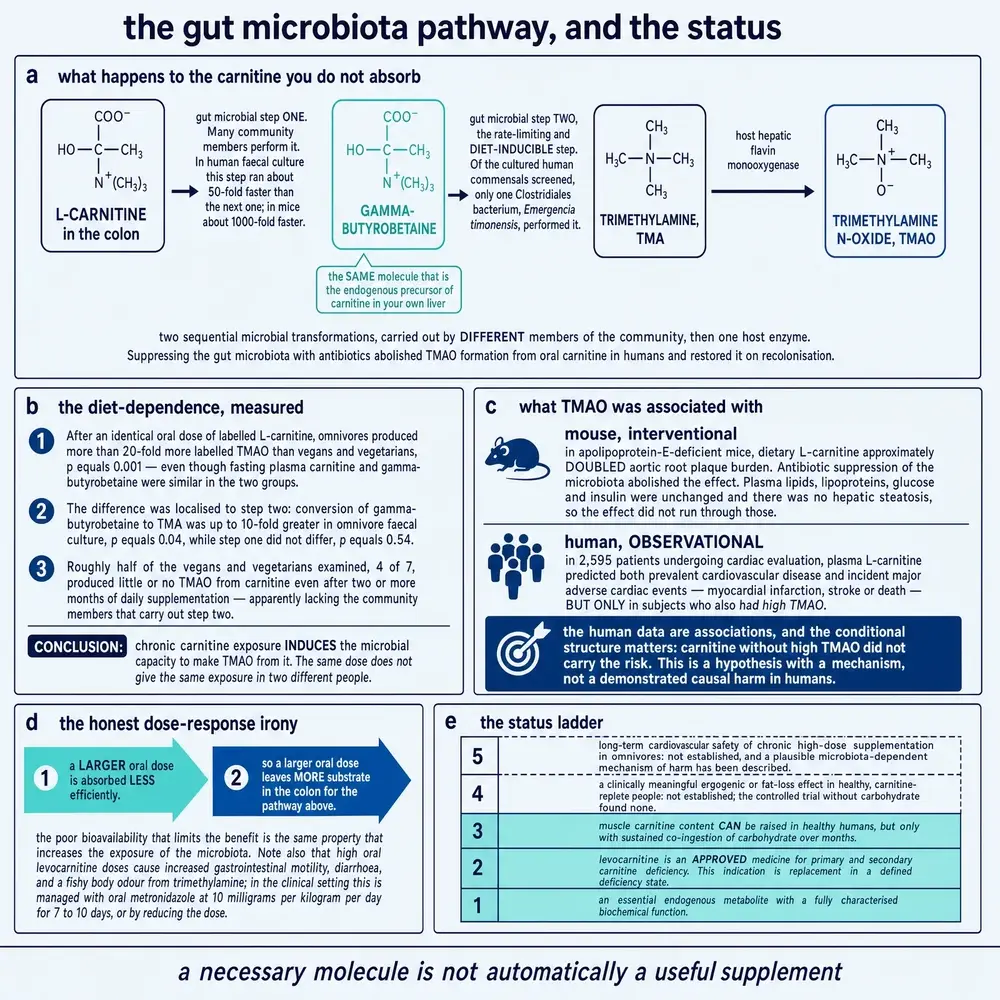
The route is not carnitine to trimethylamine. It is L-carnitine → γ-butyrobetaine → trimethylamine → TMAO, in two sequential microbial transformations before the liver does its part. γ-butyrobetaine is the same intermediate that appears in Section 06 as the immediate precursor of human carnitine synthesis. It sits in the middle of both pathways — the one that makes carnitine and the one that destroys it.
The study used deuterium-labelled tracers in 40 omnivores and 32 vegans and vegetarians, before and after courses of oral antibiotics, with faecal transformation studies alongside. Three findings matter:
The difference between diet groups is enormous, and it is not a difference in carnitine. Omnivores generated more than twenty-fold more labelled TMAO than vegans and vegetarians after the same oral dose (P = 0.001). Yet fasting endogenous L-carnitine and γ-butyrobetaine concentrations were similar between the groups. Two people with the same circulating carnitine handle an identical dose in radically different ways.
Only the second step differs. Everyone — omnivore, vegan, vegetarian — converted carnitine to γ-butyrobetaine rapidly. The second transformation, γ-butyrobetaine to trimethylamine, is diet-inducible: it is switched on by an omnivorous dietary pattern and, importantly, by chronic L-carnitine exposure itself.
The organism is scarce. Extensive anaerobic subculturing of human faeces found no single commensal capable of taking L-carnitine all the way to trimethylamine. Many community members made γ-butyrobetaine. Only one cultured organism, a Clostridiales bacterium named Emergencia timonensis, performed the second step — and in co-culture it completed the whole conversion.
Put together, these describe something unusual: a supplement that induces the capacity of the ecosystem that metabolises it. Taking it chronically teaches the gut community to convert it down the atherogenic branch. Whatever one concludes about the risk, the pharmacology of a compound whose disposition changes with continued exposure is not the pharmacology of a simple nutrient.
The size of that diet effect is easier to see than to describe, and it is the part of this story carrying the least ambiguity: two groups, one dose, one measurement.
25Corroboration, and the evidence pointing the other way
A finding this consequential should be checked against what else exists, in both directions.
Corroborating. An independent structural and enzymological study reconstituted a distinct bacterial route in Acinetobacter baumannii, in which carnitine monooxygenase cleaves L-carnitine directly to trimethylamine plus malic semialdehyde; the downstream dehydrogenase was solved at 2.6 ångström resolution (Piskol et al., 2024). Those authors are careful to note that this route’s contribution in the human microbiome “remains controversial.” Separately, an oral carnitine challenge test has been developed that classifies people as high or low TMAO producers, and the presence of Emergencia timonensis together with a second organism accounted for 43 per cent of high producers with 97 per cent specificity (Wu et al., 2020) — direct confirmation that this is a small number of organisms doing the work.
Pointing the other way. Two observational datasets in pregnancy sit awkwardly with a simple risk story, and they also sit awkwardly with each other, which is the honest state of the evidence:
- In 940 pregnancies, TMAO itself showed no association with gestational diabetes, while the lowest quartile of first-trimester L-carnitine carried increased risk — odds ratio 1.56 (1.04–2.35). Betaine and choline were null (Chen et al., 2025). Here, less carnitine was the risk.
- In a smaller longitudinal study of 60 pregnancies, higher early-pregnancy L-carnitine was associated with gestational diabetes — unadjusted odds ratio 2.78 (1.35–5.74) — and the direction reversed in the second trimester (Wu et al., 2026).
These two point in opposite directions in the same condition. Both are observational, both measure a circulating concentration rather than an administered dose, and neither is decisive. Their value is as a corrective: the relationship between carnitine concentration and cardiometabolic outcome is not a straight line with a known sign.
There is also a pharmacological mirror worth knowing about. Meldonium — the drug that became briefly famous through sports doping cases — is a γ-butyrobetaine analogue that inhibits the final enzyme of carnitine synthesis, and it is approved as a cardioprotective agent in several countries (Tars et al., 2014). One clinical tradition supplements carnitine to protect the heart; another blocks its synthesis to protect the heart. Both cite mechanism. They cannot both be straightforwardly right, and the coexistence is a useful measure of how firmly this biology is actually understood.
26Weighing it
Short-term benefit after myocardial infarction and long-term atherogenic potential are not contradictory claims, and reading them as a paradox is a mistake. They are claims about different timescales, different populations and different mechanisms.
The post-infarction trials gave carnitine for weeks to months to people whose hearts had just been injured, where the plausible mechanism is metabolic support of ischaemic myocardium. The TMAO work concerns habitual exposure over years, where the mechanism runs through a slowly shifting microbial community and impaired reverse cholesterol transport. A treatment can plausibly help in the first setting and harm in the second, and nothing in the evidence forces a choice between them.
What would settle it is straightforward to specify and has not been done: a large, modern, randomised trial of L-carnitine with cardiovascular outcomes, running for years rather than weeks, stratified by TMAO-producer status at entry — which the oral challenge test now makes practical. Until that exists, the honest summary is that the acute cardiac evidence is old and borderline, the chronic risk evidence is mechanistically strong but observational in humans, and the two have never been tested against each other.
27Safety, as reported — and where the label and the literature disagree
Adverse effects attributed to L-carnitine across this corpus are mostly mild and mostly gastrointestinal: nausea, vomiting, diarrhoea, abdominal cramps, gastritis. The most distinctive is a fishy body odour, which is not a curiosity but a direct readout of the chemistry in Part Five — it is trimethylamine, the same metabolite, escaping in sweat and breath faster than FMO3 can oxidise it. Serious hypersensitivity reactions are listed on the label: rash, urticaria and facial oedema with the oral form; anaphylaxis, laryngeal oedema and bronchospasm following intravenous administration.
Several trials in the corpus describe the compound as well tolerated, and the review of preterm infants states that no adverse effects were observed across studies despite substantial variation in dosing (Sisi et al., 2025). Those reports should be read against a limitation the reviews themselves raise repeatedly: adverse-event reporting in this literature is inconsistent, and the cardiac-surgery meta-analysis is explicit that its trials were too small and too short to detect rare or delayed harm (Shalabi et al., 2025).
One disagreement is sharp enough to require naming, and it is the reason this document went to the regulatory instrument rather than to a summary of it.
A narrative review in this corpus (Elantary et al., 2024) reports that seizures have been described anecdotally but cites a systematic review finding “no evidence to support” the association.
The current FDA label carries them as a warning, verbatim: “Seizures have been reported to occur in patients with or without pre-existing seizure activity receiving either oral or intravenous levocarnitine. In patients with pre-existing seizure activity, an increase in seizure frequency and/or severity has been reported.”
The regulatory instrument is the more cautious of the two. Where a review and a label disagree, this document reports the label and reports the disagreement.
An observed safe level of 2,000 mg per day appears in the review literature, with the explicit statement that data above that intake are insufficient to support a long-term conclusion. That figure is reported here as what the literature states, not as guidance.
That term deserves unpacking, because it is routinely misread as a recommendation and it is not one. An observed safe level is a risk-assessment construct: it names the highest intake at which the published evidence is good enough to say that no harm was seen. It is not a dose, not a target, and not a threshold above which harm begins. A low observed safe level usually means the high-intake studies have not been done, rather than that the high intakes were tested and failed. In this literature it means exactly that — and the gap it marks is the same gap Section 26 describes, where the long-term trial that would settle the question has never been run.
Set out as a ladder, the position is easier to hold in mind: what is established sits at the bottom, what is merely supported in the middle, and what is unresolved — including the safety question this Part has been about — at the top.
28What is actually known
Four things are established well enough to be treated as settled.
L-carnitine is the obligatory carrier for long-chain fatty acid entry into mitochondria, and the shuttle is one of the better-characterised pieces of intermediary metabolism in biology. Deficiency states exist, are serious, and are correctable — inherited through OCTN2 or, now, BBOX1 (Li et al., 2025), and acquired through dialysis, valproate and pivalate antibiotics. Correction of deficiency is an approved medical use with a real regulatory basis. And the D-enantiomer is harmful, which is why the drug is levocarnitine.
Three things are supported but weakly, and should be described that way. The dialysis evidence is the best of them, and it is 8 trials and 224 people with substantial heterogeneity and a formally unconfirmed secondary endpoint. The cardiometabolic effects are numerically precise and rated low to very low certainty by their own authors. The post-infarction mortality signal sits exactly on the significance threshold, comes from trials that pre-date modern cardiology, and is contradicted by a competing analysis.
And three things are simply not known. Whether chronic supplementation in healthy, replete people changes any outcome that matters — no trial of the required size and duration has been run. Whether the TMAO pathway translates into clinical harm in humans at supplemental doses — the mechanism is strong, the human evidence is observational, and the pregnancy data point both ways. And whether any benefit survives once a population is stratified by the thing that now looks most important about them, which is not their dose but their microbiome.
There is a pattern in that list worth naming, because it recurs across this series. Everything established about L-carnitine concerns a system that is broken — a missing transporter, a missing enzyme, a membrane that strips the molecule out, a drug that carries it away. Everything unresolved concerns a system that is working normally. The molecule has been an excellent answer to the question “what happens when this is absent?” and a stubbornly poor answer to the question “what happens when there is more?” Those are not the same question, and the hundred and twenty-one year history above is largely the story of the second one being asked as though the first had already answered it.
It is a strange position for a molecule to occupy after that long: thoroughly understood as biochemistry, genuinely useful in a handful of rare diseases, and still unresolved on the question almost everyone who buys it is actually asking.
This document describes published research. It does not recommend human use of L-carnitine or of any other compound named in it, and it specifies no dose, route or schedule for any person. Doses appear only as parameters of studies that have been published, always with the species, the population and the duration attached. Levocarnitine holds approved indications only for primary and secondary carnitine deficiency and for carnitine deficiency in end-stage renal disease on dialysis; nothing in Part Four or Part Five describes an approved use. Material sold for research use only is not a medicine, and no part of this document should be read as advice to obtain or administer anything.
29References
Generated from verified NCBI records rather than from recall. Author lists, journal names, volumes, pages and identifiers are taken from the PubMed record for each citation, and the build refuses to run if any identifier fails to resolve. This series has twice shipped reference lists drafted from memory in which identifiers pointed at real but unrelated papers.
- Advani SM, Advani PG, VonVille HM, Jafri SH. Pharmacological management of cachexia in adult cancer patients: a systematic review of clinical trials. BMC Cancer. 2018;18(1):1174.
PMID 30482179 · doi:10.1186/s12885-018-5080-4 · PMC6260745 - Alrazooqi MK, Abumuaileq L, Zia S, Kazim S. Massive Valproic Acid Overdose With Confirmed Pharmacobezoar Formation and Neuromuscular Toxicity: A Case Report and Literature Review. Cureus. 2025;17(11):e96884.
PMID 41245931 · doi:10.7759/cureus.96884 · PMC12619077 - Ban S, Toida C, Yamazaki M, Yoshida M, Onuki T, Morimura N. Severe Hyperammonemic Encephalopathy Following Sustained-Release Sodium Valproate Overdose: A Case Report. Cureus. 2026;18(4):e107123.
PMID 42147496 · doi:10.7759/cureus.107123 · PMC13179122 - Bodi I, Mettke L, Michaelides K, Hornyik T, Meier S, Nimani S, et al.. Beneficial normalization of cardiac repolarization by carnitine in transgenic short QT syndrome type 1 rabbit models. Cardiovasc Res. 2024;120(13):1550-1561.
PMID 39018021 · doi:10.1093/cvr/cvae149 · PMC11535723 - Buist NR. Historical Perspective on Clinical Trials of Carnitine in Children and Adults. Ann Nutr Metab. 2016;68 Suppl 3:1-4.
PMID 27931034 · doi:10.1159/000448320 - Burelle Y, Bemeur C, Rivard ME, Thompson Legault J, Boucher G, LSFC Consortium, et al.. Mitochondrial vulnerability and increased susceptibility to nutrient-induced cytotoxicity in fibroblasts from leigh syndrome French canadian patients. PLoS One. 2015;10(3):e0120767.
PMID 25835550 · doi:10.1371/journal.pone.0120767 · PMC4383560 - Chang D, Li F, Kang Y, Yan Y, Kong F, Jiang W, et al.. The effects of L-carnitine and fructose in improved Ham's F10 on sperm culture in idiopathic severe asthenospermia within 24h. PLoS One. 2025;20(2):e0306235.
PMID 39928618 · doi:10.1371/journal.pone.0306235 · PMC11809793 - Chen GD, Pang TT, Li PS, Ye SX, Gou XY, Wang HY, et al.. Associations of first-trimester TMAO and its precursors with gestational diabetes mellitus: a pilot prospective cohort study. Front Nutr. 2025;12:1587863.
PMID 40589780 · doi:10.3389/fnut.2025.1587863 · PMC12206624 - Chen L, Wang W, Zhao Y, Zhang S, Zhou X. Circular RNA CHACR is involved in the pathogenesis of cardiac hypertrophy. Theranostics. 2025;15(8):3627-3642.
PMID 40093901 · doi:10.7150/thno.104695 · PMC11905130 - Chen W, Zhang H, Shen X, Hong L, Tao H, Chen M, et al.. L-Carnitine, a new biomarker screened based on untargeted metabolomics, predict cardiac surgery-associated acute kidney injury: a prospective cohort study. BMC Nephrol. 2026;27(1):23.
PMID 41495688 · doi:10.1186/s12882-025-04593-3 · PMC12784568 - Chewcharat A, Chewcharat P, Liu W, Cellini J, Phipps EA, Melendez Young JA, et al.. The effect of levocarnitine supplementation on dialysis-related hypotension: A systematic review, meta-analysis, and trial sequential analysis. PLoS One. 2022;17(7):e0271307.
PMID 35834513 · doi:10.1371/journal.pone.0271307 · PMC9282471 - DiNicolantonio JJ, Lavie CJ, Fares H, Menezes AR, O'Keefe JH. L-carnitine in the secondary prevention of cardiovascular disease: systematic review and meta-analysis. Mayo Clin Proc. 2013;88(6):544-51.
PMID 23597877 · doi:10.1016/j.mayocp.2013.02.007 - Elantary R, Othman S. Role of L-carnitine in Cardiovascular Health: Literature Review. Cureus. 2024;16(9):e70279.
PMID 39329040 · doi:10.7759/cureus.70279 · PMC11427024 - Evans AM, Fornasini G. Pharmacokinetics of L-carnitine. Clin Pharmacokinet. 2003;42(11):941-67.
PMID 12908852 · doi:10.2165/00003088-200342110-00002 - Fallah F, Mahdavi R. Ameliorating effects of L-carnitine and synbiotic co-supplementation on anthropometric measures and cardiometabolic traits in women with obesity: a randomized controlled clinical trial. Front Endocrinol (Lausanne). 2023;14:1237882.
PMID 37929031 · doi:10.3389/fendo.2023.1237882 · PMC10622781 - FRITZ IB. Effects of choline deficiency and carnitine on palmitic acid oxidation by rat liver homogenates. Am J Physiol. 1957;190(3):449-52.
PMID 13470070 · doi:10.1152/ajplegacy.1957.190.3.449 - FRITZ IB, McEWEN B. Effects of carnitine on fatty-acid oxidation by muscle. Science. 1959;129(3345):334-5.
PMID 13624727 · doi:10.1126/science.129.3345.334 - FRITZ IB. Action of carnitine on long chain fatty acid oxidation by liver. Am J Physiol. 1959;197:297-304.
PMID 13825279 · doi:10.1152/ajplegacy.1959.197.2.297 - FRITZ IB, KAPLAN E, YUE KT. Specificity of carnitine action on fatty acid oxidation by heart muscle. Am J Physiol. 1962;202:117-21.
PMID 13895427 · doi:10.1152/ajplegacy.1962.202.1.117 - FRITZ IB, YUE KT. LONG-CHAIN CARNITINE ACYLTRANSFERASE AND THE ROLE OF ACYLCARNITINE DERIVATIVES IN THE CATALYTIC INCREASE OF FATTY ACID OXIDATION INDUCED BY CARNITINE. J Lipid Res. 1963;4:279-88.
PMID 14168165 - FRITZ IB, YUE KT. EFFECTS OF CARNITINE ON ACETYL-COA OXIDATION BY HEART MUSCLE MITOCHONDRIA. Am J Physiol. 1964;206:531-5.
PMID 14160979 · doi:10.1152/ajplegacy.1964.206.3.531 - Gheysari R, Nikbaf-Shandiz M, Hosseini AM, Rasaei N, Hosseini S, Bahari H, et al.. The effects of L-carnitine supplementation on cardiovascular risk factors in participants with impaired glucose tolerance and diabetes: a systematic review and dose-response meta-analysis. Diabetol Metab Syndr. 2024;16(1):185.
PMID 39085907 · doi:10.1186/s13098-024-01415-8 · PMC11290177 - Golpour-Hamedani S, Bagherniya M, Khorvash F, Feizi A, Sharma M, Askari G. The effects of concurrent alpha-linolenic acid, L-carnitine supplementation on clinical symptoms, mental health, and quality of life in women with migraine: a randomized, triple-blind, placebo-controlled trial. Nutr J. 2025;24(1):40.
PMID 40082970 · doi:10.1186/s12937-025-01107-7 · PMC11905556 - Hafezi M, Arabipoor A, Ghaffari F, Vesali S, Zareei M, Hessari ZH. Adding L-carnitine to antagonist ovarian stimulation doesn't improve the outcomes of IVF/ ICSI cycle in patients with polycystic ovarian syndrome: a double-blind randomized clinical trial. J Ovarian Res. 2024;17(1):9.
PMID 38191449 · doi:10.1186/s13048-023-01319-7 · PMC10775512 - Kaneko M, Shikata H, Kihara H. Valproate-Induced Hyperammonemic Encephalopathy Successfully Treated With Levocarnitine in an Elderly Patient Without Liver Dysfunction. Cureus. 2024;16(12):e76603.
PMID 39881899 · doi:10.7759/cureus.76603 · PMC11775636 - Khan A, Yen FS, Unlu G, DelGaudio NL, Erdal R, Xiao M, et al.. Machine-learning-guided discovery of SLC25A45 as a mediator of mitochondrial methylated amino acid import and carnitine synthesis. Cell Metab. 2025;37(11):2220-2232.e8.
PMID 41075780 · doi:10.1016/j.cmet.2025.09.015 · PMC12768559 - Koeth RA, Wang Z, Levison BS, Buffa JA, Org E, Sheehy BT, et al.. Intestinal microbiota metabolism of L-carnitine, a nutrient in red meat, promotes atherosclerosis. Nat Med. 2013;19(5):576-85.
PMID 23563705 · doi:10.1038/nm.3145 · PMC3650111 - Koeth RA, Lam-Galvez BR, Kirsop J, Wang Z, Levison BS, Gu X, et al.. l-Carnitine in omnivorous diets induces an atherogenic gut microbial pathway in humans. J Clin Invest. 2019;129(1):373-387.
PMID 30530985 · doi:10.1172/JCI94601 · PMC6307959 - Kontoh-Twumasi R, Aliste A, Scheid A, Lax K, Glass J, Sharma A, et al.. Altered Carnitine Homeostasis Modulates Hyperosmolarity-Induced Mitochondrial Dysfunction and Lipotoxicity in Human Corneal Epithelial Cells. Invest Ophthalmol Vis Sci. 2026;67(2):39.
PMID 41711504 · doi:10.1167/iovs.67.2.39 · PMC12924138 - Kooshesh L, Nateghian Z, Aliabadi E. Evaluation of L-Carnitine Potential in Improvement of Male Fertility. J Reprod Infertil. 2023;24(2):69-84.
PMID 37547570 · doi:10.18502/jri.v24i2.12491 · PMC10402461 - Lee S, Mun S, Lee YR, Choi H, Joo EJ, Kang HG, et al.. Discovery and validation of acetyl-L-carnitine in serum for diagnosis of major depressive disorder and remission status through metabolomic approach. Front Psychiatry. 2022;13:1002828.
PMID 36458116 · doi:10.3389/fpsyt.2022.1002828 · PMC9707625 - Li M, Yang K, De Vivo I, Eliassen AH, Qureshi AA, Nan H, et al.. Association between plasma L-carnitine levels and mitochondrial DNA copy number. BMC Mol Cell Biol. 2023;24(1):35.
PMID 38082229 · doi:10.1186/s12860-023-00496-z · PMC10712069 - Li S, Li W, Cheng M, Wang X, Chen W. Prevention and treatment of anthracycline-induced cardiotoxicity: a systematic review and network meta-analysis of randomized controlled trials. Cardiooncology. 2025;11(1):66.
PMID 40640889 · doi:10.1186/s40959-025-00360-3 · PMC12243438 - Li X, Yeganeh M, Sinclair G, Mwenifumbo J, Jacob KJ, Arbour L, et al.. Biallelic variants in BBOX1 cause L-Carnitine deficiency and elevated γ-butyrobetaine. NPJ Genom Med. 2025;10(1):64.
PMID 41022783 · doi:10.1038/s41525-025-00523-2 · PMC12480863 - Lin YH, Lian WS, Wu RW, Chen YS, Wu SL, Ko JY, et al.. Trimethylamine-N-oxide accelerates osteoporosis by PERK activation of ATF5 unfolding. Cell Mol Life Sci. 2024;82(1):13.
PMID 39719538 · doi:10.1007/s00018-024-05501-y · PMC11668722 - Matera M, Bellinghieri G, Costantino G, Santoro D, Calvani M, Savica V. History of L-carnitine: implications for renal disease. J Ren Nutr. 2003;13(1):2-14.
PMID 12563618 · doi:10.1053/jren.2003.50010 - Novakova K, Kummer O, Bouitbir J, Stoffel SD, Hoerler-Koerner U, Bodmer M, et al.. Effect of L-carnitine supplementation on the body carnitine pool, skeletal muscle energy metabolism and physical performance in male vegetarians. Eur J Nutr. 2016;55(1):207-17.
PMID 25612929 · doi:10.1007/s00394-015-0838-9 - Piskol F, Lukat P, Kaufhold L, Heger A, Blankenfeldt W, Jahn D, et al.. Biochemical and structural elucidation of the L-carnitine degradation pathway of the human pathogen Acinetobacter baumannii. Front Microbiol. 2024;15:1446595.
PMID 39206375 · doi:10.3389/fmicb.2024.1446595 · PMC11353897 - Seemann L, Frahm J, Kersten S, Bühler S, Meyer U, Visscher C, et al.. Dietary L-carnitine supplementation modifies blood parameters of mid-lactating dairy cows during standardized lipopolysaccharide-induced inflammation. Front Immunol. 2024;15:1390137.
PMID 38807585 · doi:10.3389/fimmu.2024.1390137 · PMC11130594 - Setouani S, Mehdaoui A, Hazzab N, Eddaoudi S, Khabbach K, El Boussaadni Y, et al.. Dilated Cardiomyopathy in Children: A Diverse Etiological Profile. Cureus. 2026;18(5):e108972.
PMID 42306370 · doi:10.7759/cureus.108972 · PMC13267851 - Shalabi L, Ibrahim A, Elsawy MA, Zreigh S, Dervis M, Elshabrawi MN, et al.. L-carnitine supplementation to prevent postoperative complications after cardiac surgery: A systematic review and meta-analysis of randomised clinical trials. Indian J Anaesth. 2025;69(6):547-560.
PMID 40470390 · doi:10.4103/ija.ija_1325_24 · PMC12133040 - Simó C, Fornari T, García-Risco MR, Peña-Cearra A, Abecia L, Anguita J, et al.. Resazurin-based high-throughput screening method for the discovery of dietary phytochemicals to target microbial transformation of L-carnitine into trimethylamine, a gut metabolite associated with cardiovascular disease. Food Funct. 2022;13(10):5640-5653.
PMID 35506542 · doi:10.1039/d2fo00103a - Sisi M, Yong L, Lixing Q, Changsheng G, Jin Y, Hang Z, et al.. L-carnitine: new perspectives on the management of preterm infants. Front Nutr. 2025;12:1508441.
PMID 40948868 · doi:10.3389/fnut.2025.1508441 · PMC12426001 - Sivandzadeh GR, Shahsavari A, Meftah E, Niknam R, Safarpour AR. Effect of L-carnitine supplementation on muscle cramps in liver cirrhosis: results from a retrospective cohort study. BMC Gastroenterol. 2025;25(1):150.
PMID 40059171 · doi:10.1186/s12876-025-03730-4 · PMC11890553 - Spasov AA, IIezhitsa IN. [Stereopharmacology of carnitine]. Ross Fiziol Zh Im I M Sechenova. 2005;91(12):1469-80.
PMID 16493928 - Stephens FB, Wall BT, Marimuthu K, Shannon CE, Constantin-Teodosiu D, Macdonald IA, et al.. Skeletal muscle carnitine loading increases energy expenditure, modulates fuel metabolism gene networks and prevents body fat accumulation in humans. J Physiol. 2013;591(18):4655-66.
PMID 23818692 · doi:10.1113/jphysiol.2013.255364 · PMC3784205 - Tama B, Fabara SP, Zarrate D, Anas Sohail A. Effectiveness of Propionyl-L-Carnitine Supplementation on Exercise Performance in Intermittent Claudication: A Systematic Review. Cureus. 2021;13(8):e17592.
PMID 34513531 · doi:10.7759/cureus.17592 · PMC8413087 - Tars K, Leitans J, Kazaks A, Zelencova D, Liepinsh E, Kuka J, et al.. Targeting carnitine biosynthesis: discovery of new inhibitors against γ-butyrobetaine hydroxylase. J Med Chem. 2014;57(6):2213-36.
PMID 24571165 · doi:10.1021/jm401603e - Uemura T, Suzuki N, Souma J, Kamiya H, Takeguchi-Kikuchi S, Saito T, et al.. Valproate induces non-hyperammonemic encephalopathy below a standard serum concentration range: A case report. Medicine (Baltimore). 2025;104(28):e43228.
PMID 40660597 · doi:10.1097/MD.0000000000043228 · PMC12262942 - Wall BT, Stephens FB, Constantin-Teodosiu D, Marimuthu K, Macdonald IA, Greenhaff PL. Chronic oral ingestion of L-carnitine and carbohydrate increases muscle carnitine content and alters muscle fuel metabolism during exercise in humans. J Physiol. 2011;589(Pt 4):963-73.
PMID 21224234 · doi:10.1113/jphysiol.2010.201343 · PMC3060373 - Werida RH, Okda SM. Therapeutic potential of L-carnitine in coronary artery disease: a systematic review. Inflammopharmacology. 2026;34(3):1331-1342.
PMID 41709059 · doi:10.1007/s10787-025-02048-7 · PMC12995981 - Wolf G. The discovery of a vitamin role for carnitine: The first 50 years. J Nutr. 2006;136(8):2131-4.
PMID 16857830 · doi:10.1093/jn/136.8.2131 - Wu WK, Panyod S, Liu PY, Chen CC, Kao HL, Chuang HL, et al.. Characterization of TMAO productivity from carnitine challenge facilitates personalized nutrition and microbiome signatures discovery. Microbiome. 2020;8(1):162.
PMID 33213511 · doi:10.1186/s40168-020-00912-y · PMC7676756 - Wu Y, Ni Z, Liu S, Fang S, Li Y, Lu Q, et al.. Longitudinal metabolomics reveals dynamic associations of trimethylamine N-oxide and precursors with the progression of gestational diabetes. BMC Pregnancy Childbirth. 2026;26(1).
PMID 42021207 · doi:10.1186/s12884-026-09088-z · PMC13235132 - Xu Q, Zhou Z, Jin L, Liu C, Li P, Wang F, et al.. Innovations in peritoneal dialysis fluid: biocompatible formulations and expanded therapeutic applications. Ren Fail. 2025;47(1):2583626.
PMID 41285129 · doi:10.1080/0886022X.2025.2583626 · PMC12646097 - Yang S, Li X, Lu Z, Xu X, Guo Z, He B. Levocarnitine improves cardiac energy metabolic remodeling in myocarditis mice. Front Pharmacol. 2025;16:1706936.
PMID 41585875 · doi:10.3389/fphar.2025.1706936 · PMC12827101 - Yang Y, He X, Cai J, Qu X, Tan S, You J, et al.. Efficacy of selected dietary supplements and pharmacological agents on metabolic and oxidative stress outcomes in metabolic dysfunction-associated fatty liver disease (MAFLD): a Bayesian network meta-analysis. Front Pharmacol. 2025;16:1682688.
PMID 41695987 · doi:10.3389/fphar.2025.1682688 · PMC12894030 - Zakharova N, Luo C, Aringazina R, Samusenkov V. The efficacy of L-carnitine in patients with nonalcoholic steatohepatitis and concomitant obesity. Lipids Health Dis. 2023;22(1):101.
PMID 37438785 · doi:10.1186/s12944-023-01867-3 · PMC10337194 - Zhao W, Liu K, Zhang Y, Sun P, Zeringue E, Meng L, et al.. The efficacy of orally administered L-carnitine in alleviating ovarian dysfunctions has laid the foundation for targeted in vivo use: a study employing self-control and propensity score matching. Front Endocrinol (Lausanne). 2024;15:1440182.
PMID 39359417 · doi:10.3389/fendo.2024.1440182 · PMC11445680 - Zhou J, Chen H, Chen X, Tang H, Li S, Zhou J. A rare case of isovaleric acidemia and schizophrenia: a case report. BMC Psychiatry. 2025;25(1):897.
PMID 41029572 · doi:10.1186/s12888-025-07239-8 · PMC12487407 - Zhuang Y, Lyu T, Chen Y, Li W, Tang L, Xian SP, et al.. Mechanistic insights into endometriosis: roles of Streptococcus agalactiae and L-carnitine in lesion development and angiogenesis. Angiogenesis. 2025;28(3):38.
PMID 40560287 · doi:10.1007/s10456-025-09991-7 · PMC12198069 - Zuccotti G, Gatti A, Rossi V, Cordaro E, Calcaterra V. Nutraceuticals for the management of weight and inflammation-related complications in obesity: a pediatric perspective. Systematic review and network meta-analysis. Front Nutr. 2026;13:1715574.
PMID 41769658 · doi:10.3389/fnut.2026.1715574 · PMC12937135
Sources without a PubMed record
Regulatory instruments, patents and registry searches have no PubMed record and are therefore listed separately, so that the generated list above remains wholly machine-verified.
- US Food and Drug Administration. CARNITOR (levocarnitine) Injection, 1 g per 5 mL vial — prescribing information. Accessed via DailyMed, 3 August 2026. Source of the verbatim indications for secondary carnitine deficiency and for end-stage renal disease on dialysis, and of the chemical name, empirical formula and molecular weight.
https://dailymed.nlm.nih.gov/dailymed/drugInfo.cfm?setid=cf801cc4-775e-433d-9d - US Food and Drug Administration. LEVOCARNITINE tablets — prescribing information. Accessed via DailyMed, 3 August 2026. Source of the verbatim indication for primary systemic carnitine deficiency, of the seizure warning quoted in Section 27, and of the record of mild myasthenia in uraemic patients receiving D,L-carnitine.
https://dailymed.nlm.nih.gov/dailymed/drugInfo.cfm?setid=bfd0d39f-d3b2-4f0d-b7
30How this document was assembled
The corpus was built against project 05, the Therapeutic Peptide Research Library, and the interesting part of the arithmetic is how much had to be thrown away.
The identity problem, in numbers, and it is the largest in this series. Every file with a document extension in the project’s stores was opened — 45,975 of them — and its extracted text searched. 1,050 files carried a matching string. 573 were refused, and the causes are reported separately because they mean opposite things.
232 of them — the single largest cause — named an enzyme that is named after the molecule: carnitine palmitoyltransferase, carnitine-acylcarnitine translocase, carnitine O-acetyltransferase, or the transporter OCTN2. Those documents are about proteins. A further 137 belonged to acetyl-L-carnitine and 9 to propionyl-L-carnitine — separately developed therapeutic agents whose names contain this compound’s name in full. 100 were acylcarnitine metabolomics, 44 carried the bare word with no subject-matter support, and 2 were the wrong enantiomer. That leaves 477 admitted.
The derivative agents were the hard case, and stripping their names was not sufficient on its own. A trial of acetyl-L-carnitine routinely carries a sentence of the form “acetyl-L-carnitine, the acetyl ester of L-carnitine”, which survives any strip and leaves a genuine free-molecule designation behind. 36 documents were admitted by an apparently unambiguous designation and then taken back by a dominance test written for this build, which refuses a document when a derivative whose name embeds this one is named at least as often. A second defect was found the same way: the matcher L-carnitine matches inside “acetyl-L-carnitine”, because the hyphen before the L is a word boundary, so an unstripped mention counter scores a forty-mention acetyl-L-carnitine paper as a forty-mention L-carnitine paper and clears any substantive-use threshold on a molecule that paper never studied.
The gate was break-tested before it was allowed to build a corpus, against thirteen hand-written cases whose correct answer was known in advance. That stage found two real defects. The corroboration pattern contained the identity term — carnitine was listed among its own corroborating terms — which made the entire corroboration arm inert, because every bare mention corroborated itself. And the mention counter was running on unstripped text, as described above. Both were fixed before the sweep ran.
The external harvest, and a surface too large to read. A scoped PubMed query returned 12,265 records, of which 8,262 survived a relevance screen. The wider surface — 23,522 records naming carnitine at all — was counted and deliberately not read.
The full-text route had to be redesigned rather than merely scoped. The natural body-text query, "L-carnitine"[Body], returns 17,749 PubMed Central full texts. That is not a corpus; it is the fact that L-carnitine is a routine analyte named once in the methods section of a very large number of papers that are not about it. Retrieving it and screening afterwards would have inverted the house rule that the screen moves in front of the fetch when the surface is that big. The arm was therefore rewritten to ask a different and much smaller question — which full texts are titled about this molecule — which returns 1,677. Both numbers are reported here because the difference between them is the finding.
The far-side screen. Stage 03 fetched 1,124 documents. Of those, 207 never named the compound in their retrieved body at all, 179 mentioned it below the substantive-use threshold, and 20 carried no retrievable body text. A further 90 were separated into a class created for this compound: documents naming it only in a methods section, which for a molecule that appears on every mass-spectrometry metabolite panel means it was measured rather than studied. The inherited version of that stage admitted all of them unconditionally, because for the previous compound a methods mention meant the molecule had been used. That leaves 628 articles.
Merging the local and fetched sets by PMCID gives the reading corpus this monograph is written from: 628 unique scientific full texts, roughly 5,952 printed-page equivalents, together with the complete 8,262-record metadata layer.
| Stage | What it does | Result |
|---|---|---|
| 00b | Break-test of the identity gate, before any sweep | 13 cases, 2 defects found |
| 01b | Targeted scan of the project’s document stores | 45,975 files opened |
| 01c | Interrogation of the curated library database | SQL prefilter, gated in Python |
| 01f | Banded dump of the admitted library text | 177 documents |
| 02 | PubMed E-utilities harvest, date-partitioned | 12,265 records |
| 02c | Screen-before-fetch on title and trial type | 1,046 targets |
| 03 | Open-access full-text retrieval | 1,124 documents |
| 03c | Identity gate and substantive-use screen | 628 retained |
| 04 | Keyed union, de-duplication, inventory | 628 unique full texts |
| 05 | Reference list from verified NCBI records | 62 citations |
| 05b | Every inline citation checked against its record | 51 citations, 0 mismatches |
| 06 | Assembly of this document | 1 deliverable |
Figures
Fourteen of the eighteen figures are authored vector charts generated from values traceable to the evidence dossier, and every colour in them resolves through the document’s own design tokens so that the artwork re-themes with the page. No third-party published figure has been reproduced: the project’s visual library holds no carnitine assets, and the figure crops it does hold are crops of published figures, which this series does not use.
The remaining four are commissioned artwork, and they were checked before they were used. Five plates were supplied. Every printed percentage, dose, duration, cohort size and p value was checked against the primary record, and every drawn structure against its formula. Four plates were admitted, one was withheld in full, and one of the four was reproduced in part.
The withheld plate drew the carnitine shuttle. Its malonyl-CoA carried an over-long chain and two adjacent carbonyls where the molecule has three carbons and one; its acetylcarnitine carried the acetyl ester and a free hydroxyl on the same carbon, which is self-contradictory, because the acetyl group occupies that hydroxyl; and its central transporter was unlabelled, so the panel numbered its steps one and three with nothing at two. A defective structure cannot be repaired by a caption, because a reader reads the bonds. The same content is given correctly in Figure 4.
Of the plate reproduced in part, two panels were withheld on the same principle: one carried invented and misassigned enzyme gene symbols, and the other drew the carnitine transporter OCTN2 as an antiporter when it is a sodium-coupled symporter. Two further statements disagreed with the primary record rather than being drawn wrongly, and a disagreement can be told to a reader: a pharmacokinetics plate shows two kinetic compartments where its source describes at least three, and prints a control trial’s dose as “1 gram twice daily” where the source states two grams daily without specifying a schedule. Both are corrected in the captions. Values that could not be independently verified in this pass are named as such in the caption rather than passed on silently. The full adjudication, including every value checked and its verdict, is in the delivery bundle’s figure-source-art/MAPPING.md.
Where a figure is schematic rather than plotted — the shuttle diagram, the biosynthetic chain, the microbial pathway — its caption says so and names what is not being asserted. Figure 7 is a description of this project’s own method rather than of the literature, and says so in its caption.
31Evidence handling
Findings are labelled by the kind of study that produced them, in the sentence that reports them, and the species is named every time. Animal and in-vitro results are never phrased so as to imply a human outcome.
Four molecules, kept apart. This is the discipline that matters most for this compound, because three other substances carry its name inside their own. Acetyl-L-carnitine owns the cognition, neuropathy and depression literature. Propionyl-L-carnitine owns the peripheral arterial disease literature, including the single largest clinical effect in the field — a gain of 50.86 metres in maximal walking distance across 9 studies and 1,121 patients. The acylcarnitines are a family of measured species, not an administered agent. And D-carnitine is an inhibitor. Every finding in this document names the molecule that was actually administered.
Deficiency correction is not supplementation. Levocarnitine holds real approvals, and they are for deficiency states. Nothing in Part Four or Part Five describes an approved use, and the document says so wherever the two could be confused.
Recency is weighted, but not blindly. A newer finding takes precedence over an older one unless a preponderance of evidence contradicts it. Applied here, the rule cuts both ways. The 2013 and 2019 microbiome work supersedes the older assumption that dietary carnitine is metabolically inert, and is treated as the current state of the mechanism. But the 2013 post-infarction meta-analysis is not treated as superseding the older trials it pools; it inherits their age, and the document says that the trials pre-date modern reperfusion practice rather than presenting the pooled estimate as contemporary evidence.
Conflicts are presented as conflicts. Five are live and none is resolved here: whether L-carnitine reduces post-infarction mortality, on which two meta-analyses of overlapping literature disagree; whether it lowers LDL cholesterol, on which two recent syntheses reach opposite conclusions; whether supplementation helps in assisted reproduction, where a large cohort and a smaller randomised placebo-controlled trial point opposite ways; whether circulating carnitine is a risk marker or a protective marker in pregnancy, where two observational datasets in the same condition point opposite ways; and whether the microbial TMAO pathway translates into clinical harm at supplemental doses in humans, which has never been tested directly.
Where a regulatory instrument and the review literature disagree, the instrument is reported. One case is live in this document. A review in the reading corpus states that seizures with levocarnitine are anecdotal and unsupported; the FDA label carries them as an explicit warning. The label is quoted verbatim in Section 27 and the disagreement is named. Regulatory and label claims in this document were read from the instrument itself rather than from a summary of it.
Gaps in the corpus, stated plainly. Three matter. The 1905 isolation and the 1927 structure determination pre-date PubMed indexing and could not be verified against a primary record; they are attributed through the secondary historical literature and flagged in the text where they appear. 609 of the clinical trials identified by the metadata harvest have no PubMed Central identifier at all and therefore no retrievable full text, which is a substantial and invisible hole in any full-text-based analysis of this literature. And no trial of the size and duration needed to answer the central question — whether chronic supplementation changes any outcome that matters in replete people — has ever been run, so this document reports the absence rather than assembling a proxy for it.
Continue exploring