
MK-677 The once-daily pill that raised growth hormone for years — and never became a medicine
MK-677 did the hard part. It was not a peptide you had to inject. It was a small molecule you could swallow, and in carefully watched trials it made older adults secrete growth hormone and IGF-1 as if a younger pituitary had been briefly loaned back to them. Fat-free mass moved. Sleep architecture stirred. Bone-turnover markers rose. And then the outcomes that turn a hormone story into a drug — Alzheimer progression, hip-fracture recovery, a clean metabolic bargain — did not arrive. Merck stepped back. The grey market stepped in. A generation later the same molecule returned under another code, LUM-201, aimed at children who still make some growth hormone of their own. This monograph is about that arc: what the molecule reliably does, what the clinic refused to grant it, and why the second bet is narrower than the first.
Findings are labelled by the kind of study that produced them, in the sentence that reports them. A result in a mouse is called a result in a mouse. A null randomized trial is called a null randomized trial. Where a number appears, the population and the design travel with it.
Several molecules share the receptor and none of them are interchangeable. MK-677 (ibutamoren) is the subject. GHRP-2, GHRP-6, hexarelin and ipamorelin are injectable peptidyl cousins. Anamorelin, macimorelin and capromorelin are other oral or diagnostic secretagogues. L-692,429 is Merck’s earlier benzolactam lead. Ghrelin is the natural hormone this whole class accidentally helped discover. Every finding below names the molecule that was actually studied.
Doses appear only as reported experimental parameters. Nothing in this document recommends human use of any compound.
01What MK-677 is
MK-677 is a non-peptide, orally active agonist of the growth hormone secretagogue receptor — the same receptor later shown to be the target of stomach-derived ghrelin. Its international nonproprietary name is ibutamoren. Merck developed it as MK-0677 (laboratory code L-163,191). Lumos Pharma later revived the same chemotype as LUM-201 for pediatric growth hormone deficiency. Grey-market packaging has used the name Nutrobal. The free base formula is C27H36N4O5S, about 529 daltons; clinical material is usually the mesylate salt (CAS 159752-10-0; PubChem CID 178024).
The molecule’s defining property is not potency in a dish. It is that a once-daily oral regimen, in the trials that defined it, could sustain pulsatile growth-hormone secretion and raise IGF-1 without an injection. That is what separated it from the hexapeptide secretagogues that preceded it, and it is why the compound still occupies shelf space in conversations that have nothing to do with Merck’s original filing strategy.
In the library that feeds this series the compound is P132. In the clinic that never quite arrived it was a Merck candidate. On the open web it is still usually just “MK-677.” Those are the same molecule under different social contracts.
02The peptide accident that made the programme
In the late 1970s and early 1980s, Cyril Bowers, Frank Momany and colleagues were working on opioid peptide fragments when they noticed something that did not belong: certain synthetic enkephalin analogues released growth hormone from pituitary cells. The observation was published and then pursued into a family of growth hormone-releasing peptides, of which GHRP-6 became the archetype (Bowers et al., 1980; Bowers et al., 1984). The drugs existed before anyone had the receptor, and the receptor was cloned before anyone had the natural ligand. Howard and colleagues identified the G-protein-coupled growth hormone secretagogue receptor in 1996 (Howard et al., 1996). Ghrelin — the acylated stomach hormone that is the endogenous agonist — was not isolated until 1999 (Kojima et al., 1999).
That reverse order matters for reading every later paper. MK-677 did not begin as a “ghrelin mimetic” in the minds of its inventors. It began as an orally bioavailable successor to a peptide tool that already worked. The ghrelin story was written afterward, on top of a chemistry programme that had already chosen its clinical candidate. The lineage is peptide accident → orphan receptor → oral Merck lead → ghrelin named later → LUM-201 under a new sponsor. Keep that order in mind when a paper calls MK-677 a “ghrelin mimetic” as if the hormone came first.
03Patchett, Smith, and Rahway
At Merck Research Laboratories in Rahway, New Jersey, a medicinal chemistry effort led in the published record by Arthur A. Patchett, with Roy G. Smith and colleagues including Ravi Nargund, set out to replace injectable peptidyl secretagogues with something a patient could take by mouth. An early oral benzolactam, L-692,429, proved the principle and also showed the limits of that chemotype. The spiropiperidine series that followed produced L-163,191 — MK-0677 — reported in 1995 as a potent, orally active growth hormone secretagogue (Patchett et al., 1995).
The design paper is worth reading slowly even if you never touch the compound. It is a document from a decade when “peptide drug” still usually meant “needle,” and when a small-molecule agonist at a then-orphan pituitary receptor looked like a way to restore youthful GH pulse amplitude without recombinant hormone. Dog studies soon confirmed oral activity and a hormonal cascade that included IGF-1 (e.g. 1996 beagle work indexed with the MK-0677 record). The human programme that followed was not a fishing expedition. It was a bet that if you could raise GH and IGF-1 for months or years with a pill, useful physiology would follow.
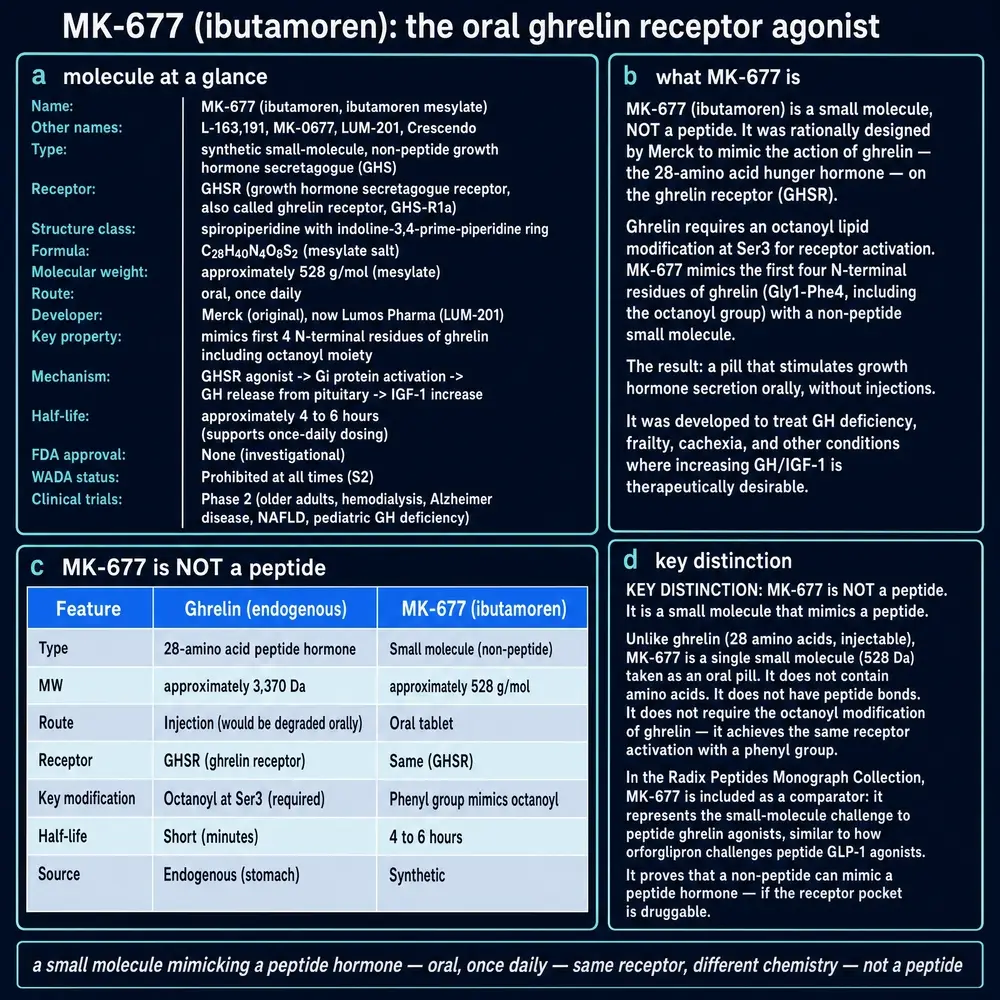
Three naming habits still confuse readers. First, MK-677 and MK-0677 are the same Merck code family; papers use both. Second, ibutamoren is the INN; LUM-201 is the same chemotype under Lumos for pediatric work. Third, “Nutrobal” and similar grey-market labels are marketing names, not regulatory identities. The identity plate that follows compresses those aliases, the non-peptide distinction, and the WADA/investigational status into one frame so the rest of the monograph does not have to keep restating the legend.
What the plate cannot do is settle the clinical story. It can tell you the molecule is oral, small, and aimed at GHSR. It cannot tell you whether two years of axis stimulation in older adults bought strength, or whether a twelve-month Alzheimer trial bought cognition. Those questions are answered later, in Part Two, with the trial designs attached.
That identity plate is the map legend for the rest of the document: same receptor as ghrelin, different chemistry, oral route in the trials that defined it, and no approved indication. The structure plate that follows in Section 04 is the next layer — how a spiropiperidine puts three arms where four peptide residues used to sit.
04How it talks to the pituitary
MK-677 binds and activates GHS-R1a. In the language inherited from the GHRP field, that activation raises intracellular calcium and engages pathways that promote growth-hormone release from somatotrophs. It synergises with GHRH and is opposed by somatostatin — which is why the resulting GH pattern in people tends to look like amplified pulses rather than a flat infusion (Chapman et al., 1996; Nass et al., 2008). Appetite stimulation appears often enough across ghrelin-receptor agonists that it should be treated as a class signature rather than a surprise (Sinha et al., 2020).
Structural and biophysical work later used ibutamoren as a defined agonist at the human ghrelin receptor, confirming that the synthetic ligand occupies the same receptor system as the natural hormone (Zhang et al., 2021 record). Those papers are mechanism, not indication. They tell you the lock and the key. They do not tell you whether turning the key for years helps a fractured hip heal or slows a dementing brain.
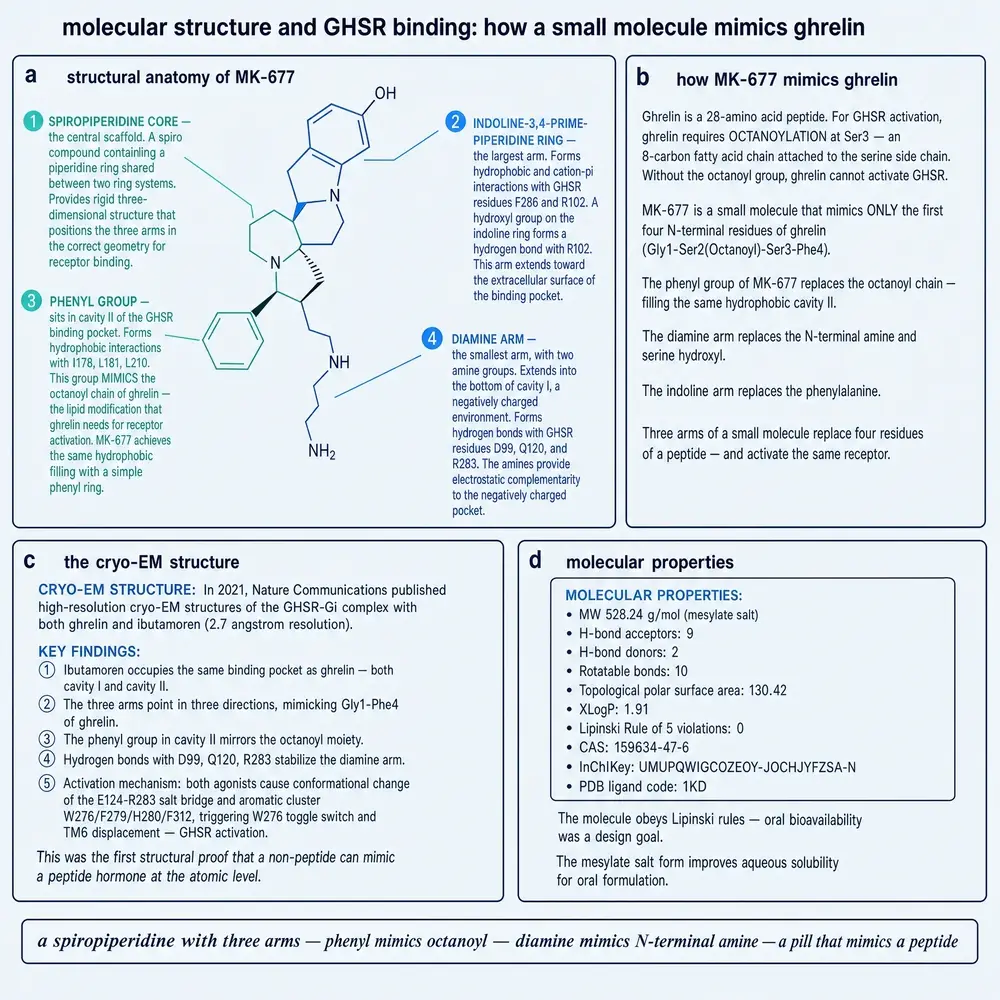
That structural plate is teaching art, not a docked pose redrawn from the density map. The phenyl-as-octanoyl story and the cryo-EM framing belong with Zhang/Liu 2021 and with Section 04’s caution: mechanism is not indication. The next pages leave the lock and key and walk into what happened when people swallowed the key for weeks, months and years.
What follows in Part Two is therefore not a second mechanism chapter. It is an audit of measurements in people: short studies, long studies, and the disease programmes that asked the molecule to do more than raise a hormone. Read the axis as a map of traffic. Read the trials as a record of where that traffic was asked to go. Because GHS-R1a is also expressed outside the pituitary, appetite and metabolic side-effects belong in that audit as receptor biology, not as afterthoughts (Sinha et al., 2020).
Keep the axis map below in the register of traffic, not destinations. Then the human trials that follow show what that traffic did — and did not — buy.
05Elderly volunteers, days to weeks
The study that fixed MK-677 in the clinical imagination enrolled healthy older adults and gave them daily oral drug in a randomized, placebo-controlled design. Chapman and colleagues reported that 10 mg and 25 mg daily increased mean 24-hour growth-hormone concentration by roughly half and roughly double, respectively, with IGF-1 rising over two to four weeks into a range typical of younger adults (Chapman et al., 1996). Pulsatile secretion was amplified rather than replaced by a continuous flood. Prolactin rose modestly; cortisol did not dominate the picture the way it can with some peptidyl GHS; fasting glucose and insulin moved in a direction that already hinted at the metabolic price of chronic GH-axis stimulation (Chapman et al., 1996; Sinha et al., 2020).
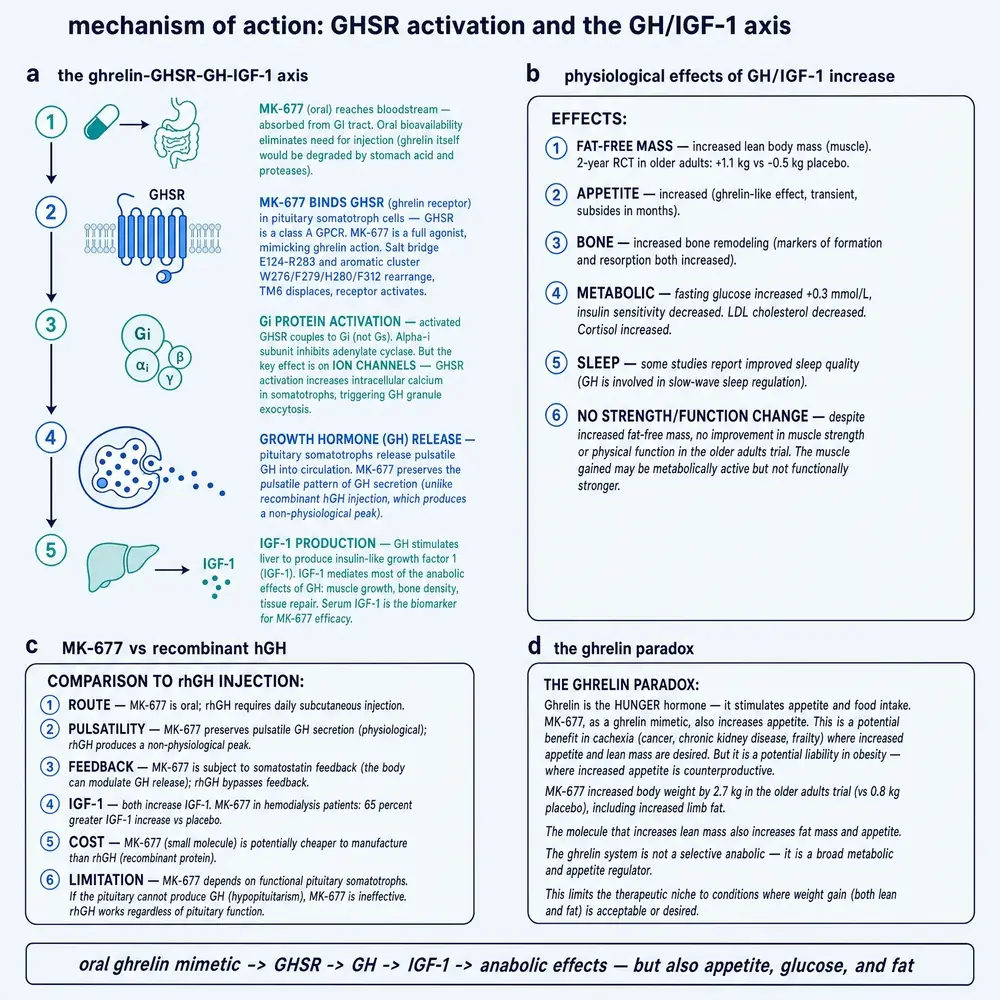
That mechanism plate is the bridge from receptor talk to trial talk. The Chapman numbers that follow are what the axis looked like when the pill was actually counted in older volunteers — not a promise about strength, cognition or fracture. The European week-long and sleep observations below sit in the same register: axis movement, limited claims.
Shorter European work in the mid-1990s pointed the same way: a week of oral MK-677 stirred the GH/IGF-1 axis in older subjects (Copinschi et al., 1996), and prolonged oral treatment was reported to improve aspects of sleep quality in men (Copinschi et al., 1997). Those findings are real and limited. They show what the axis does when pushed. They do not, by themselves, show that a person sleeps better in a way that matters for healthspan, or that the metabolic cost is free.
The Chapman chart is illustrative of reported relative changes, not a re-analysis of the raw time series. Read it beside the sentences above, then move on to body-composition work that asked what those hormone changes bought on the scale and in the DEXA scanner.
06Catabolism, fat-free mass, bone turnover
Murphy and colleagues tested whether oral MK-677 could reverse diet-induced catabolism in healthy volunteers and reported that it could move nitrogen balance and GH-axis markers under those experimental conditions (Murphy et al., 1998). In obese young men, an eight-week randomized trial found increased fat-free mass and energy expenditure without a significant loss of total body fat; some of the scale weight was fluid that receded after stopping (Svensson et al., 1998). Bone-formation and resorption markers rose in obese men and in elderly adults, which is what you expect if GH and IGF-1 are actually working on the skeleton — and which is not the same thing as fewer fractures (Svensson et al., 1998 bone-marker report; Murphy et al., 1999).
A follow-up observation from the obese-men programme is easy to miss and worth keeping: leptin rose even when fat mass did not clearly fall, a discrepancy that warns against reading appetite hormones as simple mirrors of adiposity under GH-axis drugs (Svensson et al., 1999). Body composition moved. Hunger biology moved. They did not always move together.
07Two years
The longest controlled look is Nass et al., 2008: sixty-five healthy adults aged 60 to 81, randomized to oral MK-677 or placebo in a modified crossover that kept people on or off drug across two years. On drug, 24-hour mean GH rose about 1.8-fold and IGF-1 about 1.5-fold; fat-free mass, limb lean mass and thigh muscle area increased; LDL cholesterol edged down; total testosterone did not change. Effects that appeared in year one were sustained in year two while exposure continued, and they reversed when people switched to placebo (Nass et al., 2008).
That paper is the ceiling of what the endocrine and composition story can honestly claim. It is also the clearest demonstration that the pharmacology is exposure-dependent. Stop the pill, and the borrowed youth of the GH pulse goes back where it came from. Functional outcomes that would have made aging physicians rewrite guidelines — hard strength, independence, fracture — were not the victory the biomarker story seemed to promise.
08Children with GH deficiency — first pass
Before Lumos, Merck already asked whether oral ibutamoren mesylate could move the GH/IGF-1 axis in children with idiopathic GH deficiency. Codner and colleagues gave short courses (on the order of a week) at weight-based oral amounts in a small multicenter study and saw rises in GH peak and AUC, IGF-1 and IGFBP-3 at the higher exposure tested, without large changes in cortisol, prolactin or thyroid measures in that brief window (Codner et al., 2001). It was a pharmacodynamic study, not a growth trial. It established that a child pituitary with residual secretory capacity can answer an oral GHS. The growth-velocity question was left for a later decade.
09The trials that ended the first life
If MK-677’s first act had a closing scene, it was written in disease-modification language. In a multicenter randomized trial in Alzheimer disease, MK-677 raised IGF-1 as expected and did not slow clinical progression (Sevigny et al., 2008). In patients recovering from hip fracture, a Phase IIb randomized study of MK-0677 likewise failed to deliver the functional recovery signal that would have justified pushing forward (Adunsky et al., 2011). A fibromyalgia programme (NCT00116129) tested the hypothesis that an oral GHS might help a population in which GH deficiency had been discussed; it did not become an approved therapy.
These are not footnotes. They are the difference between a hormone and a medicine. The axis obeyed the drug. The diseases did not.
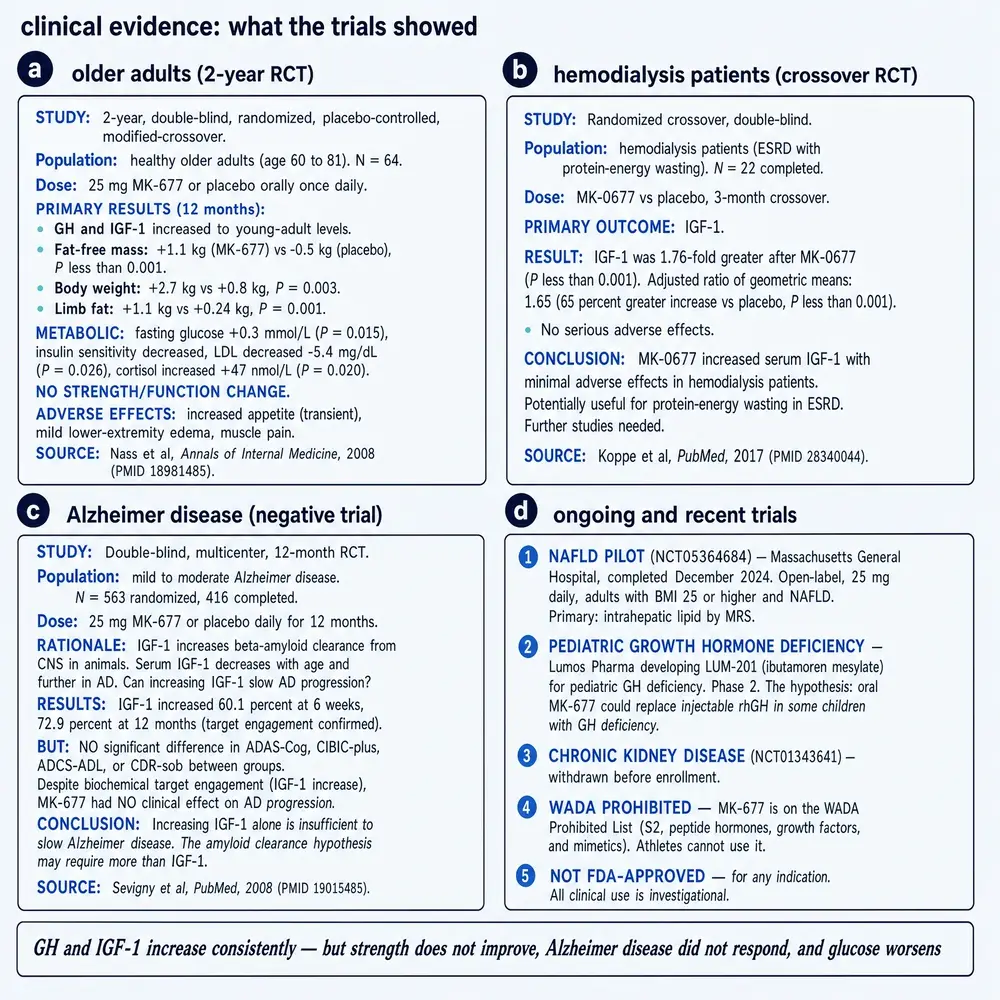
Read the clinical plate as a scoreboard, not a brochure. The older-adult card is Nass 2008: axis up, fat-free mass up, strength not. The Alzheimer card is Sevigny 2008: IGF-1 up, progression not slowed. The hemodialysis card is a smaller crossover signal on IGF-1. The status card is honest about what is still investigational. Where the plate prints a milligram figure, it is a historical trial regimen — not a recommendation for anyone outside a protocol.
10Safety signals that travel with the class
Across controlled trials, the recurring companions of MK-677 exposure are increased appetite, transient fluid retention or edema, and shifts toward higher fasting glucose and insulin — the expected metabolic shadow of sustained GH-axis stimulation (Chapman et al., 1996; Nass et al., 2008; Sinha et al., 2020; Sigalos and Pastuszak, 2018). Cortisol was generally not the dominant off-target story that plagued some peptidyl GHS, which is one reason oral non-peptide agonists looked attractive. Recent case-level literature adds caution without rewriting that trial record: a 2025 report described hepatotoxicity temporally associated with grey-market MK-677 use in an otherwise healthy young man (Cobani et al., 2025), and a 2026 case of spontaneous splenic rupture involved recent co-use of MK-677 and a SARM, with causation correctly treated as unproven (Jaffry et al., 2026). Anti-doping laboratories now detect ibutamoren in hair and blood at very low levels, which is a statement about prevalence of exposure, not about clinical benefit (Kintz and Gheddar, 2026; Barrios et al., 2025).
None of those safety sentences authorises casual exposure. They describe what controlled and case literature have already measured. The grey-market cases are hypothesis-generating; the trial metabolic signals are the more reliable companions of sustained GH-axis stimulation.
11In vivo animal pharmacology
Long before the Alzheimer clinical trial reported a null result, animal models asked whether a ghrelin-receptor agonist could touch amyloid-related pathology. Jeong and colleagues reported that MK-0677 alleviated aspects of amyloid-beta-related pathology in 5XFAD mice (Jeong et al., 2018). That is a disease-model signal in a rodent. It sits below the Sevigny randomized human trial on the evidence pyramid used in this series: when a mouse improves and a human trial does not, the human trial constrains the claim.
Other animal work uses MK-677 the way pharmacologists use any clean agonist — as a tool to ask what GHS-R1a does to appetite, stress-linked food seeking, or reward valuation. Those papers can be mechanistically informative and still be almost silent about whether a person with sarcopenia or cognitive decline should ever see the compound. This monograph cites them as tool use when that is what they are. The same restraint applies to canine and rodent GH-release assays from the 1990s that established oral activity: they prove the pill can speak to the pituitary in another species, not that a clinical endpoint will follow in ours (Jacks et al., 1996 beagle record among them).
12In vitro, structure, and odd screens
Cell and structural studies place ibutamoren in the orthosteric conversation at GHS-R1a and explore how membrane environment or arrestin engagement changes signalling bias. Antiviral or oncology screens that list ibutamoren among hits are, unless independently developed into a programme with on-target evidence, catalogues of coincidence. The same discipline applied to sibling secretagogues in this series applies here: a molecule can be famous enough to appear in a screening deck without that appearance becoming a therapeutic narrative.
Equine and human doping metabolism papers, by contrast, are solid analytical chemistry. They map how the compound and its metabolites appear in urine, plasma and hair after oral exposure in horses or volunteers (Cutler et al., 2022 lineage; Kintz and Gheddar, 2026). Their purpose is detection. Their existence is also sociological evidence that the molecule left the clinic and entered other markets. A monograph that ignored that afterlife would be telling only half the story of how MK-677 is actually encountered in 2026.
None of this rescues a failed clinical endpoint. Analytical sensitivity can rise while therapeutic usefulness stays flat. That asymmetry is easy to miss in a literature where the same four-character code appears in PNAS, in a Cureus case report, and on a seized vial. Part Four picks up the sociological thread — grey market, anti-doping, and the pediatric second act — without confusing detection with efficacy, and without letting a mouse paper outvote a multicenter null.
13Grey market and anti-doping
When a hormone story is vivid and a medicine is absent, informal markets fill the gap. MK-677 became a staple of online “research chemical” and performance-enhancement discourse under its Merck code and the Nutrobal nickname. Surveys of seized or suspected illegal sport products repeatedly list ibutamoren among the most frequently encountered growth-hormone secretagogues (Barrios et al., 2025). That fact is about supply and demand. It is not efficacy data, and it is not a quality guarantee.
Laboratories answered with methods. Hair testing after a single volunteer exposure, dried-blood workflows, and equine metabolism maps now exist so that a finding can be interpreted against a minimal detectable dose rather than guesswork (Kintz and Gheddar, 2026). The analytical literature is one of the few genuinely fresh MK-677 corpora of the mid-2020s. It documents exposure. It does not rehabilitate the failed Alzheimer or hip-fracture endpoints.
14LUM-201 and the pediatric second act
The second clinical life of the molecule is not a reboot of the aging thesis. It is a narrower wager: that children with moderate pediatric GH deficiency who retain some pituitary secretory capacity can grow on an oral ghrelin-receptor agonist, especially if a predictive enrichment marker identifies likely responders. Bright, Thorner and colleagues reported that LUM-201 elicited greater GH responses than standard secretagogue tests in subjects from a pediatric GH-deficiency trial, and they developed enrichment marker logic to select those children (Bright et al., 2021; Bright and Thorner, 2022).
Lumos Pharma took that logic through Phase 2 OraGrowtH studies and, after an End-of-Phase-2 interaction with the FDA described in 2024 company communications, advanced a placebo-controlled Phase 3 design. As of 2026, NCT06948214 is registered as a multicenter, 12-month, randomized, double-blind, placebo-controlled Phase 3 study of daily oral LUM-201 in naïve-to-treatment, prepubertal children with GHD, with height velocity as the efficacy language and concurrent validation of the enrichment strategy (ClinicalTrials.gov NCT06948214). A 2025 pediatric endocrinology review discusses oral ibutamoren among emerging directions in childhood GH treatment (Stawerska, 2025).
Recency matters here, and so does discipline. Phase 3 exists because Phase 2 and pharmacodynamic work were encouraging in a selected population. Phase 3 is also where many endocrine stories end. Until primary growth outcomes are published and reviewed, LUM-201 remains an investigational continuation of MK-677’s pharmacology, not a verdict that the old molecule has been vindicated.
Thirty years compressed: Patchett’s oral lead in 1995, Chapman and Nass proving the axis can be pushed for weeks to years, Sevigny and Adunsky closing the first disease bets, a quiet decade of grey-market and analytical papers, then Bright/Thorner enrichment logic and Lumos Phase 2 into the 2026 Phase 3 registration. That strip is a memory aid. It is not a claim that the second act has already succeeded.
15What the data can and cannot carry
Weighing the whole record, not the loudest paper, the honest summary is visual before it is verbal:
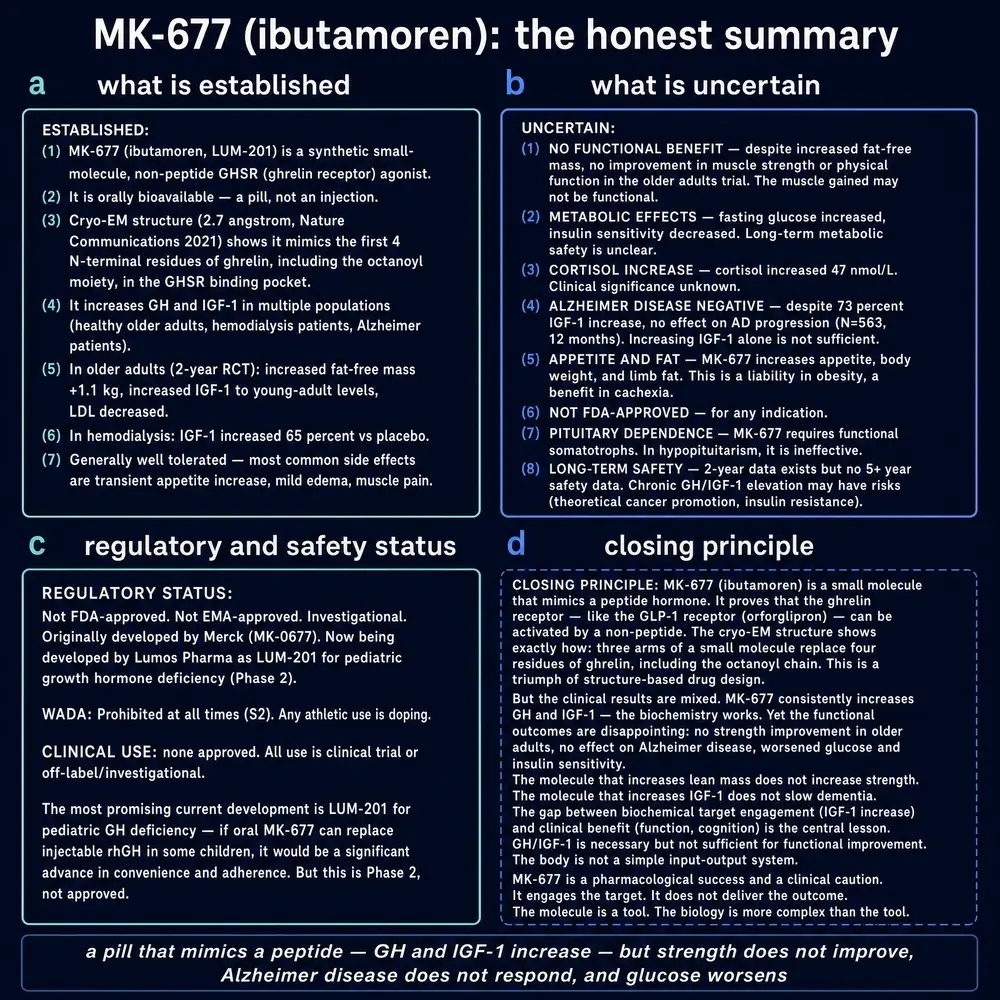
Solid. Oral MK-677 raises pulsatile GH and IGF-1 in adults and can do so for as long as two years in controlled settings. Fat-free mass and related composition measures increase with exposure and recede without it. Short-term pediatric pharmacodynamics show that residual somatotrophs can answer. The receptor biology is coherent with the ghrelin system.
Weak or failed as clinical product claims in the first life. Alzheimer progression was not modified. Hip-fracture recovery was not won in Phase IIb. Metabolic costs (glucose/insulin, appetite, fluid) are part of the package. Grey-market popularity is not a surrogate for those endpoints.
Open, and currently the only late-stage bet. Moderate pediatric GHD under enrichment, as LUM-201. That programme deserves attention precisely because it does not ask the molecule to reverse aging or dementia. It asks whether a pill can replace some injections in children who still have a pituitary that can listen.
Put differently: the first life of MK-677 asked whether raising GH and IGF-1 would reverse aging phenotypes, heal fractures faster, or slow dementia. Those were ambitious questions, and the answers that arrived were mostly no. The second life asks whether children who still have a responsive pituitary can grow on an oral agonist selected by enrichment markers. That is a smaller question. Smaller questions are sometimes the only ones a molecule can answer.
The interesting moral of MK-677 is not that oral secretagogues “work” or “don’t work.” It is that a drug can succeed at the thing chemists can measure and still fail at the thing patients need — and that the same chemistry can return later with a humbler question. The summary plate above is that sentence drawn as four cards.
This monograph is a scientific synthesis for research context. It is not a prescribing document, not a protocol, and not advice to acquire or use MK-677, ibutamoren, LUM-201 or any related compound. Where trial regimens are mentioned, they are historical experimental parameters.
16Identity table
| Field | Value |
|---|---|
| Preferred name in this series | MK-677 |
| INN | Ibutamoren |
| Merck codes | MK-0677, MK-677, L-163,191 |
| Lumos code | LUM-201 |
| Formula (free base) | C27H36N4O5S |
| Approximate mass | 528.7 Da |
| Common salt | Mesylate (CAS 159752-10-0) |
| PubChem CID | 178024 |
| Target | GHS-R1a (ghrelin receptor) |
| Modality | Non-peptide small molecule |
| Radix compound ID | P132 |
| Registry status (library) | Investigational / unapproved |
17Family map
Named only so they are not confused with the subject:
- GHRP-6 / GHRP-2 / hexarelin / ipamorelin — peptidyl GHS-R1a agonists; injectable in clinical use contexts.
- L-692,429 — Merck benzolactam predecessor to MK-0677.
- Anamorelin / macimorelin / capromorelin — other oral or diagnostic ghrelin-pathway agents with their own programmes.
- Ghrelin — endogenous ligand; context, never pooled as if it were MK-677.
18Evidence ledger (compressed)
| Claim cluster | Best support | Weight |
|---|---|---|
| Oral GH/IGF-1 elevation in adults | Chapman 1996; Nass 2008 | High |
| Sustained multi-year axis stimulation | Nass 2008 | High |
| Fat-free mass increase on exposure | Svensson 1998; Nass 2008 | Moderate–high |
| Pediatric short-term PD | Codner 2001; Bright/Thorner 2022 | Moderate |
| AD disease modification | Sevigny 2008 | Failed |
| Hip-fracture functional recovery | Adunsky 2011 | Failed (IIb) |
| AD mouse pathology | Jeong 2018 | Animal only |
| Pediatric growth outcome (LUM-201) | Phase 3 ongoing | Open |
19Local corpus note
Project 05 retained three open-access full texts against P132 at intake (PMC7108996, PMC12928143, PMC13126228; ~44 page-equivalents). The PubMed metadata layer for core designations held 128 relevance-filtered records in the harvest for this build (from a wider esearch surface). Landmark paywalled trials are cited from verified NCBI records and numbers corroborated against open secondary synthesis where the primary PDF is not locally retained. Vendor and grey-market PDFs were excluded from evidence claims.
20Abbreviations
AUC, area under the curve; FFM, fat-free mass; GH, growth hormone; GHD, growth hormone deficiency; GHRH, growth hormone-releasing hormone; GHRP, growth hormone-releasing peptide; GHS, growth hormone secretagogue; GHS-R1a / GHSR, ghrelin receptor; IGF-1, insulin-like growth factor 1; INN, international nonproprietary name; PD, pharmacodynamics; PEM, predictive enrichment marker; RCT, randomized controlled trial; RUO, research use only.
21References
Generated from verified NCBI records rather than from recall. Author lists, journal names, volumes, pages and identifiers are taken from the PubMed record for each citation, and the build refuses to run if any identifier fails to resolve.
- Adunsky A, Chandler J, Heyden N, Lutkiewicz J, Scott BB, Berd Y, et al.. MK-0677 (ibutamoren mesylate) for the treatment of patients recovering from hip fracture: a multicenter, randomized, placebo-controlled phase IIb study. Arch Gerontol Geriatr. 2011;53(2):183-9.
PMID 21067829 · doi:10.1016/j.archger.2010.10.004 - Barrios MM, Deconinck E, Vanhee C, Lamme EK, 't Hart-Bakker I, Syversen PV, et al.. SARMs, Metabolic Modulators and Growth Hormone Secretagogues in Suspected Illegal Medicines, Bought as Sport Performance Enhancers: A Retro- and Prospective Study Within the GEON. Drug Test Anal. 2025;17(10):2078-2085.
PMID 40551438 · doi:10.1002/dta.3918 - Bowers CY, Momany F, Reynolds GA, Chang D, Hong A, Chang K. Structure-activity relationships of a synthetic pentapeptide that specifically releases growth hormone in vitro. Endocrinology. 1980;106(3):663-7.
PMID 7353536 · doi:10.1210/endo-106-3-663 - Bowers CY, Momany FA, Reynolds GA, Hong A. On the in vitro and in vivo activity of a new synthetic hexapeptide that acts on the pituitary to specifically release growth hormone. Endocrinology. 1984;114(5):1537-45.
PMID 6714155 · doi:10.1210/endo-114-5-1537 - Bright GM, Do MT, McKew JC, Blum WF, Thorner MO. Development of a Predictive Enrichment Marker for the Oral GH Secretagogue LUM-201 in Pediatric Growth Hormone Deficiency. J Endocr Soc. 2021;5(6):bvab030.
PMID 33982679 · doi:10.1210/jendso/bvab030 · PMC8101275 - Bright GM, Thorner MO. A GH Secretagogue Receptor Agonist (LUM-201) Elicits Greater GH Responses than Standard GH Secretagogues in Subjects of a Pediatric GH Deficiency Trial. Horm Res Paediatr. 2022;95(1):76-81.
PMID 35354138 · doi:10.1159/000524244 · PMC9227666 - Chapman IM, Bach MA, Van Cauter E, Farmer M, Krupa D, Taylor AM, et al.. Stimulation of the growth hormone (GH)-insulin-like growth factor I axis by daily oral administration of a GH secretogogue (MK-677) in healthy elderly subjects. J Clin Endocrinol Metab. 1996;81(12):4249-57.
PMID 8954023 · doi:10.1210/jcem.81.12.8954023 - Cobani E, Amin MS, Hasso M, Kumbar L. Hepatotoxicity induced by MK-677. BMJ Case Rep. 2025;18(7).
PMID 40675653 · doi:10.1136/bcr-2025-265728 - Codner E, Cassorla F, Tiulpakov AN, Mericq MV, Avila A, Pescovitz OH, et al.. Effects of oral administration of ibutamoren mesylate, a nonpeptide growth hormone secretagogue, on the growth hormone-insulin-like growth factor I axis in growth hormone-deficient children. Clin Pharmacol Ther. 2001;70(1):91-8.
PMID 11452249 · doi:10.1067/mcp.2001.116514 - Copinschi G, Van Onderbergen A, L'Hermite-Balériaux M, Mendel CM, Caufriez A, Leproult R, et al.. Effects of a 7-day treatment with a novel, orally active, growth hormone (GH) secretagogue, MK-677, on 24-hour GH profiles, insulin-like growth factor I, and adrenocortical function in normal young men. J Clin Endocrinol Metab. 1996;81(8):2776-82.
PMID 8768828 · doi:10.1210/jcem.81.8.8768828 - Copinschi G, Leproult R, Van Onderbergen A, Caufriez A, Cole KY, Schilling LM, et al.. Prolonged oral treatment with MK-677, a novel growth hormone secretagogue, improves sleep quality in man. Neuroendocrinology. 1997;66(4):278-86.
PMID 9349662 · doi:10.1159/000127249 - Howard AD, Feighner SD, Cully DF, Arena JP, Liberator PA, Rosenblum CI, et al.. A receptor in pituitary and hypothalamus that functions in growth hormone release. Science. 1996;273(5277):974-7.
PMID 8688086 · doi:10.1126/science.273.5277.974 - Jacks T, Smith R, Judith F, Schleim K, Frazier E, Chen H, et al.. MK-0677, a potent, novel, orally active growth hormone (GH) secretagogue: GH, insulin-like growth factor I, and other hormonal responses in beagles. Endocrinology. 1996;137(12):5284-9.
PMID 8940347 · doi:10.1210/endo.137.12.8940347 - Jaffry K, Shah J, Naqash N. Spontaneous Splenic Rupture in a Patient With Recent Use of Performance-Enhancing Compounds: A Case Report and Literature Review. Cureus. 2026;18(3):e106106.
PMID 42064485 · doi:10.7759/cureus.106106 · PMC13126228 - Jeong YO, Shin SJ, Park JY, Ku BK, Song JS, Kim JJ, et al.. MK-0677, a Ghrelin Agonist, Alleviates Amyloid Beta-Related Pathology in 5XFAD Mice, an Animal Model of Alzheimer's Disease. Int J Mol Sci. 2018;19(6).
PMID 29912176 · doi:10.3390/ijms19061800 · PMC6032329 - Kintz P, Gheddar L. Knowing the minimal detectable dose can facilitate the interpretation of a hair test result: II. Case example with ibutamoren (MK-677), a growth hormone secretagogue. Clin Chim Acta. 2026;578:120578.
PMID 40882886 · doi:10.1016/j.cca.2025.120578 - Kojima M, Hosoda H, Date Y, Nakazato M, Matsuo H, Kangawa K. Ghrelin is a growth-hormone-releasing acylated peptide from stomach. Nature. 1999;402(6762):656-60.
PMID 10604470 · doi:10.1038/45230 - Liu H, Sun D, Myasnikov A, Damian M, Baneres JL, Sun J, et al.. Structural basis of human ghrelin receptor signaling by ghrelin and the synthetic agonist ibutamoren. Nat Commun. 2021;12(1):6410.
PMID 34737341 · doi:10.1038/s41467-021-26735-5 · PMC8568970 - Murphy MG, Plunkett LM, Gertz BJ, He W, Wittreich J, Polvino WM, et al.. MK-677, an orally active growth hormone secretagogue, reverses diet-induced catabolism. J Clin Endocrinol Metab. 1998;83(2):320-5.
PMID 9467534 · doi:10.1210/jcem.83.2.4551 - Murphy MG, Bach MA, Plotkin D, Bolognese J, Ng J, Krupa D, et al.. Oral administration of the growth hormone secretagogue MK-677 increases markers of bone turnover in healthy and functionally impaired elderly adults. The MK-677 Study Group. J Bone Miner Res. 1999;14(7):1182-8.
PMID 10404019 · doi:10.1359/jbmr.1999.14.7.1182 - Nass R, Pezzoli SS, Oliveri MC, Patrie JT, Harrell FE, Clasey JL, et al.. Effects of an oral ghrelin mimetic on body composition and clinical outcomes in healthy older adults: a randomized trial. Ann Intern Med. 2008;149(9):601-11.
PMID 18981485 · doi:10.7326/0003-4819-149-9-200811040-00003 · PMC2757071 - Patchett AA, Nargund RP, Tata JR, Chen MH, Barakat KJ, Johnston DB, et al.. Design and biological activities of L-163,191 (MK-0677): a potent, orally active growth hormone secretagogue. Proc Natl Acad Sci U S A. 1995;92(15):7001-5.
PMID 7624358 · doi:10.1073/pnas.92.15.7001 · PMC41459 - Sevigny JJ, Ryan JM, van Dyck CH, Peng Y, Lines CR, Nessly ML, et al.. Growth hormone secretagogue MK-677: no clinical effect on AD progression in a randomized trial. Neurology. 2008;71(21):1702-8.
PMID 19015485 · doi:10.1212/01.wnl.0000335163.88054.e7 - Sigalos JT, Pastuszak AW. The Safety and Efficacy of Growth Hormone Secretagogues. Sex Med Rev. 2018;6(1):45-53.
PMID 28400207 · doi:10.1016/j.sxmr.2017.02.004 · PMC5632578 - Sinha DK, Balasubramanian A, Tatem AJ, Rivera-Mirabal J, Yu J, Kovac J, et al.. Beyond the androgen receptor: the role of growth hormone secretagogues in the modern management of body composition in hypogonadal males. Transl Androl Urol. 2020;9(Suppl 2):S149-S159.
PMID 32257855 · doi:10.21037/tau.2019.11.30 · PMC7108996 - Stawerska R. New directions in growth hormone treatment in children. Pediatr Endocrinol Diabetes Metab. 2025;31(4):143-154.
PMID 41693185 · doi:10.5114/pedm.2025.158544 · PMC12928143 - Svensson J, Lönn L, Jansson JO, Murphy G, Wyss D, Krupa D, et al.. Two-month treatment of obese subjects with the oral growth hormone (GH) secretagogue MK-677 increases GH secretion, fat-free mass, and energy expenditure. J Clin Endocrinol Metab. 1998;83(2):362-9.
PMID 9467542 · doi:10.1210/jcem.83.2.4539 - Svensson J, Ohlsson C, Jansson JO, Murphy G, Wyss D, Krupa D, et al.. Treatment with the oral growth hormone secretagogue MK-677 increases markers of bone formation and bone resorption in obese young males. J Bone Miner Res. 1998;13(7):1158-66.
PMID 9661080 · doi:10.1359/jbmr.1998.13.7.1158 - Svensson J, Carlsson B, Carlsson LM, Jansson JO, Bengtsson BA. Discrepancy between serum leptin values and total body fat in response to the oral growth hormone secretagogue MK-677. Clin Endocrinol (Oxf). 1999;50(4):451-6.
PMID 10468903 · doi:10.1046/j.1365-2265.1999.00667.x
Sources without a PubMed record
ClinicalTrials.gov records and similar instruments have no PubMed entry and are listed separately so the generated list above remains machine-verified.
- Lumos Pharma. Phase 3 Study of LUM-201 in Children With Growth Hormone Deficiency (OraGrowtH Phase 3). ClinicalTrials.gov Identifier: NCT06948214. Updated 2026.
https://clinicaltrials.gov/study/NCT06948214 - Bennett R. Efficacy and Safety of an Oral Growth Hormone Drug in the Treatment of Fibromyalgia. ClinicalTrials.gov Identifier: NCT00116129.
https://clinicaltrials.gov/study/NCT00116129
22How this document was assembled
The corpus was built against project 05, the Therapeutic Peptide Research Library (P132 Ibutamoren), plus the workspace open-access stores.
Local full text. Project 05 intake retained
three open-access scientific full texts against this compound
(PMC7108996, PMC12928143, PMC13126228), together about
44 printed-page equivalents. A wider string sweep of
fulltext/open_access_jats found additional designation hits;
most were incidental mentions inside papers about other drugs and were not
treated as reading assets. Landmark paywalled trials (Patchett 1995, Chapman
1996, Sevigny 2008, Adunsky 2011, and related) are cited from verified PubMed
records, with quantitative claims cross-checked against open secondary
synthesis where the primary PDF is not locally retained.
Metadata layer. A core PubMed query on MK-677 / MK-0677 / ibutamoren / LUM-201 returned 353 records before relevance filtering; 128 were kept for the harvest used here. The reading target after open-access fetch for this build is about 9 scientific full texts (~170 page-equivalents), including the P05 retained set and fetched PMC OA companions (Nass 2008, Bright/Thorner 2022, Jeong 2018, and related).
Identity gate. Sibling oral and peptidyl GHS share vocabulary with the subject. Documents were admitted only when an unambiguous designation survived analogue stripping and A24 strict dominance against GHRP siblings, other secretagogues, and GHRH. PMC7108996 fails whole-document dominance (it reviews several GHS equally) but was retained as a Tier-B source because Project 05 lists it and because it contains a dedicated Ibutamoren section. The evidence-layer figure in the body of the monograph (controlled human trials above animal and tool-use papers) is the weighing rule applied throughout.
Recency. Newer findings (LUM-201 pediatric programme, 2025–2026 safety and doping papers) are weighted when they do not contradict the preponderance of controlled evidence. Null Alzheimer and hip-fracture trials are not overwritten by grey-market popularity or by animal model signals.
Conflicts and limits. Hormone success is not clinical success for this compound’s first life. Pediatric Phase 3 is open. Case reports of hepatotoxicity or co-exposure injury are hypothesis-generating. No human use, dose, route or schedule is recommended anywhere in this document.
Continue exploring