
Methylene blue From a coal-tar dye to a mitochondrial redox shuttle
Almost every compound in this series began as a designed ligand looking for a receptor. Methylene blue began as a colour. In 1876 a German industrial chemist named Heinrich Caro, working at the firm that became BASF, prepared a phenothiazine dye from the coal-tar chemistry that was then remaking European industry. Within a generation the same molecule had stained parasites for Paul Ehrlich, rescued patients whose blood could no longer carry oxygen, and seeded the chemical ancestry of the antipsychotic drugs. In the last two decades a quieter property has returned to the centre of the literature: at low concentrations the dye can act as an alternate electron carrier in mitochondria. That claim has a large preclinical record, a thinner and more conflicted human experimental record, and a popular afterlife that this document will not endorse. What follows is what the evidence actually shows, labelled by study type, weighed for recency, and kept free of use recommendations.
Findings are labelled by the kind of study that produced them, in the sentence that reports them. A result in a cell line is called a result in a cell line. A rodent tauopathy finding is not a human cognitive claim. An Alzheimer’s trial of a methylthioninium derivative is not a trial of methylene blue.
A note on amounts. Concentrations and doses appear here only as parameters of published experiments, always with the species, the preparation and the duration attached. They are facts about research. This document recommends nothing, and no amount in it is offered for use by any person.
A note on conflict. The best-known story about methylene blue in the brain is that it enhances metabolism. The most careful dual-species imaging study in this corpus found the opposite direction at clinical-range intravenous amounts (Singh et al., 2023). Both findings are reported. Neither is averaged away.
01The colour that came from coal tar
Start with the industry, not the clinic. Mid-nineteenth-century Europe had learned to pull brilliant colours out of coal tar — the sticky residue of the gasworks — and those colours built chemical companies. Heinrich Caro prepared methylene blue in 1876 at Badische Anilin- und Sodafabrik in Mannheim; the firm secured patent protection the following year. The molecule was a textile dye first: a deep blue for cotton, a product of aniline chemistry, not a designed medicine (historical synthesis reviewed in Oz et al., 2011; PubChem CID 6099).
That origin matters because it explains the next fifty years. Once a synthetic dye could enter cells and bind biological structures, microscopists and physicians noticed. The path from dye bench to sickbed was short, crowded, and often accidental. Methylene blue is routinely described in secondary histories as the first fully synthetic drug used in medicine. Treat that phrase as a historiographic tradition with named chemists behind it, not as a randomised finding.
02Stain, then drug
Paul Ehrlich’s generation turned staining into chemotherapy’s prototype. Methylene blue stained malaria parasites and was explored as an antimalarial; the same phenothiazine scaffold later fed the mid-twentieth- century antipsychotic class (Oz et al., 2011). The molecule therefore sits at a strange junction: it is older than modern receptor pharmacology, yet its ring system became one of psychiatry’s founding chemotypes.
Pharmacokinetically it is not a fleeting stain. Peter and colleagues (2000) measured substantial organ distribution after intravenous and oral administration in humans, including marked accumulation in the central nervous system relative to plasma — a fact later authors invoke when they argue that blood concentrations understate brain exposure (Peter et al., 2000; discussed in Singh et al., 2023).
03The job it already has
The established clinical identity of methylthioninium chloride is as a treatment for methemoglobinemia: the dye’s reduced form, leucomethylene blue, can return ferric iron in haemoglobin to the ferrous state that carries oxygen (clinical mechanism summarised in Oz et al., 2011 and in Singh et al., 2023). It appears on the World Health Organization’s Model List of Essential Medicines for that indication.
That fact is load-bearing context. It is also not a licence for this document to recommend any human use. The same redox chemistry that can rescue methemoglobin is concentration-dependent: clinical toxicology has long noted that high exposures can worsen the problem they are meant to solve (discussed in Singh et al., 2023). Research use only remains the frame.
04Names, structure, and near-relatives
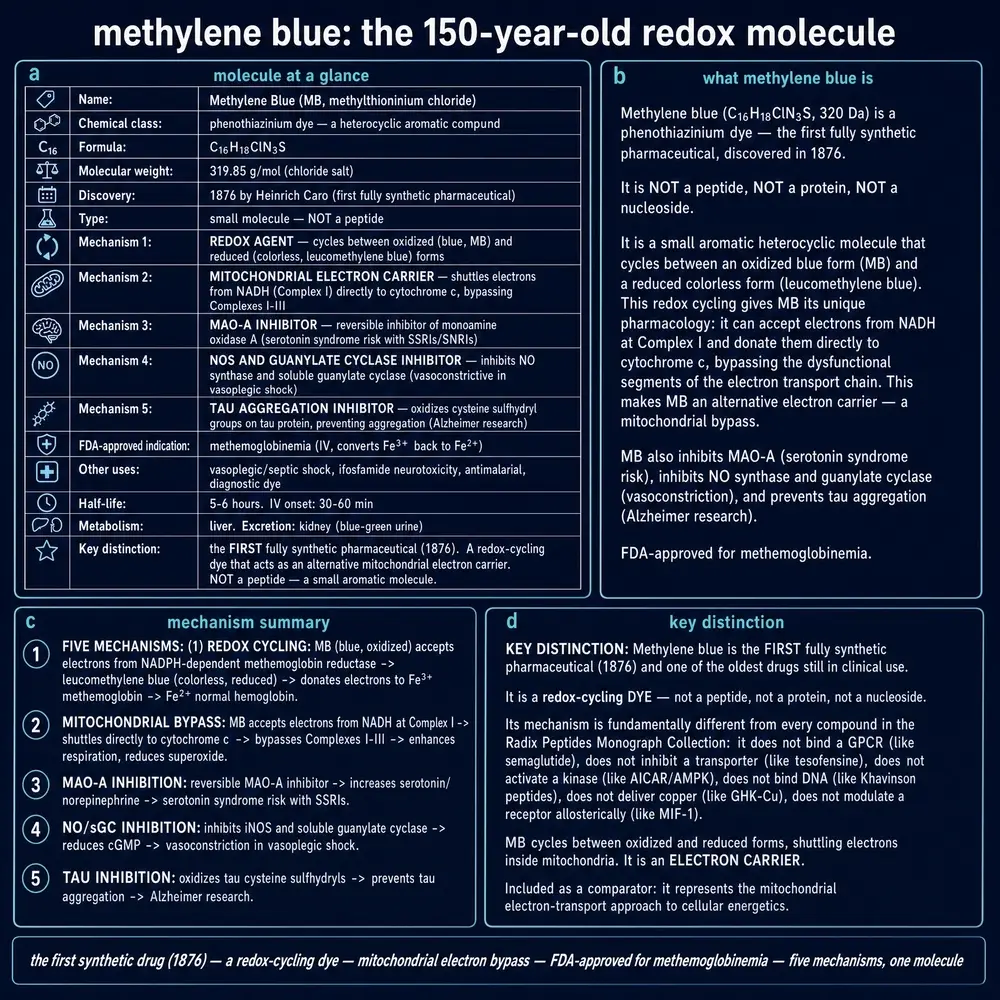
Call it methylene blue in ordinary prose and methylthioninium chloride when precision matters. PubChem lists it as CID 6099. Near-relatives that must not silently merge with the parent include Azure B, lipophilic analogues synthesised to raise mitochondrial biogenesis markers (e.g. PMC6139889), and — most importantly for the Alzheimer literature — the stabilised leuco form hydromethylthionine / LMTM tested in phase 2 and phase 3 trials (Hashmi et al., 2023). Those derivatives get their own section later. They do not inherit the parent’s results, and the parent does not inherit theirs.
05What an alternate electron carrier is
Mitochondria build a proton gradient by moving electrons through complexes in the inner membrane. When a complex is blocked, or when reactive oxygen species rise from stalled electron flow, cells suffer. The modern scientific interest in methylene blue is that the dye can accept electrons from NADH-linked chemistry and donate them downstream — a bypass rather than a receptor agonism (Atamna et al., 2008; Yang et al., 2020; Poteet et al., 2012).
Atamna and colleagues (2008), working in human IMR90 fibroblasts, reported that nanomolar methylene blue delayed replicative senescence, raised complex IV content, and increased oxygen consumption. They proposed cycling between the oxidised dye and leucomethylene blue as the mitochondrial explanation. Yang and colleagues (2020) placed that chemistry beside photobiomodulation in a neuroprotection review: both strategies, in their framing, support electron transport when ordinary routes are impaired.
The same chemistry is biphasic. Reviews of behavioural and biochemical hormesis — discussed at length by Singh and colleagues (2023) when they tried to interpret their own imaging results — place metabolic augmentation and metabolic inhibition on opposite sides of a narrow concentration window. That is why a sentence that says “methylene blue enhances mitochondrial respiration” without a concentration, a preparation and a species is not yet a scientific sentence.
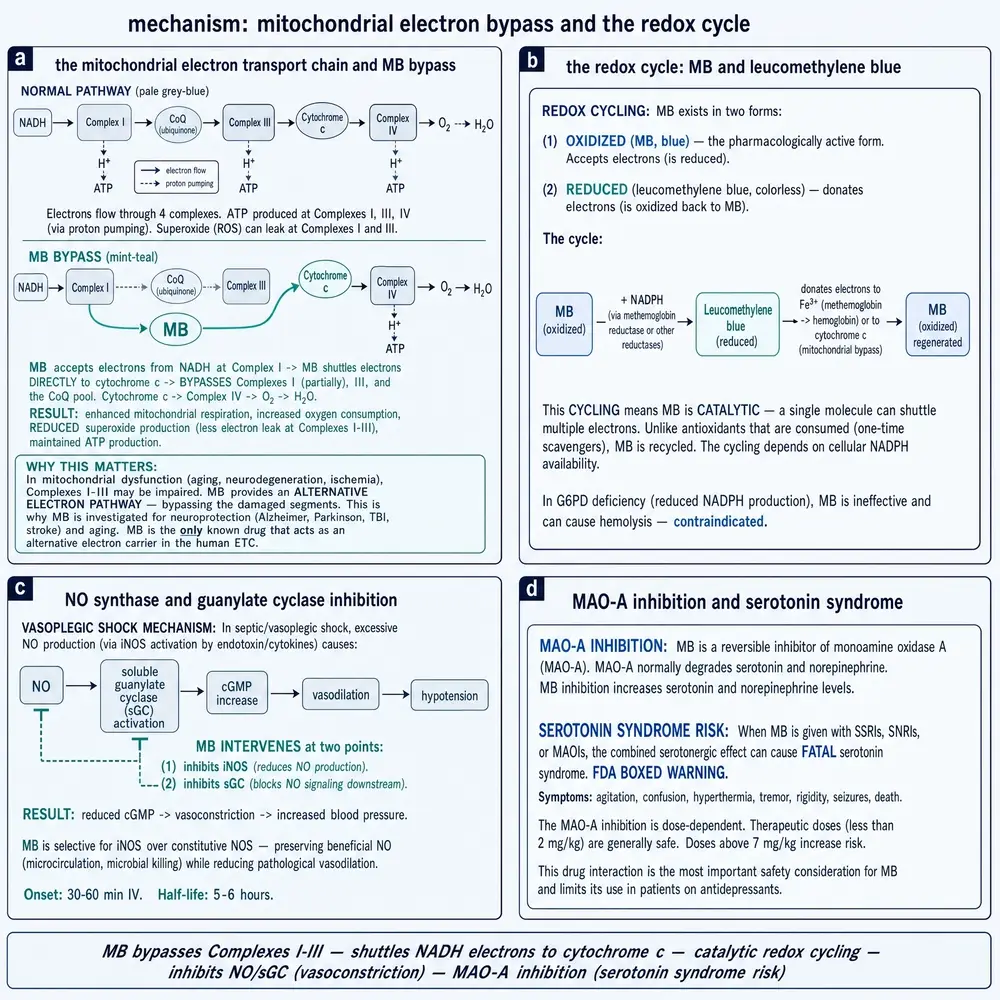
The plate restates that biphasic teaching in visual form — bypass, redox cycling, nitric-oxide pathway antagonism, and MAO-A inhibition as literature mechanisms, not as a menu of uses. None of those panels is a protocol. Each is a literature mechanism drawn large enough that a reader can see why the same dye appears in mitochondrial, vascular and serotonergic discussions without those discussions being the same claim.
The conceptual concentration curve that follows is the same warning in another register. Cell and animal work place metabolic augmentation and inhibition on opposite sides of a narrow window; the exact micromolar boundaries are preparation-specific (discussed in Singh et al., 2023). Treat the curve as a shape, not a dosing chart: it explains why an unqualified sentence about “enhancing respiration” fails before any clinical question is asked.
06Cells: energy, ROS, and autophagy
Xie and colleagues (2013) reported that methylene blue induced macroautophagy through the AMPK pathway in HT22 mouse hippocampal cells and protected those cells from serum deprivation. That is a clean cell-biology result: one pathway, one stressor, one line. It does not make a human cognitive claim.
A later fibroblast study (Atamna-linked work in Redox Biology, 2015; PMC4588422) argued that transient AMPK activation plus Keap1/Nrf2 defence signalling could explain the dye’s anti-senescence potency better than either pathway alone. Xiong and colleagues (2017) extended skin-relevant readouts in human fibroblasts and related models, reporting markers consistent with delayed senescence and improved mitochondrial function under their conditions (Xiong et al., 2017).
Not every bypass experiment favours the dye. Ehinger and colleagues (2018) compared cell-permeable succinate with methylene blue in a metformin-induced lactate model and found that succinate attenuated lactate production where methylene blue did not (Ehinger et al., 2018). Negative comparisons belong in the spine: they stop a mechanism story from becoming a universal solvent.
07Inflammasomes and immune redox
Ahn and colleagues (2017) reported that methylene blue inhibited NLRP3, NLRC4, AIM2 and non-canonical inflammasome activation in cell systems — a broad innate-immune redox finding rather than a disease-specific therapy claim (Ahn et al., 2017). Photodynamic and antifungal uses of the dye appear repeatedly in the retained corpus; they are real chemistry and real microbiology, and they are not the mitochondrial neurobiology argument. This document keeps them at the margin unless a paper is specifically about host mitochondria.
08Heart and metabolic mitochondria
In diabetic-heart mitochondrial preparations, methylene blue has been reported to decrease lysine acetylation linked to altered fuel handling (Duicu and colleagues’ line of work; PMC5532421). Separately, an ex vivo study of human cardiovascular adipose tissue reported reduced monoamine oxidase expression and oxidative-stress markers after methylene blue exposure (PMC11961462, 2024). Label both carefully: one is animal cardiac mitochondria; the other is human tissue outside the living subject. Neither is a cardiology recommendation.
Lee and colleagues (2014) showed that bypassing compromised electron transport with methylene blue alleviated oxidant stress and mitochondria-mediated death in mouse hepatocytes challenged with efavirenz/isoniazid chemistry (Lee et al., 2014). Again the pattern repeats: when the chain is broken, a redox shuttle can matter in a dish or a mouse liver cell. The leap to a person is a different experiment. Part Three turns from those isolated preparations to whole-animal brain, barrier and injury models — still not human endpoints, but the scale at which behaviour and tissue survival enter the record.
09Tau and cognition in mice
The cleanest behavioural neuroprotection story in this corpus is tau. Hochgräfe and colleagues (2015) reported that preventive methylene blue treatment preserved cognition in mice expressing full-length pro-aggregant human tau (Hochgräfe et al., 2015). An earlier phenothiazine study by O’Leary and colleagues (2010) found cognitive rescue in a tau transgenic line that required both neuroprotection and a reduced soluble tau burden (O’Leary et al., 2010). These are mouse genetics and mouse behaviour. They are among the strongest reasons the Alzheimer field kept looking at methylthioninium chemistry — and they are still not human outcomes.
10Stroke, TBI, and the blood–brain barrier
Stroke reviews that target mitochondria routinely name methylene blue as a candidate bypass agent (e.g. Watts et al. line; PMC4061853). More specific experiments fill in mechanisms without proving clinical stroke efficacy. One MRI-defined study mapped autophagy and apoptosis differently across ischemic core, penumbra and normal tissue after methylene blue (PMC4488003, 2015). A 2019 traumatic-brain-injury study reported reduced neuronal apoptosis and improved blood–brain-barrier integrity in the treated animals (PMC6856146). A porcine cardiac-arrest and resuscitation model found that methylene blue altered the genomic response to cerebral reperfusion injury (Miclescu and colleagues’ lineage; PMC2904268, 2010).
Read as a set, the injury literature says: in several mammalian brain-injury models, the dye changes cell-death and barrier readouts in a direction experimenters call protective. It does not say what a human stroke trial would find. It especially does not license informal use after a head injury.
11Retina, hearing, aging bone and tendon
Outside cortex, the corpus keeps finding the same redox theme. In an apoptosis-inducing-factor deficiency model of retinal photoreceptor degeneration, methylene blue was reported protective (PMC6175772, 2018). A noise-induced hearing-loss study reported attenuation with methylene blue under its experimental conditions (PMC4001318, 2014). Progeria models showed alleviation of nuclear and mitochondrial abnormalities (PMC4783354, 2015). More recent work has examined skeletal aging comparisons with mitoquinone (PMC11006499, 2024) and NAD+/NADH homeostasis in Achilles tendinopathy models (PMC13122246). These widen the map; they do not deepen the human certainty.
12When the bypass fails, and when 2025 complicates the story
Negative and cautionary results deserve equal weight. The succinate-versus- methylene-blue comparison in the metformin lactate model (Ehinger et al., 2018) already showed that “bypass” is not a blank cheque. In 2025, a zebrafish developmental study reported that methylene blue at concentrations used in aquarium contexts altered early metabolic trajectories (PMC11760885). That paper is not a human developmental toxicology package, but it is a reminder that “old dye, familiar concentrations” is not the same as “metabolically inert.” A 2025 rat study of intranasal administration after exhaustive exercise reported neuroprotective readouts (PMC12500559); label it clearly as rodent, route- specific, and exercise-model evidence.
An ALS SOD1 microglia study found influences on inflammation and motor- neuron degeneration that were mixed rather than triumphant (PMC3428282, 2012). The honest animal summary is not that every model works. It is that enough independent laboratories, in enough injury and proteinopathy contexts, have seen mitochondrial and behavioural signals that the mechanism cannot be dismissed as a single lab’s enthusiasm — while the gaps that separate those signals from human medicine remain wide.
13Acute cerebral blood flow and metabolism
This is the section that must not be softened. Singh and colleagues (2023) infused methylene blue intravenously at 0.5 and 1 mg/kg in eight healthy women in a crossover design and measured cerebral blood flow, oxygen extraction and a CMRO2-related parameter with quantitative MRI. Both amounts reduced global CBF by roughly eight percent; CMRO2 fell by about 7.9 percent and 11.8 percent at the two amounts, with dose dependence on the metabolic measures (Singh et al., 2023). Parallel rat experiments in the same paper found reduced CBF and, in conscious animals, reduced cerebral glucose utilisation.
Those numbers are experimental outcomes in a small, single-sex healthy sample. They are not a recommendation. They are also not what the authors expected. Their prior hypothesis, built on cell work and on Lin and colleagues (2012), was that methylene blue would raise metabolic metrics. It did not.
Lin and colleagues (2012) had reported that 0.5 mg/kg intravenous methylene blue increased CBF, oxygen extraction and CMRO2 in anaesthetised rats. Singh and colleagues discuss hormesis, nitric-oxide pathway antagonism, and the possibility that brain concentrations after clinical-range intravenous dosing sit past the augmenting window (Singh et al., 2023; Lin et al., 2012). This monograph gives Singh substantial weight: it is recent, dual-species, and contains the only quantitative human CMRO2 arm in the retained corpus. It does not delete Lin. It refuses to pretend the literature points one way.
14Alzheimer’s: parent dye versus derivatives
Hashmi and colleagues (2023) reviewed randomised trials touching methylene blue and its derivatives in Alzheimer’s disease. The important identity fact is that the large modern phase 2/3 programme used leuco-methylthioninium bis(hydromethanesulfonate) — LMTM / hydromethylthionine — not the parent hospital dye in its ordinary salt form (Hashmi et al., 2023).
Gauthier and colleagues (2016) reported a phase 3 trial of LMTM as add-on therapy that did not meet its primary efficacy analysis. Wilcock and colleagues (2018) published cohort analyses suggesting possible monotherapy signals at low LMTM amounts. Schelter and colleagues (2019) argued for concentration-dependent effects of hydromethylthionine on cognitive decline and brain atrophy, with pharmacological activity discussed at low daily amounts in their modelling. Earlier exploratory methylthioninium work by Wischik and colleagues (2015) is part of the same development arc.
Weigh this carefully. Sponsor involvement, post-hoc cohort framing, and the failure of the pre-specified add-on primary endpoint are all part of the record (see also critical discussion cited via Hashmi et al., 2023). None of these trials converts informal methylene blue use into evidence-based cognitive therapy. None of them should be cited as if they were trials of the parent dye at aquarium or “supplement” exposures.
15Skin, photobiology, and peripheral human tissue
Xiong and colleagues (2017) reported anti-aging readouts for methylene blue in human skin-cell systems. A 2021 paper explored ultraviolet-protection potentials for human skin and coral models (PMC8163870). The 2024 cardiovascular adipose ex vivo study already noted belongs here as human tissue evidence without being a clinical endpoint trial (PMC11961462). These are legitimate research observations. They are not skincare or wellness instructions.
16What “clinical trial hits” in the harvest actually are
A PubMed clinical-trial publication-type filter on methylene blue returns a non-zero surface — on the order of a hundred records in the harvest metadata for this compound. That surface is dominated by surgical localisation, methemoglobinemia, vasoplegia, and photodynamic therapy, not by CNS efficacy programmes of the parent dye. The Alzheimer randomised literature that looks like a CNS programme is mostly LMTM. Conflating those buckets is how a library count becomes a marketing sentence. This document keeps them apart.
17What is solid, what is thin
Hold the halves together.
Solid enough to teach. The discovery history is real: Caro, the dye industry, the stain-to-medicine arc, the phenothiazine ancestry (Oz et al., 2011). The methemoglobinemia mechanism is established clinical pharmacology. The alternate-electron-carrier account is coherent across cell biology and reviews (Atamna et al., 2008; Yang et al., 2020). The animal neuroprotection and injury literature is large enough that dismissing it as noise would itself be noise.
Thin, mixed, or identity-tangled. Human CNS efficacy of the parent dye outside its established indications is not established by this corpus. Acute imaging at clinical-range intravenous amounts moved metabolic metrics down, not up, in the best dual-species study here (Singh et al., 2023). Alzheimer randomised evidence is largely about derivatives, with a failed add-on primary endpoint and disputed secondary readings (Gauthier et al., 2016; Hashmi et al., 2023). Lifestyle and nootropic claims sit outside what this monograph will carry.
Recency receives weight when it is not contradicted by a larger, consistent body of earlier evidence. Singh 2023 receives weight against older “enhancer” narratives because it is newer, includes humans, and explains its conflict. A single new mouse paper does not overwrite a multi-lab animal pattern without cause. Derivative trial results do not overwrite parent-dye gaps.
18Interactions and research safety signals
Ramsay and colleagues (2007) showed that methylene blue inhibits monoamine oxidase A and discussed serotonin toxicity risk in the presence of serotonergic drugs — a pharmacological finding that entered clinical warning literature (Ramsay et al., 2007). Clinical discussions of methemoglobinemia use also flag glucose-6-phosphate dehydrogenase deficiency contexts and the high-concentration paradox in which the rescue pathway can reverse. Singh and colleagues (2023) discuss nitric-oxide synthase and guanylyl-cyclase antagonism as a plausible contributor to reduced cerebral blood flow. These are research and clinical-literature signals. They are not a complete safety datasheet, and listing them is not advice.
19Open questions
Three questions remain load-bearing after this reading.
Where is the hormetic boundary in the living human brain? Cell micromolar windows and clinical milligram-per-kilogram intravenous amounts are not the same coordinate system. Singh’s discussion of brain accumulation (Peter et al., 2000) makes the conversion non-trivial. Until more quantitative human dose–response imaging exists, “low dose enhances” remains a hypothesis that failed its most careful recent test at the amounts studied.
What, if anything, does chronic exposure do to human cognition? Acute imaging is not a six-month cognitive trial. Derivative Alzheimer programmes are not parent-dye programmes. The gap is not filled by stacking mouse tau papers.
Can the field keep identities straight in public? Methylene blue, LMTM, Azure dyes, and photodynamic protocols share a colour and a Wikipedia page in the popular imagination. They do not share a evidence dossier. The hardest editorial job in this monograph was not finding papers. It was refusing to let one molecule’s reputation borrow another’s randomised trial.
What the record actually supports
Methylene blue is a nineteenth-century industrial dye that became a twentieth-century Essential Medicine for a specific blood disorder and a twenty-first-century mitochondrial research tool. The cell and animal record around electron shuttling and neuroprotection is substantial, mechanically plausible, and still growing. The human experimental record outside methemoglobinemia and procedural dye use is smaller, sharper, and — where Singh and colleagues measured it — pointed the opposite way from the popular metabolic-enhancer story at the intravenous amounts they tested.
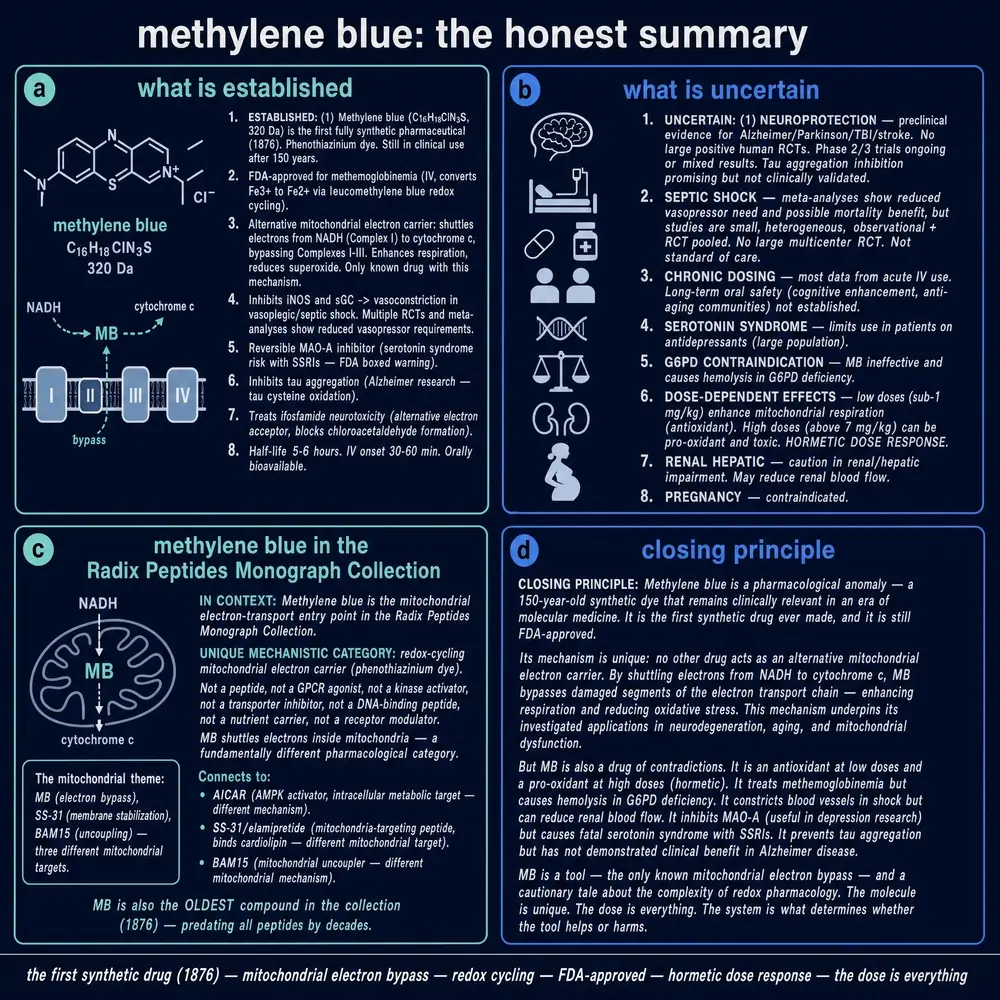
That is an interesting molecule. It is not a blank cheque. This document recommends no human use, no dose, no route and no schedule. The constraint line in the masthead is not boilerplate. It is the condition under which a dye this famous can still be written about honestly.
20References
Every PubMed entry below was resolved against the National Library of Medicine during this build and read back against its author, journal, year and title line. None was written from recall. The build refuses to run if any identifier fails to resolve. Historical and registry material without a PubMed record is listed in a second list.
- Aburel OM, Brăescu L, Buriman DG, Merce AP, Bînă AM, Borza C, et al.. Methylene blue reduces monoamine oxidase expression and oxidative stress in human cardiovascular adipose tissue. Mol Cell Biochem. 2025;480(4):2413-2421.
PMID 39167271 · doi:10.1007/s11010-024-05092-z · PMC11961462 - Ahn H, Kang SG, Yoon SI, Ko HJ, Kim PH, Hong EJ, et al.. Methylene blue inhibits NLRP3, NLRC4, AIM2, and non-canonical inflammasome activation. Sci Rep. 2017;7(1):12409.
PMID 28963531 · doi:10.1038/s41598-017-12635-6 · PMC5622101 - Atamna H, Nguyen A, Schultz C, Boyle K, Newberry J, Kato H, et al.. Methylene blue delays cellular senescence and enhances key mitochondrial biochemical pathways. FASEB J. 2008;22(3):703-12.
PMID 17928358 · doi:10.1096/fj.07-9610com - Atamna H, Atamna W, Al-Eyd G, Shanower G, Dhahbi JM. Combined activation of the energy and cellular-defense pathways may explain the potent anti-senescence activity of methylene blue. Redox Biol. 2015;6:426-435.
PMID 26386875 · doi:10.1016/j.redox.2015.09.004 · PMC4588422 - Berthiaume JM, Hsiung CH, Austin AB, McBrayer SP, Depuydt MM, Chandler MP, et al.. Methylene blue decreases mitochondrial lysine acetylation in the diabetic heart. Mol Cell Biochem. 2017;432(1-2):7-24.
PMID 28303408 · doi:10.1007/s11010-017-2993-1 · PMC5532421 - Dibaj P, Zschüntzsch J, Steffens H, Scheffel J, Göricke B, Weishaupt JH, et al.. Influence of methylene blue on microglia-induced inflammation and motor neuron degeneration in the SOD1(G93A) model for ALS. PLoS One. 2012;7(8):e43963.
PMID 22952827 · doi:10.1371/journal.pone.0043963 · PMC3428282 - Gauthier S, Feldman HH, Schneider LS, Wilcock GK, Frisoni GB, Hardlund JH, et al.. Efficacy and safety of tau-aggregation inhibitor therapy in patients with mild or moderate Alzheimer's disease: a randomised, controlled, double-blind, parallel-arm, phase 3 trial. Lancet. 2016;388(10062):2873-2884.
PMID 27863809 · doi:10.1016/S0140-6736(16)31275-2 · PMC5164296 - Hashmi MU, Ahmed R, Mahmoud S, Ahmed K, Bushra NM, Ahmed A, et al.. Exploring Methylene Blue and Its Derivatives in Alzheimer's Treatment: A Comprehensive Review of Randomized Control Trials. Cureus. 2023;15(10):e46732.
PMID 38022191 · doi:10.7759/cureus.46732 · PMC10631450 - Hochgräfe K, Sydow A, Matenia D, Cadinu D, Könen S, Petrova O, et al.. Preventive methylene blue treatment preserves cognition in mice expressing full-length pro-aggregant human Tau. Acta Neuropathol Commun. 2015;3:25.
PMID 25958115 · doi:10.1186/s40478-015-0204-4 · PMC4425867 - Jiang Z, Watts LT, Huang S, Shen Q, Rodriguez P, Chen C, et al.. The Effects of Methylene Blue on Autophagy and Apoptosis in MRI-Defined Normal Tissue, Ischemic Penumbra and Ischemic Core. PLoS One. 2015;10(6):e0131929.
PMID 26121129 · doi:10.1371/journal.pone.0131929 · PMC4488003 - Lee KK, Boelsterli UA. Bypassing the compromised mitochondrial electron transport with methylene blue alleviates efavirenz/isoniazid-induced oxidant stress and mitochondria-mediated cell death in mouse hepatocytes. Redox Biol. 2014;2:599-609.
PMID 25460728 · doi:10.1016/j.redox.2014.03.003 · PMC4297936 - Lin AL, Poteet E, Du F, Gourav RC, Liu R, Wen Y, et al.. Methylene blue as a cerebral metabolic and hemodynamic enhancer. PLoS One. 2012;7(10):e46585.
PMID 23056355 · doi:10.1371/journal.pone.0046585 · PMC3467226 - Martijn C, Wiklund L. Effect of methylene blue on the genomic response to reperfusion injury induced by cardiac arrest and cardiopulmonary resuscitation in porcine brain. BMC Med Genomics. 2010;3:27.
PMID 20594294 · doi:10.1186/1755-8794-3-27 · PMC2904268 - Mekala NK, Kurdys J, Depuydt MM, Vazquez EJ, Rosca MG. Apoptosis inducing factor deficiency causes retinal photoreceptor degeneration. The protective role of the redox compound methylene blue. Redox Biol. 2019;20:107-117.
PMID 30300862 · doi:10.1016/j.redox.2018.09.023 · PMC6175772 - Nipu N, Wei L, Hamilton L, Lee H, Thomas J, Mennigen JA. Methylene blue at recommended concentrations alters metabolism in early zebrafish development. Commun Biol. 2025;8(1):120.
PMID 39856203 · doi:10.1038/s42003-025-07471-8 · PMC11760885 - O'Leary JC, Li Q, Marinec P, Blair LJ, Congdon EE, Johnson AG, et al.. Phenothiazine-mediated rescue of cognition in tau transgenic mice requires neuroprotection and reduced soluble tau burden. Mol Neurodegener. 2010;5:45.
PMID 21040568 · doi:10.1186/1750-1326-5-45 · PMC2989315 - Oz M, Lorke DE, Hasan M, Petroianu GA. Cellular and molecular actions of Methylene Blue in the nervous system. Med Res Rev. 2011;31(1):93-117.
PMID 19760660 · doi:10.1002/med.20177 · PMC3005530 - Park JS, Jou I, Park SM. Attenuation of noise-induced hearing loss using methylene blue. Cell Death Dis. 2014;5(4):e1200.
PMID 24763057 · doi:10.1038/cddis.2014.170 · PMC4001318 - Peng G, Pan W, Cai Z, Lin L, Ma X. Intranasal methylene blue administration confers neuroprotection in rats subjected to exhaustive exercise training. Front Behav Neurosci. 2025;19:1648837.
PMID 41064749 · doi:10.3389/fnbeh.2025.1648837 · PMC12500559 - Peter C, Hongwan D, Küpfer A, Lauterburg BH. Pharmacokinetics and organ distribution of intravenous and oral methylene blue. Eur J Clin Pharmacol. 2000;56(3):247-50.
PMID 10952480 · doi:10.1007/s002280000124 - Piel S, Ehinger JK, Chamkha I, Frostner EÅ, Sjövall F, Elmér E, et al.. Bioenergetic bypass using cell-permeable succinate, but not methylene blue, attenuates metformin-induced lactate production. Intensive Care Med Exp. 2018;6(1):22.
PMID 30069806 · doi:10.1186/s40635-018-0186-1 · PMC6070446 - Poteet E, Winters A, Yan LJ, Shufelt K, Green KN, Simpkins JW, et al.. Neuroprotective actions of methylene blue and its derivatives. PLoS One. 2012;7(10):e48279.
PMID 23118969 · doi:10.1371/journal.pone.0048279 · PMC3485214 - Poudel SB, Frikha-Benayed D, Ruff RR, Yildirim G, Dixit M, Korstanje R, et al.. Targeting mitochondrial dysfunction using methylene blue or mitoquinone to improve skeletal aging. Aging (Albany NY). 2024;16(6):4948-4964.
PMID 38535998 · doi:10.18632/aging.205147 · PMC11006499 - Ramsay RR, Dunford C, Gillman PK. Methylene blue and serotonin toxicity: inhibition of monoamine oxidase A (MAO A) confirms a theoretical prediction. Br J Pharmacol. 2007;152(6):946-51.
PMID 17721552 · doi:10.1038/sj.bjp.0707430 · PMC2078225 - Schelter BO, Shiells H, Baddeley TC, Rubino CM, Ganesan H, Hammel J, et al.. Concentration-Dependent Activity of Hydromethylthionine on Cognitive Decline and Brain Atrophy in Mild to Moderate Alzheimer's Disease. J Alzheimers Dis. 2019;72(3):931-946.
PMID 31658058 · doi:10.3233/JAD-190772 · PMC6918900 - Shen J, Xin W, Li Q, Gao Y, Yuan L, Zhang J. Methylene Blue Reduces Neuronal Apoptosis and Improves Blood-Brain Barrier Integrity After Traumatic Brain Injury. Front Neurol. 2019;10:1133.
PMID 31787917 · doi:10.3389/fneur.2019.01133 · PMC6856146 - Singh N, MacNicol E, DiPasquale O, Randall K, Lythgoe D, Mazibuko N, et al.. The effects of acute Methylene Blue administration on cerebral blood flow and metabolism in humans and rats. J Cereb Blood Flow Metab. 2023;43(2_suppl):95-105.
PMID 36803299 · doi:10.1177/0271678X231157958 · PMC10638993 - Watts LT, Lloyd R, Garling RJ, Duong T. Stroke neuroprotection: targeting mitochondria. Brain Sci. 2013;3(2):540-60.
PMID 24961414 · doi:10.3390/brainsci3020540 · PMC4061853 - Wilcock GK, Gauthier S, Frisoni GB, Jia J, Hardlund JH, Moebius HJ, et al.. Potential of Low Dose Leuco-Methylthioninium Bis(Hydromethanesulphonate) (LMTM) Monotherapy for Treatment of Mild Alzheimer's Disease: Cohort Analysis as Modified Primary Outcome in a Phase III Clinical Trial. J Alzheimers Dis. 2018;61(1):435-457.
PMID 29154277 · doi:10.3233/JAD-170560 · PMC5734125 - Wischik CM, Staff RT, Wischik DJ, Bentham P, Murray AD, Storey JM, et al.. Tau aggregation inhibitor therapy: an exploratory phase 2 study in mild or moderate Alzheimer's disease. J Alzheimers Dis. 2015;44(2):705-20.
PMID 25550228 · doi:10.3233/JAD-142874 - Xie L, Li W, Winters A, Yuan F, Jin K, Yang S. Methylene blue induces macroautophagy through 5' adenosine monophosphate-activated protein kinase pathway to protect neurons from serum deprivation. Front Cell Neurosci. 2013;7:56.
PMID 23653592 · doi:10.3389/fncel.2013.00056 · PMC3642497 - Xiong ZM, O'Donovan M, Sun L, Choi JY, Ren M, Cao K. Anti-Aging Potentials of Methylene Blue for Human Skin Longevity. Sci Rep. 2017;7(1):2475.
PMID 28559565 · doi:10.1038/s41598-017-02419-3 · PMC5449383 - Xiong ZM, Choi JY, Wang K, Zhang H, Tariq Z, Wu D, et al.. Methylene blue alleviates nuclear and mitochondrial abnormalities in progeria. Aging Cell. 2016;15(2):279-90.
PMID 26663466 · doi:10.1111/acel.12434 · PMC4783354 - Xiong ZM, Mao X, Trappio M, Arya C, Kordi JE, Cao K. Ultraviolet radiation protection potentials of Methylene Blue for human skin and coral reef health. Sci Rep. 2021;11(1):10871.
PMID 34050204 · doi:10.1038/s41598-021-89970-2 · PMC8163870 - Yang L, Youngblood H, Wu C, Zhang Q. Mitochondria as a target for neuroprotection: role of methylene blue and photobiomodulation. Transl Neurodegener. 2020;9(1):19.
PMID 32475349 · doi:10.1186/s40035-020-00197-z · PMC7262767
Sources with no PubMed record.
- Caro H (historical attribution). First preparation of methylene blue as a textile dye (1876); BASF patent context 1877. Historical synthesis attributed across secondary chemical and medical histories; not a PubMed primary research article.
https://pubchem.ncbi.nlm.nih.gov/compound/6099 - World Health Organization. WHO Model List of Essential Medicines — methylthioninium chloride (methylene blue) for methemoglobinemia. Regulatory / essential-medicines listing (consult current edition for status).
https://www.who.int/groups/expert-committee-on-selection-and-use-of-essential-
21How this document was assembled
The corpus was built against project 05, the Therapeutic Peptide Research Library (Radix compound key P226), and against PubMed and PubMed Central. The retained open-access full-text set for this compound is 81 JATS documents, about 1,116 printed-page equivalents at 500 words per page, screened into Tier A (42), Tier B (10) and Tier C (29).
The interesting arithmetic is what was refused. An acquisition-scale PMC sweep names methylene blue in 323 additional files that are mostly environmental dye chemistry, dental microleakage stains, or sensor probes. Those were kept out of the narrative spine. Within the retained set, about 18 papers use the dye as a laboratory stain or photodynamic reagent rather than as the pharmacological subject; they are labelled when used and never silently treated as efficacy evidence.
PubMed surface arms recorded at harvest included roughly 2500 long-form name hits and 100 records under a clinical-trial publication-type filter. That second number is not a count of CNS efficacy trials of the parent dye: many are surgical localisation, methemoglobinemia, or photodynamic therapy. Alzheimer’s randomised work in this corpus is mostly about methylthioninium derivatives (LMTM / hydromethylthionine), which this document keeps separate from methylene blue proper.
Overstatement avoided by not merging the scale corpus into the retained set: 323 files. Figure count in this edition: 15 (derived from captions at assembly, not typed).
22Evidence handling
Findings are labelled by study type in the sentence that reports them. Cell, animal and human results are never merged into a single claim of efficacy. Amounts appear only as published experimental parameters. Derivatives are named as derivatives. Conflicts — especially the disagreement between Lin and colleagues 2012 and Singh and colleagues 2023 on acute cerebral blood flow — are stated rather than averaged away. Recency is weighted when it is not contradicted by a larger, consistent body of earlier evidence.
Continue exploring